

Summary
Yes, but selectively. A retrofit apartment in São Paulo can be a good buy, but the label itself deserves no premium: the building, the block, the technical work, the condo fee and the entry price all have to line up.
The pipeline is real. In August 2026 the Prefeitura counted 50 buildings in requalification, with 5,238 planned homes and 15 buildings already finished.
The city keeps pushing. In June 2026 it more than doubled the area eligible for retrofit incentives, from about 1,170 to 2,780 hectares, and in August it opened a fourth R$200 million subsidy call.
Prices are the uncomfortable part. A September 2026 Edifício Virgínia listing asked about R$13,011/m², above the citywide FipeZAP average of R$12,206/m² and well above the República median of about R$9,810/m².
The real divide is deep versus cosmetic retrofit. New risers, wiring, lifts, waterproofing and fire systems reset an old building; a nice lobby and new kitchens don’t. Old landmarks can cost a lot: the city’s R$13.3 million subsidy for Copan’s façade covers only about 22% of the works.
Yields shrink fast as the price climbs. At República’s median asking rent of about R$65.6/m², a R$10,000/m² purchase grosses about 7.9%, and R$14,000/m² only about 5.6%, before the 15% tax a non-resident pays on rent.
Tiny studios aren’t the safe bet they look like. Retrofit and conventional developers are building compact units for the same tenants, and many retrofit homes are HIS or HMP social housing, which can’t go on Airbnb at all.
Supply is the other problem. The eight central districts got 12,602 launches in 2025 and 5,957 more in the first half of 2026, while the city had 98,018 unsold new homes in August 2026.
Short stays got harder too. Since the STJ’s May 2026 ruling, a residential condo can require two-thirds of owners to approve Airbnb-style use, and São Paulo already has 34,925 active Airbnb listings.
Money is still expensive. The Selic is 13.75% after the September 2026 cut, so a retrofit yielding 5% to 6% gross needs a real price or location edge to make sense.
Bottom line: buy a finished, technically deep retrofit on a good block at a price that works on today’s rent. Skip generic studios at R$14,000–R$16,000/m² sold on the “Centro is coming back” story.


Is São Paulo really having a retrofit boom now?
Yes. Retrofit is now a real housing segment in São Paulo, and the pipeline is still growing.
In its August 2026 update, the Prefeitura counted 50 buildings in requalification, against 21 Requalifica Centro projects approved in February 2025. At the end of 2025 the count was 48.
The housing count tells the story better. The projects now add up to 5,238 planned homes, against 1,902 in February 2025. Finished buildings are still few but rising: 15 in August 2026, against five in early 2025.
Policy keeps moving the same way. In June 2026 the city extended Requalifica Centro to the whole central intervention area, more than doubling the area eligible for incentives from about 1,170 to 2,780 hectares. In August 2026 it opened a fourth subsidy call worth R$200 million (about USD 39.6 million).
So there’s enough activity to treat retrofit as a market of its own. The harder question is whether the apartments coming out of it are good buys.
| São Paulo retrofit measure | Earlier level | Latest reported level | Change |
|---|---|---|---|
| Buildings in the municipal pipeline | 21 Requalifica projects (Feb. 2025) | 50 buildings (Aug. 2026) | More than doubled |
| Homes represented | 1,902 | 5,238 | About 2.8× |
| Completed buildings | 5 | 15 | Tripled |
| Area eligible for incentives | About 1,170 ha | 2,780 ha (June 2026) | More than doubled |
| Fourth subsidy call | — | R$200m (Aug. 2026) | Fresh money |
| Maximum subsidy per project | — | 25% of eligible works | Real help for developers |
Why are São Paulo retrofit apartments so hard to value?
Because buyers can end up paying almost-new prices for a building that is only partly new.
A serious retrofit may replace electrical distribution, plumbing, lifts, fire systems, waterproofing, windows and common areas. In that case, many of the components responsible for expensive problems in old buildings have effectively started a new maintenance cycle.
But the term “retrofit” covers very different levels of work. Some conversions involve deep structural and technical intervention. Others preserve far more of the original building while upgrading apartments and visible common areas.
That difference can disappear in the sales brochure. New kitchens, polished concrete, designer furniture and a restored lobby are easy to photograph. Old vertical pipes, façade obligations, roof waterproofing and lift machinery are less photogenic and financially more important.
We therefore care much more about what was physically replaced than about the retrofit label itself. When a developer wants close to new-build pricing, the technical work should be close to new-build quality where it counts.
Are São Paulo retrofit apartments actually cheaper than new apartments?
Often not. The better projects already ask prices that leave little or no discount.
Edifício Virgínia on Rua Martins Fontes is a good example. In September 2026, a 34.9 m² unit was listed at R$454,090 (about USD 89,900), or about R$13,011/m². FipeZAP puts São Paulo’s citywide average asking price at R$12,206/m² in September 2026.
That’s about 7% above the city average, and about a third above the República median asking price of around R$9,810/m² (A Corrida dos Bairros, October 2026). The city average includes much cheaper and much pricier districts, but the message is clear: buyers pay a premium for the best central retrofits.
Basílio177 in República shows how wide pricing can be inside one building. Its units were reported at between R$8,500 and R$17,500/m² in 2025, depending on the unit, and its developer claimed about 30% appreciation since sales started in July 2023.
At those levels, the old idea that retrofit means “buying an old building cheap after someone else renovates it” stops working. In the best projects, you pay for location, architecture and a finished product, much like in a new development.
| Current comparison | Asking price | Size | Asking R$/m² |
|---|---|---|---|
| Edifício Virgínia listing (Sept. 2026) | R$454,090 | 34.9 m² | ~R$13,011 |
| Basílio177 units (2025 range) | — | Unit-dependent | R$8,500–R$17,500 |
| República median asking price (Oct. 2026) | — | — | ~R$9,810 |
| São Paulo FipeZAP average (Sept. 2026) | — | — | R$12,206 |
Is a retrofit better value than a normal old apartment in central São Paulo?
Sometimes, but we’d only pay a big retrofit premium when the renovation removed a big part of the building risk.
Take two apartments on similar central streets. If an ordinary older apartment costs around R$9,800/m², close to the República median, and a retrofit costs R$13,000/m², the retrofit is about 33% more expensive.
That gap may be perfectly reasonable if the R$13,000/m² building has new plumbing, electrical infrastructure, lifts, waterproofing, fire protection and properly funded common areas. Renovating an apartment yourself does nothing to solve failing shared pipes or a façade that needs millions of reais of work.
The same premium looks much worse when the building work was relatively light. Then buyers can pay new-product money while keeping many of the expenses associated with an old condominium.
A plain R$9,800/m² apartment in a well-run building can easily beat a trendier R$13,000/m² retrofit. Compare the price plus likely building spending over the next ten years, not the finishes.
Do São Paulo retrofit yields still beat a 13.75% Selic?
Not on rent alone. A well-bought retrofit around República can still gross 7% to 8%, but above R$13,000–R$14,000/m² the yield falls to the 5% range, well under what fixed income pays today.
The median asking rent in República is about R$65.6/m² a month (A Corrida dos Bairros, October 2026), close to the city’s FipeZAP average of R$65.78/m². Small units usually get more per square metre than large ones.
Citas is a useful real-world example because it runs converted central buildings instead of just selling them. At Praça da República 497, a former commercial building became about 280 compact apartments, offered at roughly R$1,800 to R$2,600 a month depending on size.
At R$65.6/m² a month, paying R$10,000/m² gives a gross yield of about 7.9% a year. At R$12,000/m² it drops to about 6.6%, and at R$14,000/m² to about 5.6%. The Virgínia listing above, at about R$13,011/m², would gross around 6%.
Then come vacancy, maintenance, management and tax. On a long lease the tenant pays the condo fee and IPTU, but a non-resident landlord has 15% of the gross rent withheld at source, which turns a 5.6% gross yield into about 4.8%.
So the rental case only works when you buy at a sensible price. A good building can’t make up for an inflated entry price forever.
| Purchase price | Gross yield at R$65.6/m² rent | After 15% non-resident withholding | Our read |
|---|---|---|---|
| R$10,000/m² | 7.9% | 6.7% | Decent |
| R$12,000/m² | 6.6% | 5.6% | Thin next to the Selic |
| R$14,000/m² | 5.6% | 4.8% | Much tighter |
| R$16,000/m² | 4.9% | 4.2% | Hard to justify |
Are tiny retrofit studios in São Paulo actually the safest bet?
No. They can be easy to rent, but you’re buying into the most crowded part of the city’s new-housing market.
The appeal is obvious. Secovi-SP data keep showing small units leading launches and sales in São Paulo, because the total ticket stays affordable even at a high price per square metre.
Retrofit developers reached the same conclusion. Praça da República 497 turned an old commercial building into about 280 homes averaging around 22 m². Edifício Virgínia has 121 apartments, including dozens of studios.
Conventional developers are chasing exactly the same residents: singles, couples, students, younger professionals and investors buying small rental units.
That is where the risk appears. A 25 m² apartment beside República station can rent very well today while still facing dozens of near-identical competitors later.
We prefer small apartments that have something difficult to reproduce: unusually good light, a separated sleeping area, a real balcony, a useful kitchen, exceptional architecture or a genuinely better street. Another dark rectangular studio with a bed beside the kitchenette has very little protection when supply rises.
Is central São Paulo adding enough residents for all these retrofit apartments?
It’s adding residents, but also a lot of new apartments, so repopulation isn’t an automatic win for every unit.
Secovi-SP counted 12,602 residential launches across Bela Vista, Bom Retiro, Cambuci, Consolação, Liberdade, República, Santa Cecília and Sé in 2025. That represented 9% of all housing launches in São Paulo.
During the first half of 2026, those same eight districts received another 5,957 units, or 9.1% of the city total. The annualised pace remained close to 12,000 units.
Retrofits are only one piece of that wave. Across the whole city, Secovi-SP counted 154,769 launches against 121,064 sales in the 12 months to August 2026, and 98,018 unsold new homes, up 50.7% in a year.
For the Centro itself, more residents are good news. They support shops, supermarkets, restaurants, services and more activity outside office hours.
For an investor buying one apartment, the picture is more competitive. Thousands of households may move into the Centro while thousands of landlords simultaneously try to rent them a studio.
| Central São Paulo housing measure | Units | Share of São Paulo | What it tells us |
|---|---|---|---|
| Residential launches in 2025 | 12,602 | 9.0% | Major supply wave |
| Residential launches in H1 2026 | 5,957 | 9.1% | Pace remains high |
| Annualised H1 2026 pace | ~11,914 | ~9% | Little sign of supply disappearing |
| Retrofit-program homes | 5,238 | — | Additional specialised pipeline |
Are São Paulo's retrofit subsidies actually good news for buyers?
Yes, but mostly indirectly. Subsidies make more projects viable and help the Centro, but you still negotiate the apartment on normal market terms.
The city can pay up to 25% of eligible retrofit works, in installments as the work progresses. The program plans R$1 billion in total (about USD 198 million), and the fourth call, opened in August 2026, adds R$200 million.
Since June 2026, Requalifica Centro covers the whole central intervention area, including Sé, República, Brás, Bom Retiro and Pari, plus parts of Bela Vista, Santa Cecília and Liberdade, about 2,780 hectares in all. Licensing has been simplified too.
Those changes are valuable because difficult old buildings can require so much upfront work that conversion would otherwise make no financial sense. Public money can bridge part of that gap.
Don’t expect the subsidy to show up as a discount. Developers still charge what the market accepts. And 75% of the program’s money is reserved for HIS and HMP social housing, which comes with income limits for buyers and tenants.
The more interesting benefit sits outside the apartment. If subsidies bring dozens of empty buildings back into use, the surrounding streets gain residents, active ground floors and investment. A buyer in a good building can benefit even if the unit itself was never subsidised.
That neighbourhood effect will take time. We would treat it as upside rather than build the entire purchase case around the promise of downtown regeneration.
Can an old São Paulo building really become almost new after a retrofit?
Yes, but only a deep São Paulo retrofit deserves that description, and architectural prestige by itself tells us almost nothing about how well the building was renewed.
Edifício Virgínia started life in the 1950s and is now being converted into 121 apartments. Praça da República 497 was a commercial building before becoming roughly 280 compact residences. Edifício das Américas, around 80 years old, was converted from offices into dozens of homes and commercial space.
All qualify broadly as retrofit, yet the original structures, floorplates and technical problems are completely different.
We would want to know whether the electrical system was renewed building-wide, whether common plumbing risers were replaced, what happened to the lifts, how waterproofing was handled, whether the façade requires specialist maintenance and what structural engineering was carried out.
Architecture can add real value when it gives the apartment something new projects struggle to reproduce: generous ceiling height, large windows, unusual proportions or a recognisable façade. It can also make maintenance more complicated.
That trade-off matters most in landmark buildings. In February 2026 the city granted R$13.3 million in subsidy for Copan’s façade restoration, which it said covers only about 22% of the works. Most retrofit condos will never face anything that big, but the point is clear: beautiful old buildings can be expensive old buildings.
| Building item | What we want to see | What should worry us | Why buyers should care |
|---|---|---|---|
| Electrical system | Building-wide renewal | Mostly apartment-level work | Fire risk and future spending |
| Plumbing | New common and private networks | Original common risers retained | Leaks affect the whole building |
| Lifts | Replacement or deep modernisation | Cosmetic refurbishment | Large future expense |
| Waterproofing | Roof/façade/common areas addressed | Little documentation | Hidden repairs can be costly |
| Fire protection | Current compliant system | Partial adaptation | Safety and insurance |
| Structure | Engineering report and repairs | Vague disclosure | Biggest hidden risk |
| Façade | Restoration plus maintenance plan | Cosmetic treatment | Potential special assessments |

Can high condominium fees kill a São Paulo retrofit investment?
Yes. A high condo fee can make a cheap-looking retrofit expensive for tenants and for the next buyer.
Small units suffer most because tenants look at the full monthly bill, and on a long lease they pay the condo fee. A studio at R$2,200 with R$800 in condo charges really costs the tenant R$3,000 before utilities. It can lose to a R$2,600 apartment with a R$300 fee. For reference, the average São Paulo condo fee in listings was about R$842 a month in 2026 (Loft).
The same math follows you at resale: whoever buys from you carries that fee forever.
Retrofit buildings can work well when the operator keeps staffing lean, uses efficient common areas and spreads fixed costs over many apartments. Large historic buildings can go the other way because lifts, façades, security, preservation work and complex shared systems cost money.
We would therefore ask for the actual approved condominium budget rather than accept an estimated fee from a sales presentation. A surprisingly low projected fee can be just as suspicious as a high one if the building clearly has expensive systems to maintain.
Can you still put a São Paulo retrofit studio on Airbnb in 2026?
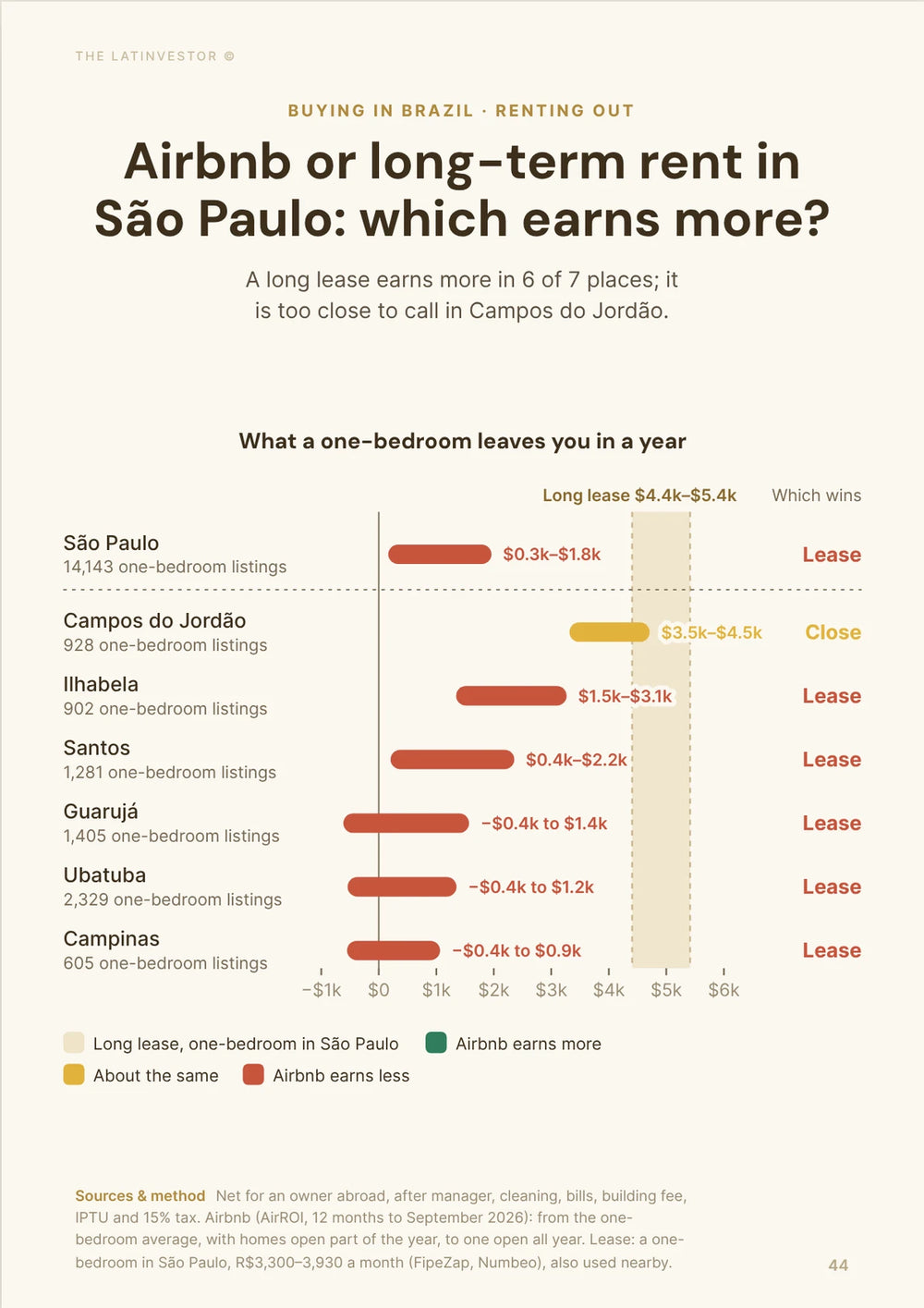
Often not, or not safely. Since May 2026, a residential condo can require two-thirds of the owners to approve Airbnb-style use, and many retrofit homes are HIS or HMP social-housing units that can’t be used for short stays at all.
On May 7, 2026, the STJ’s Second Section ruled that offering a unit on platforms like Airbnb in a residential building needs the approval of at least two-thirds of the owners. On September 17, 2026, it picked Tema 1.443 to decide, with binding effect, whether a plain “residential use” clause is enough to stop platform rentals. Until then, similar cases are on hold across Brazil.
The HIS and HMP point matters more for retrofits than for most new buildings: 75% of the city’s retrofit subsidy money is reserved for those categories, and municipal Decree 63.130/2024, as amended by Decree 64.244/2025, bars diverting those units to short-stay platforms.
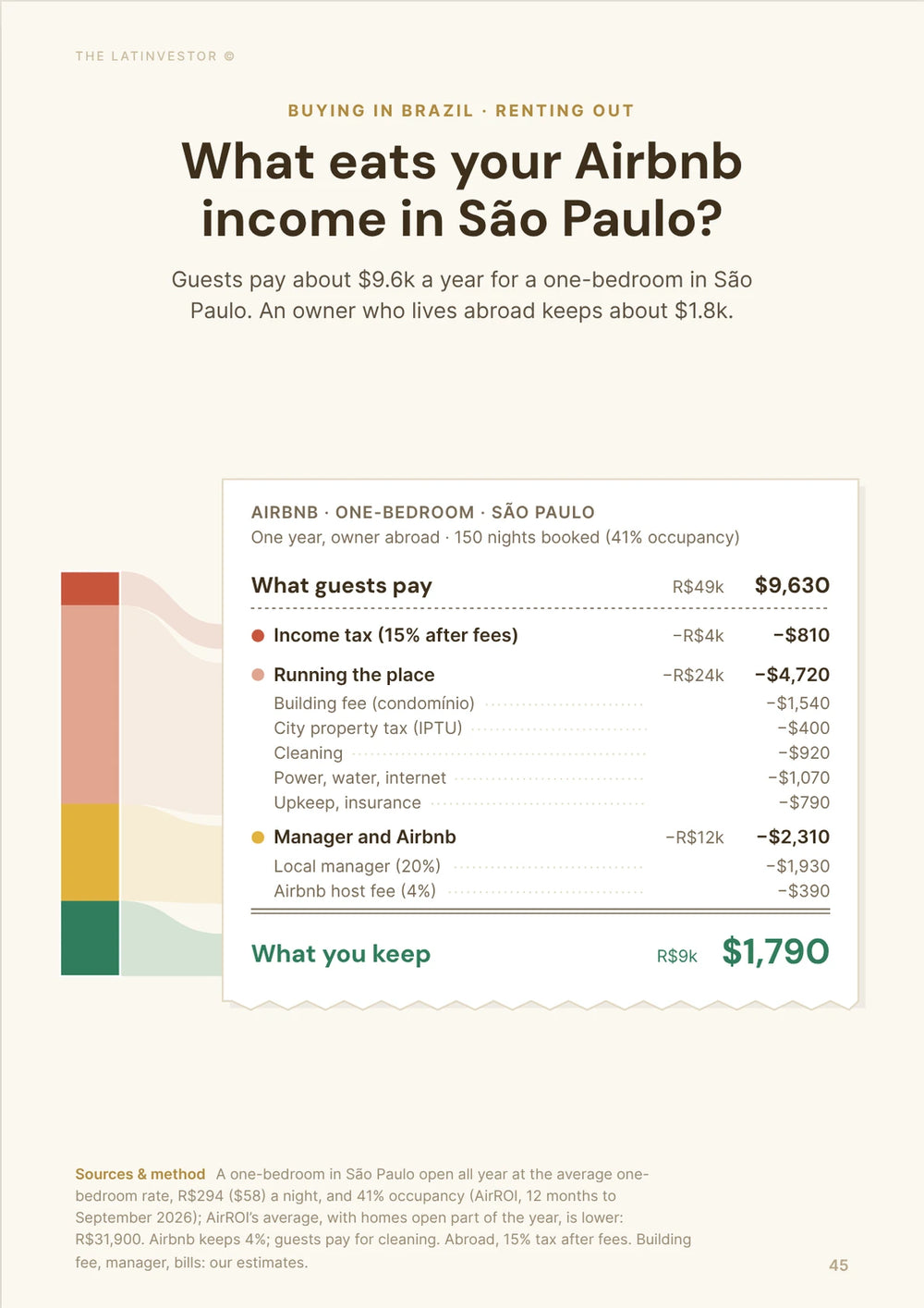
Competition is heavy anyway. AirROI counted 34,925 active Airbnb listings in São Paulo in the 12 months to September 2026, up 66% in a year, with average occupancy of 40.1%. What to do: check the unit’s registration (HIS, HMP or market rate), read the convention and the last assembly minutes, and get the síndico to confirm in writing whether short stays are allowed. If the deal only works on Airbnb, walk away.
Should we only buy completed retrofit apartments in São Paulo?
For most buyers, yes. A completed São Paulo retrofit removes several risks at once, and the resale history of this market is still too young to justify taking construction risk cheaply.
Once the work is finished, we can check the real daylight, water pressure, lift performance, acoustic isolation, corridors, street entrance and quality of the common areas. Those details are difficult to judge from renderings, especially in former office buildings with deep floorplates.
Completion also lets us see whether the developer actually delivered the technical scope promised before launch.
The track record is still short. The pipeline has grown to 50 buildings, but only 15 are finished, and few have been finished long enough to show how buyers value them five or ten years later.
That means we have better evidence on initial rentals than on mature resale performance. Current asking prices show what owners hope to receive. They do not tell us whether a 10-year-old retrofit will keep a premium over an ordinary 10-year-old condominium.
An off-plan retrofit can still make sense at a real discount. Without that discount, we would rather let somebody else absorb construction, licensing and execution risk.
Is República the best place to buy a São Paulo retrofit apartment?
República is probably the clearest place to make the São Paulo retrofit thesis work today, but the exact block matters more than the neighbourhood name.
República has the ingredients compact rental housing needs: metro access, buses, jobs, universities, restaurants, nightlife and easy movement into several central districts. That helps explain why so many conversion projects have clustered there.
Praça da República 497, Basílio177 and several other projects around República, Ipiranga and Araújo all tap into that same tenant base.
The problem is how quickly conditions change within the neighbourhood. One street can feel active into the evening while another becomes uncomfortable soon after offices close. Noise, poorly maintained storefronts, street disorder and the route from the metro can shift renter demand within a few hundred metres.
That is why postcode-level averages can mislead investors in the Centro. We would walk the actual route between the building, metro, supermarket and main commercial streets during the day and at night.
A good block in República can make an ordinary retrofit work. A weak block can undermine an architecturally impressive one.

Could all the new apartments push central São Paulo rents down?
Yes, it’s possible. The Centro can keep recovering while rent growth slows, because landlords compete with a much bigger pool of new apartments. Citywide asking rents rose 6.22% in the 12 months to September 2026 (FipeZAP).
As seen above, the eight central districts received 12,602 launches in 2025 and another 5,957 in the first half of 2026. That’s a lot of new stock in one part of the city.
Many of those units compete in the same size range. Small conventional apartments, HIS/HMP developments, purpose-built rental projects and retrofits all chase overlapping groups of tenants.
Rents therefore do not need to crash for an investor to be disappointed. More choice can simply make tenants negotiate harder, keep apartments vacant a little longer or force landlords to include furniture and other concessions.
The safest response is differentiation. A bright one-bedroom with an actual bedroom may hold pricing better than the fiftieth 24 m² studio in the same search radius.
We like the demand story in central São Paulo more than we like the idea that every small apartment there will enjoy strong rent growth.
Does the Selic cut to 13.75% change the math for retrofit buyers?
Not much yet. Rates are coming down, but slowly, and mediocre retrofits are still hard to defend against fixed income.
The Banco Central cut the Selic from 14% to 13.75% on September 16, 2026, down from 15% at the start of the easing cycle. The next Copom meeting is on November 3–4, and the market expects about 13.5% by the end of 2026 (Focus survey).
Say a retrofit grosses 6% on its price. After the 15% non-resident withholding it’s about 5%, and vacancy, maintenance and management take more. That’s far below a 13.75% risk-free rate.
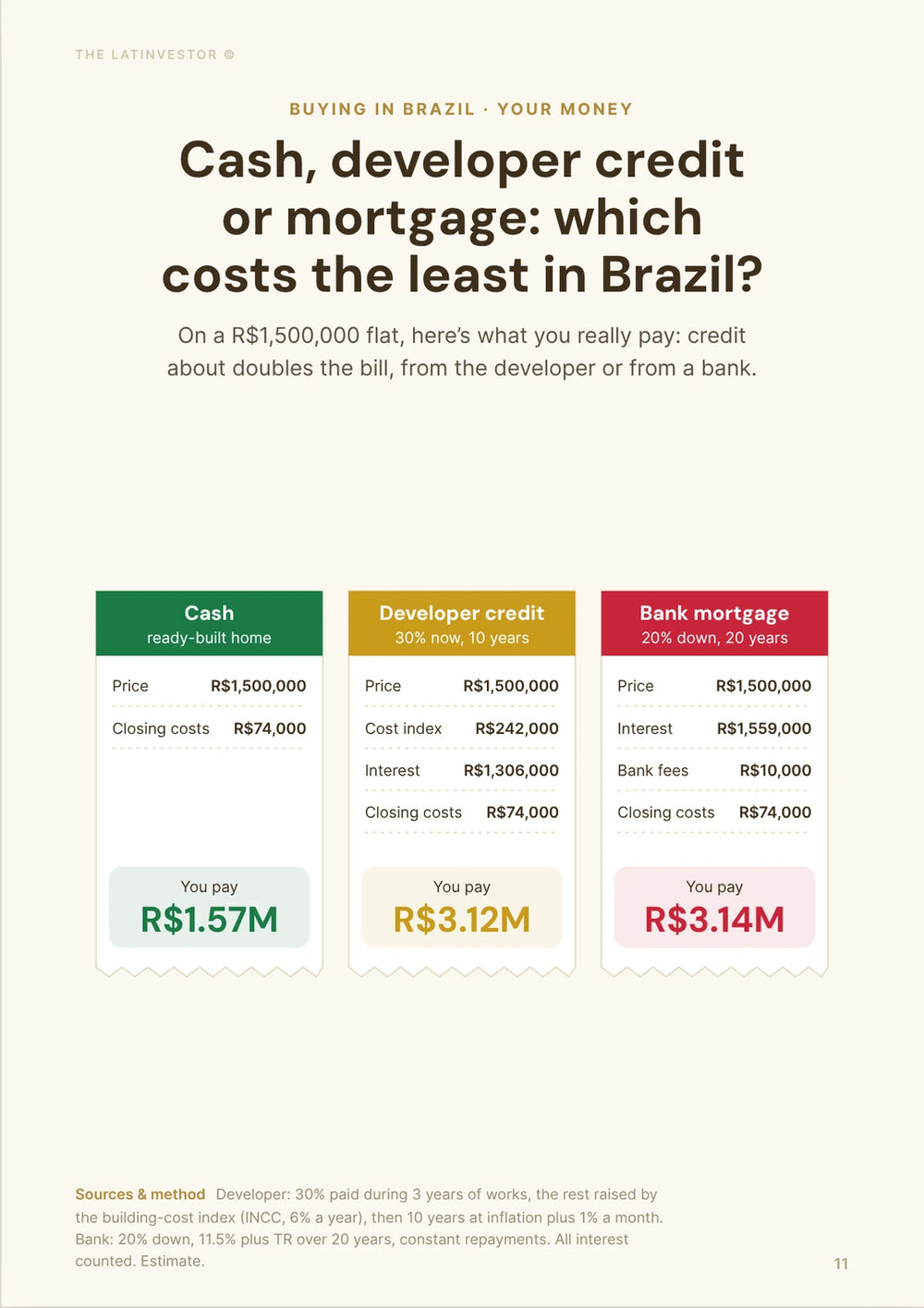
Property can still beat fixed income over a long hold, through inflation protection and appreciation, but those have to do real work. Mortgages don’t help much either: private banks charge about 11.8% plus TR on average, and they rarely lend to non-residents.
That’s why an expensive retrofit at 5% to 6% gross looks weak today unless the location or a real discount gives a convincing appreciation case.
If rates keep falling, they’ll support prices eventually. Treat that as a bonus, not something to pay for upfront.
What are the biggest red flags when buying a São Paulo retrofit apartment?
The worst São Paulo retrofit deals usually combine a high purchase price with an apartment that will be easy for future developers to copy.
A premium price per square metre is manageable when the building, street and apartment are genuinely exceptional. A tiny unit is manageable when it rents cheaply enough. High condominium fees can even work in a large, unusual apartment aimed at owner-occupiers.
The bad combinations look like this: R$14,000–R$16,000/m² for a generic 25 m² studio, weak light, R$700-plus condo costs, dozens of identical units in the building, more projects under construction nearby, and an HIS or HMP registration that rules out short stays.
We would become even more cautious if the technical retrofit scope is vague or the pitch depends heavily on words such as “revitalisation,” “historic centre” and “future appreciation.”
The Centro can improve considerably and such an apartment can still underperform. If buyers already paid several years of hoped-for regeneration in the purchase price, the neighbourhood has to outperform those expectations just to produce an ordinary return.
How can we tell whether a São Paulo retrofit apartment is actually a good deal?
A good São Paulo retrofit apartment should still look attractive after we use today's rent, today's condominium costs and conservative assumptions about future appreciation.
Start with price per square metre and compare it with nearby resales, finished new projects and other retrofits. Stay local: the citywide R$12,206/m² average says little about one block in República or Bela Vista.
Then we test the rent using comparable apartments people can actually choose today. Five to ten nearby units of similar size tell us far more than a developer's projected rental return.
The building deserves a separate review. We want documentation on plumbing, electrical work, lifts, waterproofing, structure, fire systems and the façade, plus the real condominium budget and reserve position.
Finally, we count substitutes. If 300 similar studios are already online and another 500 are coming within walking distance, we use a much more conservative rent and vacancy assumption.
The deal should survive that exercise without relying on rapid neighbourhood appreciation. When the numbers only work after assuming higher rents, lower interest rates and a much better Centro, we are buying a story.
| Test | What looks good | What looks weak | Importance |
|---|---|---|---|
| Purchase price | Discount or clearly justified premium | Large unexplained premium | Very high |
| Current rent | Supported by nearby comparables | Developer projection | Very high |
| Technical work | Detailed building-wide renewal | Vague retrofit description | Very high |
| Condominium | Sustainable real budget | High or suspiciously low estimate | High |
| Exact location | Good walk to metro and services | Weak immediate street | High |
| Nearby supply | Distinctive apartment | Hundreds of substitutes | High |
| Completion | Finished or nearly finished | Major execution exposure | Medium-high |
| Resale evidence | Actual transactions | Launch asking prices only | Medium |
So, are São Paulo retrofit apartments worth buying today?
Yes, selectively. The best retrofits are worth buying, but the category as a whole is already too expensive and too crowded to buy blindly.
The bullish case got stronger in 2026: 50 buildings in the pipeline, 5,238 planned homes, a fourth R$200 million subsidy call, and an eligible area more than doubled in June. This is no longer a handful of experiments.
Rental demand is real too. República’s median asking rent is about R$65.6/m², which works for small, well-located units bought at the right price.
Price is where we get picky. The Virgínia listing asks about R$13,011/m², above the city’s R$12,206/m² average, while the eight central districts got 12,602 launches in 2025 and 5,957 more in the first half of 2026. If you pay a premium now, you compete with a lot of new supply.
We would buy a completed, technically deep retrofit on a strong central block when the apartment has good light, sensible condominium costs and a purchase price that gives us a convincing rental return at today's rents.
We would avoid paying R$14,000–R$16,000/m² for an interchangeable micro-studio simply because an old façade has been restored and the Centro is improving.
Our verdict is clear: São Paulo retrofit apartments can be excellent buys, but most of the value now comes from choosing the right building at the right price. “Retrofit” itself deserves no premium.
Our methodology
This article estimates whether a retrofit apartment in central São Paulo is a good buy today, looking at the pipeline, public incentives, entry prices, rents, yields, building quality, condo costs, competing supply, short-stay rules and interest rates.
Pipeline and subsidy figures come from the Prefeitura de São Paulo, using its most recent update (August 2026: 50 buildings, 5,238 homes, 15 finished) and the June 2026 expansion of Requalifica Centro. Where programs overlap, we used the city’s consolidated count instead of adding them up.
Prices and rents come from FipeZAP (September 2026) for the city, A Corrida dos Bairros (October 2026) for República, and developer or operator listings for individual buildings. Yields are simple tests: we kept today’s República median rent constant and changed the purchase price, then applied the 15% withholding a non-resident pays on rent. New-home supply comes from Secovi-SP.
Rules come from official sources: the STJ’s May 2026 ruling and its September 2026 Tema 1.443 notice on short stays in condos, São Paulo’s municipal rules on HIS and HMP units, the Lei do Inquilinato for who pays condo fees and IPTU on a lease, and the Banco Central do Brasil for the Selic.
We checked these figures in October 2026. Conversions use about 5.05 reais per US dollar and 5.65 reais per euro.
Limits: FipeZAP, A Corrida dos Bairros and developer listings are asking prices, not sale prices; a single listing doesn’t represent a whole building; neighbourhood medians mix very different streets; and the retrofit market is too young to show long-term resale results.
Key sources used for this analysis include Prefeitura de São Paulo on the August 2026 subsidy call, Prefeitura de São Paulo on the June 2026 area expansion, the Prefeitura’s end-2025 program review, the February 2025 Requalifica Centro baseline, the expansion of Requalifica Centro, Decree 65.233/2026, the municipal subsidy transparency database, the Prefeitura on the Copan subsidy, Real 21’s Edifício Virgínia listing, Somauma’s Edifício Virgínia page, Portas on Basílio177 prices, Citas on Praça da República 497, Citas’s República rentals, FipeZAP sale report (September 2026), FipeZAP rental report (September 2026), A Corrida dos Bairros (República), Secovi-SP on central São Paulo launches, Secovi-SP’s August 2026 data via Portas, Portas on 2026 condo fees (Loft), the STJ’s May 2026 ruling, the STJ on Tema 1.443, AirROI São Paulo, the Banco Central’s September 2026 Selic decision, the Banco Central’s Selic history.