Summary
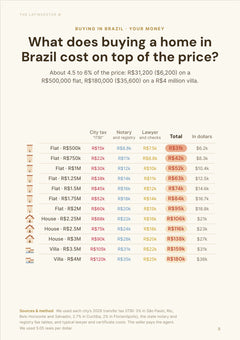
Buying property in São Paulo costs about 4% to 5% on top of the price for a normal cash purchase. On a R$1,000,000 apartment (about USD 198,000 or EUR 177,000), the ITBI, the deed and the registration come to roughly R$39,900, or 4%.
The ITBI transfer tax is the big line: 3% of the price in São Paulo, the same rate for foreigners and Brazilians. A qualifying SFH loan gets 0.5% on up to R$120,968 of the financed part, which saves at most about R$3,024.
The city's system taxes the higher of your price and its own reference value. The STJ (Tema 1.113) says your declared price comes first, so a R$1,000,000 deal assessed at R$1,200,000 means R$6,000 of extra tax you can contest.
Cartório fees come in bands, so small flats pay more in percentage terms: about 5.3% at R$300,000, 4.7% at R$500,000 and 4% at R$1,000,000. The 2026 deed costs R$5,427 between R$384,200 and R$768,400, and R$6,026 up to R$1,152,600.
Registration adds about R$2,700 to R$3,850 with state surcharges on a R$300,000 to R$1,000,000 flat. You are only the legal owner once the matrícula shows your name.
A bank loan can replace the deed, saving about R$5,400 on a R$500,000 flat, and a first home financed through the SFH gets 50% off some registry fees. Most foreign non-residents can't get a Brazilian loan, though, so they pay cash.
The agent's 6% to 8% commission (CRECI-SP reference) is usually the seller's. If a developer shifts it onto you, 6% on R$1,000,000 is R$60,000, more than all the taxes and cartório fees together. SATI "advisory" fees can be refused.
The costly surprises are unpaid IPTU and condo fees, which follow the property. Since October 2025 the STJ has confirmed that a registered buyer can be charged condo fees even before getting the keys.
IPTU changed in 2026: a new value map, increases capped at 10% a year for homes, and no IPTU on a single residence with an assessed value up to R$260,000.
You can sign the deed at a notary in another state. On a R$10 million deal it costs about R$22,300 in São Paulo against about R$6,000 in Goiás, but on a R$1,000,000 flat the saving is small.
Bottom line: keep 5% of the price aside for a cash purchase, ask the city which value it will tax before you sign, get the condo and IPTU debt statements, and make sure you know who pays the commission.


How much extra cash do you need to buy property in São Paulo today?
Budget about 4% to 5% above the price for a cash purchase. Cheaper apartments sit at the top of that range.
Three costs are mandatory: the city's ITBI, the public deed (escritura) at a notary, and registration at the property's Registro de Imóveis.
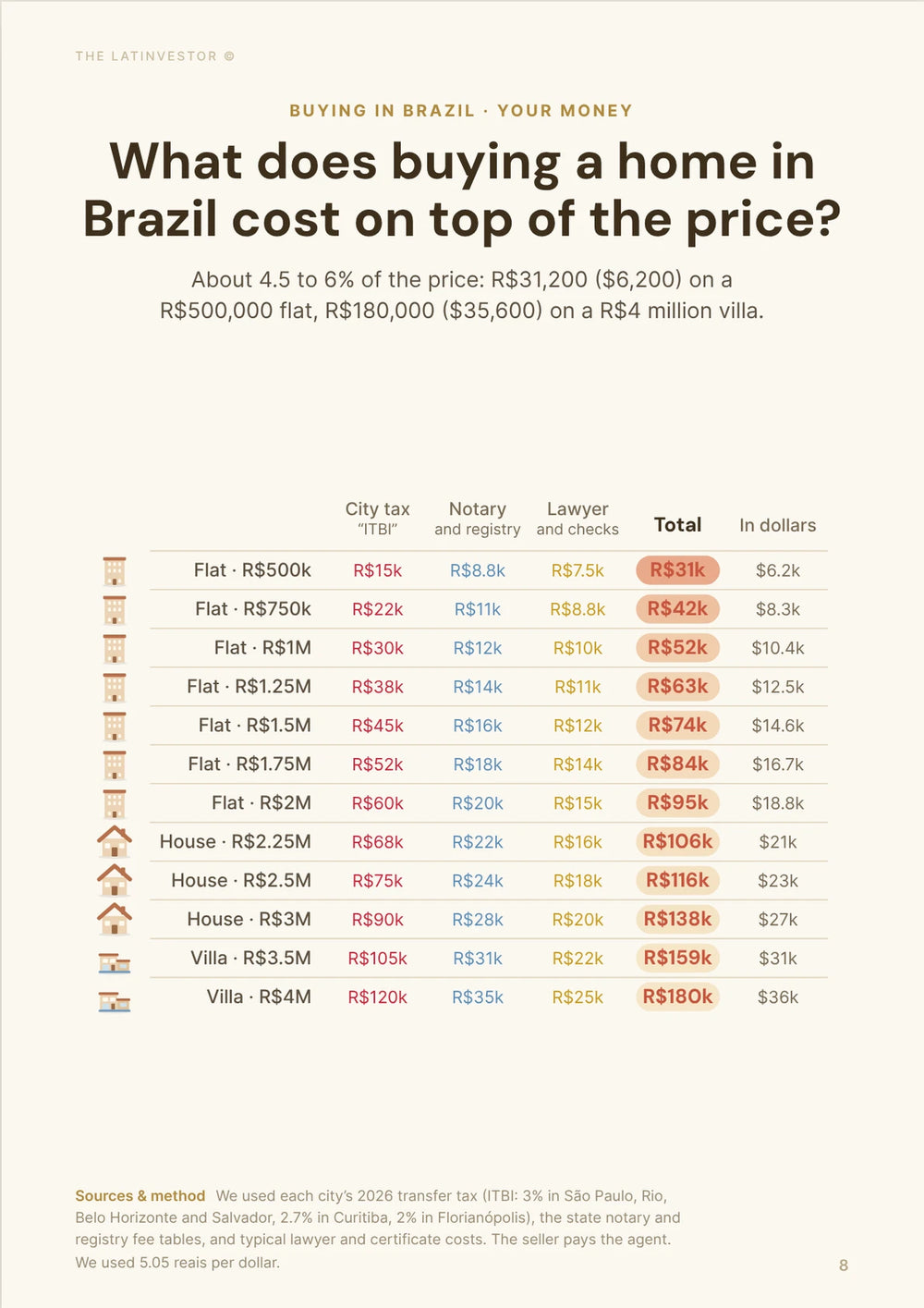
On a R$500,000 property, the 2026 deed and registration come to about R$8,712. Add R$15,000 of ITBI and you reach roughly R$23,700 (about USD 4,700), or 4.7% of the price.
On R$1,000,000, the same costs add up to roughly R$39,900 (about USD 7,900 or EUR 7,060), or 4%. Certificates and copies push that toward 4.4%. Cartório fees rise in bands, not in a straight line, so the percentage falls as the price rises.
These figures leave out the agent's commission and a lawyer. Depending on the contract, you may pay no commission at all, or one that more than doubles the bill.
| Property price | Normal ITBI | Deed + registration (2026) | Core extra cost | Extra cost as % of price |
|---|---|---|---|---|
| R$300,000 | R$9,000 | ~R$6,899 | ~R$15,899 | ~5.3% |
| R$500,000 | R$15,000 | ~R$8,712 | ~R$23,712 | ~4.7% |
| R$800,000 | R$24,000 | ~R$9,872 | ~R$33,872 | ~4.2% |
| R$1,000,000 | R$30,000 | ~R$9,872 | ~R$39,872 | ~4.0% |
How much is ITBI when buying property in São Paulo?
The ITBI is 3% of the price, and it is the biggest cost in almost every purchase. Foreigners pay the same rate as Brazilians.
It is a city tax, so rates you see for Rio, Campinas or another city don't apply inside São Paulo.
There is one reduced rate for some financed homes: 0.5% on the financed part of a qualifying SFH, social-housing or consórcio purchase. The property must be worth no more than R$725,808, and the 0.5% only applies to the first R$120,968 financed.
So the saving is small: at most about R$3,024. Take it if you qualify, but it doesn't make the tax go away. A non-resident paying cash won't qualify.
| Example on a R$500,000 qualifying purchase | Amount taxed | Rate | ITBI |
|---|---|---|---|
| First qualifying financed portion | R$120,968 | 0.5% | R$605 |
| Remaining value | R$379,032 | 3% | R$11,371 |
| Total with reduced calculation | R$500,000 | — | ~R$11,976 |
| Normal calculation | R$500,000 | 3% | R$15,000 |
| Approximate saving | — | — | ~R$3,024 |
Can São Paulo tax you on more than the price you actually paid?
It tries to. The city's ITBI system uses whichever is higher: your price or its own Valor Venal de Referência. But the courts say your declared price is the starting point.
In Tema 1.113 (2022), the STJ ruled that the price you declare is presumed to be the market value. The city can challenge it through a proper administrative procedure, but it can't replace it in advance with a reference value it set itself.
The 2026 tax reform law (LC 227/2026) now defines the tax base as the price the property would fetch in a normal cash sale, set by the city with technical criteria. That gives cities more room to argue for their own estimate, so expect this fight to continue.
What to do: before signing, generate the ITBI guide or ask the notary which value the city will use. If it is well above your price, a lawyer can contest it. On R$1,000,000 assessed at R$1,200,000, that is R$6,000 at stake. Don't under-declare the price to save ITBI: it is fraud, and it raises your capital gains tax when you sell.
| Agreed purchase price | Higher reference value | Tax on purchase price | Tax on reference value | Extra amount |
|---|---|---|---|---|
| R$700,000 | R$800,000 | R$21,000 | R$24,000 | R$3,000 |
| R$1,000,000 | R$1,200,000 | R$30,000 | R$36,000 | R$6,000 |
| R$1,500,000 | R$1,800,000 | R$45,000 | R$54,000 | R$9,000 |
Do first-time buyers get lower property fees in São Paulo?
Not automatically. A first purchase doesn't remove the ITBI. Only a first home financed through the SFH gets a break: 50% off some cartório fees.
São Paulo has no blanket ITBI exemption for first-time buyers. The reduced 0.5% rate above depends on the financing, not on it being your first home.
The federal discount comes from Article 290 of the Public Records Law: 50% off the emoluments linked to the first residential purchase financed through the Sistema Financeiro da Habitação.
So when a bank, broker or developer promises "50% off the paperwork", ask which fee they mean. It covers some registry fees, not every tax and charge.
How much does the property deed cost in São Paulo now?
The 2026 escritura costs R$5,427 for a price between R$384,200 and R$768,400, and R$6,026 between R$768,400 and R$1,152,600. These are fixed by the state table, not negotiable.
The table has been in force since 8 January 2026. Below R$384,200 the fee keeps falling in steps: R$4,176 for a price between R$268,940 and R$307,360, for example.
That weighs more on small purchases. R$5,427 is just over 1% of a R$500,000 apartment, but around R$1,000,000 the deed is only about 0.6%. Claims that the escritura "costs 1% of the price" are only right by chance.
Paying for the deed doesn't make you the owner. It still has to be registered at the Registro de Imóveis that covers the property.
Do you need a public deed if you finance a São Paulo property?
Usually not. A bank-financed purchase is signed as a private contract with the legal effect of a public deed, so you skip the escritura fee.
Federal Law 9.514/1997 allows this for loans secured by alienação fiduciária: the bank's contract does the deed's job.
On a R$500,000 purchase, that saves about R$5,400. The contract still has to be registered, and the loan brings costs of its own, covered below.
So don't take a cash-buyer checklist and just add loan fees on top: the paperwork itself changes when a bank is involved.
How much does property registration cost in São Paulo?
Registration costs roughly R$1,500 to R$3,850 for most ordinary prices, once state surcharges are added. As a share of the price, it shrinks fast.
Under the 2026 tables, we estimate about R$2,723 at R$300,000, R$3,284 at R$500,000 and R$3,846 between R$800,000 and R$1,000,000. The registrar's own fee is only part of that: Chaves na Mão put it at R$2,100 to R$2,600 for a property between R$300,000 and R$700,000 in April 2026, before surcharges.
Don't confuse it with the escritura. The deed records the sale; registration changes the matrícula so you become the registered owner.
Under the Civil Code, a signed contract, proof of payment and even a signed deed don't make you the owner. Only the registration does. Register quickly.
| Property value | Approx. registration charge | Registration as % of value | Approx. deed + registration |
|---|---|---|---|
| R$100,000 | ~R$1,489 | ~1.49% | ~R$3,754 |
| R$300,000 | ~R$2,723 | ~0.91% | ~R$6,899 |
| R$500,000 | ~R$3,284 | ~0.66% | ~R$8,712 |
| R$800,000 | ~R$3,846 | ~0.48% | ~R$9,872 |
| R$1,000,000 | ~R$3,846 | ~0.38% | ~R$9,872 |
Can you pay less by signing the deed outside São Paulo?
Yes, a little. You can sign the escritura at any notary in Brazil, even in another state. Only the registration has to happen at the registry where the property sits.
The gap between states is real. According to Bel Radar data published by Portas in July 2026, a R$10 million deed costs about R$22,300 in São Paulo, R$29,600 in Rio and about R$6,000 in Goiás, where the fee hits a ceiling. Deed prices rose 26.6% in two years, and tables are now updated twice a year.
What to do: on a R$1,000,000 flat, the most you save is a few thousand reais, so it is only worth it if signing elsewhere is easy for you (a power of attorney, a trip you were taking anyway). Above R$3 million to R$5 million, ask two or three notaries in different states for a quote.
Does financing make the upfront property fees more expensive?
Some costs go up and others go down, so compare the bank's full CET (Custo Efetivo Total), not the advertised rate.
Banco Central rules let lenders charge for the valuation of the property, limited to the cost of the service, plus up to R$25 a month for contract administration and up to R$100 to analyse an individual housing-insurance proposal.
Against that, you skip the separate deed, and a first home financed through the SFH can get 50% off eligible registry fees.
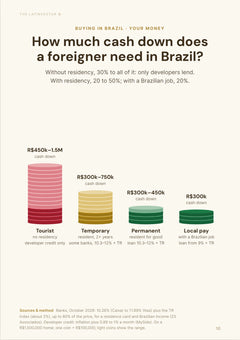
Credit is expensive right now: the Selic is at 13.75% since September 2026, and private banks averaged 11.8% a year plus TR on home loans. Banks also usually ask for Brazilian nationality or permanent residence, so most foreign non-residents buy in cash and pay the full deed.
Who pays the real-estate agent commission in São Paulo?
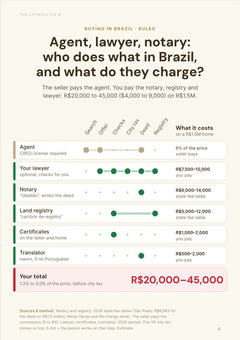
Usually the seller. But if a contract shifts it onto you, the commission becomes the biggest cost of the purchase.
CRECI-SP's reference table puts urban sale commissions at 6% to 8%. That is a reference, not a legal rate; the contract decides who pays.
Watch new developments. In Tema 938, the STJ confirmed that a developer can pass the brokerage fee to the buyer of a new unit if the buyer is told the total price beforehand and the commission is shown separately.
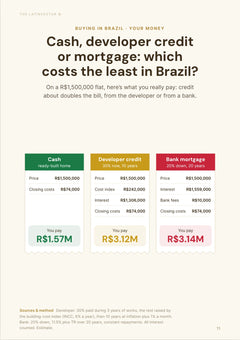
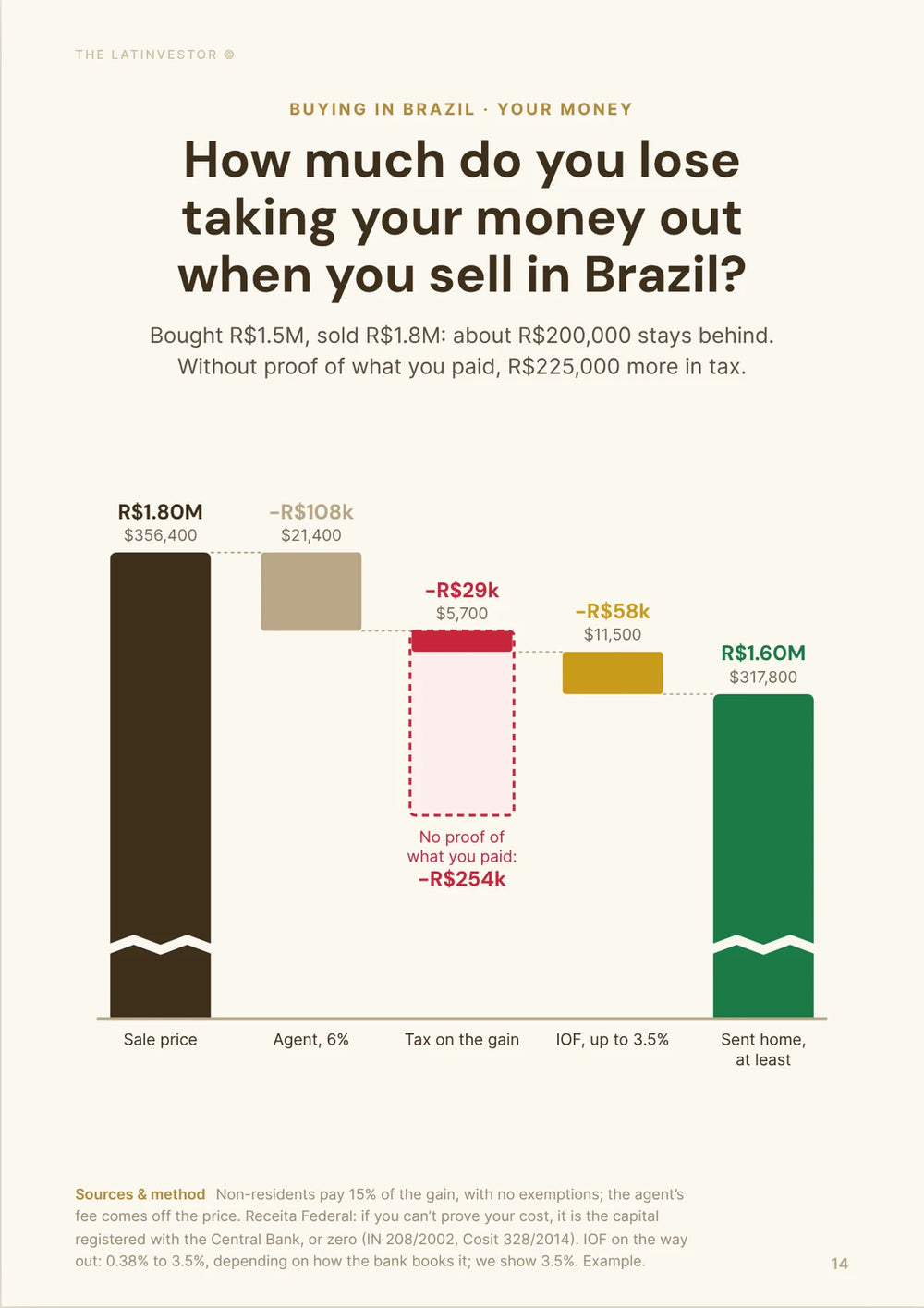
The numbers get big fast. 6% on a R$1,000,000 apartment is R$60,000 (about USD 11,900), about 50% more than the R$39,900 of taxes, deed and registration.
So before comparing two "R$1 million" apartments, check whether one price already includes the agent's fee while the other pushes it onto you.
| R$1 million purchase | Seller bears brokerage | Buyer pays 6% brokerage | Buyer pays 8% brokerage |
|---|---|---|---|
| Property price | R$1,000,000 | R$1,000,000 | R$1,000,000 |
| Core tax + cartório estimate | ~R$39,872 | ~R$39,872 | ~R$39,872 |
| Buyer-paid brokerage | R$0 | R$60,000 | R$80,000 |
| Total extra cost shown | ~R$39,872 | ~R$99,872 | ~R$119,872 |
| Extra cost as % of price | ~4.0% | ~10.0% | ~12.0% |
Can a São Paulo developer make you pay a SATI fee?
No. A developer can pass on a properly disclosed commission, but a compulsory SATI-style "advisory" fee tied to the sale was ruled abusive by the STJ.
The same Tema 938 ruling draws the line: disclosed brokerage is valid, but charges for Serviço de Assessoria Técnico-Imobiliária, or similar services imposed with the purchase contract, are not.
New launches in São Paulo often come with a sheet of extra amounts: "corretagem", "assessoria", "serviço técnico", admin fees. Ask what each line pays for, and refuse the advisory ones.
Do you need a lawyer and extra certificates when buying in São Paulo?
A lawyer isn't mandatory, but on anything other than a simple resale the fee is cheap insurance.
For a clean resale flat with one seller, the checks are routine: an updated matrícula, liens and restrictions, IPTU and condo debt statements, and the seller's lawsuit certificates.
A lawyer becomes worth it when the seller is a company, an estate, a divorcing couple or someone in litigation, or when the matrícula shows unusual entries. Foreign buyers also gain more, because powers of attorney and cross-border payments add work.
Since a September 2025 CNJ ruling, registries can no longer refuse to register a deed because tax certificates are missing. Nobody will block a risky deal for you, so run the checks yourself. Certificates cost hundreds of reais, not tens of thousands; lawyer fees are free to negotiate, so ask for a fixed quote.
Can old IPTU or condominium debt become your problem after buying?
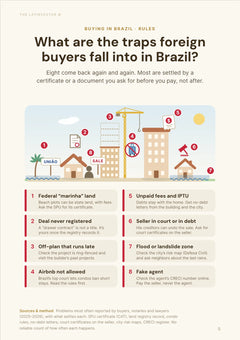
Yes. Unpaid IPTU and condo fees follow the property, so a cheap flat with debts can end up costing more than a clean one.
Under the National Tax Code, property tax debts go with the property when it changes hands. Check the city's IPTU position before closing; don't assume old bills stay with the seller.
Condo debt works the same way. In October 2025 the STJ confirmed that a buyer registered on the matrícula can be charged condo fees even before getting the keys. In May 2025 it also said the seller can still be liable for some charges after handing over possession, so the contract has to say clearly who pays what.
What to do: get a written condo debt statement from the building manager and an IPTU certificate from the city, and have the deed say the seller settles everything before signing. A hidden R$15,000 or R$30,000 of arrears costs far more than any certificate.
Will your IPTU bill jump after you buy in São Paulo?
Probably a little, every year. São Paulo adopted a new property value map (Planta Genérica de Valores) for 2026, and homes in areas that gained value can see increases of up to 10% a year.
The same 2026 rules raised the exemptions. A single residence with an assessed value (valor venal) up to R$260,000 pays no IPTU, and any property up to R$150,000 is exempt. Homes up to R$360,000 get a discount, and paying the year upfront gives 3% off.
The valor venal is usually well below the market price, so the bill is lower than the price suggests.
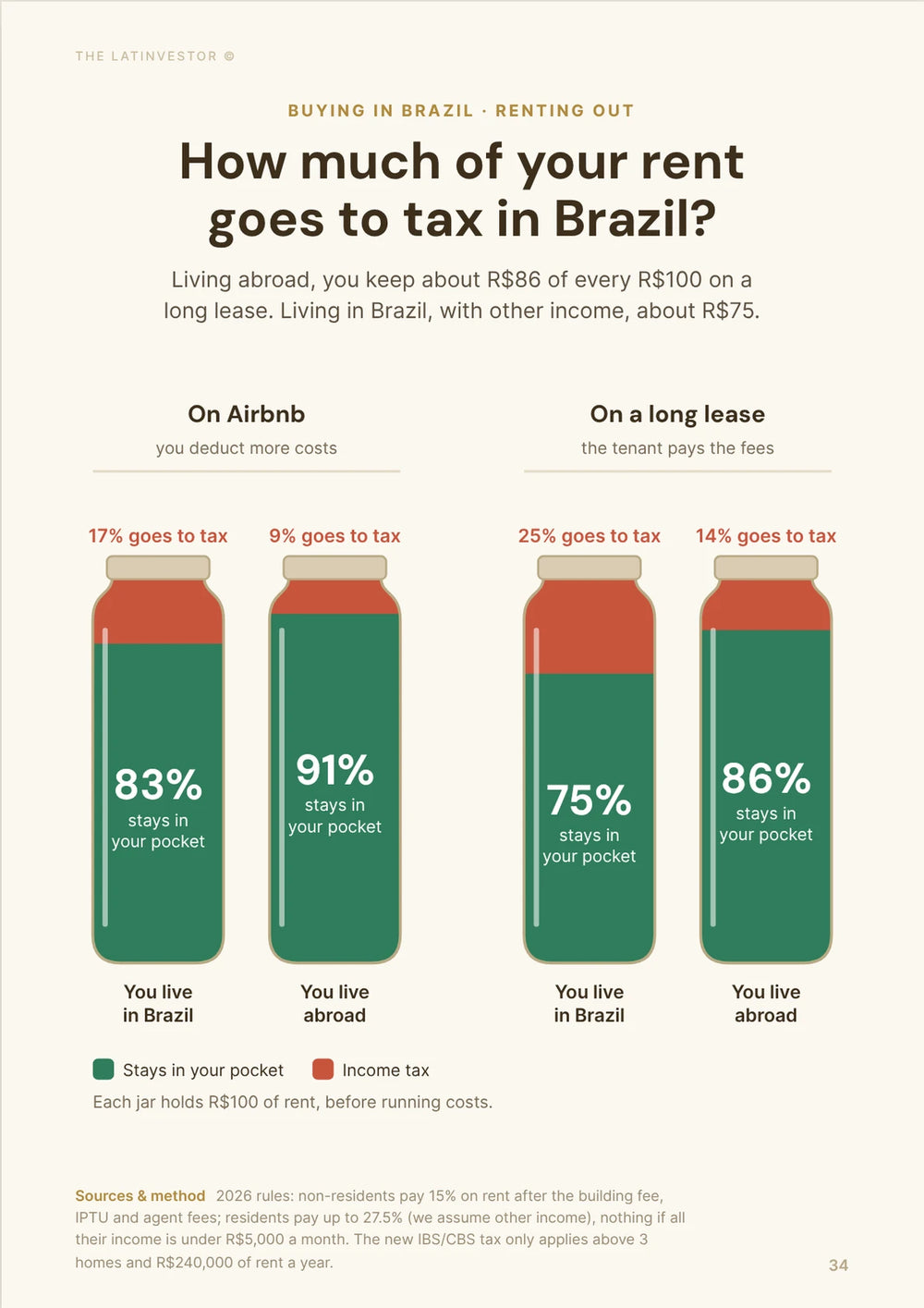
What to do: ask the seller for the 2026 IPTU carnê before signing, check the valor venal on it, and allow for a rise next year. If you rent the flat out long term, the tenant usually pays the IPTU and the ordinary condo fees.
Do foreign buyers pay higher property fees in São Paulo?
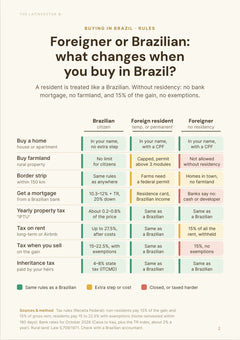
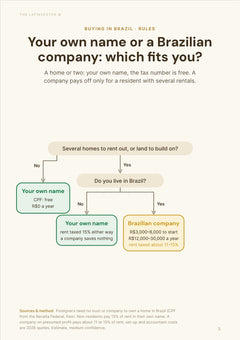
No. Foreigners pay the same 3% ITBI and the same cartório tables as Brazilians. There is no foreign-buyer surcharge.
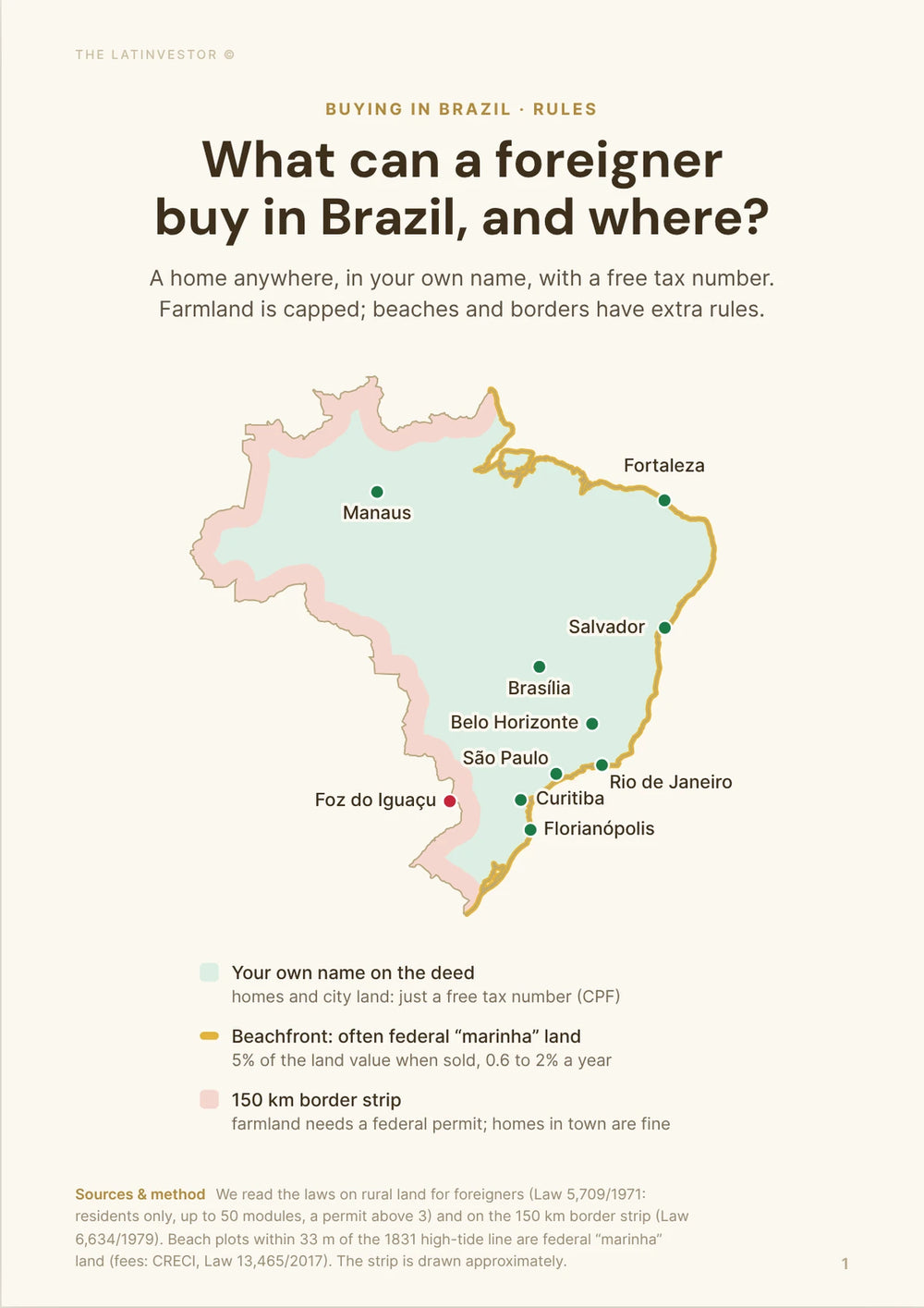
A non-resident can buy an urban apartment in their own name, with a CPF. If you live outside Brazil, you apply for it in person at a Brazilian consulate.
Your extra costs come from doing the deal from abroad: sworn translations, apostilled documents, a power of attorney and the bank transfer into Brazil. These are a few hundred to a few thousand reais, not a higher tax.
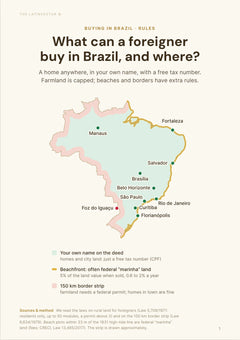
Restrictions on foreigners apply to rural land and the border strip, not to a flat in Pinheiros, Jardins or Vila Mariana.
Are property-buying fees worse on cheaper São Paulo apartments?
Yes. Cartório fees don't fall in line with the price, so cheap flats carry a higher percentage.
At R$300,000, the core cash-purchase costs come to about R$15,900 (about USD 3,150), or 5.3% of the price. At R$500,000, 4.7%. At R$1,000,000, about 4%.
That matters if you are looking at studios. With a 6% gross yield, buying costs above 5% eat almost a full year of rent, before furniture, vacancy, condo fees or the 15% tax withheld on a non-resident's rent.
It matters even more if you plan to sell in two or three years: add a 6% to 8% commission when you sell and the round trip costs 10% to 14% of the price.
What fees should you actually budget for when buying property in São Paulo?
For a simple cash purchase, keep 5% of the price aside. That covers the 3% ITBI, the deed and the registration, with some room for certificates.
On a R$500,000 flat, the core bill is about R$23,700. On R$1,000,000, about R$39,900. Financing, a first-home discount or a higher ITBI assessment can change that.
The big surprises are rarely the small fees. They are a commission pushed onto you, an ITBI value above your price, old IPTU or condo debt, or a loan whose extra charges you ignored.
Before signing: ask who pays the commission, which value the city will tax, and get the debt statements. Those three checks catch the costly surprises.
Our methodology
This article estimates what a buyer, especially a foreigner paying cash, pays on top of the price when buying an apartment in São Paulo city.
We added the 3% ITBI from the city's Finance Department to the 2026 deed fees from the CNB/SP table (in force since 8 January 2026) and to registration costs estimated from the TJSP extrajudicial fee tables, at several prices from R$100,000 to R$1,000,000. Deed fees are exact table values; registration figures are our estimates including state surcharges, cross-checked with the registrar fees reported by Chaves na Mão (April 2026).
Rules come from official texts: the STJ's Tema 1.113 on the ITBI base and Tema 938 on brokerage and SATI fees, its 2025 decisions on condo debt, Article 290 of the Public Records Law, Federal Law 9.514/1997, the Banco Central's rules on loan charges, the CNJ's 2025 ruling on certificates and the 2026 IPTU rules. The commission range is CRECI-SP's reference table; deed costs by state come from Bel Radar data published by Portas.
We checked these figures in October 2026. Conversions use about 5.05 reais per US dollar and 5.65 reais per euro.
Limits: registration costs depend on the registry and the exact act, lawyer and translation fees are free-market prices, and IPTU depends on the city's assessed value, not your price.
Key sources used for this analysis include Prefeitura de São Paulo (ITBI), Prefeitura de São Paulo (IPTU), Band on the 2026 IPTU rules, CNB/SP 2026 fee tables, TJSP fee tables, Chaves na Mão on registry fees, Portas on deed costs by state, Capital Aberto on LC 227/2026, STJ Tema 1.113, STJ Tema 938, STJ on condo fees (October 2025), CNJ on certificates, Public Records Law, Law 9.514/1997, Banco Central do Brasil, CRECI-SP and gov.br (CPF abroad).