
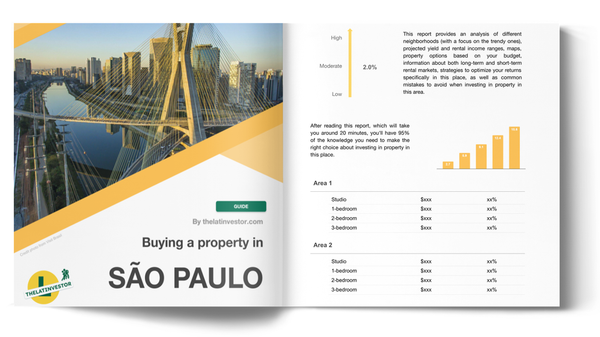
Get all the data you need about the real estate market in São Paulo
SUMMARY
Pinheiros is the best all-round part of São Paulo for property buyers today, but Vila Mariana is the stronger value choice, Vila Olímpia and Brooklin stand out for rent, and Moema or Jardins make more sense when capital preservation matters most.
The big lesson is that São Paulo no longer has one obvious “best neighborhood.” The areas with the highest rents, the strongest recent appreciation and the deepest resale demand are increasingly different places.
Pinheiros looks more attractive precisely because its sale market has cooled. Prices are roughly flat over 12 months while rents remain above R$100/m², giving buyers a better entry point into a neighborhood that still has exceptional transport, jobs and resale demand.
Vila Mariana is the clearest prime-value alternative. It costs materially less than Pinheiros, buyer interest remains very high, and recent price growth has slowed to almost zero without any obvious deterioration in the neighborhood itself.
Vila Olímpia and Brooklin are the strongest income markets in the data, but the neighborhood alone is not enough. Compact-unit construction is so heavy that a generic studio bought at a launch premium can still be a weak investment despite very high rent per square meter.
At the expensive end, Moema and Jardins currently make a cleaner defensive case than Itaim Bibi. Itaim remains excellent real estate, but its roughly R$20,000/m² entry price is harder to justify for a landlord when nearby areas can generate more rent.
Transport upgrades are creating a second group of opportunities. Perdizes and Pompéia now have an operating Line 6 connection, Campo Belo has gained Line 17 access, while Anália Franco and Vila Formosa still offer a more speculative version of the same story because their transport benefits are not yet fully mature.
Mooca and Tatuapé show why “cheaper” does not mean illiquid. Both attract substantial buyer interest and completed transactions while remaining far below southwest São Paulo on price per square meter.
Central São Paulo is becoming investable again, but this is where neighborhood averages become least useful. Bela Vista has a credible case; in the historic core, two buildings a few blocks apart can have completely different maintenance, security, occupancy and resale prospects.
The biggest trap across the city is buying a good neighborhood and assuming the apartment must therefore be good too. Condominium fees, flood exposure, building quality, oversupply and micro-location can easily overwhelm the advantage of the district name.
The strongest opportunities today are concentrated where rents have outrun purchase prices, established neighborhoods have just gained better transport, or deep buyer demand exists at a much lower entry price than in the fashionable southwest.
Recent property scams aimed at foreign buyers in São Paulo
Flats sold by owners already being sued elsewhere, and deposits taken against a matrícula nobody pulled. The cases that keep coming back, and how to check who and what you are dealing with.
Which parts of São Paulo are best for property buyers?
Why is choosing the best part of São Paulo harder than it looks?
The best part of São Paulo to buy property currently depends heavily on what we want from the purchase, because the neighborhoods producing the highest rents, the strongest price growth and the safest resale markets are no longer the same.
The latest numbers make that unusually clear. FipeZAP puts Itaim Bibi at about R$20,000 per square meter, making it the most expensive major neighborhood in its São Paulo sample, yet prices there have risen only 3.8% over the past year. Pinheiros costs around R$18,200/m² and has actually slipped 0.1%. Vila Mariana is almost flat at +0.2%.
Move a few kilometers and the picture changes. Jardins has risen 7.2%, Moema 5.1% and Perdizes 4.3%. On the rental side, QuintoAndar currently puts Vila Olímpia at R$116.50/m², Brooklin at R$109.30 and Pinheiros at R$105.40, all comfortably ahead of Itaim Bibi at R$88.90.
A São Paulo buyer is therefore choosing between different advantages. Paying more can buy scarcity and easier resale. Buying close to office districts can produce stronger rent. Moving east or north can halve the entry price. Buying around a new metro line can create appreciation potential while also exposing the buyer to competing construction.
| What the buyer wants | Areas we would look at first | Main attraction | Main weakness |
|---|---|---|---|
| Best overall balance | Pinheiros, Vila Mariana | Demand, transport, liquidity | Expensive |
| Strong rental income | Vila Olímpia, Brooklin, Campo Belo | Very high rents | Heavy compact-unit supply |
| Capital preservation | Jardins, Moema, Itaim Bibi | Scarce affluent locations | Lower yield relative to price |
| Infrastructure upside | Perdizes, Pompéia, Água Branca | Line 6 is now operating | New development supply |
| Better value | Mooca, Tatuapé | Much lower entry price | Less prime-location scarcity |
| Higher-risk upside | Bela Vista, selected Centro | Low basis + regeneration | Building and street selection matter enormously |
Is São Paulo property actually attractive to buyers right now?
São Paulo property looks more interesting today for rental investors than the headline sale-price numbers suggest, although Brazil's still-high interest rates mean an average apartment is far from an automatic investment winner.
Two large residential indexes currently tell essentially the same story from different angles. QuintoAndar's purchase index shows completed São Paulo transactions at roughly R$7,900/m², only 0.6% higher than a year earlier. Its rental index, which combines contracts and listings, has rents around R$75.20/m² and 9% higher over the same period.
FipeZAP uses a different methodology and therefore produces different absolute prices, but the broad message survives. Its São Paulo sale index is around R$12,000/m², while its latest rental data put rents around R$65/m². Rental growth has generally been running ahead of sale-price growth.
That has improved the landlord side of the equation. FipeZAP has recently estimated gross residential rental yields in São Paulo at roughly 6% to 6.5% a year, with smaller apartments tending to produce more.
There is an obvious rival for investors' money. Brazil's Selic rate has now been cut four times in a row, but it still stands at 14%. A landlord earning a 6% gross property yield still has condominium charges, IPTU, vacancies, repairs, transaction costs and possibly financing on top.
The attractive opportunities are concentrated in neighborhoods where rent is unusually strong relative to the acquisition price or where a real improvement in accessibility can support future demand.
Get fresh and reliable data on the São Paulo property market
A Faria Lima address is being charged for streets that are a fifteen minute walk from it, and no parking space comes with it. Where prices sit furthest from what places earn and resell for.
Is Pinheiros still the best all-round neighborhood to buy in São Paulo?
Pinheiros is still our best all-round São Paulo neighborhood for property buyers, especially now that purchase prices have stopped running away from buyers while rents remain among the highest in the city.
The latest FipeZAP neighborhood reading puts Pinheiros at approximately R$18,219/m². That is expensive: only Itaim Bibi costs more among the major neighborhoods in that sample. Yet Pinheiros prices are now down 0.1% over 12 months after rising 3.9% over the comparable period a year earlier.
The rental market looks much healthier. QuintoAndar currently puts Pinheiros rent around R$105.40/m², fourth-highest among the neighborhoods in its latest ranking. Only Vila Olímpia, Jardim Europa and Brooklin are higher.
We like that combination more today than we would have liked Pinheiros while both prices and rents were surging at the same time. A buyer is still paying a premium, but at least the sale market has cooled while tenant demand remains expensive.
Pinheiros also has a useful mix that few São Paulo neighborhoods can reproduce. Line 4 gives direct metro access toward Paulista and the center. Faria Lima and the wider Pinheiros business district supply high-income tenants. The neighborhood has restaurants, nightlife, hospitals and retail, while Line 9 adds another transport axis along the river.
The main place we would hesitate is the new-build studio market. Developers know exactly why investors like Pinheiros, and that popularity has produced a huge amount of small-unit construction. For us, a good two-bedroom apartment on a genuinely walkable street is currently a more interesting Pinheiros asset than the fifteenth 30 m² investor studio in the same development cluster.
Has Vila Mariana become a better value buy than Pinheiros?
Vila Mariana currently gives buyers more property for their money than Pinheiros, and the latest price slowdown makes it one of the most interesting established neighborhoods in São Paulo.
FipeZAP puts Vila Mariana around R$14,806/m², about 19% below Pinheiros. The more interesting number is the change: Vila Mariana prices are up only 0.2% over the past year after rising 7.6% over the previous comparable period.
That is one of the sharpest slowdowns among São Paulo's major neighborhoods.
The area itself has hardly become less useful. Vila Mariana has several metro stations, fast access to Paulista, hospitals, universities including ESPM and Unifesp, schools, restaurants and proximity to Ibirapuera. QuintoAndar's latest buyer-search data also place Vila Mariana at the top of the city's most searched neighborhoods for purchases.
Current listings on QuintoAndar average roughly R$14,100/m², remarkably close to the FipeZAP neighborhood figure despite the two datasets measuring the market differently.
For someone buying a home that might later become a rental, we would now seriously consider Vila Mariana before Pinheiros. The buyer gives up some access to Faria Lima's extreme rental pricing but also saves roughly R$3,400 per square meter based on the latest FipeZAP figures.
On a 70 m² apartment, that gap is around R$240,000.
| Current comparison | Vila Mariana | Pinheiros |
|---|---|---|
| FipeZAP sale price | ~R$14,806/m² | ~R$18,219/m² |
| Latest annual sale-price change | +0.2% | -0.1% |
| Approximate premium for Pinheiros | — | +23% |
| Buyer demand | Very high | Very high |
| Metro access | Excellent | Excellent |
| Best buyer | Value-conscious owner/investor | Buyer prioritizing west-side location |
Everything a foreign buyer should know before buying in São Paulo
The pack also covers what the condomínio and the IPTU take every month, and which certificates have to be clean before you pay anything.
Are Vila Olímpia and Brooklin the best parts of São Paulo for rental investors?
Vila Olímpia and Brooklin are currently two of São Paulo's strongest rental markets, but we would be much more selective about the apartment than about the neighborhood.
The rent numbers are hard to ignore. QuintoAndar's latest index puts Vila Olímpia at R$116.50/m², the highest neighborhood figure in São Paulo. Brooklin sits at R$109.30. Pinheiros follows at R$105.40, while Moema is at R$90.30 and Itaim Bibi at R$88.90.
The geography explains a lot. Vila Olímpia sits beside the Faria Lima and JK employment corridor. Brooklin connects into the Berrini and Chucri Zaidan office clusters. In these neighborhoods, living a few minutes from work can remove a long cross-city commute, and tenants pay heavily for that.
Brooklin also has a fresh transport advantage. Line 17-Gold is now operating on a transitional schedule through the corridor, serving Morumbi, Chucri Zaidan, Vila Cordeiro, Campo Belo, Brooklin Paulista and Congonhas Airport.
The risk comes from construction. According to the latest Secovi-SP market survey, apartments between 30 and 45 m² accounted for 70% of all São Paulo residential launches in one recent month. They also made up 64% of sales.
We would happily own a good small apartment in Vila Olímpia or Brooklin at the right price. We would be much less excited about paying a large launch premium for a generic studio when several nearby towers are filling with nearly identical rental units.
| Rental indicator | Vila Olímpia | Brooklin | Pinheiros | Itaim Bibi |
|---|---|---|---|---|
| Current QuintoAndar rent | R$116.50/m² | R$109.30/m² | R$105.40/m² | R$88.90/m² |
| Office demand | Extremely strong | Extremely strong | Extremely strong | Extremely strong |
| Rail access | Good | Improving | Excellent | Less direct internally |
| New compact supply | High | High | High | Moderate/high |
| Our landlord view | Excellent selectively | Excellent selectively | Excellent | Good, but expensive |
Are Moema, Jardins and Itaim Bibi still worth their huge property prices?
Moema and Jardins still justify much of their premium today, while Itaim Bibi looks harder to defend for a pure investor unless the individual property is exceptional.
The newest FipeZAP figures put Moema at about R$16,423/m², Jardins at R$17,945/m² and Itaim Bibi at R$20,039/m².
Their recent price paths are very different. Moema has risen 5.1% over 12 months, up from a 3.1% pace previously. Jardins has climbed 7.2% and is still showing strong momentum. Itaim has slowed to 3.8% from 8.9%.
Rental pricing makes the gap more interesting. QuintoAndar currently puts Moema around R$90.30/m², Jardim América around R$98.50/m² and Itaim Bibi around R$88.90/m². Nearby Vila Olímpia gets substantially more rent per square meter despite generally requiring less money to buy.
Moema works well as an all-weather ownership market. Line 5-Lilac already serves the neighborhood, Ibirapuera is nearby, Congonhas is close, and schools, restaurants, shops and larger family apartments create demand from owner-occupiers as well as tenants.
Jardins is currently the strongest expensive option in the data because its scarcity is being matched by real price appreciation.
Itaim remains excellent real estate, but at roughly R$20,000/m² the buyer is paying heavily for Faria Lima access, prestige and long-term scarcity rather than rental yield.
For capital preservation, we would currently put Jardins and Moema ahead of Itaim. For income, we would look elsewhere.
The bairros and projects in São Paulo that are most overpriced
A Faria Lima address is being charged for streets that are a fifteen minute walk from it, and no parking space comes with it. Where prices sit furthest from what places earn and resell for.
Has Line 6 made Perdizes and Pompéia much better places to buy?
Yes, Perdizes and Pompéia have become more interesting property markets now that Line 6-Orange is actually carrying passengers rather than existing only as a future transport promise.
The first operational stretch currently runs through João Paulo I, Freguesia do Ó, Santa Marina, Água Branca, Sesc-Pompéia and Perdizes. Service is still in an assisted phase, while the full line is being completed toward Brasilândia on one side and São Joaquim on the other.
When finished, Line 6 will have 15 stations across roughly 15 kilometers. The state expects the complete journey that previously took around 90 minutes by bus to fall to roughly 23 minutes.
Perdizes was hardly an inaccessible neighborhood before, but rail connectivity was an obvious weakness relative to Pinheiros, Vila Mariana or Moema. That weakness is disappearing.
Property prices have held up as well. FipeZAP currently puts Perdizes at about R$13,357/m², up 4.3% over 12 months. QuintoAndar's latest rental data are even more striking: Perdizes rent per square meter has jumped about 26% in a year.
We would resist extrapolating that 26% increase. Neighborhood rental rankings move around a lot, and one strong year can easily exaggerate the long-term change.
The broader setup is still attractive. A desirable residential neighborhood has received a major transport upgrade while costing roughly R$4,900/m² less than Pinheiros.
| Line 6 area | What has changed | Property case now | Main risk |
|---|---|---|---|
| Perdizes | Direct metro access | Strongest established buy | Prices already reflect part of the upgrade |
| Pompéia | New Sesc-Pompéia station | Strong residential + rental case | New supply |
| Água Branca | Major transport interchange | Bigger redevelopment upside | Heavy development pipeline |
| Freguesia do Ó | New metro access | Lower-cost infrastructure bet | Less proven prime-market demand |
Is Campo Belo getting more attractive now that Line 17 is open?
Campo Belo has improved materially as a São Paulo property investment because Line 17 has finally reduced one of the neighborhood's biggest weaknesses: dependence on road transport.
The new line currently links Campo Belo with Brooklin Paulista, Congonhas Airport, Chucri Zaidan and Morumbi, with an interchange to Line 5-Lilac at Campo Belo. It is still running on a transitional schedule, so the transport network has not reached its mature form yet.
The rental market already looks expensive. QuintoAndar currently puts Campo Belo at around R$95.40/m², ahead of Moema and Itaim Bibi in the same index.
Actual transaction data also show a reasonably deep market. A recent analysis of São Paulo's municipal ITBI records, covering six months and more than 32,000 transactions, counted 616 sales in Campo Belo. Pinheiros recorded 676 and Perdizes 793 over the same period.
Campo Belo interests us particularly for buyers who want the south-western employment corridor without paying Itaim or Vila Olímpia prices. We would favor apartments within practical walking distance of Line 5 or Line 17 rather than properties whose brokers loosely describe them as "near the metro."
What developers promise off plan that you should never pay for
If you walk away from an off plan purchase here the law lets the developer keep a large share of what you paid. What to check about the project before that matters, starting with how it is ring fenced.
Are Mooca and Tatuapé actually better value than western São Paulo?
Mooca and Tatuapé are currently two of São Paulo's best value neighborhoods for buyers who want an established resale market without paying R$15,000 to R$20,000 per square meter.
QuintoAndar's buyer-search data make the case unusually well. Vila Mariana ranks first among people searching to buy, but Mooca comes second and Tatuapé third. Both sit ahead of Pinheiros.
Recent ITBI data tell us this demand goes beyond browsing property portals. Tatuapé recorded 697 completed transactions over a six-month sample, slightly more than Pinheiros at 676. Perdizes, another very liquid market, had 793.
Tatuapé can therefore trade for less than half the price per square meter of Itaim while still producing hundreds of actual transactions.
Mooca offers a similar argument at an even lower entry point. Both neighborhoods have established retail, schools, restaurants, transit and large populations of people who specifically want to remain in the east side.
| Recent indicator | Mooca | Tatuapé | Pinheiros | Perdizes |
|---|---|---|---|---|
| Indicative purchase price | ~R$7,900/m² | ~R$8,800/m² | ~R$18,200/m² | ~R$13,400/m² |
| Buyer-search interest | Very high | Very high | High | High |
| Entry cost | Low/moderate | Moderate | Very high | High |
| Resale depth | Strong | Strong | Very strong | Very strong |
| Our view | Strong value | Strong value | Best overall | Strong infrastructure play |
Where are the best cheaper transport bets in São Paulo?
Butantã, Vila Sônia, Anália Franco and Vila Formosa are the most interesting cheaper transport-driven bets we see now, although the west-side pair is much further along than the east-side pair.
Line 4-Yellow changed Butantã and Vila Sônia permanently. A renter there can reach Pinheiros, Faria Lima, Paulista and the center on one high-capacity rail line. USP adds another large and fairly durable source of housing demand around Butantã.
Recent rental growth has been strong as well. QuintoAndar's latest neighborhood data put Vila Sônia among São Paulo's fastest-rising rental areas, with an increase of about 22% over 12 months. Butantã had appeared near the top of previous editions of the same ranking.
Butantã is also huge. A property genuinely walkable to a station or USP serves a very different tenant market from an apartment several kilometers away that happens to share the same district name.
Anália Franco and Vila Formosa are earlier-stage versions of the same transport idea.
Line 2-Green is being extended another 8.4 kilometers from Vila Prudente toward Penha, adding eight stations: Orfanato, Santa Clara, Anália Franco, Vila Formosa, Santa Isabel, Guilherme Giorgi, Aricanduva and Penha. The Metrô expects the extension to add roughly 320,000 weekday passengers and benefit around 1.2 million people.
For Anália Franco, the line adds direct metro access to an already affluent neighborhood with shopping, hospitals, schools and large apartments. Vila Formosa starts from a lower price base, so improved transport could have a larger percentage effect.
The difference is timing. Butantã and Vila Sônia already have the rail line. Anália Franco and Vila Formosa still depend partly on future completion.
We would therefore treat the west-side pair as established transport value and the east-side pair as a higher-risk appreciation bet.
How to spot hidden problems when you visit a property in São Paulo
Whether the street floods in February matters as much as the finishes, and the building's monthly charge tells you how it has been run. What to look at, and what each thing is telling you.
Is central São Paulo finally a serious place to buy property again?
Parts of central São Paulo are genuinely investable again, especially Bela Vista, but buying the Centro purely because it looks cheap still carries much more risk than buying in an established residential neighborhood.
The policy push has become more serious lately. São Paulo expanded the Requalifica Centro program so qualifying redevelopment can now extend across Sé, República, Brás, Bom Retiro and Pari, along with parts of Bela Vista, Santa Cecília and Liberdade.
The territory eligible for some retrofit incentives has expanded from roughly 1,170 hectares to 2,780 hectares. Separate municipal subsidies can cover up to 25% of qualifying retrofit costs for certain affordable-housing projects.
Rental data have also moved sharply. QuintoAndar's latest index shows rents up roughly 29% in Campos Elíseos and 26% in Centro over 12 months. Those increases tell us people are willing to pay more for some central locations, but they do not prove that every downtown block has been rehabilitated.
Bela Vista is where we currently find the easiest version of the central-city argument. FipeZAP puts it around R$12,515/m², with prices up 2.8% over the past year. It sits beside Paulista, major hospitals, universities and established nightlife, and the future completion of Line 6 will improve rail access further.
Santa Cecília and Liberdade can also work with careful selection.
The historic core requires much more work. Two buildings 300 meters apart can have completely different occupancy, security, maintenance and street conditions. Condominium debt and the physical condition of an old tower can easily destroy the apparent bargain in the purchase price.
Are São Paulo studios near the metro becoming too crowded an investment?
Yes, São Paulo's studio market is becoming crowded enough that we would stop treating "small apartment near metro" as an investment strategy on its own.
The latest Secovi-SP numbers are remarkable. Apartments between 30 and 45 m² accounted for 8,777 launches in a single recent month, equivalent to 70% of all residential units launched across the city. They also generated 5,985 sales, or 64% of total transactions in the primary market that month.
The pattern was already visible immediately before that. One month earlier, the same 30–45 m² category accounted for 52% of launches, 64% of sales and 51% of all available new-build inventory. Two-bedroom properties represented 65% of sales.
So the latest 70% launch share was not an isolated freak month. Developers have been feeding enormous numbers of compact apartments into São Paulo.
Tenant demand does support them. QuintoAndar currently records an average rent of roughly R$91/m² for one-bedroom apartments, well above the approximately R$67/m² paid for two- and three-bedroom homes.
We still need to separate high rent per square meter from a good investment. A studio bought at R$18,000/m² and rented at R$100/m² can generate weaker economics than an older two-bedroom bought at R$11,000/m² and rented at R$70/m².
Resale competition matters too. When an owner eventually wants to sell, dozens of virtually identical apartments inside the building can be on the market at the same time.
| Apartment type | Rental advantage | New supply | Resale audience | Our current view |
|---|---|---|---|---|
| Studio / very small 1BR | Highest rent per m² | Extremely high | Singles + investors | Buy very selectively |
| Larger 1BR | Strong | High | Singles + couples | Better |
| 2BR | Good | Broad but less extreme | Very wide | Best balance |
| 3BR | Lower rent per m² | Less new supply | Families + owners | Strong in residential areas |
| Large luxury | Lower yield | Scarcer | Wealthier buyers | Capital-preservation product |
The unwritten rules of negotiating and making an offer in São Paulo
Asking prices expect a negotiation, and a flat that has been listed through two agencies is a different conversation. How far below asking people go, and what to put in writing when you do.
What can turn a great São Paulo neighborhood into a bad property purchase?
Even in São Paulo's best neighborhoods, an expensive condominium, poor micro-location or oversupplied building can wipe out the advantage of choosing the right district.
Condominium charges deserve more attention than many buyers give them. A recent Data Lello study put the average São Paulo condominium bill at roughly R$1,085 a month, with the south zone averaging around R$1,364.
Imagine two apartments each renting for R$5,000. If one comes with a R$700 condominium and the other with R$1,700, their economics are obviously nowhere near equal, even when the headline rent looks identical.
Flood exposure can be just as local. Parts of the west and south near the Pinheiros river system repeatedly enter flood alerts during intense storms. That does not make Brooklin, Vila Olímpia or Pinheiros poor neighborhoods. A particular underground garage, access road or low-lying block may still deserve a serious discount.
Supply is another building-level problem. São Paulo currently has close to 90,000 new units available for sale in projects launched during the preceding three years, according to the latest Secovi-SP market data. Roughly half of the available stock in the preceding monthly survey consisted of 30–45 m² apartments.
Zoning adds another layer for buyers making redevelopment bets. São Paulo's zoning rules have gone through repeated legislative changes and court disputes lately, particularly around development corridors. Someone buying a normal completed apartment can mostly ignore that fight. Someone paying for future construction rights cannot.
So which parts of São Paulo are best for property buyers today?
Pinheiros is still the best all-round part of São Paulo to buy property today, while Vila Mariana currently offers the best value among prime established neighborhoods and Vila Olímpia or Brooklin make more sense for buyers focused on rent.
Pinheiros wins because very few neighborhoods score well on almost everything. Rents exceed R$100/m², Line 4 and Line 9 provide excellent connectivity, Faria Lima creates a large high-income tenant base, and resale demand comes from owner-occupiers as well as investors. The latest 0.1% fall in annual FipeZAP prices actually makes us more comfortable buying there than when prices were rising rapidly.
Vila Mariana comes next and could easily be the better purchase for many buyers. At roughly R$14,800/m², it costs around 19% less than Pinheiros, while buyer searches remain exceptionally strong. Sale-price growth has slowed to almost zero, giving buyers a much calmer entry point into one of São Paulo's most established residential markets.
For rental investors, Vila Olímpia and Brooklin move ahead. Their current QuintoAndar rents of roughly R$116.50 and R$109.30 per square meter are among the highest in the city. We would just avoid assuming every new studio deserves to trade at a premium.
Moema and Jardins are stronger choices when protecting capital matters more than maximizing income. Both are still appreciating faster than many other expensive neighborhoods, and both have unusually durable owner-occupier demand.
Perdizes and Pompéia are our favorite major infrastructure play now that Line 6 is operating through both areas. Campo Belo has also improved with Line 17.
Mooca and Tatuapé deserve a place near the top for buyers with smaller budgets because their prices remain far below the southwest while transaction and search data show very real demand.
Butantã and Vila Sônia offer the cheaper west-side option. Anália Franco and Vila Formosa have more future transport upside but require greater patience. Bela Vista is our preferred higher-risk central-city bet.
There is no single neighborhood that wins every version of the São Paulo property question. But if we had to narrow the city down today, our shortlist would look like this:
| Rank | Area | Best for | Why it ranks highly now | Main concern |
|---|---|---|---|---|
| 1 | Pinheiros | Best overall | Exceptional rent, jobs, transport and resale demand | High purchase price |
| 2 | Vila Mariana | Best prime value | Prices almost flat while buyer demand stays very strong | Less rent than the Faria Lima corridor |
| 3 | Vila Olímpia / Brooklin | Rental investors | Highest rents in São Paulo | Studio oversupply |
| 4 | Moema | Defensive long-term buyers | Price growth, family demand, strong location | Premium entry price |
| 5 | Perdizes / Pompéia | Infrastructure upside | Line 6 is finally operating | Developers can add substantial supply |
| 6 | Mooca / Tatuapé | Value buyers | Deep demand at much lower prices | Less scarcity than prime southwest |
| 7 | Jardins | Capital preservation | Scarcity plus strong current appreciation | Expensive relative to rent |
| 8 | Campo Belo | Improving rental investment | High rents plus new Line 17 access | Street and building selection matter |
| 9 | Butantã / Vila Sônia | Cheaper west-side access | Line 4 links directly into major job centers | Very uneven micro-locations |
| 10 | Bela Vista | Higher-risk appreciation | Central regeneration + Paulista + future Line 6 | Building-by-building risk |
| 11 | Anália Franco / Vila Formosa | Future transport upside | Major Line 2 extension | Benefits are still partly ahead |
The strongest opportunities in São Paulo these days are mostly places where rents have risen faster than purchase prices, mature neighborhoods have just gained better transport, or strong buyer demand exists at a much lower price than in the fashionable southwest.
We have prepared 12 documents to help you invest well in São Paulo
What each bairro costs, what it rents for, how long it sits before it sells. Plus the things nobody writes down: what the condomínio and the IPTU take every month, and which certificates have to be clean before you pay anything.
OUR METHODOLOGY
There is no obvious answer to which parts of São Paulo are best for property buyers, so we did not rank neighborhoods by reputation or price alone. We broke the question into the dimensions that matter to an actual buyer: purchase prices and recent price movement, rents, rental economics, buyer demand, transaction depth, transport access, new housing supply, infrastructure changes, and the risks that can materially change the case at neighborhood or building level.
For each dimension, we looked for the freshest meaningful evidence available and prioritized direct market data, recorded activity and official information over general commentary. No single dataset captures the whole São Paulo housing market, so we used several independent sources rather than forcing one index to answer every part of the question.
We compare like with like when methodologies differ. FipeZAP asking-price data, QuintoAndar transaction and rental data, buyer-search rankings, and Secovi-SP primary-market figures measure different parts of the market, so their absolute numbers are not expected to match. What matters more is whether the same underlying pattern appears across several datasets.
We also distinguish between what is already happening and what is still expected. An operating metro line carries more weight in our assessment than a planned extension, recorded transactions carry more weight than online interest, and a sharp one-year increase in rent is treated as evidence of momentum rather than as a permanent growth rate.
Infrastructure was assessed using official project information. That is especially important for Line 6-Orange, Line 17-Gold and the Line 2-Green extension, where the property case changes depending on whether service is already operating, in assisted operation, or still under construction.
Supply risk was assessed separately from rental strength. São Paulo can have strong tenant demand and still produce weak investment economics if too many nearly identical compact apartments are launched in the same submarket. That is why the studio sections use Secovi-SP launch, sales and inventory data alongside QuintoAndar rent-per-square-meter figures.
We then assessed the evidence together rather than allowing one attractive number to determine the conclusion. A neighborhood can rank highly for income and poorly for capital preservation, or offer strong appreciation potential while carrying much greater building-level or execution risk. The final ranking reflects that trade-off.
Key sources used for this analysis include FipeZAP residential sale-price data, QuintoAndar neighborhood rent and price data, the QuintoAndar Imovelweb Rental Index methodology, QuintoAndar buyer-search rankings, Secovi-SP's January market survey, Secovi-SP's March market survey, Secovi-SP's May market survey, Banco Central do Brasil's Selic history, São Paulo State Government information on Line 6-Orange, Metrô de São Paulo information on Line 17-Gold, Metrô de São Paulo information on the Line 2-Green extension, and Prefeitura de São Paulo information on Requalifica Centro.
Everything a foreign buyer should know before buying in São Paulo
The pack also covers what the condomínio and the IPTU take every month, and which certificates have to be clean before you pay anything.
Related blog posts
- Is downtown São Paulo finally making a comeback?
- Should you move to São Paulo as an expat?
- What kind of home can you afford in São Paulo?
- Can you still make money with Airbnb in São Paulo?
- Are São Paulo retrofit apartments worth buying?
- Are HIS and HMP apartments still worth buying in São Paulo?


