Summary
Yes, but only in pockets. The historic core went from 304 businesses in 2024 to 423 in August 2026, and central robberies fell about 63% between 2022 and 2025, yet the wider Centro still had fewer residents in 2022 than in 2010.
The comeback is residential, not corporate. Retrofit projects with about 5,200 planned homes, rents up more than 25% a year in Centro and Campos Elíseos, and population gains in República and Cambuci point to a denser, mixed-use center, not a return of the old office district.
Population is the weak spot. The Região Centro went from 431,106 residents in 2010 to 423,536 in 2022 (-1.8%), while Cambuci gained about 22% and Bela Vista lost almost 14%.
Retrofits have moved from theory to a real pipeline. By August 2026, 50 buildings were in the city's requalification programs, but only 15 had finished their works.
Tenants are paying up. QuintoAndar shows rents per m² up 28.7% in Campos Elíseos and 26.4% in Centro over the 12 months to July 2026, among the fastest rises in the city.
Crime is where the story changed most. Recorded robberies in the central region fell from about 9,200 in 2022 to 3,366 in 2025, the lowest since the series began in 2001, and fell another 10% between May 2025 and May 2026.
Safer on paper doesn't mean comfortable everywhere. Phone theft, visible drug use and dead storefronts still decide whether people walk five blocks at night or call a car.
Cracolândia was broken up, not solved. In May 2026, Folha found users circulating through about 260 points around Santa Cecília.
Shops are coming back to the historic core: 119 more businesses in about two years (+39.1%), and the number has more than tripled in four years.
Evenings lag behind. Martinelli and Copan reopened to visitors, but a normal Tuesday night downtown is still quiet.
Public money is doing much of the work: a R$1 billion retrofit subsidy envelope, the R$717 million Parque Dom Pedro II PPP and the roughly R$6 billion state government complex for about 22,000 civil servants, whose construction is expected to take around five years.
For a buyer, Centro and República ask about R$9,810 per m², about 20% below the city average, with a gross yield of about 8% on paper (about 6.8% after the 15% tax a non-resident pays on rent).
Airbnb is a weaker plan B than it looks: since May 2026 a building can block short stays, and many new studios are HIS or HMP units that can't be used for them at all.
The risk for current residents is real: rents rising above 25% a year next to more than 1,000 cortiços.
Bottom line: downtown São Paulo has moved from promised revival to real recovery, but it's still a street-by-street market, and the biggest catalysts are years away.


What would a real comeback for downtown São Paulo actually look like?
Downtown São Paulo is a recovering area today, but saying the Centro has fully come back would still be premature.
People mean different things by a "comeback." Investors look at renovated buildings. Residents care about safety, housing and whether the streets work after dark. Shop owners care about foot traffic. For the city, the real test is whether the Centro can matter again without trying to rebuild the office district it was decades ago.
Here's where things stand: crime has dropped sharply, more shops are open in the historic core, rents in Centro and Campos Elíseos are rising fast, dozens of old buildings are being converted (mostly into housing), and the big projects around Parque Dom Pedro II and Campos Elíseos have moved past announcements.
| What we would expect in a real comeback | What downtown São Paulo shows now | How convincing is it? | What is still missing? |
|---|---|---|---|
| More residents | Growth in República, Sé and especially Cambuci | Mixed | The wider central population remains below 2010 |
| More shops | 423 businesses counted in the Triângulo Histórico (August 2026) | Strong | Recovery varies enormously by street |
| Less crime | Robberies at their lowest level in the series that began in 2001 | Strong | Theft, disorder and fear still affect behavior |
| Stronger housing demand | Centro and Campos Elíseos among the fastest-rising rental areas | Strong | One year of rent data can exaggerate a turning point |
| More investment | Large retrofit and infrastructure programs underway | Strong pipeline | Many projects still have to be delivered |
| More activity after work | Culture, restaurants and events are drawing people back | Improving | Ordinary evenings remain quieter than daytime |
Why is downtown São Paulo suddenly getting so much attention again?
Because several things that had been getting worse are now improving at the same time.
The clearest example is the Triângulo Histórico. In August 2026, Vem Pro Centro, an initiative linked to the Associação Comercial de São Paulo, counted 423 businesses operating there, against 304 in 2024: 119 more in about two years, or +39.1%.
Over four years, the number of businesses in this small area has more than tripled. That doesn't mean every street in Sé or República is booming, but a jump that size can't be explained by a couple of trendy restaurants or pop-ups.
Security has improved at the same time, and towers that sat half-empty for years are being converted. In June 2026, the city also more than doubled the area eligible for Requalifica Centro retrofit incentives, from about 1,170 to 2,780 hectares, across Sé, República, Brás, Bom Retiro and Pari and parts of Bela Vista, Santa Cecília and Liberdade.
Earlier revival stories had one or two of those pieces. This one has several.
Are people actually moving back to downtown São Paulo?
Into some parts, yes, but the census shows a selective comeback, not a mass return.
The wider Região Centro had 431,106 residents in 2010 and 423,536 in 2022, according to municipal tables based on the IBGE census. That's a 1.8% drop while the city as a whole grew slightly.
Inside the Centro, the picture is mixed. República went from 57,341 to about 60,800 residents (around +6%). Sé edged up from 23,651 to about 23,830. Cambuci jumped from 36,948 to 45,163, gaining more than 8,000 residents, about 22%.
Other central districts went the other way. Bela Vista lost more than 9,000 residents, Consolação about 4,000 and Santa Cecília about 2,400.
República now has more than 26,000 people per square kilometre. So the comeback is real in a few pockets, while the central area as a whole hasn't grown yet.
| Central area | Population in 2010 | Population in 2022 | Change |
|---|---|---|---|
| Região Centro / Subprefeitura Sé | 431,106 | 423,536 | -1.8% |
| República | 57,341 | ~60,800 | ~+6% |
| Sé | 23,651 | ~23,830 | ~+1% |
| Cambuci | 36,948 | 45,163 | +22.2% |
| Santa Cecília | 83,357 | 80,972 | -2.9% |
| Bela Vista | 69,460 | 60,024 | -13.6% |
| Consolação | 57,365 | ~53,200 | ~-7% |
Is downtown São Paulo turning into a residential neighborhood?
Yes. The comeback is residential, mixed-use and cultural, not a return to the old role as the city's main office district.
The retrofit pipeline shows it. By the end of 2025, municipal programs were supporting the conversion of 48 central buildings. Forty were residential (33 open to different income groups and seven social housing) and eight commercial, such as offices or hotels.
Those projects add up to 5,238 planned homes. Even if only part of them gets delivered, several thousand new households would change demand for supermarkets, restaurants, schools, pharmacies and everyday services.
The best office demand hasn't moved: Faria Lima, Pinheiros, Paulista and the southern business corridors still take it. We found much stronger evidence of new housing in the historic Centro than of companies moving their headquarters back.
A more residential downtown also brings life outside office hours, which is exactly what the old commuter model lacked.
Are downtown São Paulo's old office towers really being converted now?
Yes. The retrofit push is now a real pipeline, but finished buildings are still a small share of the obsolete stock in the Centro.
By August 2026, 50 buildings were in the city's two main requalification programs, and 15 had finished their works. The rest cover thousands of future homes and a few commercial properties.
The money is bigger too. The city's subsidy program can fund up to 25% of eligible retrofit costs. Three calls between 2023 and 2025 allocated R$400 million, out of a planned R$1 billion envelope.
The June 2026 regulation extended Requalifica Centro to the whole central intervention area instead of a narrow historic core, which brings far more old buildings into the system.
The number to watch now is finished buildings. Nine deliveries show the model works; 48 projects show there's a pipeline.
| Retrofit measure | Latest position | What it tells us |
|---|---|---|
| Buildings in requalification programs | 48 | The pipeline is now large enough to affect multiple streets |
| Residential projects | 40 | Housing clearly dominates the strategy |
| Planned homes | 5,238 | Potentially thousands of new central residents |
| Completed retrofits | 9 | Delivery has started but remains early |
| Maximum subsidy | 25% of eligible intervention cost | Public support can materially change project economics |
| Total planned subsidy program | R$1 billion | The city is putting serious money behind conversion |
Do people actually want to rent in downtown São Paulo again?
Yes. Rents are some of the clearest evidence that tenants are paying more to live in the center.
In QuintoAndar's neighborhood data for the 12 months to July 2026, rents per m² rose 28.7% in Campos Elíseos and 26.4% in Centro, third and fourth in the city.
That puts two central areas in the same ranking as much wealthier neighborhoods like Alto de Pinheiros and Jardim Europa.
A caveat: rent indices move fast when the mix of homes changes. If lots of newly renovated studios enter the sample, the average rent per m² can rise even if older apartments haven't become more desirable.
Still, rises above 25% mean central housing is being repriced faster than almost anywhere else in São Paulo right now.
| Neighborhood | 12-month rent increase per m² | Rank among the fastest increases |
|---|---|---|
| Alto de Pinheiros | 46.2% | 1st |
| Jardim Europa | 36.1% | 2nd |
| Campos Elíseos | 28.7% | 3rd |
| Centro | 26.4% | 4th |
| Perdizes | 26.0% | 5th |
Is downtown São Paulo a good place to buy an apartment right now?
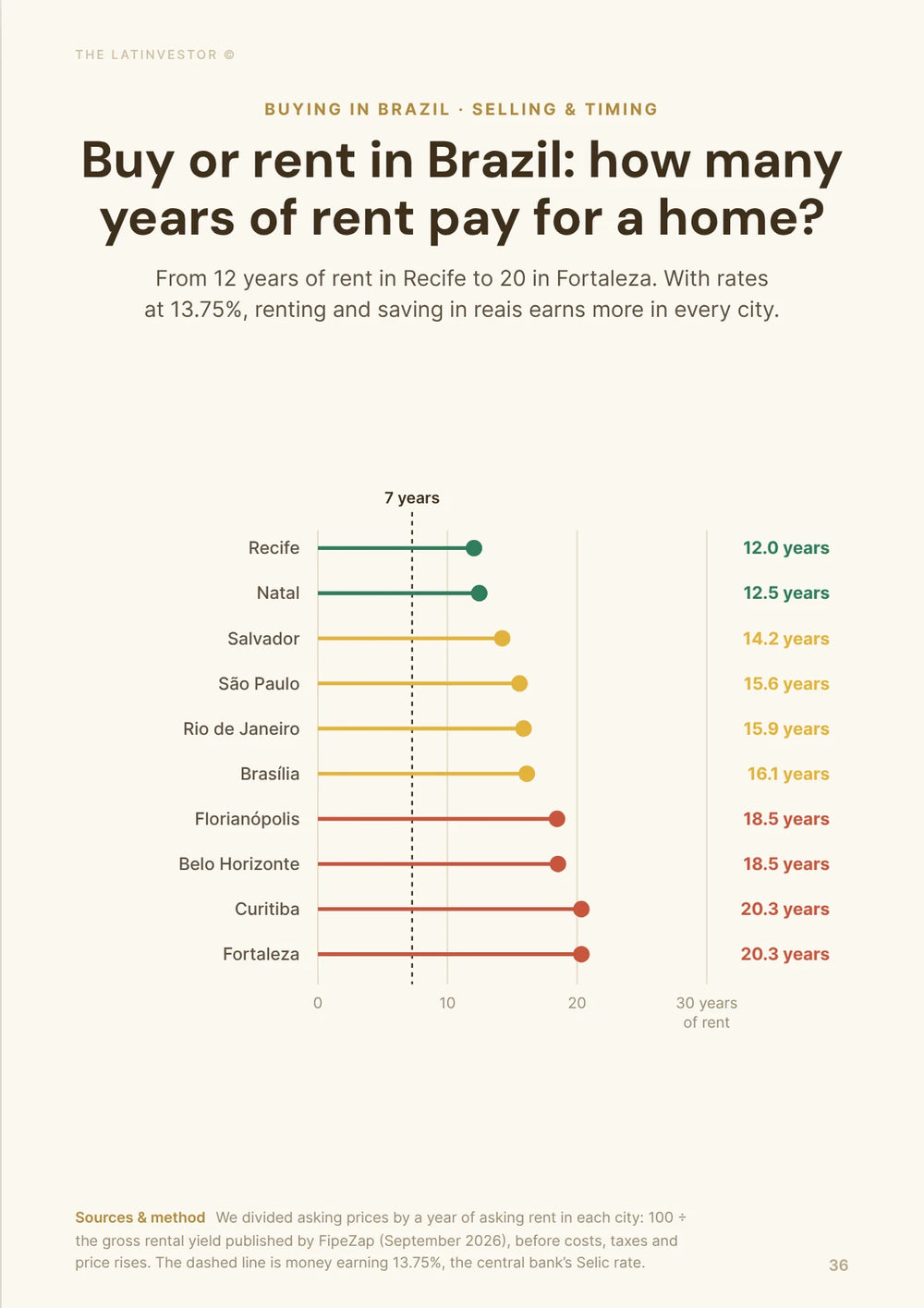
Only building by building. Centro and República ask about R$9,810 per m² (A Corrida dos Bairros, October 2026 listings), about 20% below the city's FipeZAP average of R$12,206, and the gross yield looks like about 8% on paper. But the cheap price per m² is partly the price of risk.
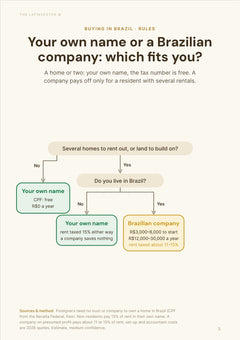
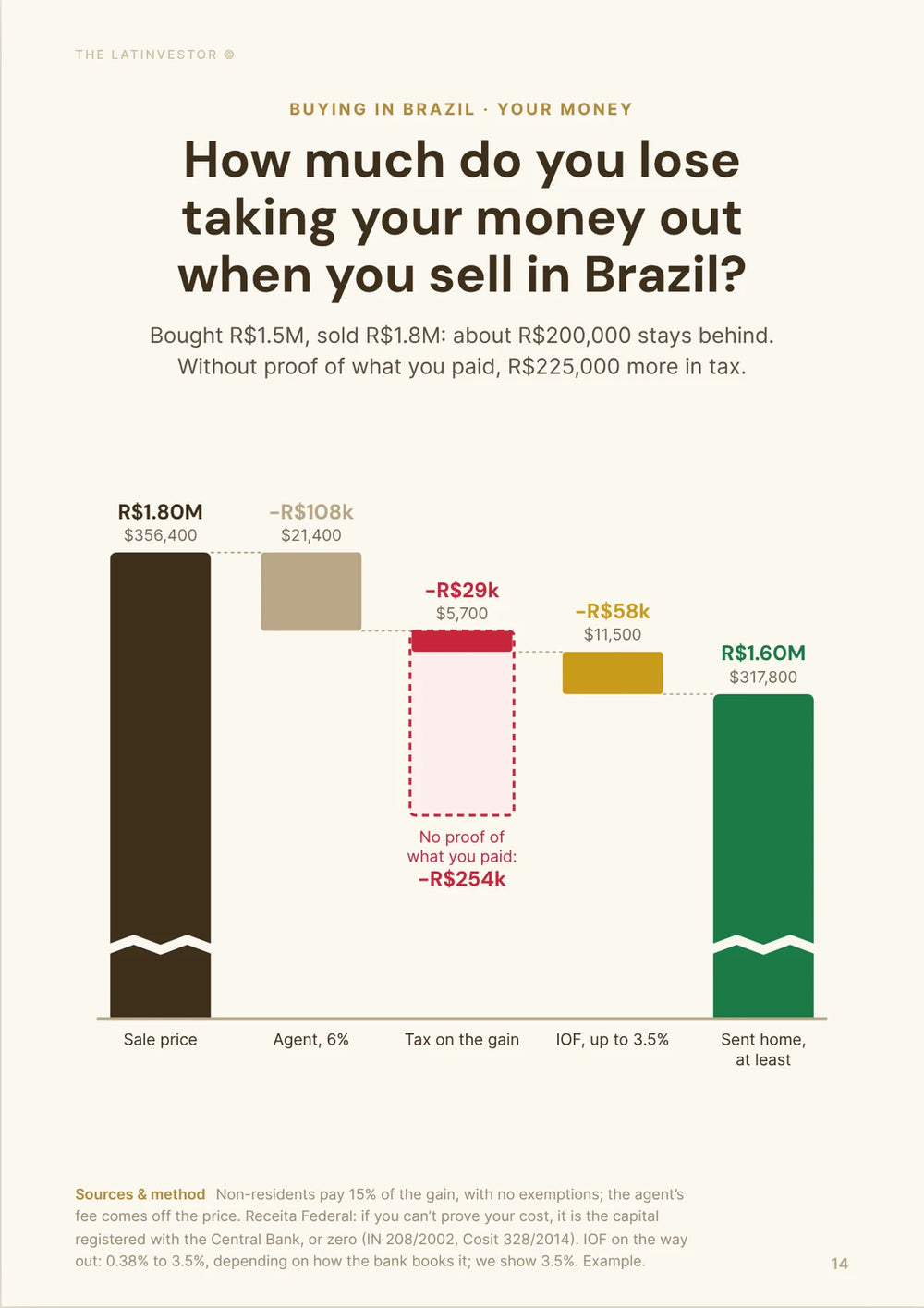
Take a 30 m² studio: about R$294,000 (USD 58,200) at the asking price. At the area's asking rent of about R$65.6 per m², it would rent for about R$1,970 a month, or roughly 8% a year gross. A non-resident pays 15% withholding tax on gross rent, which takes that to about 6.8% before vacancy, repairs and management. On a long lease, the tenant pays the condo fee and IPTU, but you pay them whenever the unit is empty.
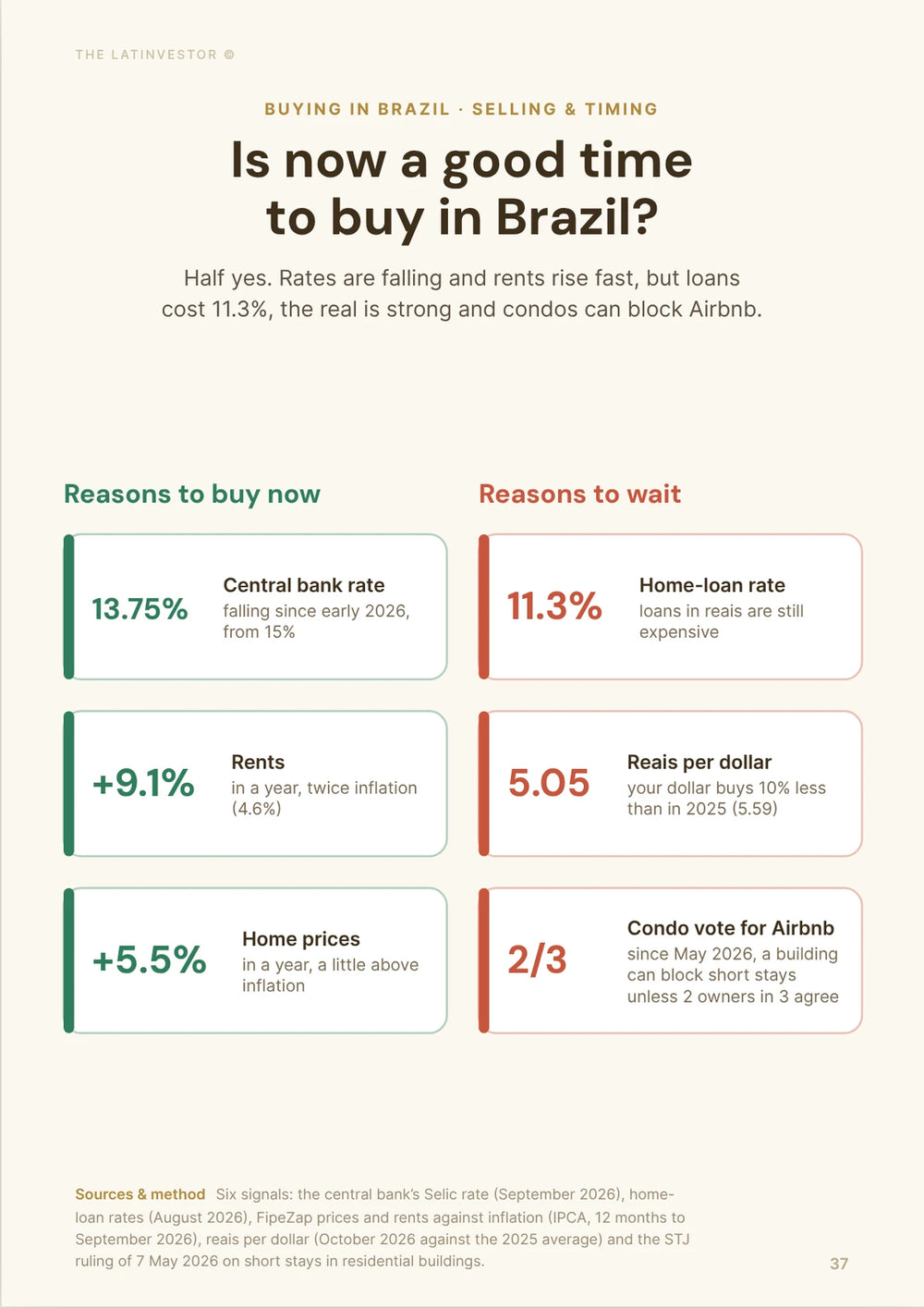
Where it gets tight: the city is full of new studios. Secovi-SP counted 98,018 unsold new homes in São Paulo in August 2026, up 50.7% in a year, many of them small units. With the Selic at 13.75%, mortgages are expensive and a non-resident usually buys in cash anyway, so a buyer with cash has leverage.
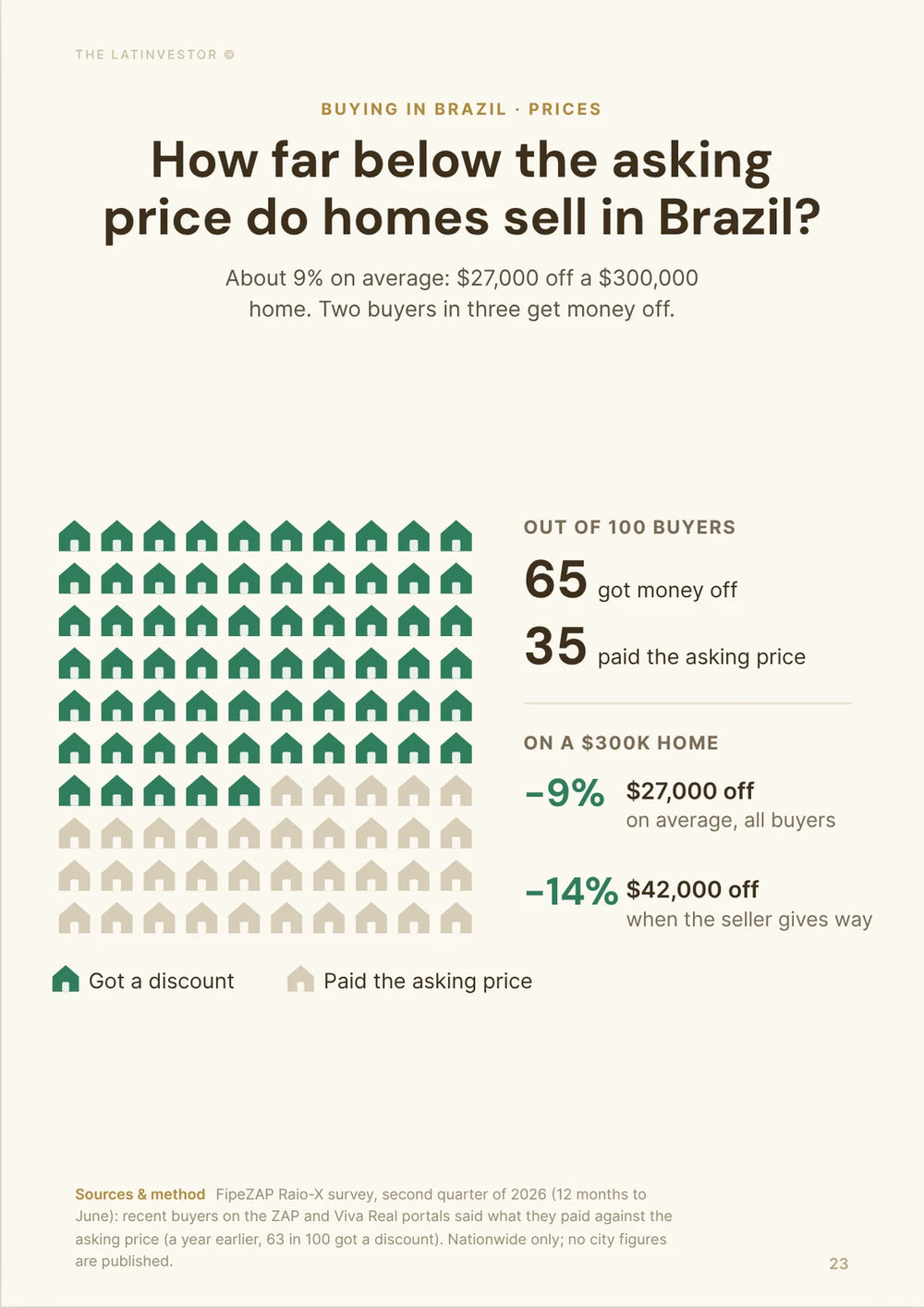
What to do: walk the street at 9 p.m. before making an offer; ask for the last 12 months of condo fees and the AVCB (fire certificate) of older buildings; check whether the unit is HIS or HMP; and offer below asking (FipeZAP's Raio-X puts the average discount at 9%, and about 14% when there is one). A restored building on a busy block near a metro station is a very different bet from a cheap unit in a tower with a dark lobby.
Can you still run an Airbnb in downtown São Paulo?
Sometimes, but don't count on it. Since the STJ ruling of May 2026, a building can require the approval of two thirds of the owners before units are offered on short-stay platforms.
Two more problems hit downtown in particular. Many new studios are HIS or HMP social-housing units, which can't legally be used for short stays. And competition is heavy: AirROI counts 34,925 active listings in São Paulo (+66% in a year) with an average occupancy of 40.1%.
What to do: before buying "for Airbnb," get the building's convention and the latest meeting minutes, ask for the unit's classification in writing, and check that the numbers still work as a long-term rental.
Has crime in downtown São Paulo really fallen that much?
Yes. Recorded robberies in central São Paulo have dropped dramatically, and the latest figures show the drop holding.
State security data show about 9,200 robberies in the central region in 2022, then 8,019 in 2023, 4,492 in 2024 and 3,366 in 2025.
That's about 63% fewer in three years. The 2025 total was the lowest since the comparable state series began in 2001.
The more recent numbers point the same way. Between May 2025 and May 2026, the Centro recorded another 10% drop in robberies, 11% fewer thefts and 31% fewer vehicle robberies, according to the municipal security department.
Policing has grown sharply too. The GCM now runs 276 cars and 226 motorcycles in the central region, against 80 cars and 71 motorcycles in 2021, and Smart Sampa has around 12,000 connected cameras in the Centro.
We can't say cameras or patrol cars alone caused the drop. But downtown is clearly safer than it was a few years ago.
| Year | Recorded robberies in central São Paulo | Change from previous year |
|---|---|---|
| 2022 | ~9,200 | — |
| 2023 | 8,019 | ~-13% |
| 2024 | 4,492 | ~-44% |
| 2025 | 3,366 | ~-25% |
| 2022 to 2025 | — | ~-63% |

Does downtown São Paulo actually feel safe now?
Safer on the data, yes. Comfortable on every street, not yet.
People react to more than robbery counts. Phone theft, visible drug use, homelessness and long rows of closed shops decide whether someone walks five blocks at night or calls a car.
Location matters a lot. República at lunchtime is packed. A quiet block of Santa Cecília late in the evening feels like a different city.
The next test is behavior: shops staying open later, more ordinary foot traffic at night, more people walking between restaurants, transit and home.
Did São Paulo actually get rid of Cracolândia?
It broke up the big Cracolândia concentration, but crack use has spread to many smaller spots instead.
Until 2025, more than 1,000 people could gather around Rua dos Protestantes in the last large open-air scene. That scene emptied, and the change around parts of Campos Elíseos and Santa Cecília was immediate and very visible.
A Folha report from May 2026 shows what happened next. Users were moving through about 260 points around Santa Cecília and nearby streets, and official monitoring over four days counted an average of 214 dependent users in the area in each period of the day.
For landlords, retailers and residents near the old concentration, that's a big physical improvement. But the addiction problem remains, and it's harder to track now that small groups can move from one block to another within hours. If you're looking at a unit in Santa Cecília or Campos Elíseos, visit at different times of day.
Are shops really coming back to São Paulo's historic center?
Yes. New businesses in the historic center are one of the hardest parts of the comeback to dismiss.
The August 2026 Vem Pro Centro survey counted 423 establishments in the Triângulo Histórico, up from 304 in 2024: 119 more businesses and +39.1%.
They aren't all tiny shops: 219 of them fell into the survey's largest revenue category.
There are signs of hiring too. A Diário do Comércio walk along São Bento, Direita, XV de Novembro and Álvares Penteado found 41 hiring signs, 26 of them on São Bento alone.
Downtown already has huge built-in foot traffic. A municipal mobility study found that Sé draws about 222,500 trips a day despite having fewer than 24,000 permanent residents. More businesses now want a share of it.
Is downtown São Paulo becoming lively after work again?
There's much more culture and leisure now, but evenings are still well behind daytime.
The assets are there: Theatro Municipal, Sesc 24 de Maio, Copan, Galeria do Rock, Farol Santander, Biblioteca Mário de Andrade, Pinacoteca, Sala São Paulo and Mercado Municipal all sit in a small area.
What has changed is how some of them are used. Martinelli reopened to the public and drew more than 100,000 visitors during its centenary program, and its redevelopment adds food, culture and visitor spaces. Copan restarted rooftop visits after a six-year pause.
Big events help too, especially around Anhangabaú. SPTuris reported a record 47.2 million visitors to São Paulo in 2025. That's a citywide figure, but central attractions are well placed to get a share.
The weak spot is ordinary weeknights. A festival can fill Anhangabaú on a Saturday; a recovered downtown should also feel alive on a normal Tuesday.
Is the new state government headquarters driving the downtown São Paulo comeback?
Public money is a major driver, and the new Campos Elíseos government complex could be the biggest boost of all, but not before the next decade.
The amounts are large. The retrofit subsidy program has a planned R$1 billion envelope (USD 198 million). The Parque Dom Pedro II PPP requires about R$717 million. The Campos Elíseos administrative complex carries an estimated R$6 billion (about USD 1.2 billion).
The state wants to bring agencies now spread over more than 40 addresses into that complex, about 22,000 civil servants in seven buildings and ten towers. The MEZ-RZK consortium was confirmed as the winner on May 15, 2026, and the project counts on about five years of construction. In June 2026, the consortium said demolitions would start this year. So realistically, the workers arrive around the early 2030s, if the timetable holds.
That's huge locally: the whole Sé district has only about 24,000 permanent residents. Around 22,000 workers coming in every day would mean steady demand for lunch places, cafés, pharmacies, gyms and convenience shops, and some may rent nearby.
For a buyer, that's the catch: Campos Elíseos is pricing in a future that's years away and depends on construction going to plan. The government is changing the economics of the Centro; the real test is whether private demand can carry more of the recovery on its own.

Is Parque Dom Pedro II finally going to change?
It has a much better chance now, because its R$717 million redevelopment has reached the signed-contract stage.
The city signed the 30-year PPP in 2026. It covers a new intermodal terminal, direct links with Pedro II metro station and the Expresso Tiradentes, changes to major road structures and about 100,000 square metres of new green space.
The location is what makes it matter. Dom Pedro II sits between the historic center, Brás, Mercado Municipal, Catavento and some of the busiest transport corridors on the eastern side of the center.
Today, big roads, terminals and viaducts cut off places that are close on the map. If the project works as planned, walking between Brás, Mercado Municipal, Sé and the historic core should get much easier.
A signed contract doesn't remove construction risk, but it puts Dom Pedro II far ahead of the many downtown plans that never left the drawing board.
| Project | Approximate scale | Where it stands | How much should we count today? |
|---|---|---|---|
| Requalifica Centro and retrofit subsidies | R$1bn planned subsidy envelope | Active, area extended in June 2026 | Already influencing projects |
| Retrofit pipeline | 50 buildings, 5,238 homes (Aug. 2026) | Mixed stages, 9 finished | Partly current |
| Parque Dom Pedro II | R$717m | Contract signed | Credible future catalyst |
| Campos Elíseos administrative complex | ~R$6bn, ~22,000 workers | Concession confirmed May 2026, about five years of works | Mostly future |
| Central light-rail proposal | Still in studies | Planning stage | Too early to count |
Could downtown São Paulo's comeback push existing residents out?
Yes. If the center keeps getting more desirable this fast, displacement could become one of the biggest costs of the comeback.
Rents are the warning sign. Campos Elíseos and Centro recorded rent rises above 25% per m² over 12 months. Low-income wages are nowhere near that pace.
These neighborhoods also have a lot of precarious housing. A municipal survey found more than 1,000 cortiços across the broader central study area, with large concentrations in Sé, República, Santa Cecília, Bela Vista and Brás.
The city's subsidies partly target that problem: three quarters of the planned retrofit funding is reserved for HIS and HMP housing.
The test is delivery. If affordable homes arrive alongside market-rate projects, the Centro can get denser without simply swapping one group of residents for another. If rents keep racing ahead while subsidized housing moves slowly, displacement will be hard to avoid.
What still has to happen before downtown São Paulo is truly back?
The recovery has to become ordinary, not something limited to a few successful projects and streets.
Several big pieces are unfinished. The wider central population hasn't grown since 2010. Most buildings in the retrofit pipeline are still works in progress. Parque Dom Pedro II is contracted but not yet transformed. The government complex is still at the demolition stage, and its workforce is years away.
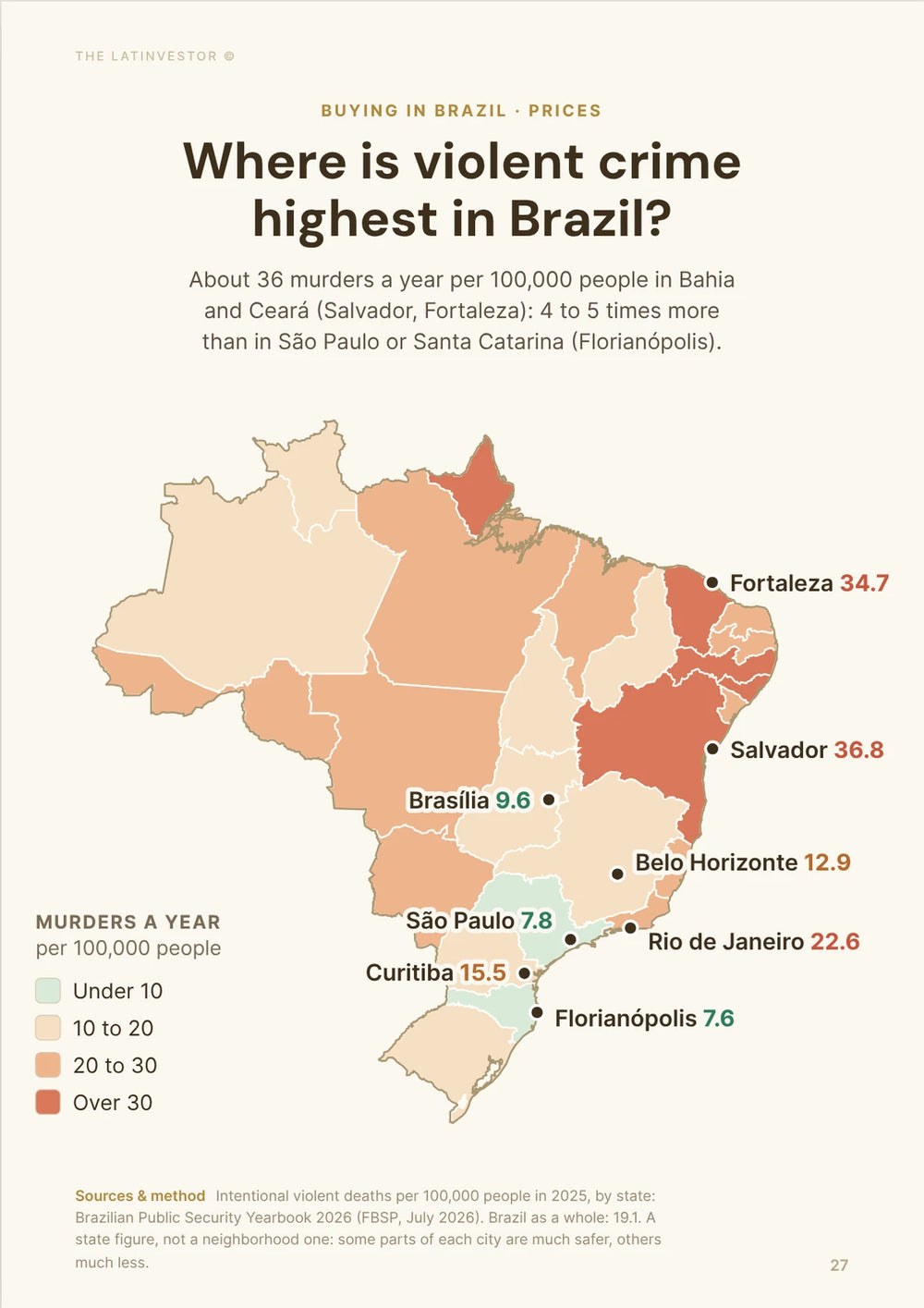
Safety is uneven too. Robberies have fallen enormously, yet the spread of crack users across Santa Cecília shows how a problem can change shape rather than disappear.
The same goes for commerce. The Triângulo Histórico is adding businesses fast, but that doesn't mean every central shopping street has recovered.
Downtown São Paulo is much closer to a normal, 24-hour neighborhood than it was a few years ago. It's not there yet.
So, is downtown São Paulo back or not?
Partly. The comeback is real, but still concentrated enough that calling the Centro fully revived would go too far.
The evidence comes from several directions at once. Robberies have collapsed from their 2022 level to the lowest annual total in the series. The Triângulo Histórico has added 119 businesses since 2024. República has more residents than in 2010, and Cambuci has grown much faster. Old buildings are being turned into thousands of homes, and the area where those conversions get incentives more than doubled in June 2026.
The 2026 news mostly strengthens the case: more shops in the historic core, crime still falling year on year, Requalifica Centro extended, a signed R$717 million contract for Parque Dom Pedro II and a confirmed builder for the government complex.
But some of the biggest numbers belong to the future. The 22,000 civil servants expected in Campos Elíseos are years away, most retrofit projects are unfinished, and large parts of the Centro still deal with visible social problems and quiet evenings.
The old story that downtown São Paulo is simply declining no longer fits. Parts of República, the Triângulo Histórico and Campos Elíseos are already changing. For a buyer, that means picking the street and the building, not betting on "the Centro" as a whole.
Our methodology
We tested whether downtown São Paulo is really recovering by splitting the question into what a comeback would look like on the ground: population, housing demand, business activity, safety, redevelopment and investment, and street life. No single number is enough: a downtown can gain investment while losing residents, or get safer without getting livelier at night.
We gave priority to official and recent data showing change already happening. Municipal population tables based on the IBGE census for demographics; QuintoAndar neighborhood data (12 months to July 2026) for rents; the August 2026 Vem Pro Centro / Associação Comercial de São Paulo survey for business counts; state (SSP) and municipal security data for crime. Prices per m² for Centro and República come from A Corrida dos Bairros listing data (October 2026); the city average is FipeZAP for September 2026; the gross yield is our own estimate from asking rents and asking prices.
For redevelopment, we used city records on Requalifica Centro and the retrofit subsidy program, and state and press sources on the Parque Dom Pedro II PPP and the new government complex (concession confirmed in May 2026). Signed or awarded projects count as credible future catalysts, not as if their impact had already arrived. Rules come from the STJ (Airbnb in condominiums, May 2026), the city (HIS/HMP units) and the 15% withholding tax on a non-resident's rent.
We checked these figures in October 2026. Conversions use about 5.05 reais per US dollar and 5.65 reais per euro.
Limits: listing prices and rents are asking figures, not closed deals; rent indices can jump when many new studios enter the sample; neighborhood boundaries differ between sources; and recorded crime is not the same as how safe a street feels. We didn't treat a strong result on a few streets as proof that the whole Centro has recovered.
Key sources used for this analysis include: Prefeitura de São Paulo population tables based on the IBGE censuses, Prefeitura de São Paulo on the central retrofit pipeline and subsidy program, Gestão Urbana on the expansion of Requalifica Centro, Prefeitura de São Paulo on the June 2026 retrofit area extension, QuintoAndar on neighborhood rental movements, A Corrida dos Bairros (República), FipeZAP (September 2026), Vem Pro Centro / Associação Comercial de São Paulo on business growth in the Triângulo Histórico, Secretaria da Segurança Pública de São Paulo crime statistics, Prefeitura de São Paulo on recent Centro crime comparisons and GCM deployment, Folha de S.Paulo on the post-Cracolândia dispersion, Prefeitura de São Paulo on the Parque Dom Pedro II PPP, Governo de São Paulo on the new administrative complex, Folha de S.Paulo on the MEZ-RZK concession (May 2026), Acessa.com on the demolition schedule (June 2026), AirROI (São Paulo), and São Paulo's Municipal Housing Secretariat on cortiços in the central area.