
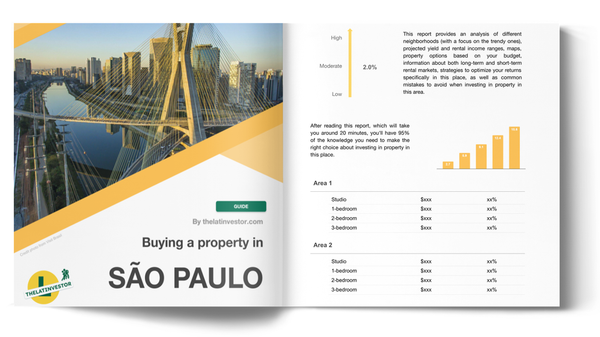
Get all the data you need about the real estate market in São Paulo
SUMMARY
How expensive are apartments in São Paulo right now? Expensive, but not uniformly so: the broad asking-price market is around R$12,100/m², putting a typical 70 m² apartment near R$850,000, while sizeable parts of the city remain closer to R$8,000–R$10,000/m² and prime neighborhoods reach roughly R$16,000–R$21,000/m².
The citywide average hides an unusually wide market. FipeZAP is near R$12,099/m² while QuintoAndar is around R$7,917/m², largely because the two datasets capture different properties and different stages of the selling process rather than because every buyer can negotiate a one-third discount.
R$500,000 is still a real apartment budget in São Paulo. A large share of new development has moved toward smaller units and Minha Casa, Minha Vida, with the R$275,000–R$400,000 segment accounting for almost half of recent new-home sales.
R$1 million exposes the city's geographic divide particularly well. At current neighborhood averages it buys roughly 50 m² in Itaim Bibi, but around 110 m² in Santana and 120 m² in Vila Andrade.
Small apartments are cheaper in total but expensive by the square meter. One-bedroom units on QuintoAndar carry roughly a 34% per-square-meter premium over two-bedroom apartments, and developers have increasingly built around that trade-off.
São Paulo is not in a broad apartment-price boom. Asking prices are still rising nominally, but recent gains have been modest, inflation has been faster over part of the latest period, and several expensive neighborhoods are barely appreciating.
Rents are behaving very differently. QuintoAndar's latest figures show rental prices rising much faster than sale values, meaning renting is becoming less cheap even while purchase-price momentum remains subdued.
Financing is arguably the harshest part of affordability today. At mortgage rates near 11.8% a year, financing R$800,000 over 30 years produces a payment around R$7,700 a month before TR, insurance, condominium fees and property taxes.
Strong developer sales should not be mistaken for broad affordability. São Paulo has kept selling huge numbers of new homes largely by shifting toward smaller tickets and subsidized products, while middle- and upper-market sales have weakened.
Supply is also building rather than disappearing. New-home inventory has risen sharply, so the market today looks less like a generalized shortage and more like several very different São Paulo housing markets operating at the same time.
Recent property scams aimed at foreign buyers in São Paulo
Flats sold by owners already being sued elsewhere, and deposits taken against a matrícula nobody pulled. The cases that keep coming back, and how to check who and what you are dealing with.
What does an apartment in São Paulo cost today?
A São Paulo apartment currently costs about R$12,100 per square meter on the broad asking-price market, which puts a typical 70 m² apartment near R$850,000 before any negotiation.
The latest FipeZAP reading puts São Paulo at R$12,099/m² across a sample of 718,664 residential listings. That works out to roughly R$484,000 for 40 m², R$726,000 for 60 m² and R$1.21 million for 100 m².
Those numbers are useful as a citywide benchmark, but São Paulo has such a wide price range that the average can quickly become misleading. FipeZAP has Itaim Bibi around R$19,990/m² and Vila Andrade around R$8,347/m². At those neighborhood averages, the same 70 m² apartment moves from roughly R$584,000 to R$1.4 million.
QuintoAndar's purchase-and-sale index adds another important perspective. Its latest São Paulo reading is R$7,917/m², with one-bedroom apartments at R$9,926/m², two-bedroom units at R$7,395/m² and three-bedroom units at R$7,961/m². The samples and methodologies differ, so we should not treat the gap between FipeZAP and QuintoAndar as a discount available to every buyer. It does show that a single “São Paulo price per square meter” cannot describe the whole market.
| Apartment size | At R$7,917/m² | At R$12,099/m² | Difference |
|---|---|---|---|
| 40 m² | R$317,000 | R$484,000 | R$167,000 |
| 60 m² | R$475,000 | R$726,000 | R$251,000 |
| 70 m² | R$554,000 | R$847,000 | R$293,000 |
| 100 m² | R$792,000 | R$1.21M | R$418,000 |
| 150 m² | R$1.19M | R$1.81M | R$627,000 |
Why do São Paulo apartment prices look so different depending on the website?
São Paulo apartment prices look inconsistent because different indexes are measuring different parts of a huge market, and asking prices can sit well above the prices represented in transaction-heavy datasets.
FipeZAP tracks advertised residential properties on major online platforms. Its current São Paulo sample exceeds 700,000 listings, so it gives us a very broad view of what sellers are asking.
QuintoAndar works with data generated much closer to actual negotiations on its platform. Its R$7,917/m² São Paulo reading is about one-third below the FipeZAP asking-price average, but calling that a 35% negotiating discount would be wrong. The geographic mix, property mix and customer base are different.
The gap is still useful. Someone browsing premium-heavy listing portals can easily come away thinking that R$12,000/m² is the floor for São Paulo. It clearly isn't. These days, buyers need comparable properties in the same neighborhood, building and age bracket rather than a citywide portal average.
Get fresh and reliable data on the São Paulo property market
A Faria Lima address is being charged for streets that are a fifteen minute walk from it, and no parking space comes with it. Where prices sit furthest from what places earn and resell for.
How expensive are apartments in Itaim Bibi, Pinheiros and Moema now?
Prime São Paulo has become a roughly R$16,000-to-R$21,000-per-square-meter market, so an ordinary family apartment can easily cost R$1.5 million to R$2.5 million.
FipeZAP currently puts Itaim Bibi at R$19,990/m², Pinheiros at R$18,302, Jardins at R$17,833 and Moema at R$16,349. Vila Mariana is lower at R$14,792, while Perdizes sits around R$13,303.
For a 100 m² apartment, those averages imply around R$2 million in Itaim Bibi, R$1.83 million in Pinheiros, R$1.78 million in Jardins and R$1.63 million in Moema. A 120 m² unit in Itaim reaches roughly R$2.4 million before we even get into exceptionally new buildings, large terraces, trophy addresses or high floors.
QuintoAndar's latest ranking points in the same direction from a different dataset: Vila Nova Conceição is currently its most expensive São Paulo neighborhood at R$20,839/m².
Around Faria Lima, R$1 million can now be the budget for a compact apartment rather than a luxury one.
| Neighborhood | Current FipeZAP price | 70 m² at that rate | 100 m² at that rate |
|---|---|---|---|
| Itaim Bibi | R$19,990/m² | R$1.40M | R$2.00M |
| Pinheiros | R$18,302/m² | R$1.28M | R$1.83M |
| Jardins | R$17,833/m² | R$1.25M | R$1.78M |
| Moema | R$16,349/m² | R$1.14M | R$1.63M |
| Vila Mariana | R$14,792/m² | R$1.04M | R$1.48M |
| Perdizes | R$13,303/m² | R$931,000 | R$1.33M |
Can you still buy an apartment in São Paulo for R$500,000?
Yes, R$500,000 still buys plenty of apartments in São Paulo today, although buyers usually give up some combination of space, location, building age or amenities.
The clearest evidence comes from new construction. Secovi-SP found that apartments priced between R$275,000 and R$400,000 recently represented 45% of launches, 47% of sales and 43% of available new-home inventory in São Paulo. That is the biggest price segment in the new-build market.
Minha Casa, Minha Vida is driving much of that volume. In the same Secovi survey, qualifying properties accounted for 70% of launches and 71% of new-home sales. The program's importance has continued through the first half of the year: Secovi later reported that MCMV launches were up 31%, while launches in the middle and upper-middle segments fell 28%.
FipeZAP's neighborhood data also shows how R$500,000 can work outside prime São Paulo. At Vila Andrade's R$8,347/m² asking-price average, that budget corresponds to roughly 60 m². At Santana's R$9,090/m², it corresponds to about 55 m².
So yes, R$500,000 is still a realistic São Paulo budget. What is hard is getting R$500,000, a large apartment, a new building and one of the city's most desirable central neighborhoods all at once.
Everything a foreign buyer should know before buying in São Paulo
The pack also covers what the condomínio and the IPTU take every month, and which certificates have to be clean before you pay anything.
What does R$1 million buy in São Paulo today?
R$1 million still buys a serious apartment in most of São Paulo, but the same budget can mean 50 m² in Itaim Bibi or roughly 120 m² in Vila Andrade.
Using current neighborhood asking prices, R$1 million corresponds to about 50 m² in Itaim Bibi, 55 m² in Pinheiros, 61 m² in Moema, 68 m² in Vila Mariana, 75 m² in Perdizes, 110 m² in Santana and 120 m² in Vila Andrade.
The difference is large enough to change the type of home completely. A buyer choosing between Santana and Itaim Bibi is not paying a modest location premium: at current averages, each square meter in Itaim costs about 2.2 times as much.
R$1 million is a strong budget across much of the city. In the premium southwest, it is increasingly ordinary.
| Neighborhood | Current asking R$/m² | Approx. space for R$1M |
|---|---|---|
| Itaim Bibi | R$19,990 | 50 m² |
| Pinheiros | R$18,302 | 55 m² |
| Moema | R$16,349 | 61 m² |
| Vila Mariana | R$14,792 | 68 m² |
| Perdizes | R$13,303 | 75 m² |
| Santana | R$9,090 | 110 m² |
| Vila Andrade | R$8,347 | 120 m² |
Are small apartments in São Paulo overpriced per square meter?
Small São Paulo apartments are currently much more expensive per square meter than larger mainstream units, even though their total purchase price is lower.
QuintoAndar's latest sales index puts one-bedroom apartments at R$9,926/m². Two-bedroom units average R$7,395/m² and three-bedroom units R$7,961/m². The one-bedroom premium over two-bedroom apartments is therefore about 34%.
Developers have leaned hard into that arithmetic. Secovi found that apartments between 30 and 45 m² accounted for 52% of launches, 64% of sales and 51% of available new inventory in one recent market reading. Small apartments have become the core product of São Paulo's new-build market.
Rents make the economics even clearer. QuintoAndar currently records average rents around R$91.14/m² for one-bedroom properties, compared with R$66.68/m² for two bedrooms and R$67.39/m² for three bedrooms.
A buyer downsizing from 70 m² to 35 m² can cut the purchase ticket dramatically, but the price usually falls by much less than 50%. The smaller unit is doing a lot more work per square meter.
| Apartment type | Sale price per m² | Rent per m² | Sale premium vs. 2BR |
|---|---|---|---|
| 1 bedroom | R$9,926 | R$91.14 | +34% |
| 2 bedrooms | R$7,395 | R$66.68 | — |
| 3 bedrooms | R$7,961 | R$67.39 | +8% |
The bairros and projects in São Paulo that are most overpriced
A Faria Lima address is being charged for streets that are a fifteen minute walk from it, and no parking space comes with it. Where prices sit furthest from what places earn and resell for.
Are São Paulo apartment prices still going up?
São Paulo apartment prices are still rising today, but the city is nowhere near a broad housing-price boom.
FipeZAP shows asking prices up 3.7% over the latest 12 months. More recently, São Paulo gained only 1.7% over the first seven months of the year, while the consumer-inflation measure used by FipeZAP rose about 3.4% over the same period. In real terms, São Paulo housing prices have therefore slipped.
The citywide number also hides striking neighborhood differences. Jardins rose 7.2% over 12 months and Moema 5.1%, while Pinheiros managed only 0.7% and Vila Mariana barely moved at 0.1%. Vila Andrade was also almost flat at 0.8%.
The picture is pretty clear these days: nominal prices are edging higher overall, but there is no synchronized surge across São Paulo. Some prime neighborhoods are appreciating, others are barely moving, and inflation has recently been running faster than the citywide housing index.
| Neighborhood | 12-month price change | Current R$/m² |
|---|---|---|
| Jardins | +7.2% | R$17,833 |
| Moema | +5.1% | R$16,349 |
| Perdizes | +4.7% | R$13,303 |
| Santana | +4.3% | R$9,090 |
| Itaim Bibi | +3.9% | R$19,990 |
| Bela Vista | +2.4% | R$12,454 |
| Vila Andrade | +0.8% | R$8,347 |
| Pinheiros | +0.7% | R$18,302 |
| Vila Mariana | +0.1% | R$14,792 |
Is São Paulo still Brazil's most expensive city for apartments?
No. São Paulo is one of Brazil's most expensive apartment markets, but several cities currently have higher asking prices per square meter.
FipeZAP puts São Paulo at R$12,099/m². Vitória currently sits around R$15,448/m² and Florianópolis around R$13,461/m². Itapema and Balneário Camboriú are even higher, at roughly R$15,403 and R$15,295 respectively.
São Paulo still costs more than Rio de Janeiro, which is around R$11,131/m², and remains slightly above Curitiba at R$11,761/m².
What makes São Paulo stand out is the depth of the market. More than 11 million people live in the municipality, FipeZAP alone is tracking more than 700,000 sale listings, and entire neighborhoods operate at R$15,000-to-R$20,000/m². Smaller Brazilian cities can post a higher average, especially where expensive waterfront apartments dominate the sample, without having anything comparable to São Paulo's sheer volume of high-priced housing.
What developers promise off plan that you should never pay for
If you walk away from an off plan purchase here the law lets the developer keep a large share of what you paid. What to check about the project before that matters, starting with how it is ring fenced.
Are São Paulo rents rising faster than apartment prices?
Yes. São Paulo rents are currently rising much faster than sale prices, which has materially narrowed the gap between renting and owning.
QuintoAndar's latest rental index puts average São Paulo rent at R$75.20/m², up 9% over 12 months. Its purchase-and-sale index, by comparison, shows home values up only 0.6% over 12 months. FipeZAP's broader asking-price measure shows a larger 3.7% increase, but rents are still comfortably ahead.
That difference has been building rather than appearing in one isolated reading. QuintoAndar says rents have already climbed another 5.9% since the start of the year.
A rough comparison illustrates the scale. R$75.20 per month equals about R$902 of annual rent per square meter. Compared with the R$12,099/m² FipeZAP sale price, that produces a crude gross yield near 7.5%. We would not use that figure as an investment yield because the two indexes cover different property samples and it ignores condominium fees, IPTU, vacancy and maintenance. It does show how quickly rents have caught up.
For buyers comparing ownership with renting, this is one of the more important recent changes. Buying remains costly, but renting is becoming noticeably less cheap.
Does financing make a São Paulo apartment much harder to afford?
Yes. High mortgage rates currently turn an already expensive São Paulo apartment into a much tougher monthly affordability problem.
Banco Central's latest published mortgage data shows how expensive housing credit remains. For regulated TR-linked financing, Bradesco, Santander and Itaú were recently around 11.8% a year, while Banco do Brasil was around 10.2%. Caixa's regulated book showed lower average rates, although actual borrower offers vary by product, income, loan-to-value and funding source.
At roughly 11.8% a year, financing R$600,000 over 30 years gives a simple constant-payment illustration of about R$5,800 a month before TR, insurance and other charges. An R$800,000 loan is around R$7,700.
Take a R$1 million apartment with a 20% down payment. The buyer first needs R$200,000 in equity and then finances R$800,000. A mortgage payment around R$7,700 already approaches the latest estimated citywide average household income of R$8,994 used by Fipe, before condominium fees, IPTU or everyday living costs.
Cash buyers and heavily financed buyers are basically living in different São Paulo property markets right now.
| Apartment price | 20% down | Mortgage amount | Approx. 30-year payment at 11.8% |
|---|---|---|---|
| R$500,000 | R$100,000 | R$400,000 | R$3,850/month |
| R$750,000 | R$150,000 | R$600,000 | R$5,780/month |
| R$1.0M | R$200,000 | R$800,000 | R$7,710/month |
| R$1.5M | R$300,000 | R$1.2M | R$11,560/month |
How to spot hidden problems when you visit a property in São Paulo
Whether the street floods in February matters as much as the finishes, and the building's monthly charge tells you how it has been run. What to look at, and what each thing is telling you.
If São Paulo apartments are expensive, why are developers selling so many?
São Paulo is still selling huge numbers of new apartments because developers have shifted heavily toward smaller and subsidized homes that keep the total purchase price lower.
Secovi-SP recorded 114,000 new-home sales over the latest 12-month period. That volume is almost unchanged from the 113,300 units sold in the comparable period a year earlier, despite expensive financing.
The composition has changed more than the headline sales number. In the latest first-half analysis from Secovi, Minha Casa, Minha Vida launches were up 31% and MCMV sales were up 17%. Meanwhile, sales in the middle and upper segments fell 22%.
The new-build market has increasingly concentrated around smaller tickets as well. Apartments priced between R$275,000 and R$400,000 recently made up almost half of sales, while 30-to-45 m² units represented nearly two-thirds.
Developers have kept the machine moving by building smaller, using subsidized financing where possible and keeping the headline ticket low enough for more buyers to qualify. Strong sales do not mean ordinary São Paulo housing has suddenly become affordable.
Is São Paulo running out of apartments?
No. São Paulo currently has plenty of new apartments for sale, and the latest numbers actually show inventory rising.
Secovi counted 88,800 new units available for sale at the end of one recent month, covering projects launched during the previous 36 months. That compares with 81,300 units only four months earlier and about 60,200 a year before that.
The increase has been substantial. From 60,200 to 88,800 units is a jump of roughly 48% in just over a year.
Developers have also been launching homes faster than buyers have been absorbing them. Over the latest 12-month period, São Paulo recorded about 143,700 launches and 114,000 sales. That leaves a gap of almost 30,000 units.
The pressure is especially visible in Minha Casa, Minha Vida. Secovi's latest first-half review put unsold MCMV inventory at roughly 52,000 units, up 58%, although the estimated clearance period remained around eight months because sales volumes are also enormous.
This supply does not make every type of apartment abundant. Large new units in Pinheiros or Itaim Bibi have little in common with R$300,000 subsidized projects farther out. Still, the current data gives us little reason to describe São Paulo as suffering from a general shortage of apartments.
The unwritten rules of negotiating and making an offer in São Paulo
Asking prices expect a negotiation, and a flat that has been listed through two agencies is a different conversation. How far below asking people go, and what to put in writing when you do.
So how expensive are apartments in São Paulo right now?
São Paulo apartments are expensive today, especially for buyers relying on a mortgage, but the city spans such a wide price range that the R$12,099/m² headline average only tells part of the story.
A useful way to think about the market is through actual budgets. Around R$400,000 still buys into São Paulo's huge compact and subsidized segment. R$500,000 to R$1 million covers a broad part of the conventional market. Once we move into places such as Vila Mariana, Moema, Pinheiros and Itaim Bibi, R$1 million stops looking exceptional very quickly. A normal 100 m² apartment in the most expensive established neighborhoods can currently run from roughly R$1.6 million to R$2 million before entering true luxury stock.
The latest evidence also changes how we should describe the market. Sale prices are rising slowly, with São Paulo up only 1.7% so far this year and below inflation over that period. Rents are climbing much faster. New-home inventory has grown sharply. Developers are selling enormous volumes mainly by pushing harder into small apartments and Minha Casa, Minha Vida. Mortgage rates remain around double digits.
Our answer is fairly sharp: apartments in São Paulo are expensive relative to local incomes and particularly painful to finance, but the city is not experiencing an across-the-board price boom. The biggest divide today is geographical. Roughly R$8,000-to-R$10,000/m² still exists across sizeable parts of São Paulo, while the prime southwest has settled into a very different R$16,000-to-R$21,000/m² world. A buyer can cross that gap without ever leaving the city.
OUR METHODOLOGY
The question “How expensive are apartments in São Paulo right now?” does not have one useful citywide answer. São Paulo's prices change sharply by neighborhood, apartment size, property type and financing profile, while the main datasets themselves measure different parts of the market.
We therefore broke the question into the dimensions that determine what “expensive” means in practice: citywide pricing, neighborhood dispersion, what different budgets actually buy, the premium attached to small apartments, price momentum, rents, mortgage affordability, new-home sales and available supply.
For each dimension, we prioritized the freshest available evidence and direct market measures. We used FipeZAP for broad asking prices, neighborhood comparisons, city comparisons and recent price movement; QuintoAndar for sale and rental prices closer to activity on its own platform; Secovi-SP for new-home launches, sales, inventory, apartment sizes and Minha Casa, Minha Vida activity; and Banco Central do Brasil for current mortgage-rate data.
We did not combine those datasets into one synthetic São Paulo price. FipeZAP and QuintoAndar use different samples and methodologies, so the gap between them is treated as useful information about market dispersion rather than as a literal negotiating discount.
We also separated nominal price movement from affordability. Prices can rise while losing ground to inflation, rents can climb much faster than sale values, and headline sales can remain strong while developers shift heavily toward smaller or subsidized units. Looking at those pieces together gives a better picture of the market than any single index.
Mortgage examples are simple affordability illustrations rather than individual loan quotes. Actual borrowing costs vary with lender, product, income, loan-to-value, TR, insurance and other charges. Official Minha Casa, Minha Vida material from the Ministry of Cities and Caixa was used where program eligibility and financing structure were relevant.
The final judgment comes from comparing those dimensions rather than letting one headline number dominate the answer. That is why the analysis distinguishes between São Paulo being expensive, particular neighborhoods being exceptionally expensive, and the city experiencing a broad price boom. The latest evidence supports the first two much more strongly than the third.
Key sources include: FipeZAP's residential sale and rental price index, QuintoAndar's Purchase and Sale Index, QuintoAndar's Rental Index, Secovi-SP's Monthly Real Estate Market Research, Secovi-SP's latest market report, Secovi-SP's data on inventory and apartment-size segmentation, Banco Central do Brasil's regulated TR-linked mortgage rates, IBGE's São Paulo municipality profile, the Ministry of Cities' Minha Casa, Minha Vida overview, and Caixa's documentation on MCMV Classe Média financing.
We have prepared 12 documents to help you invest well in São Paulo
What each bairro costs, what it rents for, how long it sits before it sells. Plus the things nobody writes down: what the condomínio and the IPTU take every month, and which certificates have to be clean before you pay anything.
Related blog posts
- How expensive are condos in São Paulo right now?
- What kind of home can you afford in São Paulo?
- Are home prices in São Paulo going up or down?
- Is it cheaper to buy than rent in São Paulo now?
- What fees should you expect when buying property in São Paulo?


