Summary
No, not with a normal mortgage. On an average 60 m² apartment, a buyer putting 20% down starts at about R$7,160 a month in loan payments, against about R$3,950 in rent.
The property itself has moved toward buyers. Asking rents rose 6.22% in the 12 months to September 2026 and sale prices only 3.64%, so FipeZAP's citywide gross yield reached 6.43%. At 5% to 7% a year, a R$3,950 rent reaches about R$5,000 to R$5,500 in five years.
The loan is what kills it. With private banks charging about 11.8% plus TR, the first month's interest alone is about R$5,760, well above the full rent.
You need about half the price in cash before interest drops below rent: with 50% down, first-month interest is about R$3,600, and the full payment still about R$4,470.
Paying cash fixes the loan but not the opportunity cost. Fixed income still pays close to 13.65% before tax with the Selic at 13.75%, about twice what the apartment saves you in rent.
If you live abroad, that's your real choice: Brazilian banks in practice don't lend to non-residents, so you're comparing a 6% to 6.5% rent saving with what your cash earns elsewhere.
Neighborhood matters: gross yields run from about 5.6% in Itaim Bibi and Jardins to 6.57% in Pinheiros and about 8% on paper in Centro and República.
Small units rent for more per m² (R$91.14 for one-beds against R$66.68 for two-beds at QuintoAndar), but unsold mid- and high-end studio stock is up 71% in a year, so pick the building carefully.
Condo fees and IPTU mostly cancel out, since tenants pay them too. Buying and selling costs don't: a round trip costs 10% to 14% of the price, about two years of rent. So plan on staying seven to ten years.
Rates are the swing factor. At 8%, first-month interest on the same loan falls to about R$3,900, roughly the rent.
Waiting for rates to fall costs little: prices fell about 0.9% after inflation in the past year, the next Copom meeting is on 3-4 November, and the Focus survey expects 13.25% by year-end.
Minha Casa, Minha Vida only works in the lower bands: around 8% for homes up to R$400,000, it roughly matches rent; the 10% middle-class band for homes up to R$600,000 doesn't.
Resale beats new for this test: buyers got an average 9% off asking in FipeZAP's mid-2026 survey, and 98,018 new homes sit unsold in the city.
Appreciation won't rescue a heavy loan: 3.64% a year is below inflation. A renter who invests the R$146,500 down payment and the monthly gap usually comes out ahead.
Bottom line: borrowing 70% to 80% today, rent. Paying cash or half down, staying ten years and buying below asking in a high-yield area, buying is close and can win.


Why is the buy-or-rent math in São Paulo pulling two ways right now?
Because the property is getting cheaper relative to rent while the loan to buy it stays very expensive.
FipeZAP put the average São Paulo asking price at R$12,206 per m² in September 2026, up 3.64% in 12 months. Its rental index had asking rents at R$65.78 per m², up 6.22%. QuintoAndar Imovelweb, which also sees signed contracts, has R$75.20 per m² and +9% over the 12 months to July 2026.
Whichever rental series you use, rents keep beating prices. That quietly helps the case for buying.
Credit doesn't. The Banco Central cut the Selic from 14% to 13.75% on 16 September 2026, but the big private banks still charged about 11.8% a year plus TR on housing loans that month (Banco Central data: Bradesco 11.77%, Santander 11.85%, Itaú 11.87%). Caixa averaged 7.98%, but its money is limited and most buyers don't get that rate.
And for most foreigners living abroad, there's no mortgage at all, which turns the question into cash against fixed income.
| São Paulo indicator | Latest level | Recent direction | Effect on buy vs rent |
|---|---|---|---|
| Asking sale price (FipeZAP, Sept. 2026) | R$12,206/m² | +3.64% in 12 months | Neutral to slightly bad for buyers |
| Asking rent (FipeZAP, Sept. 2026) | R$65.78/m²/month | +6.22% in 12 months | Helps buyers |
| QuintoAndar Imovelweb rent (July 2026) | R$75.20/m²/month | +9% in 12 months | Helps buyers |
| Selic | 13.75% a year | Cut from 14% in Sept. 2026 | Still favors renters |
| Private-bank mortgage rate (Sept. 2026) | About 11.8% + TR | Still high | Strongly favors renters |
| Caixa mortgage rate (Sept. 2026) | 7.98% + TR | Cheapest, limited funds | Brings buying close |
What would the same São Paulo apartment cost to buy or rent?
For an average 60 m² apartment, about R$732,000 to buy (USD 145,000) against about R$3,950 a month to rent (USD 782).
At FipeZAP's September 2026 averages, 60 m² comes to R$732,360 at R$12,206 per m², and R$3,947 a month at R$65.78 per m².
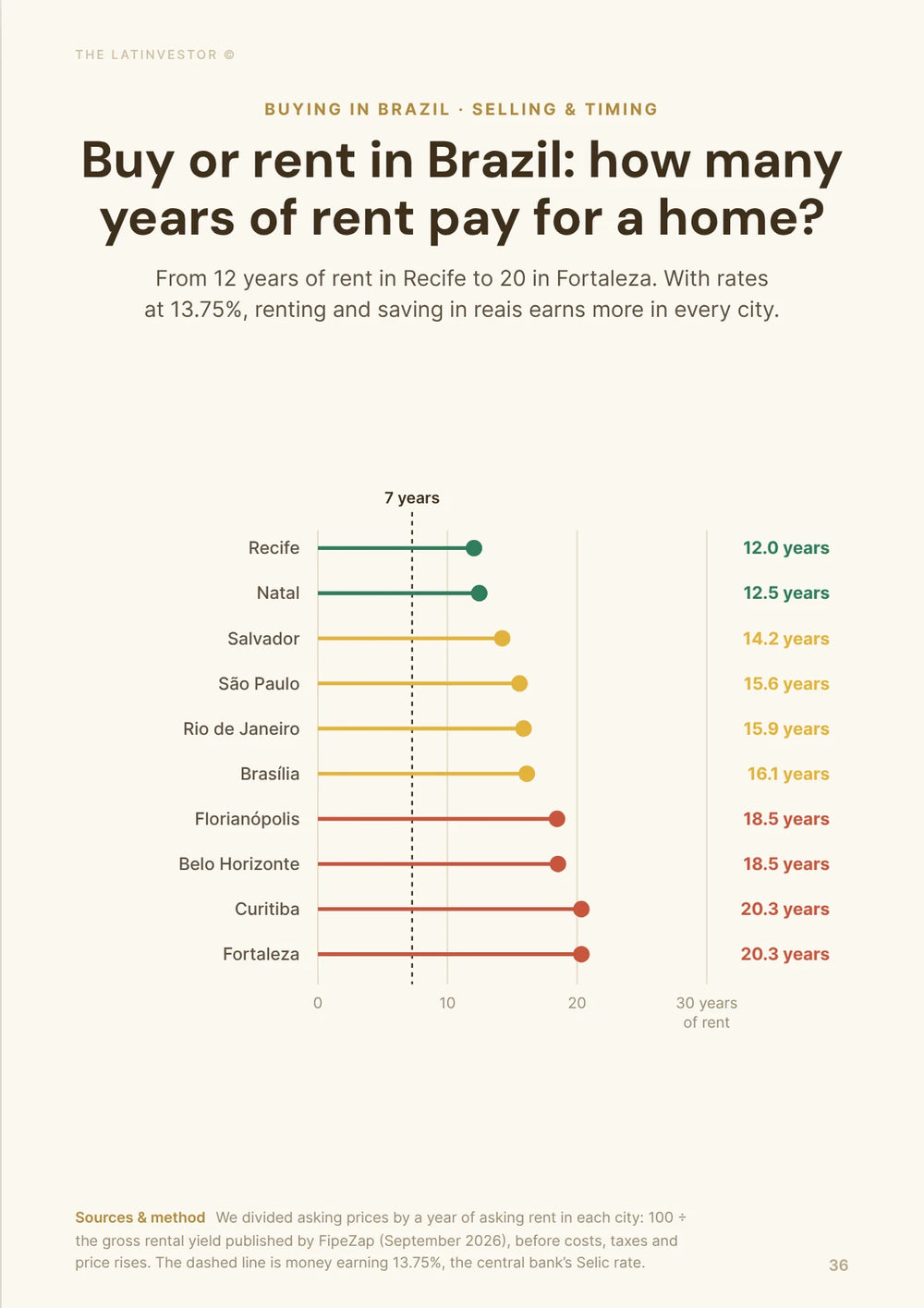
That's about R$47,400 of rent a year, a gross yield of about 6.5% (FipeZAP's own citywide figure is 6.43%). Put another way, the price equals about 186 months of rent, or 15.5 years.
So São Paulo isn't absurdly priced against its rents anymore. The expensive part starts when you borrow several hundred thousand reais.
Both figures are asking prices. Buyers in FipeZAP's mid-2026 survey paid on average 9% below the listed price, while São Paulo tenants close only about 2.8% below asking (QuintoAndar). The real gap is a bit more in the buyer's favor than this table shows.
| 60 m² São Paulo apartment | Approximate amount |
|---|---|
| Purchase price | R$732,360 |
| Monthly rent | R$3,947 |
| Annual rent | R$47,360 |
| Gross rental yield | About 6.5% |
| Price / monthly rent | 186× |
| Price / annual rent | 15.5× |
Is the mortgage payment cheaper than rent in São Paulo now?
No. With 20% down, the first loan payment is close to twice the rent on the same apartment.
On the R$732,360 apartment, 20% down is about R$146,500 (USD 29,000), so you borrow about R$585,900.
At about 11.8% a year on a 35-year SAC loan, our simplified calculation gives a first payment of about R$7,160: R$5,760 of interest and R$1,395 of principal. Mandatory insurance and fees come on top, and TR adjusts the balance.
The rent is about R$3,950. That's about R$3,200 more every month at the start. SAC payments fall over time, but the renter keeps a big cash-flow edge for years.
| Same 60 m² apartment | Renting | Buying with 20% down |
|---|---|---|
| Property value | — | R$732,360 |
| Cash put in at the start | — | About R$146,500 + buying costs |
| Loan balance | — | About R$585,900 |
| First monthly payment | About R$3,950 | About R$7,160 |
| Insurance and loan fees | — | Extra |
| Monthly gap at the start | — | About R$3,200 more |
Is even the mortgage interest higher than São Paulo rent?
Yes. With 80% financing, the first month's interest alone costs more than the whole rent.
On a R$585,900 loan at about 11.8%, first-month interest is about R$5,760. The rent is about R$3,950.
This strips out principal, which is savings, not a cost. So it's a fair comparison of two real housing costs, and the buyer is still about R$1,800 behind before insurance, TR and buying costs.
Yes, part of each payment builds equity. It doesn't change the fact that the cost of the money is already higher than the rent.
How much cash do you need before buying in São Paulo starts to compete with renting?
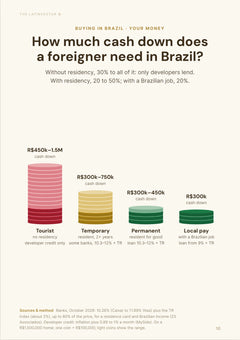
About half the price. Below that, the interest alone stays above the rent at today's private-bank rates.
With 50% down on the same apartment, you borrow about R$366,200. First-month interest falls to about R$3,600, just under the R$3,950 rent.
Add SAC principal and the first payment is still about R$4,470 before insurance and TR. You're still paying more than a tenant each month, but the gap has gone from huge to manageable, and the extra is mostly savings.
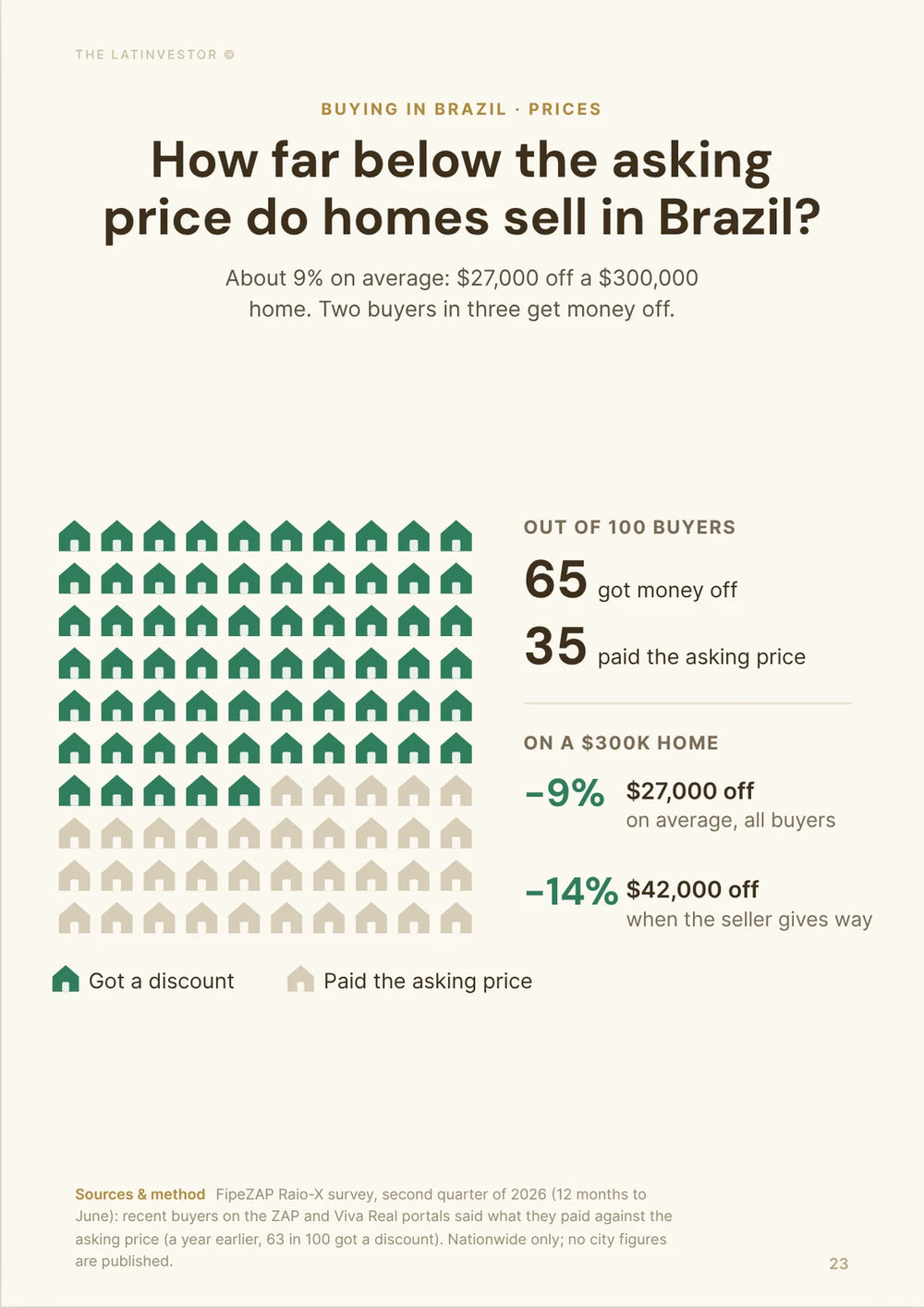
Negotiating helps on every line at once. 5% off saves about R$36,600; 10% off about R$73,200, and it cuts the down payment, the loan and the ITBI together. FipeZAP's buyer survey put the average discount at 9%, and 14% for buyers who got one.
What to do: if you can't put close to half down, the numbers only work with a cheap rate (Caixa or Minha Casa, Minha Vida) or a price well below asking.
| Down payment | Loan | First-month interest at 11.8% | Against about R$3,950 rent |
|---|---|---|---|
| 20% | R$585,900 | About R$5,760 | Clearly worse |
| 30% | R$512,700 | About R$5,040 | Worse |
| 40% | R$439,400 | About R$4,320 | Close |
| 50% | R$366,200 | About R$3,600 | Interest below rent |
| 60% | R$292,900 | About R$2,880 | Clearly better |
Is buying in São Paulo cheaper if you can pay cash?
Cheaper each month, yes. Better for your money, not yet, because cash still earns a lot in Brazil.
Without a loan, the apartment pays you back in rent you no longer pay: about 6.5% a year gross on the average 60 m² unit.
The same R$732,000 in fixed income earns close to the CDI, about 13.65% a year with the Selic at 13.75%. After the 15% income tax on investments held over two years, that's about 11.6%, or roughly R$85,000 a year, against about R$47,400 of rent saved.
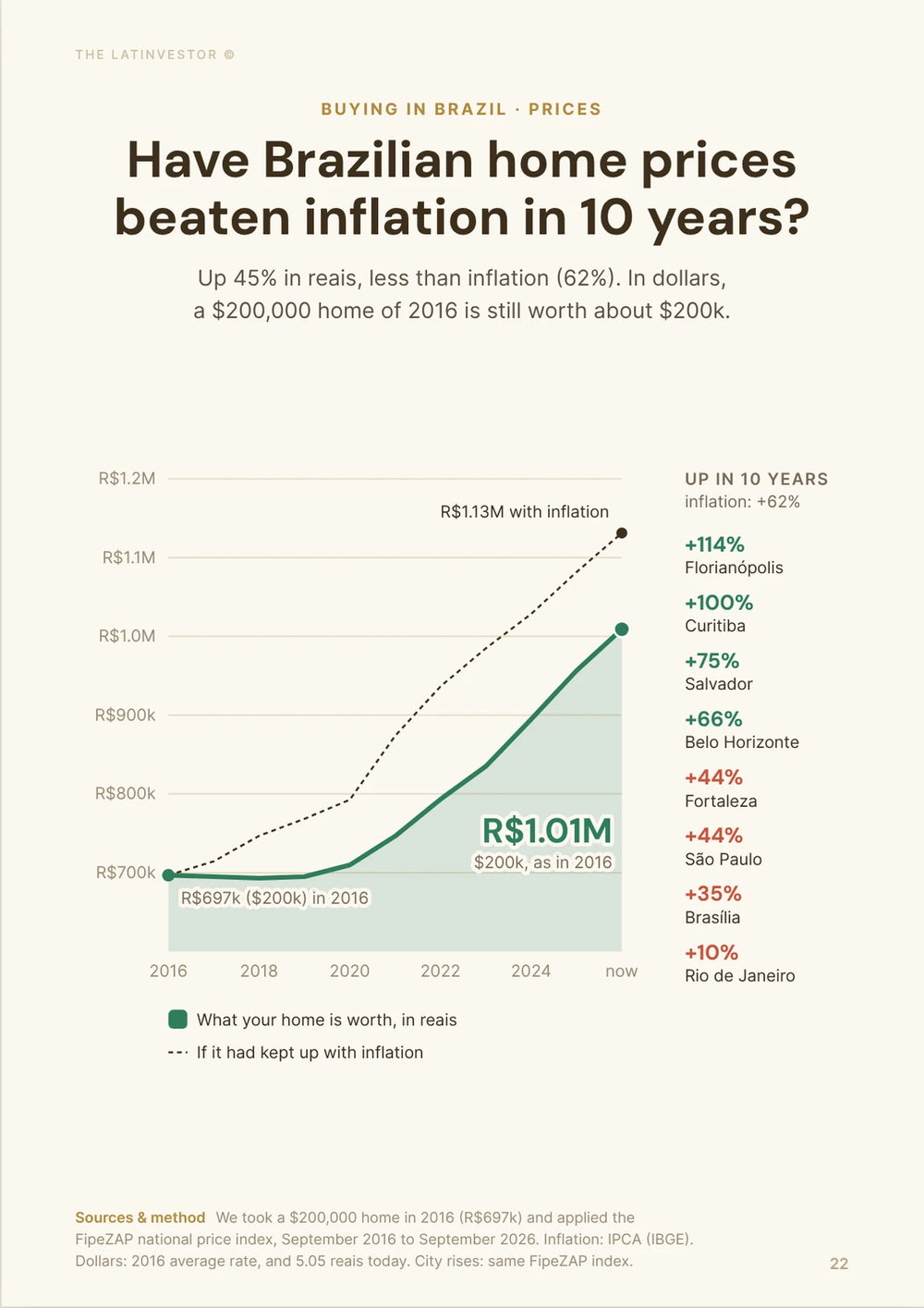
The apartment's answer to that is appreciation, and right now it's weak: São Paulo prices rose 3.64% in 12 months, below the 4.58% inflation rate.
So a cash buyer who wants security and plans to stay can reasonably buy. One who only looks at returns still does better renting while rates stay this high. The gap closes as the Selic falls.
What if you're a foreigner and can't get a Brazilian mortgage?
Then you're a cash buyer, and the question is whether a 6% to 6.5% rent saving beats what your money earns elsewhere.
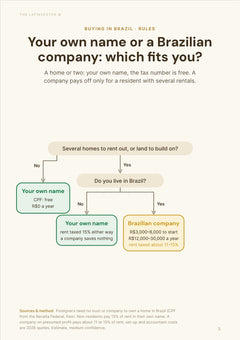
Foreigners can buy urban property in São Paulo in their own name with a CPF, but banks ask for Brazilian nationality, naturalization or permanent residency for a mortgage, and none of the big ones publishes a product for people living abroad. Foreigners with residency and Brazilian income can borrow like locals.
If you live in São Paulo part of the year, buying saves you rent in reais, which also protects you if the real moves (1 USD = 5.05 BRL in October 2026). If you plan to rent it out instead, a non-resident has 15% of the gross rent withheld at source, so a 6.43% gross yield becomes about 5.5% before any other cost.
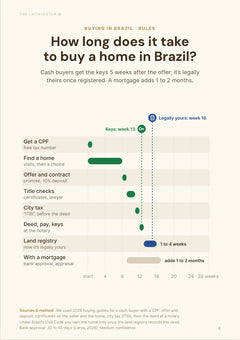
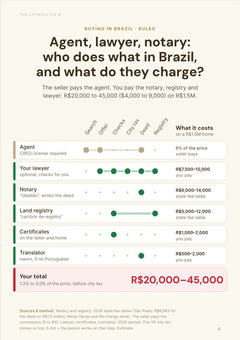
What to do: budget the full price plus 4% to 6% for buying costs (ITBI is 3% in São Paulo), and only buy if you'll keep it at least seven years. If you're staying one or two years, rent: a round trip costs 10% to 14% of the price.
Are São Paulo rents high enough to make buying attractive now?
They're high enough to make the math worth doing, especially if you borrow little or nothing.
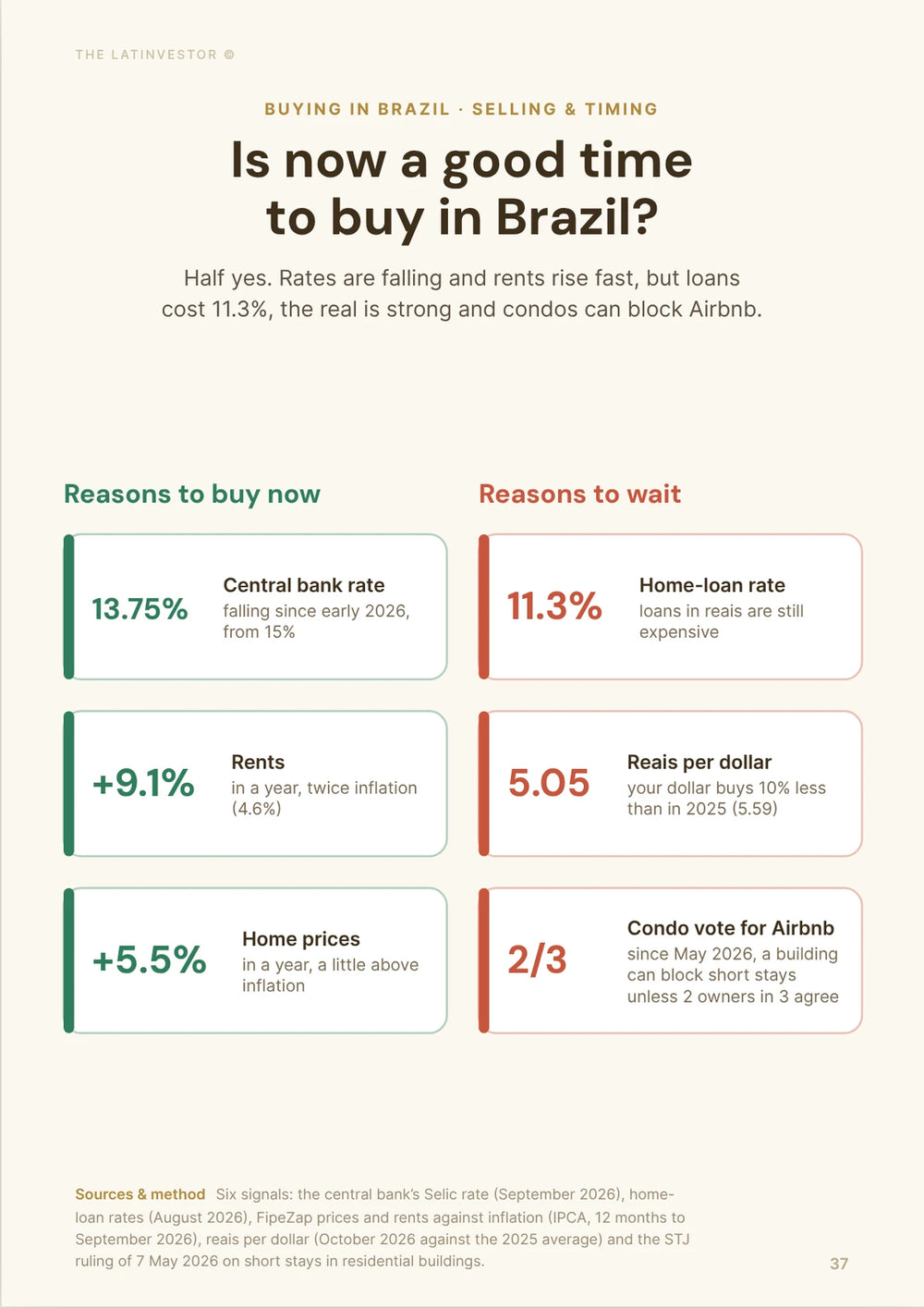
FipeZAP's citywide gross yield is 6.43%, up because rents have outpaced prices: +6.22% against +3.64% in the year to September 2026. Asking rents are about 65% above early 2022.
If that gap lasts a few more years, the math keeps moving toward buying. A R$3,950 rent growing 5% a year reaches about R$5,000 after five years; at 7%, about R$5,500.
But rent growth is slowing: it was 14.63% in 2022 and 6.22% now. Don't build a purchase on double-digit rent increases coming back.
The loan is still the obstacle: a 6% to 6.5% gross yield justifies a cash purchase far more easily than a mortgage at 11.8% plus TR.
Which São Paulo neighborhoods make buying look better than renting?
The ones where rents are high compared with prices, and the spread between districts is big enough to flip the answer.
In FipeZAP's September 2026 data, Pinheiros asks about R$18,260 per m² and rents for about R$100, a gross yield of 6.57%. Itaim Bibi asks about R$19,989 and rents for R$94, only 5.64%; Jardins is similar at 5.59%.
Centro and República look best on paper, at about R$9,810 per m² and R$65.60 of rent (A Corrida dos Bairros listings), close to 8%. But two buildings 300 meters apart there can have completely different security, upkeep and vacancy.
At 5.6%, it takes almost 18 years of rent to equal the price; at 8%, about 12.5. That changes the buy-or-rent answer before you even pick the apartment.
What to do: compare rent-to-price, not just price per m². A Pinheiros flat near the metro can make more sense to buy than a pricier Itaim Bibi one, even though Itaim Bibi has the better name.
| São Paulo neighborhood | Asking price R$/m² | Asking rent R$/m² | Gross yield |
|---|---|---|---|
| Itaim Bibi | 19,989 | 94 | 5.64% |
| Jardins | 18,028 | 84 | 5.59% |
| Pinheiros | 18,260 | 100 | 6.57% |
| Moema | 16,520 | 85 | 6.17% |
| Vila Mariana | 14,879 | 73 | 5.89% |
| Centro / República* | 9,810 | 65.6 | About 8% |
*Centro / República: A Corrida dos Bairros listing data, October 2026. Other rows: FipeZAP, September 2026.
Are small São Paulo apartments better to buy than bigger ones right now?
On rent per m², yes. On resale risk, not always: studios are where unsold stock is piling up.
Tenants pay much more per m² for small units. QuintoAndar Imovelweb had one-beds at R$91.14 per m² against R$66.68 for two-beds, because the monthly total stays affordable.
A compact apartment bought for R$350,000 that rents for R$2,000 a month replaces about 6.9% of its price in rent each year. A R$2 million apartment renting for R$9,000 replaces only 5.4%.
The catch is supply. In the mid- and high-end segment, unsold new units of up to 30 m² rose 71% in the year to June 2026, to about 10,900, about 12 months of sales, and many were bought by investors who'll compete for the same tenants and buyers when they're finished. Condo fees are also heavy per m² in studio towers (Loft puts the citywide average at R$842 a month, all sizes).
What to do: if you want a small place to live in, look for a 35 to 50 m² unit in an older building near a metro line, not a 25 m² studio in a tower full of identical ones.
Do condo fees, IPTU and buying costs change the São Paulo calculation?
Buying and selling costs do; condo fees and IPTU mostly don't.
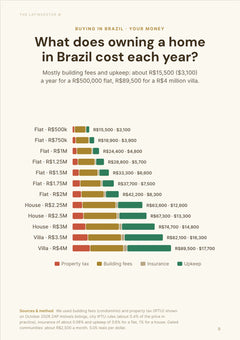
On a normal long lease, the tenant pays condo fees and IPTU (Lei do Inquilinato, art. 23). So adding them only to the owner's side gives a wrong answer.
If rent is R$3,950, the condo fee R$842 and IPTU, say, R$250, the tenant pays about R$5,040 a month. The owner pays the same R$842 and R$250, so they cancel out.
The owner still carries extra risk: special assessments (chamadas extras), facade or lift works and major repairs fall on the owner, not the tenant.
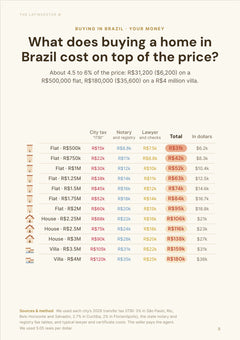
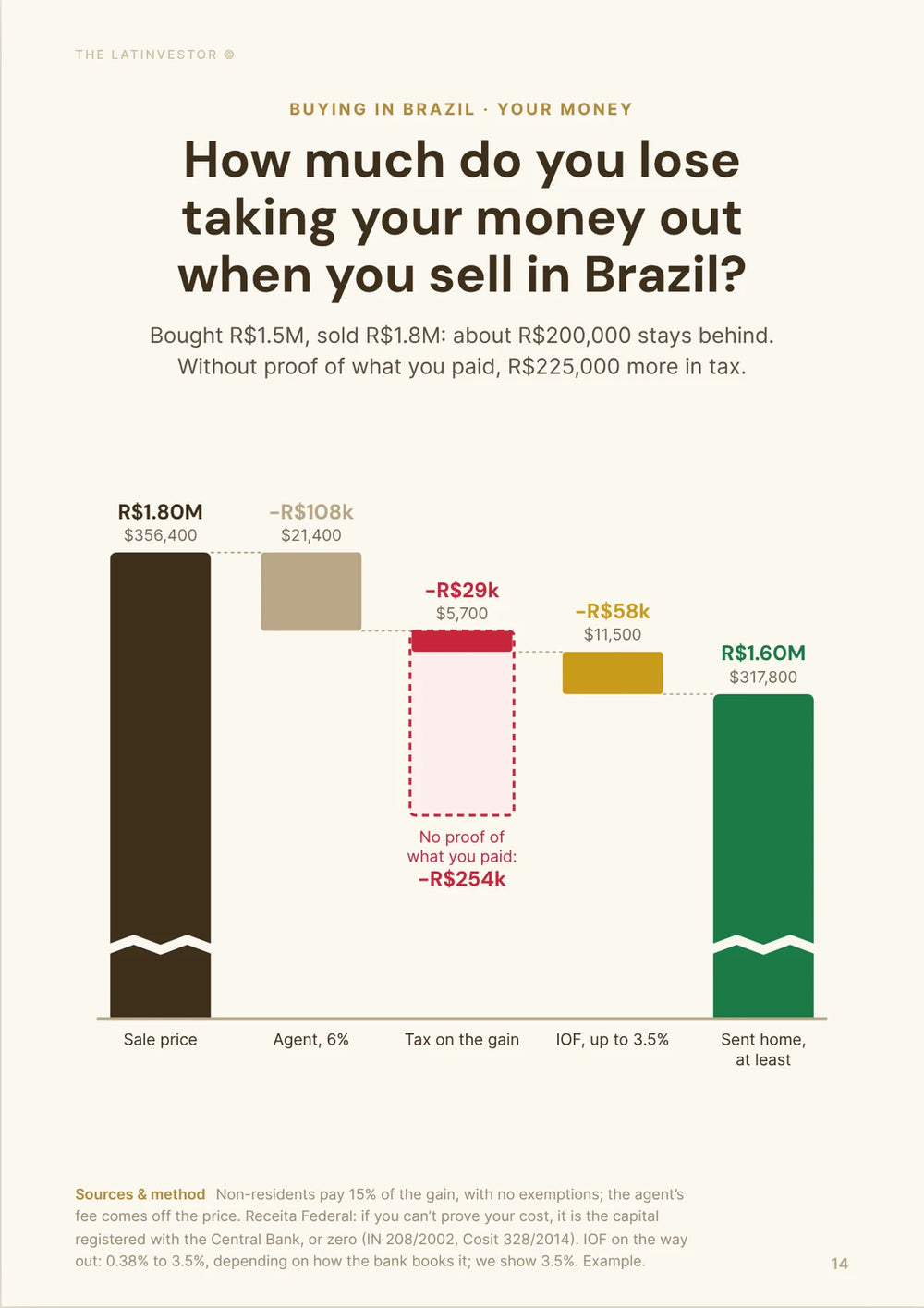
The big cost comes at the sale. São Paulo's ITBI is 3%, about R$22,000 on a R$732,000 apartment. The reduced 0.5% rate only applies to part of an SFH loan on homes up to R$725,808, so our average 60 m² flat just misses it. With registration and notary, buying costs run 4% to 6%; selling later adds a 6% to 8% agent fee.
That's 10% to 14% of the price for a round trip, roughly two years of rent. Over three years it's hard to recover; over 15 years it barely matters.

How long do you need to live in São Paulo before buying starts to make sense?
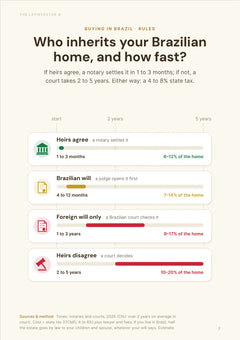
With a normal mortgage, at least seven to ten years.
Before that, you're paying for ITBI, registration, expensive early interest and the return your down payment could have earned. In the first years of a SAC loan, most of each payment is still interest.
At three years, those costs win easily. At five, buying still looks weak unless you bought well below asking or prices jumped.
At ten years, buying costs are spread thin, rent has had time to rise, the loan balance has dropped a lot and you own a real share of the apartment.
If you already expect to leave São Paulo, move neighborhoods or need a bigger place within a few years, rent.
Would lower mortgage rates make buying cheaper than renting in São Paulo?
Yes. Around 8%, the interest on the same loan is roughly the rent.
On the same R$585,900 loan, first-month interest is about R$4,880 at 10%, R$3,900 at 8% and R$3,420 at 7%.
That's about where Caixa already is (7.98% plus TR on average in September 2026), which is why Caixa borrowers are the São Paulo buyers closest to parity.
São Paulo doesn't need a price crash for buying to win. A few points off mortgage rates would do most of the work. But mortgage rates follow the Selic slowly and only partly, so don't count on a matching fall.
| Mortgage rate | First-month interest on R$585,900 | Against about R$3,950 rent |
|---|---|---|
| 11.8% (private banks, Sept. 2026) | About R$5,760 | Much higher |
| 10% | About R$4,880 | Higher |
| 8% (close to Caixa's average) | About R$3,900 | Roughly level |
| 7% | About R$3,420 | Lower |
| 6% | About R$2,930 | Clearly lower |
Should you wait for the next Selic cuts before buying in São Paulo?
If you need a loan, waiting a few months costs you little. Just don't expect a big drop in mortgage rates this year.
The Copom cut the Selic to 13.75% in September 2026 and meets again on 3-4 November. The Focus survey expects only 13.25% by the end of 2026. The presidential runoff on 25 October can move markets either way.
A new savings-funded mortgage model starts in January 2027, with a 12% cap on SFH loans for homes up to R$2.25 million. That cap is above what private banks charge today, and banks asked in August 2026 to revise it, so don't expect it to make loans cheaper.
Meanwhile prices are flat after inflation (−0.9% real in a year) and the market is full of new stock, so you're unlikely to miss a run-up. Your rent keeps rising, though, about 6% a year.
What to do: use the wait to get pre-approved at Caixa and one private bank, compare the total cost (CET), and look at resale units that have been listed for months. Brazil allows moving a loan to a cheaper bank later (portabilidade), but treat that as a bonus, not a plan.
Does Minha Casa Minha Vida make buying cheaper than renting in São Paulo?
In its lower bands, yes. In the new middle-class band, not really.
The program's limits were raised on 22 April 2026. Faixa 3 now covers families earning up to R$9,600 a month, for homes up to R$400,000; Faixa 4 covers incomes up to R$13,000, for homes up to R$600,000. Rates run from 4% to 8.16% in the traditional bands, and 10% in Faixa 4.
At R$400,000, you get about 33 m² at the city average. With 20% down and about 8.16%, first-month interest is about R$2,180, against about R$2,160 to R$2,990 of rent depending on whether you use FipeZAP or QuintoAndar's one-bed figures. That's level or better.
At R$600,000 in Faixa 4, you get about 49 m². At 10% with 20% down, first-month interest is about R$4,000, against about R$3,230 of rent. Better than the private banks, but still above rent.
Since MCMV units made up 71% of São Paulo's new-home sales in August 2026, there's plenty to choose from. If you qualify, run the numbers separately; they're nothing like a private-bank loan.

Is a resale apartment a better deal than a new São Paulo apartment?
For beating rent, usually yes, and this year more than usual.
New buildings carry a premium for amenities, layouts and marketing that tenants rarely pay back in rent. If a new unit costs R$18,000 per m² and a similar resale one nearby R$14,000, that's a 29% premium; if it rents for only 10% to 15% more, you're paying a lot of capital for little extra rent.
Off-plan has its own problem in 2026: unsold new stock in the city reached 98,018 units in August, up 50.7% in a year, and the INCC construction index (which adjusts off-plan installments) rose 6.66% against 3.64% for prices.
With resale, you see the real condo fee, the building's accounts and reserve fund, the noise and the upkeep. And a private seller is often more flexible than a developer protecting the price list of a whole project.
A new apartment can still be the better home. But if your goal is to pay less than rent, the new-build premium is the first thing to avoid.
Does property appreciation rescue the case for buying in São Paulo?
Not right now. Prices are rising more slowly than inflation.
São Paulo asking prices rose 3.64% in the 12 months to September 2026, against 4.58% inflation: about −0.9% in real terms. Hasta's FipeZAP-based model expects about 3.7% over the next year.
Any plan that only works with 8% to 10% a year of price growth isn't supported by today's data.
Long-term owners still gain: even 3% to 5% a year adds up over a decade, on top of rent saved and principal repaid.
Over three years, that modest growth gets eaten by ITBI, registration, the agent's fee and interest. Over 15 years, it has time to count.
What happens if a São Paulo renter actually invests the down payment?
With rates this high, a renter who invests the difference usually comes out ahead.
Our financed buyer puts in about R$146,500 plus buying costs. The renter keeps it in fixed income at close to the CDI.
The renter also starts with about R$3,200 a month less to pay in our 20%-down example. Investing even part of that builds up fast with the Selic at 13.75%.
It only works with discipline. The buyer saves automatically through the principal on each payment. A renter who spends the down payment and the monthly gap loses the whole advantage.
So, buy or rent in São Paulo: what's the verdict?
Rent, if you'd need a normal mortgage with 20% to 30% down. Buying is close only with a lot of cash, a cheap loan or a long stay.
An average 60 m² apartment costs about R$732,000 to buy and about R$3,950 a month to rent. That ratio has moved toward buyers because rents keep rising faster than prices.
The loan keeps renting ahead: about R$7,160 for the first payment with 20% down at private-bank rates, and buying costs make short stays even worse.
The answer changes with the buyer. With about 50% down, buying gets close. With Caixa or MCMV's lower bands around 8%, it's roughly level. A resale flat bought 9% or more below asking in a 6.5%+ yield area beats the citywide average.
For now, borrowing 70% to 80% means renting. If you bring a lot of cash, stay ten years or more and buy well, it's a close call, and it gets better for buyers with every Selic cut. In São Paulo today, how you pay decides more than what you pay.
Our methodology
This article compares the monthly and long-term cost of buying versus renting the same apartment in São Paulo, for different down payments, mortgage rates, neighborhoods, apartment sizes and holding periods.
We used one reference apartment: 60 m² at FipeZAP's September 2026 city averages for asking price (R$12,206 per m²) and asking rent (R$65.78 per m²). Loan figures are our own simplified calculations: interest is the annual rate divided by 12, principal follows a 35-year SAC loan, and insurance, TR and fees are left out. Neighborhood yields are asking rent × 12 divided by asking price.
Mortgage rates are the Banco Central's September 2026 averages by bank; the Selic and its next meeting date come from the Banco Central, and year-end expectations from the Focus survey. Minha Casa, Minha Vida limits and rates are those in force since 22 April 2026. Supply data come from Secovi-SP's August 2026 survey.
Rules come from São Paulo City Hall (ITBI), the Lei do Inquilinato (who pays condo fees and IPTU) and the Banco Central's housing-loan FAQ (conditions for borrowers). Buying costs of 4% to 6% and the 15% withholding on a non-resident's rent are the same as in our other Brazil articles.
We checked these figures in October 2026. Conversions use about 5.05 reais per US dollar and 5.65 reais per euro.
Limits: FipeZAP, QuintoAndar and A Corrida dos Bairros track asking prices and rents, not closing prices; the IPTU amount is an example, and your bank's actual rate depends on your profile. The net fixed-income return assumes the 15% tax rate for investments held over two years.
Key sources used for this analysis include the FipeZAP sale index (September 2026), the FipeZAP rental index (September 2026), FipeZAP neighborhood data (Hasta), the QuintoAndar Imovelweb rental index, A Corrida dos Bairros (República), the FipeZAP discount survey via Portas, Banco Central do Brasil mortgage rates, the Banco Central Selic decision (September 2026), the Banco Central Focus survey, the Banco Central housing-loan FAQ, the banks' request to revise the 12% cap, the April 2026 Minha Casa, Minha Vida limits, the MCMV Classe Média rules, Secovi-SP's August 2026 survey, Portas on studio stock, the Loft condo fee survey (Portas), INCC (FGV) via Partnr, IBGE IPCA, fixed-income returns and tax in 2026 (Patrimo), São Paulo City Hall's ITBI guidance and the Lei do Inquilinato.