Summary
Yes: a plain 40 m² apartment now asks about R$2,630 to R$3,010 a month (USD 521 to 596), which takes R$8,800 to R$10,000 of household income to stay near 30%. And it's not only a problem for low-income households.
The real pain is how far rents have already climbed: FipeZAP asking rents are about 65% higher than in early 2022, at R$65.78 per m² in September 2026.
Growth has slowed to 6.22% a year, but it still beats the 4.58% inflation rate, so renters keep losing ground.
On a long lease the tenant also pays condo fees and IPTU. With R$600 of charges, the income needed for that 40 m² flat climbs to about R$10,800 to R$12,000.
Near the job hubs it's worse: 40 m² in Pinheiros, Brooklin or Vila Olímpia takes about R$13,300 to R$15,500 of household income.
Cheaper districts are catching up. QuintoAndar had Campos Elíseos up 28.7% and Tucuruvi up 24.5% in a year, against 9% for the city.
Studios are cheap in total but the priciest per m²: R$91.14 for one-beds against R$66.68 for two-beds, so two people sharing a 50 m² flat pay far less each.
New tenants take the full hit. Listings close only 2.8% below asking, while sitting tenants on IGP-M leases got just 3.34% at renewal.
Incomes haven't kept up: household income per person in São Paulo state rose about 11% in 2025, against a 65% rent increase since 2022.
Supply is coming, but mostly small and subsidized: 154,769 launches in 12 months to August 2026, 77% of August launches under Minha Casa, Minha Vida, and unsold new stock up 50.7%.
Buying doesn't solve it with the Selic at 13.75%: a mortgage on an average 40 m² flat costs about R$3,840 a month in interest alone, against R$2,630 in rent.
Bottom line: rents are slowing, not falling. Your best levers are new studio towers with many empty units, renewals, and sharing a two-bed.


Why do São Paulo rents feel so expensive right now?
Because several years of increases have piled up, and rents are still rising faster than prices in general.
FipeZAP put the average São Paulo asking rent at R$65.78 per m² in September 2026, up 6.22% in 12 months. In early 2022 it was R$39.91, so asking rents are about 65% higher in less than five years.
QuintoAndar Imovelweb, which also uses signed contracts, gives a higher R$75.20 per m², up 9% over the 12 months to July 2026. The two indices measure different things, but they agree on the direction.
Slower growth on a much higher base is still growth. A 6% increase this year lands on top of the 14.63%, 13.28% and 11.51% of 2022, 2023 and 2024.
When does rent actually become unaffordable in São Paulo?
Roughly when rent alone takes more than 30% of household income.
That line isn't ours. Fundação João Pinheiro counts low-income urban households spending more than 30% of income on rent as having an excessive rent burden in Brazil's housing-deficit figures. São Paulo's own rules for HIS and HMP affordable rentals also cap rent at 30% of income (Decree 64.244/2025).
It's a benchmark, not a law of nature. Someone earning R$20,000 lives fine at 35%; someone earning R$4,000 doesn't. And the 30% is before condo fees and IPTU, which the tenant pays on a normal long lease (Lei do Inquilinato, art. 23).
How much do you need to earn to rent in São Paulo today?
About R$8,800 to R$10,000 a month of household income for a modest 40 m² apartment, rent only.
At FipeZAP's R$65.78 per m², 40 m² asks about R$2,630 (USD 521). At QuintoAndar's R$75.20, it's about R$3,010 (USD 596). Keeping that at 30% takes R$8,771 or R$10,027 a month.
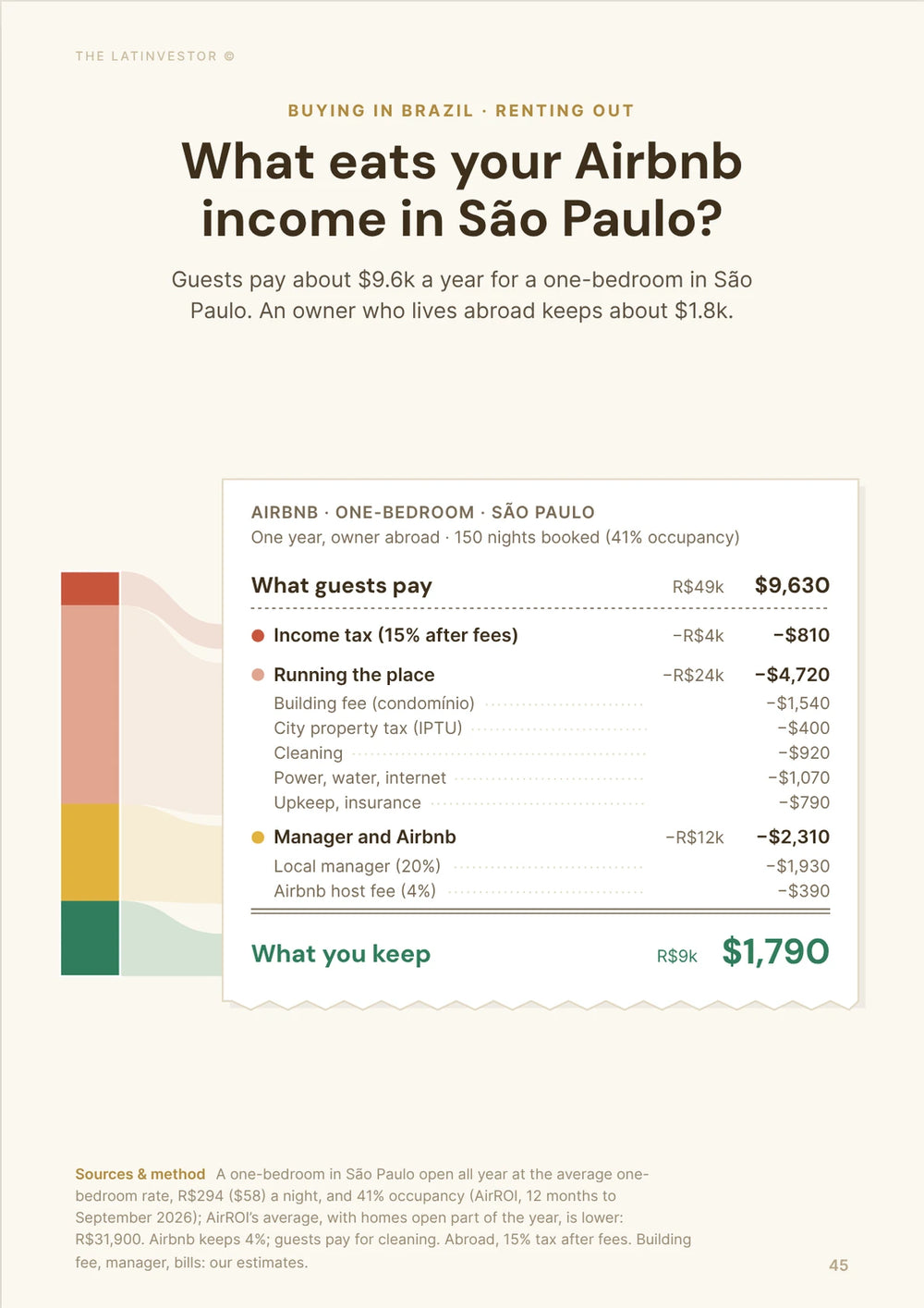
Then come the charges. If condo fees and IPTU add R$600 a month (our assumption for a small flat; Loft puts the citywide average condo fee, all sizes, at R$842), the household needs about R$10,800 to R$12,000 to keep total housing at 30%.
At 60 m², the income needed passes R$13,000 even on the lower FipeZAP figure.
| Apartment size | Rent at FipeZAP R$65.78/m² | Income needed at 30% | Rent at QuintoAndar R$75.20/m² | Income needed at 30% |
|---|---|---|---|---|
| 30 m² | R$1,973 | R$6,578 | R$2,256 | R$7,520 |
| 40 m² | R$2,631 | R$8,771 | R$3,008 | R$10,027 |
| 50 m² | R$3,289 | R$10,963 | R$3,760 | R$12,533 |
| 60 m² | R$3,947 | R$13,156 | R$4,512 | R$15,040 |
| 70 m² | R$4,605 | R$15,349 | R$5,264 | R$17,547 |
Are São Paulo rents still rising faster than inflation?
Yes, but the gap has narrowed. Asking rents rose 6.22% in the 12 months to September 2026, against 4.58% for IPCA inflation: about 1.6 points more.
The real damage was done in 2022 to 2024, when rents rose two to three times faster than prices. Those years aren't given back; they're baked into today's rents.
To repair affordability, rents would need to rise more slowly than incomes for years. A slowdown alone doesn't do that.
| Period | São Paulo asking rents (FipeZAP) | IPCA inflation | Gap |
|---|---|---|---|
| 2022 | +14.63% | +5.79% | +8.8 pp |
| 2023 | +13.28% | +4.62% | +8.7 pp |
| 2024 | +11.51% | +4.83% | +6.7 pp |
| 12 months to Sept. 2026 | +6.22% | +4.58% | +1.6 pp |
Is São Paulo's rent problem spreading beyond rich neighborhoods?
Yes. The highest rents are still in the west and south-center, but some of the fastest increases are in areas people used as cheaper alternatives.
In QuintoAndar's July 2026 neighborhood data, Vila Olímpia leads at R$116.50 per m², then Jardim Europa (R$113.20), Brooklin (R$109.30) and Pinheiros (R$105.40). FipeZAP's September figures are lower but rank the same areas on top: Pinheiros R$100, Itaim Bibi R$94.
The growth list is more telling. Alto de Pinheiros rose 46.2% in 12 months, but so did Campos Elíseos (28.7%), Centro (26.4%), Tucuruvi (24.5%), Vila Sônia (22.1%), Casa Verde (20.8%) and Jaguaré (20.5%).
Treat single-neighborhood jumps with care: a wave of new or furnished listings can lift an average without every flat gaining 25%. But a list that includes Centro, the North Zone and the West Zone shows the pressure isn't only in the rich core.
| Neighborhood | Rent per m² or 12-month rise (QuintoAndar, July 2026) | What stands out |
|---|---|---|
| Vila Olímpia | R$116.50/m² | Highest rent per m² in the city |
| Pinheiros | R$105.40/m² | 40% above the city average |
| Campos Elíseos | +28.7% | Mixed central area repricing fast |
| Centro | +26.4% | Studio-heavy center catching up |
| Tucuruvi | +24.5% | North Zone, end of metro Line 1 |
| Vila Sônia | +22.1% | West Zone, metro Line 4 |
| Casa Verde | +20.8% | Pressure beyond prime districts |
Are São Paulo studios still the cheap option for renters?
Cheaper in total, but the most expensive per m². QuintoAndar puts one-beds at R$91.14 per m² in July 2026, against R$66.68 for two-beds and R$67.39 for three-beds.
A 35 m² one-bed costs about R$3,190 a month. A 50 m² two-bed costs about R$3,334: 43% more space for R$144 more. Split between two people, that's about R$1,670 each.
Families have the opposite problem, and it's getting worse: two-bed rents rose 11.05% in 12 months and three-beds 12.80%, against 7.81% for one-beds. A 70 m² three-bed now costs about R$4,717 a month.
| Type | Rent per m² (July 2026) | Example size | Approx. rent | Income needed at 30% |
|---|---|---|---|---|
| 1 bedroom | R$91.14 | 35 m² | R$3,190 | R$10,633 |
| 2 bedrooms | R$66.68 | 50 m² | R$3,334 | R$11,113 |
| 3 bedrooms | R$67.39 | 70 m² | R$4,717 | R$15,724 |
How expensive is it to live near São Paulo's main job centers?
A 40 m² flat near the big office districts takes about R$13,300 to R$15,500 of household income, rent only.
In Vila Olímpia, at R$116.50 per m², 40 m² costs about R$4,660 a month, so a household needs about R$15,530 to stay at 30%. Pinheiros comes to about R$4,000 to R$4,216 depending on the index, or R$13,300 to R$14,000 of income.
That's the real trade-off in São Paulo: pay the premium, or pay with an extra hour of commuting. For middle-income workers, the price of living close to Faria Lima or Berrini now decides where they can live.
| Location | Rent per m² (QuintoAndar, July 2026) | 40 m² rent | Income needed at 30% | Premium vs city average |
|---|---|---|---|---|
| São Paulo average | R$75.20 | R$3,008 | R$10,027 | — |
| Pinheiros | R$105.40 | R$4,216 | R$14,053 | 40% |
| Brooklin | R$109.30 | R$4,372 | R$14,573 | 45% |
| Jardim Europa | R$113.20 | R$4,528 | R$15,093 | 51% |
| Vila Olímpia | R$116.50 | R$4,660 | R$15,533 | 55% |
Can São Paulo renters still escape high rents by moving farther out?
Yes, it still saves real money, but the cheap alternatives are getting less cheap.
Moving from Pinheiros (R$100 per m² in FipeZAP's September data) to an area at the city average (R$65.78) cuts about R$1,370 a month (USD 271) off a 40 m² rent.
The catch: Tucuruvi, Casa Verde and Vila Sônia, exactly the kind of areas that absorb people priced out of the center, rose more than 20% in a year in QuintoAndar's data.
What's getting rare isn't a cheap neighborhood. It's a cheap neighborhood with a metro station and a reasonable commute.
Who gets hit harder by São Paulo rents: new tenants or people already renting?
New tenants, by far. They pay today's market price, while sitting tenants move with the index in their lease.
The gap is wide right now. The IGP-M, still used in many leases, rose only 3.34% in the 12 months to September 2026. New asking rents rose 6.22%, and much more in some neighborhoods.
And new tenants don't get much off the asking price. QuintoAndar puts the average gap between asking and signed rent at 2.8%: about R$84 on a R$3,000 listing.
The result is a mobility penalty. A separation, a new job or a baby can push someone from an old contract straight into a much more expensive market.
Are São Paulo rents only unaffordable for poor households?
No. The poorest renters are in the worst shape, but today's rents also squeeze households most people would call middle class.
Excessive rent burden is the largest component of Brazil's housing deficit in Fundação João Pinheiro's work: lower-income urban households spending more than 30% of income on rent.
A household earning R$4,000 has R$1,200 for rent at 30%, under half of a 40 m² flat at the city average. A household earning R$8,000 has R$2,400, still below the R$2,630 to R$3,010 that same flat asks.
So you don't need to be poor anymore to find the open rental market in São Paulo hard.
Haven't São Paulo salaries risen enough to keep up with rent?
No. Incomes grew, but nowhere near as fast as rents since 2022.
IBGE put household income per person in São Paulo state at R$2,956 in 2025, up about 11% from R$2,662. At 30%, that's R$887 of rent per person.
Fipe's profile of the city estimated average household income at R$8,994, using 2023 IBGE data. It's older than the rent data, but it shows the order of magnitude: the average household sits around or below the R$8,800 to R$10,000 needed for a 40 m² flat.
Two incomes make São Paulo work for many couples. People living alone and one-income families are the ones hitting the wall.
If São Paulo is building so much housing, why are rents still high?
Because most of what's being built isn't what most renters are short of, and launches take years to become apartments.
Secovi-SP counted 154,769 launches in the 12 months to August 2026, up 25%, and 121,064 sales (Portas). In August, 77% of launches were Minha Casa, Minha Vida units.
Units of 30 to 45 m² made up 72% of launches in February 2026, 65% in March and 52% in May. That's a lot of small, subsidized flats on the outskirts, and few family apartments in Pinheiros, Moema or Perdizes.
Many of these units are also bought by owner-occupiers or end up as furnished or short-stay rentals, not on the long-term market.
| São Paulo new housing (Secovi-SP) | Latest reading | What it shows |
|---|---|---|
| Launches in 2025 | 139,700 | +34% vs 2024 |
| Launches, 12 months to Aug. 2026 | 154,769 | +25%, pipeline still growing |
| Sales, 12 months to Aug. 2026 | 121,064 | Strong demand despite record supply |
| MCMV share of Aug. 2026 launches | 77% | Mostly subsidized units |
| Unsold new stock, Aug. 2026 | 98,018 | +50.7% in a year |
| 30–45 m² share of launches | 72% (Feb.), 52% (May 2026) | Small units dominate |

Will São Paulo's studio boom eventually lower rents?
In studios, probably yes, and it's starting. Citywide, not yet.
Unsold new stock reached 98,018 units in August 2026, up 50.7% in a year. Builders are producing faster than buyers absorb, and many of those small units will end up for rent.
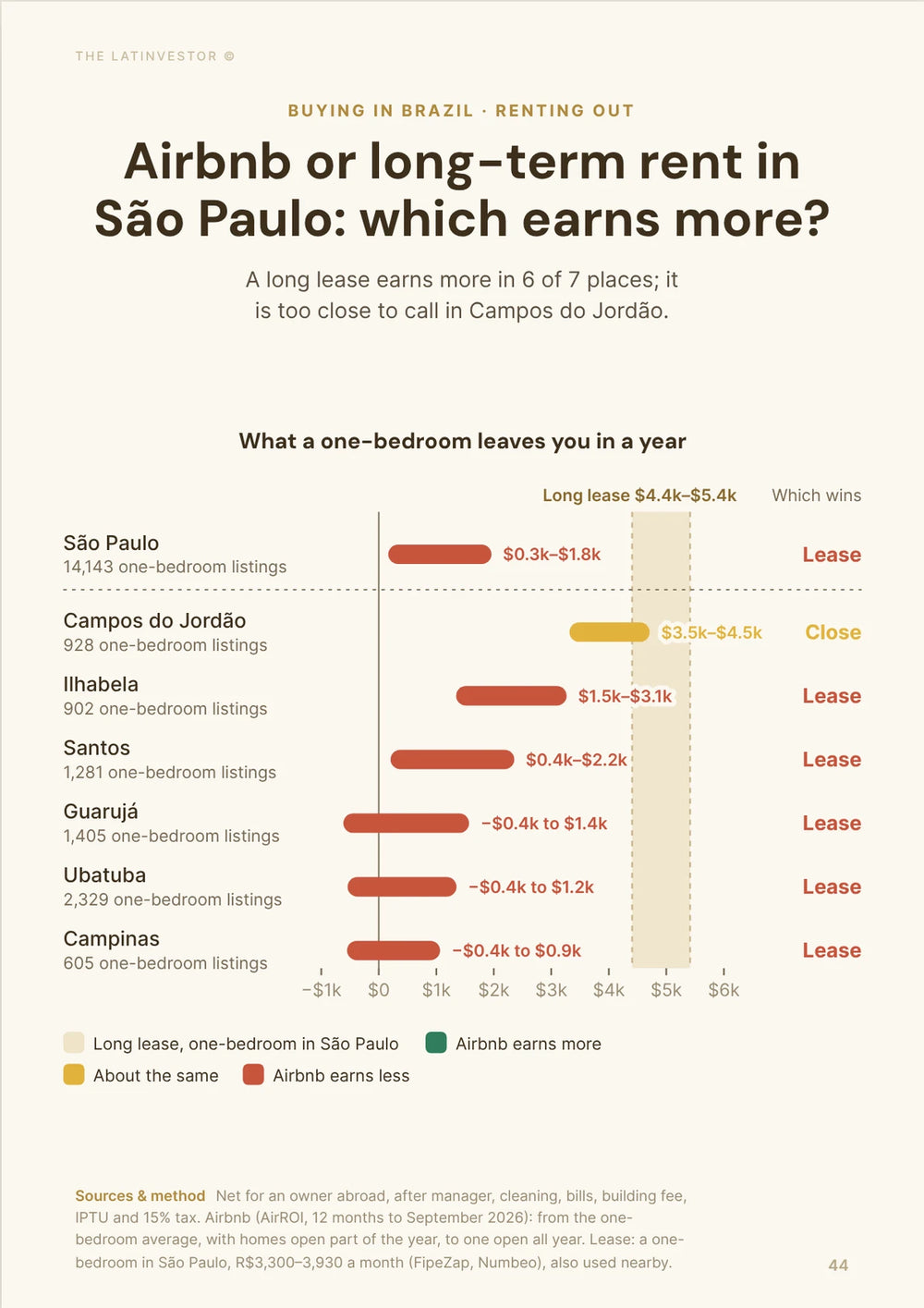
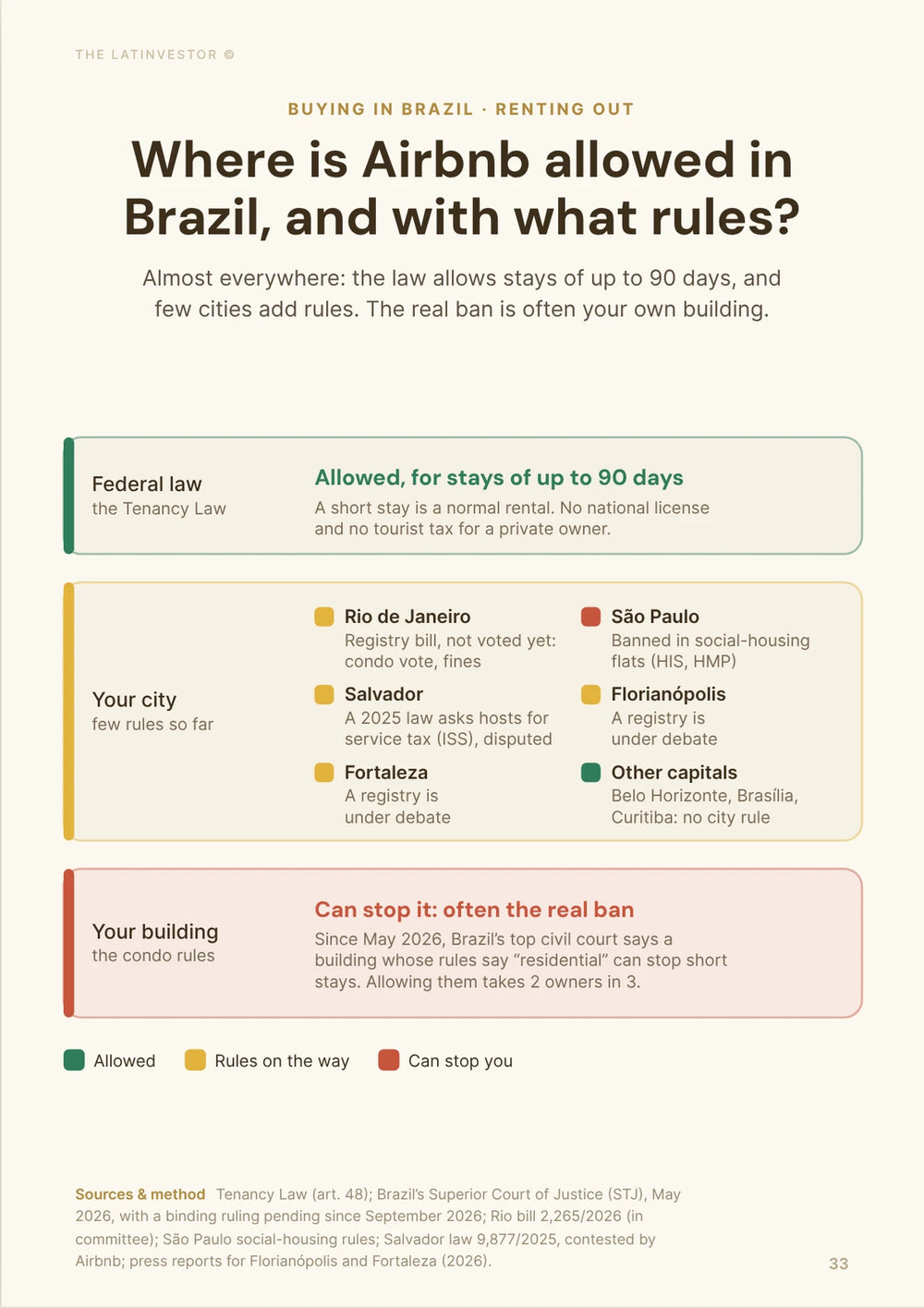
Short-stay demand is also shrinking for owners. In May 2026 the STJ ruled that a condominium can require two-thirds of owners to approve offering units on platforms like Airbnb. Studios that can't go on Airbnb land on the long-term market, next to the new ones being delivered.
Ten owners renting identical 30 m² studios in the same tower have little pricing power. The owner of a scarce three-bed in Perdizes still has plenty.
Are São Paulo rents finally starting to cool?
The pace is cooling, the prices aren't. FipeZAP's annual rise went from 14.63% in 2022 to 6.22% in September 2026, but rents still rose 0.64% in September alone.
QuintoAndar's 9% for the 12 months to July 2026 is stronger, partly because it includes signed contracts. Neither index shows a fall.
Real relief would look different: incomes beating rents for several years, bigger discounts off asking prices and falling rents across many neighborhoods. None of that is in the data yet.
Is it cheaper to rent or buy in São Paulo with the Selic at 13.75%?
Renting is clearly cheaper month to month. An average 40 m² apartment asks about R$488,000 to buy (FipeZAP, R$12,206 per m² in September 2026) and R$2,630 a month to rent.
Financing 80% at the private banks' average of about 11.8% plus TR costs about R$3,840 a month (USD 760) in interest alone in the first year, before repaying any capital. Caixa is cheaper (around 8% plus TR) but mostly for Brazilians within its program limits, and you still need about R$97,600 down plus 4% to 6% of purchase costs.
The Copom cut the Selic from 14% to 13.75% on September 16, 2026, and the market only expects 13.25% at the end of 2026. Mortgages won't get cheap soon, which keeps many would-be buyers renting and supports rents.
What to do: if you can't buy cash, rent and lock a 30-month lease. Buying starts to make sense only if you plan to stay many years or can pay without a loan.
How can you pay less rent in São Paulo right now?
Go where landlords are competing: new studio towers with several units listed at once. That's where the 50.7% jump in unsold stock and the STJ Airbnb ruling hit first.
Before you sign, count the competing listings in the same building and block. If a unit has been listed for more than a month, ask for a lower rent or a free first month; the average 2.8% discount is a floor, not a ceiling, in those buildings.
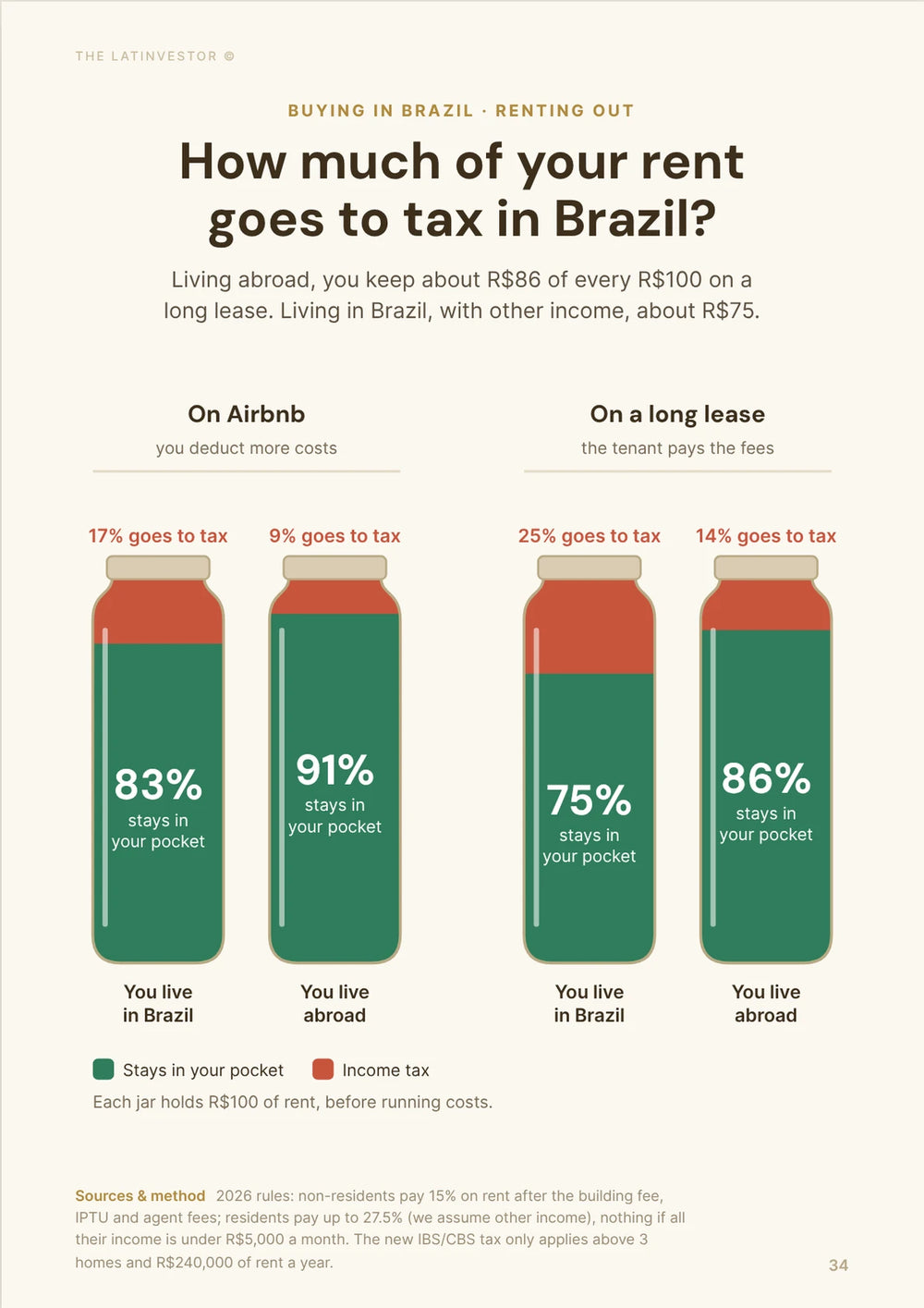
If you already rent, compare your rent with similar listings before renewing. Below market? Accept a modest IGP-M or IPCA increase on a longer lease instead of moving. Over market? Ask for a cut; after three years either side can go to court to bring the rent to market (ação revisional).
Check the full monthly bill, not just the rent: condo fee and IPTU are yours on a long lease. And a landlord can't ask for more than three months of rent as a deposit.
So, are São Paulo rents becoming unaffordable?
Yes. A modest 40 m² apartment takes R$8,800 to R$10,000 of household income at 30%, rent only, and closer to R$12,000 once condo fees and IPTU are in. Near Pinheiros, Brooklin or Vila Olímpia, it's R$13,300 to R$15,500.
Rents are up about 65% since early 2022 and still rise faster than inflation. Incomes rose too, but not enough to close that gap, and new tenants get little off the asking price.
Relief is building in one corner: small units in new towers, where unsold stock is up 50.7% and short-stay rules are tightening. Family-size apartments in good areas keep getting more expensive.
For most renters, São Paulo works today with two incomes, a shared two-bed, a longer commute or a hard negotiation in a half-empty tower.
Our methodology
This article estimates how much household income it takes to rent in São Paulo, how fast rents are rising against inflation and incomes, where the squeeze is worst, and whether supply could bring relief.
Citywide rents come from FipeZAP's September 2026 rental report (asking rents on new listings) and QuintoAndar Imovelweb's July 2026 São Paulo index (listings and signed contracts), with neighborhood and bedroom figures from QuintoAndar and FipeZAP neighborhood data reproduced by Hasta. The incomes needed are our own calculations: rent per m² × size ÷ 30%. The R$600 of monthly charges is an assumption for a small flat, set against Loft's citywide average condo fee. Purchase prices come from FipeZAP's sale report and mortgage rates from the Banco Central do Brasil.
Inflation comes from IBGE (IPCA) and FGV (IGP-M), incomes from IBGE and Fipe, and new-housing supply from Secovi-SP's monthly survey (August 2026). Rules come from the Lei do Inquilinato (charges, deposit, ação revisional), Fundação João Pinheiro's housing-deficit method and São Paulo's HIS/HMP decrees for the 30% benchmark, and the STJ's May 2026 ruling on short stays.
We checked these figures in October 2026. Conversions use about 5.05 reais per US dollar and 5.65 reais per euro.
Limits: FipeZAP shows asking rents, not what sitting tenants pay. QuintoAndar's sample leans toward the areas where it is strong, and single-neighborhood jumps can reflect a change in the mix of listed units. Fipe's household income figure uses 2023 data.
Key sources used for this analysis include FipeZAP rental report (September 2026), FipeZAP sale report (September 2026), FipeZAP rental report (December 2024), QuintoAndar Imovelweb rental index, QuintoAndar rent per m² by São Paulo neighborhood, FipeZAP neighborhood data (Hasta), Loft condo fee survey (Portas), Secovi-SP monthly survey, Portas on Secovi-SP's August 2026 survey, Secovi-SP May 2026 release, IBGE IPCA, FGV IGP-M, IBGE household income 2025, Fundação João Pinheiro housing deficit, São Paulo Decree 64.244/2025, São Paulo Decree 64.895/2026, Lei do Inquilinato, Banco Central do Brasil Focus.