Summary
In 2026, R$ 1,000,000 (about $198,000) buys roughly 100 sqm in São Judas or Saúde, but only 55 sqm in Pinheiros and 50 sqm in Itaim Bibi. In São Paulo, the neighborhood decides what you get more than the budget does.
The city average is R$ 12,206 per sqm (FipeZAP, September 2026, asking prices), so a 60 sqm apartment looks like R$ 732,000. In reality it runs from about R$ 600,000 in São Judas to R$ 1,200,000 in Itaim Bibi.
Mortgages are the other half of the problem. At private-bank rates around 11.8% plus TR, a household earning R$ 10,000 a month can borrow about R$ 256,000, which means a home of roughly R$ 320,000 with 20% down.
R$ 300,000 (about $59,400) gets you around 30 sqm in São Judas or Saúde and 15 to 20 sqm in the prime districts, so think small, older or further out.
R$ 500,000 (about $99,000) is where real one- and two-bedrooms show up: about 50 sqm in São Judas or Saúde against 34 sqm in Vila Mariana.
R$ 800,000 (about $158,000) buys a good apartment in much of the city, about 80 sqm in the cheaper metro neighborhoods, but only 48 sqm in Moema.
R$ 1,000,000 is still a big budget, except in Pinheiros, Moema and Itaim Bibi, where you pay 65% to 100% more per sqm than in São Judas.
Supply is piling up: Secovi-SP counted 98,018 unsold new homes in the city in August 2026, up 50.7% in a year, and mid- and high-end stock now takes about 13 months to sell. That gives buyers room to negotiate on new launches.
Going smaller doesn't save as much as you think: one-bedrooms ask R$ 12,260 per sqm on average across FipeZAP cities, 36% more than two-bedrooms at R$ 8,989.
Cash matters as much as salary. Each extra R$ 100,000 of savings raises your budget by R$ 100,000 and saves you borrowing it at double-digit rates. Minha Casa Minha Vida's new Faixa 4 lends at about 10% to families earning up to R$ 13,000, for homes up to R$ 600,000.
A foreigner who doesn't live in Brazil will almost always buy cash: $100,000 (R$ 505,000) is about 50 sqm in São Judas or Saúde, and R$ 1,000,000 is the amount needed for the RN 36 investor residency in São Paulo.
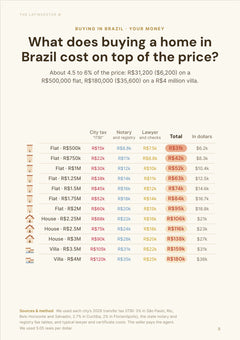
On top of the price, plan 4% to 6% in buying costs. ITBI alone is 3% in São Paulo, or about R$ 15,000 on a R$ 600,000 financed purchase.
Renting is often cheaper month to month: a 60 sqm flat in Pinheiros rents for about R$ 6,000, while the first mortgage payment on the same flat is about R$ 10,300.
With the Selic at 13.75% and prices up only 3.64% in a year (a small fall after inflation), there's no rush. The best deals come from flexibility: a few metro stops further out, an older building with healthy finances, or a negotiated price on unsold new stock.


Why does the São Paulo average tell you so little?
Because the gap between neighborhoods is huge: the same 60 sqm costs about R$ 600,000 in São Judas and about R$ 1,200,000 in Itaim Bibi.
FipeZAP puts the city at R$ 12,206 per sqm in September 2026, for apartments advertised for sale. That makes a 60 sqm apartment look like a R$ 732,000 purchase.
Move across the city and the math changes fast. October 2026 listing medians put São Judas at about R$ 10,000 per sqm and Saúde at R$ 9,868. FipeZAP has Vila Mariana at R$ 14,879, Moema at R$ 16,520, Pinheiros at R$ 18,260 and Itaim Bibi at R$ 19,989.
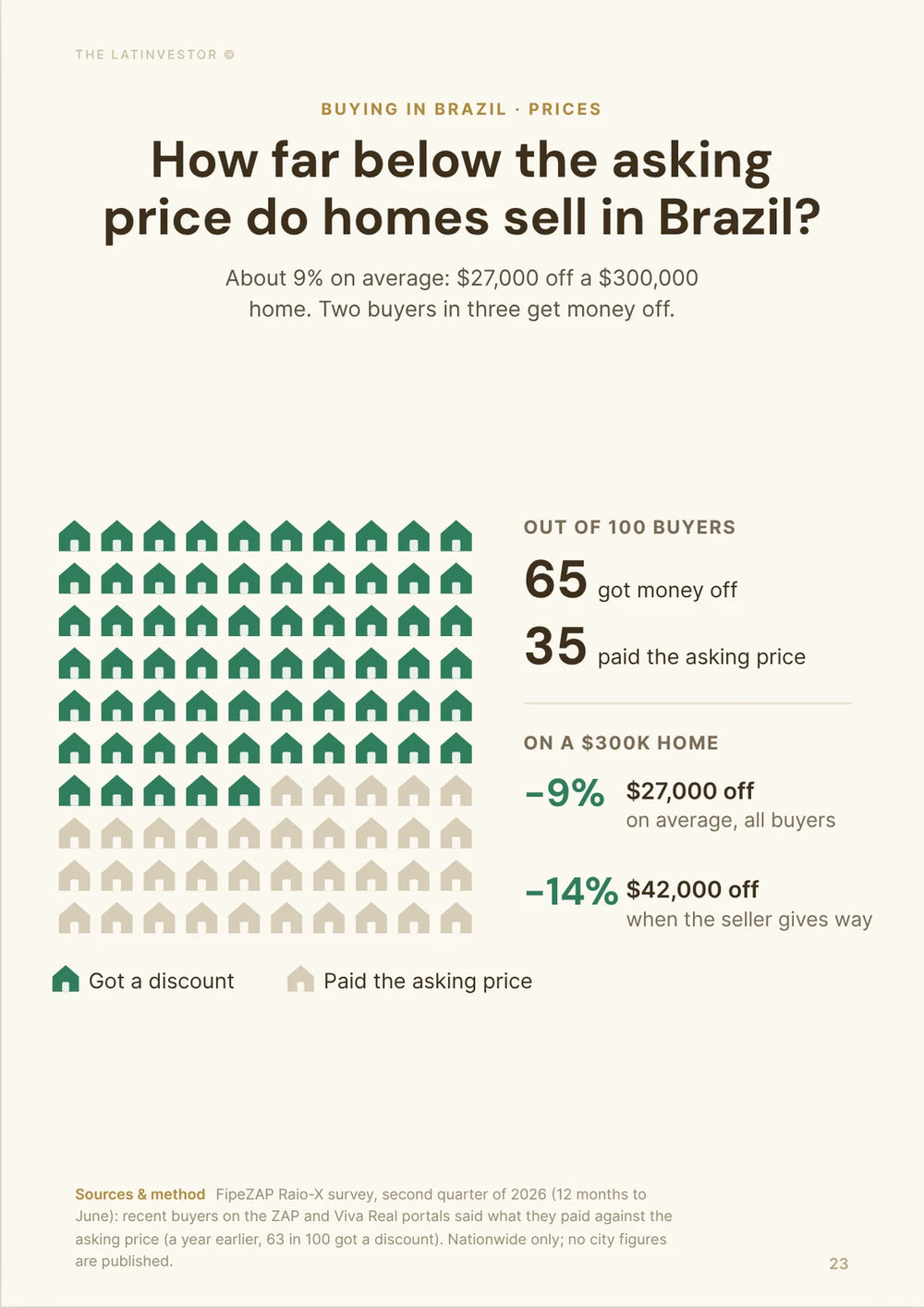
These are asking prices. FipeZAP's own buyer survey found an average discount of 9% across all sales, and 14% when the buyer got one. Then the building, the street, the floor, the parking space and the condition move the price again.
Financing adds another layer. Someone with R$ 700,000 in cash and someone who has to borrow 80% of it are not shopping in the same market. That's why we answer this by budget, income and neighborhood.
| Area | Asking price per sqm | Approx. cost of 60 sqm | Approx. cost of 80 sqm |
|---|---|---|---|
| Saúde | R$ 9,868 | R$ 592k | R$ 789k |
| São Judas | R$ 10,000 | R$ 600k | R$ 800k |
| City average | R$ 12,206 | R$ 732k | R$ 976k |
| Vila Mariana | R$ 14,879 | R$ 893k | R$ 1.19m |
| Moema | R$ 16,520 | R$ 991k | R$ 1.32m |
| Pinheiros | R$ 18,260 | R$ 1.10m | R$ 1.46m |
| Itaim Bibi | R$ 19,989 | R$ 1.20m | R$ 1.60m |
Can a middle-income household afford the average São Paulo apartment?
Not with a mortgage alone: at today's rates, a household earning R$ 10,000 a month can finance a home of about R$ 320,000, less than half the price of an average 60 sqm flat.
In September 2026, the Banco Central's data show housing loans at about 11.8% to 11.9% a year plus TR at Itaú, Bradesco and Santander. Caixa's average was lower, at 7.98% plus TR, but your real offer depends on your profile, the credit line, insurance and other charges.
Caixa also caps the monthly installment at 30% of gross household income. With rates in double digits, that cap bites hard.
Take R$ 10,000 a month. The cap leaves R$ 3,000 for the installment. On a 35-year SAC loan at 11.8%, that carries about R$ 256,000 of debt before TR, insurance and fees. With 20% down, that's a home of about R$ 320,000.
At R$ 20,000 a month, the same math reaches about R$ 640,000. At R$ 30,000, about R$ 960,000. Meanwhile, the city average already asks more than R$ 600,000 for 50 sqm.
So in São Paulo, the price of money hurts buyers as much as the price of apartments.
What can R$ 300,000 buy in São Paulo today?
R$ 300,000 (about $59,400) still buys an apartment, but you give up space, a central location or a newer building, often all three.
There's plenty of stock at this price in the outer east, north and south of the city, and small or older units in parts of the center. Far from the expensive southwest, compact two-bedrooms show up around this level.
At São Judas and Saúde prices, R$ 300,000 is about 30 sqm. In Vila Mariana it's 20 sqm, and in Moema or Pinheiros 16 to 18 sqm.
Real homes don't follow neighborhood averages exactly, and older buildings on weaker streets can ask far less. But the trade-off is clear: at this budget, look for a modest home, not a fashionable address.

What does a R$ 500,000 budget buy in São Paulo?
R$ 500,000 (about $99,000) is where you get a real choice of one- and two-bedroom apartments, not just entry-level stock.
At about R$ 10,000 per sqm, still common in established residential areas, R$ 500,000 means about 50 sqm. In cheaper districts and older buildings, 60 sqm or more is possible.
It also reaches neighborhoods on the metro without going to the edge of the city. São Judas and Saúde, both on Line 1, are good examples: about 50 sqm for this budget, against 34 sqm in Vila Mariana a few stations north.
If you want two actual bedrooms more than a prestigious address, that gap is hard to ignore.
Is R$ 800,000 enough for a good apartment in São Paulo?
Yes. R$ 800,000 (about $158,000) buys a good apartment in a large part of São Paulo, just not a big one in the priciest districts.
At R$ 10,000 to R$ 11,000 per sqm, which covers several established middle-class areas, it means about 75 to 80 sqm. Older buildings can give you more.
In Vila Mariana, at R$ 14,879 per sqm, the same money buys about 54 sqm. In Moema, about 48 sqm. In Pinheiros, about 44 sqm.
At this level, the question is no longer whether you can find a decent home, but what you put first: space, a short commute, a new building or the address.
| Budget | At R$ 10k per sqm | At R$ 15k per sqm | At R$ 20k per sqm | What changes most |
|---|---|---|---|---|
| R$ 300k | 30 sqm | 20 sqm | 15 sqm | Entry-level options |
| R$ 500k | 50 sqm | 33 sqm | 25 sqm | Two-bedrooms get easier outside prime areas |
| R$ 800k | 80 sqm | 53 sqm | 40 sqm | Good mainstream choice |
| R$ 1m | 100 sqm | 67 sqm | 50 sqm | Premium areas become realistic |
| R$ 1.5m | 150 sqm | 100 sqm | 75 sqm | Broad access to expensive districts |
Is R$ 1 million still a big housing budget in São Paulo?
Yes, R$ 1,000,000 (about $198,000) is still a strong budget, but in Pinheiros, Moema and Itaim Bibi it buys a fairly ordinary apartment.
Where prices sit around R$ 10,000 per sqm, R$ 1,000,000 buys about 100 sqm, a big apartment.
Around Faria Lima, it's a different story. At R$ 18,260 per sqm in Pinheiros and R$ 19,989 in Itaim Bibi, the same budget buys 50 to 55 sqm. Moema, at R$ 16,520, gives about 61 sqm.
Prices there are not running away either: FipeZAP shows Pinheiros down 0.3% over the past year and Itaim Bibi up 3.4%, while Moema rose 5.0%. You're paying for the address, not for momentum.
Is there too much new supply in São Paulo right now?
Yes, unsold new stock is building up, and that gives buyers of new apartments more room to negotiate than a year ago.
Secovi-SP's August 2026 survey counted 98,018 new homes for sale in the city, up 50.7% in a year. In the mid and high end, unsold stock now takes about 13 months to sell, against 7 months in 2024. In the 12 months to June 2026, mid- and high-end sales fell 21%.
The slowdown is sharpest at the top: Brain counted high-end and luxury sales down 39% in the first half of 2026, while launches fell 53%. In the R$ 600,000 to R$ 1,000,000 band, developers sold only 4.3% of their stock in June.
What to do with that: on a new or off-plan project, ask how many units are still unsold, push for a discount, a parking space or better payment terms, and compare with resale listings nearby. And check that the project has a patrimônio de afetação (a ring-fenced project fund) before you pay anything.
How much more space do you get by changing neighborhoods in São Paulo?
A lot: moving a few metro stops can give you 50% to 100% more space for the same money.
Take four neighborhoods in the south of the city. Saúde asks about R$ 9,868 per sqm and São Judas about R$ 10,000, while Vila Mariana is at R$ 14,879 and Moema at R$ 16,520.
With R$ 1,000,000, that's about 101 sqm in Saúde, 100 sqm in São Judas, 67 sqm in Vila Mariana and 61 sqm in Moema. Choosing Moema over São Judas costs you about 40% of the floor area.
And this isn't central São Paulo against a far-off suburb. São Judas has its own metro station, and Saúde is on the same Line 1 that runs through Vila Mariana.
| Neighborhood | Approx. R$ per sqm | R$ 600k buys | R$ 1m buys | R$ 1.5m buys |
|---|---|---|---|---|
| Saúde | R$ 9,868 | 61 sqm | 101 sqm | 152 sqm |
| São Judas | R$ 10,000 | 60 sqm | 100 sqm | 150 sqm |
| Vila Mariana | R$ 14,879 | 40 sqm | 67 sqm | 101 sqm |
| Moema | R$ 16,520 | 36 sqm | 61 sqm | 91 sqm |
| Pinheiros | R$ 18,260 | 33 sqm | 55 sqm | 82 sqm |
Does buying a smaller apartment save as much money as people expect?
No. Small apartments cost more per square meter, so cutting space by 30% won't cut the price by 30%.
FipeZAP's September 2026 data show one-bedrooms asking R$ 12,260 per sqm on average across its cities, against R$ 8,989 for two-bedrooms. That's about 36% more.
São Paulo has built a huge number of studios and compact units near metro stations and business districts. Investors, single people and renters all compete for them, which keeps their price per square meter high.
If you need two bedrooms, moving a few stops away usually beats squeezing into the smallest unit in the most expensive area. And if you're buying a studio to rent out, remember you're competing with a lot of new ones.
How much home can a R$ 10,000, R$ 20,000 or R$ 30,000 income actually finance?
At today's rates, R$ 10,000 a month makes you an entry-level buyer, R$ 20,000 opens much of the mainstream market, and R$ 30,000 gets you close to a R$ 1,000,000 home.
We used a simple 35-year SAC loan at 11.8% a year (about the private banks' September 2026 average), a first payment capped at 30% of gross income and 80% financing.
These are benchmarks, not bank quotes. TR, insurance, your age, existing debts and the actual offer can all lower the amount. At Caixa's lower average rate, the same income stretches further, about R$ 426,000 of home on R$ 10,000 a month, if you qualify for that line.
Doubling income from R$ 10,000 to R$ 20,000 moves the budget from about R$ 320,000 to R$ 640,000. At R$ 30,000, it reaches about R$ 960,000.
| Gross household income | 30% payment cap | Approx. loan | Approx. home with 20% down |
|---|---|---|---|
| R$ 5,000 | R$ 1,500 | ~R$ 128k | ~R$ 160k |
| R$ 10,000 | R$ 3,000 | ~R$ 256k | ~R$ 320k |
| R$ 15,000 | R$ 4,500 | ~R$ 384k | ~R$ 480k |
| R$ 20,000 | R$ 6,000 | ~R$ 512k | ~R$ 640k |
| R$ 30,000 | R$ 9,000 | ~R$ 768k | ~R$ 960k |
| R$ 50,000 | R$ 15,000 | ~R$ 1.28m | ~R$ 1.60m |
Does a bigger down payment change what you can afford in São Paulo?
Yes. With rates this high, savings change your options almost as much as salary does.
Say a household can comfortably borrow R$ 400,000. With R$ 100,000 of its own, it shops around R$ 500,000. With R$ 300,000, it can look at R$ 700,000 without borrowing another real.
Every R$ 100,000 you don't borrow is R$ 100,000 you don't pay double-digit interest on, plus TR and insurance.
FGTS helps eligible workers too: Caixa lets them use it for the down payment, to reduce the balance, to pay part of the installments or to pay off the loan, under the program's rules. Two buyers on the same salary can end up with very different homes because one has FGTS and savings and the other doesn't.
Can Minha Casa, Minha Vida change what you can afford in São Paulo?
For families who qualify, yes, mainly in the R$ 300,000 to R$ 600,000 range.
Since April 2026, the program has a Faixa 4 for families earning R$ 9,600 to R$ 13,000 a month, at about 10% a year, for homes up to R$ 600,000. Faixa 3 (R$ 5,000 to R$ 9,600) lends at 6.5% to 7.66% for homes up to R$ 400,000.
Take a couple earning R$ 10,000. At 11.8%, a R$ 3,000 payment carries about R$ 256,000. At 10%, it carries about R$ 290,000. That's R$ 34,000 more, before any FGTS.
That can move a household from a studio to a small two-bedroom, or closer to a metro line. It won't make Moema affordable on R$ 10,000 a month, and it's built for Brazilian families buying their first home, not for foreign investors.
Can a foreigner who lives abroad buy on these budgets?
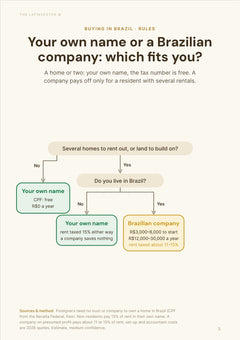
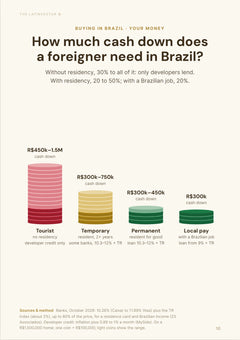
Yes, but almost always in cash: Brazilian banks usually ask for nationality, naturalization or permanent residency, so the income and FGTS math above doesn't apply to you.
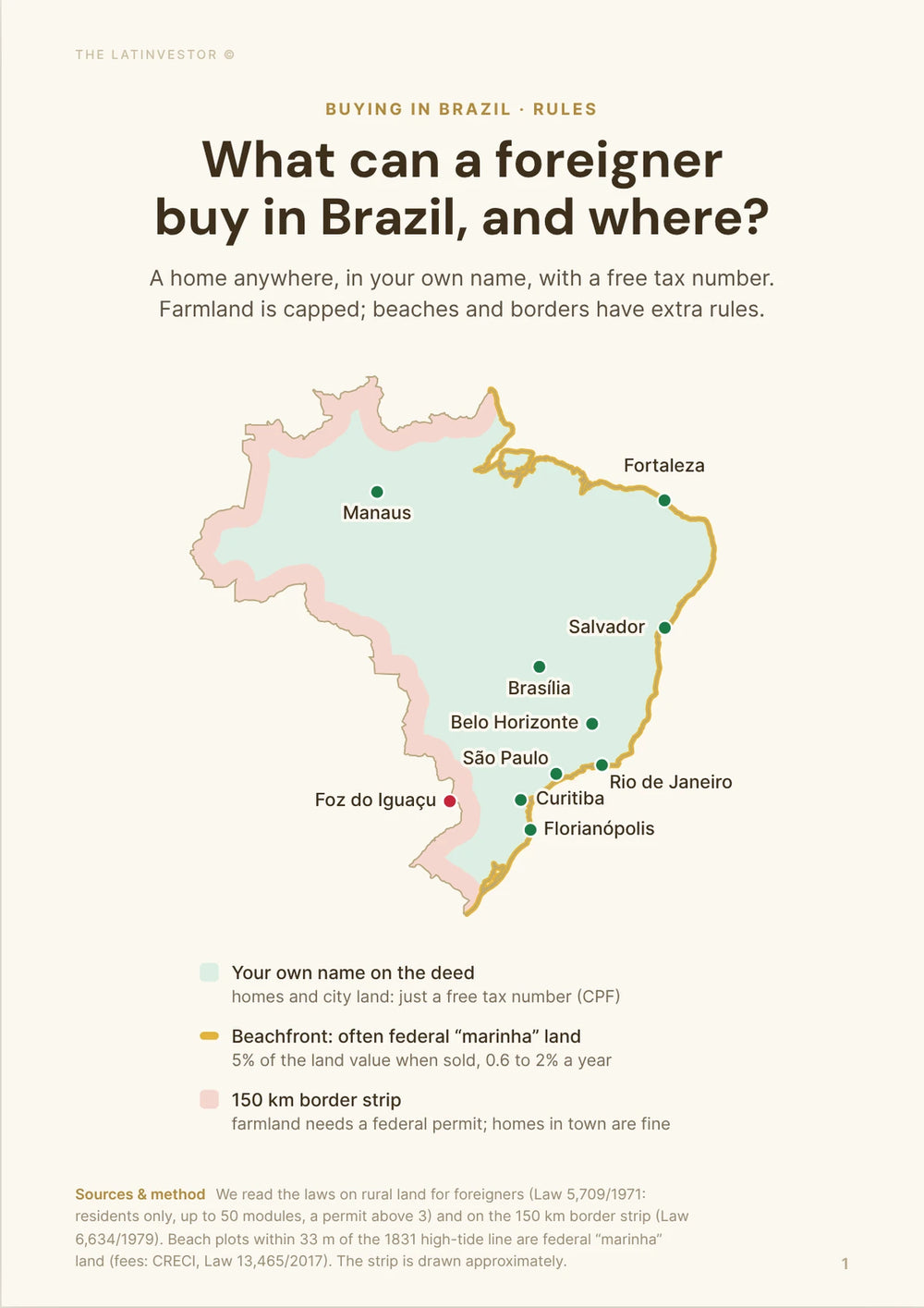
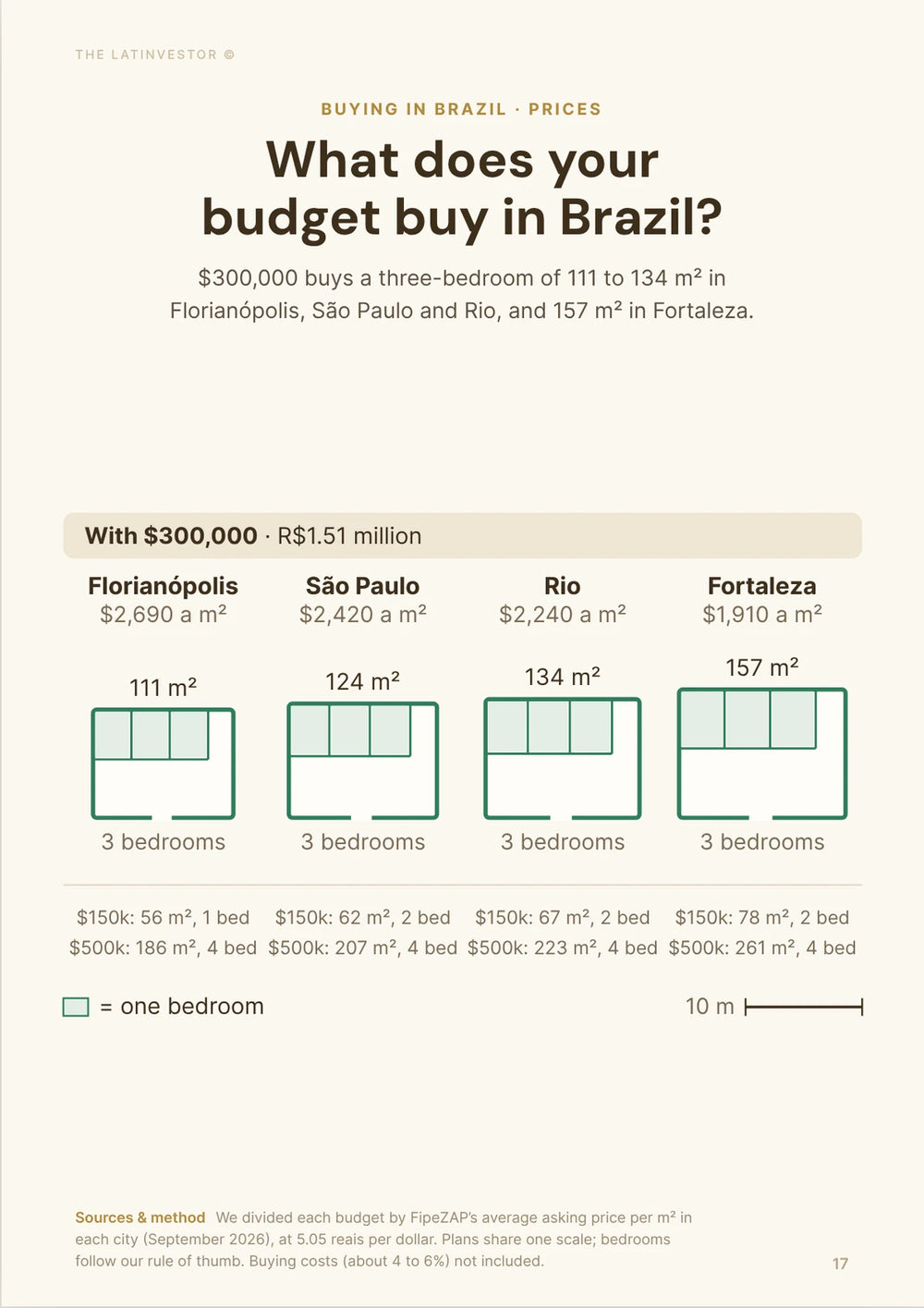
In dollars, $100,000 (R$ 505,000) buys about 50 sqm in São Judas or Saúde, 41 sqm at the city average and 34 sqm in Vila Mariana. $200,000 (R$ 1,010,000) gets you about 100 sqm in those metro neighborhoods or 55 sqm in Pinheiros. $300,000 (R$ 1,520,000) covers a two-bedroom in Pinheiros, where the October 2026 listing median was R$ 1,200,000.
R$ 1,000,000 is also the threshold for the RN 36/2018 investor residency in São Paulo (R$ 700,000 only applies in the North and Northeast). Buying doesn't give you residency automatically: you apply, with money sent from abroad through the proper channels.
Before you start, get a CPF (in person at a Brazilian consulate if you live abroad). If you plan to rent the flat out, 15% of the gross rent is withheld for a non-resident, so run your yield after that.
How much cash do you need besides the down payment in São Paulo?
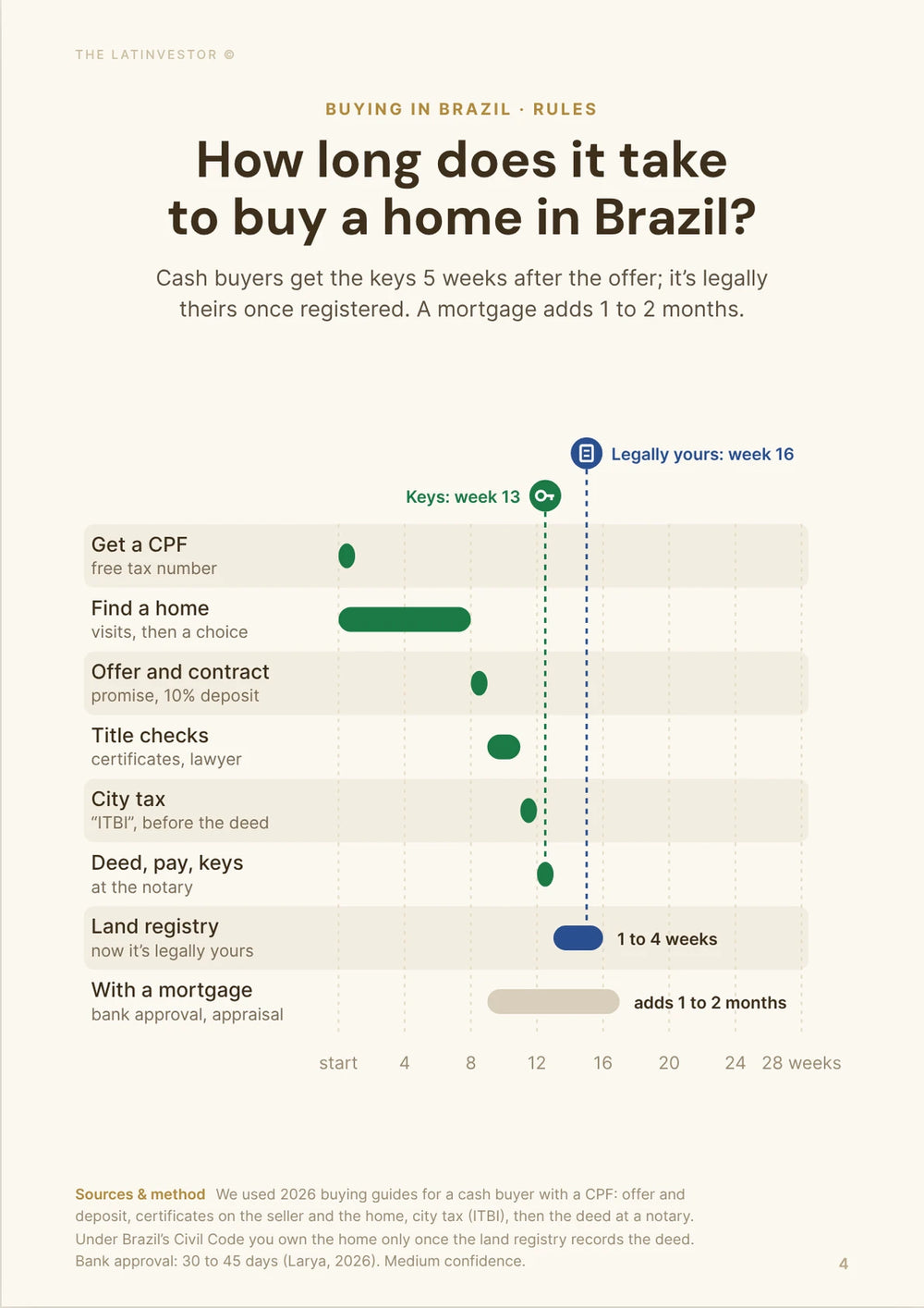
Plan 4% to 6% of the price on top of the down payment, plus money for furniture and repairs.
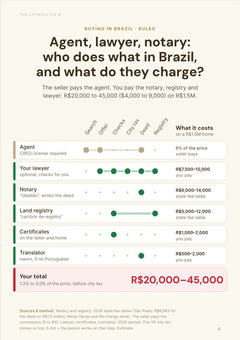
ITBI, the city's transfer tax, is 3%. For qualifying SFH, PAR and HIS purchases of homes up to R$ 725,808, São Paulo charges 0.5% on the financed amount up to R$ 120,968 and 3% on the rest. Other purchases pay 3% on the full taxable base.
On a R$ 600,000 qualifying SFH purchase with at least R$ 120,968 financed, the reduced rate saves only about R$ 3,000. ITBI still comes to about R$ 15,000.
Deed, registration, valuation and bank fees come on top. A resale flat may need work right after handover, and a new one often comes without lighting, appliances or kitchen cabinets.
| R$ 600k purchase example | Approx. cash needed | Why |
|---|---|---|
| 20% down payment | R$ 120,000 | Your share of the price |
| ITBI (qualifying SFH example) | ~R$ 15,000 | City transfer tax |
| All buying costs (ITBI, deed, registry, bank) | ~R$ 24,000 to R$ 36,000 | 4% to 6% of the price |
| Furniture or immediate work | Depends on the property | Often unavoidable after purchase |
| Cash reserve | Depends on you | So the purchase doesn't empty your savings |

Is moving farther from central São Paulo always the cheapest option?
No. A cheaper flat can end up costing more if you pay for it with long commutes, a car or high condo fees.
São Judas and Saúde work because they're much cheaper than Moema or Vila Mariana and still sit on the metro. You give up some prestige, not the train.
Compare that with a cheap flat far from any station. Two people commuting every day may need a car, spend a lot on ride-hailing or lose hours in traffic every week.
Condo fees can be the same trap. Some older complexes look cheap but carry big staff, maintenance and common-area costs. Look for cheap access, not just a cheap price.
Can an older apartment get you much more space in São Paulo?
Yes. Older buildings often give you a lot more usable space for the same money, if you're ready to renovate and check the building's finances.
Much of the older stock was built with bigger bedrooms, separate kitchens and larger living rooms. New projects, especially near transit, are mostly compact.
With R$ 700,000, you might compare a new 45 sqm unit with amenities against an older 70 to 90 sqm flat in the same part of the city.
The older one can be the better home, but check the condo fees, the elevators, the façade, the plumbing and the reserve fund. Ask for the latest condo meeting minutes and the budget: they tell you what big works are coming.
Should you buy in São Paulo now or wait for rates to fall?
There's no rush: prices are flat after inflation and rates are only starting to come down, so you can take your time and negotiate.
The Copom cut the Selic from 14% to 13.75% on September 16, 2026, and meets again on November 3 and 4. The Focus survey expects 13.25% at the end of 2026. Mortgage rates will follow slowly, not overnight.
Meanwhile, FipeZAP shows São Paulo asking prices up 3.64% over 12 months to September 2026, which is about 0.9% less than inflation. Rents rose 6.22% over the same period.
If you buy cash, the current slowdown and the unsold new stock are on your side. If you need a mortgage, waiting a few months may get you a slightly better rate, but don't count on a big drop in 2026.
Is renting currently cheaper than buying in São Paulo?
For most buyers who need a big mortgage, yes: renting the same apartment is usually cheaper month to month.
FipeZAP puts São Paulo asking rents at R$ 65.78 per sqm per month in September 2026. In Pinheiros it's about R$ 100, in Itaim Bibi R$ 94 and in Moema R$ 85.
A 60 sqm flat in Pinheiros, worth about R$ 1,100,000 at R$ 18,260 per sqm, rents for about R$ 6,000 a month. Financing 80% of it at 11.8% over 35 years means a first payment of about R$ 10,300, before condo fees, IPTU and the return you give up on your down payment.
Buying makes more sense with a big down payment, a long stay or a good price. But if you're stretching a mortgage just because rent "feels wasted", run the numbers: interest doesn't build equity either.
So what kind of home can you actually afford in São Paulo?
A decent one across a wide range of budgets, but you'll have to choose between space, location and how much expensive debt you take on.
Around R$ 300,000, think compact, older or further out. Around R$ 500,000 to R$ 700,000, real one- and two-bedrooms open up in many neighborhoods on the metro.
Around R$ 800,000 to R$ 1,000,000, you can find a comfortable apartment in much of the city, though the money shrinks fast in Pinheiros, Moema and Itaim Bibi. At R$ 1,500,000, the expensive districts are within reach, about 82 sqm in Pinheiros.
With a mortgage, about R$ 10,000 of household income buys an entry-level home unless you bring savings or subsidized credit, R$ 20,000 opens the R$ 600,000 market and R$ 30,000 gets close to R$ 1,000,000.
São Paulo doesn't have one affordability problem. It has a location problem for buyers who won't move, a financing problem for buyers with small down payments, and a space problem in the most wanted neighborhoods. Move a few metro stops, look at older buildings or bring more cash, and you'll get a much better home than the city average suggests.
Our methodology
This article estimates what kind of home a buyer can afford in São Paulo, by budget, by household income and by neighborhood, and what it costs on top of the price.
We divided each budget by asking prices per square meter: FipeZAP's September 2026 index for the city and the neighborhoods it covers (Vila Mariana, Moema, Pinheiros, Itaim Bibi), and A Corrida dos Bairros' October 2026 listing medians for Saúde and São Judas, which FipeZAP doesn't publish. The income examples use a 35-year SAC loan at 11.8% (the private banks' September 2026 average from the Banco Central), a 30% payment cap and 80% financing. Supply figures come from Secovi-SP (August 2026 survey, and June 2026 data via Banco Safra) and Brain, and rents from FipeZAP.
Rules come from São Paulo City Hall (ITBI), Caixa and the FGTS (financing and FGTS use), the Ministry of Cities and Caixa (Minha Casa, Minha Vida, rules in force since April 2026), the Ministry of Justice (RN 36/2018) and the Banco Central (Selic).
We checked these figures in October 2026 and used about 5.05 reais per US dollar and 5.65 reais per euro.
FipeZAP and listing sites show asking prices, not sale prices, and neighborhood averages hide big gaps between buildings and streets; the São Judas sample is small. The mortgage figures are benchmarks, not bank quotes, and the furniture and reserve lines depend on each buyer.
Key sources used for this analysis include FipeZAP sales index (September 2026), FipeZAP rental index (September 2026), FipeZAP methodology, FipeZAP Raio-X, A Corrida dos Bairros (Saúde), A Corrida dos Bairros (São Judas), Tô Em Casa, Hasta (FipeZAP rents by neighborhood), Secovi-SP August 2026 survey, Banco Safra on Secovi-SP data, Mercado&Consumo on Brain data, Banco Central lending rates, Banco Central (Copom), Caixa housing finance, FGTS housing rules, Portas on the 2026 Minha Casa Minha Vida rules, Ministry of Cities, São Paulo City Hall (ITBI), Ministry of Justice (RN 36/2018) and São Paulo Metrô Line 1.