
Authored by the expert who managed and guided the team behind the Brazil Property Pack
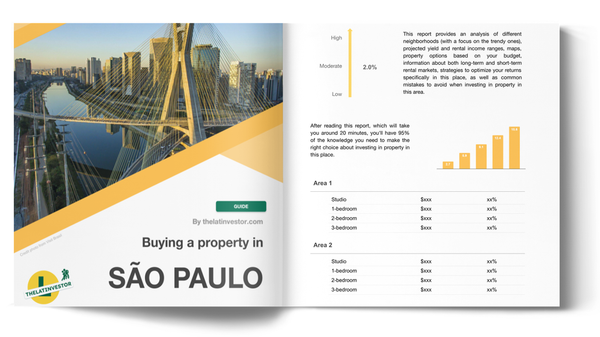
Get all the data you need about the real estate market in São Paulo
São Paulo rents in 2026 are still rising, but the market is very different from one neighborhood to another.
We constantly update this blog post because São Paulo rental prices move fast, especially near metro stations, business districts and universities.
This guide gives simple, practical rent ranges for residential apartments in São Paulo, so a non-professional landlord can understand the market without reading dozens of reports.
And if you’re planning to buy a property in this place, you may want to download our pack covering the real estate market in São Paulo.
What are typical rents in São Paulo as of 2026?
What's the average monthly rent for a studio in São Paulo as of 2026?
As of 2026, the average monthly rent for a standard studio in São Paulo is about R$2,500, which is roughly $480 or €425.
For most studios in São Paulo in 2026, a realistic monthly rent range is R$1,800 to R$4,200, or about $345 to $810 and €305 to €715.
This range is wide because São Paulo studio rents change a lot with metro access, furniture, air conditioning, building quality and whether the unit sits in places like Pinheiros, Itaim Bibi, Vila Olímpia, Jardins or a cheaper central area.
What's the average monthly rent for a 1-bedroom in São Paulo as of 2026?
As of 2026, the average monthly rent for a 1-bedroom apartment in São Paulo is about R$3,250, which is roughly $625 or €550.
For most 1-bedroom apartments in São Paulo in 2026, a realistic monthly rent range is R$2,300 to R$5,800, or about $440 to $1,115 and €390 to €985.
At the lower end, Bela Vista, Liberdade, Saúde and parts of Mooca often offer cheaper 1-bedroom rents, while Itaim Bibi, Vila Olímpia, Pinheiros, Jardins and Vila Nova Conceição usually sit at the top of the São Paulo rental market.
What's the average monthly rent for a 2-bedroom in São Paulo as of 2026?
As of 2026, the average monthly rent for a 2-bedroom apartment in São Paulo is about R$4,350, which is roughly $835 or €740.
For most 2-bedroom apartments in São Paulo in 2026, a realistic monthly rent range is R$3,000 to R$8,500, or about $575 to $1,635 and €510 to €1,445.
Cheaper 2-bedroom rents are easier to find in Vila Prudente, Santana, Ipiranga, Saúde and less prime parts of Tatuapé, while Moema, Pinheiros, Perdizes, Vila Olímpia and Jardins are much more expensive.
By the way, you will find much more detailed rent ranges in our property pack covering the real estate market in São Paulo.
What's the average rent per square meter in São Paulo as of 2026?
As of 2026, the average rent per square meter in São Paulo is about R$72 per m² per month, which is roughly $14 or €12 per m².
Across São Paulo neighborhoods in 2026, a realistic rent range is about R$50 to R$125 per m² per month, or about $10 to $24 and €8 to €21 per m².
Compared with other large Brazilian cities, São Paulo rents are among the highest because São Paulo has the deepest job market, the strongest corporate demand and the biggest concentration of high-income tenants.
In São Paulo, rent per m² usually moves above average when an apartment is compact, furnished, renovated, close to a metro station, near Faria Lima or Paulista, or inside a building with security, gym and laundry.
How much have rents changed year-over-year in São Paulo in 2026?
As of 2026, average rents in São Paulo are up by about 8% year over year, with the clearest pressure in compact and well-located apartments.
This rent growth is mainly driven by high mortgage rates, strong tenant demand near job centers, limited prime rental supply and the continued appeal of metro-linked São Paulo neighborhoods.
Compared with the previous year, São Paulo rent growth in 2026 looks slightly calmer than the strongest post-pandemic years, but it is still clearly above a normal slow market.
What's the outlook for rent growth in São Paulo in 2026?
As of 2026, a realistic rent-growth outlook for São Paulo is about 5% to 8% over the full year.
The main forces behind this outlook are high interest rates, strong service-sector jobs, university demand, smaller households and tenants delaying home purchases in São Paulo.
The strongest rent growth in São Paulo should come from Pinheiros, Vila Olímpia, Itaim Bibi, Brooklin, Tatuapé, Perdizes and areas with easy metro access.
The biggest risks are weaker hiring, a sudden increase in new rental supply, tighter tenant budgets or a fall in interest rates that makes buying more attractive again.
The unwritten rules of negotiating and making an offer in São Paulo
Asking prices expect a negotiation, and a flat that has been listed through two agencies is a different conversation. How far below asking people go, and what to put in writing when you do.
Which neighborhoods rent best in São Paulo as of 2026?
Which neighborhoods have the highest rents in São Paulo as of 2026?
As of 2026, the three most expensive rental areas in São Paulo are Vila Nova Conceição, Itaim Bibi and Vila Olímpia, where good compact apartments often rent around R$100 to R$130 per m², or about $19 to $25 and €17 to €22 per m².
These São Paulo neighborhoods command premium rents because they sit close to Faria Lima, JK, parks, restaurants, offices, private services and high-quality apartment buildings.
The typical tenant in these high-rent São Paulo neighborhoods is a young executive, corporate renter, expat, high-income couple or relocated professional who values convenience more than space.
By the way, we’ve written a blog article detailing Sources and methodology: we used QuintoAndar Imovelweb, FipeZAP and Secovi-SP indicators. We ranked neighborhoods by rent per m² and tenant liquidity. We also checked our own São Paulo neighborhood database.
Where do young professionals prefer to rent in São Paulo right now?
The top São Paulo neighborhoods for young professionals are Pinheiros, Vila Olímpia and Bela Vista because these areas shorten commutes and offer a strong mix of work, nightlife and transport.
Young professionals in these São Paulo neighborhoods usually pay about R$2,800 to R$5,800 per month, or roughly $540 to $1,115 and €475 to €985, for studios and 1-bedroom apartments.
These areas attract young renters because they offer metro access, restaurants, gyms, coworking spaces, laundry rooms, nightlife and fast trips to Faria Lima, Paulista or Berrini.
By the way, you will find a detailed tenant analysis in our property pack covering the real estate market in São Paulo.
Where do families prefer to rent in São Paulo right now?
The top São Paulo neighborhoods for families are Moema, Vila Mariana and Perdizes because these areas offer larger apartments, calmer streets and strong access to daily services.
Families in these São Paulo neighborhoods usually pay about R$4,500 to R$9,000 per month, or roughly $865 to $1,730 and €765 to €1,530, for 2-bedroom and 3-bedroom apartments.
These neighborhoods are attractive because they combine schools, supermarkets, parks, safer residential blocks, parking and easier access to work corridors than many outer areas.
Important education options near these family-friendly areas include Colégio Bandeirantes, Colégio Marista Arquidiocesano, Colégio Santa Cruz, PUC-SP access from Perdizes and several bilingual schools around Moema and Vila Mariana.
Which areas near transit or universities rent faster in São Paulo in 2026?
As of 2026, the fastest rental areas near transit or universities in São Paulo include Pinheiros and Faria Lima, Butantã near USP, and Vila Mariana around major private colleges.
In these high-demand São Paulo areas, a well-priced apartment often stays listed for only 15 to 35 days before finding a tenant.
Being within walking distance of a metro station or university can add about R$300 to R$800 per month, or roughly $60 to $155 and €50 to €135, for a compact São Paulo apartment.
Which neighborhoods are most popular with expats in São Paulo right now?
The top São Paulo neighborhoods for expats are Pinheiros, Itaim Bibi and Jardins because they offer comfort, walkability, restaurants, security and short trips to major business areas.
Expats in these São Paulo neighborhoods often pay about R$4,000 to R$9,000 per month, or roughly $770 to $1,730 and €680 to €1,530, especially for furnished studios and 1-bedroom apartments.
These neighborhoods attract expats because many buildings have elevators, security, air conditioning, parking, furnished units and easy access to Faria Lima, Paulista, hospitals and international services.
The most visible expat groups in these areas are often Europeans, North Americans, Argentinians, Chileans and other Latin American professionals linked to finance, tech, consulting and corporate relocation.
And if you are also an expat, you may want to read our Sources and methodology: we used QuintoAndar Imovelweb, FipeZAP and Secovi-SP indicators. We focused on rent premiums and business-corridor demand. We also used our own expat-oriented São Paulo neighborhood research.
How to spot hidden problems when you visit a property in São Paulo
Whether the street floods in February matters as much as the finishes, and the building's monthly charge tells you how it has been run. What to look at, and what each thing is telling you.
Who rents, and what do tenants want in São Paulo right now?
What tenant profiles dominate rentals in São Paulo?
The three main tenant profiles in São Paulo are young professionals, couples without children and families who rent because buying is still expensive in 2026.
As a practical estimate, young professionals represent about 35% of strong apartment demand, couples about 25%, families about 25%, and students, expats and corporate renters make up much of the rest.
Young professionals usually look for studios and 1-bedroom apartments, couples often look for 1-bedroom and 2-bedroom apartments, and families usually want 2-bedroom and 3-bedroom apartments near schools and services.
If you want to optimize your cashflow, you can read our Sources and methodology: we used IBGE PNAD Contínua, QuintoAndar Imovelweb and CRECISP. We estimated tenant shares from household patterns and apartment-type demand. We then tested the logic against São Paulo neighborhood demand.
Do tenants prefer furnished or unfurnished in São Paulo?
In São Paulo in 2026, about 35% to 45% of compact-apartment tenants prefer furnished rentals, while most family tenants still prefer unfurnished apartments.
A furnished São Paulo studio or 1-bedroom can often earn R$300 to R$900 more per month, or roughly $60 to $175 and €50 to €155, if the furniture is modern and practical.
Furnished rentals are especially popular with expats, students, relocated professionals, medical residents and young professionals renting in Pinheiros, Itaim Bibi, Vila Olímpia, Jardins, Bela Vista and Brooklin.
Which amenities increase rent the most in São Paulo?
The five amenities that usually increase rent the most in São Paulo are parking, air conditioning, 24-hour doorman, furnished interiors and walking distance to metro.
In 2026, these amenities can each add roughly R$150 to R$900 per month, or about $30 to $175 and €25 to €155, with the biggest premiums in compact prime apartments.
In our property pack covering the real estate market in São Paulo, we cover what are the best investments a landlord can make.
What renovations get the best ROI for rentals in São Paulo?
The five best rental renovations in São Paulo are modern kitchens, updated bathrooms, air conditioning, neutral repainting and built-in wardrobes.
For a normal São Paulo apartment, these upgrades can cost from R$2,000 to R$35,000, or about $385 to $6,730 and €340 to €5,945, and can add roughly R$150 to R$1,200 per month in rent when done well.
Landlords in São Paulo should usually avoid luxury finishes, complex layout changes, oversized custom furniture and expensive designs that look nice online but do not solve daily tenant needs.
Recent property scams aimed at foreign buyers in São Paulo
Flats sold by owners already being sued elsewhere, and deposits taken against a matrícula nobody pulled. The cases that keep coming back, and how to check who and what you are dealing with.
How strong is rental demand in São Paulo as of 2026?
What's the vacancy rate for rentals in São Paulo as of 2026?
As of 2026, the estimated vacancy rate for well-located long-term residential rentals in São Paulo is about 4% to 6%.
Across São Paulo, prime furnished studios can be closer to 3% to 5% vacancy, while overpriced, poorly maintained or badly located units can sit closer to 7% to 10%.
Compared with the historical feel of the São Paulo rental market, current vacancy looks tight because rent growth remains positive and tenants are still competing for the best-located apartments.
Finally please note that you will have all the indicators you need in our property pack covering the real estate market in São Paulo.
How many days do rentals stay listed in São Paulo as of 2026?
As of 2026, a well-priced residential rental in São Paulo usually stays listed for about 30 to 60 days.
In stronger São Paulo areas, studios and 1-bedroom apartments can rent in 15 to 35 days, while overpriced or poorly photographed units can take more than 75 days.
Compared with one year ago, days on market in São Paulo looks slightly shorter for the best compact units, but weaker apartments still need discounts or better presentation.
Which months have peak tenant demand in São Paulo?
The strongest tenant-demand months in São Paulo are usually January, February, March, July and August.
These peaks happen because São Paulo renters move for new jobs, university intake, school calendars, medical residencies and mid-year corporate relocations.
The slowest rental months in São Paulo are often November and December because many tenants delay moves during holidays, travel periods and year-end expenses.
What developers promise off plan that you should never pay for
If you walk away from an off plan purchase here the law lets the developer keep a large share of what you paid. What to check about the project before that matters, starting with how it is ring fenced.
What will my monthly costs be in São Paulo as of 2026?
What property taxes should landlords expect in São Paulo as of 2026?
As of 2026, many São Paulo apartment landlords should budget about R$2,000 to R$6,000 per year for IPTU, or roughly $385 to $1,155 and €340 to €1,020.
A realistic IPTU range in São Paulo is about R$1,000 to R$15,000 per year, or around $190 to $2,885 and €170 to €2,550, depending on the apartment, location and municipal taxable value.
São Paulo IPTU is based on the city’s official taxable value, not always the market price, and the final bill depends on the municipal calculation rules, use, size, age and location.
Please note that, in our property pack covering the real estate market in São Paulo, we cover what exemptions or deductions may be available to reduce property taxes for landlords.
What utilities do landlords often pay in São Paulo right now?
In São Paulo long-term rentals, landlords most often pay or advance condomínio and IPTU, while tenants usually pay electricity, gas, internet and daily consumption bills.
For a normal São Paulo apartment, landlord-paid or landlord-advanced costs can often be R$500 to R$1,800 per month, or roughly $95 to $345 and €85 to €305, mainly because condomínio varies a lot.
Common São Paulo practice is flexible: the lease may pass IPTU and condomínio to the tenant, but the landlord should still budget for these costs during vacancy.
How is rental income taxed in São Paulo as of 2026?
As of 2026, rental income in São Paulo is taxed federally for individual landlords, usually through Carnê-Leão when the tenant is another individual.
Landlords can commonly deduct or offset some charges such as condominium fees, IPTU and legally allowed expenses when those costs are paid by the landlord and fit Receita Federal rules.
The most São Paulo-specific mistakes are forgetting IPTU treatment, mixing condomínio with rent, ignoring Carnê-Leão, and assuming the city taxes rental income directly.
We cover these mistakes, among others, in our Sources and methodology: we used Receita Federal 2026 table, São Paulo City Hall IPTU and Banco Central Focus. We assumed a non-corporate individual landlord, not a company structure. We also simplified the tax explanation for non-professional investors.
The bairros and projects in São Paulo that are most overpriced
A Faria Lima address is being charged for streets that are a fifteen minute walk from it, and no parking space comes with it. Where prices sit furthest from what places earn and resell for.
What sources have we used to write this blog article?
Whether it’s in our blog articles or the market analyses included in our property pack about São Paulo, we always rely on the strongest methodology we can … and we don’t throw out numbers at random.
We also aim to be fully transparent, so below we’ve listed the authoritative sources we used, and explained how we used them and the methods behind our estimates.
| Source | Why this source matters | How we used it |
|---|---|---|
| FipeZAP Index, Fipe | Fipe is a respected economics institute linked to USP, and FipeZAP is one of Brazil’s main housing-price references. | We used FipeZAP to anchor São Paulo rent trends and rent-per-square-meter behavior. We also used its residential focus to avoid mixing apartments with broader real estate noise. |
| FipeZAP May 2026 residential rental report | This monthly report is a primary source behind many Brazilian rent headlines. | We used it to check rental pressure as of mid-2026. We compared its results with QuintoAndar Imovelweb and other São Paulo market indicators. |
| QuintoAndar Imovelweb Rent Index | This index is useful because it combines listing data with signed rental contract data. | We used its São Paulo rent per m², apartment-type data and neighborhood signals. We gave it strong weight because signed contracts are more realistic than listings alone. |
| QuintoAndar Imovelweb methodology page | This page explains what the rent index captures and how the data is built. | We used it to understand the mix of contracts and listings. We used that context when deciding how much weight to give the index. |
| CEIC FipeZAP rental yield São Paulo | CEIC republishes structured economic time series from recognized original sources. | We used it only as a secondary cross-check on implied rents. We did not use it as the main São Paulo rent source. |
| Secovi-SP research and indexes | Secovi-SP is the main real estate industry association in São Paulo. | We used Secovi-SP to validate market momentum and landlord cost assumptions. We avoided relying on it alone because some detailed data is member-restricted. |
| Secovi-SP economic indicators portal | This portal tracks São Paulo-specific real estate and condominium indicators. | We used it to check rental dynamics and cost pressure in São Paulo. We combined it with FipeZAP and QuintoAndar to avoid one-source bias. |
| CRECISP market research | CRECISP surveys real estate agencies and publishes São Paulo market indicators. | We used it to validate broker-side rental conditions and market temperature. We treated it as a practical demand signal, not a precise rent-price source. |
| São Paulo City Hall IPTU portal | This is the official municipal source for São Paulo property tax rules and payments. | We used it to explain landlord property-tax obligations in São Paulo. We translated the official rules into simple annual budget ranges. |
| São Paulo City Hall IPTU calculation page | This page explains how São Paulo calculates the taxable value used for IPTU. | We used it to explain why IPTU is not always based on market value. We used that point to avoid overstating taxes for investors. |
| Receita Federal 2026 personal income tax table | This is Brazil’s official federal source for income-tax brackets. | We used it for the 2026 tax treatment of rental income. We simplified the explanation for individual landlords who are not tax professionals. |
| Banco Central Focus report | This official report tracks market expectations for inflation, rates and growth in Brazil. | We used it to frame the 2026 rent-growth outlook. We connected high interest rates to continued rental demand in São Paulo. |
| IBGE PNAD Contínua | IBGE is Brazil’s official statistics agency. | We used it for housing and household context. We treated it as background for tenant demand rather than as a rent-price source. |
| São Paulo Metro network | São Paulo Metro is the official rapid-transit operator in the city. | We used it to identify rental areas with strong transit access. We connected metro proximity to faster re-letting and higher compact-unit demand. |
| USP official campus information | USP is Brazil’s largest public university and a major rental-demand generator in São Paulo. | We used it to identify student and staff demand around Butantã. We cross-checked this with neighborhood rent patterns near Line 4-Yellow. |
Everything a foreign buyer should know before buying in São Paulo
The pack also covers what the condomínio and the IPTU take every month, and which certificates have to be clean before you pay anything.


