Summary
The best place to buy in Querétaro depends on your goal. For rental income, Centro Sur and Milenio III look strongest: a Centro Sur apartment asks about 3.49 million MXN on average and rents for about 19,800 MXN a month, roughly 6.8% gross. For a home to live in and resell, Jurica, Juriquilla and El Campanario are the safe names.
Condos are the expensive part of the market. The city-wide median asking price is about 1,656 USD per square meter for condos (about 30,800 MXN), against about 1,271 USD for houses. El Campanario tops the list at about 2,174 USD per square meter.
The cheapest areas are on the edges: houses in Menchaca I ask about 9,100 MXN per square meter, against 15,800 in Juriquilla and 21,300 in Zibatá. You pay less, but you get older homes and longer commutes.
A typical two-bedroom apartment of 65 square meters asks about 1.97 million MXN and rents for about 11,650 MXN a month, which works out to about 7.1% gross before costs.
Airbnb supply is shrinking fast: active listings fell 34.9% in a year, to 2,583 in September 2026. Those still running booked 57% of their nights at about 44 USD a night, for about 8,700 USD a year on average.
Long-term rents for apartments average about 19,800 MXN a month in Centro Sur, 18,200 in Juriquilla and 15,100 in Milenio III. Rents in Centro Sur haven't moved since April 2025, while Milenio III rose 12.7%.
The Mexico City to Querétaro train was 30.38% built in September 2026, with an opening target in the second half of 2027. Querétaro gets two stations: one in El Marqués and one near the old downtown station.
Water and power are the real risks in 2026. The state counted over 1,500 power cuts in the first half of the year, and a dam release in September 2025 cut water to 336 neighborhoods.
Zibatá had about 2,376 active property listings on Propiedades.com in October 2026. That's a lot of competition if you ever need to resell.
Prices are still rising, but slower than in the rest of the country: the official index rose 5.6% in Querétaro in the first half of 2026, against 7.9% nationally. Over five years to the end of 2025, it rose about 56%.
Querétaro feels safer than most big cities: 36.1% of adults said their city was unsafe in June 2026, against 59.8% on average across 91 cities.
Bottom line: buy an apartment in Centro Sur or Milenio III for rent, a house in Jurica or Juriquilla to live in, check water supply and power history street by street, and don't count on Airbnb or the train to make the numbers work.

How much does a square meter cost across Querétaro's neighborhoods?
Which areas in Querétaro have the highest property prices per square meter in 2026?
In 2026, the most expensive areas in Querétaro are El Campanario, Jurica, Carretas, Centro Sur and the best parts of Juriquilla.
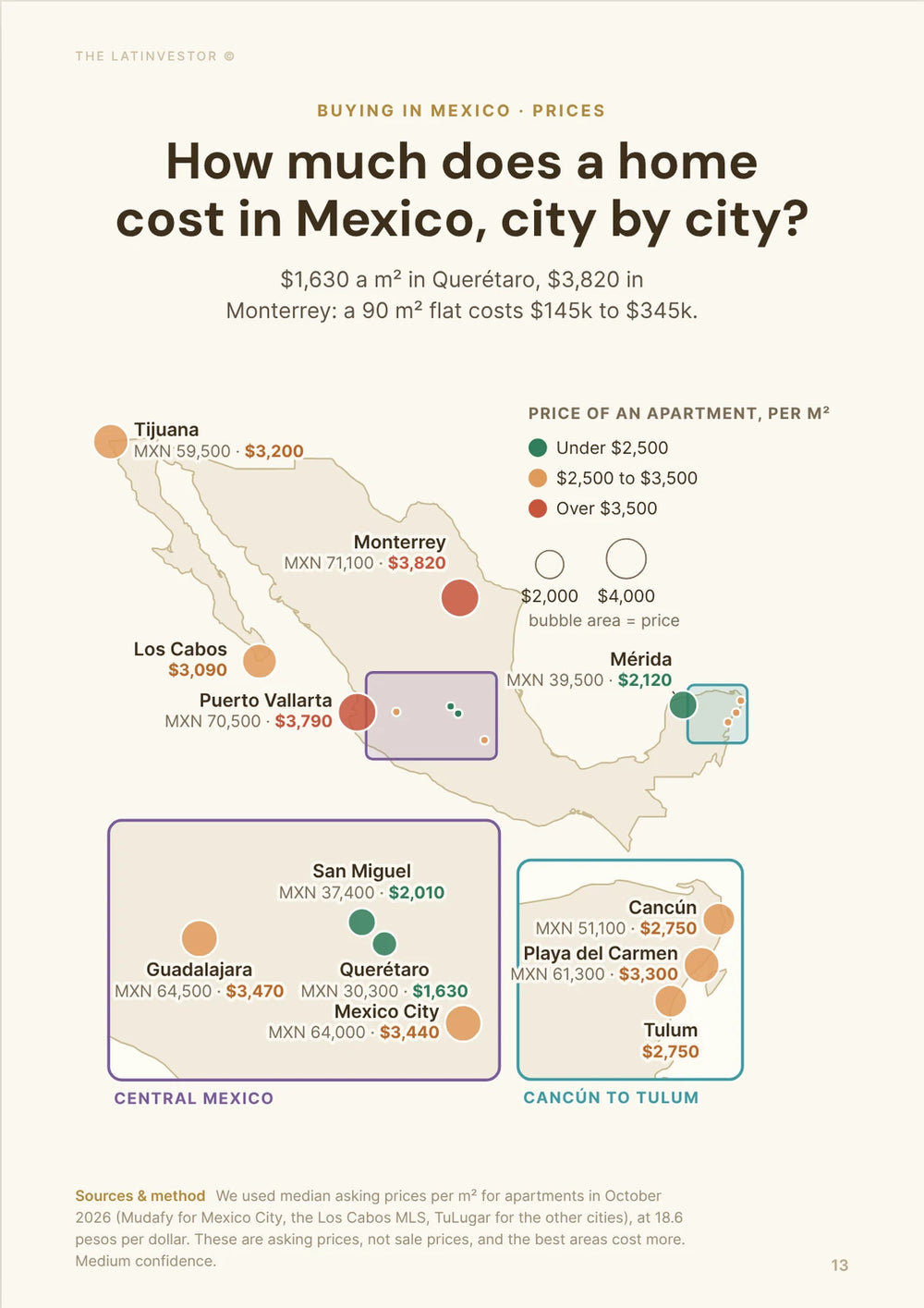
For apartments, sellers ask about 2,174 USD per square meter in El Campanario (about 40,400 MXN), about 31,700 MXN in Centro Sur (about 1,700 USD) and about 28,700 MXN in Altos Juriquilla (about 1,540 USD). Renovated homes in Centro Histórico can ask more for the best units.
For a city-wide benchmark, the median asking price on TuLugar in October 2026 is about 1,656 USD per square meter for condos (about 30,800 MXN) and about 1,271 USD for houses (about 23,600 MXN). These are asking prices, not sale prices.
Each of these areas is expensive for its own reasons:
- El Campanario: gated, golf course, large homes; the top of the market.
- Carretas: close to Centro, quiet established streets, very little new supply.
- Jurica: large lots, mature trees, and a reputation as the city's classic family neighborhood.
- Juriquilla: modern gated communities, international schools, and demand from executives and expats.
Which areas in Querétaro have the most affordable property prices in 2026?
In 2026, the most affordable areas to buy in Querétaro include Menchaca, Lomas de Casa Blanca, 10 de Abril and the outer parts of El Marqués beyond the big planned communities.
Houses in Menchaca I ask a median of about 9,100 MXN per square meter (about 490 USD), for an average of about 1.82 million MXN (about 97,800 USD). Compare that with about 15,800 MXN per square meter for houses in Juriquilla and 21,300 MXN in Zibatá.
The trade-off: older homes, longer commutes to the business districts, and tenants who are less predictable, so expect more hands-on management if you buy to rent.
Which neighborhoods give the best rental yields right now?
Which neighborhoods in Querétaro have the highest gross rental yields in 2026?
In 2026, the best gross yields are in Centro Sur, Milenio III, Villas del Mesón and well-priced units in El Refugio, usually around 6.5% to 7%.
In Centro Sur, apartments ask about 3.49 million MXN on average (about 188,000 USD) and rent for about 19,800 MXN a month, which gives about 6.8% gross. In Juriquilla, rents average about 18,200 MXN a month while apartments in Altos Juriquilla ask about 3.88 million MXN, closer to 5.5% to 6%.
For the city as a whole, a 65 square meter two-bedroom apartment asked about 1.97 million MXN in April 2026 and rented for about 11,650 MXN a month: about 7.1% gross. After property management, vacancy, maintenance fees and tax, expect a few points less.
Each of these areas does well for a reason:
- Centro Sur: executive tenants pay high rents for modern towers near the business corridors.
- Milenio III: professionals and families compete for well-located units, so vacancy stays low.
- Villas del Mesón: solid rental demand without Jurica's purchase prices.
- El Refugio: newer family housing at moderate prices that attracts stable long-term tenants.
Is Airbnb still worth it in Querétaro?
Which neighborhoods in Querétaro perform best on Airbnb in 2026?
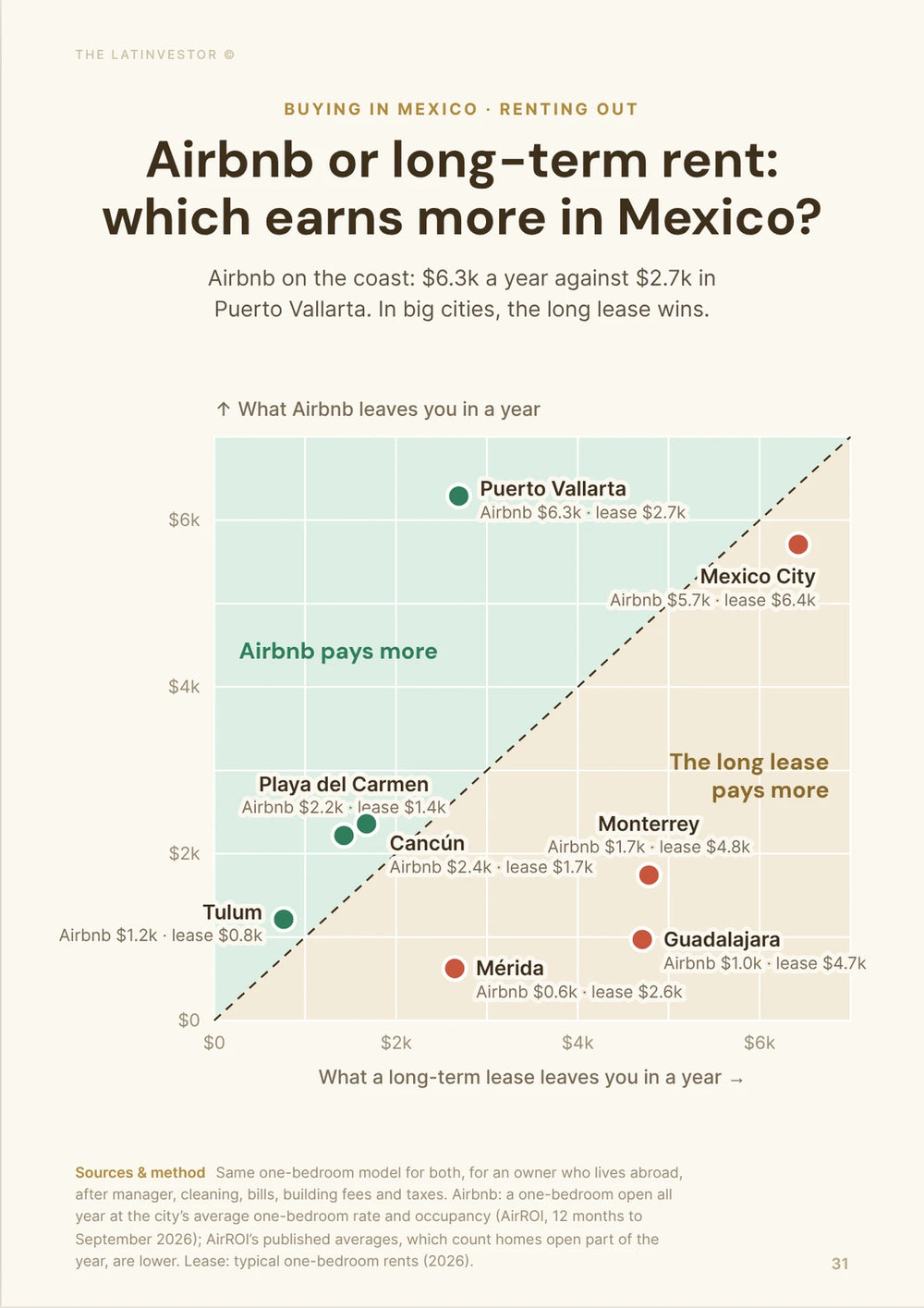
In 2026, the areas that do best on Airbnb are Centro Histórico, Álamos, Centro Sur and parts of Juriquilla. Across the city, listings booked about 57% of their nights over the past year, at about 44 USD a night (about 818 MXN).
The average active listing earned about 8,700 USD over the year (about 162,000 MXN), so roughly 13,500 MXN a month before cleaning, platform fees, the 5% state lodging tax and income tax. That's close to what a long-term tenant pays in Centro Sur, with a lot more work.
Each of these areas works for a reason:
- Centro Histórico: walkable to heritage sites and restaurants, with weekend tourists.
- Álamos: quiet and close to Centro, for guests who want calm evenings.
- Centro Sur: business travelers and event visitors who want modern buildings.
- Juriquilla: families booking bigger units with a pool and parking.
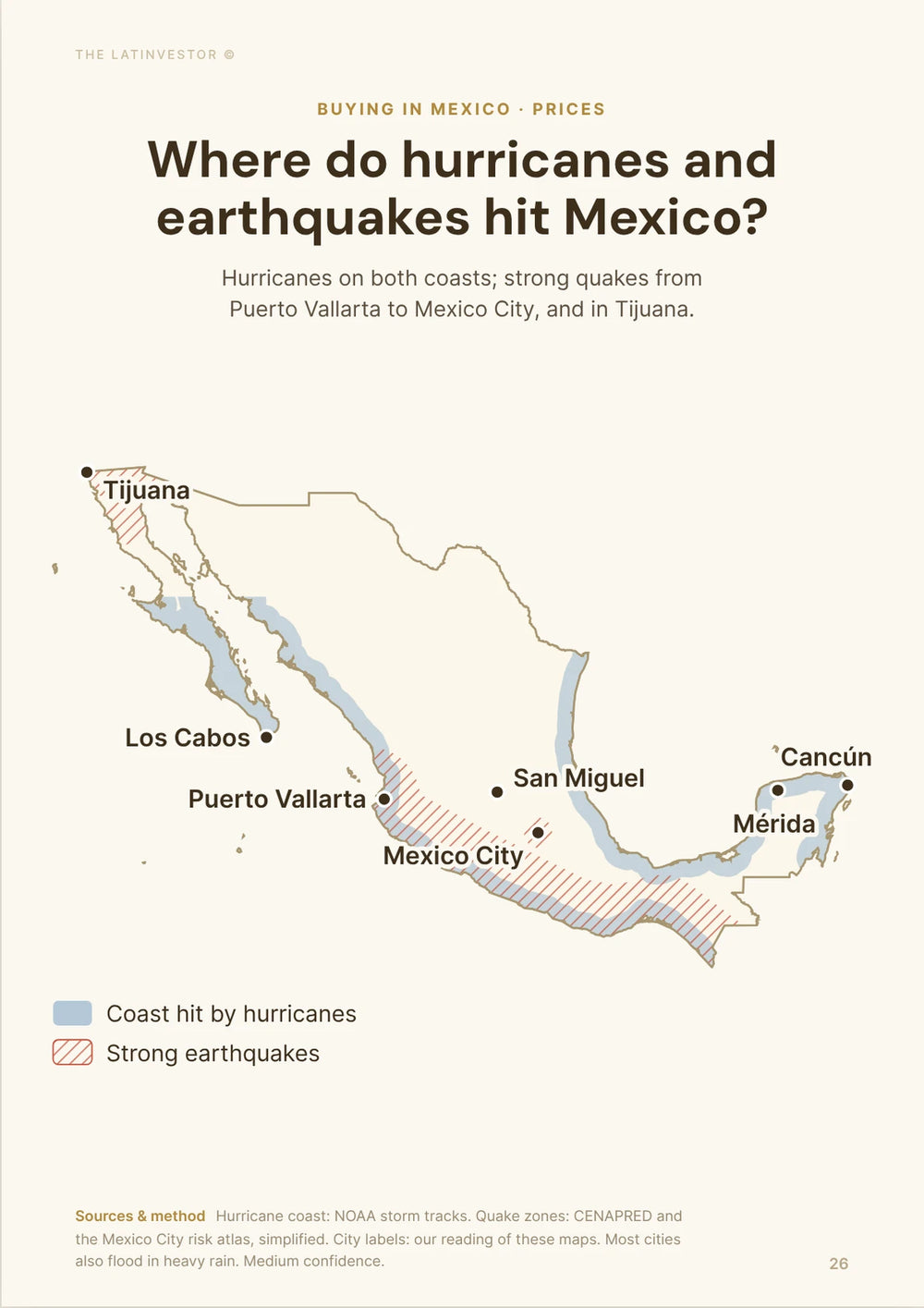
Are there too many Airbnbs in Querétaro?
Not anymore at the city level: active listings fell 34.9% in a year, to 2,583 in September 2026. Many hosts have given up and switched to long-term rentals or sold.
The crowding is now local. Generic one-bedroom condos in Centro Histórico, investor-heavy towers in Centro Sur and identical units in master-planned communities still compete with dozens of near-copies.
The warning sign: if your unit is one of 50 similar listings in the same building, you'll end up cutting prices, and your occupancy will drop below the city's 57%.
Where do long-term tenants want to live?
Which neighborhoods in Querétaro have the strongest demand for long-term tenants?
The strongest long-term rental demand in 2026 is in Centro Sur, Milenio III, Juriquilla and Zibatá, where professionals and families compete for good units.
Well-priced homes there usually rent within a few weeks. Demand comes from engineers, managers and families moving for work in the Bajío industrial corridor, where industrial vacancy was only about 4.8% in spring 2026.
Each area draws a different tenant:
- Centro Sur: corporate professionals who want modern apartments near offices.
- Milenio III: young professionals who want a central location and amenities.
- Juriquilla: expat families who want international schools and security.
- Zibatá: growing families who want new homes, green spaces and amenities.
What these areas share is easy access to jobs, good schools and newer infrastructure. Juriquilla's international schools matter a lot to expat families, and Centro Sur's location matters to corporate tenants.
What are the average long-term monthly rents by neighborhood in Querétaro in 2026?
In 2026, apartments ask about 19,800 MXN a month on average in Centro Sur (about 1,060 USD), 18,200 MXN in Juriquilla (about 980 USD) and 15,100 MXN in Milenio III (about 810 USD).
The trend isn't the same everywhere. Between April 2025 and October 2026, average asking rents didn't move in Centro Sur and fell 2.4% in Juriquilla, but rose 12.7% in Milenio III. The top of the market has stopped climbing; the middle is still moving.
In cheaper areas like Menchaca or outer El Marqués, basic one- or two-bedroom units rent for roughly 8,000 to 12,000 MXN a month (about 430 to 645 USD). The city-wide benchmark for a 65 square meter two-bedroom was about 11,650 MXN in April 2026.
At the high end, in Jurica, Villas del Mesón or the best parts of Juriquilla, large family houses with a pool and garden can ask 30,000 to 60,000 MXN a month (about 1,610 to 3,230 USD). That's our estimate from listings, not an official figure.
Which areas are up and coming, and will the train really lift prices?
Which neighborhoods in Querétaro are gentrifying and attracting new investors in 2026?
In 2026, the areas drawing the most new investor interest are renovation pockets in Centro Histórico, the Milenio III to Centro Sur corridor, and newer El Marqués developments like El Refugio and Zákia, where roads and services are catching up with housing.
The numbers back Centro Sur most clearly: average asking prices rose 12.6% for apartments and 24.6% for houses between April 2025 and October 2026. East of the city, El Marqués apartments rose 12.0%, against 5.0% for Querétaro as a whole on the same portal. Across the metro area, the official index rose 5.6% in the first half of 2026, compared with a year earlier.
Which areas in Querétaro have major infrastructure projects planned that will boost prices?
The areas most likely to gain are those close to the two future train stations: "Querétaro Central" in El Marqués and "La Corregidora" near the old railway station downtown. Areas along the upgraded Paseo 5 de Febrero corridor have also benefited.
The Mexico City to Querétaro passenger train was 30.38% built in September 2026. The federal government is aiming for the second half of 2027, if work keeps its current pace. The budget is about 143.4 billion MXN (about 7.7 billion USD). No official travel time has been announced yet.
Don't pay today for a train that isn't running. Sellers near the stations already market "train access." If a unit asks a clear premium over similar ones a few blocks away, negotiate it down or walk; you can buy after the opening date is firm.
Which areas in Querétaro should you avoid as a buyer?
Which neighborhoods in Querétaro have problems you should avoid?
Be careful with far-fringe subdivisions with weak services, some older housing on the northeast and east edges, and any area where you can't say clearly who your tenant will be and why they'll stay.
Overall, Querétaro feels safer than most Mexican cities: in June 2026, 36.1% of adults said living in the city was unsafe, against 59.8% on average across 91 cities. But that's a city-wide number, and it varies by area.
The areas to look at twice:
- San José el Alto: safety and tenant quality vary more than in central areas.
- Outskirts of Santa Rosa Jáuregui: far from jobs, long commutes, weaker services.
- Parts of Menchaca: older housing that needs more maintenance and management.
- Outermost El Marqués subdivisions: each new phase competes with your resale.
For these areas to work as investments, they'd need better public transport, more shops and services nearby, and steadier jobs close by. That could take years.
Which areas in Querétaro have stagnant or declining property prices as of 2026?
Querétaro as a whole isn't falling: the official index rose 5.6% in the first half of 2026. But some micro-markets are flat or slipping.
In Altos Juriquilla, average asking prices for apartments fell 7.2% between April 2025 and October 2026. In Menchaca I, house prices rose only 2.2% over the same period, below inflation.
The main causes:
- Investor-heavy condo clusters: too many similar units delivered at once.
- Outer sprawl developments: each new phase competes with your resale.
- Generic master-planned units: identical products lead to a race to the bottom on price.
Is Zibatá oversupplied, and should you buy in a master-planned community now?
Zibatá is a good place to live, but a crowded place to resell: Propiedades.com showed about 2,376 active listings there in October 2026. When that many owners are selling, buyers have the upper hand.
House prices in Zibatá rose 5.6% between April 2025 and October 2026, below the 7.7% for El Marqués as a whole. They ask a median of about 21,300 MXN per square meter (about 1,150 USD), more than Juriquilla's 15,800.
If you buy there: compare with resales in the same phase before you sign with a developer, ask how many units are still to be built in your section, and negotiate. A presale price is only a deal if it's clearly below what resales in finished phases ask.
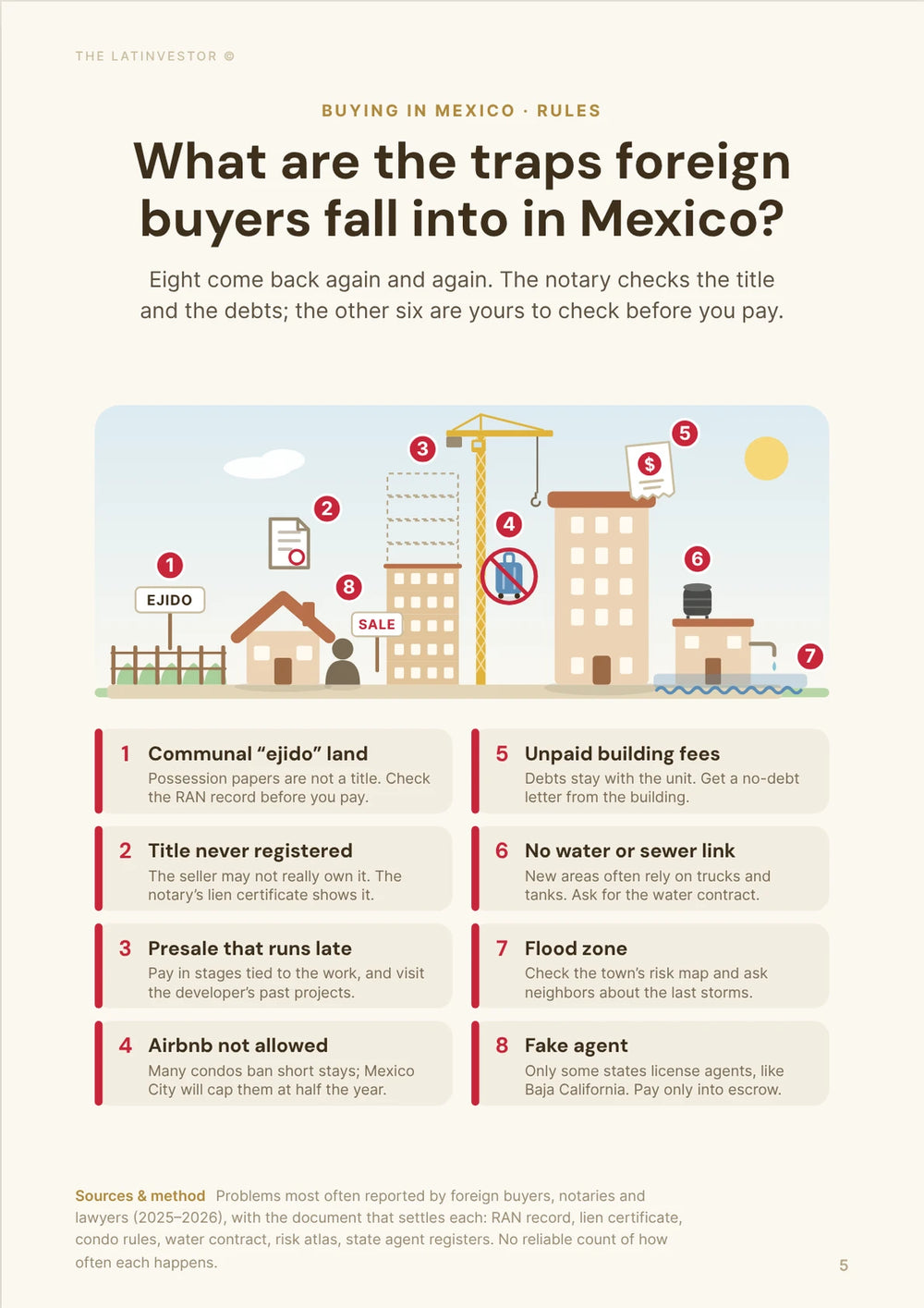
Are water and power cuts a real risk when buying in Querétaro?
Yes, and they should be on your checklist in 2026. The state government counted more than 1,500 power cuts in the first half of the year, about one every three hours, including 418 outages at 33 water pumping wells.
Water is the older problem. Querétaro depends heavily on the Acueducto II, which brings water from the Zimapán dam. When that dam had to release water in September 2025, supply was cut in 336 neighborhoods: 264 in Querétaro, 54 in Corregidora and 17 in El Marqués.
What to check before buying: ask neighbors how often the water stops, check the size of the cistern and roof tank, ask whether the development has its own well, and look at past power cuts in the building's management reports. A home with a large cistern and a backup pump is worth more here than in most cities.
Are prices in Querétaro still going up?
Which areas in Querétaro have historically appreciated the most recently?
Over the past few years, the strongest gains have been in Centro Sur, Zibatá, Jurica and the best parts of Juriquilla. Since 2025, though, the momentum has moved to Centro Sur and El Marqués, while Juriquilla and El Refugio apartments have stalled.
For the city as a whole, the official index rose about 56% over the five years to the end of 2025, the same pace as Mexico overall. But in the first half of 2026, Querétaro grew 5.6% against 7.9% nationally: it's no longer the fastest market.
Here's what the main areas did between April 2025 and October 2026, based on asking prices:
- Centro Sur: +12.6% for apartments, +24.6% for houses.
- Zibatá: +5.6% for houses, +6.6% for apartments.
- El Marqués as a whole: +12.0% for apartments, +7.7% for houses, the fastest of the big suburban names.
- El Refugio: only +2.4% for apartments.
- Juriquilla: +6.3% for houses, but -1.9% for apartments (-7.2% in Altos Juriquilla).
- Jurica: steady demand and little new supply; no reliable recent figure.
The common driver: little new land in established areas, high-income buyers and tenants, and the jobs brought by industrial growth.
Which neighborhoods in Querétaro are expected to see price growth in coming years?
Through 2028, the best bets look like Centro Sur, Milenio III, El Refugio and Zibatá where services are already in place, and the best pockets of Juriquilla.
No serious source publishes neighborhood forecasts. As a working assumption, plan on something close to the city's recent pace of about 5% to 6% a year, and treat anything a developer promises above that as marketing.
The biggest possible catalyst is the train to Mexico City. If it opens on time, it could make Querétaro more attractive to people who work in the capital part of the time. If it slips, don't expect the areas around the stations to keep their premium.
What do locals and expats really think of Querétaro's neighborhoods?
Which areas in Querétaro do local residents consider the most desirable to live?
Locals rank Jurica, Juriquilla, Álamos, Carretas and the walkable streets of Centro Histórico as the most desirable places to live.
Why they like them:
- Jurica: large lots, mature gardens, the city's classic family address.
- Juriquilla: modern amenities, good schools, suburban life close to the city.
- Álamos: established, with parks and restaurants, close to the center.
- Carretas: quiet streets near Centro, walkable, with character.
- Centro Histórico: pedestrian streets, cultural life, UNESCO heritage.
Residents there are mostly established Mexican families, professionals, business owners and retirees who care about space, security and community.
Locals and foreign buyers mostly want the same areas. Locals care more about family roots and the neighborhood's reputation; foreigners look more at yield and resale.
Which neighborhoods in Querétaro have the best reputation among expat communities?
Expats rate Juriquilla, Centro Sur, Álamos and Carretas highest, for the mix of comfort, safety and access.
Why:
- Juriquilla: international schools, English-speaking services, familiar suburban layout.
- Centro Sur: modern apartments with building amenities and easy commutes to offices.
- Álamos and Carretas: walking distance to Centro Histórico, but quieter.
The typical expat here is a remote worker in their 30s or 40s, an executive on assignment, a retired couple, or a family that needs bilingual schools.
Which areas in Querétaro do locals say are overhyped by foreign buyers?
Locals often say foreign buyers overpay for new master-planned communities sold as "guaranteed appreciation," some Centro Histórico homes with renovation surprises, and any development where the marketing budget was bigger than the construction budget.
Why:
- Some master-planned communities: lots of investor stock, so your resale competes with many identical units.
- Some Centro properties: beautiful facades can hide costly repairs and no parking.
- Heavily marketed new projects: high prices today, uncertain gains tomorrow.
Foreign buyers tend to fall for glossy brochures, amenities and brand-new construction. Locals know that established neighborhoods with a track record usually hold value better.
Which areas in Querétaro are considered boring or undesirable by residents?
Residents tend to find far-flung subdivisions, car-only developments on the outskirts and older industrial-edge neighborhoods the least appealing.
Why:
- Far-outer subdivisions: no restaurants, no parks, nothing to walk to after work.
- Car-dependent sprawl: long commutes and little sense of community.
- Older industrial-edge areas: functional, but little character or green space.
Our methodology
This article estimates where it makes most sense to buy in Querétaro: prices per square meter by area, rental yields, Airbnb and long-term rental performance, price trends, and the areas and risks to watch.
City-wide trends come first from official sources: the SHF house price index (homes bought with a mortgage), INEGI's urban security survey, and Proyectos México for the train. We add market data: Propiedades.com neighborhood medians (October 2026), TuLugar median asking prices, Inmuebles24 benchmarks reported by El Economista, and AirDNA for short-term rentals. Some ranges (rents for large houses, entry-level areas, forecasts) are our own estimates from listings, because no official source publishes them.
News on water, power cuts and industrial demand comes from local press dated 2025 and 2026 (Publimetro, Uno TV, Líder Empresarial, ADN40, Chilango).
We checked these figures in October 2026. Conversions use about 18.6 pesos per US dollar and 20.9 pesos per euro.
Limits: listing prices are asking prices, not sale prices, and the gap can be large. Some neighborhoods have few listings, so their medians move a lot. The SHF index only covers mortgage-financed homes. Airbnb figures are city-wide averages, and a given unit can do much better or worse.
Key sources used for this analysis include SHF, Global Property Guide, Propiedades.com, TuLugar, Inmuebles24, El Economista, AirDNA, Airbnb, Proyectos México, INEGI (ENSU), SESNSP, Publimetro, Uno TV, Líder Empresarial, Banxico and Secretaría de Relaciones Exteriores.