
Summary
In October 2026, the median asking price in Querétaro is about USD 174,000 (MXN 3.24 million) for a two-bedroom apartment and about USD 235,000 (MXN 4.37 million) for a three-bedroom house, according to TuLugar's listing data.
Homes actually bought with a mortgage are cheaper: the official SHF average for Querétaro state was MXN 2.38 million (USD 128,000) in the second quarter of 2026, the third highest in Mexico.
Homes usually sell for about 6% to 10% below the asking price, by our estimate. On a median two-bedroom, that brings the realistic price to around MXN 2.98 million (USD 160,000).
Apartments ask about MXN 29,500 to MXN 30,800 per square meter (about USD 1,590 to USD 1,660). Houses ask less, about MXN 23,600 (USD 1,270), because they are bigger and further out.
Prices are still rising, but more slowly: the SHF index was up 5.6% in a year in the Querétaro metro in the first half of 2026, against 7.9% for Mexico as a whole. With inflation at 3.45%, that's only about 2 points of real growth.
The tension: prices keep climbing while mortgage lending in Mexico is flat (-0.1% in real terms in the first half of 2026), and new mortgages cost about 10% to 11%. Cash buyers have the upper hand when they negotiate.
A median three-bedroom house asks about 35% more than a median two-bedroom apartment, and an urban lot under 500 m² asks about USD 116,000 (MXN 2.16 million).
New homes usually cost about 12% to 18% more than similar existing ones, by our estimate.
El Campanario is the most expensive area, with apartments asking about MXN 40,400 per square meter. Centro, Milenio III and El Refugio sit around MXN 27,600 to MXN 29,600, and Santa Rosa Jáuregui or San José el Alto can go down to MXN 12,000 to MXN 20,000.
Water is the local risk to check: when Acueducto II stopped in September 2025, 336 neighborhoods of the metro area went on rotating supply, and the state is rewriting its water law in 2026.
Taxes and fees add about 7% to 9% for a cash buyer, mostly because of the transfer tax (about 5.6% on a MXN 2.5 million home). Foreigners don't need a bank trust (fideicomiso) in Querétaro.
For dollar buyers, the bill moved in two steps: Querétaro got about 9% dearer over the year (peso prices up 5.6%, and the peso stronger than its 2025 average of 19.2), but the peso has weakened since early September (from under 17 to about 18.6 per dollar), so homes are cheaper in dollars than a few weeks ago.
With USD 200,000 (MXN 3.72 million), you can get a 120 to 150 m² family house in El Refugio or a new 80 to 95 m² apartment in Zibatá.
The bottom line: Querétaro is still reasonable for its quality of life, but prices are running ahead of what locals can borrow. Negotiate, compare the price per square meter with the area median, and check the water supply before you sign.

What does a typical home cost in Querétaro?
In October 2026, the median asking price in Querétaro city is about USD 174,000 (MXN 3.24 million or EUR 155,000) for a two-bedroom apartment and about USD 235,000 (MXN 4.37 million or EUR 209,000) for a three-bedroom house, according to TuLugar's market tables.
Homes that actually change hands with a mortgage are cheaper. The official SHF average for Querétaro state was MXN 2.38 million (USD 128,000 or EUR 114,000) in the second quarter of 2026, the third highest of all Mexican states, against MXN 1.96 million (USD 105,000) nationally. The gap is normal: SHF counts many smaller homes in the outer suburbs bought with Infonavit or bank loans, while listings lean toward newer, larger homes in the north and east of the city.
A more modest benchmark: a 65 m² two-bedroom apartment with parking asked about MXN 1.97 million (USD 106,000) in April 2026, according to Inmuebles24 data reported by El Economista.
At the entry level, about MXN 1.0 million to MXN 1.5 million (USD 53,800 to USD 80,600, or EUR 47,800 to EUR 71,800) buys a compact existing apartment or a small house around Ciudad del Sol, Satélite, San José el Alto or Santa Rosa Jáuregui, by our estimate.
At the top, a luxury home usually costs about MXN 7 million to MXN 18 million (USD 376,000 to USD 968,000, or EUR 335,000 to EUR 861,000): a large gated-community house in Juriquilla, El Campanario, Balvanera or a premium part of Zibatá.
How much below the asking price do homes sell in Querétaro?
Homes in Querétaro usually sell for about 6% to 10% below the asking price, with 8% as a practical middle figure. This is our estimate: no official source publishes closed prices against listing prices in Mexico.
On a median two-bedroom apartment asking USD 174,000, an 8% discount means a realistic price of around MXN 2.98 million (USD 160,000). The gap is smaller for rare homes in Centro Histórico, El Campanario, Juriquilla and the best gated communities. It's bigger for older homes, overpriced homes on the edge of the city and anything that has been listed for months. Ask how long the home has been on the market, and start your offer from the area's price per square meter, not from the seller's number.
What's the price per square meter in Querétaro?
In October 2026, apartments in Querétaro ask about MXN 29,500 to MXN 30,800 per square meter (USD 1,590 to USD 1,660, or EUR 1,410 to EUR 1,470), depending on the source: MXN 29,487 for NOCNOK and USD 1,656 for TuLugar. That's about MXN 2,740 to MXN 2,860 (USD 147 to USD 154) per square foot.
Houses ask less per square meter, about USD 1,270 (MXN 23,600 or EUR 1,130), or about USD 118 per square foot. They are bigger, often older, and more of them sit in the outer suburbs. Land asks about USD 409 per square meter (MXN 7,610), and about USD 458 (MXN 8,520) for urban lots under 500 m².
The highest prices per square meter are in El Campanario, Álamos, Centro Sur, Centro Histórico and Juriquilla, where premium homes often ask MXN 34,000 to MXN 65,000. The lowest are around Santa Rosa Jáuregui, San José el Alto, Ciudad del Sol, Menchaca and the cheaper parts of El Marqués, where MXN 12,000 to MXN 20,000 is common.
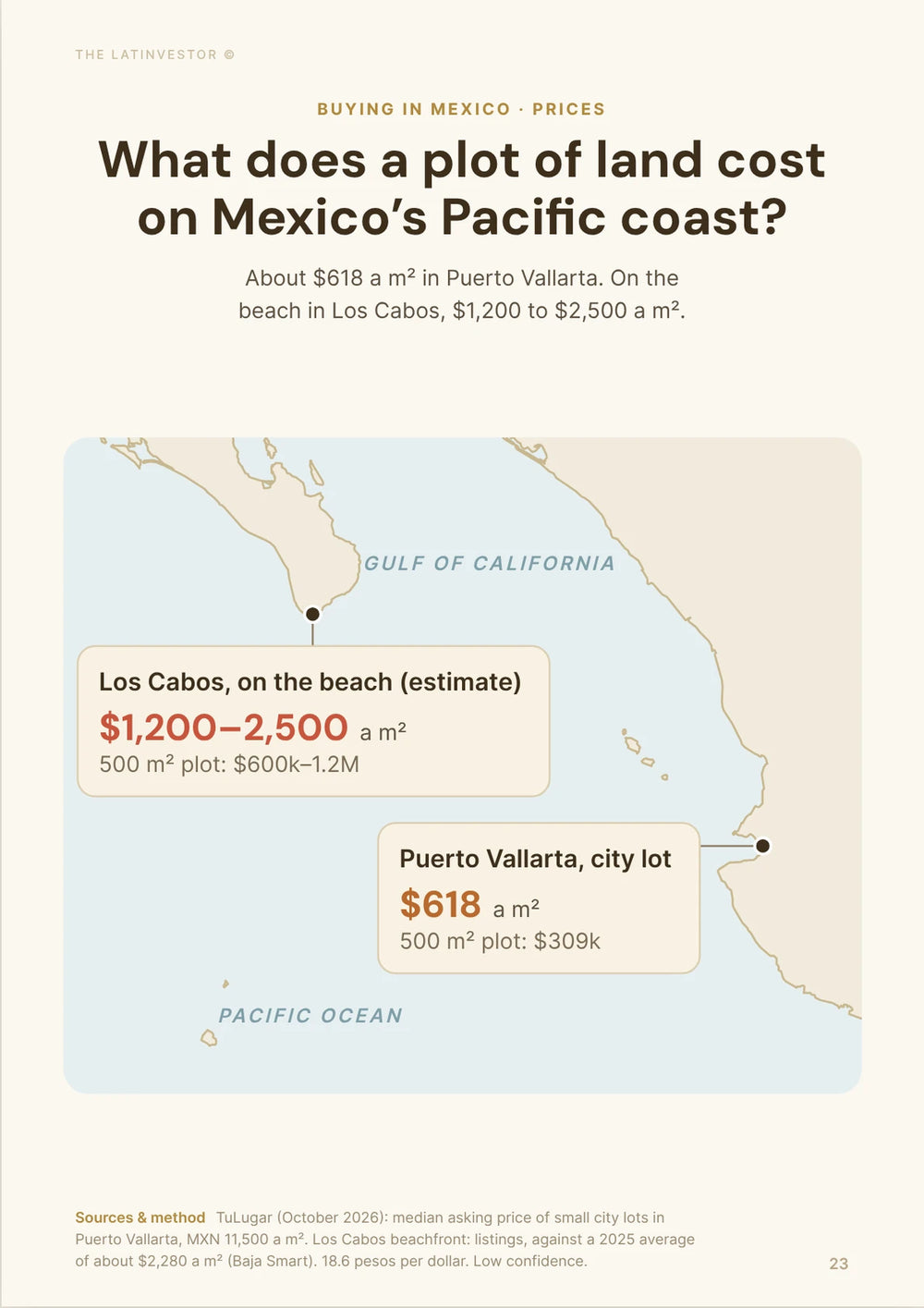
How fast are Querétaro prices rising?
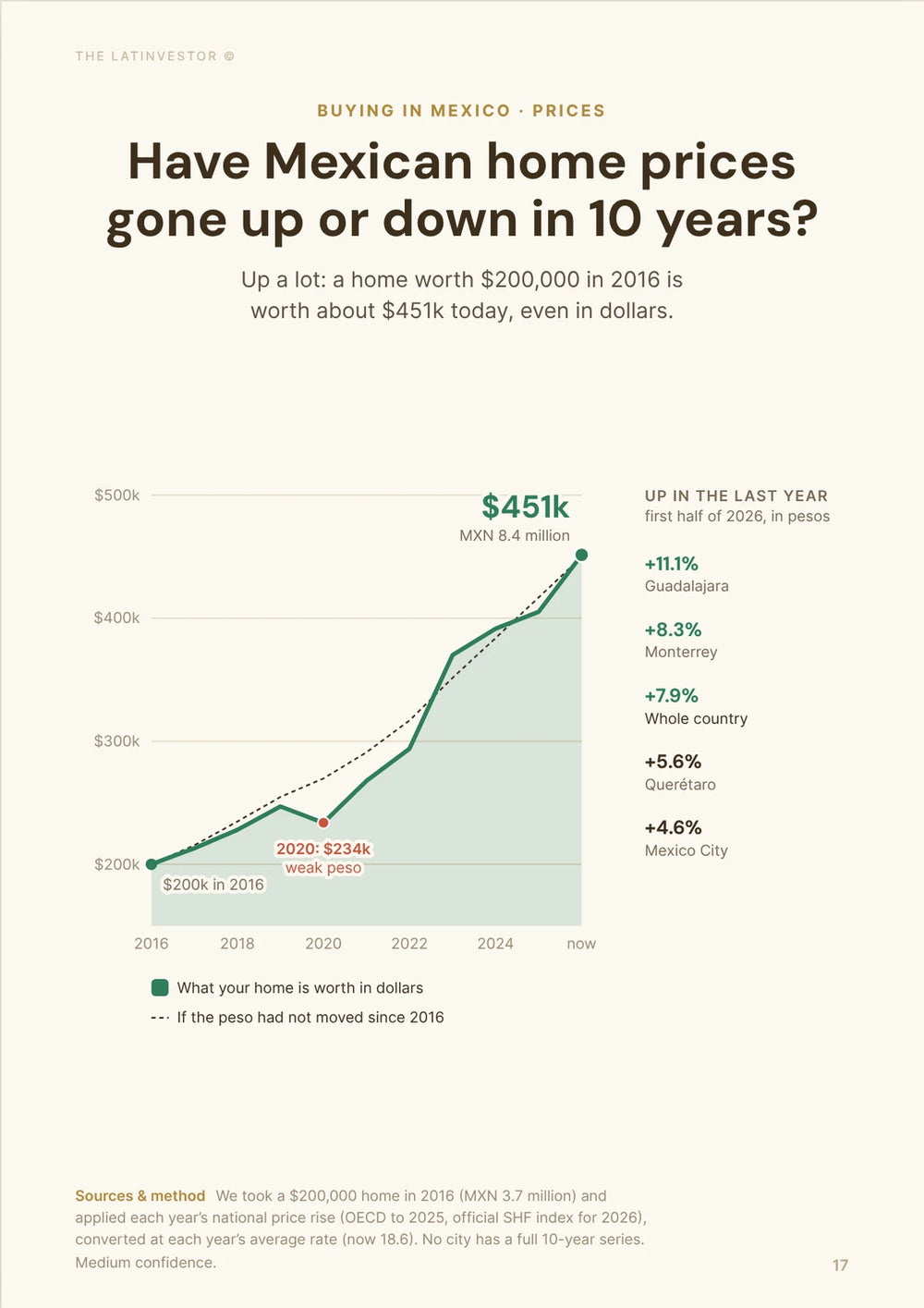
Prices in the Querétaro metro area were up 5.6% in a year in the first half of 2026, according to the official SHF index, down from 6.7% in the first quarter. That's slower than Mexico as a whole (7.9% over the same half-year). With annual inflation at 3.45% in September 2026, the real gain is only about 2 points.
Over a longer period, the SHF index for Querétaro rose about 56% between the end of 2020 and the end of 2025, the same pace as the national average. The reasons haven't changed: fast population growth, jobs in industry and logistics, and a shortage of well-located homes in the most convenient areas.
Don't pay extra for the "future train" pitch yet. The Mexico City to Querétaro passenger train was 30.38% built in September 2026, and the latest estimate is the second half of 2027 at the earliest. If a seller near the planned station adds a premium for it, push back.
Why are prices still rising when mortgage lending isn't?
Because sellers and developers are still pricing on past growth, while buyers' ability to borrow has stopped growing. In the first half of 2026, the amount lent for mortgages in Mexico fell 0.1% in real terms and the number of loans rose only 0.3%, according to BBVA Research, while SHF prices in Querétaro rose 5.6%.
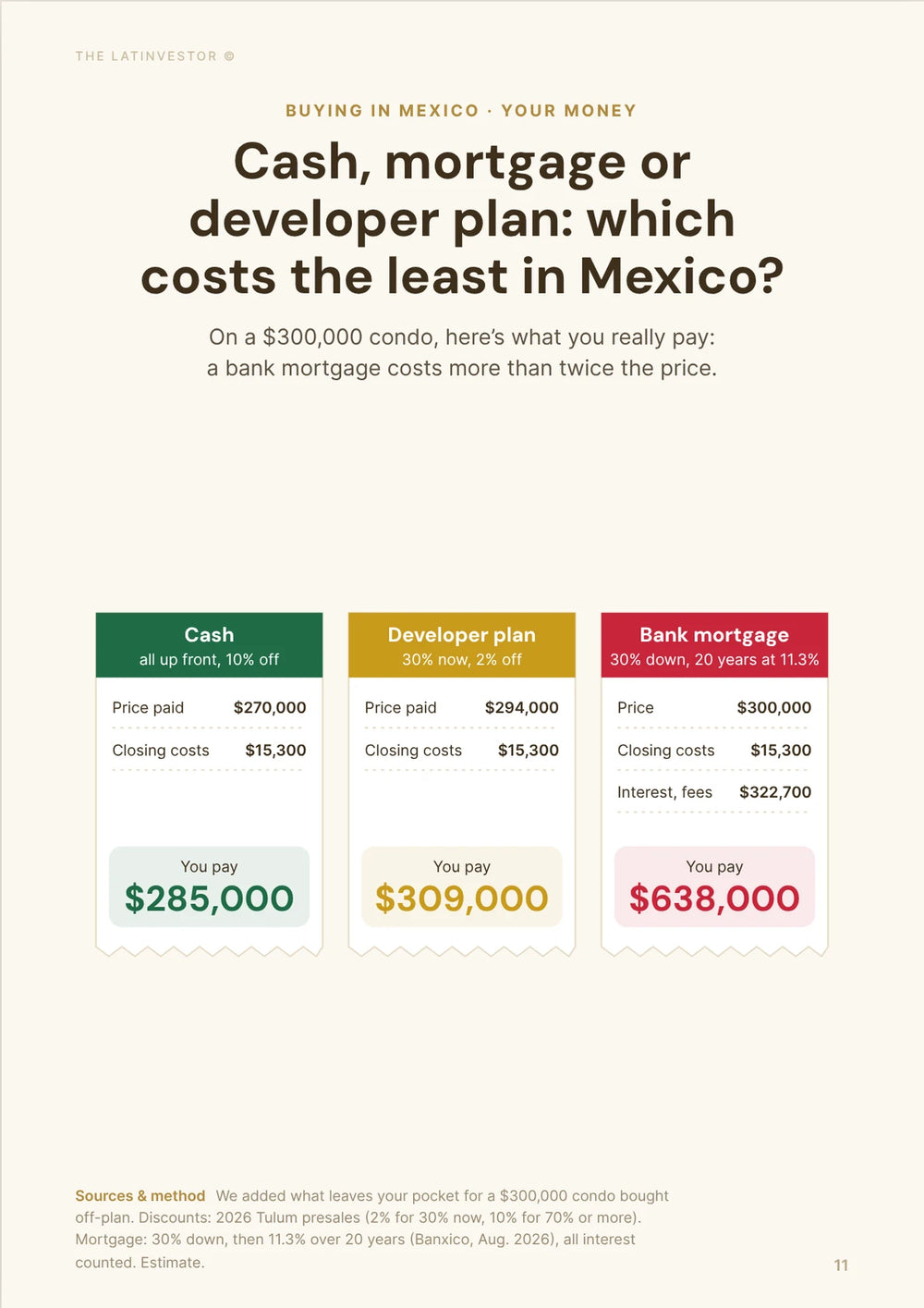
Borrowing is still expensive. Loans actually granted averaged 9.99% in June 2026 (ABM), and the average fixed-rate quote was about 11.3% in August 2026, even though the central bank rate is down to 6.5%. Foreigners rarely get a Mexican bank loan, and cross-border lenders usually ask for at least 35% down.
What this means for you: if you pay cash, you're in a strong spot. Sellers whose home has sat for months, and developers with unsold units in Zibatá, El Refugio or El Marqués, have fewer buyers who can get financing. Aim for 8% to 10% off the asking price, ask for parking, finishes or fees to be included, and don't accept a "price goes up next month" deadline at face value.
Is it cheaper to buy a house or an apartment in Querétaro?
An apartment is cheaper to get into, but a house gives you more space for the money. In October 2026, a median three-bedroom house asks about USD 235,000 (MXN 4.37 million), about 35% more than a median two-bedroom apartment at USD 174,000 (MXN 3.24 million). But houses ask about MXN 23,600 per square meter, against about MXN 30,800 for apartments.
Querétaro is still a house city. Apartments are more common in Centro Histórico, Centro Sur, Zibatá, El Refugio and the new master-planned areas. Gated-community houses in Juriquilla, Zibatá or Cumbres del Lago usually start around MXN 4 million (USD 215,000), and luxury detached homes in El Campanario often ask MXN 10 million (USD 538,000) or more, by our estimate. An urban lot under 500 m² asks about USD 116,000 (MXN 2.16 million).
How much more do you pay for a new home in Querétaro?
A new home usually costs about 12% to 18% more than a similar existing one in Querétaro, with 15% as a practical middle figure. This is our estimate; no official series compares the two directly.
Developers price in current land costs, financing, amenities, security and newer finishes. Older homes can be cheaper unless they sit in a very good location. Before paying the new-build premium, compare the price per square meter with resale homes in the same area, and check what you get: water feasibility, parking, and the monthly fee, which runs about MXN 25 to MXN 60 per square meter in amenity-heavy complexes like those in Juriquilla.
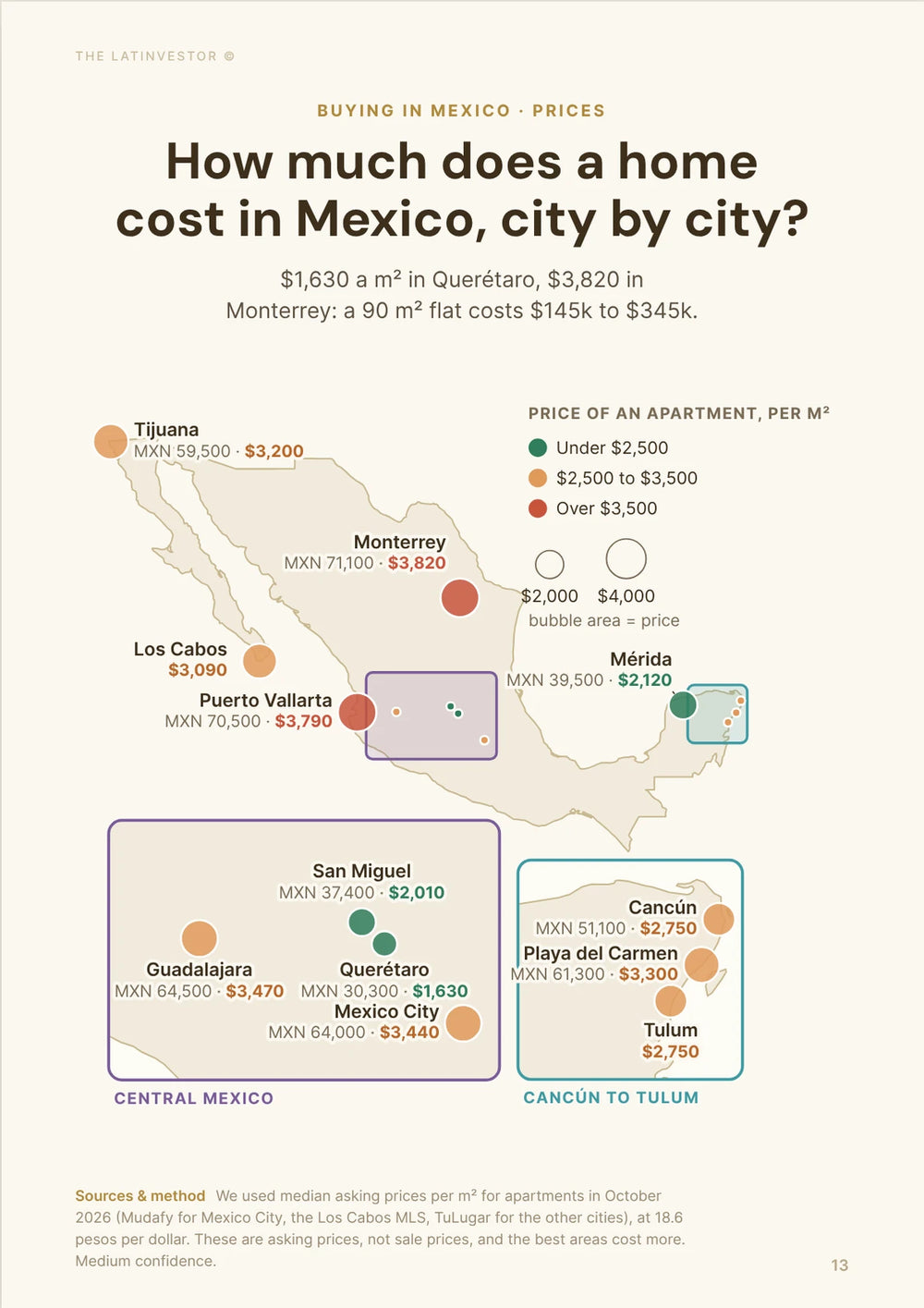
Which Querétaro neighborhoods are the most and least expensive?
El Campanario is the most expensive area: apartments there ask about MXN 40,400 per square meter (USD 2,170), and large homes often ask MXN 10 million to MXN 25 million (USD 538,000 to USD 1.34 million). Buyers pay for golf, gated security and big lots.
Juriquilla is the family and expat favorite, with homes from about MXN 3.5 million to MXN 9.5 million (USD 188,000 to USD 511,000). You pay for private communities, schools, universities and a quiet suburban life, but you'll need a car.
In Centro Histórico and Centro, apartments ask about MXN 29,400 per square meter (USD 1,580), and renovated colonial homes and apartments usually go for MXN 2.5 million to MXN 7 million (USD 134,000 to USD 376,000). Walkable historic property is scarce, which keeps the best homes expensive.
Zibatá and El Refugio are where the new building is: apartments, townhouses and master-planned gated communities from about MXN 2 million to MXN 6 million (USD 108,000 to USD 323,000). Apartments in El Refugio ask about MXN 27,600 per square meter, and about MXN 29,600 in Milenio III.
| Area in Querétaro | Market label | Typical price range | Typical range per m² |
|---|---|---|---|
| Centro Histórico | Lifestyle and walkable | MXN 2.5M to 7.0M USD 134k to 376k |
MXN 27k to 45k USD 1,450 to 2,420 |
| Álamos | Central and premium | MXN 3.0M to 8.0M USD 161k to 430k |
MXN 30k to 50k USD 1,610 to 2,690 |
| Juriquilla | Family and expat | MXN 3.5M to 9.5M USD 188k to 511k |
MXN 24k to 42k USD 1,290 to 2,260 |
| El Campanario | Luxury and gated | MXN 10M to 25M USD 538k to 1.34M |
MXN 38k to 65k USD 2,040 to 3,490 |
| Zibatá | New-build and planned | MXN 2.4M to 6.0M USD 129k to 323k |
MXN 27k to 42k USD 1,450 to 2,260 |
| El Refugio | Family and new suburbs | MXN 2.0M to 4.8M USD 108k to 258k |
MXN 23k to 34k USD 1,240 to 1,830 |
| Centro Sur | Commute and executive | MXN 2.8M to 6.5M USD 151k to 349k |
MXN 30k to 48k USD 1,610 to 2,580 |
| Milenio III | Family and established | MXN 2.5M to 5.8M USD 134k to 312k |
MXN 25k to 38k USD 1,340 to 2,040 |
| Cumbres del Lago | Family near Juriquilla | MXN 3.0M to 6.8M USD 161k to 366k |
MXN 22k to 35k USD 1,180 to 1,880 |
| Corregidora and El Pueblito | Value and commute | MXN 1.8M to 4.5M USD 96.8k to 242k |
MXN 20k to 31k USD 1,080 to 1,670 |
| Santa Rosa Jáuregui | Entry and outer edge | MXN 1.0M to 3.5M USD 53.8k to 188k |
MXN 13k to 22k USD 699 to 1,180 |
| San José el Alto and Menchaca | Entry and budget | MXN 900k to 2.4M USD 48.4k to 129k |
MXN 12k to 20k USD 645 to 1,080 |
Should you worry about water when you buy in Querétaro?
Yes, it's the main local risk to check. Querétaro is one of the most water-stressed states in Mexico, with 8 of its 11 aquifers overexploited, and a large part of the metro area's supply runs through Acueducto II.
When Acueducto II was shut down in September 2025 (the Zimapán dam had to release water), 336 neighborhoods went on rotating supply: 264 in Querétaro municipality, 54 in Corregidora and 17 in El Marqués. Some got water every other day, others one day in three. In 2026, the state Congress started rewriting the water law, and lawmakers said it must also cover how new housing developments get water.
What to do: ask neighbors and the building manager how often water was cut last year, check the size of the cistern (cisterna) and the rooftop tank, and for a new development ask the developer for the final water feasibility from the state water commission (CEA), not just a provisional contract. A home with good storage in an area with a steady supply is worth more than a nicer kitchen.
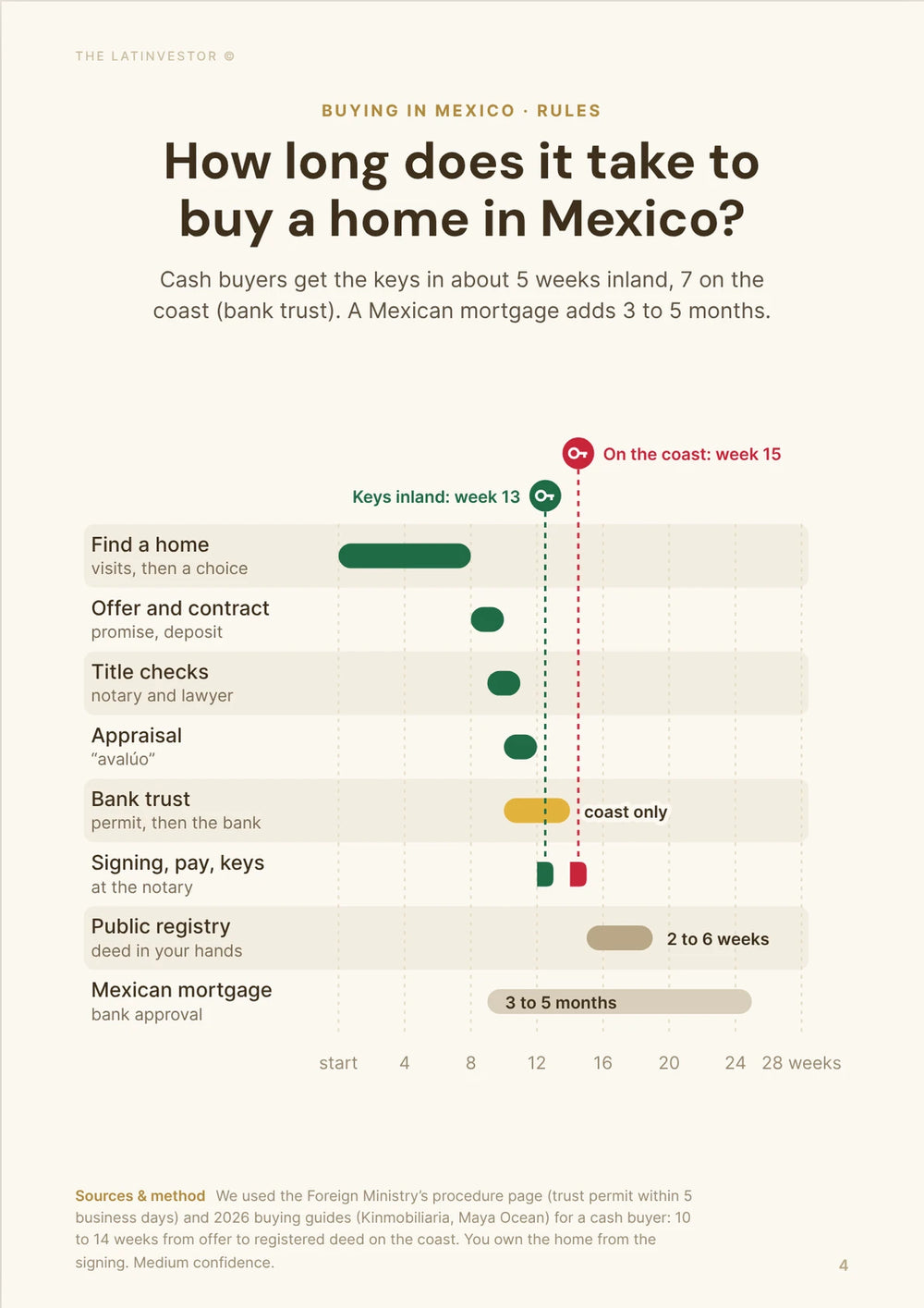
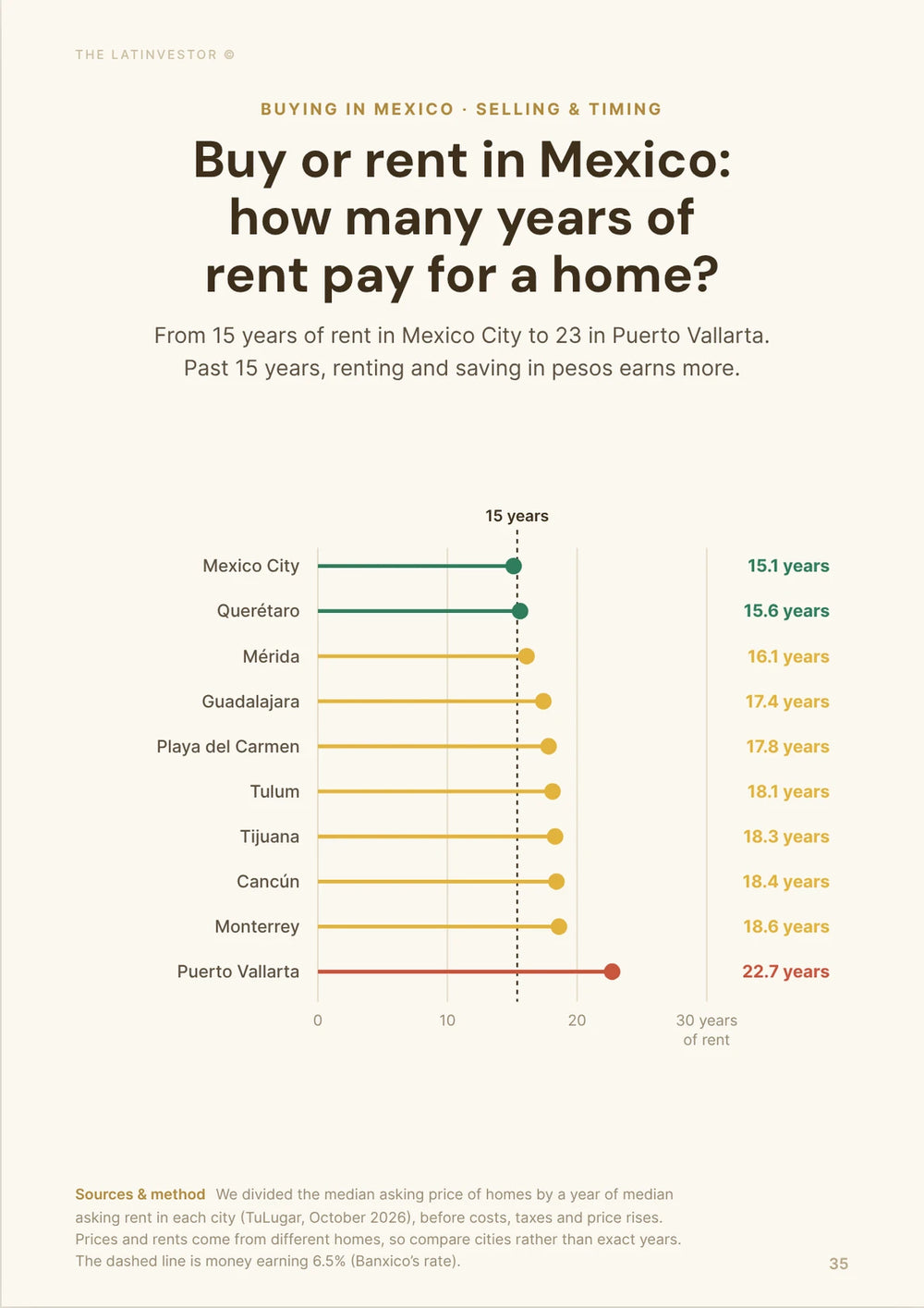
How much do taxes, fees and renovation add to the price in Querétaro?
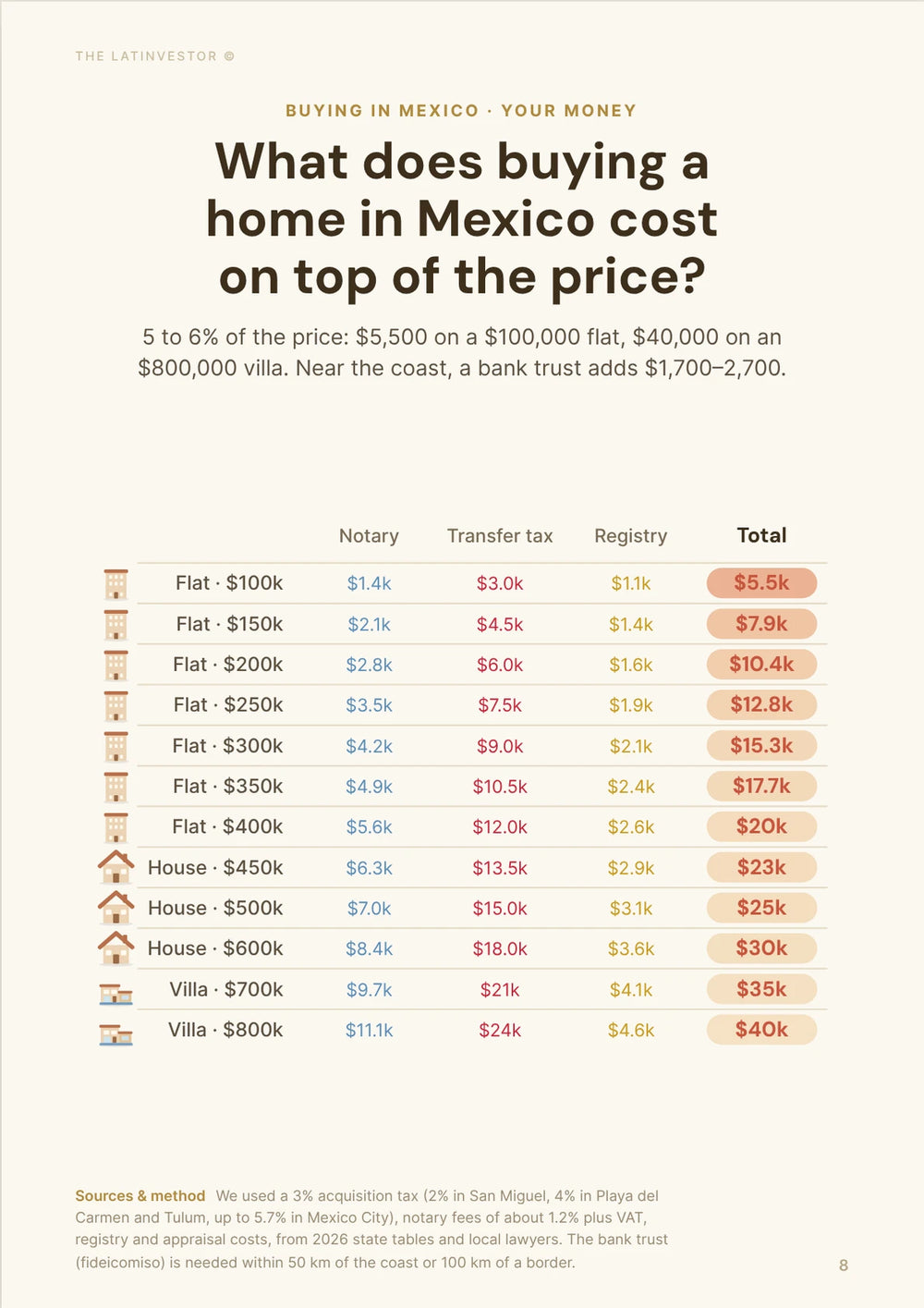
For a normal existing home bought in cash, plan on about 7% to 9% on top of the price. Add about 13% to 22% in total if the home needs moderate renovation, and 25% to 40% or more if it needs heavy work. The big item is the transfer tax: in Querétaro municipality it is progressive, about 5.6% of the price on a MXN 2.5 million home, and higher on expensive homes. Foreigners don't need a bank trust (fideicomiso) here, because Querétaro is outside the restricted coastal and border zones.
For a USD 200,000 home (MXN 3.72 million), closing costs come to about MXN 260,000 to MXN 335,000 (USD 14,000 to USD 18,000). With moderate renovation, the total can reach about MXN 4.20 million to MXN 4.54 million (USD 226,000 to USD 244,000).
For a USD 500,000 home (MXN 9.30 million), closing costs come to about MXN 651,000 to MXN 837,000 (USD 35,000 to USD 45,000). With moderate renovation, plan on about MXN 10.5 million to MXN 11.35 million (USD 565,000 to USD 610,000).
For a USD 1 million home (MXN 18.6 million), the transfer tax rate is higher, so closing costs come closer to 8% to 10%, about MXN 1.49 million to MXN 1.86 million (USD 80,100 to USD 100,000). With heavy renovation or premium upgrades, the total can pass MXN 23.25 million (USD 1.25 million).
| Extra cost | Type | Estimated cost range and what it means |
|---|---|---|
| Transfer tax (ISAI) | Tax | Progressive, from about 2.8% up to about 6.9% at the top of the scale. On a MXN 2.5 million home, it comes to about 5.6%, or about MXN 141,000 (USD 7,580). This is the biggest extra cost in Querétaro. |
| Notary fees and VAT on fees | Fees | Usually about 0.5% to 1.5% of the price. On a MXN 3 million home, that's about MXN 15,000 to MXN 45,000 (USD 806 to USD 2,420). The exact amount depends on the notary and the deal. |
| Public registry, certificates and admin costs | Fees | Usually about 0.5% to 1.0% of the price. On a MXN 3 million home, that's about MXN 15,000 to MXN 30,000 (USD 806 to USD 1,610). |
| Appraisal | Fees | Usually about MXN 5,000 to MXN 20,000 (USD 269 to USD 1,080), depending on the size of the home and the lender. Mortgage buyers almost always need one. |
| Mortgage opening and bank costs | Financing | Often about 0.5% to 1.5% of the loan. On a MXN 3 million loan, that's about MXN 15,000 to MXN 45,000 (USD 806 to USD 2,420). Cash buyers skip this. |
| Light cosmetic renovation | Renovation | About MXN 3,000 to MXN 7,000 per m² (USD 161 to USD 376). Paint, basic kitchen updates, bathroom touch-ups and small repairs. |
| Medium renovation | Renovation | About MXN 8,000 to MXN 14,000 per m² (USD 430 to USD 753). Deeper kitchen and bathroom work, floors, electrical updates and better finishes. |
| Heavy renovation | Renovation | About MXN 15,000 to MXN 25,000 or more per m² (USD 806 to USD 1,340). Structural work, major systems or high-end finishes. Treat it as a separate project. |
Is Querétaro cheaper or dearer for dollar buyers since the peso weakened?
Cheaper than a few weeks ago, dearer than a year ago. The peso has weakened since early September, from under 17 to about 18.6 per dollar, so the same peso price costs close to 9% fewer dollars than in early September. Over a full year, though, Querétaro still got about 9% more expensive in dollars: peso prices rose 5.6%, and 18.6 is still a stronger peso than the 2025 average of about 19.2.
Don't assume the window stays open. BBVA Research expects about 17.3 pesos per dollar at the end of 2026, Banxico's survey of analysts about 17.6, and Citi's survey about 18.2: all of them a stronger peso than today.
What to do: negotiate and compare in pesos, since that's the currency the market moves in. Don't wire all your money long before closing. And if a seller or developer quotes in dollars, check the peso price too, because a dollar quote set at an older exchange rate can hide a higher peso price.
What can you buy in Querétaro with USD 100,000 to USD 2 million?
With USD 100,000 (about MXN 1.86 million), you're at the entry level: an existing 55 to 65 m² apartment in Satélite or Ciudad del Sol, an existing 70 to 85 m² small house in San José el Alto, or a compact new apartment on the outer edge of El Marqués or Zakia.
With USD 200,000 (about MXN 3.72 million), you can find an existing 120 to 150 m² family house in El Refugio, a new 80 to 95 m² apartment in Zibatá, or an existing 90 to 120 m² townhouse in Corregidora or El Pueblito.
With USD 300,000 (about MXN 5.58 million), you can find an existing 180 to 220 m² house in Juriquilla, a new 120 to 150 m² apartment or townhouse in Centro Sur, or an existing 160 to 200 m² house in Milenio III.
With USD 500,000 (about MXN 9.30 million), you can find a large existing 260 to 330 m² house in Juriquilla or Cumbres del Lago, a renovated house or premium apartment in Centro Histórico or Álamos, or a new 220 to 280 m² detached home in a premium section of Zibatá.
With USD 1 million (about MXN 18.6 million), you can find a 350 to 500 m² luxury house in El Campanario, a large high-end home in Juriquilla or Balvanera, or a rare renovated colonial property in Centro Histórico.
With USD 2 million (about MXN 37.2 million), the market gets thin: a very large villa in El Campanario, an estate in Balvanera or premium Corregidora, or a trophy property in Centro Histórico if the right one comes up. These sizes are our estimates, based on the price per square meter in each area.
Related blog posts
- Are property prices in Querétaro likely to rise?
- How much does a house cost in Querétaro?
- How much does an apartment cost in Querétaro?
- Is the property market in Querétaro still growing?
- Are rents still rising in Querétaro?
- Moving to Querétaro? Here's everything you need to know (2026)
Our methodology
This article estimates what homes cost in Querétaro in 2026: typical prices, price per square meter, prices by type and area, how fast they're rising, and what taxes, fees and renovation add.
We start from official data: the Sociedad Hipotecaria Federal (SHF) index for price growth and the average value of homes bought with a mortgage, and INEGI for inflation. We then use listing data from TuLugar, NOCNOK and Inmuebles24 for asking prices by type and area. Where no source gives a figure (the gap between asking and sale prices, the new-build premium, neighborhood ranges, renovation costs), we give our own estimate and say so.
For buying costs, we used the Municipality of Querétaro's transfer-tax procedure and a 2026 calculation of its progressive scale, plus published notary fee ranges. For water, we used state and press reports from 2025 and 2026.
We checked these figures in October 2026. Conversions use about 18.6 pesos per US dollar and 20.9 pesos per euro.
Keep the limits in mind: asking prices are not sale prices, SHF only covers homes bought with a mortgage, and a citywide median says little about a specific street. Querétaro, Corregidora and El Marqués also have different tax rates and water situations.
Key sources used for this analysis include SHF's Q2 2026 housing price index, IIEG's Q2 2026 report on the SHF index, INEGI's September 2026 inflation, TuLugar, NOCNOK, El Economista (Inmuebles24 data), El Economista on SHF in Querétaro, Quadratin Querétaro, Global Property Guide, BBVA Research, Banco de México, Municipality of Querétaro, Rivenza, Publimetro Querétaro, ADN40 on the water law, Animal Político and BBVA Research's peso forecast.