Summary
Zazil-Ha is still the best all-round place to buy in Playa del Carmen. Apartments there ask about $3,675 per m² in October 2026, and its rents give the best gross yield of the main areas, about 6%.
The price map has changed. Centro is now the most expensive of the central areas at about $4,120 per m², ahead of Gonzalo Guerrero ($3,796), Zazil-Ha, Colosio ($3,562) and Playacar Fase II ($3,041). Inland areas sit near $1,160 to $1,400.
Zazil-Ha wins because renters still pay for it. Asking rents there are about MXN 19,675 a month, down only 1.5% while the city average fell 7.6%.
Centro has the lowest gross yield of the main areas, about 4.6%. You pay the highest price per m² and compete with 658 other listings, so only a quiet, well-run building makes sense there.
Gonzalo Guerrero is our second choice. Rents there haven't moved (about MXN 19,675), and it keeps the walkability without the noisiest blocks.
Colosio's discount is mostly gone. It asks about $3,562 per m², only 3% below Zazil-Ha, against about 24% in our previous update, and its title, water and flooding problems are still there.
Colosio's land question isn't settled either. The government says 474 titles were handed out in July 2026; residents say only about 250 actually arrived.
Playacar is the pick if you'll live there. Fase II asks about $3,041 per m² and Playacar hotels were 90.3% full from January to April 2026, the highest in Mexico's federal ranking.
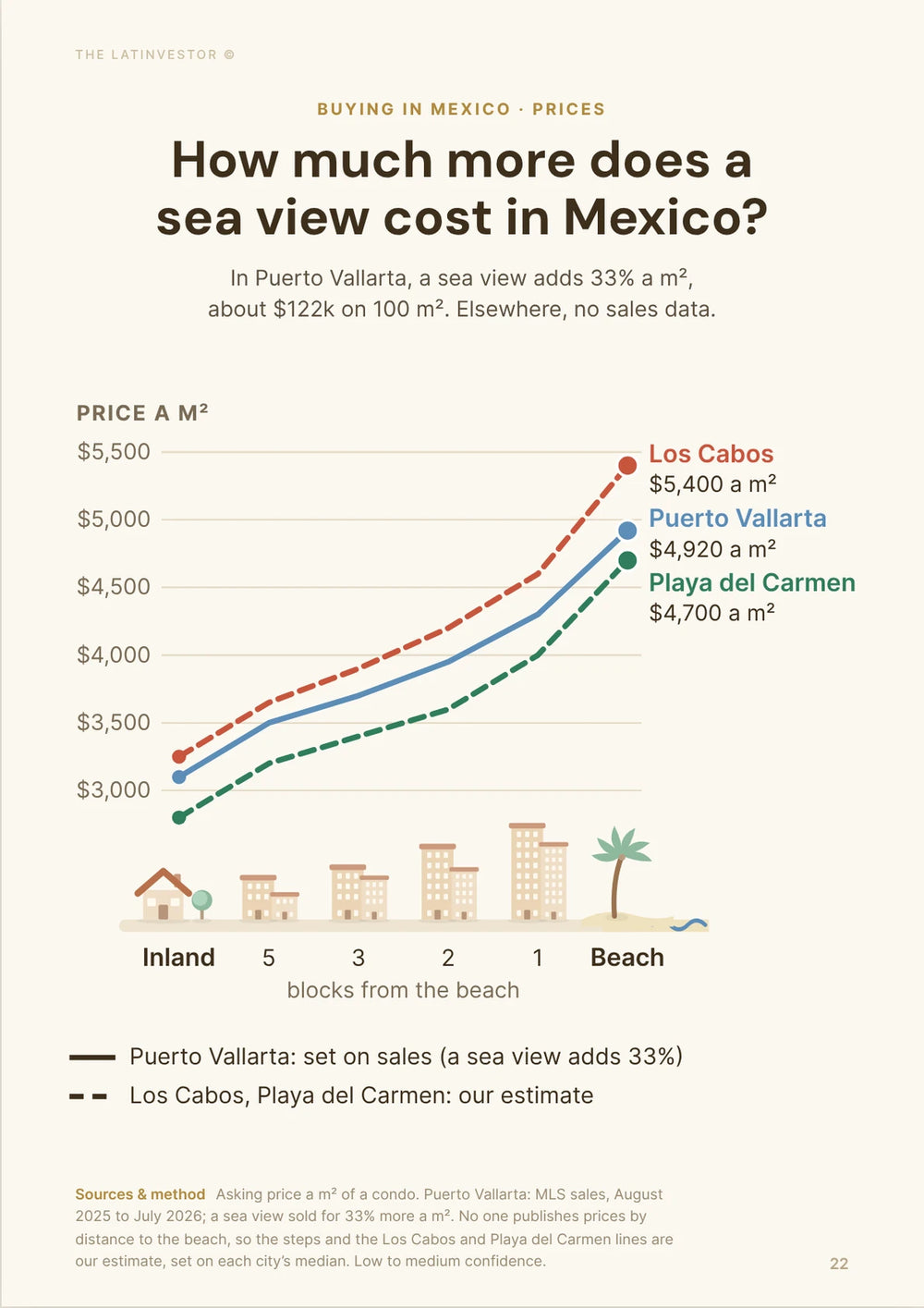
You don't need to be on the sand. Maya Ocean's May 2026 study puts condos 100 to 500 meters from the sea at about $5,217 per m², almost the same as the $5,451 right on the beach.
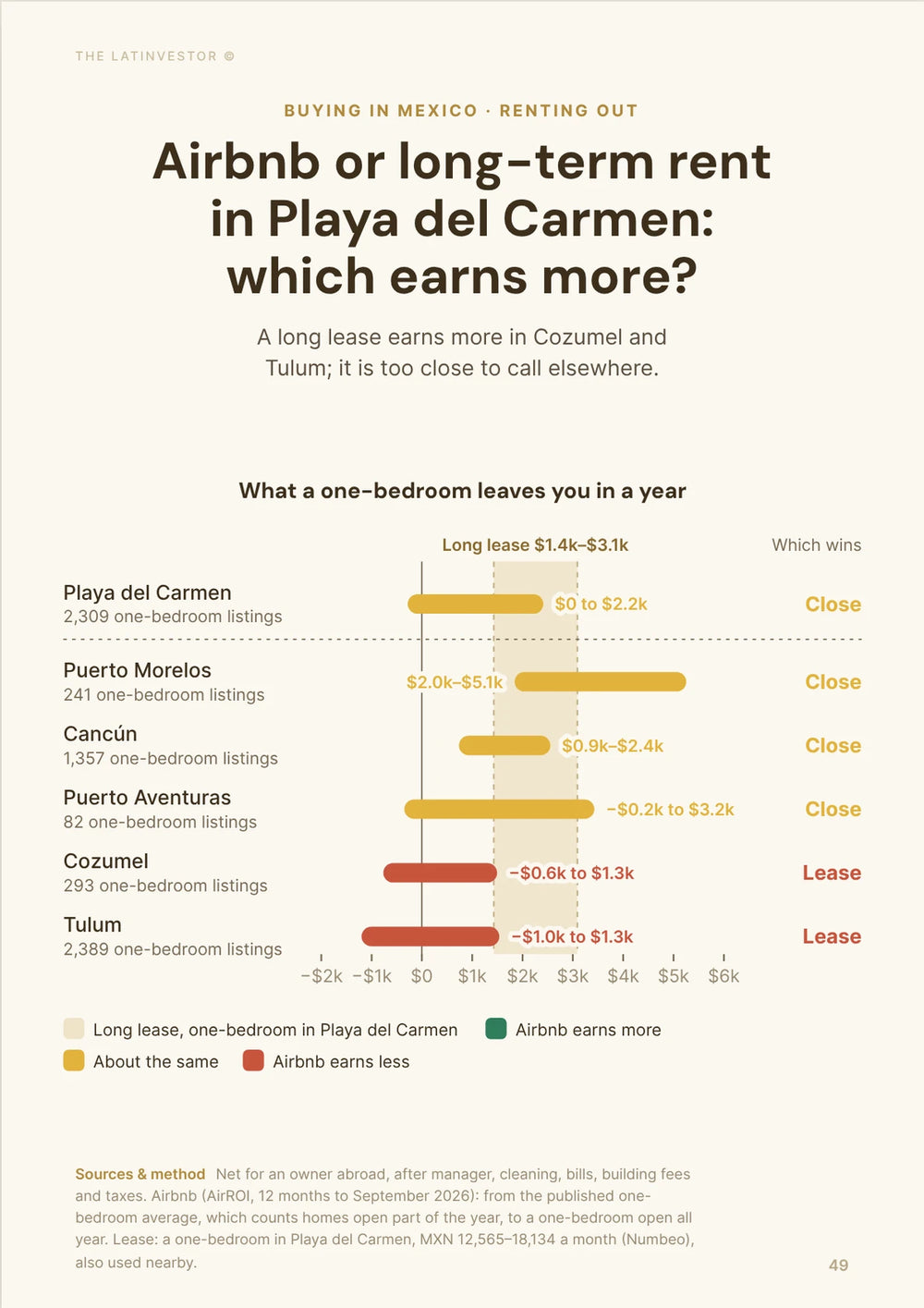
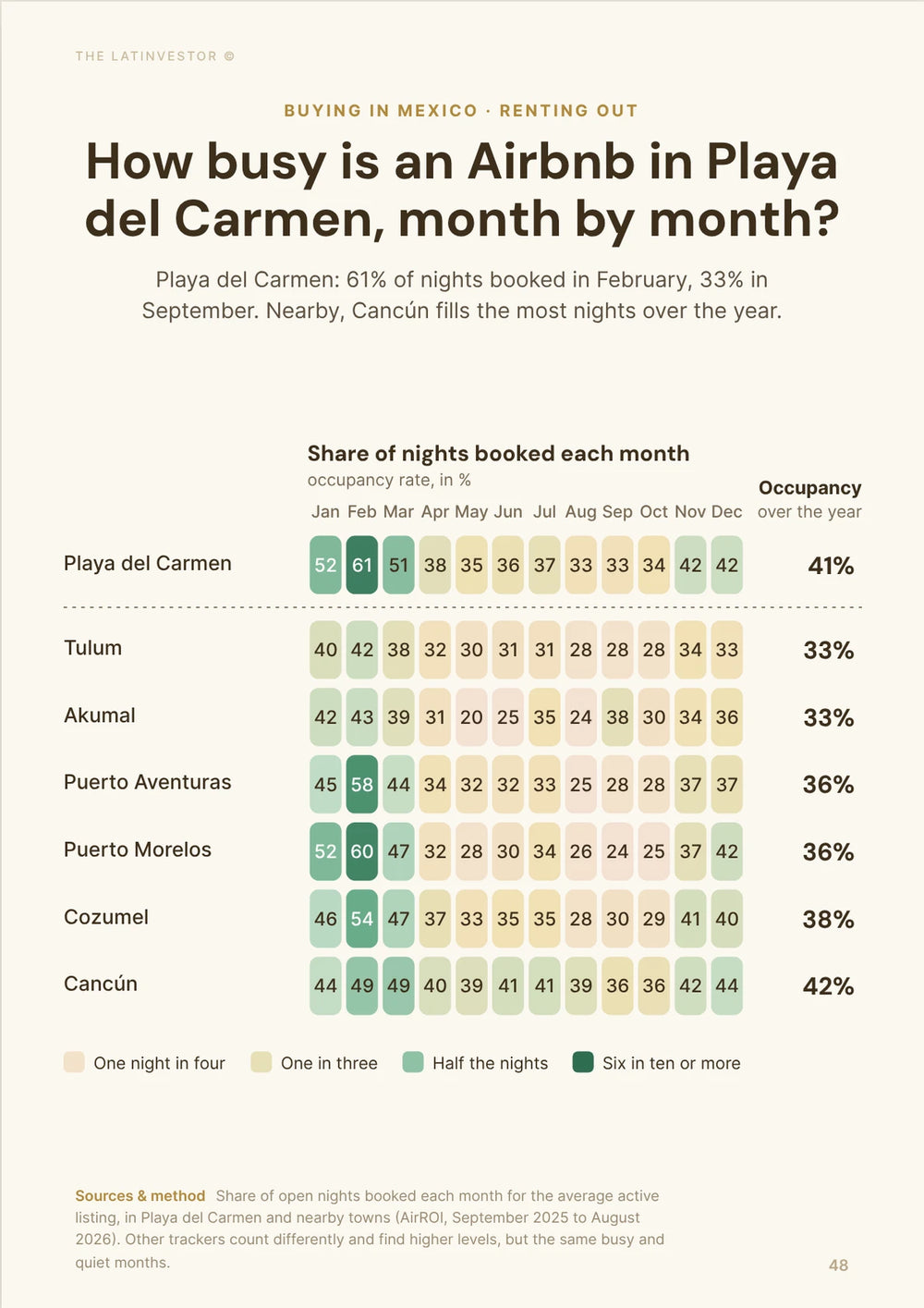
Airbnb shouldn't choose the area for you. AirDNA's active listings in Playa fell about 60% in a year, occupancy is 58% and the average nightly rate dropped to $103.
Supply is deep. Maya Ocean tracks about 6,230 unsold units across 238 developments, including 2,140 within 500 meters of the sea.
Buy finished rather than presale unless the discount is real. Developers quote 20% to 35% below finished units, and Quintana Roo's blacklist of irregular developments reached 123 in August 2026.
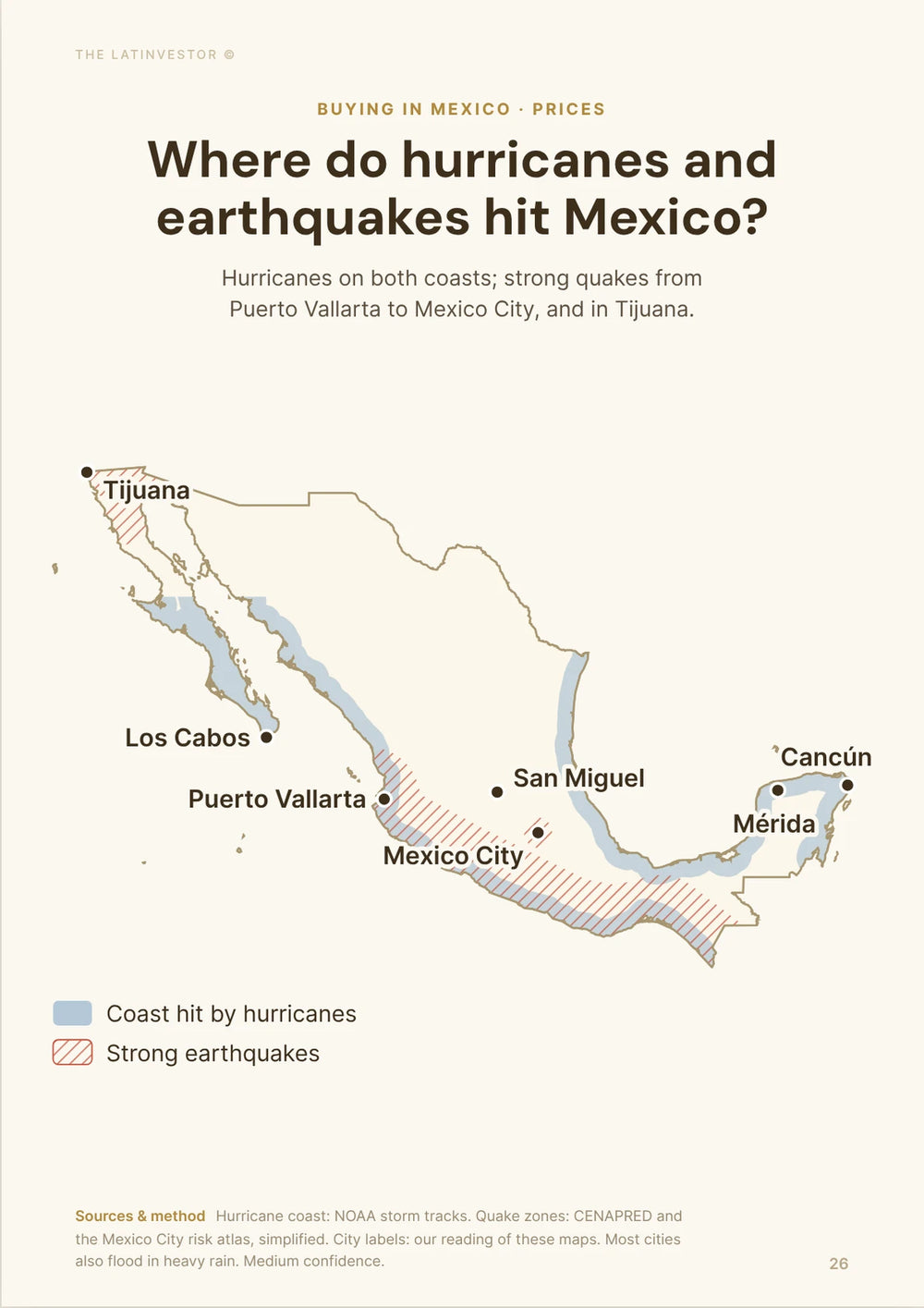
Water is now a neighborhood question. In July 2026, at least 18 neighborhoods, including Zazil-Ha and Colosio, had little or no running water for up to two weeks.
If we were buying one property now, we'd look for a finished one- or two-bedroom in Zazil-Ha, a few streets back from the beach, in a building with its own cistern. We'd only cross into Colosio for a unit that is clearly cheaper than Zazil-Ha and has a clean title.

Which Playa del Carmen neighborhood is the most expensive right now?
Centro. TuLugar's October 2026 data puts apartments there at about $4,120 per m², the highest of the main central areas. That changes the usual story, where Zazil-Ha was the expensive one and Colosio the bargain.
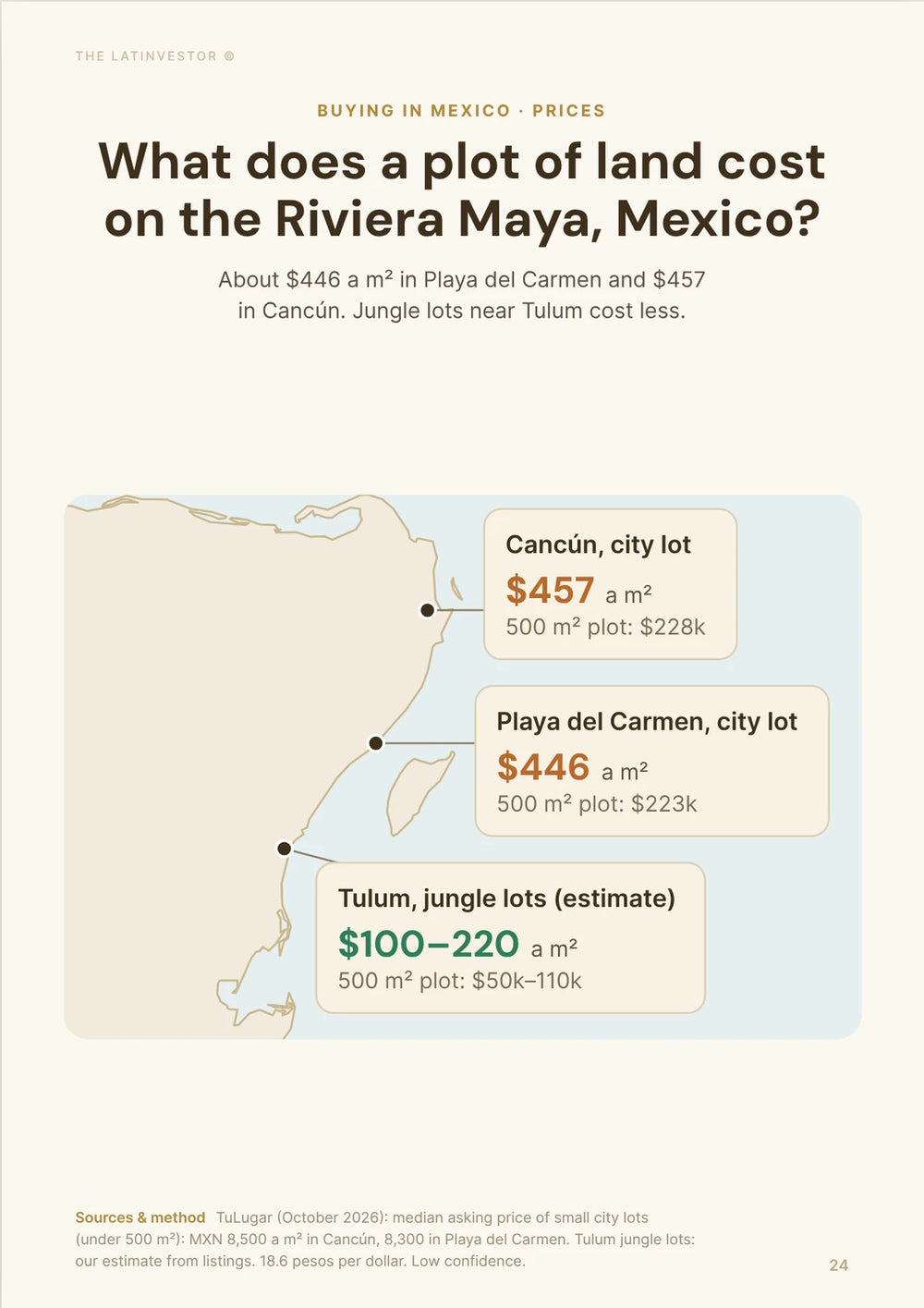
Playa is a deep market. Maya Ocean tracks about 6,230 unsold units across 238 developments, and TuLugar monitors about 11,000 listings, with a citywide median of about $3,353 per m² for apartments. With that much choice, an average unit is easy to replace.
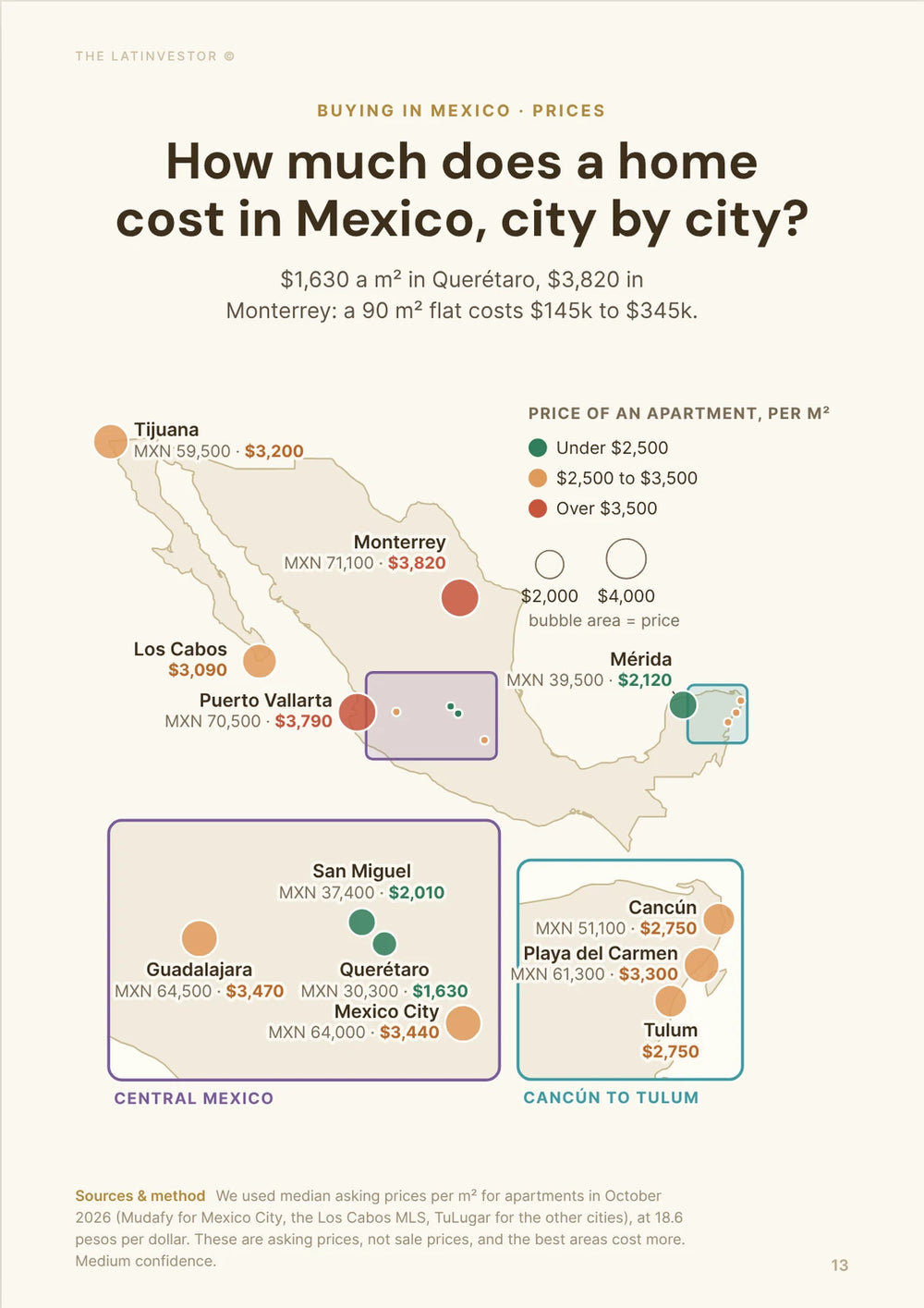
By area, TuLugar has Gonzalo Guerrero at about $3,796 per m², Zazil-Ha at $3,675, Luis Donaldo Colosio at $3,562 and Playacar Fase II at $3,041. Inland, Real Ibiza Plus Fase II is near $1,402 and Paseo de los Olivos II near $1,164. These are asking prices, not sale prices.
The gaps between central areas are now small, so the neighborhood alone won't make you money. The building, the street and the price you negotiate matter more.
| Area | What you're really buying | Asking $/m² (Oct. 2026) | Main weakness | Our current view |
|---|---|---|---|---|
| Zazil-Ha | Walkability + beach + mixed demand | $3,675 | Water cuts in 2026 | Best overall |
| Gonzalo Guerrero | Central location without the most tourist-heavy blocks | $3,796 | Few bargains | Strong rental choice |
| Centro | Maximum tourist convenience | $4,120 | Highest price, lowest yield, noise | Only for the right building |
| Colosio | Lowest ticket near the center | $3,562 | Discount mostly gone + title history | Selective |
| Playacar Fase II | Gated lifestyle + established demand | $3,041 | Higher total ticket | Best for living |
| Real Ibiza Plus Fase II | Cheap residential entry | $1,402 | Weak tourist appeal | Local-rental play |
Is Zazil-Ha really the best neighborhood to buy in Playa del Carmen?
Yes. If we had to pick one neighborhood without knowing whether the buyer would live there, rent it out or sell it later, we'd start with Zazil-Ha.
The location does most of the work. Zazil-Ha sits at the northern end of central Playa, close to Fifth Avenue and the beach but away from the loudest blocks. A good apartment there can work for vacationers, people staying a few months, foreign residents and local professionals with bigger budgets.
That wide pool of renters is what holds up now. Propiedades.com puts the average asking rent in Playa down 7.6% since April 2025, but Zazil-Ha is down only 1.5%, at about MXN 19,675 a month (USD 1,060). Centro is near MXN 16,700 and Ejidal near MXN 14,200. Unit sizes differ between areas, so treat these as levels, not clean comparisons.
And it's no longer the priciest part of the center. At about $3,675 per m², Zazil-Ha asks around 11% less than Centro, and TuLugar's medians give it the best gross yield of the main areas, about 6%.
What we'd avoid: paying $4,000-plus per m² for a tiny studio with high monthly fees in a building full of identical short-term rentals. A real one-bedroom or compact two-bedroom a few streets back from the beach gives you more ways to use the place and more buyers when you sell.
| October 2026 | Zazil-Ha | Centro | Gonzalo Guerrero | Colosio |
|---|---|---|---|---|
| Asking price per m² (TuLugar) | $3,675 | $4,120 | $3,796 | $3,562 |
| Listings tracked (all types, TuLugar) | 577 | 658 | 533 | 462 |
| Median apartment asking price (TuLugar) | $224K | $229K | $275K | $191K |
| Average asking rent (Propiedades.com) | MXN 19.7K | MXN 16.7K | MXN 19.7K | MXN 12.7K |
| Gross yield from TuLugar medians | 6.0% | 4.6% | 5.2% | 5.0% |
| Our preference | Best overall | Selective | Strong | Selective |
Is Centro now overpriced compared with the rest of Playa del Carmen?
For a typical investor condo, yes. Centro has the highest asking price per m² of the main areas (about $4,120) and the lowest gross yield (about 4.6%), so you pay the most for the weakest rental return.
Centro still has something no inland project can copy: you step outside and you're on Fifth Avenue, near the beach, restaurants, nightlife and the Cozumel ferry.
The problem is competition. TuLugar counts 658 listings in Centro, the most of any neighborhood, and much of it is the same recipe: small units, rooftop pool, short-term rental pitch. Rents are slipping too: Propiedades.com has Centro at about MXN 16,692 a month (USD 897), down 4.4% since April 2025.
The street matters a lot. A condo near clubs looks great on a map and becomes hard to rent for longer stays. A few blocks away, you keep most of the walkability and open the unit to tenants who want to sleep.
We'd still buy in Centro when the unit has something others can't copy: a quiet position, a good layout, a real rental record, proper outdoor space or a genuine view. And we'd use the 658 competing listings to push the price down.
Is Gonzalo Guerrero a better buy than Centro?
For most buyers, yes. Gonzalo Guerrero keeps most of Centro's walkability, costs less per m² and rents for more.
On a map the difference looks small. On the ground, moving north and away from the busiest tourist blocks changes how a place feels. Fifth Avenue and the sea are still a walk away, but monthly renters and owners who live there become a real part of the demand.
The numbers back it up. TuLugar puts Gonzalo Guerrero at about $3,796 per m², about 8% below Centro, and Propiedades.com has rents near MXN 19,675 a month, unchanged since April 2025, against about MXN 16,700 in Centro.
We'd choose Gonzalo Guerrero over Centro for mixed use: some personal stays, some vacation rentals and the option to switch to longer leases.
That flexibility matters more now that tourism is softer. Quintana Roo's tourism observatory puts Playa's hotel occupancy at 71.27% from January to July 2026, against 75.76% a year earlier.
Has Colosio's discount to Zazil-Ha disappeared?
Mostly, yes. TuLugar now puts Luis Donaldo Colosio at about $3,562 per m² against $3,675 in Zazil-Ha, a gap of only about 3%. In our previous update, based on older TuLugar data, the gap was around 24%.
Part of that is the convergence buyers were betting on: the eastern and southern blocks of Colosio now blend into northern central Playa, with new restaurants and apartments, and the beach is close from the better streets. But it also means the cheap entry that justified Colosio's risks is largely priced in.
Colosio still has the lowest median ticket of the central areas, about $191,000 for an apartment, because units are smaller. Rents are much lower though, near MXN 12,700 a month (USD 683), and the gross yield (about 5.0%) is below Zazil-Ha's.
The risks haven't gone away. Title regularization is still in dispute (see below), several Colosio streets flooded in January 2026, and the neighborhood was on the list of areas without running water in July.
Building quality also varies a lot. Some new projects target the same international buyer as Zazil-Ha; others are ordinary buildings using the Colosio growth story to justify ambitious prices. If a Colosio unit asks about the same per m² as one in Zazil-Ha, we'd buy in Zazil-Ha.
| Colosio factor | What we see now | Effect on the investment |
|---|---|---|
| Price gap with Zazil-Ha | About 3% per m² ($3,562 vs $3,675) | The upside argument is much weaker |
| Median apartment price | About $191,000, the lowest of the central areas | Smaller units, lower ticket |
| Beach access | Good from eastern blocks | Supports mixed rental demand |
| Title regularization | 474 titles announced in July 2026, residents say about 250 delivered | Strict title checks needed |
| Water and flooding | Water cuts in July 2026, flooded streets in January 2026 | Check the building's cistern and drainage |
| Overall view | Less discount, same risks | Only with a clear price gap |
Is Playacar the best area if you plan to live in Playa del Carmen, and where do cheaper or luxury areas fit?
Yes. If you'll spend months a year in Playa, Playacar is probably the strongest choice. Cheaper inland areas and resort communities like Grand Coral or Corasol suit very different buyers.
Playacar trades downtown's buzz for security, greenery, bigger homes and a calmer, gated setting. That matters far more to someone living there than to a tourist booking four nights.
It also stays in demand. DataTur reported 90.3% hotel occupancy in Playacar from January to April 2026, the highest among the Mexican destinations in its ranking, against 75.6% for Playa del Carmen overall.
Prices are lower than the luxury image suggests. TuLugar puts Playacar Fase II at about $3,041 per m², below Zazil-Ha and Gonzalo Guerrero, but the median apartment asks about $344,000 because units are bigger. Rents are high too (about $1,637 a month on TuLugar), for a gross yield near 5.7%.
Inland works on the opposite logic. Real Ibiza Plus Fase II asks about $1,402 per m² and Paseo de los Olivos II about $1,164, around a third of Zazil-Ha. Rents don't fall as much: Propiedades.com shows about MXN 14,200 a month in Ejidal and MXN 12,700 in Ciudad Mayakoba. The numbers can work at the right price, but demand there depends on local jobs, schools and transport, not tourists.
At the top end, TuLugar has Grand Coral at about $3,795 per m² with a median apartment around $507,000. People buy there for golf, resort amenities and space, not yield.
For a family, retiree or second-home buyer, we'd give Playacar more weight than an Airbnb spreadsheet would. Inland areas are for local long-term rental math, and Grand Coral or Corasol for buyers who really want the resort life.
How close to the beach should you buy in Playa del Carmen?
For most buyers, about 100 to 500 meters from the sea, not directly on the beach.
Maya Ocean counted 2,140 active condos within 500 meters of the sea across 52 developments in its May 2026 study. That's a lot of supply, so being "close to the beach" isn't rare anymore.
The pricing is the interesting part. Maya Ocean found average asking prices of about $5,451 per m² within 100 meters of the sea and $5,217 between 100 and 500 meters, then about $4,117 between 500 meters and 2 kilometers. The first few hundred meters back from the sand keep almost all the premium. These are developer-heavy figures, higher than TuLugar's neighborhood medians.
Sargassum is another reason not to pay for the front row. More than 45,000 tonnes were collected in the municipality between January and late September 2026, even with five kilometers of anti-sargassum barriers between Playa Fundadores and Punta Esmeralda.
We'd rather own a great condo a few minutes from the beach whose appeal also comes from restaurants, walkability and the neighborhood itself.
| Distance from sea | Maya Ocean active units | Approx. $/m² | Our take |
|---|---|---|---|
| Under 100 m | 348 | $5,451 | Pay up only for a truly special unit |
| 100–500 m | 1,792 | $5,217 | Best coastal balance |
| 0.5–2 km | 3,752 | $4,117 | Strong value if still walkable |
| 2–5 km | 3,328 | $1,839 | Different renter profile |
| More than 5 km | 1,777 | $765 | Local housing economics |
This distance study covers a wider set of listings than Maya Ocean's city inventory, so the bands don't add up to the 6,230 units mentioned above.
Is Airbnb still strong enough to choose where to buy in Playa del Carmen?
No. Short-term rentals are still a big part of Playa's market, but the current numbers don't justify letting Airbnb decide the whole purchase.
AirDNA counts about 6,498 active short-term rentals in Playa (September 2026), with 58% average occupancy, an average nightly rate of $103 and about $18,800 a year in revenue per active listing.
The year-on-year changes need care. Active listings are down about 60%, revenue per listing roughly doubled and the nightly rate fell about 19%, yet revenue per available night (RevPAR) rose only 3.9%. Those swings mostly reflect who dropped out of the data, not a boom for those who stayed.
Hotels say the same. Playa's hotel occupancy was 71.27% from January to July 2026, down from 75.76%, and small hotels fell to about 18% in September, according to their association.
The rules are tightening too. Quintana Roo now requires every vacation rental to be registered in the state tourism register (RETUR-Q) and hold a municipal licence, and platforms are to show the registration. Before buying for Airbnb, check that the condo rules allow short stays and that the building's other owners are registered. A unit that can switch between weekly, monthly and long-term renters gives you room if short-term income drops.
Has Playa del Carmen built too many condos?
For generic units, yes. Playa has enough supply to punish ordinary condos, even though demand is still too strong to call the market broken.
Maya Ocean's database tracks about 6,230 unsold units across 238 developments, more than 3,600 of them condos. Within 500 meters of the sea, it counted 2,140 units, and its 15 developments with the most near-sea stock had a median of 63 units each for sale. Several had more than 70; one had 239.
Rents confirm it. Propiedades.com has Playa's average asking rent down 7.6% since April 2025, and Centro down 4.4%. Hotel occupancy has slipped as well.
Supply is deep enough that the property has to earn attention. We'd favor good layouts, reasonable HOA fees, quiet streets, established buildings and real views over another amenity-heavy studio.
| Supply evidence (2026) | Scale | What we take from it |
|---|---|---|
| Maya Ocean tracked developments | 238 | Buyers have huge choice |
| Total Maya Ocean unsold units | About 6,230 | Competition across all of Playa |
| Condos in that database | 3,600+ | Apartments are not scarce |
| Units within 500 m of sea | 2,140 | "Near the beach" alone is common |
| Median stock, top-15 near-sea projects | 63 units | Direct competitors inside the same building |
Should you buy a presale or an existing condo in Playa del Carmen now?
A finished condo, for most buyers, unless the presale discount still holds up against resale units nearby.
Buying finished lets you check the exact layout, build quality, noise, common areas, real HOA charges and, when available, rental history. With this much inventory, you lose little by waiting for a finished unit.
A presale swaps those facts for developer risk: delivery date, final finishes, future HOA costs and how much competing stock lands before you get the keys. Maya Ocean says Riviera Maya presales are often marketed 20% to 35% below finished projects, with many delivering between 2026 and 2028. Check that discount yourself.
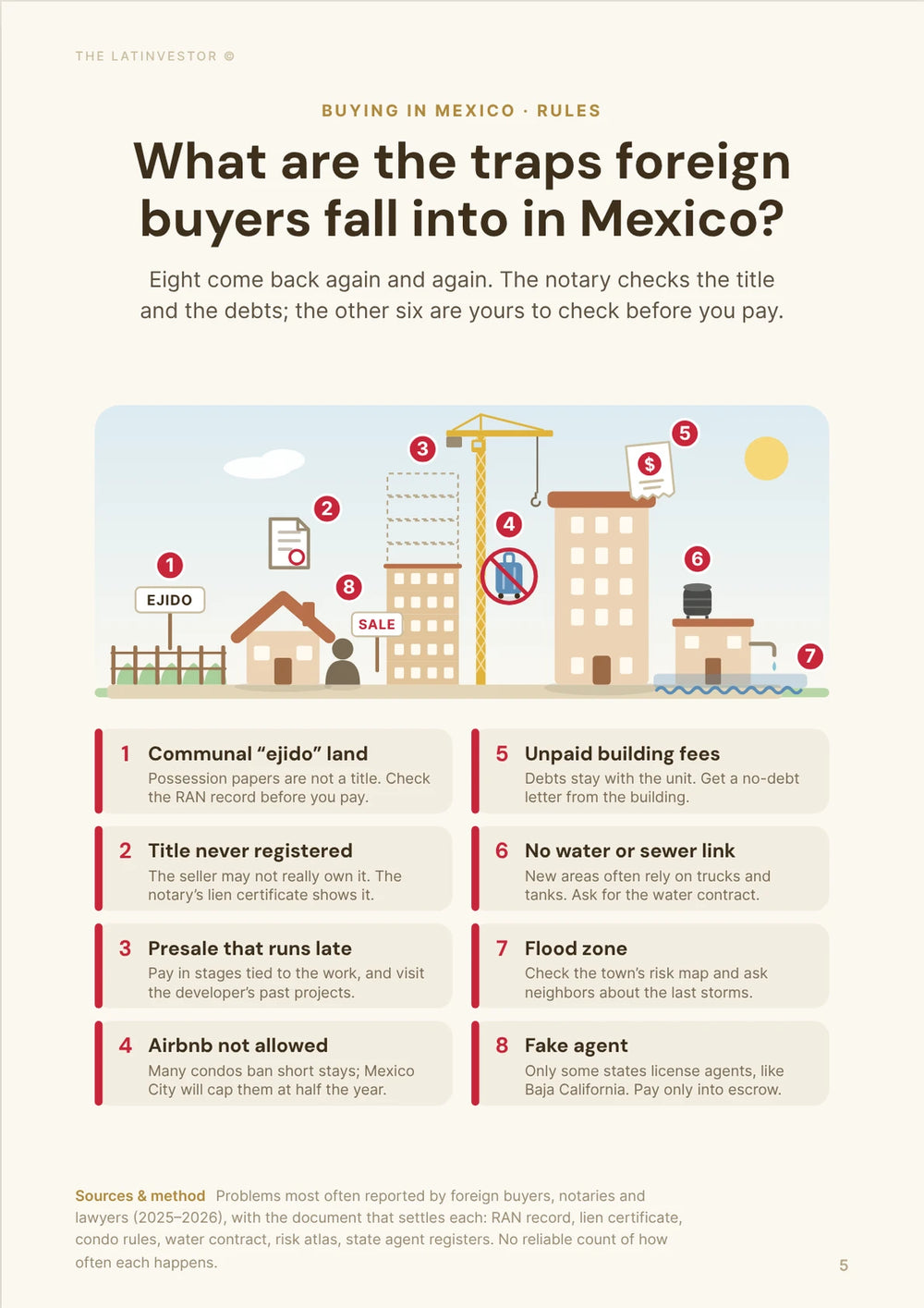
The risk is real right now. Quintana Roo's urban development agency (SEDETUS) had 123 irregular developments on its public list by August 2026, with Playa and Tulum the most affected. In Playa's SÚUT presale, more than 50 buyers paid over MXN 200 million for 91 apartments they never received.
What to do: search the project in the SEDETUS registry, ask for the construction licence and land-use permit, pay only through the notary or an escrow account, and compare the price with finished units within a few blocks. If it's about the same once size, furniture, closing costs and payment timing are included, take the finished one.
Is buying property in Colosio legally riskier than elsewhere in Playa del Carmen?
Yes. Colosio deserves more title checks than the mature central areas, because land regularization there is still going on and still disputed.
On July 17, 2026, the federal and state governments announced 474 property titles and 30 deeds for Colosio families, after two to three decades of uncertainty. Two weeks later, residents' groups said only about 250 titles had actually been delivered, and that many long-time occupants still can't get one.
For a buyer, that history should trigger specific checks, not vague fear. The deed must match the Public Property Registry, the cadastral record must match the property, construction permits must exist, and the condominium regime must be properly set up when it applies. Ask for a recent lien certificate and pay only through the notary.
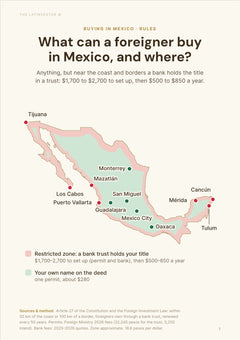
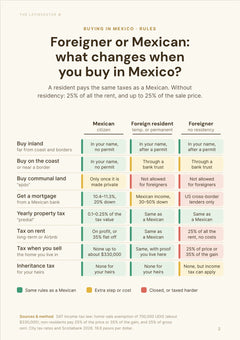
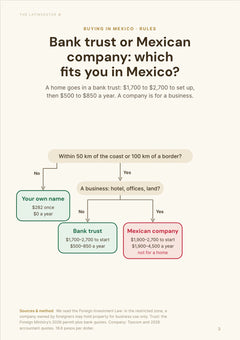
Foreign buyers also deal with the bank trust everywhere in coastal Playa. Mexico's Foreign Affairs Ministry (SRE) says residential property bought by foreigners within 50 kilometers of the coast is held through a fideicomiso, granted for up to 50 years and renewable. The SRE permit costs MXN 21,650, and banks charge about $550 to $800 to set it up and $550 to $700 a year.
Developer history, unpaid HOA balances, permits and condominium documents matter everywhere in Playa. Colosio just leaves you less room to be casual.
Which Playa del Carmen neighborhoods had water cuts or flooding in 2026?
Several of the areas buyers look at most. In July 2026, Por Esto! reported at least 18 neighborhoods with little or no running water, some for about two weeks, including Zazil-Ha, Colosio and El Ejido. In January 2026, a cold front flooded streets in Colosio and Gonzalo Guerrero, among others.
The water problem is about capacity. Residents blame the water company's network, which hasn't kept up with Playa's growth, and in some streets pipes ran dry from mid-morning until night. That's the same growth that fills the condo pipeline.
What to check before buying: does the building have its own cistern and pump, and how many days does it cover? Ask the HOA how often it bought water by truck in 2026 and what it cost. Check the street after heavy rain, and ask the administrator whether the parking or ground floor has flooded. A unit with a cistern in Zazil-Ha is a much easier rental than one without.
Where should you buy in Playa del Carmen for rental income?
Zazil-Ha and Gonzalo Guerrero first, then quieter parts of Centro only if the price is right.
These areas work because the renter doesn't have to fit one profile. A tourist can stay a week, a remote worker three months, and a local can sign a year-long lease.
Zazil-Ha and Gonzalo Guerrero both ask about MXN 19,675 a month on Propiedades.com, and neither has really dropped. Centro is near MXN 16,700, Colosio near MXN 12,700. On TuLugar's medians, gross yields run from about 4.6% in Centro to 6.0% in Zazil-Ha.
Do the math building by building. A $224,000 Zazil-Ha condo renting at TuLugar's median of about $1,118 a month earns about 6% gross. A non-resident owner pays 25% of the gross rent in Mexican tax, which brings that to about 4.5% before HOA fees (often MXN 4,500 to 12,000 a month in beach-zone buildings), management, utilities, maintenance and empty months.
Airbnb argues for flexibility, not against it. AirDNA's 58% occupancy and $103 nightly rate show a working market, but a 3.9% rise in RevPAR doesn't support bold revenue assumptions.
For pure long-term rental income, inland areas deserve a separate look, because prices fall much faster than rents.
Where should you buy in Playa del Carmen for appreciation?
Now that Colosio has nearly caught up, we'd bet on quality rather than on a cheap neighborhood: a well-built, well-located unit in Zazil-Ha or Gonzalo Guerrero bought below its asking price.
Colosio's appeal was the gap. With Colosio at about $3,562 per m² and Zazil-Ha at $3,675, the gap is only about $110 per m², so there's little left for a catch-up to deliver. Some of that catch-up has already happened.
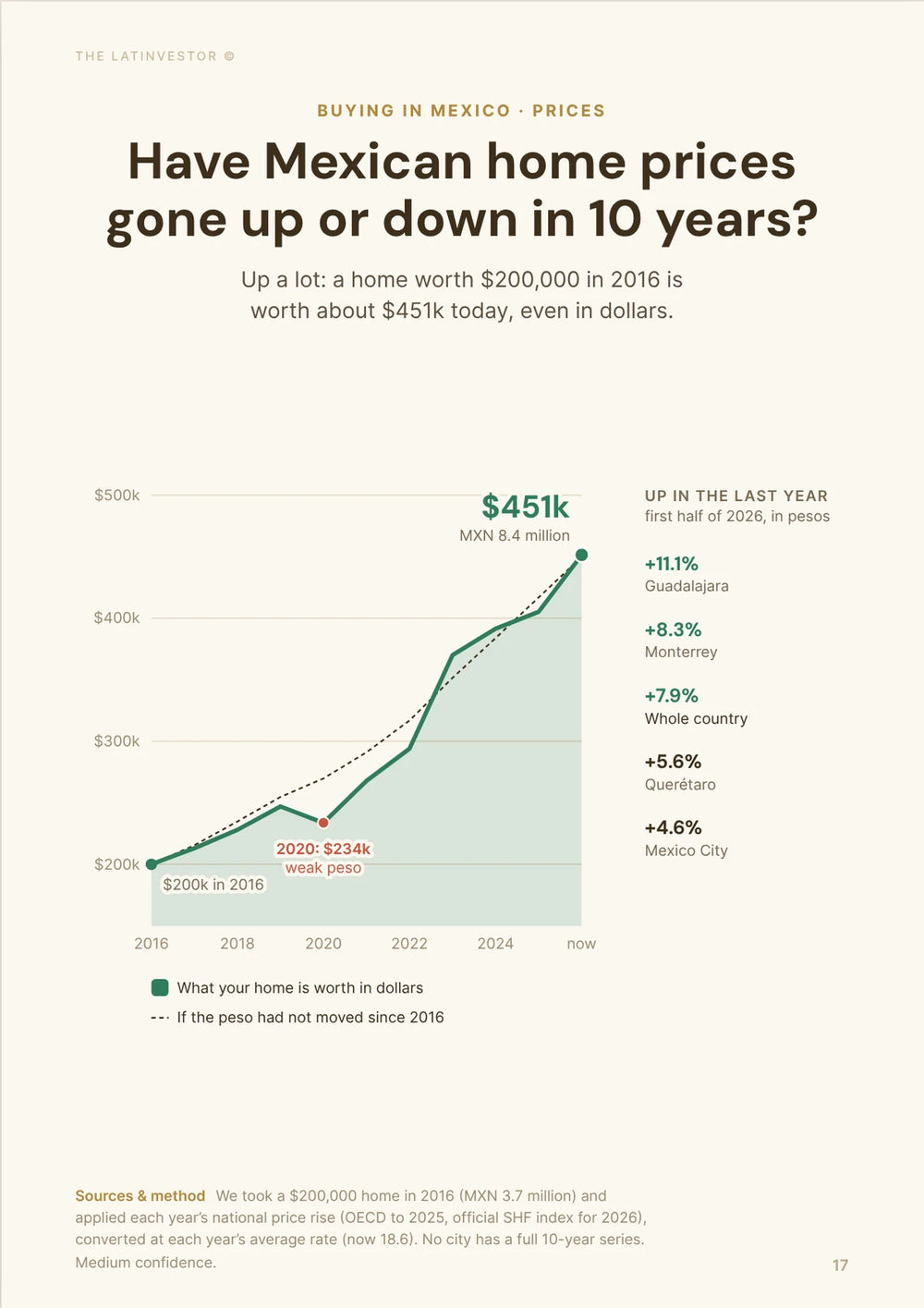
The official index still points up for the city. SHF's mortgage-based price index for Solidaridad, Playa's municipality, rose 11.7% in the first half of 2026. But that index tracks homes bought with a mortgage, mostly family houses, not beach condos competing with 6,230 unsold units.
If you still want Colosio for upside, stick to the blocks that already benefit from beach access and northern Playa's growth, and only buy where the price is clearly below comparable Zazil-Ha units. A title or permit problem would wipe out the very upside you were buying.
So where is the best place to buy in Playa del Carmen today?
Zazil-Ha, overall. It's walkable to Fifth Avenue and the beach, works for tourists and longer-term renters, has held its rents (about MXN 19,675) and now asks less per m² than Centro.
Gonzalo Guerrero comes next when rental flexibility matters. You get most of central Playa's convenience without the busiest tourist streets, and rents there haven't fallen.
For someone who'll live in Playa for months, Playacar moves to the top of the list. At about $3,041 per m² in Fase II, it's cheaper per m² than the center, with bigger units and a calmer setting.
Colosio has dropped down our list. Its discount to Zazil-Ha is down to about 3%, and title disputes, water cuts and flooding remain. Centro is the most expensive area per m² with the lowest yield, so only an exceptional unit makes sense there.
Supply shapes everything: about 6,230 unsold units across 238 developments, including 2,140 within 500 meters of the sea. That's your leverage when you negotiate.
If we were buying one property now, we'd look for a finished one- or two-bedroom in Zazil-Ha, close enough to walk to Fifth Avenue and the beach, away from the loudest streets, in a building with its own cistern. We'd only go to Colosio for a unit that is clearly cheaper than its Zazil-Ha equivalent and has a boringly clean title.
| Rank | Playa del Carmen area | Best use | Why we'd buy | What could stop us |
|---|---|---|---|---|
| 1 | Zazil-Ha | Best overall | Beach, walkability, rents holding, best yield | Water cuts, overpaying for a generic unit |
| 2 | Gonzalo Guerrero | Rental + mixed use | Central, more residential, rents flat | Already priced at a premium |
| 3 | Playacar | Living + capital preservation | Established, gated, high-end demand | Larger ticket and community costs |
| 4 | Colosio | Lowest central ticket | Cheapest median unit near the center | Discount mostly gone, title, water |
| 5 | Centro | Tourist-focused rental | Maximum visitor convenience | Highest $/m², lowest yield, competition |
| 6 | Grand Coral / Corasol | Luxury lifestyle | Resort setting and bigger homes | Weak fit for yield-first buyers |
| 7 | Inland Playa | Long-term local rental | Very low purchase price | Little tourist demand |
Our methodology
This article estimates where the best place to buy in Playa del Carmen is today, comparing neighborhoods on price, rent, yield, tourism exposure, competing supply, lifestyle, resale, appreciation potential and, where relevant, legal and infrastructure risk.
Neighborhood prices, listing counts, median apartment prices and gross yields come from TuLugar's October 2026 listing data. Rents and their direction come from Propiedades.com. Supply and the price-by-distance-to-the-sea figures come from Maya Ocean's developer inventory and its May 2026 study, which we keep separate from TuLugar because they cover different parts of the market. Short-term rental figures come from AirDNA (September 2026), checked against official hotel occupancy from Quintana Roo's tourism observatory (SITUR) and DataTur.
For Colosio, the title figures come from the July 2026 government announcement and residents' response as reported in the press. Water cuts, flooding and sargassum come from dated 2026 local reports and official statements, and HOA ranges from a 2026 buyer guide. Ownership rules for foreigners come from Mexico's Foreign Affairs Ministry (SRE), and irregular developments from the SEDETUS registry. The 25% tax on a non-resident's gross rent comes from article 158 of Mexico's income tax law.
We checked these figures in October 2026. Conversions use about 18.6 pesos per US dollar and 20.9 pesos per euro.
These are asking prices and asking rents, not final sale prices or signed leases. Neighborhood samples differ in unit size and mix, so the gaps between areas are indications, not exact measures. The ranking is our judgment, based on where several independent sources point the same way.
Key sources used for this analysis include TuLugar's Playa del Carmen market data, Propiedades.com on Playa del Carmen apartment rents, Propiedades.com on Playa del Carmen Centro, Propiedades.com on Gonzalo Guerrero, Propiedades.com on Zazil Ha, Maya Ocean's Playa del Carmen inventory, Maya Ocean on condos near the sea (May 2026), Maya Ocean's Riviera Maya presale inventory, AirDNA's Playa del Carmen market overview, SITUR Quintana Roo's hotel-occupancy series, DataTur's April 2026 hotel occupancy report, Por Esto! on small hotels in Playa del Carmen (September 2026), La Razón on the July 2026 Colosio titles, Playa del Carmen's municipal record of the Colosio titles, Riviera Maya News on residents disputing the 474 titles, Por Esto! on the July 2026 water cuts, Riviera Maya News on the January 2026 flooding, the SEDETUS registry of irregular developments, Riviera Maya News on the 123 blacklisted developments, Por Esto! on the SÚUT buyers, Quintana Roo's tourism register (RETUR-Q), Mexico's Foreign Affairs Ministry on restricted-zone trusts, article 158 of Mexico's income tax law, Ruptura 360 on SHF prices for Playa del Carmen (August 2026), Diario Cambio 22 on 2026 sargassum collection, the Mexican Navy on sargassum containment, and The Mexico Handbook on HOA fees.