Summary
Yes, buying in Playa del Carmen is safe if the property has clean registered title and you check it before paying. The risk sits in specific deals: Quintana Roo had 123 irregular developments on its public blacklist by August 2026, and Playa is among the most affected areas.
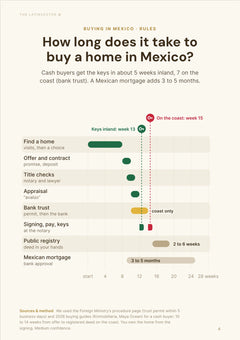
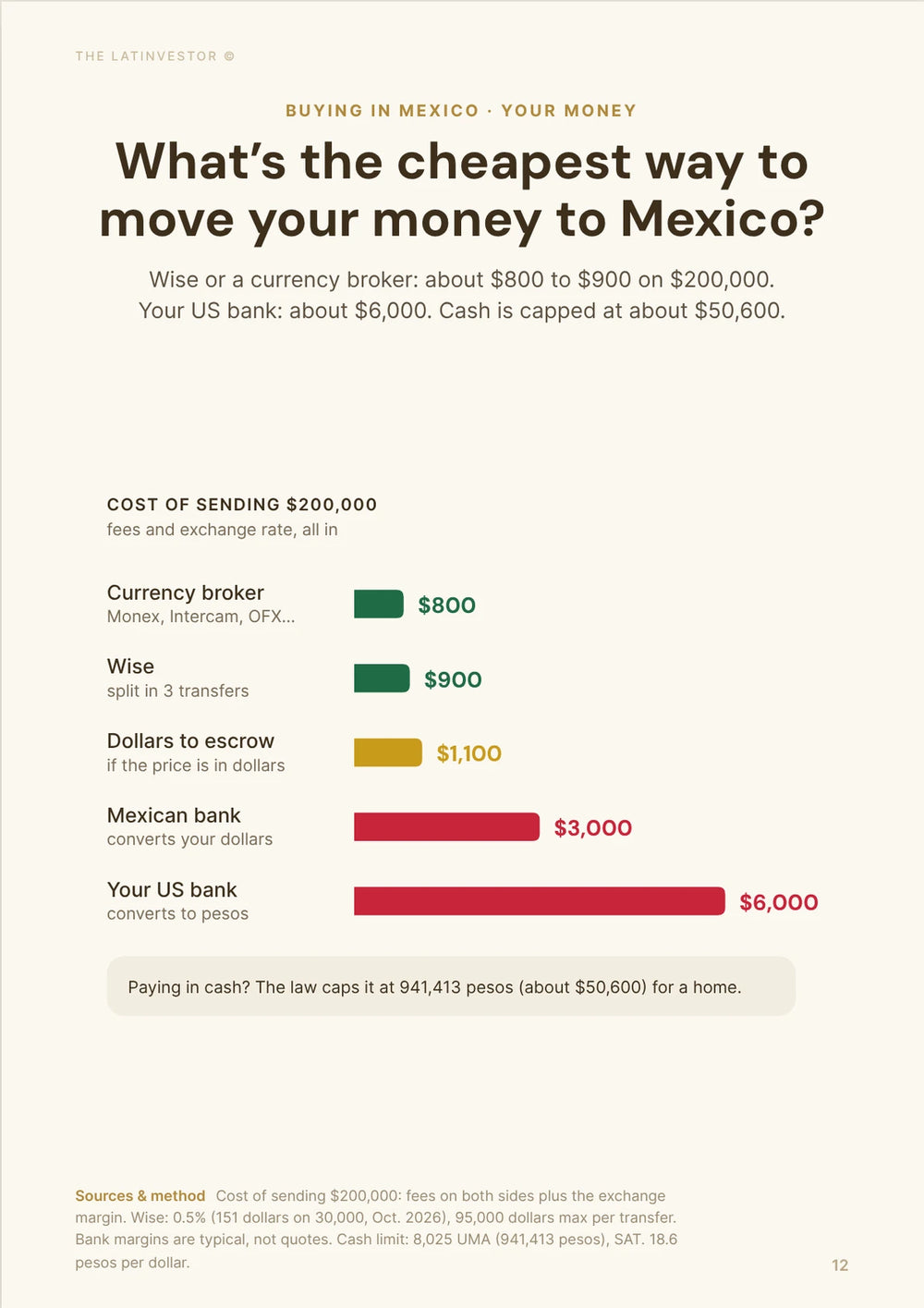
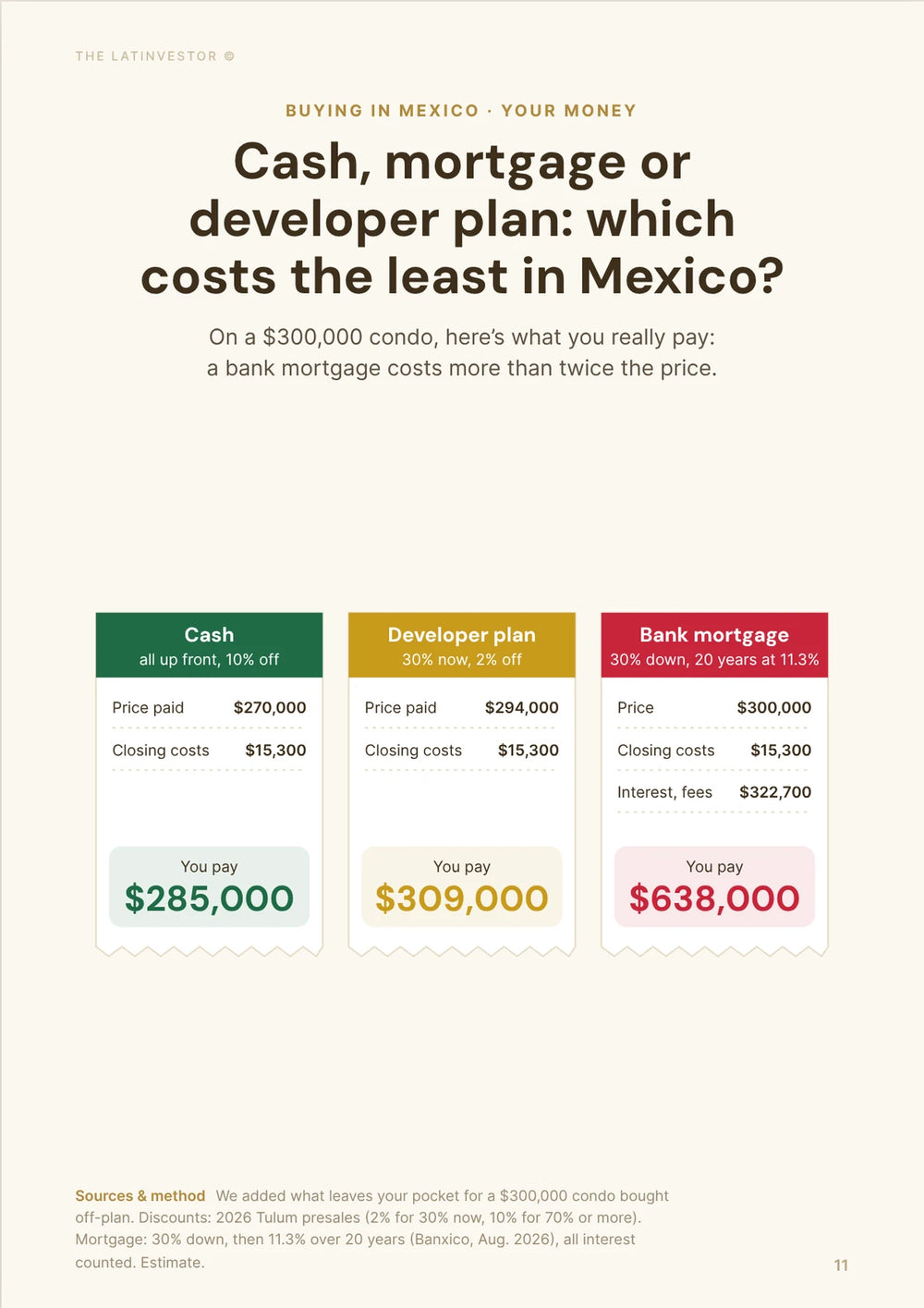
Being a foreigner isn't the problem. You buy through a bank trust (fideicomiso) that the SRE approves within 3 business days since June 2026, for a MXN 21,650 permit (about USD 1,160) plus the bank's own fees.
Title is where deals break. In the first ten months of 2025, SEDETUS opened 125 proceedings against irregular works and developments in Quintana Roo, 25 of them in Playa del Carmen, second only to Tulum.
The case everyone in Playa talks about is SÚUT: more than 50 buyers paid over MXN 200 million (about USD 10.8 million) for 91 apartments that were never delivered.
A notary is essential but not enough. Quintana Roo had six open investigations against notaries in February 2026 and 47 complaints filed in 2025, mostly about property sales.
Presales carry the most risk. NOM-247 gives you a 5-business-day window to cancel and a Profeco-registered contract, but no rule forces a weak developer to finish.
Deposits are the weak spot: scam presales and lots around Playa ask for MXN 10,000 to 50,000 against a simple receipt. Pay through the notary or escrow, and keep 30% to 40% back until handover.
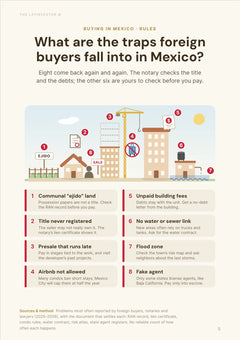
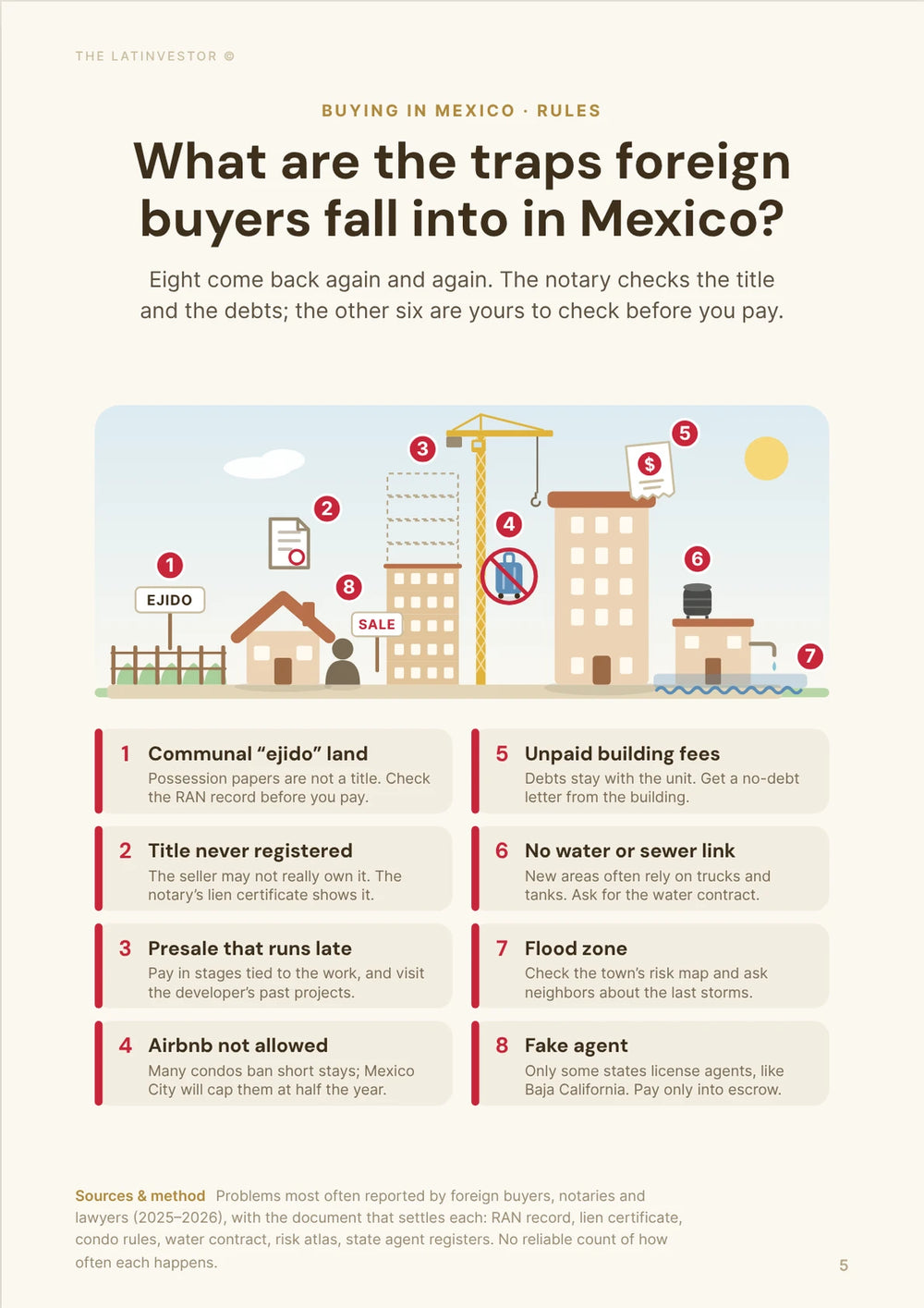
Ejido land is still the clearest trap. If the conversion to private title (dominio pleno) isn't finished and registered, don't buy.
Beachfront needs extra checks: the first strip of sand is federal (ZOFEMAT), and Playa del Carmen collected more than 45,000 tonnes of sargassum between January and late September 2026.
Crime is low for the region: about 5.7 homicides per 100,000 people over the year to September 2026, and the city says homicides fell 51.6% in the first eight months of 2026.
Water is a growing practical risk. In July 2026, at least 18 neighborhoods, including Zazil-Ha and Colosio, went days without running water.
A legal condo can still lose you money: AirDNA counts 6,498 active short-term rentals in Playa, 60% fewer than a year ago, with 58% occupancy.
The safest buy is a finished, privately titled condo with a clean lien certificate, a project that's not on the SEDETUS list, a building with a cistern and healthy finances, and money that only moves through the notary.

Is being a foreigner a risk when buying in Playa del Carmen?
No, the foreign-buyer side is the safe part: the legal route is old, well used and getting faster.
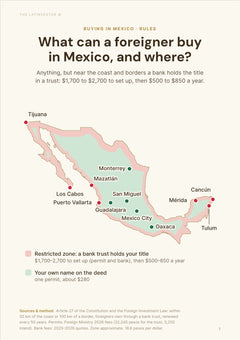
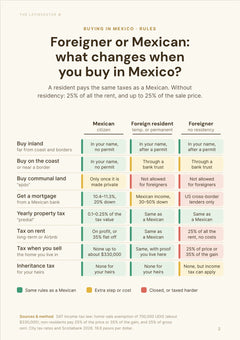
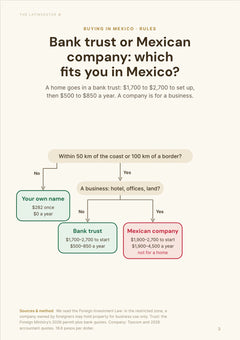
Playa del Carmen is less than 50 kilometers from the coast, so it sits in Mexico's restricted zone. Article 27 of the Constitution stops foreigners from holding residential land there directly, so you buy through a fideicomiso, a bank trust.
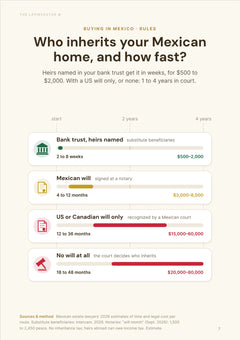
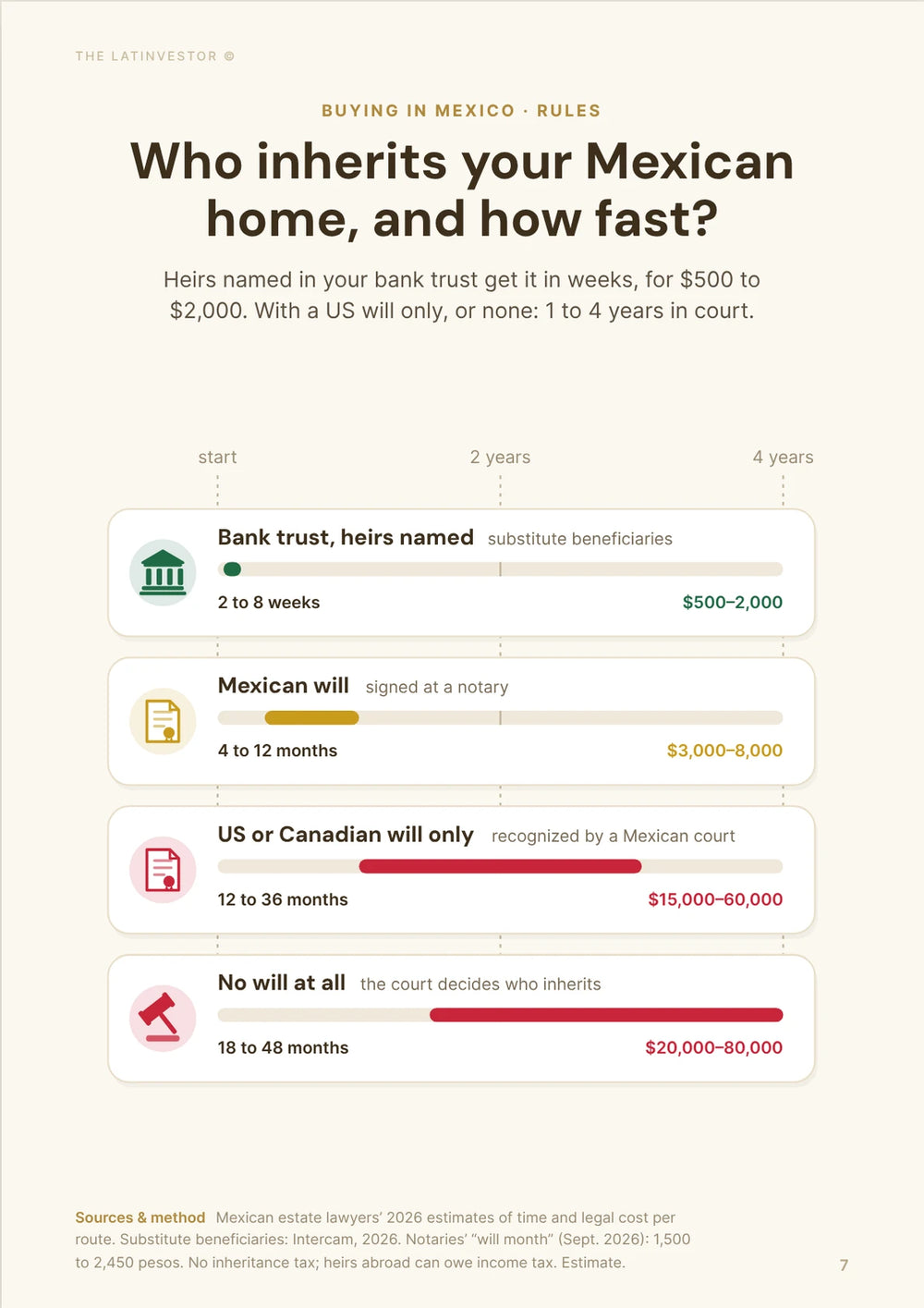
A Mexican bank holds title as trustee and you're the beneficiary. You can live in the property, rent it out, sell it and name who inherits it.
The trust runs for up to 50 years and can be renewed. The SRE charges MXN 21,650 (about USD 1,160) for the permit in 2026, and since June 2026 it has to issue it within 3 business days instead of 5. Banks then charge roughly USD 550 to 800 to open the trust and USD 550 to 700 a year, according to a 2026 comparison of bank fees.
So the trust adds paperwork and a yearly bill, not real risk. The real question is whether the property you put inside it has clean title.
| Issue | Foreign buyer in Playa del Carmen | What happens in practice | Risk if properly handled |
|---|---|---|---|
| Direct residential land ownership | Restricted | Foreign buyer generally cannot take direct title | Not applicable |
| Fideicomiso | Permitted | Mexican bank holds title as trustee | Low |
| Occupying the property | Permitted | Beneficiary can use the home | Low |
| Renting the property | Generally permitted | Subject to condo and local rules | Low to moderate |
| Selling | Permitted | Beneficial rights can be transferred | Low |
| Inheritance | Permitted | Substitute beneficiaries can be named | Low |
| Initial trust duration | Up to 50 years | Formal extension procedure exists | Low |
What is the biggest property-buying risk in Playa del Carmen?
The biggest risk is buying a property whose ownership, permits or legal status nobody properly checked.
You can check all of this before closing. Quintana Roo's Public Property Registry (Registro Público de la Propiedad y del Comercio) issues a Certificado de Libertad de Gravamen that shows liens and annotations on the property, and you can get certified copies of the registered deeds and the property's history.
That counts more than anything in a sales presentation. A seller showing an escritura is a start, but you still need to tie that deed to the right registry folio, confirm the seller can sell, check for liens and make sure the unit you visit matches the legal description.
Enforcement shows why. SEDETUS, the state urban development agency, reported 125 administrative proceedings against irregular works and developments in the first ten months of 2025. Playa del Carmen had 25 of them, second only to Tulum with 42.
SEDETUS put 116 irregular developments on its public list by the end of 2025. The list reached 121 in July 2026 and 123 in August 2026, with Playa del Carmen and Tulum the most affected. Those are statewide numbers, not 123 projects in Playa, but they show the problem is current, not historical.
What to do: before any payment, search the project name in the SEDETUS registry of irregular developments. The list changes often, so check it again just before you pay.
What happened at SÚUT, and could it happen with your Playa presale?
Yes, it could, if your money goes straight to a developer who needs new sales to keep building. SÚUT is the case that shows it.
SÚUT was a luxury presale in Playa del Carmen with 91 apartments. According to Por Esto!, more than 50 buyers paid over MXN 200 million (about USD 10.8 million) for units they never received. One of the people running the project was arrested in November 2024, accused of diverting presale money and a MXN 90.6 million bank loan (about USD 4.87 million). Excélsior reported that none of the 91 apartments had been finished or delivered.
It isn't a one-off. In April 2026, local advisers described the same pattern in Playa, Tulum and Puerto Morelos: presales sold on amenities that don't exist yet, lots priced far below the market with promised streets, deeds and nearby cenotes, and a first payment of MXN 10,000 to 50,000 (about USD 540 to 2,690) backed only by a simple receipt. Buyers keep paying until the seller stops answering.
What to do: ask who the developer is and visit a building they've already finished. Get the municipal construction licence and land-use permit in writing. Check the land in the Public Property Registry. Pay in stages tied to construction progress, never to a personal account, and walk away from any "price valid only today".
Does a Mexican notary make a Playa del Carmen purchase safe?
A notary removes a big part of the legal risk, but not all of it. For anything complicated, add your own lawyer.
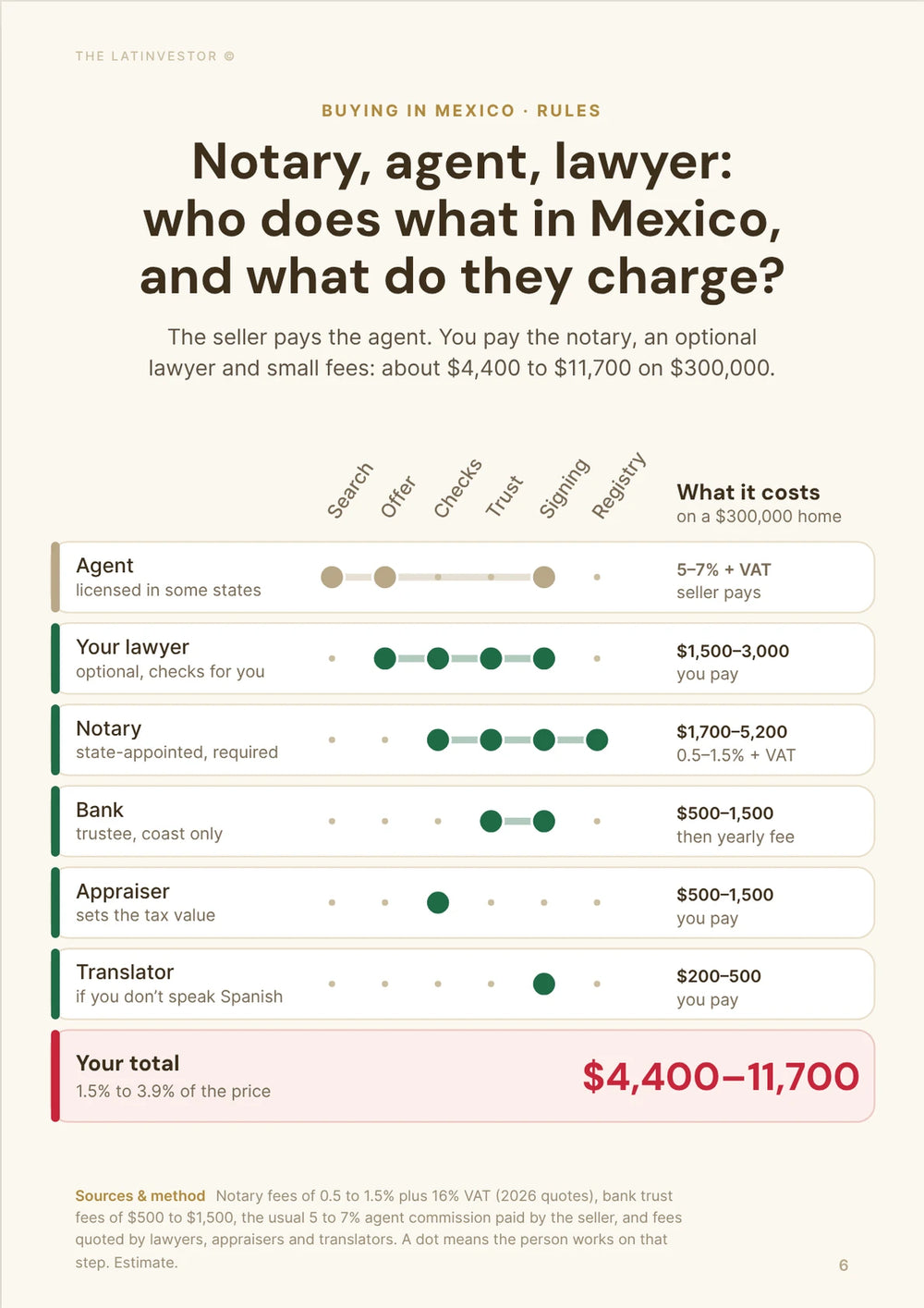
A Mexican notario público does far more than witness signatures. The notary checks the documents, drafts the deed, calculates and withholds the taxes, and sends the sale to the registry. That makes the notary central to a safe closing.
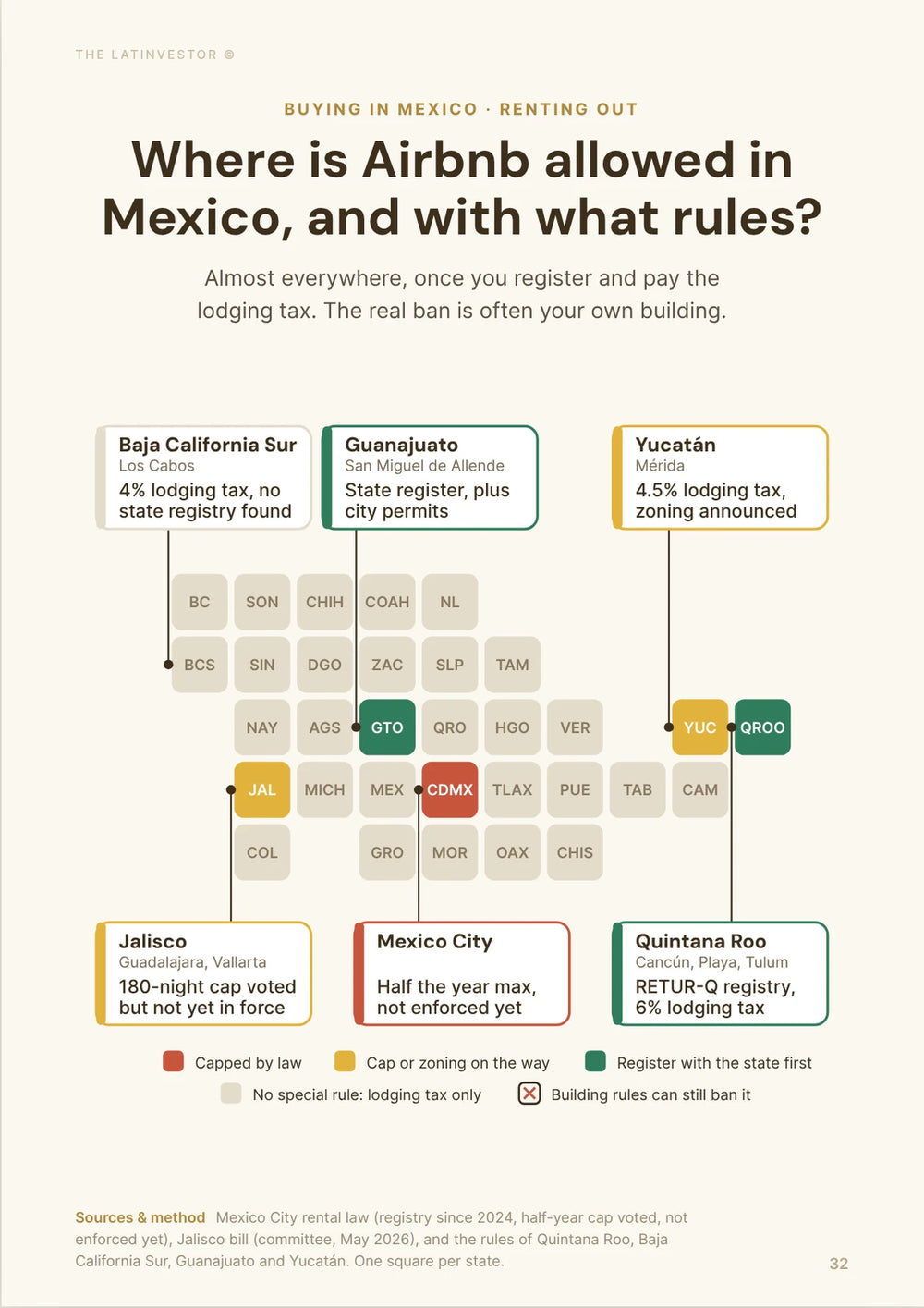
Notaries aren't infallible, though. In February 2026, Quintana Roo had six open investigations against notaries, and 47 complaints had been filed in 2025, only four of them resolved. Most concerned property sales, including altered appraisals and fraud on homes and land. The cases reported were mainly in Cancún, but the lesson is the same for Playa: choose the notary yourself rather than taking the one the developer or seller insists on.
The notary makes sure a sale is legally formalized. A buyer-side lawyer asks whether you should sign the contract at all. For a clean resale condo, the gap is small. For a presale where you might pay 30% to 50% long before delivery, it's large.
Are presale condos in Playa del Carmen safe right now?
Some are fine, but presale is the riskiest common way to buy in Playa, and the slower market makes it riskier.
With a finished apartment, you buy something you can see. With an early presale, you buy the developer's ability to finish. That ability depends on new sales, and AirDNA's count of active short-term rentals in Playa fell 60% in a year, so the investor demand many presales rely on is weaker than in 2024.
The rules help. NOM-247-SE-2021 requires developers to show proof of ownership or authority to sell, existing liens, the property's features, permits and a contract registered with Profeco. For a presale, you're also entitled to the construction project, the ownership of the land and the building permits. Under NOM-247, you usually get 5 business days to cancel a contract after signing.
The state is also checking more. In 2025, SEDETUS carried out 153 inspections, up 113% on the previous year. The rules are stronger than most foreign buyers think, but non-compliant projects are still common enough to fill a public blacklist.
| Question | Finished resale | Completed new condo | Early presale |
|---|---|---|---|
| Can we inspect the exact property? | Yes | Yes | No |
| Construction risk | Almost gone | Almost gone | High |
| Delivery-delay risk | Very low | Very low | High |
| Developer execution matters | Little | Somewhat | A lot |
| Real condo operating costs visible | Usually | Partly | Usually not |
| Surrounding area already observable | Yes | Mostly | Sometimes not |
| Main remaining risk | Title and condition | Title and defects | Title, permits, financing and execution |
Does Profeco really protect Playa del Carmen property buyers?
Profeco protects you against bad contracts, but it can't make a project get built.
Under NOM-247-SE-2021, developers and sellers have to disclose information and use a standard contract registered with Profeco. You can look that contract up in Profeco's public registry of adhesion contracts.
The contract has to cover ownership, liens, construction features, payment terms, delivery conditions, penalties, deed arrangements and how to complain. Compare it line by line with what the salesperson told you. If delivery dates, amenities or delay penalties aren't in it, they don't exist.
Profeco can't fix everything afterwards. A valid claim against a developer that runs out of money doesn't give you an apartment. Getting your money back and getting your keys are two different things.
How safe is a deposit on a Playa del Carmen presale?
A presale deposit is only as safe as the account it goes into and the contract behind it.
Before paying, find out which company receives the money, whether it's the same company that signs the contract as seller, when the payment stops being refundable and what happens if delivery is late.
Don't assume your money sits in escrow until handover. Mexican consumer rules give you information and contract rights, but advance payments usually go straight to the developer unless the contract says otherwise.
A small reservation fee and 40% of the price stuck in a stalled building are very different risks. What to do: pay through the notary or a third-party escrow account, keep 30% to 40% back until you get the keys and the deed, and insist on a written delivery date with a penalty if it slips. If someone says another buyer is waiting, let them have it. Losing one apartment is cheaper than chasing a deposit for years.
Could you accidentally buy ejido land around Playa del Carmen?
Yes, and it's still the easiest way to lose everything on a land purchase around Playa.
Ejido land is collectively held farmland under agrarian law, a different system from ordinary private property. Someone who occupies an ejido parcel or holds agrarian papers can't sell it like a titled residential lot.
There is a legal route out. Through dominio pleno, the ejido assembly approves the change, it's registered with the National Agrarian Registry (RAN), a property title is issued, and only then does the land enter the ordinary property registry.
Until that's done, be very wary of "the title is coming soon", "everybody buys this way here" or "the assembly already approved everything". In October 2026, Tulum's authorities warned buyers about two developments sold without urban permits, one of them on an ejido parcel. For a normal foreign purchase around Playa, wait until the conversion is complete and the private title is registered.
| What the seller shows | What it actually tells us | Enough for a normal foreign purchase? | What we would check next |
|---|---|---|---|
| Physical possession | Somebody occupies the land | No | Legal land regime |
| Ejido parcel documentation | Agrarian rights exist | No | RAN status |
| Promise of future dominio pleno | Privatization may be planned | No | Wait for completion |
| Private-property title | Conversion may be complete | Not by itself | Public registration |
| Registered private deed | Private ownership is much clearer | Much stronger | Liens and seller authority |
| Clean registry certificate | Shows relevant recorded burdens | Essential | Final closing review |
How do you know a Playa del Carmen development is actually legal?
You ask for its land-use and construction approvals, and check them, instead of trusting the brochure.
Playa del Carmen's municipal government runs procedures for land use, construction and coastal matters. A construction licence can require registered proof of ownership, architectural and structural plans, professional sign-offs, structural calculations and soil studies.
The land-use authorization matters just as much, because it sets what can legally be built on the plot: uses, coverage, density, setbacks and height.
That's where presales often go wrong. Rooftop pools, extra towers, shops, beach clubs and future phases all appear in marketing. What you're paying for has to match what's authorized.
Owning the land answers only half the question. Playa alone had 25 SEDETUS proceedings in the first ten months of 2025, so check that the developer is allowed to build what it's selling.
Is beachfront property in Playa del Carmen riskier?
Yes, beachfront property needs extra legal checks, and it now carries a bigger running cost too.
The first strip of land along the sea is federal: the Zona Federal Marítimo Terrestre, or ZOFEMAT. Playa del Carmen's municipal government handles ZOFEMAT use, concessions, payments and technical reviews, and it issues a certificate of use or non-use of ZOFEMAT (constancia de uso o no uso de ZOFEMAT) that confirms whether a property uses the federal zone.
In practice, you can own a lot right next to the sea without owning the sand in front of it. That affects beach access, structures, commercial use and how much a "private beach" is really worth.
Then there's sargassum. Playa del Carmen collected more than 45,000 tonnes of it between January and late September 2026. If the price you pay depends on the beach in front, budget for bad seasons and check how the building handles them.
| Property type | ZOFEMAT relevance | Extra check | Complexity |
|---|---|---|---|
| Downtown condo away from beach | Usually very low | Standard title checks | Normal |
| Condo close to the beach | Depends on parcel | Verify boundaries | Normal to moderate |
| Direct beachfront building | Relevant | Review coastal boundaries | Moderate |
| Beachfront house | High | Boundary and concession review | Higher |
| Property depending on ZOFEMAT concession | Direct | Verify concession and payment status | High |
Is crime in Playa del Carmen a reason not to buy?
No, not on current numbers. Playa del Carmen had about 5.7 homicides per 100,000 people over the year to September 2026, against about 26 in Tulum.
The trend is improving. The municipality reported a 51.6% drop in intentional homicides between January and August 2026 compared with the same period a year earlier. That's the city's own figure, so take it as a direction rather than an exact number.
Citywide figures hide big differences between neighborhoods, and petty crime and nightlife trouble along Fifth Avenue are a different issue from violent crime. What to do: visit the street at night and on a weekend, ask the building administrator about break-ins, and check what security the building pays for, because it shows up in the HOA fee.
Do water cuts in Playa del Carmen change what you should buy?
Yes. Water supply has become a real day-to-day risk in parts of Playa, so a building's water setup is now worth checking as carefully as its title.
In late July 2026, at least 18 neighborhoods went without running water, including Zazil-Ha, Colosio, Villamar, Misión del Carmen and Forjadores. In some, water had been down to a trickle for about two weeks, with pipes empty from about 9 a.m. and refilling only at night. Residents blamed growth outpacing the network.
What to do: ask whether the building has a cistern and a pump, and how big they are. Turn on the taps mid-morning, not just in the evening. Ask the administrator how often the building bought water trucks (pipas) this year and what that cost owners. A condo with its own storage holds its rental value much better during an outage.
Can we trust real-estate agents in Playa del Carmen?
You can at least check that an adviser is accredited, which beats trusting Instagram, WhatsApp or a nice website.
Quintana Roo regulates real-estate brokers, promoters, property managers and consultants. SEDETUS runs the state accreditation system and can inspect agents and agencies.
The system is in use. The state reported about 2,700 registered advisers by the end of 2025, after issuing 1,345 registrations that year, and SEDETUS issued another 80 in Playa del Carmen in March 2026. Asking for an accreditation number is a normal request.
Still, don't let the agent be your only source. An accredited agent can find and negotiate a property, but title, permits, the contract and the legal status should be checked independently.
Can a perfectly legal Playa del Carmen condo still be a bad investment?
Yes. A Playa del Carmen condo can have spotless paperwork and still lose you money.
You can legally own a unit you overpaid for. The building can compete with dozens of near-identical rentals, HOA fees can rise, repairs can cost more than planned, and reselling can take far longer than the developer's slide said.
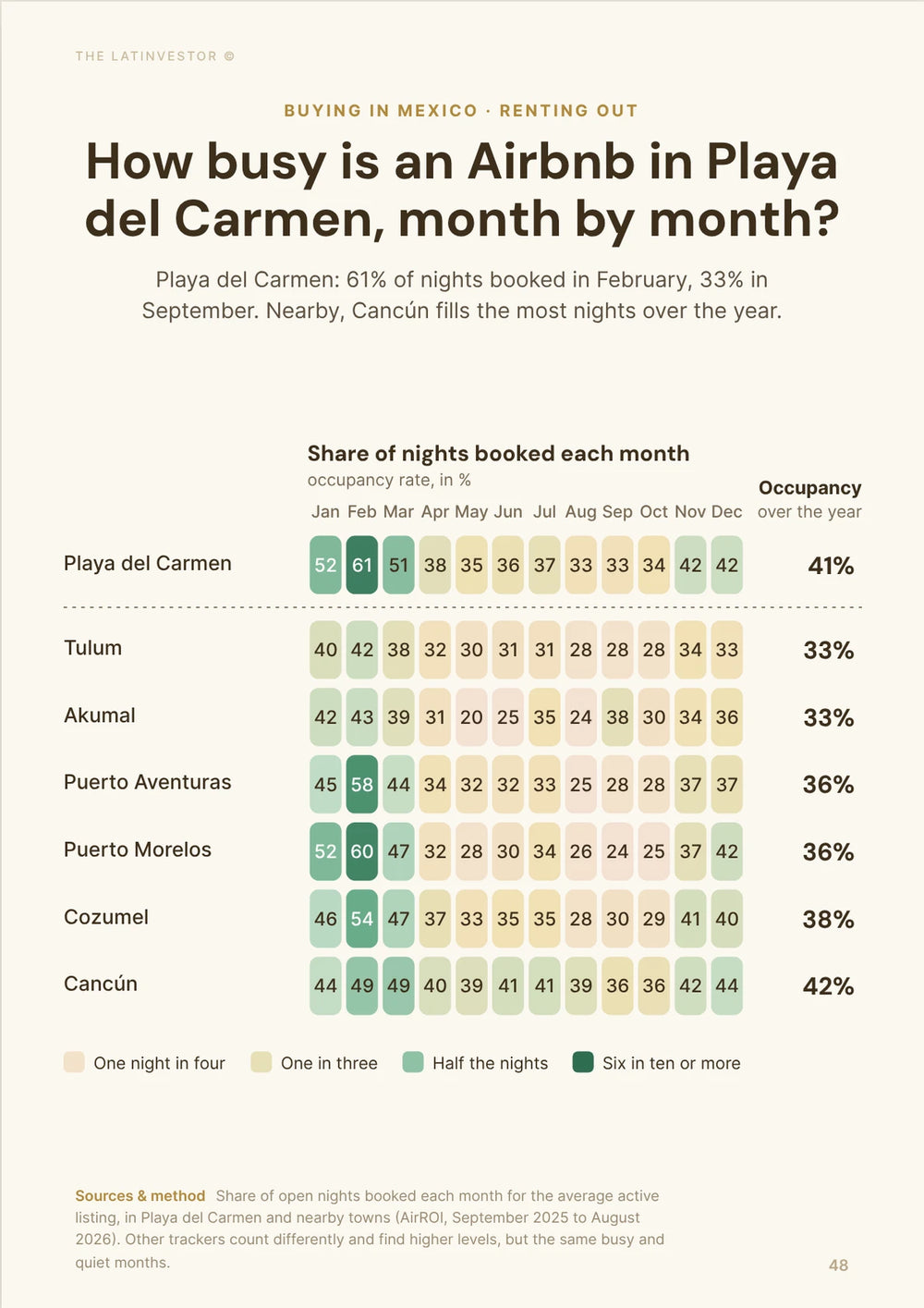
The rental numbers have cooled. AirDNA counts 6,498 active short-term rentals in Playa in September 2026, 60% fewer than a year earlier, with 58% occupancy, about USD 103 a night and about USD 18,800 of yearly revenue per listing. Quintana Roo also now requires state and municipal licences and registration in the state tourism register (RETUR-Q) for short-term rentals.
Don't assume Airbnb is allowed in a building just because the area is full of vacation rentals. Under Quintana Roo's condominium law, the owners' assembly controls common matters, shared expenses and reserve funds, so the building's rules and finances matter.
What to do: ask for recent assembly minutes, the current maintenance fee (often around MXN 4,500 to 12,000 a month, or about USD 240 to 650), the reserve fund, planned major works and the rules on short stays. For a ten-year-old condo, those papers tell you more than another set of listing photos.
| Risk | The question we are really asking | Can due diligence reduce it? | Main problem |
|---|---|---|---|
| Legal | Will our ownership rights hold up? | A lot | Bad title or contract |
| Development | Will the promised property be delivered? | Partly | Delay or developer failure |
| Building | Is the condo well run and maintained? | A lot | Poor management or large repairs |
| Financial | Are we paying a sensible price? | Partly | Overpaying or weak rental economics |
| Resale | Can we exit without a huge discount? | Only partly | Limited buyer demand |
Is a finished condo safer than a Playa del Carmen presale?
Yes, a finished condo is usually the safer choice when protecting your money matters more than getting the lowest entry price.
With a finished property, you can walk through the exact unit and check the lifts, the water pressure, the rooftop and whether a new tower next door will block the view.
You also see the real condominium: actual maintenance fees, decisions owners have already made, defects that have shown up, and the written rules on rentals.
Above all, you're no longer betting that construction will be finished.
A presale can still make sense with a large discount, a developer with finished buildings you can visit and clean documents. That discount is your pay for the extra risk. When a finished condo and a presale come out roughly the same, take the finished one.
Which Playa del Carmen property red flags should make you walk away?
Walk away when a seller or developer can't back up a major promise with documents an independent professional can verify.
The clearest warning is ownership. If the seller isn't the registered owner and can't explain the chain right away, everything stops until it's sorted out.
For land, unresolved ejido status gets the same reaction. For a presale, you want proof of the developer's rights over the land, the construction permits and the contract required by NOM-247.
Also be wary of unexplained liens, payment requested by a company that isn't the seller on the contract, missing permit numbers, amenities that only exist in marketing, a project on the SEDETUS list, or any resistance to independent legal review. The more pressure to skip these checks, the worse the deal.
Quintana Roo didn't build a public blacklist of 123 developments and more than double its inspections because these problems are rare.
| Red flag | Why we care | Can it sometimes be fixed? | What we would do |
|---|---|---|---|
| Seller does not match registered owner | Authority to sell is unclear | Sometimes | Stop and verify |
| Ejido land presented as ordinary private title | Legal regime may be different | Only through proper process | Stop |
| Unexplained lien | Another party may have rights over the property | Often | Resolve before closing |
| Missing construction authorization | Project legality is unclear | Sometimes | Pause |
| Unverifiable contract documentation | Buyer protections may be weaker | Sometimes | Pause |
| Immediate pressure to wire money | Due diligence is being compressed | Avoidable | Refuse |
| Major promises exist only in sales material | Enforcement becomes harder | Yes, if contractualized | Do not rely on them |
| Independent review is discouraged | Buyer loses a basic safeguard | No good reason for it | Walk away |
So, is it actually safe to buy property in Playa del Carmen?
Yes, Playa del Carmen is a reasonably safe place to buy if you pick a clean, registered property and check the deal before sending serious money.
The legal base is solid. Foreign buyers have a bank trust system approved by the SRE in 3 business days, Quintana Roo has a working property registry, developers face NOM-247 and Profeco rules, agents need state accreditation, and the municipality runs procedures for construction, land use and ZOFEMAT.
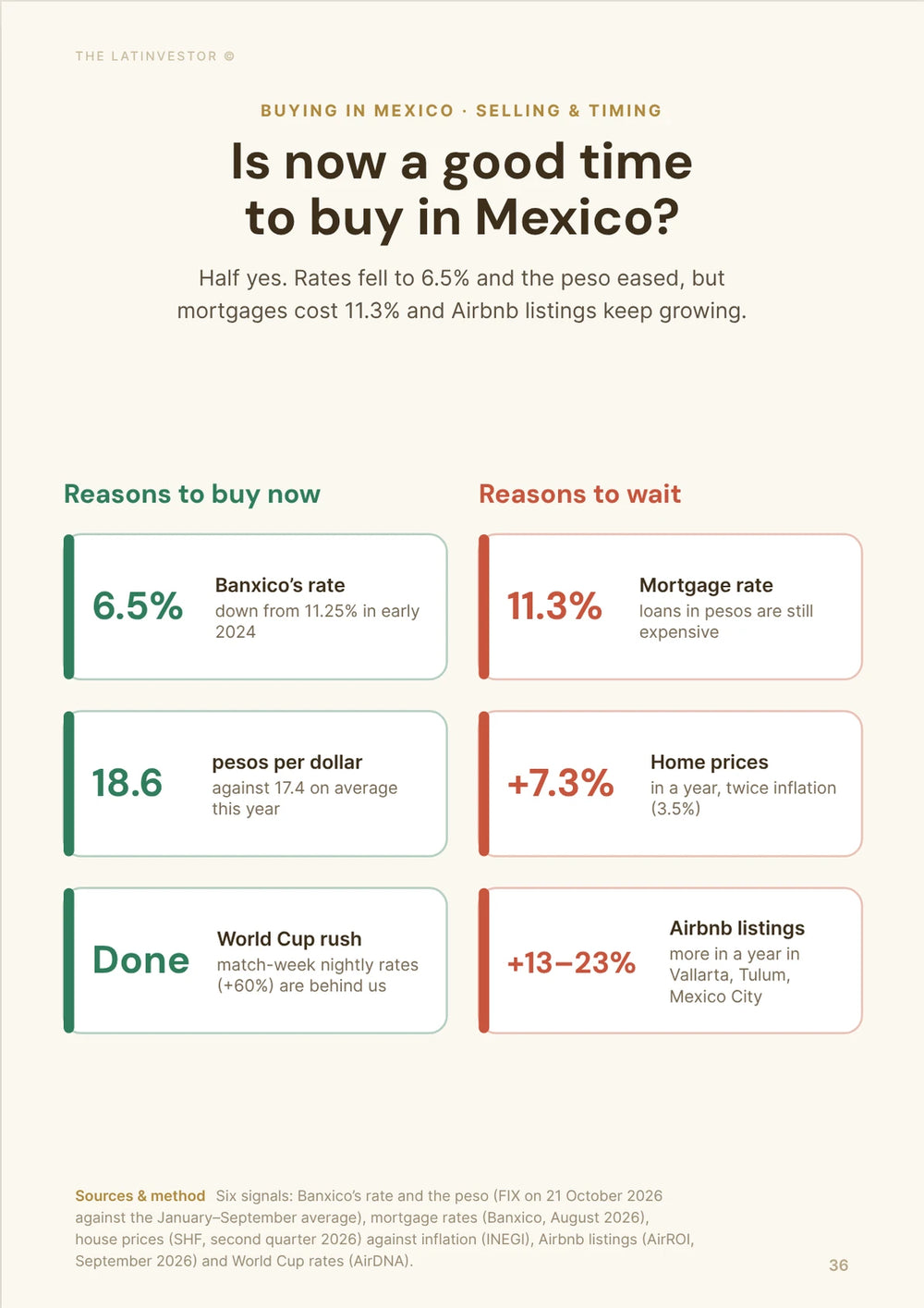
But 2026 gives no reason to be casual. The state's blacklist went from 116 irregular developments at the end of 2025 to 123 in August 2026, Playa had 25 enforcement cases in 2025, SÚUT buyers were still without their apartments in April 2026, and some neighborhoods spent days without water this summer.
A finished condo with registered title, a clean lien certificate, a properly set up fideicomiso, a cistern and an independently reviewed closing is a fairly simple purchase. Risk climbs fast with early presales, land with unclear status, unfinished ejido conversions, unclear beachfront rights and promises you can't check.
So the useful question isn't whether Playa del Carmen is safe. It's which property in Playa deserves your money.
Our methodology
This article estimates how risky it is to buy property in Playa del Carmen by splitting the question into the risks that change the outcome of a purchase: foreign ownership, title and registry, presales, consumer protection, ejido land, permits, beachfront rights, crime, water supply, agents, condominium finances and rental economics.
We used current laws, official procedures and recent enforcement records first: the Constitution, the Foreign Investment Law and SRE rules for the bank trust; NOM-247 and Profeco for presales; the National Agrarian Registry for ejido land; and Quintana Roo and Playa del Carmen sources for the registry, notaries, agent accreditation, construction, land use, ZOFEMAT and SEDETUS enforcement. Recent local press (Por Esto!, Excélsior, Riviera Maya News) covers the SÚUT case, scam patterns, notary complaints and the July 2026 water cuts.
We kept local and statewide figures apart. Playa del Carmen figures, such as its 25 enforcement cases in 2025, are local. Quintana Roo figures, such as the 123 blacklisted developments, show that permit problems are active across the state, not how many Playa properties are unsafe. Crime figures are municipal and come from SESNSP-based data and the city's own report; rental figures come from AirDNA.
We checked these figures in October 2026. Conversions use about 18.6 pesos per US dollar and 20.9 pesos per euro.
Limits: bank trust fees and maintenance fees come from third-party 2026 guides, not bank or building tariffs. Press reports on fraud cases reflect what buyers and prosecutors said at the time and may change in court. The SEDETUS list changes often, so check it again before paying.
Key sources used for this analysis include: the Mexican Constitution, Article 27, the Foreign Investment Law, SRE on restricted-zone trust permits, SRE fees and processing times, Homia's 2026 comparison of bank trust fees, the Quintana Roo Notarial Law, NOM-247-SE-2021, Profeco on cancelling a contract, Profeco's registry of adhesion contracts, Profeco on property buyers' rights, RAN on locating land in ejidos, RAN on converting ejido land to private property, RAN on property titles after dominio pleno, the October 2026 SEDETUS warning in Tulum, Playa del Carmen's land-use certificate, municipal zoning and land-use authorization, municipal construction-licence requirements, the municipal ZOFEMAT use or non-use certificate, the Quintana Roo Real Estate Services Law, the Quintana Roo Condominium Property Law, SEDETUS on registered real-estate advisers, SEDETUS registrations in Playa del Carmen, SEDETUS enforcement figures by municipality, SEDETUS inspection data, SEDETUS on its list of 116 irregular developments, Por Esto! on the 121 irregular developments, Riviera Maya News on the 123 blacklisted developments, the SEDETUS registry of irregular developments, Por Esto! on the SÚUT buyers, Excélsior on the SÚUT arrest, Por Esto! on scam patterns in the Mexican Caribbean, Por Esto! on complaints against notaries, Por Esto! on the July 2026 water cuts, Diario Cambio 22 on 2026 sargassum volumes, Enfemex municipal crime data, Playa del Carmen's 2026 security report, AirDNA for Playa del Carmen, the RETUR-Q state tourism register and The Mexico Handbook on 2026 HOA fees.