Summary
Airbnb is still worth it in Playa del Carmen for selected properties, but a typical condo earning the market median of about MXN 276,000 a year keeps only about 2.2% of the money invested after running costs, so buying one today for passive income is hard to justify.
Tourism remains substantial: hotels filled about 71% of rooms from January through July 2026. But local hotel occupancy and Cancún Airport traffic both declined year over year, weakening the demand tailwind that once made new rentals easier to fill.
Competition is growing faster than typical rental income. Airbtics reports 39.7% more active listings in one year, while median annual revenue increased just 3% and occupancy fell 10.3% in relative terms.
The rental-data providers disagree sharply. Airbtics counts 8,917 active listings, AirDNA 6,498 and AirROI 8,070. A buyer should demand booking histories from comparable units, not rely on a single citywide average.
Higher nightly prices are masking weaker occupancy. Airbtics reports a 13.9% increase in nightly rates, but much less growth in annual revenue. Winter can still perform well, while September has become markedly weaker in the broader accommodation market.
Location premiums do not automatically produce higher yields. Playacar Fase II apartments have much higher median asking prices than those in Centro, and a better address cannot compensate for any purchase price.
The financial model is the clearest warning. A MXN 3.9 million total investment earning MXN 276,000 in annual bookings retains approximately MXN 86,640 after the modeled operating costs: a 2.2% yield before income tax and debt, and only about 0.5% after the 25% tax a non-resident owner pays on gross bookings.
To reach a 5% operating yield under the same assumptions, annual bookings would need to approach MXN 445,000, roughly 61% above Airbtics’ median benchmark. Paying less for the property could be just as important as earning more.
Self-management raises the modeled yield to 3.6%, but it turns supposedly passive income into active work. A conventional long-term lease can also compete with Airbnb once platform and management fees are deducted.
The remaining opportunities favor established rentals with verified earnings, unusually good acquisition prices, or genuinely differentiated properties. Buyers must also check condominium rules, permits, tax treatment and beach conditions before assuming the rental income is achievable.


Why are investors questioning Airbnb in Playa del Carmen now?
Playa del Carmen's Airbnb market is being squeezed by weaker tourism indicators and intense competition from other vacation rentals.
According to Airbtics, the city had 8,917 active short-term rental listings in its latest reporting period, an increase of 39.7% over one year. During that period, median annual rental revenue rose only 3%, while occupancy fell 10.3% in relative terms.
The broader tourism market is also showing pressure. Quintana Roo's official tourism statistics show Playa del Carmen hotel occupancy declining from 75.3% in 2024 to 70.8% in 2025. For January through July 2026, hotel occupancy was 71.27%, compared with 75.76% during the equivalent period a year earlier.
These are different datasets, and hotel occupancy does not measure Airbnb bookings directly. Still, they point toward the same concern: attracting visitors is becoming harder, while vacation-rental investors have more competition for their bookings.
The question has shifted from whether tourists want to stay in Playa del Carmen to whether another investor-owned condo can attract enough bookings to justify its price.
Are tourists actually abandoning Playa del Carmen?
No, Playa del Carmen remains a major tourist destination, but the latest evidence shows softer demand rather than continued growth.
The city's hotels still filled an average of 71.27% of their rooms during the first seven months of 2026, according to Quintana Roo's tourism information system. That is a substantial level of activity, even though it represents a decline of 4.49 percentage points from the corresponding period in 2025.
Airport figures reinforce the slowdown. ASUR, which operates Cancún International Airport, reported approximately 20.88 million passengers through September 2026, compared with 22.20 million during the same period in 2025. That represents a 5.9% decline. International passengers fell 6.5%.
Cancún Airport serves several destinations, including Cancún, Puerto Morelos, Playa del Carmen and Tulum. Its figures cannot tell us precisely how much Playa del Carmen tourism declined.
Together, the airport figures and declining local hotel occupancy provide a clearer picture than either indicator alone.
Playa del Carmen still has a major tourism industry, but recent demand has struggled to keep pace with expanding accommodation supply.
Are there already too many Airbnbs in Playa del Carmen?
Playa del Carmen has enough competing Airbnbs to make another ordinary condo a difficult investment, although the exact degree of oversupply is uncertain.
Airbtics reports 8,917 active listings, up 39.7% over one year and 65.7% over three years. Over those same three years, its median revenue estimate increased just 8.4%, while occupancy declined 14.8% in relative terms.
That imbalance is hard to ignore. A growing tourist destination can absorb more vacation rentals when demand keeps up. Here, rapid listing growth alongside falling occupancy suggests individual properties are becoming harder to fill.
The situation is particularly challenging for interchangeable apartments. A standard one-bedroom condo with a shared rooftop pool may compete against dozens of similar properties with comparable photographs, amenities and locations.
We cannot calculate the precise number of excess properties from public listing counts. A listing is not necessarily available every night, and some owners rent only occasionally.
Nevertheless, Airbtics' three-year pattern is consistent with a market where rental inventory has expanded much faster than the revenue earned by a typical listing.
Why do Airbnb statistics for Playa del Carmen disagree so much?
Published Airbnb statistics for Playa del Carmen disagree enough that no single market average should be treated as a reliable property-level forecast.
Three established data providers currently report very different numbers. Airbtics estimates 8,917 listings and 53% occupancy. AirDNA reports 6,498 listings and 58% occupancy. AirROI reports 8,070 listings and 38.2% occupancy.
Their revenue estimates also differ, and the comparison is complicated by different currencies, reporting periods, property coverage, and statistical methods.
The disagreement becomes even more important when we look at growth. Airbtics reports listing supply increasing 39.7% year over year, while AirDNA reports a 60.2% contraction. Both cannot describe the same consistently measured inventory over the same period.
AirDNA also reports a 100% increase in annual revenue per active listing, while Airbtics reports only 3% growth in median revenue. Changes in the properties covered or calculation methods could explain part of this divergence, but the public figures do not establish the cause.
We therefore should not average these figures together. For an actual purchase, the stronger evidence would be the booking histories of comparable units in the same building, with the same bedroom count and similar availability.
| Provider | Active listings | Annual revenue per listing | Occupancy | Reported listing growth |
|---|---|---|---|---|
| Airbtics | 8,917 | MXN 276,000 median | 53% | +39.7% |
| AirDNA | 6,498 | USD 18,800 average | 58% | -60.2% |
| AirROI | 8,070 | MXN 218,805 average (about USD 11,800) | 38.2% | +20% |
How much money does an Airbnb in Playa del Carmen really make?
A typical Playa del Carmen Airbnb generates roughly MXN 276,000 in annual revenue according to Airbtics, but individual properties can perform several times better or worse.
That figure represents approximately MXN 23,000 per month before we deduct the expenses of owning and operating the property, assuming we use it as a gross-bookings benchmark.
AirROI provides a useful picture of how dramatically earnings vary across listings. Its median monthly revenue is about MXN 18,600 (about USD 1,000), compared with MXN 8,160 (about USD 439) for a lower-quartile property. Listings in the top 10% generate at least MXN 65,500 (about USD 3,520) per month.
That means a top-decile listing can produce at least 3.5 times the monthly revenue of the median property in AirROI's dataset.
However, higher revenue does not automatically mean a better investment. Large beachfront villas can generate impressive booking totals while requiring much larger investments, more maintenance and additional staff.
For an investor buying a conventional condo, the number that matters is not how much the city's most successful Airbnbs earn. It is what comparable apartments bought at similar prices consistently retain after expenses.
| AirROI performance tier | Monthly revenue | Annualized revenue | Versus median |
|---|---|---|---|
| Top 10% | USD 3,520+ | USD 42,300+ | At least 3.5× |
| Top 25% | USD 1,930+ | USD 23,200+ | At least 1.9× |
| Median | USD 1,000 | USD 12,000 | 1.0× |
| Bottom 25% | USD 439 | USD 5,260 | 0.44× |
Are Playa del Carmen Airbnb hosts charging more but renting fewer nights?
Yes, Playa del Carmen Airbnb nightly rates are rising while occupancy falls, leaving surprisingly little growth in typical rental revenue.
According to Airbtics, average nightly rates increased 13.9% over one year, reaching MXN 1,389. At the same time, occupancy declined 10.3% in relative terms, and median annual revenue grew just 3%.
The three-year figures are even more revealing. Nightly rates increased 26.1%, but occupancy declined 14.8%, and annual revenue increased only 8.4%.
Higher prices per booked night appear to be compensating for fewer occupied nights.
That is not necessarily evidence that every host has increased prices successfully. Changes in the mix of available properties can also affect the reported averages. Nor does it prove that individual guests are paying 26.1% more for identical accommodation.
But the economic result is clear: stronger advertised prices have not translated into equally strong revenue growth for the typical listing.
And because maintenance, staffing, utilities and other operating expenses must still be paid, even modest revenue growth does not guarantee higher profits.
Is Playa del Carmen Airbnb only profitable during winter?
Playa del Carmen Airbnbs can earn throughout the year, but winter demand remains essential and the weaker months create a serious profitability problem.
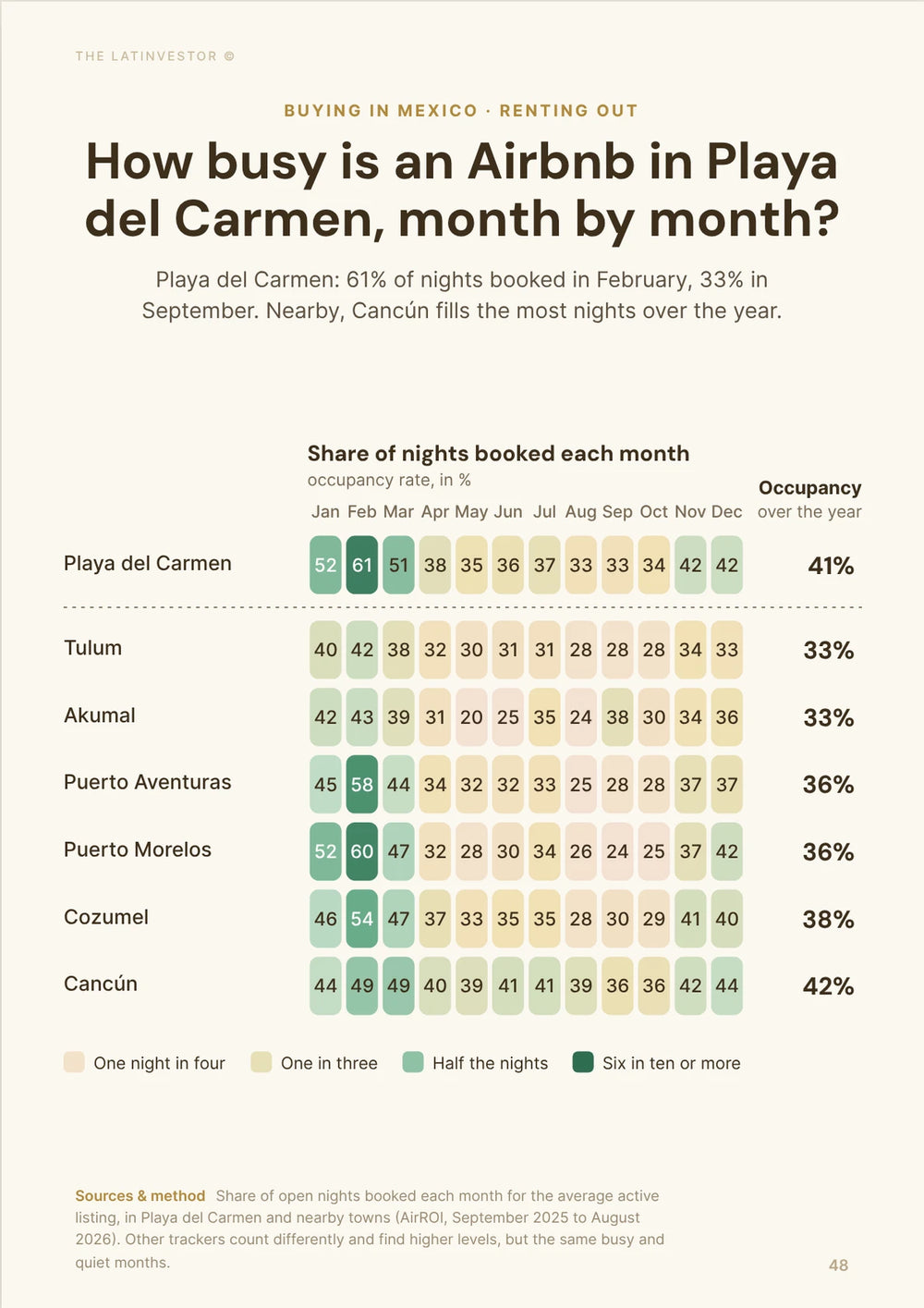
Airbtics identifies February as a particularly strong month. AirROI also identifies February as the highest-revenue month and September as the weakest.
Federal DATATUR hotel statistics reveal a longer-term pattern.
January hotel occupancy remained around 78% to 81% between 2023 and 2026. September occupancy, however, declined from 57.5% in 2023 to 51.5% in 2024 and 41.6% in 2025.
The gap between January and September nearly doubled between 2023 and 2025, increasing from approximately 20 to 39 percentage points.
Hotel occupancy is not the same as Airbnb occupancy, so this does not prove that vacation rentals experienced an identical decline. Still, it demonstrates that the broader destination's weak-season demand has deteriorated more than its winter demand.
An investor relying on winter booking screenshots could therefore overestimate the income available across a full year.
| Year | January hotel occupancy | September hotel occupancy | Difference |
|---|---|---|---|
| 2023 | 77.8% | 57.5% | 20.3 points |
| 2024 | 81.3% | 51.5% | 29.8 points |
| 2025 | 80.2% | 41.6% | 38.6 points |
Does buying near the beach still guarantee better Airbnb returns?
No, buying near the beach increases Playa del Carmen's rental appeal, but higher property prices can erase the advantage.
Airbtics estimates that listings near Playacar earn a 19% location premium compared with similar listings elsewhere. Its analysis covered 153 nearby listings.
That is meaningful evidence that location affects bookings and revenue. But property prices vary dramatically between neighborhoods.
TuLugar's monitored sale listings show median apartment asking prices around USD 229,000 in Centro, USD 224,000 in Zazil Ha and USD 344,000 in Playacar Fase II.
Playacar Fase II's median asking price is approximately 50% higher than Centro's. These are not matched properties, and the 19% rental premium cannot be applied directly to those asking-price differences. The comparison nevertheless illustrates why stronger rental demand does not automatically produce a stronger yield.
We would rather find an apartment within comfortable walking distance of the beach, restaurants and Fifth Avenue at a favorable purchase price than pay an excessive premium for a prestigious address.
The right measure is additional net income divided by additional investment, not simply additional nightly revenue.
Do studios make better Airbnb investments than larger condos?
Small studios currently show stronger occupancy in Playa del Carmen, but we cannot conclude that they deliver better investment returns.
Airbtics reports 59% occupancy for studios, compared with 53% across the broader market.
Studios can appeal to solo travelers and couples, while often requiring less upfront capital than larger apartments. But their occupancy advantage is only six percentage points, and that alone does not reveal their profitability.
A two-bedroom apartment might earn more from families or groups while requiring fewer bookings to generate equivalent revenue. A studio might maintain stronger occupancy but offer limited pricing power.
Property prices also complicate the comparison. TuLugar reports median asking prices around USD 184,000 for one-bedroom apartments and USD 262,000 for two-bedroom apartments. Its studio sample is too small to establish a similarly reliable citywide price benchmark.
Smaller units are worth investigating, but the evidence does not establish them as the winner.
What counts is a unit’s full-year operating statement against its total acquisition cost, not occupancy alone.
Have Playa del Carmen condo prices become too expensive for Airbnb investors?
Many Playa del Carmen condos are expensive relative to typical Airbnb revenue, especially when buyers assume the property will operate as a passive investment.
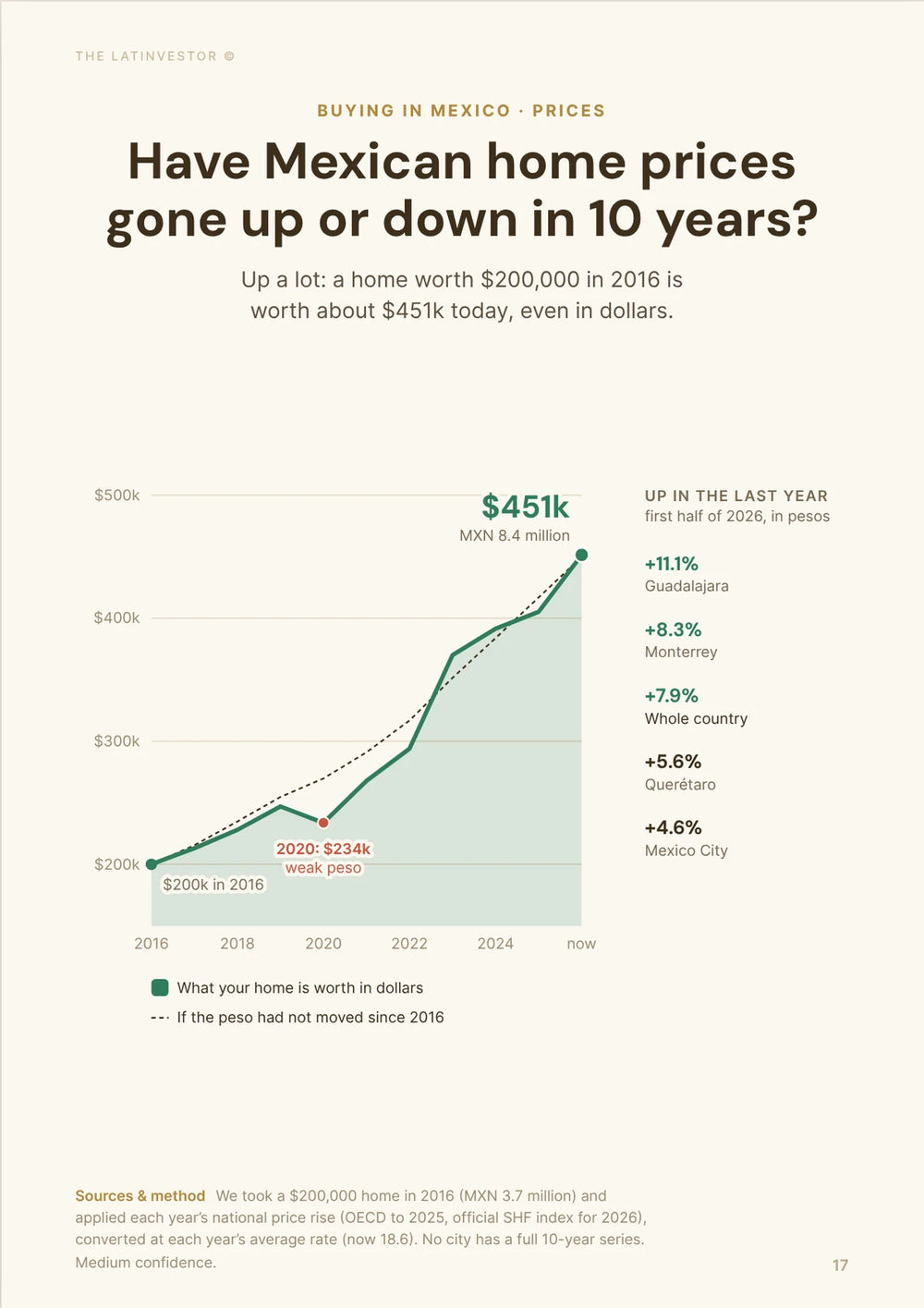
TuLugar monitors more than 11,000 real estate listings in Playa del Carmen. Its apartment inventory includes more than 2,100 one-bedroom listings with a median asking price around USD 184,000, and more than 2,000 two-bedroom listings with a median around USD 262,000.
A local 2026 purchasing guide from Build a Life Abroad places central one-bedroom condos around MXN 3.3 million to MXN 4 million, depending on location and characteristics.
Compare those prices with Airbtics' MXN 276,000 median annual revenue. A hypothetical property bought for MXN 3.6 million and earning that amount would produce a gross rental yield of approximately 7.7%.
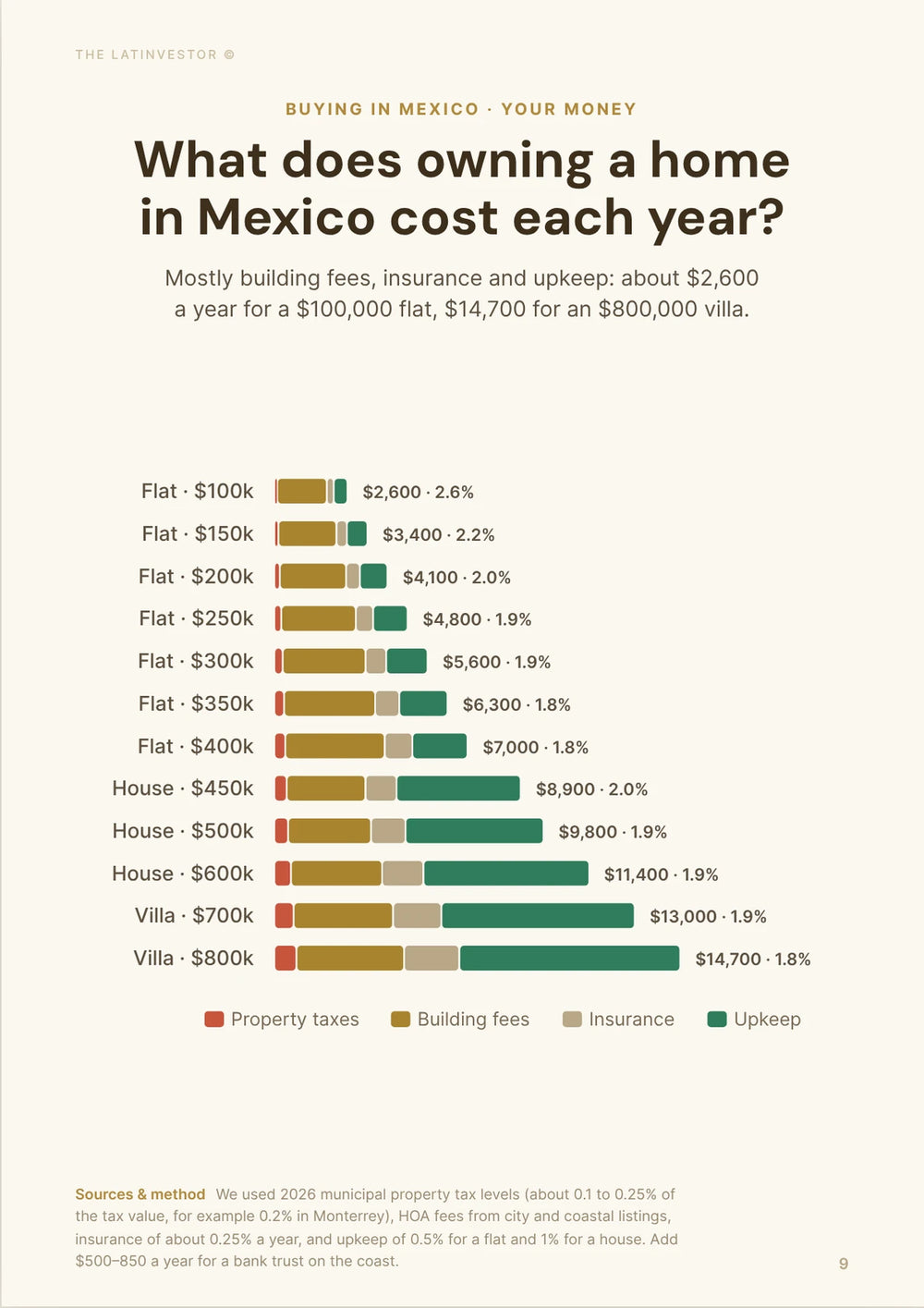
That initially looks attractive. But it excludes acquisition costs, platform commissions, property management, maintenance, utilities, insurance and taxes.
This calculation is only a market-level illustration, not a matched estimate for a specific one-bedroom unit. The revenue benchmark covers different property sizes, while asking prices are not completed transactions.
Even so, the comparison exposes the key risk: gross yields that look comfortable before expenses can become modest net yields once the complete operating budget is included.
| Hypothetical condo price | Assumed annual revenue | Gross rental yield | Before closing costs |
|---|---|---|---|
| MXN 3,000,000 | MXN 276,000 | 9.2% | Yes |
| MXN 3,300,000 | MXN 276,000 | 8.4% | Yes |
| MXN 3,600,000 | MXN 276,000 | 7.7% | Yes |
| MXN 4,000,000 | MXN 276,000 | 6.9% | Yes |
How much Airbnb income is left after all the expenses?
A professionally managed Playa del Carmen Airbnb can retain surprisingly little of its booking revenue after recurring costs.
We modeled a hypothetical MXN 3.6 million condo with MXN 300,000 in combined transaction and initial setup costs, creating a total investment of MXN 3.9 million.
For revenue, we used MXN 276,000 annually, equivalent to Airbtics' reported market median, treating it as gross booked rent before commissions. This is a constructed investment scenario, not the financial statement of an actual property.
Airbnb's published fee structure identifies a 16% single host-service fee for listings in Mexico using that model. Riviera Maya property-management guides commonly quote approximately 20% to 30% of gross rental revenue for full-service management. We use the bottom of that range.
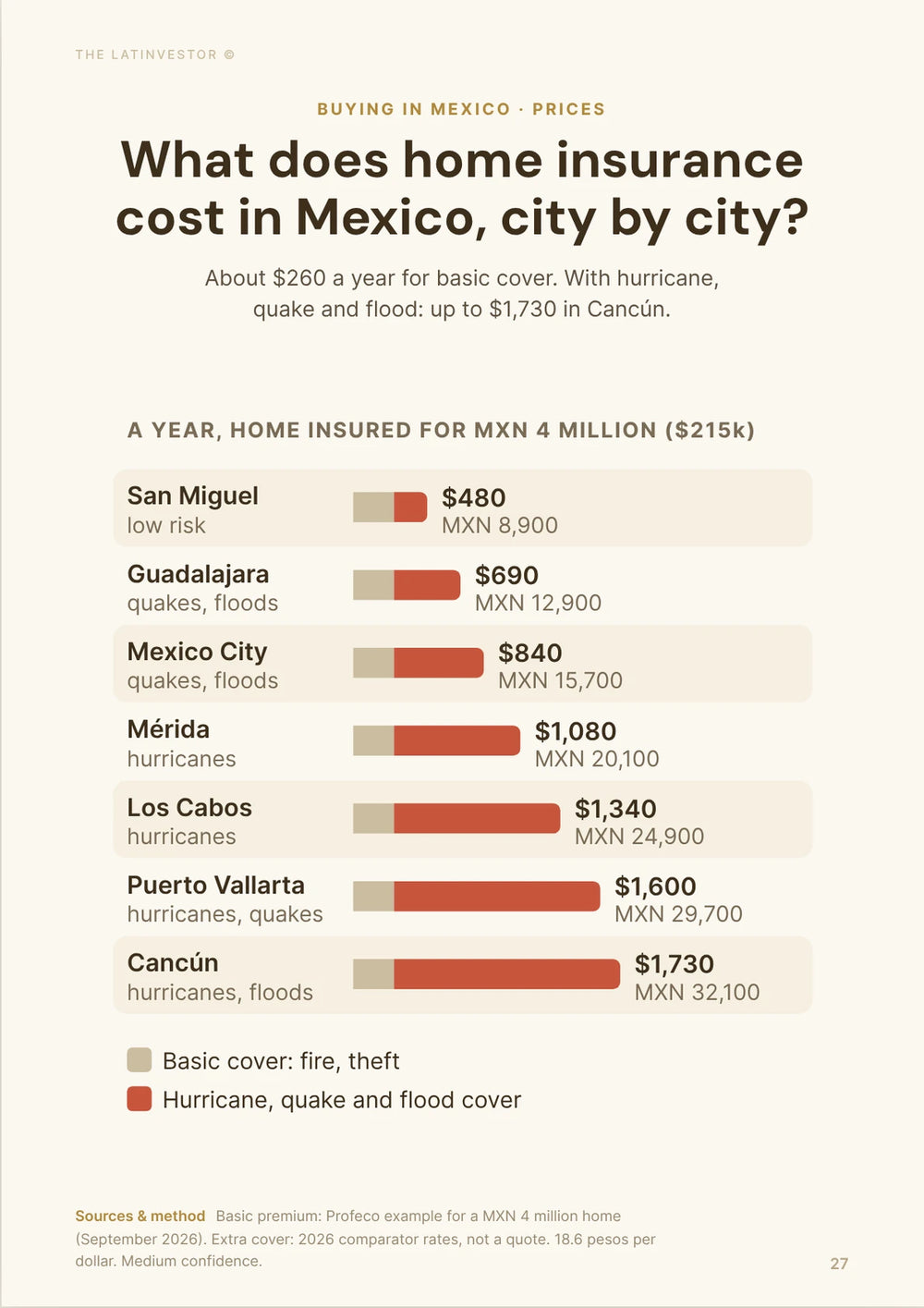
We also assume MXN 3,500 in monthly condominium fees, MXN 2,000 in monthly utilities, and annual allowances for maintenance, insurance, property tax and miscellaneous recurring expenses.
After these deductions, the property retains approximately MXN 86,640 annually.
That represents a 2.2% operating yield on the MXN 3.9 million invested, before income tax, financing costs, depreciation or major unexpected repairs.
The model excludes separately charged cleaning that is fully passed through to cleaning providers. It also assumes lodging taxes are collected separately from guests, rather than reducing the MXN 276,000 booking-revenue figure. Actual fee arrangements and tax treatment must be checked against the host's statements.
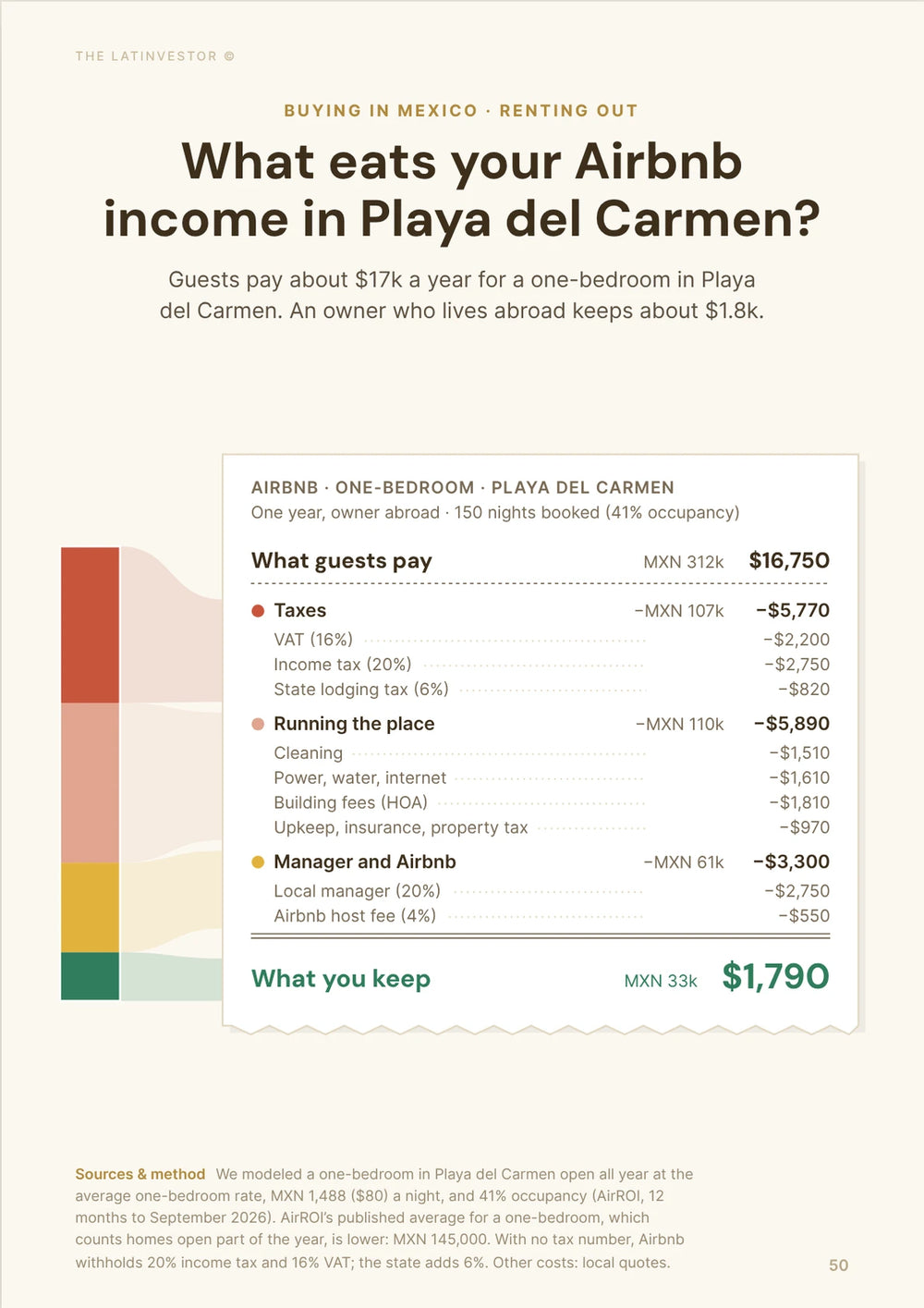
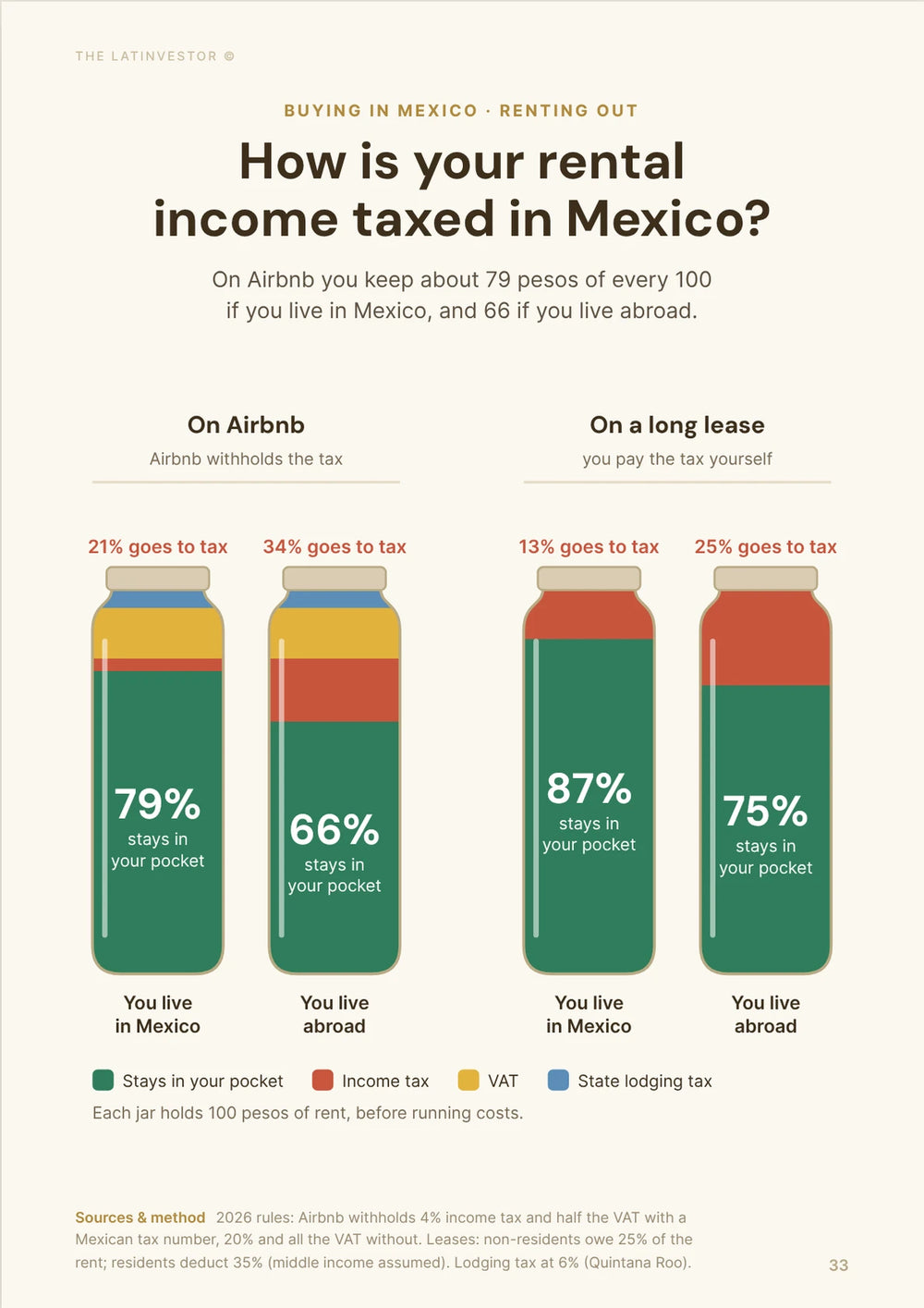
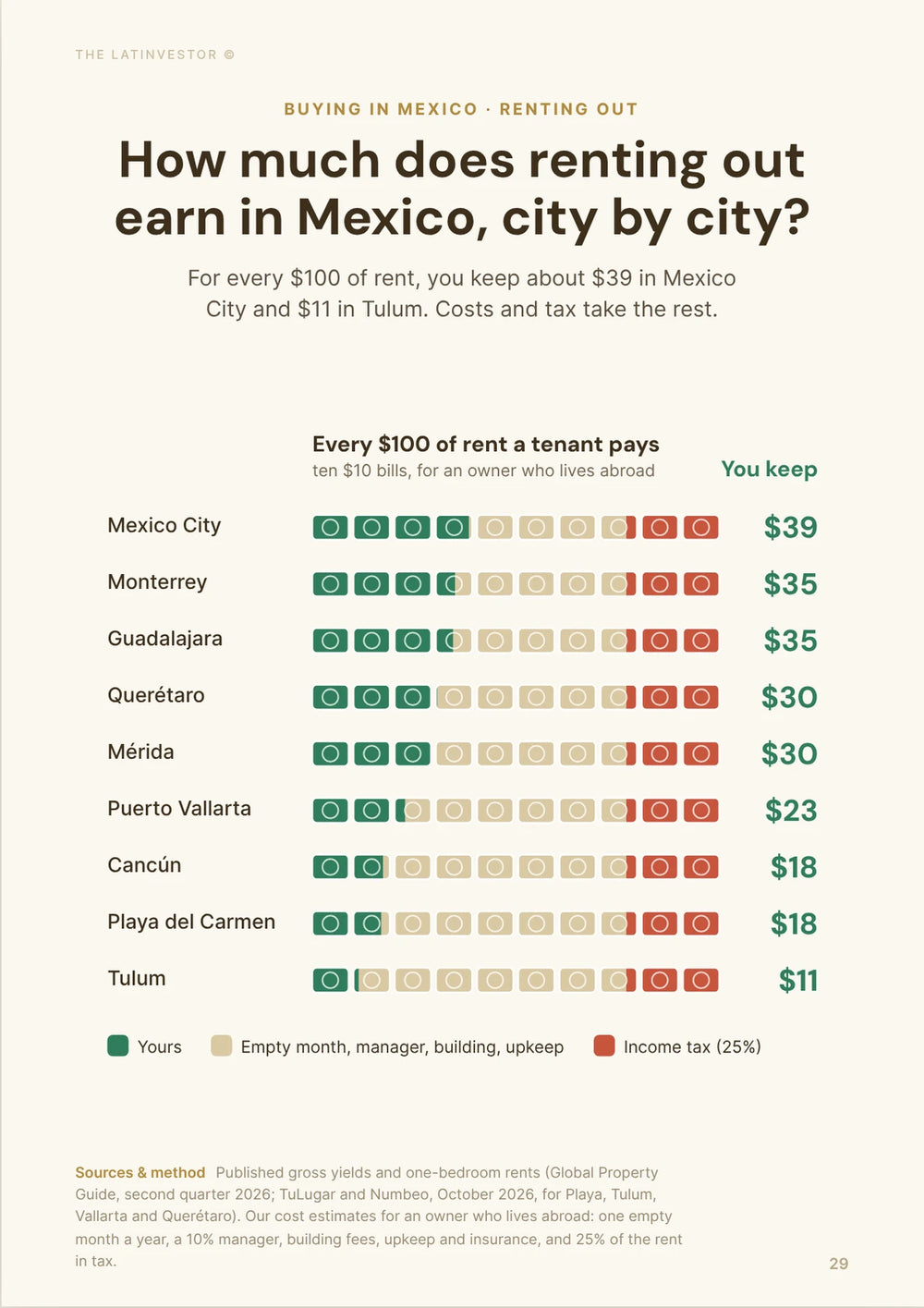
If you don't live in Mexico, there's one more cut: a non-resident owner pays 25% of gross rental income in Mexican income tax, with no deduction for costs. On MXN 276,000 of bookings, that's MXN 69,000, which leaves about MXN 17,640 a year, or about 0.5% of the MXN 3.9 million invested.
A 2.2% yield is not the outcome for every Playa del Carmen Airbnb. But the exercise shows how quickly a 7.7% gross yield can shrink under a realistic cost structure.
| Revenue or cost | Assumption | Annual MXN | Calculation |
|---|---|---|---|
| Gross bookings | Market-based scenario | +276,000 | Starting revenue |
| Airbnb fee | 16% | -44,160 | Platform commission |
| Property management | 20% | -55,200 | Full-service assumption |
| Condominium fees | 3,500/month | -42,000 | Fixed cost |
| Utilities and internet | 2,000/month | -24,000 | Fixed cost |
| Repairs and insurance | Annual allowance | -18,000 | Reserve |
| Property tax and miscellaneous costs | Annual allowance | -6,000 | Reserve |
| Operating income | Before income tax and debt | 86,640 | 31.4% of bookings |
| Yield on total investment | MXN 3.9M invested | 2.2% | Before income tax and debt |
| Non-resident income tax | 25% of gross bookings | -69,000 | No deduction for costs |
| Yield after non-resident tax | MXN 17,640 kept | 0.5% | Before debt |
Can managing your own Airbnb make Playa del Carmen profitable again?
Self-managing an Airbnb can materially improve returns in Playa del Carmen, but the savings come from doing work that a professional operator would otherwise perform.
In our MXN 276,000 revenue scenario, removing the assumed 20% management commission saves MXN 55,200 annually.
Operating income increases from approximately MXN 86,640 to MXN 141,840, lifting the modeled yield from 2.2% to 3.6% on the same MXN 3.9 million investment. For a non-resident, after the 25% tax on gross bookings, that's about 1.9%.
That is a meaningful difference. However, self-management involves guest messages, cleaning coordination, maintenance problems, pricing adjustments, check-ins and resolving complaints.
There is also an important calculation for owners evaluating a manager's promise to boost performance.
Under our model, a professional manager charging 20% of gross revenue would need to increase bookings by approximately 31% to offset that fee compared with self-management at the same platform commission rate.
For a property generating MXN 276,000, that means increasing gross revenue to approximately MXN 362,250 merely to preserve the owner's operating income before any differences in other costs.
We should therefore judge property managers on demonstrated additional net income, not simply occupancy improvements or attractive booking screenshots.
What would an Airbnb need to earn to deliver a 5% operating yield in Playa del Carmen?
A typical professionally managed Airbnb in our Playa del Carmen investment scenario would need roughly 61% more annual booking revenue to achieve a 5% operating yield.
Our model starts with MXN 3.9 million invested, MXN 90,000 in annual fixed operating expenses, and combined platform and management fees equal to 36% of bookings.
To produce a 5% operating yield, the condo must retain MXN 195,000 annually. Solving for revenue gives approximately MXN 445,000 in gross annual bookings.
That is 1.61 times the MXN 276,000 market-median benchmark.
To reach a 7% operating yield, it would need approximately MXN 567,000 in gross bookings, more than double the benchmark.
We can also translate those requirements into nightly prices. At 53% calendar occupancy, the condo would sell approximately 193 nights annually. Reaching 5% would therefore require about MXN 2,300 per occupied night, compared with Airbtics' market average nightly rate of MXN 1,389.
These are scenario calculations, not forecasts. The occupancy and average nightly price are market aggregates that do not necessarily belong to the same type of property.
Nonetheless, the exercise reveals why the purchase price matters so much. A property bought at a high price needs considerably better-than-typical rental performance just to produce a moderate operating return.
| Operating-yield outcome | Required annual net | Gross bookings needed | Nightly revenue at 193 booked nights | Multiple of baseline bookings |
|---|---|---|---|---|
| Modeled baseline, 2.2% | MXN 86,640 | MXN 276,000 | MXN 1,430 | 1.00× |
| 5% | MXN 195,000 | MXN 445,313 | MXN 2,307 | 1.61× |
| 7% | MXN 273,000 | MXN 567,188 | MXN 2,939 | 2.06× |
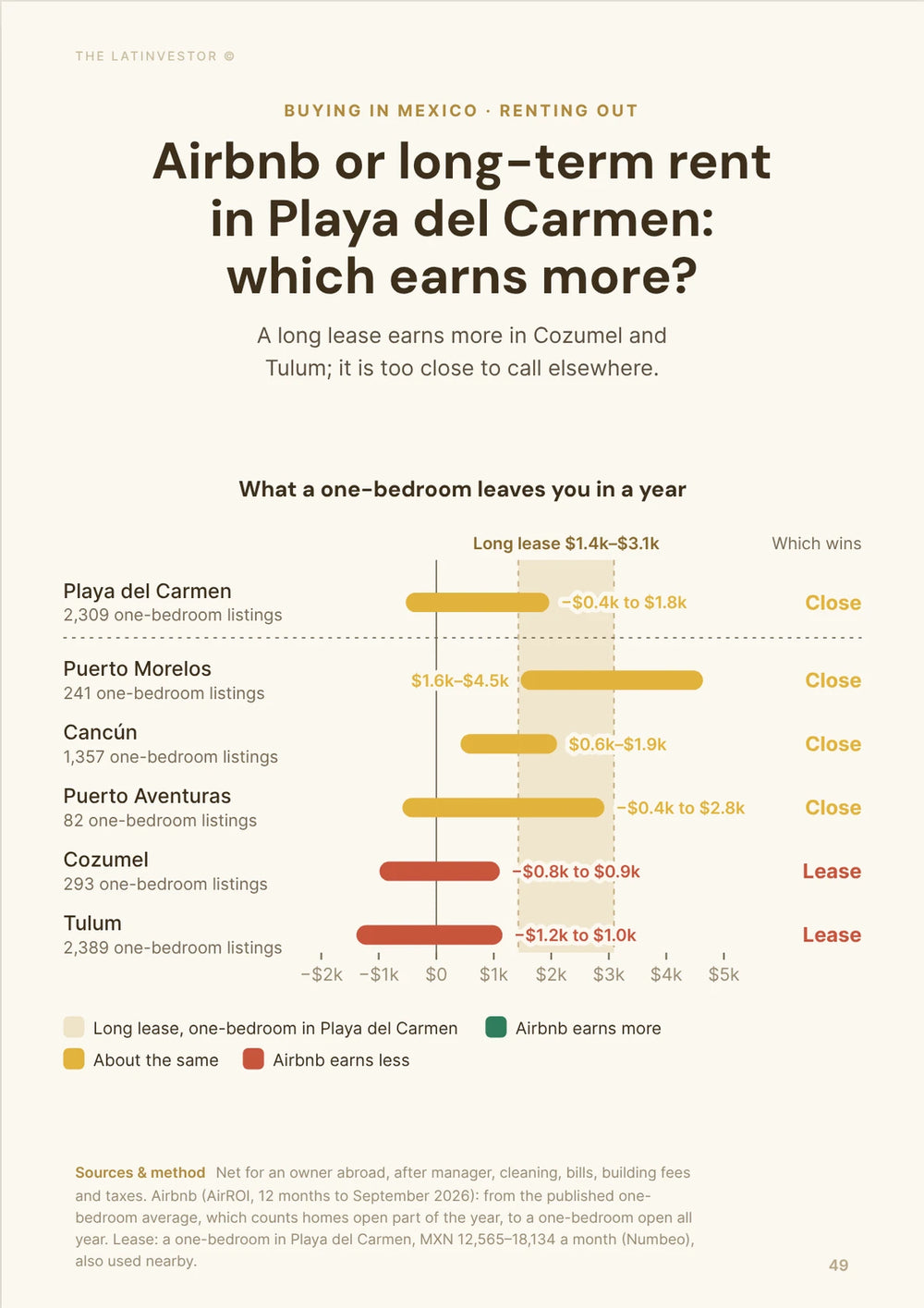
Would renting a Playa del Carmen condo long-term make more sense?
A long-term rental can be financially more attractive than Airbnb in Playa del Carmen when the short-term premium disappears after management and platform fees.
Build a Life Abroad's 2026 local pricing guide places monthly rents for central one-bedroom apartments around MXN 14,000 to MXN 26,000.
At MXN 18,000 per month, a continuously occupied property would generate MXN 216,000 in annual rent before expenses.
Compare that with MXN 276,000 in Airbnb bookings. The Airbnb generates 28% more gross revenue, but our combined 16% platform and 20% management assumptions remove MXN 99,360 before utilities, condominium fees and repairs.
That leaves MXN 176,640 from Airbnb bookings after those two distribution costs, compared with MXN 216,000 in hypothetical long-term gross rental income.
This is not a comparison of final profits. Long-term rentals have vacancy risk, possible management commissions, repairs and different lease obligations. The two properties would also need to be matched for size, location and furnishing.
But it demonstrates why short-term rentals can lose their economic advantage even while producing higher headline revenue.
Long-term tenants may also pay their own electricity and internet, reducing costs that Airbnb owners ordinarily absorb.
| Monthly long-term rent | Annual long-term gross | Versus MXN 276K Airbnb gross | Long-term gross versus MXN 176,640 Airbnb after platform and management fees |
|---|---|---|---|
| MXN 14,000 | MXN 168,000 | 61% | Lower |
| MXN 18,000 | MXN 216,000 | 78% | Higher |
| MXN 26,000 | MXN 312,000 | 113% | Higher |
Is Airbnb still legal and easy to operate in Playa del Carmen?
Airbnb remains legal in Playa del Carmen, but operating a compliant vacation rental involves considerably more than creating an online listing.
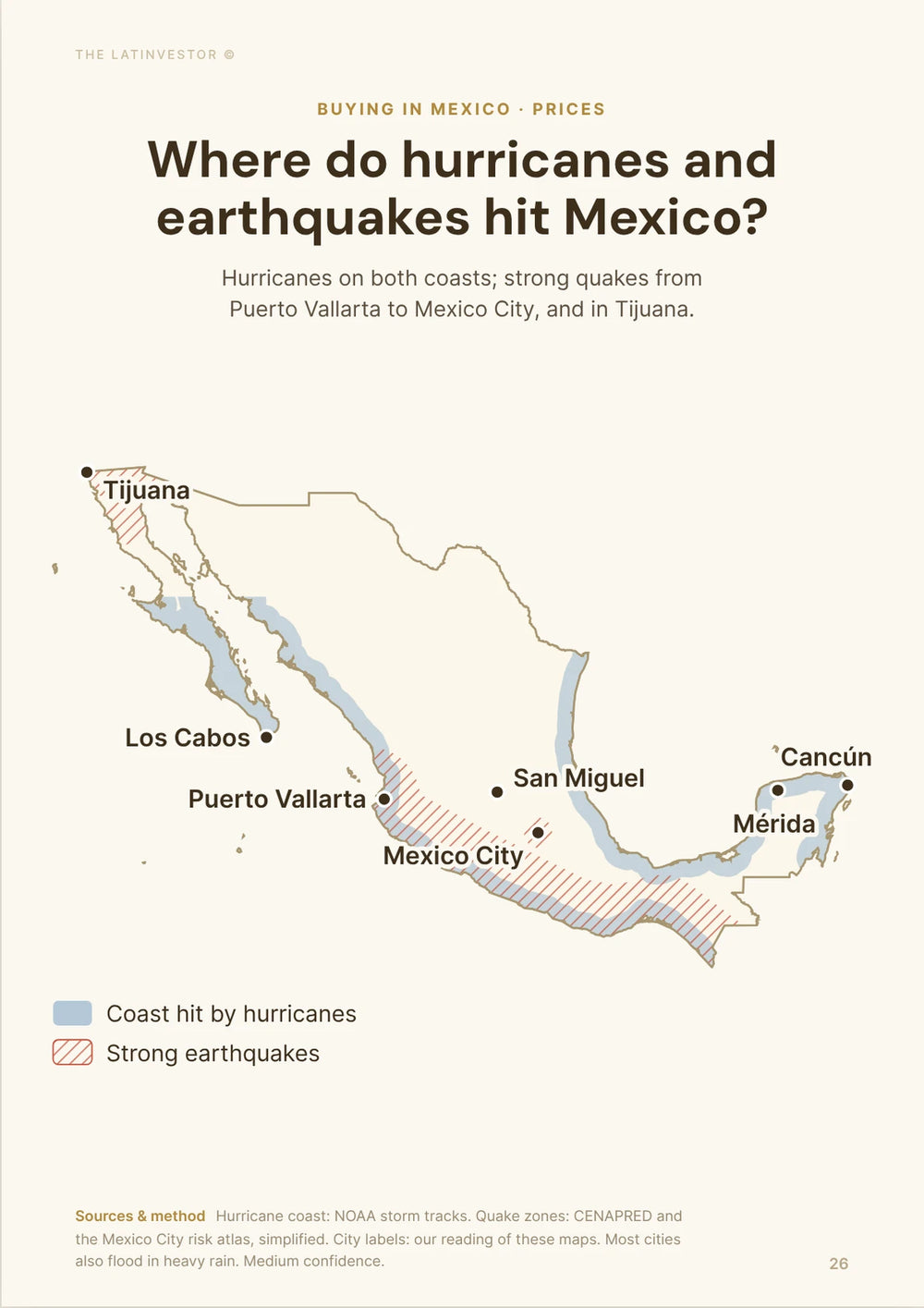
Quintana Roo's Tourism Law requires tourism-service providers, including applicable vacation-rental hosts, to register annually with RETUR-Q, the state tourism registry.
The state also has a specific lodging-tax regime. Under Article 8 of Quintana Roo's lodging-tax law, private apartments, houses and villas used for paid accommodation are subject to a 6% lodging tax. This is generally collected from guests or handled through the applicable platform collection mechanism, rather than automatically representing a 6% reduction in the owner's rental revenue.
Separately, Playa del Carmen's municipal government publishes a lodging-business operating-license procedure. Its current guidance says establishments providing accommodation services must register and renew their municipal licenses annually.
At the federal level, Mexico's tax authority also establishes income-tax withholding rules for income earned through digital accommodation platforms. Article 113-A specifies a 4% withholding rate for relevant lodging income received by individuals through these platforms. Withholding is not necessarily the host's final tax liability.
There is also a property-level issue that public rental datasets cannot resolve: whether the condominium's bylaws and relevant building approvals permit short-term guests.
These obligations do not make Airbnb impossible. They do make the idea of buying a random residential condo and immediately operating it as a vacation rental a potentially expensive assumption.
Does buying an Airbnb in Playa del Carmen become more complicated for foreigners?
Foreign investors can legally acquire residential property interests in Playa del Carmen, but they face additional legal structures and transaction costs.
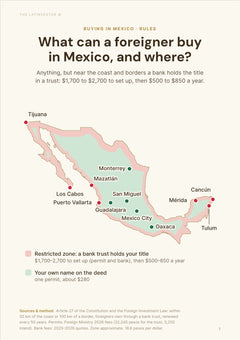
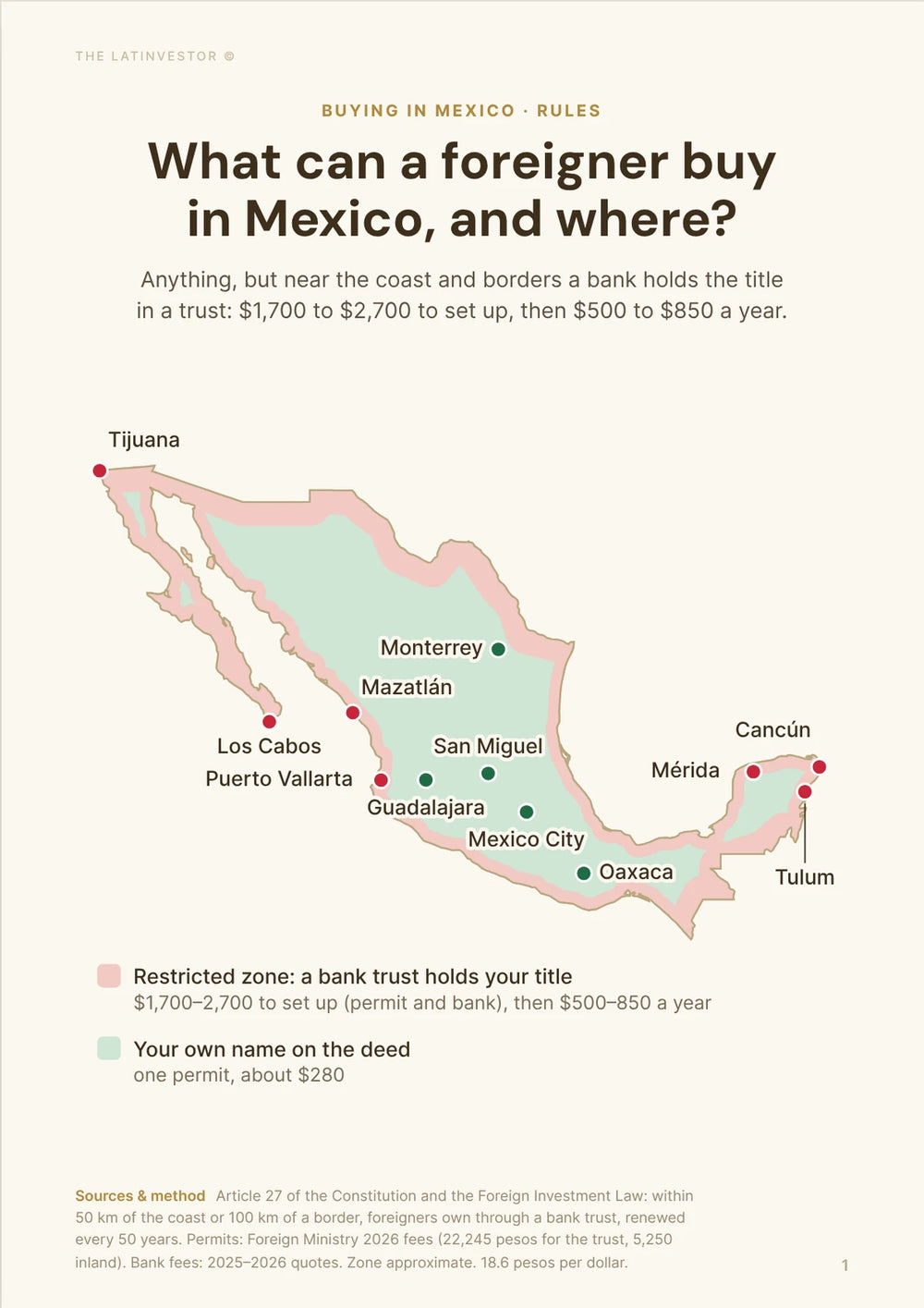
Mexico's Ministry of Foreign Affairs explains that foreign individuals cannot directly hold title to residential land within 50 kilometers of the coastline. Playa del Carmen falls inside that restricted zone.
Foreign buyers commonly use a bank trust, known as a fideicomiso, to obtain rights to use and benefit from the property. The trust can have a 50-year term under the legal framework.
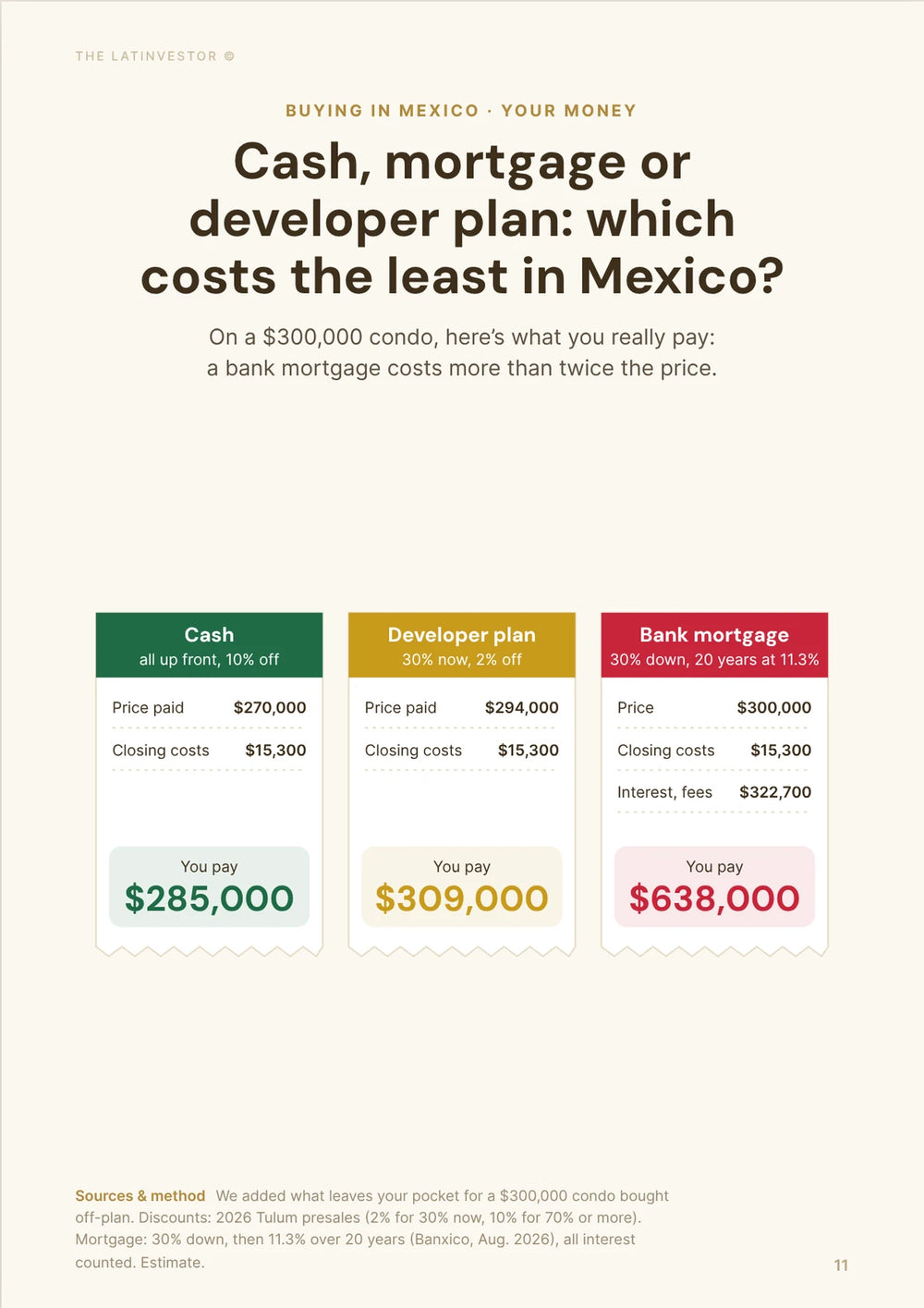
This structure is established and widely used, but it creates administrative obligations and trust-related fees alongside the usual purchase expenses.
For an Airbnb investor, those costs are important because they reduce the investment's actual yield, particularly when the property generates only modest annual operating income.
There is also currency exposure. A foreign investor may assess returns in dollars or euros while paying some expenses and receiving some bookings in pesos. Changes in exchange rates can affect the investor's home-currency results.
The ownership structure is manageable. The problem is that it adds costs to an investment whose margins may already be limited.
Is sargassum making Playa del Carmen Airbnbs riskier?
Sargassum is a recurring risk for Playa del Carmen vacation rentals, although public evidence does not establish how much Airbnb revenue it has reduced.
The coastal seaweed problem is not new. Playa del Carmen's municipal government reported collecting approximately 23,000 tonnes in 2019, 37,533 tonnes in 2022 and 13,663 tonnes in 2024. This year is far heavier: more than 45,000 tonnes were collected in the municipality between January and late September 2026.
At the state level, Mexico's Navy reported a record collection of approximately 92,783 tonnes across Quintana Roo during 2025.
These numbers reflect different reporting geographies and periods, so they should not be combined into a single local trend. They demonstrate that the region faces repeated large-scale clean-up requirements rather than an isolated event.
The risk is also highly localized. Recent drone observations published by Sargazo Watch showed relatively clear central Playa del Carmen beaches while other northern locations, including Punta Esmeralda, experienced heavier accumulations.
That distinction matters to an Airbnb owner advertising beach access. Two apartments marketed as being near the Caribbean may offer very different beach experiences during the same period.
We cannot responsibly attribute a particular percentage of lost occupancy to seaweed without property-level booking and cancellation records.
But we can identify the investment implication: beach conditions introduce another variable that the owner cannot control, precisely when guests are comparing many competing rentals.
Is Playa del Carmen a better Airbnb market than Cancún or Tulum?
Playa del Carmen currently shows stronger short-term rental occupancy than Cancún and Tulum in AirDNA's dataset, but that does not make it the most profitable investment market.
AirDNA reports approximately 58% occupancy in Playa del Carmen, compared with 54% in Cancún and 46% in Tulum.
However, Playa del Carmen's average nightly rate of USD 103 is below Cancún's USD 129 and Tulum's USD 125.
Annual revenue per active listing is also higher in Cancún, at USD 23,500, than in Playa del Carmen, at USD 18,800. Tulum is lower at USD 17,400.
These figures suggest that Playa del Carmen is relatively effective at filling available rental nights but captures less revenue per booked night.
Playa del Carmen's advantage appears stronger on occupancy than on pricing power.
We should not interpret this as proof that Cancún delivers better returns. Purchase prices, apartment sizes, management costs and neighborhood-level performance vary between the markets.
For investors, higher citywide revenue is useful only when compared against the capital required to acquire and operate a comparable property.
| Market | Active listings | Annual revenue per listing | Occupancy | Nightly rate |
|---|---|---|---|---|
| Cancún | 6,661 | USD 23,500 | 54% | USD 129 |
| Playa del Carmen | 6,498 | USD 18,800 | 58% | USD 103 |
| Tulum | 3,608 | USD 17,400 | 46% | USD 125 |
Who can still make good money with an Airbnb in Playa del Carmen?
The strongest Airbnb opportunities in Playa del Carmen now belong to owners with favorable acquisition costs, demonstrated rental performance, or a meaningful advantage over competing properties.
Professional operation is already established in the market. Airbtics identifies major local hosts and managers such as Mati, Happyaddress, Julia, Nasplaya and Enrique, each associated with more than 50 listings in its latest host dataset.
Their scale does not prove their properties are profitable. It does illustrate that independent hosts compete against operators managing substantial inventories and established guest-service systems.
For a new investor, the most convincing opportunity is therefore not necessarily a newly built apartment advertised with an optimistic occupancy projection.
A completed condo with a documented twelve-month booking history offers stronger evidence. So does an established property bought at a meaningful discount, provided its condition, condominium finances and rental permissions are sound.
We can quantify how much price matters.
In our earlier operating scenario, the property retains MXN 86,640 annually with professional management. To achieve a 5% operating yield at that revenue level, the buyer's total investment would have to be approximately MXN 1.73 million, far below the MXN 3.9 million assumed in the example.
Self-management raises modeled operating income to MXN 141,840, supporting an approximately MXN 2.84 million total investment at the same 5% target.
These are not predictions of achievable purchase prices. They are the investment ceilings implied by our assumptions.
Better operations help. Buying at the right price often helps more.
Is keeping an existing Playa del Carmen Airbnb better than buying a new one?
Keeping a successful existing Airbnb can make considerably more sense than purchasing another property at current asking prices.
An owner who bought several years ago may have a lower acquisition cost, an established review history and an operating system that already works.
For that owner, an additional year of rental income does not require paying another round of acquisition expenses, furnishing a new apartment or attracting an initial group of guests from zero.
However, we should not measure the decision solely against what the property originally cost.
If an owner can sell a condo for MXN 4 million today, keeping it means retaining approximately MXN 4 million of capital in that investment, regardless of whether the original purchase price was lower.
The correct financial comparison is between expected future rental income, potential resale value, selling costs, and alternative uses of that capital.
This is why the answer differs between a current owner and a new buyer. Existing owners may have good operational reasons to continue renting. New buyers must justify the full amount of money they commit today.
So, is Airbnb still worth it in Playa del Carmen?
Yes, Airbnb is still worth it in Playa del Carmen for selected properties, but buying an ordinary condo at a typical asking price and expecting attractive passive income is increasingly difficult to justify.
We found substantial remaining tourist demand, but also weakening hotel occupancy, declining airport traffic, significant short-term rental competition and slower revenue growth than nightly-rate growth in Airbtics' data.
The financial comparison is more concerning than the tourism outlook.
Airbtics estimates approximately MXN 276,000 in median annual rental revenue. In our illustrative purchase-and-management scenario, that level of bookings produces only about a 2.2% operating yield before income taxes and financing.
Reaching 5% would require approximately MXN 445,000 in annual bookings under the same assumptions, around 61% more than the benchmark.
That does not mean Playa del Carmen is an unprofitable Airbnb market. Revenue and occupancy vary enormously between properties, and we do not have audited net-income records for the full local rental inventory.
But the evidence no longer supports the idea that a normal vacation condo automatically generates strong investment returns merely because it is located in a popular Caribbean destination.
Our judgment is that Playa del Carmen has moved from an attractive location-driven Airbnb opportunity toward a much more selective, property-specific investment market.
For an existing owner with proven bookings and manageable costs, keeping the Airbnb can still be worthwhile. For an active operator buying at a discount or offering something genuinely different, opportunities remain.
For a new investor buying a standard condo at full asking price, hiring a manager and depending on market-average bookings, we would generally pass unless verified property-level financial records show materially better economics.
Playa del Carmen still has tourists. What it no longer offers is an easy guarantee that owning accommodation for those tourists will generate a good return.
Our methodology
To answer whether Airbnb is still worth it in Playa del Carmen, we broke the investment question into distinct tests: demand, competing supply, actual rental income, property prices, operating costs, seasonality, regulation and the alternatives available to an owner. We examined recent evidence for each before forming a judgment on the market as a whole.
We compared rental-market estimates from Airbtics, AirDNA and AirROI rather than blending their conflicting listing counts, occupancy rates and revenue measures. For demand, we examined Quintana Roo tourism records, DATATUR hotel occupancy and ASUR passenger traffic. Property-price comparisons draw on monitored asking-price data from TuLugar and local rental benchmarks from Build a Life Abroad.
We also tested the investment economics directly. The operating-yield calculations combine a stated hypothetical purchase price, Airbtics’ median revenue benchmark, Airbnb’s published fee structure, local management-cost guidance and explicit recurring-cost assumptions. These calculations are illustrations of what a purchase would need to earn, not audited results from a particular condo. Regulatory questions were assessed against official state, municipal and federal sources.
We checked these figures in October 2026. Amounts are kept in the currency each source publishes (pesos or US dollars); where we convert, we use about 18.6 pesos per US dollar and 20.9 pesos per euro. Yields after tax use the 25% of gross rent a non-resident owner pays. We evaluated each finding in context and then brought the dimensions together. The aim was to avoid judging an entire investment market from a single headline metric, whether that metric was tourist arrivals, gross rental revenue or advertised yield.
Key sources include Airbtics’ Playa del Carmen rental data, AirDNA’s market overview, AirROI’s rental estimates, Quintana Roo’s tourism bulletin, ASUR’s September 2026 traffic report, DATATUR’s hotel indicators, TuLugar’s apartment asking prices, Build a Life Abroad’s local pricing guide, Airbnb’s host-fee rules, RETUR-Q’s official registration guidance, Quintana Roo’s lodging-tax law, SAT’s Article 113-A, the Foreign Affairs Ministry’s restricted-zone trust guidance and Sargazo Watch’s beach observations and Diario Cambio 22 on 2026 sargassum collection.