Summary
For most foreign retirees, about $2,500–3,000 a month for one person or $3,500–4,500 for a couple is enough for a comfortable retirement in Playa del Carmen. Around $2,000 can still work for one person, but it is now a lower-end budget that depends heavily on rent, healthcare choices and how much of daily life happens in tourist areas.
Housing creates the biggest swing. A long-term apartment around MXN 12,000 can keep a retirement budget surprisingly lean, while a furnished central unit near Fifth Avenue can absorb several hundred dollars more every month before food or healthcare even enter the picture.
Playa has two cost structures operating side by side. Someone shopping at Mexican supermarkets, eating in neighborhood restaurants and living a few streets inland can spend much closer to local prices than someone consuming the city through beach clubs, imported groceries and central furnished rentals.
Healthcare is cheap at the routine end and potentially expensive at the catastrophic end. Paying cash for consultations can work well, but a serious hospitalization, strong private insurance or international coverage can quickly become one of the largest retirement expenses.
Owning a condo outright can reduce monthly spending by roughly $800–1,300, but it does not make housing free. HOA fees, maintenance, insurance, coastal wear and the opportunity cost of tying up capital still belong in the retirement calculation.
Air-conditioning is one of the easiest costs to underestimate. Efficient units and moderate use can keep electricity manageable; cooling a large apartment all day can materially raise the bill and, at high enough consumption, change the tariff economics.
A car is often optional if the neighborhood is chosen well. Paying a bit more for a walkable location can be cheaper than saving on rent and then carrying the full cost of insurance, fuel, maintenance, parking and depreciation.
Currency risk is real for retirees funded in dollars, euros or Canadian dollars. A strong peso can cut local purchasing power by hundreds of dollars a month, so a 10–15% buffer is more useful than building a plan around one favorable exchange rate.
Mexico's residency solvency test is a separate problem from Playa's cost of living. Someone can afford a $3,000 monthly lifestyle and still fail a consulate's financial threshold, which is why immigration eligibility and retirement affordability should be calculated independently.
The amount of invested capital needed depends far more on guaranteed income than on small lifestyle optimizations. A $3,000 monthly lifestyle funded entirely from investments points to roughly $900,000 at a 4% starting withdrawal rate, while $2,500 of dependable monthly pension income reduces the portfolio gap to only about $150,000 at the same rate.

Can you still retire in Playa del Carmen on $2,000 a month?
Retiring in Playa del Carmen on $2,000 a month is still possible for one person, but that budget now requires real choices about housing, healthcare and how often you spend in tourist areas.
Rent decides a large part of the equation. Long-term apartments away from the beachfront core can still fall around MXN 10,000–14,000 a month, while furnished apartments in central Playa regularly move closer to MXN 17,000–18,000. One recent Inmuebles24 listing near Fifth Avenue, for example, asked MXN 17,999 for a furnished one-bedroom.
That difference can absorb several hundred dollars every month before groceries or healthcare enter the picture.
A retiree renting for around MXN 12,000, cooking regularly, using local transport and paying cash for routine healthcare can still make $2,000 work. Someone wanting a central furnished apartment, constant air-conditioning, frequent restaurants and broad private insurance will struggle.
We would therefore treat $2,000 as a workable lower-end retirement budget rather than the amount to aim for.
| Monthly expense | Lean lifestyle | Comfortable lifestyle | Higher-cost lifestyle |
|---|---|---|---|
| Rent | $550–750 | $850–1,100 | $1,300+ |
| Utilities and internet | $100–160 | $150–220 | $250+ |
| Food | $300–400 | $400–550 | $650+ |
| Healthcare | $100–200 | $250–450 | $500+ |
| Transport | $80–150 | $150–250 | $300+ |
| Leisure and other spending | $200–300 | $350–500 | $600+ |
| Approximate total | $1,330–1,960 | $2,150–3,070 | $3,600+ |
Is $3,000 a month enough to retire comfortably in Playa del Carmen?
Around $3,000 a month is currently a strong target for one retiree who wants to live comfortably in Playa del Carmen without watching every expense.
The extra $1,000 compared with a $2,000 budget changes the lifestyle considerably. Suppose rent costs about $1,000 and healthcare averages $350. With a $2,000 budget, only $650 remains for food, transport, utilities, restaurants, entertainment and everything unexpected. At $3,000, that remaining amount rises to $1,650.
That gives a retiree room for a good apartment, regular meals out, private medical appointments, taxis, air-conditioning and normal leisure spending.
Playa also has an unusual pricing split. Someone buying groceries at Walmart or Soriana and eating in neighborhood restaurants can spend much closer to local Mexican prices. Walk a few blocks toward Fifth Avenue, beach clubs and internationally oriented restaurants, and the same city starts feeling much more expensive.
For one foreign retiree, roughly $2,500–3,000 a month is currently the realistic comfort zone.
How much does a retired couple need in Playa del Carmen?
A retired couple can live comfortably in Playa del Carmen on roughly $3,500–4,500 a month today, because many of the biggest costs are shared.
Housing is the clearest example. Two people do not need two apartments, two internet connections or twice as much electricity. A couple therefore needs much less than double the budget of a single retiree.
Food, healthcare and travel do rise meaningfully with the second person, especially if both retirees carry private medical insurance. That is where the range becomes wider.
A couple living in a residential neighborhood and relying heavily on local services could stay near $3,000. Around $4,000 gives much more breathing room. Once the budget reaches $5,500 or more, the difference increasingly reflects premium housing, more travel, frequent restaurants and higher-end healthcare rather than the basic cost of retiring in Playa.
| Lifestyle | One retiree | Retired couple | Typical setup |
|---|---|---|---|
| Cost-conscious | $1,700–2,000 | $2,500–3,000 | Residential area, mostly local spending |
| Comfortable | $2,500–3,000 | $3,500–4,500 | Good rental, restaurants, healthcare allowance |
| Higher-end | $4,000+ | $5,500+ | Premium location, frequent travel and dining |
How much should you budget for rent in Playa del Carmen now?
For a good long-term one-bedroom rental in Playa del Carmen, we would currently budget around MXN 12,000–18,000 a month unless living close to the beach is a priority.
Playa has several rental markets operating side by side. Residential neighborhoods can still produce one-bedroom apartments around MXN 10,000–14,000. Central furnished properties frequently sit around MXN 16,000–20,000, while Playacar and prime beach locations can climb much higher. Numbeo's crowd-sourced averages put a one-bedroom at about MXN 18,500 a month in the center and MXN 6,800 outside it.
A recent Inmuebles24 listing illustrates where the central market sits these days: MXN 17,999 for a furnished studio near Fifth Avenue and Mamitas Beach. Another furnished one-bedroom was listed at MXN 17,000.
Those listings do not mean everyone pays MXN 17,000. They show how quickly the budget rises when someone wants furniture, amenities and a walkable tourist-core location.
For retirement planning, using the cheapest apartment found online is risky. MXN 12,000–18,000 gives a much more useful range for someone who wants decent long-term housing without paying beachfront prices.
| Type of location | Indicative monthly rent | What to expect |
|---|---|---|
| Outer residential areas | MXN 8,000–13,000 | Basic/local housing |
| Colosio or similar areas | MXN 10,000–15,000 | Better value |
| Central Playa | MXN 15,000–22,000+ | Walkable and tourist-oriented |
| Playacar | MXN 18,000–30,000+ | Premium/gated |
| Prime beachfront | MXN 28,000+ | Luxury pricing |
Is buying a condo in Playa del Carmen cheaper than renting in retirement?
Owning a Playa del Carmen condo outright can cut monthly retirement spending by around $800–1,300, but buying only makes sense if the property itself fits the wider retirement plan.
Removing rent is powerful. Someone spending $3,000 while renting could potentially live on closer to $2,000–2,200 after buying a suitable property outright.
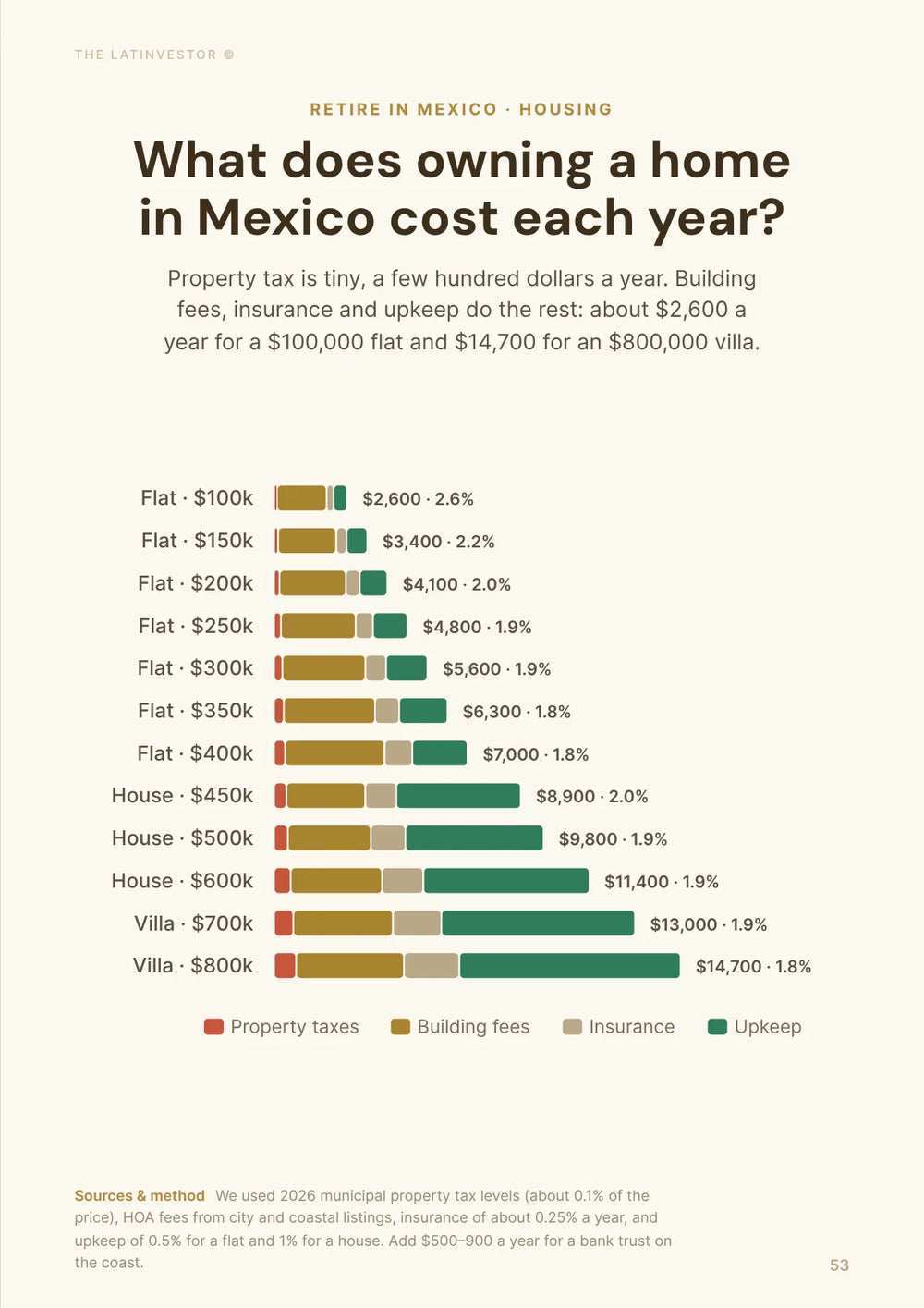
The condo still costs money to own. HOA fees, insurance, maintenance, appliance replacement and occasional building assessments continue after the mortgage disappears. Coastal humidity and salt also make maintenance worth taking seriously.
There is another cost that does not appear on a monthly bill: the capital locked into the property. Putting $250,000 into a condo means that $250,000 is no longer sitting in a liquid investment portfolio producing retirement income.
This is why very low Playa retirement budgets often look more convincing once we learn that the person already owns the home.
If buying is part of the plan, keep the condo purchase separate from the retirement portfolio calculation. The numbers are much easier to judge that way.
How much should retirees budget for healthcare in Playa del Carmen?
A healthy retiree can spend very little on routine healthcare in Playa del Carmen, while comprehensive private insurance can add several hundred dollars every month.
Ordinary private healthcare remains one of Mexico's big advantages. Routine consultations, dental care, tests and common medications can cost much less than their US equivalents, which makes paying cash attractive for everyday treatment.
Major medical risk is where budgets separate sharply.
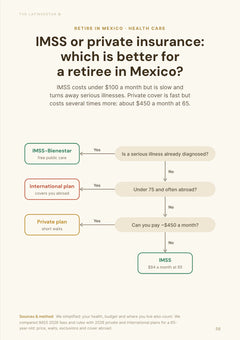
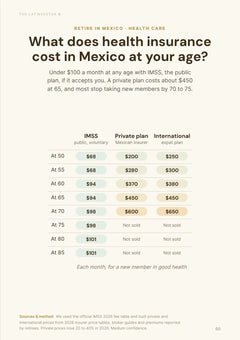
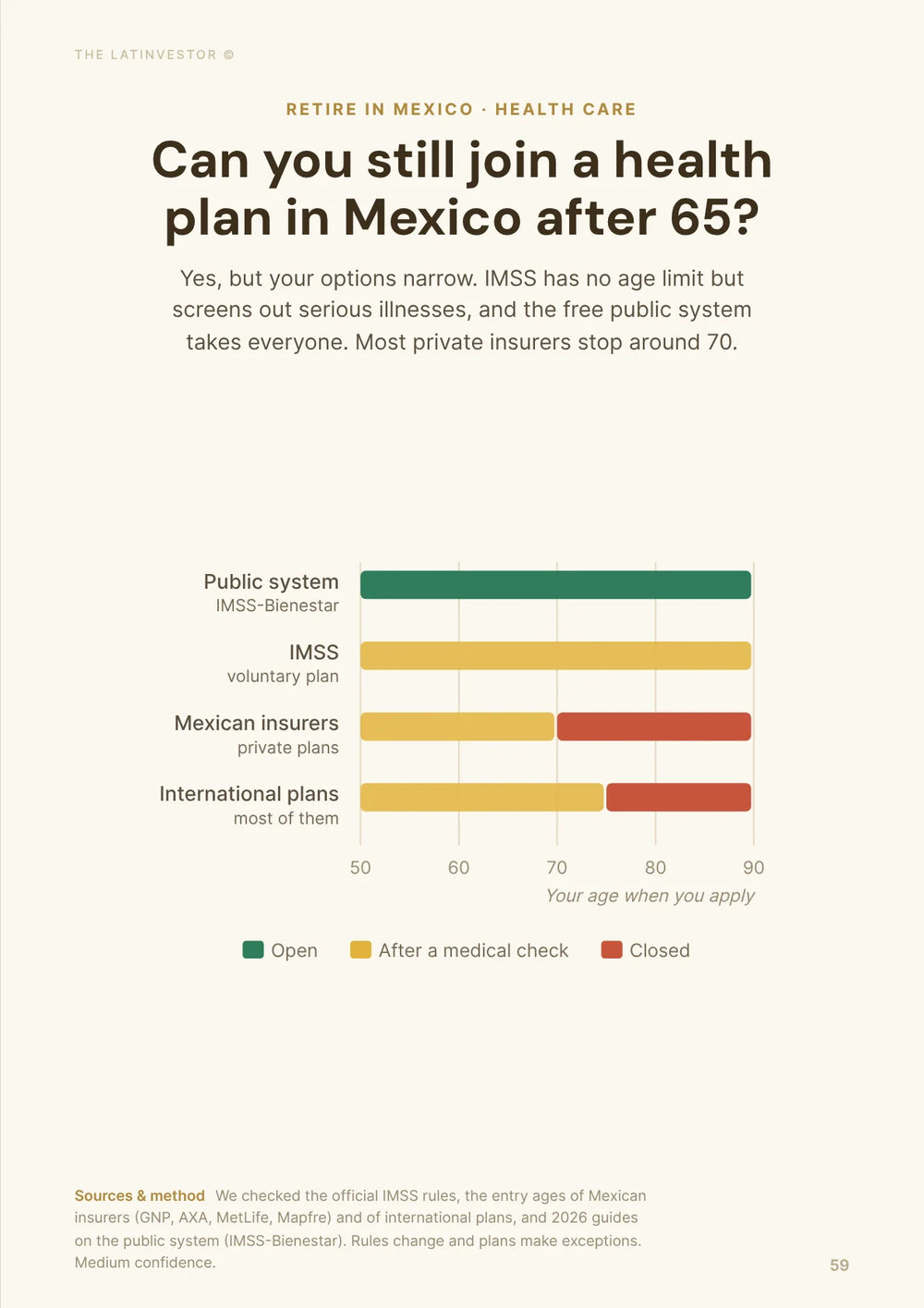
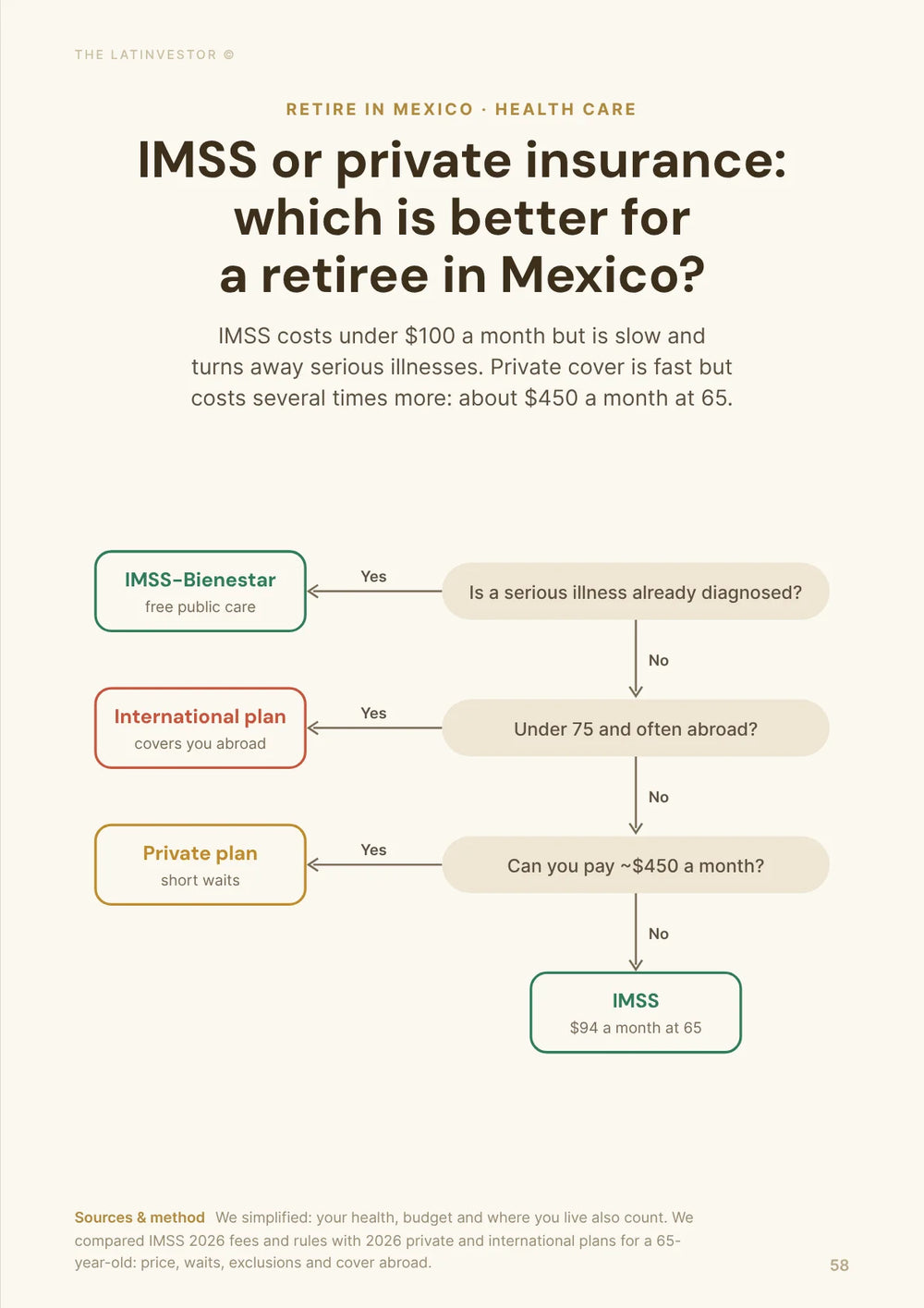
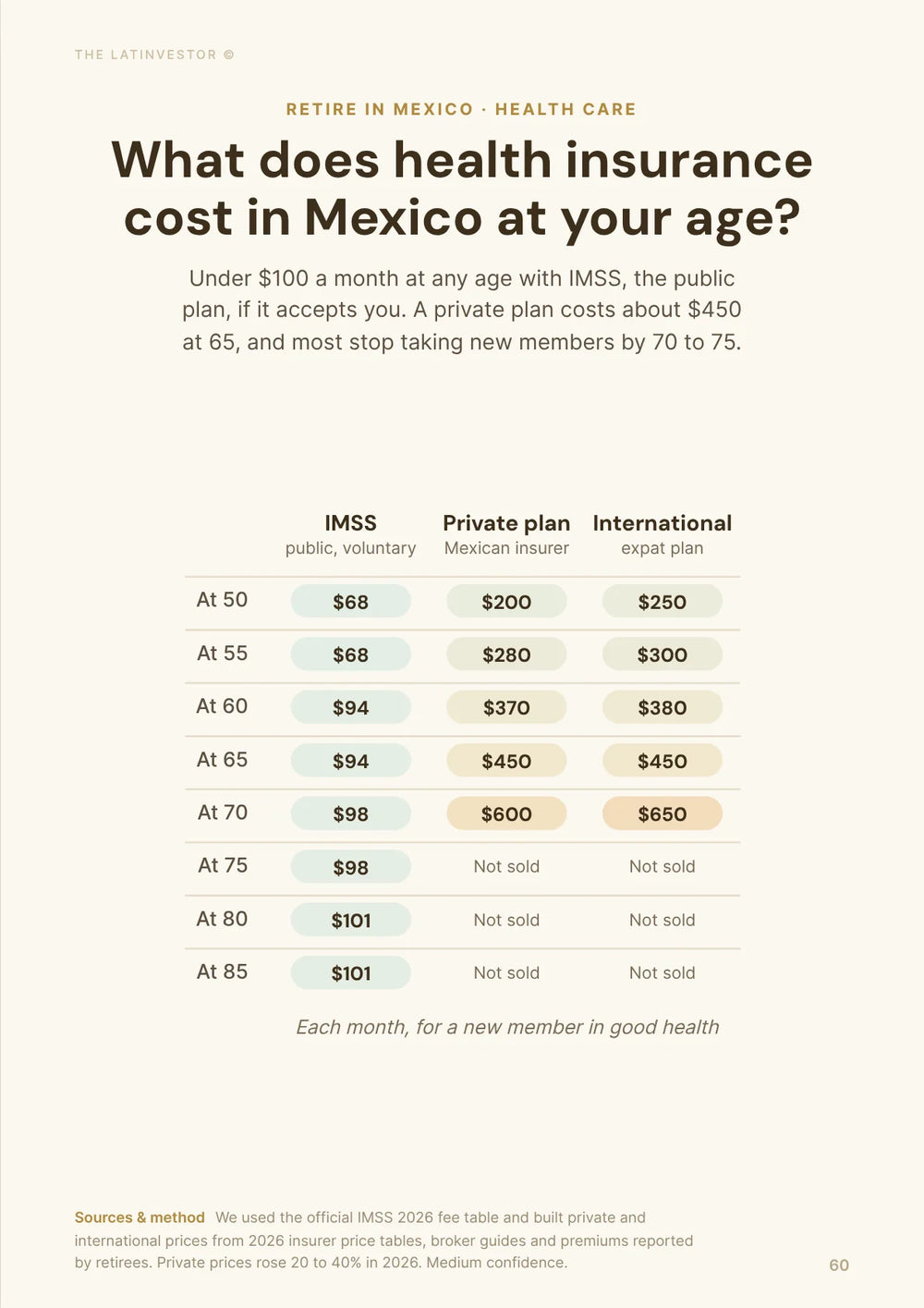
A retiree using IMSS where eligible (its voluntary plan costs MXN 20,600 a year, about $1,115, between 60 and 69 in 2026), plus cash payments for private consultations, may keep ongoing healthcare spending near $100–250 a month. Someone buying strong private Mexican or international coverage can easily move into the $300–700 range, sometimes higher with age, medical history or broader international benefits. As a reference, a mid-range Mexican plan for a woman aged 60 to 64 costs about MXN 58,000–90,000 a year ($3,135–$4,865) in 2026.
Medical insurance has also been getting more expensive. These days, premium inflation can run much faster than Mexico's overall inflation rate, especially for older policyholders.
For that reason, a universal $100 healthcare line is too neat. That figure may describe routine medical spending; it says very little about protection against a major hospitalization.
| Healthcare setup | Approximate monthly budget | Main consideration |
|---|---|---|
| Mostly public / IMSS + cash care | $75–150 | Cheapest approach |
| Cash routine care + medical reserve | $100–250 | More personal financial risk |
| Mexican private insurance | $200–500+ | Better private protection |
| International private insurance | $350–1,000+ | Broadest coverage, expensive with age |
Can retirees in Playa del Carmen skip private health insurance and pay cash?
Paying cash for everyday healthcare in Playa del Carmen can work very well, but fully self-insuring a major medical problem only makes sense when the retiree has enough liquid money to absorb a large bill.
The attraction is obvious. If a private consultation costs tens of dollars rather than hundreds, paying an insurer for every small medical expense can feel unnecessary.
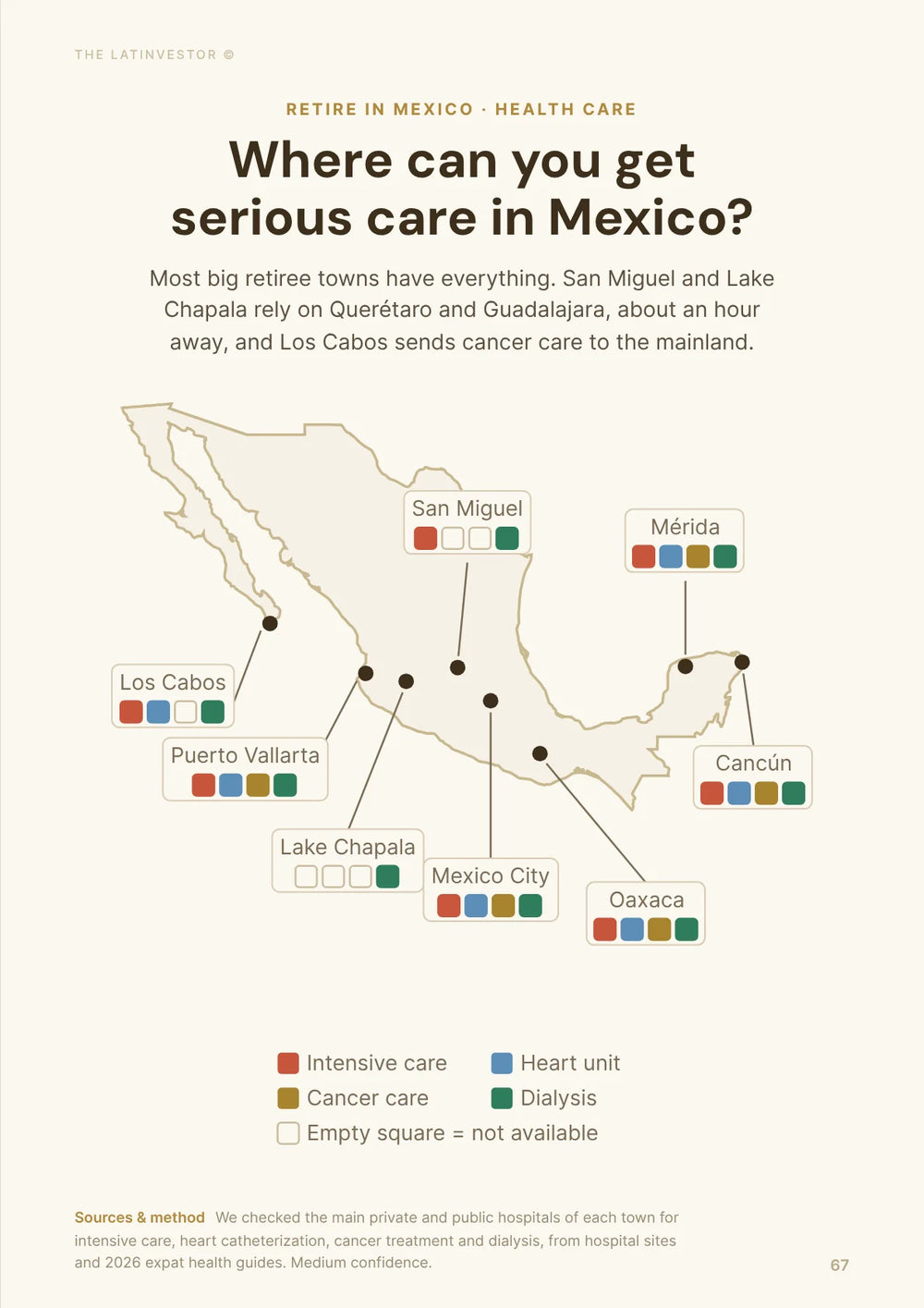
A serious hospitalization changes that calculation. Surgery, intensive care or prolonged cancer treatment can create bills large enough to damage a retirement portfolio even when Mexican hospital prices are below US levels.
Age also makes waiting risky. Private insurers can exclude pre-existing conditions, increase premiums or make new coverage harder to obtain later.
The most practical setup for many retirees is to pay directly for small medical expenses while keeping either catastrophic insurance or a dedicated medical reserve for larger events.
Someone retiring with $1.5 million can reasonably carry more of that risk personally. Someone whose entire retirement capital is $200,000 cannot. That's the catch.
Will air-conditioning make Playa del Carmen expensive to live in?
Air-conditioning can turn electricity into a meaningful Playa del Carmen expense, especially for retirees who cool a large apartment throughout the day.
CFE residential tariffs in hot parts of Mexico provide subsidized electricity within certain consumption bands, so moderate use can remain quite affordable. Heavy consumption changes the picture.
Apartment choice matters as much as thermostat habits. A shaded unit with efficient inverter air conditioners can use far less electricity than a top-floor apartment with large sun-facing windows and old equipment.
Someone who mainly cools the bedroom at night may hardly think about the electricity bill. Running several units all day can add a noticeable amount to monthly spending and may eventually push a household toward less favorable high-consumption pricing.
Numbeo puts basic utilities for an 85 m² apartment at about MXN 1,540 a month ($83), plus about MXN 540 for home internet and MXN 400 for a mobile plan. For a comfortable retirement budget, we would leave around $150–220 a month for electricity, water, internet and mobile service combined, with extra room for heavy air-conditioning.
Are food and restaurants still cheap in Playa del Carmen?
Food can still be cheap in Playa del Carmen if retirees buy Mexican products and eat where residents eat, while imported groceries and tourist restaurants can quickly make the city feel expensive.
This pricing gap shows up everywhere.
Fresh produce, tortillas, local meat and Mexican supermarket brands remain relatively inexpensive. Imported cheese, specialty health foods, European products and familiar North American brands can cost far more.
Restaurants work the same way. Neighborhood tacos, local lunch menus and casual Mexican restaurants can be remarkably affordable. Fifth Avenue, beachfront restaurants and venues aimed at foreign tourists operate in a completely different price range.
A retiree cooking regularly and eating out selectively can reasonably budget around $350–450 a month for food. Frequent restaurant meals and imported groceries can push that figure well above $600.
Playa gives retirees a surprising amount of control over this part of the budget. Two people with similar apartments can spend very different amounts simply because one consumes the city as a resident and the other consumes it like a visitor.
Does a retiree need a car in Playa del Carmen?
Most retirees can live comfortably in Playa del Carmen without a car if they choose a walkable neighborhood, which can save several thousand dollars a year.
Central Playa is compact enough for many daily trips on foot. Taxis, colectivos and other local transport cover most of the remaining journeys, with a local ride at around MXN 10.
Owning a car adds insurance, fuel, maintenance, depreciation and parking. Coastal humidity also means vehicles can age harder than retirees expect.
A car becomes more useful for someone living on the outskirts, making frequent regional trips or simply wanting maximum independence.
That creates an interesting trade-off when choosing housing. Spending an extra $150–200 on rent in a walkable neighborhood can still be cheaper than saving the same amount on rent and then maintaining a car.
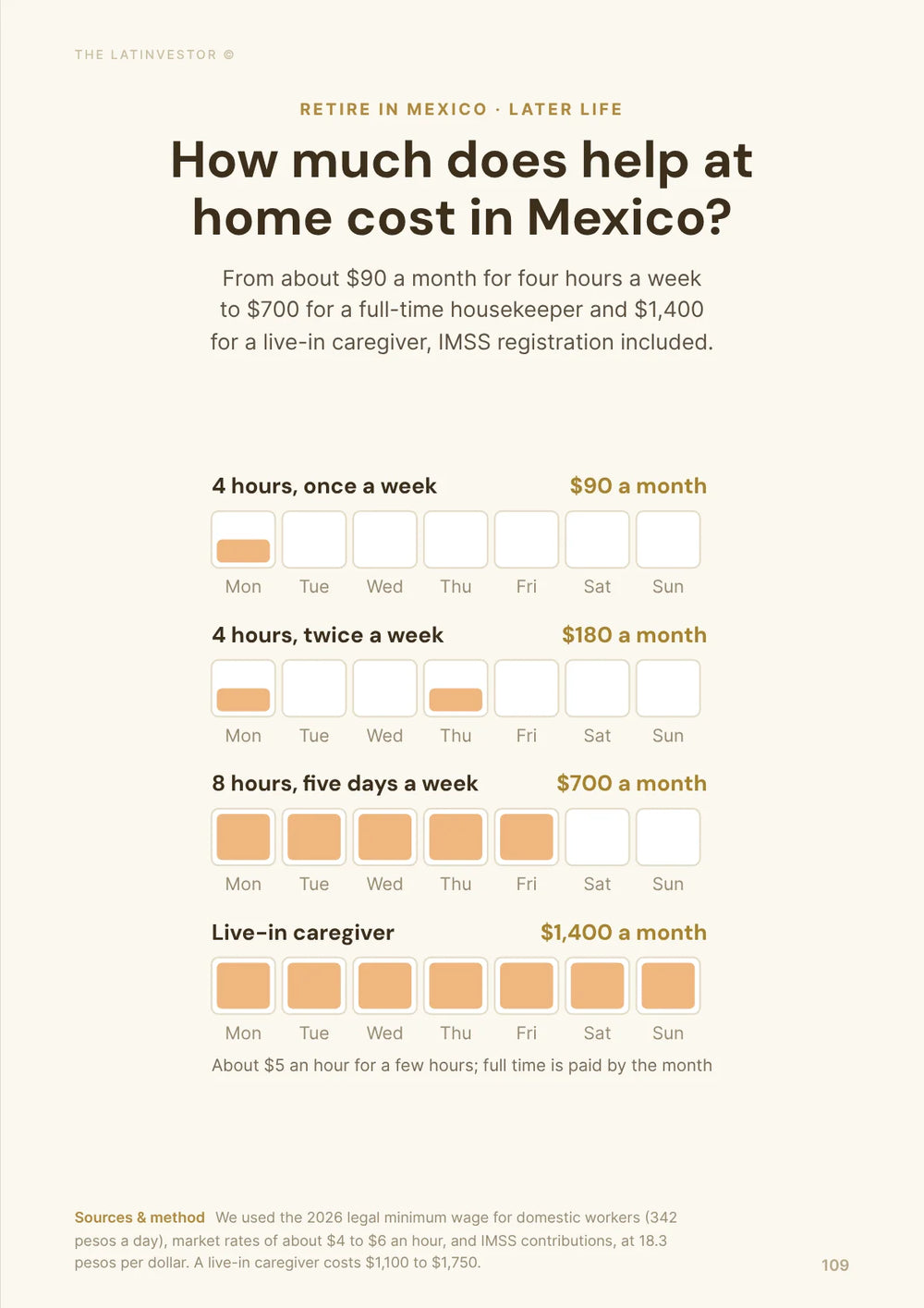
A car-free retiree could reasonably budget around $100–200 a month for transportation. Full car ownership can take the true monthly cost several hundred dollars higher.
Can a strong or weak Mexican peso wreck a Playa del Carmen retirement budget?
Currency swings can change a foreign retiree's Playa del Carmen spending power by hundreds of dollars a month even when the pension itself never changes.
Take someone receiving $3,000 each month in US dollars. At MXN 18.5 per dollar, roughly the October 2026 rate, that produces MXN 55,500. If the peso strengthens to 14, the same $3,000 produces just MXN 42,000. At 20 pesos per dollar, it becomes MXN 60,000.
That is an MXN 18,000 monthly gap between the strong-peso and weak-peso scenarios.
Inflation adds another layer. INEGI reported annual headline inflation of 3.45% in September 2026. Housing and health insurance can move differently from those national averages.
Retirees therefore need enough margin to survive a period when the peso strengthens while some of their biggest local expenses continue rising.
We would build at least a 10–15% buffer into any Playa retirement plan funded mainly from dollars, euros or Canadian dollars.
| USD/MXN exchange rate | $2,500 monthly income | $3,000 monthly income | $4,000 monthly income |
|---|---|---|---|
| 14 | MXN 35,000 | MXN 42,000 | MXN 56,000 |
| 18.5 (Oct. 2026) | MXN 46,250 | MXN 55,500 | MXN 74,000 |
| 20 | MXN 50,000 | MXN 60,000 | MXN 80,000 |
| 22 | MXN 55,000 | MXN 66,000 | MXN 88,000 |
Can you afford Playa del Carmen but still fail Mexico's residency requirements?
Yes. A retiree can have enough income to live comfortably in Playa del Carmen and still fall short of the financial test used by a Mexican consulate for residency.
That distinction catches people by surprise because immigration authorities are testing financial solvency rather than estimating the actual cost of living in Playa.
The thresholds can also vary by consulate because each office converts the underlying Mexican requirements into local currency. For temporary residency in 2026, for example, the San Diego consulate asks for about $4,510 a month of income or $75,950 in savings, while Del Rio asks for about $4,786 or $79,773.
As a result, someone with a dependable $3,000 monthly retirement income could have a perfectly viable Playa lifestyle while still needing more assets, more qualifying pension income or another residency route.
The same applies in reverse. Someone can satisfy a high bank-balance requirement and still have a poor retirement plan if most of the money is tied up or being spent too quickly.
Run the immigration calculation separately from the cost-of-living calculation. Combining the two gives a misleading answer to both.
How much invested money do you need to retire in Playa del Carmen with no pension?
A retiree funding everything from investments should think roughly $750,000–$1 million for a comfortable single-person Playa del Carmen retirement, with more required as spending rises.
The basic math is straightforward.
Spending $2,500 a month means withdrawing $30,000 a year. A 4% starting withdrawal rate implies around $750,000 of invested capital. At 3.5%, it rises to about $857,000.
At $3,000 a month, annual spending reaches $36,000. That requires around $900,000 at 4%, or just over $1 million at 3.5%.
A couple spending $4,000 a month needs $48,000 a year. The equivalent figures rise to about $1.2 million at 4% and $1.37 million at 3.5%.
We would lean closer to 3–3.5% for someone retiring unusually young, because a retirement starting at 50 or 55 may need to survive four decades. Someone beginning later with flexible expenses and future pension income has more room to use a higher withdrawal rate.
| Desired monthly spending | Annual spending | Capital at 4% | Capital at 3.5% |
|---|---|---|---|
| $2,000 | $24,000 | $600,000 | ~$686,000 |
| $2,500 | $30,000 | $750,000 | ~$857,000 |
| $3,000 | $36,000 | $900,000 | ~$1.03M |
| $3,500 | $42,000 | $1.05M | $1.20M |
| $4,000 | $48,000 | $1.20M | ~$1.37M |
| $5,000 | $60,000 | $1.50M | ~$1.71M |
How much money do you need if Social Security or a pension already pays part of your Playa retirement?
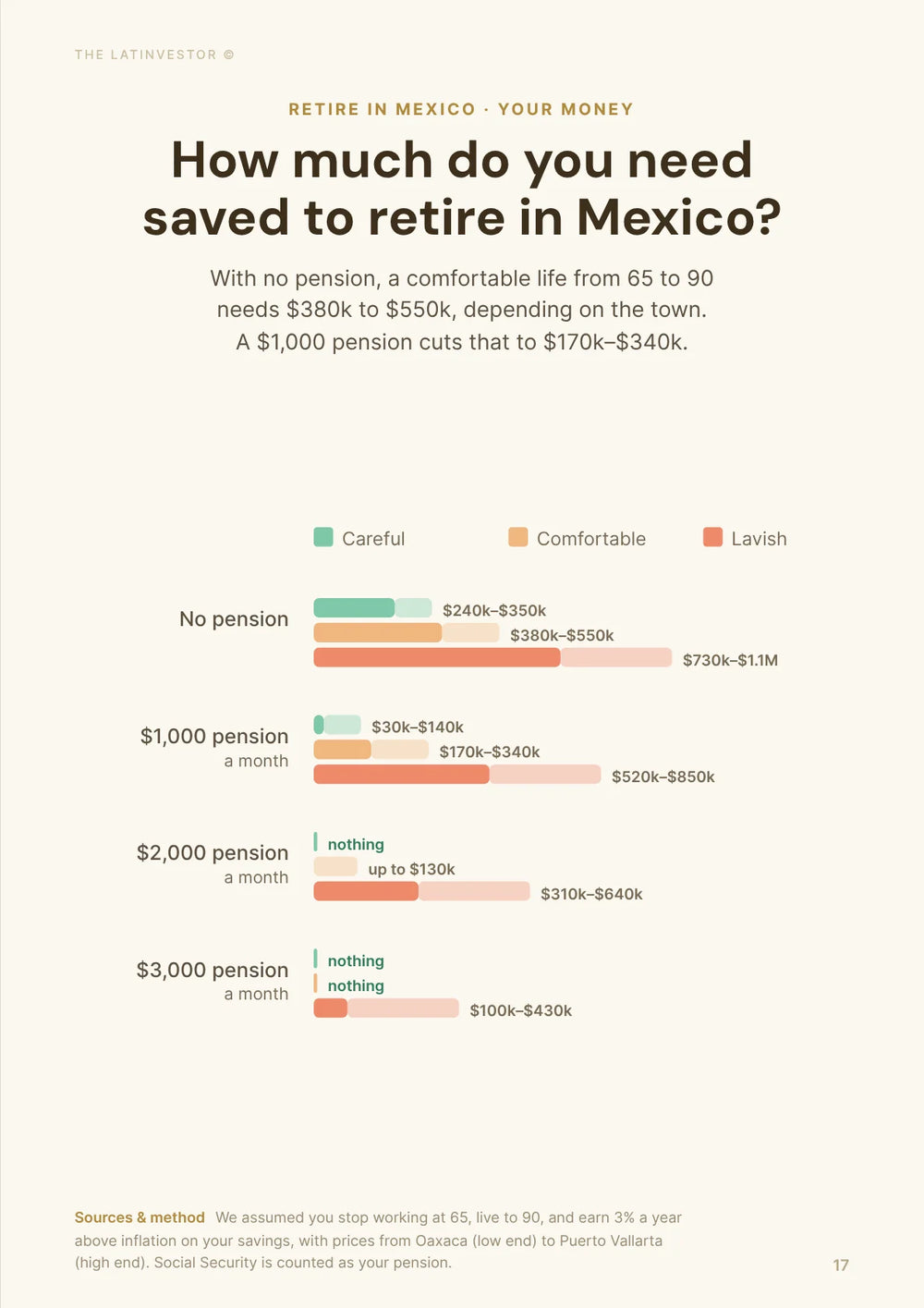
A reliable pension can reduce the investment portfolio needed for Playa del Carmen by hundreds of thousands of dollars.
Suppose a retiree wants a $3,000 monthly lifestyle and receives $2,000 from Social Security or another guaranteed pension. Investments only need to provide the missing $1,000 a month, or $12,000 annually.
Using a 4% starting withdrawal rate, that gap corresponds to roughly $300,000 of invested capital.
Increase guaranteed income to $2,500 and the shortfall falls to $500 a month. The portfolio requirement drops to around $150,000.
This has a far bigger effect than shaving $100 from groceries or searching for a slightly cheaper apartment.
A person with $900,000 and no pension can therefore be in a similar spending position to someone with $300,000 and $2,000 of dependable monthly income.
For retirees comparing whether they can afford Playa, guaranteed monthly income deserves to be calculated first.
| Target lifestyle | Guaranteed monthly income | Portfolio must provide | Capital at 4% |
|---|---|---|---|
| $3,000/month | $0 | $3,000/month | $900,000 |
| $3,000/month | $1,500 | $1,500/month | $450,000 |
| $3,000/month | $2,000 | $1,000/month | $300,000 |
| $3,000/month | $2,500 | $500/month | $150,000 |
| $3,000/month | $3,000 | $0 | Expenses already covered |
Is Playa del Carmen getting too expensive to retire in?
Playa del Carmen is clearly more expensive than the ultra-cheap retirement destination sometimes portrayed online, but it remains affordable enough to make retirement attractive for foreigners with moderate income.
Housing explains much of the confusion. Local residential rentals still exist around MXN 10,000–14,000, while furnished central apartments can approach MXN 18,000 or more. Prime locations go much higher.
Healthcare creates another widening gap. Routine Mexican medical treatment remains inexpensive, while strong private insurance for an older foreigner can become one of the largest monthly expenses.
General inflation is relatively calm right now. INEGI put annual headline inflation at 3.45% in September 2026. That helps, although retirees should care more about what happens to rent, medical insurance and other expenses that dominate their own budget.
Playa still works particularly well because retirees can adjust their spending without leaving the city. Moving a few neighborhoods inland, eating more locally or giving up a car can reduce monthly costs substantially.
The people most likely to find Playa unexpectedly expensive are those arriving with a local-Mexico budget while expecting a beachfront, internationally oriented lifestyle.
Is Playa del Carmen safe enough for retirement right now?
Current crime figures are moving in the right direction in Playa del Carmen, and safety would not stop us from considering the city for retirement.
The latest comparison from the municipal government shows intentional homicides down 51.6% from January through August 2026 compared with the same period a year earlier. Through July, SESNSP figures recorded 15 homicides against 28 a year before.
Several property crimes fell sharply during the same comparison. Vehicle theft dropped 45.5%, motorcycle theft 45.6% and home burglary 33.2%.
Eight months of better data cannot guarantee that the improvement will continue, and neighborhood choice still matters. Playa remains a tourist city where petty theft and other security issues deserve ordinary precautions.
Still, the latest numbers weaken the idea that retirees need to pay Playacar prices simply to feel reasonably secure. Plenty of residential areas offer a much cheaper housing option.
What expenses do Playa del Carmen retirement calculators usually forget?
The biggest mistakes in Playa del Carmen retirement budgets usually come from irregular expenses such as international flights, medical deductibles, apartment moves and replacing household equipment.
A spreadsheet built from rent, groceries and electricity can look remarkably cheap because none of those expenses happens every month.
A trip home for a family emergency might cost $1,000 with very little notice. Dental work could create another four-figure year. A laptop, air conditioner or refrigerator eventually needs replacing. Moving apartments can require a new deposit and upfront rent.
Retirees also spend money on residency paperwork, tax advice, visitors, short trips and flights home. None of these costs is extraordinary, yet together they can add several thousand dollars over a year.
We would simply add around 10–15% to the normal lifestyle budget for these irregular expenses.
That means a retirement calculated at $2,600 a month is safer when funded closer to $3,000.


So how much money do you really need to retire in Playa del Carmen?
For most foreign retirees, about $2,500–3,000 a month for one person or $3,500–4,500 for a couple is enough for a genuinely comfortable Playa del Carmen retirement today.
A single retiree can still make around $2,000 work, especially with inexpensive housing. We would not build a long-term retirement plan around that number unless income is very secure or spending can easily be reduced.
Around $3,000 gives one person much more room for a decent apartment, private healthcare, restaurants, air-conditioning, travel and the expenses that never appear in basic cost-of-living comparisons.
Without pension income, a retiree wanting to spend $3,000 a month should think in the neighborhood of $900,000 invested using a 4% starting withdrawal rate, or roughly $1.03 million at 3.5%.
A couple spending $4,000 monthly would need about $1.2 million at 4%.
Guaranteed income changes those numbers dramatically. Someone receiving $2,500 a month from Social Security or pensions and spending $3,000 only needs investments to finance the remaining $500. At 4%, that is roughly $150,000, plus the cash reserve and medical protection we would want separately.
Owning a Playa property outright can also push the required monthly income much lower because rent is the largest adjustable cost for most retirees.
Our strongest all-around target for one renter is therefore around $3,000 a month, six to twelve months of expenses held in accessible cash, and enough investment capital to fund whatever part of that $3,000 is not already covered by guaranteed income.
| Retirement situation | Practical target |
|---|---|
| One person, cost-conscious | ~$1,800–2,000/month |
| One person, comfortable | ~$2,500–3,000/month |
| One person, higher-end | ~$4,000+/month |
| Couple, cost-conscious | ~$2,500–3,000/month |
| Couple, comfortable | ~$3,500–4,500/month |
| Couple, higher-end | ~$5,500+/month |
| Portfolio funding $3,000/month alone | ~$900,000 at 4% |
| Portfolio funding $4,000/month alone | ~$1.2M at 4% |
| Suggested cash reserve | 6–12 months of expenses |
Our methodology
This analysis tests how much money a foreign retiree realistically needs to live in Playa del Carmen by separating the costs that move the budget most: housing, healthcare, utilities, food, transport, currency exposure, immigration requirements and the amount of retirement income that must come from investments.
For housing, we used current long-term rental evidence rather than one generic cost-of-living average. The rental range is anchored by recent Inmuebles24 listings, including a central furnished property around MXN 17,999, a lower-cost central rental around MXN 12,000 and premium Playacar inventory around MXN 25,000.
Utility assumptions are checked against CFE's official residential tariff structure, including Tarifa 1C and the DAC high-consumption framework, while current residential internet pricing is cross-checked with TELMEX. That is especially relevant in Playa because heavy air-conditioning can move electricity spending far more than a basic utility estimate suggests.
Healthcare is split between routine medical spending and protection against a major event. We use IMSS's official Seguro de Salud para la Familia framework, CONDUSEF's major-medical insurance tools and current insurance guidance rather than treating a low cash consultation price as a complete healthcare budget.
For broader spending and purchasing-power context, we use INEGI for inflation and Banco de México for the USD/MXN FIX exchange rate (about 18.5 pesos per dollar in October 2026), INEGI's ENIGH data for Quintana Roo household spending, and PROFECO's current consumer-price monitoring. These sources help distinguish local everyday spending from the higher prices found in tourist-oriented parts of Playa.
Immigration affordability is treated separately from lifestyle affordability. The residency discussion is based on the Secretaría de Relaciones Exteriores temporary-resident framework and official 2026 consular solvency guidance from the Mexican consulates in San Diego and Del Rio, which also shows why applicants should verify the specific consulate where they plan to apply.
For safety, we use the SESNSP municipal crime database and the municipal government's January–August comparison rather than general perceptions of Playa del Carmen. For portfolio funding, we use current Morningstar retirement-income research as the reference behind the 4% scenario while also showing a more conservative 3.5% case for longer retirement horizons.
Key sources used include: Inmuebles24 on a central furnished rental, Inmuebles24 on a lower-cost central rental, Inmuebles24 on Playacar rental pricing, CFE Tarifa 1C, CFE's DAC tariff, IMSS Seguro de Salud para la Familia, CONDUSEF's major-medical insurance simulator, Banco de México inflation data, Banco de México's FIX exchange rate, INEGI ENIGH for Quintana Roo, PROFECO consumer-price monitoring, SRE temporary-resident requirements, the Mexican Consulate in San Diego's 2026 solvency guidance, the Mexican Consulate in Del Rio's visa guidance, SESNSP crime data, the Playa del Carmen municipal government, INEGI inflation data, and Morningstar's 2026 withdrawal-rate research.