Summary
Barely: a 65 m² 2-bedroom in Querétaro asked about MXN 11,600 a month in June 2026 (about USD 624), only 3.5% more than two years earlier. That's under 2% a year, below inflation, which was 3.45% in September 2026.
We estimate a studio at around MXN 7,000 and a 1-bedroom at around MXN 8,600 a month. On average, that's about MXN 178 per square meter.
Rents have stalled since spring: MXN 11,650 in April 2026, MXN 11,600 in June. We expect only 2% to 4% more over the next 12 months.
There's no cap on rent increases in Querétaro, unlike Mexico City. But a landlord can only raise the rent through a new signed agreement, so put the increase rule in the lease from day one.
The expensive areas have stopped climbing. Since April 2025, apartment rents were flat in Centro Sur (about MXN 19,800) and down 2.4% in Juriquilla (about MXN 18,200), while Milenio III rose 12.7% to about MXN 15,100.
The cheaper areas are catching up: rents rose 11% in two years in Corregidora and 10% around Felipe Carrillo Puerto, to about MXN 9,300 for a 2-bedroom.
Families usually pay MXN 13,000 to 28,000 in Juriquilla, Zibatá or El Refugio. Young professionals pay MXN 8,000 to 15,000 in Centro Sur, Álamos or Centro Histórico.
Furniture adds about MXN 1,000 to 3,000 a month, and parking MXN 800 to 1,500. After the 2025 water cuts, a large cistern also matters to tenants.
Airbnb is shrinking: active listings fell 34.9% in a year, to 2,583. Those still running made about USD 8,700 in a year, before costs, not far from a long lease on a 2-bedroom.
A well-priced rental usually finds a tenant in 20 to 35 days, and we estimate vacancy at about 4% to 6% in good locations.
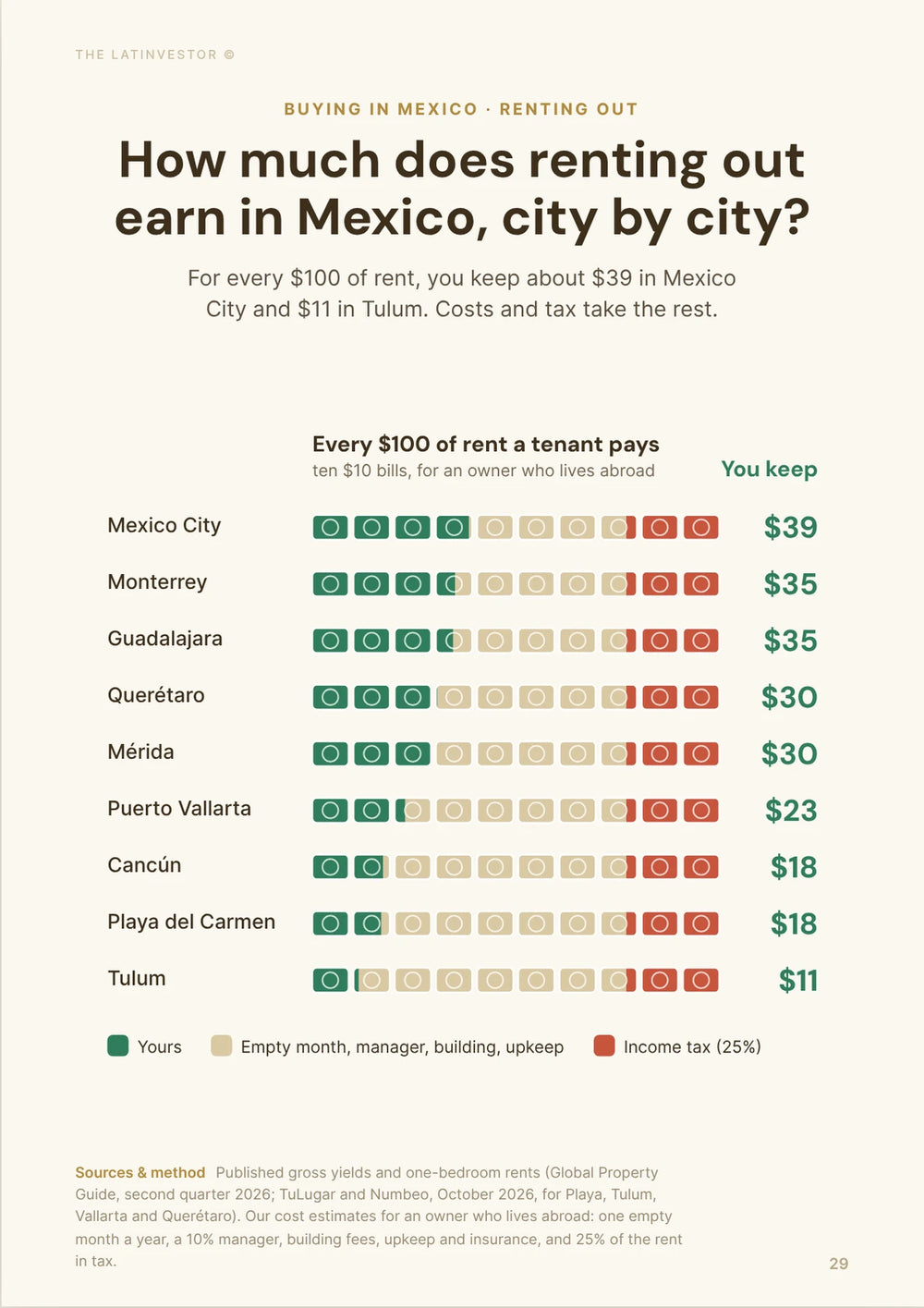
Predial on a typical apartment is often MXN 2,000 to 6,000 a year. A landlord who isn't a Mexican tax resident owes 25% of the gross rent in income tax, with no deductions.
The bottom line: rents in Querétaro are no longer rising in real terms. Price your unit against current listings, not last year's ads, and look at Milenio III or the cheaper areas if you want rent growth.

What does an apartment rent for in Querétaro today?
What's the average monthly rent for a studio in Querétaro?
In 2026, a typical studio in Querétaro rents for about MXN 7,000 per month, roughly USD 376 or EUR 335. That's our estimate, since the main index only tracks 2-bedroom apartments.
Most studios fall between MXN 6,000 and MXN 10,000 per month, or about USD 323 to USD 538 and EUR 287 to EUR 478.
The rent changes mainly with location, furniture, parking and security, and whether the studio is near Centro Histórico, Álamos, Milenio III, the universities or the office corridors.
What's the average monthly rent for a 1-bedroom in Querétaro?
In 2026, a normal 1-bedroom apartment in Querétaro rents for about MXN 8,600 per month, roughly USD 462 or EUR 411. That's also our estimate.
Most 1-bedroom apartments sit between MXN 6,500 and MXN 13,000 per month, or about USD 349 to USD 699 and EUR 311 to EUR 622.
The cheapest are in older central, northern or less sought-after areas. The most expensive are in Centro Sur, Álamos, Juriquilla and Zibatá.
What's the average monthly rent for a 2-bedroom in Querétaro?
In June 2026, a 2-bedroom apartment of 65 m² in Querétaro asked MXN 11,601 per month on average, about USD 624 or EUR 555, according to the Inmuebles24 index.
Most 2-bedroom apartments fall between MXN 9,000 and MXN 24,000 per month, or about USD 484 to USD 1,290 and EUR 431 to EUR 1,150.
Under MXN 10,000, look at Corregidora, El Marqués or the Felipe Carrillo Puerto and Epigmenio González districts. The most expensive 2-bedrooms are in El Campanario, Juriquilla, Zibatá, Álamos and Centro Sur.
What's the average rent per square meter in Querétaro?
In 2026, the average rent in Querétaro is about MXN 178 per m² per month, roughly USD 9.60 or EUR 8.50.
Across neighborhoods, a realistic range is about MXN 140 to MXN 260 per m² per month, or about USD 7.50 to USD 14 and EUR 6.70 to EUR 12.40.
Querétaro is cheaper than Mexico City, but dearer than many mid-sized Mexican cities, because jobs, people moving in and demand for gated housing keep rents up.
Rent per m² rises above average when the unit is furnished, modern, secure, close to schools or offices, and in Juriquilla, Zibatá, El Campanario, Centro Sur or Álamos.
Are rents in Querétaro still rising faster than inflation?
No. The Inmuebles24 index for a 65 m² 2-bedroom went from MXN 11,206 in June 2024 to MXN 11,601 in June 2026: up 3.5% in two years, or under 2% a year. Inflation in Mexico was 3.45% over the year to September 2026, so in real terms, rents are slipping.
And the last few months are flat: MXN 11,652 in April 2026, MXN 11,601 in June. Back in January 2025, the index was already rising only 1% a year.
Why it's stuck, as we read it: premium areas like Centro Sur have hit what tenants there can pay, new apartments keep arriving in the same corridors, and some of the units that left Airbnb (listings fell by about a third in a year) are now on long leases.
Will rents in Querétaro go up in the next 12 months?
Only a little. We expect Querétaro rents to rise about 2% to 4% over the next 12 months, so roughly in line with inflation.
Demand is still there: formal jobs in the Bajío industrial corridor, people moving in, the universities, and households that can't afford to buy. But the supply of new apartments and the return of former Airbnb units cap what landlords can ask.
The best chances of rent growth are in the mid-priced areas, like Milenio III, Corregidora and El Refugio. Premium areas like Centro Sur and Juriquilla have stopped rising for now.
The risks: slower hiring, more new apartments in the same corridor, and tenant budgets that can't stretch further.
Can a landlord raise the rent as much as they want in Querétaro?
Yes, at renewal. Querétaro has no cap on rent increases. Rent is whatever the landlord and tenant agree to in the lease, under the state civil code.
That's different from Mexico City, where since 2024 a yearly increase on a home can't be more than the previous year's inflation. Querétaro hasn't copied that rule.
But a landlord can't just announce a new rent. If a fixed-term lease ends and the tenant stays with no objection, it usually renews on the same terms, at the same rent. A higher rent needs a new written agreement signed by both sides.
What to do: write the increase rule into the lease from the start (most leases tie it to inflation, the INPC), give written notice well before the end date, and don't ask much more than similar units nearby. With rents flat in 2026, an overpriced renewal often ends with an empty apartment. Expect to ask for one month's deposit and a guarantor (fiador or aval) or a legal guarantee policy (póliza jurídica).
Where in Querétaro are rents highest, and where are they still climbing?
Which neighborhoods have the highest rents in Querétaro?
In 2026, the highest rents in Querétaro are in El Campanario, Juriquilla, Zibatá and Centro Sur, where good rentals often ask MXN 18,000 to MXN 30,000 per month, or about USD 968 to USD 1,610 and EUR 861 to EUR 1,440.
On Propiedades.com in October 2026, apartments for rent averaged about MXN 19,800 in Centro Sur and about MXN 18,200 in Juriquilla. But the top has stopped climbing: since April 2025, Centro Sur rents haven't moved and Juriquilla's fell 2.4%. In the Inmuebles24 index, the Josefa Vergara district, which takes in Centro Sur, is down 7% in two years, to about MXN 12,600 for a 2-bedroom.
Rents are still moving in the middle of the market. Milenio III rose 12.7% since April 2025, to about MXN 15,100. In the index, Corregidora rose 11% in two years and Felipe Carrillo Puerto 10%, both to about MXN 9,300.
Tenants in the premium areas pay for security, gated living, parking, newer buildings, schools and easy access to the main roads. They're executives, families moving for work, remote workers, expats and well-off Mexican households.
We've also written about the best areas to buy property in Querétaro.
Where do young professionals prefer to rent in Querétaro right now?
Young professionals mostly rent in Centro Sur, Álamos and Centro Histórico, and also in Milenio III, Juriquilla and El Refugio.
They usually pay about MXN 8,000 to MXN 15,000 per month, or roughly USD 430 to USD 806 and EUR 383 to EUR 718.
They choose these areas for shorter commutes, restaurants, cafés, gyms, coworking spaces, good internet and modern apartments.
Where do families prefer to rent in Querétaro right now?
Families mostly rent in Juriquilla, Zibatá and El Refugio, and also in Cumbres del Lago, Jurica, El Campanario and Corregidora.
For 2- and 3-bedroom homes there, most families pay about MXN 13,000 to MXN 28,000 per month, or roughly USD 699 to USD 1,510 and EUR 622 to EUR 1,340.
They want gated clusters, parking, schools, parks, supermarkets, safe streets and space for children. Schools nearby include Universidad Anáhuac Querétaro, UVM Juriquilla, UNAM Juriquilla, Instituto Asunción, Colegio Newland and other private bilingual schools.
Which areas near transit or universities rent faster in Querétaro?
In 2026, the fastest-renting areas are Centro Histórico near the UAQ, Juriquilla near UNAM and UVM, and Zibatá or El Marqués near Universidad Anáhuac.
A well-priced rental there often finds a tenant in about 10 to 20 days.
Being close to a university, a Qrobús route or an office corridor can add about MXN 800 to MXN 2,500 per month, or roughly USD 43 to USD 134 and EUR 38 to EUR 120.
Which neighborhoods are most popular with expats in Querétaro right now?
Expats mostly rent in Centro Histórico, Juriquilla and Zibatá, and also in El Refugio, El Campanario, Jurica, Álamos and Centro Sur.
They usually pay about MXN 12,000 to MXN 30,000 per month, or roughly USD 645 to USD 1,610 and EUR 574 to EUR 1,440.
They look for furnished rentals, walkable streets or gated living, good internet, schools and restaurants. Americans, Canadians, Europeans and Latin American professionals are the most visible groups, but the rental market is still mostly Mexican.
If you're moving there, read our guide for expats in Querétaro.
Who rents in Querétaro, and what will they pay extra for?
What tenant profiles dominate rentals in Querétaro?
Most tenants in Querétaro are families moving for work, young professionals, and students or people in their first jobs.
As a rough estimate, families make up about 40% of demand for good long-term rentals, young professionals about 35%, and students or early-career renters about 15%. Expats and company-paid tenants make up most of the rest.
Families want 2- or 3-bedroom homes with parking. Young professionals want studios and 1-bedrooms near work. Students want small, cheap units near the UAQ, UNAM, UVM or Anáhuac.
If you're thinking of buying to rent, see our guide on how to buy and rent out in Querétaro.
Do tenants prefer furnished or unfurnished in Querétaro?
In Querétaro, about 65% to 75% of long-term tenants prefer unfurnished homes, and about 25% to 35% want furnished ones.
A good furnished apartment can ask about MXN 1,000 to MXN 3,000 more per month, or roughly USD 54 to USD 161 and EUR 48 to EUR 144.
Furnished units suit students, young professionals, company-paid tenants, expats and remote workers who want to move in quickly.
Which amenities increase rent the most in Querétaro?
The amenities that add the most rent in Querétaro are parking, security, furniture, an equipped kitchen, and building extras like a gym, pool or coworking space.
Parking can add about MXN 800 to MXN 1,500, security about MXN 1,000 to MXN 2,000, furniture about MXN 1,000 to MXN 3,000, an equipped kitchen about MXN 700 to MXN 1,500, and building extras about MXN 1,000 to MXN 2,500 per month. That's roughly USD 38 to USD 161 and EUR 33 to EUR 144 per item.
Water is the one people forget. In September 2025, a release at the Zimapán dam cut supply to 336 neighborhoods across the metro area. A big cistern, a roof tank and a backup pump make a unit easier to rent, and tenants who've been through a cut will ask about them.
What renovations get the best ROI for rentals in Querétaro?
The renovations that pay back best in Querétaro are a kitchen refresh, a bathroom refresh, closets, better lighting and a work corner with good internet.
A kitchen refresh may cost MXN 25,000 to MXN 80,000 and add MXN 800 to MXN 2,000 in monthly rent. A bathroom may cost MXN 20,000 to MXN 60,000 and add MXN 600 to MXN 1,500. Closets cost about MXN 10,000 to MXN 35,000 and add MXN 400 to MXN 1,000. Lighting costs MXN 4,000 to MXN 15,000 and adds MXN 300 to MXN 700. A desk and better internet cost MXN 5,000 to MXN 20,000 and add MXN 300 to MXN 900. In total, that's roughly USD 215 to USD 4,300, or EUR 191 to EUR 3,830, per project.
Skip very personal luxury finishes, expensive imported furniture and oversized appliances. They look nice but don't fix what tenants care about: parking, storage, internet, water and security.
Is Airbnb still worth it in Querétaro, or is a long lease better?
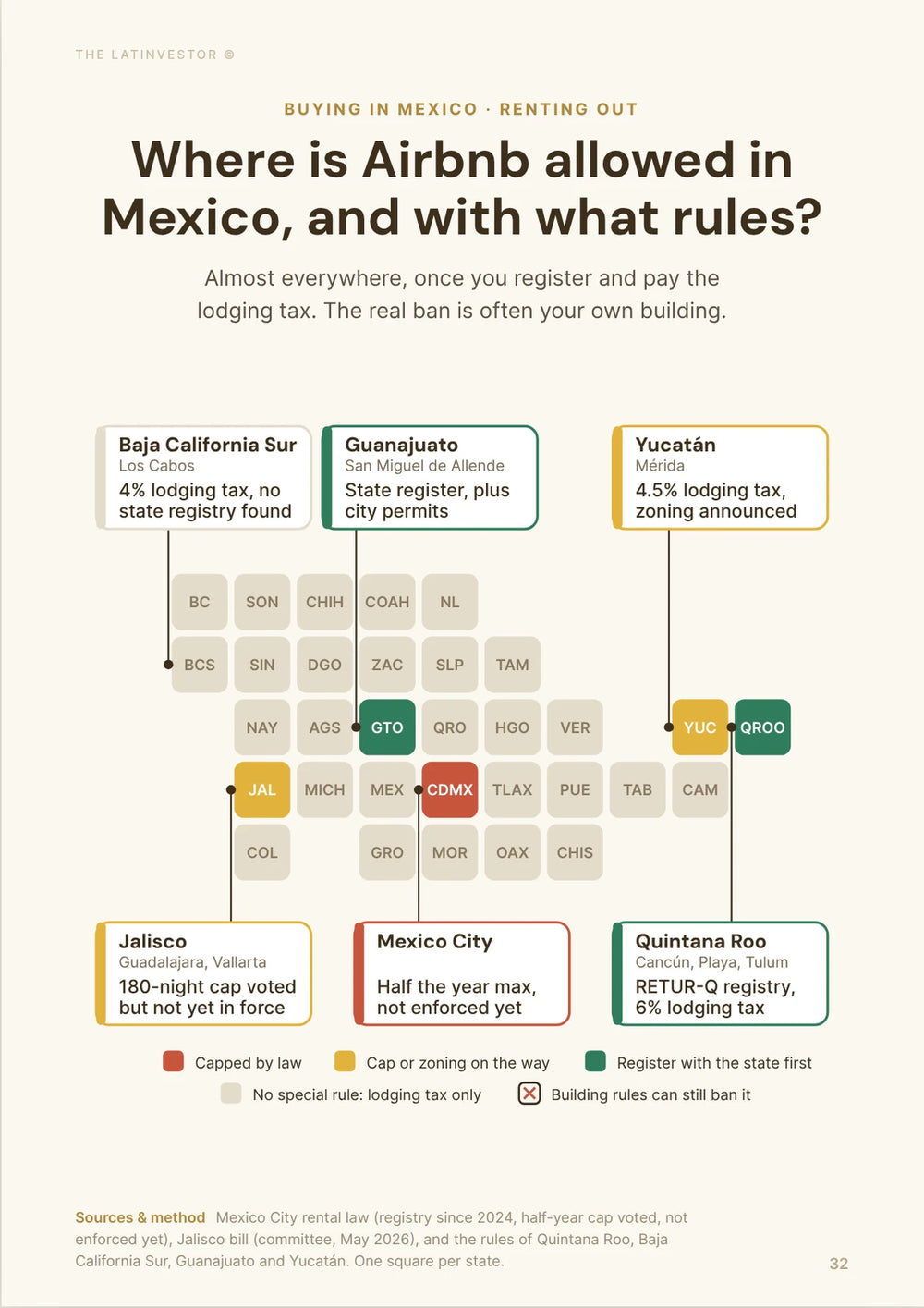
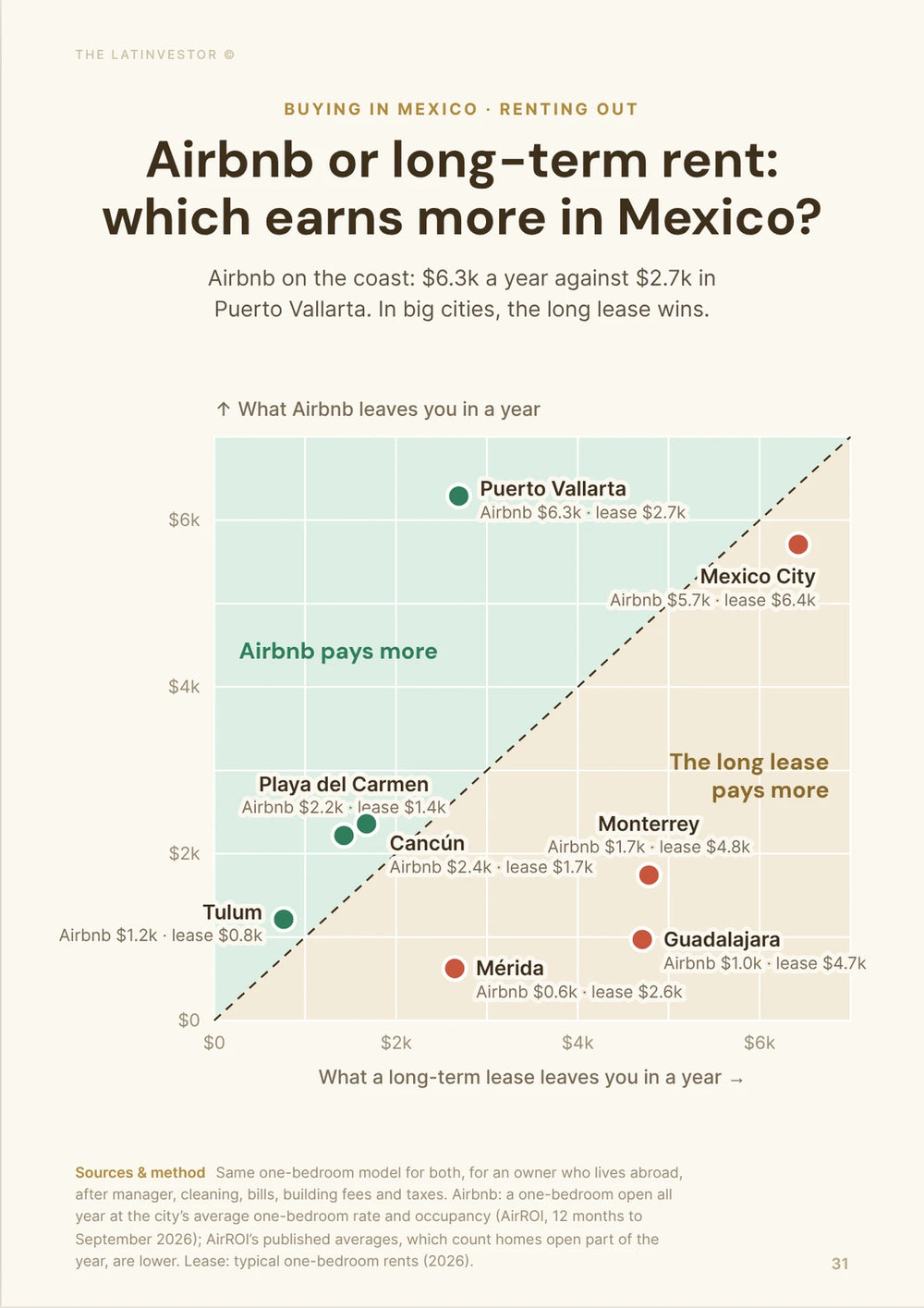
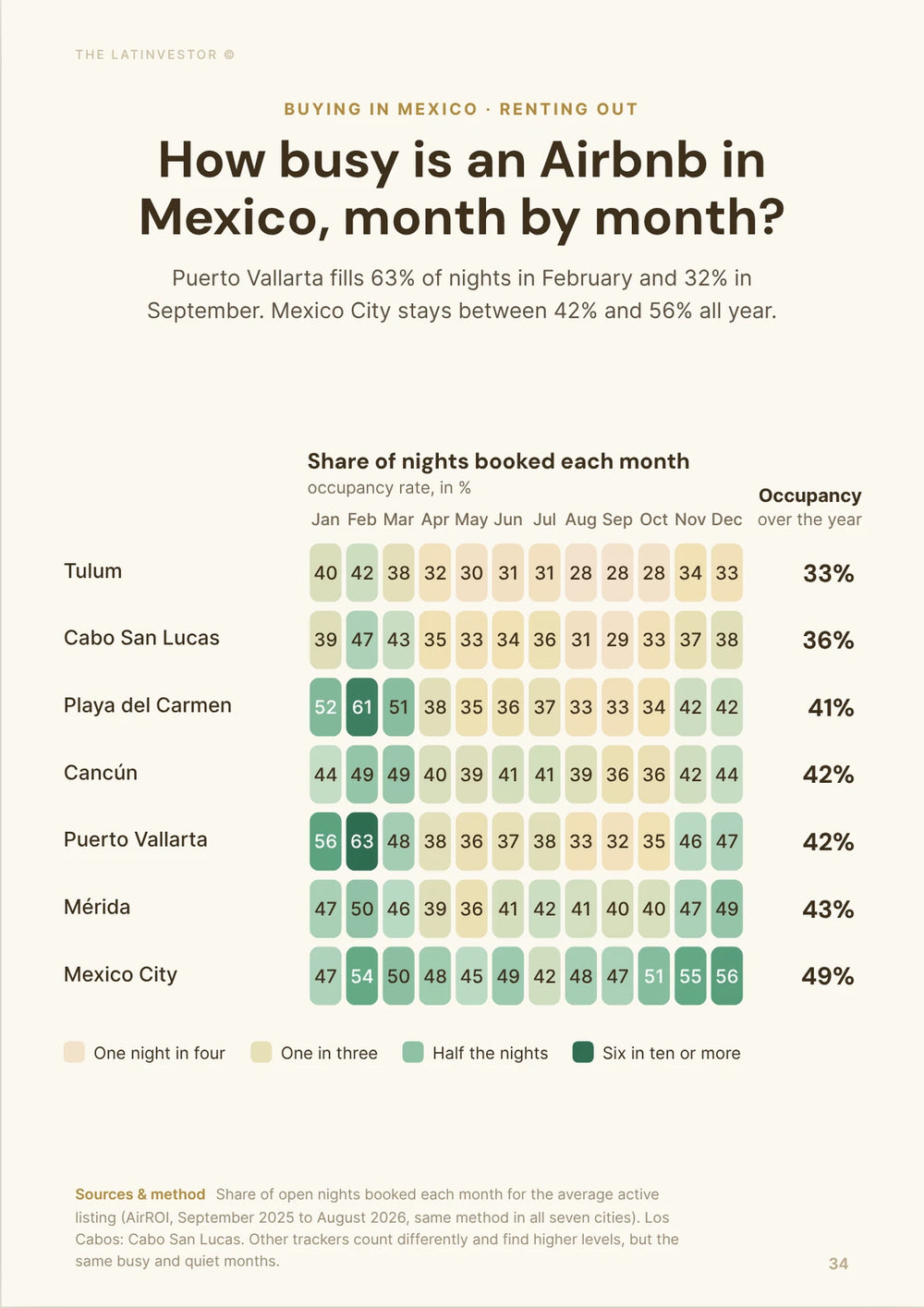
For most owners, a long lease now makes more sense. Active short-term listings in Querétaro fell 34.9% in a year, to 2,583 in September 2026, according to AirDNA. Many hosts have given up.
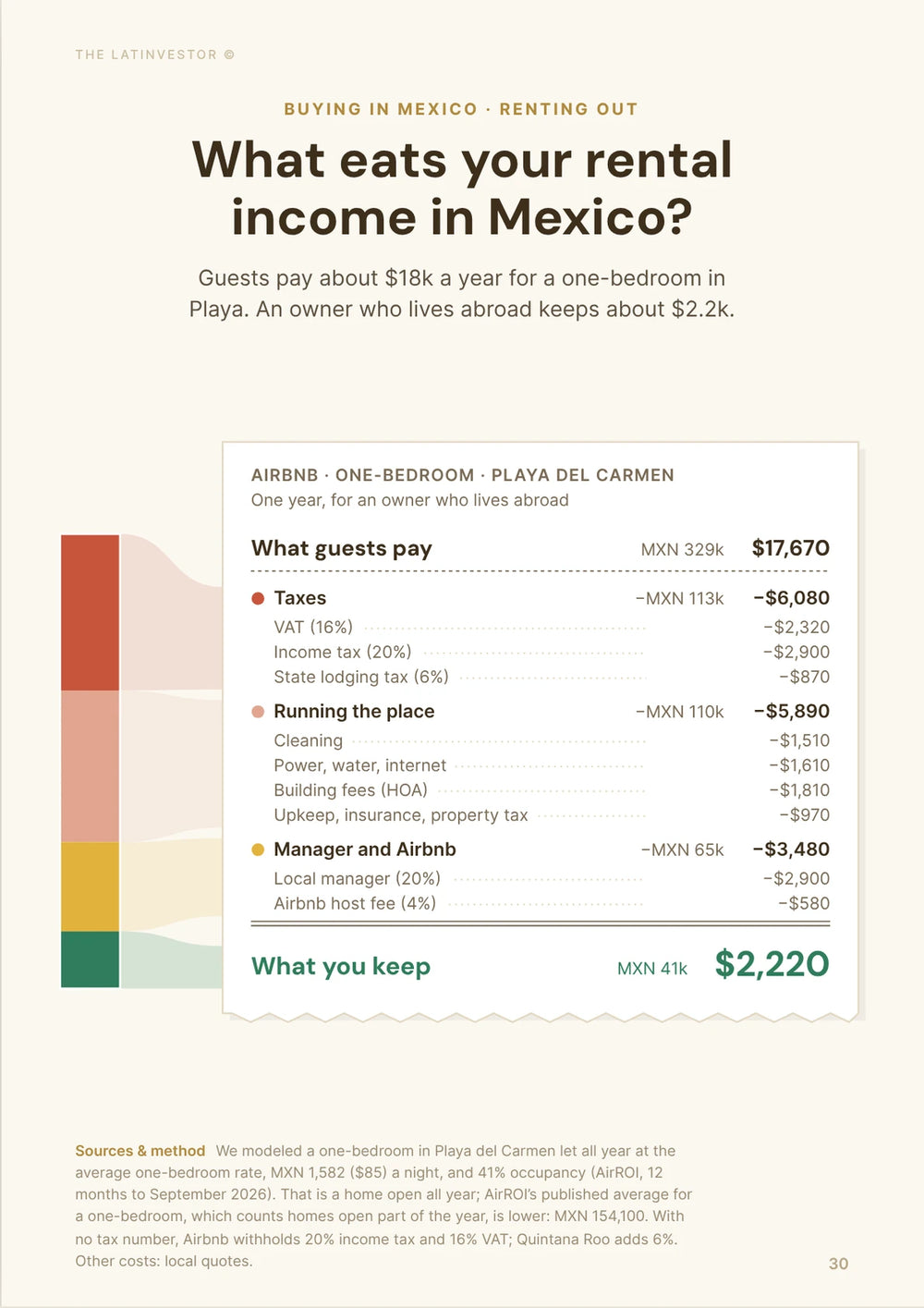
Those still running booked 57% of their nights at about USD 44 a night, for about USD 8,700 in revenue over the year to September 2026 (about MXN 162,000). A 2-bedroom on a long lease at the June 2026 benchmark brings in about MXN 139,000 a year (about USD 7,480), with far less work.
The gap shrinks fast once you count the costs of short stays: cleaning, furniture, utilities, platform fees, and the taxes. Airbnb collects a 5% state lodging tax from guests in Querétaro, and as an individual host with an RFC, the platform withholds 4% of your income for ISR, plus VAT where it applies.
What to do: if you already own a short-term unit in a business area like Centro Sur or near Centro Histórico, check your real net income over the last 12 months against a long lease. On a gross yield of about 7.1% for a standard 2-bedroom (April 2026 asking prices), a well-run long lease is hard to beat here.
How fast do good apartments rent in Querétaro?
What's the vacancy rate for rentals in Querétaro?
In 2026, we estimate vacancy for well-located long-term rentals in Querétaro at about 4% to 6%.
It can be closer to 3% to 5% for well-priced units near jobs or schools, but 7% to 10% for overpriced, poorly kept or badly located ones.
Demand from jobs and newcomers is still solid, but with flat rents and more units on the market, the gap between well-priced and overpriced homes is wider than a year ago.
How many days do rentals stay listed in Querétaro?
In 2026, a well-priced rental in Querétaro usually finds a tenant in about 20 to 35 days.
Cheap studios and 1-bedrooms near the universities can go in 10 to 20 days. Premium or overpriced homes in the expensive gated areas can take 45 to 75 days.
With rents flat in Centro Sur and Juriquilla, an owner who asks last year's top price there now waits longer. Cutting the price by a few percent usually costs less than a month empty.
Which months have peak tenant demand in Querétaro?
Demand peaks in January, February, July, August, November and December.
January and February bring job moves, July and August bring school and university moves, and in November and December families and companies plan for the next year.
April, May and early June are usually quieter, as fewer families want to move before the school year ends.
What does a landlord pay in taxes and running costs in Querétaro?
What property taxes should landlords expect in Querétaro?
In 2026, many Querétaro landlords should budget about MXN 2,000 to MXN 6,000 a year in predial on a typical apartment, roughly USD 108 to USD 323 or EUR 96 to EUR 287.
The full range is wider, from about MXN 1,500 a year for a modest unit to more than MXN 15,000 for a premium home, or roughly USD 81 to USD 806 and EUR 72 to EUR 718.
Predial is based on the cadastral value and the municipal value tables, not on the rent you collect.
What utilities and running costs do landlords often pay in Querétaro?
In Querétaro, landlords usually pay the condo maintenance fee (HOA), predial and building insurance, and sometimes internet or water if the lease includes them.
A common monthly budget is MXN 800 to MXN 2,500 for HOA, MXN 170 to MXN 500 set aside for predial, MXN 150 to MXN 400 for insurance, and MXN 400 to MXN 700 for internet if included. In complexes with a pool and amenities, as in Juriquilla, the HOA can reach MXN 25 to MXN 60 per m², so about MXN 1,620 to MXN 3,900 a month for 65 m² (about USD 87 to USD 210).
On long leases, tenants usually pay electricity, water, gas and their own internet, unless the landlord includes some of them to rent a furnished unit faster.
How is rental income taxed in Querétaro?
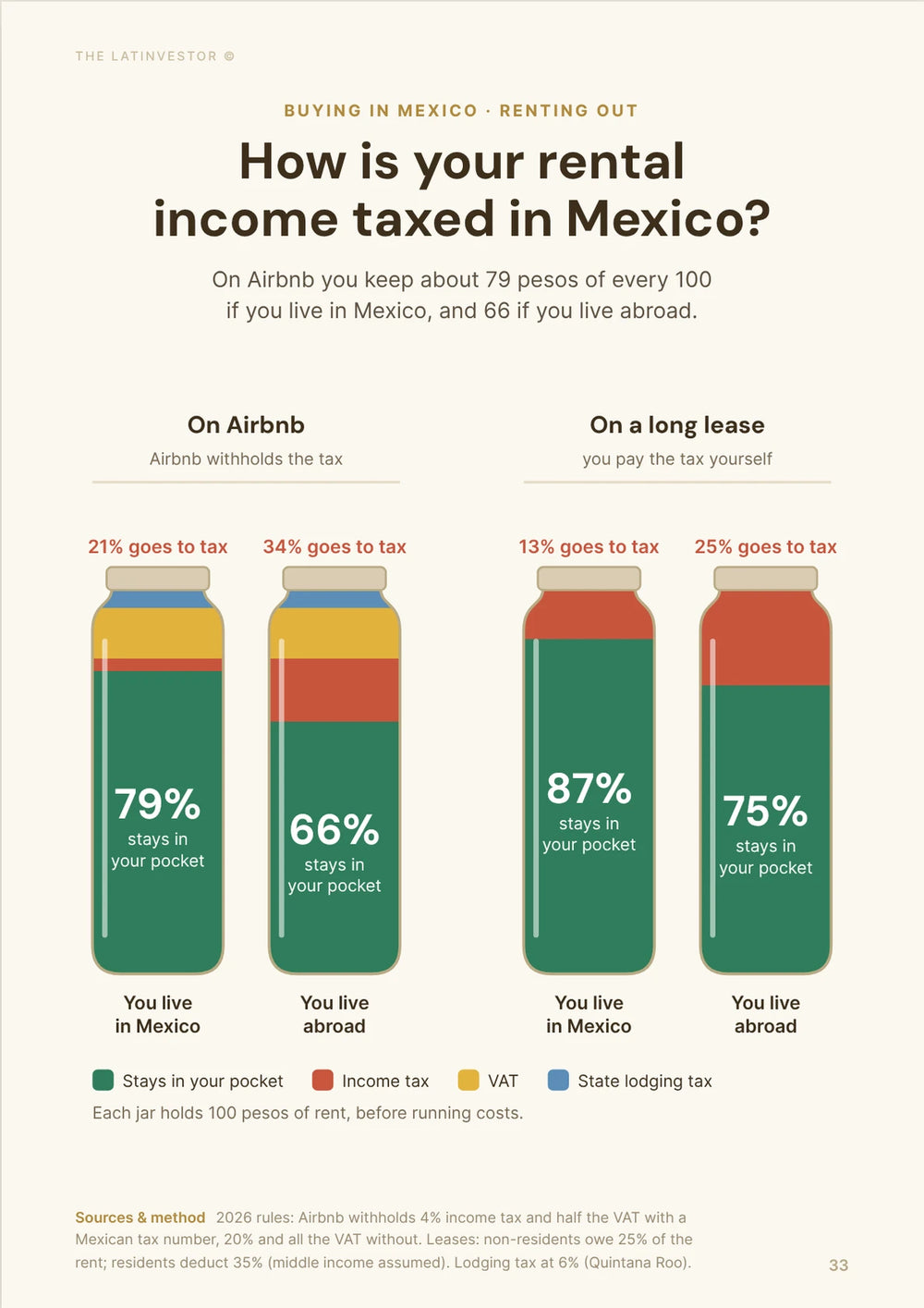
Rental income is taxed at the federal level by the SAT, not by the city. A long-term lease on a home used only as a dwelling is generally exempt from VAT (IVA).
If you're a Mexican tax resident, you pay ISR on your net rental income at the normal rates. You can deduct real expenses or take a flat 35% deduction plus predial; which is better depends on your total income. If you're not a Mexican tax resident, the tax is 25% of the gross rent, with no deductions.
The most common mistakes: not issuing CFDI invoices, mixing up predial and income tax, thinking a furnished rental is tax-free, and forgetting that predial (municipal) and ISR (federal) are two separate bills. We cover more of them in our list of risks and pitfalls when buying property in Querétaro.
Related blog posts
- Where is the best place to buy in Querétaro?
- What are housing prices like in Querétaro now?
- How much does a house cost in Querétaro?
- Is the property market in Querétaro still growing?
- Can foreigners buy property in Querétaro?
- Moving to Querétaro? Here's everything you need to know (2026)
Our methodology
This article estimates how much it costs to rent a home in Querétaro in 2026, whether rents are still rising, which areas are moving, and what a landlord earns and pays.
The rent figures start from the Inmuebles24 index, which tracks a standard 65 m² 2-bedroom (April and June 2026, compared with June 2024 and January 2025), and from Propiedades.com neighborhood averages (October 2026). We compared them with INEGI's inflation figure. Studio and 1-bedroom rents, vacancy, time to rent and the costs of amenities and renovations are our own estimates from listings on Mercado Libre Inmuebles and Vivanuncios, because no official source publishes them.
Short-term rental figures come from AirDNA (October 2025 to September 2026). Rules on rent increases, taxes and predial come from the SAT, the Ley del ISR, the Municipio de Querétaro, the state legislature and Landager's review of Mexican lease law.
We checked these figures in October 2026. We converted pesos at about 18.6 pesos per US dollar and 20.9 pesos per euro.
All rents here are asking rents, not signed leases. Tenants often negotiate, and an index for a standard 65 m² unit doesn't show every type of home.
Key sources used for this analysis include Real Estate Market (Inmuebles24 index, June 2026), El Economista, Inmuebles24, Propiedades.com, El Contribuyente (INEGI inflation), AirDNA, Airbnb, Landager, NorthAmericans, SAT, Ley del ISR, Municipio de Querétaro, Querétaro Legislature, Data México, IMSS via Observatorio Laboral, CONAPO, Uno TV, Mercado Libre Inmuebles and Vivanuncios.