Summary
The best place to buy in Mérida depends on your goal. For resale and steady tenants, it's the north (Altabrisa, Montebello, Santa Gertrudis Copó, Temozón Norte), where Altabrisa apartments ask about 49,600 MXN per square meter. For yield, it's cheaper family areas like Dzityá and Cholul, at an estimated 8.4% to 8.6% gross for houses.
City-wide, the median asking price is about 40,100 MXN per square meter for apartments (about 2,160 USD) and about 23,100 MXN for houses (about 1,240 USD). The cheapest apartment areas, like Dzityá, San Pedro Cholul and Las Américas II, ask around 34,500 to 36,100 MXN.
Gross rental yields average about 6% city-wide. Our neighborhood estimates go from about 5.6% in Yucatán Country Club to about 8.6% for houses in Dzityá, though agency price and rent ranges put Cholul nearer 6%.
Airbnb supply is shrinking fast: active listings fell 35.7% in a year, to 4,856 in September 2026. Those still running booked 58% of their nights at about 67 USD a night, for about 13,300 USD a year on average.
The city started registering more than 5,000 Airbnb-type rentals in January 2026, over half of them in Centro, and the state lodging tax is 4.5% since January 2026.
Long-term apartment rents run from about 440 USD a month in Las Américas II to about 1,360 USD in Altabrisa, with a city median around 870 USD.
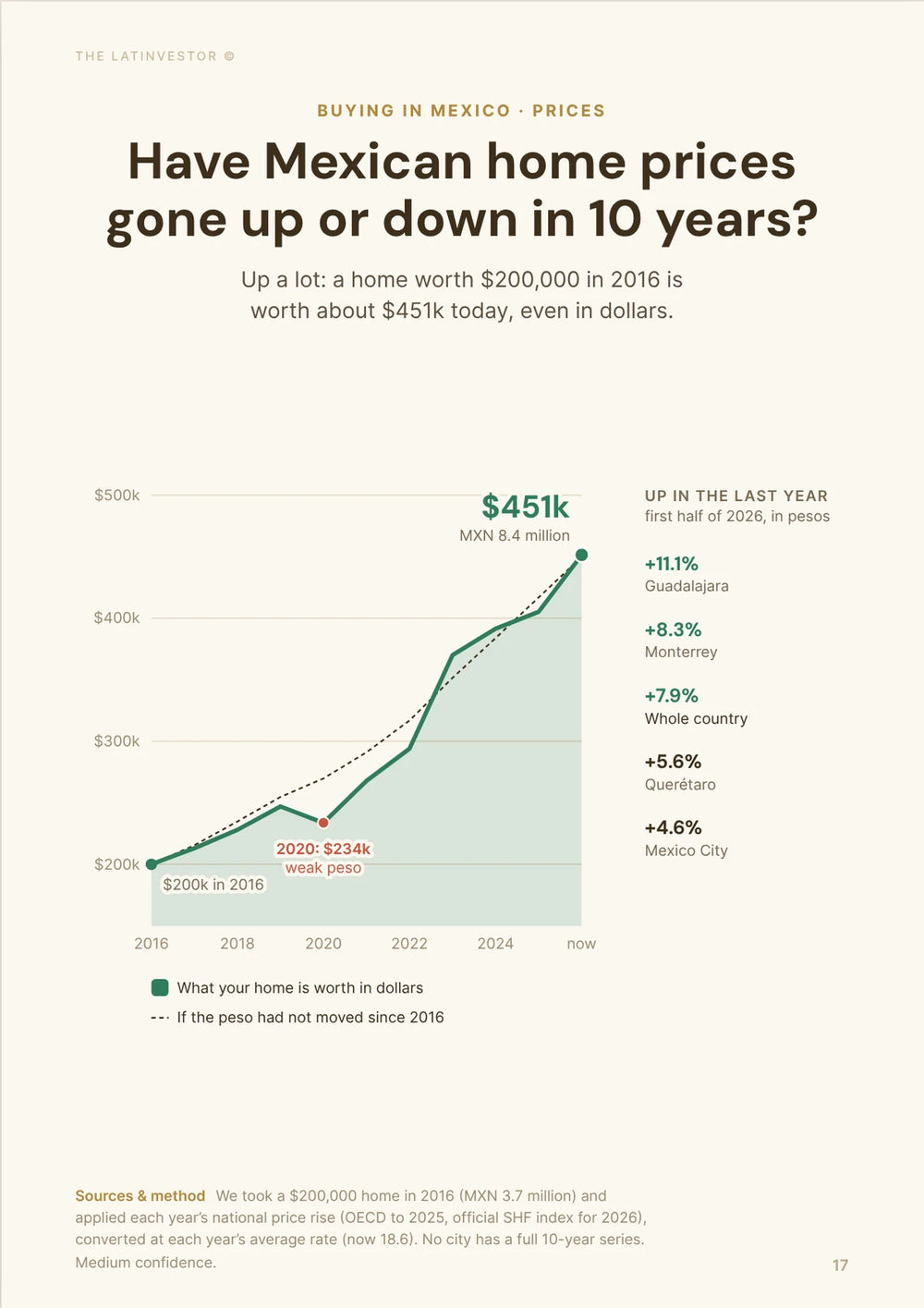
Prices keep rising: about 11% over the past year according to Tinsa, and 61% over the five years to the end of 2025 according to the official SHF index.
The IE-TRAM electric bus network now runs five lines and links Centro to the Tren Maya stations at Teya and Umán. The airport handled over 2 million passengers in the first half of 2026.
Water is the new weak spot in the north: in October 2026, a treatment plant running at 60% left 46 areas, including parts of Montebello and Altabrisa, with low pressure.
Mérida is still one of Mexico's safest big cities: 38.2% of adults felt unsafe in mid-2026, against 59.8% nationally.
Bottom line: buy in the north if you want easy resale and long-term tenants, in Dzityá or Cholul for yield, and only buy in Centro for Airbnb if the numbers still work at 58% occupancy and with full registration and taxes.

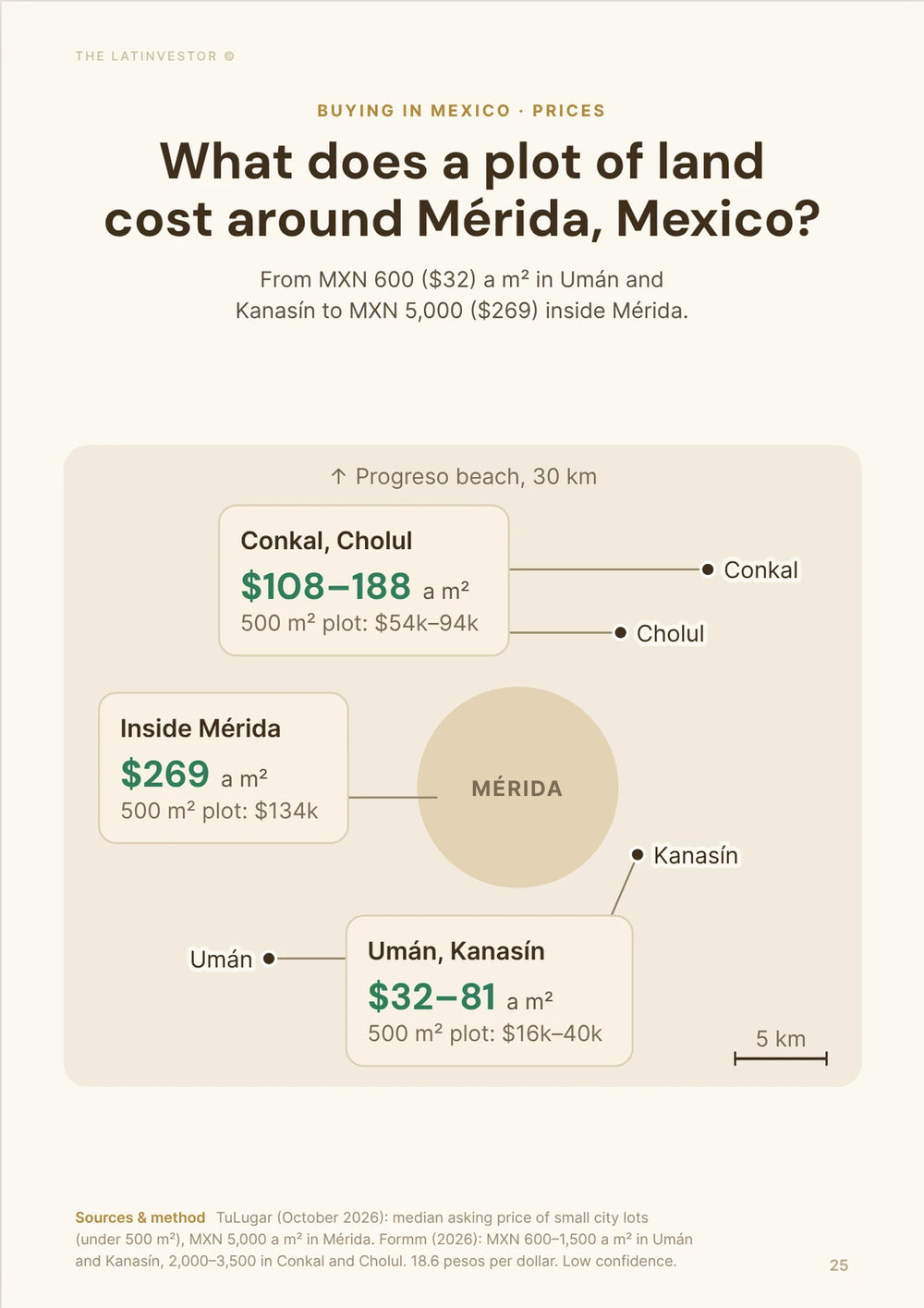
How much does a square meter cost across Mérida's neighborhoods?
Which areas in Mérida have the highest property prices per square meter in 2026?
In October 2026, the most expensive apartments in Mérida are in Fraccionamiento Santa Gertrudis (about 68,400 MXN per square meter asked), García Ginerés (about 55,400 MXN), Montealbán (about 53,100 MXN), México Norte (about 50,600 MXN) and Altabrisa (about 49,600 MXN).
That's 3,680 down to 2,670 USD per square meter, against a city-wide median of about 40,100 MXN (2,160 USD) for apartments. Some of these neighborhoods have only a handful of listings, so take each figure as a rough marker, not a precise price. These are asking prices, not sale prices.
For houses, the gated north is where the money is. Local agencies quoted average house prices in January 2026 of 3.8 to 5.5 million MXN in Temozón Norte (about 204,000 to 296,000 USD), 4.8 to 6.5 million in Altabrisa, and 7 to 10 million in Cabo Norte (about 376,000 to 538,000 USD).
Each of these premium areas commands high prices for its own reasons:
- Altabrisa: next to the main private hospitals, big malls and private schools
- Temozón Norte: new gated communities with pools and amenities, popular with locals moving from other states and with expats
- Cabo Norte: master-planned development around La Isla mall, with a premium brand and resort-style amenities
- Centro Histórico (Santa Ana, Santiago): renovated colonial homes are scarce, and buyers from abroad pay up for them
Which areas in Mérida have the most affordable property prices in 2026?
In 2026, the most affordable areas to buy an apartment in Mérida include Royal del Parque (about 26,900 MXN per square meter asked), Dzityá (about 34,500 MXN), San Pedro Cholul and Las Américas II (about 36,100 MXN each).
That's roughly 1,450 to 1,940 USD per square meter. Houses are cheaper per square meter than apartments in Mérida: the city-wide median for houses is about 23,100 MXN (1,240 USD). Ciudad Caucel, in the far west, is mostly houses in large subdivisions and sits at the low end of the market.
The trade-off is longer drives and fewer services nearby. Dzityá and Cholul are the exceptions: they're close to the north's hospitals and malls. Las Américas has steady demand from working families, and in Ciudad Caucel the exact street matters a lot, because some pockets rent much more slowly than others.
Where in Mérida do rents pay back the purchase price best?
Which neighborhoods in Mérida have the highest gross rental yields in 2026?
In 2026, the highest gross rental yields in Mérida are in Dzityá (about 8.6% for houses, by our estimate), Cholul (about 8.4% for houses), Temozón Norte (about 7% for houses and apartments) and Altabrisa (about 6.5% for apartments).
City-wide, the average gross yield is about 6.1%, based on asking rents and asking prices for one- to three-bedroom apartments. For scale, the median two-bedroom condo asks about 194,000 USD (about 3.6 million MXN) and rents for about 975 USD a month. The best yields come from mid-priced family areas, not from luxury zones, where rents haven't kept up with prices.
Treat the 8%-plus figures as the best case. On local agencies' average house prices and rents (Por Esto, January 2026), Cholul comes out at about 6% and Temozón Norte at about 5.9%, close to the city average. The gap comes from the data: Propiedades.com averages mix older and newer homes, while agencies quote what's on offer now. Check what similar houses in the same development actually rent for before you count on more than 6% to 7%.
Why these areas do well:
- Dzityá: low purchase prices and steady demand from families moving to the north-west
- Cholul: new gated communities and better roads attract professionals, at rents high compared with prices
- Temozón Norte: premium location with entry prices that are still manageable
- Altabrisa: hospitals and malls bring a steady flow of doctors, nurses and office workers looking to rent
Where does Airbnb still work in Mérida?
Which neighborhoods in Mérida perform best on Airbnb in 2026?
In 2026, the best Airbnb areas in Mérida are still in and around Centro: Santa Ana, Santiago, La Mejorada and the Paseo de Montejo corridor, where renovated colonial homes with pools get the most bookings.
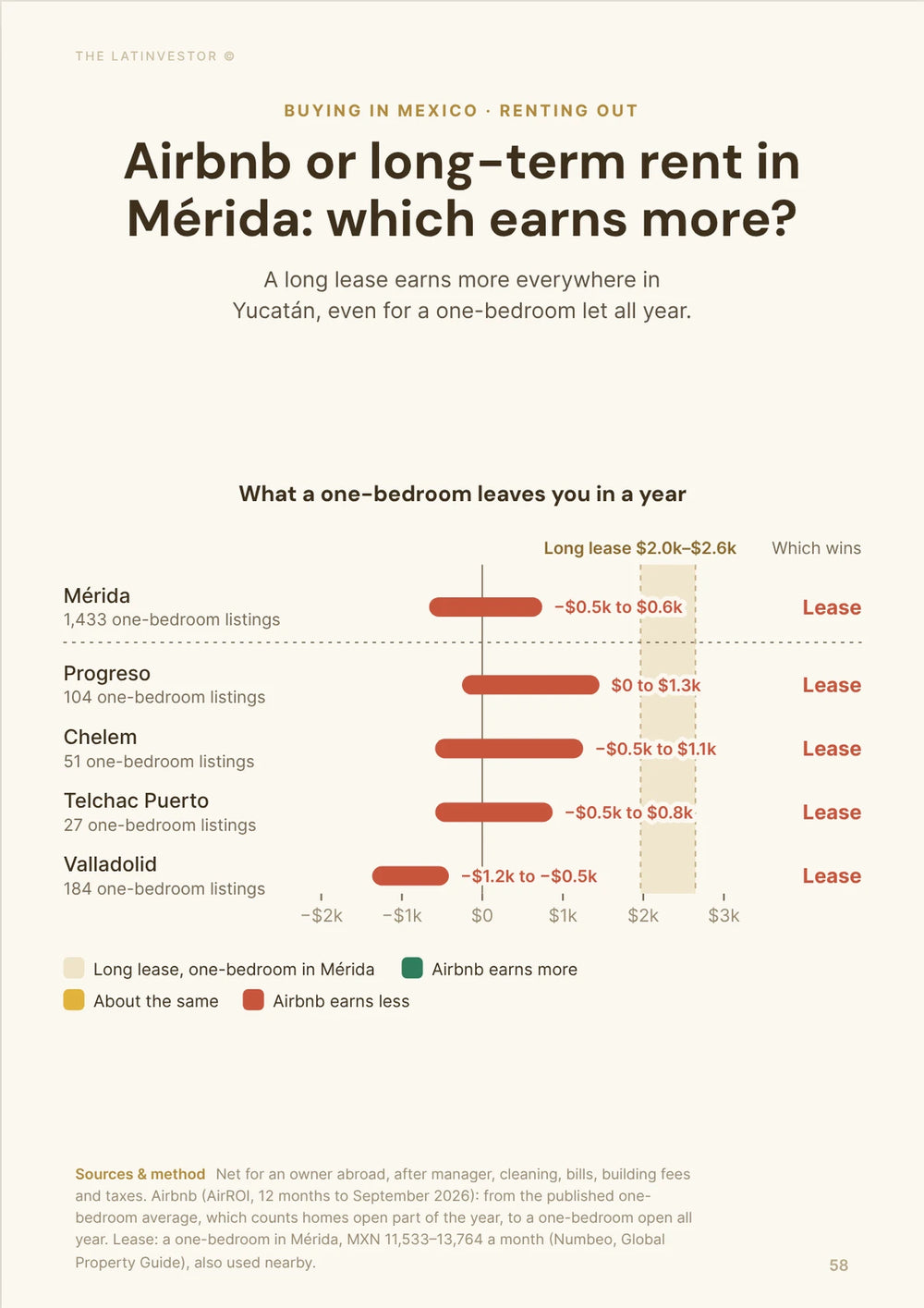
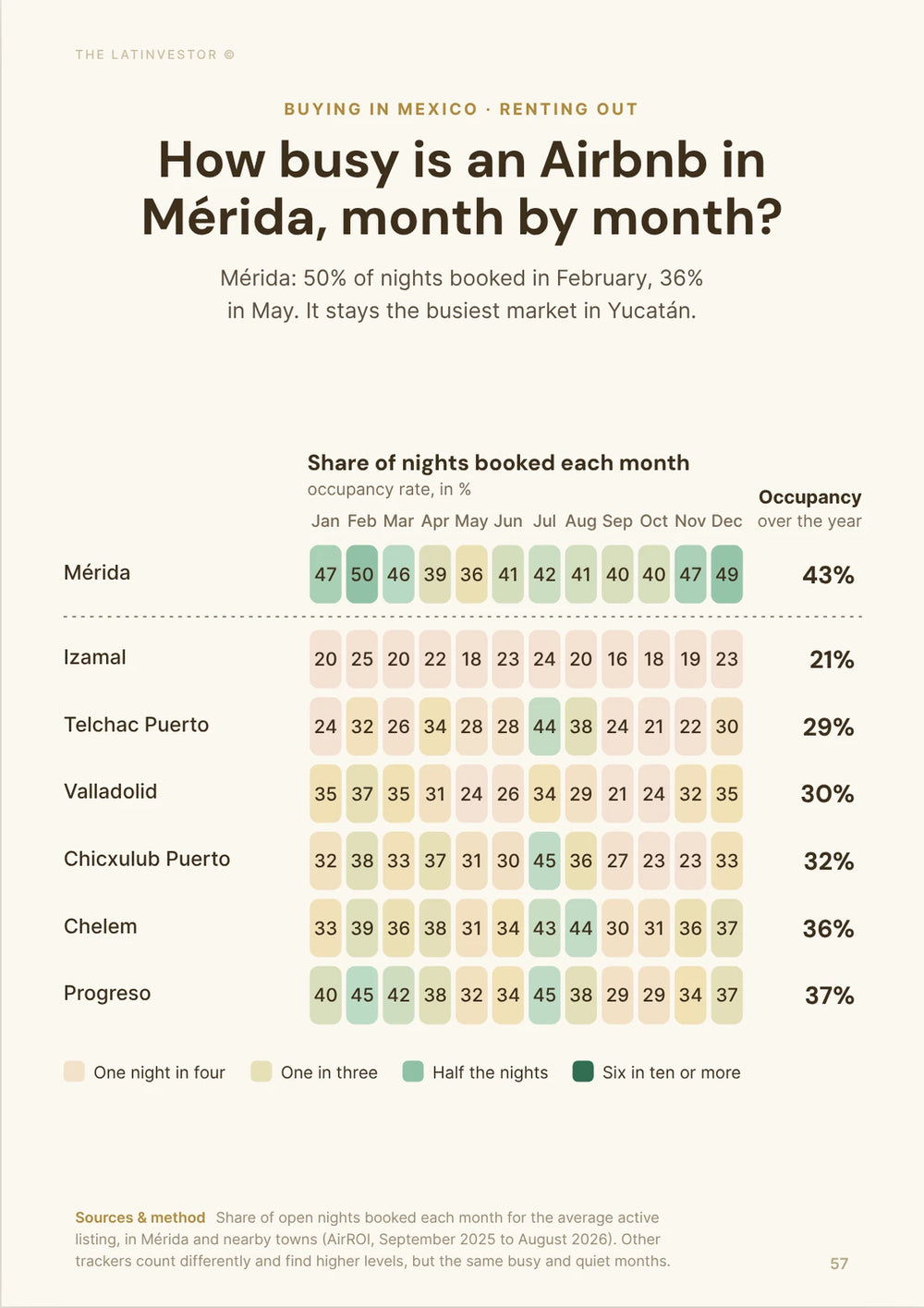
City-wide, over the 12 months to September 2026, Mérida listings booked 58% of their nights at an average of about 67 USD a night (about 1,250 MXN), and earned about 13,300 USD a year on average (about 247,000 MXN), or roughly 1,100 USD a month. A well-designed colonial house with a pool in Santa Ana can beat that by a wide margin, while a plain studio will do worse.
What each area offers guests:
- Santa Ana: walk to restaurants, galleries and Paseo de Montejo, so it's the easiest Centro area for tourists
- Santiago: lots of renovated homes near the market and the plaza, for travelers who want local life
- La Mejorada: quieter, around the park, popular with couples and remote workers
- Paseo de Montejo corridor: mansions and big houses for groups and weekend stays
Which tourist areas in Mérida are becoming oversaturated with short-term rentals?
The most crowded short-term rental areas in Mérida are the tourist streets of Centro: Santa Ana, Santiago and Santa Lucía. When the city counted Airbnb-type rentals in January 2026, it found more than 5,000, over half of them in Centro.
The good news for owners is that supply is now shrinking. AirDNA counted 4,856 active listings in September 2026, down 35.7% in a year. Average occupancy over the past year was 58%, so outside the winter high season hosts still compete hard, with discounts, free cancellation and upgrades.
Is Mérida cracking down on Airbnb, and what does it mean for buyers?
Not a ban, but the screws are tightening. In January 2026, the city of Mérida started a process to register more than 5,000 Airbnb-type rentals under its "Mérida Ordenada" plan, with a formal scheme similar to hotels. The first step: contacting owners to get them up to date on property tax (predial), garbage and water bills.
The pressure comes from hotels. In April 2026, the Mérida chamber of commerce (Canaco) blamed platforms for weak hotel occupancy, even over Easter, and asked for these rentals to be counted in official tourism statistics and taxed like hotels. On top of that, Yucatán's state lodging tax is 4.5% since January 2026 (down from 5%). Airbnb's help pages still show 4%, so check what the platform actually collects for you.
What to do if you buy in Centro for Airbnb: check that the seller's predial, water and garbage bills are paid and that the property can be registered, ask for 12 months of real booking statements (not a projection), and run your numbers at the city average of 58% occupancy and about 67 USD a night. If the deal only works at 75% occupancy, walk away or plan for a long-term rental instead.
Where in Mérida is it easiest to find long-term tenants?
Which neighborhoods in Mérida have the strongest demand for long-term tenants?
The strongest long-term rental demand in Mérida is in the north (Altabrisa, Montebello, Montes de Amé and Santa Gertrudis Copó), plus Santa Ana and Santiago in Centro for expats who want to walk everywhere.
Well-priced rentals in these areas usually find a tenant within a few weeks, because several types of tenants compete for the same homes. Overpriced or tired units can sit for months.
Who rents where:
- Altabrisa: doctors, office workers and families who want to be near hospitals and schools
- Montebello and Montes de Amé: established professionals and upper-middle-class families looking for modern apartments
- Santa Gertrudis Copó: families who want a gated community close to the north's services
- Santa Ana and Santiago: remote workers, digital nomads and expats on 12-month leases
What these areas share is daily convenience: supermarkets, pharmacies, schools, hospitals and frequent Va y Ven bus routes, so tenants don't need a car for everything.
What are the average long-term monthly rents by neighborhood in Mérida in 2026?
In October 2026, median asking rents for apartments in Mérida go from about 440 USD a month in Las Américas II (about 8,220 MXN) to about 1,360 USD in Altabrisa (about 25,400 MXN). The city-wide median is about 870 USD (about 16,200 MXN).
In between: Real Montejo asks about 630 USD (11,700 MXN), Las Américas about 740 USD (13,700 MXN), Montebello about 850 USD (15,900 MXN), Montes de Amé about 960 USD (17,800 MXN) and Santa Gertrudis Copó about 980 USD (18,300 MXN).
Houses in the north cost more. Local agencies quoted these monthly rents in January 2026: 14,000 to 20,000 MXN in Cholul (about 750 to 1,080 USD), 18,000 to 28,000 MXN in Temozón Norte, 25,000 to 35,000 MXN in Altabrisa, 30,000 to 45,000 MXN in Montebello, and 40,000 to 60,000 MXN in Cabo Norte (about 2,150 to 3,230 USD). The top of each range is for houses with a pool, solar panels or high-end finishes.
Which Mérida neighborhoods are still early, before prices catch up?
Which neighborhoods in Mérida are gentrifying and attracting new investors in 2026?
In 2026, the areas drawing the most new investors in Mérida are La Mejorada and Chembech in Centro's "second ring," San Sebastián at the edge of Santiago, and Dzityá and Cholul on the north-west and north-east edges of the city.
City-wide, home prices rose about 11% over the past year. Some streets in Centro's second ring have done better, as investors priced out of Santa Ana move a few blocks out. There's no reliable price series by neighborhood, so treat any colonia-level growth figure you hear (including ours) as an estimate.
Which areas in Mérida have major infrastructure projects planned that will boost prices?
The areas most likely to gain are the neighborhoods along the IE-TRAM electric bus lines, which link Centro (Parque La Plancha) to the Tren Maya stations at Teya and Umán, and the north-central colonias near the airport.
The IE-TRAM now runs five lines, on a network planned at about 116 km. The airport handled over 2 million passengers in the first half of 2026, and its operator Asur expects close to 4 million for the year, with a modernization plan running to 2028.
Better transit usually pushes rents and prices up along the route, because tenants pay for shorter commutes. How much and how fast is hard to pin down, so don't pay today for gains that depend on a line not built yet.
Which parts of Mérida should you think twice about?
Which neighborhoods in Mérida should I avoid, and why?
Be careful with very cheap areas on the far west and south edges, far from Va y Ven bus routes, with Centro houses that look cheap but need structural work, and with Airbnb-only buys on Centro's busiest streets.
The specific issues:
- Far-west fringe (parts of Ciudad Caucel): long vacancies, because tenants care more about transport than about a low rent
- Unrenovated colonial houses in Centro: roofs, plumbing and humidity damage can eat years of rental income
- "Instagram-famous" Centro streets: too many similar Airbnb listings, so constant discounts and high marketing costs
- South Mérida subdivisions far from services: slower to rent, because jobs and shops are concentrated in the north
For these areas to become good buys, they'd need a new transit line, new jobs and shops nearby, or fewer competing short-term rentals.
Which areas in Mérida have stagnant or declining property prices as of 2026?
In 2026, prices look stuck in some luxury pockets, like parts of Yucatán Country Club (where we estimate gross yields have dropped to about 5.6%), and in new-build clusters where identical units compete with each other on discounts.
In these areas, sale prices rose faster than rents over the past two years, so yields shrank. If you buy at the top, expect flat returns until rents catch up.
Why they stall:
- Yucatán Country Club: prices are set by lifestyle buyers, so the rental return is secondary
- Mass-market new-build areas: too many similar units, so developers throw in discounts and upgrades to close sales
- Premium master-planned communities: sales slowed as mortgage rates stayed high (average mortgage rates were around 10% to 11% in 2026) and buyers took their time
Is water supply a problem in north Mérida?
It's becoming one. On October 11, 2026, the water agency JAPAY warned that its Mérida III treatment plant was running at only 60%, leaving 46 colonias, fraccionamientos and private developments with low pressure or no water, including Royal Montebello, Bosques de Altabrisa, Gran Royal Altabrisa II, Montealbán, San Ramón and parts of Montebello.
It wasn't a one-off. On May 31, 2026, a power failure knocked out the Mérida I plant and hit 94 colonias, Centro included. JAPAY also reported supply problems in the north and west in May and October 2026, and says it's working on modernizing its plants. The north has grown faster than the water network.
What to check before you buy: that the house has a cistern (cisterna) and a pump, not just a roof tank; how many days of water the cistern holds; whether the development has its own well; and what neighbors say about outages this year. In a new development, ask the developer in writing who supplies the water and who pays if the network isn't connected on time.
Which Mérida neighborhoods should keep gaining value?
Which areas in Mérida have historically appreciated the most recently?
Over the past five to ten years, the areas that gained the most in Mérida are the best parts of Centro (Santa Ana, Santiago, La Mejorada), the north's service hubs (Altabrisa, Montebello, Montes de Amé), and premium master-planned developments (Cabo Norte, Vía Montejo).
For the city as a whole, the official SHF house price index rose about 61% over the five years to the end of 2025, and Tinsa estimates prices rose about 11% over the past year. By neighborhood, our estimates are:
- Santa Ana and Santiago: renovated colonial homes have more than doubled in value over 10 years, in pesos
- Altabrisa and Montebello: steady gains, roughly 8% to 12% a year
- Cabo Norte and Vía Montejo: roughly 10% to 15% a year since the first phases launched
The drivers: scarcity (especially renovated houses in Centro), demand from several types of buyers at once (expats, locals moving from other states, investors), and Mérida's reputation as one of Mexico's safest big cities.
Which neighborhoods in Mérida are expected to see price growth in coming years?
The areas with the most room to grow are Cholul and Dzityá (still affordable, with good yields), Temozón Norte (the main expansion area in the north), and Centro's "second ring" around La Mejorada (as Santa Ana gets too expensive).
Our estimates for yearly price growth:
- Cholul: 8% to 12% as roads and services catch up with the new homes
- Dzityá: 7% to 10% with continued north-west growth and family demand
- Temozón Norte: 6% to 9% as the area fills in with shops and services
- La Mejorada and Centro's second ring: 10% to 15% as investors move one block out from Santa Ana
These are our estimates, not forecasts from an official source. What could slow them down: water and road networks that can't keep up with the north's growth, and mortgage rates around 10% to 11% that keep many local buyers on the sidelines.
What do locals and expats really think of Mérida's neighborhoods?
Which areas in Mérida do local residents consider the most desirable to live?
Locals usually rank Altabrisa, Montebello, Montes de Amé and Santa Gertrudis Copó as the most desirable areas, because they care more about daily convenience than about colonial charm.
Why locals like them:
- Altabrisa: walking distance to the top hospitals, Galerías Mérida mall and several supermarkets
- Montebello: established middle-class area with reliable services and good schools
- Montes de Amé: newer apartment buildings and family amenities at a reasonable price
- Santa Gertrudis Copó: gated security with quick access to the rest of the north
These areas attract upper-middle-class Mexican families, hospital staff and business owners. Mérida as a whole feels safe to them: in the second quarter of 2026, 38.2% of adults said they felt unsafe in the city, against 59.8% nationally.
Locals rarely put Centro's colonial houses first, while foreigners often overlook the north, where locals actually prefer to live.
Which neighborhoods in Mérida have the best reputation among expat communities?
Expats favor Santa Ana, Santiago, Santa Lucía and La Mejorada in Centro, plus Altabrisa, Montebello and Vía Montejo for those who prefer modern comforts.
Why:
- Santa Ana: the most English-speaking services, international restaurants and expat events
- Santiago: market life and colonial character, with a growing community of retirees and remote workers
- La Mejorada: quieter than the rest of Centro, still walkable to parks and cafés
- Altabrisa and Vía Montejo: modern apartments with reliable air conditioning, parking and North American-style amenities
The typical expat in Centro is an American or Canadian retiree drawn by healthcare costs and warm weather. Younger remote workers often split their time between Centro and modern apartments in the north.
Which areas in Mérida do locals say are overhyped by foreign buyers?
Locals often say foreign buyers overpay on Centro's busiest streets around Santa Ana and Santiago, and in some prestige master-planned communities where buyers expect investment returns but pay for lifestyle.
Why locals think so:
- Santa Ana and "Instagram-famous" Centro streets: prices pushed up by buyers from abroad, while yields are low and Airbnb competition is tough
- Paseo de Montejo trophy houses: foreigners pay for historic prestige that locals don't value much for daily life
- Luxury gated communities: some foreign buyers expect 8% to 10% yields where 5% to 6% is realistic
Foreign buyers see colonial architecture and walkability. Locals look at parking, the drive to work and value for money, which usually points them to the less photogenic north.
Which areas in Mérida are considered boring or undesirable by residents?
Residents often find the far-west subdivisions (parts of Ciudad Caucel and the edges of Real Montejo) and the car-dependent developments in the south dull or impractical, because they lack shops and transit.
Why:
- Far-west fringe: "all subdivision, no city," with long drives to restaurants, hospitals or entertainment
- Southern outskirts: little public transit, so you need a car
- Identical new-build clusters: rows of the same house and almost no shops make them feel isolated
Our methodology
This article estimates where it makes most sense to buy in Mérida: prices per square meter, rental yields, Airbnb and long-term rental performance, price trends, and the areas and risks to watch.
City-wide trends come first from official sources: the SHF house price index (homes bought with a mortgage), INEGI's ENSU safety survey, and Banxico for mortgage rates. We add market data: TuLugar asking-price and rent medians by neighborhood, Tinsa's price estimate, Global Property Guide yields, and AirDNA short-term rental figures. Neighborhood yields and growth figures are our own estimates from Propiedades.com and Vivanuncios listings, because no official source publishes them.
Rules and recent news come from the Yucatán Tourism Secretariat (lodging tax), the city of Mérida (Airbnb registration), JAPAY (water supply), and local press dated 2026 (Por Esto, Diario de Yucatán).
We checked these figures in October 2026. Conversions use about 18.6 pesos per US dollar and 20.9 pesos per euro.
Limits: listing prices are asking prices, not sale prices, and some neighborhoods have few listings. The SHF index only covers homes bought with a mortgage. Airbnb figures are city-wide averages, and a given unit can do much better or worse. Neighborhood growth figures are our estimates, not forecasts.
Key sources used for this analysis include TuLugar, Global Property Guide, El Economista (Tinsa), AirDNA, Airbnb, Yucatán Tourism Secretariat, INEGI (ENSU), Banxico, SESNSP, Propiedades.com, Vivanuncios, Proyectos México, Yucatán Transport Agency, Por Esto and Diario de Yucatán.