Summary
It can be, but only if you buy at the right price and run it well: the average Airbnb in Mérida grosses about USD 13,300 a year (MXN 247,000) at 58% occupancy, and costs and tax take most of that.
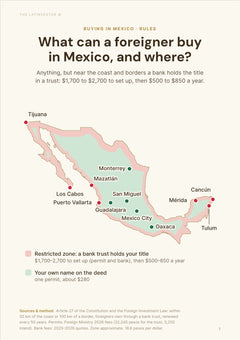
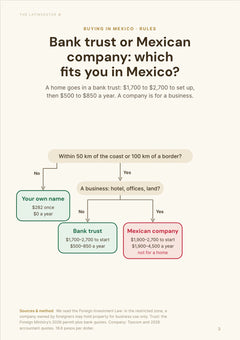
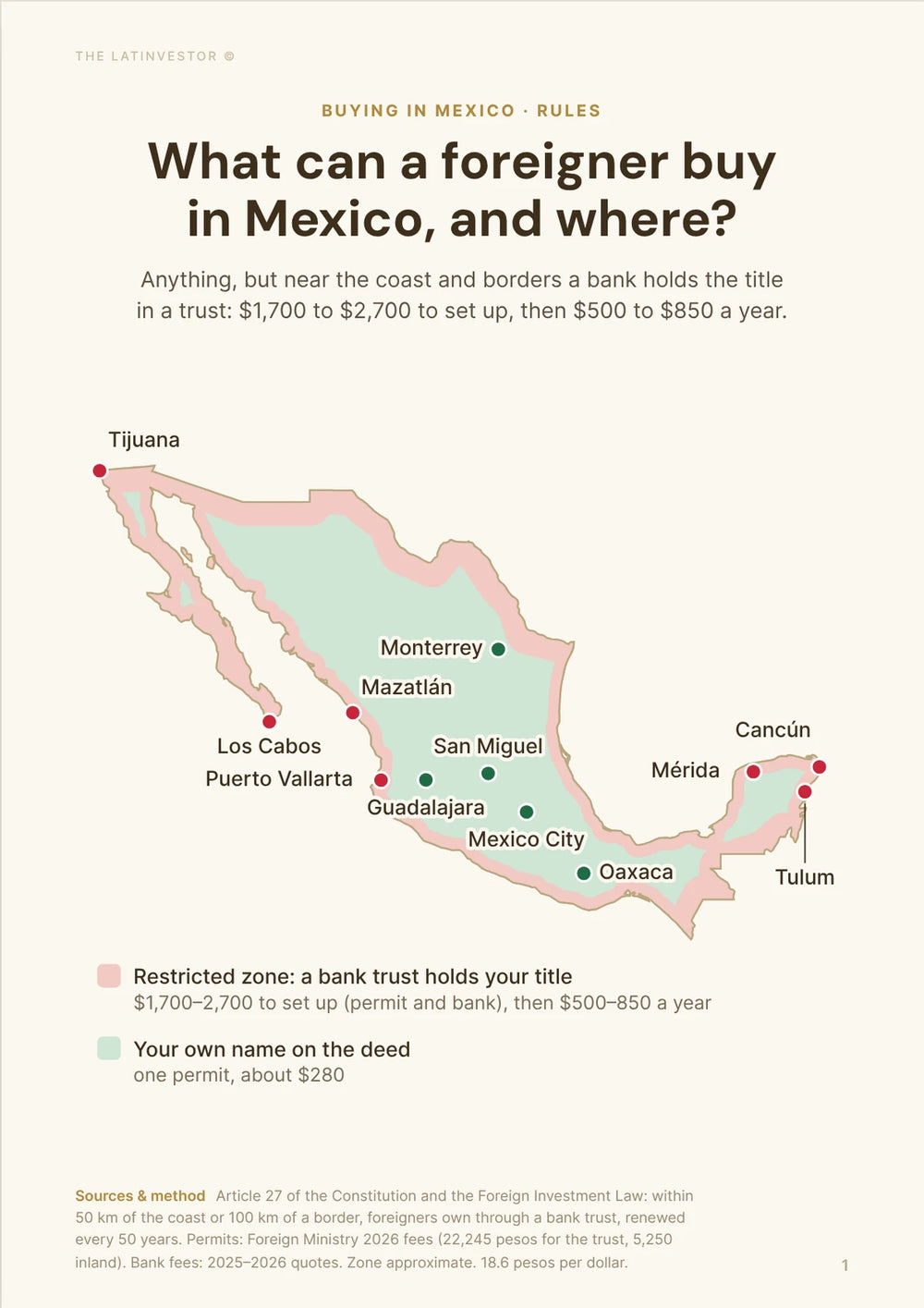
Short-term renting is legal, with no night cap and no primary-residence rule. Mérida sits inside the 50 km coastal zone, so a foreign buyer holds the home through a fideicomiso: a MXN 21,650 permit, USD 550-800 to set it up and USD 550-700 a year.
The city is putting more than 5,000 Airbnb-type homes on a register, over half of them in Centro, starting with unpaid predial, water and garbage fees. The state's tourism business council wants permits and inspections on top.
The average nightly rate is about USD 67 (MXN 1,250), 11.5% lower than a year earlier, according to AirDNA.
AirDNA puts average occupancy at 58%. For a new listing, plan on 45-55% in year one.
The average listing earns about MXN 20,600 a month (USD 1,110) before costs. Top pool homes can reach MXN 45,000-80,000 in a good month.
Running costs are about MXN 8,000-18,000 a month before the platform fee and a manager. Electricity is the trap: a home that goes over CFE's limit moves to the DAC rate, at about 6-7 pesos per kWh.
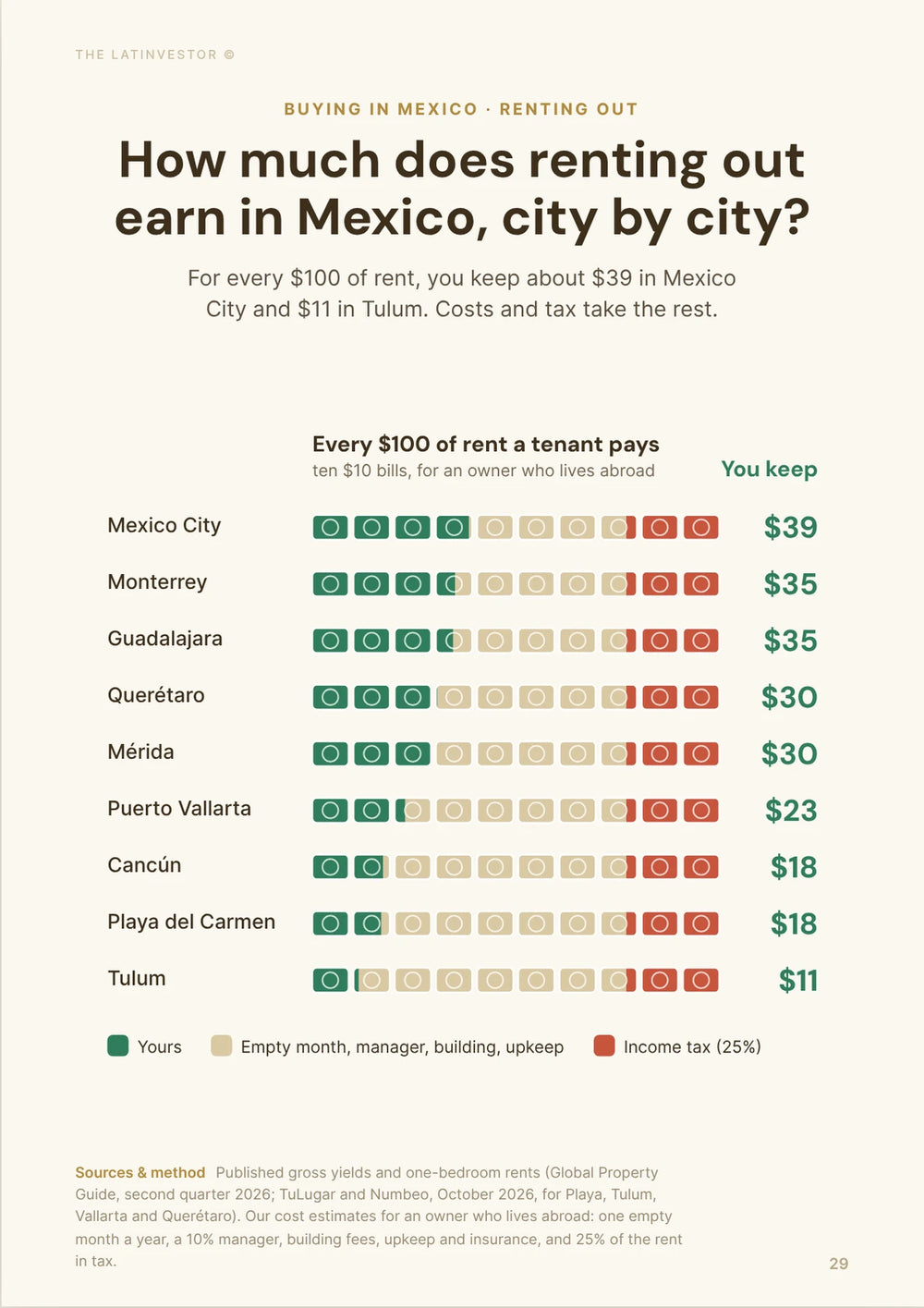
Our worked example for a USD 194,000 condo: about 1.2% a year before income tax with a full-service co-host, or 3.4% if it's run locally on the 4% host fee. A non-resident then pays 25% of gross income, which turns the first case into a loss.
Demand is softer this year: Mérida hotels were 43.9% full in June 2026, against 56.3% a year earlier, and 49.2% in July.
AirDNA counts 4,856 active listings, 35.7% fewer than a year ago, while Airbnb still advertised more than 6,600 spaces in June 2026.
Centro, Santa Ana, Santiago and Santa Lucía are the most crowded areas, and the busiest price band is MXN 1,000-1,800 a night.
The safest product is a well-cooled 2-bedroom house or townhouse with a private pool, in a walkable area near Centro or a strong northern area.
The bottom line: buy a property that would also work on a long-term lease, run your numbers at about USD 67 a night and 50% occupancy, and treat anything above that as a bonus.


Can you legally run an Airbnb in Mérida?
Is short-term renting allowed in Mérida in 2026?
Yes. In 2026, short-term renting is allowed in Mérida, in Centro's colonial houses as well as in the condos and gated communities of the north.
The rules come from three levels: federal tax (SAT), Yucatán's 4.5% lodging tax, and the city of Mérida, which is now registering short-term rentals.
Running one legally means getting an RFC (tax number), declaring platform income, handling the lodging tax and being ready for the city's register.
In Centro Histórico, restored colonial houses also face heritage rules: renting is allowed, but façade changes, building work and signs need permits. In April 2026, 22 building sites in Centro were stopped for breaking INAH rules.
Are there minimum-stay rules and maximum nights-per-year caps for Airbnbs in Mérida?
No. Mérida has no citywide minimum stay and no cap on the number of nights you can rent per year.
That's the same for colonial houses in Centro, condos in the north, townhouses and small villas with a pool.
Minimum stays are your own choice, usually set to cover cleaning costs. Mexico City's cap on short-term rentals doesn't apply here.
Do I have to live there, or can I Airbnb a secondary home in Mérida right now?
You don't have to live there: Mérida has no primary-residence rule, and second homes and investment properties can be rented out short term.
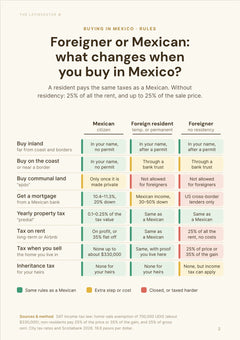
As a foreigner, you'll own it through a fideicomiso, because Mérida sits within 50 km of the Gulf coast. The bank holds the title for you, and you keep the right to live in it, rent it out and sell it. Budget MXN 21,650 for the SRE permit, USD 550-800 for the bank to open the trust and USD 550-700 a year to keep it, which is a fixed cost your Airbnb has to cover.
The other conditions are the same for everyone: tax registration, platform income reporting, the city's register, and the condo's rules if you buy in a gated development.
The real difference with a second home is practical: you need someone local for check-ins, cleaning, the pool and the air conditioning.
Can I run multiple Airbnbs under one name in Mérida right now?
Yes. Mérida has no limit on how many listings one person or company can run.
The more units you run, the more visible you are to SAT and the city, so bookkeeping, RFC details and lodging-tax filings need to be clean.
The city says its register is about knowing where these homes are and getting their fees paid, not about stopping small investors.
Do I need a short-term rental license or a business registration to host in Mérida?
There's no single Airbnb license yet, but you do need to be registered for tax, and the city now wants hosts on its register.
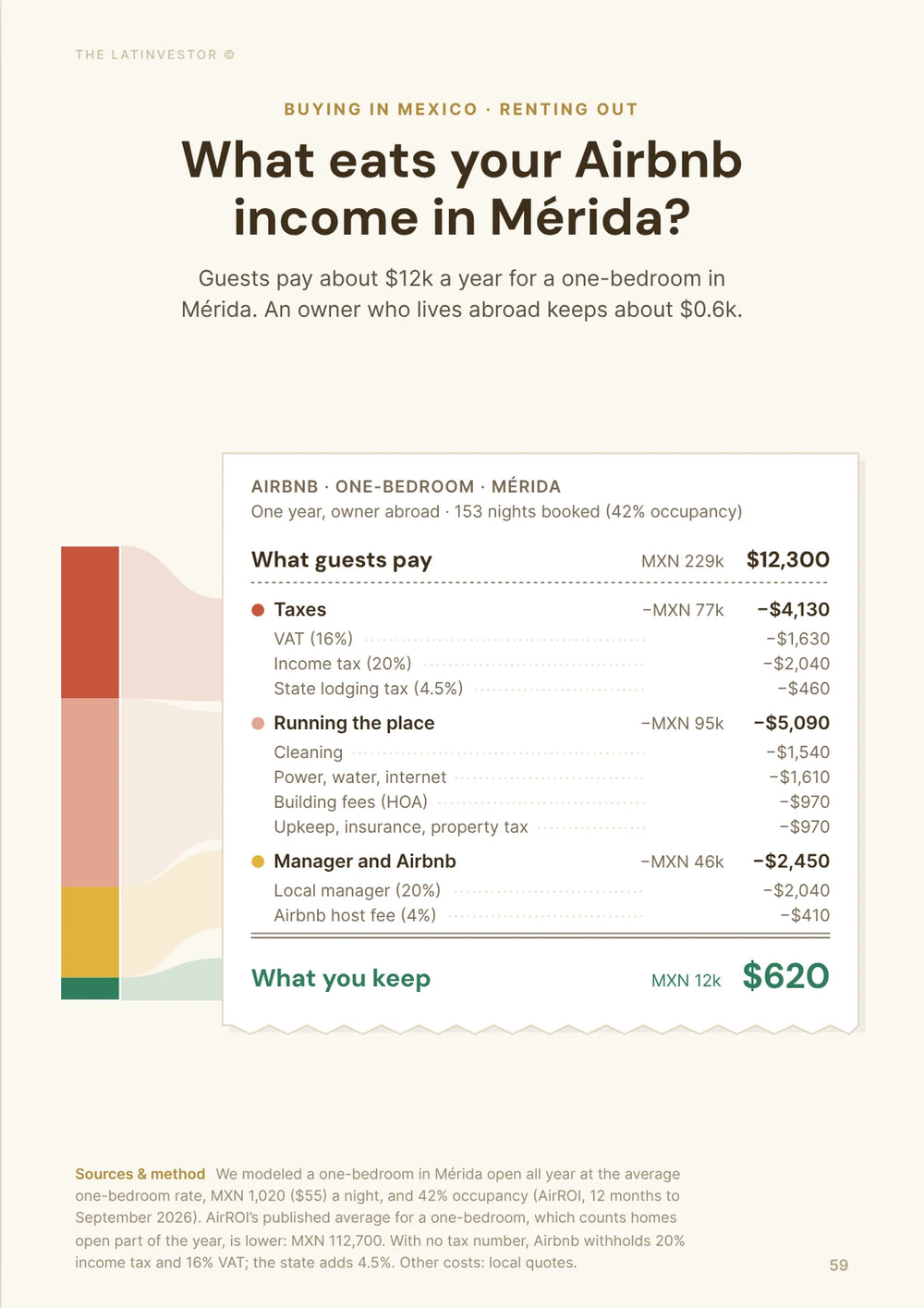
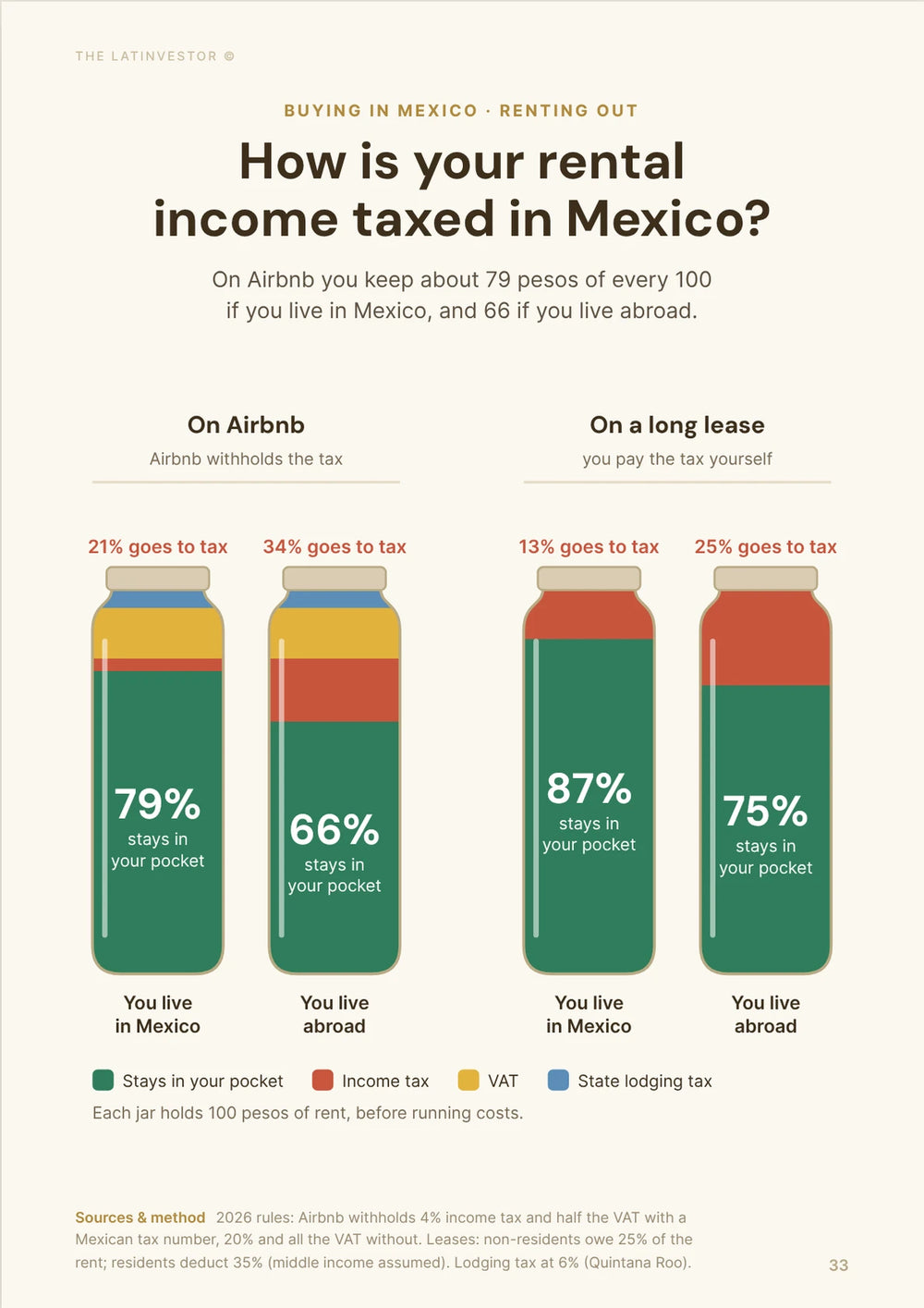
Start with an RFC. With one, Airbnb withholds 4% income tax on your bookings; without one, it withholds 20%. VAT applies on top, and Airbnb collects Yucatán's 4.5% lodging tax from guests (its help page still shows 4%).
For the city, owners contact the municipal treasury and the urban development office. No fee or deadline had been published by October 2026.
Budget for an accountant from day one rather than sorting out the tax setup yourself.
Are there neighborhood bans or restricted zones for Airbnb in Mérida?
No neighborhood bans Airbnb in Mérida, but Centro Histórico is where you need to be most careful.
Centro, including Santa Ana, Santiago, Santa Lucía, La Ermita, Mejorada, Paseo de Montejo and the La Plancha area, has heritage buildings, dense Airbnb supply, noise complaints and strict renovation controls.
The city wants to protect historic buildings and keep streets that are still residential from turning into hotel districts. Over half of the homes on its Airbnb register are in the historic center.
Is Mérida about to crack down on Airbnb?
Not a crackdown, but the free-for-all is ending: in January 2026 the mayor launched "Mérida Ordenada" to put more than 5,000 Airbnb-type homes on a municipal register.
The city starts with the money: unpaid predial, water and garbage fees. Mayor Cecilia Patrón Laviada said the plan isn't meant to punish anyone, and no deadline or fine has been announced. But in June 2026 the state's tourism business council (Cetur) asked for more: permits, inspections and civil protection (Protección Civil) checks for platform hosts, as for any hotel. None of that is in force yet.
What to do before you buy: ask the seller for the last predial and water receipts and make sure they're paid; read the condo rules (reglamento) to see if short-term rentals are allowed, because some gated developments ban them; and in Centro, check that any past renovation had its permits. Price in a few thousand pesos a year for fire extinguishers, smoke detectors and signage, in case the Cetur rules go through.
How much does an Airbnb in Mérida really earn?
What's the average nightly price on Airbnb in Mérida in 2026?
The average nightly rate on Airbnb in Mérida is about USD 67 (MXN 1,250, or EUR 60), according to AirDNA's data to September 2026. That's 11.5% less than a year earlier.
Most residential listings price between about MXN 850 and MXN 3,200 a night (USD 46-172).
Location only gets you so far. Guests pay more in Centro or the north when the home also has strong air conditioning, good design and, for houses, a private pool.
How much do nightly prices vary by neighborhood in Mérida?
Quite a lot: from about MXN 900 a night (USD 48) in Ciudad Caucel, Las Américas or Francisco de Montejo to more than MXN 3,500 (USD 188) for the best homes in Santa Lucía, Paseo de Montejo or Cabo Norte.
In those top areas, a strong home often lists around MXN 2,200-4,000 a night (USD 118-215).
The cheaper areas still get bookings from guests who want a lower price, parking, or a base near family rather than tourist streets.
What's the typical occupancy rate in Mérida in 2026?
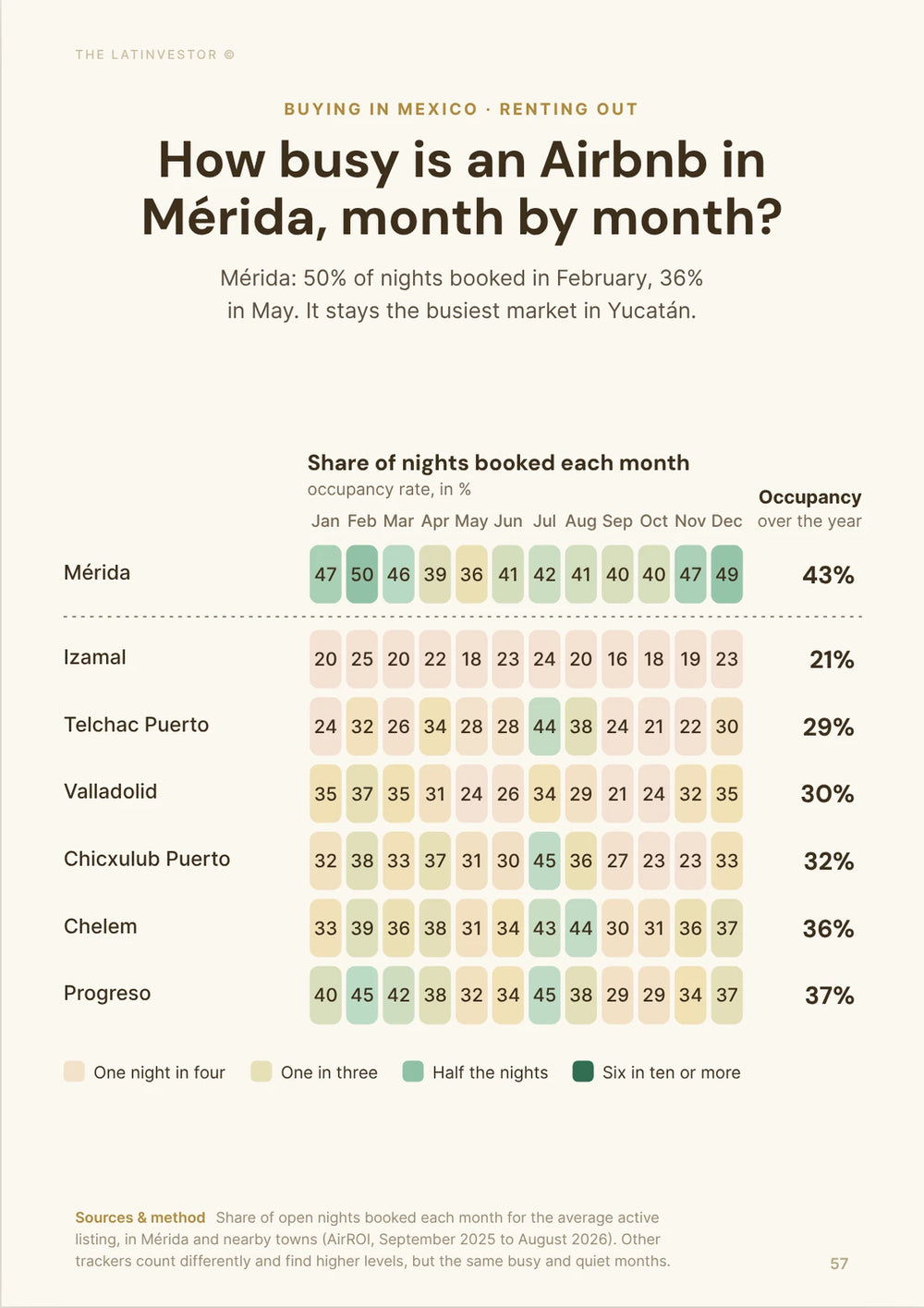
AirDNA puts average occupancy at 58% over the 12 months to September 2026. For a new listing, we'd plan on 45-55% in the first year.
Most listings land somewhere between 35% and 65%: plain apartments sit at the bottom, well-reviewed pool homes at the top.
AirDNA's occupancy rose sharply on paper, but part of that comes from the company changing its method in 2026 and counting fewer inactive listings. Revenue per available night, at about USD 39, is the steadier figure.
What lifts occupancy most in Mérida is comfort in the heat: cold bedrooms, shade, a pool, clean bathrooms and fast Wi-Fi.
What's the average monthly revenue per listing in Mérida in 2026?
The average active listing earned about USD 13,300 over the 12 months to September 2026 (MXN 247,000), or about MXN 20,600 a month (USD 1,110), before any cost.
Most residential listings gross somewhere between MXN 8,000 and MXN 45,000 a month (USD 430-2,420).
Top 2- and 3-bedroom pool homes can reach MXN 45,000-80,000 in a strong month (USD 2,420-4,300). The math is simple: MXN 2,800 a night at 65% occupancy is about 20 booked nights, or roughly MXN 56,000.
What's the typical low-season vs high-season monthly revenue in Mérida in 2026?
A typical listing might gross about MXN 10,000-16,000 a month in low season (USD 538-860) and MXN 25,000-45,000 in high season (USD 1,340-2,420). These are our estimates.
The weak months are late August, September and early October, plus the hottest weeks of May and June. The strong ones are January to April, July, and late October to December, with events like Hanal Pixán.
Mérida is less seasonal than the beach towns: AirDNA gives it 93 out of 100 for steady revenue across the year.
What's a realistic Airbnb monthly expense range in Mérida in 2026?
Expect about MXN 8,000-18,000 a month (USD 430-968) in running costs, before the platform fee, a manager and any mortgage.
Electricity is the line that surprises people. Air conditioning running for guests can push a home over CFE's subsidized limit, averaged over 12 months. Once that happens, you move to the DAC rate: a fixed charge of about MXN 145 plus 6-7 pesos per kWh, with no subsidy, and it takes a full year under the limit to get back. Solar panels or a separate meter for the guest unit are worth pricing before you buy.
On top, the platform takes 4% of each booking on the split fee (up from 3% in June 2026) or up to 16% on the host-only fee, and a full-service co-host takes 15-30%. Together, these usually eat 20-45% of gross revenue.
What's realistic monthly net profit and profit per available night for Airbnb in Mérida in 2026?
For an average listing, expect about MXN 3,500 a month (USD 188) with a full-service co-host, and about MXN 10,000 (USD 538) if it's run locally on the 4% fee. That's before income tax and any mortgage.
That works out to roughly MXN 115-330 of profit per available night. Strong pool homes earning MXN 45,000 or more a month can clear MXN 20,000 (USD 1,080).
Break-even occupancy is about 30-40%, at the current average rate. A large pool home with high electricity and management costs needs more.
Does a USD 194,000 condo still pay as an Airbnb in Mérida?
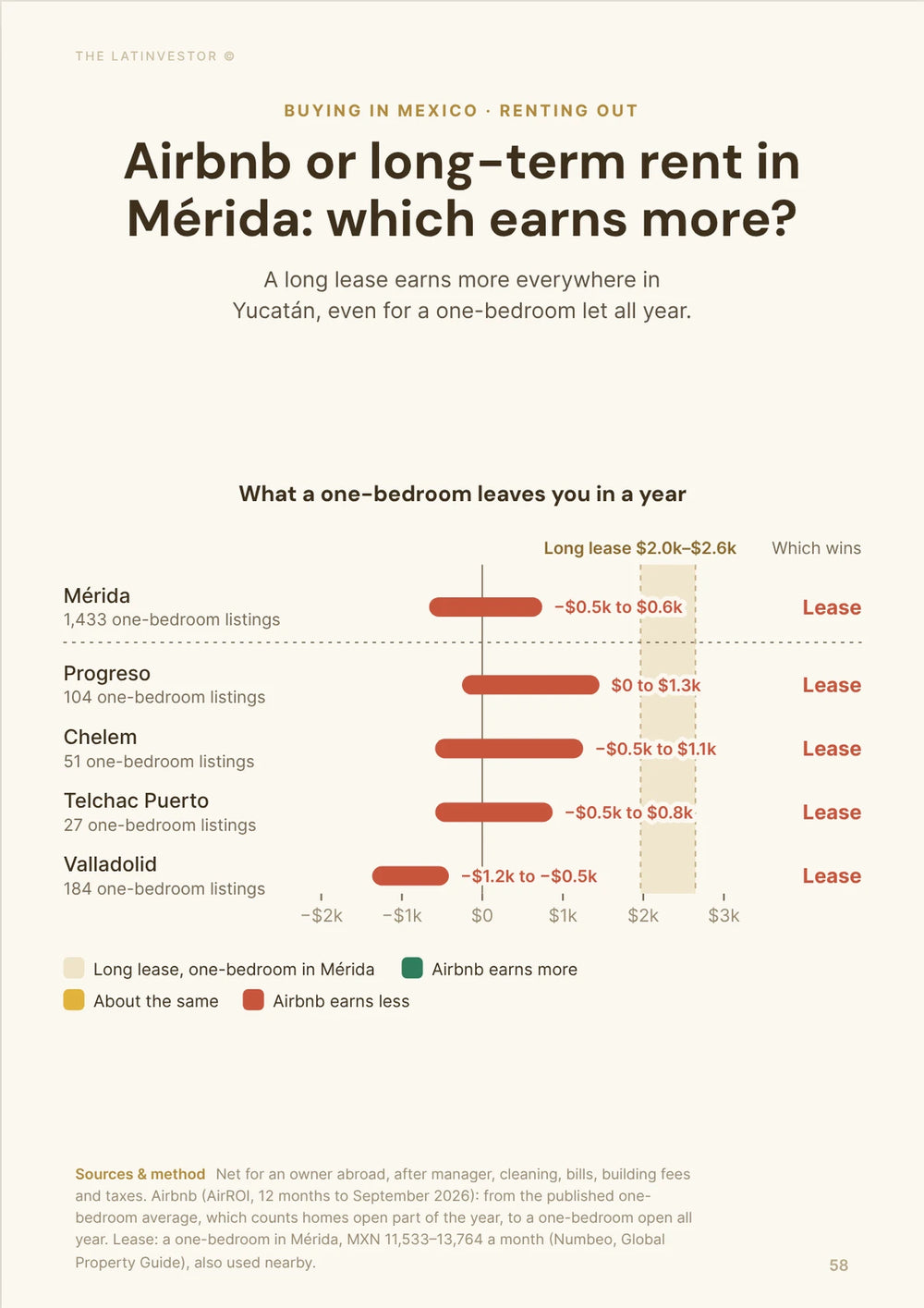
Barely: an average-performing 2-bedroom condo bought at the median asking price earns about 1.2% a year before income tax with a full-service co-host, and loses money once a non-resident pays tax.
Here's our math. The median 2-bedroom condo in Mérida asks about USD 194,000 (MXN 3,610,000). At AirDNA's average, it grosses MXN 247,000 a year (USD 13,300).
| Per year | Full-service co-host | Run locally, 4% fee |
|---|---|---|
| Gross revenue | MXN 247,000 | MXN 247,000 |
| Airbnb fee (16% or 4%) | MXN 39,500 | MXN 9,900 |
| Co-host (20%) | MXN 49,400 | none |
| Electricity | MXN 36,000 | MXN 36,000 |
| HOA fees | MXN 30,000 | MXN 30,000 |
| Internet, water, gas, supplies | MXN 18,000 | MXN 18,000 |
| Maintenance and air conditioning | MXN 15,000 | MXN 15,000 |
| Fideicomiso (about USD 650) | MXN 12,100 | MXN 12,100 |
| Predial | MXN 5,000 | MXN 5,000 |
| Before income tax | MXN 42,000 (1.2%) | MXN 121,000 (3.4%) |
| After 25% non-resident tax on gross | loss of MXN 19,800 | MXN 59,300 (1.6%) |
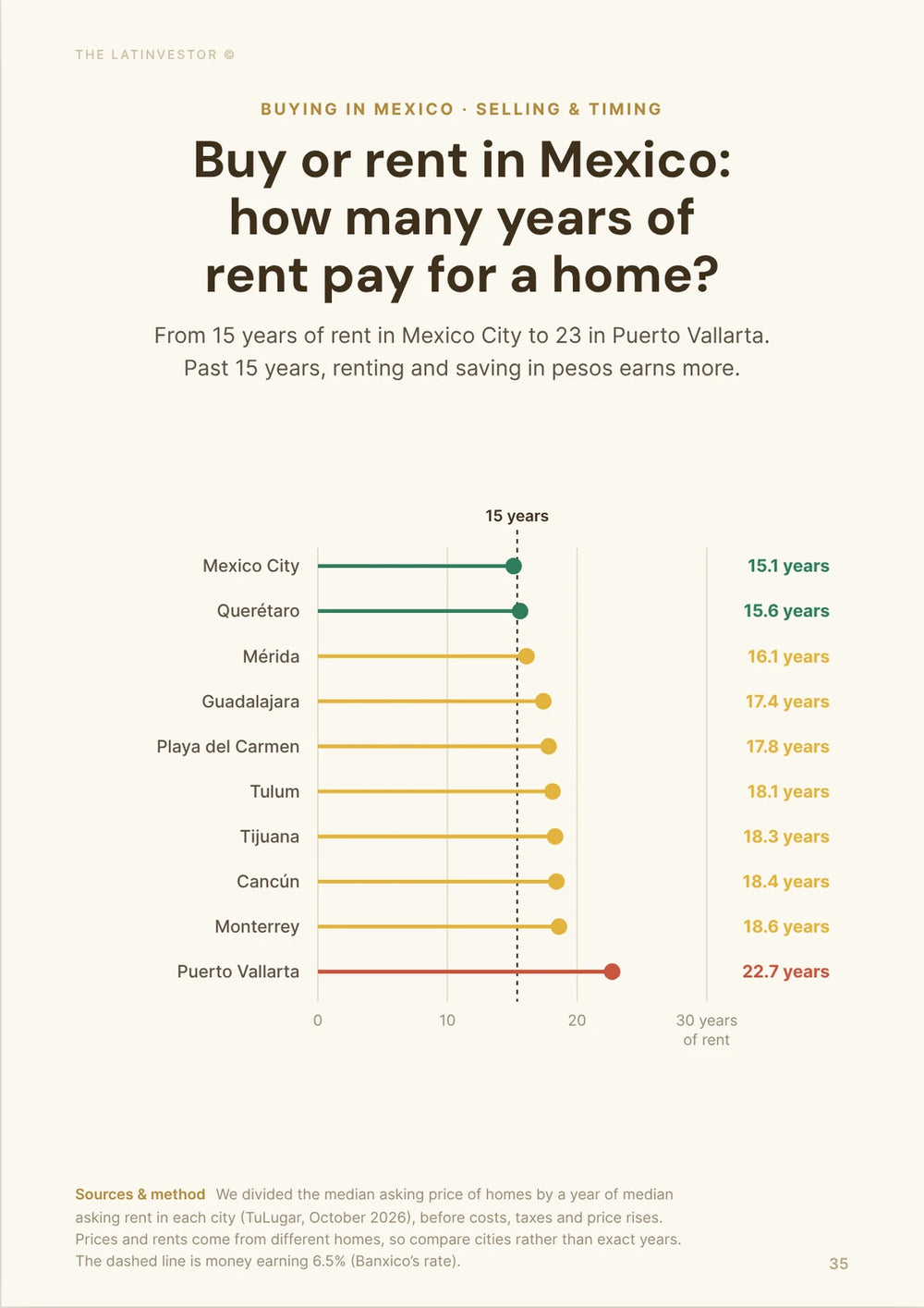
For comparison, the same condo on a 12-month lease nets about 3.4% before tax and 2.0% after it for a non-resident. And with mortgage rates averaging about 11.3%, borrowing to buy makes either option lose money. So in Mérida, Airbnb only beats a long-term lease if your listing does clearly better than average.
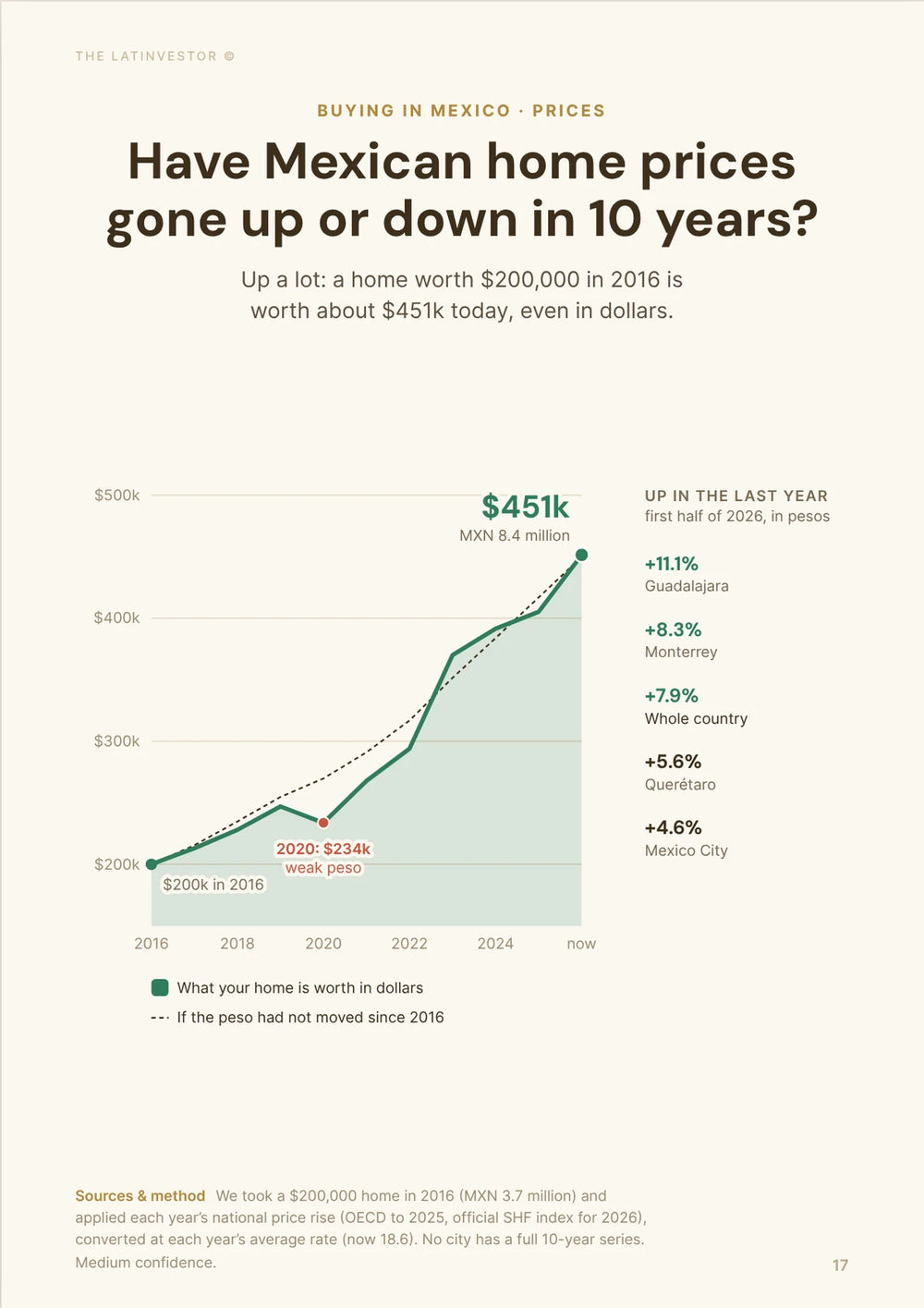
What to do: ask the seller or developer for 12 months of real booking history, not a projection. Run your numbers at USD 67 a night and 50% occupancy. Use the 11% price rise of the past year to negotiate, since a lower price is the one thing that improves every line. And check the electricity bills of the unit before you sign.
Are fewer tourists staying in Mérida in 2026?
Yes, a little: Mérida's hotels were 43.9% full in June 2026, against 56.3% a year earlier, and 49.2% in July.
Visitors staying overnight in Mérida fell 2.5% in June, and airport traffic fell 3.7% the same month. Across Yucatán, hotel occupancy in July was 8.3 points below 2025.
The base is still solid. The airport handled more than 2 million passengers in the first half of 2026 and expects close to 4 million for the year, with full flights to Miami, Houston and Dallas, a new Tijuana route and a seasonal Toronto route from November.
What it means for you: hotels with empty rooms cut prices, and that pulls Airbnb rates down too, which fits the 11.5% drop in AirDNA's average rate. Don't count on rates going back up next year. The weaker peso, at about 18.6 to the dollar against under 17 in early September, helps a little with American and Canadian guests.
How crowded is the Airbnb market in Mérida?
How many active Airbnb listings are in Mérida in 2026?
AirDNA counts 4,856 active short-term rentals in Mérida in September 2026, 35.7% fewer than a year earlier. Airbnb itself still advertised more than 6,600 spaces in June 2026, tenth in Mexico, because it counts every space offered, not only the active ones.
Part of AirDNA's drop comes from its 2026 change of method, but it also fits the city's push to register hosts: some owners are likely moving back to long-term leases.
Mérida is still one of Mexico's most visible Airbnb cities, and the competition hasn't gone away.
Which neighborhoods are most saturated in Mérida in 2026?
Centro Histórico and its barrios: Santa Ana, Santiago, Santa Lucía, La Ermita, Mejorada, Paseo de Montejo and the La Plancha area. The city says over half of its Airbnb-type homes are there.
Guests love them for the walkable streets, colonial houses, restaurants and culture, and so do the dozens of similar listings on every block.
There's less competition in García Ginerés, Itzimná, Chuburná, Montebello, Altabrisa, Temozón Norte and Cabo Norte, if the home suits longer stays, families, medical visitors or business travelers.
What local events spike demand in Mérida?
The main ones are Mérida Fest in January, Carnaval in February, Semana Santa in March or April, Noche Blanca in May (22 and 23 May in 2026), the July holidays, Hanal Pixán and the Festival de las Ánimas in late October, and November's cultural and business travel.
During these, good listings can often charge 15-40% more (our estimate), and the best-placed Centro homes sometimes more.
Set event prices 60 to 120 days ahead: many guests book only a few weeks before arriving, but the best homes fill early for peak weekends.
What occupancy differences exist between top and average hosts in Mérida?
Top hosts in Mérida often reach 65-75% occupancy, against 58% for the average listing in AirDNA's data.
That gap is why two similar homes on the same street can give very different results.
A new listing usually needs 6 to 18 months to get there: reviews, pricing history and reliable maintenance take time.
Which price points are most crowded, and where's the "white space" for new hosts in Mérida right now?
The most crowded band is about MXN 1,000-1,800 a night (USD 54-97), right around the city average.
The gap is just above it, around MXN 2,000-3,200 (USD 108-172), for guests who want real comfort but not a luxury villa.
To compete there: 2 or 3 bedrooms, a private pool, strong air conditioning, a real workspace, easy parking or check-in, in Santiago, Santa Ana, García Ginerés, Itzimná, Montebello or Altabrisa.
What kind of property books best in Mérida?
What bedroom count gets the most bookings in Mérida?
Two bedrooms are the safest choice, followed by 1-bedrooms for couples and 3-bedroom homes for families.
A 2-bedroom works for couples, remote workers, small families, visiting relatives, medical travelers and longer stays, without being too costly to cool, clean and maintain.
Studios are the easiest to copy, so they compete mostly on price.
What property type performs best in Mérida in 2026?
A 2- or 3-bedroom house or townhouse with a private pool, either in a walkable area near Centro or in a strong northern neighborhood.
Pool houses usually fill more nights than apartments and charge more for them. Small villas can do very well too, but cost more to buy and maintain.
It matches what guests come to Mérida for: colonial charm or northern convenience, plus cool rooms, outdoor space and a break from the heat.
Our methodology
This article estimates whether a residential Airbnb in Mérida pays in 2026: the rules, nightly rates, occupancy, revenue, costs, net profit and competition.
Rates, occupancy, revenue and listing counts come from AirDNA's data for the 12 months to September 2026, all listing sizes. We used one data provider for the calculations so the numbers stay comparable. Hotel occupancy, visitor and airport figures come from Yucatán's tourism secretariat and local press. Purchase prices are asking prices from TuLugar.
Rules come from official sources first: the Foreign Ministry (SRE) for the fideicomiso, SAT and the income tax law (articles 113-A, 113-C and 158) for tax, Yucatán's tourism secretariat for the 4.5% lodging tax, and the city of Mérida for heritage and its new register.
We checked these figures in October 2026 and converted currencies at about 18.6 pesos per US dollar and 20.9 pesos per euro.
Limits: AirDNA averages mix all listing sizes and changed method in 2026, asking prices aren't sale prices, and running costs, neighborhood rates, top-host occupancy and seasonal ranges are our own estimates.
Key sources used for this analysis include AirDNA, Sefotur Yucatán, SRE, SAT, Posta on "Mérida Ordenada", Por Esto! on the Airbnb register, Por Esto! on Airbnb listings and Cetur, Por Esto! on summer hotel occupancy, Por Esto! on airport traffic, Diario de Yucatán on the DAC rate, TuLugar, El Economista (Tinsa) and Airbnb.