
Authored by the expert who managed and guided the team behind the Brazil Property Pack
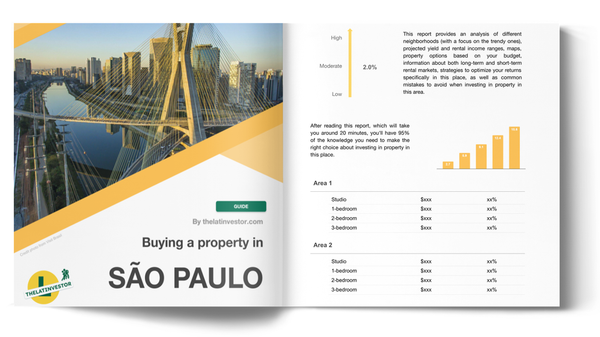
Yes, the analysis of São Paulo's property market is included in our pack
In this article, we cover current housing prices in São Paulo, how prices have moved over the past year, and where they are likely headed in 2026 and beyond.
We update this blog post regularly so you always have access to the most recent data available.
All figures are based on the latest market reports and data sources we trust.
And if you're planning to buy a property in this place, you may want to download our pack covering the real estate market in São Paulo.


What are the current property price trends in São Paulo as of 2026?
What is the average house price in São Paulo as of 2026?
As of early 2026, the estimated average house price in São Paulo is around R$ 750,000 (roughly $130,000 USD or €120,000 EUR), which reflects a blended figure across apartments and houses, with apartments making up the vast majority of transactions.
The average price per square meter for properties in São Paulo sits around R$ 11,900/m² (approximately $2,060 USD/m² or €1,890 EUR/m²) based on listing data, though closed transaction data points to a somewhat lower figure closer to R$ 7,400/m².
A realistic price range that covers roughly 80% of property purchases in São Paulo runs from about R$ 350,000 to R$ 1,400,000 (approximately $60,000 to $245,000 USD or €55,000 to €225,000 EUR), with entry-level studios at the lower end and larger apartments in desirable neighborhoods at the top.
How much have property prices increased in São Paulo over the past 12 months?
Property prices in São Paulo rose by approximately 4.5% over the past 12 months, according to data running through the end of 2025.
Price increases across different property types and neighborhoods ranged from roughly 2% to 8% over the same period, with transit-connected and infrastructure-adjacent areas tending toward the higher end.
The most significant driver behind this price movement has been persistent supply scarcity in central and well-served neighborhoods, which has kept asking prices firm even as expensive credit limited how many buyers could participate in the market.
Which neighborhoods have the fastest rising property prices in São Paulo as of 2026?
As of early 2026, the neighborhoods showing the fastest rising property prices in São Paulo are Tatuapé, Anália Franco, and Perdizes, all of which are benefiting directly from major metro expansion and strong buyer demand.
Each of these neighborhoods has been registering annual price growth in the range of 6% to 9%, outpacing the city average of roughly 4.5% as improved accessibility drives more buyers to compete for a limited supply of units.
The main demand driver behind this growth is improved or soon-to-improve metro connectivity: the Linha 2-Verde expansion is reshaping the appeal of the East Zone, while the anticipated Linha 6-Laranja is already lifting expectations in the Perdizes and Barra Funda corridor.
By the way, you will find much more detailed price ranges across neighborhoods in our property pack covering the real estate market in São Paulo.
Get fresh and reliable information about the market in São Paulo
Don't base significant investment decisions on outdated data. Get updated and accurate information.

Which property types are increasing faster in value in São Paulo as of 2026?
As of early 2026, the ranking of property types by appreciation rate in São Paulo puts studios and compact 1-bedroom apartments at the top, followed by 2-bedroom apartments, then houses and casas em condomínio, with large luxury units appreciating the slowest on a percentage basis.
Studios and 1-bedroom apartments in transit-connected areas of São Paulo have been appreciating at roughly 6% to 9% annually, driven by strong rental demand from young professionals and the fact that their smaller price tickets make them easier to finance in a high-interest-rate environment.
The main reason this property type is outperforming others is that expensive credit pushes buyers toward more affordable, financeable units, concentrating demand in the most liquid and lowest-ticket segment of the São Paulo market.
Finally, if you're interested in a specific property type, you will find our latest analyses here:
- How much should you pay for an apartment in São Paulo?
- How much should you pay for a condo in São Paulo?
What is driving property prices up or down in São Paulo as of 2026?
As of early 2026, the top three factors currently driving property prices in São Paulo are rising construction costs, ongoing infrastructure investment across several metro lines, and structural housing scarcity in central neighborhoods.
The single factor with the strongest upward pressure on São Paulo property prices is construction cost inflation, which rose about 6% over the past year and makes it economically difficult to build new supply at prices that would meaningfully cool the existing market.
If you want to understand these factors at a deeper level, you can read our latest property market analysis about São Paulo here.
Don't buy the wrong property, in the wrong area of São Paulo
Buying real estate is a significant investment. Don't rely solely on your intuition. Gather the right information to make the best decision.
What is the property price forecast for São Paulo in 2026?
How much are property prices expected to increase in São Paulo in 2026?
As of early 2026, property prices in São Paulo are expected to rise by approximately 5% in nominal terms over the course of the year, continuing the modest but positive trend seen in 2025.
Analyst forecasts for São Paulo property price growth in 2026 range from around 3% on the cautious end to about 8% in an optimistic scenario where interest rates start easing meaningfully before mid-year.
Most forecasts assume that interest rates will remain high for at least the first half of 2026 but will not rise further, which keeps broad-based price acceleration off the table while still allowing supply-constrained areas to drift upward.
We go deeper and try to understand how solid are these forecasts in our pack covering the property market in São Paulo.
Which neighborhoods will see the highest price growth in São Paulo in 2026?
As of early 2026, the neighborhoods expected to see the highest property price growth in São Paulo are Tatuapé, Anália Franco, and Perdizes, all of which benefit from confirmed infrastructure upgrades already underway.
These top-performing neighborhoods in São Paulo are projected to see price growth of roughly 7% to 10% over the course of 2026, comfortably above the citywide average of around 5%.
The primary catalyst driving growth in these neighborhoods is metro expansion: the Linha 2-Verde extension improves East Zone connectivity significantly, while the Linha 6-Laranja project is already pulling buyer attention toward the Perdizes and Barra Funda corridor ahead of its expected partial opening.
One emerging neighborhood in São Paulo that could surprise with higher-than-expected growth is Casa Verde, which sits within the broader Arco Tietê regeneration framework and is still priced well below the premium corridors despite steadily improving accessibility and city investment.
By the way, we've written a blog article detailing what are the current best areas to invest in property in São Paulo.
What property types will appreciate the most in São Paulo in 2026?
As of early 2026, compact 1-bedroom and studio apartments in transit-accessible neighborhoods of São Paulo are expected to appreciate the most, continuing a trend that has been building since interest rates began weighing on the broader market.
The top-performing property type in São Paulo is projected to see appreciation of around 7% to 10% in 2026, reflecting a combination of strong rental demand, high liquidity, and financing accessibility relative to larger units.
The main demand trend driving appreciation for this property type is the concentration of buyer activity in the most affordable and most rentable segment: with mortgages expensive, both investors and first-time buyers gravitate toward smaller units that are easier to finance and easier to rent out.
Large luxury apartments and penthouses are the property type most likely to underperform in São Paulo in 2026, not because values are expected to fall, but because their higher price points and thinner buyer pools mean they tend to hold value rather than accelerate.
Make a profitable investment in São Paulo
Better information leads to better decisions. Save time and money. Download our data.
How will interest rates affect property prices in São Paulo in 2026?
As of early 2026, high interest rates are acting as a ceiling on broad-based property price acceleration in São Paulo, keeping growth moderate even in a city with strong structural demand.
Brazil's benchmark Selic rate entered 2026 at an elevated level above 12%, and market consensus points to rates staying restrictive for at least the first half of the year before any meaningful easing begins.
In São Paulo, a 1 percentage point increase in mortgage rates typically translates to a reduction in purchasing power of around 8% to 12% for a standard buyer, which shifts demand toward smaller units and can slow price appreciation in the mid-to-upper segments of the market.
You can also read our latest update about mortgage and interest rates in Brazil.
What are the biggest risks for property prices in São Paulo in 2026?
As of early 2026, the three biggest risks for property prices in São Paulo are interest rates staying high longer than expected, a slowdown in income growth that limits buyer upgrading, and a wave of new supply in specific corridors that could cap appreciation in those pockets.
Among these, the risk of interest rates remaining restrictive throughout 2026 has the highest probability of materializing, given that Banco Central do Brasil entered the year with a hawkish stance and inflation still above its comfort zone.
We actually cover all these risks and their likelihoods in our pack about the real estate market in São Paulo.
Is it a good time to buy a rental property in São Paulo in 2026?
As of early 2026, São Paulo is a selective yes for buying a rental property: the math can work well if you focus on the right unit type and corridor, but not every segment offers the same opportunity.
The strongest argument in favor of buying a rental property in São Paulo now is the gross rental yield of around 6.4% per year available on well-located 1- and 2-bedroom apartments, which provides a meaningful income buffer even in a high-rate environment.
The strongest argument for waiting is that mortgage costs remain elevated, which means the net yield after financing is thin for leveraged buyers and there is a reasonable chance that prices soften slightly or stagnate in rate-sensitive segments if credit conditions worsen.
If you want to know our latest analysis (results may differ from what you just read), you can read our assessment on whether now is a good time to buy a property in São Paulo.
You'll also find a dedicated document about this specific question in our pack about real estate in São Paulo.
Get to know the market before buying a property in São Paulo
Better information leads to better decisions. Get all the data you need before investing a large amount of money.
Where will property prices be in 5 years in São Paulo?
What is the 5-year property price forecast for São Paulo as of 2026?
As of early 2026, the most realistic estimate for cumulative property price growth in São Paulo over the next five years is around 30%, which works out to roughly 5.4% per year in nominal terms.
The range of 5-year scenarios runs from about 15% cumulative in a downside case where rates stay high and credit remains tight, up to around 45% cumulative if monetary conditions normalize sooner and income growth holds up.
Most forecasters project an average annual appreciation rate of around 5% to 6% for São Paulo property prices over the five-year horizon, anchored by strong structural demand and persistent construction cost inflation.
The key assumption underpinning most five-year forecasts for São Paulo is that Brazil's interest rate cycle eventually turns, unlocking pent-up demand from buyers who have been sitting on the sidelines in a high-rate environment.
Which areas in São Paulo will have the best price growth over the next 5 years?
The three areas in São Paulo expected to deliver the best property price growth over the next five years are the East Zone transit corridor anchored by Tatuapé, Anália Franco and Vila Formosa, the Linha 6-Laranja belt around Perdizes and Barra Funda, and the Arco Tietê regeneration zone covering Santana, Vila Maria, and Casa Verde.
These top-performing areas in São Paulo could see cumulative five-year gains of 40% to 55%, meaningfully above the city baseline, as infrastructure completion converts accessibility potential into realized price premiums.
The five-year outperformer list broadly echoes the shorter-term forecast, but with one important difference: the Arco Tietê belt moves up in relevance over five years because regeneration-driven repricing is a slower, structural process that does not fully show up in a single year.
Among currently undervalued areas, Casa Verde stands out as the one with the best outperformance potential over five years: it sits inside a major regeneration corridor, is still priced at a significant discount to more central neighborhoods, and benefits from improving public transport links.
What property type will give the best return in São Paulo over 5 years as of 2026?
As of early 2026, small 1- and 2-bedroom apartments in transit-connected neighborhoods of São Paulo are expected to deliver the best total return over five years, combining solid capital appreciation with reliable rental income.
The projected five-year total return for this property type in São Paulo, combining appreciation of around 30% to 40% with annual rental yields near 6%, puts the gross total return in the range of 55% to 70% before costs and taxes over a five-year hold.
The main structural trend favoring this property type over the next five years in São Paulo is the continued growth of single-person and small households: as the city's demographic profile shifts toward younger, mobile professionals, demand for compact, well-located rentals keeps deepening.
For investors prioritizing balance between return and lower risk over five years in São Paulo, a well-located 2-bedroom apartment in an established neighborhood like Vila Mariana or Moema offers the most reliable combination of liquidity, yield, and capital preservation.
How will new infrastructure projects affect property prices in São Paulo over 5 years?
The three major infrastructure projects most likely to impact São Paulo property prices over the next five years are the Linha 2-Verde metro expansion into the East Zone, the Linha 6-Laranja new metro line connecting the northwest to the city center, and the broader Arco Tietê urban regeneration program.
In São Paulo, properties near completed or confirmed metro stations have historically traded at a premium of roughly 10% to 20% compared to similar properties further away, and this accessibility premium tends to build gradually as opening dates become more certain.
The specific neighborhoods that will benefit most from these infrastructure developments include Tatuapé, Anália Franco, and Penha on the Linha 2 corridor, Perdizes and Barra Funda on the Linha 6 axis, and Santana and Vila Maria within the Arco Tietê regeneration belt.
How will population growth and other factors impact property values in São Paulo in 5 years?
São Paulo's population growth is slow at the city level, but ongoing household formation in a city of over 11 million residents means demand for housing units remains structurally active and is expected to keep supporting property values over the next five years.
The demographic shift with the strongest influence on property demand in São Paulo over five years is the rise of smaller, younger households: more single-person and two-person households mean more demand for compact, well-located apartments rather than large family homes.
Internal migration from other Brazilian states continues to keep São Paulo's housing demand more dynamic than its headline population growth suggests, since new arrivals typically seek rental accommodation first and owner-occupied property second, supporting both segments of the market.
The property types and areas that benefit most from these demographic trends in São Paulo are 1- and 2-bedroom apartments in transit-connected neighborhoods like Mooca, Vila Mariana, Tatuapé, Brooklin, and Pinheiros, where the combination of accessibility, services, and compact unit supply directly matches the needs of smaller, urban households.

We made this infographic to show you how property prices in Brazil compare to other big cities across the region. It breaks down the average price per square meter in city centers, so you can see how cities stack up. It’s an easy way to spot where you might get the best value for your money. We hope you like it.
What is the 10 year property price outlook in São Paulo?
What is the 10-year property price prediction for São Paulo as of 2026?
As of early 2026, São Paulo property prices are estimated to grow by approximately 70% in cumulative nominal terms over the next ten years, which works out to a compound annual rate of around 5.5%.
The range of 10-year scenarios for São Paulo runs from about 40% cumulative in a downside case of prolonged high rates and slow growth, up to roughly 110% in an upside scenario of earlier monetary easing and sustained income gains.
Over a 10-year horizon, the projected average annual appreciation rate for São Paulo property of around 5% to 6% reflects the city's enduring combination of scarcity in desirable areas, rising replacement costs, and periodic accessibility improvements that reprice specific corridors.
The biggest uncertainty factor in any 10-year prediction for São Paulo property prices is Brazil's long-run interest rate regime: whether the Selic rate eventually converges toward lower structural levels will determine whether the mortgage market deepens enough to unlock broad-based price appreciation across the city.
What long-term economic factors will shape property prices in São Paulo?
The three long-term economic factors that will shape São Paulo property prices most over the next decade are Brazil's structural interest rate level and the depth of the mortgage market, long-run construction costs and their impact on new supply economics, and the city's ongoing transit and urban regeneration investment pipeline.
Among these, the evolution of Brazil's interest rate regime will have the most positive impact on São Paulo property values if it moves in the right direction: a sustained reduction in the Selic rate would unlock a wave of new buyers, deepen mortgage credit, and likely accelerate price growth across most market segments.
The greatest structural risk to São Paulo property values over the long term is a scenario where Brazil's inflation and interest rates remain persistently high, which would keep mortgage affordability out of reach for a large share of would-be buyers and structurally limit the price ceiling in the mid-market.
You'll also find a much more detailed analysis in our pack about real estate in São Paulo.
What sources have we used to write this blog article?
Whether it's in our blog articles or the market analyses included in our property pack about São Paulo, we always rely on the strongest methodology we can ... and we don't throw out numbers at random.
We also aim to be fully transparent, so below we've listed the authoritative sources we used, and explained how we used them and the methods behind our estimates.
| Source | Why it is reliable | How we used it |
|---|---|---|
| FipeZAP Residential Sales Index (December 2025) | A long-running, transparent price index produced by FIPE and widely cited across the Brazilian real estate industry. | We used it to anchor São Paulo's citywide price per square meter and 12-month change as our primary "current market" reference. We treated its figures as asking-price indicators and paired them with transaction data to avoid listing-price bias. |
| QuintoAndar Sales Report (Q3 2025) | A major rental and sales platform with large transaction coverage and a clearly stated methodology in its published reports. | We used it to cross-check transaction-based medians against listing prices, identify which neighborhoods have the strongest buyer demand, and extract gross rental yield estimates by property type. It served as our primary reality check on the gap between asking and closing prices. |
| Banco Central do Brasil - Focus Market Expectations | Brazil's central bank publishes this weekly consolidation of market forecasts, making it the standard reference for macro consensus. | We used it to frame 2026 interest rate and inflation expectations that shape housing affordability and credit availability. We treated it as consensus expectations rather than as the central bank's own official forecast. |
| Banco Central do Brasil - Monetary Policy Report (December 2025) | An official central bank publication explaining the macro, inflation, and interest rate backdrop in detail. | We used it to support the sections explaining why prices move in São Paulo and to stress-test our 2026 scenarios against the official policy view. It grounded our rate-risk discussion in BCB's own published analysis. |
| Banco Central do Brasil - IVG-R Dataset | An official dataset built from regulated credit-system data, specifically designed for macroprudential monitoring of residential property. | We used it to anchor the long-run direction of Brazilian residential prices and to validate whether São Paulo's near-term trajectory is historically plausible. We treated it as a national benchmark rather than a São Paulo-specific data point. |
| ABECIP Housing Credit Bulletin (November 2025) | Brazil's leading housing finance association tracks mortgage origination volumes and is widely used by the sector to benchmark credit conditions. | We used it to quantify how credit availability changed heading into 2026 and to connect financing volumes to price momentum, particularly in mid-market segments that depend more on mortgage access. |
| FGV IBRE - INCC-M Index (December 2025) | FGV is a premier Brazilian economic institution and the INCC-M is the standard national construction cost index. | We used it to capture construction cost pressure as a key driver of replacement costs for new housing. It helped explain why São Paulo prices resist broad nominal declines even when demand is soft, because building new supply at lower prices is economically difficult. |
| IBGE - São Paulo City Profile, Censo 2022 | The official statistical agency's municipal profile from Brazil's national census is the most authoritative source for population and housing stock data. | We used it to ground our structural demand analysis with verified population and household figures for São Paulo. It helped explain why supply is tight in many central areas and why small shifts in preferences can move prices in specific neighborhoods. |
| São Paulo Metro - Linha 2-Verde Official Page | The official operator's project page states the confirmed scope and benefits of the expansion directly from the public authority responsible for it. | We used it to identify which corridors gain meaningful accessibility improvements and to support the sections on neighborhood outperformance driven by infrastructure. It grounded our East Zone forecast in confirmed project scope rather than speculation. |
| City of São Paulo - Arco Tietê Urban Development Page | The municipality's own planning documentation for a major redevelopment area, making it the most direct source for what regeneration is officially planned and where. | We used it to explain where long-run regeneration is targeted and why some districts like Santana, Vila Maria, and Casa Verde may reprice over a five- to ten-year horizon. It helped us avoid speculative neighborhood claims by anchoring them in official planning frameworks. |
Get the full checklist for your due diligence in São Paulo
Don't repeat the same mistakes others have made before you. Make sure everything is in order before signing your sales contract.

If you want to go deeper, you can read the following: