Summary
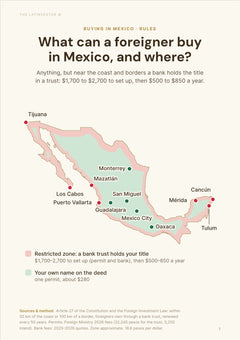
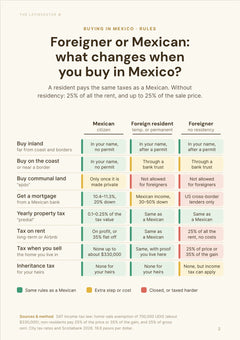
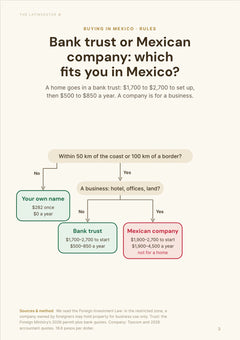
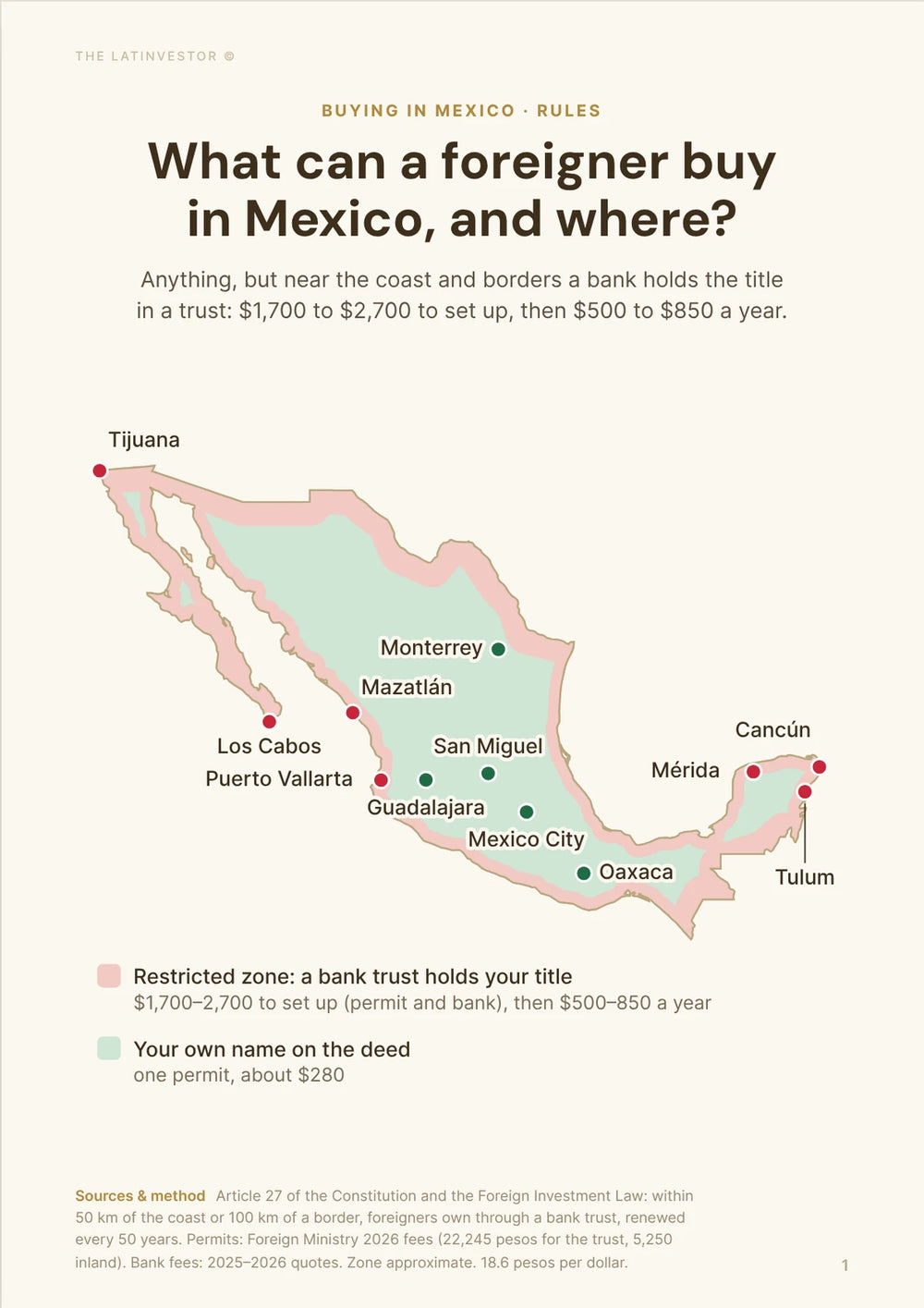
Yes, and in your own name. Querétaro is far from the coast and the border, so a foreigner holds the deed directly, with no bank trust (fideicomiso). The only federal step is a foreigner agreement with the foreign ministry (SRE), which costs MXN 5,250 (about USD 282) in 2026.
That saves real money compared with beach towns, where the trust permit alone is MXN 21,650 and banks charge about USD 550 to USD 800 to open the trust, plus USD 550 to USD 700 every year.
The rights aren't the problem. The paperwork is: ejido-origin land, unapproved subdivisions and pre-sale units without their own registration cause most of the trouble, in a market where prices rose 5.6% in a year (SHF, first half of 2026).
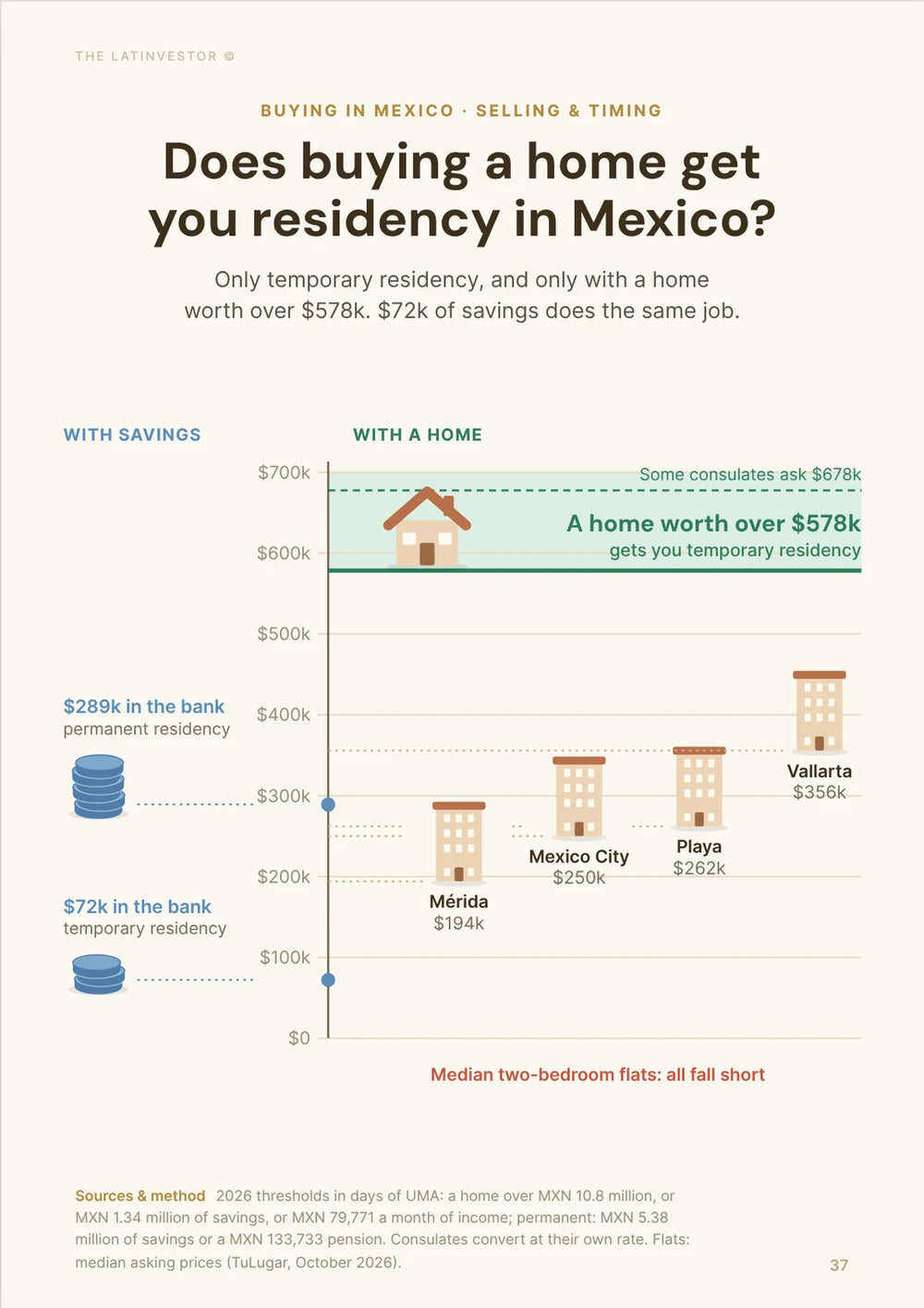
You don't need a visa to buy. Buying won't get you residency either, unless the property is worth about MXN 10.76 million (about USD 578,000), more than three times the median asking price of a two-bedroom apartment in the city (USD 174,000).
Airbnb is not the easy money it looks like: active listings fell 34.9% in a year to 2,583, and the average listing earned about USD 8,700, roughly 5% gross on a median two-bedroom before costs and taxes.
A clean cash resale usually takes about 45 to 90 days from accepted offer to registered deed, and the notary is the one step you can't skip.
Before signing, get the registered deed, a recent certificate of no liens and a land-use report, and match them with the cadastre. Forged papers happen here too: three people were arrested in Corregidora in late August 2026 over a property fraud with fake documents.
New projects need extra care: of 555 developments rated by the city's Semáforo Inmobiliario by June 2026, only 26% had a clean record.
Mortgages exist but are hard to get: the average fixed-rate quote was 11.31% in August 2026, and cross-border lenders finance only 50% to 65% of the price.
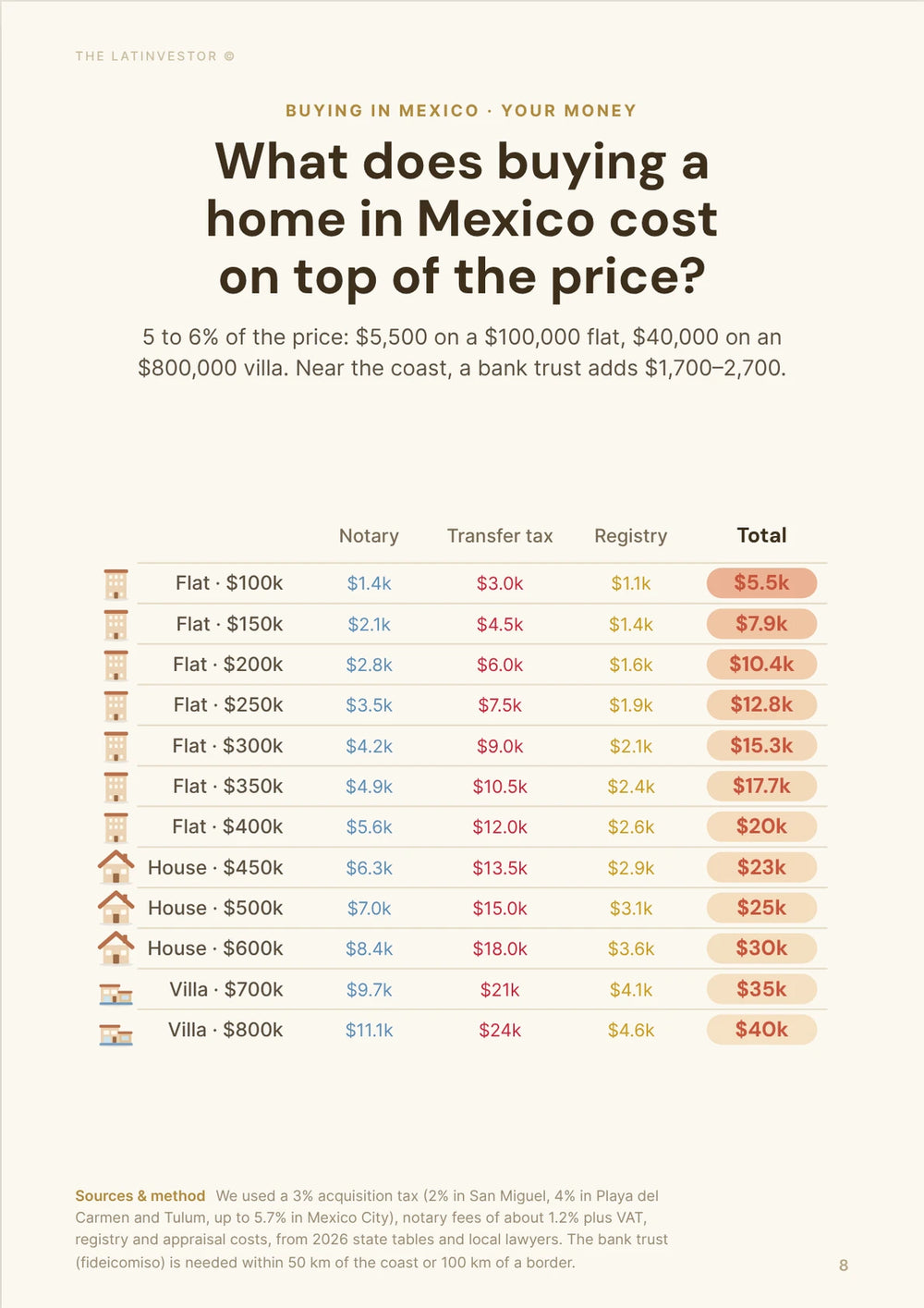
Budget about 7% to 9% of the price for closing costs. The transfer tax alone works out to about 5.6% on a MXN 2.5 million home, roughly MXN 141,000.
Yearly costs stay modest: predial of roughly MXN 5,000 to MXN 15,000 (no increase in 2026), insurance from about MXN 4,900, and 25% tax on gross rent if you're a non-resident landlord.
Bottom line: Querétaro is one of the easiest places in Mexico for a foreigner to own property. Spend your energy on the title, the project's permits and the rental numbers, not on the ownership paperwork.

What can a foreigner own in Querétaro, and in whose name?
What property types can foreigners buy in Querétaro?
Foreigners can buy houses, townhouses, condos, apartments, titled residential lots and homes in gated communities (fraccionamientos) in Querétaro, in their own name.
The one formality is the SRE foreigner agreement (convenio de renuncia): you agree to be treated like a Mexican for that property and not to ask your own government for protection over it. It costs MXN 5,250 (about USD 282 or EUR 251) in 2026, and the notary usually handles it.
That works the same in Juriquilla, Jurica, Zibatá, El Refugio, El Campanario, Milenio III, Centro Histórico, Corregidora or El Marqués, where most new-builds and gated projects sit.
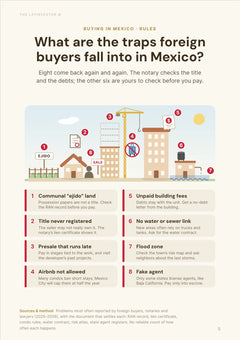
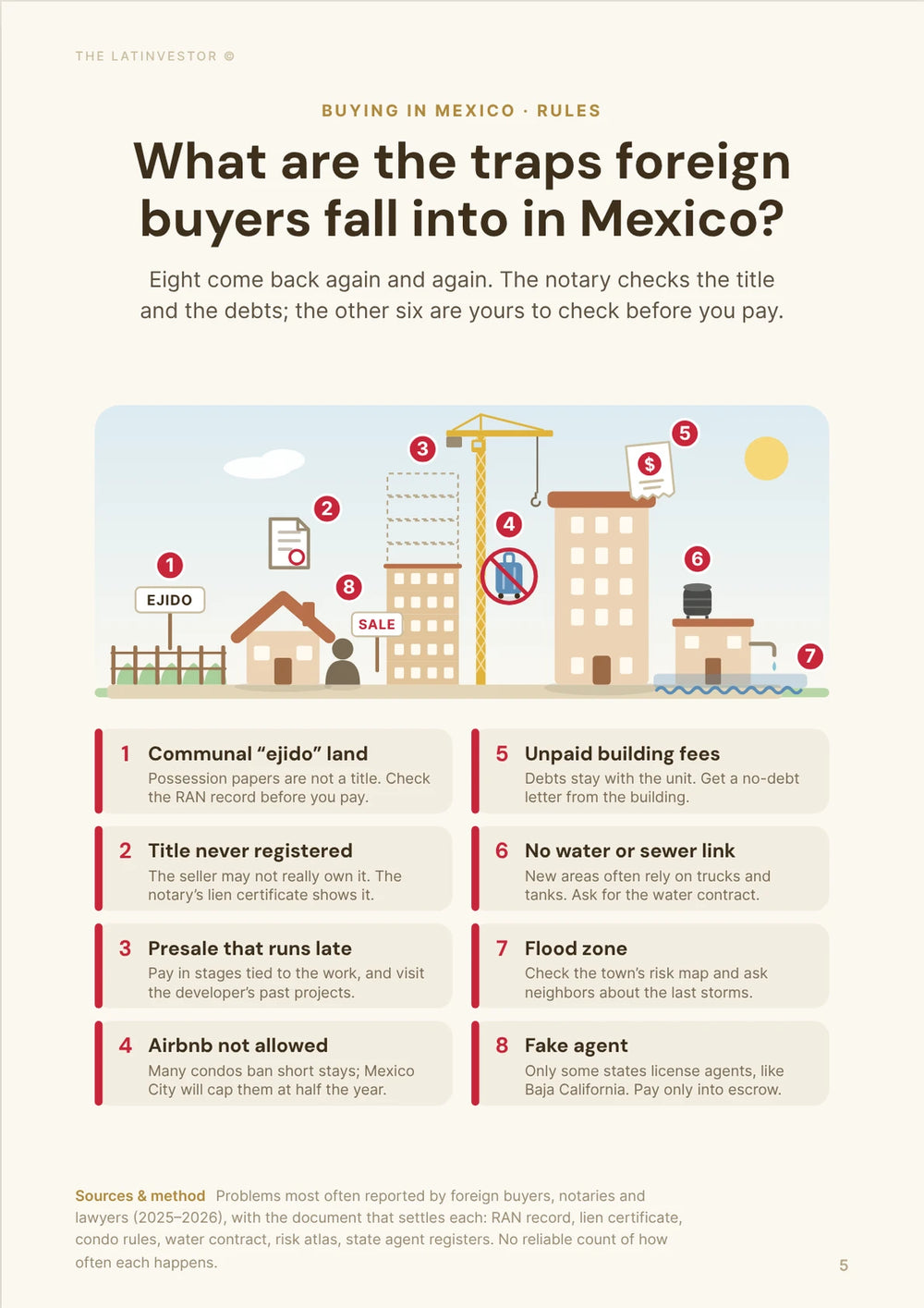
What to avoid isn't a type of home but a type of paperwork: ejido-origin land, lots in unapproved subdivisions, unpaid debts on the property and projects missing their development permits.
Can I own land in my own name in Querétaro?
Yes. Querétaro is not within 100 km of a border or 50 km of the coast, so a foreigner can hold titled residential land directly, with no fideicomiso.
That doesn't cover every parcel: rural land, ejido-derived land, irregular lots and land without subdivision approval can still be impossible to register or resell.
For a normal house or condo, you sign the SRE agreement instead of setting up a bank trust like in Cancún, Tulum, Puerto Vallarta or Los Cabos, then the notarized deed is registered with the state's public registry.
What other foreign-ownership rules should I know in Querétaro?
There's no cap on foreign owners. A building in Juriquilla, Zibatá, Centro Histórico, Álamos or Milenio III doesn't become restricted because several buyers are foreigners.
The real rules are local: the deed must be signed before a Mexican notary and registered with the public registry, and the cadastre must be updated after closing.
Watch the cadastral values too. The city approved new unit values for 2026, and they drive both predial and the transfer tax, so the tax base can sit above or below what you actually pay.
What's the biggest ownership mistake foreigners make in Querétaro?
Assuming that direct ownership means low risk, then paying before the notary has checked title, liens, land use, cadastre and project approvals.
Skip those checks and you can end up with a delayed deed, an unregistered transfer, a home no bank will finance, or one that's much harder to resell. Fake paperwork is not theoretical here: in late August 2026, prosecutors arrested three people in Corregidora over a property fraud using forged documents.
Other classic mistakes: rushing into a pre-sale, trusting a developer's promise instead of registry documents, ignoring HOA debts, and not checking whether a fraccionamiento is fully approved.
Does your visa matter when you buy or rent out in Querétaro?
Do I need a specific visa to buy property in Querétaro?
No. You can buy as a tourist, temporary resident, permanent resident or non-resident.
The real hurdle for non-residents is practical: proving identity, signing correctly, moving money through documented channels and giving the notary what it needs for tax and anti-money-laundering checks.
You can often start without an RFC (Mexican tax ID), but get one early: utilities, rental income, invoices and resale are all easier with it.
A typical buyer file: passport, immigration document if you have one, proof of address, marital status papers, tax details, proof of where the money comes from, and a legalized power of attorney if someone signs for you.
Does buying property in Querétaro get me residency or citizenship?
Not on its own. Mexico has no simple golden visa, and buying a home doesn't give you residency, permanent residency or citizenship automatically.
The property route asks for a lot: consulates quote a deed value of about MXN 10.76 million (91,710 times the 2026 daily UMA of MXN 117.31), or about USD 578,000, and each consulate checks the file case by case. That's more than three times the median asking price of a two-bedroom apartment in Querétaro (USD 174,000).
So most buyers qualify through income or savings instead: about MXN 79,800 a month in net income (about USD 4,290) or about MXN 1.34 million in average savings (about USD 72,300) for temporary residence, according to 2026 calculations based on consular rules.
Can I legally rent out my property in Querétaro on my visa?
Yes, owning a rental is fine on any status. Your visa only matters if you run the rental yourself while in Mexico, like a local host.
You don't need to live in Mexico to earn rent, but you need a local tax setup, a reliable manager and a clear way to handle payments, invoices and repairs.
Taxes are where non-residents get caught. A non-resident landlord pays 25% income tax on gross rent, with no deductions. For short stays, platforms withhold 4% income tax from hosts with an RFC (20% without one), 16% VAT applies, and Querétaro charges a 5% lodging tax on platform stays. Check the condo bylaws too: a building can ban short stays.
Can a foreign owner still make Airbnb pay in Querétaro?
Harder than a year ago. AirDNA counted 2,583 active short-term listings in the city in September 2026, 34.9% fewer than a year earlier, and the average listing earned about USD 8,700 (about MXN 162,000) over the year, at 57% occupancy and USD 44 a night.
Against the median asking price of a two-bedroom apartment (USD 174,000), that's roughly 5% gross before cleaning, management, HOA fees and taxes. A plain long-term lease on a 65 m² two-bedroom shows about 7.1% gross on the city benchmark, with far less work.
The rules are light: the city has no specific short-term rental permit, but the 5% state lodging tax applies to platform stays (up from 3.5%), and a non-resident still owes 25% on gross rent.
What to do: run your numbers on a 12-month lease first and treat Airbnb as a bonus, not the plan. Ask the condo administrator for the bylaws in writing before you buy, and don't pay a premium for a unit sold as an "Airbnb investment".
How long does a purchase in Querétaro take, from offer to deed?
What are the steps to buy property in Querétaro?
The usual sequence: choose the property, review basic documents, sign an offer or promise agreement, appoint a notary, check title and liens, confirm cadastre and land use, sign the SRE agreement and the deed, pay taxes and fees, register the deed, then update utilities and HOA records.
You don't have to be in Querétaro to sign: a properly prepared and legalized power of attorney lets someone sign for you. Signing in person is still simpler for a first purchase.
The deal becomes binding with the signed promise agreement or purchase contract, while ownership is fully protected once the deed (escritura) is signed before the notary and registered.
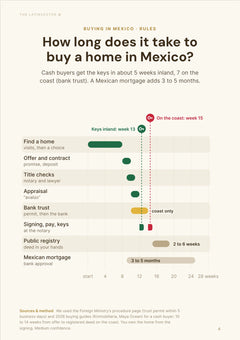
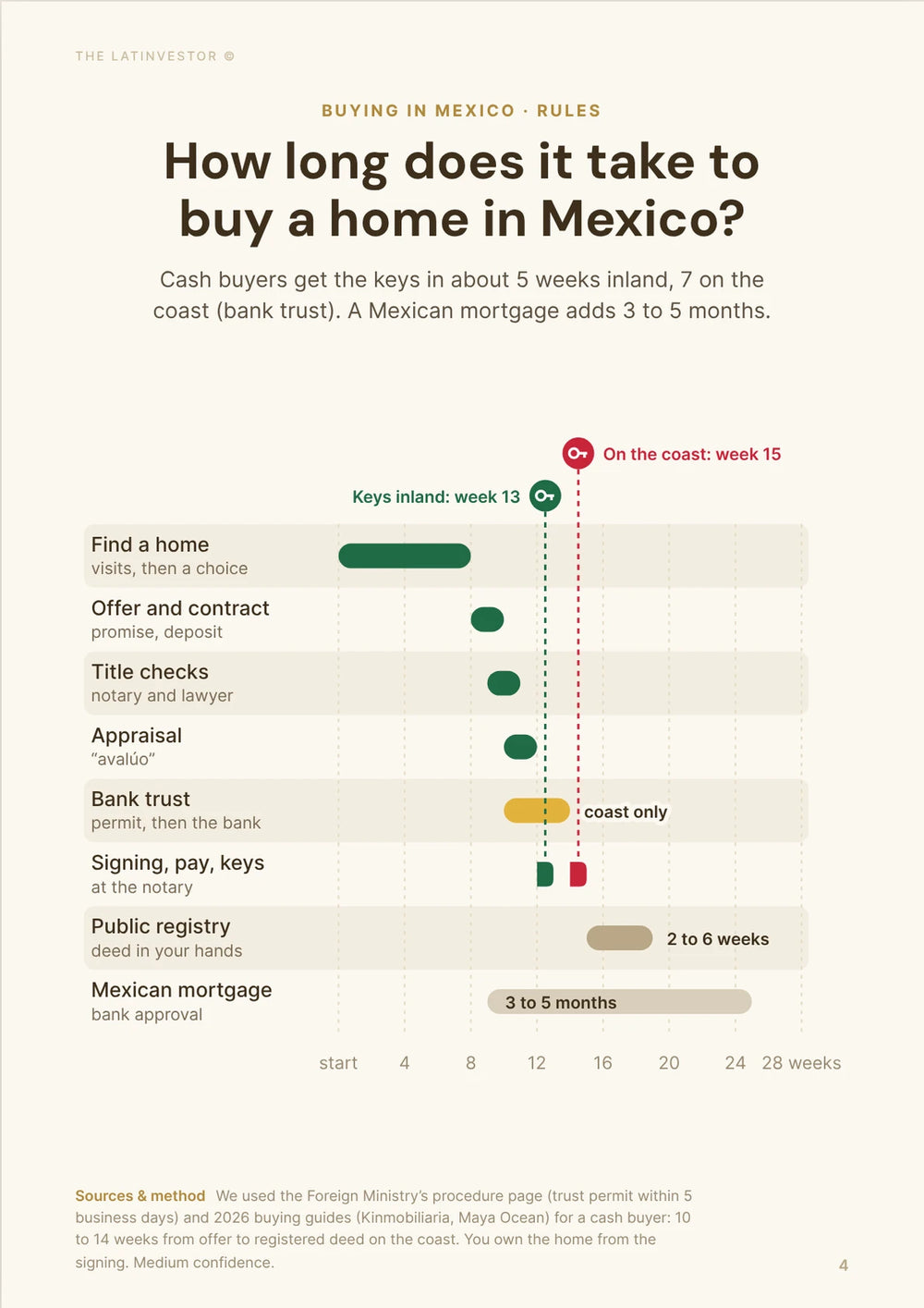
A clean cash purchase usually takes about 45 to 90 days from accepted offer to registration. A mortgage, a pre-sale unit, missing papers or remote signing make it longer. That's our estimate, not an official deadline.
Do I need a lawyer or a notary to buy a property in Querétaro?
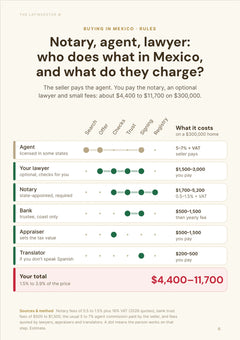
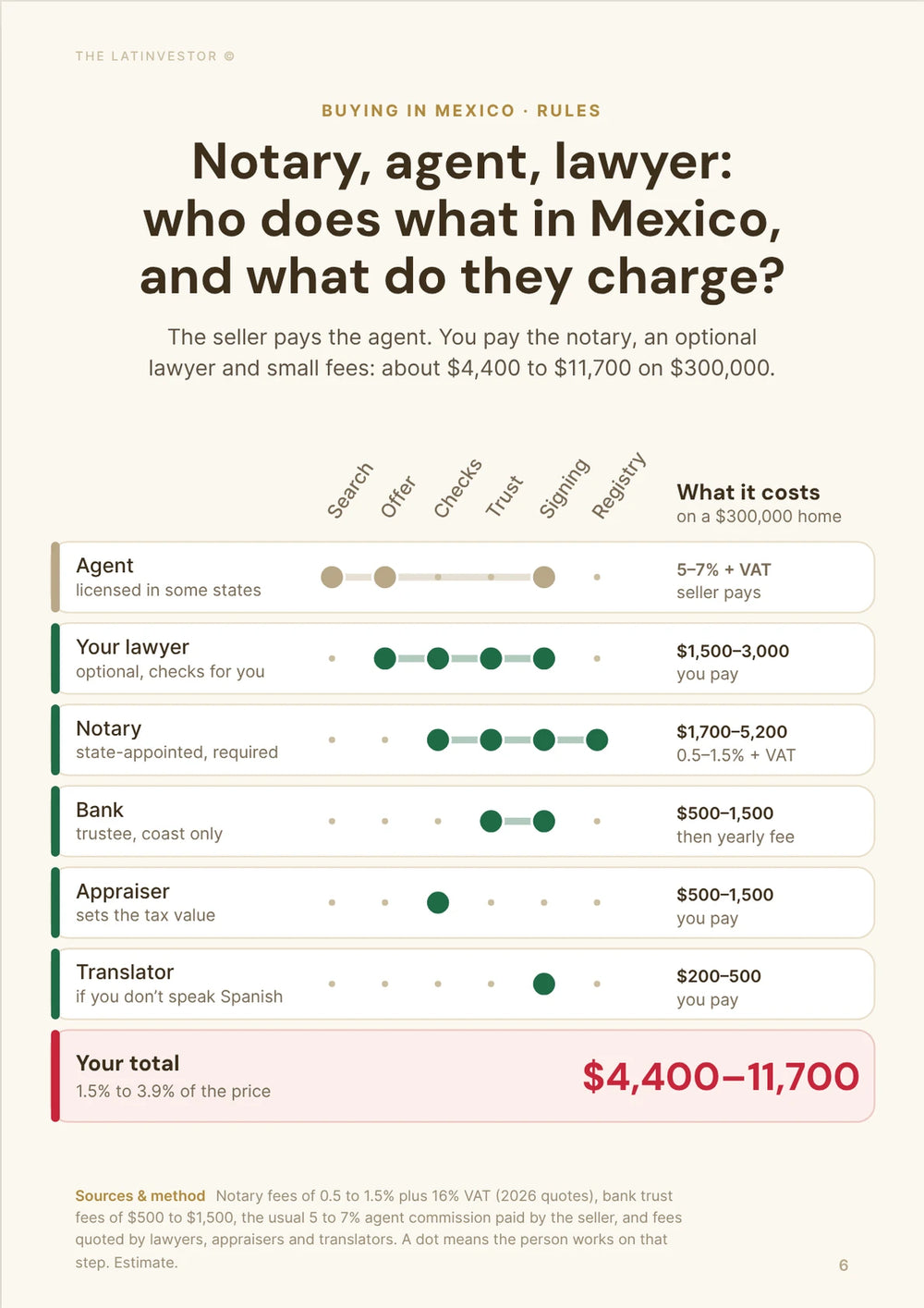
The notary is required: the deed has to be formalized and registered. A private lawyer isn't legally required, but foreign buyers should use one.
The notary handles the transfer, taxes, registry and deed. Your lawyer works for you before you commit money: deposits, pre-sale risks, contract wording and developer promises.
Put it in writing that the lawyer checks title, liens, land use, condo or fraccionamiento approvals and the seller's identity, and gives you a written opinion before the final payment. Notary fees usually run about 0.5% to 1.5% of the price.
How do you avoid buying a problem property in Querétaro?
How do I verify title and ownership history in Querétaro?
Check title at the state's Public Property Registry, and match it with the municipal cadastre.
The key document is the current registered deed, matched against the cadastral account, the seller's ID, their marital status and the property's physical details.
Look back at least to how the seller got clean title, and further for inherited, subdivided or recently regularized property.
Stop if the seller only has a private contract, a developer promise, an assignment letter or ejido-related paper instead of a registered deed.
How do I confirm there are no liens on a property in Querétaro?
Ask the notary to get the lien status from the public registry before you sign the final deed.
Ask about mortgages, court attachments, embargoes, unpaid predial, unpaid water bills, HOA debts and condo assessments. Water and HOA debts never show up in the registry.
The proof you want is a recent certificado de libertad de gravamen, plus paid-up receipts for predial, water and HOA fees.
How do I check zoning and permitted use in Querétaro?
Ask the municipality's land-use office for a land-use report (informe or dictamen de uso de suelo) before you commit.
What counts is the result for that exact parcel, backed by the municipal planning maps. A neighborhood's reputation isn't enough.
The common mistake: buying a lot or mixed-use property near Zibatá, El Refugio, Juriquilla, El Marqués, Corregidora or Bernardo Quintana without confirming that the home or rental use you plan is allowed. Corregidora and El Marqués are separate municipalities with their own offices.
Is the new project you're buying into actually legal?
Often only partly. The city's Semáforo Inmobiliario had rated 555 developments by June 2026: only 26% were green (no violations), 67% yellow (one to three), 4% orange and 3% red.
Land is riskier still. In July 2026 the state counted 1,168 irregular settlements, 435 of them still waiting for regularization. Lots there sell cheap, but without a registered title and often without guaranteed water or power.
Water is the other local check: when the Acueducto II stopped in September 2025, 336 neighborhoods of the metro area went on rotating supply, and the new state water law was still pending in late August 2026.
What to do: look the project up on the Semáforo before you pay a deposit, ask the developer in writing what any yellow flags are and how they were fixed, and walk away from red. Ask for the final water feasibility from the state water commission (CEA), not a provisional contract. For El Marqués or Corregidora, ask the municipality for the project's permits directly.
Can a foreigner still get a mortgage in Querétaro?
Do banks lend to foreigners for homes in Querétaro?
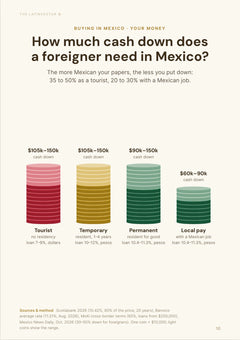
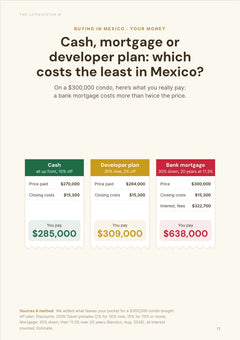
Yes, but most foreign buyers still pay cash. Loans are much easier with Mexican residency, documented income, a local credit history and a big down payment.
Banks aren't lending more either: the number of new mortgages in Mexico rose just 0.3% in the first half of 2026, and the amount lent fell 0.1% in real terms, while Querétaro prices rose 5.6% in a year. That gap is why cash buyers have the upper hand when they negotiate.
Non-residents usually go through cross-border lenders, which finance about 50% to 65% of the price, so plan on putting down 35% to 50%. The usual sticking point is proving foreign income in a way a Mexican lender accepts.
Which banks are most foreigner-friendly in Querétaro?
Start with BBVA, Banorte and Santander, then HSBC and Scotiabank depending on your profile.
They have national mortgage products, large branch networks in Querétaro and more experience with documented foreign income than small local lenders.
Non-residents can ask, but expect a higher down payment, more documents or a request for a stronger Mexican connection.
What mortgage rates are foreigners offered in Querétaro?
No public figure tracks rates for foreigners alone. The benchmarks: loans actually granted averaged 9.99% in June 2026 (ABM), and the average fixed-rate quote was 11.31% in August 2026 (Banxico), with Banxico's own rate on hold at 6.50%.
A foreign resident with a solid file should expect something close to those numbers. Non-residents, weak files and developer financing pay more.
Fixed rates in pesos are the safer choice. Variable or developer financing can look cheaper at first but can raise your payments later.
How much do you pay to buy and keep a home in Querétaro?
What are the total closing costs in Querétaro?
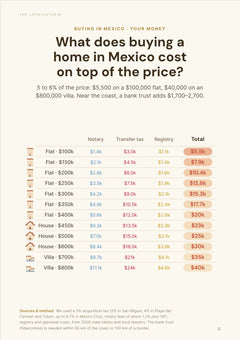
Plan on about 7% to 9% of the purchase price for a standard cash purchase.
The biggest item is the transfer tax (ISAI). The city's 2026 tariff is progressive, from about 2.8% to 6.9%, which works out to about 5.6% on a MXN 2.5 million home, roughly MXN 141,000 (about USD 7,580).
Then come notary fees (about 0.5% to 1.5%), registry fees, certificates, the appraisal, the SRE agreement (MXN 5,250) and legal review. A mortgage or a messy title pushes you toward the top of the range. There's no bank trust to pay for here.
What annual property tax should I budget in Querétaro?
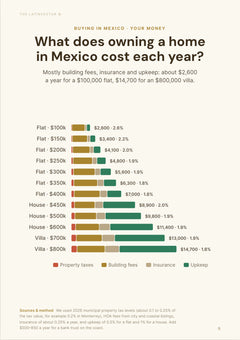
Many standard homes pay roughly MXN 5,000 to MXN 15,000 a year in predial, about USD 269 to USD 806 or EUR 239 to EUR 718. That's our estimate, not an official figure.
Predial is based on cadastral values, not on the price you paid, so ask the seller for the last receipts. The city kept predial unchanged for 2026 and gives discounts for paying early in the year.
How is rental income taxed for foreigners in Querétaro?
A non-resident landlord usually pays 25% Mexican income tax on gross rent, with no deductions.
The tax has to be withheld or declared correctly in Mexico, and the setup depends on whether you're tax resident, have an RFC or rent through a platform. Short stays add the 4% platform withholding, 16% VAT and the 5% state lodging tax.
How much does home insurance cost in Querétaro?
For a home insured at about MXN 4 million, PROFECO found annual premiums from about MXN 4,900 to MXN 25,900 in September 2026 (about USD 264 to USD 1,390, or EUR 235 to EUR 1,240).
The usual cover: fire, earthquake, liability, theft, water damage, contents, and sometimes loss of rent for investment properties.
The price depends mostly on the insured value, then on the cover, the deductible and the construction type.
Our methodology
This article explains what a foreigner can legally own in Querétaro, what visas change, whether short-term renting still pays, how a purchase runs, which checks to make (including on new projects), how financing works and what it costs to buy and hold a home.
The rules come from official sources first: the Foreign Investment Law, the SRE pages and its 2026 fee table, the Income Tax Law and SAT, INEGI's 2026 UMA, Banxico, PROFECO, consular visa guidance, the state's public registry and the city of Querétaro's cadastre, land-use, revenue and transfer-tax pages. Where no official number exists, such as cross-border loan terms, notary fees, predial for a typical home or the purchase timeline, we used recent 2026 market guides or our own estimate and say so in the text.
Prices come from TuLugar's asking-price medians for the city, and the yearly change from the SHF index for the Querétaro metro. The transfer-tax figure is an effective rate calculated on a MXN 2.5 million example under the 2026 tariff. Short-term rental figures come from AirDNA only, and the long-term yield from Inmuebles24 data published by El Economista. Local news on projects, water and fraud comes from Publimetro and N+ reports dated 2025 and 2026.
We checked these figures in October 2026 and converted amounts at about 18.6 pesos per US dollar and 20.9 pesos per euro.
Some limits: asking prices aren't sale prices, consulates apply residency thresholds case by case, bank rates change with each file, and the predial, timeline and yield figures are planning estimates. Have a Mexican notary and accountant confirm your own case.
Key sources used for this analysis include Mexican SRE, SRE costs, Homia's 2026 trust fee comparison, the Foreign Investment Law, Querétaro's public registry, the cadastre transfer procedure, the transfer-tax procedure, the 2026 cadastral values, the land-use page, the subdivisions and condominiums page, INEGI UMA 2026, the Migration Law Regulation, NorthAmericans, the Income Tax Law, Airbnb's Mexico tax page, AirDNA Querétaro, BNBCalc, El Economista (Inmuebles24 data), TuLugar, the SHF price index, Publimetro on the Semáforo Inmobiliario, Publimetro on irregular settlements, Publimetro on the 2025 water cuts, Publimetro on the pending water law, Banxico, BBVA Research, Global Property Mortgages, Rivenza, Compass Abroad, N+ and PROFECO.