Summary
Yes. Across Puerto Vallarta and Bahía de Banderas there are about 31 months of homes for sale once presales are counted, against six months in a balanced market, although active condo listings fell 17.5% to 2,672 in September 2026.
Supply grew much faster than buyers. Teseo Data Lab estimates active condos went from about 800 in 2020 to 3,211 in 2025, while yearly sales only went from about 1,200 to 2,400.
The timing explains the crowded feeling. Projects were planned when sales peaked at about 2,800 in 2023 and were delivered after demand had cooled.
Sellers are pulling back, but buyers are too. Condo closings fell 21.1% from January to September 2026, September alone was down 41.5%, and the median condo now takes 262 days to sell.
Prices are holding better than sales. The year-to-date median condo sale is about $400,000, up 7.7%, but 69% of homes sold below their asking price and the median sale closed 8% below its first price.
The glut is uneven. The Bay Report puts the Romantic Zone at 14 months of resale supply, with its median sale down 6.3%, and Versalles, Fluvial and Amapas at 16 months.
Presales are the biggest pressure. They are 46% of active listings but only 26% of closings, and about 1,534 more units are due by 2028, with 607 of them in 2027.
Airbnb won't absorb the extra units. AirDNA has the average nightly rate down 17.5% to $178, and well-known buildings such as Residences by Pinnacle were offering up to 50% off in October 2026.
Tourism isn't coming to the rescue right now. Airport traffic fell 12.3% from January to September 2026, and international passengers fell 19.4%.
Negotiate on anything generic. With 262 days as the condo median and 8% as the typical cut from the first price, a listing that has sat for most of a year is where you push hardest.
Our take: the market is correcting, not cleared. Ordinary investor condos and presales without a real discount are the most exposed; scarce, well-priced units still sell.

How far has condo supply outrun buyers in Puerto Vallarta?
A long way. Puerto Vallarta has more condos than buyers can absorb, even if the latest numbers show the excess has started to shrink.
The longest series comes from Teseo Data Lab, which covers Puerto Vallarta and Riviera Nayarit. It estimates that active condo inventory grew from roughly 800 units in 2020 to 3,211 in 2025, and projects around 3,500 for 2026. Yearly sales grew too, but much less: from about 1,200 in 2020 to a peak of 2,800 in 2023, then back to roughly 2,400 in 2025.
Divide the stock by yearly sales and the shift is easy to see: about eight months of sales in 2020, 6.4 months at the 2023 peak and roughly 16 months in 2025. It's a rough calculation, not an official MLS measure, but the direction is clear.
The newer Bay Report from Vallarta Seaside, built on MLS closings across Puerto Vallarta and Bahía de Banderas to September 2026, goes further: about 23 months of resale supply, and 31 months once presales are added. Six months is usually seen as balanced.
| Market year (Teseo) | Active condos | Annual transactions | Rough inventory / annual sales |
|---|---|---|---|
| 2020 | ~800 | 1,200 | ~8.0 months |
| 2023 | ~1,500 | 2,800 | ~6.4 months |
| 2025 | 3,211 | ~2,400 | ~16.1 months |
| 2026 projection | ~3,500 | ~2,600 | ~16.2 months |
Why does Puerto Vallarta suddenly feel packed with condos?
Because developers are still delivering projects planned during a much hotter cycle.
Teseo estimates yearly sales jumped from roughly 1,200 in 2020 to 1,800 in 2021, 2,400 in 2022 and 2,800 in 2023. That's when developers were buying land, raising money and launching presales.
Condos take years to build. By the time those towers were finished, sales had already cooled from the 2023 peak. Active inventory went from roughly 1,500 units in 2023 to around 2,000 in 2024 and 3,211 in 2025.
That lag is why condos seem to have appeared everywhere at once. The decisions were spread over several years; the finished units all showed up later.
Did Puerto Vallarta condo demand collapse, or did builders simply add too much?
Builders added too much. Demand cooled, but it didn't collapse.
In Teseo's figures, sales roughly doubled between 2020 and 2025, from about 1,200 to 2,400, while active condos roughly quadrupled, from about 800 to 3,211. Selling times stretched from about 90 days to more than 200.
The Bay Report still counted 1,338 residential closings in the twelve months to September 2026, down 7.5%. People are still buying. They just have far more units to choose from.
| Teseo market series | 2020 | 2023 | 2025 | Change 2020–25 |
|---|---|---|---|---|
| Active condos | ~800 | ~1,500 | 3,211 | ~+301% |
| Annual transactions | 1,200 | 2,800 | ~2,400 | ~+100% |
| Days on market | 90 | 140 | 200+ | More than double |
| Market direction | Tight | Very liquid | Oversupplied | Clear deterioration |
Is Puerto Vallarta condo inventory still getting worse today?
No. Condo inventory is shrinking, which is the best sign yet that the glut has peaked.
Coldwell Banker La Costa's October 2026 report, built on MLS data for Puerto Vallarta and Riviera Nayarit, counted 2,672 active condo listings in September 2026, down 17.5% in a year and down from 2,801 in its August report. New listings were down 32.0% from January to September.
The catch: buyers slowed down too. Only 48 condos closed in September, 41.5% fewer than a year earlier, and new pending sales were also 48, down 51.0%. From January to September, 750 condos closed, down 21.1%. Pending sales are the next few months of closings, so the slowdown isn't over.
So "recovery" is too strong a word. Owners are listing less, which helps, but buyers aren't coming back yet.
| Coldwell Banker MLS condo measure | September 2026 | Year-over-year change |
|---|---|---|
| Active listings | 2,672 | -17.5% |
| New listings, January to September | — | -32.0% |
| Closed sales in September | 48 | -41.5% |
| Closed sales, January to September | 750 | -21.1% |
| New pending sales in September | 48 | -51.0% |
| Median days on market | 262 days | +10.1% |
Are Puerto Vallarta condos taking too long to sell?
Yes. The median condo that sold in September 2026 took 262 days to find a buyer, 10.1% longer than a year earlier.
Teseo's longer series shows days on market rising from about 90 in 2020 to 140 in 2023, 160 in 2024 and more than 200 in 2025. Across all homes on the bay, the Bay Report puts the median at 229 days, up 13.9%.
Almost nine months is a long time to carry HOA fees, property tax and an empty unit. Good condos still sell fast; the typical one now needs a patient seller.
Are Puerto Vallarta condo sellers cutting prices?
Yes, but at the closing table rather than on the listing. In the Bay Report's twelve months to September 2026, 69% of homes sold below their asking price, only 11% above, and the median sale closed 8% below its first price.
Single deals show the range. SearchPV recorded an Agave Vallarta condo in Emiliano Zapata closing at $600,000 after being listed at $685,000, about 12.4% less. A Serdan condo listed at $299,000 sold for $275,000, about 8% below asking. An Indah unit in Lower Conchas Chinas closed at $1.77 million against $1.879 million, roughly 5.8% lower.
Others held up. A Loma Linda condo in Amapas sold for $675,000 against $695,000, only about 2.9% below asking.
The spread matters more than any average. Buyers have leverage when several similar units are for sale; sellers of genuinely good ones don't need to slash.
How much can you negotiate on a Puerto Vallarta condo right now?
Start around 8% below the first asking price, which is the median cut in the Bay Report, and go further on units that have sat past the 262-day condo median.
Ask for the listing history: the original price, every cut and the date it was listed. A seller who has already dropped once and waited most of a year knows what the market thinks. Then compare price per m² with the other units for sale in the same tower; in a building with four or five similar listings, the cheapest one sets the real price.
Push hardest on generic one- and two-bedroom investor units, high HOA fees and anything with a weak rental record. Don't expect much on scarce oceanfront units or well-priced condos that sell in a couple of months: only 11% of sales closed above asking, but those are the ones that do.
Why haven't Puerto Vallarta condo prices crashed?
Because too much supply shows up first as slow sales, not as forced selling.
Coldwell Banker La Costa puts the year-to-date median condo sale at about $400,000, up 7.7%, and the September median at $432,500, up just 1.6%. The Bay Report's median sale across all homes is about $415,000, up 9.2%, but it says that rise mostly reflects buyers choosing bigger, higher-end units; its median price per m² for condos is flat at about $3,948.
Long-time owners can also wait. MLSVallarta estimates the average condo sale price rose from roughly $310,000 in 2015 to about $490,000 in 2025. Someone who bought years ago has a paper gain and no reason to accept a low offer tomorrow.
So published prices stay firm while selling gets harder underneath. The pain today is time on market and the discount at closing, not a headline crash.
Which Puerto Vallarta neighborhoods have the biggest condo oversupply?
The Romantic Zone is the one where prices are giving way. The Bay Report puts its median sale down 6.3% over the twelve months to September 2026, with about 14 months of resale supply.
Versalles and Fluvial, Amapas, and Marina Vallarta with the Hotel Zone each sit at about 16 months of resale supply, before counting presales. Prices there are still up in the report, but Marina Vallarta's +83.0% comes from a small mix of sales and shouldn't be read as a trend.
The Romantic Zone still has real demand. The problem is that buyers can compare dozens of similar one- and two-bedroom condos with rooftop pools, gyms and rental potential. Scarcity has gone.
Versalles shows the same change in a different way. MLSVallarta says the wider Francisco Villa area was only about 2% of sales in 2015 but more than 10% by 2025. The neighborhood became popular, developers followed, and owners now face much more competition.
| Area (Bay Report, 12 months to Sept. 2026) | Median sale price change | Months of resale supply |
|---|---|---|
| Romantic Zone | -6.3% | 14 |
| Versalles and Fluvial | +7.6% | 16 |
| Amapas | +4.4% | 16 |
| Marina Vallarta and Hotel Zone | +83.0%* | 16 |
| Whole bay, presales included | — | 31 |
*Based on a small number of sales; the report itself says to read it with caution.
Are new condo projects still making Puerto Vallarta's oversupply worse?
Yes. About 1,534 presale units are due for delivery by 2028, more than the 1,338 homes sold across the whole bay in the latest twelve months.
The Bay Report spreads them out: about 401 in 2026, 607 in 2027 and 480 in 2028. MLSVallarta's development map was already tracking around 60 projects across Puerto Vallarta and Riviera Nayarit, with presales still being marketed in Versalles and the Romantic Zone.
Presales compete head-on with resale owners. They make up 46% of active listings but only 26% of closings, and they ask more: about $4,194 per m² against $3,762 for resale condos. A buyer looking at a five-year-old $400,000 condo also sees a new $400,000 presale with staged payments and fresh amenities.
The fall in new listings helps, but the pipeline is already built or half-built. That backlog will keep a lid on ordinary condo prices for a while.
| Presale pipeline (Bay Report, Sept. 2026) | Figure |
|---|---|
| Units due in 2026 | ~401 |
| Units due in 2027 | ~607 |
| Units due in 2028 | ~480 |
| Presale share of active listings | 46% |
| Presale share of closings | 26% |
| Condo price per m², presale vs resale | $4,194 vs $3,762 |
Is a presale condo in Puerto Vallarta too risky right now?
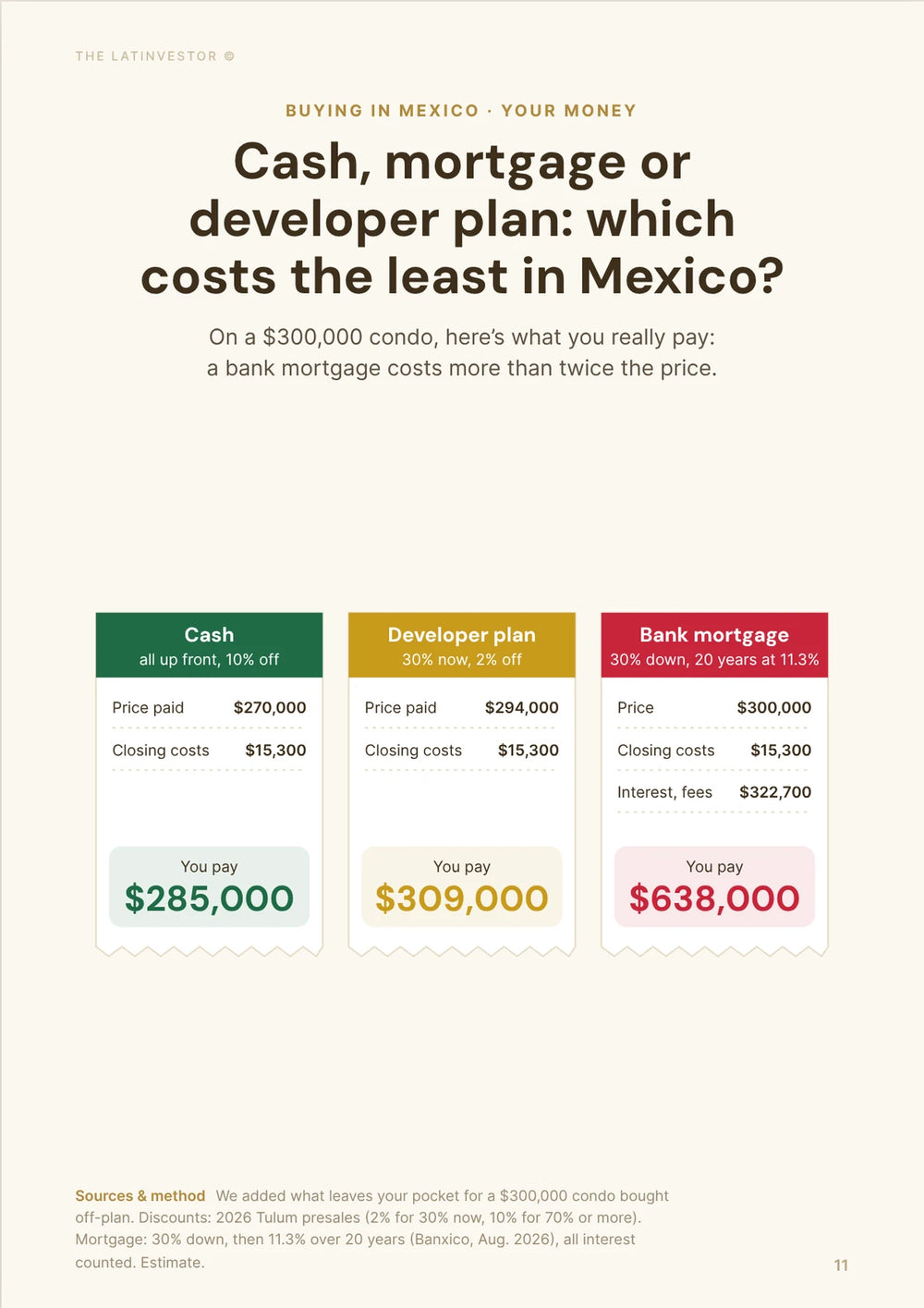
For most buyers, yes, unless the developer gives a real discount. You pay about 11% more per m² than for a resale, for a unit that will be delivered into the busiest delivery year, 2027, with about 607 units due.
The bigger risk is the developer's cash. Presales are almost half of the listings but only about a quarter of sales; a developer who sells slowly has less money to finish, and that is when delivery dates slip and specs get cut.
If you still go ahead: check that the developer owns the land, has the building permits, has registered its sales contract with Profeco, and that the contract has penalties for late delivery. Pay in stages tied to construction progress, not up front. And price the unit against finished buildings nearby, where you can see the real view, the real HOA fee and real rental results.
Can Airbnb demand absorb Puerto Vallarta's extra condos?
No. Puerto Vallarta has a large vacation-rental market, but not enough demand to make every investor condo work.
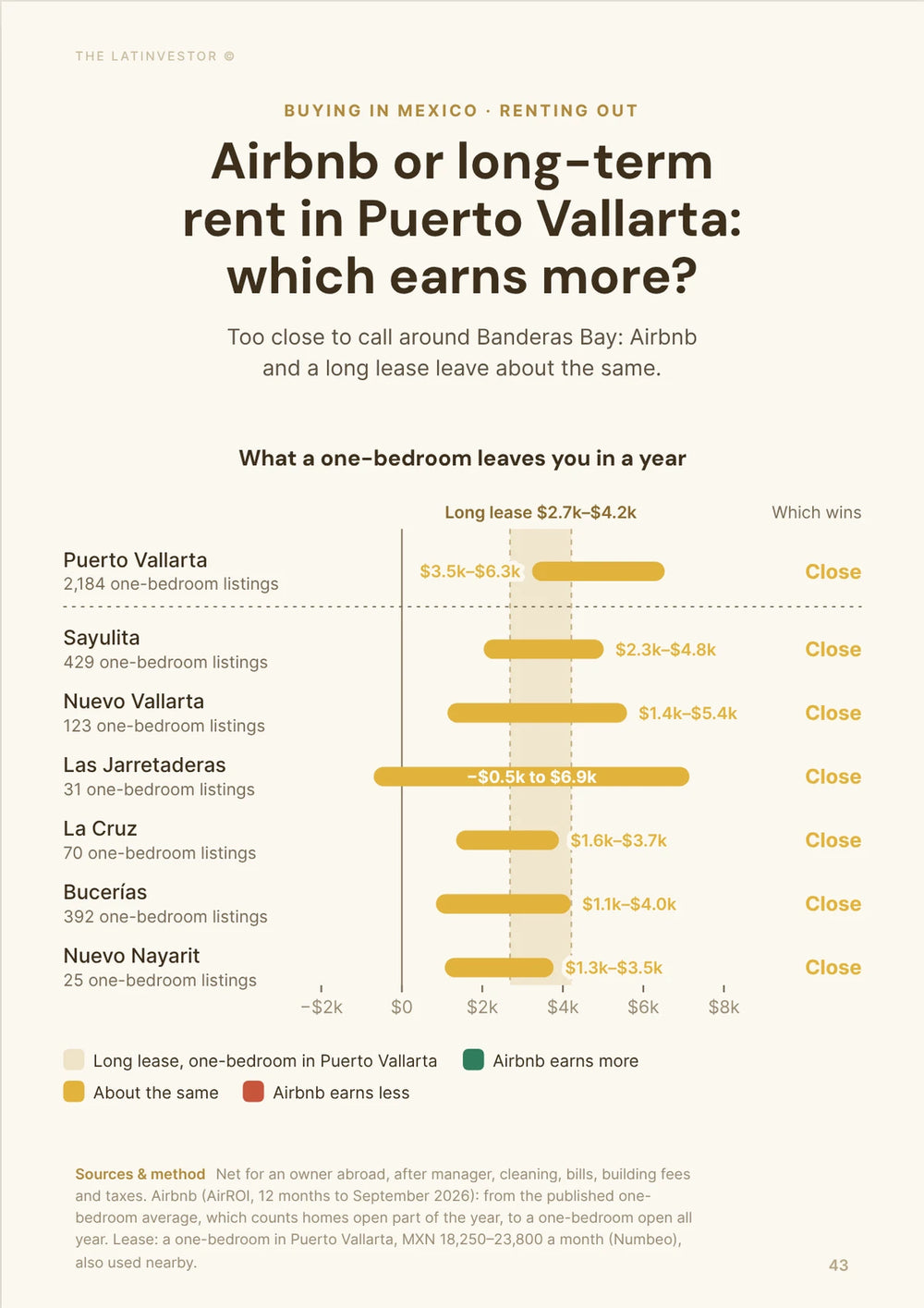
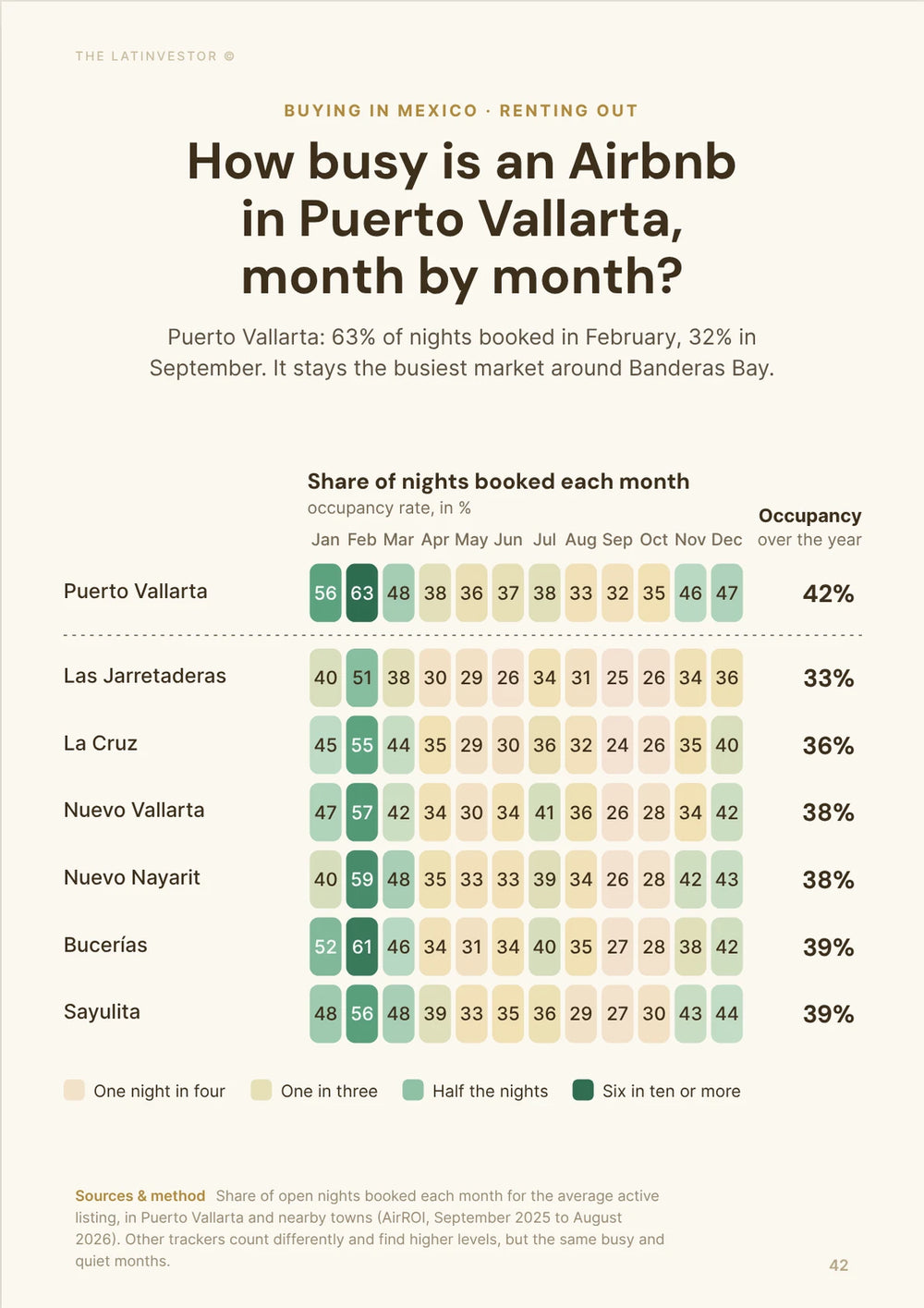
AirDNA tracks about 5,900 active short-term rentals in Puerto Vallarta, Jalisco, in September 2026. Over the twelve months to September, occupancy was around 57% and the average booked nightly rate $178.
The number that matters is revenue per available night (RevPAR), which combines both. AirDNA puts it at about $101, down 10.4% in a year, with the nightly rate down 17.5%. Hosts are filling nights by charging less.
AirDNA also shows active listings down 54.3% in a year, which looks more like a change in how it counts listings than thousands of rentals disappearing, so we wouldn't lean on it. The pricing data is the useful part.
| AirDNA Puerto Vallarta measure | Current level | Year-over-year change |
|---|---|---|
| Active short-term rentals | ~5,900 | Dataset shows sharp decline* |
| Occupancy | 57% | — |
| Average daily rate | $178 | -17.5% |
| RevPAR | $101 | -10.4% |
| Average annual revenue per listing | $31,300 | — |
*AirDNA's 54.3% drop in active listings probably reflects a coverage change, so treat it with caution.
Are Puerto Vallarta vacation rentals having to discount more?
Yes. In October 2026, PVRPV's deals page listed about 40 discounted rentals, mostly at 20% to 30% off.
The names matter more than the percentages: up to 50% off at Residences by Pinnacle in Amapas, 40% at a V177 penthouse in Old Town, and 20% to 30% at Harbor 171, Molino de Agua and Sayan Beach. These are established buildings in strong locations, not condos miles from the beach.
October is low season, and discounts in slow weeks are normal. But if well-known buildings have to cut this hard to fill dates, be careful with any rental projection that assumes high rates most nights of the year.
Is Puerto Vallarta tourism growing fast enough to support all these condos?
No, not right now. Grupo Aeroportuario del Pacífico counted about 4.54 million passengers at Puerto Vallarta airport from January to September 2026, down from 5.17 million a year earlier, a 12.3% drop.
International traffic fell 19.4% over those nine months. That matters because US and Canadian visitors are the main pool of second-home and vacation-rental buyers. Hurricane Simón then passed off the coast on October 11 and closed the airport until October 13, just before high season.
Nine weak months don't prove a lasting decline. But nothing in the numbers says visitor growth will quickly soak up the extra condos.
Didn't Puerto Vallarta's huge price boom justify building all these condos?
It explains why developers built them, not that buyers would take every unit.
MLSVallarta estimates the average condo price climbed from around $310,000 in 2015 to roughly $490,000 in 2025, close to 60% more. Some areas rose faster: Central North roughly 150% over the decade, while Central South and the Hotel Zone roughly doubled.
Higher prices make land and construction look profitable, and strong presales make financing easier. But building is slow: a shortage leads to years of construction that lands after the shortage is gone. Puerto Vallarta is living through that delay now.
Could local population growth eventually absorb Puerto Vallarta's extra condos?
Only partly. Much of the new stock was never priced for local households.
The new-build market targets foreign retirees, second-home owners, Mexican buyers from bigger cities and short-term-rental investors. A $400,000 ocean-view one-bedroom and the home a local family needs are both "housing," but they don't serve the same buyer.
Local growth helps over the long run, as neighborhoods mature and prices adjust. It can't be counted on as instant demand for thousands of tourist-oriented units.
Will Puerto Vallarta's condo oversupply fix itself?
Probably, but it will take time.
The first half is happening: active condo listings are down 17.5% and new listings down 32.0%. Owners and developers are putting less on the market.
The second half isn't there yet. Condo closings are down 21.1% this year, the median condo needs 262 days to sell, and about 1,534 presale units are still to be delivered by 2028. The market needs fewer new units and steadier sales at the same time before the excess is gone.
Which Puerto Vallarta condos are most at risk now?
Generic condos priced like premium ones are the most exposed.
Liquidity can vanish inside a single building. SearchPV's building pages have shown Avalon in Amapas with four active condos against three sales in a year, and Villas Tizoc with six active listings and only one sale. These samples are tiny, so the ratios jump after a single deal, but they show how a tower can stall while the city still trades.
Well-priced units still move. The Loma Linda condo in Amapas sold in 59 days at about 97% of asking.
Today buyers can punish an ordinary layout, a weak view, a high HOA fee, an inflated price or a mediocre rental record, because another condo is usually for sale nearby.
Who has the advantage in Puerto Vallarta's condo market today?
Buyers, in most buildings. Sellers of genuinely scarce units can still hold their price.
Buyers can compare resales with presales, several buildings in the same neighborhood and several units in the same tower. Long selling times mean there's no need to rush.
The presale premium is the first thing to question. At about $4,194 per m² against $3,762 for resale condos, a presale should offer something concrete for the extra: a better location, better construction, real payment terms or amenities nobody else has.
For sellers, pricing off the most optimistic listing in the building no longer works. Buyers can see the alternatives.
So, are there too many condos in Puerto Vallarta now?
Yes. There are still more condos than buyers, but the excess has started to shrink.
The case doesn't rest on one number. Condo inventory grew several times faster than sales after 2020, selling times stretched to almost nine months, presales keep arriving, and the Romantic Zone, Versalles and Amapas each carry well over a year of resale supply.
The good news: active condo listings fell 17.5% to 2,672 and new listings are down 32.0%. Prices have not collapsed. The bad news: sales haven't recovered, with closings down 21.1% this year and pending sales down 51.0% in September.
Puerto Vallarta built too many interchangeable condos for the buyers chasing them. Oceanfront units, great views, good layouts and realistic prices still sell. The hard part is the large middle of modern investor condos with dozens of similar options nearby.
For now, it's an oversupplied market that has started to heal. Buyers have the upper hand in most buildings, and it will take a longer stretch of shrinking inventory and better sales before the excess is really gone.
Our methodology
This article estimates whether Puerto Vallarta has more condos than buyers can absorb. We look at supply, sales, selling times, prices, neighborhoods, buildings, new projects, vacation rentals and tourism, rather than relying on visible construction or one citywide number.
Recent market figures come from MLS data. Coldwell Banker La Costa's October 2026 report (Puerto Vallarta and Riviera Nayarit, to September 2026) gives condo listings, closings, pending sales, prices and days on market. The Vallarta Seaside Bay Report (MLS closings across Puerto Vallarta and Bahía de Banderas, twelve months to September 2026) gives months of supply, neighborhood trends, presale shares and the delivery pipeline. Teseo Data Lab gives the longer 2020–2025 inventory and sales series, MLSVallarta the 2015–2025 price history and development map, and SearchPV individual closings and building data.
Short-term rental figures come from AirDNA (twelve months to September 2026), current rental promotions from PVRPV's deals page, and airport traffic from Grupo Aeroportuario del Pacífico's monthly releases. We keep the datasets separate because they cover different areas and periods.
We checked these figures in October 2026. Prices are quoted in US dollars, as the local market does; where we convert, we use about 18.6 pesos per US dollar and 20.9 pesos per euro.
Limits: the inventory-to-sales ratio from Teseo's figures is our rough calculation, not an official measure. Small neighborhood and building samples can swing after one sale. Asking prices are not sale prices, and AirDNA's year-over-year listing count is unreliable.
Key sources used for this analysis include: Coldwell Banker La Costa's October 2026 market pulse, the Vallarta Seaside Bay Report, Teseo Data Lab's Puerto Vallarta–Riviera Nayarit real-estate outlook, MLSVallarta's 2015–2025 market review, MLSVallarta's development-map review, SearchPV's Agave Vallarta closed sale, SearchPV's Serdan closed sale, SearchPV's Indah closed sale, SearchPV's Loma Linda closed sale, SearchPV's Avalon market analytics, SearchPV's Villas Tizoc market analytics, AirDNA's Puerto Vallarta short-term-rental overview, PVRPV's current rental promotions, Grupo Aeroportuario del Pacífico's passenger releases and AP on Hurricane Simón.