
Summary
Not across the whole city. Propiedades.com has the average Puerto Vallarta apartment rent at 0.0% change between April 2025 and October 2026, while Versalles is up 24.4% and Emiliano Zapata 22.3%.
High and rising are two different things. Rents went through several years of repricing and stayed there, but the citywide push has stopped.
Which figure you see depends on the website. Pincali's 86 listed apartments have a median ask of MXN 35,000 (USD 1,880) a month, while Propiedades.com's neighborhood averages run from about MXN 9,500 in Ixtapa to MXN 34,400 in Marina Vallarta.
Growth is now very local. Versalles and Emiliano Zapata are still climbing, Marina Vallarta and Zona Hotelera Norte are flat, and 5 de Diciembre is down 7.4%.
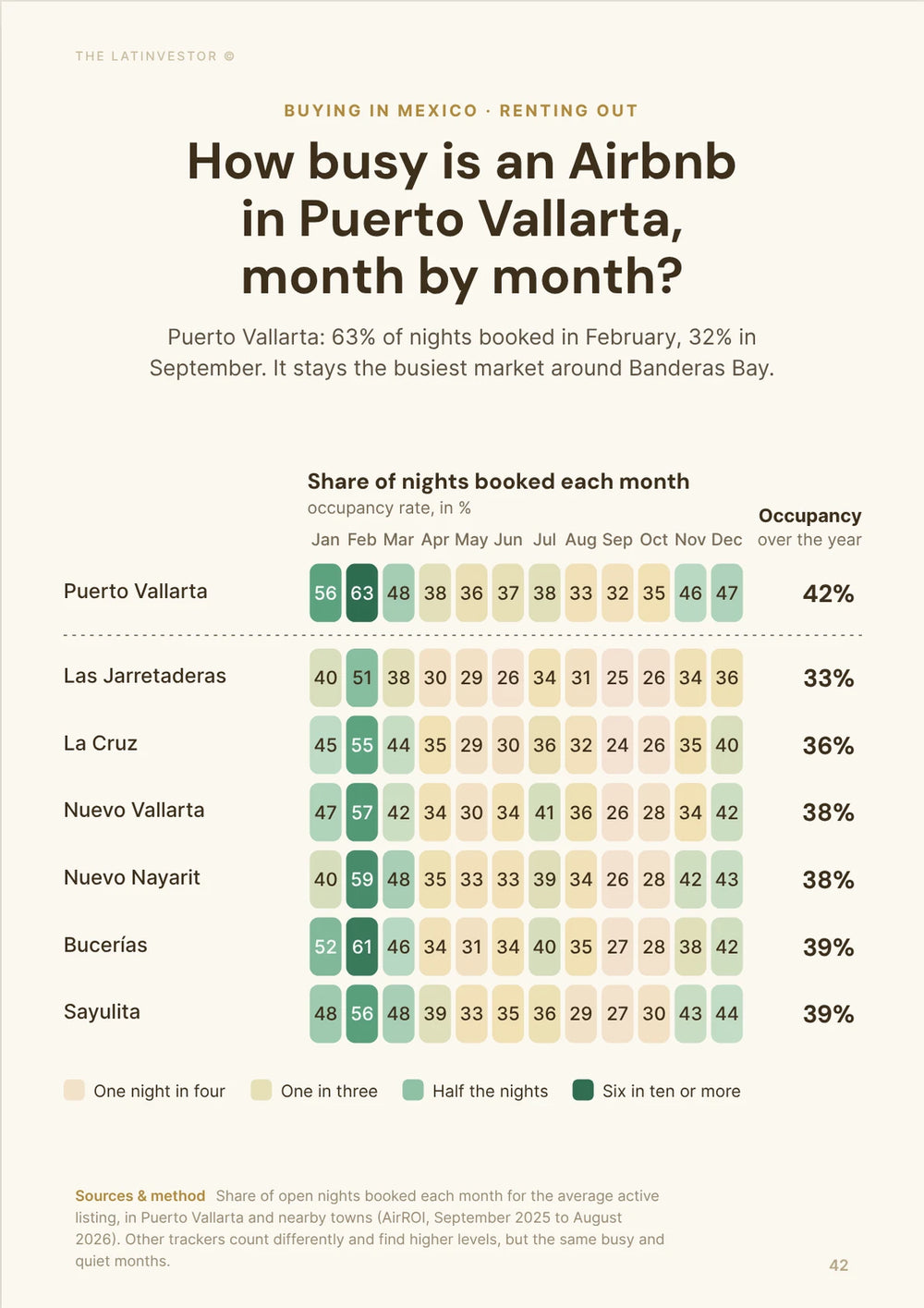
Short-term rentals are losing pricing power. AirDNA has the average nightly rate down 17.5% to US$178 and RevPAR down 10.4%, even as occupancy rose to 57%.
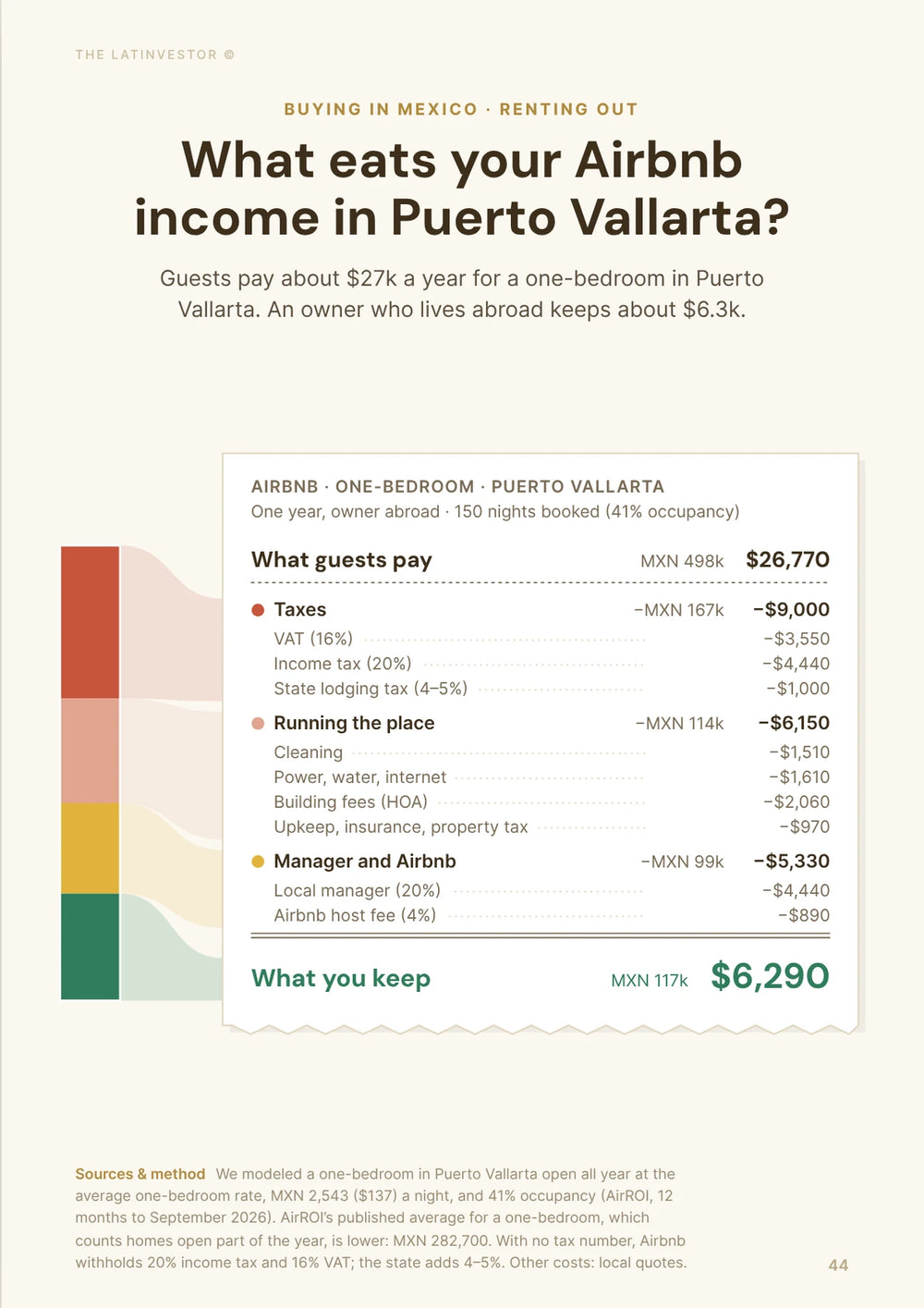
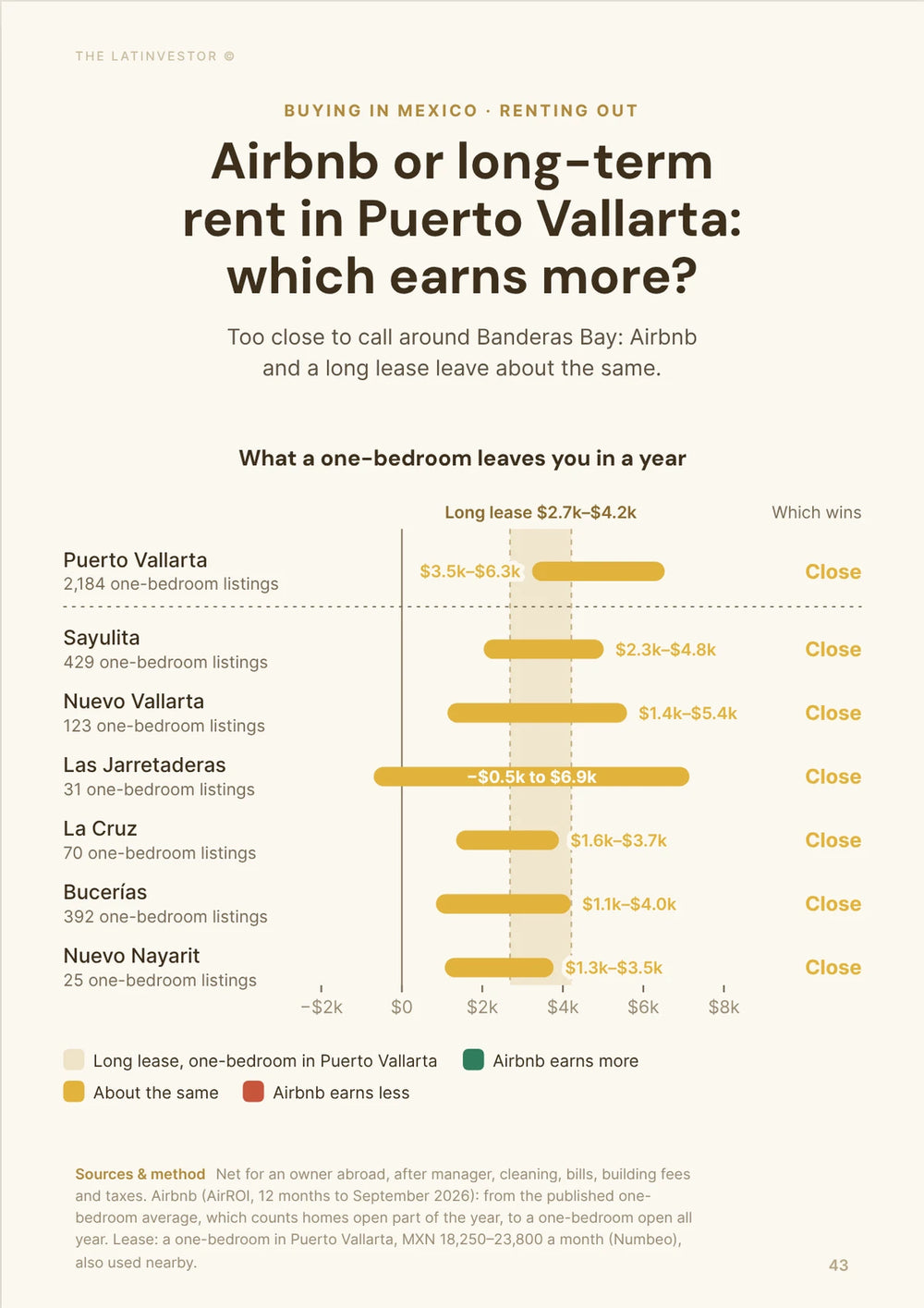
The Airbnb-to-lease switch deserves a real calculation. AirDNA's average listing grosses about US$31,300 a year before costs, against MXN 420,000 (USD 22,600) for a year of long-term rent at the Pincali median.
Tourism is the main brake. The airport handled about 4.54 million passengers from January to September 2026, 12.3% fewer than a year earlier, with international traffic down 19.4%.
Sales are slowing too. Closed condo sales are down 21.1% this year and the median condo takes 262 days to sell, so more owners may rent instead of selling.
Prices have run ahead of rents. Pincali's sale and rent medians imply a gross yield of about 5.2% before HOA fees, management, vacancy and taxes.
Cheaper rents still exist inland and in older stock, around MXN 9,500 in Ixtapa and MXN 15,700 in Las Glorias or 5 de Diciembre.
Flat rents are no relief for locals. In a 2026 survey, 73.0% of Puerto Vallarta respondents said they felt rising housing costs or displacement.
Renters have more leverage than a year ago, especially on furnished, foreign-facing condos. Compare any ask with the neighborhood average, and check water supply and storm clauses before signing.
The likely next phase is a high, uneven plateau, not a crash. Another citywide surge would need tourism to come back and new supply to dry up.

Is the citywide rent average really flat?
Yes. Puerto Vallarta rents have stopped rising citywide, even though a few popular neighborhoods are still getting more expensive.
The clearest benchmark is Propiedades.com. Its October 2026 rental data shows the average apartment rent across Puerto Vallarta at 0.0% change between April 2025 and October 2026.
Some neighborhoods tell a very different story. Versalles is up 24.4% over the same period and Emiliano Zapata 22.3%. Marina Vallarta is flat, Zona Hotelera Norte is up just 0.9%, and 5 de Diciembre is down 7.4%.
That gap is the story now. Rents went through a big repricing over the previous several years and stayed at that higher level, but a new citywide wave is hard to find in the data.
The short-term market points the same way. AirDNA (data updated October 20, 2026) puts Puerto Vallarta's average nightly rate at US$178 over the 12 months to September 2026, down 17.5% year over year. The market that helped landlords push returns up is now moving the other way.
So Puerto Vallarta is an expensive rental market where growth has become very local. The neighborhood matters much more than the city trend.
| Puerto Vallarta rental indicator | Current level | Change (Apr 2025 to Oct 2026) | What it suggests |
|---|---|---|---|
| Citywide long-term apartment rents | City benchmark | 0.0% | Citywide growth has stalled |
| Versalles apartment rents | MXN 19,675/month | +24.4% | Still rising (small sample) |
| Emiliano Zapata apartment rents | MXN 17,775/month | +22.3% | Still rising (very small sample) |
| Zona Hotelera Norte apartment rents | MXN 20,442/month | +0.9% | High but flat |
| 5 de Diciembre apartment rents | MXN 15,740/month | -7.4% | Softening |
| Airbnb average daily rate | US$178/night | -17.5% YoY | Short-term pricing is weakening |
Why do Puerto Vallarta rent figures look so different depending on where you look?
Because each website is measuring a different slice of the rental market.
Pincali currently shows a median asking rent of MXN 35,000 (USD 1,880) a month across 86 apartments. TuLugar's October 2026 report puts the citywide condo asking rent at about USD 1,364 (MXN 25,400). Inmuebles24 lists 192 apartments, with Nuevo Ixtapa averaging about MXN 16,500.
Propiedades.com gives numbers that look much cheaper: about MXN 19,675 in Versalles, MXN 17,775 in Emiliano Zapata, MXN 15,700 in Las Glorias and MXN 9,500 in Ixtapa.
Most of the gap comes from listing mix. Pincali carries a lot of newer, furnished condos with pools, aimed at foreigners, seasonal residents and well-off Mexican renters. Its top listings are in Marina Vallarta and reach MXN 140,000 a month. Propiedades.com captures more ordinary housing alongside that premium stock.
So an "average Puerto Vallarta rent" can mislead quickly. A foreigner looking for a furnished two-bedroom with a pool may really face MXN 30,000 to 40,000. A local household looking inland is shopping in a different market.
| Source / market | Current figure | Listings | Market captured |
|---|---|---|---|
| Pincali Puerto Vallarta apartments | MXN 35,000 median | 86 | Heavily premium/furnished |
| TuLugar Puerto Vallarta condos | USD 1,364 median | Not stated | Citywide asking rents |
| Propiedades.com Versalles | MXN 19,675 | 10 | Mixed neighborhood stock |
| Propiedades.com Emiliano Zapata | MXN 17,775 | 5 | Central neighborhood |
| Propiedades.com Ixtapa | MXN 9,500 | 7 | Lower-cost outer market |
Which Puerto Vallarta neighborhoods are still seeing rents rise?
Mainly Versalles and Emiliano Zapata. Rent growth is concentrated in a few central neighborhoods, not spread across the city.
Propiedades.com has Versalles up 24.4% between April 2025 and October 2026, and Emiliano Zapata up 22.3%, against 0.0% for the city.
Be careful with those percentages. The samples are tiny: 10 active listings in Versalles and 5 in Emiliano Zapata. A couple of expensive new apartments coming onto the market can move the average a lot.
Versalles still deserves some confidence because other evidence lines up. MLS Vallarta found that the Francisco Villa area, which includes Versalles, was about 2% of regional property sales in 2015 and more than 10% by 2025.
That is a big shift. Buyers and renters have moved beyond Zona Romántica and the beachfront, and the neighborhoods taking that demand have repriced.
| Area | Average apartment rent | Change since April 2025 | How much confidence we put in it |
|---|---|---|---|
| Versalles | MXN 19,675 | +24.4% | Moderate (10 listings, backed by sales data) |
| Emiliano Zapata | MXN 17,775 | +22.3% | Low (5 listings) |
| Zona Hotelera Norte | MXN 20,442 | +0.9% | Good (24 listings) |
| Marina Vallarta | MXN 34,431 | 0.0% | Good (34 listings) |
| 5 de Diciembre | MXN 15,740 | -7.4% | Good (22 listings) |
Is Versalles still getting more expensive?
Yes, but most of its big repricing has already happened.
Propiedades.com puts the average Versalles apartment at about MXN 19,675 a month, up 24.4% since April 2025. Newer buildings with amenities ask much more: furnished one-bedrooms often list between about MXN 23,000 and 35,000.
The neighborhood now has restaurants, new condo buildings, easy access to the Hotel Zone and a strong name among foreign renters. TuLugar describes it as a fairly walkable restaurant hub for residents, remote workers and expats.
Good Versalles apartments should keep getting more expensive over time, but repeating the recent pace will be harder. Renters have found it, developers have built there, and new towers keep adding units that compete with each other.
Are beachfront and luxury rents in Puerto Vallarta still going up?
No. Premium rents are still very high, but they are no longer rising automatically every year.
Marina Vallarta shows the price level. Propiedades.com puts the average apartment there at about MXN 34,431 a month, with 0.0% change since April 2025 across 34 listings.
Zona Hotelera Norte is similar: about MXN 20,442 on Propiedades.com, up only 0.9%. TuLugar's asking median there is higher, about USD 1,909 (MXN 35,500), because it captures more beachfront towers.
So a renter can still face MXN 30,000, 40,000 or more for the right waterfront apartment, while rent growth in those areas has stopped.
New buildings add pressure. An older condo now competes with towers that offer rooftop pools, gyms and coworking spaces, so owners of ordinary units can't raise rents just because they're near the beach.
Are Puerto Vallarta Airbnb prices still rising?
No. Nightly prices are falling sharply.
AirDNA's Puerto Vallarta data, updated October 2026, covers 5,943 active short-term rentals. Over the 12 months to September 2026, occupancy averaged 57%, up 13.3% year over year, while the average daily rate fell 17.5% to US$178.
RevPAR, which combines occupancy and price, is down 10.4% to about US$101. Hosts are filling more nights but earning less per available night.
AirDNA also shows average yearly revenue of US$31,300 per active listing, up 62.3%. Treat that with caution: the number of active listings fell 54.3% over the same period. When half the pool drops out, the remaining listings look better on average even if each available night earns less.
For rents, ADR and RevPAR are the cleaner signals. Both are pointing down.
| Puerto Vallarta short-term rental metric | Latest level | YoY change | Read |
|---|---|---|---|
| Active listings | 5,943 | -54.3% | Big change in tracked supply |
| Occupancy | 57% | +13.3% | More available nights are booked |
| Average daily rate | US$178 | -17.5% | Guests pay less per night |
| RevPAR | US$101 | -10.4% | Earning power per available night is down |
| Annual revenue per active listing | US$31,300 | +62.3% | Distorted by the shrinking listing pool |
Should Airbnb owners in Puerto Vallarta switch to long-term tenants now?
For many ordinary condos, it's worth running the numbers now, because the gap between the two has narrowed.
AirDNA's average active listing grosses about US$31,300 a year. That is before platform fees, cleaning, management, utilities, furnishing wear and the state lodging tax. A long-term tenant at the Pincali median of MXN 35,000 a month brings in MXN 420,000 (USD 22,600) a year, with far fewer of those costs. And the AirDNA average includes large villas; a typical one- or two-bedroom condo earns less.
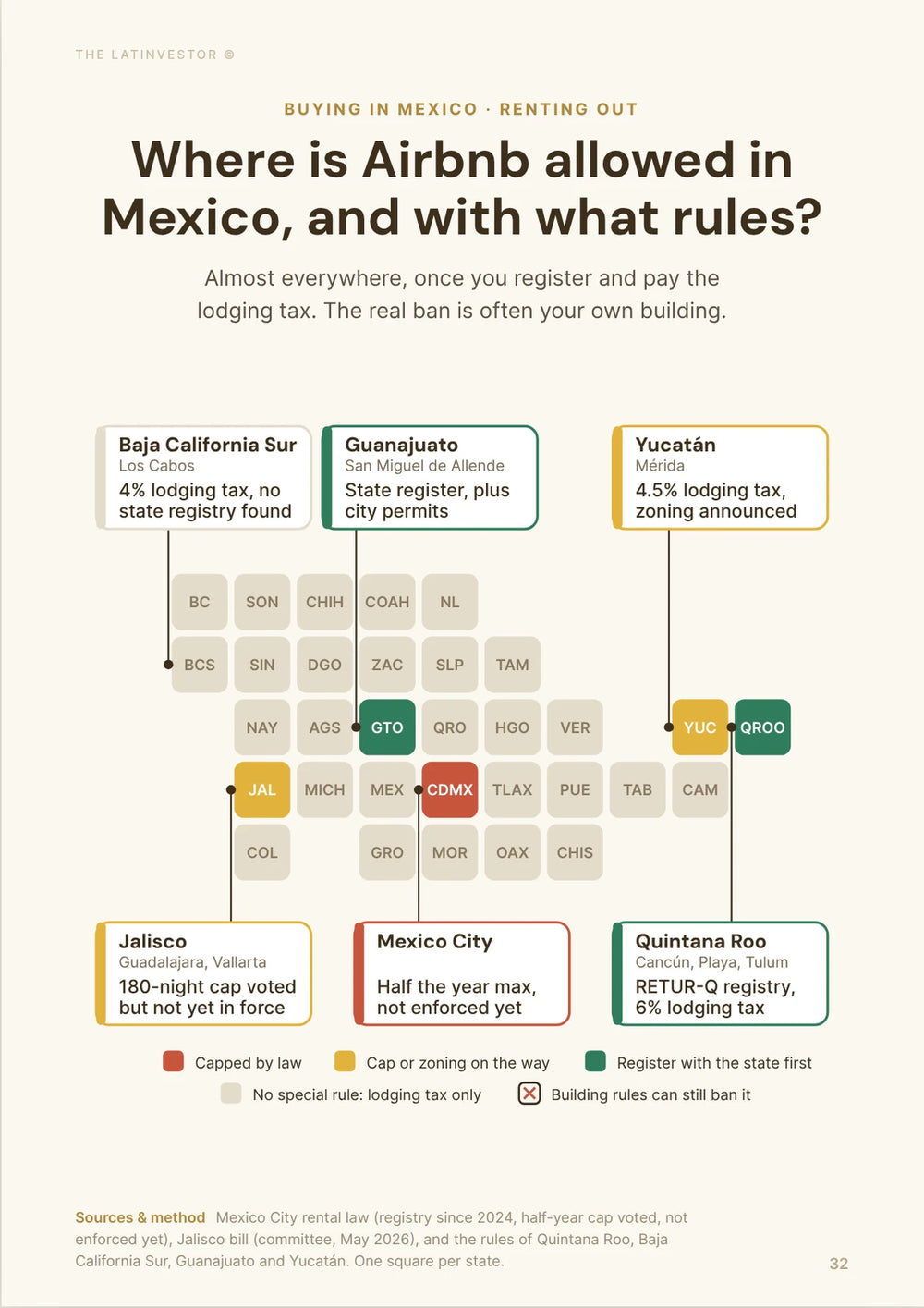
There is also rule risk. On May 25, 2026, a Jalisco Congress committee approved a 180-night yearly cap on short-term rentals of homes that aren't the owner's main residence, in "high tourism pressure" zones, mainly Guadalajara and Puerto Vallarta. The full Congress hasn't voted. Separately, a Jalisco state deputy proposed extra levies of 5% to 11% on owners running several short-term rentals. Neither is law yet, but both push owners toward monthly and long-term leases, which adds supply to the long-term rental market.
What to do: take your last 12 months of Airbnb payouts, subtract every cost, and compare the result with a 12-month lease at your neighborhood's real average, not the top ask on Pincali. If the lease comes within reach, the quieter income and lower wear often win. If you switch, a furnished condo in Versalles, Marina Vallarta or the Hotel Zone is where long-term demand from remote workers and seasonal residents is strongest.
Is weaker tourism taking pressure off Puerto Vallarta rents?
Yes, especially for apartments aimed at foreign visitors.
Grupo Aeroportuario del Pacífico recorded about 4.54 million passengers at Puerto Vallarta airport from January to September 2026, against 5.17 million a year earlier, a 12.3% drop.
International traffic is the weak point: down 19.4% over those nine months, to about 2.27 million, though September alone was down a smaller 12.0%. Domestic traffic fell only 3.7%. Canadians and Americans fill a large share of high-season and furnished rentals, so this hits the foreign-facing end of the market hardest.
October added a scare. Hurricane Simón passed off the coast and GAP shut the airport to commercial flights until October 13, 2026. The city escaped major damage, but storm headlines just before high season rarely help bookings.
This doesn't mean long-term rents will collapse. Residents create housing demand on their own. But landlords counting on visitors and seasonal foreigners have less room to push prices while international arrivals keep falling.
Is all the new condo construction slowing Puerto Vallarta rent growth?
At the upper end, yes. New condos give renters more choice and make repeated increases harder.
MLS Vallarta describes the bay as being in another active building cycle, across Puerto Vallarta and Riviera Nayarit. Marina Vallarta is filling its last development sites, and Versalles has become one of the busiest growth areas.
The sales side is slowing at the same time. Coldwell Banker La Costa's MLS figures show closed condo sales down 21.1% from January to September 2026, with condos taking a median 262 days to sell. Condo listings for sale also fell 17.5% to 2,672.
That matters for rents. An investor who can't sell, or whose new unit was meant for Airbnb, has three options: live in it, rent it nightly, or find a long-term tenant. With nightly rates down, more of them will pick the third, which adds supply to the monthly market.
None of this helps local workers much. Most new stock is expensive and does little for the shortage of affordable housing.
Have Puerto Vallarta home prices risen faster than rents?
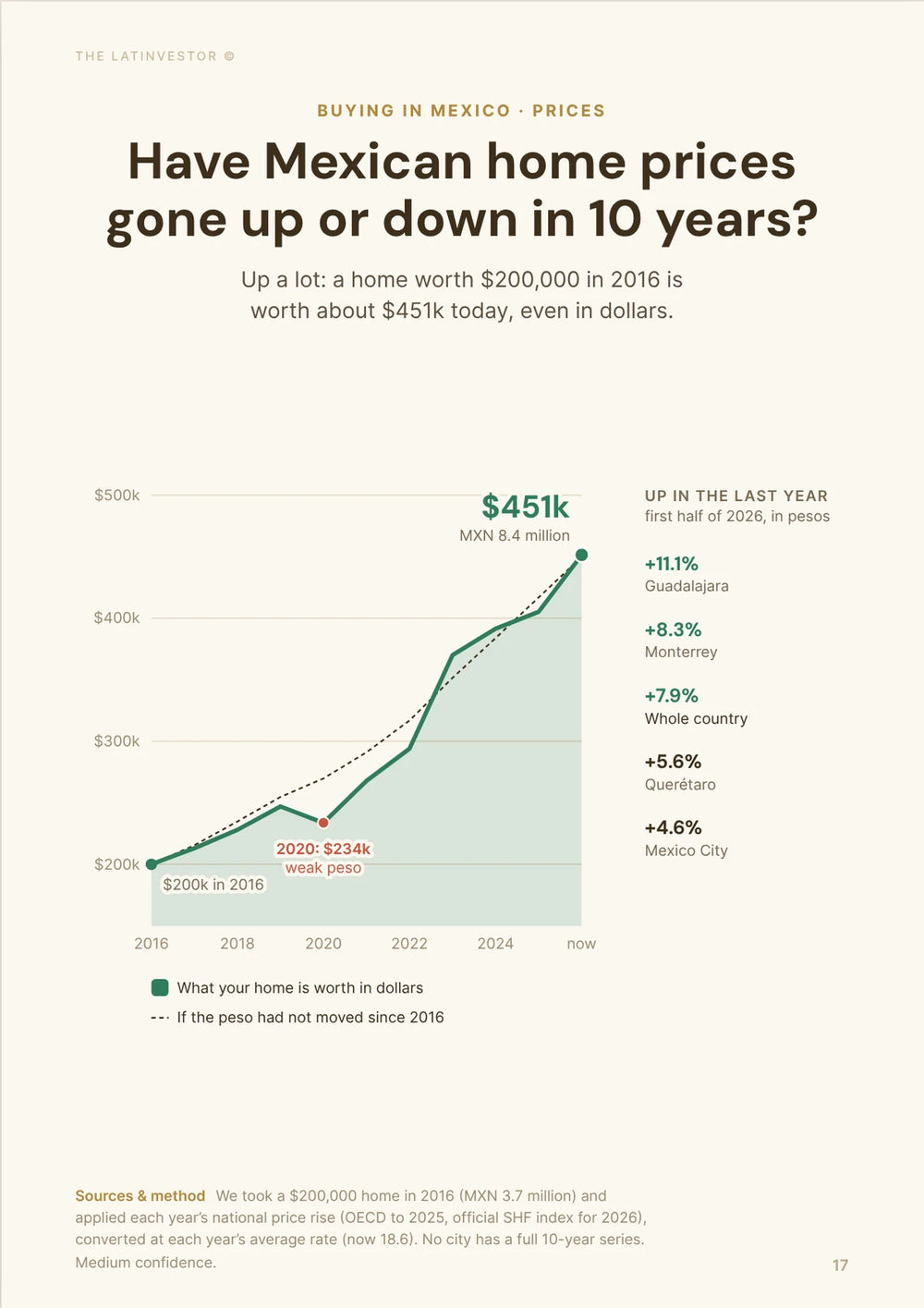
Over the long term, yes, by a wide margin.
MLS Vallarta's ten-year review puts the average condo sale price across the wider Vallarta and Riviera Nayarit market at about US$310,000 in 2015 and US$490,000 in 2025, roughly 58% higher. Central Vallarta North gained about 150% over the decade, while Central South and the Hotel Zone roughly doubled.
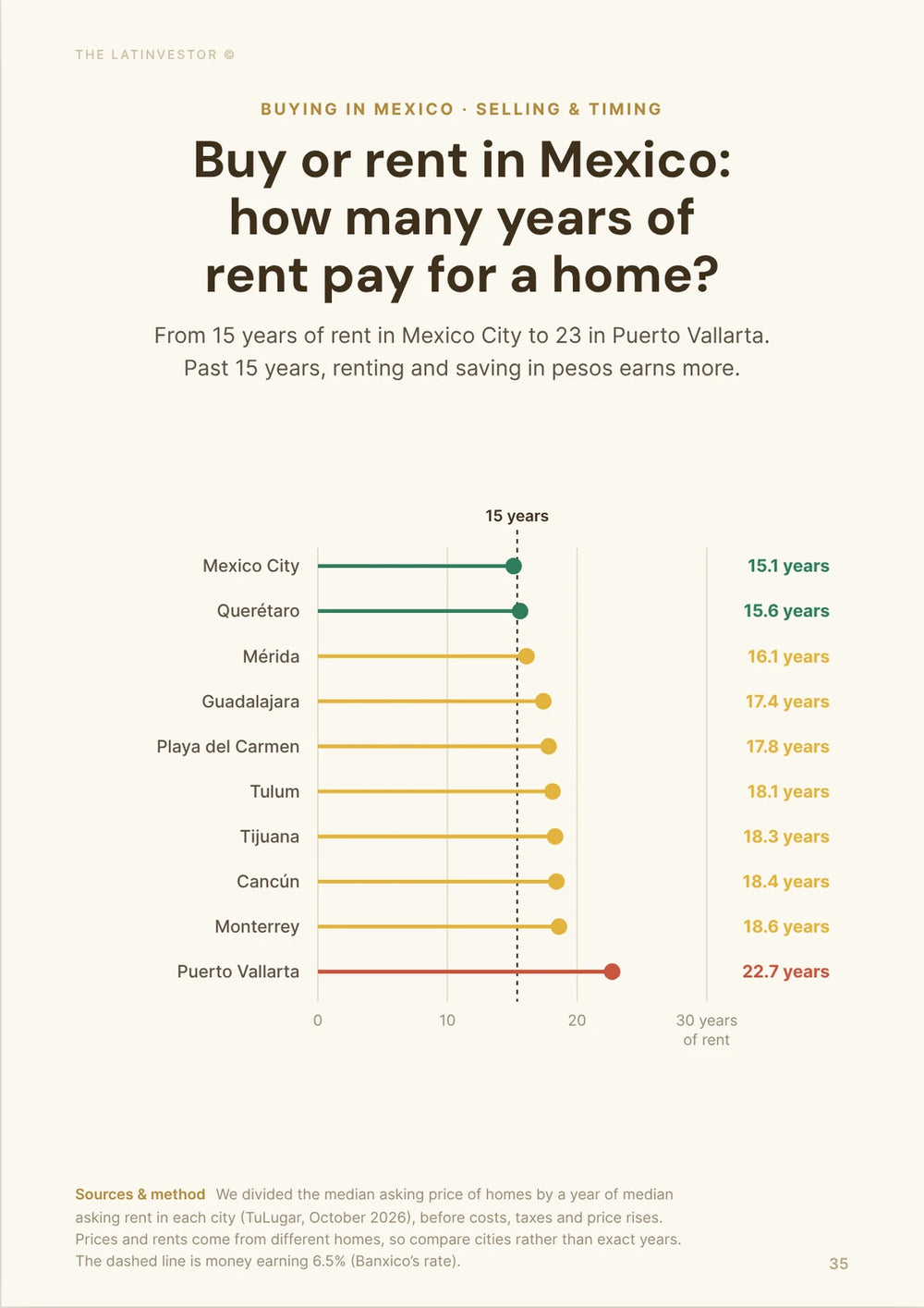
Asking prices are still high. Pincali puts the median Puerto Vallarta apartment for sale at about MXN 8.08 million (USD 434,000) across 603 listings, while its rental median is MXN 35,000 a month.
MXN 35,000 times 12 gives MXN 420,000 a year. Against MXN 8.08 million, that is about 5.2% gross, before HOA fees, management, vacancy, repairs, insurance and taxes. Real yields are lower, since asking prices and asking rents are both above what changes hands.
With citywide rents flat, buyers can't count on rising rents to fix an expensive purchase price.
| Puerto Vallarta apartment measure | Current / historical value | Calculation | What it means |
|---|---|---|---|
| Average MLS condo price in 2015 (wider bay) | US$310,000 | — | Pre-boom benchmark |
| Average MLS condo price in 2025 (wider bay) | US$490,000 | ~+58% | Big ten-year rise |
| Current Pincali sale median | MXN 8.08m | 603 listings | Expensive entry point |
| Current Pincali rent median | MXN 35,000/month | 86 listings | Premium rental benchmark |
| Implied gross yield | ~5.2% | 420k / 8.08m | Moderate before expenses |
Where can renters still find cheaper apartments in Puerto Vallarta?
Away from the waterfront and the foreign-facing condo market, where plenty of apartments still rent well below MXN 30,000 a month.
Propiedades.com puts the average apartment rent at about MXN 9,500 in Ixtapa, MXN 15,700 in 5 de Diciembre and Las Glorias, MXN 16,200 in Puerto Vallarta Centro, MXN 17,775 in Emiliano Zapata and MXN 19,675 in Versalles. Marina Vallarta, at about MXN 34,400, is in another league.
Listings confirm the lower end exists. Pincali's cheapest apartments start below MXN 12,000, and Inmuebles24 has Nuevo Ixtapa averaging about MXN 16,500.
5 de Diciembre is the interesting middle ground: close to downtown and the coast, without the premium of the newest Zona Romántica and Marina Vallarta buildings, and its average rent is down 7.4% since April 2025.
Ixtapa goes much further on price, but the trade-off is distance: more driving, fewer amenities, no walk to the beach. Las Glorias is exposed to flooding at high tide and in heavy rain; SEAPAL has been working on drainage there.
| Area | Average apartment rent | Position in the market | Main trade-off |
|---|---|---|---|
| Ixtapa | MXN 9,500 | Affordable | Farther inland |
| 5 de Diciembre | MXN 15,700 | Lower-middle | Older, mixed stock; hilly streets |
| Las Glorias | MXN 15,700 | Lower-middle | Flood exposure |
| Puerto Vallarta Centro | MXN 16,200 | Lower-middle | Older buildings, busy streets |
| Emiliano Zapata | MXN 17,775 | Mid-market | Huge variation by building |
| Versalles | MXN 19,675 | Mid-market / rising | Fast gentrification |
| Marina Vallarta | MXN 34,400 | Premium | High-end location and amenities |
Are Puerto Vallarta rents becoming unaffordable for local residents?
For the foreign-facing market, they already are.
The rent ladder makes it clear. Pincali's median apartment asks MXN 35,000 a month. Even the cheaper neighborhood averages are substantial: about MXN 15,700 in 5 de Diciembre and MXN 19,675 in Versalles.
Locals feel it. In a 2026 academic survey published in Ciencia y Reflexión, 73.0% of Puerto Vallarta respondents said they perceived rising housing costs or displacement linked to gentrification, against 64.5% in neighboring Bahía de Banderas.
Buying is no easier. ITESO reported a citywide median home price around MXN 2.4 million in 2025, while NAMI Realty's October 2026 MLS data puts the median marketed property near MXN 7.47 million (USD 402,000). Locals and foreigners are mostly shopping in separate markets.
Versalles shows the squeeze best. A 24.4% rent increase is easy to absorb for someone earning dollars, much less so for a household earning pesos in hotels or restaurants. Moving inland to Ixtapa is the main escape, but commuting becomes part of the housing cost.
So flat citywide rents offer little relief. They stop things getting worse as fast; they don't undo the previous increases.
Could Puerto Vallarta rents actually fall from here?
They could soften over the next year, but a long stretch of flat, uneven rents is more likely than a citywide drop.
Several forces now favor renters. International airport traffic is down 19.4% this year, short-term nightly rates are down 17.5%, condo sales are slow and new buildings keep delivering units.
That should make landlords more flexible. An apartment that sits empty for a month because the owner insists on MXN 35,000 can easily end up earning less over the year than one let at MXN 31,000 or 32,000 to a reliable tenant.
The strongest neighborhoods can resist. Versalles and Emiliano Zapata have their own demand, and scarce apartments with views, walkability or good amenities still command premium rents.
Our base case is a messier market: some landlords cutting unrealistic asks, some neighborhoods still rising, and the city average going sideways.
What can renters negotiate in Puerto Vallarta right now?
More than a year ago, especially on furnished condos aimed at foreigners, where asks often sit well above neighborhood averages.
Start with the gap. In Zona Hotelera Norte, Propiedades.com's average is about MXN 20,442 and flat, yet TuLugar's asking median there is about USD 1,909 (MXN 35,500). An ask far above the local average, for a unit without a view or a new building, is the one to push on. Offer a 12-month lease and on-time references in exchange for a lower rent; owners watching nightly rates fall value a steady tenant.
Then check what can go wrong. In August 2026, SEAPAL reported water disruptions in about 40% of neighborhoods linked to highway works, and Hurricane Simón closed the airport in October. Ask how the building stores water (cistern and tank), who pays for storm repairs, and whether rent is reduced if the unit becomes unusable. Get it in the lease.
Finally, time it. Low season and the weeks after a storm scare are when owners are most open to offers. In December, when Canadians and Americans arrive, your leverage drops.
What would make Puerto Vallarta rents start rising quickly again?
Tourism would need to recover and new supply would need to slow, both at once.
A rebound in international visitors would be the fastest trigger. The airport has lost about 599,000 passengers in the first eight months of 2026 compared with a year earlier. Reversing that would lift vacation demand and pull apartments back into short-term rental.
Higher Airbnb prices would reinforce it. Hosts now have higher occupancy but weaker nightly rates. If both rose together, more owners would leave the monthly market.
Construction is the other side. As long as developers keep adding investor-oriented units in Versalles, Marina Vallarta and the Hotel Zone, rental supply has room to grow.
For now those conditions haven't lined up. The rental market has more supply and weaker tourist pricing than during the post-pandemic boom.
So, are rents still rising in Puerto Vallarta?
Mostly no: rents are high, but the citywide rise has stalled.
Propiedades.com has Puerto Vallarta at 0.0% from April 2025 to October 2026. Versalles is up 24.4% and Emiliano Zapata 22.3%, both on small samples, while Marina Vallarta and Zona Hotelera Norte are flat and 5 de Diciembre is down 7.4%.
Short-term rentals are losing pricing power, with AirDNA showing the nightly rate down 17.5% and RevPAR down 10.4%. Airport traffic is down 12.3% this year, and condo sales are slow.
None of this makes Puerto Vallarta cheap. Pincali still shows a MXN 35,000 median apartment rent, Marina Vallarta averages about MXN 34,400, and furnished units in good buildings easily reach MXN 30,000 to 50,000.
The better description is a high plateau: a few neighborhoods still climbing, the rest of the market catching its breath, and renters with more room to negotiate than they've had in years.
Our methodology
This article tests whether Puerto Vallarta rents are still rising. We separated the price level from the direction of travel, and compared long-term rents, neighborhood changes, short-term rental pricing, tourism, the sales market and property prices.
For long-term rents, we relied mainly on Propiedades.com neighborhood series, which measure change over the same period (April 2025 to October 2026). We gave less weight to big percentage moves built on very few listings, like Emiliano Zapata's 5. Pincali, TuLugar and Inmuebles24 show what renters are being asked today; their inventories lean toward furnished, newer and foreign-facing condos, so we did not treat them as the same thing as neighborhood averages.
For short-term rentals, we used AirDNA's ADR and RevPAR as the main signals, and treated revenue per listing with caution because the number of active listings halved. We did not mix AirDNA with other short-term rental data providers in any calculation.
We checked these figures in October 2026. Tourism comes from Grupo Aeroportuario del Pacífico's September 2026 traffic report, the sales market from Coldwell Banker La Costa's MLS figures, long-term prices from MLS Vallarta, and the local context from SEAPAL, a 2026 academic survey and the Jalisco Congress. Conversions use about 18.6 pesos per US dollar and 20.9 pesos per euro.
The limits: all rent figures are asking rents, not signed leases, and the 5.2% gross yield compares two separate sets of listings rather than matched properties. Treat it as a reality check, not an investment return.
Key sources used for this analysis include: Crónica Jalisco on the 180-night committee vote, Propiedades.com on Versalles rents, Propiedades.com on Emiliano Zapata rents, Propiedades.com on Zona Hotelera Norte, Propiedades.com on Marina Vallarta, Propiedades.com on 5 de Diciembre, Pincali on apartment rentals, Pincali on apartments for sale, TuLugar's Puerto Vallarta market report, Inmuebles24 on apartment rentals, AirDNA on Puerto Vallarta short-term rentals, Grupo Aeroportuario del Pacífico's September 2026 traffic report, Crónica on the airport reopening after Hurricane Simón, Coldwell Banker La Costa's October 2026 market pulse, MLS Vallarta's 2015–2025 market review, MLS Vallarta's development inventory, Ciencia y Reflexión on gentrification in Puerto Vallarta, NAMI Realty's Vallarta MLS data, SEAPAL on 2026 water disruptions, SEAPAL on drainage in Las Glorias and the Jalisco Congress on the proposed short-term rental levy.