Summary
Airbnbs in Puerto Vallarta currently generate around MX$400,000 to MX$430,000 in annual gross bookings according to two major rental datasets, but an ordinary professionally managed property may leave its owner only about MX$10,000 per month before taxes and financing.
The market's headline revenue figures conceal an enormous gap between property types. A typical one-bedroom generates roughly MX$180,000 annually, while a two-bedroom reaches MX$232,000. Large luxury villas pull citywide averages sharply upward.
Revenue is also moving in the wrong direction for many hosts. AirROI reports a 7.1% annual decline, while Airbtics finds falling occupancy despite a 10.3% increase in nightly rates. Raising prices isn't making up for fewer bookings.
Competition helps explain the pressure. Airbtics tracked a 56.5% increase in active listings over three years, against just 5.9% growth in median annual revenue. More properties are chasing a market where typical earnings have barely improved.
Tourism conditions are adding uncertainty. Puerto Vallarta airport passenger traffic fell 12.3% during the first nine months of 2026, with international passengers down 19.4%. That's particularly relevant for a destination heavily dependent on American and Canadian visitors.
Seasonality makes annual averages deceptive. February can generate roughly two and a half times September's revenue, while winter bookings are often made months ahead. A property that performs brilliantly in February may still struggle to cover expenses during quieter months.
Location and amenities produce striking revenue differences, but the comparisons need care. Conchas Chinas commands roughly 5.5 times the nightly rate of 5 de Diciembre, and properties with pools earn over six times as much as those without. Much of that gap reflects larger, more luxurious properties rather than a guaranteed premium from location or amenities alone.
The operating costs change the investment calculation considerably. On approximately MX$399,000 in annual bookings, our expense model leaves around MX$199,000 for a self-managing owner or MX$119,000 with professional management, before taxes and financing. A non-resident owner taxed at 25% of gross rent would hand over about MX$99,700 more.
Purchase prices can make those earnings look surprisingly small. A US$400,000 condo, about the 2026 median condo sale price, generating the typical two-bedroom revenue of MX$232,000 produces only a 3.1% gross rental yield, before platform fees, maintenance, taxes and other expenses.
Long-term renting deserves serious consideration. In Zona Romántica, advertised monthly rents for furnished apartments can rival the monthly equivalent of typical Airbnb earnings, without the same turnover costs and seasonal uncertainty.
Our conclusion is that Puerto Vallarta still offers profitable Airbnb opportunities, especially for well-bought properties and exceptional operators. But for someone purchasing an expensive ordinary condo today, the likely return is much less impressive than advertised nightly rates suggest. The acquisition price and actual operating surplus matter far more than headline Airbnb revenue.


Are Puerto Vallarta Airbnbs earning less money now?
Puerto Vallarta Airbnb revenue is currently falling in two major rental datasets, even though hosts are charging more per night.
AirROI reports that average annual revenue per listing declined 7.1% over the past year. Airbtics measured a smaller 1.9% decrease in median revenue, but its figures reveal something more interesting: nightly rates rose 10.3%, while occupancy fell 11.7%.
In other words, charging guests more has not been enough to compensate for fewer bookings. Airbtics also gave Puerto Vallarta a D+ investment grade, placing it among Mexico's weaker markets for rental yields.
A third provider, AirDNA, reports rising revenue, which complicates the picture. We examine that disagreement below, because it changes how confidently we can describe the market.
For now, the two datasets showing weaker earnings give owners good reason to question projections based on steadily rising tourist demand.
How much does the average Airbnb in Puerto Vallarta make per year?
A Puerto Vallarta Airbnb currently brings in roughly MX$400,000 to MX$430,000 in annual gross revenue according to two major rental trackers, but individual properties vary enormously.
AirROI reports MX$398,845 per active listing, while Airbtics estimates median revenue of MX$429,000. Those figures differ by approximately 8%, although comparing an average with a median is not quite like comparing two identical measurements.
AirDNA puts annual revenue considerably higher, at US$31,300, or approximately MX$582,000 at 18.6 pesos per dollar.
We would use the lower two estimates as a starting point for understanding the market, then investigate comparable properties before making an investment decision. AirDNA's higher number is worth considering, but the disagreement between providers is too large to ignore.
All three figures describe booking revenue before operating expenses, taxes and financing. They do not tell us how much the owner actually keeps.
| Data provider | Annual gross revenue | Occupancy | Active listings |
|---|---|---|---|
| AirROI | MX$398,845 average | 39.2% | 6,975 |
| Airbtics | MX$429,000 median | 53% | 7,150 |
| AirDNA | ≈MX$582,000 average | 57% | 5,943 |
Why do Puerto Vallarta Airbnb estimates disagree so much?
Puerto Vallarta's Airbnb revenue estimates differ partly because rental-data companies count different properties and calculate occupancy differently.
AirDNA currently reports an extraordinary combination: annual revenue per listing increased 62.3%, while the number of active listings dropped 54.3%. Yet its revenue per available night fell 10.4%.
Compare that with AirROI and Airbtics, which both report growing supply and declining annual revenue per property. We cannot reconcile those opposite trends from the providers' public methodology alone.
Availability creates another problem. AirROI found that only 53.5% of listings were open for at least 271 days during the year. Nearly 17% were available for fewer than 181 days.
That helps explain why multiplying the market's average nightly rate by occupancy and 365 days gives a much higher estimate than the measured annual revenue. The averages come from properties with different prices, occupancy levels and operating calendars.
We also checked BNBCalc, which displays MX$581,200 in annual revenue on its dashboard but MX$432,000 in its written market summary. Until those figures are reconciled, we would avoid using either as a precise benchmark.
For an actual property purchase, we would ask for monthly revenue records from nearby listings with the same bedroom count, similar amenities and comparable availability. Citywide estimates are useful for context, but they're too broad to predict one property's earnings reliably.
Are there too many Airbnbs in Puerto Vallarta now?
Puerto Vallarta is becoming considerably more competitive for Airbnb hosts, and three years of Airbtics data suggest that new supply has grown much faster than rental income.
According to Airbtics, active listings increased 56.5% over three years. During the same period, median annual revenue rose only 5.9%, despite nightly prices increasing 22.9%. Occupancy declined 14.5%.
We found a particularly revealing gap: the percentage increase in properties was nearly ten times the percentage increase in median revenue.
These numbers do not establish that every neighborhood is oversupplied. New properties may differ in size, quality and operating calendars, and the figures cannot isolate the effect of competition from changing tourist demand.
Still, the pattern is hard to dismiss. More owners are competing for bookings, and raising nightly prices has delivered little additional annual income for the typical listing.
The concentration is already considerable in central neighborhoods. Zona Romántica alone has more than 2,000 Airbnb listings in Airbtics' database, making it one of the most competitive parts of the city.
An ordinary apartment entering that neighborhood today is competing with established hosts who already have reviews, professional photography and years of booking history. That's a difficult starting position.
Are fewer tourists coming to Puerto Vallarta these days?
Puerto Vallarta is currently seeing a substantial decline in airport passengers, particularly international travelers, who account for a large share of vacation-rental guests.
Grupo Aeroportuario del Pacífico, the company operating the airport, reported 4.54 million passengers during the first nine months of 2026, compared with 5.17 million over the same period a year earlier.
That is approximately 634,000 fewer passengers, a decline of 12.3%.
The international figures are more concerning. International traffic fell 19.4%, from 2.82 million to 2.27 million passengers. Domestic traffic declined only 3.7%.
We calculate that international routes accounted for approximately 86% of the airport's passenger shortfall.
AirROI's guest-review analysis helps explain why this is particularly relevant for Airbnb owners. Around 46% of reviewed guests came from the United States and 17% from Canada, compared with 33% from Mexico.
Airport statistics include both arrivals and departures, and many travelers stay in hotels or private homes. We cannot conclude that Airbnb bookings have declined by the same percentage.
However, Puerto Vallarta's international tourism exposure is substantial. The recent drop in airline traffic makes aggressive growth forecasts harder to defend, especially for properties targeting American and Canadian visitors.
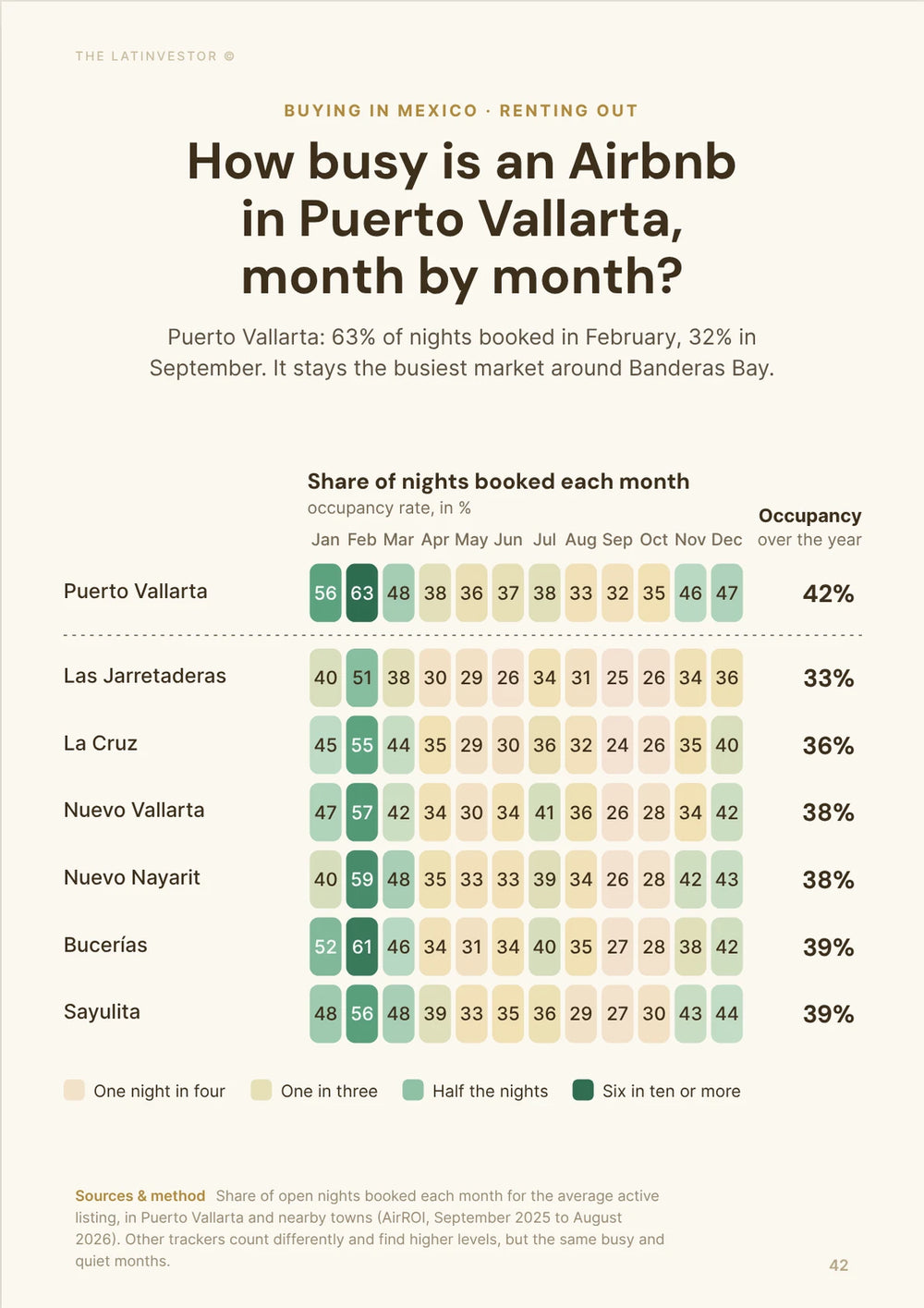
Which months make the most Airbnb money in Puerto Vallarta?
February is currently Puerto Vallarta's strongest Airbnb month, generating approximately two and a half times the revenue of September.
AirROI estimates that a listing active in February earns around MX$75,600 during that month, compared with MX$30,600 in September. January comes close to February, while December and March also benefit from winter tourism.
The winter advantage comes from higher prices and fuller calendars. December through March average 55% occupancy and nightly rates near MX$4,091. Low-season occupancy falls to 36%, with nightly rates around MX$3,469.
Booking timing adds another challenge. February stays are reserved approximately 93 days in advance, against only 34 days for June.
An owner who waits until January to optimize February prices may have already missed an important booking window.
One detail needs explaining: these monthly figures average properties active in each month. Adding them together would exaggerate annual revenue because some listings operate for only part of the year.
| Season | Months | Average monthly revenue | Occupancy | Nightly rate |
|---|---|---|---|---|
| High | Dec–Mar | MX$70,000 | 55% | MX$4,091 |
| Shoulder | Apr, Jul, Nov | MX$49,700 | 43% | MX$3,648 |
| Low | May–Jun, Aug–Oct | MX$38,800 | 36% | MX$3,469 |
How much do one-bedroom and two-bedroom Airbnbs make in Puerto Vallarta?
A typical one-bedroom Airbnb in Puerto Vallarta earns about MX$180,000 annually, while a two-bedroom generates roughly MX$232,000, far below the citywide average.
AirROI's bedroom-level data reveal how much larger properties influence headline revenue figures. The average two-bedroom earns MX$357,000, but its median is only MX$232,000.
That difference suggests a relatively small group of high earners pulls the average upward.
Property size also changes occupancy. Studios and one-bedroom apartments average approximately 41% occupancy, compared with 34% for homes with five bedrooms or more. Large properties compensate through much higher nightly rates.
This explains how some Puerto Vallarta Airbnbs reach MX$1 million annually. At MX$3,938 per night, a property would need approximately 254 booked nights to reach that target from nightly charges alone, equivalent to nearly 70% occupancy over a full year.
For a normal two-bedroom, that's an extremely ambitious target.
At the top of the market, AirROI identified a nine-bedroom beachfront villa generating approximately MX$13.9 million in annual bookings. Its nightly rate exceeded MX$51,000, with roughly 81% occupancy.
Luxury homes operate in a completely different market from ordinary condos. We would never use their results to estimate what a modest apartment could earn.
| Property size | Listings | Median annual revenue | Average annual revenue | Occupancy |
|---|---|---|---|---|
| Studio | 579 | MX$133,000 | MX$196,000 | 41% |
| 1 bedroom | 2,184 | MX$180,000 | MX$266,000 | 41% |
| 2 bedrooms | 2,327 | MX$232,000 | MX$357,000 | 40% |
| 3 bedrooms | 663 | MX$382,000 | MX$600,000 | 37% |
| 4 bedrooms | 249 | MX$640,000 | MX$950,000 | 36% |
| 5+ bedrooms | 235 | MX$1,420,000 | MX$2,090,000 | 34% |
Which Puerto Vallarta neighborhoods charge the highest Airbnb prices?
Conchas Chinas currently commands some of Puerto Vallarta's highest Airbnb nightly rates, while Zona Romántica has a much larger concentration of rental properties.
Airbtics reports an average nightly rate of MX$7,945 in Conchas Chinas, compared with MX$2,625 in Zona Romántica and MX$1,441 in 5 de Diciembre.
That puts Conchas Chinas at roughly 5.5 times the nightly price of 5 de Diciembre.
However, Conchas Chinas includes luxury villas and larger hillside properties. Comparing its average rate directly with a neighborhood full of smaller apartments tells us more about the mix of properties than the profitability of a typical investment.
Zona Romántica has a different advantage: restaurants, nightlife, walkability and access to Playa Los Muertos. Its popularity supports demand, although the number of competing listings is substantial.
Airbtics also found that properties near the Sayan development earned a 26% location premium compared with similar listings elsewhere in its analysis. That gives us a more useful indication of the value of a specific location than broad neighborhood averages.
We cannot rank these neighborhoods by net investment return without reliable property-level purchase prices, occupancy and expenses. High nightly rates alone cannot settle the question.
| Neighborhood | Active listings | Average nightly rate | Main distinction |
|---|---|---|---|
| Conchas Chinas | 297 | MX$7,945 | Luxury and larger homes |
| Marina Vallarta | 496 | MX$2,711 | Marina and resort setting |
| Zona Romántica | 2,068 | MX$2,625 | Walkable tourist center |
| Las Glorias | 530 | MX$2,402 | Coastal condominiums |
| Lázaro Cárdenas | 252 | MX$1,904 | Lower-priced urban rentals |
| 5 de Diciembre | 432 | MX$1,441 | More affordable accommodation |
Does having a pool really increase Airbnb income in Puerto Vallarta?
Puerto Vallarta Airbnbs with a pool earn substantially more than properties without one, although the difference mostly reflects the types of homes being compared.
AirROI found that pool-equipped listings generated approximately MX$525,000 annually, compared with MX$83,600 for properties without a pool.
That's 6.3 times as much revenue.
We found similar patterns for other amenities. Properties advertising a hot tub earned MX$691,000 on average, compared with MX$290,000 without one. Listings with a gym earned MX$603,000, against MX$258,000 without.
The catch is that luxury homes tend to have several of these features simultaneously. They are also bigger, more expensive and often better located.
Installing a pool in an ordinary property will not automatically multiply its income sixfold.
A more useful comparison would be between two similar apartments in the same neighborhood, one with access to a pool and one without.
Since 71% of tracked listings already advertise a pool, the amenity is common enough that many guests may simply expect it, especially in the coastal condo market.
How much does Airbnb take from Puerto Vallarta hosts now?
Airbnb currently charges Mexican hosts 16% of the booking subtotal under its single-fee model, which can take a substantial amount out of annual rental income.
Airbnb recently expanded its single-fee structure, including moving hosts using property-management software onto the new arrangement. Its updated hosting guidance confirms that the rate for Mexico is 16%.
The previous split-fee structure generally charged Mexican hosts 4%, with a separate fee paid by guests. Airbnb is phasing that arrangement out, although some hosts may still have bookings under the older rules.
For every MX$100,000 in booking revenue subject to the new fee, Airbnb deducts approximately MX$16,000. At MX$400,000, the deduction reaches MX$64,000.
Hosts who have not adjusted their advertised prices may see lower payouts, although increasing prices can also affect how many guests book.
Cleaning creates another expense. AirROI found that roughly 80% of listings charge a cleaning fee, with a median charge of MX$701 per stay. Those fees contribute to booking totals, but the owner still has to pay for cleaning and laundry.
Professional management adds another layer. Puerto Vallarta operator PVRPV advertises a 20% short-term rental commission based on the booked vacation service, while HOMIA advertises 20% of rental revenue after platform fees, with separate charges for full-service management.
The distinction between commissions on gross and net revenue can make a noticeable difference over a year. Owners should ask managers to show exactly which charges are included before comparing their offers.
How much profit does a Puerto Vallarta Airbnb owner actually keep?
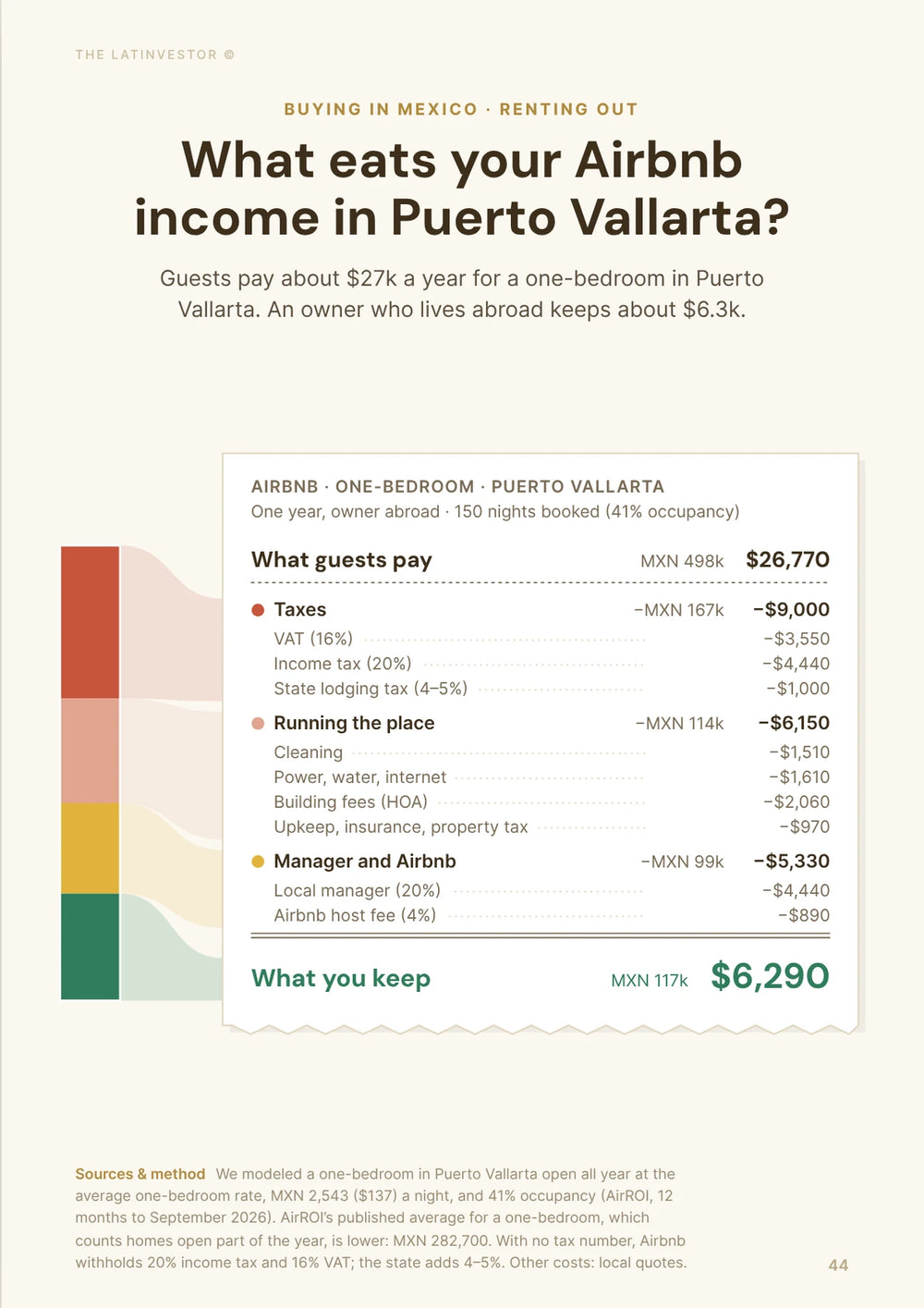
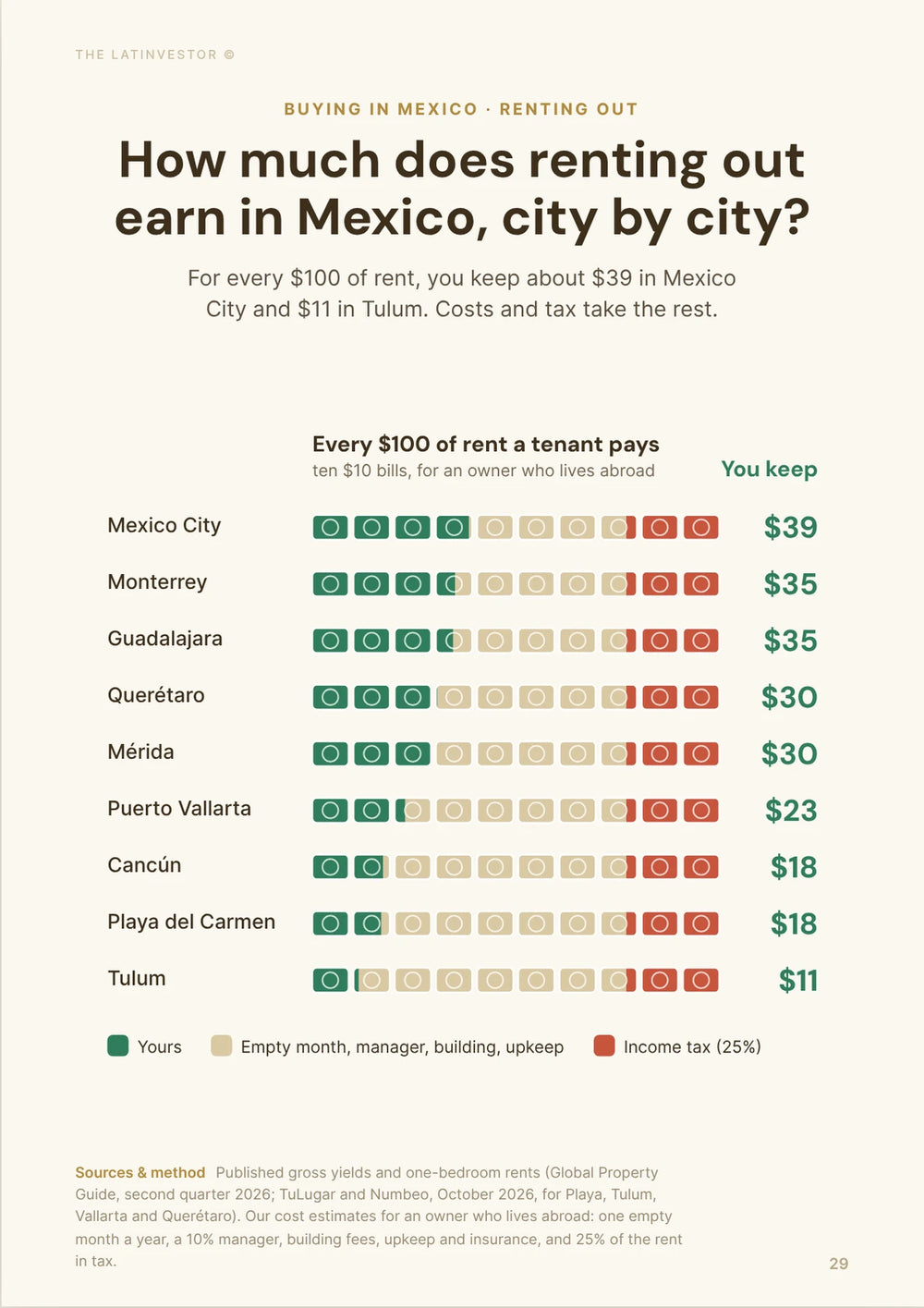
A Puerto Vallarta Airbnb grossing around MX$400,000 annually could leave approximately MX$199,000 before taxes and financing when self-managed, or MX$119,000 with professional management, under our illustrative expense model.
We calculated both figures using the local rental benchmark, Airbnb's 16% single-host fee, a 20% management commission when applicable, and operating expenses for cleaning, utilities, supplies, insurance and repairs.
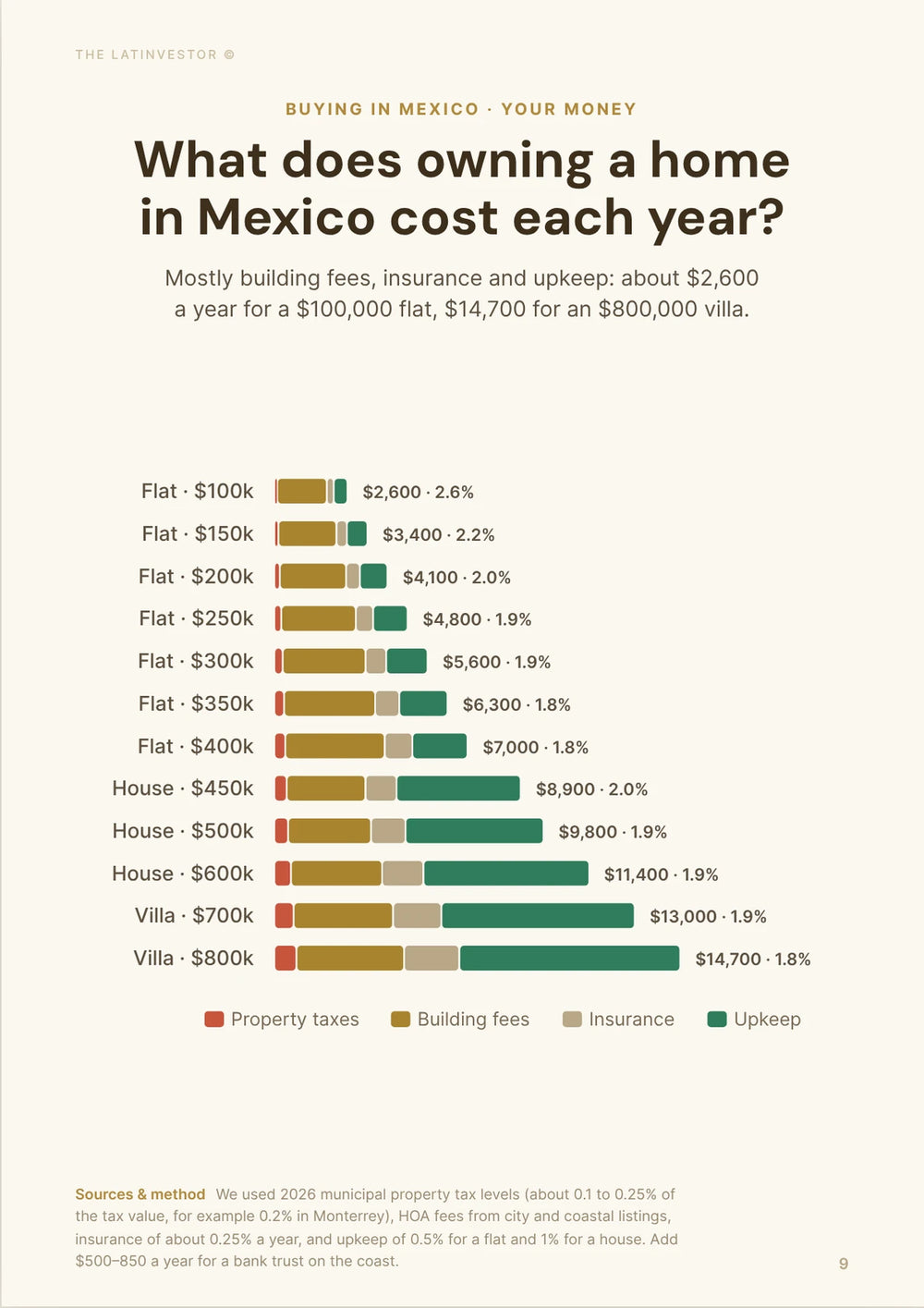
We also included condominium dues of MX$6,000 per month. That's a plausible figure for a mid-market property: HOMIA's local guide describes standard condominium fees of approximately US$150–400 monthly for a 100-square-meter two-bedroom unit, while an Encanto Vallarta property listing reports MX$6,000 in monthly dues.
The results differ sharply depending on who manages the property. On these assumptions, the self-managing owner keeps about half of gross bookings as operating surplus. Professional management reduces that to roughly 30%.
There is also a less obvious implication for cheaper apartments. Because condominium dues and insurance continue even when booking revenue is modest, their share of the owner's income can become surprisingly large.
These are modeled operating surpluses, not measured average owner profits. They exclude income taxes, mortgage payments, bank-trust costs where relevant, major building assessments, purchase expenses and exceptional repairs. Cleaning and management charges also depend on the contract.
| Annual item | Assumption | Self-managed | Professionally managed |
|---|---|---|---|
| Gross bookings | AirROI benchmark | MX$398,845 | MX$398,845 |
| Airbnb platform fee | 16% | −63,815 | −63,815 |
| Cleaning | 5% | −19,942 | −19,942 |
| Utilities | 5% | −19,942 | −19,942 |
| Guest supplies | 2% | −7,977 | −7,977 |
| Repairs and replacements | 3% | −11,965 | −11,965 |
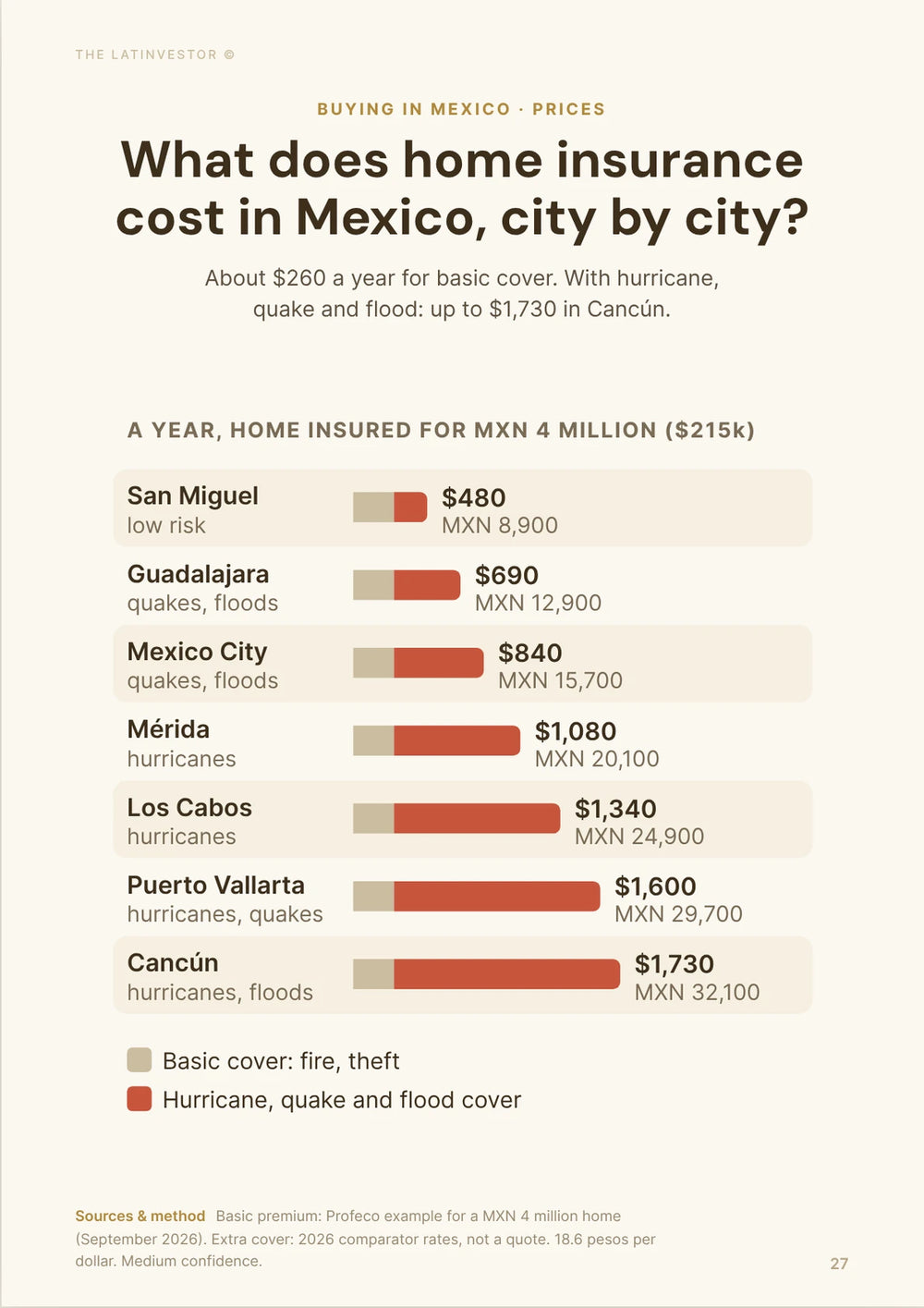
| Insurance | MX$4,000/year | −4,000 | −4,000 |
| Condo dues | MX$6,000/month | −72,000 | −72,000 |
| Management | 20% of gross | 0 | −79,769 |
| Operating surplus | Before tax and financing | MX$199,203 | MX$119,434 |
| Monthly equivalent | Annual surplus ÷ 12 | MX$16,600 | MX$9,953 |
Is buying a Puerto Vallarta condo for Airbnb still profitable?
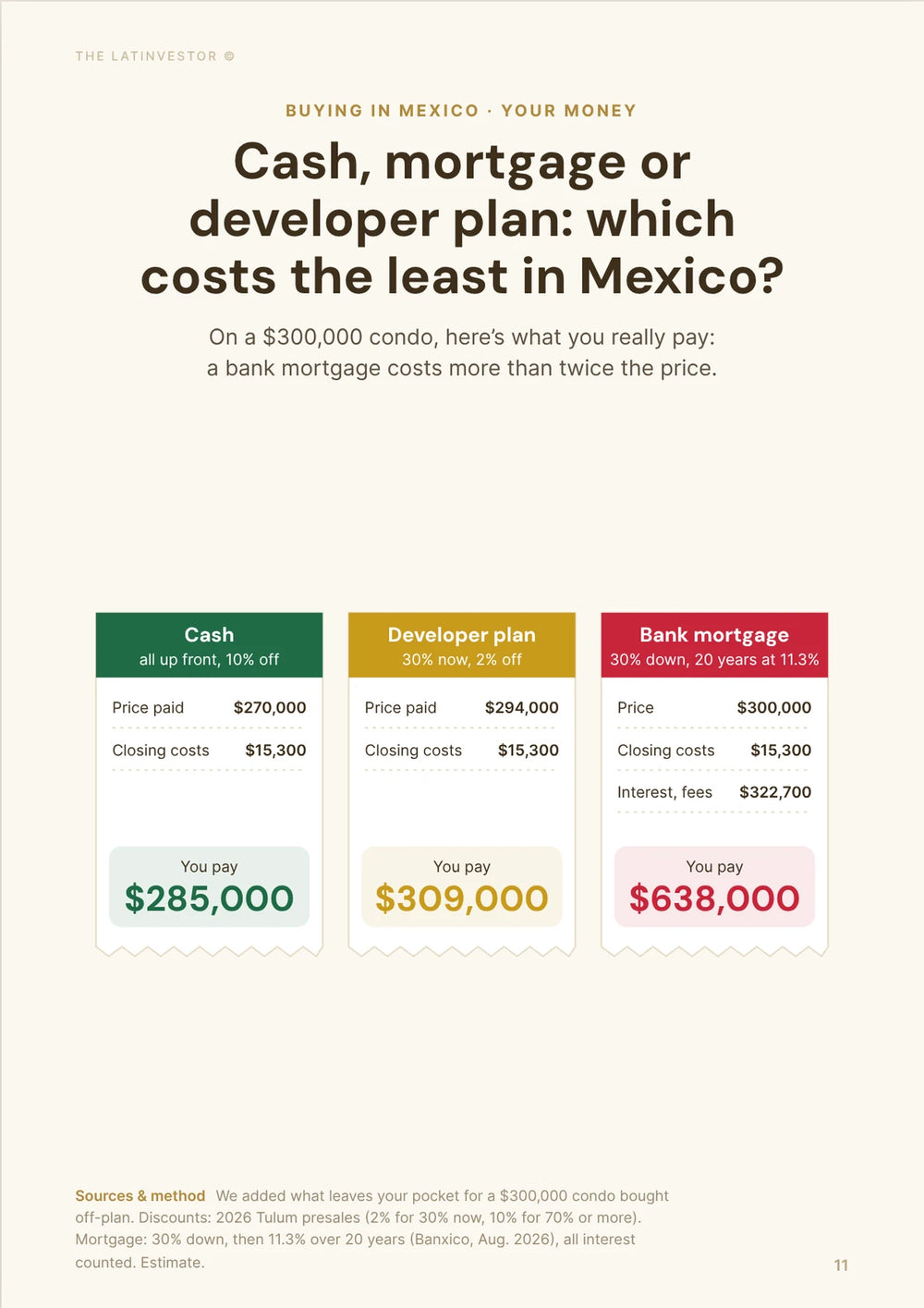
Buying a Puerto Vallarta condo for Airbnb can still work, but current property prices make the returns disappointing for many ordinary apartments.
Coldwell Banker La Costa's October 2026 market pulse puts the median condo sale at about US$400,000 from January to September 2026, up 7.7%.
Sales are moving the other way. Condo closings fell 21.1% over the same nine months, and the median condo now takes 262 days to sell. Buyers have room to negotiate, but prices have not come down yet.
These are closed sales from the local MLS, so they are a useful acquisition-price reference rather than a precise benchmark for Airbnb-ready condos in one neighborhood.
We can test the rental economics against several hypothetical purchase prices.
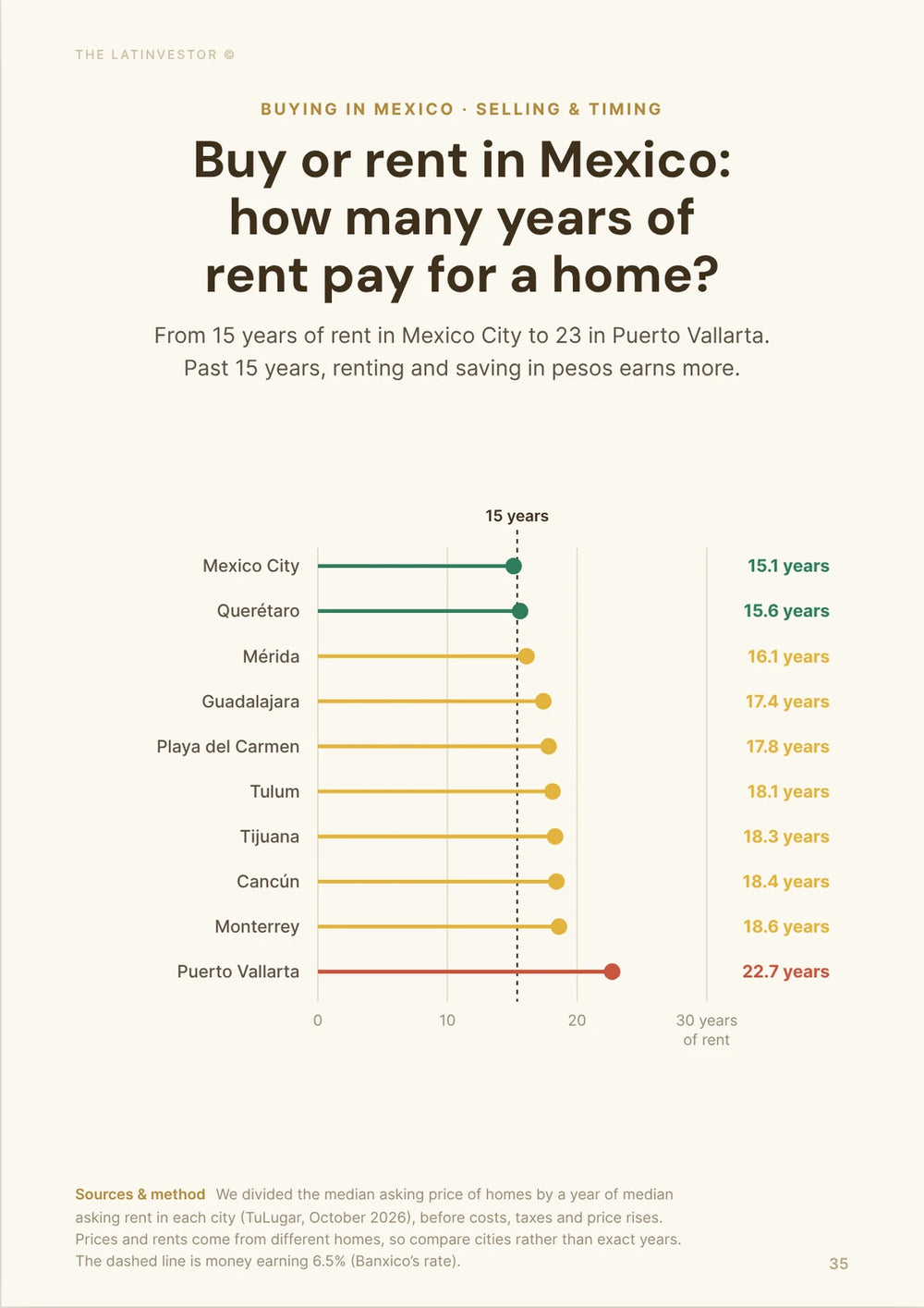
Using the two-bedroom median revenue discussed earlier, a US$250,000 condo produces a gross rental yield of approximately 5.0%. At US$400,000, that falls to 3.1%. A US$600,000 property produces only 2.1%.
Those yields come before maintenance, platform charges, taxes, management and financing.
A more expensive apartment may generate higher rent, of course. But unless that increase is large enough to compensate for the purchase price, an impressive Airbnb calendar can still produce a weak investment return.
| Purchase price | Annual gross rent | Gross rental yield | Before expenses |
|---|---|---|---|
| US$250,000 | MX$232,000 | 4.99% | Yes |
| US$400,000 | MX$232,000 | 3.12% | Yes |
| US$500,000 | MX$232,000 | 2.49% | Yes |
| US$600,000 | MX$232,000 | 2.08% | Yes |
Calculations use 18.6 pesos per US dollar (October 2026) and exclude transaction costs.
Could renting long-term make more money than Airbnb in Puerto Vallarta?
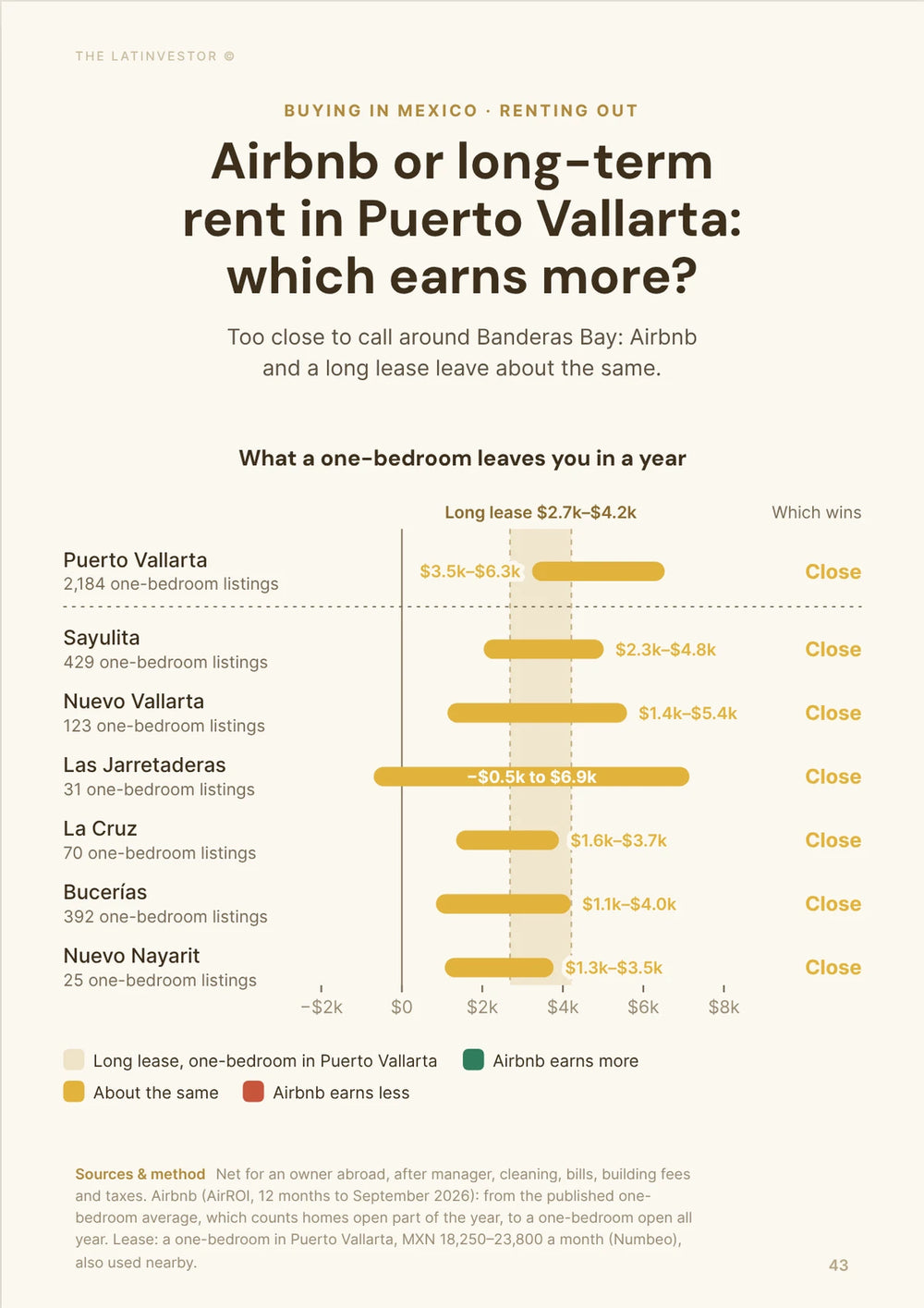
A long-term rental in Puerto Vallarta can compete surprisingly well with a typical Airbnb, especially for smaller condos with high management expenses.
As we saw earlier, the median Airbnb income for a one-bedroom works out to roughly MX$15,000 per calendar month before expenses. For a two-bedroom, the equivalent is around MX$19,300.
VivaRenta, a local rental marketplace, reports that furnished studios and one-bedroom apartments in Zona Romántica are advertised at approximately MX$12,000–28,000 per month. Two-bedroom asking rents range from MX$22,000 to MX$45,000.
These are advertised prices rather than confirmed signed leases, and the marketplace covers a specific neighborhood rather than the same properties tracked by AirROI.
Even so, the comparison raises a serious question: why accept frequent guest turnovers, seasonal vacancies and platform charges if a conventional tenant can deliver a similar monthly payment?
Short-term rentals retain advantages. A well-managed apartment can charge substantially more during winter, and owners can keep certain dates for personal use.
But the financial comparison is closer than the nightly rates suggest. A conventional lease usually brings steadier income and fewer turnovers, although owners still face vacancies, repairs and possible tenant problems.
We would compare a property's actual twelve-month Airbnb payouts with the achievable lease rent for that exact unit. For an average condo, long-term renting deserves to be evaluated rather than dismissed.
Are Airbnb taxes and local rental rules a problem in Puerto Vallarta?
Puerto Vallarta Airbnb owners face several tax obligations, while individual condominium buildings can restrict short-term rentals even when other buildings nearby allow them.
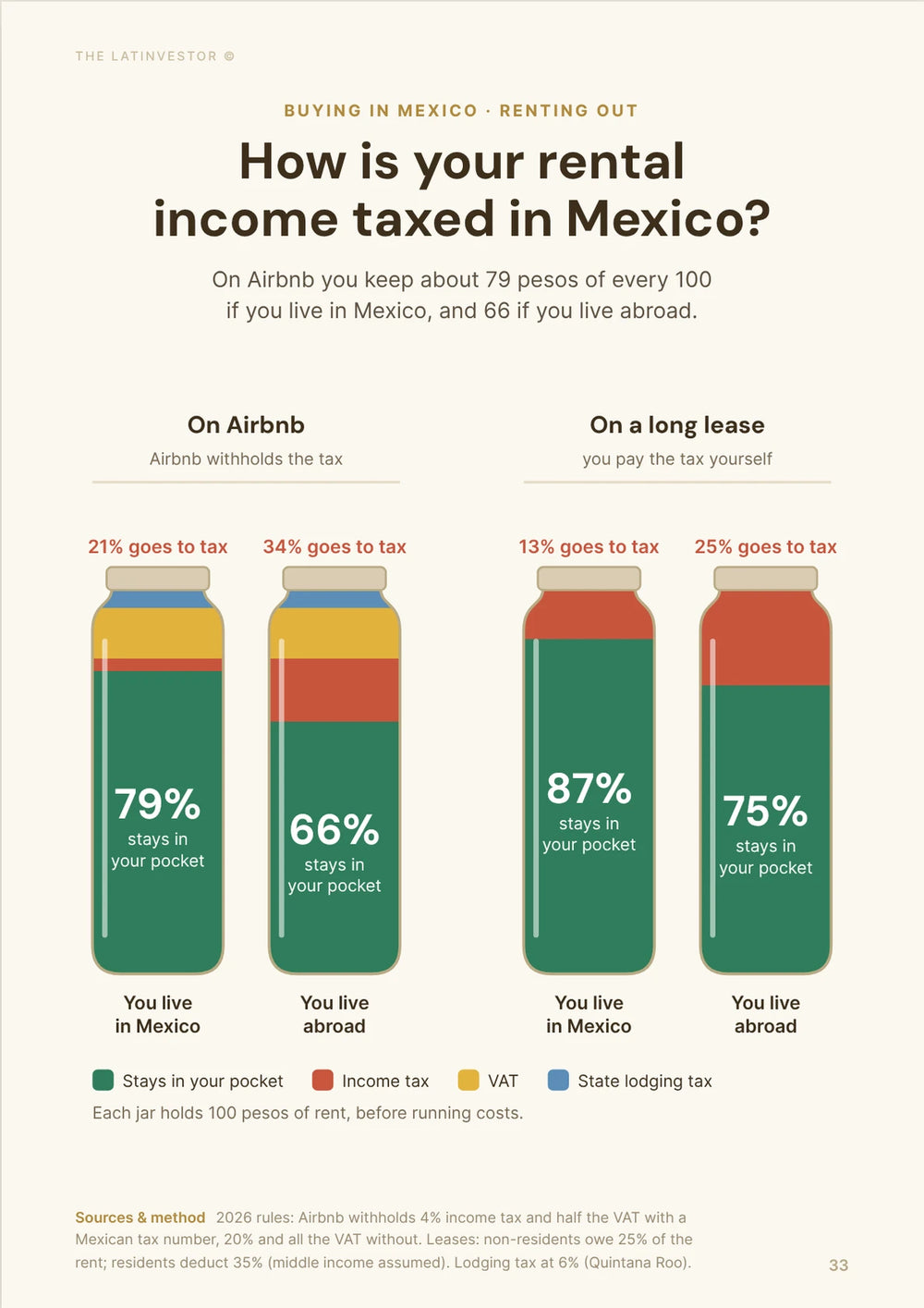
Airbnb's Mexican tax guidance states that accommodation bookings can be subject to 16% federal VAT. In Jalisco, there is also a 5% lodging tax on applicable reservations, including cleaning charges.
These taxes are generally charged to guests under the applicable collection arrangements, so we should avoid automatically subtracting them from host revenue a second time.
Income tax works differently. Mexico's tax authority, SAT, specifies a 4% withholding rate on accommodation income received by qualifying individuals through digital platforms. That withholding is not necessarily the owner's final tax bill. A foreign owner who is not a Mexican tax resident generally pays 25% of gross rent, with no deductions. On MX$398,845 of bookings that is about MX$99,700 a year, which would cut our managed example's MX$119,434 surplus to roughly MX$19,700. Get a local accountant to confirm your status before you buy.
State rules may tighten too. On May 25, 2026, a Jalisco Congress committee approved a 180-night yearly cap on short-term rentals of homes that aren't the owner's main residence, in "high tourism pressure" zones, mainly Guadalajara and Puerto Vallarta. The full Congress hasn't voted. At AirDNA's 57% average occupancy, a listing books about 208 nights a year, so the cap would bite on the best performers first.
Building rules can be just as important as tax rates.
In December 2025, local media reported comments from Denisse Ruiz, president of the Association of Condominium Administrators and Professionals of Puerto Vallarta. She explained that some condominiums permit one- or two-night stays, while others require rentals of at least three months.
AirROI found that none of the active Puerto Vallarta listings in its sample displayed a permit number. That observation cannot establish whether the properties were legally compliant because not every registration system requires a publicly displayed number.
For a buyer, we would check the building bylaws, municipal requirements, tax registration and property jurisdiction before signing. Puerto Vallarta is in Jalisco, while nearby Riviera Nayarit properties fall under Nayarit's rules.
A condo that cannot legally accept short stays is worth considerably less to an investor whose entire business plan depends on Airbnb income.
How much money could a Puerto Vallarta Airbnb lose in a bad year?
A 20% fall in Airbnb revenue could reduce a professionally managed Puerto Vallarta property's operating surplus by roughly one-third under our expense assumptions.
We tested the earlier example against lower booking revenue, keeping the same platform charges, cleaning costs, management commission and annual fixed expenses.
If gross bookings fall 20%, the managed property's operating surplus drops from approximately MX$119,400 to MX$80,300. A 30% revenue decline reduces it to MX$60,800.
The decline in profit is much sharper than the decline in bookings because condo dues and insurance remain payable throughout the year.
A mortgage would make the situation more difficult. An owner can still earn positive operating income while losing cash after financing expenses.
These scenarios are calculations rather than predictions. We have no reliable basis for claiming that Puerto Vallarta Airbnb income will fall by 20% or 30% next year.
Still, given the recent weakness in rental performance and international passenger traffic, testing a property against lower revenue is sensible. An investment that works only at optimistic occupancy levels leaves little room for mistakes.
| Revenue scenario | Annual gross bookings | Self-managed surplus | Managed surplus |
|---|---|---|---|
| Revenue +20% | MX$478,614 | MX$254,244 | MX$158,521 |
| Current benchmark | MX$398,845 | MX$199,203 | MX$119,434 |
| Revenue −20% | MX$319,076 | MX$144,162 | MX$80,347 |
| Revenue −30% | MX$279,192 | MX$116,642 | MX$60,804 |
So how much do Airbnbs really make in Puerto Vallarta today?
Puerto Vallarta Airbnbs still bring in meaningful rental income, but the idea that an ordinary condo can easily generate US$30,000 in annual profit is exaggerated.
The latest available market data puts gross bookings around MX$400,000–430,000 annually in two major rental datasets, with a third reporting a higher estimate. Smaller apartments generally earn substantially less, while large luxury villas push the averages upward.
After examining platform charges, management fees, building expenses and operating costs, we found that a property grossing near the market average could leave roughly MX$10,000 per month in operating surplus with professional management, under our illustrative assumptions, before taxes and financing.
That is respectable income for some owners, but it looks less attractive when the property itself costs several hundred thousand US dollars.
Conditions are also becoming tougher. Two rental-data providers report declining earnings per listing, the latest official airport figures show fewer international passengers, and a non-resident owner's 25% tax on gross rent can absorb most of a managed condo's surplus. None of this supports the assumption that a new Airbnb will automatically earn more each year.
There are still good opportunities. Owners who bought cheaply, run exceptional properties or manage expenses carefully can outperform these benchmarks considerably. Luxury villas also have much higher revenue potential, although they require far more capital.
For a new investor buying an expensive one- or two-bedroom apartment today, however, the numbers are much less exciting.
Our conclusion is that Puerto Vallarta remains a viable Airbnb market, but ordinary condos often generate modest investment returns once their real costs are included. The property's purchase price, actual booking history and operating expenses will tell us far more than any advertised nightly rate.
Our methodology
How much an Airbnb really makes in Puerto Vallarta is harder to establish than it first appears. Different rental platforms publish considerably different earnings figures, the city's properties range from small apartments to multimillion-dollar villas, and gross booking revenue says surprisingly little about an owner's actual investment return. We approached this by breaking the central question into 16 researchable questions, rather than relying on one market average or a general impression of local tourism.
For each question, we examined recent, relevant evidence across rental performance, supply growth, tourism demand, seasonality, property sizes, neighborhood pricing, operating expenses, acquisition costs, and rental regulations. We compared the findings across these dimensions, checked where different sources agreed or contradicted one another, and calculated additional comparisons where the underlying figures allowed it. The final assessment reflects the combined evidence rather than any single dataset or an assumption that Puerto Vallarta must be a good or bad Airbnb investment.
We used the published rental estimates from AirROI, Airbtics, AirDNA, and BNBCalc, keeping their different definitions and measurement methods in mind. Average and median revenue are treated separately, as are market-wide estimates and property-level results. For tourism, we used the airport operator's official passenger statistics. For acquisition prices, we examined reported regional condominium transactions rather than relying on advertised property prices alone.
We checked these figures in October 2026. Peso amounts use about 18.6 pesos per US dollar and 20.9 pesos per euro. Rental-data providers measure different things (Airbnb only or several platforms, averages or medians), so we never mix their numbers in one calculation, and sale prices come from closed sales rather than asking prices.
To connect rental income with what an owner might actually keep, we built an illustrative operating model using documented Airbnb host fees, local property-management commissions, condominium maintenance benchmarks, and stated assumptions for recurring expenses. We then tested different purchase prices, management arrangements, and revenue scenarios. These calculations are intended to reveal the economics behind the headline numbers; they are not presented as measured profits for every property in the city.
Key sources include AirROI's Puerto Vallarta rental dataset, Airbtics' revenue and investment analysis, AirDNA's market dashboard, and BNBCalc's alternative market estimates. We also consulted AirROI's methodology, Airbtics' data methodology, and AirDNA's occupancy definitions to understand differences between their figures.
Key sources used for this analysis also include Crónica Jalisco on the 180-night committee vote, Grupo Aeroportuario del Pacífico's official passenger report, Coldwell Banker La Costa's October 2026 market pulse, VivaRenta's long-term rental comparisons, Airbnb's official service-fee policy, PVRPV's management terms, HOMIA's management terms, and HOMIA's condominium maintenance benchmarks. For taxes and regulatory context, we referred to Airbnb's Mexican accommodation-tax guidance, Mexico's SAT income-tax withholding rules, and Jalisco's official 2026 state revenue legislation.