Summary
You currently need about 40,000–50,000 MXN a month to retire comfortably in Puerto Vallarta as a single renter, or roughly 55,000–70,000 MXN for a retired couple.
A $2,000 monthly budget still works, but only if housing stays cheap. Once rent moves toward 20,000–25,000 MXN, the rest of the budget gets tight very quickly.
Rent is the main dividing line in Puerto Vallarta retirement. A long-term apartment around 12,000–15,000 MXN can keep the city affordable, while a newer furnished condo near the beach can cost 35,000–50,000 MXN before anything else is paid.
Couples do not need twice the single-person budget because the biggest household costs are shared. That is why roughly 60,000 MXN a month can support a comfortable couple even though a comfortable single renter may already spend 40,000–50,000 MXN.
Beach proximity is expensive enough to change the long-term retirement calculation. Paying an extra $1,000 a month for a premium location adds $240,000 over 20 years before inflation or investment returns.
Owning a mortgage-free home changes the picture more than trimming restaurant or transport spending. Eliminating 20,000 MXN of monthly rent removes 240,000 MXN of annual spending and cuts the investment portfolio needed to fund retirement by millions of pesos.
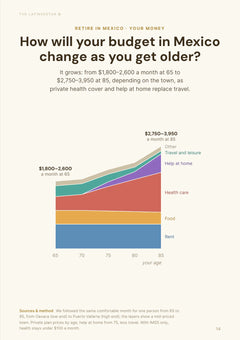
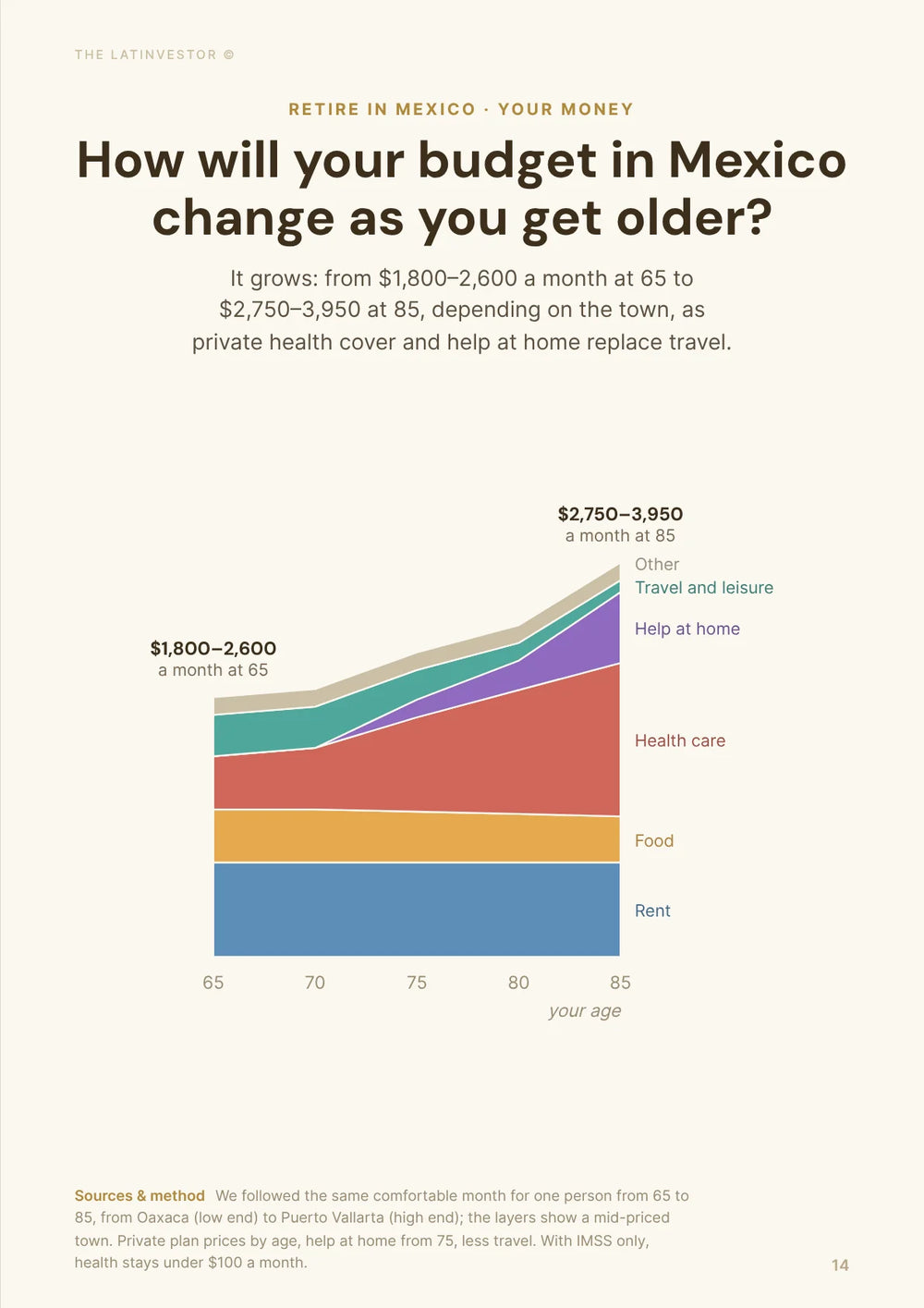
Healthcare is the hardest monthly cost to generalize. IMSS can be inexpensive for eligible retirees, while private insurance and major medical care become much more sensitive to age, medical history and the level of coverage wanted.
Foreign retirees also carry currency risk. A lifestyle costing 45,000 MXN is $2,250 at 20 pesos per dollar but $2,813 at 16, even though nothing about the local lifestyle has changed.
Being able to afford Puerto Vallarta does not automatically mean qualifying for Mexican residency. Consular solvency tests measure documented income or assets, and those thresholds can sit above what a retiree actually needs to spend locally.
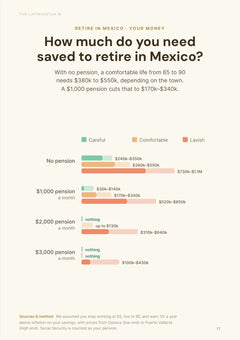
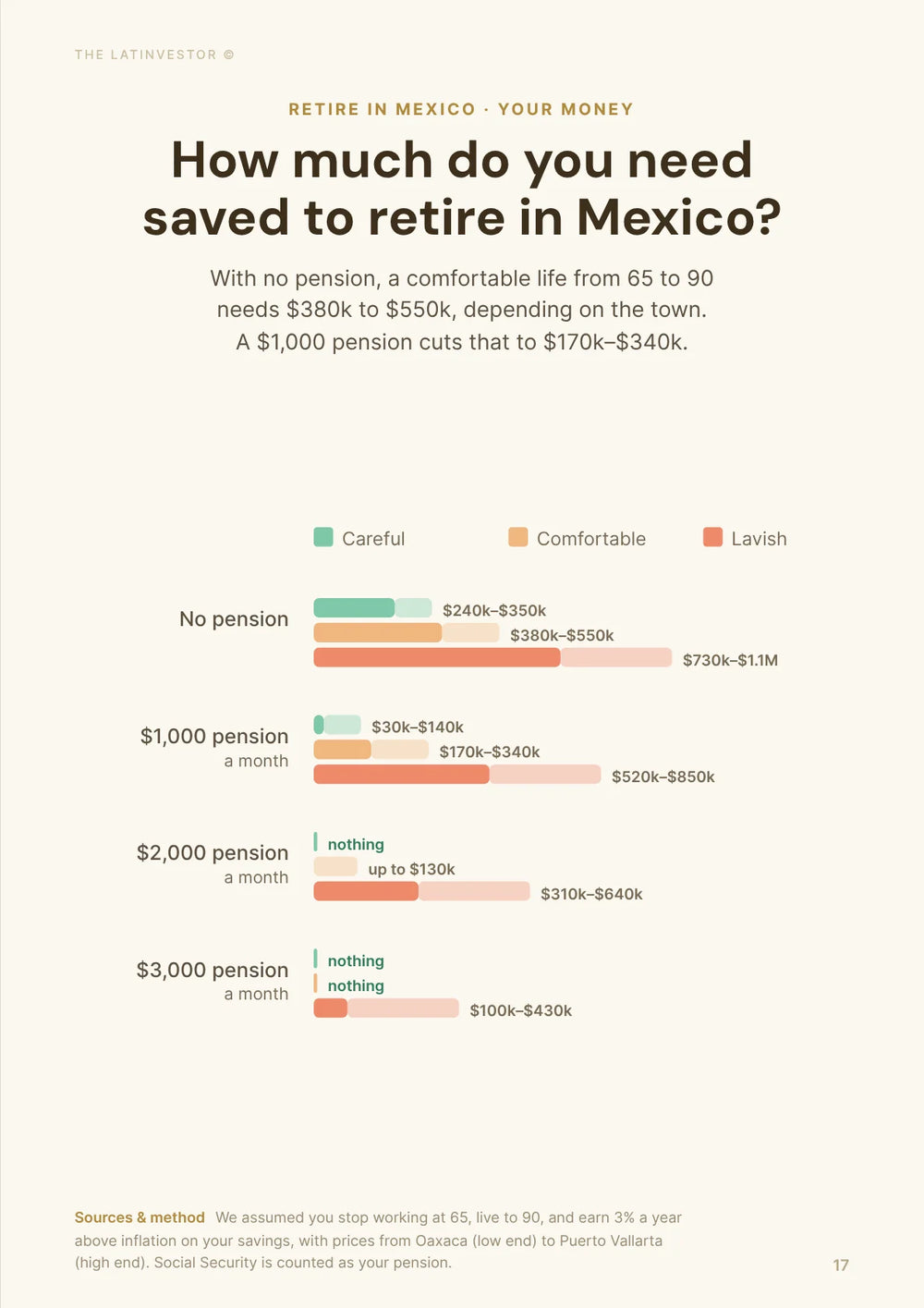
For someone with no pension or Social Security, a comfortable retirement generally points toward roughly $740,000–$930,000 invested for one person and around $1 million or more for a couple. With a paid-off home or reliable retirement income, the portfolio requirement can fall sharply.

Is $2,000 a month still enough to retire in Puerto Vallarta?
A $2,000 monthly retirement budget can still work in Puerto Vallarta, but today it requires a fairly cheap long-term rental and some discipline with spending.
Housing decides most of the outcome. Recent Puerto Vallarta cost-of-living data puts a one-bedroom apartment at roughly 23,800 MXN a month in the central areas and around 12,700 MXN outside them. At about 18.5 pesos per dollar (October 2026), that means roughly $685–$1,290 a month before electricity, food, healthcare or entertainment.
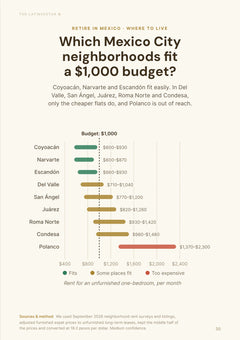
The rental market also has a much wider spread than a citywide average suggests. Recent local and expat-focused estimates still find one-bedroom apartments from around $500–$800 in cheaper neighborhoods, while desirable furnished condos near the beach can easily move above $1,500 and sometimes well beyond $2,000.
Someone paying 12,000–15,000 MXN in rent can make $2,000 work reasonably well. Someone paying 25,000 MXN has already spent most of that budget before doing anything else.
So $2,000 remains possible, but it is now a budget-conscious version of retirement in Puerto Vallarta rather than the easy benchmark it once sounded like.
How much does one person really need to retire comfortably in Puerto Vallarta?
A single retiree should currently plan on roughly 40,000–50,000 MXN a month for a comfortable life in Puerto Vallarta while renting.
That range is higher than the minimum needed to live there. A recent ExpatDen review, for example, estimated that a single retiree could live comfortably on around $2,050 a month. We would leave more room because rent, healthcare and travel can move the budget very quickly.
At around 30,000–35,000 MXN a month, Puerto Vallarta is still workable with a modest apartment, plenty of local spending and careful control of extras.
Around 40,000–50,000 MXN gives much more breathing room. A retiree can rent a decent apartment, eat out regularly, use private doctors when needed and spend money on activities without checking every bill.
Once spending reaches 70,000 MXN or more, the lifestyle starts accommodating newer condos, premium locations, regular international restaurants and more frequent travel.
| Lifestyle | Monthly budget | Approx. USD | What it can realistically cover |
|---|---|---|---|
| Lean | 30,000–35,000 MXN | ~$1,620–$1,890 | Modest rental, local spending, limited extras |
| Comfortable | 40,000–50,000 MXN | ~$2,160–$2,700 | Good rental, restaurants, healthcare allowance, leisure |
| Upscale | 70,000+ MXN | ~$3,780+ | Premium housing, heavier dining and travel spending |
How much does a retired couple need in Puerto Vallarta?
A retired couple can live comfortably in Puerto Vallarta on roughly 55,000–70,000 MXN a month these days, assuming they rent rather than own.
Couples benefit heavily from sharing the largest bill. Rent, internet, household equipment and many utility costs barely change whether one or two people live in the apartment.
Food, healthcare, travel and entertainment obviously rise with a second person, but the total budget does not double.
Around 45,000 MXN a month is possible for a couple who keeps rent low and lives fairly locally. At approximately 60,000 MXN, there is much more room for a good apartment, frequent restaurants, private medical care and regular entertainment.
A couple wanting a modern condo close to Los Muertos Beach or in another highly desirable tourist area can easily push beyond 75,000 MXN. Housing alone can absorb 35,000–50,000 MXN in that part of the market.
| Couple's lifestyle | Monthly budget | Annual budget | Approx. monthly USD |
|---|---|---|---|
| Careful | 45,000 MXN | 540,000 MXN | ~$2,430 |
| Comfortable | 60,000 MXN | 720,000 MXN | ~$3,240 |
| Very comfortable | 75,000 MXN | 900,000 MXN | ~$4,050 |
| Premium | 90,000+ MXN | 1.08M+ MXN | ~$4,860+ |
Is rent what makes Puerto Vallarta retirement expensive now?
Yes. Rent currently creates the biggest gap between a cheap Puerto Vallarta retirement and an expensive one.
Recent cost-of-living observations put a one-bedroom outside the center near 12,700 MXN a month, while the central average is closer to 23,800 MXN. That difference alone adds roughly 133,000 MXN to annual spending.
And “central Puerto Vallarta” still hides radically different properties. Simpler long-term apartments can be found far below premium-market prices, while newer furnished buildings with pools, elevators, views and easy beach access often ask 35,000–50,000 MXN a month.
Seasonal rentals can go much higher because they compete with tourists. A retiree renewing furnished short-term rentals throughout the year may therefore spend far more than somebody who negotiates a proper annual lease.
Saving 15,000 MXN a month on rent means keeping 180,000 MXN a year. That is more than many retirees will spend on restaurants, buses and internet combined.
| Rental type | Typical order of magnitude | Annual housing cost | Retirement impact |
|---|---|---|---|
| Lower-cost long-term 1BR | 10,000–15,000 MXN | 120,000–180,000 MXN | Keeps a $2,000 budget viable |
| Typical outside-center 1BR | ~12,700 MXN | ~152,000 MXN | Leaves plenty for other spending |
| Central 1BR average | ~23,800 MXN | ~286,000 MXN | Requires materially more income |
| Premium furnished condo | 35,000–50,000+ MXN | 420,000–600,000+ MXN | Housing dominates the budget |
Does living near the beach really cost that much more in Puerto Vallarta?
Yes. Choosing a newer condo close to the beach can add $1,000 or more to a Puerto Vallarta retiree's monthly budget compared with living a little farther inland.
Retirees looking around Zona Romántica, Centro and beachfront areas compete with vacation demand as well as other long-term residents.
Recent retirement guides still find one-bedroom rentals around $500–$800 in less expensive parts of Puerto Vallarta. In the most desirable tourist areas, good furnished condos can cost several times that amount.
Even within the same broad neighborhood, the gap can be enormous. An older apartment without resort amenities may remain affordable while a nearby building with an ocean view, rooftop infinity pool and concierge operates at international resort pricing.
Over a 20-year retirement, spending an extra $1,000 a month on housing adds $240,000 before inflation or investment returns enter the calculation.
That choice matters far more than whether lunch costs $8 or $12.
Does owning a home make retiring in Puerto Vallarta much cheaper?
Owning a paid-off home can cut the income needed for retirement in Puerto Vallarta by hundreds of dollars or even more than $1,000 each month.
Consider a retiree currently paying 20,000 MXN in rent. Eliminating that payment removes 240,000 MXN of annual spending.
At a 3.5% withdrawal rate, an investment portfolio would need almost 6.9 million MXN just to generate those 240,000 MXN every year.
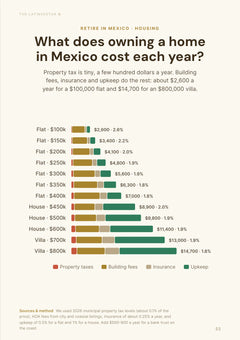
Homeowners still pay property tax, repairs, insurance and possibly substantial condo fees. Buildings with pools, elevators, security and extensive common areas can carry meaningful monthly HOA costs.
Even so, someone who already owns a mortgage-free home enters retirement from a completely different financial position. A 30,000–40,000 MXN monthly budget can feel quite comfortable once market rent disappears.
Buying a property solely to reduce retirement spending deserves a separate calculation because the purchase ties up a large amount of capital. For an existing owner, though, the benefit is immediate.
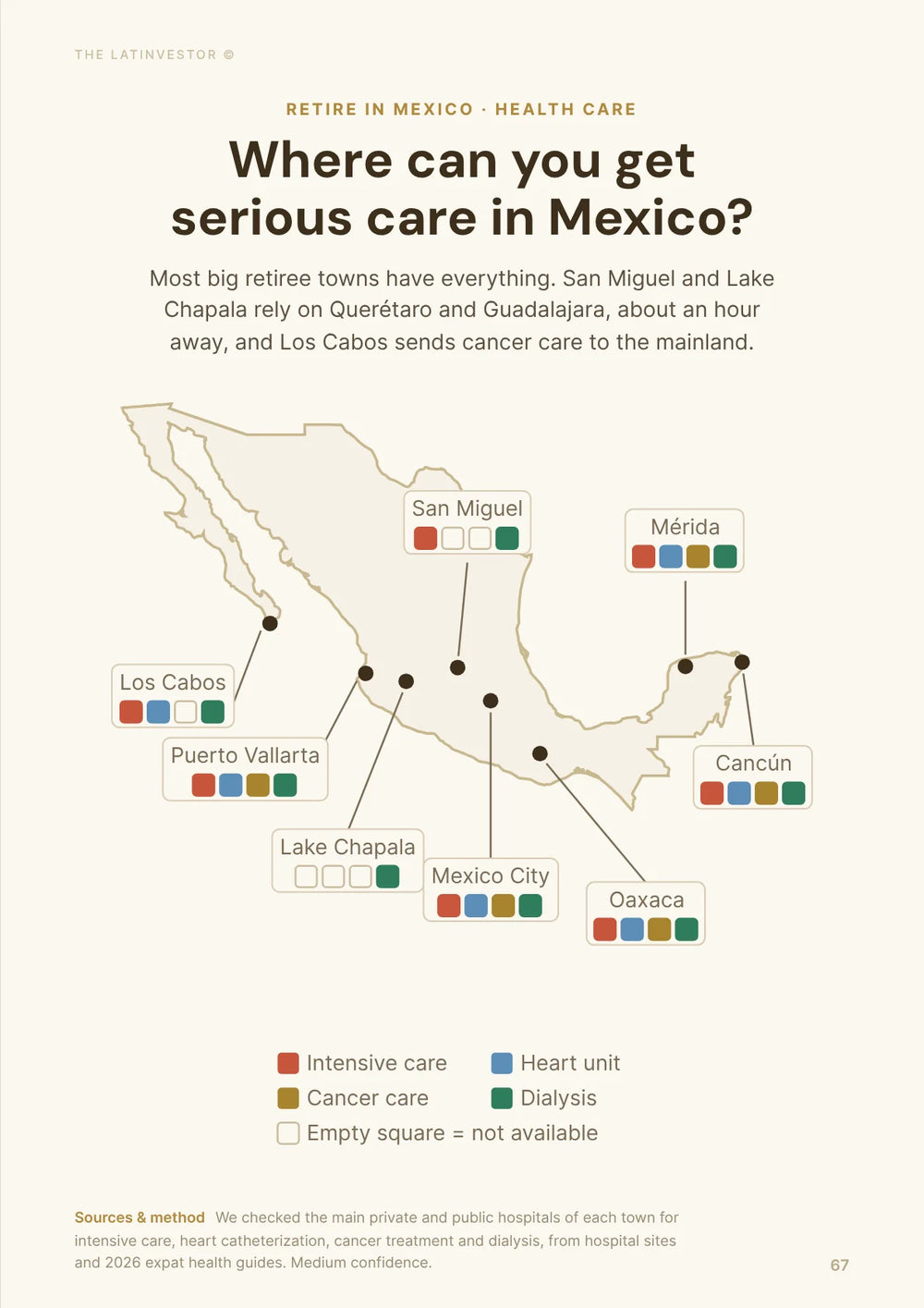
How much should retirees budget for healthcare in Puerto Vallarta?
Retirees in Puerto Vallarta should keep a dedicated healthcare budget even while healthy, because medical spending becomes less predictable as retirement goes on.
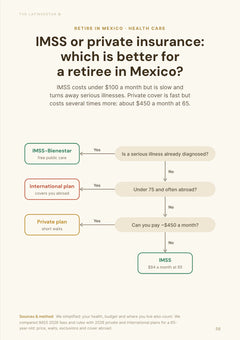
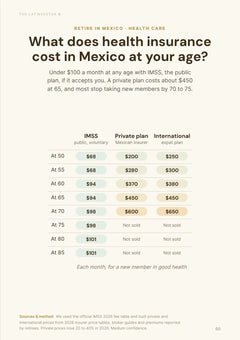
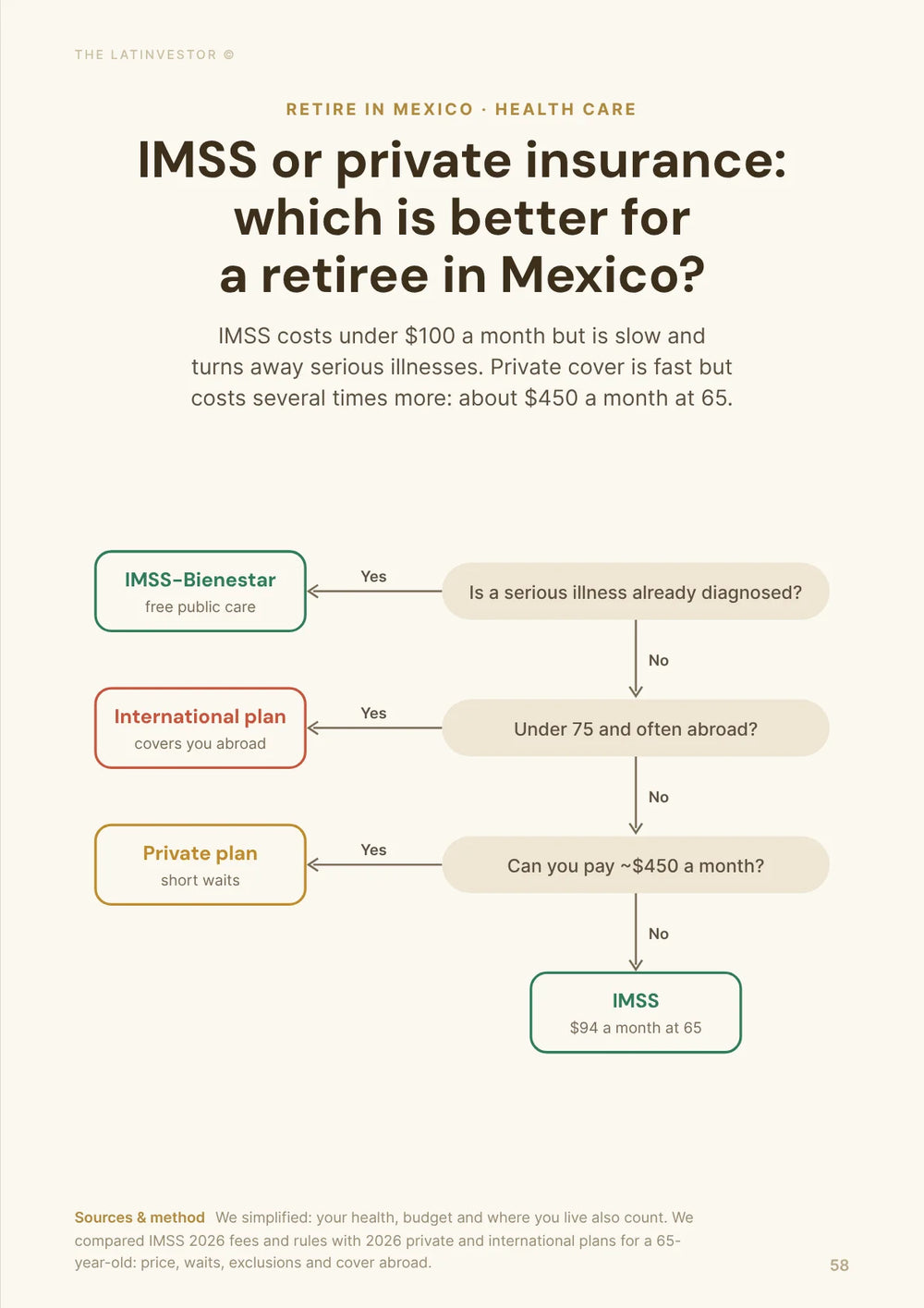
Mexico's IMSS system remains remarkably inexpensive on paper. The current Seguro de Salud para la Familia schedule charges 20,600 MXN a year for people aged 60–69, 21,500 MXN for ages 70–79 and 22,150 MXN from age 80.
Those premiums work out to less than 2,000 MXN a month.
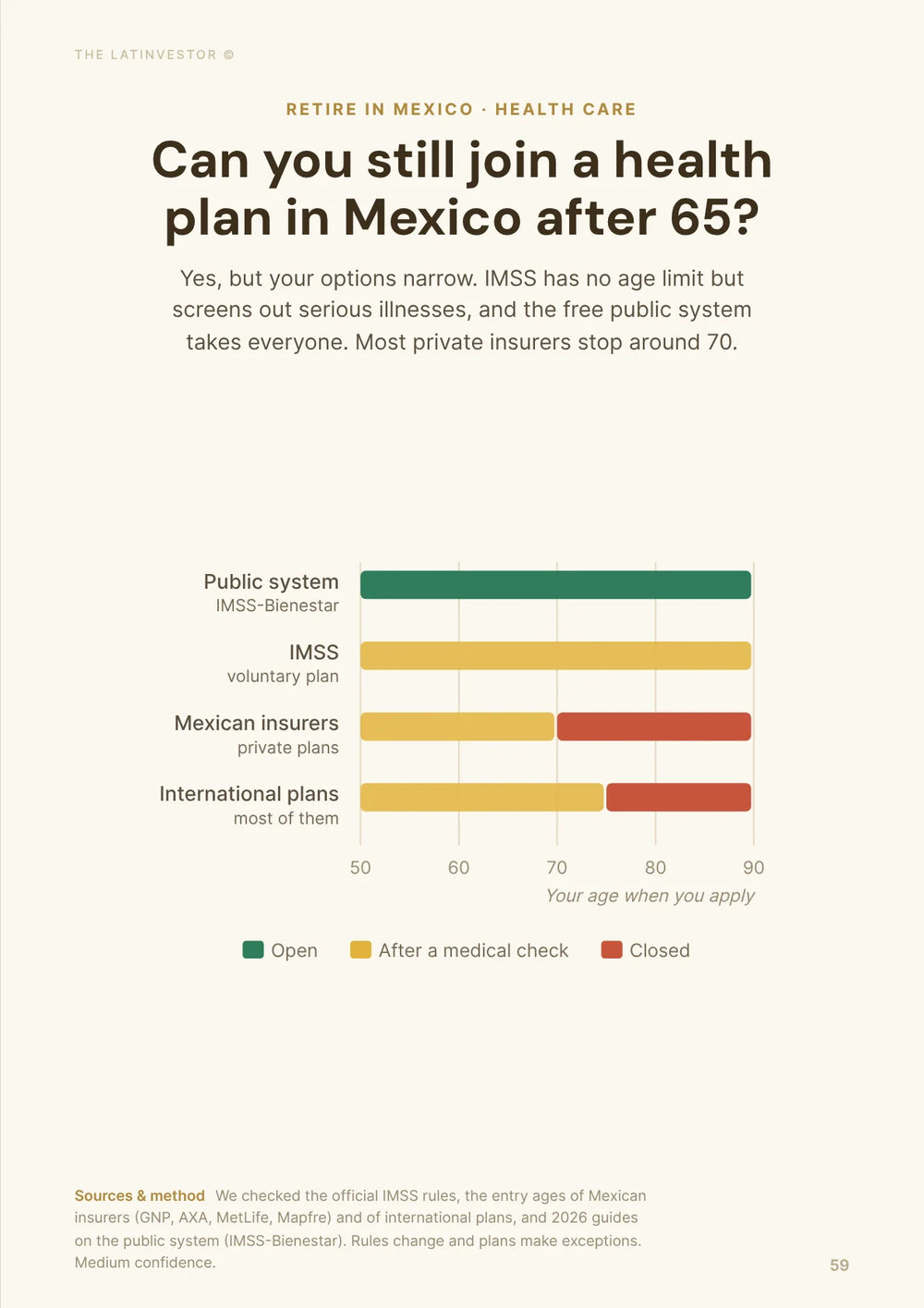
Eligibility deserves attention, however. IMSS states that applicants must meet its conditions and that some pre-existing illnesses can prevent enrollment or limit coverage.
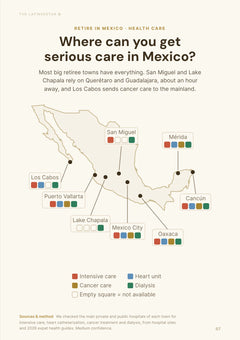
Many foreign retirees also use Puerto Vallarta's private system. Private consultations can remain relatively affordable compared with the United States, but hospitalization, surgery and insurance premiums become a different order of magnitude. Age and medical history can increase private insurance costs sharply. As an example, a 2026 quote for a healthy 65-year-old on a Bupa national plan came to about 120,000 MXN a year with a 32,000 MXN deductible and 10% coinsurance, and about 175,000 MXN with no deductible.
A healthy 62-year-old who mostly pays doctors directly therefore faces a very different healthcare budget from a 78-year-old who wants extensive private coverage.
We would keep several thousand pesos a month available for routine healthcare and maintain a separate reserve for larger medical expenses.
| Healthcare expense | Current order of magnitude | What it tells us |
|---|---|---|
| IMSS age 60–69 | 20,600 MXN/year | Public coverage remains inexpensive |
| IMSS age 70–79 | 21,500 MXN/year | Premium rises only modestly with age |
| IMSS age 80+ | 22,150 MXN/year | Still inexpensive compared with private insurance |
| Private healthcare | About 120,000–175,000 MXN/year at 65 (one insurer's quotes) | Age and medical history can change the budget substantially |
Are food, utilities and getting around still cheap in Puerto Vallarta?
Yes. Food, utilities and local transport are still relatively manageable in Puerto Vallarta, which is why housing has such an outsized effect on the retirement budget.
Recent local cost data puts an inexpensive restaurant meal around 250 MXN and a mid-range three-course dinner for two near 1,050 MXN. Basic supermarket prices remain much lower than the cost of regularly eating in beachfront restaurants.
A retiree who buys groceries locally and eats out several times a week could reasonably spend around 6,000–10,000 MXN a month on food. Frequent cocktails, imported groceries and tourist-area dining can push that figure much higher.
Utilities deserve a little more room than generic Mexico budgets often assume. Air conditioning can make electricity noticeably more expensive during Puerto Vallarta's hot and humid months. Recent observations put basic utilities (electricity, water and garbage) for an 85 m² apartment at about 1,575 MXN a month, and home internet at about 590 MXN. Heavy air conditioning can push the electricity bill much higher.
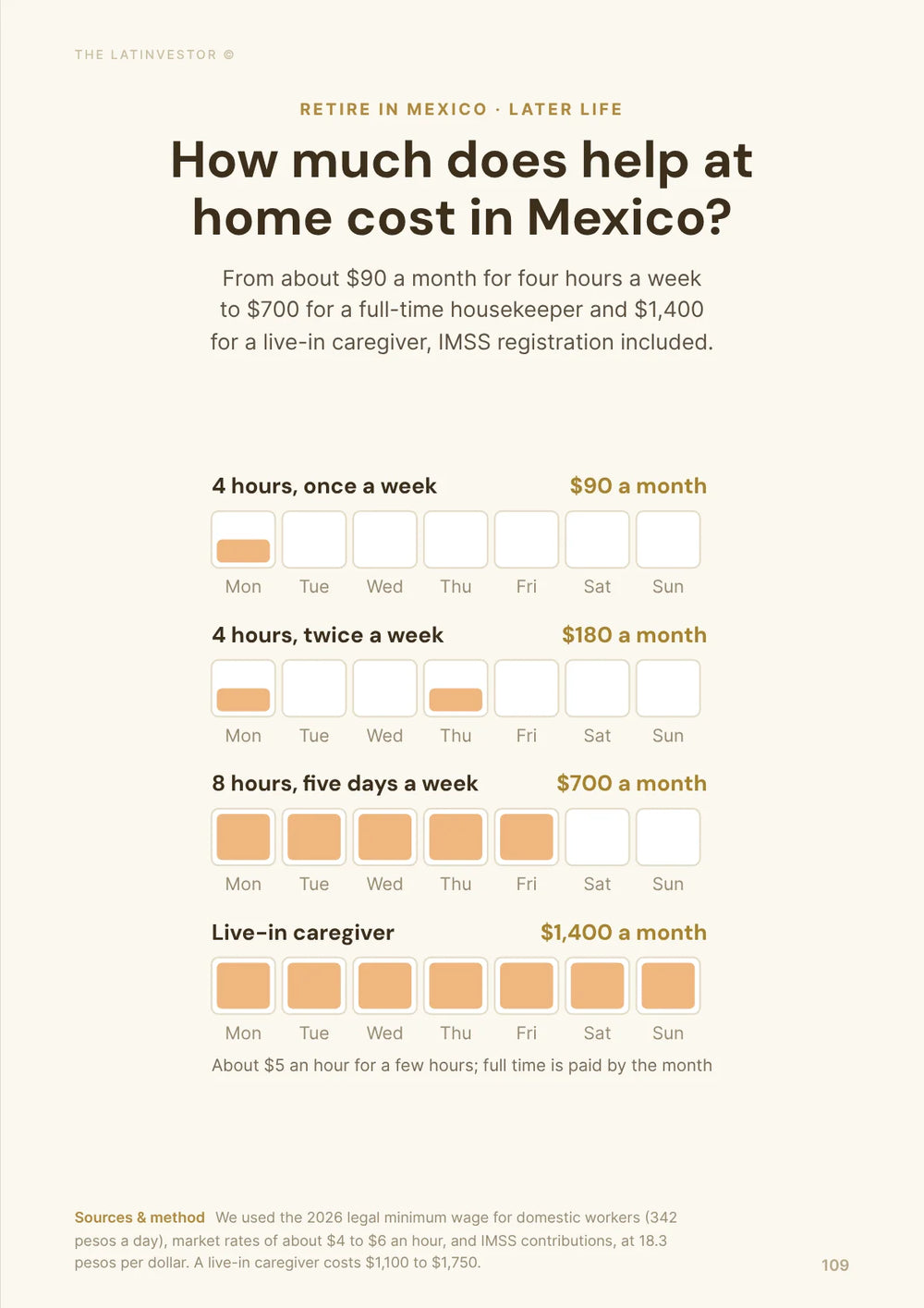
A car is optional for many retirees. Local buses cost 11 MXN a ride, taxis and ride-hailing cover occasional longer trips, and walkable neighborhoods let retirees avoid insurance, fuel, maintenance and depreciation altogether.
Paying somewhat more for a walkable apartment can sometimes save enough on transportation to narrow the housing premium.
Can the peso suddenly make retirement in Puerto Vallarta more expensive?
Yes. A stronger Mexican peso can raise a foreign retiree's Puerto Vallarta costs by hundreds of dollars a month even when local prices barely move.
Take monthly spending of 45,000 MXN.
At 20 pesos per U.S. dollar, that lifestyle costs $2,250. At 18.5 pesos, roughly the October 2026 rate, it costs $2,432. At 16 pesos, it rises to $2,813.
The retiree is buying exactly the same groceries, paying exactly the same rent and visiting the same restaurants. Only the currency conversion has changed.
Anyone receiving Social Security, a pension or investment income in dollars therefore carries exchange-rate risk throughout retirement.
We would calculate the long-term budget in pesos first and leave a currency cushion rather than assuming today's exchange rate will last for the next 20 years.
| USD/MXN rate | Cost of 45,000 MXN | Cost of 60,000 MXN | Effect on retiree |
|---|---|---|---|
| 16 | $2,813 | $3,750 | Strong peso raises dollar cost |
| 17.5 | $2,571 | $3,429 | Middle scenario |
| 18.5 (Oct. 2026) | $2,432 | $3,243 | Current level |
| 20 | $2,250 | $3,000 | Weak peso lowers dollar cost |
Can you afford Puerto Vallarta but still fail Mexico's residency requirements?
Yes. Some retirees can easily afford to live in Puerto Vallarta yet still fall short of the financial requirements used for Mexican residency.
The gap exists because residency solvency tests measure income or assets rather than the actual amount someone spends in Puerto Vallarta.
Temporary residency usually requires applicants to demonstrate qualifying monthly income or substantial savings. Permanent residency for retirees generally requires a much higher pension or asset level.
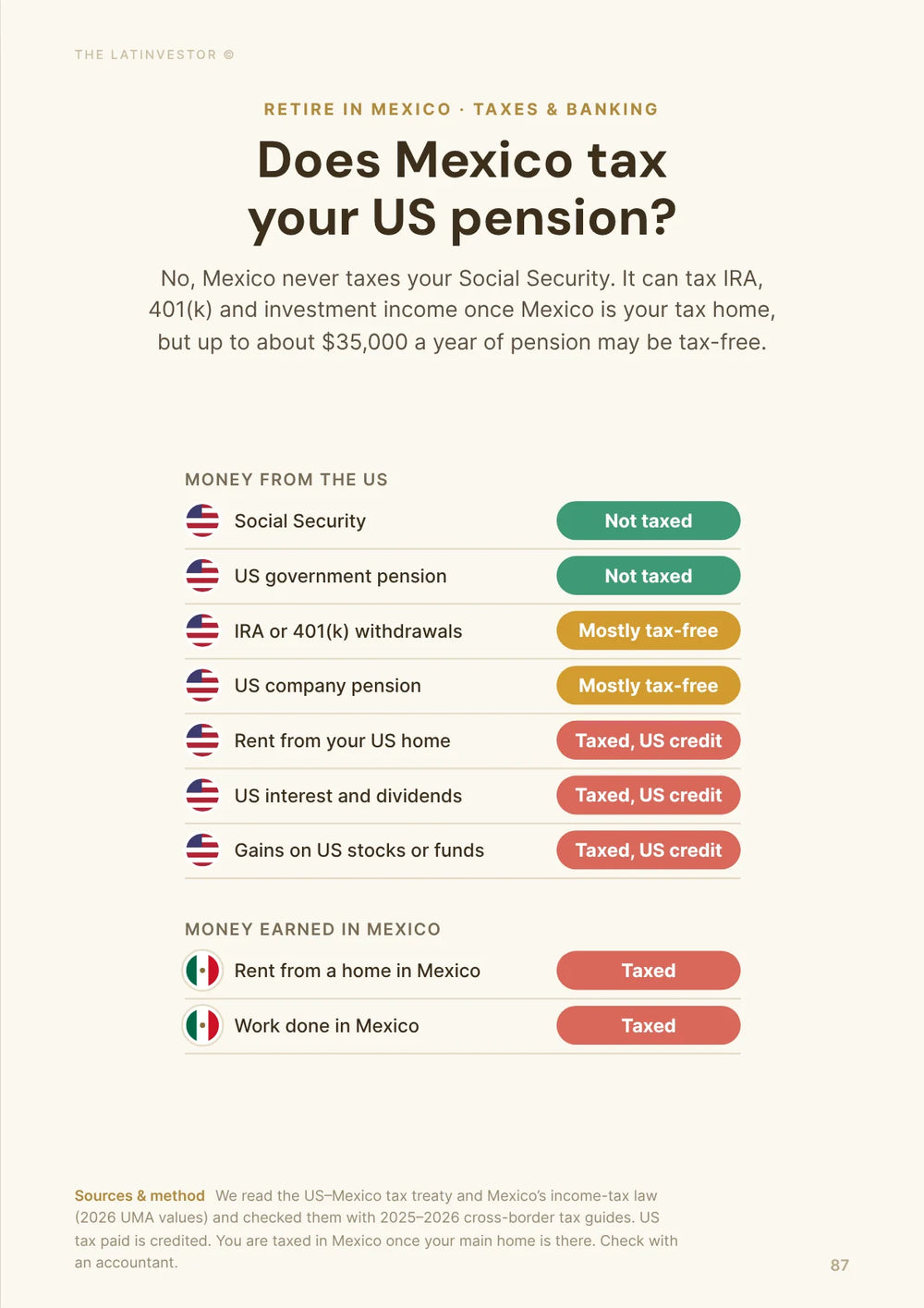
The exact threshold can vary by Mexican consulate, which makes a universal dollar figure misleading. In 2026, the San Diego consulate asks for a monthly income of about $4,510 (83,435 MXN) over the last six months, or savings of about $75,950 (1,405,075 MXN) over the last twelve months, for temporary residency. That is well above the roughly $2,000–$3,000 a month that many single retirees actually spend.
Someone living comfortably on $2,500 a month may therefore have enough money for daily life but insufficient qualifying income for the consulate handling the application.
Retirees should check the specific Mexican consulate where they plan to apply before treating their living budget as proof that residency will be straightforward.
How much retirement savings do you need in Puerto Vallarta with no pension?
A retiree with no pension or Social Security should probably have around $740,000–$930,000 invested for a comfortable single retirement in Puerto Vallarta, while a couple can reasonably target around $1 million or more.
We get there by starting with annual spending.
A single retiree spending 45,000 MXN a month needs 540,000 MXN a year. At a 3.5% initial withdrawal rate, funding that entirely from investments requires about 15.4 million MXN.
A couple spending 60,000 MXN monthly needs 720,000 MXN a year. At the same withdrawal rate, the portfolio rises to roughly 20.6 million MXN.
Using 3.5% rather than automatically applying 4% gives some extra room for a long retirement, healthcare surprises and currency swings.
These calculations also assume the investment portfolio needs to fund the entire lifestyle. Owning a home or receiving even a modest pension changes the picture dramatically.
| Monthly spending | Annual spending | Portfolio at 3.5% |
|---|---|---|
| 32,000 MXN | 384,000 MXN | 11.0M MXN |
| 45,000 MXN | 540,000 MXN | 15.4M MXN |
| 60,000 MXN | 720,000 MXN | 20.6M MXN |
| 75,000 MXN | 900,000 MXN | 25.7M MXN |
Is $500,000 enough to retire in Puerto Vallarta?
A $500,000 portfolio can be enough to retire comfortably in Puerto Vallarta when it sits alongside Social Security, a pension or a paid-off home; by itself, it leaves much less room.
At a 3.5% withdrawal rate, $500,000 produces about $17,500 a year, or roughly $1,460 a month before tax.
That falls below the comfortable Puerto Vallarta spending range we found for a renter.
Now add $2,000 a month of Social Security. Total gross cash flow rises to roughly $3,460 a month, which comfortably clears our benchmark for many single retirees and can also support a budget-conscious couple.
The same logic applies to smaller pensions. A retiree spending $2,600 a month and receiving $2,000 of guaranteed income needs the portfolio to cover only $600 a month.
Funding that $7,200 annual gap at 3.5% requires roughly $206,000.
This is why retirement-savings headlines can be misleading. $500,000 with no outside income is one situation. $500,000 plus a $2,000 pension and a paid-off apartment is an entirely different one.
Is $1,500 a month enough to retire in Puerto Vallarta anymore?
A $1,500 monthly retirement in Puerto Vallarta is still possible, but these days it leaves very little margin for expensive rent, major healthcare costs or a tourist-style lifestyle.
At roughly 27,750 MXN a month, somebody paying 12,000 MXN in rent still has around 15,750 MXN for groceries, utilities, buses, healthcare and entertainment.
That can work.
Move the same retiree into an apartment costing 20,000–25,000 MXN and the budget breaks down almost immediately.
A $1,500 lifestyle therefore depends heavily on finding below-average long-term housing, cooking regularly, avoiding a car and keeping discretionary spending under control.
A healthy retiree could live that way for years. We would be far less comfortable recommending the same budget to somebody entering retirement without substantial emergency savings, because one medical problem, a stronger peso or a forced move into a more expensive rental could quickly erase the margin.
How much money do you really need to retire in Puerto Vallarta?
A realistic target for retiring comfortably in Puerto Vallarta today is about 40,000–50,000 MXN a month for one renter and roughly 55,000–70,000 MXN for a couple.
Those figures put a single retiree around $2,160–$2,700 a month and a couple around $2,970–$3,780 at about 18.5 pesos per dollar (October 2026).
Spending can fall much lower. A single person with a 12,000 MXN apartment, no car and mostly local habits can still make Puerto Vallarta work around 30,000 MXN a month.
The premium version of Puerto Vallarta has moved much farther away from that number. A modern furnished condo near the beach can cost 35,000–50,000 MXN before food, healthcare or travel enters the budget.
For somebody relying entirely on investments, we would want roughly $740,000–$930,000 for a comfortable single retirement and around $1 million or more for a couple. Social Security, a pension or a paid-off home can reduce the required portfolio by hundreds of thousands of dollars.
The old “$1,500 a month in Mexico” idea still describes one possible Puerto Vallarta lifestyle, but it no longer describes the city particularly well. Around $2,500 a month for one person or $3,500 for a couple is a much more useful target now, with a separate emergency and healthcare reserve on top.
Our methodology
This analysis is built for one question: how much money someone currently needs to retire in Puerto Vallarta. Instead of forcing the city into one generic cost-of-living number, we separated the answer into the factors that actually change it: housing, healthcare, transport, exchange rates, residency requirements, home ownership and the amount of spending that must be funded from investments.
Housing was treated as the biggest variable. We used current Puerto Vallarta rental inventory from Mercado Libre and Inmuebles24, together with monthly furnished inventory from Airbnb and location-specific Airbnb searches around Los Muertos Beach, Conchas Chinas and Marina Vallarta. We used those sources to judge the spread between conventional long-term housing and premium furnished coastal rentals rather than blending them into one average.
Healthcare was checked against official Mexican sources. The current Seguro de Salud para la Familia premiums and eligibility conditions come from IMSS and its voluntary family health-insurance guidance. Private-insurance cost structure was cross-checked with CONDUSEF.
Currency scenarios were built in pesos first and translated into dollars using official Banco de México exchange-rate data and its historical USD/MXN series. Dollar figures use about 18.5 pesos per dollar, the October 2026 level. That avoids pretending today's exchange rate will remain fixed throughout a long retirement.
Residency was kept separate from living costs because Mexican consulates test financial solvency rather than actual Puerto Vallarta spending. We used current consular guidance from the Mexican Consulate in Denver, the Mexican Consulate in Las Vegas and the Mexican Consulate in Shanghai to show why someone can afford the city but still miss a visa threshold.
For everyday non-housing costs, we used official references where they were available, including the Government of Jalisco public-transport fare and CFE residential electricity tariffs. For homeowners, we also checked the 2026 Puerto Vallarta property-tax framework rather than treating a paid-off home as cost-free housing.
Retirement-capital estimates were calculated from the spending that still needs to be funded after pensions, Social Security and housing are accounted for. We used a 3.5% withdrawal rate as a conservative planning assumption. That sits below Morningstar's current baseline research, which is around 3.9% for a 30-year inflation-adjusted strategy under its stated assumptions.
The final ranges are therefore not the output of one cost-of-living database. They combine live rental evidence, official Mexican rules, exchange-rate stress tests and retirement-finance assumptions, with the conclusion expressed as a range because Puerto Vallarta retirement costs change sharply with housing choice and income structure.