
Summary
Yes, but only when the rent already pays for today's price. A normal long-term lease in Puerto Vallarta yields about 4% to 6.4% gross in October 2026, so we wouldn't buy a weak-yield condo and hope prices bail it out.
Buyers have the upper hand for now. Condo closings fell 21.1% from January to September 2026 and the median condo takes 262 days to sell, yet the median condo still sold for about US$400,000, up 7.7%.
Fewer foreign tourists are coming. International passengers at the airport fell 19.4% from January to September 2026, and Hurricane Simón closed the airport for about two days in October, just before high season.
Airbnb still earns real money, but less per night. AirDNA puts the average listing at about US$31,300 a year with 57% occupancy, while the nightly rate fell 17.5% and revenue per available night fell 10.4%.
That US$31,300 is about 7.8% of a US$400,000 condo before costs, 5.2% at US$600,000 and 4.5% at US$700,000.
Long-term renting holds up well against Airbnb. Versalles and Marina Vallarta give about 6.3% to 6.4% gross on a normal lease, with no nightly-rate war.
The tourist hot spots yield least. Emiliano Zapata, which covers much of Zona Romántica, sits near 3.7% gross on a long lease, and Centro and Amapas near 3.9%.
Versalles has a catch this autumn: SEAPAL reported sewer backups there in October 2026, and water cuts hit about 40% of the city's neighborhoods in August.
One-bedrooms are not automatically the better buy. On Airbnb, AirROI's average one-bedroom grosses about 5.1% of the citywide asking price, a two-bedroom about 5.4%.
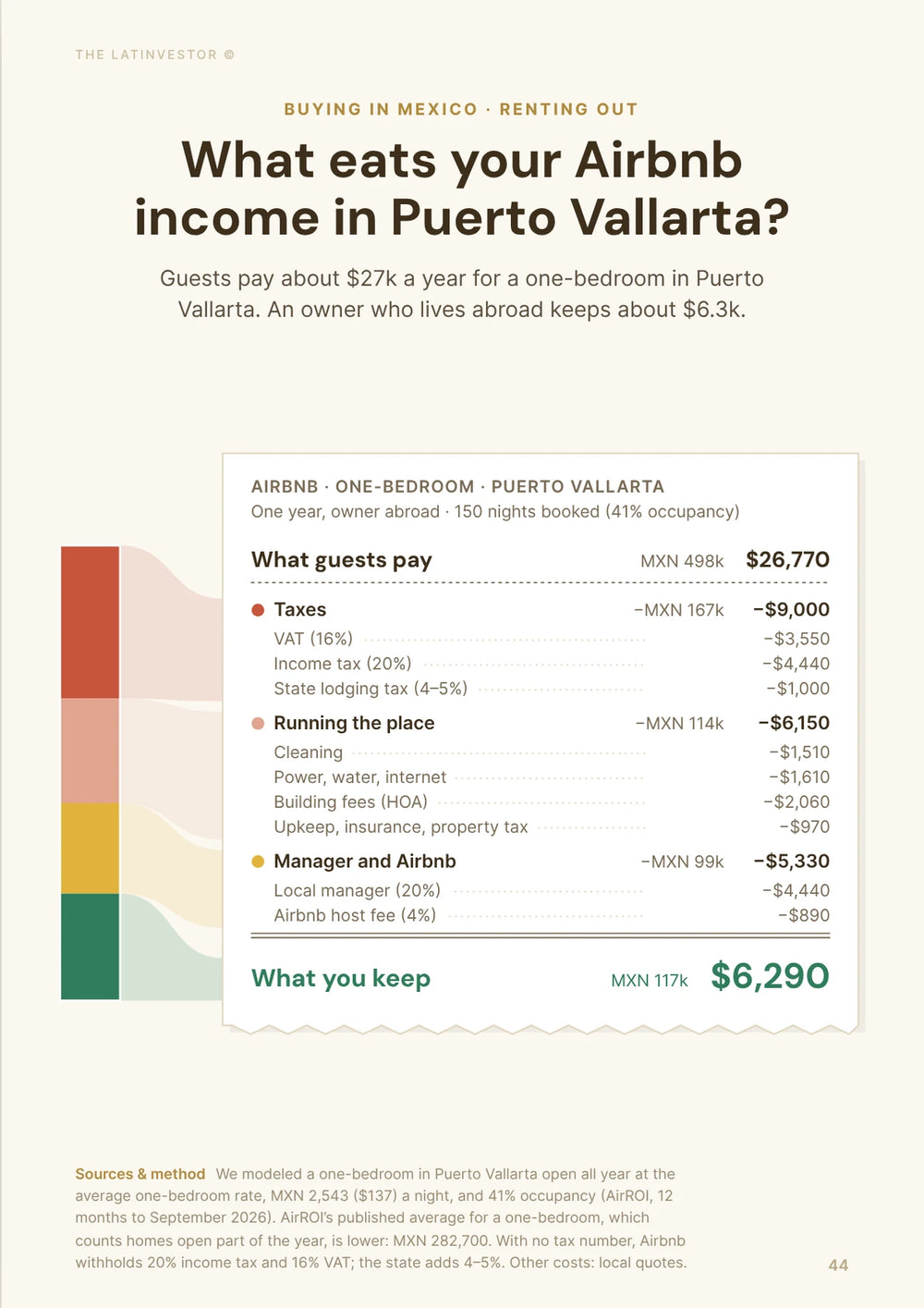
Costs take a big bite. A US$300,000 Airbnb condo grossing 8% keeps about 4.5% after management, HOA fees, utilities, insurance and maintenance, before tax.
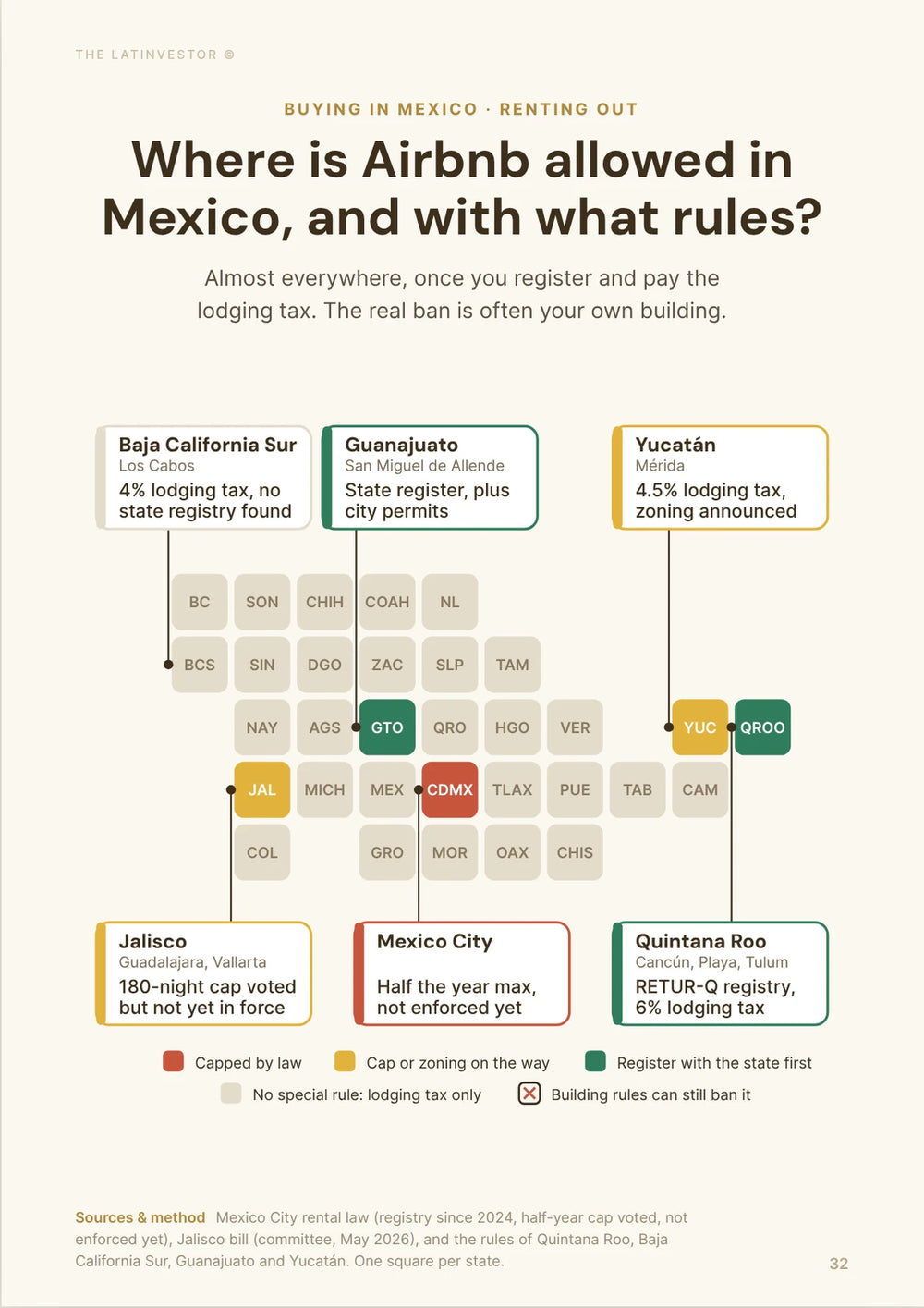
Rules may tighten: a Jalisco Congress committee approved a 180-night yearly cap on second-home short-term rentals in May 2026, and a separate proposal would add a 5% to 11% levy. Neither has had a full vote.
Foreigners can legally rent out through a bank trust, which costs a MXN 21,650 government permit plus the bank's own fees.
Our rule: at MXN 20,000 a month in rent, don't pay more than about MXN 4 million if you want 6% gross. Buy compact, well-priced units in Versalles, Marina Vallarta or 5 de Diciembre, and treat any price growth as a bonus.

Why is a Puerto Vallarta rental property harder to buy well today?
Because the boom no longer does the work for you: sales have slowed, supply piled up, and only the rent can justify the price now.
Teseo Data Lab, working with AMPI Riviera Nayarit, estimates that active condo inventory across the wider Puerto Vallarta market grew from roughly 800 units in 2020 to 3,211 in 2025. Its measure of potential demand grew by only about 38% over the same period. Supply expanded close to nine times faster.
That buildup is now shrinking. Coldwell Banker La Costa's FlexMLS data show active condo listings down 17.5% year over year to 2,672 in September 2026, and new condo listings down 32.0% from January to September.
Buyers are slower too. There were 750 condo closings from January to September 2026, 21.1% fewer than a year earlier. September alone was bad: 48 condo closings, down 41.5%, and new pending condo sales down 51.0%. The median condo now spends 262 days on the market, up 10.1%.
Prices haven't followed. The year-to-date median condo sale was about US$400,000, up 7.7%.
So you get fewer sales, long selling times and plenty of choice, while sellers hold their prices. Pay the wrong price and you end up with a mediocre yield and a slow exit. Pay the right one and the slow market works for you: a listing that has sat for nine months shouldn't get a full-price offer.
| Puerto Vallarta condo indicator | Earlier comparison | Latest reading | Change | What we learn |
|---|---|---|---|---|
| Active condos, long-run Teseo series | ~800 in 2020 | 3,211 in 2025 | ~+301% | Supply exploded during the boom |
| Potential-demand base | 2020 baseline | ~38% higher | ~+38% | Demand grew far more slowly |
| Active FlexMLS condo listings | Sep 2025 | 2,672 (Sep 2026) | -17.5% | Excess supply is shrinking |
| Condo closings, Jan to Sep | 2025 | 750 (2026) | -21.1% | Buyers are still moving slowly |
| Median condo days on market | Sep 2025 | 262 days (Sep 2026) | +10.1% | Selling takes patience |
| Median condo sale, Jan to Sep | 2025 | ~US$400,000 (2026) | +7.7% | Prices have held up better than sales |
Is Puerto Vallarta tourism weak enough to hurt rental income?
It's clearly softer, especially for the foreign visitors who pay the most, so we would already build that slowdown into any vacation-rental purchase.
Grupo Aeroportuario del Pacífico reported about 4.54 million passengers at Puerto Vallarta airport from January to September 2026, 12.3% fewer than a year earlier. International traffic fell 19.4%, while domestic traffic slipped only 3.7%.
The drop started with the violence in Jalisco on February 22, 2026, which grounded international flights for the day and shook confidence; international traffic fell 32.1% in March. Spirit Airlines shut down in May and higher fuel prices pushed fares up. September was better, with international passengers down 12.0%.
Hotels felt it too. DATATUR figures for the first half of 2026 put hotel occupancy at 69.38%, against 75.41% a year earlier.
More than 4.5 million passengers in nine months is still a huge visitor base. But nobody should underwrite 70% Airbnb occupancy and rising nightly rates as if tourism only goes up.
Will Hurricane Simón and fewer foreign flights hurt this winter's bookings?
Probably a little, not a lot: Simón closed the airport for about two days in October 2026 without major reported damage, and some winter flights from Canada are being added.
Simón passed as a Category 3 hurricane on October 11, with its eye about 45 miles south of Cabo Corrientes, according to AP. The boardwalk closed and some hotels evacuated. GAP reopened the airport at 00:01 on October 13, earlier than planned. The bigger risk is perception: storm headlines a few weeks before high season can slow last-minute bookings.
On flights, the picture is mixed. Porter adds an Edmonton route from November 3, 2026, while Delta paused Seattle from October 6 to November 8. The airport's second terminal, meant to double international capacity, is targeted for early 2027.
If you're buying a rental now, ask the seller or manager for confirmed bookings from December to March compared with the same date last year, and how many guests cancelled around Simón. Check that the insurance covers hurricane damage and lost rental income. Run your numbers on last winter's real results, not on 2025's.
Do Puerto Vallarta Airbnbs still make enough money to justify condo prices?
They still bring in serious revenue, but the average only looks good against condo prices when the purchase price stays disciplined.
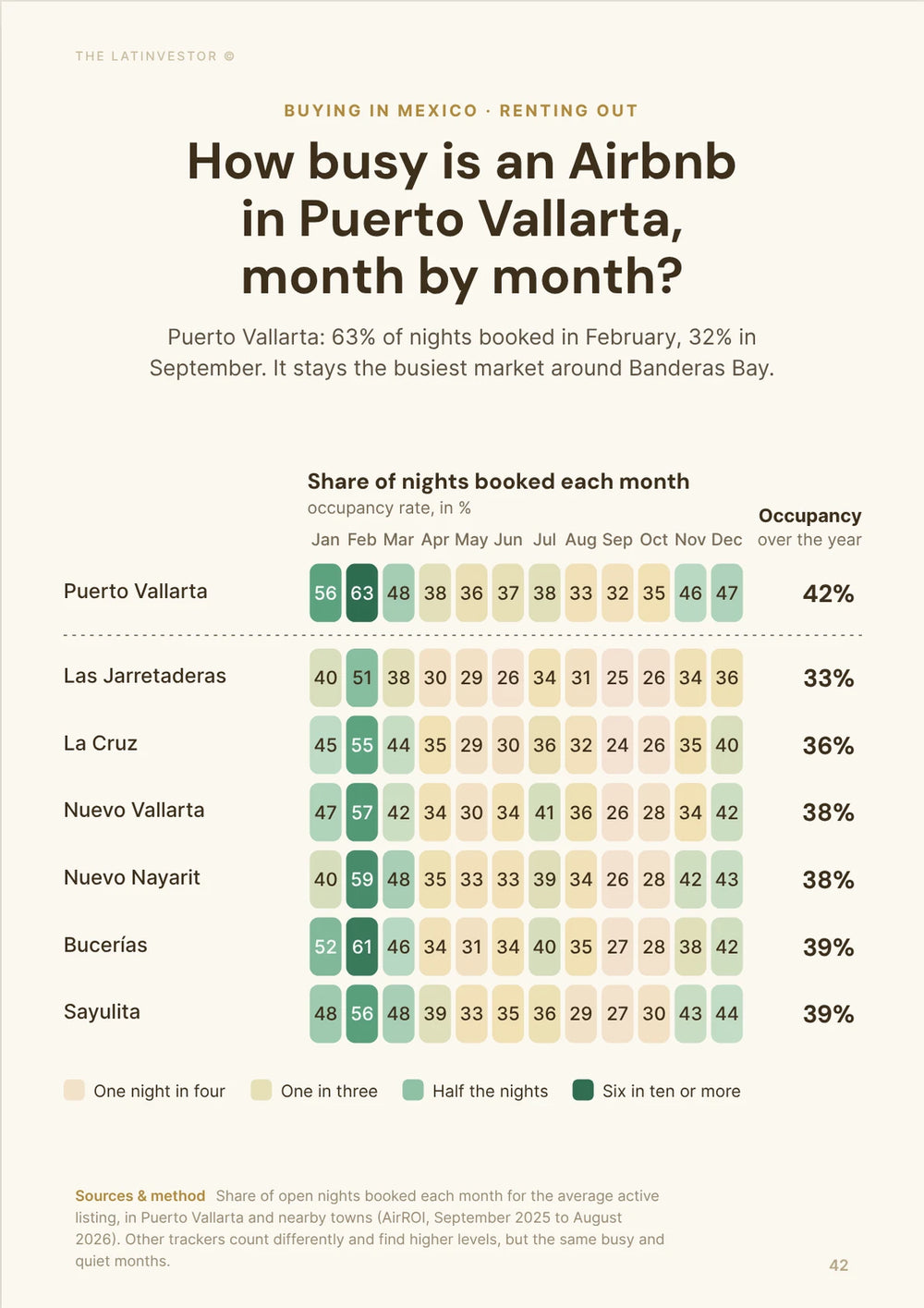
AirDNA, which covers Airbnb, Vrbo and Booking.com, tracks 5,943 active short-term rentals in Puerto Vallarta over the 12 months to September 2026, with 57% occupancy, a US$178 average nightly rate and average revenue of about US$31,300 a year.
Underneath, earning power is down. Revenue per available night (RevPAR) is about US$101, down 10.4% in a year, and the nightly rate fell 17.5%. Hosts are filling more nights by charging less.
Be careful with one figure: average revenue per listing is up 62.3%. That's because AirDNA's active-listing count fell 54.3%; weaker listings dropped out and the survivors look richer. AirROI, which only tracks Airbnb and counts listings differently, shows revenue per listing down 7.1%. Don't mix the two in one calculation.
Now compare US$31,300 with property prices. The median condo sold for about US$400,000 from January to September 2026. The data don't match property for property, but the ratio is a useful test: US$31,300 is about 7.8% of US$400,000, before any cost.
At US$500,000, the same revenue is 6.3%. At US$600,000, it falls to 5.2%. At US$700,000, it's 4.5%.
The owner still pays condo fees, utilities, internet, insurance, repairs, furniture, cleaning not passed on to guests, platform fees, taxes and usually a manager. A US$600,000 condo bringing in US$30,000 to US$35,000 a year is an ordinary investment. Work out believable net income first, and let that set the maximum price.
| AirDNA metric (12 months to Sep 2026) | Current reading | YoY change | Our read |
|---|---|---|---|
| Active listings | 5,943 | -54.3% | Measured supply has halved |
| Occupancy | 57% | Higher | Remaining listings fill more nights |
| Average nightly rate | US$178 | -17.5% | Hosts have lost pricing power |
| RevPAR | US$101 | -10.4% | Earning power per night is down |
| Annual revenue per listing | US$31,300 | +62.3% | Strong headline, distorted by listings leaving |
Is a long-term rental better than Airbnb in Puerto Vallarta today?
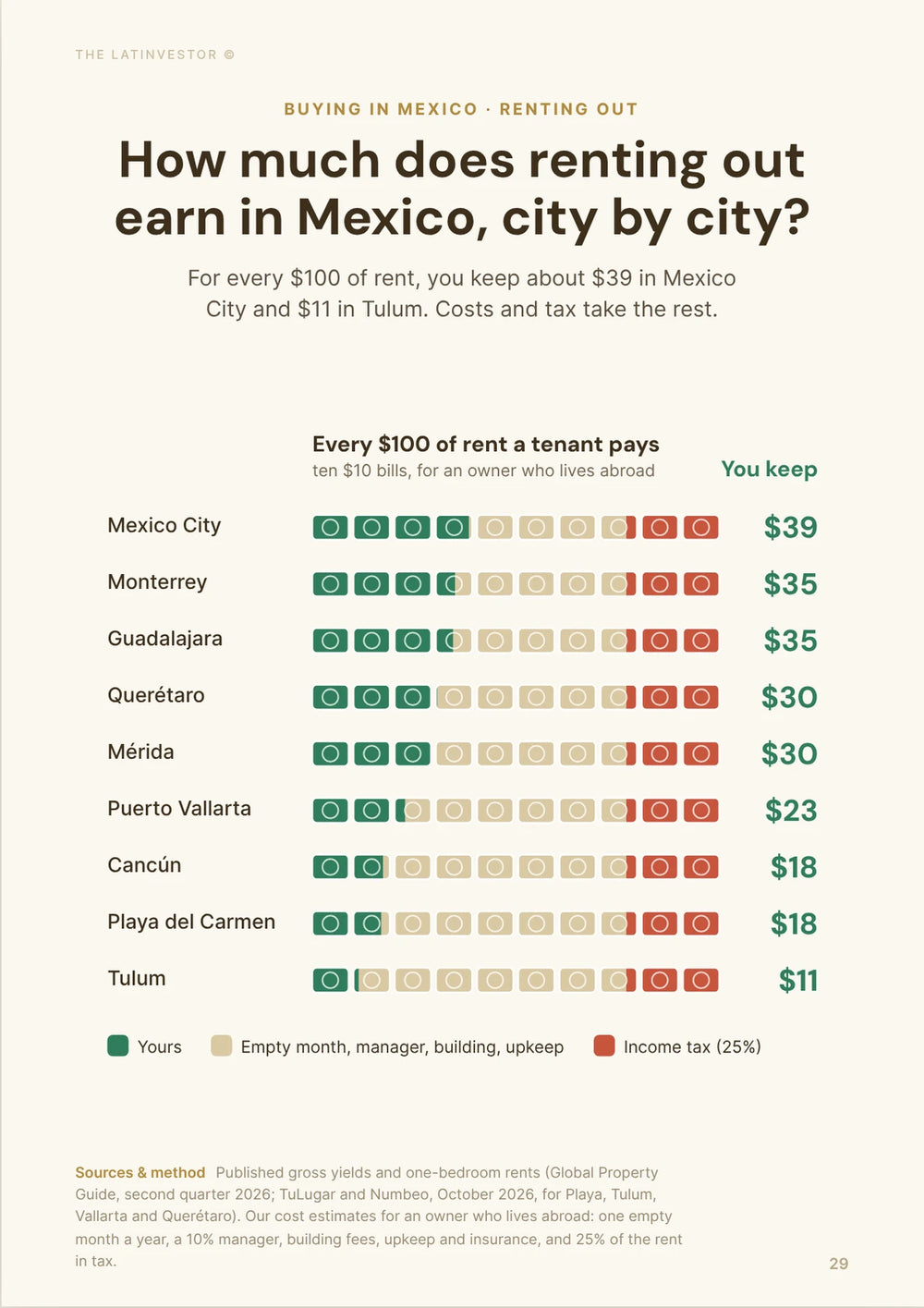
Often, yes: a normal lease gives about 4% to 6.4% gross in the main neighborhoods, with much lower costs and no exposure to falling nightly rates.
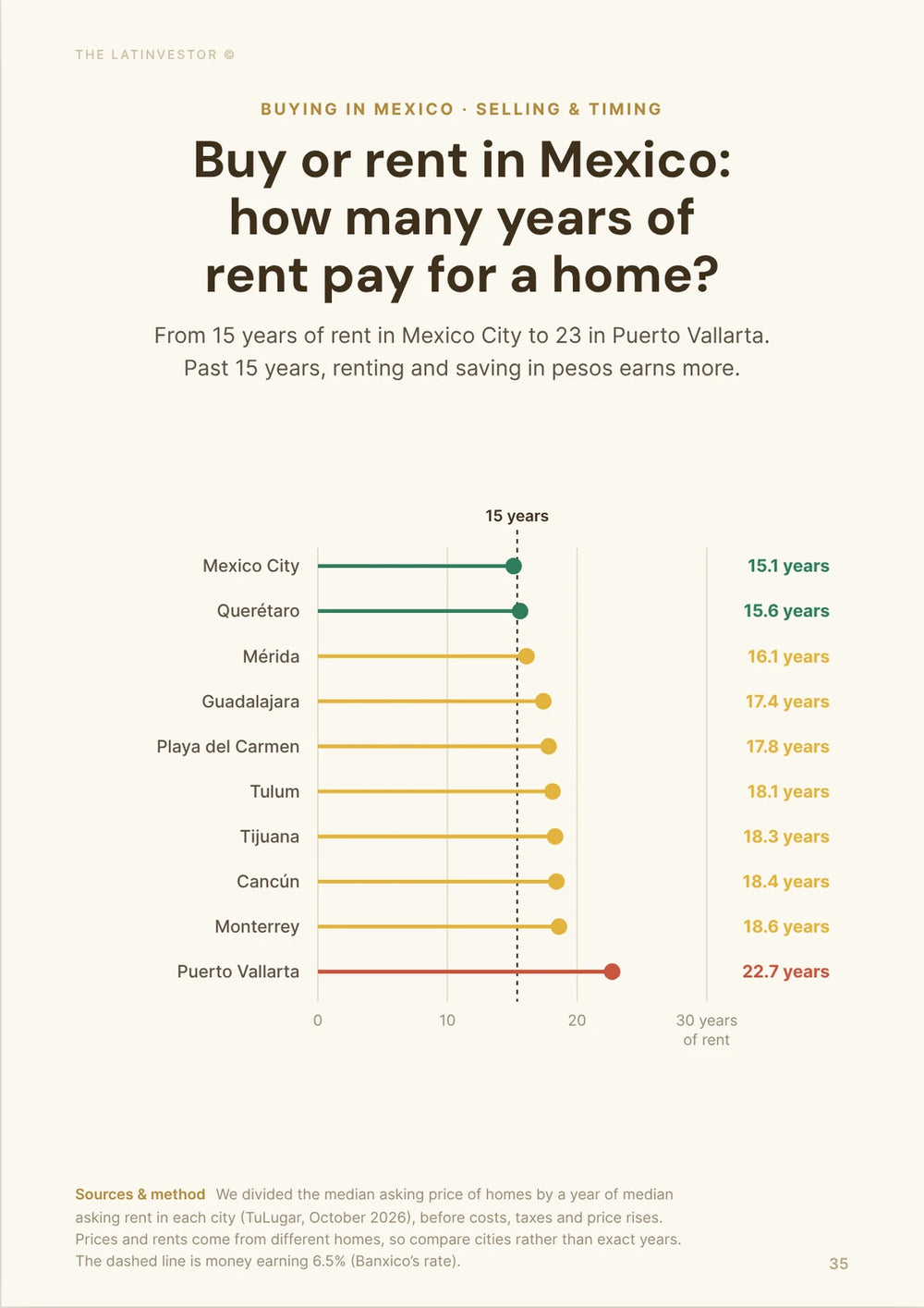
We compared monthly rent per square meter with sale price per square meter from Propiedades.com's October 2026 neighborhood data, because rental and sale listings aren't the same apartments. Versalles comes out at about 6.3% gross and Marina Vallarta at about 6.4%.
After those two, it drops fast: 5 de Diciembre near 4.5%, Zona Hotelera Norte around 4.1%, Centro and Amapas around 3.9%, Emiliano Zapata about 3.7%.
Rents are moving in the landlord's favor in Versalles. Its average asking rent is about MXN 19,675 a month (about US$1,060), up 24.4% between April 2025 and October 2026, while asking prices slipped 2.5%.
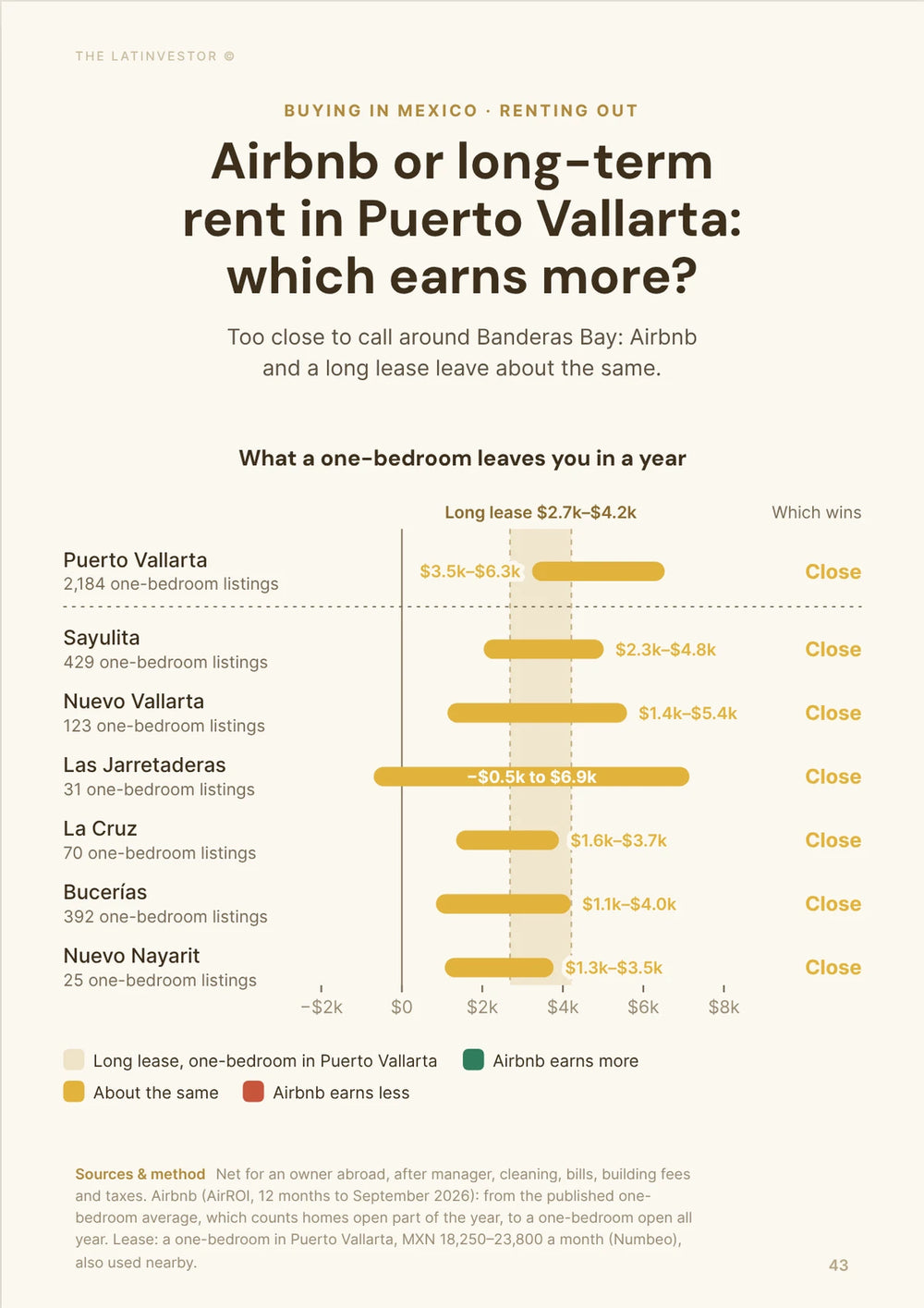
A furnished one-to-six-month rental sits in between. A US$300,000 apartment let at US$2,000 a month makes US$24,000 a year (8% gross) with twelve months let, or US$20,000 (6.7%) with ten, with far lighter running costs than an Airbnb paying a 20% manager.
Airbnb can still win when the apartment is exceptional, winter rates are strong and you manage it yourself. For steady cash flow with less work, a lease is easier to defend.
| Area (Propiedades.com, Oct 2026) | Monthly rent / m² | Sale price / m² | Implied gross long-term yield |
|---|---|---|---|
| Marina Vallarta | MXN 257 | MXN 48,300 | ~6.4% |
| Versalles | MXN 234 | MXN 44,500 | ~6.3% |
| 5 de Diciembre | MXN 225 | MXN 59,900 | ~4.5% |
| Zona Hotelera Norte | MXN 178 | MXN 51,600 | ~4.1% |
| Centro | MXN 181 | MXN 56,100 | ~3.9% |
| Amapas (only 2 rental listings) | MXN 173 | MXN 53,600 | ~3.9% |
| Emiliano Zapata (much of Zona Romántica) | MXN 254 | MXN 81,300 | ~3.7% |
Where do Puerto Vallarta rental yields look best right now?
In practical, mid-priced areas like Versalles and Marina Vallarta for long leases, and in 5 de Diciembre and Versalles for vacation rentals, not in the ocean-view districts.
Versalles is the clearest case. A typical apartment lists around MXN 4.01 million (about US$216,000) on Propiedades.com, and TuLugar's median one-bedroom asks US$198,000 (about MXN 3.68 million). Rents are rising and prices aren't, which is exactly what a landlord wants.
It also works outside a spreadsheet: close to the Hotel Zone, main roads, supermarkets, hospitals and restaurants, so tenants include locals, expats, remote workers and medium-stay residents, not only tourists.
Marina Vallarta gets the same long-term yield with much bigger rents, around MXN 34,431 a month on average, but apartments list near MXN 7.24 million and rents have been flat since April 2025. It suits larger furnished units for seasonal residents.
For vacation rentals, HOMIA's 2026 estimates put gross yields around 6.5% to 7.7% in 5 de Diciembre and 5.5% to 7% in Versalles, against 5% to 6.5% in Zona Romántica and 4.5% to 6% in Marina Vallarta, Amapas and Conchas Chinas.
TuLugar's October listing medians rank the areas in roughly the same order with different numbers: about 8.3% gross for Versalles, 5.4% for Las Glorias and Marina Vallarta, 4.5% for Fluvial and 3.8% for Emiliano Zapata. Puerto Vallarta's best pure-income properties are usually one step back from the postcard.
Should Versalles' sewer and water problems worry a landlord?
Yes, enough to check before you buy: Versalles had sewer backups in October 2026, and water cuts hit a large part of the city in August.
SEAPAL, the city water utility, linked the Versalles backups partly to two failed pumps at the Norte I treatment plant. In August 2026, highway works by a concessionaire disrupted water supply in about 40% of Puerto Vallarta's neighborhoods.
For a rental, a day without water means refunds and bad reviews. Ask whether the building has its own cistern and how many days it covers, whether the HOA has a pump and backup power, and what happened during the August cuts and this rainy season. For an Airbnb, read the last year of guest reviews in the building for "water" and "smell".
Is Zona Romántica still worth buying for rental income?
Only for a short-term rental in a building that can really cash in on the location; on a long lease the numbers are weak.
Few places in Puerto Vallarta are easier to rent to visitors. Los Muertos Beach, restaurants, bars, galleries and the Malecón are all within walking distance.
But buyers pay heavily for that. Emiliano Zapata, which covers much of Zona Romántica, lists apartments at about MXN 81,300 per square meter on Propiedades.com, an average of about MXN 7.65 million (about US$411,000), up 8.1% since April 2025. A long-term tenant pays about MXN 254 per square meter a month, which gives only about 3.7% gross.
Short-term rentals close part of that gap. A well-reviewed unit with a rooftop pool, elevator, view and a quiet bedroom can charge far more in high season than any lease. HOMIA still puts Zona Romántica vacation-rental yields at about 5% to 6.5% gross, below Versalles and 5 de Diciembre.
So the building decides. A poor floor plan, street noise, a weak HOA or rules against short stays can wipe out the location premium. For a pure cash-flow buyer, we'd want an unusually good unit or a price that reflects today's slow market.
Are Amapas and Conchas Chinas too expensive for rental investors?
For most investors who want income, yes: rents haven't kept up with what buyers pay for views, space and prestige.
Amapas shows it clearly. Propiedades.com puts the average apartment at about MXN 10.39 million (about US$559,000), up 28.0% between April 2025 and October 2026, or about MXN 53,600 per square meter. The few apartments listed for rent ask about MXN 173 per square meter a month, roughly 3.9% gross. Only two rental listings make that sample, so treat it as a hint, not a benchmark.
Vacation rentals do a little better: HOMIA puts Amapas and Conchas Chinas at about 4.5% to 6% gross. We didn't find reliable 2026 apartment rent and price data for Conchas Chinas, which is mostly houses and villas.
A buyer may value the view, terrace, privacy and personal use enough to accept that. For a pure income investor, a yield in the 4% range leaves too much riding on future price growth unless the purchase price is unusually good.
| Area | Average apartment asking price | Change, Apr 2025 to Oct 2026 | Gross yield |
|---|---|---|---|
| Amapas | MXN 10.39M | +28.0% | ~3.9% long term, ~4.5–6% Airbnb |
| Conchas Chinas | No reliable apartment data | — | ~4.5–6% Airbnb |
| Emiliano Zapata | MXN 7.65M | +8.1% | ~3.7% long term, ~5–6.5% Airbnb |
| Versalles (for comparison) | MXN 4.01M | -2.5% | ~6.3% long term, ~5.5–7% Airbnb |
Are there too many Puerto Vallarta condos to sell easily later?
There's still enough supply to make resale slow, even though the oversupply is finally shrinking.
Teseo Data Lab estimates active condos at around 800 in 2020, 1,000 in 2021, 1,200 in 2022, 1,500 in 2023, 2,000 in 2024 and 3,211 in 2025.
Compared with sales, the shift is clear. Teseo estimates about 2,800 transactions in 2023, when active inventory was about 1,500. By 2025 it estimates about 2,400 transactions against 3,211 active condos. That's roughly 6.4 months of yearly sales on the market in 2023 against about 16 months in 2025. It's an approximation, not a formal MLS calculation, but the direction is obvious.
The latest FlexMLS reading is better: active condo listings are down 17.5% and new condo listings down 32.0%. Owners are holding back, not dumping.
Resale is still slow, with a median of 262 days on the market. Units with obvious strengths, like walkability, a real rental history, an efficient layout or a view nobody can block, sell much faster.
Generic investor condos face a harder exit, competing with dozens of similar units while developers nearby offer new finishes, payment plans and discounts. Price the exit into the purchase from day one.
Should you buy a one-bedroom or a two-bedroom rental in Puerto Vallarta?
It depends on the neighborhood: one-bedrooms aren't automatically the better deal, and the price gap between the two decides it.
On Airbnb, AirROI puts the average one-bedroom at about MXN 266,000 a year (about US$14,300) and the average two-bedroom at MXN 357,000 (about US$19,200). Against TuLugar's citywide median asking prices of US$278,000 for a one-bedroom and US$356,000 for a two-bedroom, that's about 5.1% and 5.4% gross. The second bedroom pays for itself here.
In Versalles it's even clearer. TuLugar's median one-bedroom asks US$198,000 and the median two-bedroom US$230,000, only 16% more. The same AirROI revenue would give about 7.2% on the one-bedroom and 8.3% on the two-bedroom. Averages are not your unit's results, but the gap is worth a look.
Elsewhere the second bedroom costs a lot more. In Marina Vallarta the medians are US$431,000 and US$550,000; in Las Glorias, US$413,000 and US$803,000. There, a compact unit usually gives more rent for each peso.
Our rule: compare the price per extra bedroom with real bookings or leases for both sizes in the same building before you choose.
Can future price growth rescue a weak Puerto Vallarta rental yield?
We wouldn't count on it: recent price data is too mixed to carry a weak yield.
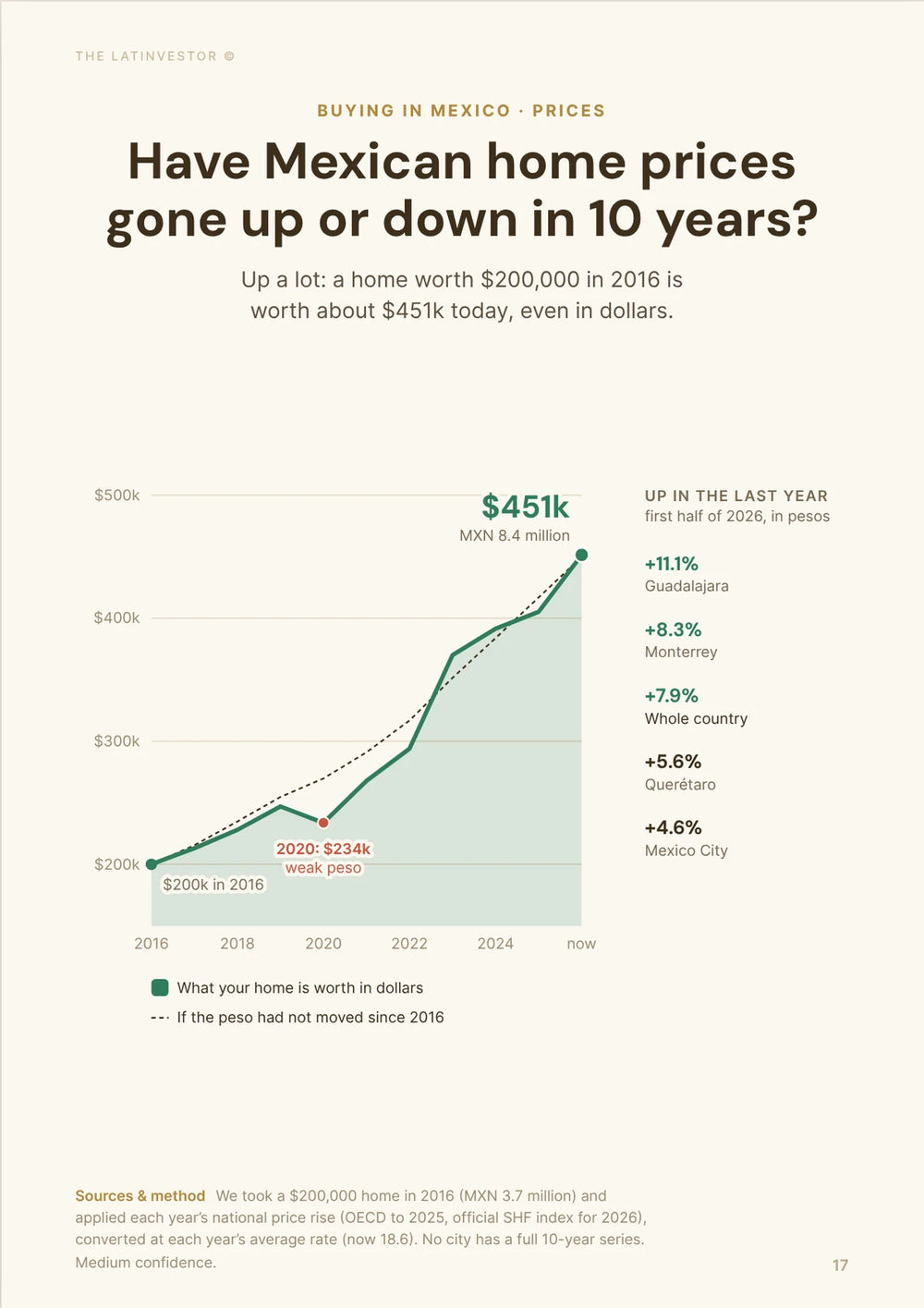
Teseo Data Lab estimates the average transaction price in its broader market series at around US$280,000 in 2020, US$320,000 in 2021, US$380,000 in 2022 and US$415,000 in 2023. Then it slipped to around US$387,000 in 2024 and US$325,000 in 2025. These figures move a lot with the mix of properties sold.
Fresh data shows the same ambiguity. The median condo sale was up 7.7% from January to September 2026. But across Puerto Vallarta and Bahía de Banderas, Vallarta Seaside's Bay Report shows that over the twelve months to July the median sale rose 8.3% while the median price per square meter slipped 1.8%. Buyers bought bigger homes; the same space didn't get more expensive.
The peso adds another twist. It has weakened since early September, from under 17 to about 18.6 per dollar, so a peso-priced condo costs a dollar buyer less than a few weeks ago, though still a bit more than on the 2025 average of about 19.2. The same move cuts the dollar value of rents collected in pesos, so a long-term lease in pesos earns a dollar owner less than it did in September.
Puerto Vallarta may well be pricier in five or ten years, but keep growth outside the rental case. A condo yielding 3.5% that only works with strong annual price growth is a weak income investment today.
Can foreign investors legally rent out Puerto Vallarta property?
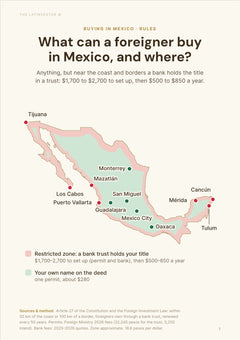
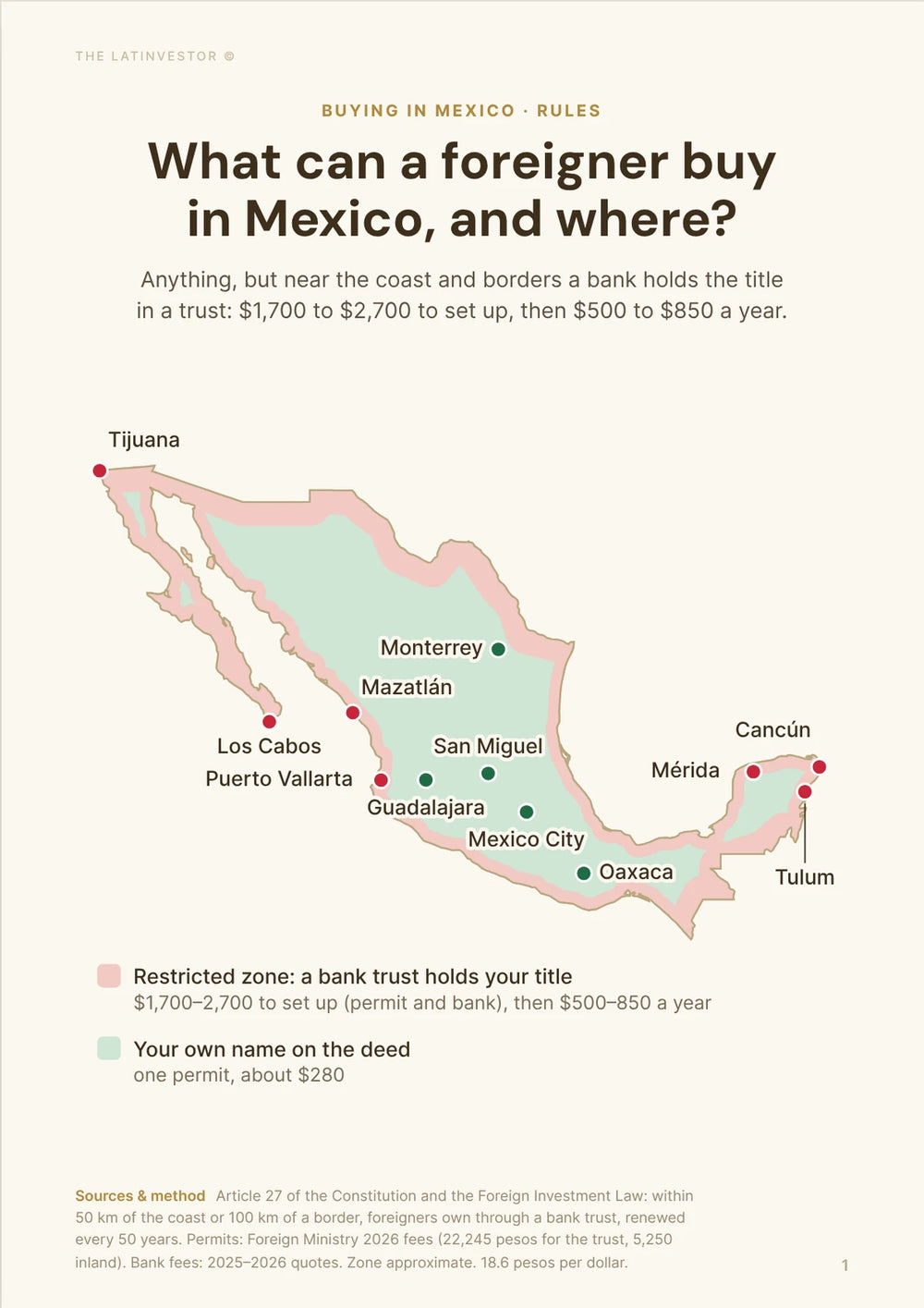
Yes. Foreigners can buy and earn rental income from homes in Puerto Vallarta through a bank trust, the fideicomiso, so ownership rules don't block a normal rental strategy.
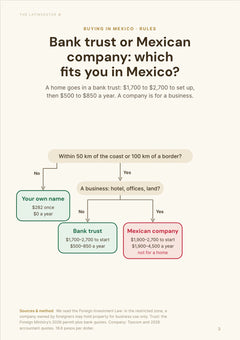
Puerto Vallarta lies within 50 kilometers of the coast, inside Mexico's restricted zone, where foreigners can't hold residential land directly. A Mexican bank holds title as trustee and the buyer is the beneficiary, for up to 50 years, renewable. The Foreign Investment Law's definition of use and enjoyment includes earning income from the property.
It has a cost. The SRE's 2026 permit to set up the trust is MXN 21,650 (about US$1,160). Banks add roughly US$550 to US$800 to open it and US$550 to US$700 a year to run it.
The bigger risk is usually the building. A legally owned condo can still be a terrible Airbnb if the condominium rules restrict short stays. Check title, liens, condominium rules, unpaid HOA balances and the trust documents before closing.
How much of a Puerto Vallarta rental yield disappears after expenses?
Several percentage points: a professionally managed Airbnb can easily lose three or four points between gross yield and what the owner keeps, before tax.
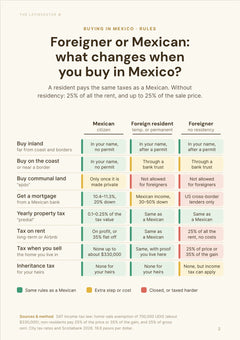
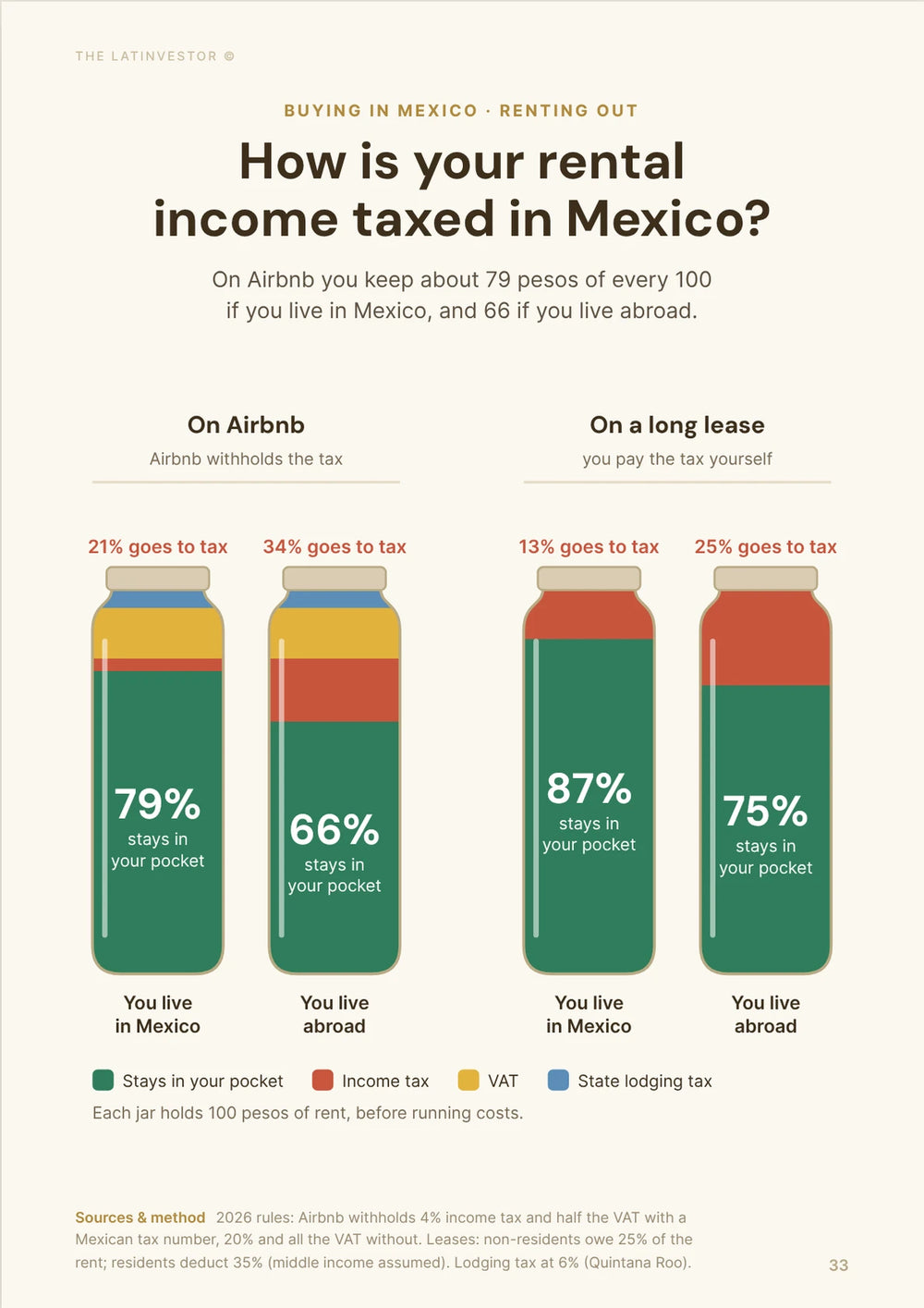
Take a long-term one-bedroom earning MXN 25,000 a month, or MXN 300,000 a year. At MXN 4 million (about US$215,000), that's 7.5% gross. HOA fees, maintenance, insurance, management, accounting, some vacancy and replacing things inside the unit can bring it to 5% to 6% before tax. A non-resident also owes 25% of the gross rent (MXN 75,000 a year here), which leaves about 3% to 4% net.
Short-term rentals cost more. Take a US$300,000 condo grossing US$24,000 a year, 8% gross. A 20% manager takes US$4,800. HOA fees of US$3,000 a year (local guides put a typical two-bedroom building at US$150 to US$400 a month), US$1,500 for utilities and insurance and a US$1,200 maintenance reserve leave about US$13,500: 4.5%.
Then tax. Platforms withhold 4% income tax from hosts with an RFC, the Mexican tax number, and 20% from those without. Guests pay 16% VAT and Jalisco's lodging tax, which Airbnb collects at 5% (some advisers quote 4% for 2026). A non-resident renting long term faces 25% withholding on gross rent, which turns a 6% gross yield into 4.5%.
Ask for real HOA statements, utility bills, management terms and rental statements before believing a seller's projection. A brochure saying "8% ROI" means little until you know which costs were taken out.
| US$300K vacation condo example | Annual amount | Yield on purchase price |
|---|---|---|
| Gross rental revenue | US$24,000 | 8.0% |
| After 20% management | US$19,200 | 6.4% |
| After US$3,000 HOA | US$16,200 | 5.4% |
| After US$1,500 utilities + insurance | US$14,700 | 4.9% |
| After US$1,200 maintenance reserve | US$13,500 | 4.5% |
Is Jalisco about to tax Airbnb owners harder?
Maybe. On May 25, 2026, a Jalisco state deputy proposed a progressive levy on short-term rentals, from 5% for small hosts up to 11% for operators with more than 13 properties. It's a proposal, not law, and Congress hasn't voted on it.
The same proposal includes a mandatory register of short-term rentals and rules against splitting ownership through companies or trusts to stay in the lower bracket.
What to do now: get your RFC before you list, or the platform withholds 20% instead of 4%. Run your numbers with an extra 5% off gross revenue and see if the deal still works. If you plan to own several units, don't count on separate structures to keep you in the small-host rate.
What Puerto Vallarta rental property would we actually buy now?
A well-priced one- or two-bedroom in Versalles, Marina Vallarta or 5 de Diciembre, or a carefully chosen Zona Romántica unit for short stays, and we'd walk away if the yield only works on optimistic assumptions.
Versalles would be our first stop for long-term income: about 6.3% gross on a normal lease, rents up 24.4% since April 2025 and asking prices slightly down. Check drainage and water storage first.
Marina Vallarta suits a buyer who wants bigger furnished rentals for seasonal residents, at a similar yield but a much higher ticket.
5 de Diciembre looks good for vacation rentals, at about 6.5% to 7.7% gross in HOMIA's estimates. Centro is weak on a long lease, around 3.9% gross, but its average asking price fell 4.9% since April 2025, so there's room to negotiate.
Zona Romántica deserves its premium only when the unit can turn the location into higher short-term revenue. We'd be much stricter in Amapas and Conchas Chinas.
The price test is simple. If a property can bring in MXN 300,000 a year after normal costs, paying MXN 4 million gives 7.5% after costs, before tax. At MXN 5 million, it's 6%. At MXN 6 million, 5%. At MXN 7.5 million, only 4%. With condos taking 262 days to sell, patient buyers can afford to say no.
| Investment goal | Areas we would check first | Why | What could kill the deal |
|---|---|---|---|
| Long-term cash flow | Versalles | ~6.3% gross, rents rising | Drainage, water, overpaying for new towers |
| Furnished seasonal rental | Marina Vallarta | ~6.4% gross, deep long-stay demand | HOA costs and high entry price |
| Vacation rental yield | 5 de Diciembre | ~6.5–7.7% gross on Airbnb | Noise, parking, older buildings |
| Negotiated central buy | Centro | Asking prices down 4.9% | ~3.9% gross on a long lease |
| Vacation rental location | Selected Zona Romántica | Walkability and tourist demand | ~3.7% long term, rental restrictions |
| Luxury + personal use | Amapas / Conchas Chinas | Views and prestige | Poor rent-to-price ratio |
Is rental property worth buying in Puerto Vallarta today?
Yes, at the right price and for cash flow, not as a bet on another easy boom.
The good news: Versalles and Marina Vallarta still give about 6.3% to 6.4% gross on a normal lease, Versalles rents keep rising, and the average short-term rental still grosses about US$31,300 a year on AirDNA. Active condo listings are down 17.5%, so the post-boom glut is clearing.
The bad news is just as clear. International air traffic is down 19.4%, nightly rates fell 17.5%, condo closings are down 21.1% and the median condo takes 262 days to sell. A Jalisco proposal could add a 5% to 11% levy on short-term rentals, and a 180-night cap approved in committee on May 25, 2026 still awaits a full vote.
The tourist and luxury areas, Zona Romántica, Amapas and Conchas Chinas, make more sense when personal use is part of the return. Their rent-to-price ratios are too weak to rank among the best pure rental buys.
Our verdict: buy in Puerto Vallarta when today's rent already justifies today's price. Aim for about 6% gross on a lease or 7% to 8% gross on Airbnb, and treat any price growth as a bonus.
Our methodology
This article estimates whether a Puerto Vallarta rental property can pay for itself at today's prices, looking at resale liquidity, tourism, short-term and long-term rental income, neighborhood yields, running costs, taxes and the legal setup for foreign owners.
Sales, listings and days on market come from Coldwell Banker La Costa's FlexMLS data to September 2026, with Teseo Data Lab and AMPI Riviera Nayarit for the longer inventory series. Short-term rental figures come from AirDNA (Airbnb, Vrbo and Booking.com) for the 12 months to September 2026, with AirROI (Airbnb only) as a cross-check; we never mix the two in one calculation. Long-term yields compare monthly rent per square meter with sale price per square meter from Propiedades.com's October 2026 neighborhood data, cross-checked with TuLugar's October 2026 listing medians and HOMIA's vacation-rental estimates.
Tourism comes from Grupo Aeroportuario del Pacífico's traffic reports and DATATUR. Rules come from the SRE, the Constitution and the Foreign Investment Law for the bank trust, SAT for platform taxes and withholding, Airbnb for lodging tax collection, and the Jalisco Congress for the May 2026 proposal. Water and sewage incidents come from SEAPAL.
We checked these figures in October 2026. Conversions use about 18.6 pesos per US dollar and 20.9 pesos per euro.
Limits: asking prices are usually above final sale prices, rental listings show what landlords ask rather than what tenants sign, some neighborhood samples are tiny (Amapas has two rental listings), and the sales data and Airbnb data don't cover exactly the same properties. Your own unit's 12-month numbers matter more than any average here.
Key sources used for this analysis include Crónica Jalisco on the 180-night committee vote, Teseo Data Lab's Puerto Vallarta / Riviera Nayarit market outlook, Teseo's year-end 2025 market report, Coldwell Banker La Costa's October 2026 market pulse, Vallarta Seaside's Bay Report, AirDNA's Puerto Vallarta data, AirROI's Puerto Vallarta data, Propiedades.com on Versalles rents, Versalles sale prices, Marina Vallarta rents, Marina Vallarta sale prices, 5 de Diciembre rents, 5 de Diciembre sale prices, Zona Hotelera Norte rents, Zona Hotelera Norte sale prices, Centro rents, Centro sale prices, Amapas rents, Amapas sale prices, Emiliano Zapata rents and Emiliano Zapata sale prices, TuLugar's Puerto Vallarta market data, HOMIA's neighborhood yield estimates, HOMIA on condo fees, HOMIA on 2026 bank trust fees, Grupo Aeroportuario del Pacífico's passenger releases, UnoTV on the March 2026 drop, Crónica on the airport reopening after Hurricane Simón, AP on Hurricane Simón, Out and About PV on the 2026 airport trend, GayPV on 2026-27 flights, DATATUR's hotel-occupancy data, SEAPAL on the August water cuts, SEAPAL on Versalles drainage, the SRE on restricted-zone fideicomisos, SRE's 2026 permit fees, the Mexican Constitution, the Foreign Investment Law, SAT's income-tax rules for digital platforms, SAT on withholding without an RFC, Article 158 of the income-tax law, Airbnb on lodging tax in Jalisco and the Jalisco Congress on the May 2026 proposal.