
Summary
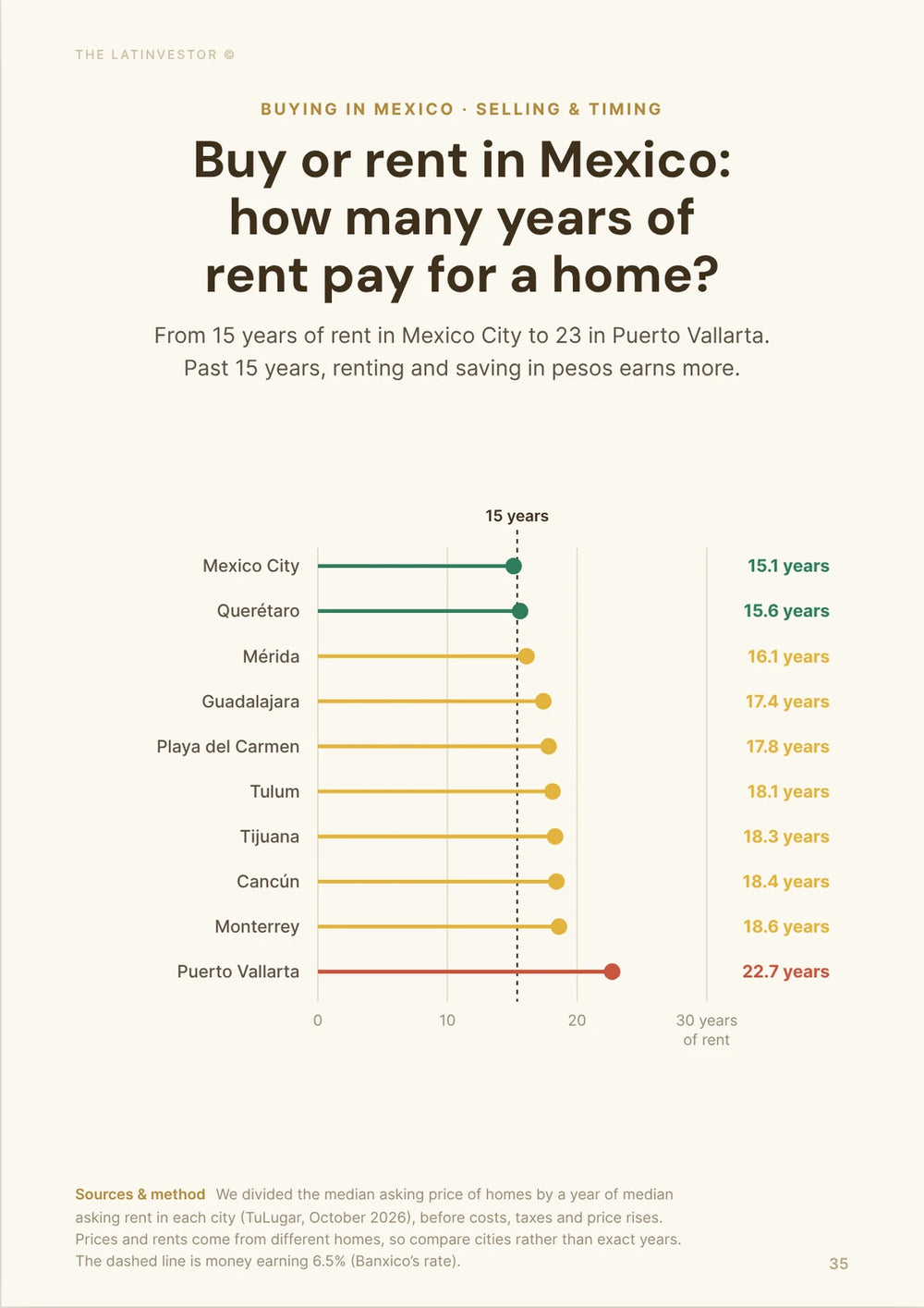
A Puerto Vallarta apartment yields roughly 4% to 6.4% gross on a normal long-term lease in October 2026. A well-bought vacation rental can reach 6% to 10% gross, but much less once costs come off.
Versalles and Marina Vallarta lead on long-term yield, at about 6.3% to 6.4% gross. Emiliano Zapata, which covers much of Zona Romántica, sits near 3.7% because buyers pay around MXN 81,300 per square meter.
Small units beat the averages because rent doesn't double when floor area does. A one-bedroom bought at MXN 2.4 million and rented at MXN 19,000 a month would yield 9.5% gross, but you have to find it.
In Versalles, average asking rents are up 24.4% since April 2025 while asking prices are down 2.5%. The catch this October: sewer backups linked to two failed pumps at a nearby treatment plant.
Marina Vallarta has the big rents, around MXN 34,431 a month on average, but apartments list near MXN 7.24 million and rents have been flat since April 2025.
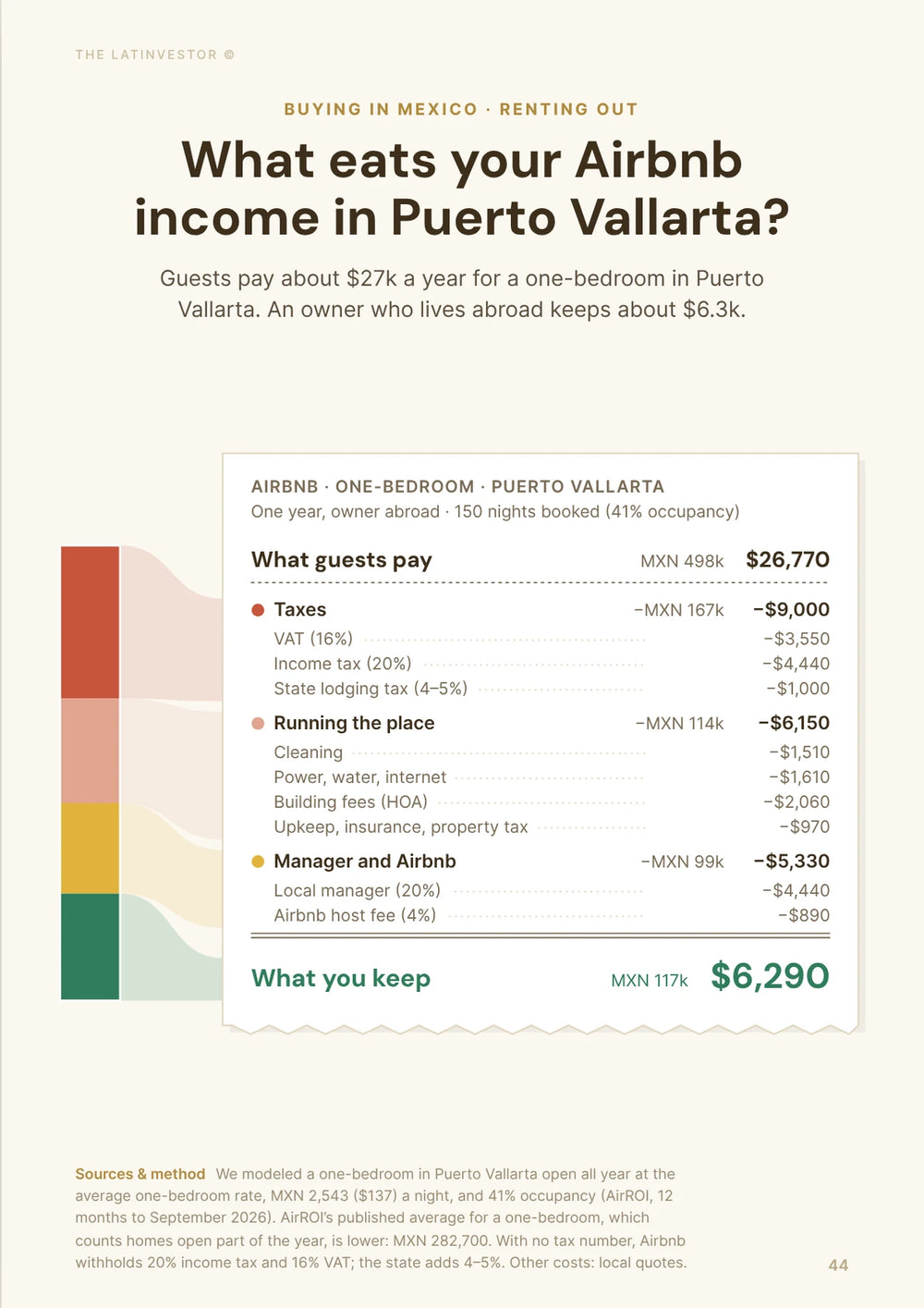
A typical Airbnb grosses about US$31,300 a year according to AirDNA, at 57% occupancy. AirROI, which only tracks Airbnb, puts the average at MXN 398,845 and says it fell 7.1% in a year. The two don't even agree on supply (AirDNA: 54.3% fewer listings, AirROI: 13% more), so treat any single headline with care.
Price drives neighborhood Airbnb yields too: 5 de Diciembre and Versalles screen at about 5.5% to 7.7% gross, Marina Vallarta and Amapas closer to 4.5% to 6%.
Costs bite hard. A US$300,000 condo grossing US$24,000 (8%) keeps about US$13,500, or 4.5%, after management, HOA fees, utilities, insurance and maintenance, before tax.
A furnished one-to-six-month rental at US$2,000 a month yields 6.7% to 8% gross with far lighter running costs, which can beat an average Airbnb that pays a 20% manager.
Fewer tourists flew in this year. Airport traffic was down 12.3% from January to September 2026, and international passengers fell 19.4% after the February violence, the Spirit Airlines shutdown and pricier fares.
Simple rule for price: at MXN 20,000 a month, an apartment must cost about MXN 4 million to give 6% gross. At MXN 5 million, you're down to 4.8%.
A 6% net Airbnb yield on a US$300,000 condo needs about US$30,000 a year in bookings with 40% costs, or about US$51,400 for a non-resident who also pays 25% tax on gross rent. At US$500,000, you need US$50,000, or US$85,700 for a non-resident, far above the market average.
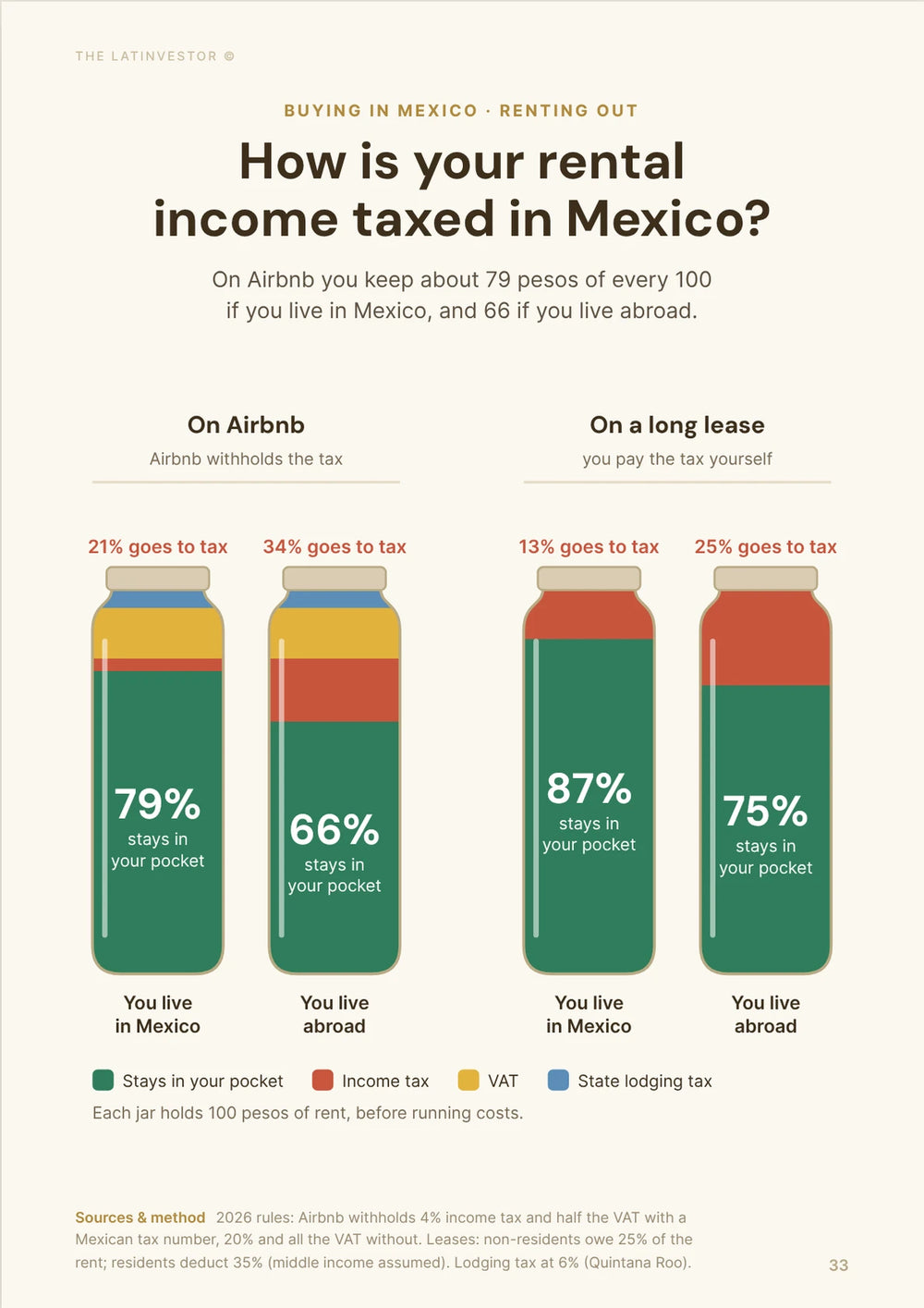
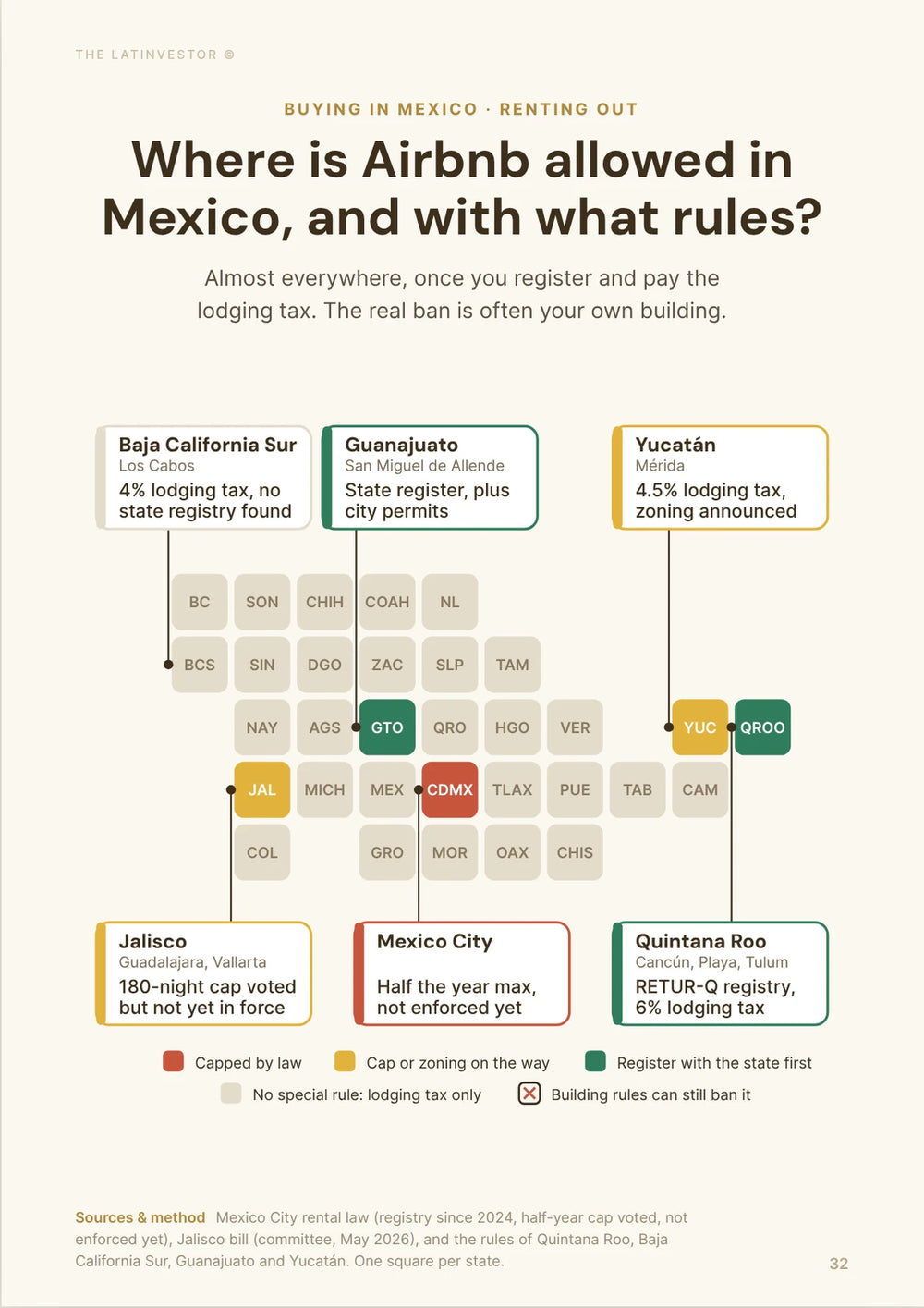
Rules are moving. A Jalisco Congress committee approved a 180-night yearly cap on second-home short-term rentals in May 2026, not yet voted by the full Congress, and a separate proposal would add a 5% to 11% levy on short-term rentals, on top of the current 4% to 5% lodging tax, 16% VAT and 4% income-tax withholding (20% without an RFC).
Water is a real risk: in August 2026, highway works disrupted supply in about 40% of the city's neighborhoods. Check the building's cistern before you buy.
Bottom line: aim for about 6% gross long term or 7% to 8% gross on Airbnb, and buy compact MXN 3 to 4 million apartments rather than trophy condos.

Which rental strategy gives the best yield in Puerto Vallarta right now?
A long-term lease gives roughly 4% to 6.4% gross, a vacation rental 6% to 10% gross before costs, and a furnished monthly rental sits in between with much lower running costs.
The ranges are wide because the city has several rental markets at once. A local tenant on a one-year lease, a Canadian staying three months and a tourist booking five nights in Zona Romántica pay very different amounts for the same apartment.
On the long-term side, Propiedades.com's October 2026 neighborhood data put Versalles and Marina Vallarta at about 6.3% to 6.4% gross when we compare monthly rent per square meter with sale price per square meter. 5 de Diciembre is closer to 4.5%, Zona Hotelera Norte around 4.1%, and Emiliano Zapata about 3.7%.
Vacation rentals have more upside, but the headline revenue misleads. AirDNA tracks 5,943 active short-term rentals averaging about US$31,300 a year, with 57% occupancy and a US$178 average daily rate. Once management, HOA fees, utilities, maintenance and taxes come off, several percentage points disappear.
The range to expect depends on how you'll actually rent the apartment.
| Puerto Vallarta rental strategy | Rough gross-yield range | What a good deal can look like | Main catch |
|---|---|---|---|
| Long-term lease | ~4–6.4% | ~6%+ | Lower upside |
| Small high-yield long-term unit | ~6–9% | ~7–9% | Very property-specific |
| Vacation rental | ~6–10% | ~7–8%+ | Higher operating costs, softer 2026 demand |
| Professionally managed vacation rental | Often ~3–6% net before owner tax | ~5–6% net | Management and HOA eat into revenue |
| Furnished medium-term rental | Often ~5–7% | Around ~6%+ | Less peak-season upside |
What does a normal long-term apartment actually yield in Puerto Vallarta?
A normal long-term rental is a mid-single-digit investment: roughly 4% to 6.4% gross is a believable expectation, not 8% or 10%.
We compared monthly rent per square meter with sale price per square meter from Propiedades.com's October 2026 neighborhood data. Dividing headline average rent by headline average price would mix different apartment sizes, because the rental and sale samples aren't the same units.
Versalles comes out at about 6.3% gross: MXN 234 in monthly rent per square meter against about MXN 44,500 per square meter to buy. Marina Vallarta gets about 6.4%, with MXN 257 in monthly rent against roughly MXN 48,300 per square meter.
After those two, the drop is sharp. 5 de Diciembre works out near 4.5% and Zona Hotelera Norte around 4.1%. Emiliano Zapata, which covers much of what buyers call Zona Romántica, falls to about 3.7%.
These are asking prices on both sides, not closed deals, so use them as benchmarks, not promises. TuLugar's October listing medians tell the same story with different numbers: about 8.3% for Versalles, 5.4% for Marina Vallarta and 3.8% for Emiliano Zapata, but below 3% for 5 de Diciembre and the northern Hotel Zone. Strong tourism doesn't turn an ordinary apartment into a high-yield one.
| Neighborhood | Monthly rent / m² | Sale price / m² | Implied gross long-term yield |
|---|---|---|---|
| Marina Vallarta | MXN 257 | MXN 48,300 | ~6.4% |
| Versalles | MXN 234 | MXN 44,500 | ~6.3% |
| 5 de Diciembre | MXN 225 | MXN 59,900 | ~4.5% |
| Zona Hotelera Norte | MXN 178 | MXN 51,600 | ~4.1% |
| Emiliano Zapata | MXN 254 | MXN 81,300 | ~3.7% |
Can a small Puerto Vallarta apartment really yield 8% or 9%?
Yes, a small apartment can reach 8% or even 9% gross, but it comes from finding the right unit, not from picking the right city.
Compact apartments rent for much more per square meter than big ones. A tenant might pay MXN 20,000 (about US$1,080) for a well-located one-bedroom but rarely twice that for twice the space. Purchase prices follow size more closely, so small units often get a better rent-to-price ratio.
Here's how it works on numbers: a one-bedroom bought at MXN 2.4 million (about US$129,000) and rented at MXN 19,000 a month yields about 9.5% gross. That's a deal-level target, not a neighborhood average. In Versalles, TuLugar's median asking price for a one-bedroom is US$198,000 (about MXN 3.68 million), so you'd need to buy well below that.
That gap shows how much a compact unit bought under the area's usual price can add.
Some spectacular neighborhood yields deserve extra caution. La Floresta shows MXN 246 per square meter in monthly rent on Propiedades.com, but that comes from a single active listing. One odd listing can bend a tiny sample completely.
If you're chasing 8%+, you need to search apartment by apartment. City averages won't hand it to you.
Is Versalles still the best place in Puerto Vallarta for rental yield?
Versalles is still one of the strongest neighborhoods if you care more about rental return than beachfront prestige, but check the drainage before you buy.
Propiedades.com's October 2026 data show an average apartment asking price around MXN 4.01 million (about US$215,000) and an average long-term rent close to MXN 19,675 a month. On a square-meter basis, that's about 6.3% gross.
The trend helps. Between April 2025 and October 2026, average asking rents in Versalles rose 24.4% while average asking prices slipped 2.5%. Across Puerto Vallarta, asking prices rose 7.3% over the same period.
Versalles sits in a useful middle ground: restaurants, cafés and a growing food scene, close to the Hotel Zone and services. That gives landlords several possible tenants: locals, expats, remote workers, medium-term residents and tourists.
The weak spot right now is infrastructure. In October 2026, SEAPAL, the city water utility, reported sewer backups in Versalles, partly caused by two failed pumps at the Norte I treatment plant. If you buy here, ask the building administrator whether the street flooded or backed up this rainy season, and look at recent guest reviews for complaints.
| Versalles metric | Latest indication |
|---|---|
| Average apartment asking price | ~MXN 4.01M |
| Sale price / m² | ~MXN 44,500 |
| Average monthly apartment rent | ~MXN 19,675 |
| Monthly rent / m² | ~MXN 234 |
| Implied long-term gross yield | ~6.3% |
| Change in asking sale price, Apr 2025 to Oct 2026 | -2.5% |
| Change in asking rent, Apr 2025 to Oct 2026 | +24.4% |
Does Marina Vallarta's high rent mean it gives the best yield?
No. Marina Vallarta has some of the highest rents in the city, but its yield is only a hair above Versalles because apartments cost far more to buy.
Propiedades.com puts the average Marina Vallarta apartment rent at about MXN 34,431 a month (about US$1,850). Versalles is below MXN 20,000.
The price gap is just as big. A typical Marina apartment lists around MXN 7.24 million (about US$390,000), against roughly MXN 4.01 million in Versalles.
Adjusted for size, Marina still looks solid: about MXN 257 a month in rent per square meter against MXN 48,300 per square meter to buy. That's roughly 6.4% gross, against 6.3% in Versalles.
The trend favors Versalles. Marina asking prices rose 7.8% between February 2025 and August 2026, while average asking rents didn't move between April 2025 and October 2026.
Marina can still work, especially larger furnished apartments for seasonal residents and medium-term tenants. Just don't assume a MXN 35,000 rent means a big return.
Why can Zona Romántica have weak long-term yields even though tourists love it?
Because buyers pay a large tourism premium that a twelve-month tenant doesn't pay back.
Emiliano Zapata, which covers much of the wider Zona Romántica, shows apartment asking prices around MXN 81,300 per square meter on Propiedades.com, up 8.1% since April 2025.
Long-term rents average about MXN 254 per square meter a month. That gives an implied gross yield of only about 3.7%, against roughly 6.3% in Versalles with the same method.
Yet Zona Romántica is still one of the city's strongest tourist spots. Visitors pay for walkability, restaurants, nightlife and Los Muertos Beach, and they pay for it by the night, not through an annual lease.
If you pay the Zona Romántica premium and then rent long term, you leave unused the very thing that made the apartment expensive. For a long-term landlord, that's a poor start. For a short-term operator, the math can look much better.
How much can an Airbnb apartment make in Puerto Vallarta now?
An average Puerto Vallarta short-term rental grosses about US$31,300 a year according to AirDNA, and a one-bedroom on Airbnb about MXN 266,000 (about US$14,300) according to AirROI.
AirDNA covers Airbnb, Vrbo and Booking.com and tracks 5,943 active listings for the 12 months to September 2026, with 57% occupancy and a US$178 average daily rate.
AirROI only tracks Airbnb and uses a different method. It counts 6,975 active listings, 39.2% occupancy and average revenue of MXN 398,845 (about US$21,400) a year. By size, it puts one-bedrooms at MXN 266,000 a year with 41% occupancy, and two-bedrooms at MXN 357,000 (about US$19,200) with 40%.
The gap between the two isn't a mistake; they count different listings in different ways. Don't mix them in one calculation, and don't treat either average as what your own condo will earn.
A quick reality check with AirROI's one-bedroom figure: against TuLugar's citywide median asking price of US$278,000 (about MXN 5.17 million) for a one-bedroom condo, MXN 266,000 a year is about 5.1% gross, before any cost. The same revenue on a MXN 3.68 million Versalles one-bedroom would be about 7.2%.
For your own numbers, use comparable apartments in the same neighborhood, with similar bedrooms, views, amenities and building rules. Local brokers generally put a well-managed vacation condo at 6% to 10% gross; reaching the top of that range needs a strong purchase price and strong bookings.
Why do Puerto Vallarta's Airbnb numbers send such mixed signals?
Because demand softened in 2026 while the data providers disagree on almost everything else, including how many listings there are.
AirDNA says active listings fell 54.3% in a year. AirROI says Airbnb listings rose 13% over the same period. They can't both describe the same pool of apartments, so read each one only against its own history.
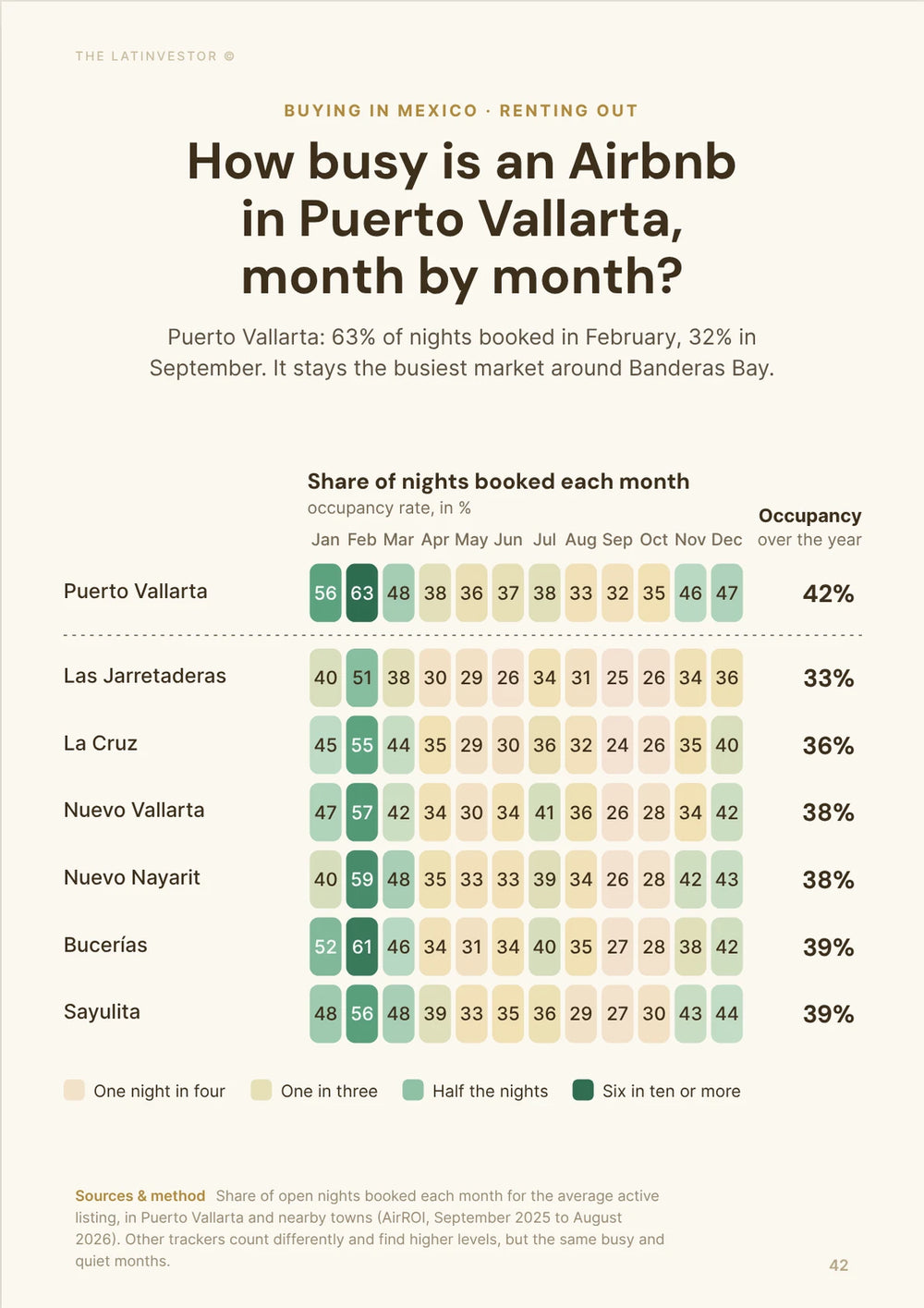
What's clear is that revenue per apartment isn't booming. AirROI shows average revenue per Airbnb listing down 7.1% in a year, and its nightly rates swing from about MXN 4,231 in December 2025 to about MXN 3,560 in August 2026. Occupancy runs from 63.1% in February to 33.4% in August.
That seasonality is what you underwrite. A Puerto Vallarta Airbnb makes most of its money from November to March, so a slow winter hurts the whole year. Plan your budget on a soft season, not on February.
| Latest 12-month metric (to Sep 2026) | AirDNA (Airbnb, Vrbo, Booking.com) | AirROI (Airbnb only) |
|---|---|---|
| Active listings | 5,943 | 6,975 |
| Listings change over 12 months | -54.3% | +13% |
| Annual revenue per listing | ~US$31,300 | ~MXN 398,845 |
| Occupancy | 57% | 39.2% |
| Average daily rate | US$178 | MXN 3,938 |
| Revenue trend | Not compared here | -7.1% in a year |
Which Puerto Vallarta neighborhoods give the best Airbnb yield?
5 de Diciembre and Versalles look better for percentage returns than the expensive luxury areas.
HOMIA's 2026 neighborhood estimates put vacation-rental gross yields around 6.5% to 7.7% in 5 de Diciembre and about 5.5% to 7% in Versalles. Zona Romántica comes in closer to 5% to 6.5%, while Marina Vallarta, Amapas and Conchas Chinas sit around 4.5% to 6%.
That order feels upside down because luxury areas charge the highest nightly rates. Purchase price explains most of it.
On Propiedades.com, a typical Versalles apartment lists around MXN 4.01 million and 5 de Diciembre around MXN 5.63 million (about US$303,000). Emiliano Zapata is closer to MXN 7.65 million (about US$411,000).
A high-end Amapas apartment can earn far more per year than a Versalles one-bedroom, but the buyer may also have paid twice as much or more.
If yield is the goal, 5 de Diciembre and Versalles deserve more attention than their prestige suggests. Zona Romántica still wins on total revenue, walkability and resale appeal to foreign buyers; percentage return is a different contest.
How much do management, HOA fees and taxes cut an Airbnb yield in Puerto Vallarta?
A professionally managed Airbnb can easily lose three or four percentage points between its gross yield and what the owner actually keeps, before income tax.
Management is the first big cut. Local operators commonly charge around 18% to 25% of gross revenue, and some full-service deals reach 30%. Also check which Airbnb fee model your listing is on: the host-only service fee in Mexico is 16%.
Take a US$300,000 apartment grossing US$24,000 a year: 8% gross.
A 20% manager takes US$4,800, leaving US$19,200. US$3,000 a year in HOA fees (local guides put a typical two-bedroom building at US$150 to US$400 a month) brings it to US$16,200. Another US$1,500 for utilities and insurance leaves US$14,700. A US$1,200 maintenance reserve leaves US$13,500.
That's a 4.5% operating yield before the owner's own tax.
Taxes come on top and depend on your situation. Guests pay Jalisco's lodging tax, which Airbnb collects at 5% (some tax advisers quote 4% for 2026), and 16% VAT applies to short stays. Platforms withhold 4% income tax from hosts who give a valid RFC, the Mexican tax number, and 20% from those who don't. A non-resident renting long term faces a 25% withholding on gross rent, which turns a 6% gross yield into 4.5%.
To compare two properties, work out the operating yield after management, HOA, utilities, insurance and maintenance first, then add your own tax setup on top.
| US$300K vacation condo example | Annual amount | Yield on purchase price |
|---|---|---|
| Gross rental revenue | US$24,000 | 8.0% |
| After 20% management | US$19,200 | 6.4% |
| After US$3,000 HOA | US$16,200 | 5.4% |
| After US$1,500 utilities + insurance | US$14,700 | 4.9% |
| After US$1,200 maintenance reserve | US$13,500 | 4.5% |
| Operating income before owner-specific tax | US$13,500 | 4.5% |
Is Jalisco about to tax Airbnb owners harder?
Maybe. In May 2026, a Jalisco state deputy proposed a progressive levy on short-term rentals, from 5% for small hosts up to 11% for operators with more than 13 properties. It's a proposal, not law, and the Congress hasn't reported a vote.
The same proposal includes a mandatory register of short-term rental properties and rules against splitting ownership through companies or trusts to dodge the higher rates. The cap matters more for yields. On May 25, 2026, a Jalisco Congress committee approved a 180-night yearly cap on short-term rentals of homes that aren't the owner's main residence, in "high tourism pressure" zones, mainly Guadalajara and Puerto Vallarta. The full Congress hasn't voted. At AirDNA's 57% average occupancy, a listing books about 208 nights a year, so 180 nights would cut roughly an eighth of them.
What to do now: get your RFC before you list, or the platform withholds 20% instead of 4%. Run your numbers with an extra 5% off gross revenue to see if the deal still works if the levy passes. Test the Airbnb case at 180 nights plus monthly stays too. And if you plan to own several units, don't count on holding them in separate structures to stay in the small-host bracket.
Can a furnished monthly rental beat Airbnb in Puerto Vallarta?
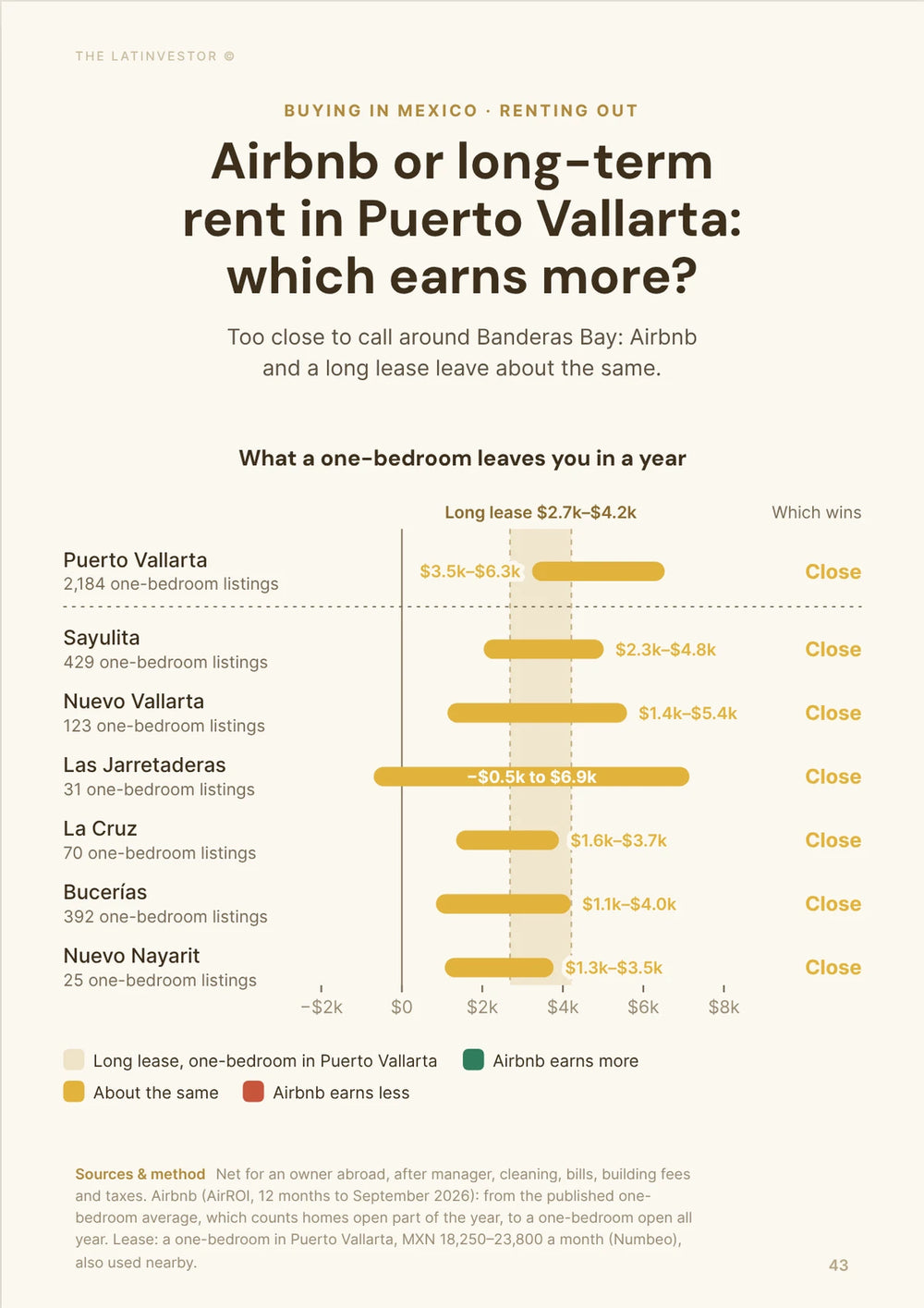
Yes, when nightly rates are only average and management is expensive, a furnished one-to-six-month rental can leave the owner with more.
It works well in places like Versalles and Marina Vallarta, which attract winter residents, remote workers, retirees and people testing Puerto Vallarta before moving.
The revenue ceiling is lower than a busy Airbnb in high season, but the costs are much lighter.
A US$300,000 apartment rented at US$2,000 a month makes US$24,000 with twelve months let, an 8% gross yield. With ten months let, it makes US$20,000, about 6.7%.
Compare that with an Airbnb grossing the AirDNA average of US$31,300. A 20% management fee alone takes US$6,260, leaving about US$25,040, and extra utilities, turnovers, cleaning and wear eat into what's left.
If you manage the Airbnb yourself, you keep much more of the upside. If you want something close to passive income, a steady furnished tenant can simply be the better business.
Did the 2026 drop in flights hurt Puerto Vallarta rentals?
Yes. Puerto Vallarta's airport handled 12.3% fewer passengers from January to September 2026 than a year earlier, and international traffic, the guests who pay the most, fell 19.4%.
2025 was a record year, with about 6.95 million passengers, 3.82 million of them international. Then the violence in Jalisco on February 22, 2026 grounded all international flights at the airport for the day and shook confidence: international traffic fell 32.1% in March. Spirit Airlines shut down in May, and higher fuel prices pushed fares up.
The trend is improving. International traffic was down 12.0% in September, a smaller fall than earlier in the year, domestic traffic stayed close to flat, and Southwest announced new routes from San Diego and St. Louis.
What it means for a buyer: don't build your Airbnb budget on 2025 occupancy. Ask the seller or manager for the unit's real bookings from November 2025 to March 2026, check how much of next winter is already booked, and make sure the deal still works at a long-term rent if tourists stay away another season.
What purchase price do you need to get a 6% rental yield in Puerto Vallarta?
An apartment needs to cost no more than about 200 times its sustainable monthly rent to give 6% gross on a long-term lease.
An apartment renting at MXN 20,000 a month makes MXN 240,000 a year. At MXN 4 million (about US$215,000), that's exactly 6% gross.
If the seller wants MXN 5 million (about US$269,000) for the same apartment, the yield drops to 4.8%.
For 7%, that MXN 20,000 rent supports a price of only about MXN 3.43 million. For 8%, the maximum falls to MXN 3 million.
This is why two equally nice apartments can be completely different investments. Negotiating MXN 500,000 off the price changes the yield for good. Hoping for MXN 500 more in rent barely moves it.
| Sustainable monthly rent | Price for 5% gross | Price for 6% gross | Price for 7% gross | Price for 8% gross |
|---|---|---|---|---|
| MXN 15,000 | MXN 3.60M | MXN 3.00M | MXN 2.57M | MXN 2.25M |
| MXN 20,000 | MXN 4.80M | MXN 4.00M | MXN 3.43M | MXN 3.00M |
| MXN 25,000 | MXN 6.00M | MXN 5.00M | MXN 4.29M | MXN 3.75M |
| MXN 30,000 | MXN 7.20M | MXN 6.00M | MXN 5.14M | MXN 4.50M |
| MXN 35,000 | MXN 8.40M | MXN 7.00M | MXN 6.00M | MXN 5.25M |
Should water cuts and sewage problems worry a Puerto Vallarta landlord?
Yes, enough to check before you buy. In August 2026, highway works by a concessionaire disrupted water supply in about 40% of Puerto Vallarta's neighborhoods, according to SEAPAL.
It wasn't the only incident this year. A flood on August 22 affected at least 18 homes, Playa del Cuale failed the federal bathing-water standard in COFEPRIS's July 2026 tests, and Versalles had sewer backups in October.
For a rental, a day without water means refunds and bad reviews. Before buying, ask whether the building has its own cistern and how many days it covers, whether the HOA owns a pump and backup power, and what happened during the August cuts. For an Airbnb, read the last year of guest reviews in the building for "water" and "smell".
How hard is it to make a real 6% net yield from a Puerto Vallarta Airbnb?
It's doable on a mid-priced condo, but expensive condos need far more revenue than the market average to get there.
Take a US$300,000 apartment. A 6% net target means US$18,000 a year of operating income.
If costs take 30% of gross revenue, the apartment needs about US$25,700 in bookings. At 40%, it needs US$30,000. At 45%, about US$32,700.
That's close to AirDNA's market average of US$31,300. So a US$300,000 apartment performing around average could get near 6% net if costs stay tight, and if the 2026 dip in visitors doesn't drag it below average.
Now make the price US$500,000. The owner needs US$30,000 of net income for the same 6%. With costs at 40% of bookings, the apartment must gross US$50,000 a year, far above the market average.
A non-resident owner has one more cut: income tax of 25% of gross rent, with no deductions. With 40% costs plus that tax, only 35% of bookings is left, so a 6% net yield needs about US$51,400 a year on a US$300,000 condo and US$85,700 on a US$500,000 one. For a non-resident, a 6% net Airbnb is out of reach at average revenue; 3% to 4% is more realistic.
The required performance climbs fast as you move into premium condos. They can still work, but the rental business has to justify the premium, not just look good in a listing.
So what rental yield should we actually expect from a Puerto Vallarta apartment?
Aim for about 6% gross on a long-term lease or 7% to 8% gross as a vacation rental; anything much higher has to be proven with the apartment's own numbers.
For long-term rentals, the main neighborhoods give roughly 4% to 6.4% gross. Versalles and Marina Vallarta sit at the top of that range.
Small apartments bought cheaply can pass 7%, and single deals can approach 9%. Those are deal-level results, not city averages.
Vacation rentals have a higher ceiling: local brokers still quote 6% to 10% gross for well-placed condos, and AirDNA shows average revenue around US$31,300 a year. But visitor numbers dropped in 2026, and AirROI shows revenue per Airbnb listing down 7.1%.
The gap between gross and net matters more than the headline revenue. Management takes about a fifth of bookings, then HOA fees, utilities, insurance, repairs, vacancy and taxes keep cutting. A projected 4% or 5% gross Airbnb yield isn't worth the extra work. Around 7% to 8% gross gets interesting. A properly calculated 6% net is a strong result today.
Versalles stands out for income because prices are moderate and rents have been rising, as long as the building handles water and drainage well. 5 de Diciembre deserves a look for vacation rentals. Marina Vallarta works for higher-budget furnished rentals. Zona Romántica is a top tourist location, but its prices make high percentage yields hard.
The purchase price decides most of the result. A compact MXN 3 to 4 million apartment renting at MXN 20,000 to 25,000 a month can be a serious income property. A beautiful MXN 9 million condo (about US$484,000) earning only somewhat more rent may be a great place to own, but expect a much lower yield.
Our methodology
This article estimates what rental yield a Puerto Vallarta apartment can realistically make, keeping long-term leases, short-term rentals and furnished monthly rentals apart instead of forcing them into one citywide percentage.
For long-term rentals, we used Propiedades.com's neighborhood data updated in October 2026 (August 2026 for Marina Vallarta sale prices) and compared monthly rent per square meter with asking sale price per square meter, because the typical rental unit and the typical unit for sale are different sizes. We cross-checked with TuLugar's October 2026 listing medians. Both are asking prices, not closed deals. Example yields such as the 9.5% one-bedroom are worked calculations, not neighborhood averages.
For short-term rentals, we used AirDNA (Airbnb, Vrbo and Booking.com) and AirROI (Airbnb only) for the 12 months to September 2026, side by side and never mixed in one calculation. HOMIA's 2026 estimates give neighborhood vacation-rental yields. Management costs come from local operators such as PVRPV, HOA and insurance ranges from local 2026 guides.
Tax rules come from SAT (income-tax withholding on platform income, VAT, non-resident withholding on rent), Airbnb's Mexico help pages and the Jalisco Congress for the 2025 and 2026 proposals. Visitor numbers come from Grupo Aeroportuario del Pacífico's monthly traffic reports, and water and sewage incidents from SEAPAL and COFEPRIS.
We checked these figures in October 2026. Conversions use about 18.6 pesos per US dollar and 20.9 pesos per euro.
Limits: asking prices are usually above final sale prices, rental listings show what landlords ask rather than what tenants sign, small samples (like La Floresta's single listing) can mislead, and the two Airbnb data providers count listings differently. Your own apartment's numbers matter more than any average here.
Key sources used for this analysis include Propiedades.com on Versalles rents, Versalles sale prices, Marina Vallarta rents, Marina Vallarta sale prices, 5 de Diciembre rents, 5 de Diciembre sale prices, Emiliano Zapata rents, Emiliano Zapata sale prices, Zona Hotelera Norte rents, Zona Hotelera Norte sale prices, La Floresta rents, TuLugar's Puerto Vallarta market report, AirDNA's Puerto Vallarta data, AirROI's Puerto Vallarta data, HOMIA's neighborhood yield estimates, HOMIA on condo fees, PVRPV on management commissions, Airbnb on host fees, Airbnb on lodging tax in Jalisco, SAT on digital-platform taxation, SAT on withholding without an RFC, Article 158 of the income-tax law, the Government of Jalisco on lodging tax, the Jalisco Congress on the May 2026 proposal, Crónica Jalisco on the 180-night committee vote, GAP's 2025 airport traffic, Grupo Aeroportuario del Pacífico's September 2026 traffic report, UnoTV on the March 2026 drop, Out and About PV on the 2026 airport trend, SEAPAL on the August water cuts, SEAPAL on Versalles drainage, and COFEPRIS beach monitoring.