Summary
Yes, but only if you buy at the right price. AirDNA puts the average Puerto Vallarta short-term rental at about US$31,300 a year, yet the nightly rate fell 17.5% and revenue per available night fell 10.4% over the 12 months to September 2026.
The +62.3% jump in average revenue is mostly a statistical effect: AirDNA counts 54.3% fewer active listings, so weaker ones dropped out and the survivors look richer. AirROI, which only tracks Airbnb, shows revenue per listing down 7.1%.
Fewer foreign guests are flying in. International passengers at the airport fell 19.4% from January to September 2026, and total traffic was down 12.3%.
Hurricane Simón closed the airport until October 13, 2026, just before high season. No major damage was reported, and Porter adds an Edmonton route from November 3, so this winter is soft, not broken.
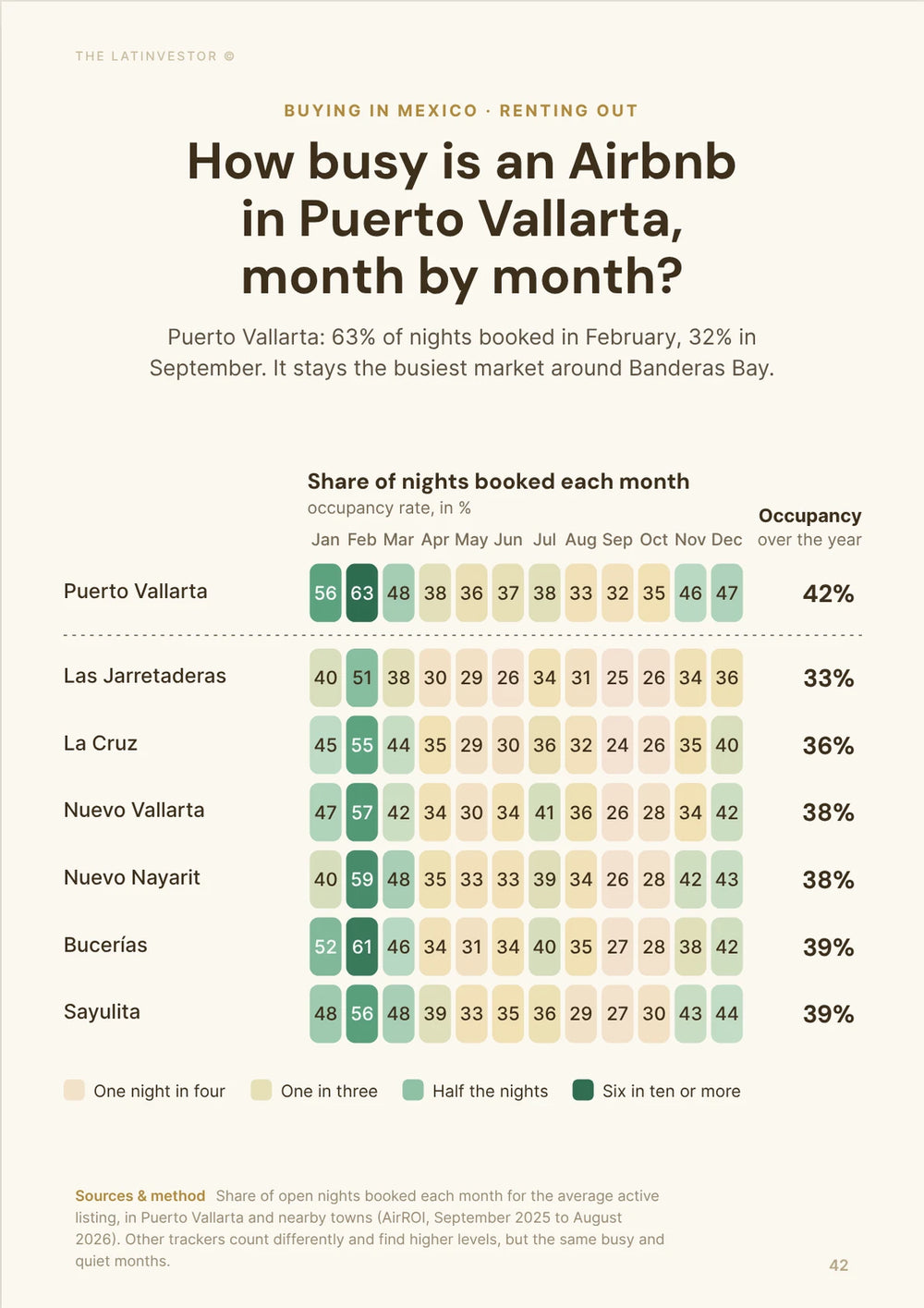
Seasonality is sharp: AirROI's occupancy runs from 63.1% in February to 33.4% in August. Budget on 12 months of real bookings, not on February.
Competition is about quality now, not volume: about 94% of listings are entire homes and almost half are one-bedrooms.
Purchase price decides most of the return. Emiliano Zapata apartments list at about MXN 7.65 million, up 8.1% since April 2025, against about MXN 4.01 million in Versalles, down 2.5%.
Sellers are under pressure: condo closings fell 41.5% in September 2026 and the median condo takes 262 days to sell, so a stale listing should not get a full-price offer.
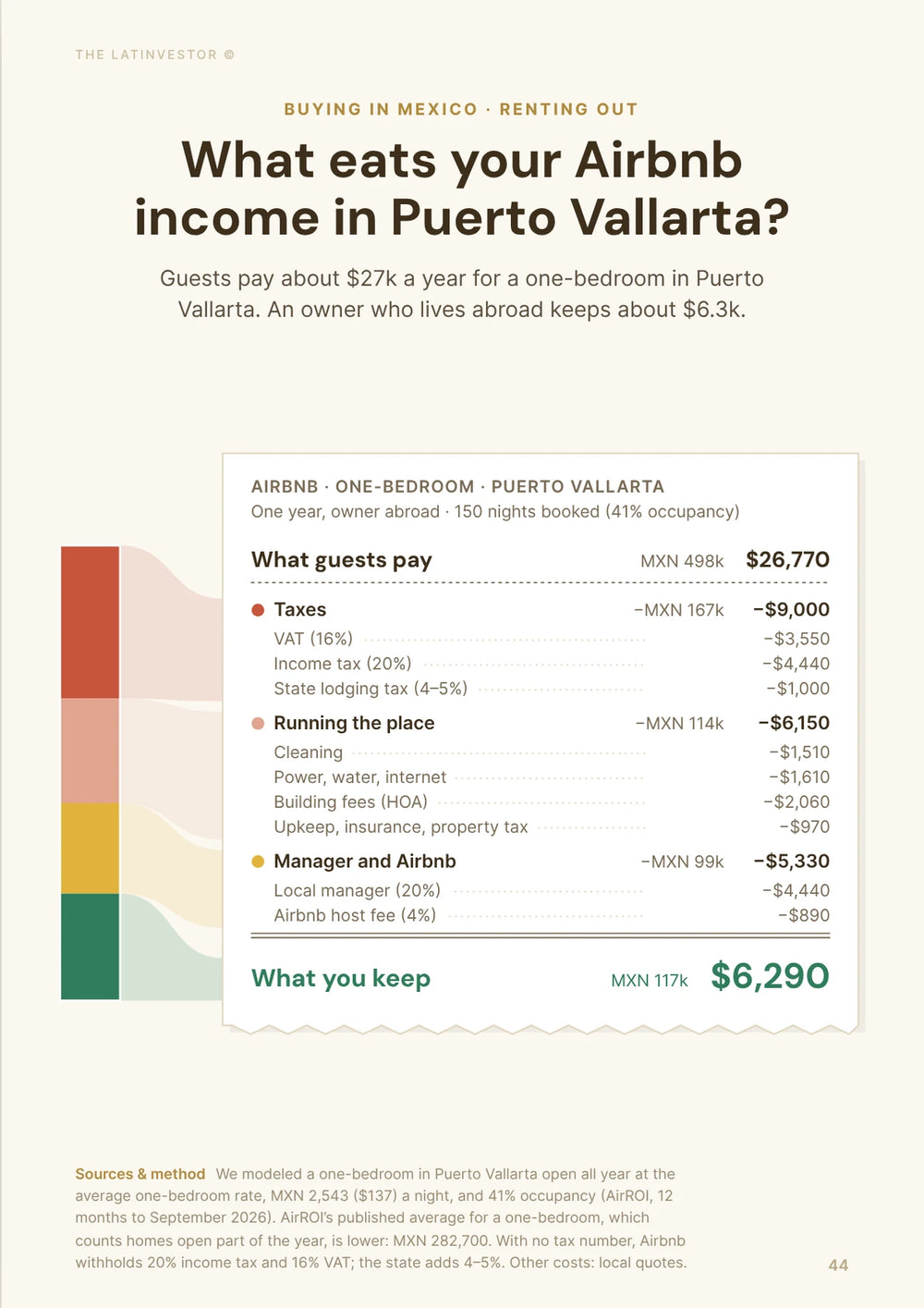
On a US$371,000 condo with 7% closing costs, the AirDNA average revenue is a 7.9% gross yield, and about 5.9% after a 25% manager, before HOA fees, utilities and repairs. A non-resident's 25% tax on gross rent takes that to just under 4%.
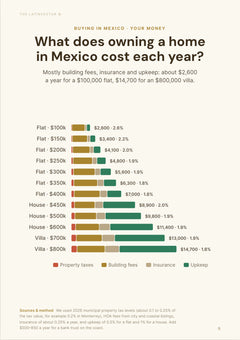
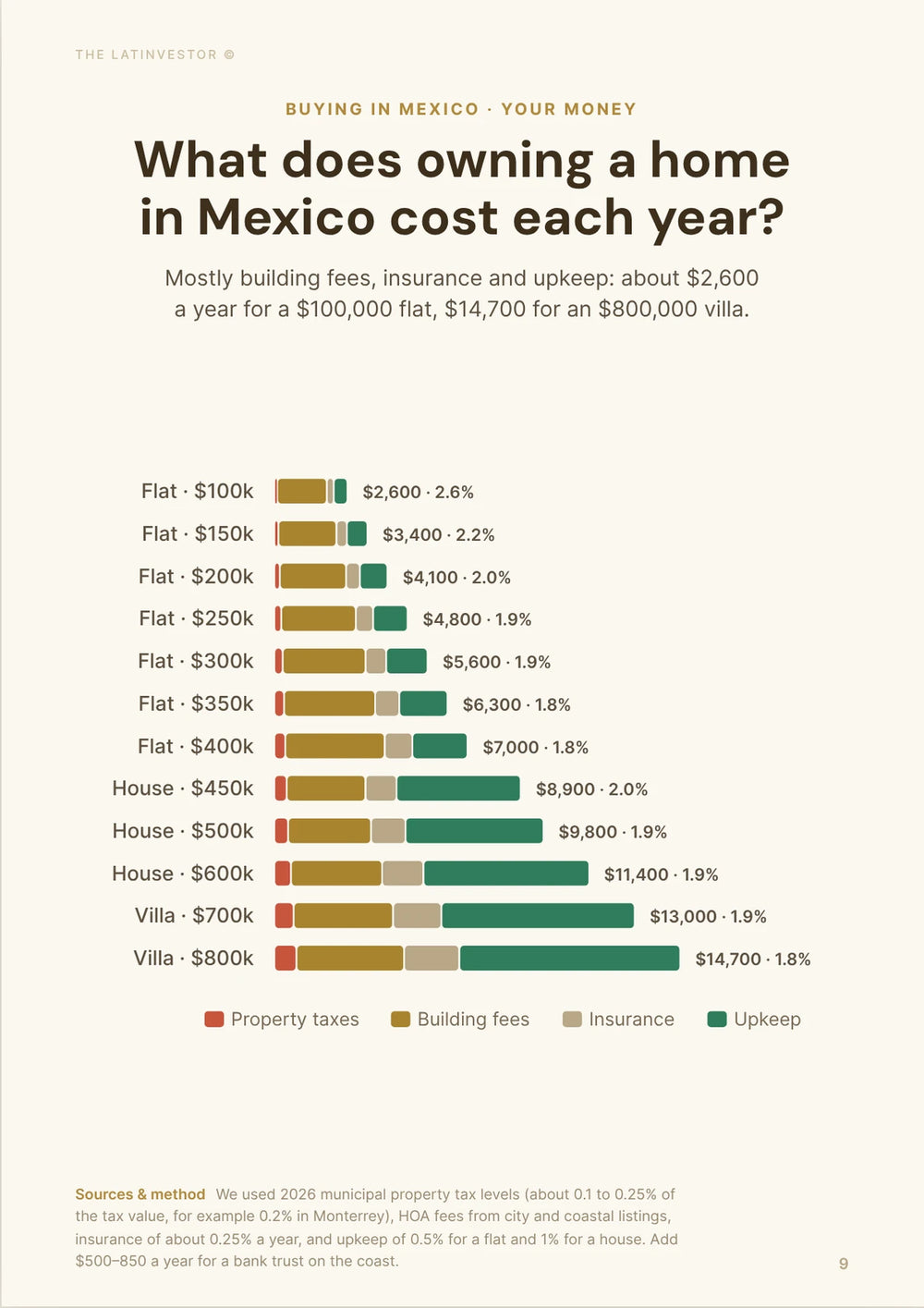
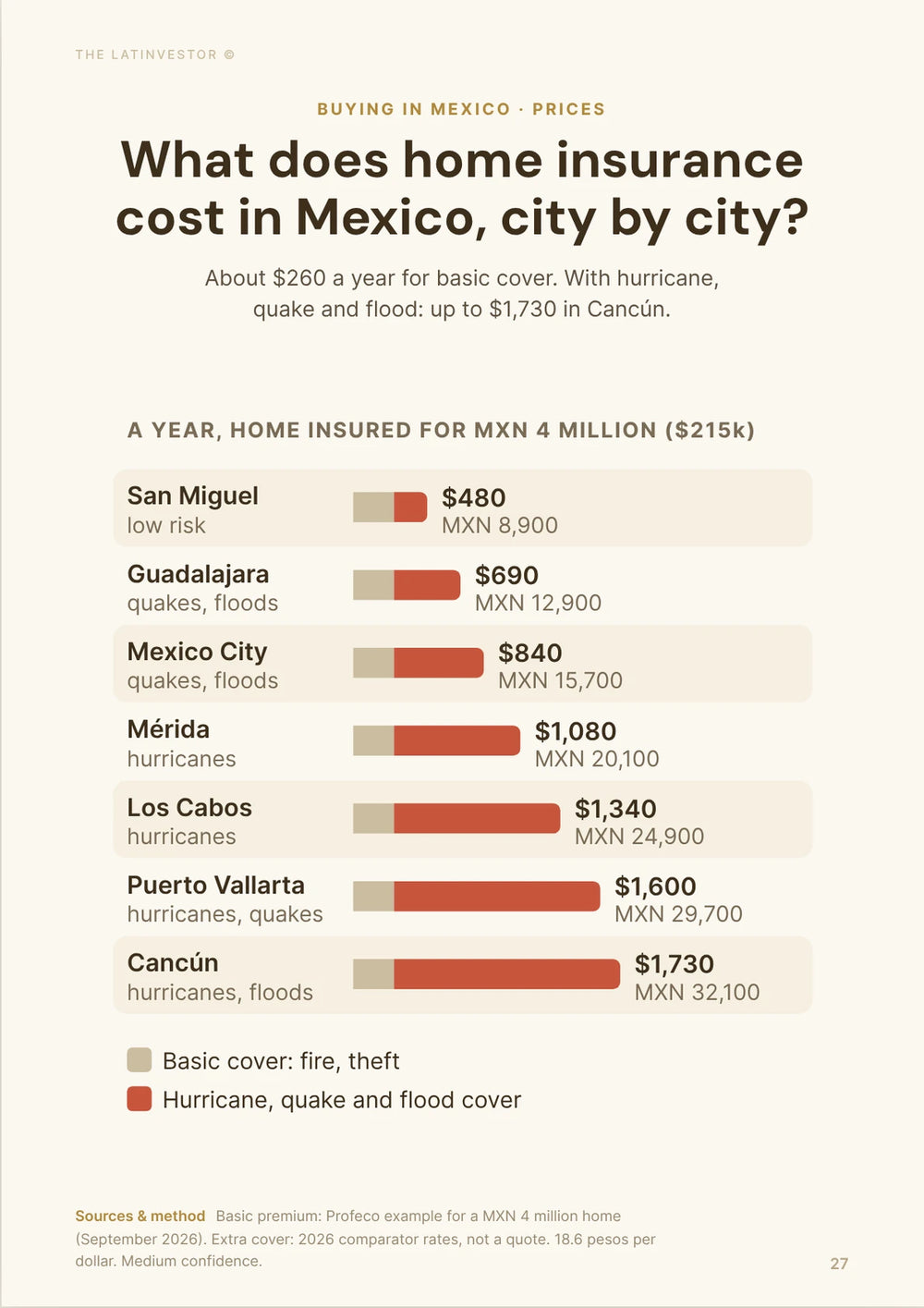
Running costs add up: HOA fees for a typical two-bedroom building run about US$150 to US$400 a month, and insurance about US$600 to US$900 a year.
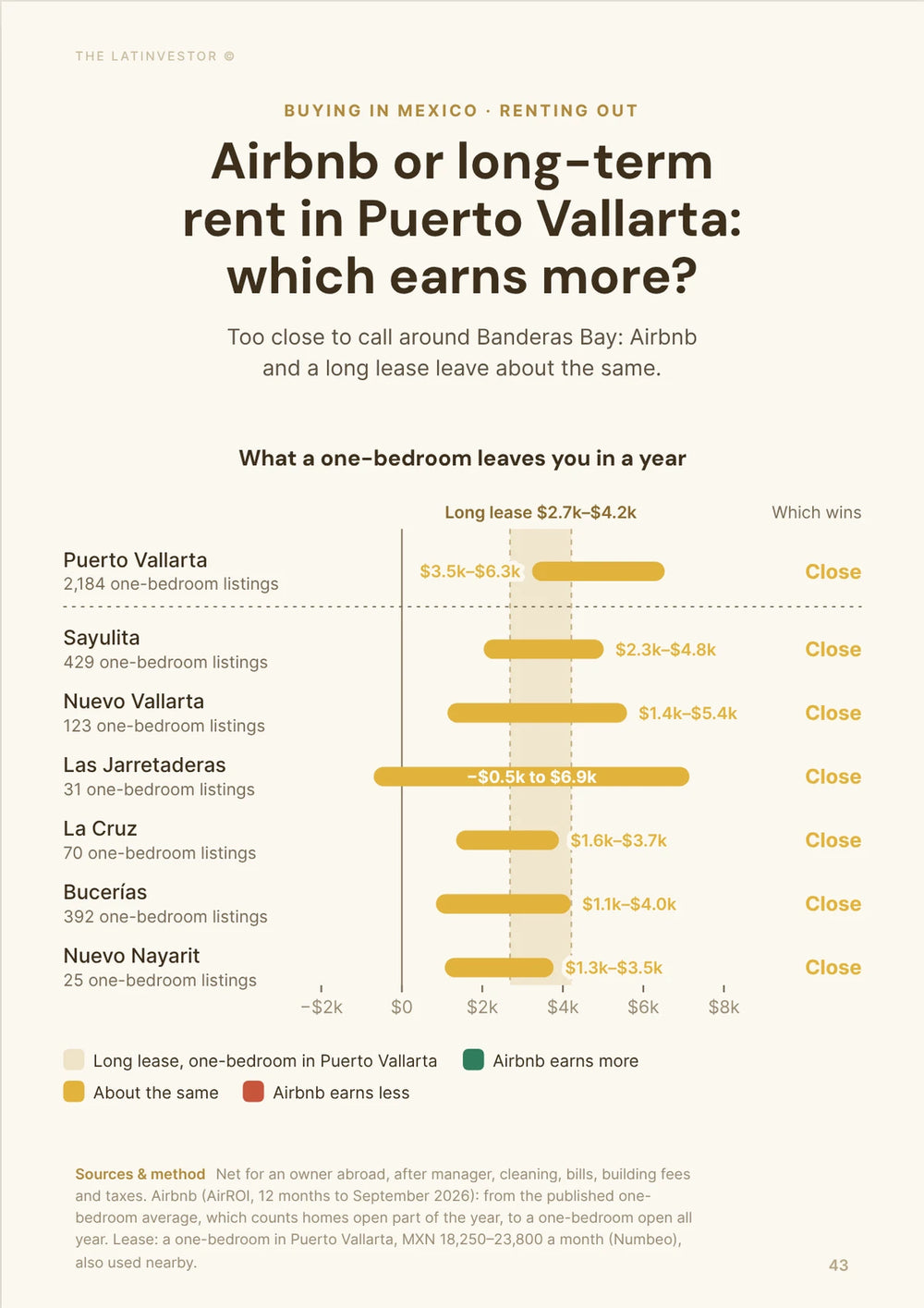
Long-term renting is a serious alternative: Versalles gives about 6.3% gross on a normal lease, against about 3.7% in Emiliano Zapata.
Rules are tightening. A Jalisco Congress committee approved a 180-night yearly cap on short-term rentals of second homes in May 2026, and a separate proposal would add a 5% to 11% levy on top of the 4% to 5% lodging tax, 16% VAT and 4% income-tax withholding (20% without an RFC). Neither has had a full vote.
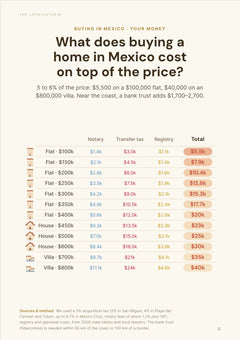
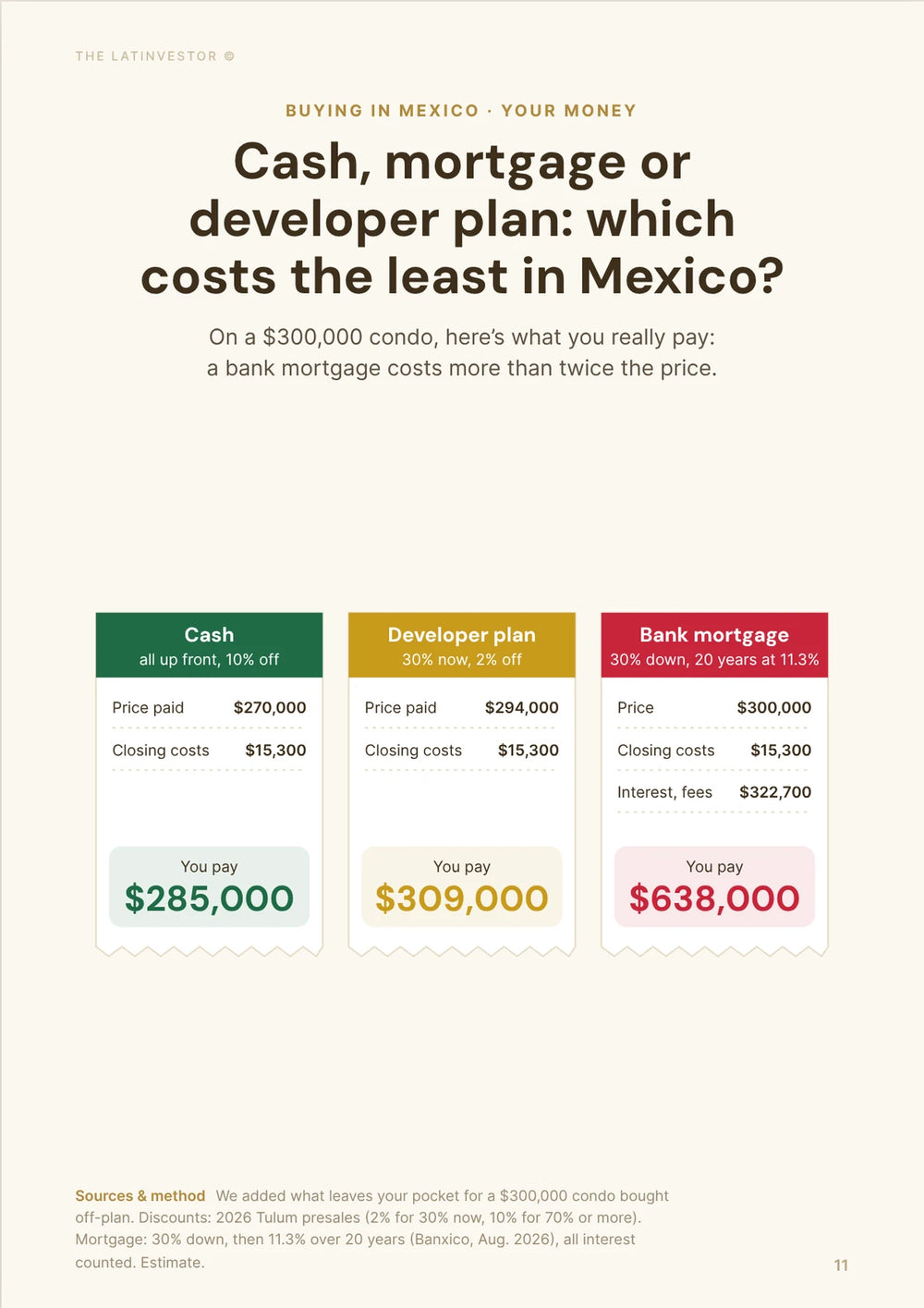
Foreigners also pay for the bank trust: a MXN 21,650 permit, US$550 to US$800 to open it and US$550 to US$700 a year, with total closing costs around 5% to 8%.
Our take: if you hire a manager, want at least 8% realistic gross and ideally 9% to 10%. Buy a well-priced one- or two-bedroom with real booking history and a long-term fallback, not a generic new condo sold on a projected ROI.


Is Airbnb in Puerto Vallarta still making good money?
Yes, an Airbnb in Puerto Vallarta can still make good money, but the average revenue figure makes the market look stronger than it really is.
AirDNA, which covers Airbnb, Vrbo and Booking.com, counts 5,943 active short-term rentals over the 12 months to September 2026, earning an average of about US$31,300 a year. Average occupancy is 57%, the average booked nightly rate is US$178, and revenue per available night (RevPAR) is about US$101.
At 57% occupancy, a property rented all year sells about 208 nights. For the right condo, that still beats a normal long-term lease.
The strange part is the year-over-year comparison. AirDNA shows average revenue per active listing up 62.3%, while active listings fell 54.3%. Over the same period, the nightly rate dropped 17.5% and RevPAR fell 10.4%.
Many weaker or seasonal listings seem to have left the active pool, leaving a smaller group of better performers whose average naturally rises. AirROI, which only tracks Airbnb and counts listings differently, shows the opposite on supply (6,975 listings, up 13%) and average revenue down 7.1% to MXN 398,845 a year. The two can't be mixed, but neither shows the same apartment earning more.
So Puerto Vallarta Airbnbs still bring in real money. Just don't read the 62.3% as proof that a given property became 62.3% more profitable.
| AirDNA metric (12 months to Sep 2026) | Current level | YoY change | What we learn |
|---|---|---|---|
| Active listings | 5,943 | -54.3% | Measured supply has halved |
| Average annual revenue | US$31,300 | +62.3% | The surviving pool looks stronger |
| Occupancy | 57% | Higher | Remaining listings fill more nights |
| Average nightly rate | US$178 | -17.5% | Guests pay less per night |
| RevPAR | US$101 | -10.4% | Earning power per available night is down |
Is the Puerto Vallarta Airbnb market actually getting better?
No. Underneath the headline revenue, Puerto Vallarta Airbnbs are earning less per available night than a year ago.
RevPAR is the cleaner signal because it combines occupancy and price, and it fell 10.4%. Occupancy went up, but the nightly rate fell 17.5%: hosts are filling more nights by charging less.
AirROI's Airbnb-only data points the same way, with revenue per listing down 7.1% in a year.
For a buyer today, that's the story that counts. You'll compete at today's rates, not benefit from a statistical improvement created by weaker listings leaving the sample.
Puerto Vallarta still works as an Airbnb market. Calling it a boom would be hard to defend.
Is Puerto Vallarta tourism still strong enough for Airbnb?
Yes, the tourism base is still large, but 2026 has given investors a real reason to stay conservative.
According to Grupo Aeroportuario del Pacífico, Puerto Vallarta airport handled about 4.54 million passengers from January to September 2026, 12.3% fewer than a year earlier.
International traffic, the guests who pay the most, fell 19.4% over those nine months. September alone was down 12.0%, a smaller drop than earlier in the year. Domestic traffic held up better.
That matters here because Canadian and US visitors drive the higher-priced winter bookings.
There is still plenty of tourism to go around: millions of passengers, and 57% average short-term rental occupancy on AirDNA. We would model a Puerto Vallarta Airbnb on flat tourism and treat any rebound in international flights as upside.
| Tourism indicator | Latest level or trend | What it means for Airbnb |
|---|---|---|
| Airport passengers, Jan to Sep 2026 | ~4.54M | Huge tourism base remains |
| Passenger traffic vs prior year | -12.3% | Demand has weakened |
| International passengers vs prior year | -19.4% | The best-paying guests fell most |
| Airbnb occupancy (AirDNA) | 57% | Short-term rental demand is still substantial |
| Average nightly rate (AirDNA) | US$178 | Demand supports lower prices than a year ago |
Will Hurricane Simón and fewer foreign flights hurt this winter's bookings?
Probably a little, not a lot: Simón closed the airport for about two days in October 2026 without major reported damage, and winter flight capacity from Canada is growing.
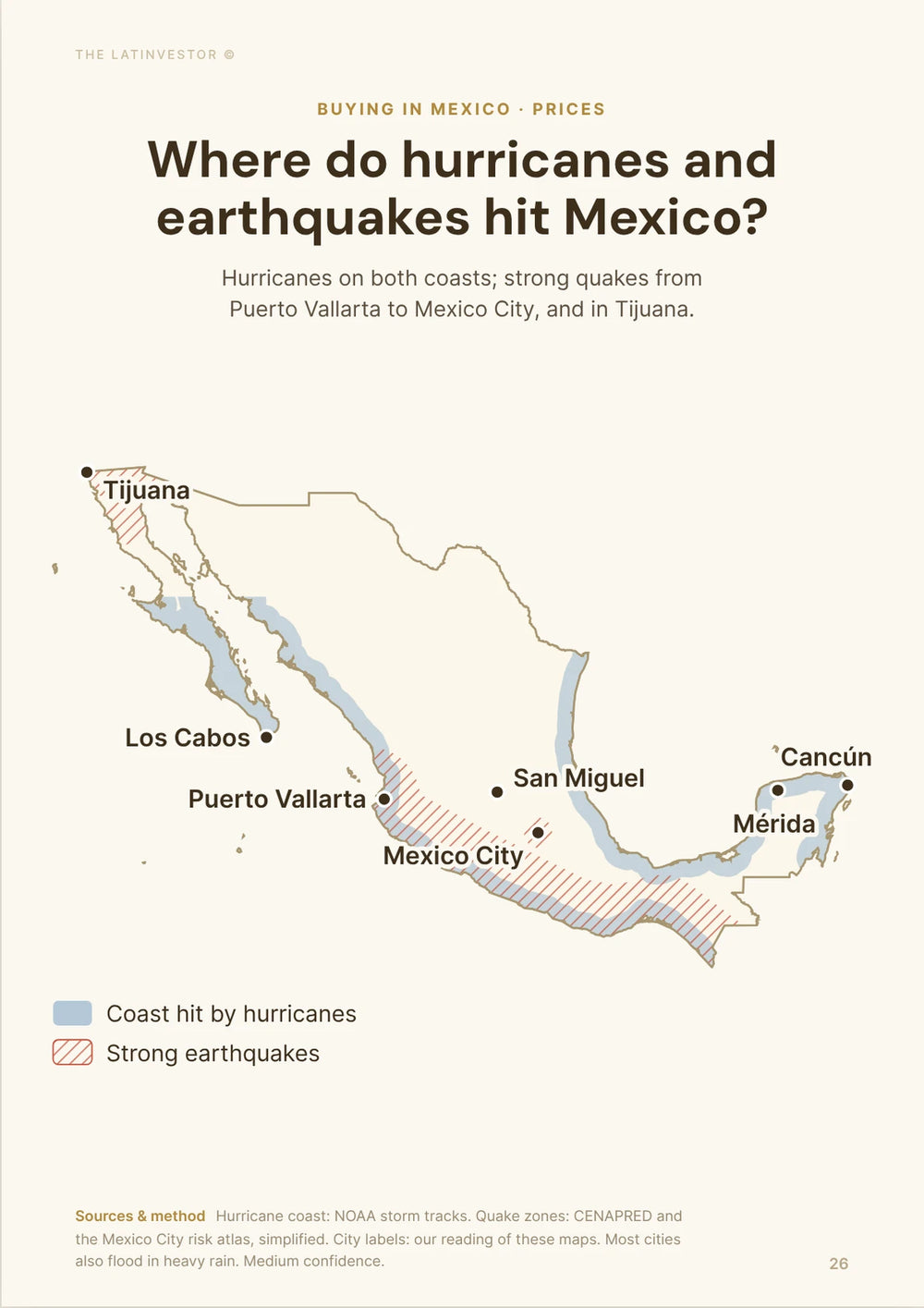
Simón came close as a Category 3 hurricane on October 11, with its eye about 45 miles south of Cabo Corrientes, the southern tip of the bay, according to AP. The boardwalk was closed and some hotels evacuated. GAP reopened the airport to commercial flights at 00:01 on October 13, earlier than planned. The bigger risk is perception: storm headlines a few weeks before high season can slow last-minute bookings.
On flights, the picture is mixed. A local travel site's May 2026 roundup lists Porter's new Edmonton route from November 3, 2026 and daily Toronto service, while Delta paused Seattle from October 6 to November 8. The second terminal, meant to double international capacity, is targeted for early 2027.
What to do if you're buying a rental now: ask the seller or manager for confirmed bookings from December to March compared with the same date last year, and how many guests cancelled around Simón. Check that the insurance policy covers hurricane damage and loss of rental income. And run your numbers on last winter's real results, not 2025's.
Is Puerto Vallarta too seasonal for Airbnb?
No, the seasonality is manageable, but buying on winter rates can wreck the math.
AirROI's monthly Airbnb data show occupancy at 63.1% in February 2026, then 38.0% in April and 33.4% in August. Canadian and US visitors fill the winter; summer leans on domestic travelers and cheaper bookings.
The mistake is mentally annualizing January or February.
HOA fees, internet, maintenance, insurance and the bank trust fee keep running during the empty weeks, so the strong months have to carry the weak ones.
Use the unit's trailing 12-month revenue whenever you can. Three great winter months tell you very little about the yearly return.
Is Airbnb competition still getting worse in Puerto Vallarta?
Competition is still tough, but the threat now is the quality of the hosts already there, not a flood of new listings.
AirDNA shows active supply down 54.3% in a year. Whatever the full reason, Puerto Vallarta doesn't look like a market where thousands of new rentals are pouring onto the platforms right now.
What remains is serious. AirDNA's supply breakdown in mid-2026 showed that entire homes dominate, one- and two-bedrooms make up most of the market, and a large share of listings are open almost all year.
Many owners list on Airbnb, Vrbo and Booking.com at once, with dynamic pricing, professional photos, automated messages and long review histories.
That makes the generic condo vulnerable. A new one-bedroom with average furniture and a rooftop pool looks special to its owner and interchangeable to a guest scrolling through dozens of similar options.
| Supply characteristic (AirDNA, mid-2026) | Approx. share | Why we care |
|---|---|---|
| Entire homes | ~94% | Most competitors are dedicated rentals |
| 1-bedroom units | ~47.6% | Most crowded category |
| 2-bedroom units | ~34.7% | Another heavily represented segment |
| Available 271 to 365 nights | ~60.9% | Many competitors operate almost full-time |
| Multi-platform listings | ~32.1% | Professional distribution is common |
Are Puerto Vallarta property prices too high for Airbnb now?
In the most touristy neighborhoods, yes: purchase prices are high enough to squeeze Airbnb returns badly.
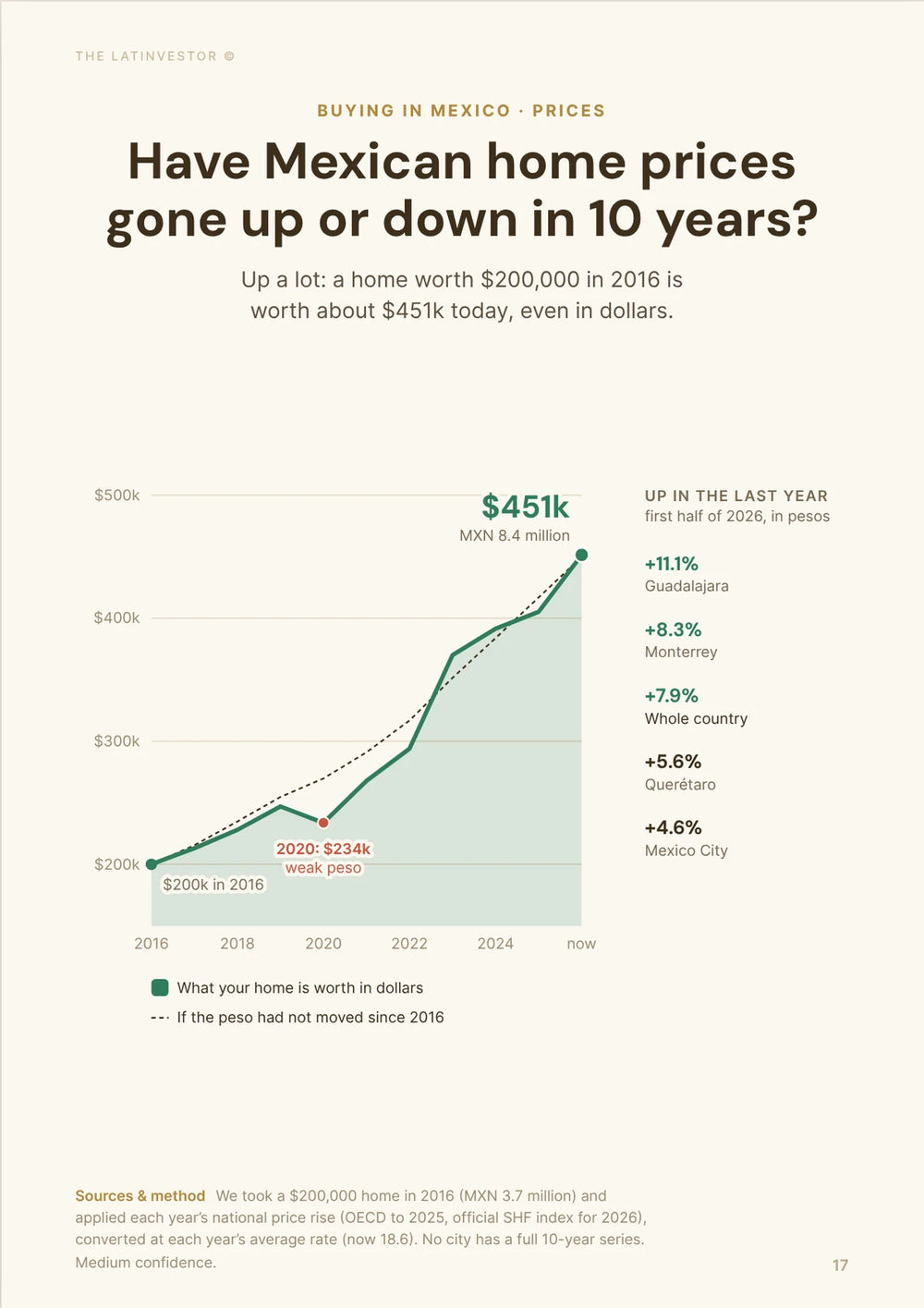
Propiedades.com's October 2026 data make the gap easy to see. The average listed apartment in Emiliano Zapata is about MXN 7.65 million (about US$411,000) and in Marina Vallarta about MXN 7.24 million. Versalles is much lower, at about MXN 4.01 million (about US$215,000).
The direction is even more telling. Between April 2025 and October 2026, average asking prices rose 8.1% in Emiliano Zapata and 28.0% in Amapas, while Versalles slipped 2.5% and Centro 4.9%. Puerto Vallarta as a whole rose 7.3%.
Emiliano Zapata, which covers much of the Romantic Zone, has obvious rental pluses: Los Muertos Beach, restaurants, nightlife and walkability. But buyers are paying more and more for them.
A tourist might happily pay 30% to 50% more per night for the location. If the apartment costs 90% more, the better neighborhood can still give the worse yield.
| Area | Average apartment asking price | Change, Apr 2025 to Oct 2026 | Airbnb takeaway |
|---|---|---|---|
| Amapas | ~MXN 10.39M | +28.0% | Views and prestige, very expensive entry |
| Emiliano Zapata | ~MXN 7.65M | +8.1% | Strong demand, expensive entry |
| Marina Vallarta | ~MXN 7.24M | +7.8% (Feb 2025 to Aug 2026) | Premium, better for longer stays |
| 5 de Diciembre | ~MXN 5.63M | n/a | Central compromise |
| Puerto Vallarta Centro | ~MXN 5.61M | -4.9% | More room to negotiate |
| Versalles | ~MXN 4.01M | -2.5% | Much lower entry price |
Can you negotiate a better price on an Airbnb condo right now?
Yes, more than at any time in the last few years: condo sales have slowed sharply, and stale listings are closing well below their asking price.
Coldwell Banker La Costa counted only 48 condo closings in September 2026, 41.5% fewer than a year earlier, and new pending condo sales were down 51%. The median condo now takes 262 days to sell.
Recent resale closings on SearchPV show properties that had sat for months selling at 73% to 88% of their final asking price. Generic Airbnb condos are likely to feel it most, because fewer foreign guests make their projected income harder to believe.
How to use it: target listings that have been on the market for more than six months, ask for the unit's 12-month booking statements and HOA bills, and build your offer from the yield you need, not from the asking price. If the seller's own numbers only give 6% gross at the asking price, that's your argument for a lower one.
What Airbnb yield can you realistically get in Puerto Vallarta?
A well-bought Puerto Vallarta Airbnb can still reach an attractive gross yield, but the net return usually ends up several points lower.
Take TuLugar's October 2026 median asking price for a condo, about US$371,000 (about MXN 6.9 million), and AirDNA's average revenue of US$31,300. That's an 8.4% gross yield on the price.
A foreign buyer then pays closing costs, usually about 5% to 8% with a bank trust in Puerto Vallarta. At 7%, the total outlay is about US$397,000, and the same revenue becomes a 7.9% gross return on the money actually invested.
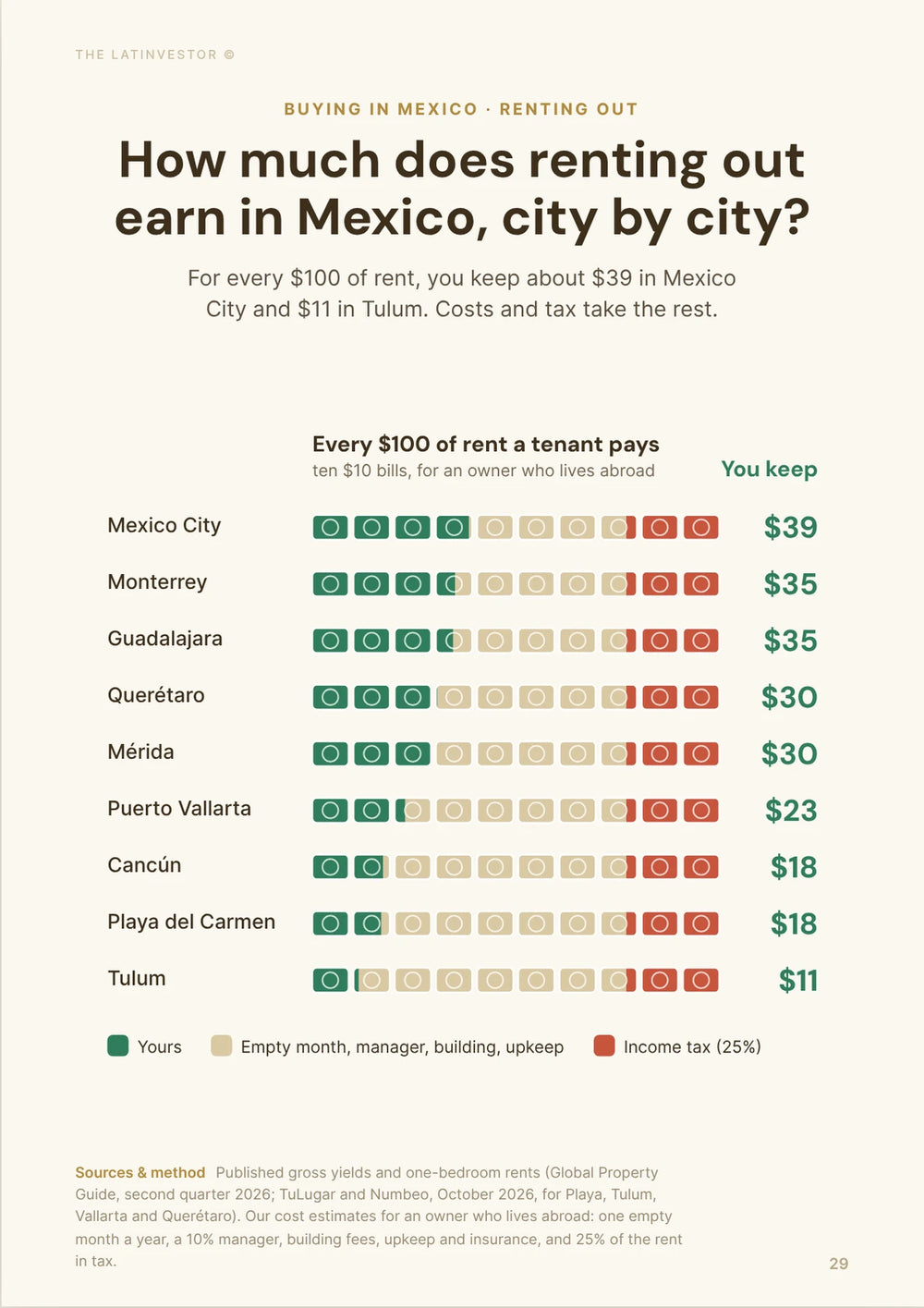
Professional management takes another cut, usually 18% to 25% of revenue and up to 30% for full service. At 25%, US$31,300 falls to about US$23,500, or 5.9% on the money invested, before HOA fees, electricity, internet, insurance, repairs, furniture, accounting and tax.
Keep in mind that the AirDNA average includes large villas; a typical one- or two-bedroom condo usually earns less. And be suspicious of anyone who shows you gross revenue divided only by the advertised price.
| Illustrative calculation | Amount |
|---|---|
| Property price (TuLugar condo median) | ~US$371,000 |
| Closing costs at 7% | ~US$26,000 |
| Total initial capital | ~US$397,000 |
| Average short-term rental revenue (AirDNA) | ~US$31,300 |
| Gross yield on property price | ~8.4% |
| Gross yield on total initial capital | ~7.9% |
| Revenue after 25% management | ~US$23,500 |
| Return after management, before other costs | ~5.9% |
Do property managers make Puerto Vallarta Airbnb returns too weak?
Sometimes, yes. A mediocre gross yield becomes unattractive fast once a manager takes 18% to 30% of the revenue.
On US$30,000 of yearly bookings, a 20% fee costs US$6,000. At 30%, it's US$9,000.
For an absentee foreign owner, that cost doesn't go away. Someone has to handle cleaners, guest messages, check-ins, repairs, pricing and emergencies.
Owners who live nearby and manage themselves can keep several thousand dollars more a year.
We'd be much stricter with an absentee purchase. A 7% gross yield under a 25% contract leaves 5.25% before HOA, utilities, repairs, insurance and taxes. A 10% gross yield still leaves 7.5% at the same stage. That gap separates a fragile deal from a good one.
| Gross Airbnb yield | After 25% management | Our view before other expenses |
|---|---|---|
| 6% | 4.5% | Too thin for most absentee buyers |
| 7% | 5.25% | Weak |
| 8% | 6.0% | Can work with low other costs |
| 10% | 7.5% | Much healthier |
| 12% | 9.0% | Strong margin for error |
Are Puerto Vallarta HOA fees and maintenance easy to underestimate?
Yes. HOA fees, utilities and coastal wear can eat a surprisingly large part of an Airbnb's revenue.
New buildings sell infinity pools, elevators, gyms, security and rooftops. Guests enjoy them; owners pay for them every month, booked or not. Local 2026 guides put a typical two-bedroom building at about US$150 to US$400 a month, so US$1,800 to US$4,800 a year.
Electricity matters too. Air-conditioning is expected, and vacation guests have no reason to save power. Insurance for a condo with hurricane cover runs about US$600 to US$900 a year according to Compass Abroad.
Then there's the coast. Humidity and salt air are hard on air-conditioners, outdoor furniture, metal, seals, paint and electronics, and a busy Airbnb goes through linens and small appliances faster than a normal rental. In 2026, water cuts hit about 40% of neighborhoods in August and Versalles had sewer backups in October; for a rental, a day without water means refunds and bad reviews.
Before trusting any seller's "net yield," ask for the actual HOA statement, 12 months of utility and repair bills, and how the building handled the water cuts (cistern size, pump, backup power).
Is the Romantic Zone still the best place to buy an Airbnb in Puerto Vallarta?
It's still one of the easiest places to rent to tourists, but no longer the obvious best investment.
Demand is excellent. Guests get the location immediately: Los Muertos Beach, restaurants, bars and the tourist core are all walkable.
The price side is harder. Propiedades.com puts the average Emiliano Zapata apartment at about MXN 7.65 million, up 8.1% since April 2025. Nearby Amapas is about MXN 10.39 million (about US$559,000), up 28.0%. Versalles is about MXN 4.01 million, down 2.5% over the same period.
A Romantic Zone condo should earn more on Airbnb than a Versalles one. The question is how much more. If it costs almost twice as much and earns only 30% or 40% more, the famous location has hurt the return.
We still like the Romantic Zone when a unit has proven rental numbers, or when you find an unusually good resale price. Paying the premium first and hoping bookings catch up is much harder to justify these days.
Is long-term renting becoming better than Airbnb in Puerto Vallarta?
In some neighborhoods, long-term renting is close enough to Airbnb that the simpler strategy deserves a serious look.
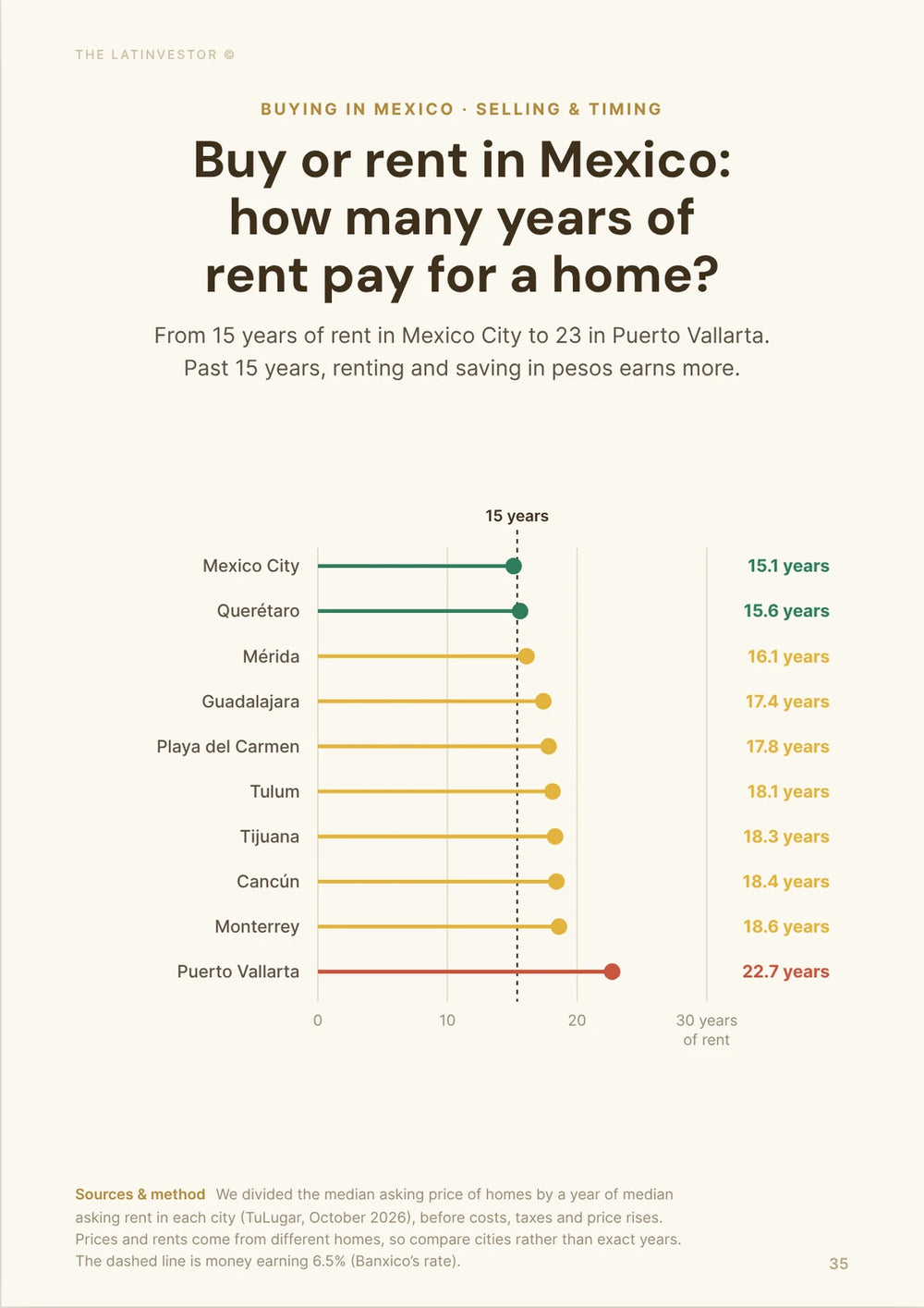
Versalles is the clearest case. Propiedades.com shows an average apartment asking price of about MXN 4.01 million and an average asking rent of about MXN 19,675 a month (about US$1,060), up 24.4% since April 2025. Compared per square meter, that's about a 6.3% gross long-term yield.
A long-term landlord pays far less for management, cleaning, guest messages, electricity and furniture. So an Airbnb at 8% gross can end up surprisingly close to a 6% long-term rental once its extra costs come off.
Versalles also has more than one kind of demand: locals, expats, remote workers and tourists. If nightly rates keep falling, an owner can switch to a tenant without wrecking the numbers.
That escape route is much weaker in Emiliano Zapata, where the same method gives only about 3.7% gross on a long lease because prices are so high.
| Example | Average asking price | Monthly long-term rent | Approx. gross yield |
|---|---|---|---|
| Versalles apartment | MXN 4.01M | MXN 19,675 | ~6.3% |
| Emiliano Zapata apartment | MXN 7.65M | MXN 17,775 | ~3.7% |
| Puerto Vallarta Airbnb benchmark | Varies | ~US$31,300 a year (AirDNA average) | Often ~6% to 10% gross before costs |
Is Jalisco about to tax or cap Airbnb in Puerto Vallarta?
Not yet, but two bills are on the table, and you should check that your numbers survive them.
Platform rentals are already inside the rules. Puerto Vallarta's 2026 municipal revenue law explicitly includes homes rented through Airbnb, Vrbo and Booking.com in its lodging sanitation charge, and Jalisco charges a lodging tax that Airbnb collects at 5%.
In May 2026, a Jalisco deputy proposed a progressive levy on short-term rentals, from 5% for small hosts up to 11% for operators with more than 13 properties, plus a mandatory state register and rules against splitting ownership to stay in the low bracket. The bigger one is the cap: on May 25, 2026, a Jalisco Congress committee approved a bill that would limit short-term rentals of homes that aren't the owner's main residence to 180 nights a year in "high tourism pressure" zones, mainly Guadalajara and Puerto Vallarta, and keep homes less than five years old off the platforms. The full Congress hasn't voted on either.
There's no citywide Airbnb ban in sight. But for a new condo, the five-year rule would hit hard if it ever passed, and AirDNA's 57% average occupancy is already about 208 nights a year. What to do: run your numbers at 180 nights plus monthly stays and with an extra 5% off gross revenue, prefer buildings with a track record of legal short-term renting, and don't count on spreading several units across companies or trusts to stay small.
What taxes does a Puerto Vallarta Airbnb owner actually pay?
Airbnb income is taxable, and a foreign owner without the right setup can lose far more than expected to withholding.
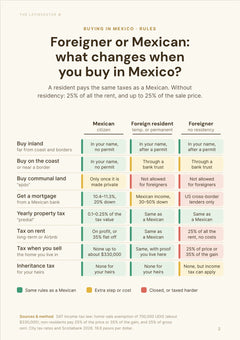
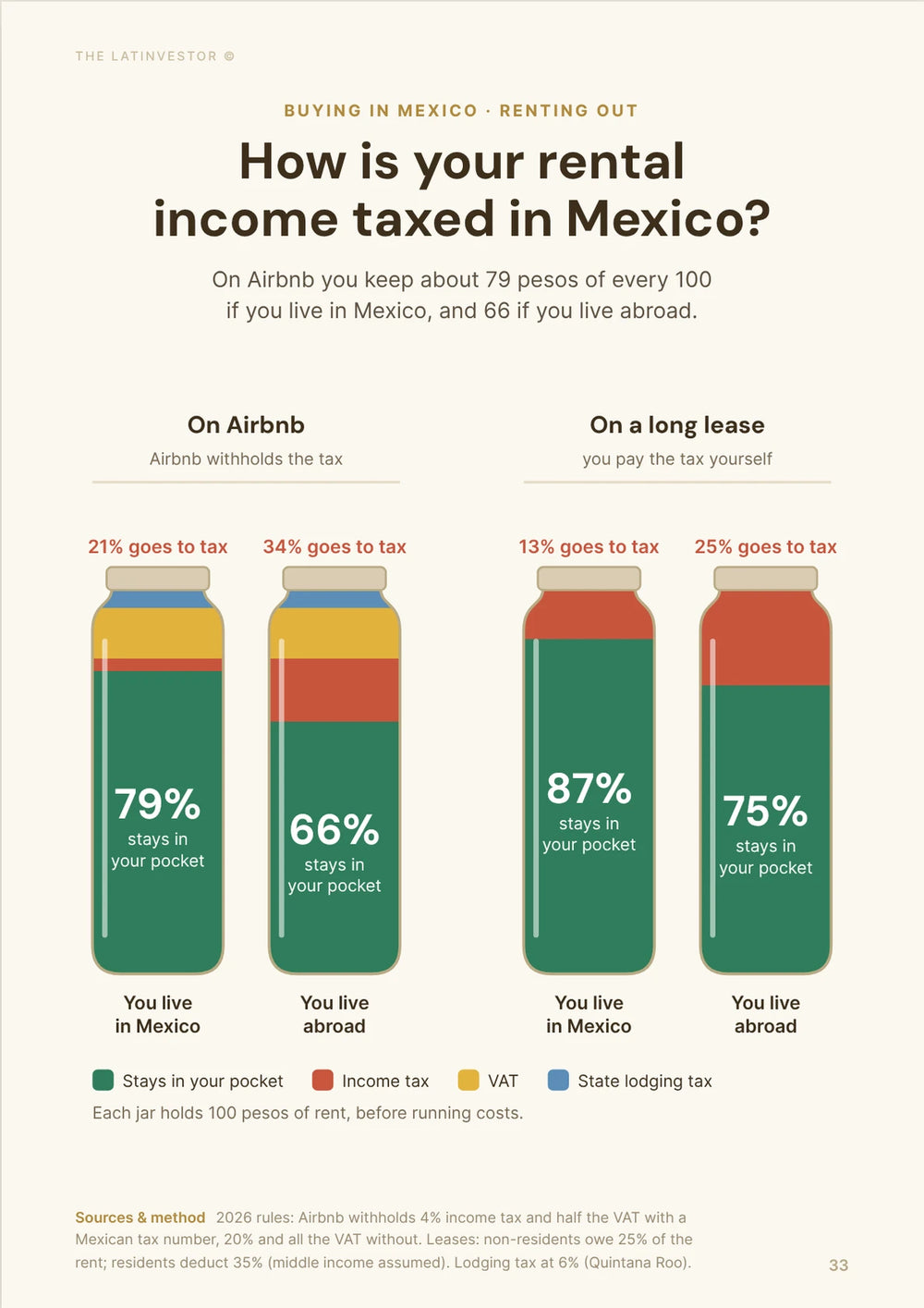
Platforms withhold 4% income tax from hosts who give a valid RFC, the Mexican tax number, and 20% from those who don't. Short stays also carry 16% VAT, and guests pay Jalisco's lodging tax, which Airbnb collects at 5% (some tax advisers quote 4% for 2026).
Getting an RFC before your first booking is the single easiest money you'll save.
The bigger bill hits non-residents. If you're not tax resident in Mexico, income tax on rent is generally 25% of the gross, with no deductions. On the AirDNA average of US$31,300, that's about US$7,800 a year, which takes our managed example from 5.9% to just under 4% on the money invested, still before HOA fees, utilities and repairs.
The right treatment depends on whether you're tax resident in Mexico, how the property is held and how many units you run. Have a Mexican accountant model your after-tax cash flow before closing on any Airbnb bought mainly for income.
Can a Puerto Vallarta condo building ban Airbnb?
Yes. A building can restrict short-term rentals even where Airbnb is allowed in the neighborhood.
This is one of the easiest risks for an overseas buyer to miss.
Mexican condo buildings run under their own condominium regime, bylaws and assembly decisions. Those can control rental procedures, guest access, minimum stays and how units are used.
Seeing Airbnb listings in the building helps, but it doesn't replace checking the paperwork. Some owners may be operating under older rules, ignoring restrictions, or relying on rules that the next assembly vote could change.
Before putting a value on short-term rental income, have the condominium regime, bylaws, HOA rules and recent assembly minutes reviewed. A great Airbnb projection becomes a very different investment if the building sets a seven-night minimum after you buy.
Does buying a Puerto Vallarta Airbnb as a foreigner make the return worse?
Yes, a little, and it belongs in the yield calculation from day one.
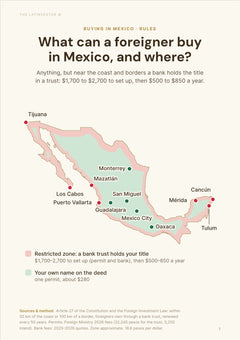
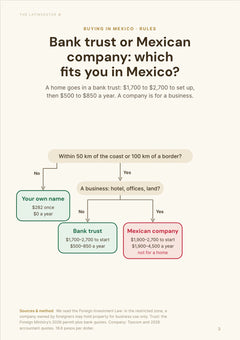
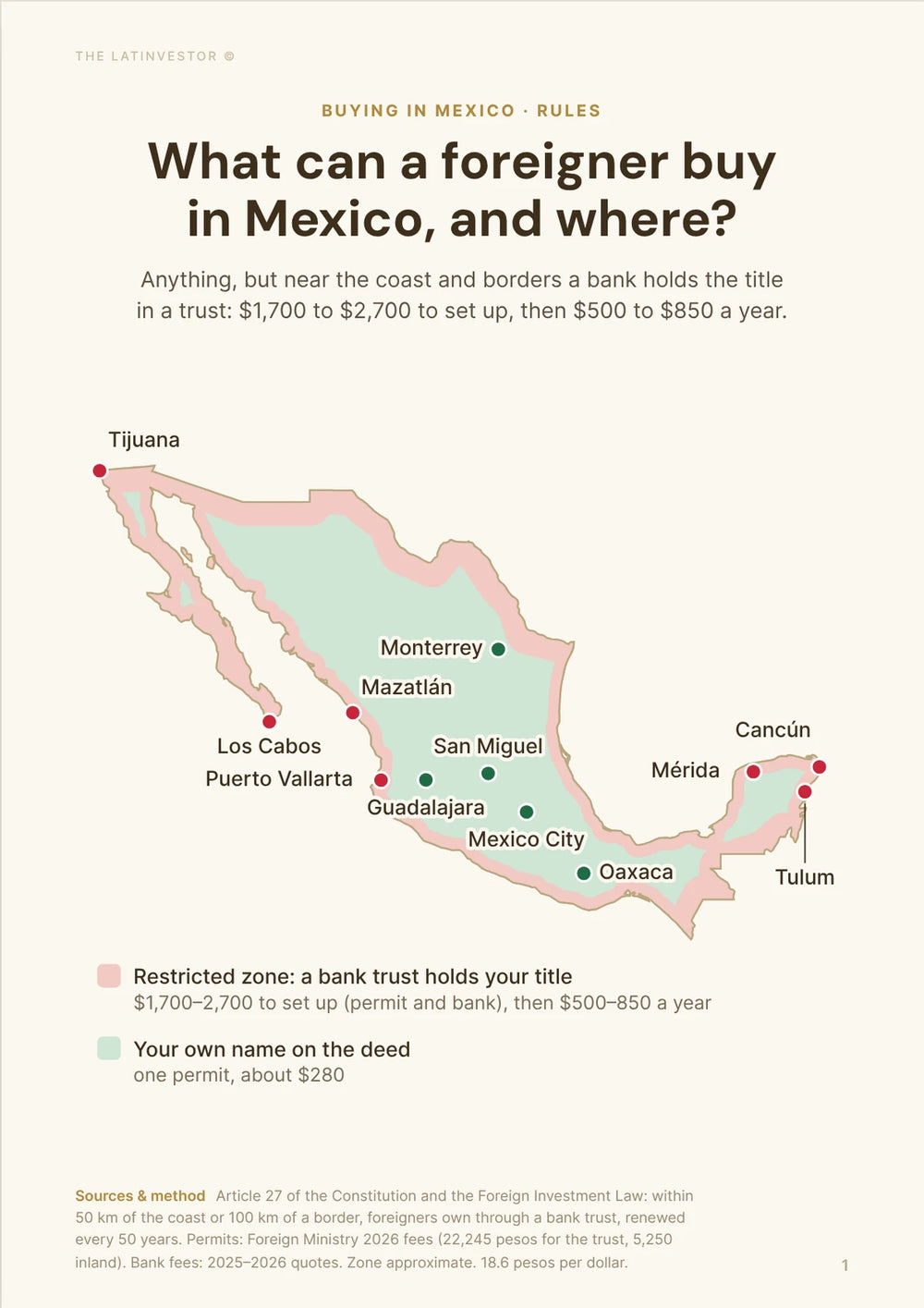
Puerto Vallarta is inside Mexico's restricted coastal zone. Foreigners can buy homes there, but through a bank trust called a fideicomiso.
The trust itself is manageable. The government permit costs MXN 21,650 (about US$1,160). Banks charge about US$550 to US$800 to open the trust and about US$550 to US$700 a year after that.
Closing costs matter more. In Puerto Vallarta, where the transfer tax is about 3%, total foreign-buyer costs come to about 5% to 8% of the price with a trust (Compass Abroad gives 6% to 9% nationally). On a US$400,000 condo, that's another US$20,000 to US$32,000 before furniture or renovation.
That extra money lowers the real yield. An 8% gross return on the purchase price falls to about 7.5% once you spend another 7% to close.
What kind of Airbnb still makes sense in Puerto Vallarta now?
Well-priced one- or two-bedrooms with real walkability, a clear reason for guests to pick them, legal short-term rental use and a decent long-term fallback.
The price comes first. Emiliano Zapata apartments average about MXN 7.65 million while Versalles is near MXN 4.01 million, and Centro's average asking price has slipped 4.9% since April 2025. With condo sales down sharply, there's room to negotiate beyond the obvious tourist streets.
The apartment should then give guests something easy to understand: a real ocean view, great walkability, an unusually good rooftop, good design, parking where it's scarce, or enough beds for families and groups.
Generic one-bedrooms have the hardest job because they already make up almost half of the supply.
We'd rather buy a resale unit with a verifiable 12-month booking history than a new condo sold on a projected ROI. Real nightly rates, occupancy and bills tell you much more.
The best deal still works after a drop in nightly rates, stays acceptable with a manager, and can switch to a long-term tenant if tourism weakens again.
So should you buy an Airbnb in Puerto Vallarta now?
Yes, if the numbers hold up: we'd only buy when a property can realistically gross 9% to 10%, or has a strong fallback, and we'd walk away below about 8% if you need a manager.
Puerto Vallarta still has what Airbnb investors need. Tourism is huge, AirDNA's average occupancy is 57%, and average revenue is about US$31,300 a year.
The easy-money version is gone. RevPAR is down 10.4%, international passengers fell 19.4% this year, Simón briefly shut the airport before high season, and Jalisco is discussing a 180-night cap and a 5% to 11% levy on short-term rentals.
At the same time, buyers have more leverage. Condo closings fell 41.5% in September 2026, Versalles and Centro asking prices are slipping, and Emiliano Zapata and Amapas keep rising. Comparing neighborhoods, and negotiating hard on stale listings, is where the returns are now.
Above 10% gross, there's enough room for management, HOA fees and a weak season. Below 8%, a professionally managed foreign-owned condo rarely makes sense unless personal use or price growth is a big part of the plan.
Puerto Vallarta itself isn't the investment. Two condos a few kilometers apart can have completely different prices, bookings, HOA costs, long-term rents and building rules. Buy the specific property at the right price.
Our methodology
This article estimates whether buying a short-term rental in Puerto Vallarta still makes financial sense, by separating rental demand (bookings, tourism) from investment economics (purchase price, costs, rules and tax).
Short-term rental figures come from AirDNA (Airbnb, Vrbo and Booking.com) for the 12 months to September 2026, with AirROI (Airbnb only) as a cross-check and for monthly occupancy. We never mix the two in one calculation, because they count listings differently. Purchase prices and long-term rents come from Propiedades.com's October 2026 neighborhood data and TuLugar's October 2026 listing medians; long-term yields compare rent and price per square meter. Sales activity comes from Coldwell Banker La Costa and SearchPV's MLS closings, and tourism from Grupo Aeroportuario del Pacífico's monthly traffic reports.
Rules and taxes come from SAT, the Secretaría de Relaciones Exteriores, Puerto Vallarta's 2026 revenue law, Jalisco's tax law, the Jalisco Congress and Airbnb's Mexico help pages. Costs (closing, trust fees, HOA, insurance, management) come from local 2026 guides and operators.
We checked these figures in October 2026. Conversions use about 18.6 pesos per US dollar and 20.9 pesos per euro.
Limits: listing prices are asking prices, usually above final sale prices; the AirDNA average includes large villas; Propiedades.com samples are small in some neighborhoods; the Jalisco levy and night cap are proposals, not law; and the yield thresholds in our conclusion are our own decision rules for an absentee foreign owner, not market benchmarks. Your unit's own 12-month numbers matter more than any average here.
Key sources used for this analysis include AirDNA's Puerto Vallarta overview, AirDNA's supply breakdown, AirROI's Puerto Vallarta data, Grupo Aeroportuario del Pacífico's September 2026 traffic report, Crónica on the airport reopening after Hurricane Simón, AP on Hurricane Simón, GayPV on 2026-27 flights, Propiedades.com on Emiliano Zapata, Versalles sales, Versalles rents, Marina Vallarta, Amapas and Puerto Vallarta Centro, TuLugar's Puerto Vallarta market data, Coldwell Banker La Costa's October 2026 market pulse, SearchPV's resale condo closings, Homia on condo fees, Homia on 2026 bank trust fees, Compass Abroad on 2026 closing costs, Compass Abroad on homeowner insurance, Puerto Vallarta's 2026 Revenue Law, Jalisco's state tax law, the Jalisco Congress on the May 2026 proposal, Crónica Jalisco on the 180-night committee vote, SAT's digital-platform tax guidance, SAT on withholding without an RFC, Airbnb on lodging tax in Jalisco, and the Secretaría de Relaciones Exteriores on restricted-zone trusts.