Summary
Not on average, but in parts of the market and on individual homes, yes. The bay's median sale price is up 9.2% to $415,000 over the twelve months to September 2026, yet the median condo price per square meter is flat at about $3,948 and 69% of homes sold below asking.
The headline rise is mostly a mix effect. Larger, pricier homes sold this year; comparable space barely got more expensive.
Buyers now hold the cards. There are about 23 months of resale homes for sale, 31 with presales, and only 11% of recent deals closed above asking.
Sales have dropped hard in recent months. Coldwell Banker La Costa counted 48 condo closings in September 2026, 41.5% fewer than a year earlier, even though the condo median held at $432,500.
Neighborhoods have split. The Romantic Zone is down 6.3% and Conchas Chinas 19%, Centro is flat, while Versalles and Fluvial are up 7.6% and Amapas 4.4%.
Houses are under more pressure than good condos. Active house listings are up 26.5% in a year, and several recent house sales closed 12% to 24% below their last asking price.
The typical seller now gives up about 8% from the first asking price. The big discounts sit on listings that have been on the market for close to a year or more.
Selling time is the clearest sign. The median home took 229 days to sell, 13.9% longer than a year earlier.
New supply keeps coming. Presales are 46% of active listings but only 26% of sales, and about 1,534 units are due by 2028, at about $4,194 per m² against $3,762 for resales.
Fewer foreign visitors add to the pressure. International passengers at the airport fell 19.4% from January to September 2026.
The peso has weakened since early September, from under 17 to about 18.6 per dollar. An MXN 8 million home now costs a dollar buyer about $430,000, against more than $470,000 a few weeks ago, though still more than the $417,000 it cost at the 2025 average rate.
A crash still looks unlikely. About 94% of sales were made without a bank mortgage, so few owners are forced to sell.
Don't wait for a headline saying prices fell 10%. A listing that has sat for a year with two price cuts may already be there; that is where to negotiate.

What do the latest sales numbers actually show?
They show a market that is still up on paper but softening underneath, with real falls in some neighborhoods and on individual properties.
The Bay Report, built on FlexMLS data, covers 1,338 residential closings across Puerto Vallarta and Bahía de Banderas over the 12 months to September 2026, 7.5% fewer than a year earlier. The median sale price reached $415,000, up 9.2% on the previous 12 months.
The price per square meter tells a different story: the median condo held at about $3,948 per m², which the report calls stable. Buyers spent more per deal because larger homes changed hands, while what they paid for the same amount of space barely moved.
The quarterly medians swing: $424,000 in Q1 2026, $384,000 in Q2 and about $440,000 in a preliminary Q3. Those swings follow the mix of homes sold, not values. What is steady is the drop in sales: every quarter of 2026 ran below the same quarter of 2025.
The freshest monthly data points the same way. Coldwell Banker La Costa's September 2026 condo median was $432,500, up just 1.6% in a year.
| Metric | Previous reading | Latest reading | Change | What we see |
|---|---|---|---|---|
| Bay median sale price, 12 months | ~$380,000 | $415,000 | +9.2% | Headline price still higher |
| Median condo price per m² | — | $3,948 | Stable | Comparable space barely moved |
| Q2 2026 median | $424,000 (Q1) | $384,000 | -9.4% QoQ | Swings with the mix |
| Q3 2026 median (preliminary) | $384,000 (Q2) | ~$440,000 | +14.6% QoQ | Swings with the mix |
| Residential closings, 12 months | ~1,446 | 1,338 | -7.5% | Fewer buyers |
| Condo median closing price, September 2026 | — | $432,500 | +1.6% YoY | Almost flat |
Why can Puerto Vallarta prices look up and down at the same time?
Because the homes selling today are not the same homes that sold a year ago.
When more large two- and three-bedroom condos sell, the median sale price goes up. That does not mean an identical condo became more valuable.
The Bay Report shows it clearly: the median sale rose 9.2% while the median condo price per square meter stayed flat. About 45% of all sales were two-bedroom homes, with a $410,000 median, while homes with three or more bedrooms had a $626,000 median.
Monthly reports can make it worse. Coldwell Banker La Costa's April 2026 MLS snapshot put the condo median at $428,219, roughly 30% above the year before, while condo sales were down more than 50%. Nobody's condo got 30% dearer in a year; fewer, pricier units simply sold.
To know whether comparable homes are getting cheaper, look at price per square meter, neighborhood sales and individual closing prices, not one monthly median.
Has Puerto Vallarta become a buyer's market?
Yes. Sellers face far more competition, and buyers have time to say no.
The Bay Report to September 2026 puts existing-home supply at about 23 months. Add presales and it rises to 31 months. A balanced market sits around six.
The 31-month figure overstates what you can move into today: 46% of active listings are presale units that may not be delivered for one to three years. But even without them, 23 months of resale stock is a lot.
Only 11% of recent sales closed above asking, and 69% closed below it. And 29% of homes were still unsold after a full year.
That shift in bargaining power matters more right now than the headline price.
| Current market measure | Latest reading | What it means |
|---|---|---|
| Existing-home supply | ~23 months | Plenty of resale choice |
| Supply including presales | 31 months | Heavy headline inventory |
| Median days on market | 229 days | Buyers can take their time |
| Unsold after one year | 29% | Lots of stale listings |
| Sales below asking | 69% | Negotiation is normal |
Did Puerto Vallarta sales just drop off a cliff?
Condo sales did, at least for now: Coldwell Banker La Costa counted only 48 condo closings in September 2026, 41.5% fewer than in September 2025.
The slowdown started earlier. The bay recorded 380 closings in Q2 2026 against 501 in Q2 2025, a 24% drop, and the twelve months to September are down 7.5%. Every quarter of 2026 has run below 2025.
Prices have not followed yet. The September condo median stayed at $432,500, and active condo listings actually fell 17.5% to 2,672, so condo sellers are not flooding the market. Houses are the opposite: 750 active listings, up 26.5% in a year.
What to do with that: September is low season, so one month proves little. But if you are buying a house, you are in the segment where supply is growing fastest. Ask the agent how many similar homes closed nearby in the last six months and at what price, and use the answer in your offer.
Are Puerto Vallarta condos actually getting cheaper?
In some areas, yes, but condos have held up better than many buyers expected.
The Romantic Zone's median sale price fell 6.3% year over year to $429,000, according to the Bay Report's neighborhood breakdown to September 2026. Centro and 5 de Diciembre were flat, up 0.6% to $410,000.
Other areas moved the other way. Versalles and Fluvial rose 7.6% to $339,000 and Amapas 4.4% to $710,000, while Marina Vallarta and the Hotel Zone jumped sharply because more expensive units made up a bigger share of sales.
Single sales show why averages need care. Loma Linda C6 in Amapas sold for $675,000 after just 59 days, only 2.9% below its $695,000 asking price. Avalon 305, also in Amapas, sold for $955,000, about 97% of its final list price, despite spending 581 days on the market.
Condos are not repricing together. Ordinary units in heavily built-up neighborhoods feel the pressure first; scarce ocean-view or well-located condos still hold their price surprisingly well.
Are Puerto Vallarta houses under more pressure than condos?
Yes. House buyers have more choice, and some house sellers are accepting very large discounts.
SearchPV's recent house closings show it. Hacienda Versalles sold for $725,000 against a final $825,000 list price, an 87.9% ratio. A Sierra del Mar home closed at $1.8 million after being listed at $2.099 million. Another Sierra del Mar property sold for about $2.49 million against $2.95 million.
Villa Amanda in Upper Conchas Chinas is the most dramatic case: it closed at $799,000 after a $1.05 million final asking price, 76.1% of the list price, after 361 days on the market.
A handful of luxury sales is not an average; size, view, condition and seller motivation vary hugely. But when unrelated homes in Versalles, Sierra del Mar and Conchas Chinas all close 12% to 24% below asking, and house listings are up 26.5% in a year, the discounts stop looking like accidents.
Houses do not sit longer than condos: Coldwell Banker La Costa's September 2026 data shows about 154 days on market for houses against 262 for condos. The pressure on houses shows up in the price, not the waiting time.
| Recent house sale | Area | Final list | Sold price | Sold/list |
|---|---|---|---|---|
| Hacienda Versalles | Versalles | $825,000 | $725,000 | 87.9% |
| Sierra del Mar | Sierra del Mar | $2,099,000 | $1,800,000 | 85.8% |
| Sierra del Mar | Sierra del Mar | $2,950,000 | $2,492,494 | 84.5% |
| Villa Amanda | Upper Conchas Chinas | $1,050,000 | $799,000 | 76.1% |
How much are Puerto Vallarta sellers cutting their prices?
Real money, but the typical cut is much smaller than the dramatic deals suggest.
Across the Bay Report's 12 months to September 2026, the median reduction from the first asking price to the sale price was 8%. A typical negotiation ends closer to 8% off than 20%.
The median hides the listings that matter most to buyers: those sitting for six months, nine months or a year. That is where the bigger discounts are. Loma Linda C6, Harbor 171 and V Estrella sold at around 97% of asking; Hacienda Versalles came in below 88% and Villa Amanda at 76.1%.
Sale-to-list ratios also hide earlier cuts. A seller may drop from $400,000 to $360,000 and later accept $345,000. The sale looks only 4% below asking, but the seller took nearly 14% less than first hoped.
So don't offer 15% below everything. Ask for the listing history first: the date it was first listed, every price cut, and closed prices per m² in the same building. Push hard where the history shows a tired seller.
Are Puerto Vallarta homes really taking that long to sell?
Yes, and slow sales are the clearest proof that sellers have lost the upper hand.
The median time on market reached 229 days in the Bay Report to September 2026, 13.9% longer than a year earlier. The fastest quarter of homes sold within 127 days; the slowest quarter took at least 396 days. Coldwell Banker La Costa's September 2026 data splits it by type: about 262 days for condos and 154 for houses.
Recent SearchPV closings fit that pattern. Sierra del Mar took 378 days, Villa Amanda 361 and Avalon 305 581. One Fluvial house that eventually sold for $647,000 had been listed for 924 days.
There are exceptions. Loma Linda C6 in Amapas sold in 59 days because its price was close to what buyers would actually pay. The market now punishes optimistic pricing and rewards realistic pricing, fast.
Is Puerto Vallarta drowning in new condos?
There is a lot of future condo supply, but "31 months of homes for sale" exaggerates what is ready today.
About 46% of active baywide listings are presales, according to the Bay Report to September 2026, but presales were only 26% of closings over the previous 12 months. Developers are offering far more than buyers are taking.
Roughly 1,534 presale units are still to be delivered through 2028, with the biggest batch, about 607, due in 2027 and about 480 in 2028.
New builds sell at a premium: around $4,194 per square meter for presales against about $3,762 for resale condos, an 11% gap. That leaves resale sellers stuck. The new tower next door offers fresh finishes, payment plans and a rooftop pool, so an older condo has to be clearly cheaper to compete.
Presales also sit longer on the MLS: a median of 398 days against 200 for resales. Expect this competition to last at least two more years, especially in neighborhoods with a heavy pipeline like Versalles.
| Supply measure | Current reading | What we see |
|---|---|---|
| Presale share of active listings | 46% | Half of visible supply is future product |
| Presale share of closings | 26% | Sales lag their listing share |
| Units scheduled through 2028 | ~1,534 | More inventory is coming |
| Presale price per m² | ~$4,194 | New-build premium |
| Resale price per m² | ~$3,762 | Existing homes trade cheaper |
| Presale median days on market | 398 days | Developers also wait a long time |
Which Puerto Vallarta neighborhoods are already falling?
The Romantic Zone and Conchas Chinas are recording lower median sale prices; Centro is flat, and Versalles, Fluvial and Amapas are still rising.
The Romantic Zone fell 6.3% year over year to a median sale price of $429,000. Conchas Chinas dropped 19.0% to $806,000, the kind of fall a handful of deeply discounted luxury sales can cause in a small neighborhood. Centro and 5 de Diciembre were flat at $410,000 (+0.6%).
Versalles and Fluvial went the other way, rising 7.6% to $339,000, and Amapas rose 4.4% to $710,000.
Marina Vallarta and the Hotel Zone posted an 83% jump to $690,000. Ignore that one: a few more expensive sales can move a neighborhood median that much.
Supply is now similar everywhere: about 13 to 16 months of resale homes in each area, from Conchas Chinas at the low end to Versalles, Amapas and the Marina at the top.
| Puerto Vallarta area | Median sale price | YoY change | Existing supply | Median days on market |
|---|---|---|---|---|
| Romantic Zone | $429,000 | -6.3% | 14 months | 213 |
| Centro + 5 de Diciembre | $410,000 | +0.6% | 15 months | 220 |
| Versalles + Fluvial | $339,000 | +7.6% | 16 months | 242 |
| Amapas | $710,000 | +4.4% | 16 months | 184 |
| Conchas Chinas | $806,000 | -19.0% | 13 months | 206 |
| Marina + Hotel Zone | $690,000 | +83.0% | 16 months | 221 |
Are prime Puerto Vallarta properties still holding their value?
Mostly, but not everywhere. The best properties are holding up much better than the average listing.
Amapas is the clearest example: its median sale price is up 4.4%, and Loma Linda C6 closed at 97.1% of asking in under two months.
But even expensive areas no longer forgive a bad price. Conchas Chinas' median fell 19% to about $806,000, Villa Amanda in Upper Conchas Chinas sold more than 20% below its final list price, and Sierra del Mar has produced several recent sales around 85% of asking.
The dividing line is the property and its price, not the postcode. A good ocean view, a well-run building, sensible HOA fees and a realistic price still find a buyer quickly. An expensive address does not save an overpriced home.
Is the drop in foreign tourists pushing Puerto Vallarta prices down?
It is adding pressure, mainly on vacation-rental condos and second homes aimed at Americans and Canadians.
Puerto Vallarta airport handled about 4.54 million passengers from January to September 2026, 12.3% fewer than a year earlier, according to Grupo Aeroportuario del Pacífico. International traffic fell 19.4%, while domestic traffic dropped only 3.7%. In September alone, international passengers were down 12.0%, a smaller fall than earlier in the year.
Visitors have not vanished. Hotel occupancy still averaged about 69% in the first half of 2026, down from about 75% a year earlier, and ASIPONA counted about 251,000 cruise passengers in the first five months of 2026, after roughly 535,000 in all of 2025.
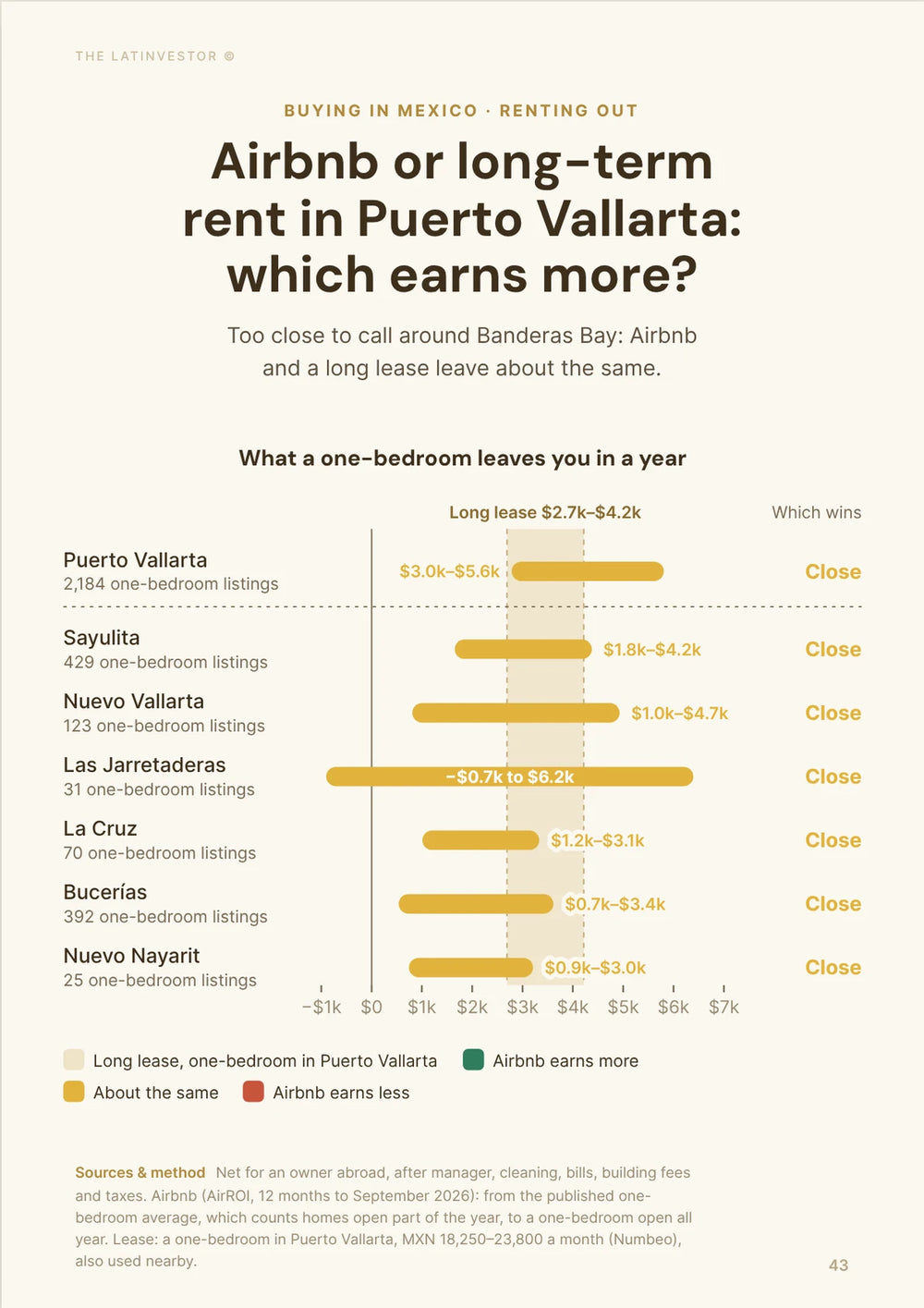
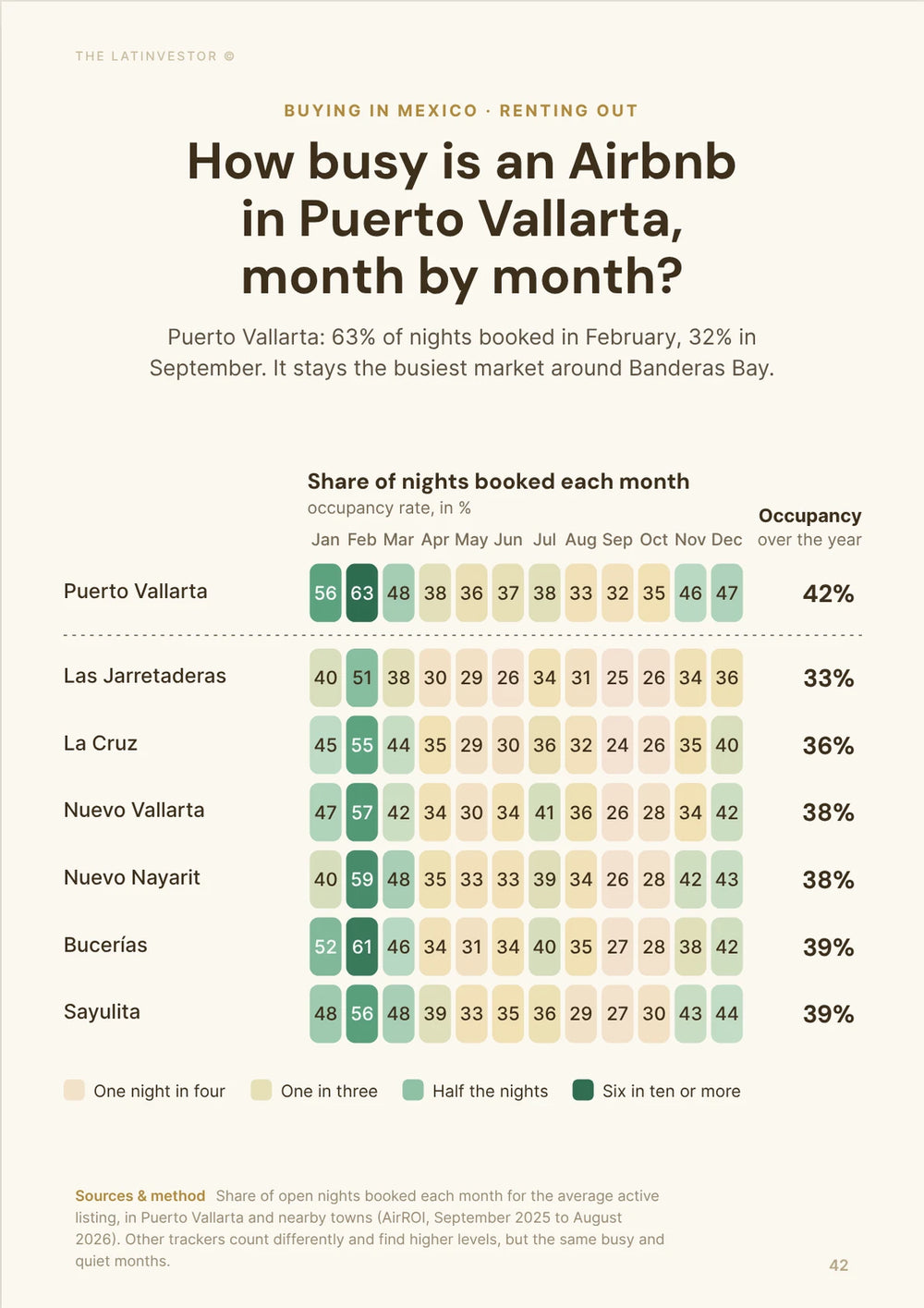
The weak spot is short-term rentals. AirDNA counts about 5,943 active listings in Puerto Vallarta, 54.3% fewer than a year earlier, with an average nightly rate of about $178, down 17.5% in a year, and 57% occupancy. Owners are pulling units off the platforms, and fewer foreign guests make it harder to justify paying a high price for a generic Airbnb condo, which is exactly the kind of unit that now sits longest and sells below asking.
Does the weaker peso make Puerto Vallarta cheaper for American buyers?
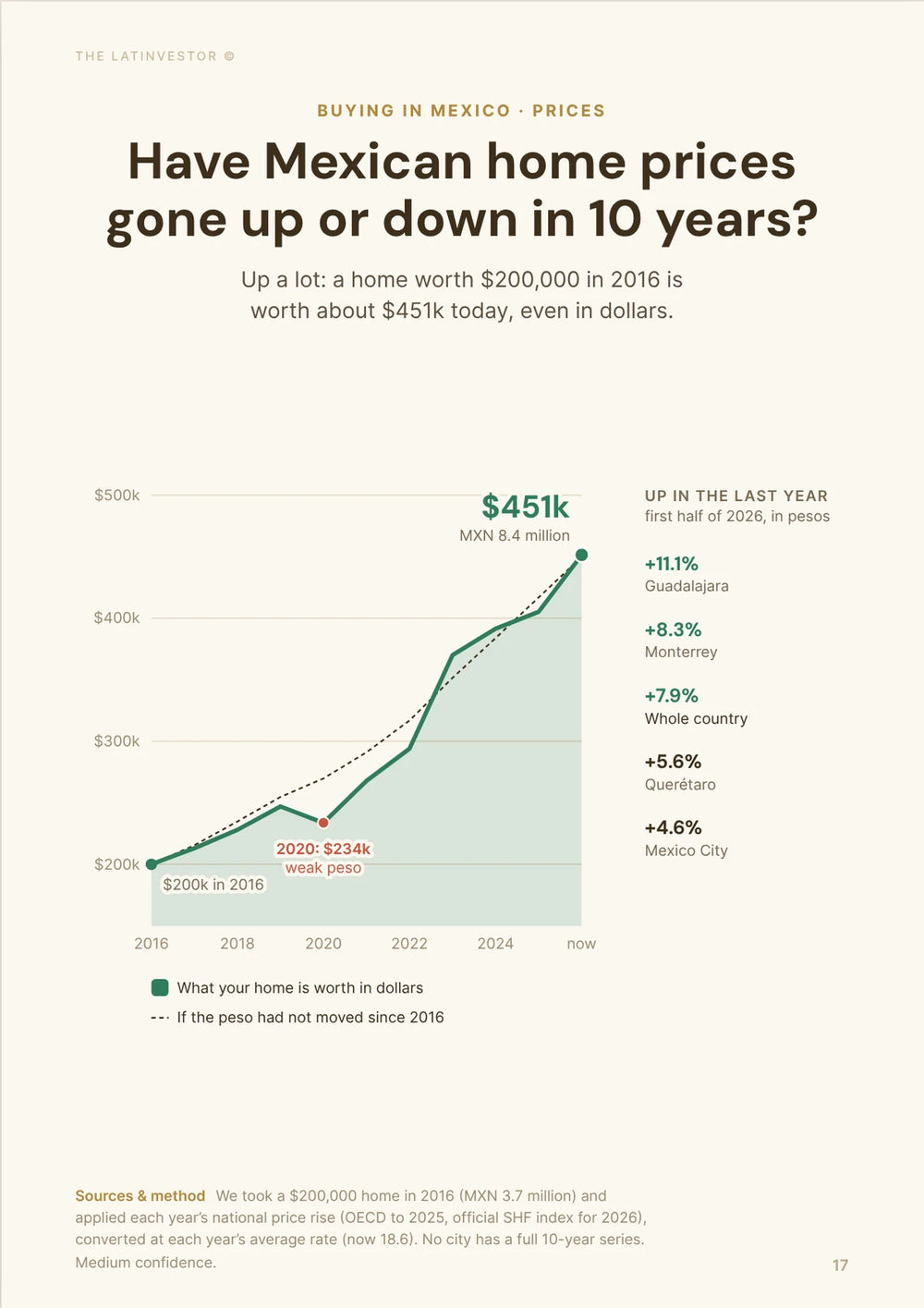
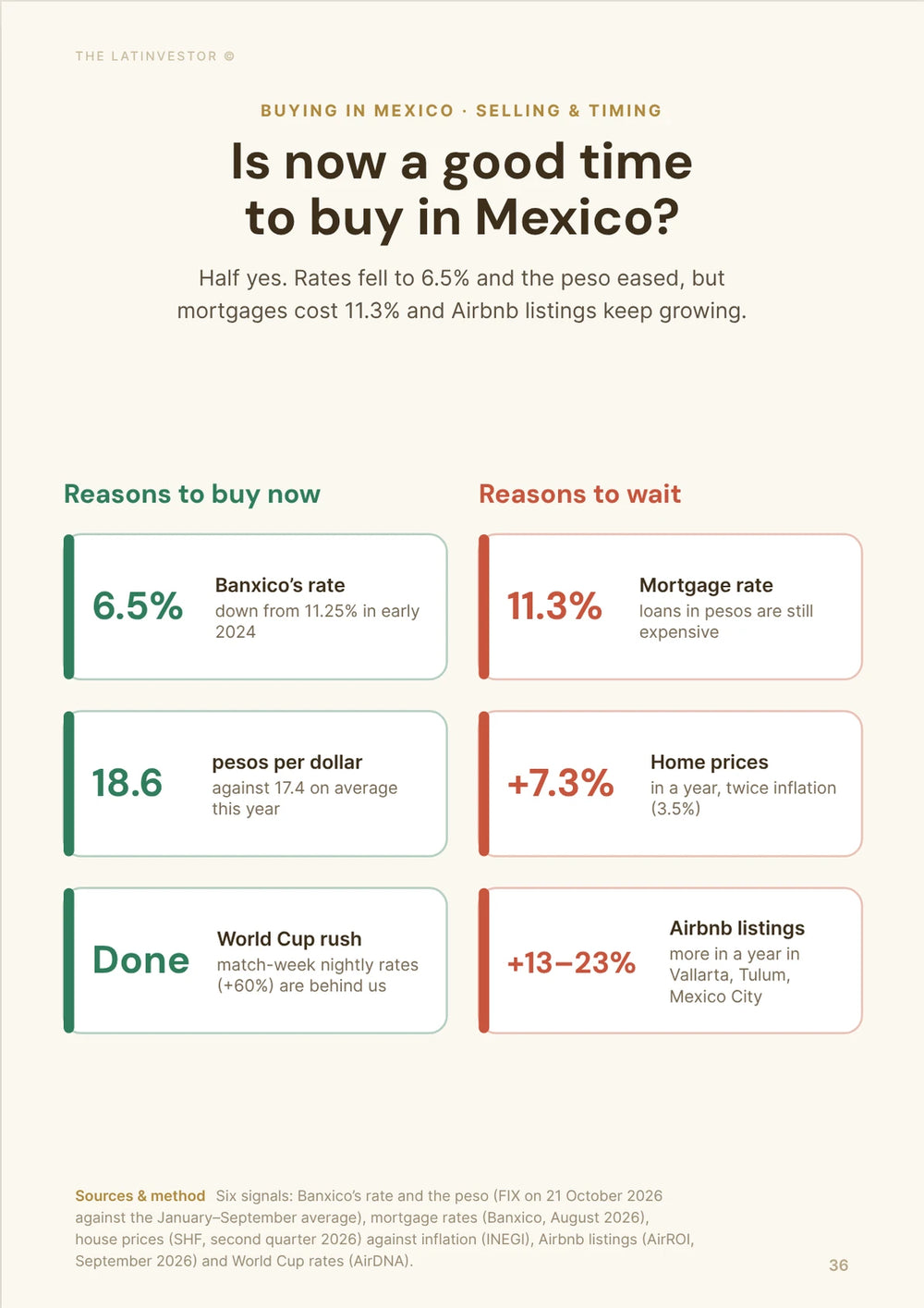
For peso-priced homes, yes, compared with a few weeks ago. The peso has weakened since early September, from under 17 to about 18.6 per dollar, though it is still a bit stronger than its 2025 average of about 19.2.
An MXN 8 million home costs about $430,000 today, against more than $470,000 in early September and roughly $417,000 at the 2025 average rate. The seller cut nothing; the exchange rate did the work.
Most of the MLS figures in this article are in dollars, because much of Puerto Vallarta's foreign-buyer market lists in dollars. Peso-priced homes, often in local neighborhoods, can look flat in pesos and still swing by 10% for a dollar buyer within a few weeks.
What to do: compare listings in the currency they are priced in, and if you plan to pay in pesos, ask whether the seller will fix the price in pesos in the contract. If the peso weakens further before closing, that works in your favor; if it bounces back, it works against you.
Has Puerto Vallarta simply become too expensive?
For many buyers, yes, and that is why they have become much pickier, especially in the tourist core.
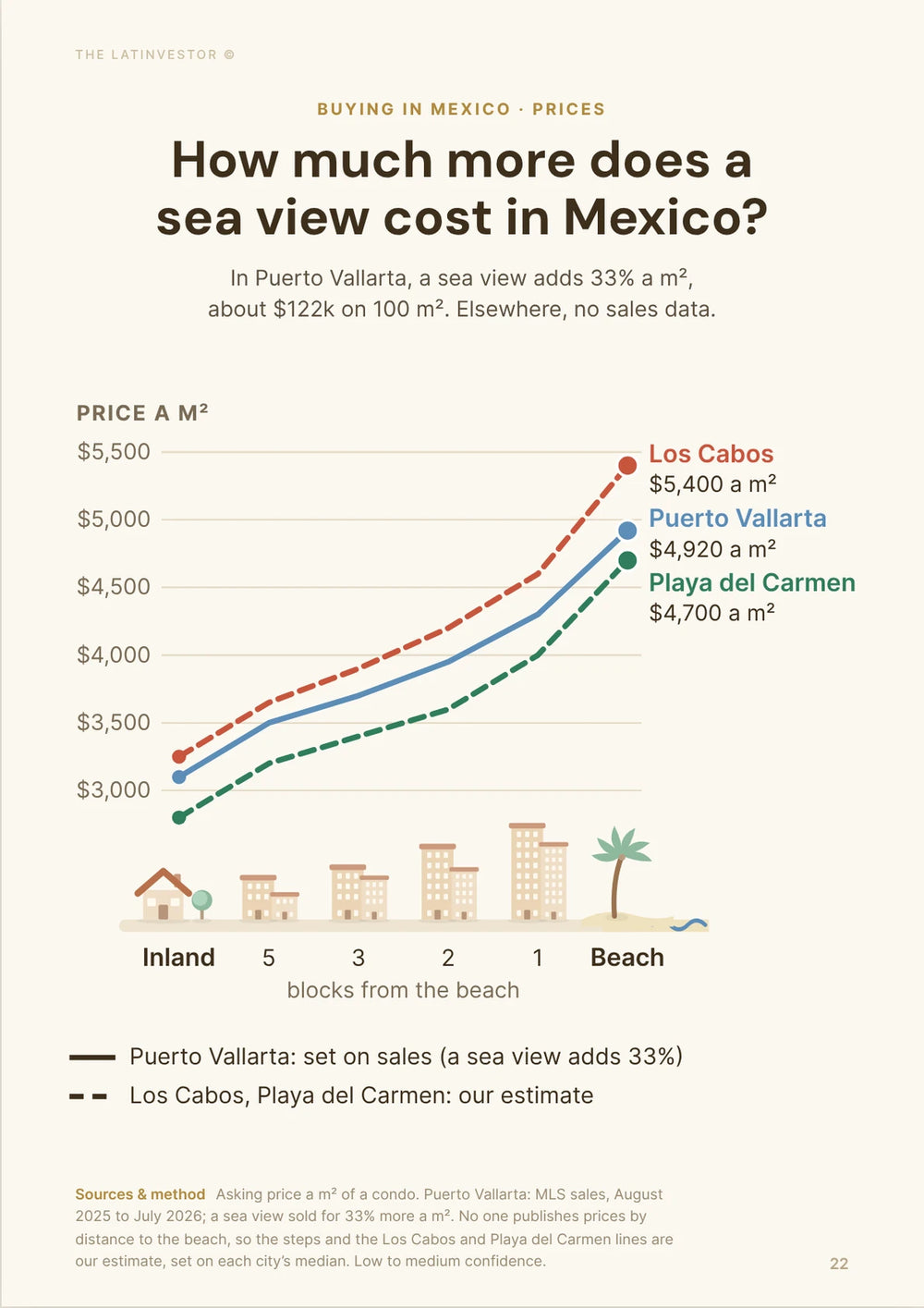
Asking prices show the gap. Listings in the Romantic Zone ask around $5,450 per m² (MXN 101,000) and Emiliano Zapata about $6,200 (MXN 115,000), against about $3,650 (MXN 67,800) in Versalles and a citywide condo median of about $3,850 (MXN 71,700). Inland areas such as Ixtapa and Pitillal are much cheaper. These are asking prices, not sale prices.
Actual sales sit much lower than the glossy new projects suggest. Homes below $300,000 made up 30% of closings across the bay, another 32% sold between $300,000 and $500,000, and only 9% sold above $1 million.
So six buyers in ten still close under $500,000, while a large share of new construction is priced well above that. Developers and sellers can ask luxury prices; most of the money in the market is spent lower down.
Could Puerto Vallarta property prices fall much further?
They could fall further in oversupplied neighborhoods, but a citywide crash still looks unlikely.
The case for more falls is easy to make. Resale supply is high, presales keep coming, many homes take most of a year to sell, the Romantic Zone and Conchas Chinas are already down, foreign visitors are fewer and sales volumes are now dropping too, with condo closings down 41.5% in September.
The main thing working against a crash is who owns the homes. In the Bay Report, about 94% of sales were made without a bank mortgage. Owners without a mortgage are rarely forced to sell; they can wait, rent the property out or pull it off the market.
That usually means a slow correction: long listing times, repeated cuts and selective discounts rather than a wave of forced sales. Watch for the warning sign: if neighborhood prices keep falling while inventory stays high and sales stay this weak into the 2026–2027 winter season, a deeper drop becomes much more likely.
Should buyers wait for Puerto Vallarta prices to fall more?
Waiting for a crash makes less sense than hunting for an overpriced home with a motivated seller now.
A home that has sat for 350 days with two price cuts is a completely different negotiation from a good Amapas condo listed 40 days ago, yet both count in the same market figures. With 29% of listings still unsold after a year, there are plenty of sellers who may now care more about closing than about their original price.
The market could soften further. But if you wait for a headline saying "Puerto Vallarta prices fell 10%," you may miss the individual homes where that has already happened. Winter, when most foreign buyers visit, is also when sellers feel least pressure, so the best leverage is often in late summer and autumn.
So, is this a real price correction?
Yes, a real but selective one. It is too uneven to call a citywide price drop.
Several signals point the same way. Price per square meter has stopped rising across the bay. The Romantic Zone and Conchas Chinas are recording lower median sale prices. Homes take 229 days to sell, 69% of sales close below asking, and some houses are changing hands 12% to 24% below their latest list price.
At the same time, this is not a crash. The 12-month median sale price is still higher, Amapas and Versalles are firm, and cash buyers dominate.
The boom is over. Sellers can no longer count on time to rescue an ambitious price, and buyers no longer need to chase whatever comes on the market. Some neighborhoods and houses are already cheaper, good condos in prime spots have barely moved, and the next step depends on whether this winter brings foreign buyers back.
Our methodology
This article estimates whether Puerto Vallarta property prices are falling. A market can weaken well before a headline price turns negative, so we looked at several signals together: sale prices, price per square meter, neighborhood results, supply, time on market, discounts, new construction and demand from foreign visitors.
Most market figures come from the Vallarta Seaside Bay Report, which uses FlexMLS closings across Puerto Vallarta and Bahía de Banderas over the 12 months to September 2026 (published in October 2026). We cross-checked it with Coldwell Banker La Costa's monthly MLS reports, including September 2026 condo and house data, and used SearchPV's closing records to see how real deals are clearing.
Asking prices per square meter come from TuLugar's October 2026 market data and the ZEPTO listing map. Demand figures come from Grupo Aeroportuario del Pacífico (airport traffic), DataTur (hotel occupancy), ASIPONA Puerto Vallarta (cruise passengers) and AirDNA (short-term rentals).
We checked these figures in October 2026. Conversions use about 18.6 pesos per US dollar and 20.9 pesos per euro; the comparisons use the 2025 average of about 19.2 pesos per dollar and the early-September 2026 rate of just under 17.
Limits: MLS data covers agent-listed sales, not every private sale, and medians move with the mix of homes sold. Asking prices are not sale prices. Single sales are examples, not averages, and the September figures cover one low-season month.
Key sources used for this analysis include the Vallarta Seaside Bay Report, the FlexMLS Market Summary Report, FlexMLS Sales Statistics by Area, the FlexMLS Price Range Report, SearchPV resale condo closings, SearchPV house closings, SearchPV's Loma Linda C6 record, Coldwell Banker La Costa's October 2026 market pulse, Coldwell Banker La Costa's May 2026 market report, TuLugar's Puerto Vallarta market data, ZEPTO, Grupo Aeroportuario del Pacífico's September 2026 traffic report, AirDNA, DataTur hotel statistics, ASIPONA Puerto Vallarta's cruise-passenger statistics and Calcu.mx (historical exchange rates).