Summary
Yes. In a 2026 University of Guadalajara survey, 73.0% of Puerto Vallarta respondents said gentrification had pushed up housing costs or displaced people, and in Zona Romántica and Emiliano Zapata most of the change has already happened.
Emiliano Zapata is the clearest case. Apartments there ask an average of MXN 7.65 million (about USD 411,000), up 8.1% since April 2025, and only about 22% of one studied area was still residential.
The long-run numbers point the same way. Average condo sales across the Vallarta/Nayarit market went from about USD 310,000 in 2015 to USD 490,000 in 2025, almost 60% more, and Central North rose about 150%.
Rents are where locals feel it. An average apartment asks MXN 17,775 a month in Emiliano Zapata and MXN 19,675 in Versalles, about 61% and 68% of what an average Jalisco household earns.
The survey also shows displacement. Among Puerto Vallarta respondents, 47% had trouble finding housing because foreigners pay higher rents or pay in dollars.
Foreign money is a big driver, and the weaker peso helps it. Foreigners make about 62% of vacation-home purchases in the wider bay, and a USD 400,000 budget now buys about MXN 7.44 million, against less than MXN 6.8 million in early September.
Airbnb still adds pressure, but its growth has stalled. AirDNA counted about 5,943 active listings in September 2026 and reports a sharp drop over a year.
Jalisco may cap Airbnb at 180 nights a year in Puerto Vallarta. A committee approved it on May 25, 2026, but the full Congress has not voted.
Versalles is the new front line. Its rents jumped 24.4% since April 2025 while apartment asking prices slipped 2.5%.
New condos don't fix it. Presales make up 46% of listings around the bay but only 26% of sales, and about 1,534 more units are due by 2028.
The market is cooling without reversing the trend. Sales fell 7.5% in the year to September 2026 and 69% of homes sold below asking, but asking prices in Emiliano Zapata are still rising.
Tourism makes the city richer and dearer at the same time. Real estate is about 22% of the local economy and supports more than 54,600 jobs in the wider region.
Bottom line: gentrification is still spreading, from Zona Romántica to Versalles and then out to Ixtapa and Bahía de Banderas. If you buy, the slowdown gives you room to negotiate, but don't count on Airbnb income that a 180-night cap could cut.

Why is everyone in Puerto Vallarta talking about gentrification?
Because residents now see it in their own housing, not just in new towers. Expensive rents, vacation rentals and foreign demand are changing where locals can afford to live.
University of Guadalajara researchers documented tourist-driven redevelopment around Emiliano Zapata and Zona Romántica years ago. What's new is a 2026 survey of 440 residents of Puerto Vallarta and Bahía de Banderas. Among Puerto Vallarta respondents, 73.0% linked gentrification to higher housing costs or displacement, against 64.5% in Bahía de Banderas. Across the whole sample, 44% had trouble finding a home because foreigners rent at higher prices or pay in foreign currency. Renters were hit hardest.
Prices moved the same way. MLSVallarta's ten-year review found that the average condo sale across the Vallarta/Nayarit market went from about USD 310,000 in 2015 to USD 490,000 in 2025. Building and buying have spread from the old tourist core into Versalles, Francisco Villa and further north.
So the word has gone mainstream: people see their neighborhood rebuilt for a richer market while their own options shrink.
Which Puerto Vallarta neighborhoods are gentrifying the fastest, and has Zona Romántica already been gentrified?
Zona Romántica and Emiliano Zapata are the most advanced. Versalles, 5 de Diciembre and parts of Centro are next in line.
Zona Romántica sits inside and around Colonia Emiliano Zapata, and it has changed the most. Old low-rise houses, small hotels and local shops now sit between condo buildings with rooftop pools, bars and vacation units sold abroad.
University researchers found homes replaced by vertical housing, short-stay rentals and tourist businesses. In one land-use study, only about 22% of the area studied was still residential, against 43% hotels or short-stay lodging and 35% shops and services.
Asking prices show how far it went. In October 2026, Propiedades.com put the average apartment at about MXN 7.65 million in Emiliano Zapata (about USD 411,000) and MXN 10.39 million in Amapas, against MXN 5.63 million in 5 de Diciembre and MXN 4.01 million in Versalles. TuLugar's listings tell the same story per square meter: about USD 6,205 in Emiliano Zapata against USD 3,853 citywide.
Emiliano Zapata is also one of the deepest markets, with about 195 apartments for sale, and its average asking price rose 8.1% between April 2025 and October 2026, close to the 7.3% citywide.
Versalles shows how it spreads beyond the beach. It became a restaurant area with central, still affordable housing, and developers followed. MLSVallarta found that the wider Francisco Villa area, which includes Versalles, went from barely 2% of the region's sales in 2015 to more than 10% in 2025.
5 de Diciembre is exposed for the same reasons: close to Centro and the sea, with older houses that can still be renovated or torn down.
Further toward Ixtapa and Las Juntas, the picture changes. Housing is cheaper, there are fewer tourists and less redevelopment.
So Zona Romántica is no longer a risk to watch: it's done. Elsewhere the process moves through central land at different speeds.
How much have Puerto Vallarta home prices actually increased?
By almost 60% in ten years for the average condo, and much more in some central areas.
MLSVallarta's ten-year review is the clearest long-run comparison. The average condo sale across Puerto Vallarta and Riviera Nayarit was about USD 310,000 in 2015 and USD 490,000 in 2025.
From the 2017 recovery, the jump is about 80%. Central North rose around 150% over the decade, and Central South and the Hotel Zone roughly doubled.
Those gains pushed buyers outward. Central South and the South Shore went from 55% of the region's sales in 2015 to 26% in 2025. Mezcales, Jarretaderas, Pitillal and Aramara grew from less than 2% to 13% of sales as buyers looked further out for lower prices.
Central Puerto Vallarta is still expensive in October 2026. Propiedades.com puts average apartment asking prices at about MXN 10.39 million in Amapas, MXN 7.65 million in Emiliano Zapata, MXN 7.38 million in Marina Vallarta, MXN 5.63 million in 5 de Diciembre and MXN 4.01 million in Versalles.
The latest trend is slower and uneven. Between April 2025 and October 2026, asking prices rose 8.1% in Emiliano Zapata, 8.9% in 5 de Diciembre and 7.3% citywide, but fell 4.9% in Centro and 2.5% in Versalles.
| Market | Earlier level | Latest comparable level | Change | What it shows |
|---|---|---|---|---|
| Average regional condo | USD 310k in 2015 | USD 490k in 2025 | ~+58% | Ten years of repricing |
| Average condo since 2017 | Index 100 | ~180 in 2025 | ~+80% | Fast rise after 2017 |
| Central North | Index 100 in 2015 | ~250 in 2025 | ~+150% | Central land repriced far faster |
| Emiliano Zapata apartments | Apr. 2025 | MXN 7.65M (Oct. 2026) | +8.1% | Still rising from a very high level |
| Puerto Vallarta apartments | Apr. 2025 | Oct. 2026 | +7.3% | The wider market keeps climbing |
Are Puerto Vallarta rents becoming unaffordable for locals?
Yes. A central apartment now takes 54% to 68% of an average Jalisco household's income, and only rents far from the tourist core get closer to a normal share.
Propiedades.com's October 2026 data put the average asking rent for an apartment at about MXN 17,775 a month in Emiliano Zapata, MXN 19,675 in Versalles, MXN 15,740 in 5 de Diciembre and MXN 16,200 in Centro. Ixtapa is around MXN 9,500.
Between April 2025 and October 2026, rents rose 24.4% in Versalles and 22.3% in Emiliano Zapata, while the citywide figure didn't move. These neighborhood samples are small (10 and 5 listings), so read them as a direction, not an exact rate.
Now compare with local incomes. INEGI's latest household survey puts the average Jalisco household at about MXN 29,000 a month, and the 2026 minimum wage works out to about MXN 9,580 a month. Puerto Vallarta's own figures don't exist, so this is a state benchmark. A minimum-wage worker can't cover rent in any of these neighborhoods alone, and an average household renting in Versalles would spend about two thirds of its income on it.
So the adjustment happens by moving: cheaper rent survives further from the tourist districts.
| Area | Average listed apartment rent (Oct. 2026) | Change since Apr. 2025 | Share of an average Jalisco household's income |
|---|---|---|---|
| Ixtapa | ~MXN 9,500 | — | ~33% |
| 5 de Diciembre | ~MXN 15,740 | -7.4% | ~54% |
| Puerto Vallarta Centro | ~MXN 16,200 | — | ~56% |
| Emiliano Zapata | ~MXN 17,775 | +22.3% | ~61% |
| Versalles | ~MXN 19,675 | +24.4% | ~68% |
| Marina Vallarta | ~MXN 34,430 | 0.0% | More than a whole average income |
Are Puerto Vallarta locals actually being pushed out?
Yes. Residents are moving outward because central housing has become too expensive.
The 440-person University of Guadalajara study is the strongest recent evidence. Residents reported steep housing price increases, moves toward the edges of the metro area and more homes turned into short-stay rentals.
Renters were 31% of respondents and far more exposed to rising costs and forced moves than owners. Across the sample, 44% had trouble finding housing because foreigners rent at higher prices or pay in foreign currency, and 47% among Puerto Vallarta respondents. In Puerto Vallarta, 73.0% linked gentrification to higher costs or displacement, against 64.5% in Bahía de Banderas.
It's a non-probability survey, so it shows what residents live through rather than a census count. But it matches earlier University of Guadalajara work and local reporting: workers and renters moving to Ixtapa, inland neighborhoods or across the state line into Bahía de Banderas. We look at whether those households can still buy in our article on whether locals can afford to buy in Puerto Vallarta.
The displacement is mostly about which income groups can still live where inside the metro area.
Are foreign buyers causing Puerto Vallarta's gentrification?
They're a major part of it, especially in vacation homes, but the real dividing line is purchasing power, not passport.
An AMPI–APAR study of the Puerto Vallarta–Riviera Nayarit corridor, published in December 2025, estimates that foreigners make about 62% of vacation-home purchases, mostly Americans and Canadians. That's too big to call a side issue.
The gap in buying power is huge. A retiree with dollar savings, a Canadian who sold a house in Vancouver or a remote worker on a US salary bids under completely different limits from someone paid in pesos by a hotel or restaurant in town.
The peso just widened that gap. It was under 17 per dollar in early September and is about 18.6 today, so a USD 400,000 budget now buys about MXN 7.44 million of property, against less than MXN 6.8 million six weeks ago. Sellers who price in pesos are effectively offering dollar buyers a discount of at least 8%, while local wages haven't moved.
The fideicomiso system makes coastal ownership easy for foreigners. Puerto Vallarta is in the restricted coastal zone, but foreigners can hold property through a bank trust and sell, rent, pass on and use it much like any owner.
But nationality doesn't explain what happens once a house becomes valuable. Mexican investors, local owners and developers respond to the same opportunity. An MXN 8 million investment condo takes housing away from locals whether the buyer lives in Guadalajara, Los Angeles or Toronto.
Foreign money raises the ceiling on what Puerto Vallarta property can fetch, and domestic investors follow the same price.
| Indicator | Latest evidence | Scale | What we can conclude |
|---|---|---|---|
| Foreign share of vacation-home purchases | 62% | Puerto Vallarta–Riviera Nayarit corridor | Foreign buyers are a major market force |
| Main foreign buyer origins | US and Canada | Regional | Dollar income sets the pace |
| Pesos per US dollar | Under 17 (early Sept.) → 18.6 (Oct. 2026) | National | Dollar buyers get at least 9% more pesos |
| Residents reporting foreign-linked housing difficulty | 44% | 440-person metro survey | Locals see the pressure directly |
| Same measure in Puerto Vallarta respondents | 47% | Puerto Vallarta sample | Stronger inside Vallarta |
| Vacation real-estate activity | MXN 33.22bn a year | Regional corridor | Investor housing is big business |
Is Airbnb still making Puerto Vallarta's housing problem worse?
Yes, but supply has stopped growing, so it no longer explains the whole story.
AirDNA counted about 5,943 active short-term rentals in Puerto Vallarta (Jalisco side only) in September 2026. That's thousands of homes tied to tourists rather than to local tenants.
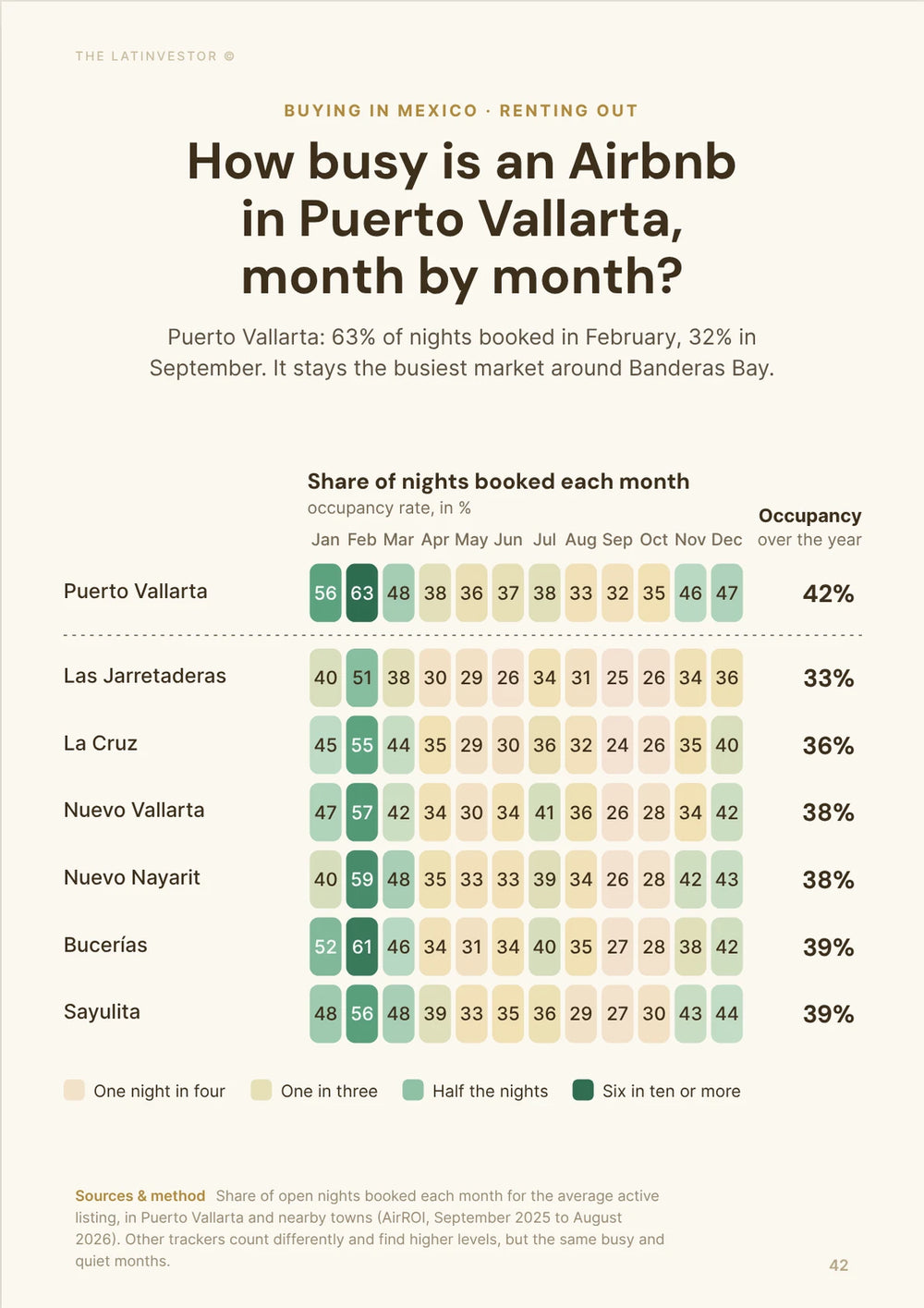
AirDNA also reports active listings down about 54% over a year, with occupancy around 57% and average revenue of about USD 31,300 a year per listing. Treat that drop with caution: these databases change how they count and clean listings. The safe reading is that Airbnb supply in Puerto Vallarta is no longer growing fast.
Once a neighborhood has been repriced for vacation demand and second homes, though, gentrification continues even if the number of Airbnbs stops rising. Prices don't come back down because a few hosts leave.
Will Jalisco's 180-night Airbnb cap slow gentrification in Puerto Vallarta?
Maybe at the margin, and not yet. On May 25, 2026, a Jalisco Congress committee approved a cap of 180 nights a year on short-term rentals of homes that aren't the owner's main residence in "high tourism pressure" zones, mainly Guadalajara and Puerto Vallarta. As of October 2026, the full Congress hasn't voted.
The same package would stop new or remodeled homes from being rented short-term in their first five years, which goes straight at the condo-for-Airbnb model that drives Versalles and Zona Romántica. Separately, a May 2026 proposal would add a 5% to 11% levy on short-term rental income for owners of several properties.
For locals, a cap wouldn't make central housing cheap: land stays expensive and an MXN 8 million condo doesn't become affordable because it can't be rented nightly. It could push some units back to monthly or yearly leases, which is the part that would help renters.
For buyers, the risk is concrete. At 57% occupancy, the average listing books about 208 nights a year, so a 180-night cap would cut roughly an eighth of its nights, and a lot more for the best performers. Run your numbers on 180 nights plus monthly stays, avoid new-build or presale units that only work as full-time Airbnbs, and check the condo's bylaws and the final text before you sign.
Is Versalles becoming the next Zona Romántica?
It's gentrifying now, but rents are moving much faster than sale prices, so it's not an exact repeat.
Versalles has become one of Puerto Vallarta's best-known restaurant areas, with new condo buildings between older homes. It's central, fairly flat and close to services without being in the beach-tourism core.
Buyers came fast. MLSVallarta reports that the wider Francisco Villa area, which includes Versalles, went from about 2% of the region's sales in 2015 to more than 10% in 2025.
Rents moved fastest. Propiedades.com puts the average Versalles apartment at about MXN 19,675 a month in October 2026, up 24.4% since April 2025, while the citywide figure was flat. The rental sample is small (10 listings), but the direction matches what residents describe.
Sale prices are softer. The average apartment asks about MXN 4.01 million (about USD 215,000), down 2.5% over the same period while Puerto Vallarta rose 7.3%, with about 55 apartments for sale.
That mix means strong demand from tenants, and enough new condos for buyers to negotiate. Versalles is still about half the price of Emiliano Zapata.
| Measure | Versalles | Puerto Vallarta comparison | Reading |
|---|---|---|---|
| Average apartment asking price (Oct. 2026) | ~MXN 4.01M | — | Still cheaper than the tourist core |
| Sale-price change since Apr. 2025 | -2.5% | +7.3% | Buyers have some leverage |
| Apartments listed for sale | ~55 | — | Plenty of new and resale supply |
| Average apartment rent (Oct. 2026) | ~MXN 19,675 | — | Already too expensive for many local households |
| Rent change since Apr. 2025 | +24.4% | 0.0% | Rental demand moved much faster |
| Regional sales share including Versalles | More than 10% in 2025 | ~2% in 2015 | Buyers moved into the area |
Are all the new Puerto Vallarta condos helping the housing shortage?
Only a little. Puerto Vallarta builds a lot, but most new central units are priced for a completely different market from the families looking for a long-term rental.
A new MXN 6 million apartment adds one home to the city's stock. For a household looking for something around MXN 10,000 a month, it might as well be in another city.
The pipeline is large. In Vallarta Seaside's Bay Report on MLS data to September 2026, presales make up 46% of active listings around the bay but only 26% of sales, and about 1,534 more units are due by 2028, 607 of them in 2027. Most of them target foreign or wealthy Mexican buyers.
Developers have good reasons to keep doing that. The AMPI–APAR study estimates that real estate is about 22% of Puerto Vallarta's economy and that vacation real estate across the corridor generates more than MXN 33 billion a year. Wealthier buyers pay for margins that modest local housing can't match.
More building still helps indirectly: buyers get choice, and pressure on older homes eases a bit. Versalles, where sale prices slipped while rents rose, shows that supply gives buyers bargaining power.
But very little of what's being built sits in the price range where Puerto Vallarta's housing problem is.
Is Puerto Vallarta gentrification still accelerating today?
It's still moving forward, but more slowly and unevenly than a few years ago.
Emiliano Zapata is one side of it: apartment asking prices up 8.1% and asking rents up 22.3% between April 2025 and October 2026, both ahead of the city.
Versalles is the other: rents up 24.4%, sale prices down 2.5%. Centro's asking prices fell 4.9%, and AirDNA shows fewer active short-term rentals than a year earlier.
The map of buyers has changed too. Central South and the South Shore went from 55% of the region's sales in 2015 to 26% in 2025, as buyers spread to Versalles, Marina Vallarta, Bucerías, Mezcales, Jarretaderas and the rest of the bay.
So the pressure spreads geographically while each neighborhood behaves differently. Zona Romántica has been repriced, Versalles is filling with tenants and investors, and buyers looking for cheaper homes keep moving outward.
Prices are softening around the bay: does that stop gentrification, and should you buy now?
No, it doesn't reverse it, but it gives buyers leverage. In the year to September 2026, the Bay Report counts 1,338 sales across Puerto Vallarta and Bahía de Banderas, down 7.5%, and 69% of homes sold below asking, with a median discount of about 8%.
Supply is heavy: about 23 months of resale stock, 31 months counting presales, when six months is usually seen as balanced. Coldwell Banker La Costa's September data split the market: condo listings in Puerto Vallarta fell 17.5% over a year, to about 2,672, while house listings rose 26.5%, to about 750.
For residents, this changes little. Central asking prices and rents are still well above local incomes, and a discount on a USD 400,000 condo doesn't help a household that can borrow MXN 1 million.
For buyers, it's a real opening. Aim for 8% or more below asking on resale, use the time on market (a median of 262 days for condos, per Coldwell Banker) to ask for repairs or fees, prefer finished buildings over presales, and in Versalles or Centro, where asking prices are already falling, don't pay last year's price.
Is tourism making Puerto Vallarta richer while housing gets harder to afford?
Yes. Tourism and real estate bring a lot of income and jobs, and they push up the value of the land and homes residents need.
The AMPI–APAR study estimates that real estate is about 22% of Puerto Vallarta's economy, with more than MXN 14 billion of activity a year. Across the wider corridor, vacation real estate alone generates about MXN 33.22 billion a year through construction, sales, maintenance and rentals.
The jobs are real too. The study counts more than 54,600 jobs in real estate and vacation rentals across the region, about 16% of the working population, including around 25,000 direct construction jobs and about 15,000 in cleaning, maintenance, management and guest services.
Thousands of local households earn their living from the same economy that pushes housing costs up.
The gains depend on whether you own. Someone who bought a house twenty years ago has seen its land value jump. Someone renting that house feels the same rise as a higher monthly bill.
Restaurants get richer customers while their staff struggle to live nearby. Developers earn more from expensive buildings, while the workers who build them often can't afford to live in them.
So Puerto Vallarta is getting both more prosperous and harder to afford, and both trends are happening now.
| Change | Main beneficiaries | Main pressure | Current result |
|---|---|---|---|
| Higher property values | Existing owners, developers | New buyers | Wealth rises for people who already own |
| Vacation rentals | Hosts, managers, service workers | Long-term renters | Homes get a better-paying use |
| Condo construction | Developers, construction sector | Affordable land | More homes, mostly at high prices |
| Restaurant growth | Owners, visitors, workers | Commercial rents and nearby housing | Neighborhoods become more desirable |
| Foreign investment | Sellers, real-estate industry | Buyers earning pesos | Dollar budgets enter local housing |
| Tourism growth | Much of the local service economy | Land values, traffic, rents | Growth and affordability pressure together |
Can Puerto Vallarta do anything about gentrification without wrecking its economy?
Yes, but it has to build and protect ordinary housing, not just blame outsiders.
Limiting short-term rentals can free up some apartments, mostly in neighborhoods where vacation rentals hold a big share of homes. That's what Jalisco's proposed 180-night cap aims at, if the full Congress passes it.
It still leaves Puerto Vallarta with expensive land. An MXN 8 million condo doesn't become affordable to a hotel worker because its owner can't rent it nightly.
The bigger question is what gets built and where. More ordinary long-term housing in well-connected areas would let workers live closer to their jobs. Density helps when part of it reaches the long-term market. Better transport matters too, because the city already depends on workers commuting from further and further away.
The city knows housing is a problem. The municipal Mi Hogar Renace program targets households in poor housing, and the latest University of Guadalajara research says the metro area still lacks policies that can deal with exclusion and displacement at the scale now seen.
The hard part is economic. Real estate and tourism are Puerto Vallarta's business model, and rules strict enough to kill investment would also hit construction, rentals, restaurants and property services.
A realistic goal is to keep every desirable neighborhood from slowly becoming off-limits to people earning local wages.
So, is Puerto Vallarta getting gentrified?
Yes, and the evidence is now strong enough to stop calling it a theory.
Zona Romántica and Emiliano Zapata are far along. Versalles is moving fast. 5 de Diciembre, Centro and nearby areas face the same pressure, while cheaper housing and buyers keep shifting toward the outer parts of Puerto Vallarta and Bahía de Banderas.
The numbers line up. Average condo sales rose almost 60% between 2015 and 2025, and about 80% since 2017, with some central areas rising much more. Foreigners make an estimated 62% of vacation-home purchases in the corridor. Apartments rent for about MXN 17,775 a month in Emiliano Zapata and MXN 19,675 in Versalles, against about MXN 9,500 in Ixtapa.
And residents confirm it. In the 2026 University of Guadalajara study of 440 people, 73.0% of Puerto Vallarta respondents linked gentrification to higher costs or displacement, and 47% had trouble finding housing because foreigners pay more or pay in dollars.
It doesn't apply to every neighborhood. Puerto Vallarta is still a growing Mexican city with large areas where locals live, work and buy, mostly away from the tourist core.
But central housing is now priced on what tourists, investors, second-home buyers and richer residents can pay, and the weaker peso has just stretched dollar budgets further. The current slowdown, with 69% of sales below asking, helps buyers negotiate; it doesn't bring prices back within reach of local wages.
As the pressure spreads into Versalles and buyers look further out, Puerto Vallarta's gentrification is becoming a metro-wide issue rather than a Zona Romántica one.
Our methodology
This article estimates whether Puerto Vallarta is being gentrified, how far it has gone and where it is spreading. We split the question into prices, rents, incomes, displacement, foreign demand, short-term rentals, new construction and where buyers and renters are moving around the bay.
Neighborhood prices and rents come from Propiedades.com's data updated on October 1, 2026 (changes measured from April 2025) and TuLugar's October 2026 listings. Long-run prices and the shift in sales between areas come from MLSVallarta's 2015–2025 and 2017–2022 reviews. Market conditions come from Vallarta Seaside's Bay Report on MLS closings to September 2026 and Coldwell Banker La Costa's September 2026 data. Incomes come from INEGI's ENIGH 2024 survey for Jalisco and CONASAMI's 2026 minimum wage; the rent-to-income shares are our own calculation using the Jalisco average, because reliable Puerto Vallarta income data doesn't exist.
Resident experience comes from the University of Guadalajara's 2026 survey of 440 people in Puerto Vallarta and Bahía de Banderas and earlier University of Guadalajara research. Foreign demand and the size of the real-estate economy come from the AMPI–APAR study of the Puerto Vallarta–Riviera Nayarit corridor. Short-term rentals come from AirDNA's Puerto Vallarta data for September 2026. Rules come from the SRE (fideicomiso), the Jalisco Congress and Crónica's reporting on the 180-night cap.
We checked these figures in October 2026. Conversions use about 18.6 pesos per US dollar and 20.9 pesos per euro.
Limits: most prices and rents are asking prices, and homes usually sell below them (69% did around the bay in the year to September 2026). Some neighborhood rent samples are very small. The resident survey is not a random sample. Incomes are state averages, and AirDNA's year-on-year listing change depends on how it counts listings.
Key sources used for this analysis include: Ciencia y Reflexión on housing access and displacement in Puerto Vallarta and Bahía de Banderas, Universidad de Guadalajara on digital nomads and displacement, Universidad de Guadalajara on tourism growth and inequality, MLSVallarta's 2015–2025 market review, MLSVallarta's 2017–2022 trend analysis, Vallarta Seaside's Bay Report, Coldwell Banker La Costa's October 2026 market pulse, TuLugar's Puerto Vallarta market data, AMPI–APAR on foreign buyers and the regional real-estate economy, AirDNA on Puerto Vallarta short-term rentals, INEGI's ENIGH 2024 results for Jalisco, CONASAMI on the 2026 minimum wage, Crónica Jalisco on the 180-night committee vote, the Jalisco Congress on the May 2026 rental-tax proposal, SRE on fideicomisos in the restricted zone, Puerto Vallarta's Mi Hogar Renace program, Propiedades.com on Emiliano Zapata sale prices, Propiedades.com on Emiliano Zapata rents, Propiedades.com on Versalles sale prices, Propiedades.com on Versalles rents, Propiedades.com on 5 de Diciembre sale prices, Propiedades.com on 5 de Diciembre rents, Propiedades.com on Marina Vallarta sale prices, Propiedades.com on Marina Vallarta rents and Propiedades.com on Puerto Vallarta Centro prices.