Summary
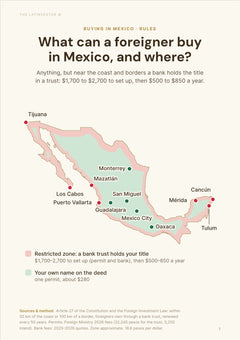
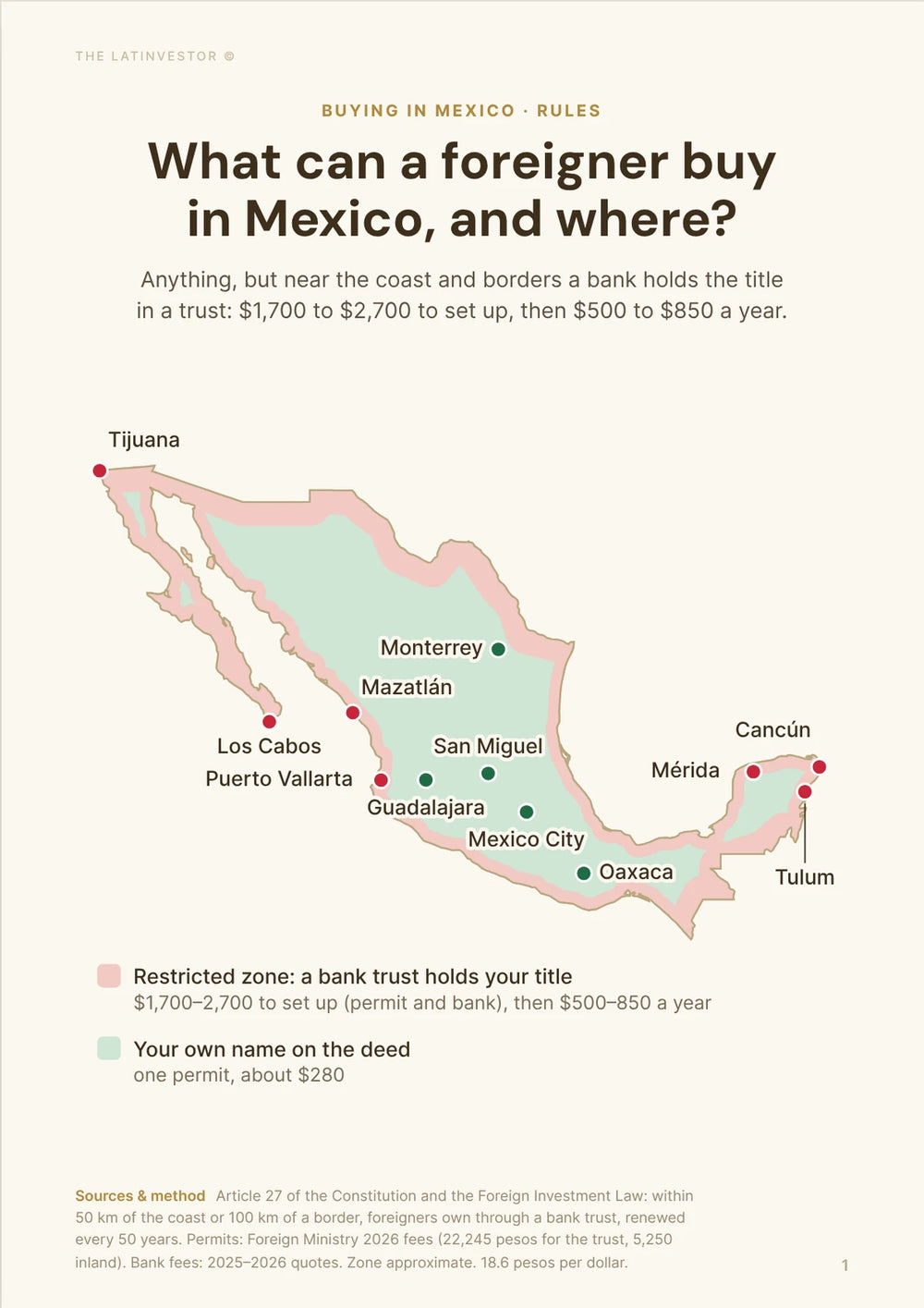
Yes, but only away from the coast and the borders. Inland, a foreigner holds the deed in their own name after signing an SRE agreement that costs MXN 5,250 (about USD 282) in 2026. Within 50 km of the coast or 100 km of a border, a Mexican bank holds the title for you through a fideicomiso.
That band covers most of the places foreigners actually buy. Cancún, Tulum, Puerto Vallarta and Los Cabos are inside it. Mexico City, Guadalajara and San Miguel de Allende are outside it.
A fideicomiso gets you close to ownership, not all the way. You can live in the home, rent it out, sell it and pass it on, but the name on the title is the bank's.
The 50-year term is renewable. An on-time extension costs MXN 9,740 plus a MXN 595 review fee in 2026; filing late pushes the permit to MXN 10,615.
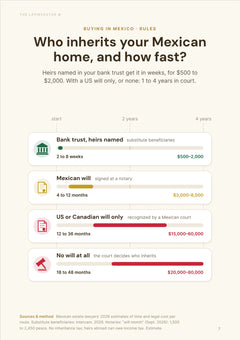
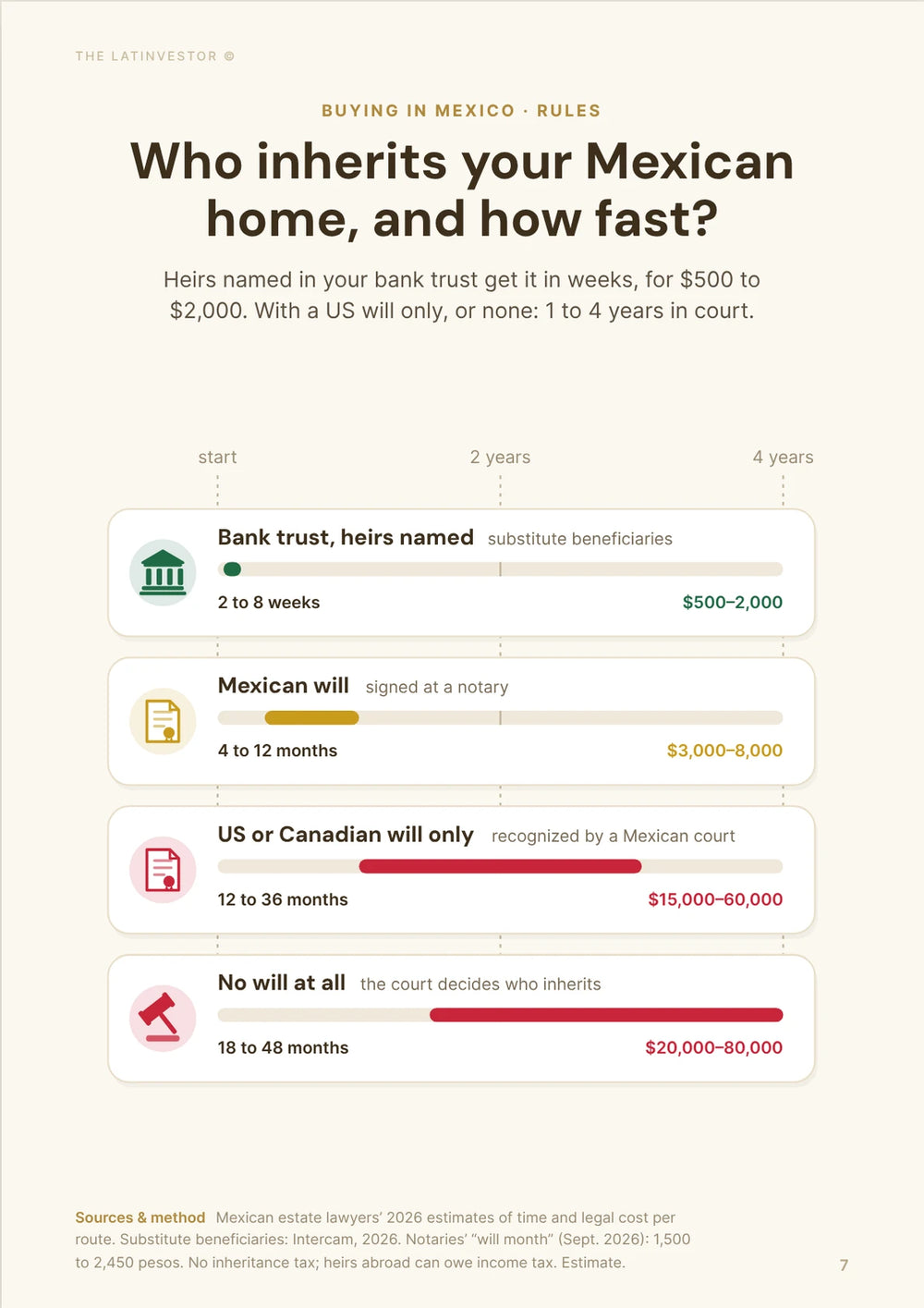
Your children can inherit. A trust lets you name substitute beneficiaries, and Mexico has no federal income tax on inheritances, though notary and registration costs still apply.
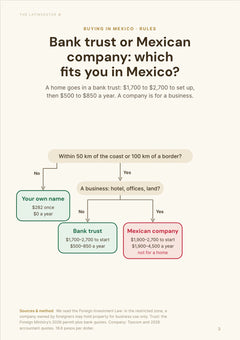
A Mexican company is not a shortcut for a holiday home. It can own restricted-zone property directly only for genuine non-residential use, and forming one costs roughly MXN 35,000 to 50,000 before any yearly accounting.
Ejido land is a different problem. Until a parcel has gone through dominio pleno and been registered as private property, nobody can sell you clean title to it.
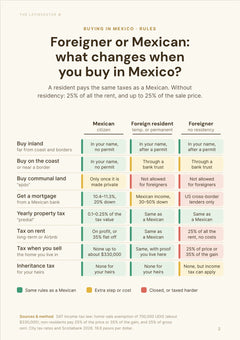
The gap with Mexican buyers is real on the coast: a Mexican can hold title to the same condo that a foreigner can only hold through a bank.
Don't count on that changing soon. The 2013 reform to allow direct coastal ownership is still stuck in the Senate, and the Foreign Investment Law reform the Senate passed on 30 September 2026 is about national-security screening of companies, not homes.
You don't need residency or citizenship to buy, but the SRE form asks for your immigration status and document number.
This is routine, not a loophole. In 2024 the SRE approved 7,192 direct foreign purchases outside the zone and authorized 6,817 new trusts inside it, 77% more trusts than in 2020.
The bank layer has a running cost. On top of the MXN 21,650 SRE permit, 2026 broker comparisons put bank fees at about USD 550 to 800 to open the trust and USD 550 to 700 a year to run it.
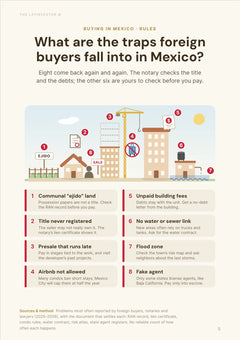
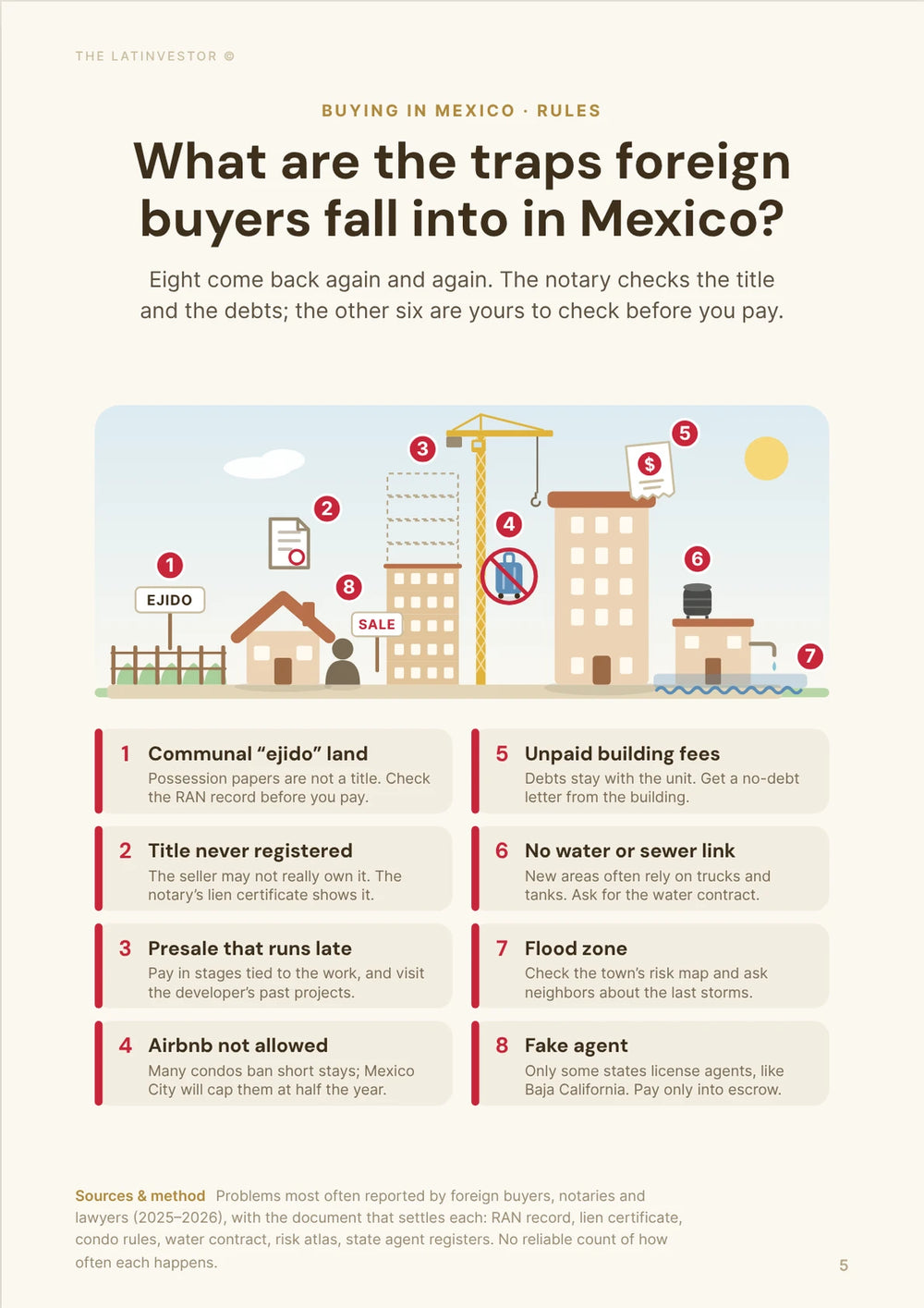
The bigger risk is the property itself. Quintana Roo's urban development agency had flagged 123 irregular developments by August 2026, and no trust fixes a bad title or a project with no permits.
Bottom line: check the land status first, then where the property sits on the map, then exactly whose name will be on the title after closing.

Which properties can a foreigner hold in their own name?
Anything outside the restricted zone, as long as it is ordinary private property. Inside the zone, a foreigner buying a home can only hold it through a bank trust.
Outside the coastal and border bands, a foreign buyer signs the Article 27 agreement with the Secretaría de Relaciones Exteriores (SRE) and takes title directly. Inside them, a foreign individual buying a home uses a fideicomiso: a Mexican bank holds the title as trustee and the buyer is the beneficiary.
That split explains most of the confusion online. A buyer in Mexico City gets the deed in their own name. A buyer in Cancún, Tulum, Puerto Vallarta or Los Cabos usually doesn't, even though both can live in, rent out and sell their homes.
Ejido land is a third case, because agrarian rights are not ordinary private title.
| Property situation | Can a foreigner buy? | Who holds legal title? | Usual structure | Direct personal ownership? |
|---|---|---|---|---|
| Property outside restricted zone | Yes | Foreign buyer | Direct acquisition | Yes |
| Residential property inside restricted zone | Yes | Mexican bank as trustee | Fideicomiso | No |
| Qualifying non-residential property held by Mexican company | Yes | Mexican company | Corporate ownership | Yes, by the company |
| Land still under ejido regime | Not like ordinary private land | Depends on agrarian rights | Agrarian system | No ordinary private title |
Can foreigners directly own property outside Mexico’s restricted zone?
Yes. Outside the restricted zone, a foreigner can hold the deed in their own name.
Article 27 of the Constitution and the Foreign Investment Law allow it once the buyer signs the SRE agreement, often called the Calvo clause. The buyer agrees to be treated as Mexican regarding that property and not to ask their own government for diplomatic help over it. In 2026 the SRE charges MXN 5,250 (about USD 282) for it.
After closing, there is no bank between the buyer and the title and no 50-year term. That is the normal situation in Mexico City, Guadalajara and San Miguel de Allende.
The procedure is very much alive. A simplification agreement published in the federal gazette on 16 June 2026 moved several documents into the SRE's online form, which now asks for your nationality, immigration status, immigration-document number and the exact location of the property.
What exactly is Mexico’s restricted zone?
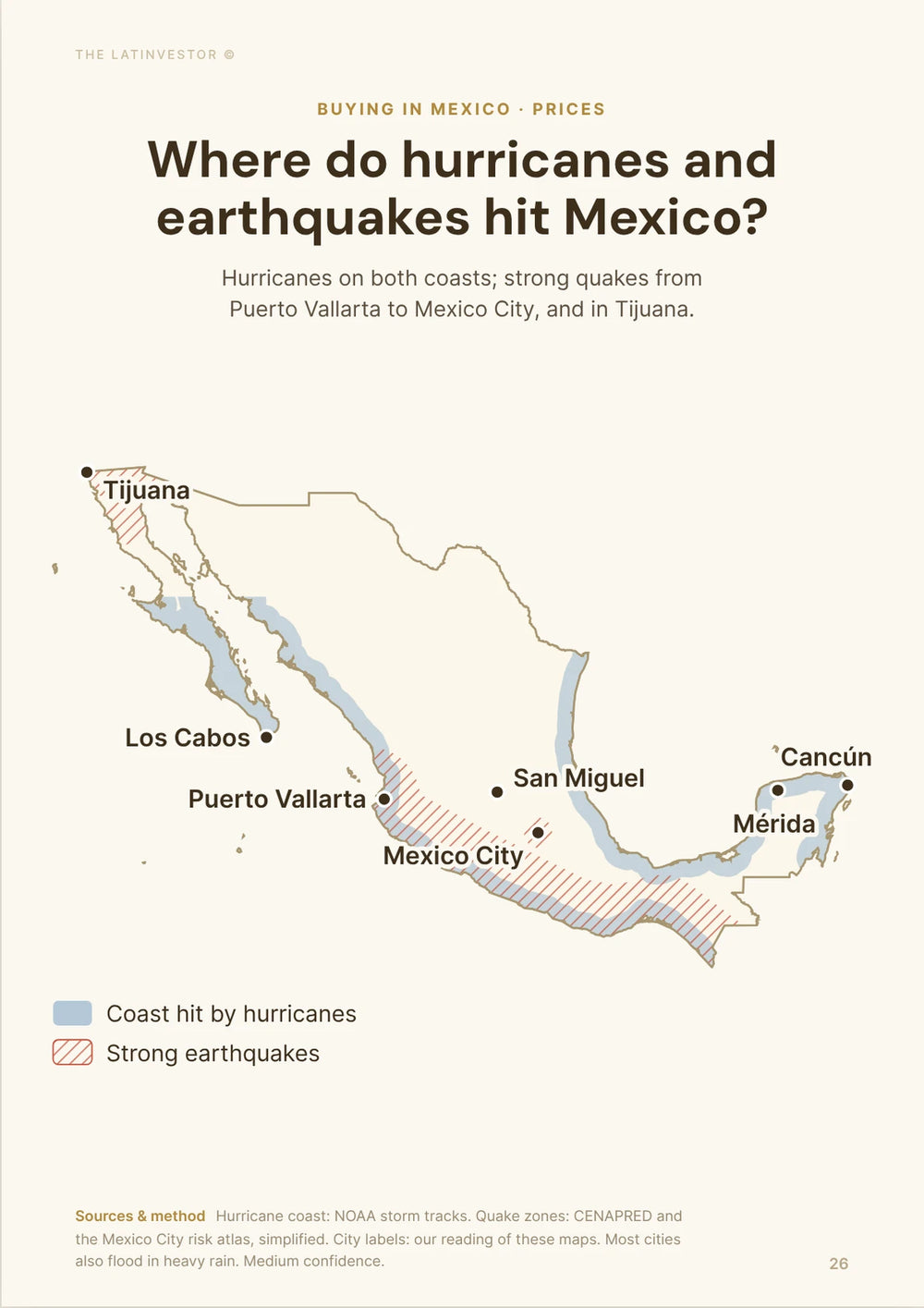
It is all land within 50 km of the coast and within 100 km of an international border. Foreign individuals cannot hold direct title anywhere in it.
The rule comes straight from Article 27 of the Constitution, and it reaches much farther inland than “foreigners can’t own beachfront” suggests. A house 30 km from the sea, with no ocean view at all, can still be inside it.
The property’s coordinates decide, not the listing. When the location is unclear, the SRE can ask INEGI, the national geography agency, to rule on it, and you may have to supply geographic or UTM coordinates.
| Area | Restricted distance | Can foreign individual take direct title? | Normal residential route |
|---|---|---|---|
| Coast | 50 km inland | No | Fideicomiso |
| International border | 100 km inward | No | Fideicomiso |
| Beyond both bands | Outside those limits | Yes | Direct ownership |
| Unclear location | Depends on coordinates | Depends on determination | SRE can consult INEGI |
Does Mexico’s restricted zone cover the places foreigners actually buy?
Yes, which is why the rule feels bigger than it looks on a map.
Cancún, Playa del Carmen, Tulum, Puerto Vallarta and Los Cabos are all in the coastal band. Baja California is largely covered by the coastal rule, the border rule or both. Mexico City, Guadalajara and San Miguel de Allende are outside.
Someone who only browses Tulum and Cabo listings can easily conclude that every foreign purchase needs a bank trust. The government’s numbers say otherwise. In 2024, the SRE received 7,849 applications for foreign purchases outside the zone and approved 7,192 of them. The same year, it authorized 6,817 new restricted-zone trusts.
So the two routes are about the same size. Neither is a niche exception.
| Market | Restricted-zone status | Typical foreign residential structure | Personal direct title? |
|---|---|---|---|
| Mexico City | Outside | Direct acquisition | Yes |
| Guadalajara | Outside | Direct acquisition | Yes |
| San Miguel de Allende | Outside | Direct acquisition | Yes |
| Cancún | Inside coastal zone | Fideicomiso | No |
| Tulum | Inside coastal zone | Fideicomiso | No |
| Puerto Vallarta | Inside coastal zone | Fideicomiso | No |
| Los Cabos | Inside coastal zone | Fideicomiso | No |
Is a fideicomiso basically full ownership?
Economically, close. Legally, no: the foreign buyer does not hold direct title.
Article 11 of the Foreign Investment Law says it plainly. The bank acquires the rights over the property as trustee so the foreign beneficiary can use and benefit from it, without the beneficiary getting direct real rights over the land.
Calling the buyer a tenant is just as wrong. Article 12 gives the beneficiary the right to use and enjoy the property and to keep the income it produces.
“Beneficial ownership through a bank trust” is the honest description. It works for main homes, holiday homes and rentals, but it is not the same as your name on the deed.
What can a foreign buyer actually do with a fideicomiso property?
Live in it, rent it out, sell it and pass it on, under the terms of the trust contract.
The Foreign Investment Law expressly covers use, enjoyment and the income from operating the property. The trust contract then sets how the rights can be transferred and who takes over after you. That contract is what governs your case, so read it rather than relying on “all fideicomisos are the same.”
The bank does not use your condo or collect your rent. What it adds is paperwork and dependence: certain changes go through the trustee, you pay it every year, and you rely on it to keep acting. A direct owner in Mexico City skips that layer entirely.
Day to day, you won’t feel much difference. You will when you sell, change beneficiaries, extend the trust or settle an estate.
| Right or feature | Direct foreign owner outside restricted zone | Foreign fideicomiso beneficiary |
|---|---|---|
| Live in the property | Yes | Yes |
| Receive economic returns | Yes | Yes |
| Personal name holds direct title | Yes | No |
| Mexican bank involved | No | Yes |
| Property structure has fixed trust periods | No | Yes |
| Formal acts pass through fiduciary structure | No | Usually yes |
Do foreigners lose their Mexican property when the 50-year fideicomiso ends?
No. The 50-year limit is renewable, so year 50 is a renewal date, not a loss.
Article 13 of the Foreign Investment Law sets a maximum of 50 years and explicitly allows extensions. In 2026, an on-time extension permit costs MXN 9,740 (about USD 524) plus a MXN 595 (about USD 32) review fee, so MXN 10,335 in total (about USD 556). Filing late raises the permit itself to MXN 10,615 (about USD 571).
It is still a real difference from direct title: a direct owner never has to renew anything. But a fideicomiso is not a “50-year lease.” What matters is that the trust is kept up and extended on time.
What to do: note the trust’s end date when you buy, and put the extension on your calendar a year or two ahead. If you are buying a resale, check how many years are left on the seller’s trust.
Can your children inherit a fideicomiso property, and is there inheritance tax?
Yes, and the simplest way is to name them in the trust itself. A fideicomiso lets you designate substitute beneficiaries who take over your rights when you die.
A May-June 2026 analysis published by the American Bar Association describes beneficiary rights as personal, transferable and part of the beneficiary’s estate, and says heirs can be Mexican or foreign. The trust carries on; it is not dissolved when the beneficiary dies.
Mexico has no federal inheritance tax as such. Article 93 of the income tax law exempts inheritances received by heirs from income tax. That does not mean zero cost: notary fees, registration and the paperwork to change beneficiaries still apply, and your home country may tax the estate.
What to do: name substitute beneficiaries when the trust is drafted, not later, and keep them consistent with your will. If they are missing, your heirs may need a Mexican succession process before the bank will recognize them, which is slower and more expensive than a line in the trust contract.
Can foreigners use a Mexican company to own coastal property directly?
Only for genuinely non-residential property. A company is not a way around the trust for a holiday home.
Article 10 of the Foreign Investment Law lets Mexican companies with foreign partners own restricted-zone real estate directly when it is used for non-residential activities, after notifying the SRE (MXN 1,475, about USD 79, if filed on time). Residential property held by such a company goes back to the fideicomiso route.
A hotel or a commercial building can qualify. A personal condo in Tulum can’t, and renting it on Airbnb doesn’t turn it into a business property. Forming an S.A. de C.V. costs roughly MXN 35,000 to 50,000 (about USD 1,880 to 2,690) in legal and notary fees, before yearly accounting and tax filings.
The corporate route is growing fast but stays smaller. A federal audit of the SRE found that company notices rose from 370 in 2020 to 1,342 in 2024, while new trust permits went from 3,862 to 6,817.
Can foreigners safely buy ejido land in Mexico?
Not as if it were ordinary titled land. Ejido land is communal agrarian land, and until it leaves that regime there is no private title to buy.
The Agrarian Law only allows parcel rights to move under specific rules, mostly among members of the agrarian community. Paying an ejido member for a lot does not give a foreigner the same thing as buying a titled plot.
Ejido land can become private property through dominio pleno. Once the agrarian steps are done and the parcel is registered as private, ordinary property rules apply.
The phrase to run from is “it can be converted later.” A future conversion gives you nothing today. On the coast, the order is: first valid private title, then the fideicomiso.
| Land status | Ordinary private title? | Can foreign buyer treat it like normal titled property? | Main legal regime |
|---|---|---|---|
| Private property | Yes | Yes, subject to foreign-ownership rules | Civil/property law |
| Existing ejido parcel | No ordinary private title | No | Agrarian law |
| Ejido parcel promised for later conversion | Not yet | No | Agrarian law |
| Properly converted dominio pleno property | Yes | Potentially | Ordinary property law |
Do foreigners really have weaker property rights than Mexicans in coastal Mexico?
Yes. A Mexican can hold a coastal home directly, while a foreign individual has to go through a bank trust.
The foreigner has a bank in the middle, a renewable term, yearly trustee fees and more paperwork. The Mexican next door has their name on the deed.
Economically, the gap is small. Both can live there, rent it out, gain from appreciation and sell. In Los Cabos or Cancún, two neighbors can have almost the same financial exposure to identical condos through different legal structures.
A fideicomiso is strong enough for normal ownership. Direct title is still the cleaner position.
Is Mexico about to let foreigners own beachfront homes directly?
No. Nothing passed in 2026 changes the restricted zone, and the only reform that would have done it has been stuck since 2013.
In 2013, the Chamber of Deputies voted 356 to 119 to let foreigners hold direct title to homes in the restricted zone. The amendment never cleared the Senate, and a May-June 2026 American Bar Association analysis still describes it as under discussion there.
The 2026 moves go the other way, or elsewhere. A Senate initiative filed in February 2026 would add more checks on trusts: identifying the ultimate beneficiary, certified property records, proof the property isn’t in litigation and tighter due diligence by trustee banks. It is still in committee. The Foreign Investment Law reform the Senate approved on 30 September 2026 adds a national-security review for foreign investment in sensitive sectors; it doesn’t touch the restricted-zone articles.
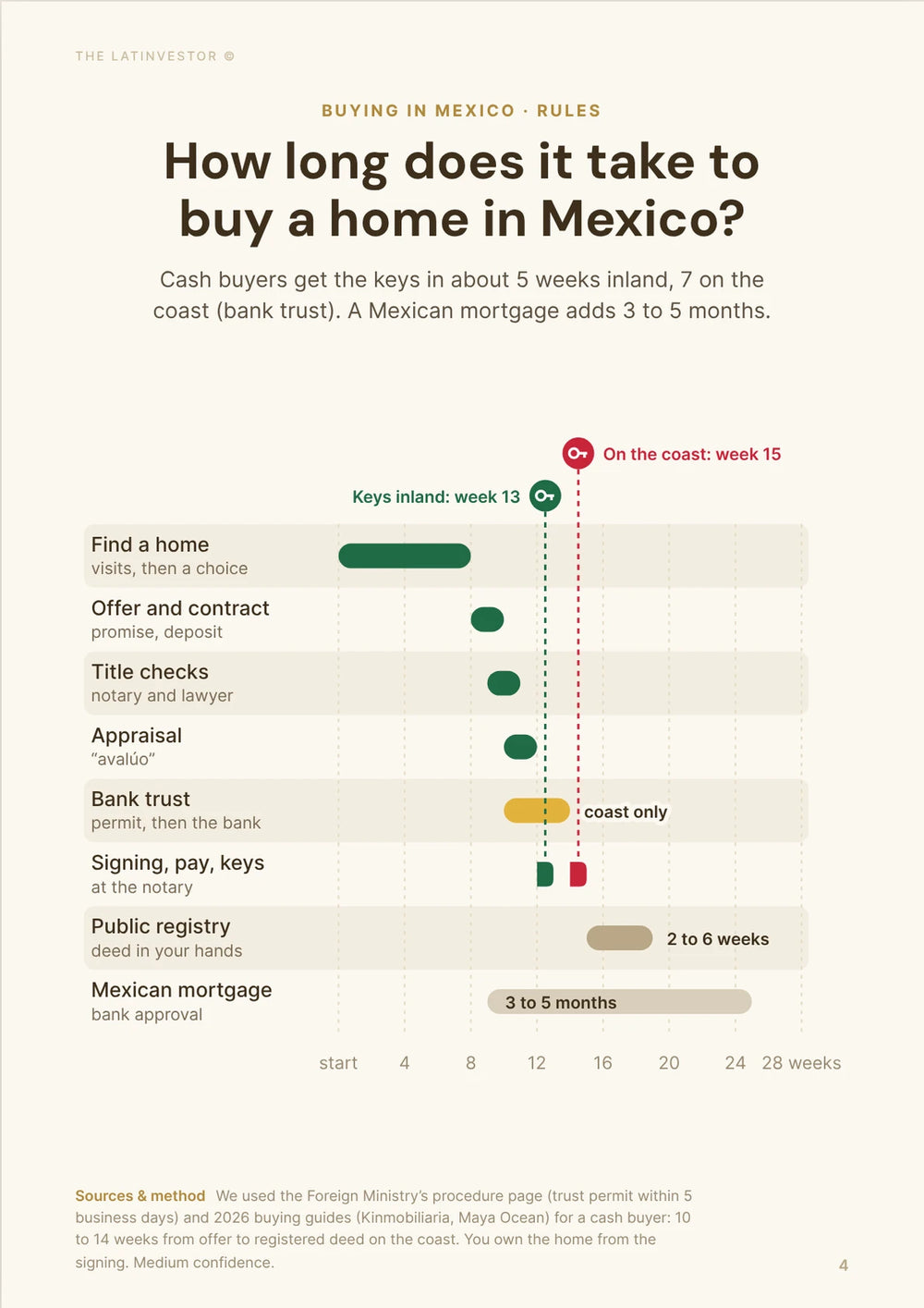
What did change is speed: since the June 2026 SRE agreement, the ministry has 3 business days instead of 5 to issue a trust permit or extension. If an agent tells you the trust is “about to become optional,” treat it as a sales line and budget for it.
Do foreigners need Mexican residency or citizenship to buy property?
No, but the SRE wants to know your immigration status.
The current form for buying outside the restricted zone asks an individual foreign buyer for nationality, immigration status and immigration-document details. You don’t need a resident visa to buy; you need a valid immigration document to show.
The Calvo clause sounds scarier online than it is. It just keeps disputes about the property inside the Mexican legal system.
Only naturalization removes the restriction, because you would then buy as a Mexican. Becoming a citizen just to skip a fideicomiso is an extreme solution for most people. Permanent residency, even after many years, does not change anything.
How common is foreign property ownership in Mexico now?
Common enough to fill thousands of files a year on each route.
The latest audited figures, from the Auditoría Superior de la Federación’s review of the SRE for 2024, are the best view we have because they count government procedures, not agent estimates. Outside the zone, the SRE received 7,849 foreign purchase applications and approved 7,192. Inside it, it authorized 6,817 new trusts.
The trend is steep. Trust permits rose from 3,862 in 2020 to 6,817 in 2024, about 77% more in four years. Company notices for non-residential property rose faster still, from 370 to 1,342.
These are mature channels used every day, not workarounds at the edge of the law.
| SRE activity | 2020 | 2024 | Change |
|---|---|---|---|
| New restricted-zone fideicomiso authorizations | 3,862 | 6,817 | +77% |
| Restricted-zone corporate property notices | 370 | 1,342 | +263% |
| Foreign acquisition applications outside restricted zone | — | 7,849 | — |
| Foreign acquisitions outside restricted zone approved | — | 7,192 | — |
How much extra does a foreigner pay to own property in Mexico in 2026?
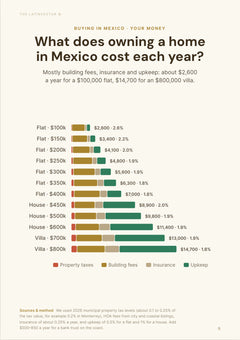
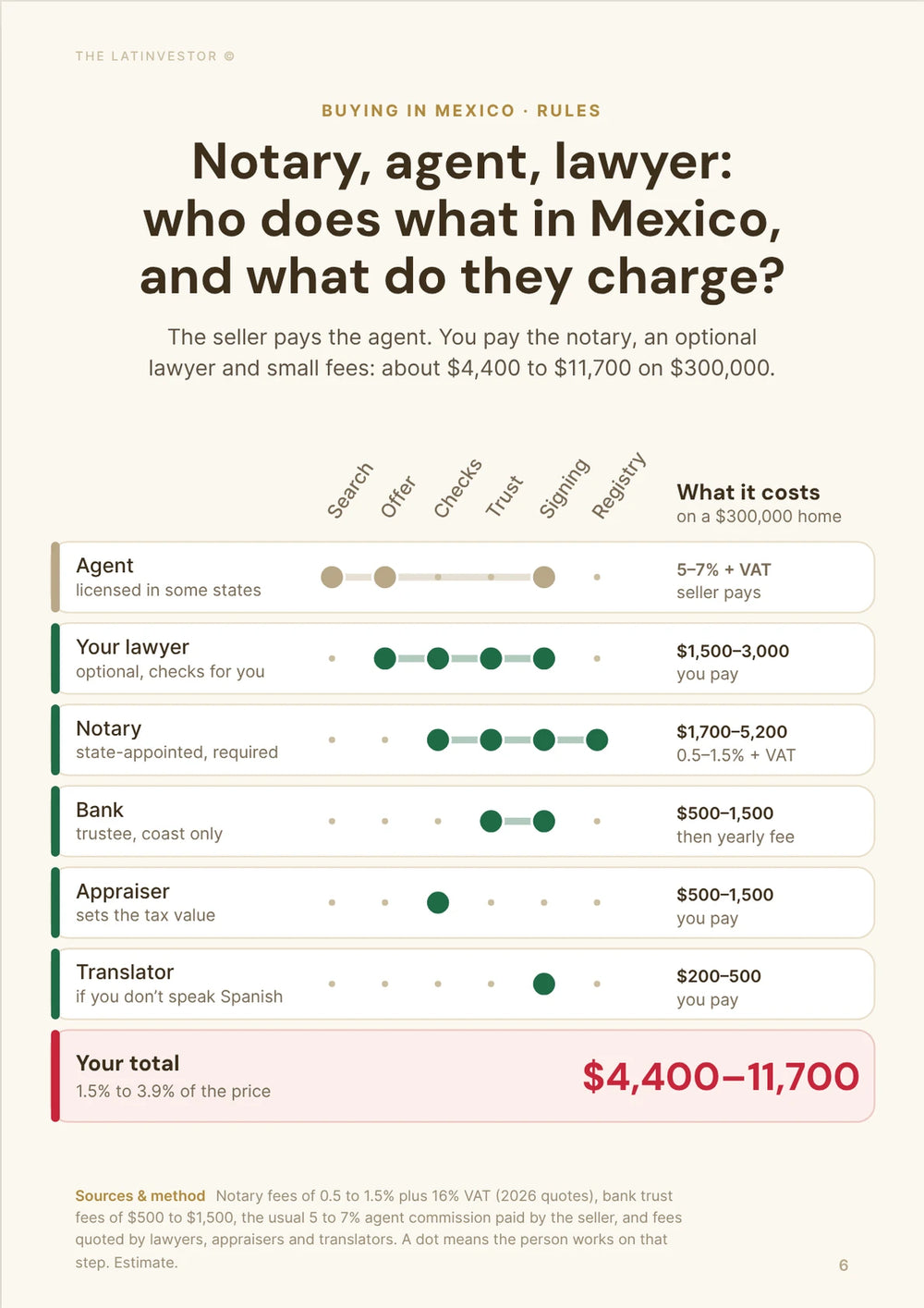
Inland, very little: MXN 5,250 (about USD 282) for the SRE agreement. On the coast, the trust adds roughly USD 1,700 to 2,000 up front and USD 550 to 700 a year.
The SRE fee schedule, updated on 21 September 2026, charges MXN 21,650 (about USD 1,160) for a new trust permit. The bank then charges its own fees. Banks don’t publish comparable official tariffs, but a 2026 broker comparison (Homia) puts the opening fee at about USD 550 (Banorte) to USD 800 (HSBC) and the yearly fee at about USD 550 to 700. Treat those as estimates and ask for a written quote.
The yearly fee is the one that adds up. At USD 600 a year, 20 years of ownership costs USD 12,000 in trustee fees alone, something a Mexican buyer or an inland foreign owner never pays.
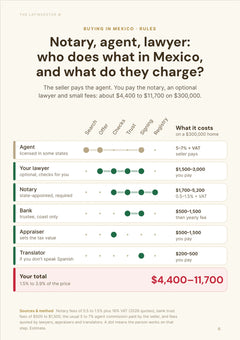
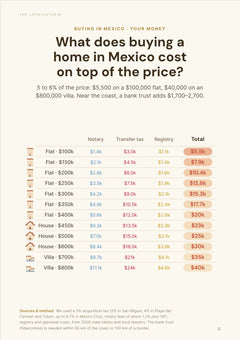
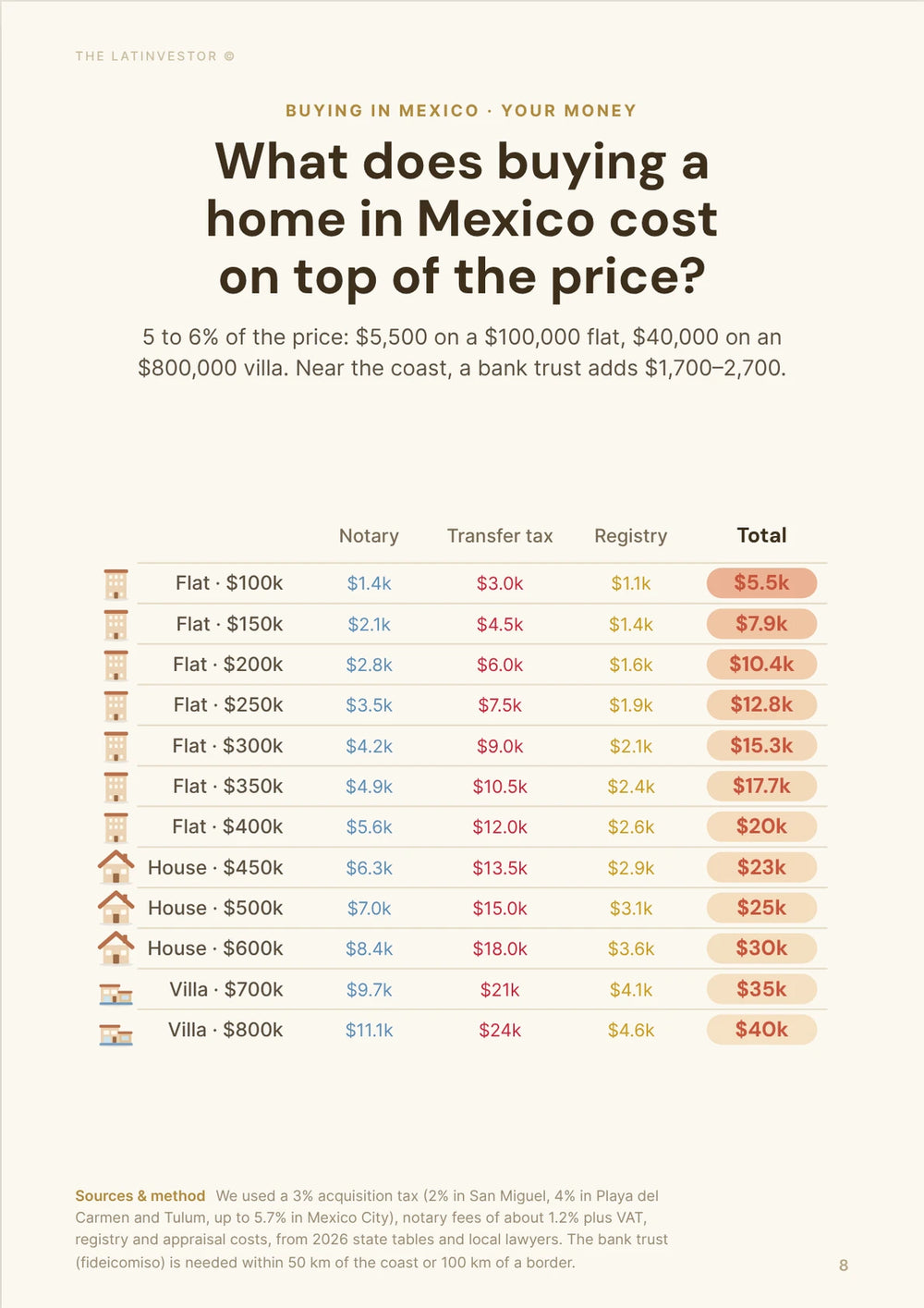
What to do: get quotes from two or three trustee banks before closing (the developer or notary often suggests one), check whether the yearly fee includes VAT and how it rises, and ask what the bank charges to change beneficiaries or release the trust when you sell. Notary fees, acquisition tax and registration come on top for every buyer and vary by state.
| Cost (2026) | MXN | About USD |
|---|---|---|
| SRE agreement for a purchase outside the restricted zone | 5,250 | 282 |
| SRE permit for a new restricted-zone trust | 21,650 | 1,160 |
| SRE review fee for a trust extension or change | 595 | 32 |
| SRE trust extension or change, filed on time | 9,740 | 524 |
| SRE trust extension, filed late | 10,615 | 571 |
| SRE notice for a company buying non-residential property in the zone (on time) | 1,475 | 79 |
| Bank fee to open the trust (estimate) | — | 550 to 800 |
| Bank yearly trustee fee (estimate) | — | 550 to 700 |
What should foreign buyers worry about most right now?
The property, not the trust. A bad title or an unpermitted project will hurt you far more than the restricted-zone rule.
The rule is simple once you know where the property sits. The hard part is when the seller doesn’t have the rights you think they have: ejido land, liens, boundary problems, a broken registration history, missing permits or someone without authority to sell.
The numbers on the coast are not small. Quintana Roo’s urban development agency (Sedetus) had 123 irregular developments on its blacklist by August 2026, mostly in Tulum, Isla Mujeres, Playa del Carmen and Cancún. A fideicomiso doesn’t fix any of that: the bank only takes title to what the seller can legally transfer.
A Mexican notary is required to close, but don’t treat the notary as your lawyer. Before any deposit, ask: what exactly am I buying, who legally owns it today, and whose name or trust will hold it after closing? For a presale, also ask for the land deed, the construction license and the land-use permit, and check the project against Sedetus alerts.
So what does “full ownership” really mean for a foreigner?
Inland, exactly what it means for a Mexican: your name on the deed. On the coast and near the borders, ownership-like rights through a bank, but not the title itself.
Outside the restricted zone, the answer is clean: sign the SRE agreement for MXN 5,250 and you are the owner.
Inside it, a foreign home buyer uses a fideicomiso. You can use the property, earn from it, sell it and leave it to your children, while a Mexican bank holds legal title for terms of up to 50 years that can be renewed. Calling that a tenancy is wrong; calling it identical to a deed goes too far the other way.
It matters because so many of the markets foreigners want, Cancún, Tulum, Puerto Vallarta and Los Cabos among them, sit inside the zone. And with trust permits up from 3,862 in 2020 to 6,817 in 2024, it is clearly not stopping anyone.
The address decides the structure. The title check decides whether the purchase is safe.
Our methodology
This article answers what “ownership” really means for a foreign buyer in Mexico. We split the question into what changes the legal answer: where the property is, whether it is private or ejido land, who holds title after closing, what a fideicomiso actually gives you, how it is renewed and inherited, and what the foreigner route costs.
The rules come from the highest legal sources first: Article 27 of the Constitution, the Foreign Investment Law and its regulations, the credit and trust law, the Agrarian Law and the income tax law for inheritances. We then checked them against the SRE procedures that are actually being processed today, including the June 2026 simplification agreement published in the federal gazette.
Government fees come straight from the SRE fee schedule updated on 21 September 2026. Bank trust fees are not published in a comparable official form, so we use a 2026 broker comparison and show them as estimates. Company setup costs come from a 2026 Mexican adviser estimate. The number of purchases and trusts comes from the federal audit office’s review of SRE activity for 2020 to 2024, the latest audited figures. Legislative status comes from Senate records, the American Bar Association (May-June 2026) and law-firm and press coverage of the September 2026 reform; the Quintana Roo figures come from local press reports of July and August 2026.
We checked these figures in October 2026. Dollar amounts use about 18.6 pesos per US dollar and 20.9 pesos per euro.
Limits: bank fees vary by bank, property and negotiation; the audit counts procedures, not unique buyers; and none of this replaces a review of a specific property by a notary and your own lawyer.
Key sources used for this analysis include the Mexican Constitution, Article 27, the Foreign Investment Law, the Regulations of the Foreign Investment Law, the General Law of Negotiable Instruments and Credit Operations, the Agrarian Law, the Registro Agrario Nacional procedure for dominio pleno titles, SAT on Article 93 of the income tax law, the SRE procedures for purchases outside the restricted zone, new restricted-zone trusts, trust extensions and changes and company acquisitions, the SRE 2026 costs schedule, the June 2026 SRE simplification agreement, the Auditoría Superior de la Federación’s 2024 SRE audit, the American Bar Association on the restricted zone (2026), Tropicasa on the 2013 lower-house vote, the February 2026 Senate initiative on foreign investment, Foley on the 2026 national-security screening reform, Crónica on the Senate vote (October 2026), Homia’s 2026 fideicomiso cost comparison, Tandazo on company setup costs and Por Esto on Quintana Roo’s irregular developments (July 2026), Riviera Maya News on the 123 blacklisted developments (August 2026).