Summary
Yes. Playa del Carmen has more Airbnbs than its tourists can fill at good prices: Airbtics counts 8,917 active listings, up 65.7% in three years, while median occupancy fell to 53%.
Supply grew much faster than income. Over those three years, Airbtics' median revenue per listing rose only 8.4%, to about MXN 276,000 (about $14,800) a year.
Nobody agrees on the exact count. AirDNA, which also tracks Vrbo and Booking.com, finds 6,498 active rentals in September 2026, 60.2% fewer than a year earlier. Part of that drop is how AirDNA counts, part is weaker listings leaving.
Occupancy sits in the mid-50s: 53% for Airbtics, 56% for ListingOK, 58% for AirDNA. That's fine for a beach town, but it means a typical unit sits empty around 13 nights a month.
Hosts are cutting prices to fill. AirDNA's average nightly rate is down 19.2% in a year to $103, the lowest of the big Mexican beach markets.
The low season is where it hurts. ListingOK's occupancy went from 79.8% in February 2026 to 40.1% in May and 40.6% in September.
Tourism is cooling, not collapsing. Playa's hotels were 72.58% full in the first half of 2026 against 77.05% a year earlier, and Cancún airport traffic was down 5.9% from January to September.
Playa is still in better shape than Tulum: 58% occupancy against 46% in AirDNA's data, and Airbtics' three-year revenue is up 8.4% in Playa but down 10.8% in Tulum.
The real glut is identical condos. Maya Ocean tracks about 6,230 unsold new units in 238 developments, and about 2,140 condos were for sale within 500 meters of the sea in May 2026.
The rules are tightening too. Since 2026, platforms should list only rentals registered with the state's RETUR-Q, and fines can top MXN 100,000 (about $5,380). Airbtics finds a licence on fewer than 1% of listings.
The money is thinner than brochures say. On a one-bedroom listed at about $184,000, AirDNA's $18,800 of yearly revenue is about 10% gross, before management, fees, empty weeks and the 25% tax a non-resident owes on gross rent.
Bottom line: Playa still has plenty of tourists, but not for another generic "Airbnb-ready" condo. Buy only a unit that stands out, at a price that still works as a long-term rental, with 12 months of real payouts in hand.

Why are people saying Playa del Carmen has too many Airbnbs?
Because the number of rentals grew far faster than the nights each one can sell.
Airbtics gives the clearest long-term view. In the 12 months to August 2026, it counted 8,917 active listings, up 39.7% in one year and 65.7% in three. Over the same three years, median occupancy fell 14.8% to 53%, and median revenue per listing rose only 8.4%.
That's hard to explain away. If demand had kept pace, adding two-thirds more rentals wouldn't have left the typical property emptier and earning barely more than three years ago, less once inflation is counted.
The building boom happened at the same time. The Red Search counted 5,861 units across 131 Playa del Carmen condo developments in 2023. By September 2024, its dataset had reached 7,561 units across 158 developments. Today Maya Ocean still tracks about 6,230 unsold units across 238 developments.
Not every condo becomes an Airbnb. But most of this new stock is studios, one-bedrooms and two-bedrooms in buildings with pools and gyms, sold to vacation buyers and investors.
Playa still gets a huge number of tourists. The problem is that places to stay grew even faster.
| Playa del Carmen Airbnb metric | Airbtics, 12 months to Aug. 2026 | 1-year change | 3-year change | What changed |
|---|---|---|---|---|
| Active listings | 8,917 | +39.7% | +65.7% | Supply exploded |
| Occupancy (median) | 53% | -10.3% | -14.8% | Each property sells fewer nights |
| Nightly rate | MXN 1,389 | +13.9% | +26.1% | Higher prices hid weaker occupancy |
| Annual revenue (median) | MXN 276,000 | +3.0% | +8.4% | Three years of supply growth, almost no real revenue gain |
How many Airbnbs are actually competing in Playa del Carmen today?
Somewhere between about 6,500 and 9,000, depending on who counts and how.
Airbtics counts 8,917 active Airbnb listings in the 12 months to August 2026. AirDNA, which combines Airbnb, Vrbo and Booking.com and removes duplicates, counts 6,498 active rentals in September 2026.
The trends disagree even more. Airbtics says supply grew 39.7% in a year. AirDNA says it fell 60.2%. Both can't describe the same thing measured the same way.
Be careful with AirDNA's drop. Its counts also fell 51.7% in Cancún, 54.3% in Puerto Vallarta and 73.1% in Tulum over the same year, so part of it is a change in how listings are counted or classed as active, not owners leaving. AirDNA also shows revenue per listing doubling (+100%) in a year, which fits a smaller, better-performing sample more than a real boom.
So don't treat any of these as a census. What's solid is the scale: several thousand rentals compete for short stays, after years of very fast growth.
The newest data also suggest that some weak inventory is dropping out. That matters later, because a crowded market can partly fix itself.
Did Playa del Carmen build Airbnbs faster than tourists could fill them?
Yes. Rentals were added much faster than bookings could absorb them.
The three-year Airbtics figures show it well: active listings up 65.7%, median occupancy down 14.8% and median revenue up only 8.4%, while nightly rates rose 26.1%. Owners raised prices and still earned barely more.
The past year looks similar. ListingOK puts average Playa occupancy at about 56% and says revenue per listing is 9% lower than a year earlier.
Thousands of extra properties could have been absorbed if visitor nights had grown at the same pace. They didn't. Owners ended up splitting the same demand among many more rentals.
There's still enough demand to keep many properties profitable. There just wasn't enough new demand to make the whole expansion painless.
Is mid-50s Airbnb occupancy actually bad for Playa del Carmen?
It's decent for a beach town, but it's nowhere near a shortage of rentals.
Depending on the source, Playa's occupancy is 53% (Airbtics), 56% (ListingOK) or 58% (AirDNA). At 56%, a property is booked about 17 nights in an average month and empty for around 13.
Next to other Mexican markets, Playa holds up. In AirDNA's data, which uses the same method everywhere, it beats Cancún, Puerto Vallarta and Tulum on occupancy. Only Mexico City, with steadier year-round business travel, is higher.
The catch is the price. Playa has the lowest average nightly rate of the big beach markets, at $103 against $129 in Cancún and $178 in Puerto Vallarta. It fills more nights partly because it's cheaper.
For a buyer, the comparison that matters is the one in the sales pitch. A condo sold on 70% or 75% occupancy will look very different once real results settle in the mid-50s and the low months drop to 40%.
Someone who bought cheaply with cash and uses the place part of the year may be happy with 56%. Someone who paid a premium for Airbnb income won't be.
| Market (AirDNA) | Active listings, Sep. 2026 | Occupancy | Average nightly rate | Yearly revenue per listing |
|---|---|---|---|---|
| Mexico City | 25,568 | 64% | $91 | $19,800 |
| Playa del Carmen | 6,498 | 58% | $103 | $18,800 |
| Puerto Vallarta | 5,943 | 57% | $178 | $31,300 |
| Cancún | 6,673 | 54% | $129 | $23,500 |
| Tulum | 3,608 | 46% | $125 | $17,400 |
Are Playa del Carmen Airbnb owners cutting prices now?
Yes. Hosts are competing hard on price, and AirDNA's latest data make it obvious.
AirDNA puts the average nightly rate at $103 over the 12 months to September 2026, down 19.2% from a year earlier. Occupancy is up in its dataset, to 58%, but revenue per available night rose only 3.9%.
In plain terms: more nights are selling, but owners accept much lower prices to fill them.
Airbtics shows the earlier phase of the cycle: its nightly rates were still up 13.9% in a year while occupancy fell. AirDNA's newer reading suggests pricing has turned.
The two companies don't use the same method, so don't splice their percentages together. The sequence is what counts: supply jumped, occupancy got harder, and hosts now cut rates to win bookings. That's what a crowded market looks like.
Does Playa del Carmen still fill Airbnbs during high season?
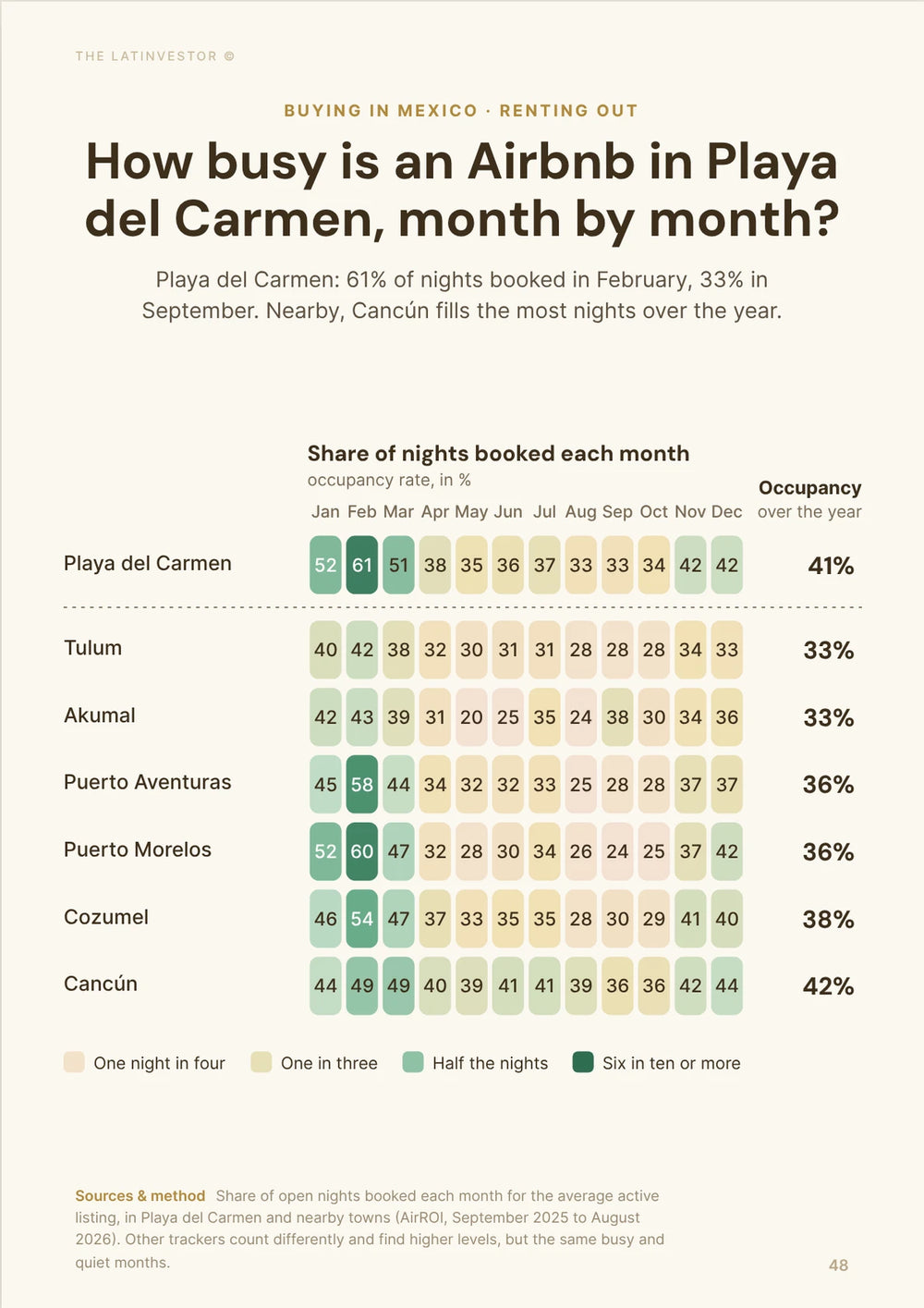
Yes. Winter still works very well, with occupancy close to 80% in the best month.
ListingOK recorded 64.9% occupancy in December 2025, 69.6% in January 2026 and 79.8% in February.
Then it drops fast: 46.2% in April, 40.1% in May, 43.5% in August and 40.6% in September. Airbtics also names February as the strongest month and May as the weakest.
So February fills about twice as many nights as May. That's why the oversupply is easy to miss in winter: at 70% to 80%, it feels like there are guests for everyone. A few months later, thousands of properties chase a much thinner crowd.
The spring and summer were weaker than a year earlier: April fell from 53.3% to 46.2%, July from 56.4% to 52.7%. The real test is yearly revenue after those months, not a good February.
| Month | Playa del Carmen Airbnb occupancy | Same month one year earlier |
|---|---|---|
| October 2025 | 50.8% | 50.8% |
| November 2025 | 60.8% | 61.8% |
| December 2025 | 64.9% | 67.0% |
| January 2026 | 69.6% | 66.9% |
| February 2026 | 79.8% | 76.9% |
| March 2026 | 62.2% | 66.7% |
| April 2026 | 46.2% | 53.3% |
| May 2026 | 40.1% | 39.8% |
| June 2026 | 45.9% | 47.9% |
| July 2026 | 52.7% | 56.4% |
| August 2026 | 43.5% | 44.0% |
| September 2026 | 40.6% | 40.5% |
Is weaker tourism making Playa del Carmen's Airbnb problem worse?
Yes. Tourism has softened enough to make the extra supply hurt more, even though visitor numbers are still large.
Quintana Roo's tourism observatory puts Playa's hotel occupancy at 72.58% in the first half of 2026, down from 77.05% a year earlier. From January to July, it was 71.27% against 75.76%. Full-year occupancy had already slipped from 75.3% in 2024 to 70.8% in 2025.
Cancún airport, where most Playa visitors land, handled about 20.88 million passengers from January to September 2026, against 22.20 million a year earlier (-5.9%). September alone was down 8.6%, and international traffic down 11.8% (ASUR).
The summer was rough for everyone renting rooms. Small hotels in Playa were down to about 18% occupancy in September, according to their association. In June, the vacation-rental managers' association (APAR) said bookings on rental platforms in the Mexican Caribbean stood at 25%, against 31% a year earlier, and that Tulum and Playa were down up to 10% in occupancy so far this year. For Playa alone, APAR measured 22% vacation-rental occupancy in May 2026, against 32% in May 2025.
So guests aren't simply leaving Airbnbs for resorts. Hotels are emptier too. Playa isn't in crisis, but a few points of weaker demand hurt a lot more when thousands of units already fight for bookings.
| Tourism indicator | Year earlier | Latest reading | Change |
|---|---|---|---|
| Playa hotel occupancy, first half of 2026 | 77.05% | 72.58% | -4.47 pts |
| Playa hotel occupancy, January to July 2026 | 75.76% | 71.27% | -4.49 pts |
| Playa hotel occupancy, full year 2025 | 75.3% | 70.8% | -4.5 pts |
| Cancún airport passengers, January to September 2026 | 22.20M | 20.88M | -5.9% |
| Cancún airport passengers, September 2026 | - | 1.61M | -8.6% |
Is Playa del Carmen's Airbnb market worse than Cancún or Tulum?
No. Playa is crowded, but Tulum is the clearer oversupply story in the Riviera Maya.
In AirDNA's data, Playa fills 58% of its nights, against 54% in Cancún and 46% in Tulum. ListingOK gives the same order: 56% in Playa, 54% in Cancún, 44% in Tulum.
The three-year Airbtics figures make the gap clearer. Playa's listings rose 65.7% and its median revenue 8.4%. In Tulum, listings rose 106.5% while median revenue fell 10.8%, and median occupancy is 43%.
That doesn't make Playa undersupplied. It means the city absorbed its condo and Airbnb boom much better than Tulum.
Playa has real advantages: a large local population, a walkable center, a mature restaurant and nightlife scene, the ferry to Cozumel, and a tourism economy that existed long before the latest building wave. It also competes on price, with a lower nightly rate than Cancún or Tulum.
The market is under pressure, but the data don't point to a Tulum-style breakdown.
Is the real problem too many Airbnbs or too many identical Playa del Carmen condos?
Too many identical condos chasing the same guest.
Search around Centro, Gonzalo Guerrero, Zazil-Ha or Colosio and you'll see the same package again and again: one or two bedrooms, a rooftop pool, a small gym, modern furniture and a short walk to Quinta Avenida or the beach.
Those apartments replace one another very easily. Airbtics even finds studios with the highest occupancy of any property type (59%), which tells you guests pick the cheapest of similar options.
The for-sale pipeline adds to it. Maya Ocean tracks about 6,230 available new units across 238 Playa developments. Its separate count of condos within 500 meters of the sea found about 2,140 for sale in May 2026, in that narrow coastal strip alone.
Not all of them will become Airbnbs. But it shows how deep the condo market still is after years of construction.
So a central address helps, but dozens of other units share it. A rooftop pool sounds great until every new building has one. The units that escape the crowd have something hard to copy: real beachfront, a great view, more space, a big terrace, a family-friendly layout, standout design or a well-run resort setting.
Generic "Airbnb-ready" condos are the part of the market we'd worry about most.
Could all the new condos make Playa del Carmen Airbnb oversupply worse again?
Yes. Playa still has enough condos under way and for sale to start another wave of competition if investors come back.
The Red Search's data showed how fast the development base grew: from 131 projects and 5,861 units in 2023 to 158 projects and 7,561 units by September 2024.
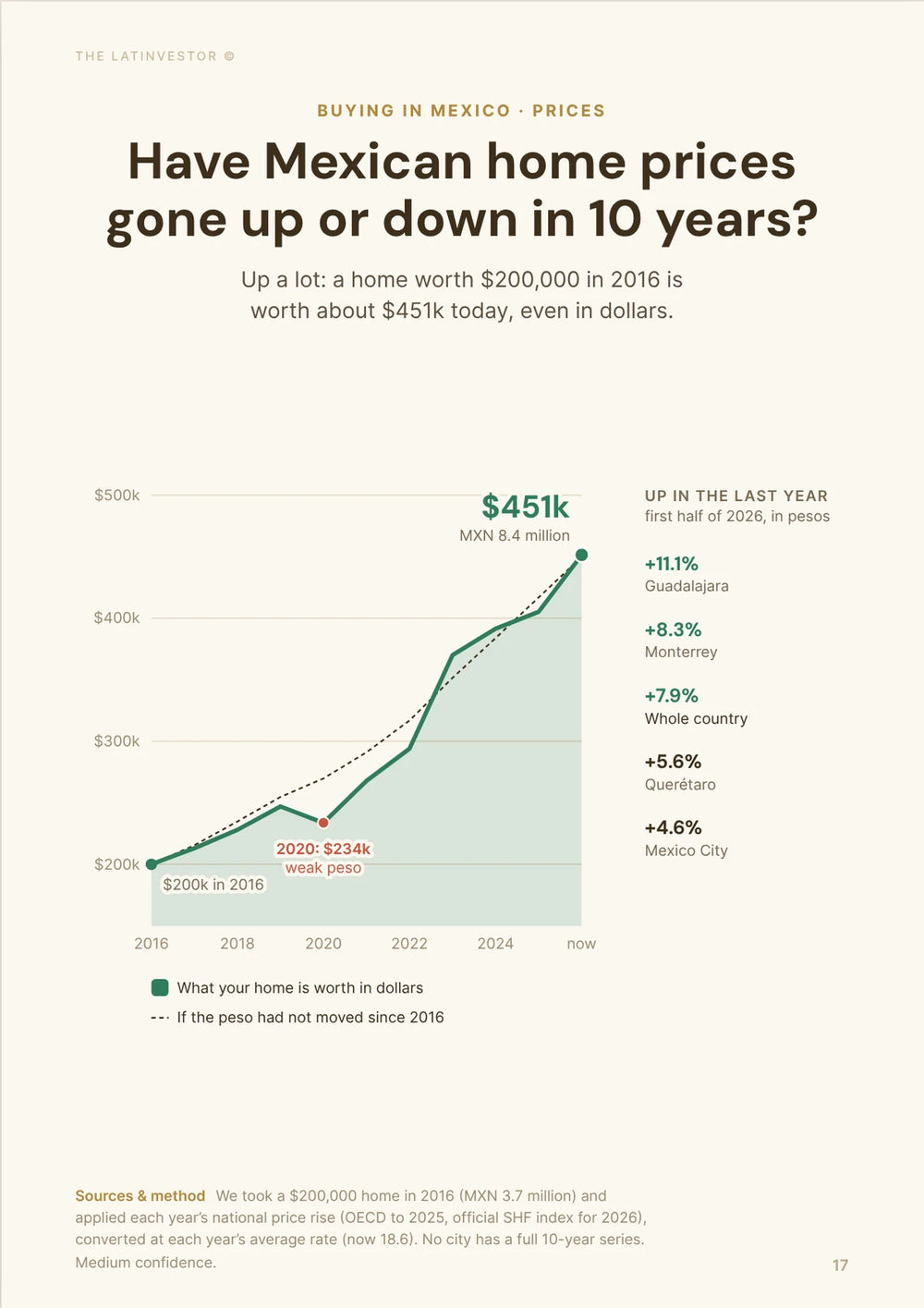
Today's inventory is still deep. Maya Ocean follows about 6,230 available units across 238 developments, and TuLugar's median one-bedroom is listed at about $184,000 in October 2026.
Many of these will become homes, second homes or long-term rentals. But Playa has spent years building small furnished condos that can switch between personal use, long-term rent and Airbnb in a few weeks.
That makes supply very elastic. Hosts leave the platforms when returns fall, and new owners come back when they rise. A drop in active listings isn't a lasting shortage.
Is Playa del Carmen's Airbnb market starting to fix itself?
Partly. Weak listings seem to be leaving, but we trust the direction more than AirDNA's 60% drop.
AirDNA counts 6,498 active rentals in September 2026, with occupancy up to 58% and nightly rates down 19.2%. That's what a crowded market looks like when it starts to clear: fewer active units, cheaper nights, fuller calendars.
The ways out are well known. Owners switch to long-term leases, sell, or stop renting. Managers drop weak units. Others cut prices until their calendars fill. The new state registration is pushing informal hosts out too (see below).
It's too early to call the correction done. Playa still has a large stock of condos that can come back to short-term rental, and tourism has softened.
Still, fewer active listings is healthier than another year of nonstop growth.
Do Playa del Carmen Airbnbs now need a state registration?
Yes. Every short-term rental in Quintana Roo now needs a state and municipal licence and a RETUR-Q registration, and platforms are supposed to list only registered properties from 2026.
The state's tourism secretary said in November 2025 that, from 2026, platforms "will be able to offer a property only if it has the State Registry". At the time, a little over 3,000 tourism providers were registered, while the state estimated about 40,000 properties used for vacation rentals. Fines for unregistered hosts can go above MXN 100,000 (about $5,380). Registration also comes with safety rules: smoke and carbon-monoxide alarms, a fire extinguisher and a first-aid kit.
Enforcement is still catching up. Airbtics finds a short-term-rental licence on fewer than 1% of Playa listings. That gap is one reason listings may keep dropping out, and it's a risk for anyone buying a unit that has never been registered.
What to do: before buying, ask the seller for the RETUR-Q number, the municipal licence and proof that the 6% lodging tax has been collected. Check the condo rules allow short stays. If nothing is registered, price in the time and cost of doing it yourself, or walk away.
Can an Airbnb still make money in Playa del Carmen today?
Yes, a good one can. But buying an average condo and expecting average bookings to give a great return is now a weak bet.
AirDNA puts average revenue per active listing at about $18,800 a year. ListingOK estimates about $1,224 a month. Airbtics' median is MXN 276,000 (about $14,800) a year.
The methods differ, so we don't force them into one "typical income". They point to the same thing: a real rental market, but with typical gross revenue in the mid-teens of thousands of dollars, not a windfall.
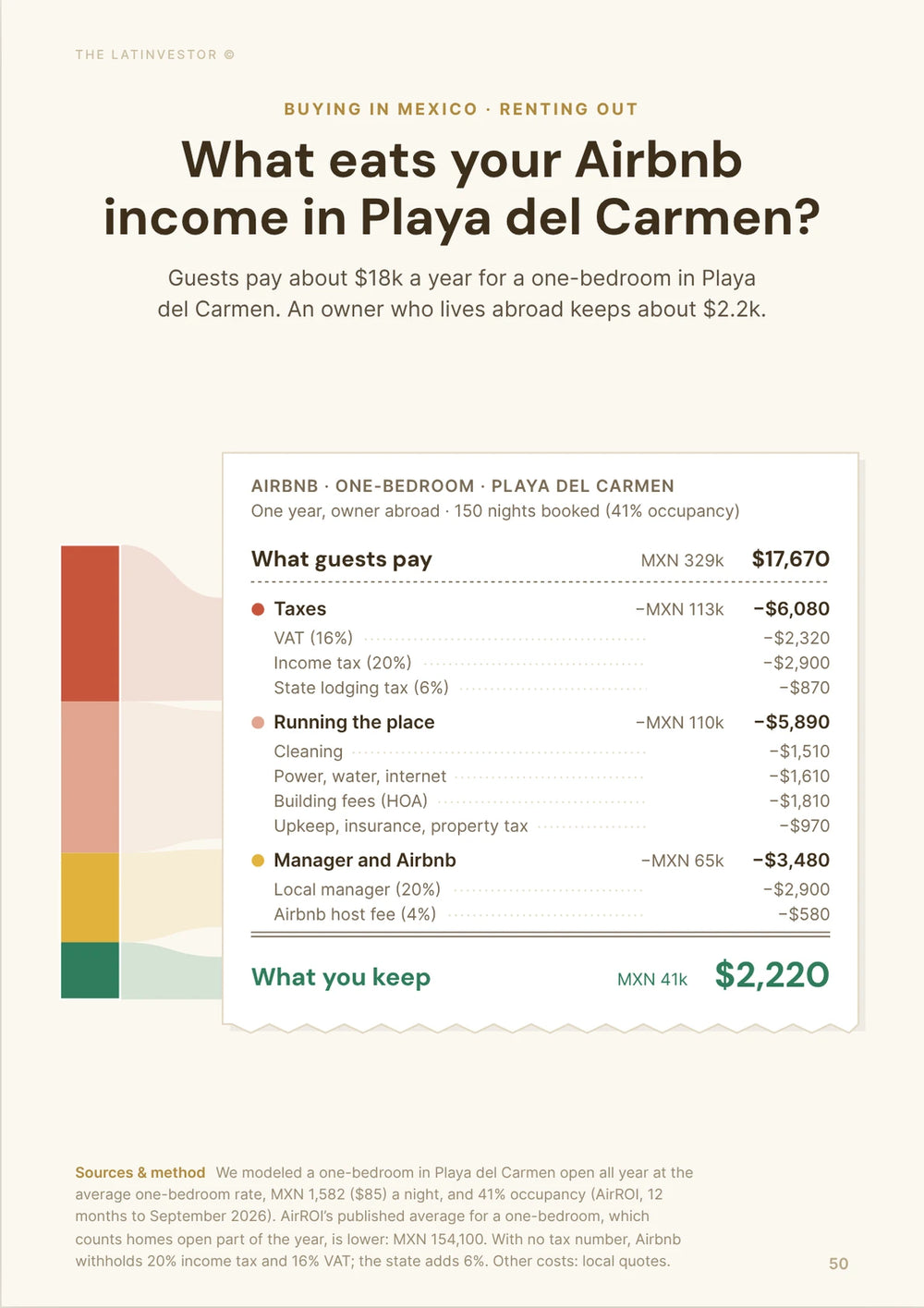
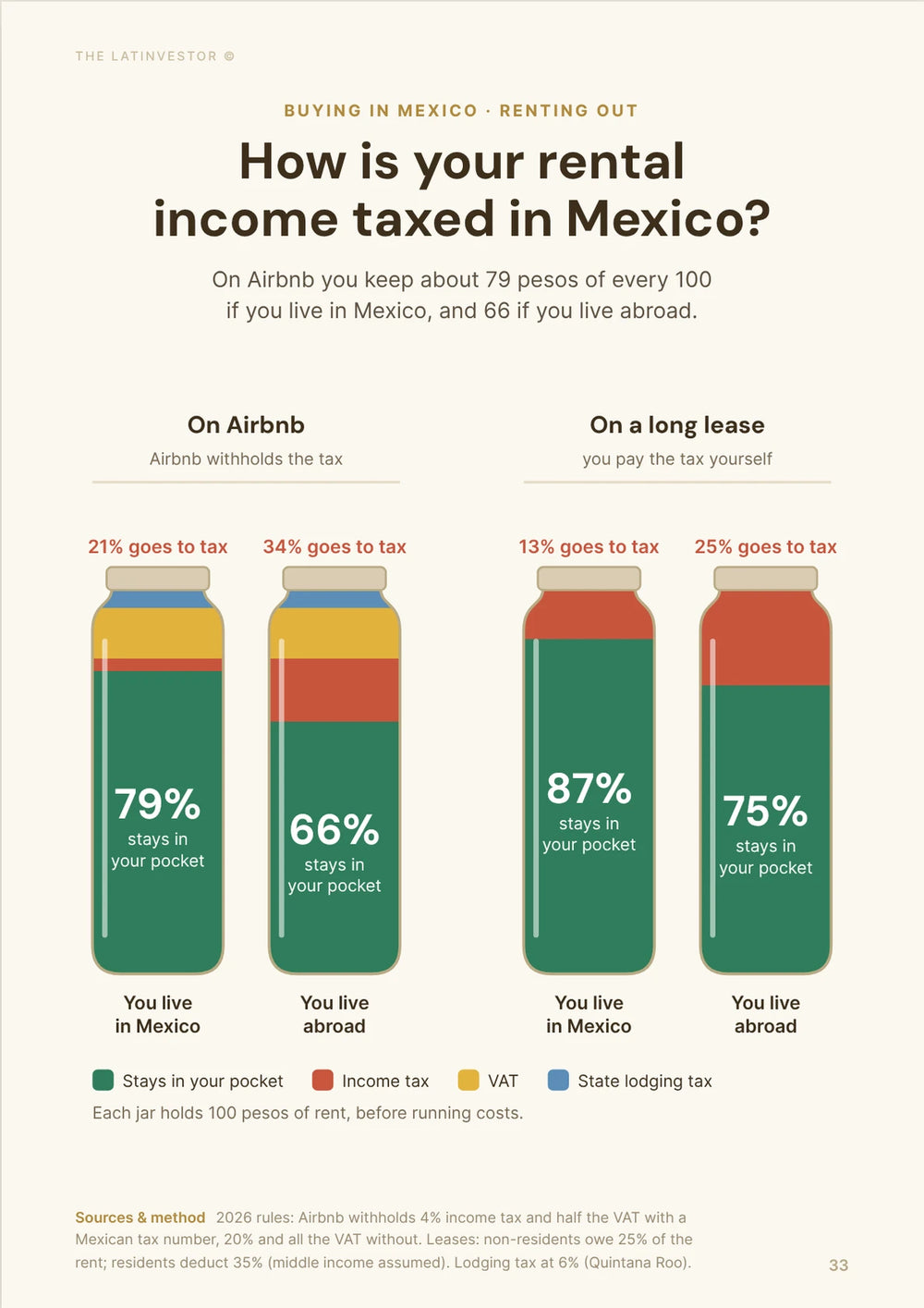
And that's gross. An owner still pays management, HOA fees, electricity, internet, maintenance, furniture, repairs, insurance and the cost of empty nights. Quintana Roo charges a 6% lodging tax on stays booked through platforms, and a non-resident owner owes 25% of gross rent in income tax.
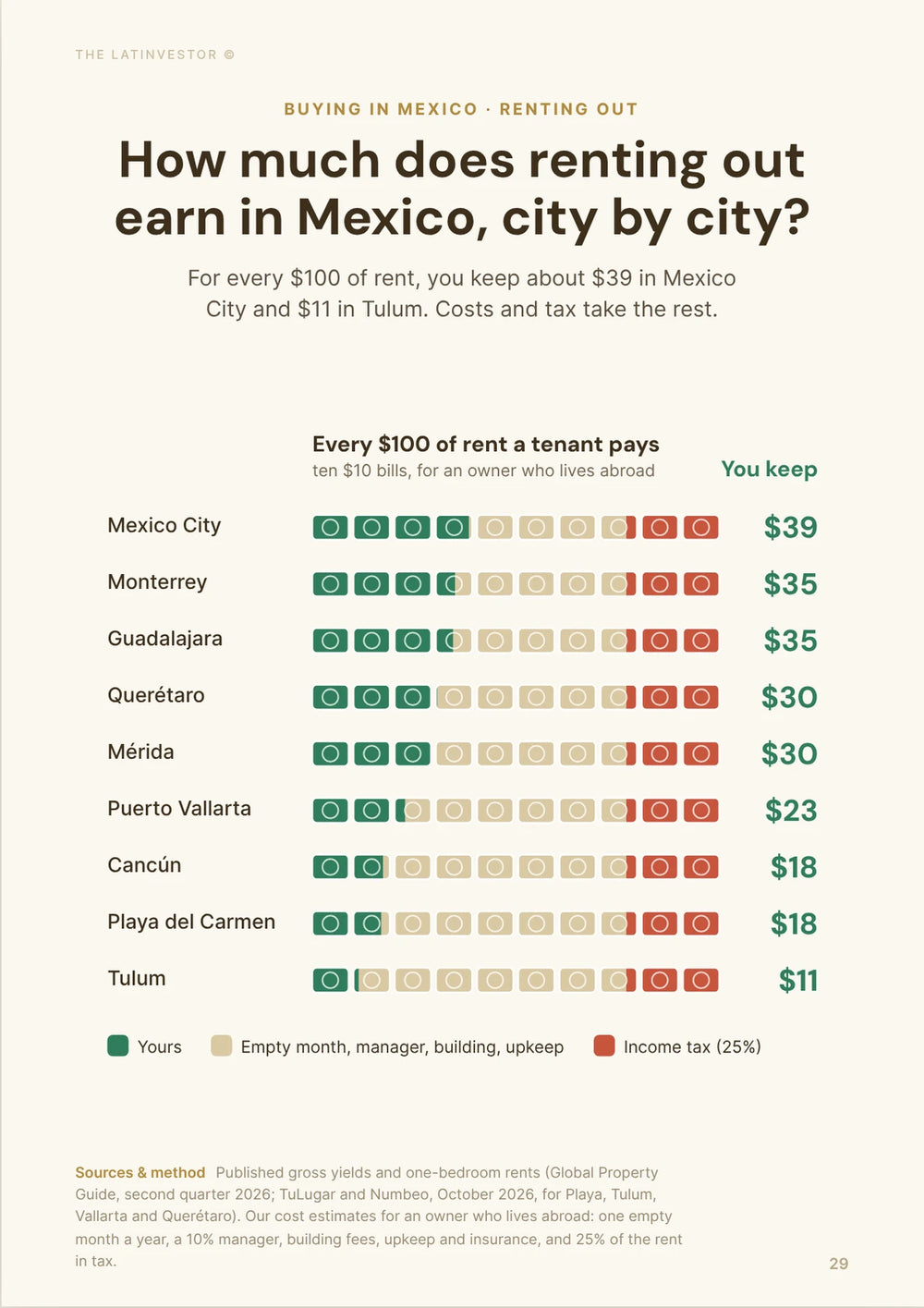
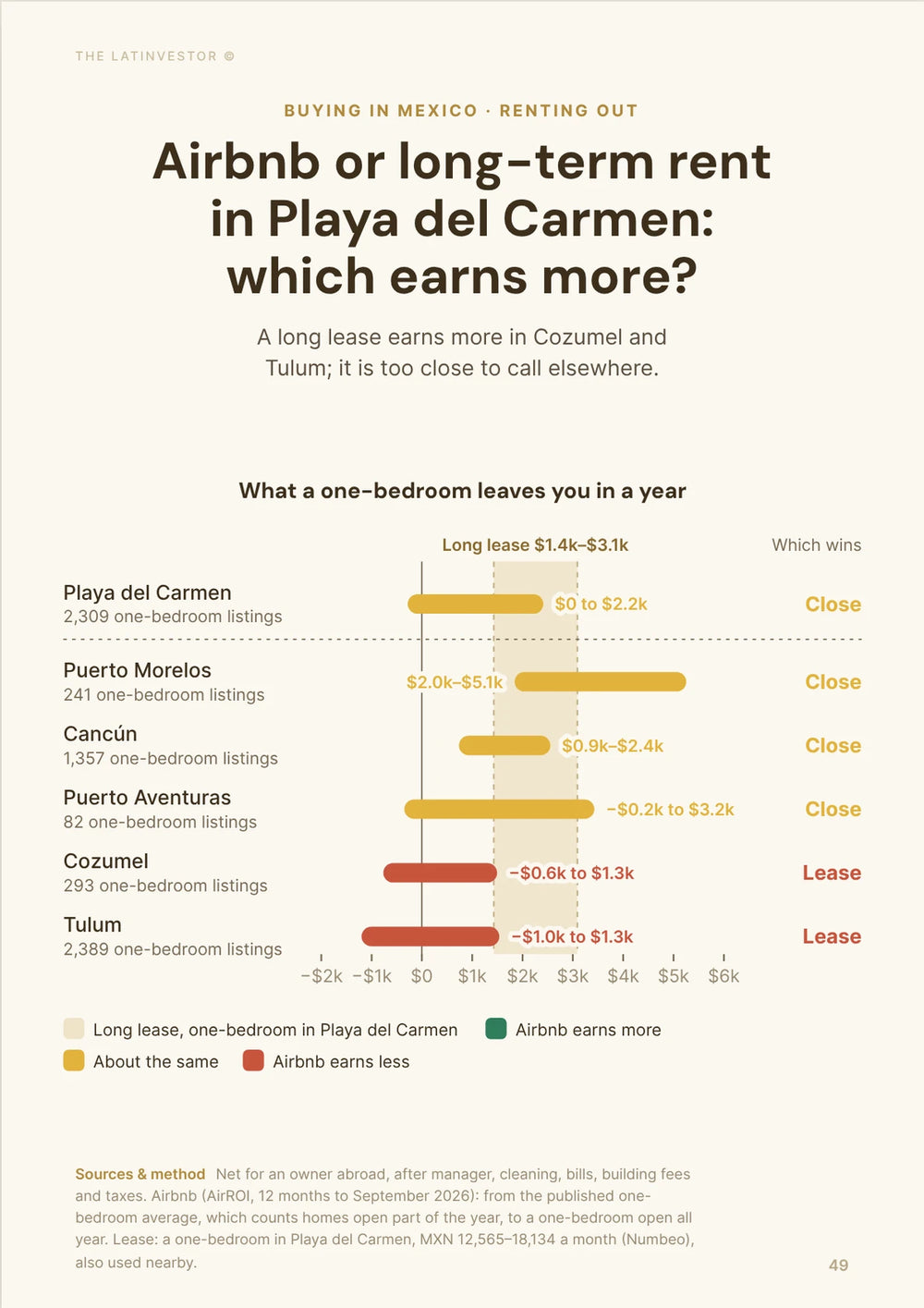
On a one-bedroom listed at about $184,000, AirDNA's $18,800 is about 10% gross. Take 25% tax (about $4,700) and you're near 7.7%, before any running cost. With professional management and the rest, the net can end up close to what a long-term lease pays.
So the purchase price matters most, then management costs, then whether the unit beats its neighbors. A well-bought, distinctive unit can still work. A pricey generic condo backed by a developer's rental projection deserves a lot of doubt.
What should you check before buying a Playa del Carmen condo for Airbnb?
Real numbers from the unit itself, not the market average or the developer's projection.
Ask for 12 months of payout statements from Airbnb or the manager, not screenshots of the calendar. Look at May and September: if the unit doesn't clear about 40% occupancy then, it won't beat the market. Compare its nightly rate with the city's $103 average: a unit that only fills by being cheap has no edge.
Count the competition. Search the building and the two blocks around it on Airbnb for your dates: if 20 near-identical one-bedrooms show up, so will the price war. Check the RETUR-Q registration, the condo rules on short stays and the HOA fees, which can eat a lot of a small unit's income.
Then run the numbers as a long-term rental. If the price only works with Airbnb at 70% occupancy, it's too high. Negotiate from that number, or walk away: with about 6,230 new units on the market, there's always another one.
Does location still save a Playa del Carmen Airbnb from oversupply?
A great location still helps a lot, but it can't rescue an ordinary property anymore.
Being a short walk from the beach, Quinta Avenida and restaurants makes life easy for guests and widens the pool of people who'll book. Playacar also offers more of a resort setting than most standalone condo buildings, and Airbtics finds listings near Playacar earning about 19% more than similar ones elsewhere.
But the most popular areas also have the most rentals. Centro, Gonzalo Guerrero, Zazil-Ha and the nearby coast aren't scarce just because they're desirable.
Think like a guest. If 40 apartments sit within the same walk of the beach, "great location" no longer sets one apart from the other 39. Reviews, photos, design, outdoor space, beds, building management, noise, internet and the view decide who gets booked.
Location is still one of the first filters we'd use. We just wouldn't pay a big premium for it without counting how many similar rentals surround the unit.
Is Playa del Carmen Airbnb oversupply going away soon?
No. Much of the extra capacity is physical condo stock that will stay in the city for decades.
Some of the pressure is cyclical. Air traffic can recover, a strong winter can lift occupancy, and weak hosts can leave, which AirDNA's numbers suggest is already happening.
The buildings are permanent. Thousands of condos have layouts that work as short-term rentals. Even when owners switch to long-term leases or leave the platforms, those units can come back.
Regulation can slow that down without removing it. RETUR-Q registration, the 6% lodging tax and the 2026 platform rule make life harder for casual or informal hosts. They don't remove thousands of legally rentable condos.
So expect competition to stay tough even if occupancy improves. The easy phase of Airbnb growth in Playa is probably over.
So, is Playa del Carmen oversupplied with Airbnbs?
Yes, for the average generic rental. There are too many of them to enjoy easy occupancy or easy pricing.
The case is strong. Supply grew by about two-thirds in three years while median occupancy fell. Monthly occupancy still drops to about 40% in May and September. ListingOK shows revenue down 9% in a year, and AirDNA shows nightly rates down 19.2%. Hotels are emptier and Cancún airport is handling fewer passengers.
That doesn't make Playa a bad Airbnb market. It still fills 53% to 58% of nights depending on the dataset, reaches nearly 80% in February, clearly beats Tulum, and weaker rentals are already leaving.
What's gone is the room for mediocrity. A few years ago, fast tourism growth could carry an ordinary condo. Today that one-bedroom is surrounded by dozens of others with the same rooftop pool, the same furniture and the same walk to the beach.
So for a buyer, the answer is simple. Playa has plenty of demand; the excess is in interchangeable rentals. A distinctive, registered unit bought at the right price can still make sense. Another generic condo bought because "Playa always has tourists" is hard to defend.
Our methodology
This article asks whether Playa del Carmen has more short-term rentals than its demand can fill. We looked at supply growth, occupancy and seasonality, nightly rates and revenue, tourism and air traffic, other Mexican markets, the condo pipeline and the new registration rules.
Rental figures come from three trackers: Airbtics (Airbnb only, 12 months to August 2026), AirDNA (Airbnb, Vrbo and Booking.com, de-duplicated, 12 months to September 2026) and ListingOK (monthly occupancy from October 2025 to September 2026). They define "active" listings and their city boundaries differently, so we never averaged them or mixed them in one calculation; we looked at the direction and size of each trend. Hotel occupancy comes from Quintana Roo's official tourism observatory, and air traffic from ASUR, the Cancún airport operator. Condo inventory from The Red Search and Maya Ocean was treated as possible future supply, never added to rental counts.
Rules come from the Quintana Roo government and RETUR-Q, the state lodging-tax law and Mexico's income-tax rules for the 25% tax on a non-resident's gross rent. Purchase prices are TuLugar's October 2026 asking prices.
We checked these figures in October 2026. Conversions use about 18.6 pesos per US dollar and 20.9 pesos per euro.
Limits: rental trackers estimate occupancy from calendars and can change their methods, as AirDNA's 60% drop in listings shows. Asking prices are not sale prices. Hotel occupancy and airport traffic describe the destination, not Airbnbs directly. A single property can do much better or worse than any average.
Key sources used for this analysis include Airbtics' Playa del Carmen rental data, Airbtics' Tulum data, AirDNA's Playa del Carmen market overview, AirDNA's Tulum data, AirDNA's data-model documentation, ListingOK's Playa del Carmen occupancy and seasonality data, SITUR Quintana Roo's hotel-occupancy series, Quintana Roo's December 2025 tourism report, Quintana Roo's tourism bulletin, ASUR's September 2026 traffic report, Por Esto! on small hotels in Playa del Carmen, Por Esto! on vacation-rental bookings (June 2026), Riviera Maya News on APAR's May 2026 occupancy, The Red Search's Playa del Carmen development statistics, Maya Ocean's developer-inventory database, Maya Ocean on condos near the sea (May 2026), TuLugar's Playa del Carmen market data, Quintana Roo's tourism register (RETUR-Q), Riviera Maya News on the 2026 platform rule, Riviera Maya News on RETUR-Q fines, the Government of Quintana Roo on rental registration, Quintana Roo's lodging-tax law and SAT's rules on platform rental income.