Summary
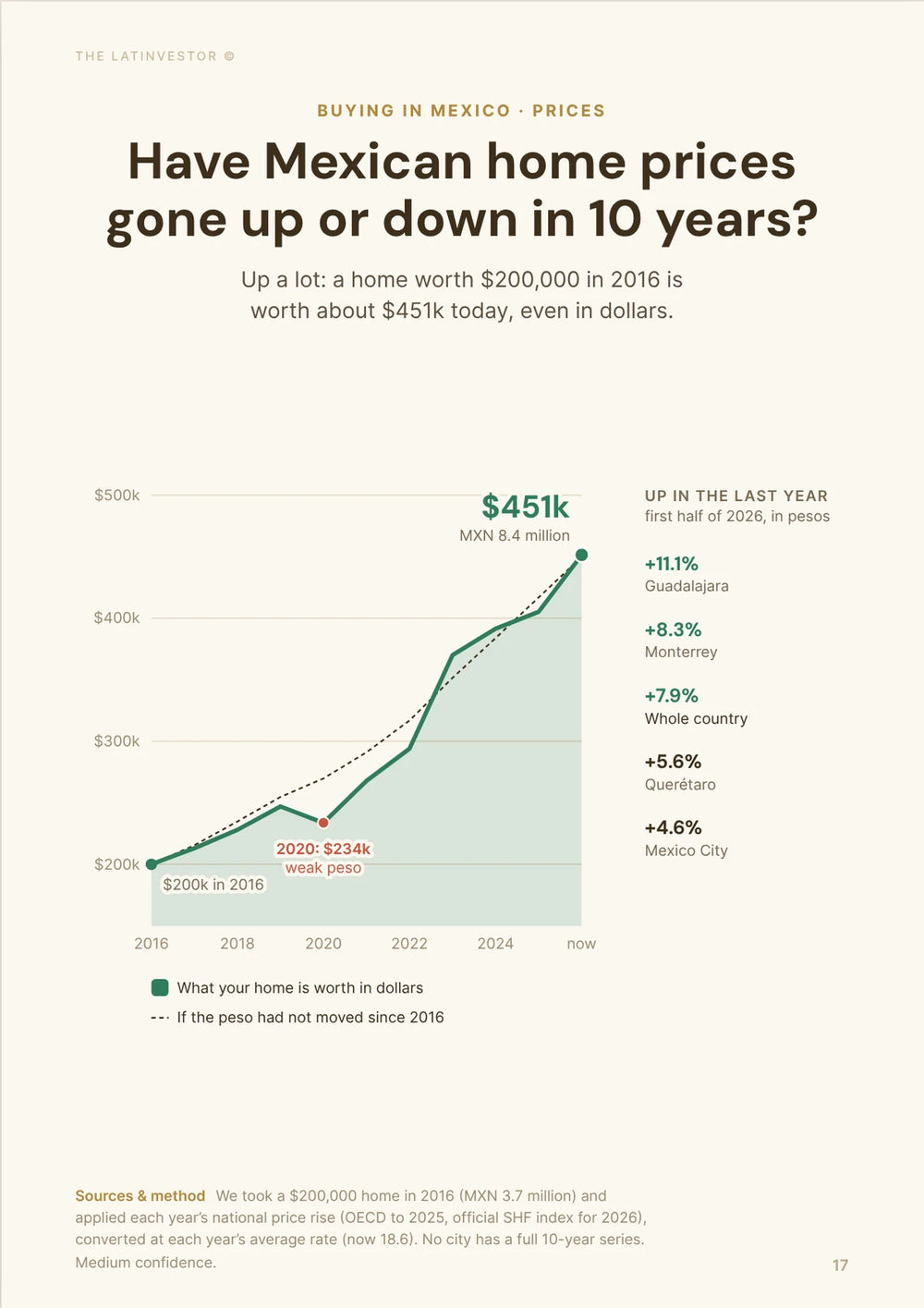
Yes, but slower and not everywhere. Housing prices in Solidaridad, Playa del Carmen's municipality, rose 11.7% in the first half of 2026, against 7.9% for Mexico as a whole.
That lead is real, but the pace is cooling: Quintana Roo was running near 15% a year at the end of 2025 and was down to 11.5% by mid-2026.
Playa no longer moves as one market. Between April 2025 and October 2026, asking prices in Playacar Fase I rose about 19.0%, Centro about 4.6%, and Natura fell about 10.0%.
Supply is the main brake. Maya Ocean tracks about 6,230 unsold units in 238 developments, including about 2,140 within 500 meters of the sea, so "near the beach" is not rare anymore.
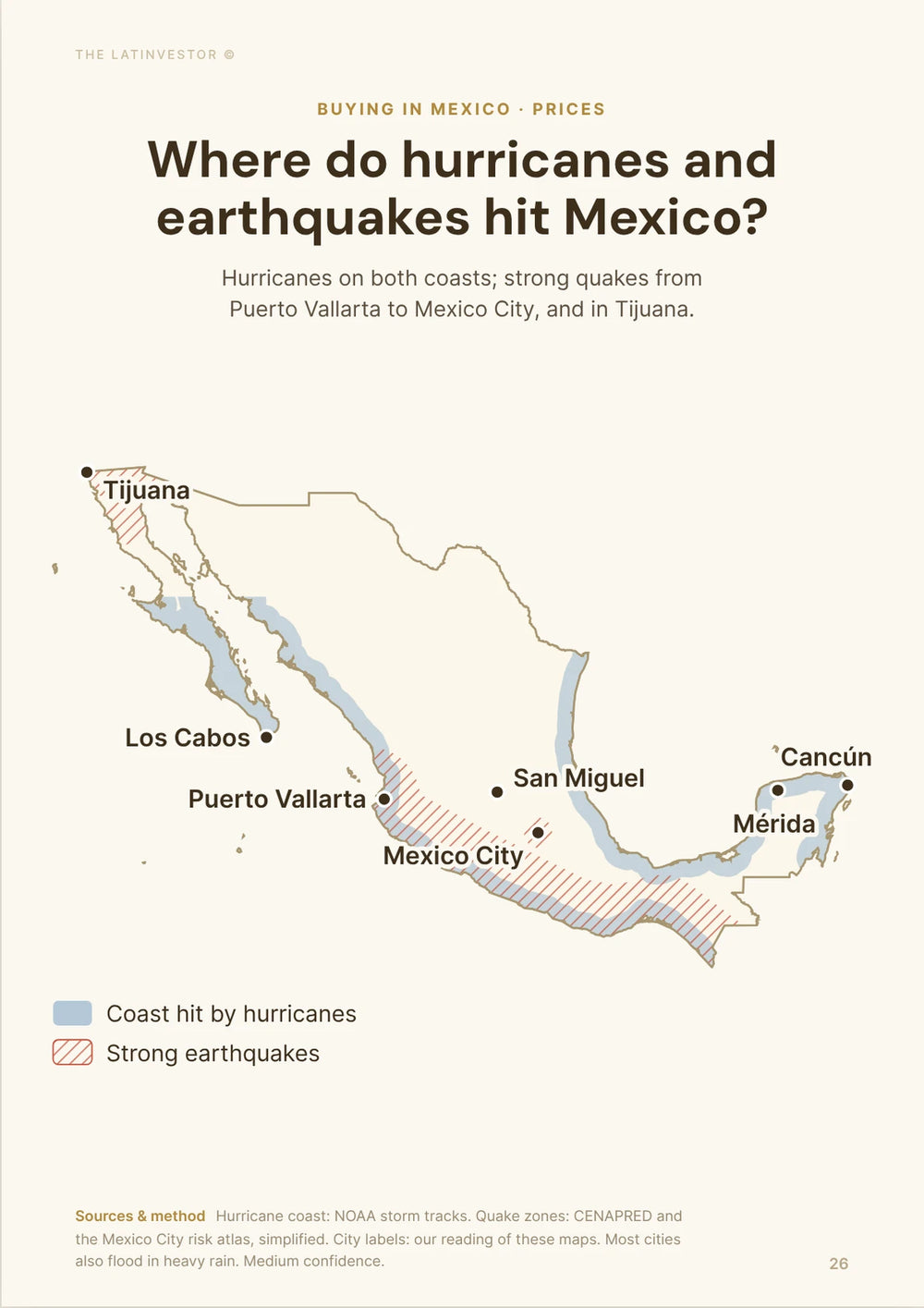
Playa is safer than Tulum because people actually live there: the city went from about 150,000 residents in 2010 to about 305,000 in 2020.
Tourism is the weak spot right now. Hotel occupancy fell from 75.3% in 2024 to 70.8% in 2025, and the summer of 2026 was bad, with small hotels in Playa down to 18% occupancy in September.
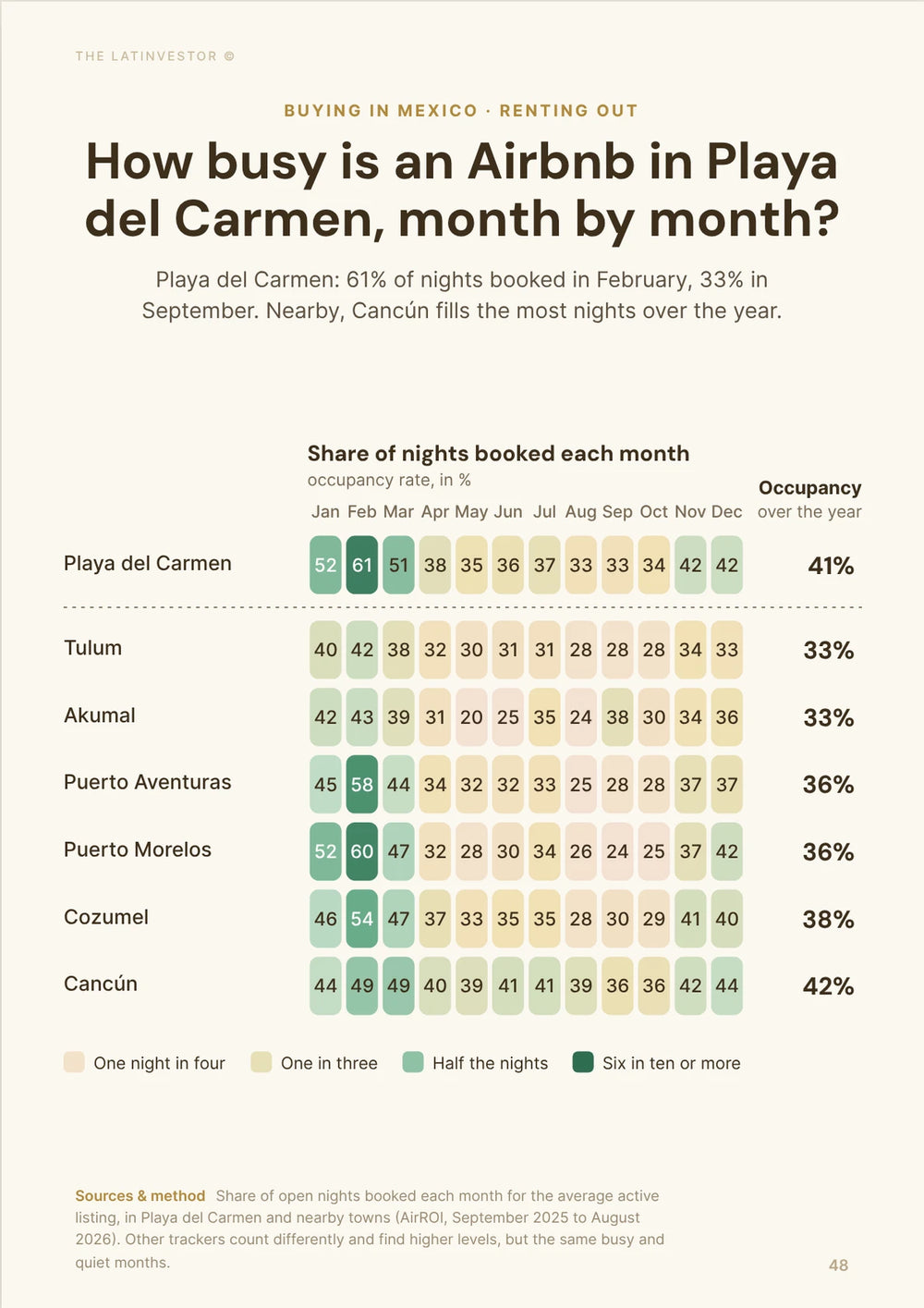
Airbnb numbers no longer carry high prices on their own. AirDNA puts Playa's short-term rentals at 58% occupancy and about $18,800 of average yearly revenue, and the state now wants every listing registered.
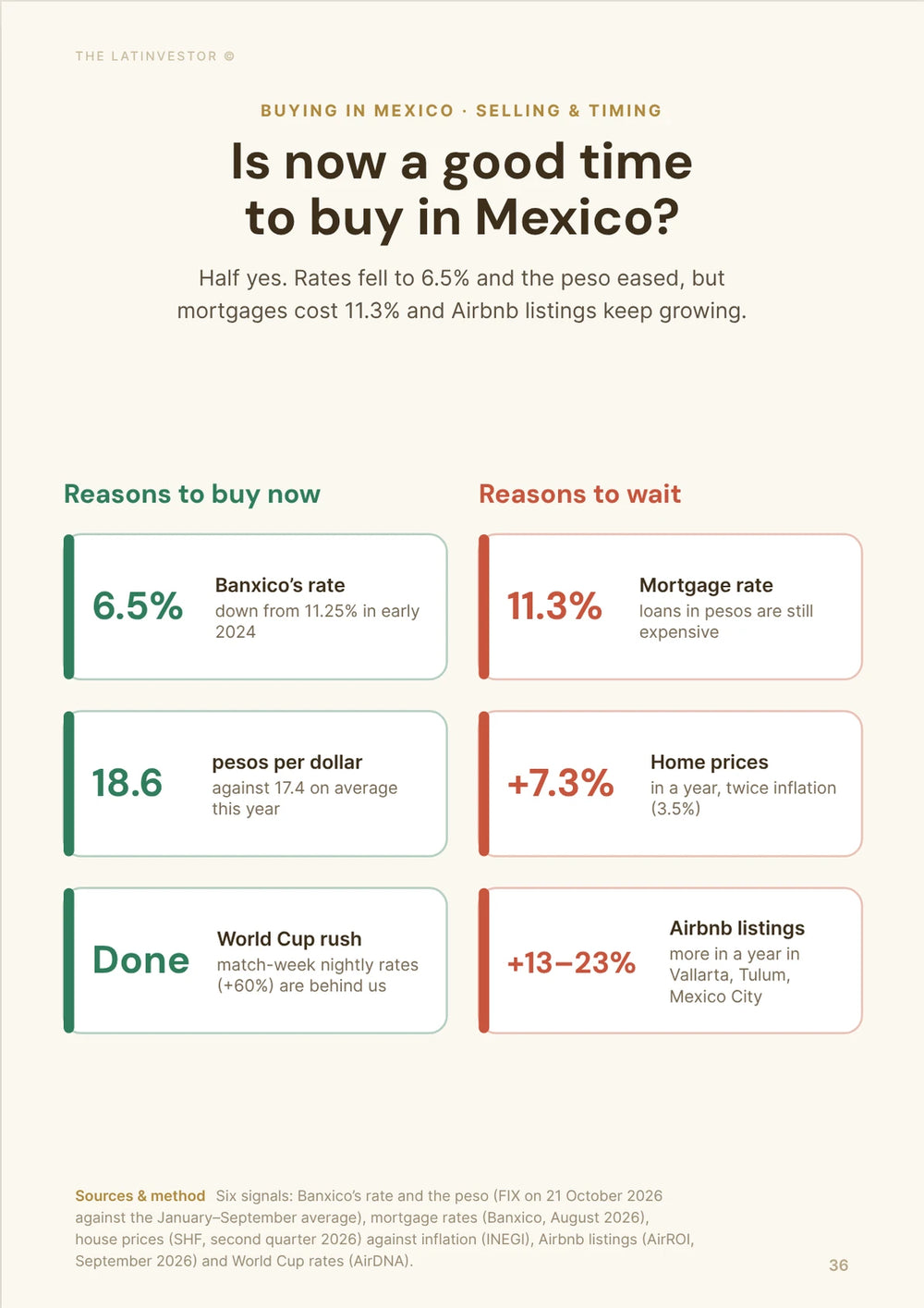
Money is not getting much cheaper. Banxico's rate is at 6.50% and analysts expect no change through 2027, while the peso has slid from under 17 to about 18.6 per dollar since early September, which makes peso-priced homes cheaper for dollar buyers than a few weeks ago.
Beachfront still earns a premium (around $5,451/m² within 100 meters of the sea in new projects), but sargassum is a growing cost: Playa collected more than 45,000 tonnes between January and late September 2026.
Presales need more checking than before. A rising developer price sheet is not appreciation, and Quintana Roo's list of irregular developments went from 116 at the end of 2025 to 123 in August 2026.
Resales often make more sense now, because you can see the real building, real HOA fees and real rental history before paying.
Our base case: moderate price growth for Playa overall, with good two-bedroom homes, Playacar and real beachfront doing well, and generic investor studios staying flat or falling.

Are Playa del Carmen property prices still rising in 2026?
Yes. Playa del Carmen property prices are still rising, and the official data show the local market still beating Mexico overall.
Sociedad Hipotecaria Federal reported that housing prices in Solidaridad, the municipality centered on Playa del Carmen, rose 11.7% year over year during the first half of 2026. Mexico as a whole was up 7.9%, while Quintana Roo increased 11.5%. Only two municipalities in the country did better than Playa.
That follows an unusually strong run. Quintana Roo had already posted roughly 15% annual appreciation at the end of 2025. Growth then slowed somewhat in 2026, but it remained well above the national rate.
Private listing data point in the same direction, although the gains are less dramatic. Propiedades.com estimates that apartment prices in Playa del Carmen Centro increased about 4.6% between April 2025 and October 2026, while its broader Solidaridad series rose about 5.5%.
We should be careful with those comparisons. SHF tracks homes financed with mortgages, while much of Playa's foreign-facing condo market involves cash purchases and dollar-denominated pricing. Property portals, meanwhile, mostly track advertised prices rather than final closing prices.
Still, official housing values and private asking prices are both moving higher. The market has continued to appreciate, even if the exact percentage depends on which part of Playa we measure.
| Market measure | Recent change | Area covered | What it shows |
|---|---|---|---|
| SHF housing index | +11.7% | Solidaridad | Strong appreciation in mortgage-financed housing |
| SHF housing index | +11.5% | Quintana Roo | The state remains one of Mexico's stronger markets |
| SHF housing index | +7.9% | Mexico | National benchmark |
| Propiedades.com | +4.6% | Playa del Carmen Centro apartments | Asking prices are still moving higher |
| Propiedades.com | +5.5% | Solidaridad apartments | Broader listing prices also remain positive |
Why is it so hard to say whether Playa del Carmen prices will keep rising?
Playa del Carmen property prices are hard to forecast because several very different real-estate markets are being grouped under one citywide headline.
Mexican families buying homes with mortgages are one market. Foreigners paying cash for vacation condos are another. Then we have presale apartments sold mainly to investors, luxury beachfront properties, long-term residential communities and older resale buildings.
Those properties do not respond to the same pressures.
A two-bedroom home in Playacar can attract residents, retirees and long-term tenants. A 30-square-meter studio marketed around projected Airbnb returns has a much narrower buyer pool. A true beachfront condo also has a scarcity advantage that a new building several blocks inland does not.
The data themselves add another layer of confusion. SHF tells us a lot about Mexican housing transactions, but it misses part of the cash-heavy foreign market. Developer price sheets tell us what sellers want, but not necessarily what buyers ultimately pay. Portal averages can also move because the mix of properties listed for sale has changed.
So when someone says that "Playa del Carmen prices rose 12%," we first need to ask which properties rose 12%. That distinction becomes increasingly important as the market matures.
Is Playa del Carmen still outperforming the rest of Mexico?
Yes. Playa del Carmen's housing market is currently outperforming Mexico by enough that we should treat it as a real difference rather than normal statistical noise.
SHF measured 7.9% national housing appreciation during the first half of 2026. Quintana Roo reached 11.5%, while Solidaridad reached 11.7%.
That puts Playa's municipality almost four percentage points ahead of Mexico as a whole.
The trajectory is worth watching, though. Quintana Roo was running close to 15% annual appreciation near the end of 2025. The latest pace is lower.
For now, that slowdown looks healthier than another acceleration. Double-digit annual property inflation cannot continue indefinitely unless household incomes, rents and foreign buying power rise quickly enough to support it.
Playa therefore remains one of Mexico's stronger markets, but extrapolating the previous 12% to 15% annual gains several years into the future would be aggressive.
Are Playa del Carmen prices rising everywhere?
No. Playa del Carmen property prices are already splitting sharply by neighborhood, and that divergence is one of the clearest clues about what comes next.
Propiedades.com estimates that apartment prices in Playacar Fase I rose about 19.0% between April 2025 and October 2026. Centro increased about 4.6%.
Natura Playa del Carmen moved the other way, with the portal estimating a decline of about 10.0% over the same period.
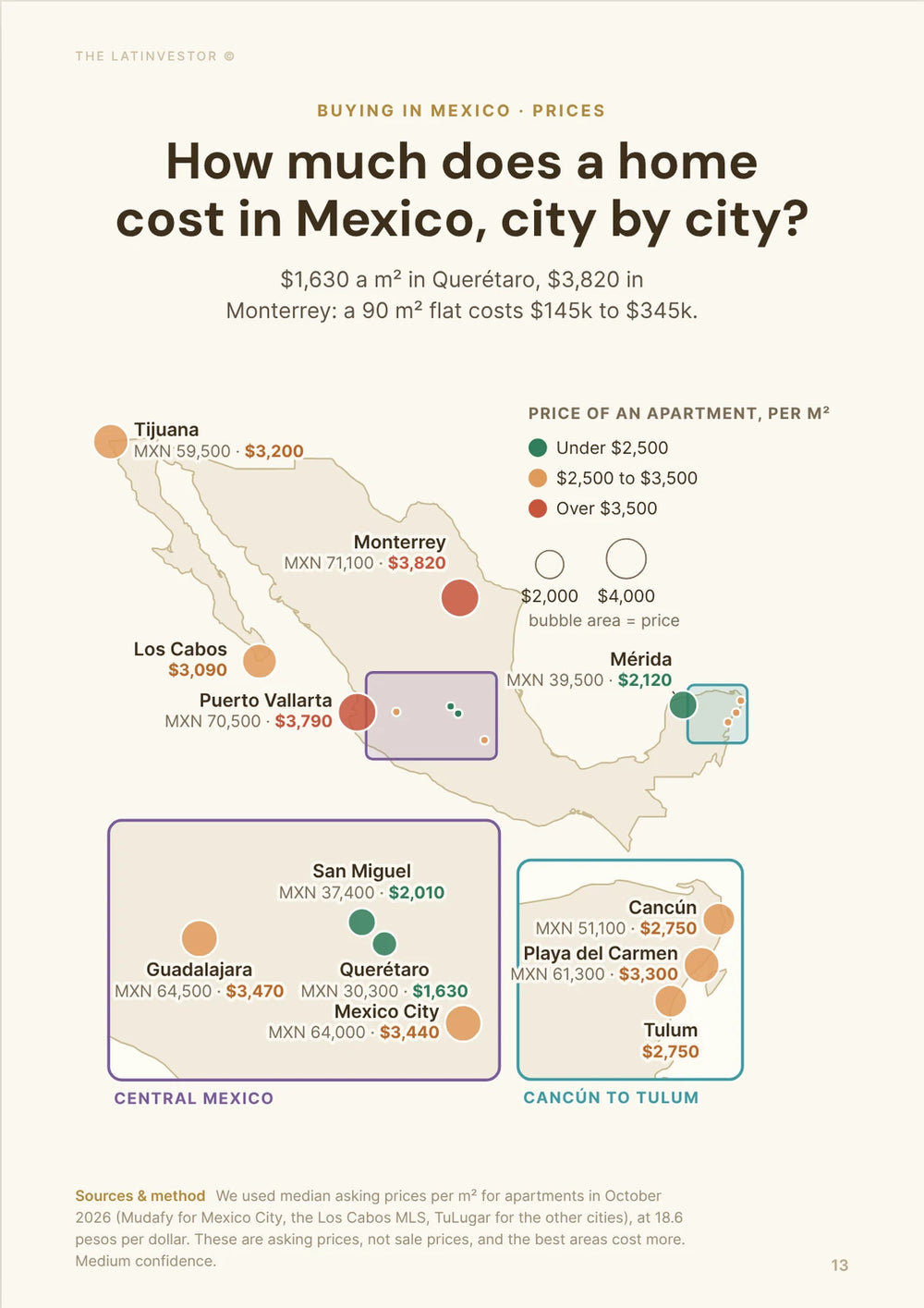
Current asking prices also show a wide spread. Propiedades.com puts Playacar Fase I around MXN55,200 per square meter (about $2,970) and Centro near MXN50,300 (about $2,700), compared with roughly MXN34,200 (about $1,840) in Natura.
Other trackers don't draw the same map, which is a reminder that these are asking prices. TuLugar's October 2026 data put the citywide condo median at $3,353 per square meter, with Centro and Fifth Avenue at about $4,120 and Playacar at about $3,041, because each source counts a different mix of listings.
Those gaps make a citywide forecast less useful than it first appears. A buyer can own property in a rising city and still lose money if the building, neighborhood or purchase price is wrong.
The market now appears to be rewarding established locations, walkability, beach access, construction quality and residential usefulness more selectively. That should continue as buyers get more alternatives and become less willing to pay simply because a project is new.
| Area | Approx. recent price change | Approx. asking price/m² | Current picture |
|---|---|---|---|
| Playacar Fase I | +19.0% | MXN55,200 | Strong premium-market appreciation |
| Playa del Carmen Centro | +4.6% | MXN50,300 | Positive, but much slower |
| Solidaridad overall | +5.5% | Varies | Broad market remains positive |
| Natura Playa del Carmen | -10.0% | MXN34,200 | Clear local correction |
Are there already too many condos for sale in Playa del Carmen?
There are enough new condos in Playa del Carmen to put real pressure on future appreciation, especially for small investor units that look similar to hundreds of others.
Maya Ocean's live database currently tracks roughly 6,230 available units across 238 Playa del Carmen developments, with a median price around $184,000 and roughly $4,300 per square meter. That is new-build stock only; across all listed condos, TuLugar's October 2026 median asking price is about $215,000.
The surprising part is how much supply exists even close to the Caribbean. Its separate study of properties within 500 meters of the sea identified about 2,140 active units across 52 developments.
That changes the scarcity argument quite a bit. Being "near the beach" sounds rare until buyers can choose among more than two thousand units within that same distance.
Some individual developments are also large. A single project such as KOOL PLAYA was recently showing around 290 active units in Maya Ocean's database. When buyers have that much choice, developers have to compete through price, payment terms, amenities or commissions.
Playa's underlying demand and its condo supply need to be separated. The city can keep growing while mediocre investor units struggle to appreciate.
This is probably the biggest constraint on a repeat of the easy gains seen earlier in Playa's development cycle.
| Current supply measure | Approximate level | What it means |
|---|---|---|
| Available units tracked by Maya Ocean | 6,230 | Buyers have a very large choice |
| Developments tracked | 238 | Competition is spread across many projects |
| Units within 500m of the sea | 2,140 | "Near beach" does not automatically mean scarce |
| Developments within 500m | 52 | Even coastal inventory is broad |
| Median tracked price | ~$184,000 | Entry prices remain accessible to many foreign buyers |
| Median tracked price/m² | ~$4,300 | Useful benchmark for comparing new projects |
Is Playa del Carmen heading toward the same problem as Tulum?
Probably not across the whole city. Playa del Carmen has a much deeper residential economy than Tulum, although some investor-heavy condo pockets can absolutely suffer from the same oversupply problem.
Playa had 304,942 residents in the 2020 census, while the wider municipality counted 333,800. The city's population had already more than doubled from 149,923 in 2010.
That permanent population supports supermarkets, hospitals, schools, restaurants, offices, long-term rentals and ordinary housing demand. Playa therefore has buyers and tenants who have nothing to do with vacation-property speculation.
Current tourism numbers also show a meaningful difference. Quintana Roo's tourism monitoring system recorded first-half 2026 hotel occupancy of 72.58% in Playa del Carmen compared with 66.18% in Tulum.
Tulum's experience is still a useful warning. Large amounts of similar investor inventory can overwhelm rental demand even when the destination itself remains popular.
Playa's stronger local economy gives the overall market more protection, but it cannot rescue every building. Small studios whose economics depend almost entirely on Airbnb demand remain much more exposed than properties that locals would also want to rent or buy.
Is Playa del Carmen's population still strong enough to support property prices?
Yes. Playa del Carmen's population growth remains one of the strongest reasons to expect property prices to rise over a long enough period.
INEGI counted 149,923 residents in Playa del Carmen in 2010 and 304,942 in 2020. The population more than doubled within a decade.
The municipal government reports 333,800 residents across the wider municipality and cites an annual growth rate of about 6.8%, combining natural growth and migration.
We should not assume another decade of population doubling. Growth rates normally slow as cities become larger and more expensive.
Even a substantial slowdown would still leave Playa with something many resort markets lack: a growing base of permanent residents who need normal housing.
That makes family-size apartments, houses and practical residential communities particularly interesting. Much of the new investor inventory, however, consists of compact studios and one-bedroom units designed around short stays.
Playa can therefore have strong population-driven housing demand while simultaneously having too many vacation condos. Investors who confuse those two markets could badly misread the city's growth story.
Is tourism still strong enough to push Playa del Carmen property prices higher?
Playa del Carmen tourism is still large enough to support property prices, but recent numbers are too soft to justify expecting tourism alone to drive another property boom.
According to Quintana Roo's tourism monitoring system, Playa del Carmen hotel occupancy averaged 72.58% during the first half of 2026, down from 77.05% during the same period a year earlier.
The weakness started earlier. Full-year occupancy had already fallen from 75.3% in 2024 to 70.8% in 2025.
Then the summer of 2026 went badly. In the week of July 4 to 10, SITUR put the Riviera Maya at 54.1% hotel occupancy, and Playa's small hotels were at about 32%, some 15 points below the same week of 2025, according to their association (reported by EFE). Heavy sargassum, expensive flights and a World Cup that kept American fans at home were the reasons given.
By September, small hotels in Playa had dropped to about 18% occupancy, with room rates cut by around half and some discounts of up to 70% (Por Esto, September 8, 2026). The association estimated that about 15% of small hotels had closed for good or for a while.
Big all-inclusive resorts held up better, and a weak low season is not a crash. But small hotels compete directly with Airbnb condos for the same guests, so their pain is a good preview of what investor units face.
Be very skeptical of any property pitch built on ever-rising visitor numbers.
| Playa del Carmen hotel occupancy | Earlier period | Latest comparable period | Change |
|---|---|---|---|
| Full year | 75.3% in 2024 | 70.8% in 2025 | -4.5 points |
| First half | 77.05% in 2025 | 72.58% in 2026 | -4.47 points |
| Small hotels, early July | About 47% in 2025 | About 32% in 2026 | About -15 points |
Can Airbnb still justify today's Playa del Carmen condo prices?
Sometimes. Playa del Carmen Airbnb demand can still make a good condo work, but buyers should now demand real operating numbers before paying a large investor premium.
Short-term rentals remain deeply embedded in Playa's tourism economy. What has changed is the amount of competition.
Thousands of condos now target essentially the same guest: couples or small groups looking for a modern apartment near the beach, Fifth Avenue or a rooftop pool.
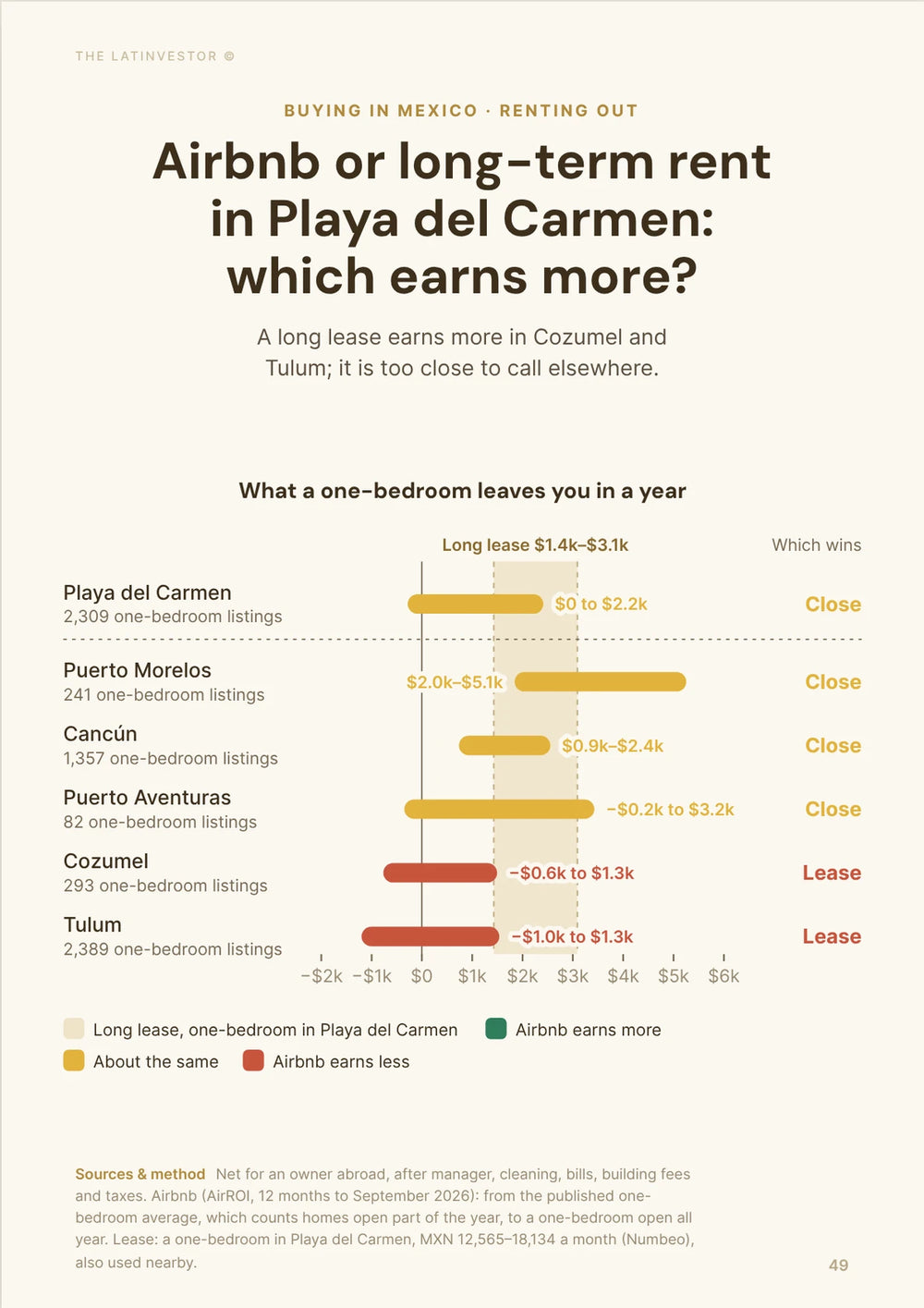
The citywide numbers are ordinary. Over the 12 months to September 2026, AirDNA puts Playa's short-term rentals at 58% occupancy, an average nightly rate of about $103 and average revenue of about $18,800 a year per active listing, before any costs.
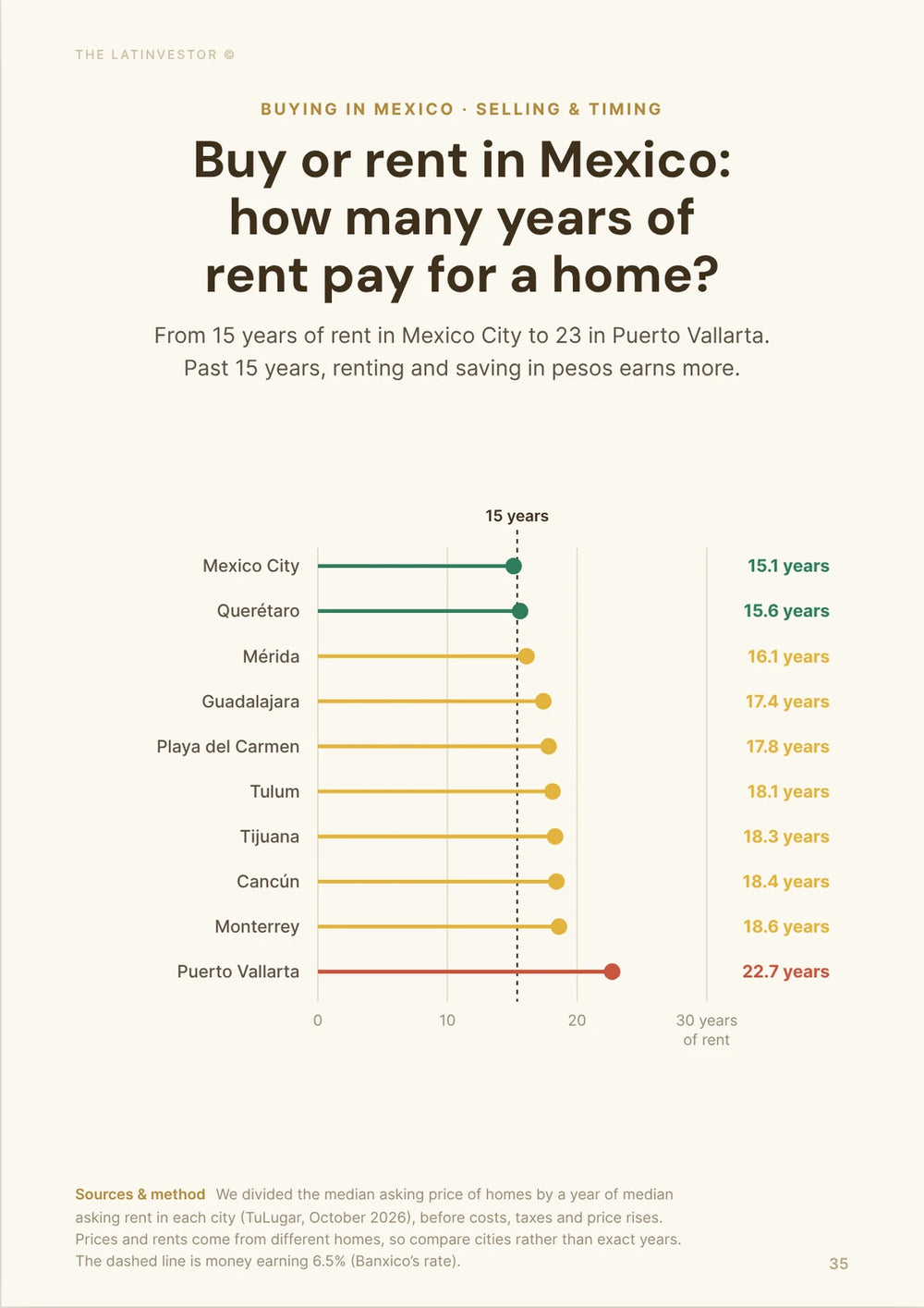
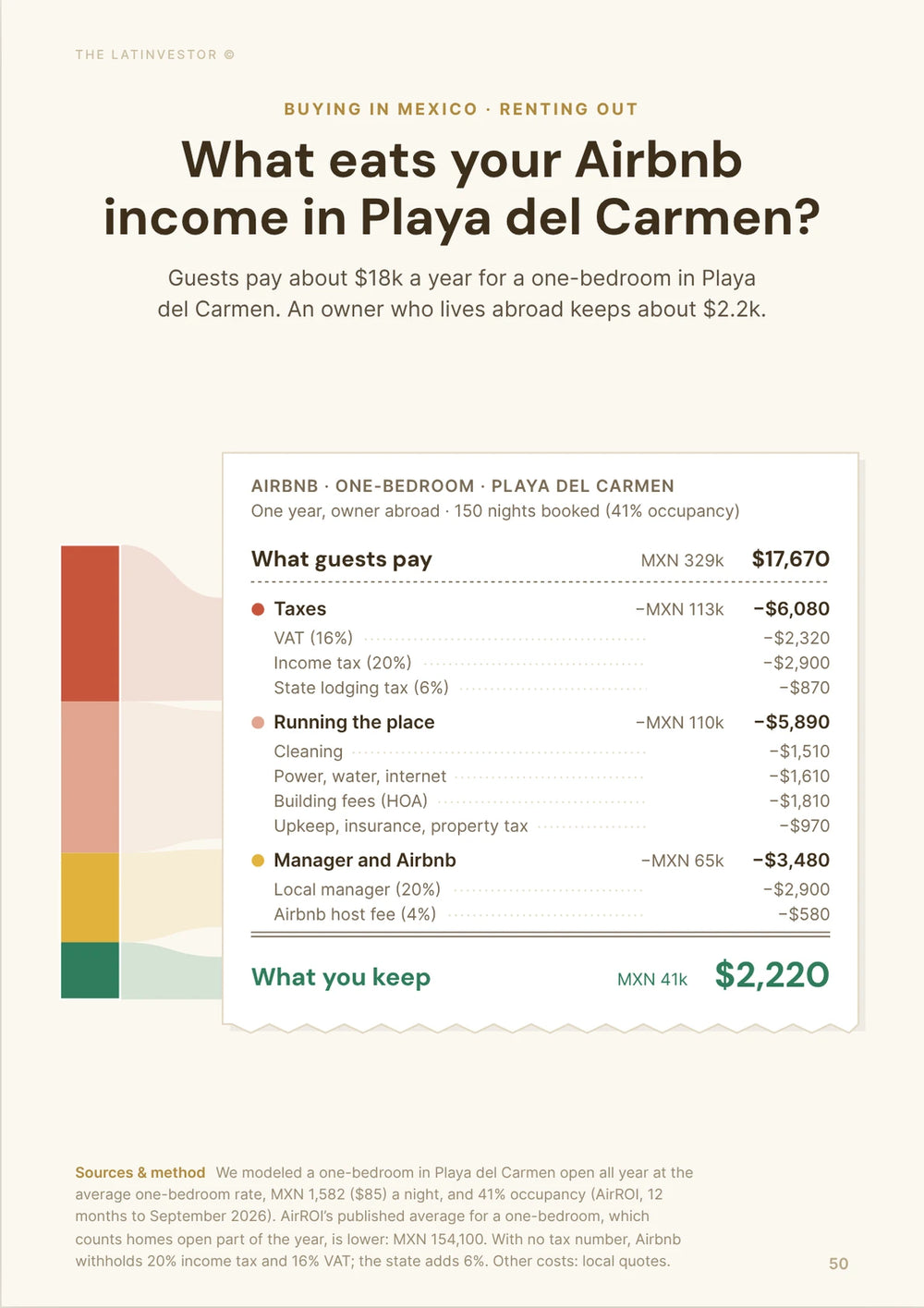
Put that next to a median one-bedroom condo asking about $184,000 (TuLugar, October 2026) and you see the problem: once management, cleaning, HOA fees, electricity and taxes come out, an average unit earns a modest return, not the double-digit yields still found in brochures.
Citywide averages also hide a lot. Use them as a sanity check, then ask for the comparable listings in the same few blocks.
For an actual purchase, we would want to see at least 12 months of achieved revenue from comparable units, seasonal occupancy, management costs, platform fees, electricity, cleaning, HOA charges and replacement expenses.
A condo can produce attractive gross revenue and still deliver an ordinary net yield once those costs are included.
As Playa gets more expensive, that gap between gross revenue and actual owner return becomes harder to ignore.
Will Quintana Roo's new rental registration rules hit Playa del Carmen condo values?
They won't crash prices, but they make an unlicensed Airbnb condo worth less than one that is set up properly. Quintana Roo now requires short-term rentals to hold state and municipal operating licences and to be listed in the state tourism register (RETUR-Q), and the state wants platforms to show that registration in 2026.
The money is not the issue. Playa's municipal lodging licence costs roughly MXN821 to MXN2,933 a year at the 2026 UMA value (about $44 to $158), and the city's procedure, updated in August 2026, says it must be renewed every year. The real change is that each listing now leaves a paper trail for taxes, safety equipment and condo rules.
AirDNA's count of active listings in Playa fell to 6,498 in September 2026, about 60% fewer than a year earlier. Part of that may come from changes in how the data are collected, so don't read it as an exact figure, but it fits a market where weaker and informal listings are dropping out.
If you buy for short stays, ask the seller for the municipal licence and RETUR-Q number, check that the condo regulations allow rentals of a few nights, and budget the 6% state lodging tax platforms collect from guests. A unit that can't show those is a long-term rental, and should be priced like one.
Do interest rates and the weaker peso change the math in Playa del Carmen?
A little. Banxico's rate cuts have mostly run their course and mortgages are still expensive, but the peso's slide since early September has made Playa somewhat cheaper for dollar buyers.
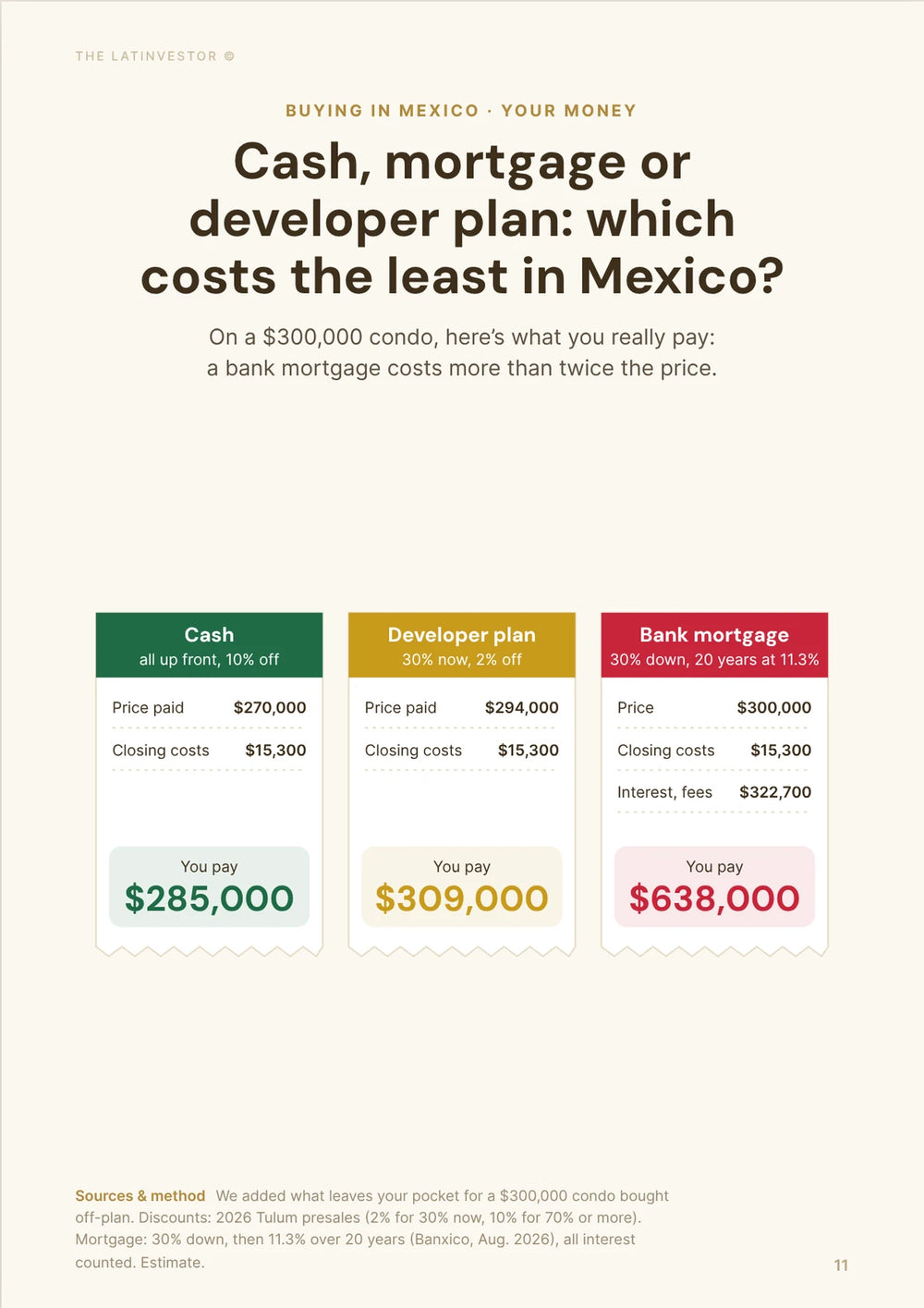
Banco de México's policy rate is at 6.50% in October 2026, well below the 2024 peak, and analysts surveyed by Citi expect no change in 2026 or 2027 (El Financiero, October 20, 2026). But banks still advertised about 11.31% on average in August 2026 (Banxico), and the average rate actually granted was 9.99% in June (ABM), so cheaper money has barely reached Mexican home buyers.
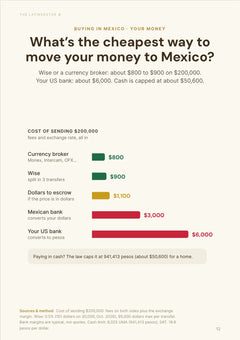
Many foreign buyers pay cash, so for them the exchange rate matters more. The peso was under 17 per dollar in early September 2026 and is about 18.6 now, after one of the steepest falls of any currency this autumn. A $200,000 budget converts to about MXN3.72 million today, against about MXN3.4 million in early September, though still a bit less than on the 2025 average of about 19.2.
Don't build a purchase on where it goes next. Analysts surveyed by Banxico in September 2026, before most of the slide, expected about 17.57 pesos per dollar at the end of 2026, and BBVA about 17.30, so forecasters see some of this move reversing.
Some Playa developments are quoted directly in dollars, which hides the effect at first. But land, construction, wages and local resale values all sit in pesos, so the exchange rate shows up in resale prices only slowly. For now, the weaker peso is a small discount for anyone paying in dollars or euros.
Does better infrastructure really add much to Playa del Carmen property values?
Yes, but Playa del Carmen's improved infrastructure should support prices gradually rather than produce a sudden revaluation.
The clearest recent addition is the Tren Maya. Playa now has rail connections toward Cancún Airport, Tulum and other destinations across the Yucatán Peninsula.
That adds another transport option to an already well-connected destination.
Playa was never isolated. Highway 307 already linked the city with Cancún Airport and Tulum, while ferries connect downtown Playa with Cozumel. The city also has hospitals, supermarkets, schools and a much broader service economy than most Riviera Maya resort communities.
That existing infrastructure is one reason Playa deserves a lower long-term risk premium than a destination whose growth depends heavily on infrastructure that has not yet been built.
The train improves that position further, especially if ridership keeps growing. We simply would not pay a large property premium because a sales brochure mentions Tren Maya.
Connectivity helps the whole city over time. It rarely makes a mediocre condo suddenly valuable.
Will beachfront Playa del Carmen property keep outperforming?
Probably. Genuine beachfront and hard-to-replace Playa del Carmen properties still have the clearest scarcity argument, although simply being close to the sea is no longer enough.
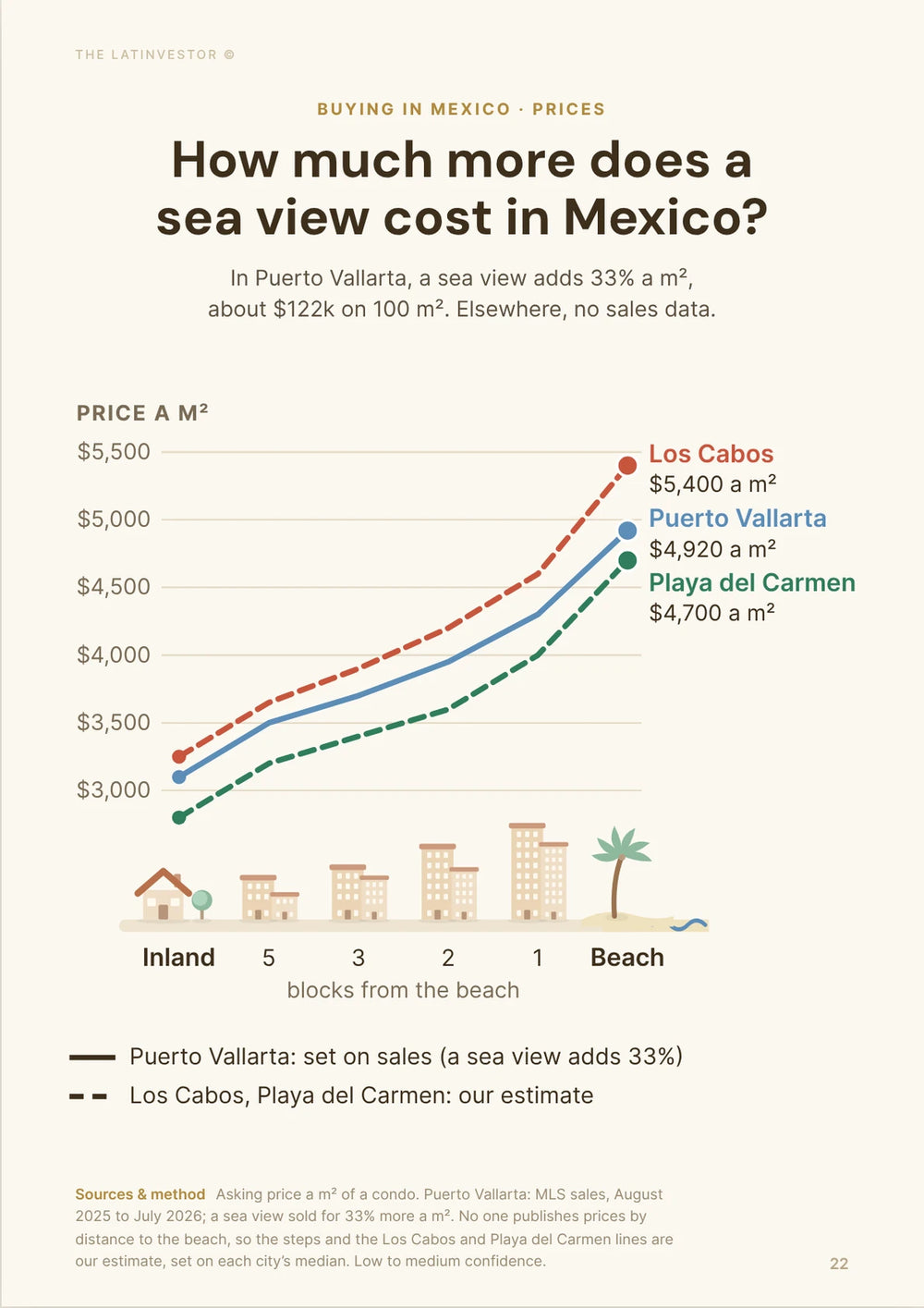
Maya Ocean's current inventory illustrates the distinction well. Its study found 348 active units within 100 meters of the sea and another 1,792 between 100 and 500 meters.
Average pricing was roughly $5,451 per square meter for the sub-100-meter group and $5,217 between 100 and 500 meters.
Move between 500 meters and two kilometers inland and the average fell to roughly $4,117 per square meter.
This distance study comes from a separate Maya Ocean snapshot, and its rows add up to more than the 6,230 units in the citywide count. Use it for the price gaps, not as a total.
Buyers clearly pay for coastal access, but thousands of near-sea units now compete for that premium. We therefore prefer genuinely difficult-to-replicate properties: direct beachfront, unusually good views, established low-density communities, or walkable locations where future construction opportunities are limited.
Playacar is a good example of the broader principle. Mature landscaping, security, beach access in parts of the community and years of established demand are harder for a new inland development to copy than a rooftop infinity pool.
That kind of scarcity should become more valuable as the city's generic condo stock keeps expanding.
| Distance from sea | Active units in Maya Ocean study | Average price/m² | Reading |
|---|---|---|---|
| Under 100m | 348 | ~$5,451 | Highest scarcity and coastal premium |
| 100–500m | 1,792 | ~$5,217 | Expensive, but substantial competing supply |
| 0.5–2km | 3,752 | ~$4,117 | Clear price drop once walk-to-beach premium weakens |
| 2–5km | 3,328 | ~$1,839 | Much more residential/inland pricing |
Could sargassum and beach erosion eventually drag down Playa del Carmen prices?
Yes. Sargassum and coastal erosion have become serious enough that we would price them into any Playa del Carmen property whose value depends heavily on the beach.
The latest sargassum season has been particularly severe.
Playa's municipal government said the city collected more than 30,000 tonnes during 2025, then its highest volume in a decade. 2026 is much worse: by mid-July Playa had already passed 30,000 tonnes, the most of any municipality in Quintana Roo, and by September 23 the state environment ministry counted about 45,100 tonnes collected in Playa (Diario Cambio 22).
The response has become correspondingly expensive. Playa expanded planned anti-sargassum barriers to five kilometers, while the federal government later announced a MXN2 billion Quintana Roo strategy covering Playa and other major destinations.
That level of intervention tells us how persistent the problem has become. It is also already hitting income: hotel owners blamed sargassum first for the empty summer of 2026.
The effect on real estate will vary enormously by location. Sargassum does not hit every beach with the same intensity, and cleanup can dramatically improve conditions in heavily managed hotel zones.
Still, an investor paying a large beachfront premium is effectively making a long-term bet on beach quality. More frequent sargassum arrivals, erosion, hurricane exposure and higher maintenance costs make that bet less straightforward than it looked a decade ago.
We still expect scarce coastal property to command a premium. We would simply demand a better property and a better price before accepting the environmental risk attached to it.
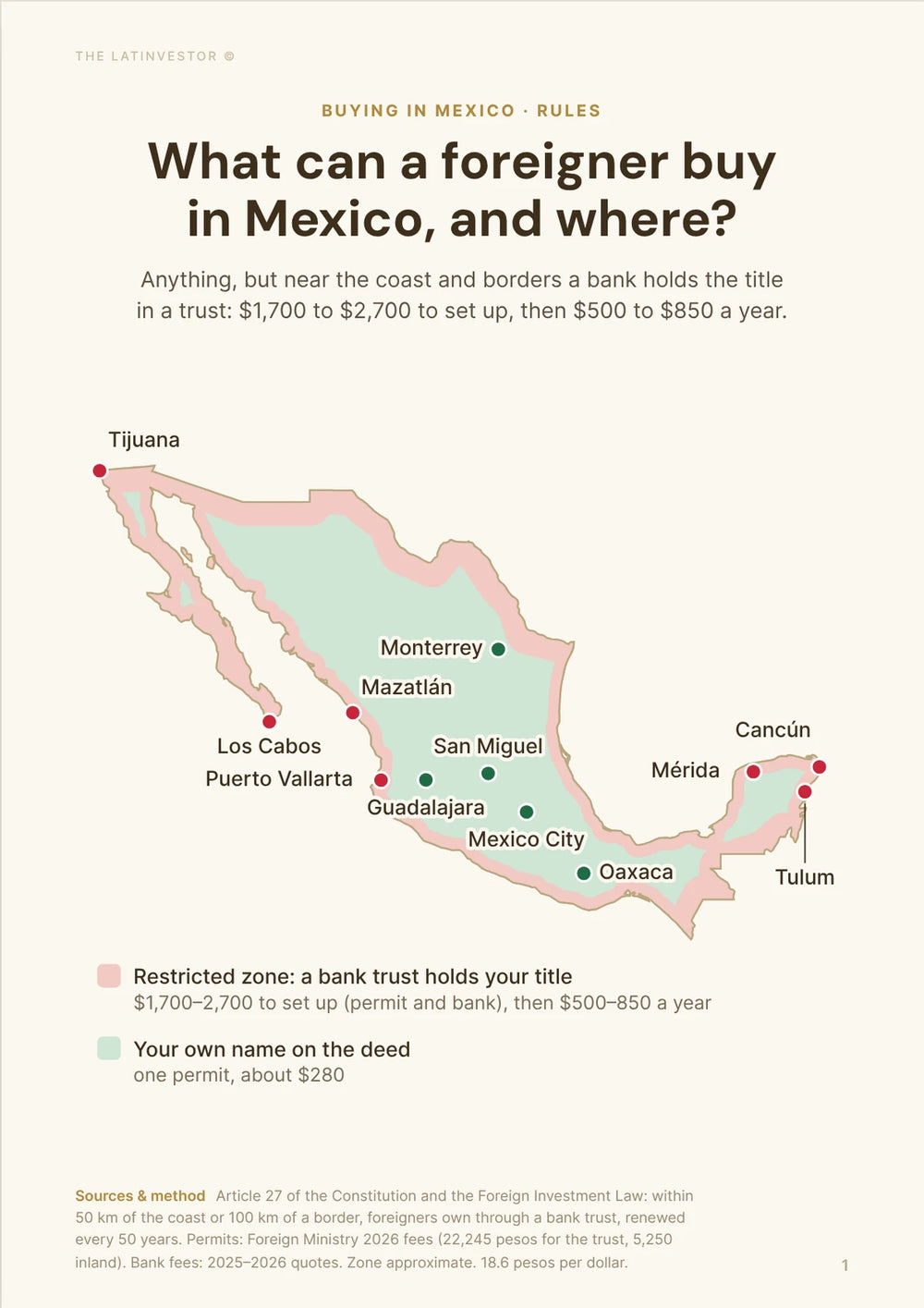
Are Playa del Carmen developers creating real appreciation or just raising presale prices?
Both happen. Playa del Carmen presale prices can genuinely rise during construction, but a developer raising its price sheet does not prove that an early buyer has made money.
Suppose a studio launches at $150,000 and the developer later advertises the remaining units at $180,000. On paper, the first buyer appears to have gained 20%.
The real test comes when that buyer tries to sell.
If independent buyers will pay around $180,000 for completed resales, the appreciation is real. If comparable owners can only sell around $155,000 while the developer continues advertising new units at $180,000 with financing, commissions and incentives, the original 20% gain mostly exists on a price sheet.
That distinction matters more now because Playa buyers can choose among more than 6,200 development units in Maya Ocean's current database.
The strongest presale projects can still perform very well. A scarce location, disciplined unit count, reliable developer and attractive finished product can create genuine value during construction.
We would be much more skeptical of repeated launch-price increases in buildings where dozens of similar units remain unsold.
As seen above, Playa currently has too much competing inventory for every developer's asking price to be treated as a market price.
Is it riskier to buy presale in Playa del Carmen right now?
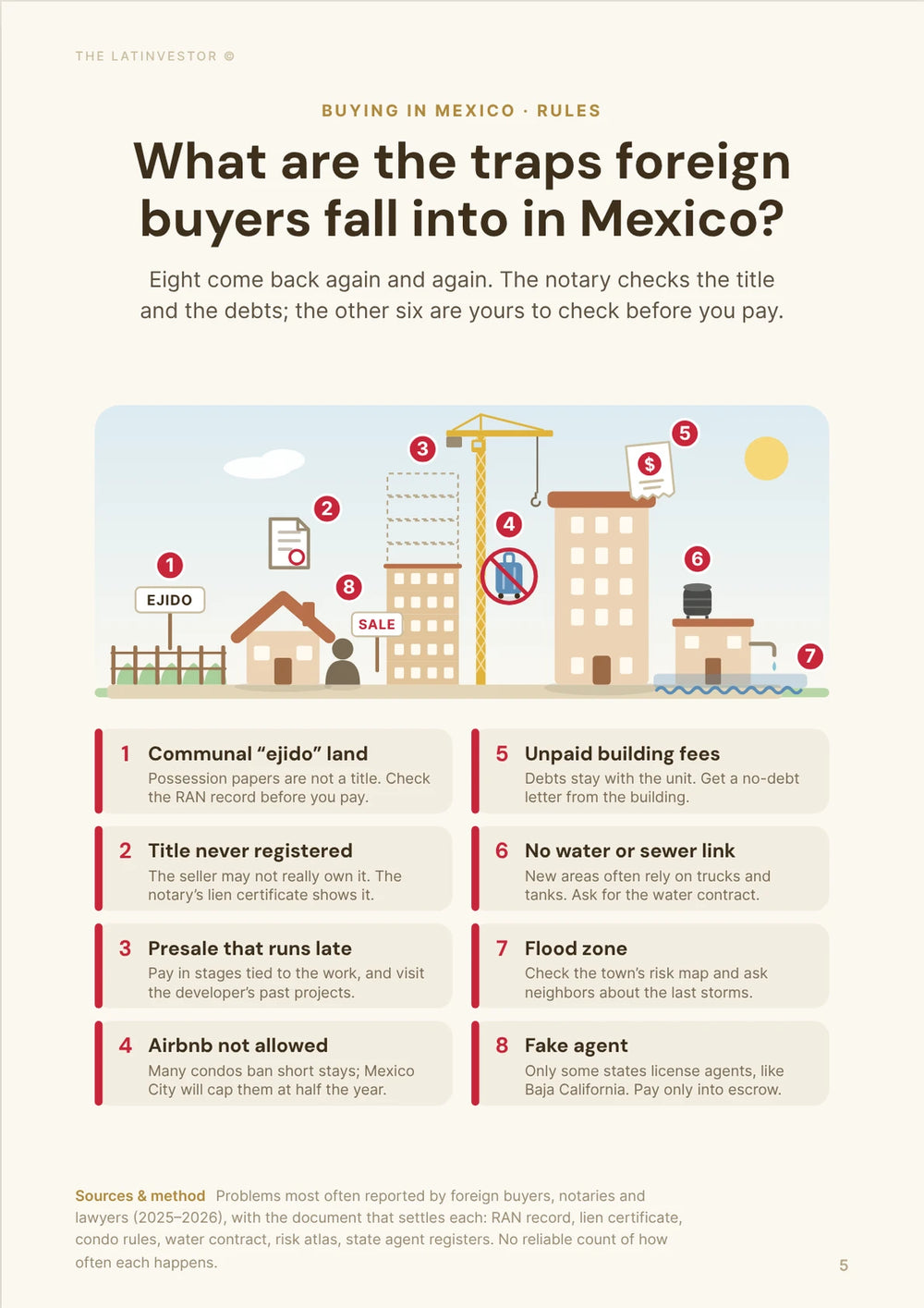
Yes, a bit, and mostly because of who you buy from rather than the market. Quintana Roo's urban development ministry (SEDETUS) had 123 irregular real estate developments on its public list in August 2026, up from 116 at the end of 2025, with Playa del Carmen and Tulum the most affected and problems such as missing permits or unclear land status.
Playa is one of the busiest presale markets in the state, so this is not a distant problem. In a slower market, weak developers also run short of cash, and late delivery becomes more likely when units stop selling.
Before paying a deposit, check that the project is not on the SEDETUS list, ask for the construction licence and land-use permit, and check that the condominium regime is registered or will be before delivery. Pay into escrow or through the notary, not to a personal or offshore account, and ask for a contract with a delivery date and a penalty if it slips.
If the developer can't show these papers in a week, walk away. With more than 6,200 units on the market, there is always another option.
Are Playa del Carmen resales becoming better value than new condos?
In many parts of Playa del Carmen, yes. Resales now deserve much more attention because buyers can compare a real operating property with increasingly expensive new developments.
A completed building answers questions that presale brochures cannot.
We can see the actual construction quality, neighboring buildings, street noise, water pressure, maintenance standards, HOA fees and condition of the common areas. For rental properties, we can also inspect real guest reviews and achieved rates.
That transparency becomes more valuable as Playa's new-build market grows.
Many new projects offer similar combinations of rooftop pools, gyms, coworking areas and compact layouts. A newer building may still deserve a premium, but the premium needs to buy something meaningful.
Resales also let us see where sellers are willing to negotiate. Developers often defend official list prices because lowering them publicly affects every unsold unit in the building. An individual owner has more freedom when circumstances change.
Older property comes with its own risks, especially in a humid coastal climate. Poor maintenance can turn a cheap resale into an expensive mistake.
Still, buyers who ignore resales simply because new construction feels safer are probably leaving opportunities on the table these days.
What could actually make Playa del Carmen property prices fall?
A broad Playa del Carmen property decline would probably require oversupply to combine with a deeper drop in tourism or foreign demand.
Oversupply is already the easiest part of that scenario to see. Thousands of new units are available, and more projects can still be built away from the most constrained coastal locations.
Tourism is currently softer too. Playa's first-half hotel occupancy dropped roughly 4.5 percentage points year over year, and small hotels went through a very weak summer and September.
Neither development has been enough to push the overall market into decline.
For a larger correction, we would probably need another force: a US or Canadian recession reducing foreign purchases, much weaker short-term rental revenue, persistent currency pressure on foreign buyers, a major hurricane or environmental shock, or developers being forced to discount large inventories.
The more realistic risk for now is local rather than citywide.
A building with 80 similar studios, high monthly fees and disappointing Airbnb income can fall in value while Playacar homes or scarce beachfront properties continue rising.
That is why we see a much higher probability of individual-project corrections than a Playa-wide property crash.
Should you buy in Playa del Carmen now or wait?
If you find the right property, waiting is unlikely to get you a much cheaper market, but it can get you a better deal on a single unit. Citywide prices are still rising (11.7% in the first half of 2026), so a broad drop is not the base case.
What has changed is the seller's position. After a summer when small hotels fell to 18% occupancy and Airbnb averaged 58%, owners of rental condos who counted on high season are feeling it, and developers with many unsold units are competing on terms. That is where room to negotiate exists right now, especially in the September to November low season.
Timing the peso is a weak plan. It has already slid from under 17 to about 18.6 per dollar since early September, which gives dollar buyers about 9% more pesos than a few weeks ago, and analysts in Banxico's own survey still expect it to end 2026 a bit stronger, near 17.57. Banxico's rate is expected to stay at 6.50%.
In practice: shortlist resales that have been listed for months, ask for 12 months of real booking statements, compare the price with the $3,353 per square meter citywide condo median, and make an offer below asking backed by those numbers. Don't pay the brochure price for a presale studio when similar finished units are for sale down the street.
Which Playa del Carmen properties are most likely to rise from here?
The Playa del Carmen properties most likely to appreciate are the ones that people would still want even if short-term rental returns became mediocre.
That pushes us toward established prime neighborhoods, truly scarce coastal property, good residential communities and practical apartments with enough space for longer stays.
A two-bedroom unit with parking, sensible HOA fees and a good location can appeal to residents, retirees, long-term tenants and vacation buyers. That gives the owner several ways to exit or generate income.
A tiny studio designed almost entirely around Airbnb has fewer options.
We would also pay close attention to the number of comparable units. Owning one of 20 similar apartments gives the seller a very different position from owning one of 200.
Building economics matter as well. High HOA charges quietly reduce both rental returns and resale affordability, especially once a property is no longer new enough to command a novelty premium.
Playa's next phase should reward properties that are genuinely hard to replace. The city name alone is becoming less important than what someone actually owns inside it.
So, are property prices in Playa del Carmen likely to rise?
Yes. We think Playa del Carmen property prices are more likely to rise than fall over the next several years, but another citywide double-digit boom is no longer the most realistic base case.
The long-term case remains strong. Solidaridad housing values are currently rising faster than Mexico overall. Playa has grown from about 150,000 residents in 2010 to more than 300,000 in 2020. It has a large permanent economy, established international tourism, better regional transport and a broader buyer base than most resort markets.
We also have enough evidence now to see where the limits are.
Maya Ocean currently tracks more than 6,200 available development units. Roughly 2,140 units sit within 500 meters of the sea alone. Hotel occupancy has weakened two years running and the summer of 2026 was poor, Airbnb occupancy sits at 58%, and Playa had collected more than 45,000 tonnes of sargassum by late September.
At the same time, individual neighborhoods are already moving in very different directions. Recent portal data show Playacar Fase I rising strongly while other parts of the city have been flat or negative.
Our base case is therefore moderate nominal appreciation for Playa del Carmen as a whole, with a widening gap between good and bad properties.
Prime established areas, genuinely scarce coastal assets and useful residential properties can still produce strong gains. Generic investor studios, expensive presales and buildings competing against large amounts of nearly identical inventory may rise slowly, stay flat or lose value.
Playa del Carmen still looks like a good city in which to own the right property. Buying almost anything and waiting for the city to lift it is a much weaker strategy today.
| Scenario | What would drive it | How likely it looks now | Likely result |
|---|---|---|---|
| Strong upside | Tourism rebounds strongly, inventory absorbs faster, financing gets cheaper | Possible | Prime property returns to strong appreciation |
| Base case | Population keeps growing, tourism stabilizes, supply remains high | Most likely | Moderate overall gains with large neighborhood differences |
| Flat condo market | Developers keep adding units faster than investor demand grows | Quite plausible | Many generic condos stagnate |
| Local correction | Weak location, high HOA, too many similar units, poor rental results | Already possible | Individual buildings fall while Playa overall rises |
| Broad downturn | Deep tourism shock combined with weaker foreign demand and forced selling | Lower probability | Citywide prices decline materially |
Our methodology
This article estimates whether property prices in Playa del Carmen are likely to keep rising, and which kinds of property are most likely to do well or badly over the next few years.
For price trends we start with the official SHF housing-price index for Solidaridad, Quintana Roo and Mexico, which covers mortgage-financed homes. Because much of Playa's foreign market pays cash, we add asking prices from Propiedades.com and TuLugar, development inventory from Maya Ocean, short-term rental data from AirDNA, and hotel occupancy from SITUR and the local press.
For rules and risks we use official sources: the Quintana Roo government and the city of Playa del Carmen for rental licences and registration, SEDETUS for irregular developments, Banco de México for rates and the exchange rate, and state and federal sources for sargassum.
We checked these figures in October 2026. Conversions use about 18.6 pesos per US dollar and 20.9 pesos per euro.
Portal and developer figures are asking prices, not sale prices, and each source counts a different mix of listings, so their numbers don't match exactly. AirDNA figures are citywide averages and can shift with its own method. Our base case is a judgment built from these trends, not a precise forecast.
Key sources used for this analysis include: Sociedad Hipotecaria Federal on second-quarter 2026 housing prices, Ruptura 360 on the SHF ranking for Playa del Carmen and Quintana Roo (August 2026), SHF year-end 2025 housing-price data, Propiedades.com for Playacar Fase I, Propiedades.com for Playa del Carmen Centro, Propiedades.com for Natura Playa del Carmen, TuLugar's Playa del Carmen market data (October 2026), Maya Ocean on development inventory and pricing by distance from the sea, AirDNA on Playa del Carmen short-term rentals, Quintana Roo SITUR hotel-occupancy data, EFE on July 2026 occupancy in the Mexican Caribbean, Por Esto on small-hotel occupancy in Playa del Carmen (September 2026), the Quintana Roo government on short-term rental registration, Playa del Carmen's lodging licence procedure, Riviera Maya Pulse on licence fees, SEDETUS on 116 irregular developments, Riviera Maya News on the 123 blacklisted developments (August 2026), Playa del Carmen municipal population information, federal population data for Playa del Carmen, Banco de México's policy-rate series, El Financiero on rate expectations, BBVA Research's September 2026 outlook, Banco de México's peso/dollar FIX series, Tren Maya on the Playa del Carmen station, Diario Cambio 22 on 2026 sargassum collection, the Mexican Navy on sargassum containment, and the federal government's 2026 sargassum response.