Summary
Yes. Airbnb is still legal in Playa del Carmen, but in 2026 a condo needs a RETUR-Q state registration and a municipal license, platforms are supposed to list only registered rentals, and fines for unregistered hosts can top MXN 100,000 (about $5,380).
There is no ban. The city's lodging-license procedure, updated on August 14, 2026, names platform rentals directly, and complete files can be approved in 3 to 5 business days.
What changed is paperwork. On August 15, 2026, Playa opened a registration platform meant to cover about 16,000 vacation-rental listings: operating license, environmental sanitation fee and Protection Civil approval.
Most hosts aren't there yet. In November 2025 the state had a little over 3,000 registered tourism providers against about 40,000 homes used as vacation rentals, and Airbtics finds a license on fewer than 1% of Playa listings.
Six layers of rules apply: federal tax, state tax, the state tourism registry, the city license, land use and the condo itself. None of them replaces the others.
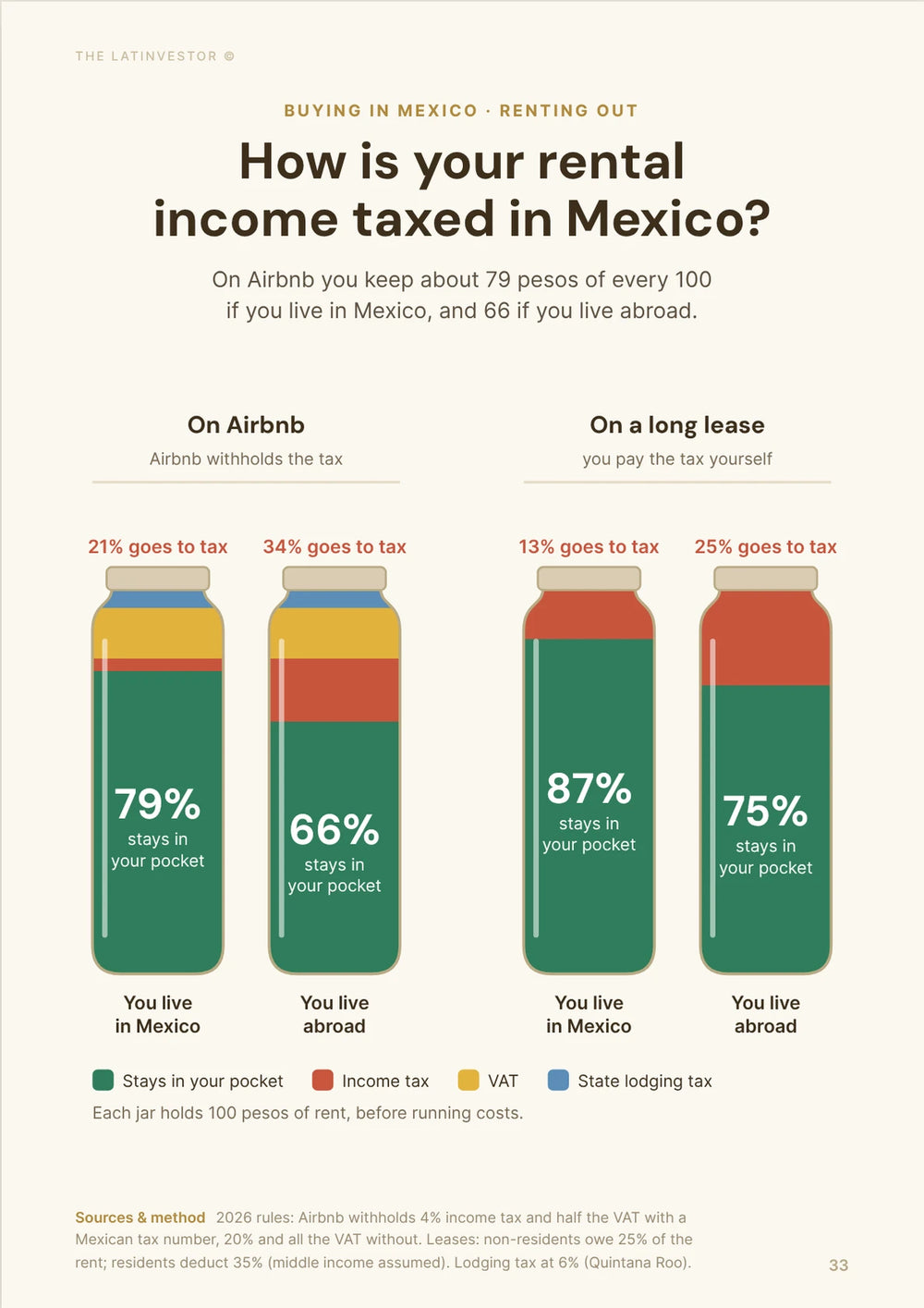
Airbnb collecting Quintana Roo's 6% lodging tax doesn't make you legal. It covers one tax, not your registration, license, land use or the 25% a non-resident owes on gross rent.
Land use is the hardest problem to fix after buying. A missing registration can be filed later; a unit whose permitted use doesn't allow tourist lodging may never get a license.
Condo documents matter almost as much. Forty listings in the same tower show what owners do today, not what the registered deed and regulations allow.
Enforcement is light for now, but it won't stay that way. In September 2026 the city said it wouldn't run verification visits yet, while the state and city databases keep filling up.
Safety is part of the deal: RETUR-Q comes with smoke and carbon-monoxide alarms, a fire extinguisher and a first-aid kit, and Playa ran more than 17,000 commercial safety inspections in 2025.
Fewer listings doesn't mean rules are killing the market. AirDNA counts 6,498 active rentals in September 2026, 60.2% fewer than a year earlier, but occupancy rose to 58% and nightly rates fell 19.2% to $103.
Bottom line: buy only a condo whose papers prove it can be licensed, ask the seller for the RETUR-Q number and the municipal license, and run the numbers after compliance costs and tax.

Did Playa del Carmen ban Airbnb?
No. You can still legally run an Airbnb in Playa del Carmen today, and the city now has an operating-license process that specifically covers accommodation offered through digital platforms.
That is stronger evidence than simply seeing thousands of live listings. Playa del Carmen's current municipal procedure for lodging businesses explicitly includes “servicios de hospedaje a través de plataformas tecnológicas digitales.” Hosts in this category must even declare the maximum number of guests their property can accommodate.
The city is tightening control, though. Earlier this year, Mayor Estefanía Mercado said Playa del Carmen would regulate Airbnb rentals and use municipal licensing to determine where they can operate. The procedure was updated on August 14, 2026, and the next day the city opened a registration platform it expects to cover about 16,000 vacation-rental listings.
The license itself isn't slow: the city says a complete file can be resolved in 3 to 5 business days. But it expires at the end of each fiscal year, so it has to be renewed every year.
The practical answer is straightforward: Airbnb remains legal, but the city increasingly expects a vacation rental to operate like a real lodging business rather than an informal side activity.
| Question | Answer today | What it means |
|---|---|---|
| Is Airbnb banned in Playa del Carmen? | No | Legal short-term rentals still exist |
| Does Playa del Carmen recognize platform rentals? | Yes | The municipal lodging procedure names them directly |
| Does every condo automatically qualify? | No | The specific property still has to meet local rules |
| Is regulation getting tighter? | Yes | Informal operation carries more risk now |
Why is Airbnb legality in Playa del Carmen suddenly so confusing?
Airbnb legality in Playa del Carmen is confusing because a host can satisfy one government requirement while still failing another.
There are several authorities involved. Mexico's federal tax system covers ISR and VAT. Quintana Roo has its own tourism registration and lodging-tax rules. Playa del Carmen handles municipal operating licenses and land use. Protection Civil deals with safety. The condominium's legal documents can create another restriction inside the building.
None of these approvals should be treated as a substitute for the others.
Take the most common misunderstanding. Airbnb currently adds Quintana Roo's 6% lodging tax to qualifying reservations and remits it. A host could therefore be paying the correct lodging tax while lacking the municipal paperwork needed to run accommodation at that address.
The reverse can happen too. A building may look perfectly suited to tourists, yet the individual host may still be missing RETUR-Q registration.
Most of the apparent contradictions around Playa del Carmen Airbnb rules come from mixing these layers together.
| Layer | Who handles it? | What it covers | Enough on its own? |
|---|---|---|---|
| Federal tax | SAT | ISR, VAT, platform income | No |
| State tax | Quintana Roo / SATQ | Lodging-related state obligations | No |
| State tourism | SEDETUR / RETUR-Q | Tourism-provider registration | No |
| Municipal | Playa del Carmen | Business license and local compliance | No |
| Land use | Playa del Carmen | Whether the activity fits the property | No |
| Building rules | Condominium | What owners and occupants may do | No |
What changed with RETUR-Q for Playa del Carmen Airbnb hosts?
RETUR-Q has become a real part of operating an Airbnb legally in Playa del Carmen, rather than paperwork a host can safely ignore.
RETUR-Q is Quintana Roo's state tourism registry. The state Tourism Law includes accommodation providers using digital platforms within the tourism-provider system, and the state has opened a specific 2026 registration and renewal process.
The application goes beyond entering a host's name. Current RETUR-Q guidance asks accommodation providers for information linked to their state tax status as well as evidence concerning the property and basic safety measures.
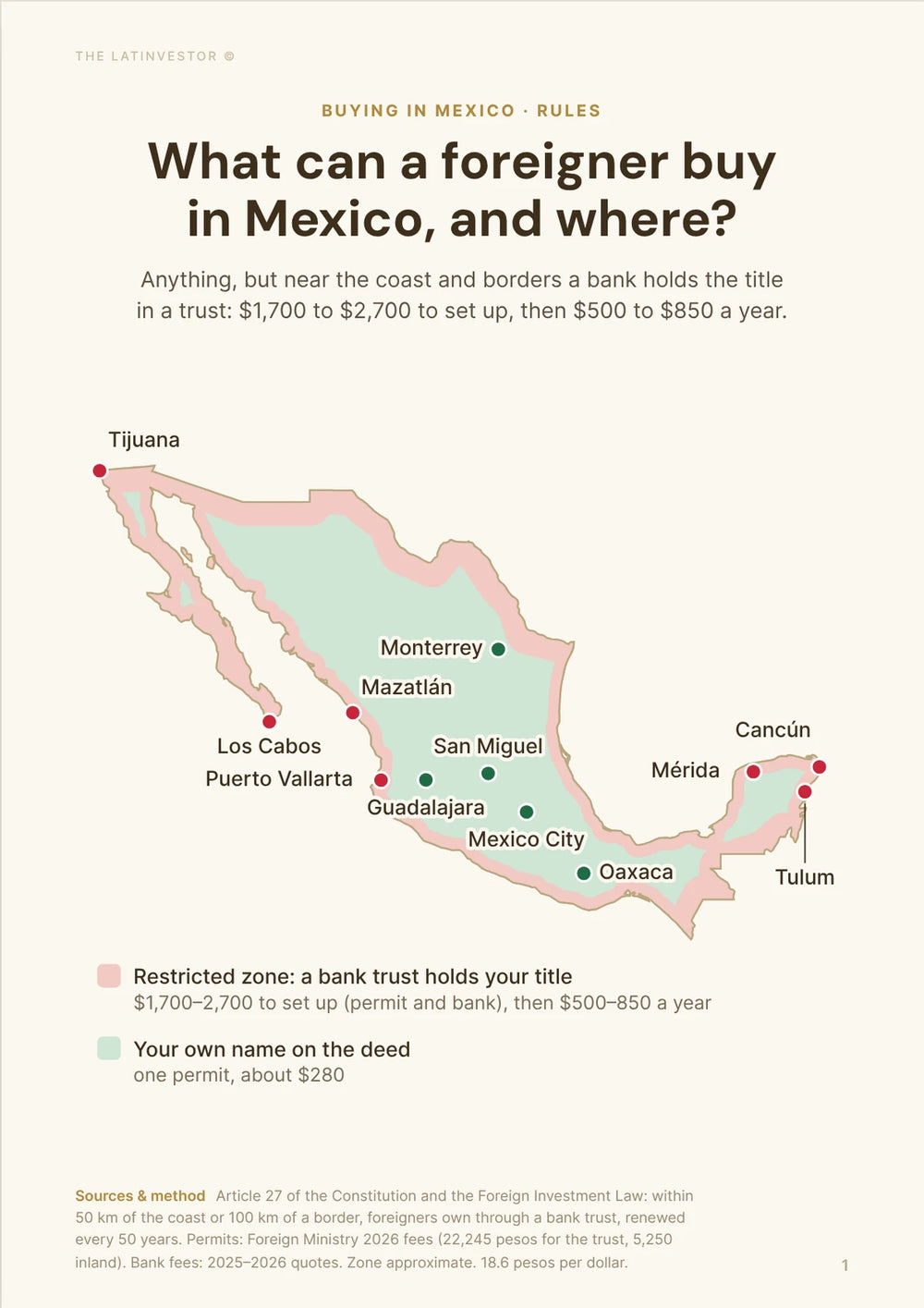
The state has set a clear rule: from 2026, platforms should only list properties that have the state registration. When the state's tourism secretary announced it in November 2025, a little over 3,000 tourism providers were registered, against about 40,000 properties the state estimated were used as vacation rentals. Fines for unregistered hosts can go above MXN 100,000 (about $5,380).
Quintana Roo has also been pushing platforms toward direct enforcement. During FITUR 2026, Governor Mara Lezama said digital platforms would have to configure their systems so that accommodation without the required registration could no longer be published. She also tied registration to basic safety measures such as smoke detection, fire extinguishers and first-aid equipment.
The filtering clearly isn't complete. Airbtics finds a short-term-rental license on fewer than 1% of Playa listings, so thousands of unregistered units are still online.
Still, relying on a listing being live is becoming a weak strategy. RETUR-Q is now firmly embedded in Quintana Roo's legal framework for vacation rentals.
If Airbnb collects the 6% lodging tax, am I already legal?
No. Airbnb collecting Quintana Roo's 6% lodging tax does not make a Playa del Carmen condo fully compliant.
Airbnb currently tells guests that reservations in Quintana Roo are charged a 6% lodging tax on the listing price, including applicable cleaning fees. Airbnb adds the tax to the reservation and handles its remittance.
That solves an important payment step, but only that step.
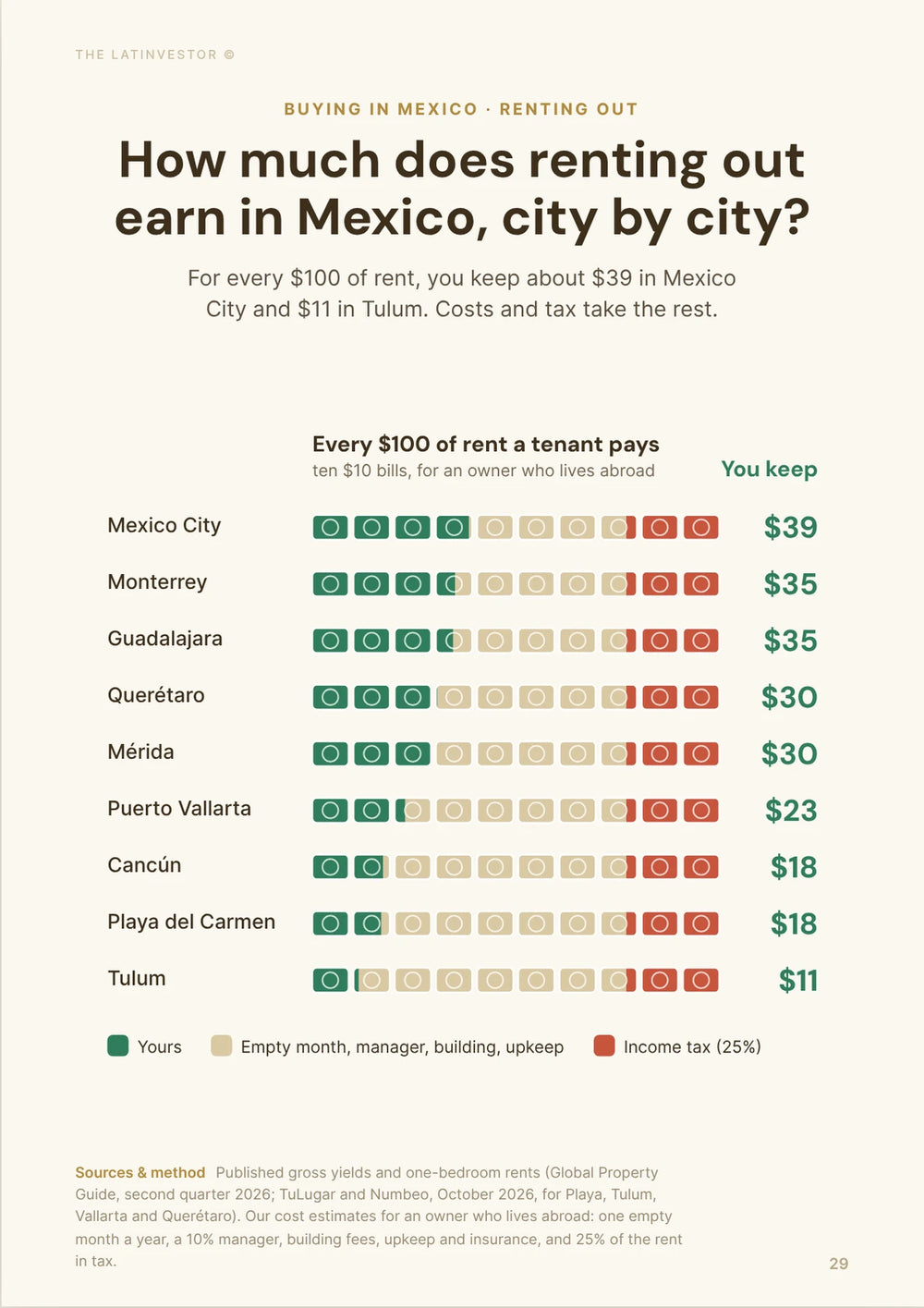
Hosts can still have federal ISR and VAT obligations connected with digital-platform income. A non-resident owner owes 25% of gross rent in income tax, with no deduction for costs. Quintana Roo also maintains registration requirements for accommodation providers. RETUR-Q sits on top of those tax obligations, while Playa del Carmen has its own municipal licensing process.
This distinction is particularly important for foreign buyers. Airbnb's checkout page can make the tax side feel automatic, yet the platform is not issuing the condo's land-use approval, municipal lodging license or RETUR-Q registration.
Paying the tax and having permission to operate are separate questions.
What does Playa del Carmen require from an Airbnb condo now?
A Playa del Carmen Airbnb now needs to be treated much more like a small lodging business when dealing with the municipality.
The city's current lodging-license procedure covers the opening and renewal of businesses providing accommodation. Its latest documentation explicitly includes lodging through technological and digital platforms.
The paperwork can involve federal tax information, proof of ownership or legal possession, property documentation and local municipal records. For platform accommodation, the owner must declare maximum guest capacity.
The wider licensing system also links business authorization with land-use and Protection Civil requirements. Playa del Carmen's own licensing information explains that a municipal operating license is the annual document authorizing a commercial or service establishment to operate and that the municipal process can connect with both commercial land use and Protection Civil approval.
Environmental sanitation has also entered the same compliance chain. Current municipal lodging paperwork requires validation concerning the Derecho de Saneamiento Ambiental when applicable, particularly for renewals and related license procedures.
So an owner looking only for an “Airbnb permit” is asking the wrong question. The municipality currently treats vacation rentals through several connected approvals.
| Municipal issue | What the city checks | Why a host should care |
|---|---|---|
| Operating license | Whether the lodging activity is registered | Core municipal authorization |
| Guest capacity | Maximum occupancy | Platform rentals are specifically asked to declare it |
| Land use | Whether the activity fits the property | Can create a property-level obstacle |
| Protection Civil | Safety compliance | Required within the wider licensing process |
| Property documents | Ownership or legal possession | Operator must justify the right to use the unit |
| Sanitation obligations | Local environmental charge compliance | Can affect the municipal file and renewals |
Is land use the biggest Airbnb risk when buying a condo in Playa del Carmen?
For many buyers, yes. Land use is one of the hardest Airbnb problems to fix after purchasing the wrong Playa del Carmen condo.
A missing registration is usually an administrative problem. An owner can file paperwork, supply documents and pay what is due. A land-use problem can run much deeper because it concerns what activities the property itself is allowed to host.
Playa del Carmen currently has a formal Constancia de Uso de Suelo Giro Comercial procedure. Municipal approval depends on the applicable urban-development rules for the property.
This has become especially relevant because the city government has publicly connected its Airbnb policy with where vacation rentals should be allowed. The mayor said earlier this year that the municipality wanted to regulate platform rentals partly because of their effect on housing and rents.
That does not mean a simple map currently divides Playa del Carmen into Airbnb neighborhoods and banned neighborhoods. We found no blanket rule like that in the current municipal procedures.
Residential zoning also needs more nuance than many sales pitches suggest. Playa del Carmen has a special operating-license route for certain low-risk businesses located in residential areas that cannot obtain an ordinary commercial land-use certificate. That procedure can require a Development Urban document and even consent from ten neighbors.
We would not assume that route automatically works for every Airbnb. Its existence simply shows why “residential equals impossible” is too crude.
Before buying, the useful question is whether this specific condo has a defensible route to the land-use authorization required for its rental activity.
Can a Playa del Carmen condo association stop Airbnb rentals?
Yes, condominium documents can create a serious Airbnb problem in Playa del Carmen even when short-term rentals remain legal in the city generally.
Quintana Roo's condominium law gives an owner the right to lease a privately owned unit without asking the other owners for permission every time. But the same law requires owners and occupants to respect the destination established for the property and the restrictions contained in the constitutive deed and condominium regulations.
That is the part buyers often miss.
An owner's general right to rent does not automatically override every properly established rule governing how the condominium can be used. At the same time, an HOA should not be assumed to have unlimited power to wipe out rental rights with any ordinary vote.
The legal wording makes the registered documents unusually important. We would want the constitutive deed, current condominium regulations and any registered amendments. Recent assembly minutes are useful too because they show whether owners are actively fighting over short-term rentals.
There has also been political interest in giving condominium assemblies clearer powers over short-term rentals in Quintana Roo. Proposals and debates should not be confused with enacted law. The current statewide condominium rules remain the starting point.
“Airbnb friendly” has very little value as a verbal promise. We would want to know exactly what the registered building documents say.
| Evidence | How useful is it? | What it actually proves |
|---|---|---|
| Agent says “Airbnb friendly” | Very weak | Almost nothing legally |
| Many units are on Airbnb | Weak | Rentals are currently happening |
| Building manager confirms rentals | Moderate | Current building practice |
| Recent assembly minutes | Stronger | Current owner sentiment and disputes |
| Registered condo regulations | Strong | Formal building rules |
| Constitutive deed | Very strong | Legal destination and structure of the condominium |
Do I still need RETUR-Q if Airbnb lets me publish the listing?
Yes. A live Airbnb listing in Playa del Carmen should not be treated as proof that RETUR-Q is optional.
Quintana Roo's tourism system requires covered tourism providers to register, and the state has been moving toward linking digital-platform listings more closely with that registration.
The gap between law and what someone can physically click on Airbnb is important. A platform can take time to update onboarding, validate existing inventory or remove non-compliant listings. Enforcement can also arrive in stages.
That makes the logic “Airbnb accepted my property, therefore the government approved it” particularly risky these days.
State officials have been unusually explicit about the direction of travel. Quintana Roo wants digital platforms to stop carrying lodging that is not properly registered. Even if some listings still slip through or remain online during the transition, that does not change the host's underlying obligation.
For someone buying a condo now, we would underwrite the property on the assumption that registration will be checked more closely over time, not less.
Is Playa del Carmen actually enforcing Airbnb rules now?
Partly. Playa del Carmen now has the machinery to identify and license vacation rentals, but in September 2026 it said it wouldn't send inspectors to check hosts yet.
The clearest evidence is the municipality's lodging-license procedure, updated on August 14, 2026, which names platform rentals directly, and the registration platform opened on August 15. Municipal Treasurer Guillermo Brahms González said in early September that there would be no verification visits "for now".
That follows the mayor's earlier announcement that Airbnb properties would be brought into a municipal licensing system and that the city wanted control over where these rentals operate.
Quintana Roo is moving in the same direction from the state level. RETUR-Q's 2026 renewal process is active, platforms are supposed to show only registered rentals, and fines can top MXN 100,000 (about $5,380).
Those actions are more important than counting occasional fines. A licensing system, a tourism registry, tax records and platform registration numbers can eventually be matched against one another. Once an address appears in one database but not another, finding informal rentals gets much easier.
Playa del Carmen also already has meaningful inspection capacity on the business side. The municipality reported more than 17,000 commercial safety inspections during 2025 across its broader Protection Civil activity. That figure is not an Airbnb inspection count, but it shows that the city has an operating inspection apparatus rather than a licensing system that exists only on paper.
"No visits for now" is a grace period, not an amnesty. We would take current Airbnb compliance rules more seriously than we would have a few years ago.
What should a Playa del Carmen Airbnb owner do now that registration is open?
Register now, while the city is still in its no-inspection phase. Fixing paperwork today is cheap compared with a fine above MXN 100,000 (about $5,380) or a listing that a platform removes.
Start with RETUR-Q on the state's SEDETUR portal, since platforms are meant to check it. Then file for the municipal lodging license: a complete file can be resolved in 3 to 5 business days, and the city also wants the environmental sanitation fee paid and Protection Civil approval.
Put the renewal in your calendar. The municipal license expires at the end of each fiscal year, so it has to be renewed every year, not filed once and forgotten.
If you're buying a unit that is already rented out, make the seller's RETUR-Q number and municipal license part of the deal. If neither exists, price in the time and cost of registering it yourself, and check the land use and condo rules first: if those block it, no amount of paperwork will fix it.
Does a normal Playa del Carmen Airbnb really need Protection Civil compliance?
Yes. Even a small Playa del Carmen Airbnb can face safety requirements because the unit is being used as tourist accommodation.
Quintana Roo has tied RETUR-Q registration to basic safety and Protection Civil measures. State officials have specifically mentioned smoke and carbon-monoxide detection, fire extinguishers, first-aid kits and safe management of gas equipment.
Playa del Carmen's municipal licensing system also connects business operation with Protection Civil approval.
For condo owners, the awkward part is that safety exists at two levels. The unit can have smoke detectors and an extinguisher while the building has its own emergency exits, common-area equipment and evacuation procedures.
A host controls the first group much more easily than the second.
That is one reason a professionally run condo building can be safer from an investment perspective. Management accustomed to vacation rentals is more likely to understand the documentation and common-area requirements that individual owners cannot fix alone.
Is Playa del Carmen about to restrict Airbnb to certain neighborhoods?
Playa del Carmen wants more control over where Airbnbs operate, but there is currently no simple citywide list saying that entire neighborhoods such as Centro or Zazil-Ha are automatically legal or illegal.
The mayor has openly said the city wants to determine where Airbnb activity can operate. That makes location a real regulatory issue rather than speculation.
The mechanism currently visible in municipal procedures is land use. Properties are assessed under zoning and urban-development rules, and commercial activities need the appropriate authorization.
That produces a much messier reality than a neighborhood map.
Two condo buildings on nearby streets can have different legal histories, land-use approvals, condominium structures or construction permits. One may have an easy path to compliant tourist accommodation while the other has been running Airbnbs mainly because enforcement was loose.
The city's broader planning rules are also still evolving. Playa del Carmen launched public consultation on a new urban-development plan earlier this year, which means buyers should be careful about assuming that today's urban framework will stay untouched for decades.
For now, property-level documents tell us more than neighborhood folklore.
Are Playa del Carmen Airbnbs disappearing because of the new rules?
Playa del Carmen still has a huge short-term-rental market, although the latest supply data shows a striking drop that deserves attention rather than a simplistic “Airbnb is dying” conclusion.
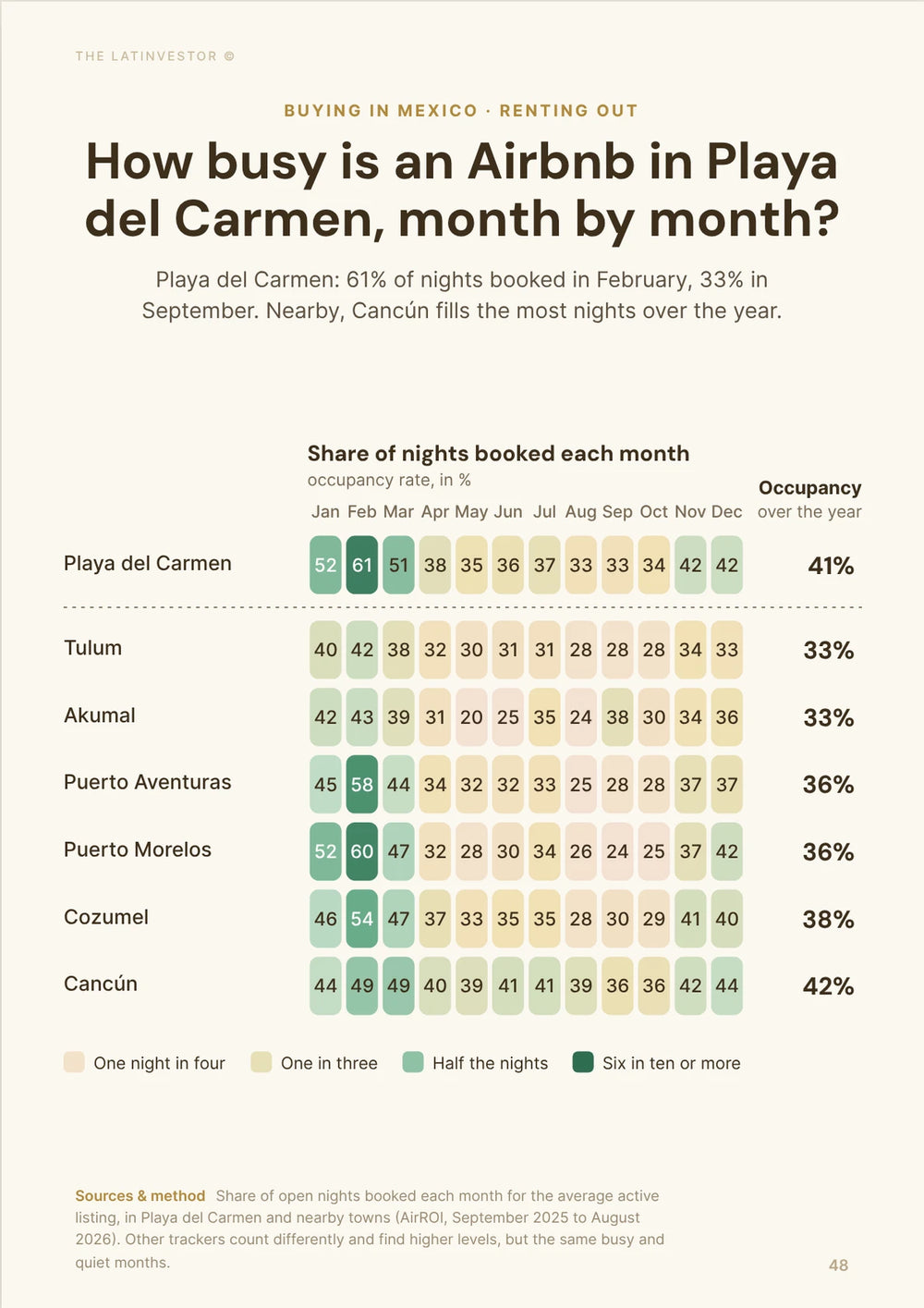
AirDNA counts 6,498 active short-term rentals across Airbnb, Vrbo and Booking.com in September 2026. That is still a very large base.
More surprisingly, that is 60.2% fewer than a year earlier.
We should be cautious with that number. AirDNA's counts also fell by half or more in Cancún, Puerto Vallarta and Tulum over the same year, which points to a change in how listings are counted. Its definitions and methodology can produce sharp changes, and a one-year supply comparison does not tell us how many properties disappeared because of regulation, owner decisions, duplicate listings, platform changes or ordinary market churn.
Other metrics argue against reading the fall as simple market collapse. AirDNA reports 58% average occupancy, up from a year earlier, while revenue per available night rose 3.9%. Average nightly rates fell 19.2% to $103.
That combination looks more like a market being reshuffled than one where guests have stopped coming. Fewer tracked listings are sharing demand at lower nightly prices, while revenue per available night has stayed slightly ahead of last year.
Regulation could be one contributor to the supply reset, particularly as informal hosts face more paperwork. We do not have strong enough evidence to assign most of the decline to regulation alone.
| AirDNA metric, 12 months to Sep. 2026 | Current level | Year-over-year change | What we take from it |
|---|---|---|---|
| Active listings | 6,498 | -60.2% | Supply has contracted sharply in the dataset |
| Occupancy | 58% | Up | Remaining supply is filling more nights |
| Average daily rate | $103 | -19.2% | Pricing has become more competitive |
| Revenue per available night | - | +3.9% | Revenue per available night has held up |
| Average annual revenue | $18,800 | About +100% | Market mix has changed dramatically, so this figure needs caution |
What is the biggest trap when buying an “Airbnb-friendly” condo in Playa del Carmen?
The biggest trap is assuming that current Airbnb activity proves the condo has a legal right to keep operating that way.
A buyer tours the property, sees lockboxes in the lobby, finds 40 listings from the same building on Airbnb and hears the agent say short-term rentals are allowed. That can feel like overwhelming evidence.
Legally, it is surprisingly weak.
Those listings tell us that people are renting today. They do not tell us whether each host has RETUR-Q, whether the property's land use supports the activity, whether municipal operating licenses exist or whether the condominium documents clearly allow the use.
The strongest properties now are the ones where several pieces line up. The building documents support short stays, the land-use position is clear, current operators can show municipal compliance, and RETUR-Q registration is routine rather than unusual.
This can create a real split in the market. Two condos with similar furniture, location and rental revenue may deserve different valuations if one has clean documentation and the other relies on years of informal tolerance.
That legal difference is becoming harder to ignore in Playa del Carmen.
What should I check before buying a Playa del Carmen condo for Airbnb?
Before buying a Playa del Carmen condo for Airbnb, we would want documents proving the rental can work legally at that exact property, rather than assurances that Airbnb is generally allowed in the city.
Start with the condominium's constitutive deed and current regulations. The language describing the unit's permitted use matters, as do any clauses dealing with rentals, guests or commercial activity.
Then check the property's municipal position. We would want to understand the applicable land use and whether comparable units in that building have actually obtained lodging operating licenses. Seeing a real license from the same building is far more useful than hearing that one supposedly exists.
The state side comes next. The host needs to understand SATQ obligations and current RETUR-Q requirements. Protection Civil should also be checked before purchase if compliance depends on building-wide equipment or approvals.
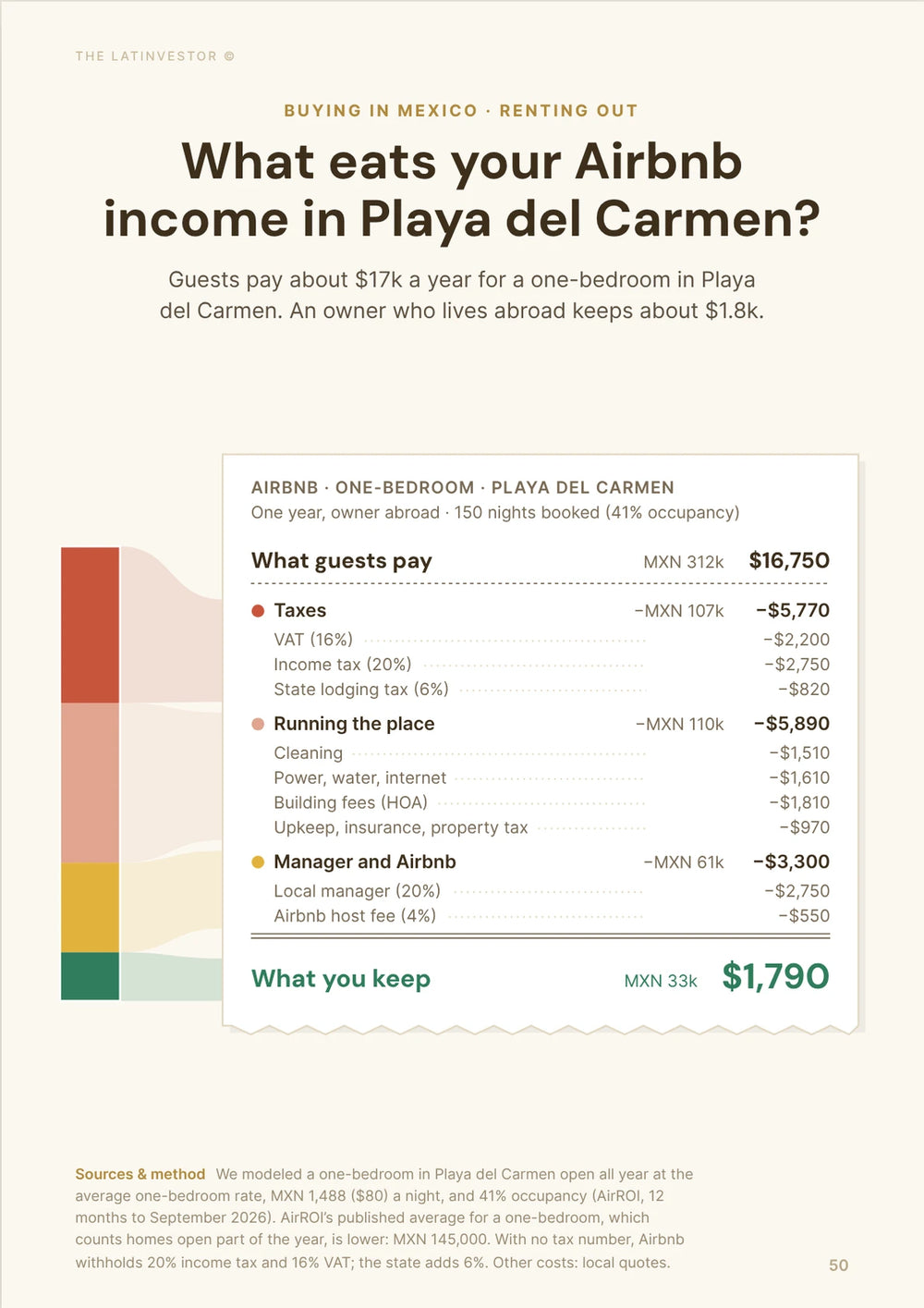
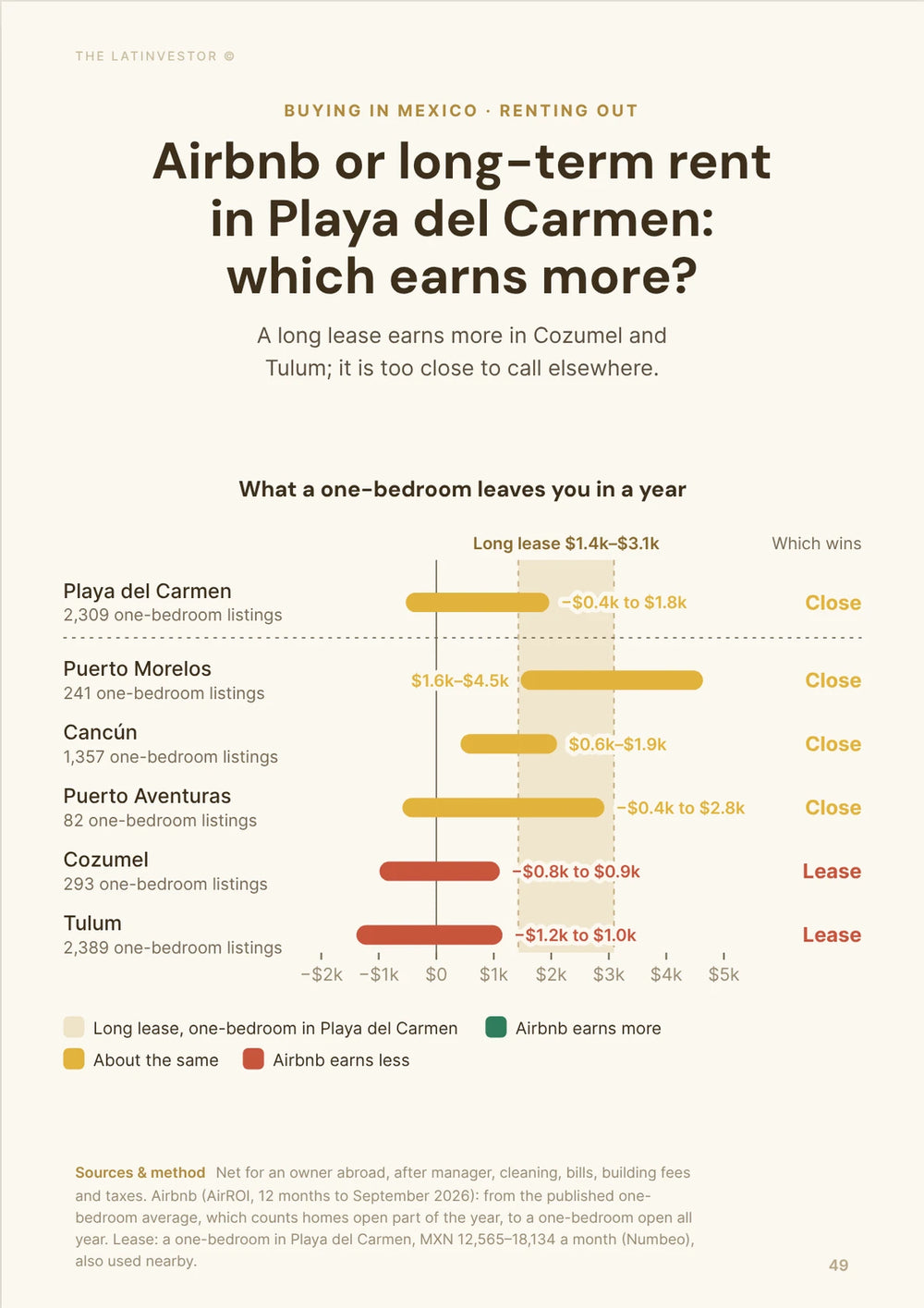
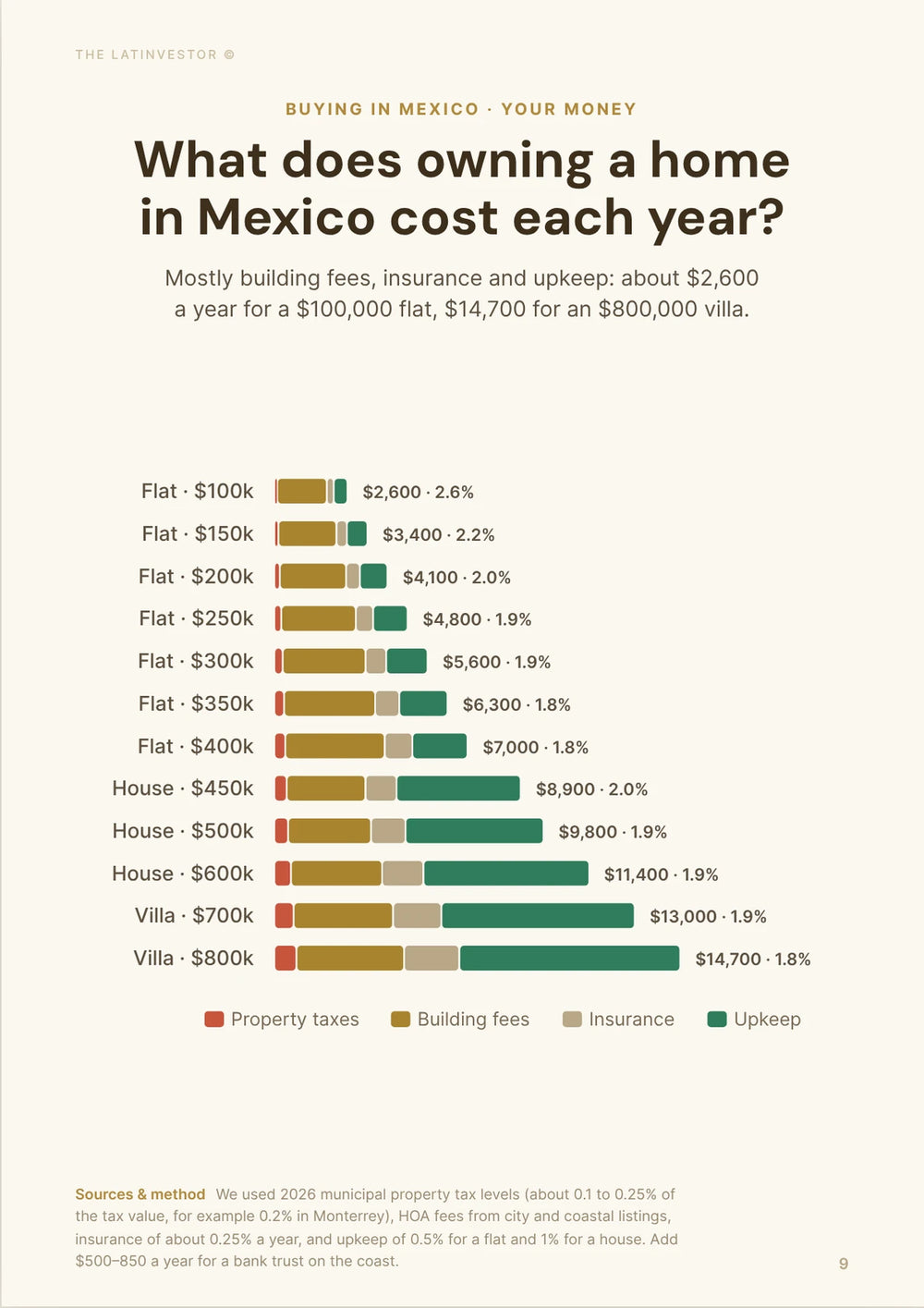
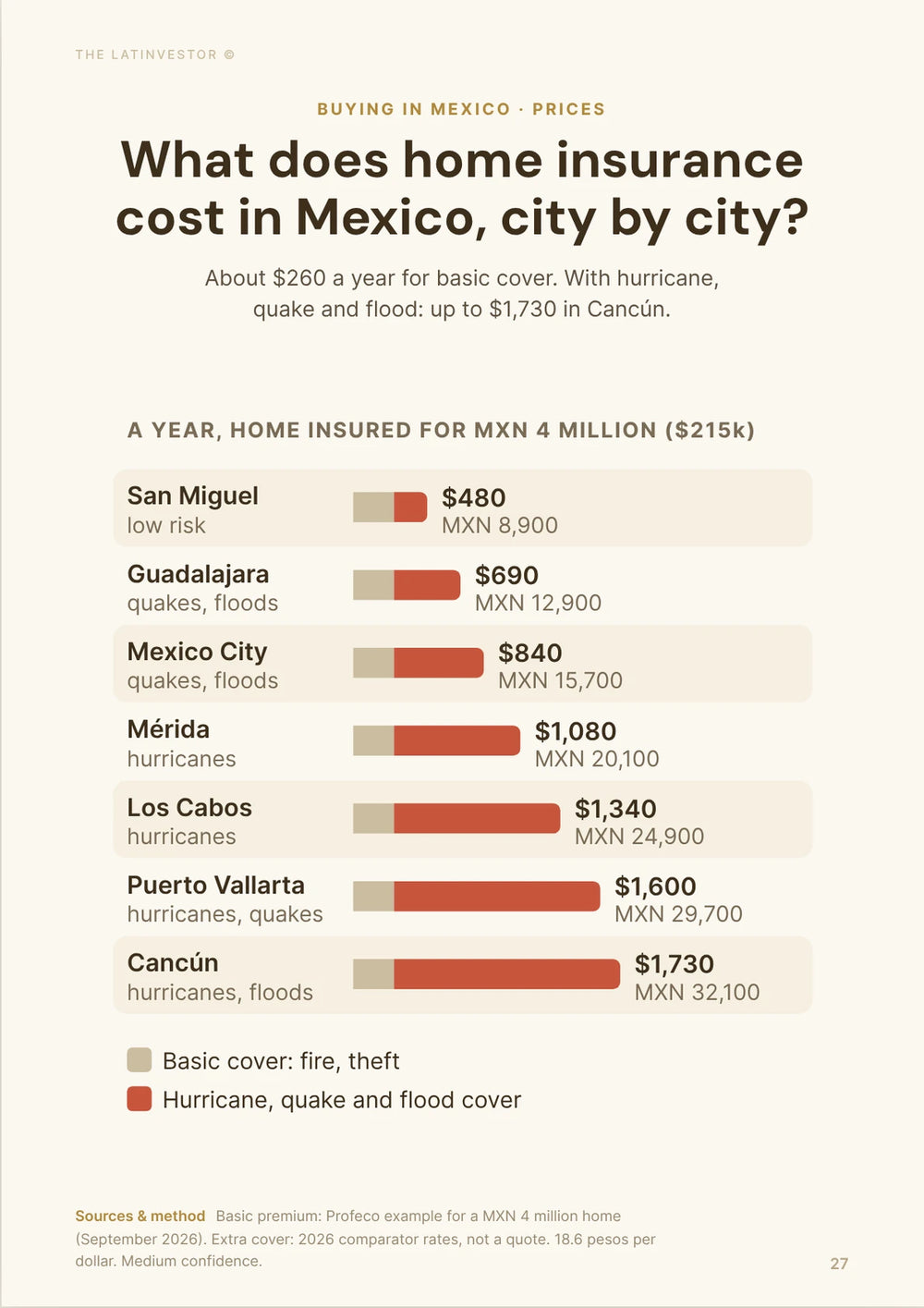
Finally, rerun the financial model using the compliant version of the business. AirDNA's average Playa rental earns about $18,800 a year before costs. Take the 25% a non-resident owes on gross rent (about $4,700) and you're near $14,100, before management, HOA fees, sanitation fee, insurance, safety equipment and licensing.
A condo can pass every legal check and still be a bad Airbnb investment. But failing a legal check can make the revenue projection irrelevant.
| What to verify | What we would ask to see | What we would not accept as proof |
|---|---|---|
| Condo permits short stays | Registered deed and regulations | “The agent confirmed it” |
| Land use works | Municipal land-use documentation | “The whole area has Airbnbs” |
| Municipal lodging is possible | Current license from the unit or comparable units | Airbnb listing screenshots |
| State registration works | Current RETUR-Q documentation | Host says tax is automatic |
| Safety is manageable | Protection Civil requirements and building records | “The building is new” |
| Rules are stable | Recent assembly minutes | “Nobody has complained before” |
| Rental economics work | Net income after compliance costs | Gross revenue screenshots |
So can I still legally Airbnb a condo in Playa del Carmen?
Yes. You can still legally Airbnb a condo in Playa del Carmen today, but legality now depends much more on the exact condo you buy than on the fact that Airbnb operates in the city.
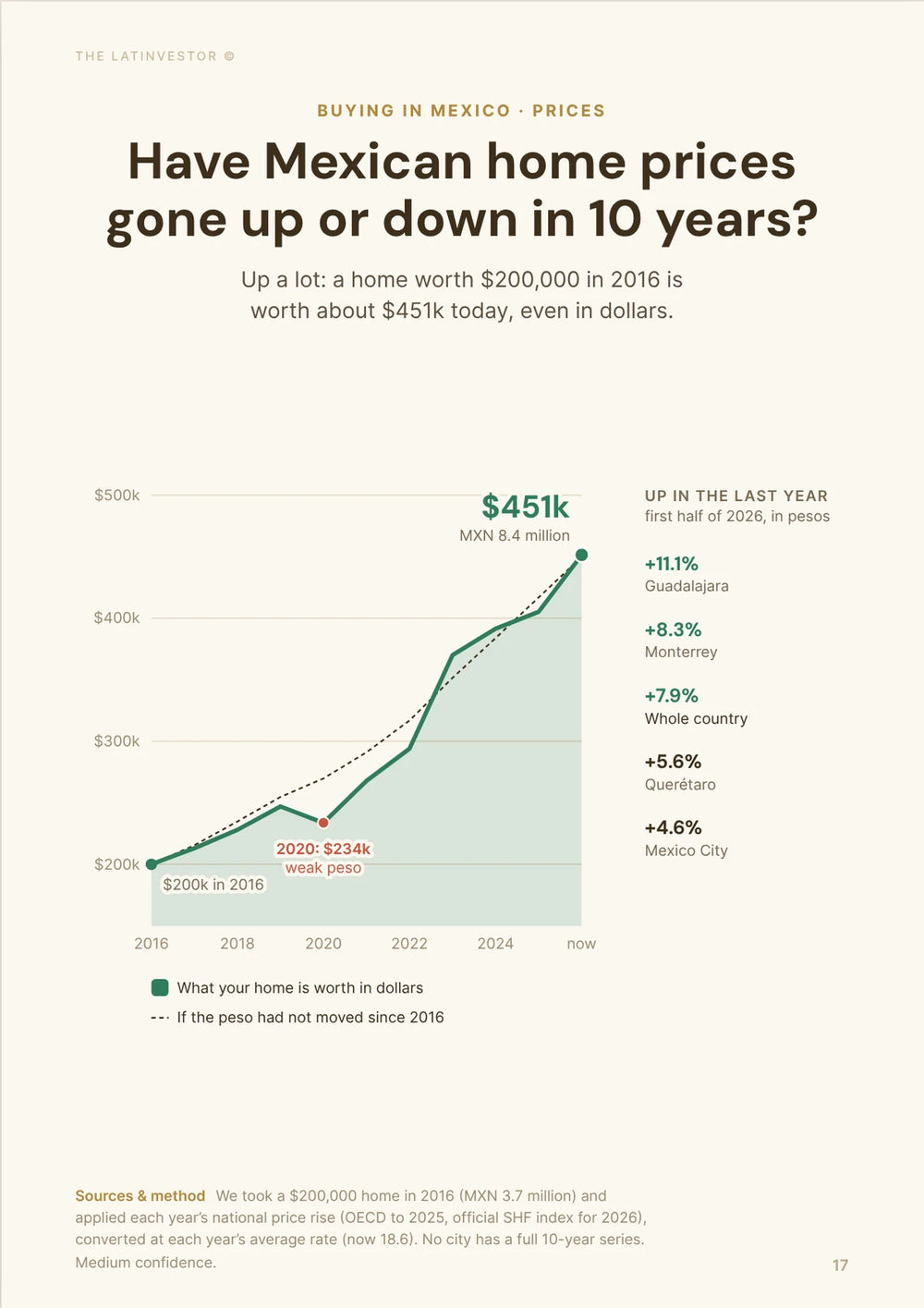
The evidence is clear enough to reject the idea of a citywide Airbnb ban. Playa del Carmen currently has a municipal lodging-license procedure that explicitly includes digital-platform accommodation. Quintana Roo continues to register vacation-rental providers through RETUR-Q. AirDNA still tracks about 6,500 active short-term rentals in the city.
At the same time, buying any condo and assuming Airbnb will work is becoming a poor bet.
The rules have teeth now: platforms are meant to list only registered rentals, and fines can top MXN 100,000. A serious owner has to think about RETUR-Q, state tax obligations, municipal licensing, land use, Protection Civil and the condominium's own legal documents. Airbnb collecting the 6% lodging tax covers only one piece of that puzzle.
The biggest change these days is the gap opening between documented rentals and tolerated rentals.
A condo with compatible land use, supportive building documents, current registration and a workable municipal licensing path can still operate legally. Another condo in the same part of Playa del Carmen may fail because its documents do not support tourist lodging.
That is the answer we would use when buying today: Airbnb is still legal in Playa del Carmen, but “Airbnb-friendly” is no longer enough. The property itself needs to prove it.
Our methodology
This article asks whether you can still legally run a condo as an Airbnb in Playa del Carmen. We looked at the rules layer by layer: federal tax, state registration and lodging tax, the city's license and land-use procedures, condo law, safety, enforcement, and the rental market itself.
We relied first on official and recent sources: the city's lodging-license procedure (updated August 14, 2026), its land-use and sanitation procedures, Quintana Roo's Tourism Law and condo law, SEDETUR's RETUR-Q portal and the governor's FITUR 2026 statement. News reports from Riviera Maya News and Diario de Yucatán (November 2025 to September 2026) were used for the 2026 platform rule, the fines, the August 15 registration platform and the decision not to run verification visits for now.
Taxes come from SAT (income from platforms and the 25% tax on a non-resident's gross rent), the state lodging-tax law and Airbnb's own page on the 6% Quintana Roo tax it collects. We kept tax separate from permission to operate.
Market figures come from AirDNA (Airbnb, Vrbo and Booking.com, 12 months to September 2026) and, for the share of licensed listings, Airbtics. We never mixed the two in one calculation, and we treated AirDNA's 60% fall in listings with caution because its counts dropped across all Mexican beach markets at once.
We checked these figures in October 2026. Conversions use about 18.6 pesos per US dollar and 20.9 pesos per euro.
Limits: rules are applied unevenly, and announcements are not always enforced on schedule. Whether a given condo can be licensed depends on its own land use and registered documents, which no citywide figure can tell you. Rental trackers estimate activity from calendars and can change their methods.
Key sources used for this analysis include Playa del Carmen's lodging-license procedure, the commercial land-use certificate procedure, the general land-use certificate procedure, the special operating-license route, the Derecho de Saneamiento Ambiental procedure, Quintana Roo's Tourism Law, SEDETUR's RETUR-Q portal, SEDETUR's 2026 state regulation page, the Quintana Roo government's FITUR 2026 statement, Riviera Maya News on the 2026 platform rule, Riviera Maya News on RETUR-Q fines, Riviera Maya News on the city's registration platform (September 2026), Diario de Yucatán on the city's rental app (August 2026), Quintana Roo's lodging-tax law, SATQ / SEFIPLAN guidance for platforms and hosts, SAT guidance for individuals using digital platforms, SAT's rules on platform rental income, Airbnb's Mexico tax-collection page, Quintana Roo's Condominium Property Law, Playa del Carmen's Protection Civil report, the city's 2026 urban-development-plan consultation, AirDNA's Playa del Carmen market overview and Airbtics' Playa del Carmen rental data.