
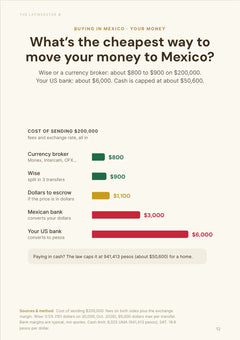
Summary
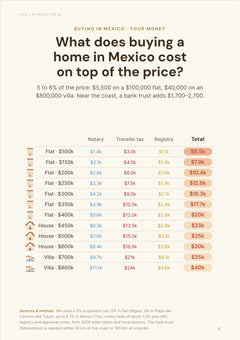
Annual property tax (predial) in Mexico is usually small, but buying is not cheap: plan on about 6% to 9% of the price in closing taxes and fees until a notary gives you an exact quote.
Predial is the easiest number to compare with the US or Canada, which is why people focus on it. On most deals, acquisition tax, deed costs and registration cost more than several years of predial.
There is no national predial rate. Each municipality sets its own cadastral values and tariffs, and 2026 broker estimates range from about 0.05% to 0.36% of cadastral value in Mexico City to 0.15% to 0.25% in Quintana Roo.
Cadastral values often sit well below market prices, which keeps bills low. That gap is closing in places: Jalisco municipalities have proposed table increases above 10% and 15%, and Los Cabos wants new cadastral values.
Acquisition tax is the big one, and it has gone up in some beach towns. Playa del Carmen has charged 4% since December 2025, Tulum charges 4%, Los Cabos 3%, while Guadalajara works out at about 2.81% on a MXN 2.5 million home.
Writing a lower price in the deed doesn't work: a MXN 6 million home doesn't become a MXN 4 million tax deal, because Mexico City can tax the highest of the price, the cadastral value and the appraisal. A low recorded price also raises your tax when you sell.
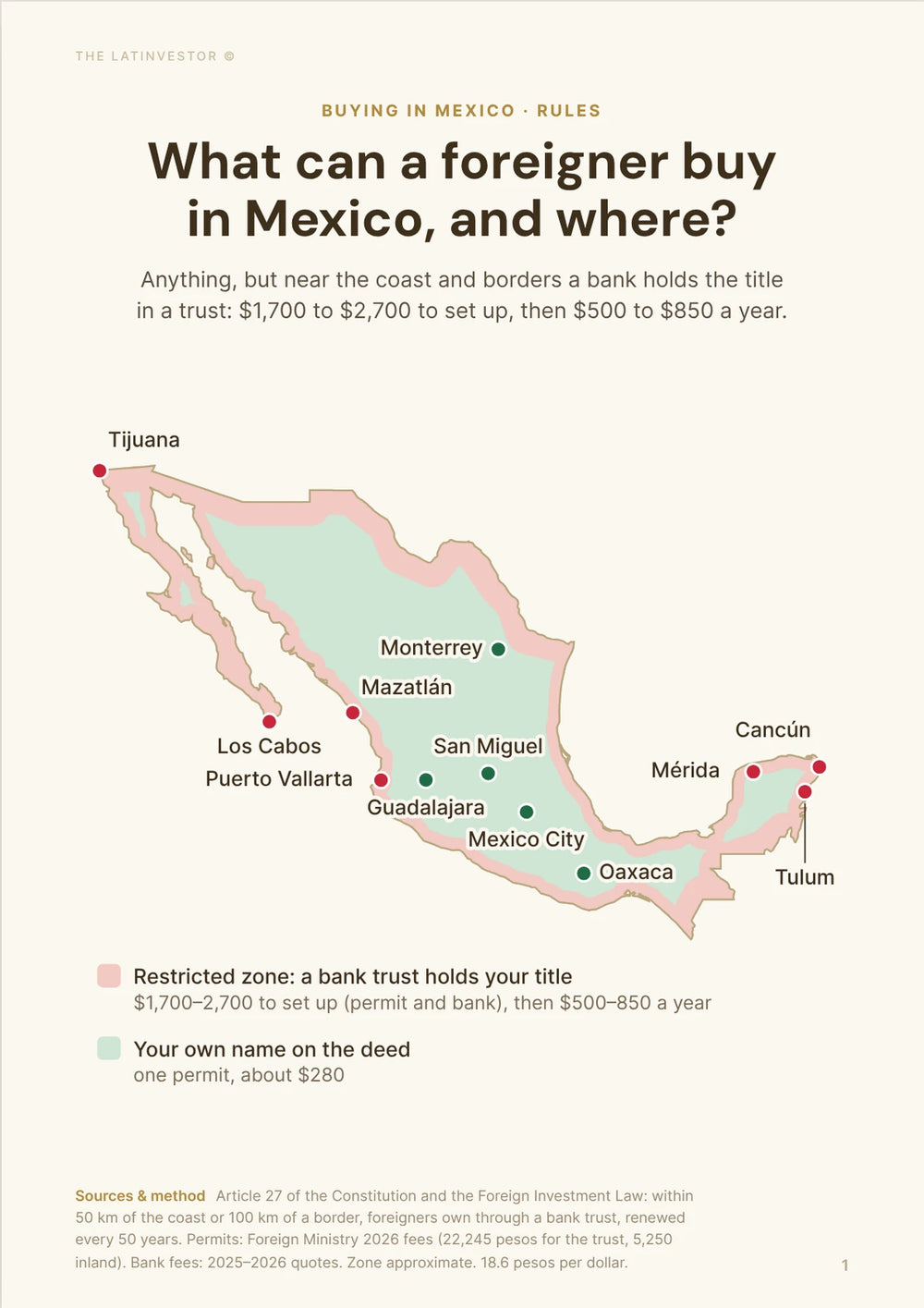
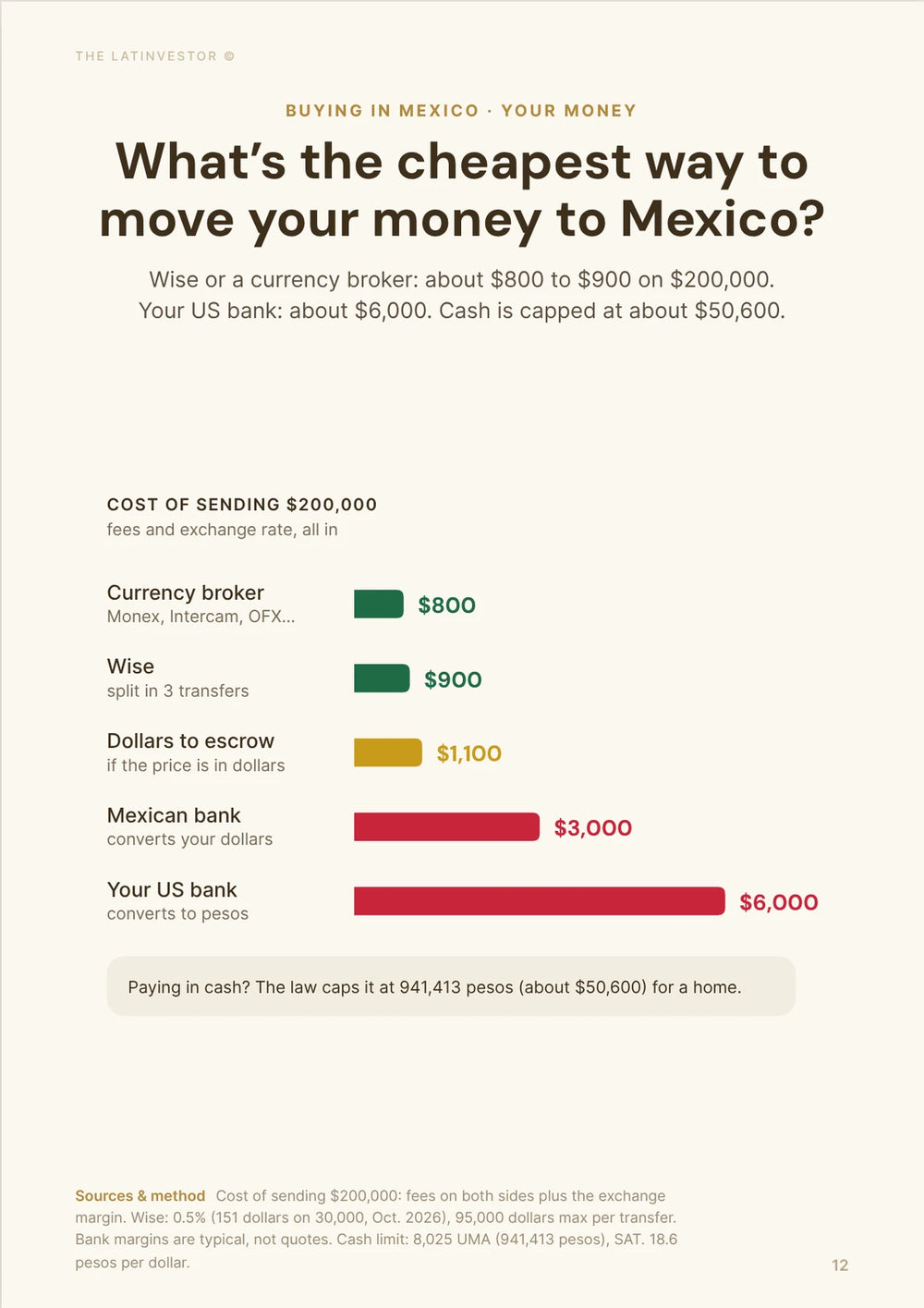
Foreigners pay the same predial as Mexicans. The extra cost is the fideicomiso needed within 50 km of the coast or 100 km of a border: a MXN 21,650 federal permit, plus bank fees of roughly USD 550 to 800 to set up and USD 550 to 700 a year. The trust pays none of your other bills: predial, HOA fees and insurance stay yours.
A normal home purchase doesn't carry the 16% IVA. VAT shows up on services such as notary and trustee fees, and on short-term lodging.
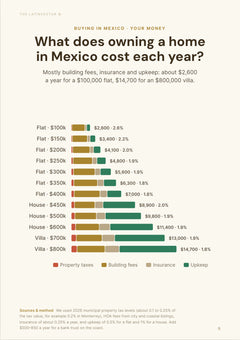
HOA fees often cost far more than predial: MXN 4,500 to 12,000 a month in a beach-zone condo in Tulum or Playa del Carmen, versus MXN 1,500 to 4,000 for a mid-range condo in Mérida or Guadalajara.
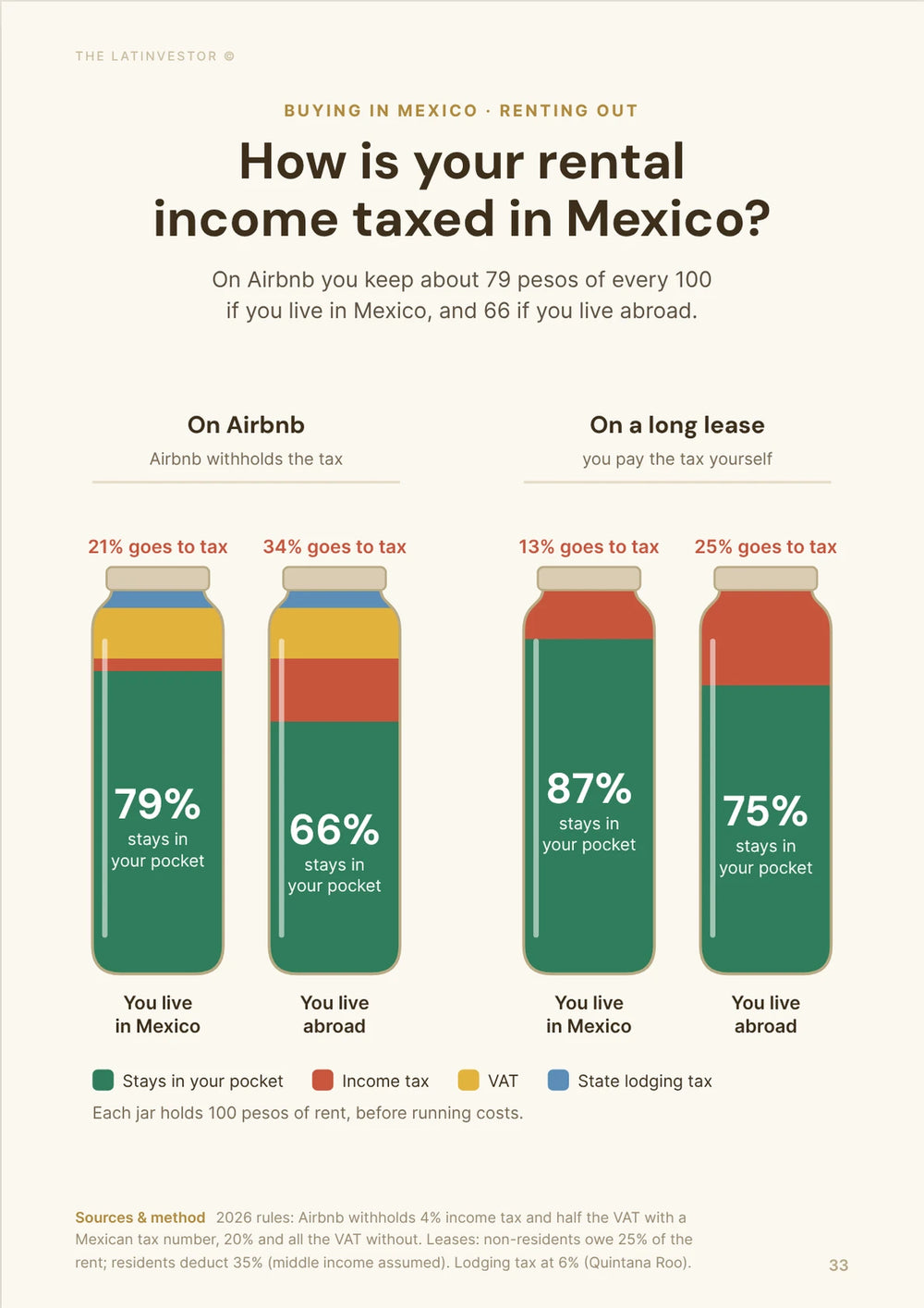
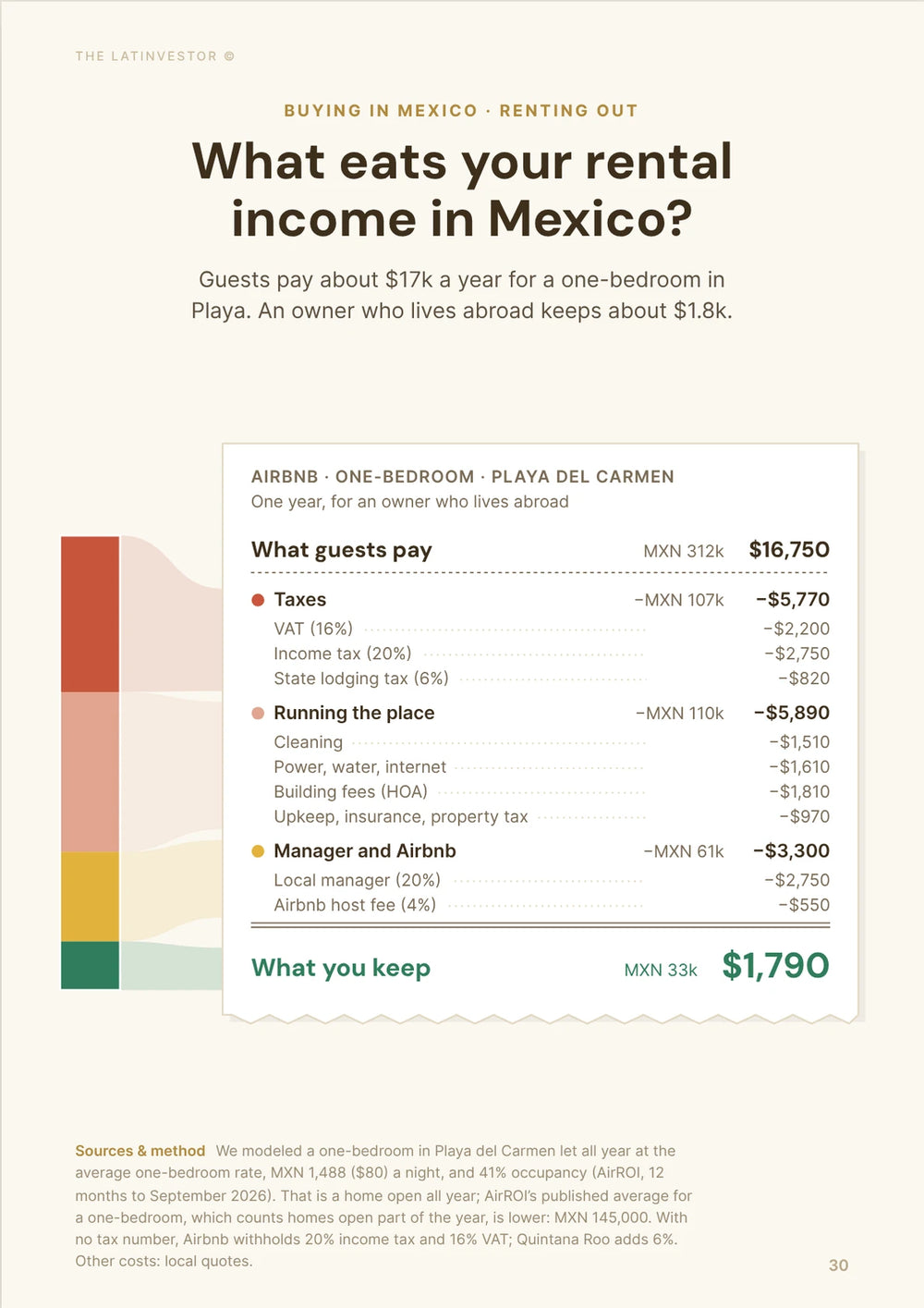
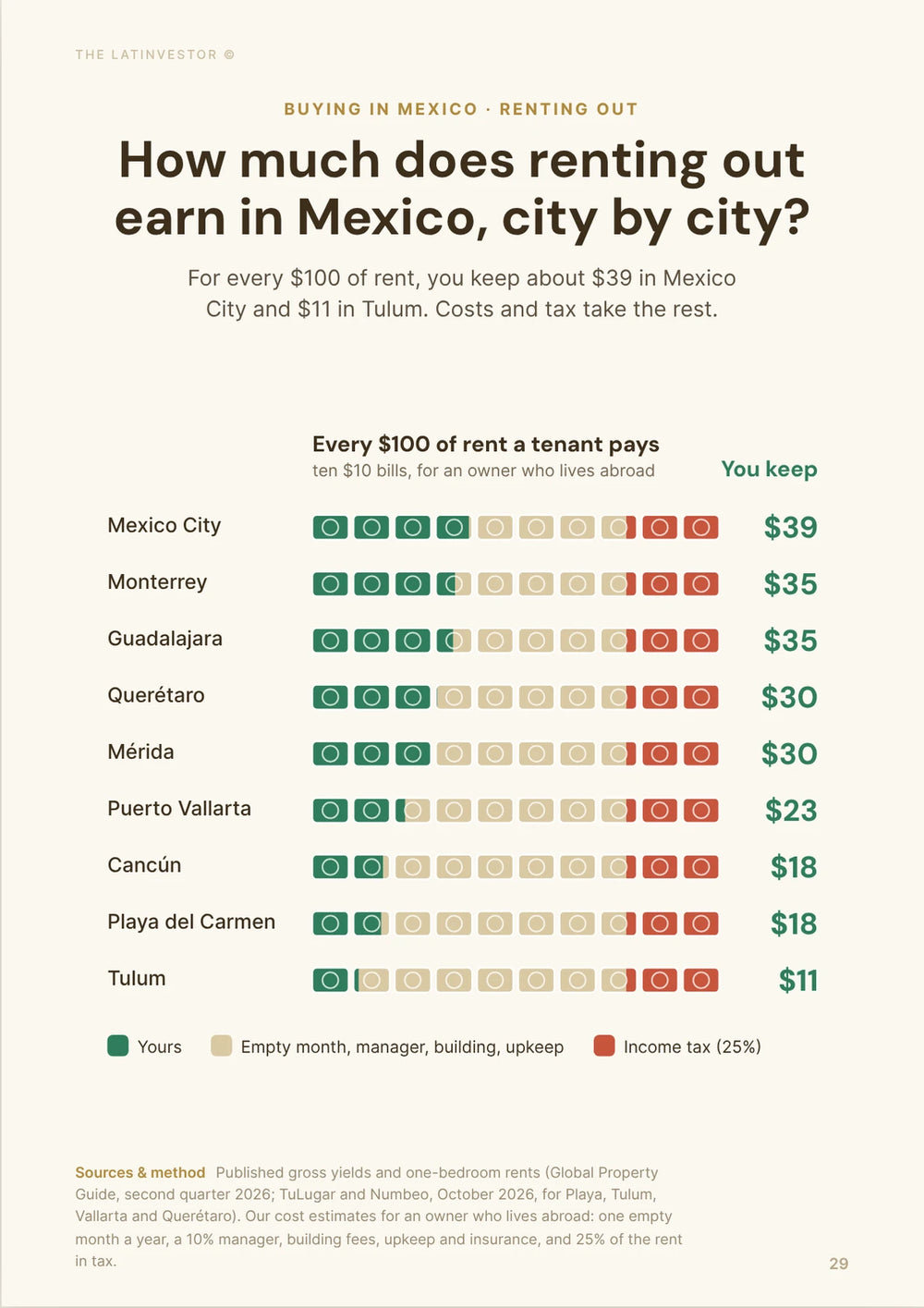
Renting changes the tax bill. Non-resident landlords face 25% withholding on gross rent, and Airbnb hosts without a valid RFC get 20% held back by the platform instead of 4%.
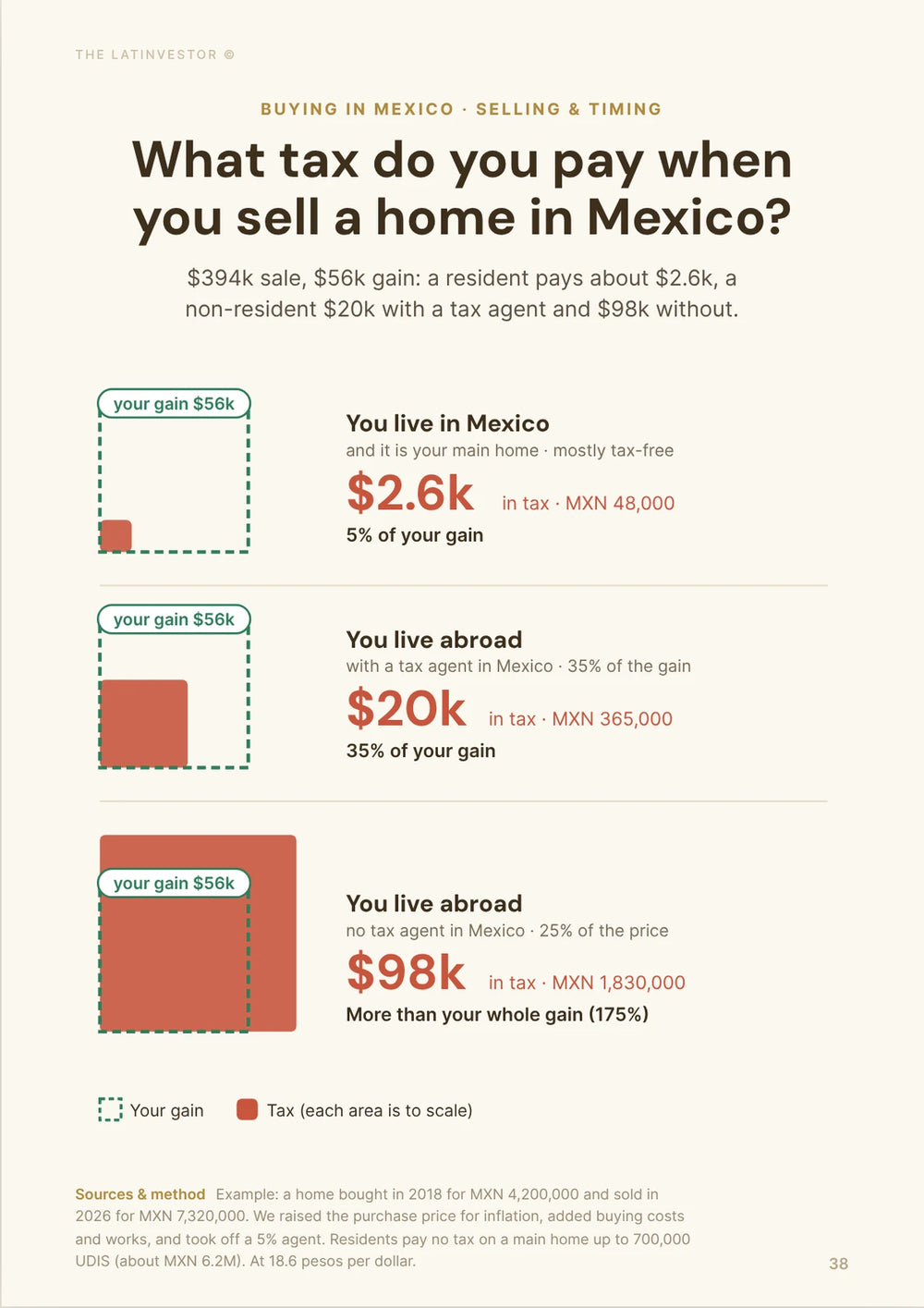
Selling can cost the most of all: non-residents face a default 25% of the gross sale price, or up to 35% of the net gain under the alternative method.
In practice, a MXN 5 million purchase means setting aside about MXN 300,000 to 450,000 at closing, then a modest predial bill, and a much bigger tax question the day you sell.

Are property taxes in Mexico actually low?
Yes. Property taxes in Mexico are still low next to the United States or Canada, and annual predial is rarely the biggest cost of owning a home.
Predial is the municipal property tax paid by owners. Municipalities calculate it from a cadastral value, not from what the home could sell for today.
That gap between cadastral value and market value is why a home worth several million pesos can carry a predial bill that looks tiny to an American buyer.
The real money goes out when the property changes hands. Acquisition tax, deed (escritura) costs, registration and, for many foreigners, a fideicomiso add several percentage points to the price.
So Mexico does have cheap property taxes. The trap is assuming that buying and owning here is cheap across the board.
| Cost | Who charges it? | When is it paid? | How important is it? | Does everyone pay it? |
|---|---|---|---|---|
| Predial | Municipality | Usually annually | Usually small | Property owners |
| Acquisition tax | State/local authority | At purchase | Often large | Most buyers |
| Escritura and registration | Notary/public authorities | At purchase | Often large | Most buyers |
| Fideicomiso | Federal government + bank | Setup + annually | Relevant for some foreigners | Only when required |
| HOA fees | Condominium | Monthly/quarterly | Can be much larger than predial | Condo owners |
Why can two Mexican homes worth the same amount have completely different property taxes?
Because there is no national property-tax rate. Each municipality sets its own cadastral values, tariffs, discounts and collection rules, so Mexico City, Guadalajara, Zapopan, Los Cabos and Playa del Carmen all calculate predial differently.
The taxable value can also be far from the selling price. One MXN 5 million home may sit in an area where cadastral values were updated recently, while another at the same price still carries a much older, lower assessment.
Both Jalisco and Los Cabos are updating their cadastral values right now, after years of strong price growth.
That won't turn Mexico into a high-property-tax country. It does mean the seller's current predial bill is not a permanent feature of the property.
How much predial does a homeowner in Mexico actually pay?
Usually not much, but no one can give you an honest national percentage without the municipality and the cadastral value.
Broker estimates for 2026 give an idea of the spread: about 0.05% to 0.36% of cadastral value a year in Mexico City, 0.10% to 0.20% in Los Cabos, 0.15% to 0.25% in Quintana Roo (Cancún, Playa del Carmen, Tulum) and 0.16% to 0.22% in Puerto Vallarta. These are percentages of the cadastral value, not of the price you pay.
Mexico City uses a progressive tariff linked to cadastral value. Most municipalities also reward early payment: Mexico City gives a discount to owners who pay the whole year early, and Los Cabos has offered even larger early-payment reductions.
The simplest way to get the real number is to ask the seller for the latest predial receipt. It shows the actual bill and confirms there are no unpaid municipal taxes. Estimating predial from the listing price can be badly off.
Could Mexico’s low property taxes rise from here?
Yes, and without any headline rate increase: municipalities only need to raise cadastral values.
This is the main threat to the "property tax is almost nothing in Mexico" idea over the next few years.
Jalisco is the clearest example. Its recent updates to municipal cadastral tables included proposed increases above 10% and 15% in some places, which went under scrutiny in the state congress. Reassessment alone can move the bill a lot.
Los Cabos has the same problem in a sharper form. Prices in its resort areas have climbed for years while old cadastral values lagged behind, and the municipality has sent new values to the state congress.
We still expect predial to stay cheap by US standards. What we wouldn't count on is a very old, very low assessment staying untouched for decades.
How much is acquisition tax in Mexico, and is it going up?
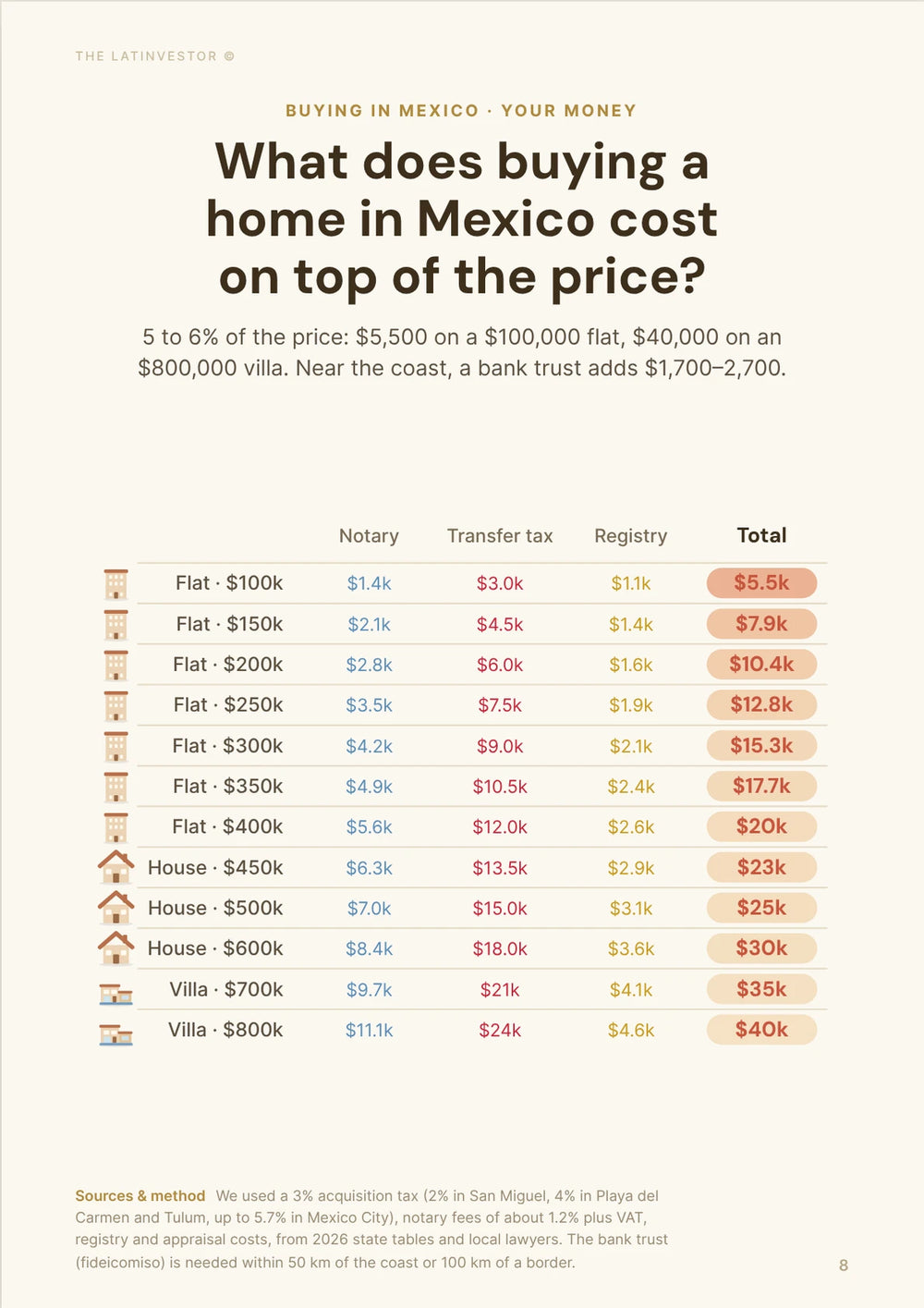
Acquisition tax runs from roughly 3% to 5% of the price in the main markets, and it can cost more at closing than many years of predial combined.
Depending on the state, it's called ISAI, ISABI or impuesto sobre transmisiones patrimoniales. The name changes, but it's the same thing: a tax the buyer pays for acquiring the property.
Some popular beach towns have raised it. Playa del Carmen has charged 4% since December 2025, Tulum charges 4%, and Los Cabos is at 3% after Baja California Sur extended its higher rate statewide. In Cancún, the 3% rate plus a 10% municipal surcharge on the tax works out at about 3.3%.
Big cities use progressive tariffs, so the rate rises with the price. On a MXN 2.5 million home, it works out at about 5.07% in Mexico City, 3.18% in Mérida and 2.81% in Guadalajara. On a MXN 5 million condo in Playa del Carmen, 4% means MXN 200,000 for this tax alone.
The old idea that acquisition tax is a harmless 2% everywhere doesn't hold. On an expensive home, get the exact figure from the notary before you commit.
| City | Acquisition tax (2026) | How it works |
|---|---|---|
| Mexico City | About 5.07% | Progressive; effective rate on a MXN 2.5 million home |
| Playa del Carmen | 4% | Flat municipal rate since December 2025 |
| Tulum | 4% | Municipal rate |
| Cancún | About 3.3% | 3% plus a 10% surcharge on the tax |
| Mérida | About 3.18% | Progressive (2.5% to 5%); effective rate on a MXN 2.5 million home |
| Los Cabos | 3% | Rate on the applicable taxable base |
| Guadalajara | About 2.81% | Progressive (2.5% to 3.5%); effective rate on a MXN 2.5 million home |
Can you lower the acquisition tax by putting a lower price in the deed?
Not really, and it's a bad idea, because the authorities can use another valuation.
Mexico City is a good example: for acquisition tax, its rules can use the highest figure among the price, the cadastral value and the appraisal.
So a MXN 6 million property doesn't become a MXN 4 million tax transaction just because the deed says MXN 4 million.
It also hurts you later. The value recorded at purchase is your starting point when you calculate the taxable gain on a future sale, along with documented improvements and qualifying expenses.
Saving a little acquisition tax today can mean a much bigger tax bill when you sell. The deed, the appraisal and the real price should line up.
How much do notary fees and closing costs add in Mexico?
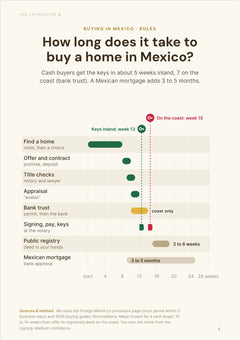
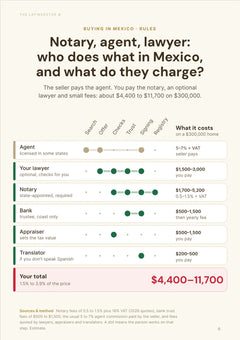
Expect about 6% to 9% of the purchase price in total, according to 2026 buyer guides that include a fideicomiso where one is needed. Surveyed Riviera Maya deals land anywhere from 4.1% to 9.3%.
The Colegio Nacional del Notariado Mexicano gives a similar benchmark: deed costs in the Mexico City metro area can run around 4% to 7% of the property value.
That doesn't mean the notary keeps it. The notary's own fee is usually closer to 0.5% to 1.5% of the price. Most of the rest is acquisition tax, registry fees and other government charges that pass through the notary.
A cheap property in a low-tax state can land below the range. An expensive home in a 4% beach town, with a trust and an appraisal, can land above it.
For planning, we would set aside 6% to 9% of the price until the notary gives a property-specific quote.
| Property price | 6% budget | 7.5% budget | 9% budget |
|---|---|---|---|
| MXN 3,000,000 (about USD 161,000) | MXN 180,000 | MXN 225,000 | MXN 270,000 |
| MXN 5,000,000 (about USD 269,000) | MXN 300,000 | MXN 375,000 | MXN 450,000 |
| MXN 10,000,000 (about USD 538,000) | MXN 600,000 | MXN 750,000 | MXN 900,000 |
| MXN 20,000,000 (about USD 1,080,000) | MXN 1,200,000 | MXN 1,500,000 | MXN 1,800,000 |
Do foreigners pay more property tax in Mexico?
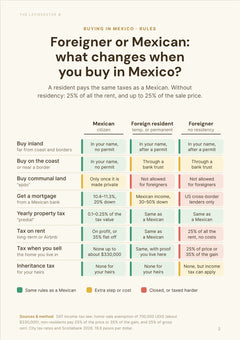
No. Foreigners pay the same predial as Mexican owners. What changes is the ownership structure, depending on where you buy.
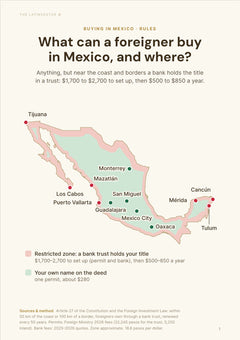
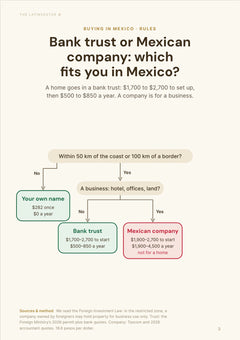
Under Article 27 of the Constitution, foreigners can't directly own residential land within 100 kilometers of an international border or 50 kilometers of the coast. In that restricted zone, a foreign buyer holds the home through a Mexican bank trust, the fideicomiso.
That covers most places foreigners actually want: Los Cabos, Puerto Vallarta, Cancún, Playa del Carmen, Tulum and long stretches of coast.
A Mexican and an American with similar condos in the same building pay roughly the same predial. The American also has a bank trust to pay for every year.
So there is no "foreigner surcharge" to look for. The trust is the extra cost that matters.
How much does a fideicomiso cost for a foreign buyer today?
The federal permit costs MXN 21,650 (about USD 1,160), and the bank adds its own setup fee and an annual fee, usually somewhere around USD 550 to 800 to open and USD 550 to 700 a year.
The federal number is easy to check: the Secretaría de Relaciones Exteriores (SRE) lists MXN 21,650 for the permit to set up a trust in the restricted zone, in a schedule updated in September 2026.
Bank fees are not standardized. A 2026 broker comparison puts setup fees at about USD 550 at Banorte, USD 600 at Banamex, USD 650 at BBVA, USD 700 at Scotiabank and USD 800 at HSBC (about MXN 10,200 to 14,900), and annual fees at about USD 550 to 700 (about MXN 10,200 to 13,000). INVEX publishes USD 550 plus IVA for both its acceptance fee and its first annual fee.
So there is no single "fideicomiso costs $X a year" figure. The permit is fixed; the bank's fees are not, and they usually come with IVA on top.
On an expensive beach condo, the annual fee is small. On a cheaper property, a roughly fixed USD 550 to 700 a year weighs a lot more as a share of the investment.
| Fideicomiso expense | 2026 figure | How often? | Who receives it? |
|---|---|---|---|
| SRE permit | MXN 21,650 (about USD 1,160) | At creation | Federal government |
| Bank setup fee | About USD 550 to 800 (INVEX: USD 550 + IVA) | Usually once | Trustee bank |
| Annual fee | About USD 550 to 700 (INVEX: USD 550 + IVA) | Annual | Trustee bank |
| Amendments/transfers | Varies | When needed | Bank/government |
| Related notarial work | Varies | Usually at setup | Notary/public authorities |
Does a fideicomiso cover the other property taxes and fees?
No. The trust is an extra cost; predial, HOA fees and every other running expense stay yours.
The bank holds legal title, and you keep the rights set out in the trust. That doesn't make the bank responsible for the home's bills. INVEX, for example, tells clients plainly that the trustee does not pay predial or other property charges for them.
A foreign condo owner in Tulum or Los Cabos therefore pays predial, the trust's annual fee, condo maintenance, insurance, utilities and any taxes on rental income.
Of those, the HOA bill is usually the biggest by far.
Do you pay 16% IVA when buying a house in Mexico?
No. A normal home purchase doesn't get 16% IVA added to the price.
The VAT law exempts the sale of land and of buildings used as a home. So never estimate closing costs by adding 16% to the price.
IVA still shows up around the deal: on the notary's fees, on professional services and on the trustee bank's fees. That's why a bank quotes its fideicomiso fee "plus IVA" even though the home itself is exempt.
Commercial property, mixed-use buildings and short-term lodging are treated differently.
If you see IVA on a closing statement, check exactly what it applies to.
Why do condo fees often cost more than property tax in Mexico?
Because amenities cost money and predial doesn't pay for them. In condo and resort markets, a year of HOA fees is often several times the predial bill.
Pools, elevators, guards, gyms, gardens, common-area electricity, water systems, beach facilities and staff all add up. A luxury building can have cheap predial and a heavy monthly maintenance charge.
2026 estimates give the scale: about MXN 4,500 to 12,000 a month (about USD 242 to 645) in a beach-zone condo in Tulum or Playa del Carmen, MXN 3,500 to 8,500 in an upscale Mexico City building, USD 150 to 400 for a two-bedroom in Puerto Vallarta, and MXN 1,500 to 4,000 for a mid-range condo in Mérida or Guadalajara.
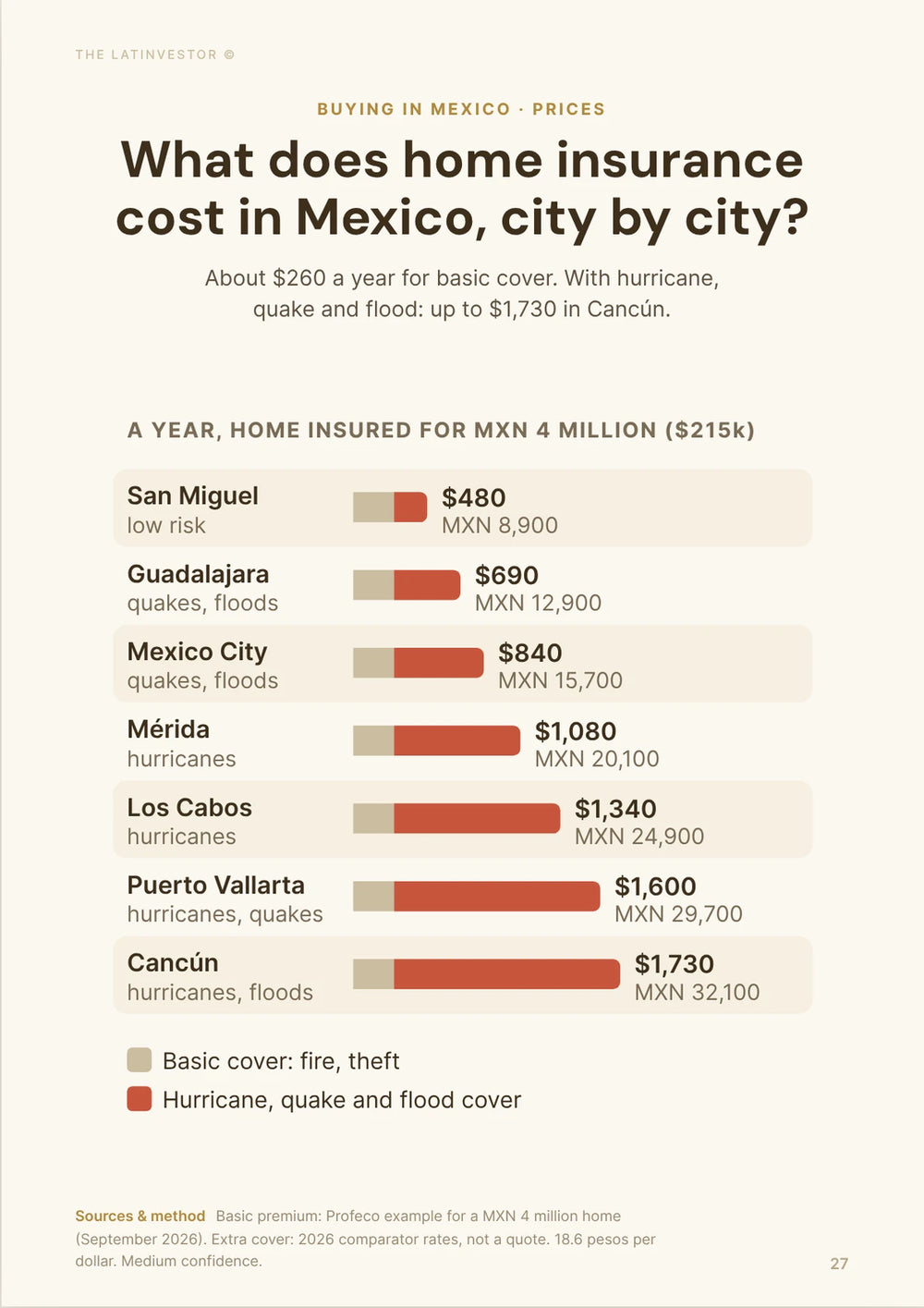
At MXN 12,000 a month, that's MXN 144,000 a year before insurance. Home insurance alone runs from about MXN 4,910 to 25,900 a year for a property insured at around MXN 4 million, according to Profeco's 2026 comparison.
So look at the HOA budget, the reserve fund, recent special assessments and the maintenance history as closely as at predial. For most condo owners, those private charges decide the yearly cost.
What taxes change if you rent out property in Mexico?
Renting adds income tax, and short stays can add 16% IVA and local lodging taxes on top.
A home that's cheap to hold for yourself becomes a lot more complicated once it earns Airbnb income.
Long-term residential rent is generally exempt from IVA. Short stays are not: furnished lodging can carry 16% IVA, and local governments can add lodging taxes.
Platforms now withhold tax at the source. For an individual host who gives Airbnb a valid RFC (Mexican tax ID), the platform withholds 4% income tax on lodging income. Without a valid RFC, the withholding jumps to 20%. Neither is necessarily the final tax.
Non-resident landlords face 25% withholding on gross rent, with no deduction for expenses under that method. Mexican tax residents can instead deduct a flat 35% of rental income or their actual expenses, and some qualify for the simplified RESICO regime at 1% to 2.5% of income.
If you're buying for Airbnb, run the numbers after these taxes. Low predial says nothing about how heavily your rental income will be taxed.
| Property use | Predial | Income tax | IVA can matter? | Other costs |
|---|---|---|---|---|
| Personal residence | Yes | Usually no rental income | Usually no on residential sale | HOA, insurance |
| Long-term residential rental | Yes | Yes (25% of gross rent withheld for non-residents) | Often exempt on qualifying rent | Management |
| Short-term furnished rental | Yes | Yes (4% platform withholding with RFC, 20% without) | Yes, 16% depending on structure | Lodging/platform taxes |
| Commercial property | Yes | Yes | Commonly | Business compliance |
How expensive can taxes become when you sell Mexican property?
Much more expensive than owning. The tax on a sale can dwarf years of predial.
The calculation depends on whether you're a Mexican tax resident or not, and whether the sale qualifies for an exemption.
For non-residents, the default is 25% of the gross sale price, with no deductions. Through a Mexican legal representative and a notarized sale, you can instead be taxed on the net gain, at rates up to 35%. On a property that hasn't gained much, the two results can be miles apart.
Mexican tax residents selling their main home can exempt up to 700,000 UDIS of the gain if they meet the conditions, and normally only once every 3 years. The sale must be properly formalized.
This is where the purchase paperwork pays off. The recorded purchase value, invoices for improvements and other deductible costs can be worth a lot years later.
A buyer who saves a little through sloppy paperwork at purchase can lose far more on the way out.
So how much should you really budget for property taxes and fees in Mexico?
Budget about 6% to 9% of the price at closing, then expect predial to be one of your smallest yearly costs.
Acquisition tax is the biggest single item at purchase (4% in Playa del Carmen and Tulum, about 5% in Mexico City), with deed, registry and notary charges on top.
Foreigners buying near the coast or a border add the fideicomiso: MXN 21,650 for the federal permit, then bank fees of roughly USD 550 to 800 to open and USD 550 to 700 a year.
For a MXN 5 million property, that means setting aside about MXN 300,000 to 450,000 before you get an exact quote. For MXN 10 million, about MXN 600,000 to 900,000.
After closing, predial is usually modest, while HOA fees, insurance, the trust's annual fee and rental taxes weigh much more.
That's what confuses people about Mexican property: holding it is fairly cheap, but getting the keys, and later selling, costs more than most buyers expect.
Our methodology
This article estimates what a buyer actually pays in taxes and fees on Mexican property: at purchase (acquisition tax, deed, registration, notary, fideicomiso), every year (predial, trust fee, HOA, insurance), when renting, and when selling. There is no single national rate, so we broke the question into those costs.
For each cost, we started with official sources: the Constitution, federal tax laws (income tax and VAT), SAT rules on platform withholding, the SRE fee schedule for trusts, and municipal sources such as Playa del Carmen's and Cancún's acquisition-tax pages, Mexico City's and Los Cabos' predial notices, and Jalisco's and Los Cabos' cadastral updates. Where no official figure exists, we used dated 2026 estimates from notarial guidance, law firms, tax calculators and buyer guides, and say so in the text.
Closing-cost ranges (6% to 9%) and bank trust fees come from 2026 buyer guides and broker comparisons, not from bank or notary tariffs, so treat them as planning figures. Effective acquisition-tax rates for Mexico City, Mérida and Guadalajara are calculated on a MXN 2.5 million sample home and change with the price. Predial rates are percentages of cadastral value, not of market price.
We checked these figures in October 2026. Conversions use about 18.6 pesos per US dollar and 20.9 pesos per euro.
Limits: tax rules depend on your residency, the municipality and how the deal is structured, and they change. HOA fees and insurance vary a lot by building and coverage. Always get a written quote from the notary for your property before signing.
Key sources used for this analysis include: the Mexican Constitution, Article 27, SRE guidance on fideicomisos in the restricted zone, SRE's fideicomiso fee schedule, INVEX Fiduciario's restricted-zone trust fees, Homia's 2026 comparison of bank trust fees, the Mexico City Fiscal Code 2026, Mexico City's acquisition-tax tariff, Rivenza's 2026 acquisition-tax calculations, Playa del Carmen's acquisition-tax page, Cancún's municipal government, Snell & Wilmer on the Baja California Sur acquisition-tax increase, Mexico City's 2026 predial discount notice, Los Cabos' 2026 predial discount notice, Los Cabos' proposed cadastral values, Jalisco's Municipal Cadastre Law, Jalisco Congress material on 2026 cadastral values, Bektu's 2026 predial estimates, the Colegio Nacional del Notariado Mexicano on deed costs, Compass Abroad on notary fees and closing costs, Mayan Wealth Homes on Riviera Maya closing costs, The Mexico Handbook on HOA fees, Profeco's home insurance comparison, the VAT law, SAT on IVA exemptions for residential rent, SAT on platform income (Article 113-A), SAT on withholding without an RFC (Article 113-C), Income Tax Law Article 158 on non-resident rent, Income Tax Law Article 160 on non-resident sales, Income Tax Law Article 93 on the home-sale exemption, and SAT's 2026 framework for payments to foreign residents.