Summary
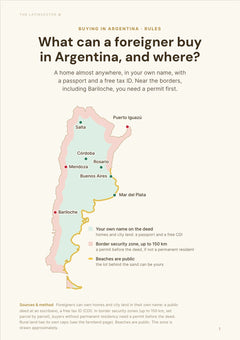
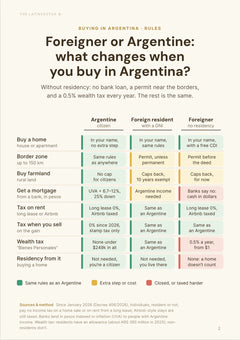
Yes. A foreigner can buy and fully own a flat, a house or an urban lot in Argentine Patagonia in their own name, without residency, with a free CDI tax ID that ARCA can take up to 30 business days to issue.
A home in Bariloche, Neuquén, San Martín de los Andes, Puerto Madryn or Ushuaia is the easy case. Estancias, lake parcels and land near the Chilean border are where the rules bite.
Rural land is capped again: since the Supreme Court ruling of 9 October 2026, in a case that came from Bariloche, foreigners can hold at most 15% of rural land per province and department, and Magallanes in Santa Cruz is already at about 25.8%.
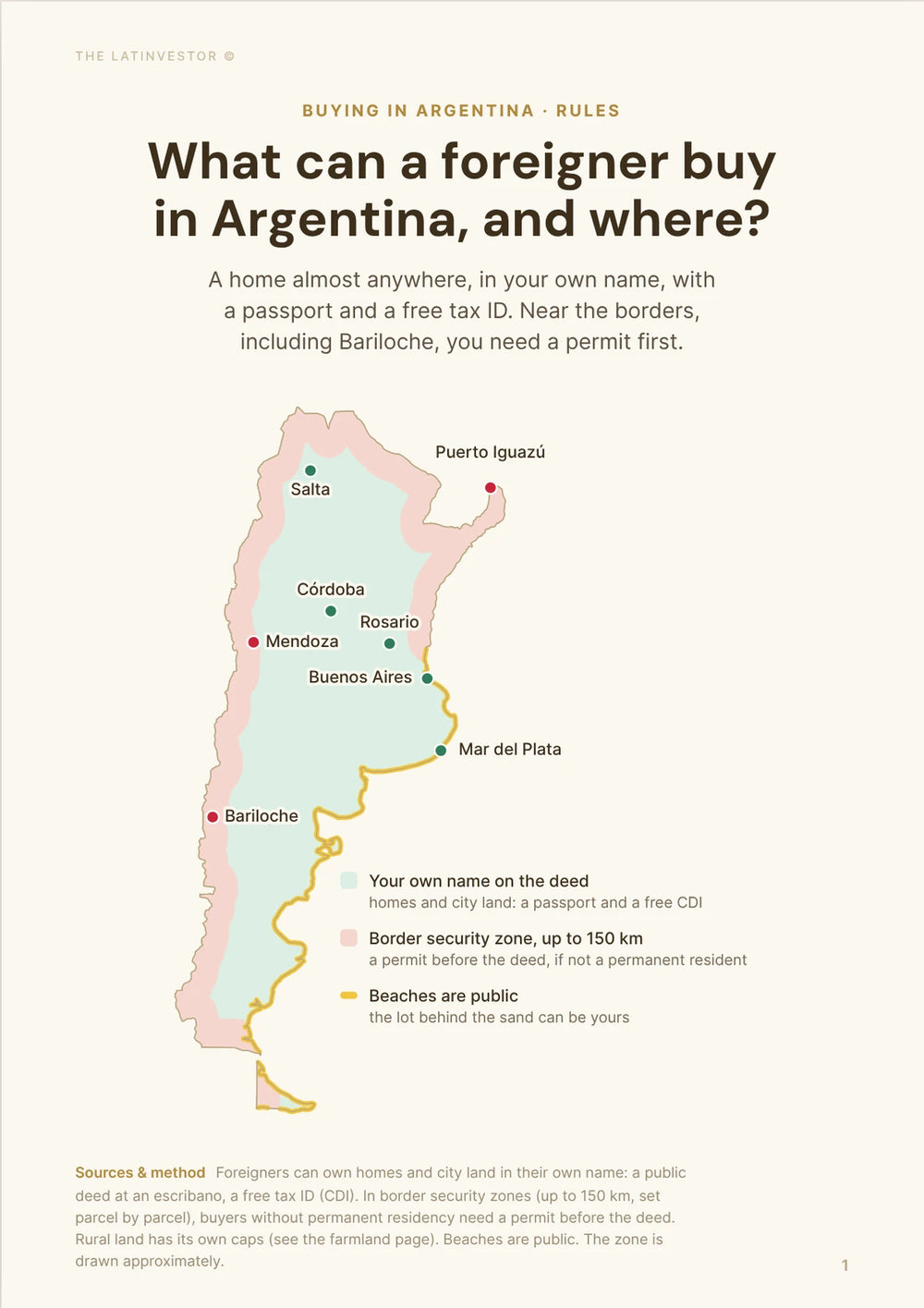
Border security zones can reach up to 150 km from a land border, so check any parcel near Chile, and a non-exempt parcel there needs prior approval (Previa Conformidad).
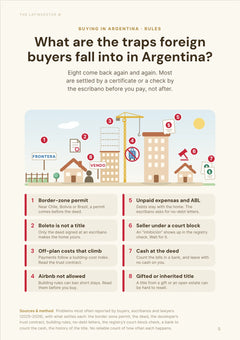
The biggest mistake is buying a cabin or chacra like a city flat: the 2025 El Bolsón fire alone destroyed 166 homes, and title, access and land status need checking before any deposit.
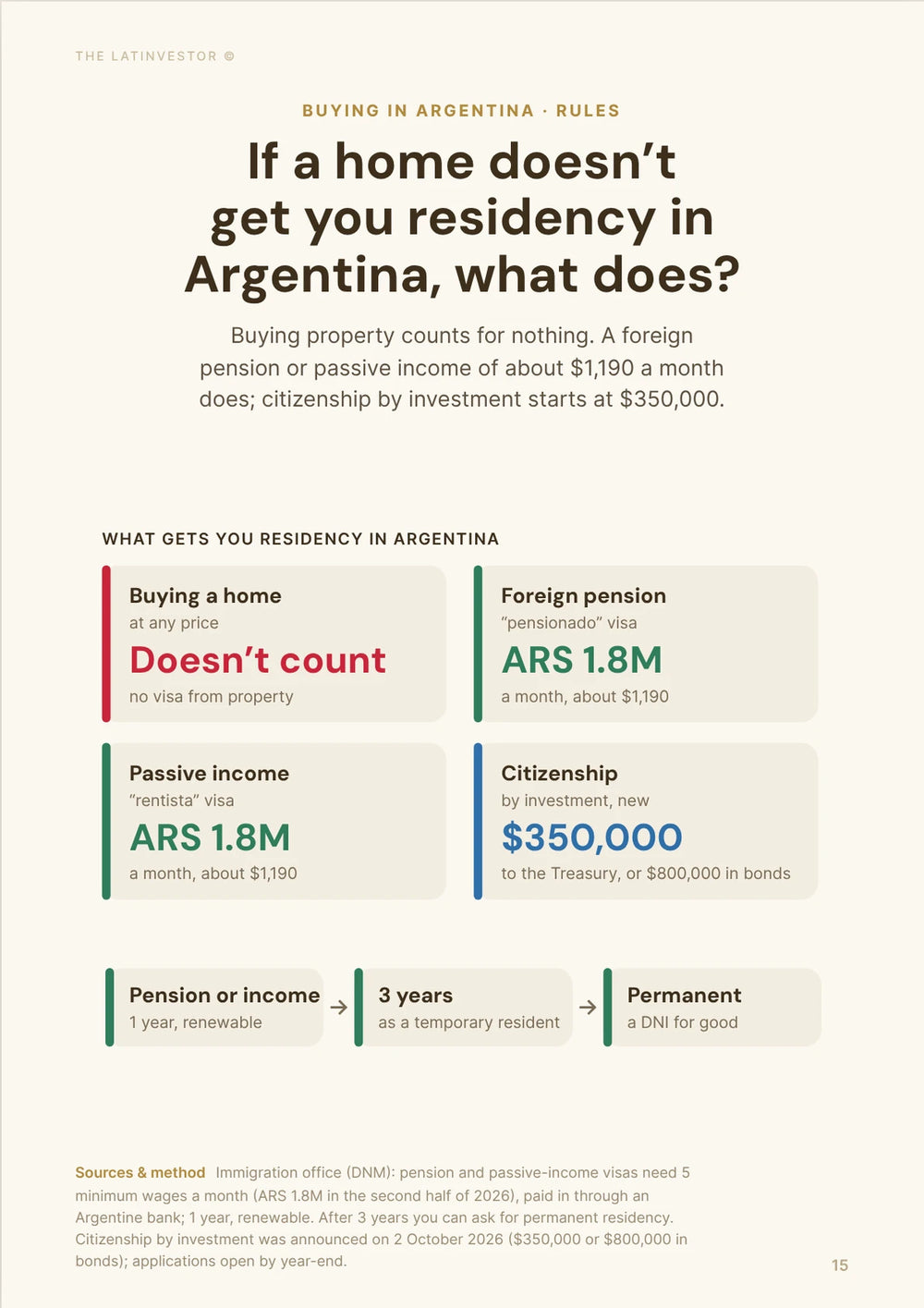
No visa is needed to buy, and owning gives no residency. The rentista route asks for passive income of at least five minimum wages, about ARS 1.84 million (USD 1,190) a month.
You can rent out without living in Argentina, but Bariloche and other tourist towns require a municipal licence for short stays.
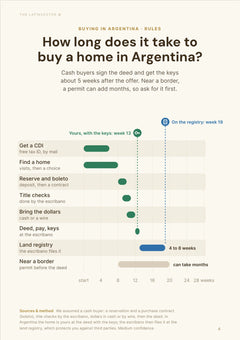
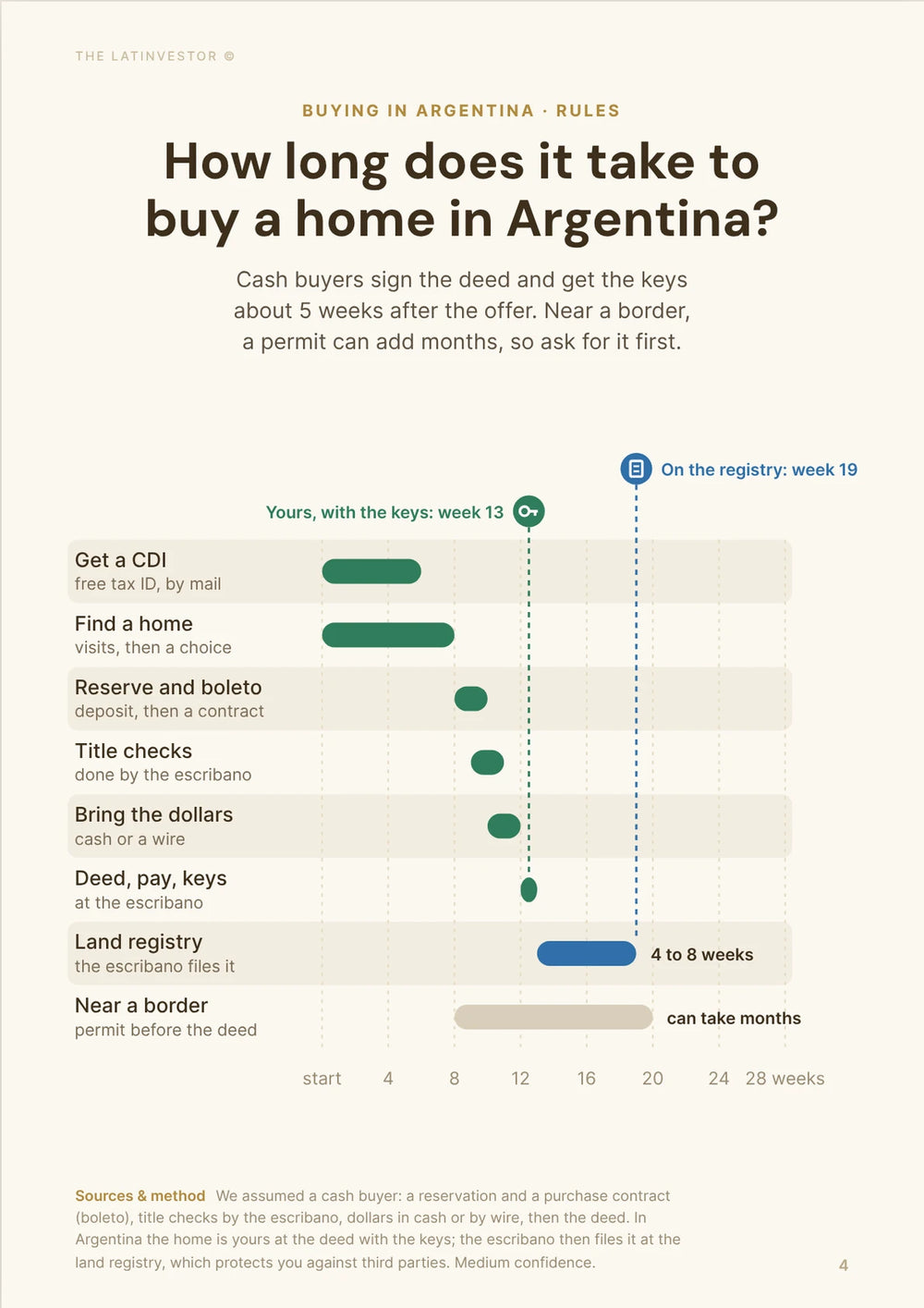
A simple urban purchase usually takes 30 to 90 days from accepted offer to registration, with a notary (escribano) mandatory and a buyer's lawyer strongly advised.
Ask the notary for the title and lien certificates from the provincial registry, and look back at least 10 years on a town home, 20 to 30 years on rural or inherited land.
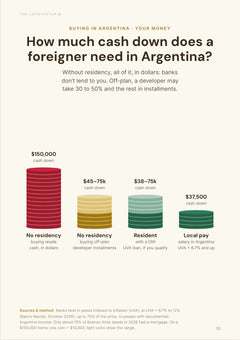
Plan as a cash buyer: non-residents with only foreign income have no confirmed access to UVA mortgages, which cost UVA plus about 6.5% to 12% for local earners.
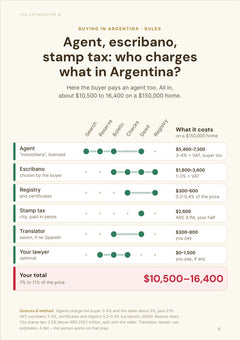
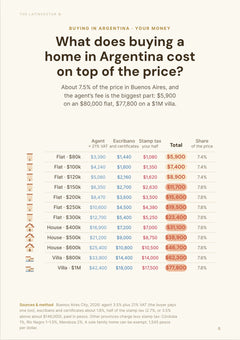
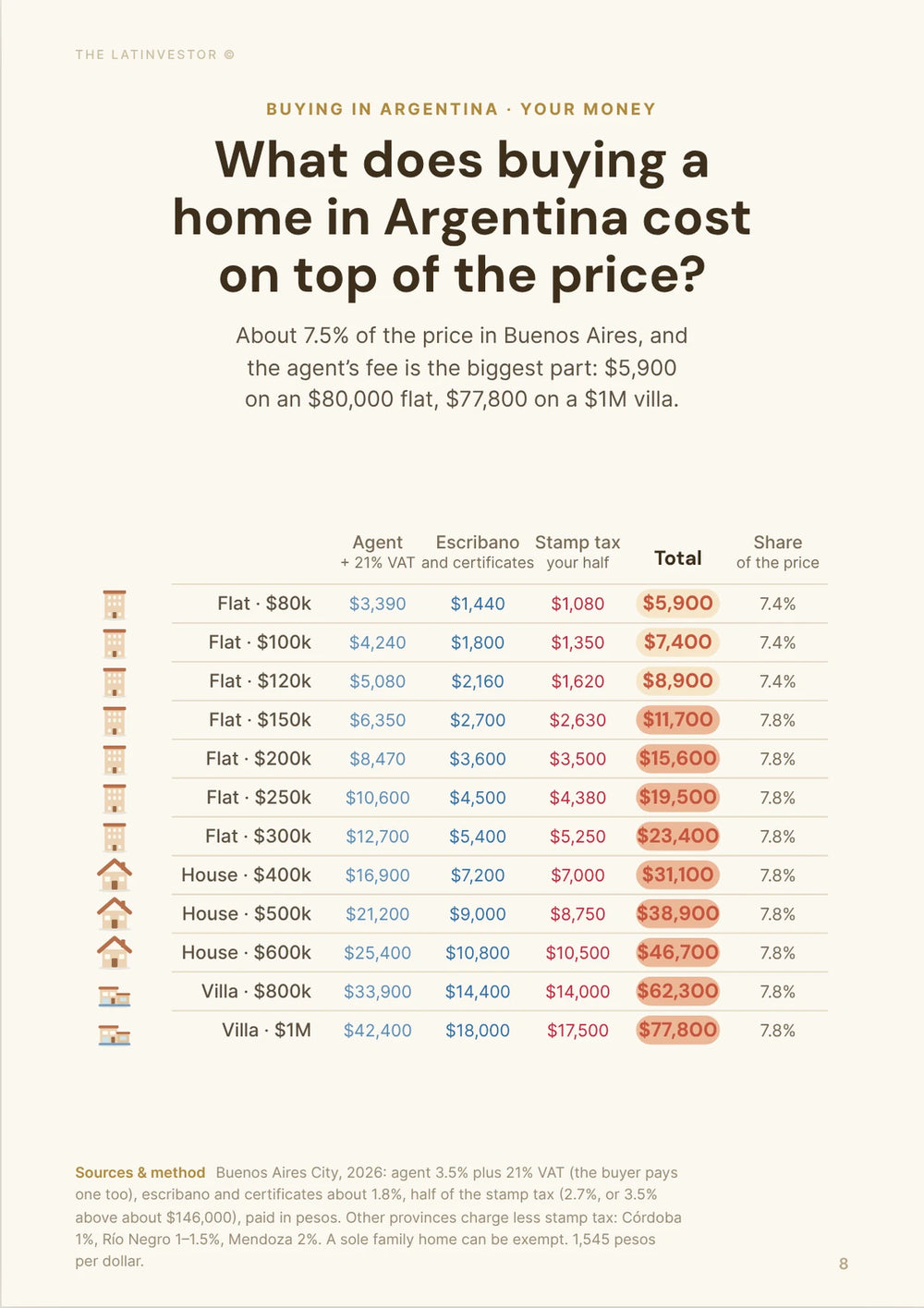
Buying costs come to about 5.5% to 9% of the price, so USD 13,750 to USD 22,500 on a USD 250,000 house; Río Negro stamp tax is 1% to 1.5%.
A non-resident landlord should budget 21% of gross rent in income tax until an adviser confirms the 2026 exemption applies, plus about 0.5% a year of wealth tax.
Cash deals above ARS 275.85 million (about USD 178,000) are reported to the UIF, a line the median Bariloche house, asking USD 300,000, already crosses.
Our view: a town flat or house is open to you today with normal paperwork. For anything rural, on a lake or near Chile, make the reservation conditional on the notary's written answer on rural and border status.

Which properties can a foreigner own in Patagonia, and where does it get tricky?
What property types can foreigners legally buy in Patagonia right now?
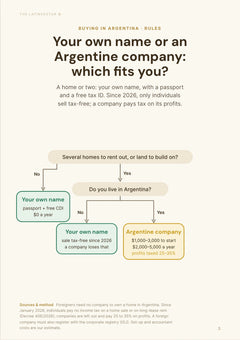
Foreigners can buy apartments, houses, cabins, chalets, duplexes, homes in gated communities and urban residential lots in Argentine Patagonia, in their own name. Article 20 of the Constitution gives foreigners the same right as Argentines to buy and sell real estate.
The question to ask is not your nationality but the land itself: is the property urban, rural, inside a border security zone, on a lake or river, or inside a protected area? Each answer changes the paperwork.
Normal homes in Bariloche, San Martín de los Andes, Villa La Angostura, Neuquén, El Calafate, Esquel, Trelew, Puerto Madryn and Ushuaia are simple. Estancias, rural plots and parcels close to Chile are not.
Can I own land in my own name in Patagonia right now?
Yes for an urban lot. The answer changes quickly when the land is rural, near the border or on the water.
Rural land falls under Law 26.737, which is back in force for now (see the section on the October 2026 ruling below): foreign ownership is capped at 15% of rural land nationally, per province and per department, and covered rural land that contains or borders a significant permanent lake or river can be off-limits to foreigners.
Patagonia is where those caps matter most. The Rural Lands Registry puts foreign ownership at about 8.1% of rural land in Santa Cruz, and at about 25.8% in its Magallanes department, already over the 15% limit.
Border land is a separate regime. Under Decree-Law 15.385, security zones can reach up to 150 km from a land border, and buying a non-exempt parcel there needs prior approval from the Interior Ministry (Previa Conformidad).
What other foreign-ownership rules should I know in Patagonia?
Beyond rural and border land, the rules that actually affect foreigners are practical: a tax ID, registry checks and local rental permits. There is no foreign quota on flats or town houses.
The first step is the CDI, the tax ID for non-residents. ARCA issues it free on a passport, but allows up to 30 business days, so apply before you make an offer or have a local representative do it with a power of attorney.
Building rules (reglamento de copropiedad) can still restrict short-term rentals, pets, works or commercial use. Read them before you sign if you plan to rent to tourists.
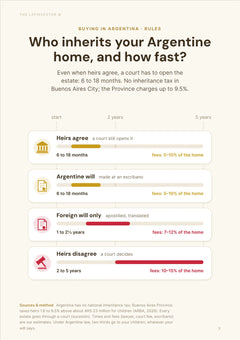
What changed in 2026 is tax, not ownership: since 1 January 2026, individuals, residents or not, pay no income tax on resale gains (Law 27.802 and Decree 406/2026), and the old 1.5% ITI transfer tax has been gone since July 2024.
What’s the biggest ownership mistake foreigners make in Patagonia right now?
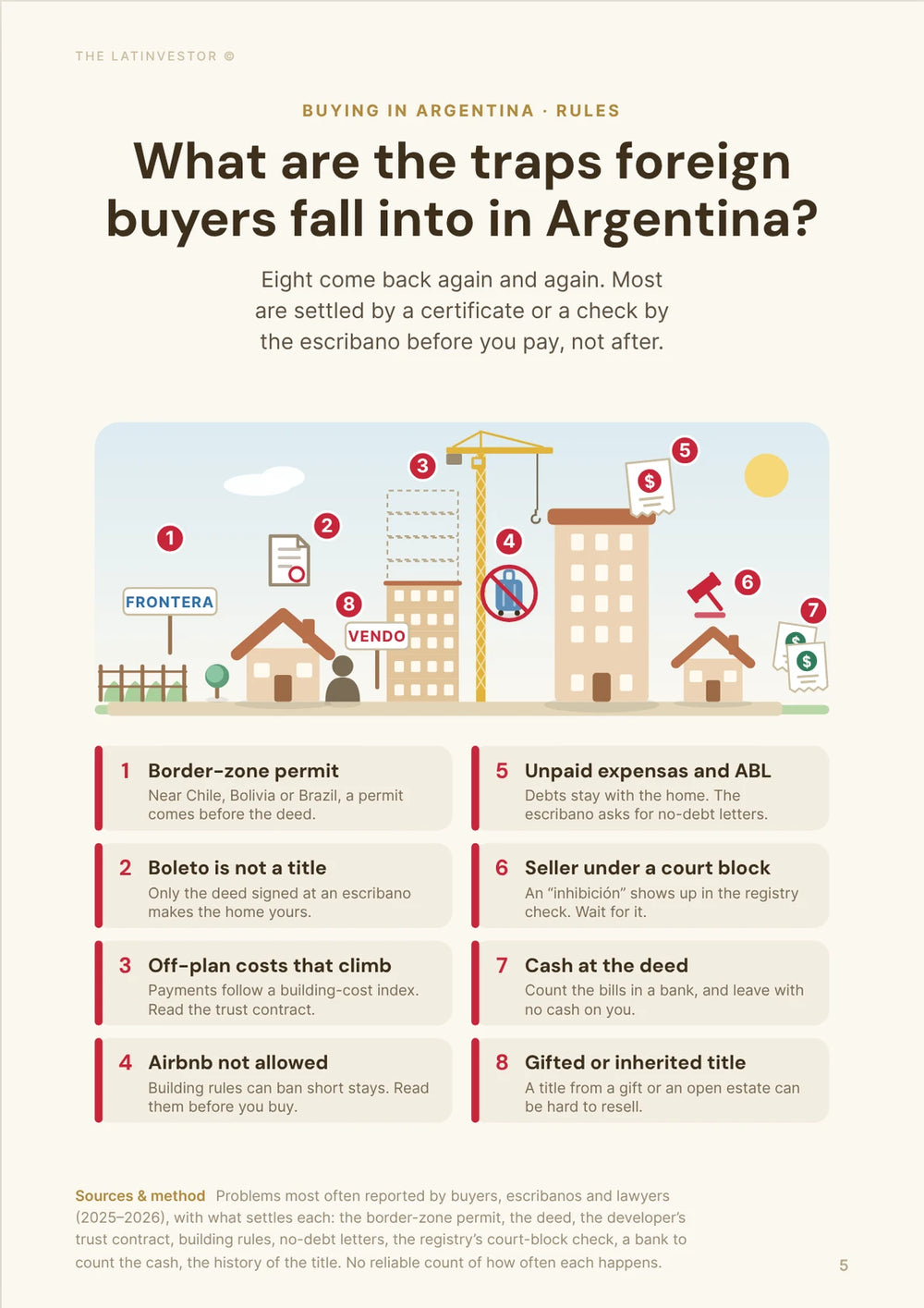
Treating a cabin, lake home or chacra like a normal city flat, and signing before checking land status, title, access, water and fire risk.
The result can be a buyer who has paid a deposit, lawyers and flights, then finds out that the land cannot be transferred to a foreigner, built on, rented legally or insured at a sensible price.
Fire is a real Patagonian risk, not a footnote. The El Bolsón fire in early 2025 hit 221 homes, 166 of them destroyed, according to the Río Negro government. Ask for an insurance quote before you sign on a house at the forest edge.
Other classic traps: informal possession instead of registered title, an unresolved inheritance on the seller's side, missing easements, roads that close in winter, poor insulation and heating, and assuming tourist rentals are allowed.
Which visa or residency status changes what I can do in Patagonia?
Do I need a specific visa to buy property in Patagonia right now?
No. You can buy on a tourist entry, or from abroad through a power of attorney, as long as you have a CDI, a valid passport and proof of where the money comes from.
What usually blocks a file is not the visa but the paperwork: no tax ID yet, documents without an apostille or sworn translation, or a power of attorney that does not meet the notary's requirements.
A typical document set: passport, CDI, proof of funds, marital-status documents, apostilles, sworn translations into Spanish and, if you sign remotely, a power of attorney drafted with the Argentine notary.
Does buying property help me get residency and citizenship in Patagonia in 2026?
No. Buying a home in Patagonia gives no residency, permanent residency or citizenship.
The routes that exist are separate. Rentista residence is for people living off passive income and pensionado residence for foreign pensioners, both with at least five times the minimum monthly wage. With the minimum wage at ARS 367,800 for July to December 2026, that is about ARS 1.84 million, or USD 1,190, a month. Rent from your Patagonian property can count only if it arrives through an authorized bank.
The citizenship-by-investment programme announced on 2 October 2026 asks for a USD 350,000 contribution to the Treasury or a USD 800,000 bond. A property does not count, and the detailed rules were not out when we checked.
Can I legally rent out property on my visa in Patagonia right now?
Yes. Your visa does not stop you from earning rent as an owner, and you do not need to live in Argentina. In practice a non-resident needs a local accountant, a property manager and someone to act as tax representative.
Short stays are the regulated part. Bariloche asks lodging, including rentals to tourists, to be licensed with the municipality, and other tourist towns such as Villa La Angostura, San Martín de los Andes, El Calafate and Ushuaia have their own rules. Check the town and the building rules before you buy for Airbnb.
Long leases are simpler: rent control ended in December 2023 (DNU 70/2023), so you agree the price, currency and indexation freely with the tenant.
How does the buying process actually work step-by-step in Patagonia?
What are the exact steps to buy property in Patagonia right now?
The usual order: get your CDI, classify the property (urban, rural, border zone), make an offer, sign a reservation, choose the escribano, run title and lien checks, get any special approval, sign the boleto or go straight to the deed, pay, register, then move taxes and utilities into your name.
You do not have to be there, since a power of attorney works. For a first purchase, go anyway: check access in winter, boundaries, heating, water, septic and the neighbours.
The deal becomes binding with the signed boleto de compraventa or the deed. Full protection against third parties comes with registration at the provincial property registry.
For a simple urban home, count roughly 30 to 90 days from accepted offer to registration. Rural land, border approvals, an inheritance on the seller's side or a mortgage add weeks or months.
Is it mandatory to get a lawyer or a notary to buy a property in Patagonia right now?
An escribano is mandatory: property is transferred by public deed and then registered. A separate buyer's lawyer is not required, but we would hire one in Patagonia.
The notary drafts and registers the deed; your lawyer reviews the risks for you: land classification, border status, permits, taxes and the exit clauses of the reservation.
Ask for a written scope: title review, liens and inhibitions, seller's capacity, tax and municipal debts, zoning, whether tourist rental is allowed, rural and border status, and a list of conditions to be met before closing.
What checks should I run so I don’t buy a problem property in Patagonia?
How do I verify title and ownership history in Patagonia right now?
Through the property registry of the province: Río Negro for Bariloche and El Bolsón, Neuquén for San Martín de los Andes and Villa La Angostura, Chubut for Esquel and Puerto Madryn, Santa Cruz for El Calafate, Tierra del Fuego for Ushuaia.
The key document is the dominio (title) report from the registry, which the escribano orders before the deed.
We suggest looking back at least 10 years on a town home and 20 to 30 years on rural, inherited or lakefront land.
Stop the deal if the seller is not clearly registered as owner, if an inheritance is unresolved, if the cadastral boundaries do not match the fences, or if the chain of title has a gap.
How do I confirm there are no liens in Patagonia right now?
The escribano orders the official certificates of title, liens and inhibitions (dominio, gravámenes e inhibiciones) from the provincial registry before the deed is signed.
Ask about mortgages, embargoes, easements, seller inhibitions, unpaid building fees (expensas), municipal and provincial tax debts, utility debts and road-access obligations.
Get the free-debt certificates from the municipality and the provincial tax agency in writing, and make the payment conditional on them.
How do I check zoning and permitted use in Patagonia right now?
With the municipality: its planning office and the cadastre say what can be built and what the property can be used for. In Bariloche, the urban code and the Bariloche Construye portal let you check land use and building parameters online.
The common trap is a cabin, chacra or lot that looks perfect for tourist rental or a second house, then local zoning, building rules, septic rules or road access do not allow the plan.
Ask for the land-use certificate before you pay, and write the use you intend into the reservation.
Can I get a mortgage as a foreigner in Patagonia, and on what terms?
Do banks lend to foreigners for homes in Patagonia in 2026?
Plan as a cash buyer. The UVA mortgages that came back in 2024 are for documented Argentine earners, and we found no bank offering them to a non-resident with only foreign income.
A foreign resident with local, declared income can apply like anyone else. Banks look at income, residency, tax ID and credit history, not nationality.
Lending is slowing anyway: 14,237 mortgage loans in January to July 2026 across Argentina, 43% fewer than a year earlier (BCRA via Tejido Urbano).
Which banks are most foreigner-friendly in Patagonia in 2026?
The practical starting points are Banco Nación, Banco Patagonia, Santander and BBVA, because they have branches across the region and an active mortgage business.
None of them has a product for foreign buyers. What helps is a branch that knows how to read formal income, a CDI or CUIT, and residency documents.
Without local income, expect a refusal, or at best a request for a large down payment and many documents.
What mortgage rates are foreigners offered in Patagonia in 2026?
For borrowers who qualify, UVA plus about 6.5% to 12% a year in October 2026: Banco Nación UVA + 6.7% for eligible salary clients buying a single home and UVA + 12% otherwise, BBVA 7.5% to 11.5% over UVA.
The UVA balance follows inflation (33.4% over 12 months to September 2026). With the peso strong in real terms, a UVA balance rose about 18% in dollars between January and September 2026, which hurts anyone earning in dollars or euros.
What will taxes, fees, and ongoing costs look like in Patagonia?
What are the total closing costs as a percent in Patagonia in 2026?
About 5.5% to 9% of the price for the buyer, so USD 13,750 to USD 22,500 on a USD 250,000 house. Buying direct from the owner, without an agent, brings it much lower.
The items: your share of the provincial stamp tax, the escribano at 1% to 2% plus VAT, certificates and registry at 0.2% to 0.4%, and the buyer's broker fee, usually 3% to 4% plus 21% VAT.
Stamp tax depends on the province. In Río Negro (Bariloche, El Bolsón, Dina Huapi) it is 1% to 1.5%; in Neuquén about 2.5% in total (a Roomix figure, not confirmed by an official source), usually split with the seller. Chubut, Santa Cruz and Tierra del Fuego have their own rates, so ask the notary for a written estimate.
Extra checks on rural, lakefront or remote land (survey, water, access, border status) come on top.
What annual property tax should I budget in Patagonia in 2026?
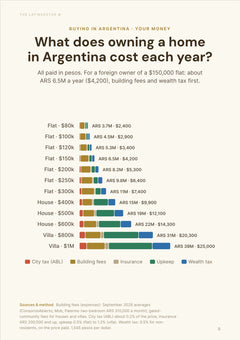
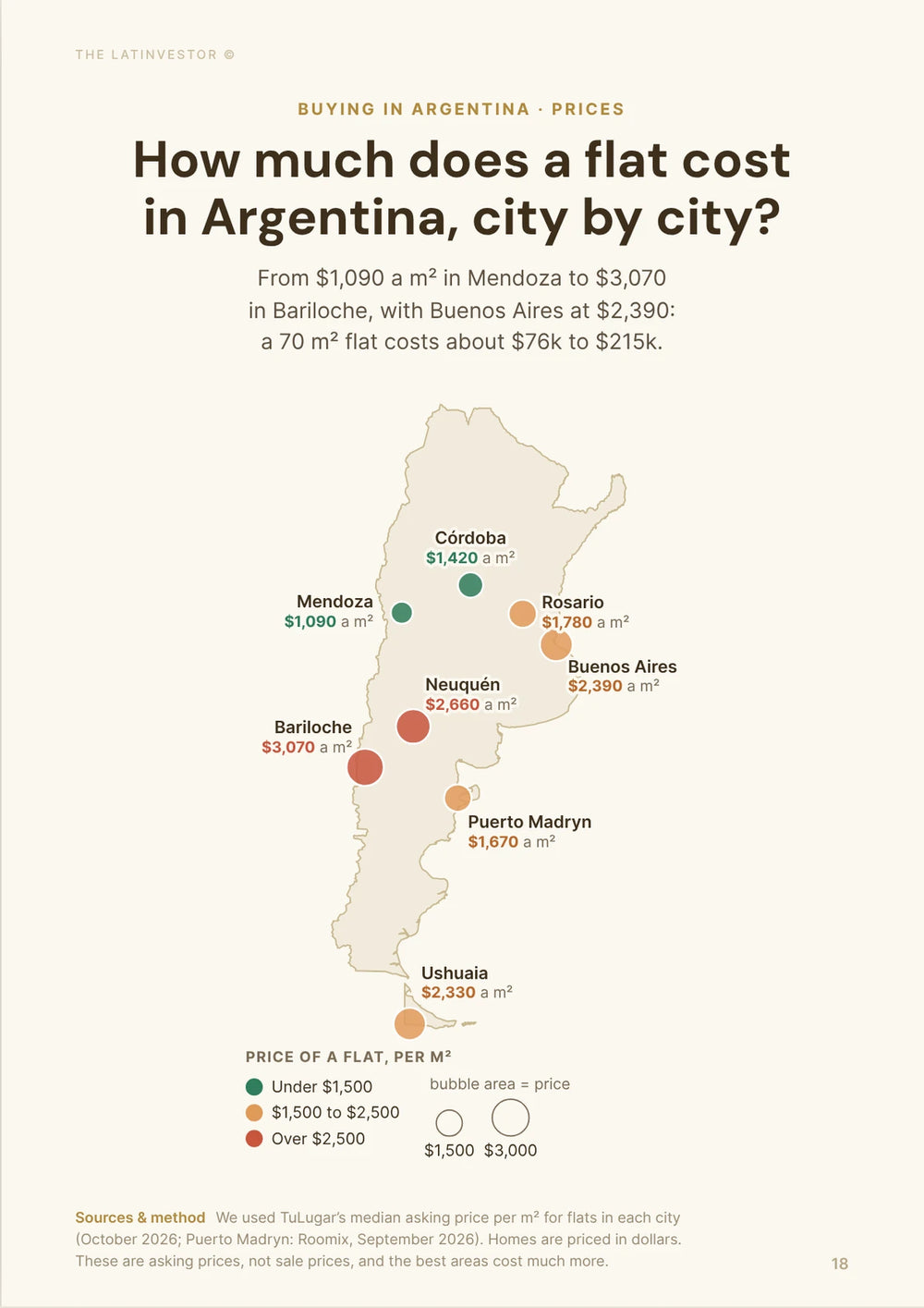
Roughly ARS 300,000 to ARS 2.1 million a year in provincial property tax and municipal charges for a normal home (USD 195 to USD 1,350). Lake houses and large plots pay more. There is no official typical amount, so ask the seller for the last bills.
The tax is based on a provincial fiscal value, usually well below the market price.
A non-resident also pays Bienes Personales (wealth tax) at about 0.5% a year with no allowance, through a local representative: up to about USD 1,500 a year on a house valued at USD 300,000 for tax purposes.
How is rental income taxed for foreigners in Patagonia in 2026?
Since 1 January 2026, long-term rent to a tenant's permanent home is exempt from income tax for resident landlords (Decree 406/2026). The decree does not say whether non-residents get the same treatment.
Until a tax adviser confirms it for your case, budget the standard withholding for non-residents: 35% on a presumed 60% net, so 21% of gross rent. On a Bariloche 2-bedroom let at ARS 1,575,000 a month (USD 1,020), that is about ARS 330,750 (USD 215) a month.
Tourist rentals are not covered by the exemption: count the same 21%, plus provincial gross-income tax and possibly VAT.
What insurance is common and how much in Patagonia in 2026?
Roughly ARS 280,000 to ARS 980,000 a year for a normal home (USD 180 to USD 630), more for high-value houses.
The usual cover is fire and property damage, often with liability, contents and theft. A lender will require it if you have a mortgage.
The price depends on physical risk: wooden cabin, forest edge, snow load, wind, distance from the fire brigade, and whether you rent to tourists. Get a quote before you sign.
What did the October 2026 Supreme Court ruling change for foreigners buying land in Patagonia?
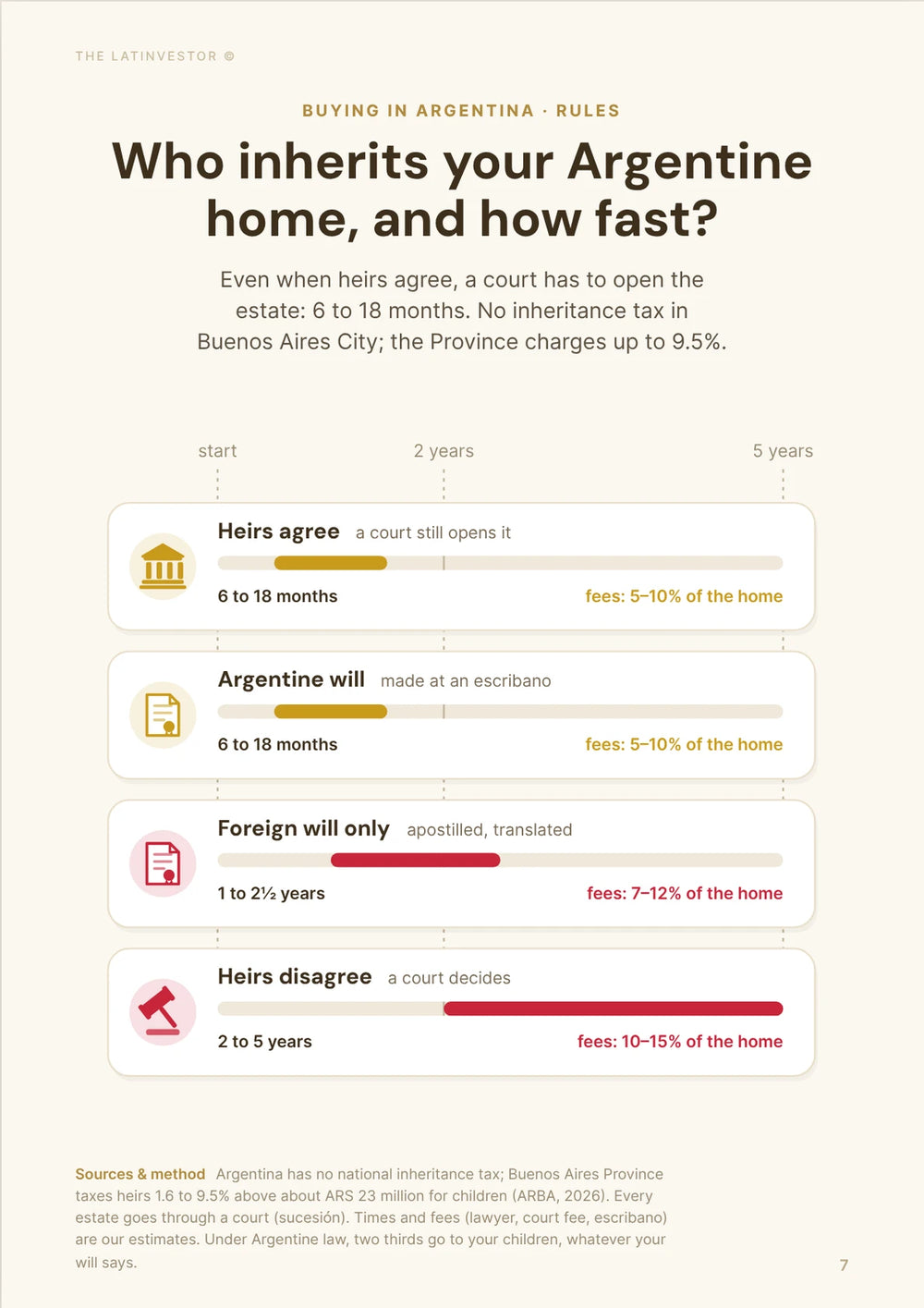
It brought the foreign caps on rural land back, for now. Decree 70/2023 had tried to repeal Law 26.737. On 29 September 2026 the Supreme Court threw out one challenge to that repeal for lack of standing. Then on 9 October 2026 it provisionally suspended the repeal in a case brought by the group Árbol de Pie in Bariloche.
The suspension lasts until the federal judge in Bariloche rules. Until then the 15% caps, the per-owner surface limits and the waterfront restrictions apply again, and the Rural Lands Registry asks foreigners for a habilitation certificate before buying covered land. A deal that breaks the law can be void.
For a flat or a house in town, nothing changes. For a chacra, an estancia or a lake parcel outside the urban grid, it changes a lot: headlines saying the law was "repealed" are out of date.
What to do: ask the notary to confirm in writing whether the parcel is classed as rural and whether it sits in a border security zone, and make the reservation conditional on that answer.
How do foreigners pay for a property in Patagonia in 2026?
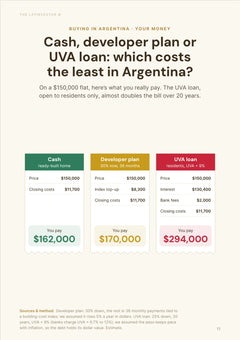
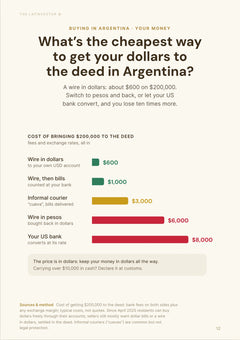
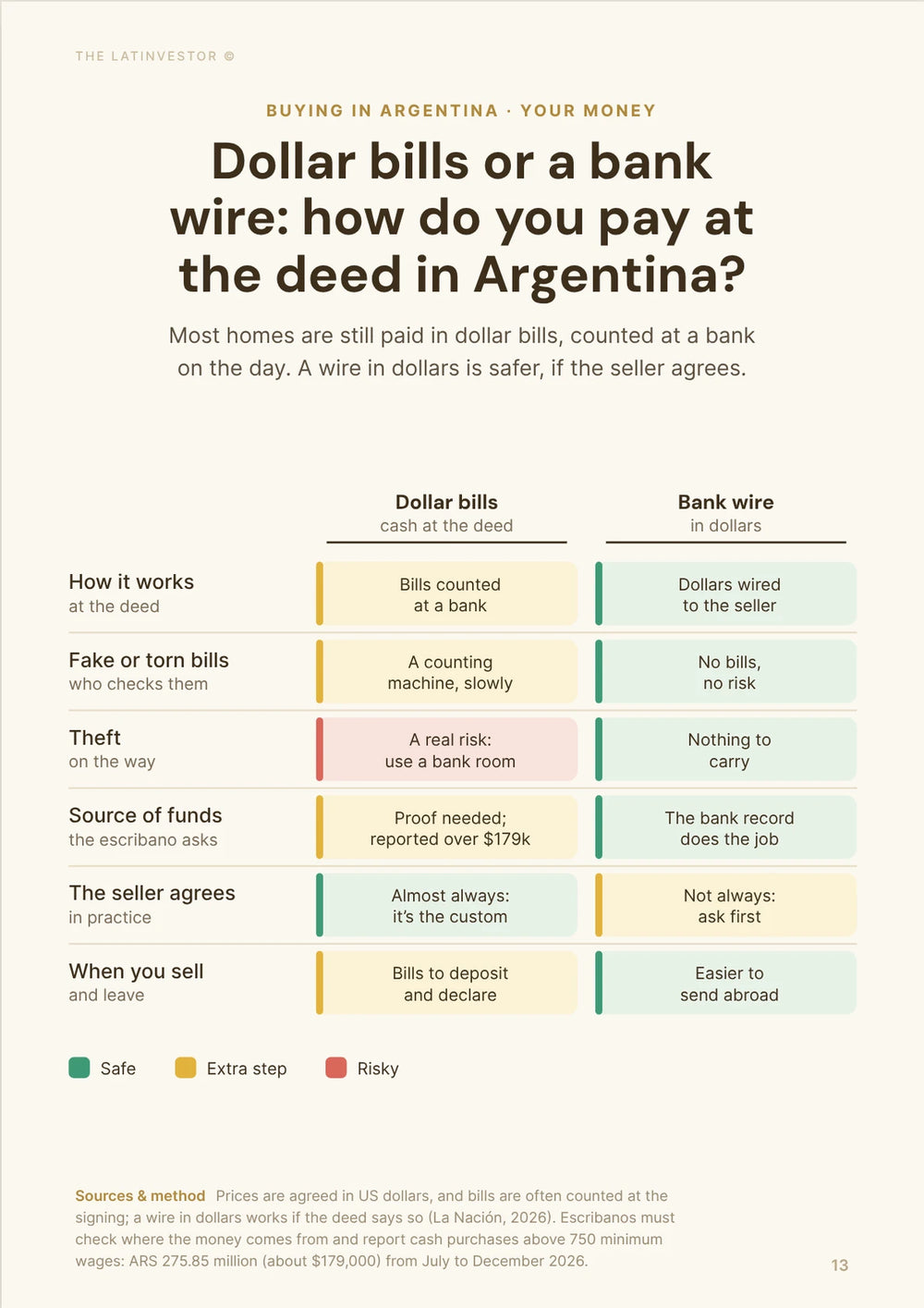
In dollars, with your own money. Homes are priced in US dollars, and a contract written in dollars has to be paid in dollars (Civil Code, articles 765 and 766). Payment is either cash counted at the deed signing or a bank transfer that the deed spells out.
Cash deals above ARS 275.85 million (about USD 178,000) in the second half of 2026 are reported to the financial intelligence unit (UIF). With the median Bariloche house asking USD 300,000 (TuLugar, October 2026), a typical house purchase there crosses that line, so have your bank statements and transfer records ready for the notary.
The exchange rate is less of a trap than it used to be: official, MEP and blue rates were within 2% of each other in October 2026, around ARS 1,550 per dollar. But the peso has been strong in real terms, with prices up about 23.6% from January to September against a dollar up about 5%, so local costs in Patagonia got more expensive in dollars this year.
Our methodology
This article explains what a foreign individual can buy and own in Argentine Patagonia (Río Negro, Neuquén, Chubut, Santa Cruz and Tierra del Fuego), where that right stops, and what a non-resident buyer needs and pays: paperwork, process, checks, mortgages, taxes and running costs. Chilean Patagonia is not covered.
Ownership rules come from primary law and the agencies that apply it: the Constitution, Law 26.737 and the Rural Lands Registry's departmental data, Decree-Law 15.385 and the Previa Conformidad procedure for border zones, and the national and Río Negro property registries. The status of the rural land law comes from Chequeado's coverage of the Supreme Court decisions of 29 September and 9 October 2026.
Taxes and costs come from Decree 406/2026, Estudio Piccinini on non-resident landlords, ARCA for the CDI and Bienes Personales, the 2026 Río Negro and Neuquén stamp-duty schedules and La Nación for notary and agent fees. Residency comes from the Dirección Nacional de Migraciones and the 2 October 2026 citizenship announcement; mortgages from Banco Nación, the BCRA and Tejido Urbano; prices and rents from TuLugar and Reporte Inmobiliario.
We checked these figures in October 2026. Peso amounts are converted at about ARS 1,550 per US dollar (official and MEP rates were within 1% of each other on 22 October 2026, the blue rate about ARS 1,570), and euro amounts at about ARS 1,740 per euro.
Where we had no direct figure, we said so: annual property tax, insurance, the purchase timeline and the title look-back periods are our estimates; the rent-tax treatment of non-resident landlords is not confirmed; stamp rates for Chubut, Santa Cruz and Tierra del Fuego were not verified; and the rural land case is not finally decided. Treat this as a guide, not legal or tax advice.
Key sources used for this analysis include Argentina's Constitution, Rural Lands Law 26.737, Rural Lands Registry departmental data, Chequeado on the October 2026 Supreme Court decision, Decree-Law 15.385, the border-zone approval checklist, Argentina's property registry portal, Río Negro Property Registry, the CDI procedure, the rentista residence procedure, the citizenship-by-investment announcement, Decree 406/2026, Estudio Piccinini, ARCA on Bienes Personales, Río Negro stamp duty 2026, Banco Nación mortgages, BCRA interest-rate data, Tejido Urbano, TuLugar Bariloche, Río Negro government on the El Bolsón fire and Infobae on exchange rates.