Summary
Yes, a foreigner can buy and own land in Argentine Patagonia, but only a town plot is simple: since 9 October 2026 the Supreme Court has put the 15% caps on foreign-owned rural land back in force, and some Patagonian areas are already far over them.
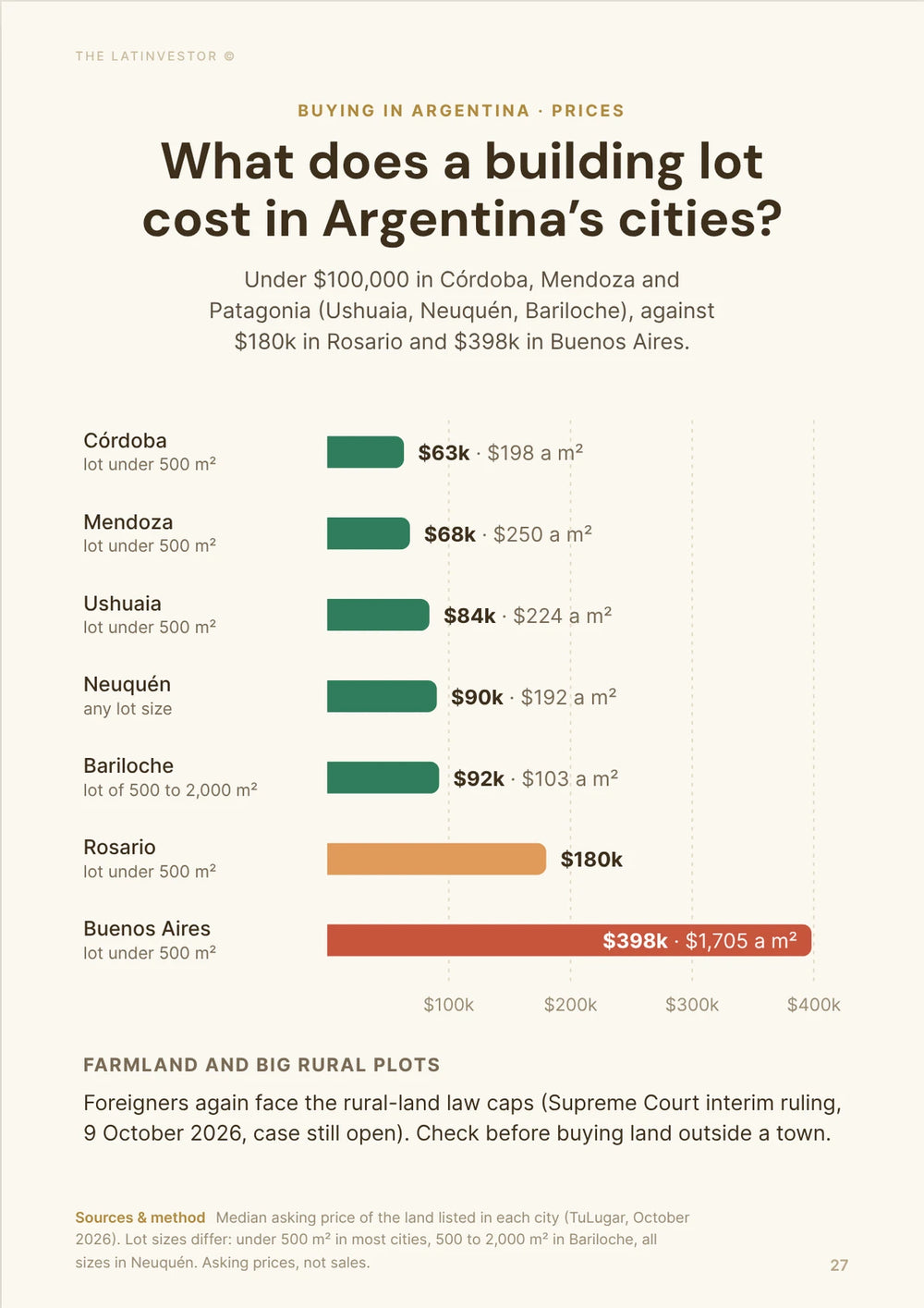
A lot or a flat inside a town's urban boundary is an ordinary purchase: deed before a notary, registration, a free CDI tax number. A median residential lot lists at about USD 92,000 in Bariloche, and a small urban lot at about USD 84,000 in Ushuaia (TuLugar, October 2026).
Rural land is a parcel-by-parcel test. Law 26.737 caps foreign ownership at 15% per country, province and department, and Lácar department (San Martín de los Andes) is already at about 54% foreign-held according to a UBA-CONICET map.
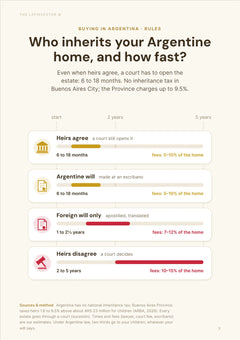
Being married to an Argentine does not help on its own. The rural caps stop applying only after 5 years of residence with an Argentine spouse or child, or 10 years of continuous residence.
Residency is not needed to buy. ARCA issues the CDI free on a passport, but allows up to 30 business days for non-residents, so apply before you make an offer.
Border security zones can reach up to 150 km from the Chilean border and may need a prior approval (Previa Conformidad), except in listed towns and for small urban lots of up to 5,000 m² not bought for profit.
A company does not get around the rules: an Argentine company counts as foreign when foreigners hold more than 51% of it, and a deal that breaks the rural land law can be void with no compensation.
The purchase runs through the notary in 9 steps, with a reservation deposit of 5% to 10%; for rural or border parcels, make the deposit conditional on a written land-status check.
The common scams are fake powers of attorney, double sales, the wrong parcel on the deed and land with no legal road access. A registry search and a survey cost little next to the price.
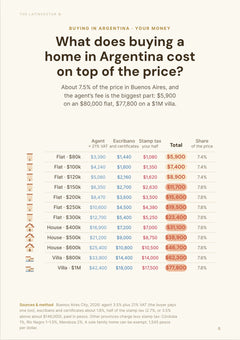
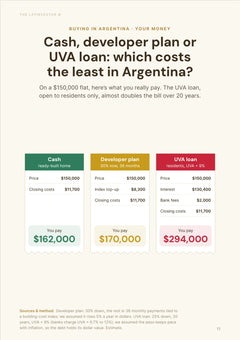
Budget about 5.5% to 9% on top of the price, so USD 11,000 to 18,000 on a USD 200,000 plot, plus 1% to 3% for surveys and checks on remote land. Stamp tax is 1% to 1.5% in Río Negro and about 2.5% in Neuquén (not officially confirmed), usually split.
Once you own, a non-resident pays about 0.5% a year of wealth tax (Bienes Personales) plus local property tax, and resale gains by individuals are tax-free since 1 January 2026.
The October 2026 rulings are provisional: the case is back with a federal judge in Bariloche, and a bid in Congress to overturn the deregulation decree failed on 15 October. US owners already hold about 2.7 million hectares, the most of any nationality, so an American buyer should also check the 30% per-nationality limit.
Our view: buy inside the urban grid if you want a quick, clean deal. For a lakefront plot, a chacra or an estancia, get the notary's written answer on rural status, the department's foreign quota and the border zone before you pay anything.

Town plot, rural land or border zone: what can a foreigner own in Argentine Patagonia?
Can foreigners own land in Patagonia in 2026?
Yes. In Argentine Patagonia a foreigner can own land in his own name, without residency. What changes everything is whether the plot is legally urban or rural, and whether it sits in a border security zone.
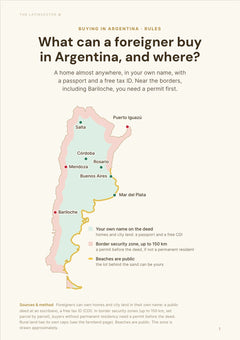
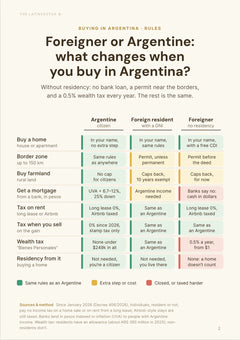
Inside a town's urban boundary (a lot in Bariloche, Neuquén, Ushuaia or El Calafate, for example), there is no foreign-ownership limit. Article 20 of the Constitution gives foreigners the same right to buy real estate as Argentines.
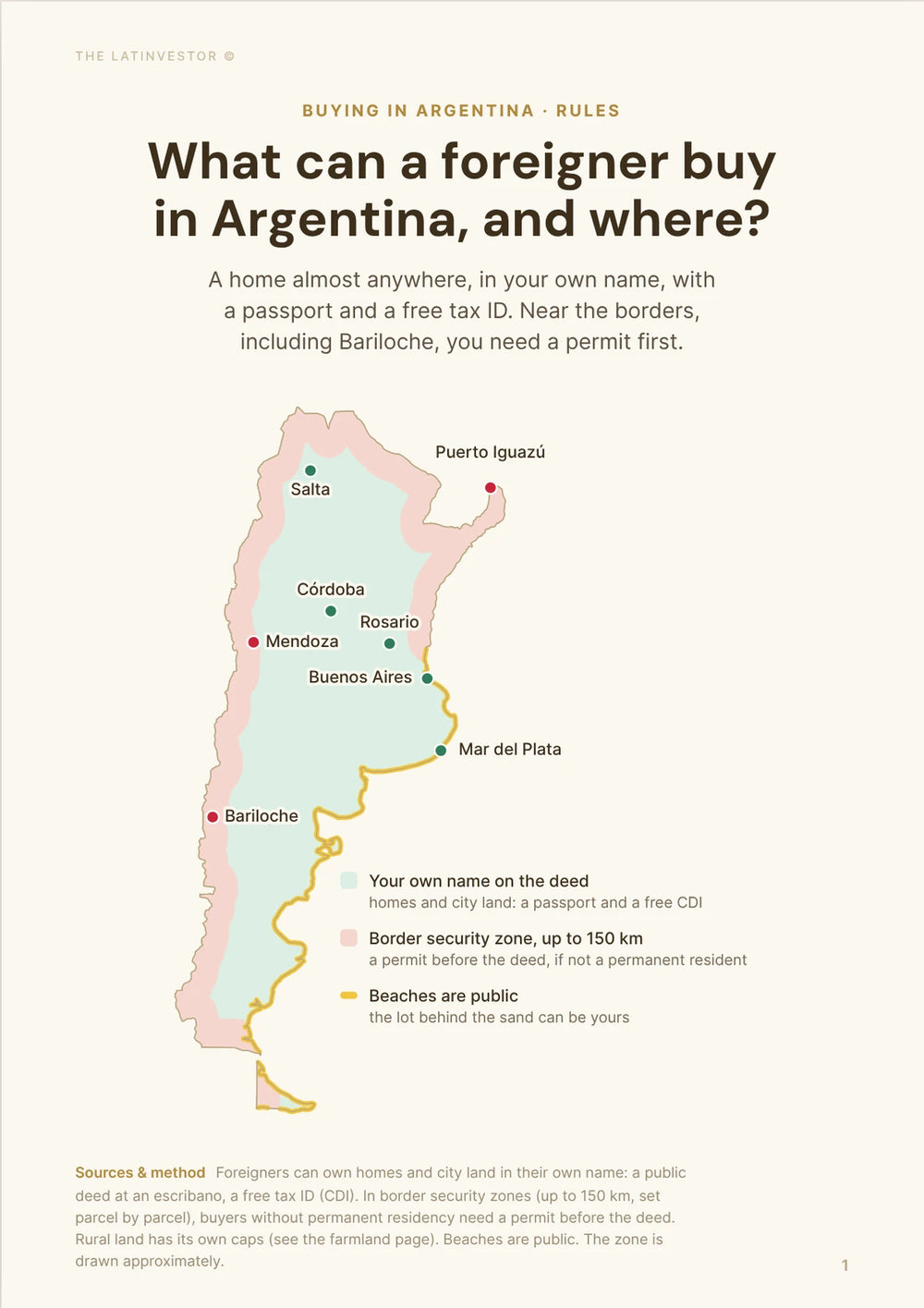
Outside the urban boundary, the Rural Land Law (Law 26.737) applies again since the Supreme Court's 9 October 2026 ruling. Foreign ownership is capped at 15% of rural land nationally, per province and per department, buyers of one nationality can hold at most 30% of that foreign share, and rural land containing or bordering large permanent lakes and rivers can be off-limits.
The rules target "foreign persons" in general, not a given nationality. If a rural plot is blocked, the usual fallback is a plot inside the urban grid nearby, or a lease, which has its own limits (see below).
Can I own a house but not the land in Patagonia in 2026?
Yes, and it is common. In a condominium building (propiedad horizontal) in Bariloche, San Martín de los Andes or Ushuaia, you own your unit plus a share of the common areas, and the land belongs to the building as a whole.
You get a deed (escritura) for your unit, registered with the provincial property registry. Legally, that is full ownership, with the same protection as a house on its own lot.
Building on someone else's land under a lease is a different story: when the lease ends, the building usually goes to the landowner, unless the contract lets you remove it or extend.
Do rules differ by region or city for land ownership in Patagonia right now?
Yes. Argentine Patagonia covers five provinces (Neuquén, Río Negro, Chubut, Santa Cruz and Tierra del Fuego), and the department you buy in matters as much as the province.
The foreign quota is counted per department. Lácar department, where San Martín de los Andes sits, had about 257,000 of its 475,000 rural hectares in foreign hands, or 54%, on the UBA-CONICET map published in December 2025. Magallanes in Santa Cruz is at about 25.8% in the Rural Land Registry data. In both, a new foreign rural purchase is blocked for now. Santa Cruz province as a whole is at about 8.1%.
Taxes also change by province. Stamp tax is 1% in Río Negro (Bariloche, El Bolsón, Dina Huapi) when the special fiscal value is up to ARS 55 million (about USD 35,500), and 1.5% above. In Neuquén it is about 2.5% in total (a Roomix figure, not confirmed by an official source), usually split with the seller. Chubut, Santa Cruz and Tierra del Fuego have their own rates.
The border security zones along the Chilean border come on top of all this and cover large parts of the Andean towns foreigners like most.
Can I buy land in Patagonia through marriage to a local in 2026?
Not just by marrying. The Rural Land Law looks at nationality and years of residence. A foreigner married to an Argentine falls outside the rural caps only after 5 years of marriage and permanent, continuous residence in Argentina. The same 5 years apply to a foreign parent of an Argentine child, and 10 years of continuous residence exempt anyone.
Putting the land in your spouse's name works legally, but then it is your spouse's land. If you pay, sign a notarized agreement on who paid what and who owns which share, and check how the marital property regime (comunidad de ganancias by default) treats it.
In a divorce, property bought during the marriage is usually split under that regime. Land held only in your spouse's name, bought with money you cannot trace, is much harder to claim.
What eligibility and status do I need to buy land in Patagonia?
Do I need residency to buy land in Patagonia in 2026?
No. A non-resident can buy a lot, house or flat on a tourist entry with a passport and a CDI tax number. Residency matters only for the rural-land exemptions above (5 or 10 years).
Buying does not give residency either. The citizenship-by-investment programme announced on 2 October 2026 asks for a USD 350,000 contribution or a USD 800,000 bond, not a property.
You can buy remotely with a power of attorney signed abroad (apostilled and translated), letting a local lawyer or representative sign for you. For a rural or remote plot, go and walk it first: access, water and boundaries are the usual surprises.
Do I need a local tax number to buy lands in Patagonia?
Yes. Without a CUIT or CUIL you need a CDI (Clave de Identificación) from ARCA, the tax agency formerly called AFIP. The deed cannot be registered without it.
The CDI is free and issued on a passport, but ARCA allows up to 30 business days for non-residents. Foreign documents need an apostille and a sworn translation. A local representative with a power of attorney can file for you.
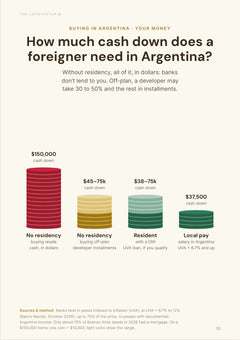
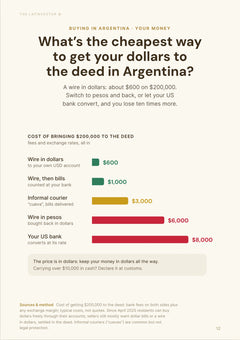
A local bank account is not required. It helps to pay property tax and utilities, but most foreign buyers pay the price in US dollars, cash at the signing or by a transfer described in the deed.
Is there a minimum investment to buy land in Patagonia in 2026?
No. There is no legal minimum for a foreigner. The citizenship programme's USD 350,000 has nothing to do with buying land.
In practice, fixed costs set a floor. Notary, certificates, a survey and the checks a foreigner needs on a remote plot cost a few thousand dollars whatever the price, so below about USD 30,000 they eat a big share of the deal. For reference, a residential lot lists at a median of about USD 92,000 in Bariloche, the median lot at USD 90,000 in Neuquén city and a small urban lot at USD 84,000 in Ushuaia (TuLugar, October 2026).
Are there restricted zones foreigners can't buy in Patagonia?
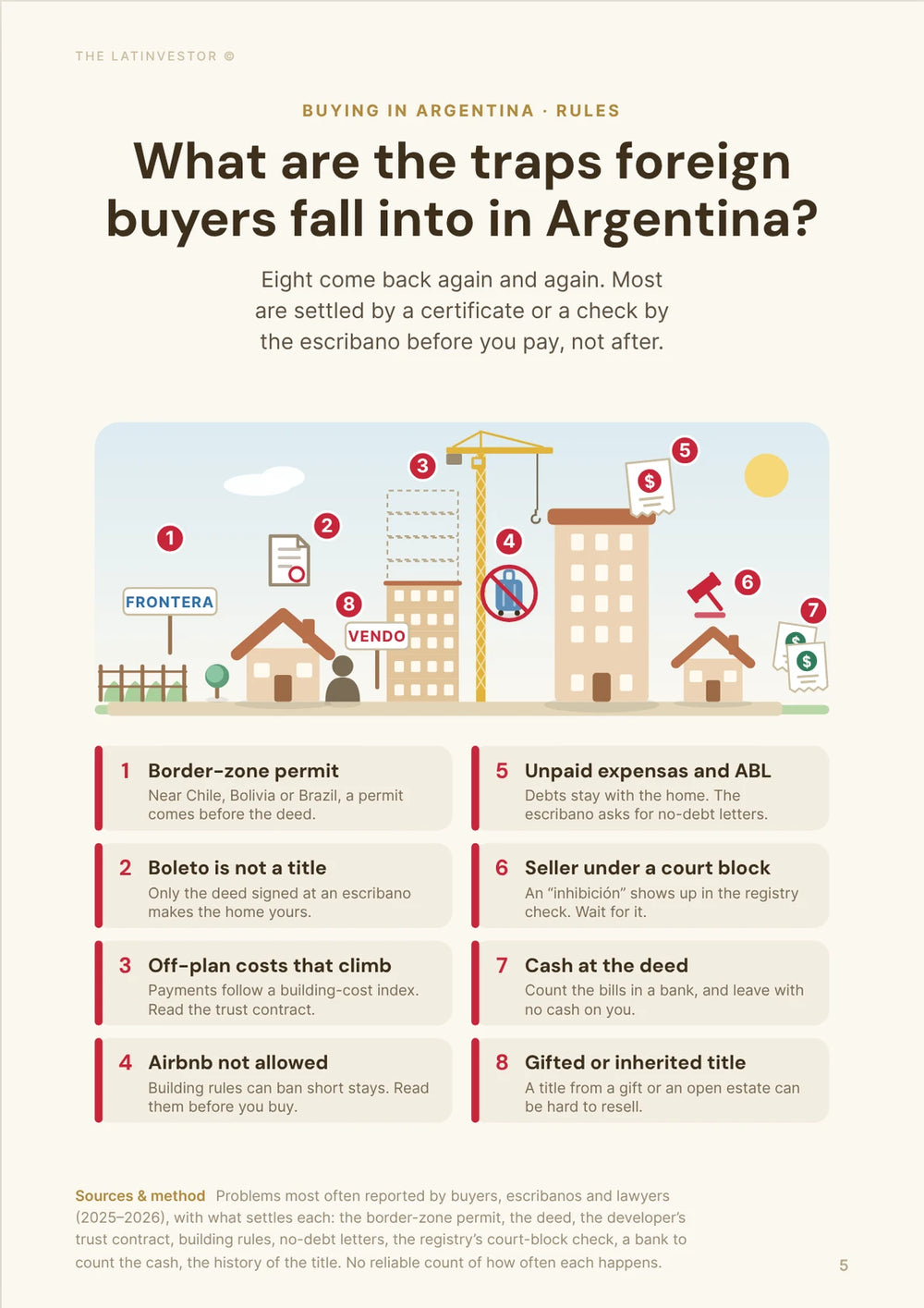
Yes, three kinds. First, rural departments already over the 15% foreign quota, such as Lácar or Magallanes. Second, rural land containing or bordering large permanent lakes and rivers, which matters around Nahuel Huapi, Lácar or Traful. Third, border security zones, which can reach up to 150 km from the Chilean border and need prior approval for many purchases.
The border rules have exemptions: listed urban centres are exempt whatever the buyer's nationality (Resolution 166/2009), and foreigners can also be exempt for an urban property of up to 5,000 m² that is not bought for profit.
To check a plot, give the notary (escribano) the cadastral number and ask for three written answers: urban or rural, border zone or not, and the department's foreign quota at the Rural Land Registry.
Can foreigners buy agricultural, coastal or border land in Patagonia right now?
Sometimes, and each needs its own check.
Agricultural and rural land: you need a Certificate of Authorization (habilitación) from the Rural Land Registry before buying. The Registry checks the department's foreign share, your nationality's share and how much land you already own. The 1,000-hectare limit applies only in the core farming zone; Patagonia uses equivalence tables, so the allowed surface varies.
Coastal land (Puerto Madryn, the Atlantic coast): the shore itself is public, so check access rights, setbacks and servitudes in the deed and the municipal plan.
Border land: inside a security zone, a non-exempt purchase needs Previa Conformidad from the Interior Ministry. A rural plot in a border zone needs both approvals.
What are the safest legal structures to control land in Patagonia?
Is a long-term lease equivalent to ownership in Patagonia right now?
No. A lease gives you use, not ownership: you carry renewal risk, and selling or passing on your rights depends on the contract.
Rural leases of 10 to 30 years are common, but there is no automatic right to renew. Negotiate renewal, the right to transfer and what happens to buildings at the end into the first contract.
A lease is not a way around the border rules: inside a security zone, leases and other transfers of possession to a foreigner can need the same Previa Conformidad as a purchase.
Can I buy land in Patagonia via a local company?
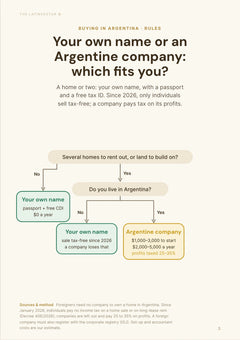
Yes, but it does not get around the rural caps. An Argentine company counts as foreign under Law 26.737 when foreigners hold more than 51% of its capital or control its decisions.
In border security zones, a change in the shareholders of a company that owns land there can itself need Previa Conformidad. A company also means yearly accounts, filings and a local administrator, so use one only for a real business reason.
What "grey-area" ownership setups get foreigners in trouble in Patagonia?
The shortcuts that tend to blow up later, at a resale, a divorce or an inheritance: a local nominee (prestanombre) holding the title for you, buying "possession rights" (posesión) that were never registered, skipping the border approval, and boundaries agreed on a handshake that do not match the cadastre.
The Rural Land Law calls nominee schemes fraud and says a purchase that breaks it is void, with no right to compensation. In practice you may also be unable to register, sell or pass on the land, and the nominee can face liability.
How does the land purchase process work in Patagonia, step-by-step?
What are the exact steps to buy land in Patagonia right now?
In Argentina the notary (escribano) runs the deal: title checks, the deed and the registry filing.
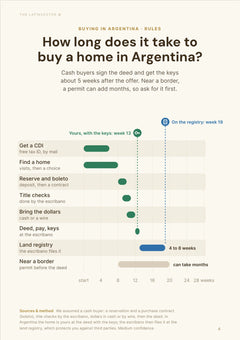
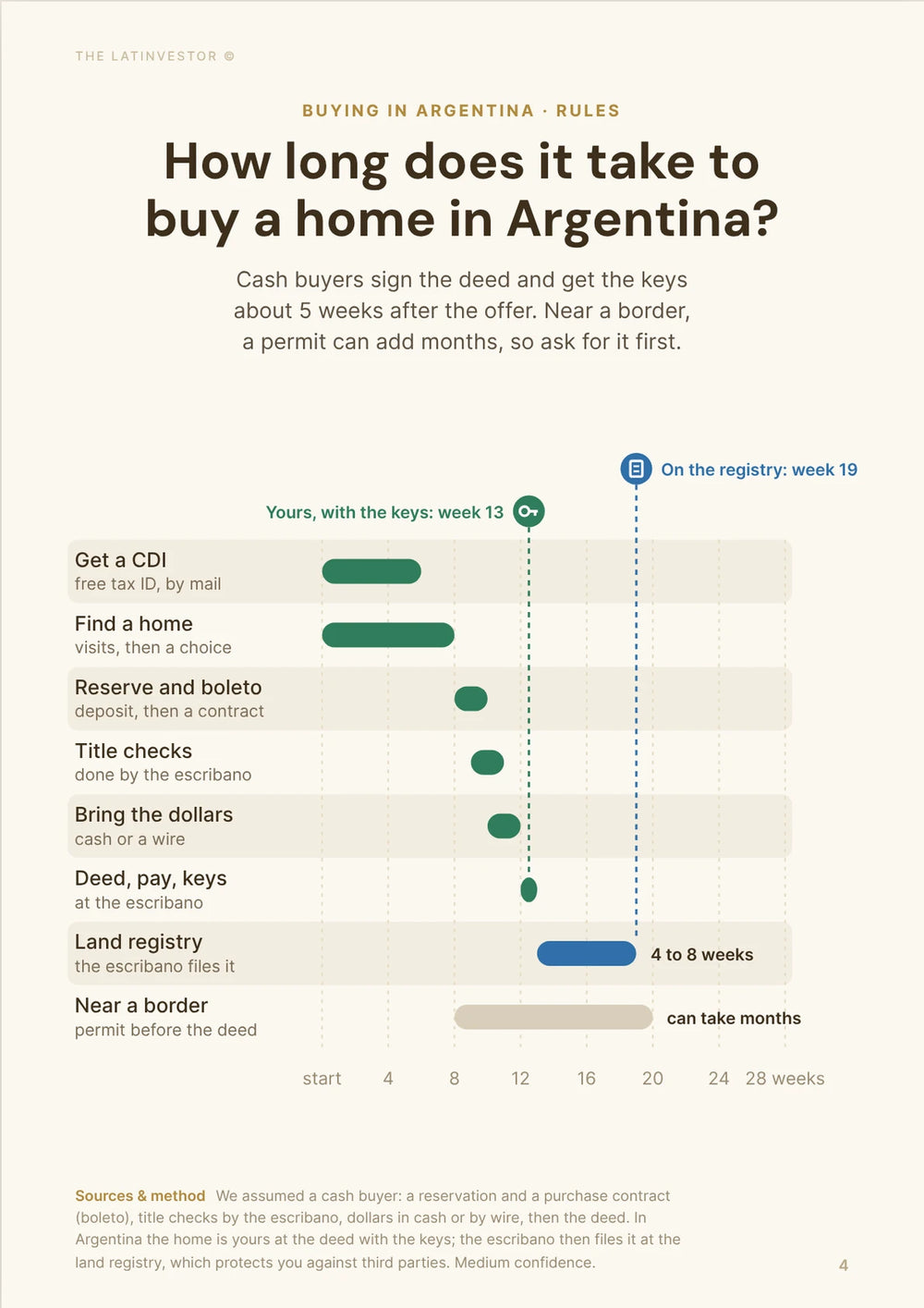
The usual steps are: (1) get your CDI; (2) choose a notary, ideally your own, and an agent if needed; (3) check whether the plot is urban or rural; (4) check the border zone; (5) run title and debt checks and a survey; (6) sign a reservation or preliminary contract (boleto de compraventa) with a 5% to 10% deposit; (7) obtain the Rural Land Registry certificate and Previa Conformidad if needed; (8) sign the deed (escritura) and pay; (9) register it with the provincial property registry.
A clean urban lot can close in a few weeks once the CDI is in hand. A rural or border-zone plot takes longer, and there is no official processing time for the approvals, so leave a margin of several months and do not fix a hard deadline in the boleto.
The documents you sign are the reservation or boleto, the deed and, if you buy from abroad, a power of attorney. Price is usually in US dollars, and a contract in dollars must be paid in dollars (Civil Code, arts. 765–766). Cash deals above ARS 275,850,000 (about USD 178,000) are reported to the financial intelligence unit (UIF) in the second half of 2026.
What scams are common when it comes to buying land in Patagonia right now?
What scams target foreign land buyers in Patagonia right now?
Remote land, foreign buyers in a hurry and a language gap make Patagonia an easy target.
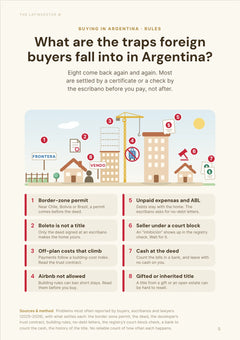
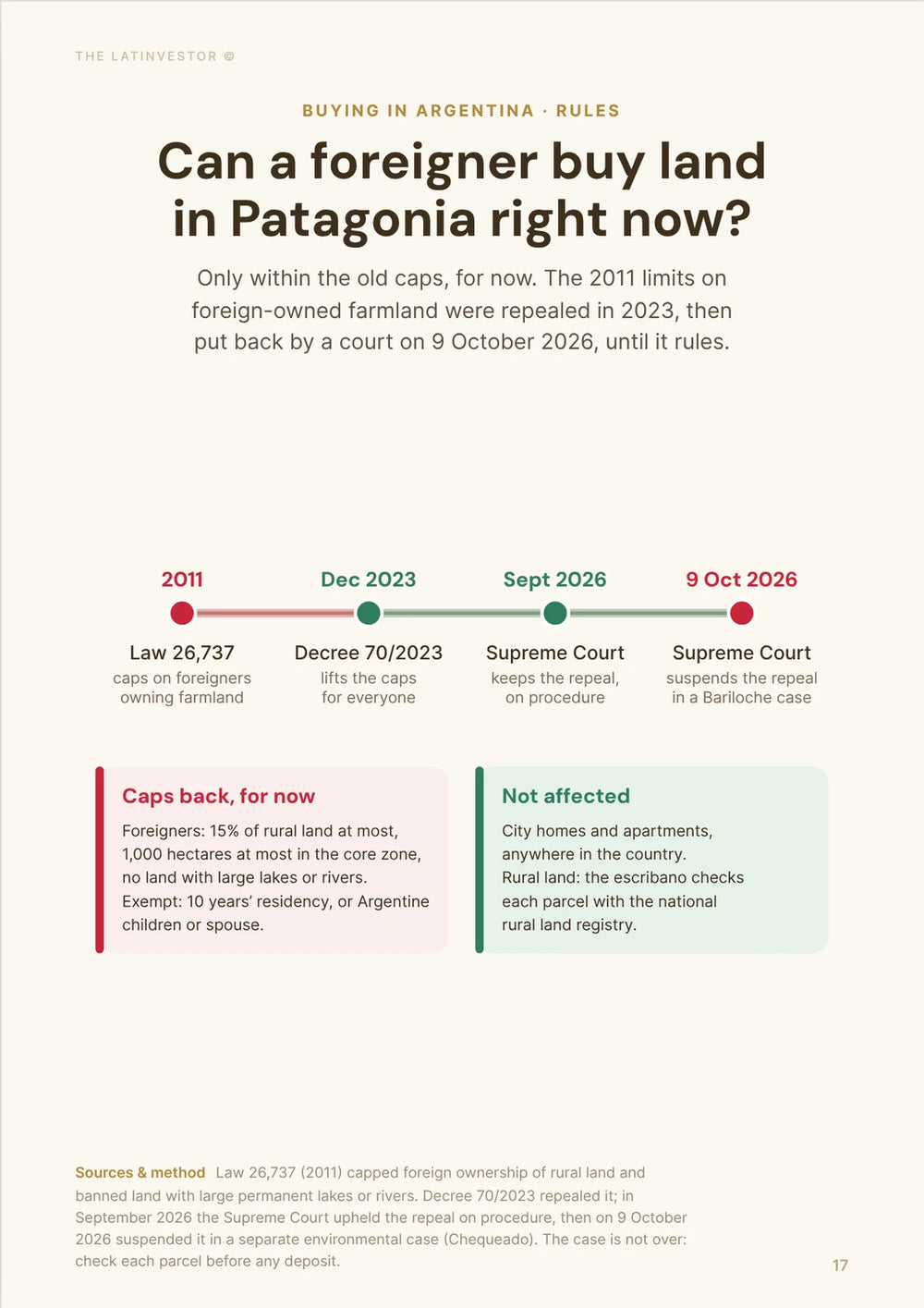
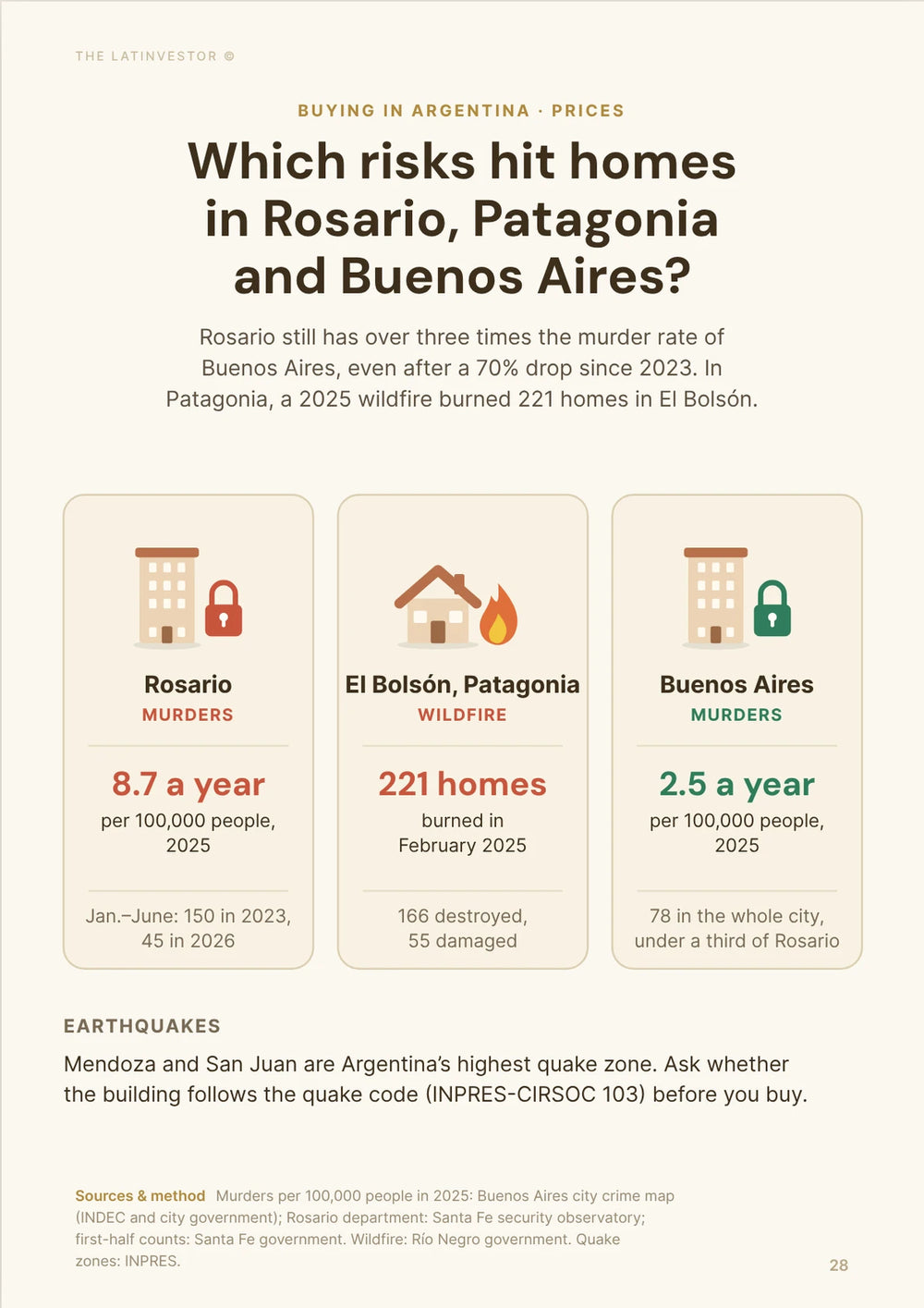
The usual tricks: a fake seller with a forged power of attorney, the same plot sold twice, a different parcel on the deed from the one you were shown, land with no legal road access, and rural land sold as a "residential lot" to hide the extra rules.
Warning signs: pressure to pay a big deposit before any title check, no current registry certificate, a price far below nearby lots, and a seller who does not want a notary involved from the start.
After the fact you can file a criminal complaint and sue, but recovering money is slow and uncertain. Checking before paying costs far less.
How do I verify the seller is legit in Patagonia right now?
Have your own notary pull the registry records, rather than trusting the documents the seller brings. The ownership report (informe de dominio) shows who the registered owner is and whether there are mortgages, embargoes or bans on selling (inhibiciones).
Ask the notary to also check unpaid property tax and municipal debts on the plot, and the seller's identity and any power of attorney he uses.
The notary is the key person: he must check the title and cannot sign the deed if the seller has no right to sell.
How do I confirm land boundaries in Patagonia right now?
Hire a licensed surveyor (agrimensor) to check the plot on the ground against the cadastral plan, not against fences or what the seller points at.
Compare the cadastral plan (plano de mensura), the description in the deed and any servitudes or easements, especially those giving access to the road or the water.
A survey is not always mandatory, but on rural or semi-rural land it is worth every peso: fences built in the wrong place, rivers that moved and "local agreements" are common.
The classic problems: no legal access to the road, a neighbour's fence on your land (or yours on his), and a river boundary that has shifted since the last survey.
What will it cost me, all-in, to buy and hold land in Patagonia?
What purchase taxes and fees apply in Patagonia in 2026?
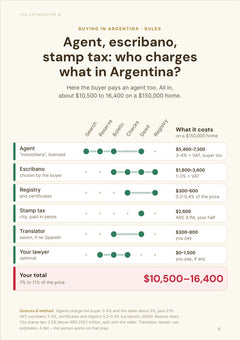
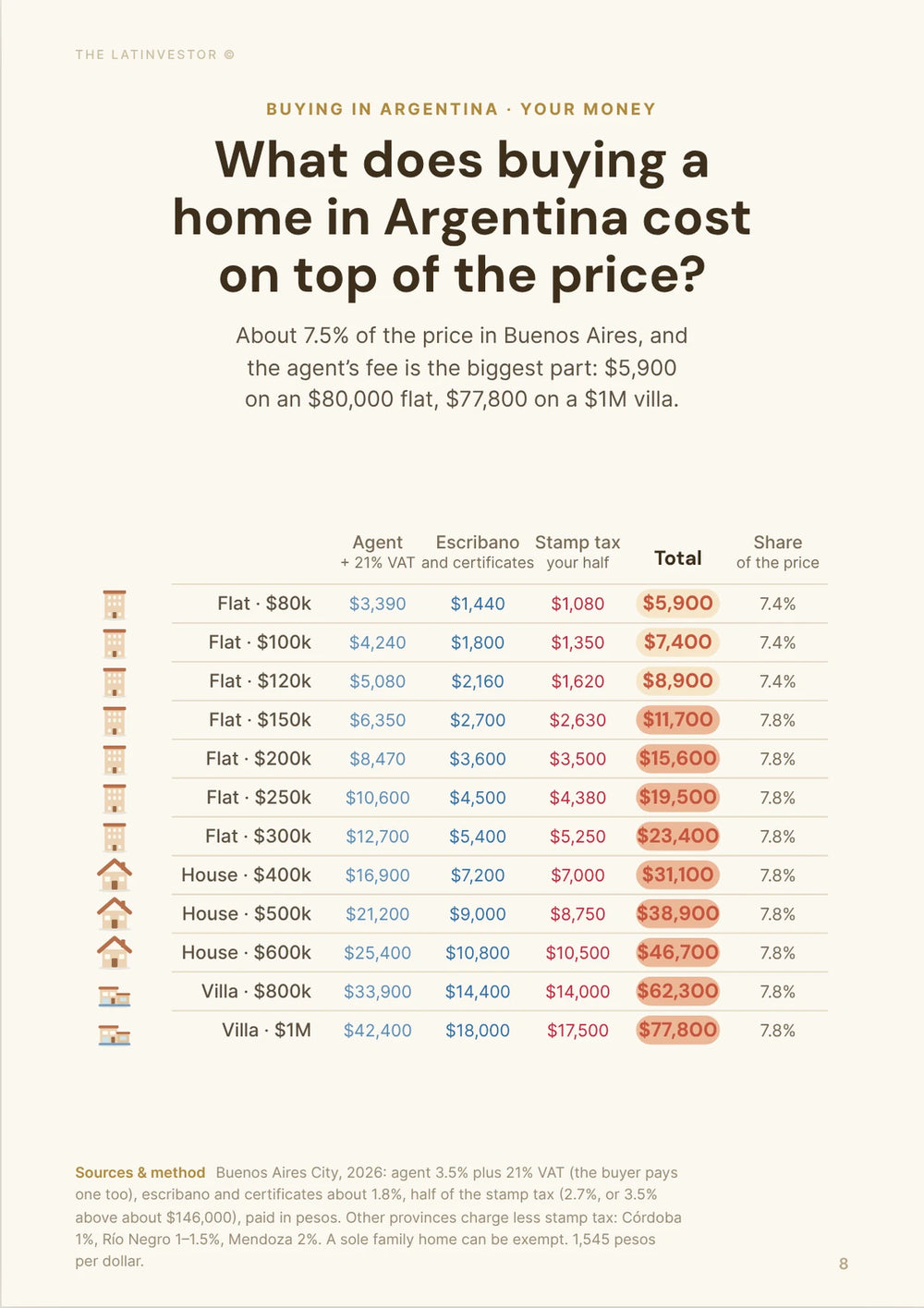
Count about 5.5% to 9% of the price on the buyer's side, so USD 11,000 to 18,000 on a USD 200,000 plot.
| Item | Typical cost | Note |
|---|---|---|
| Stamp tax | 1% to 1.5% (Río Negro); about 2.5% (Neuquén, Roomix, not officially confirmed) | Usually split with the seller; other provinces have their own rates |
| Notary (escribano) | 1% to 2% + 21% VAT | Also checks title, debts and land status |
| Certificates and registry | 0.2% to 0.4% | Ownership report, debt certificates, registration |
| Buyer's broker | 3% to 4% + 21% VAT | Only if you use an agent; often the biggest item |
| Total | About 5.5% to 9% | Lower without an agent |
There is no extra tax for being foreign. The old 1.5% ITI transfer tax was abolished in July 2024. A foreigner's extra cost is legal work on rural or border plots.
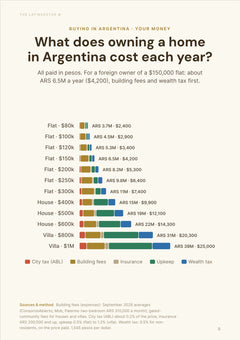
Holding costs are small: provincial property tax and municipal fees depend on the parcel's fiscal value, and a non-resident owes Bienes Personales (wealth tax) of about 0.5% a year, paid through a local representative. If you resell, an individual, resident or not, pays no income tax on the gain since 1 January 2026.
What hidden fees surprise foreigners in Patagonia most often?
On remote land, add about 1% to 3% of the price, so USD 2,000 to 6,000 on a USD 200,000 plot, because it needs more checks than a flat in town.
Rough budgets for the usual extras: a survey when the cadastral plan is old (about USD 500 to 2,000), documenting road access and servitudes (USD 300 to 1,000), legal work on the border-zone file (USD 500 to 1,500), and apostilles and sworn translations (USD 200 to 500). Off-grid water, septic and power on an empty plot can cost several thousand dollars more.
Most of these show up after you sign the boleto and pay the deposit. Ask the notary for a written estimate of all costs before you sign anything binding, naming the survey, the access check and any border procedure.
What changed for rural land in Patagonia in October 2026?
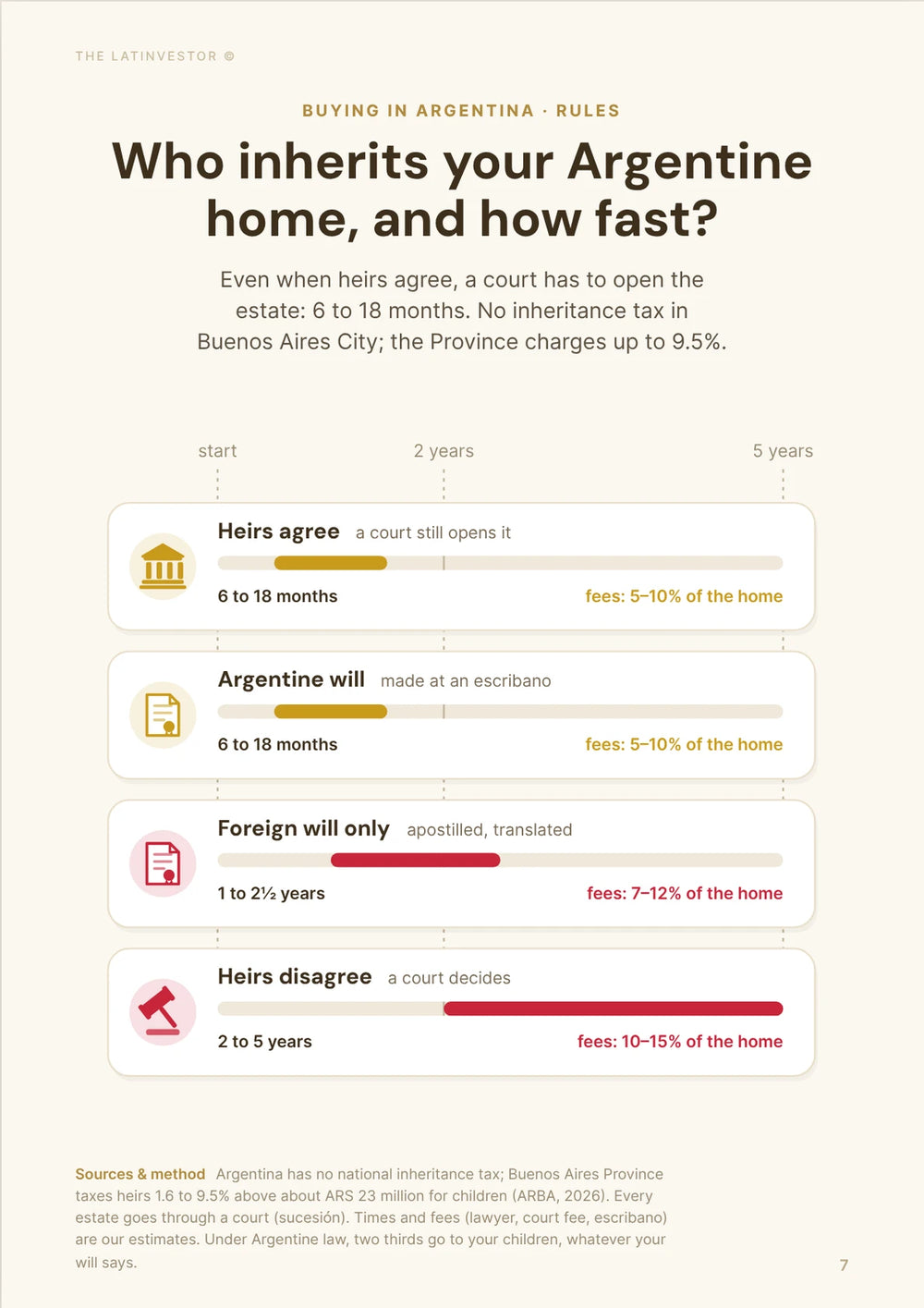
The rules flipped twice in two weeks. Decree 70/2023 had tried to repeal the Rural Land Law in December 2023. On 29 September 2026 the Supreme Court threw out one challenge (the CECIM case) on standing, which many read as the end of the caps.
Then, on 9 October 2026, the Court provisionally suspended the repeal in a second case brought by the environmental group Árbol de Pie, and sent it back to the federal judge in Bariloche. Until that judge rules, the 15% caps, the surface limits and the waterfront ban apply again.
A move in Congress to overturn the whole decree failed on 15 October 2026 for lack of quorum, so nothing else changed. If you read "Argentina repealed its foreign land limits" in an older article, it is out of date.
What to do: write into the reservation contract that the deposit comes back if the parcel turns out to be rural and the Registry refuses the authorization. Do not plan a purchase on the hope that the final ruling goes your way.
Who already owns Patagonian land, and where is the foreign quota full?
Nationally, foreigners hold about 13.38 million of 266.7 million rural hectares, roughly 5%, well under the 15% cap, and no province is over it. More than 30 departments are, though, and several are in Patagonia.
Lácar (San Martín de los Andes, Neuquén) is the most extreme Patagonian case at about 54%, fourth in the country. Magallanes in Santa Cruz is at about 25.8%. For a foreigner, a new rural purchase there is off the table while the caps apply.
By nationality, US owners hold the most foreign land, about 2.7 million hectares, followed by Italian and Spanish owners; the three together hold about half of all foreign-owned land (UBA-CONICET, December 2025). So for a US buyer, ask about the 30% per-nationality limit in that department too, not only the overall 15%.
What to check: ask the notary for the Registry's current figure for your department and your nationality, not the provincial average.
Our methodology
This article explains what land a foreigner can buy in Argentine Patagonia, in town and in the countryside, what papers are needed, the steps, the common scams and what it costs to buy and hold. Chilean Patagonia (Puerto Varas, Coyhaique, Punta Arenas) follows Chilean law and is not covered.
The rules come from the texts and official pages first: the Constitution, Law 26.737 and the Rural Land Registry, Decree-Law 15.385 and the Interior Ministry's Previa Conformidad procedure, ARCA for the CDI and taxes, and Decree 406/2026 for resale gains. The October 2026 Supreme Court rulings come from Chequeado. Foreign-ownership shares come from the Registry and the UBA-CONICET land map. Lot prices are TuLugar median asking prices for October 2026.
Buying costs come from the 2026 Río Negro and Neuquén stamp-tax schedules, Roomix for Bariloche closing costs and national notary and broker references; the UIF cash threshold uses the second-half 2026 minimum wage.
We checked these figures in October 2026. Peso amounts are converted at about ARS 1,550 per US dollar (official and MEP rates were within 1% of each other on 22 October 2026, the blue rate about ARS 1,570), and euro amounts at about ARS 1,740 per euro.
Where we had no direct figure, we said so: there is no official processing time for border-zone approvals, no per-department Registry figure published for every Patagonian department, and the extra-cost ranges for surveys and access checks are our own estimates. Lot prices are asking prices, not deed prices. This is not legal advice: the land status of a given parcel has to be confirmed by a notary.
Key sources used for this analysis include Argentina National Registry of Rural Land, Chequeado, Argentine Interior Ministry (Border Security), Previa Conformidad Portal, Decree-Law 15.385, ARCA CDI guide, La Gaceta (UBA-CONICET land map), LM Neuquén, TuLugar Bariloche, TuLugar Neuquén, TuLugar Ushuaia, Río Negro stamp tax 2026, Neuquén stamp tax 2026, Roomix, Decree 406/2026, Multilaw, Creimerman Law, Gateway to South America and Infobae.