Summary
Buying a flat or house inside a town in Argentine Patagonia is low-risk for a foreigner if you check the title yourself; the real dangers are rural land, paperwork and fire, not crime, with 2025 homicide rates of 2.7 to 5.7 per 100,000 people across the Patagonian provinces.
A non-resident can buy town property in his own name with a free CDI tax ID, a public deed (escritura) before a notary and registration at the provincial property registry.
Rural land is the trap: since the Supreme Court decision of 9 October 2026, the 15% caps on foreign ownership of rural land apply again pending a final ruling, and Magallanes in Santa Cruz is already at about 25.8% foreign ownership.
The most common scam is a "lot" outside the urban grid sold as a future building plot, where you cannot legally build, subdivide or connect services as promised.
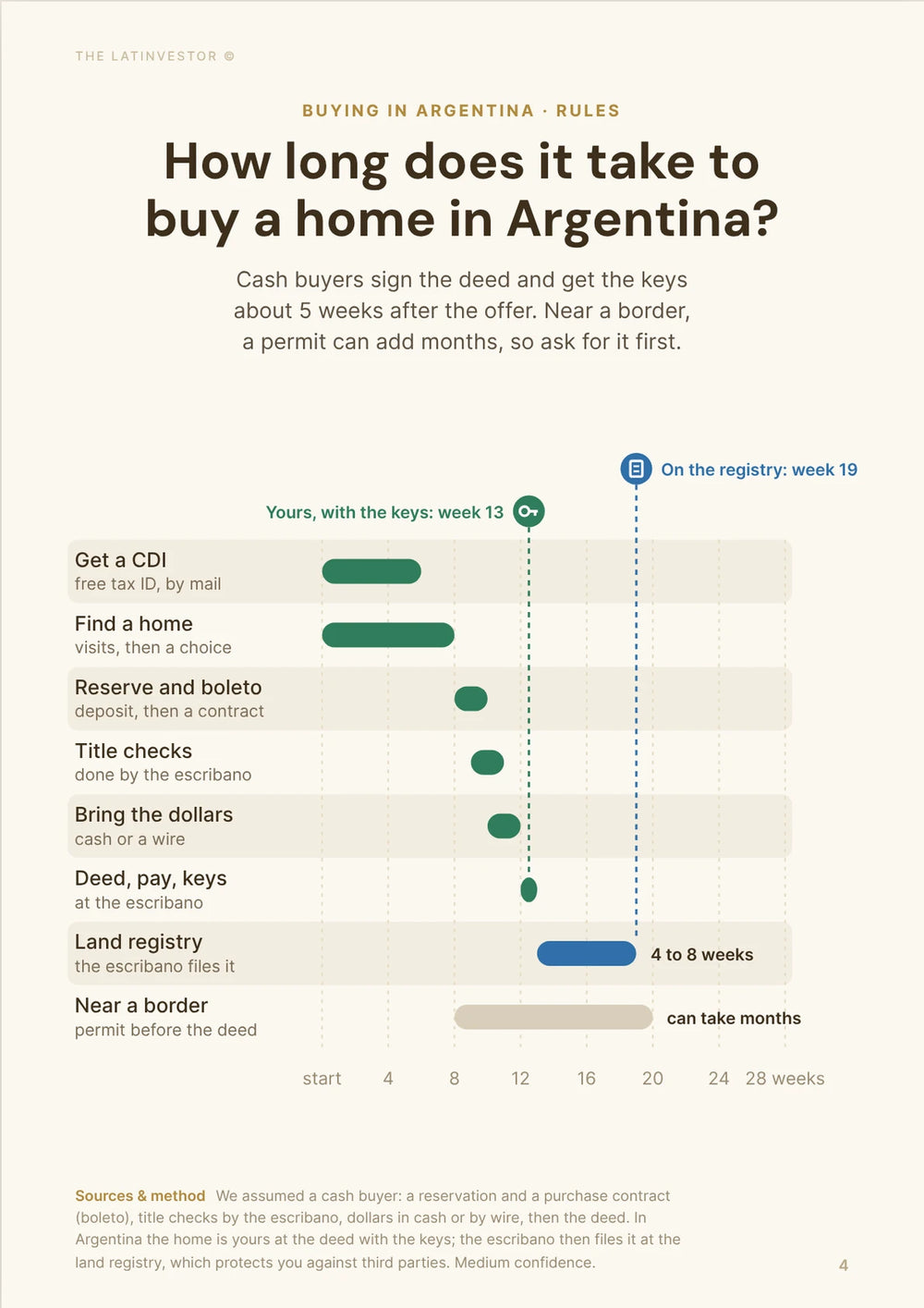
A signed boleto de compraventa is only a contract: you are protected against third parties once the escritura is signed and registered, so keep most of the money for that day.
To check the seller, order the dominio and lien certificate from the provincial registry and an inhibición report on the seller yourself; do not rely on copies the seller hands you.
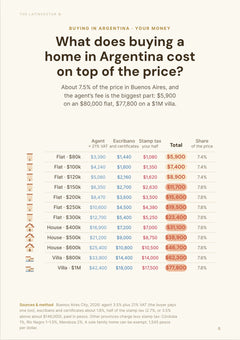
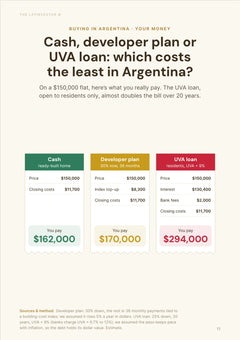
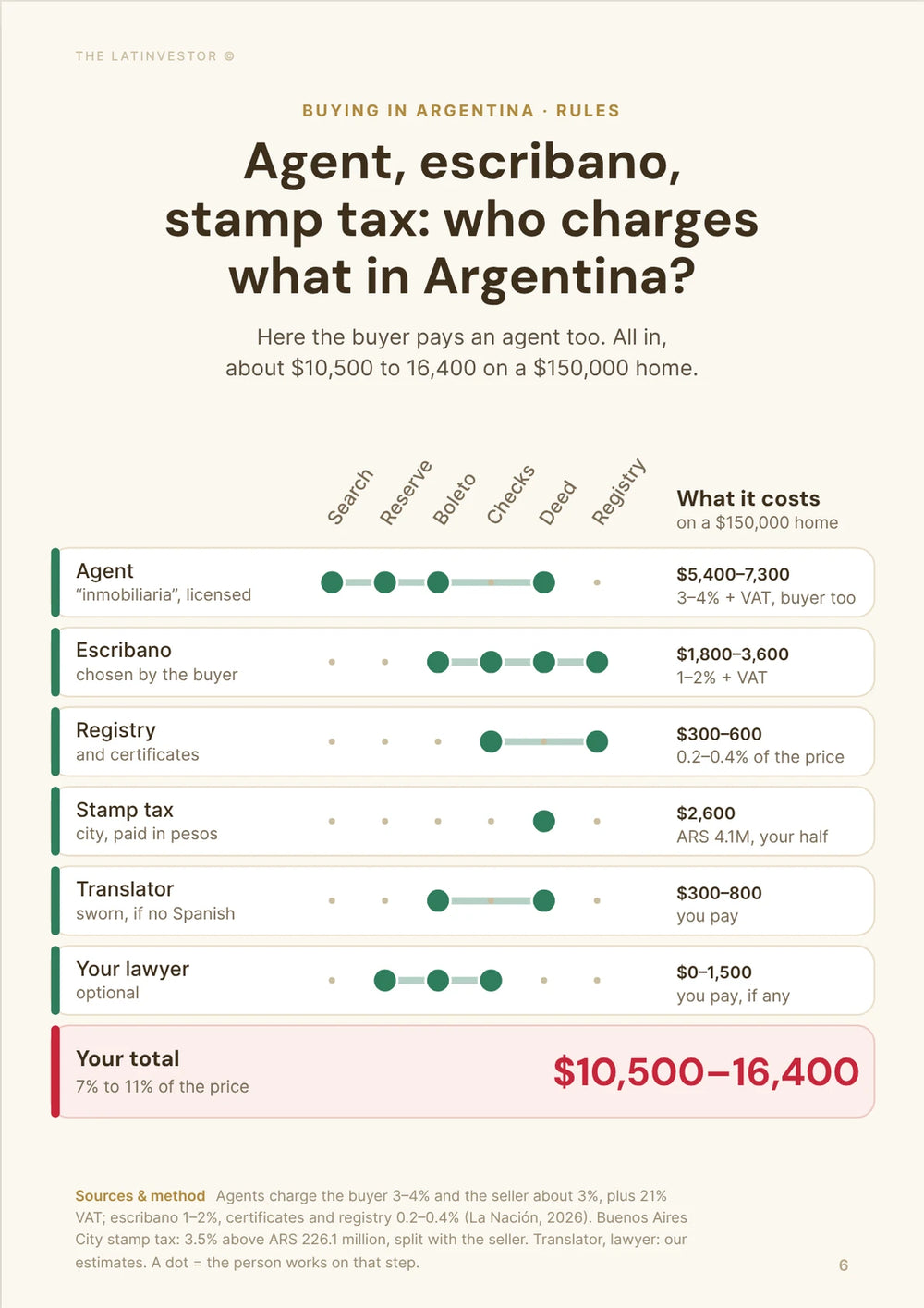
Budget about 5.5% to 9% on top of the price in stamp tax, notary, registry and broker fees, or roughly USD 13,750 to USD 22,500 on a USD 250,000 house, plus any cost to legalize unpermitted cabins or extensions.
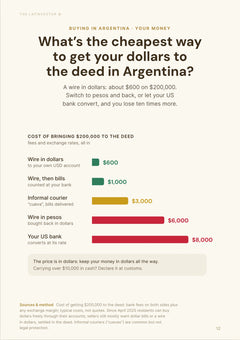
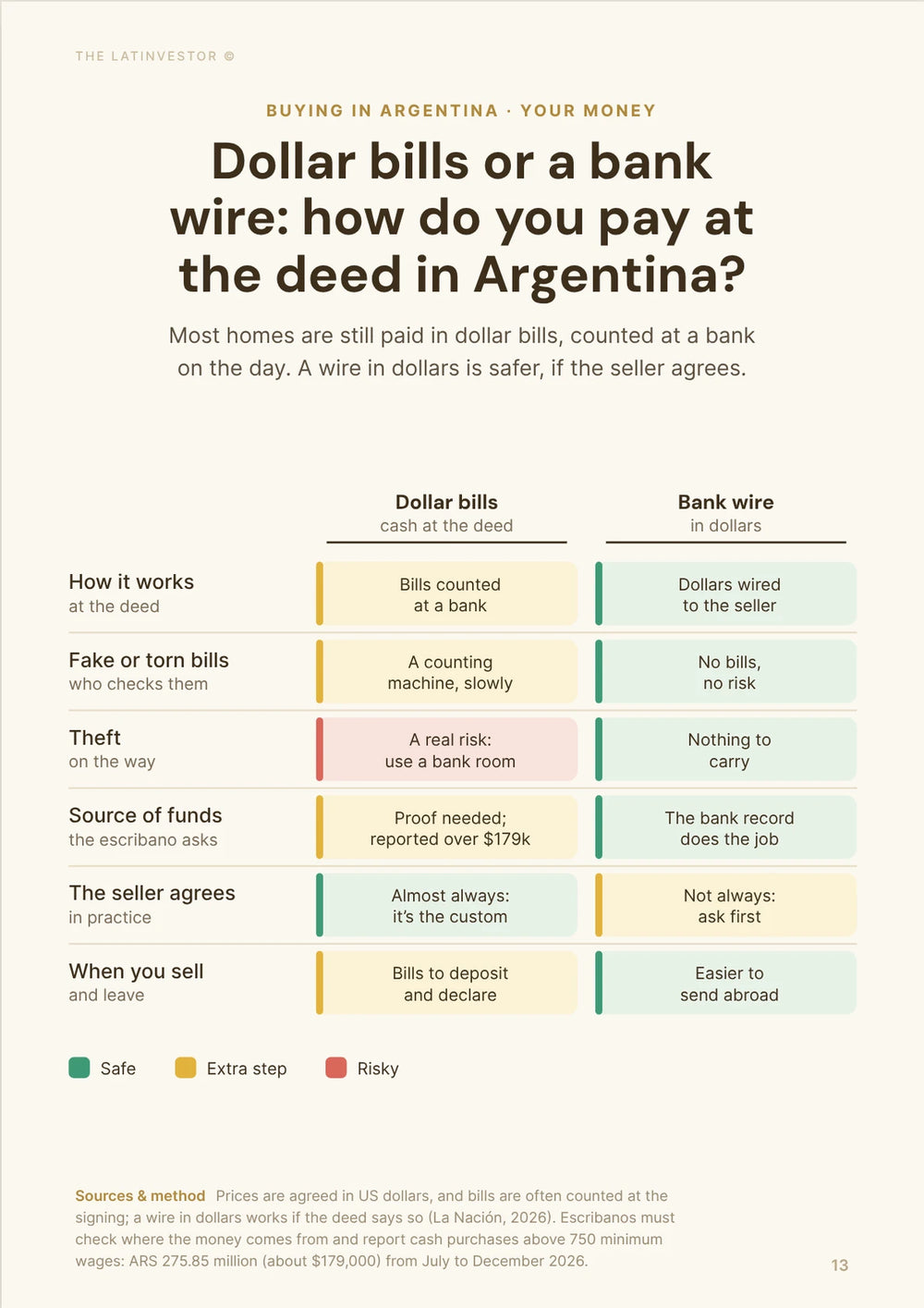
Refuse "cash under the table": a contract in dollars must be paid in dollars, and cash deals above ARS 275,850,000 (about USD 178,000) are reported to the UIF in the second half of 2026.
Agents must hold a matrícula from their provincial college, and the buyer's fee is usually 3% to 4% plus 21% VAT, so agree in writing who pays what.
Inspect for cold-climate problems and get a surveyor to stake the boundaries; access easements that were never registered cause most neighbour disputes.
Fire and access are now the physical risks to price in: the 2025 El Bolsón fire hit 221 homes, and Route 40 near Villa La Angostura was fully closed after a slope collapse on 18 October 2026.
Our view: a town flat with a clean registry search is a normal purchase; anything rural, on a lake, near the Chilean border or in a forest needs a written check from the notary before you pay a deposit.

What can a foreigner legally own in Argentine Patagonia, and where does it get risky?
Can foreigners legally own properties in Patagonia in 2026?
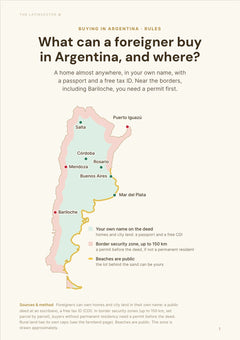
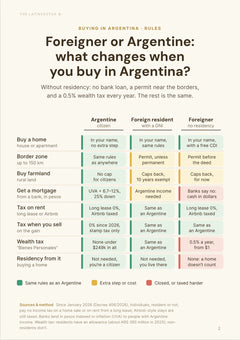
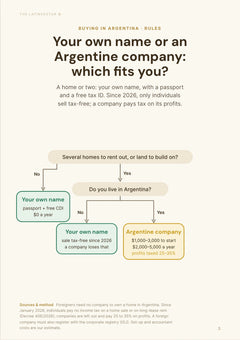
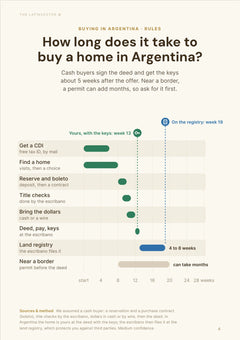
Yes. A non-resident foreigner can buy an apartment or a house inside a town in Argentine Patagonia (Neuquén, Río Negro, Chubut, Santa Cruz, Tierra del Fuego) in his own name. You need a CDI tax ID from ARCA, which is free but can take up to 30 business days for non-residents, a public deed signed before a notary (escribano) and registration at the provincial property registry. This article covers the Argentine side only; Chilean Patagonia has its own rules.
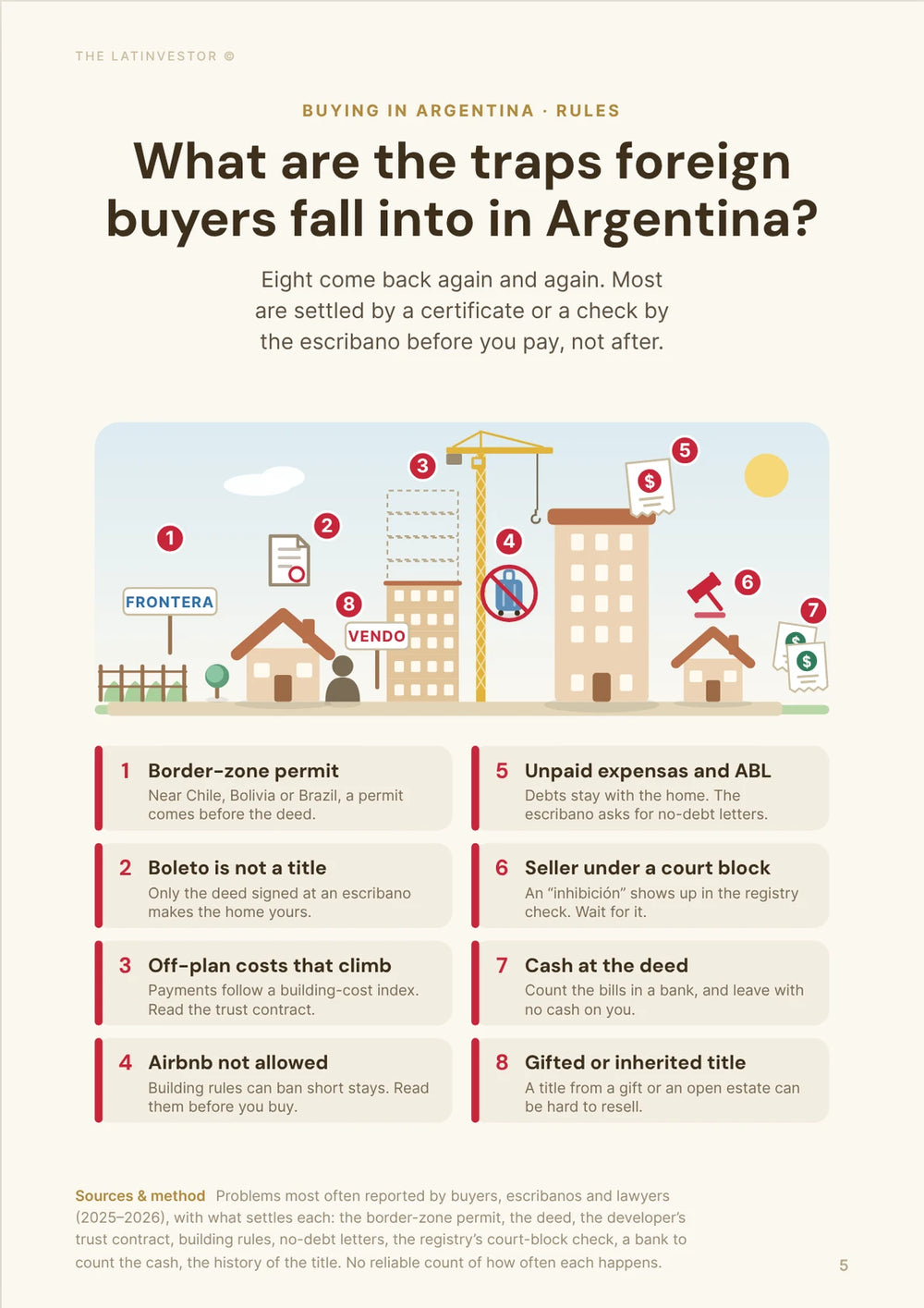
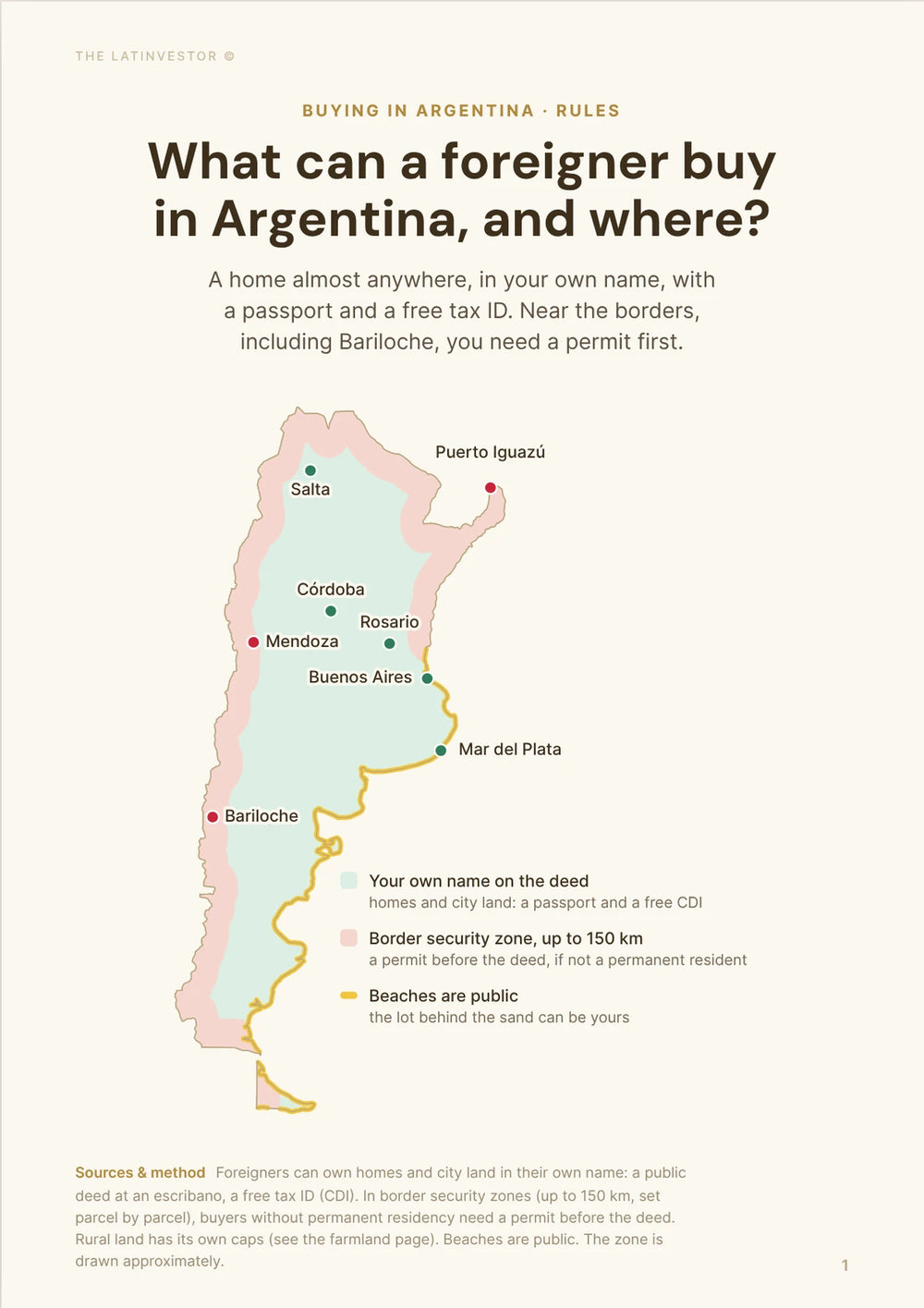
The restrictions sit on rural land, meaning anything outside a town's urban boundary. Law 26.737 caps foreign ownership at 15% of rural land nationally, per province and per department, and limits land around large lakes and rivers. Its repeal by Decree 70/2023 was provisionally suspended by the Supreme Court on 9 October 2026, in a case brought from Bariloche, so the caps apply again for now.
Border security zones are a separate layer. Under Decree-Law 15.385 they can reach up to 150 km from a land border, which covers much of Andean Patagonia, and a non-exempt parcel needs prior approval (Previa Conformidad). Listed urban centres are exempt, and so are some small urban lots up to 5,000 m² not bought for profit.
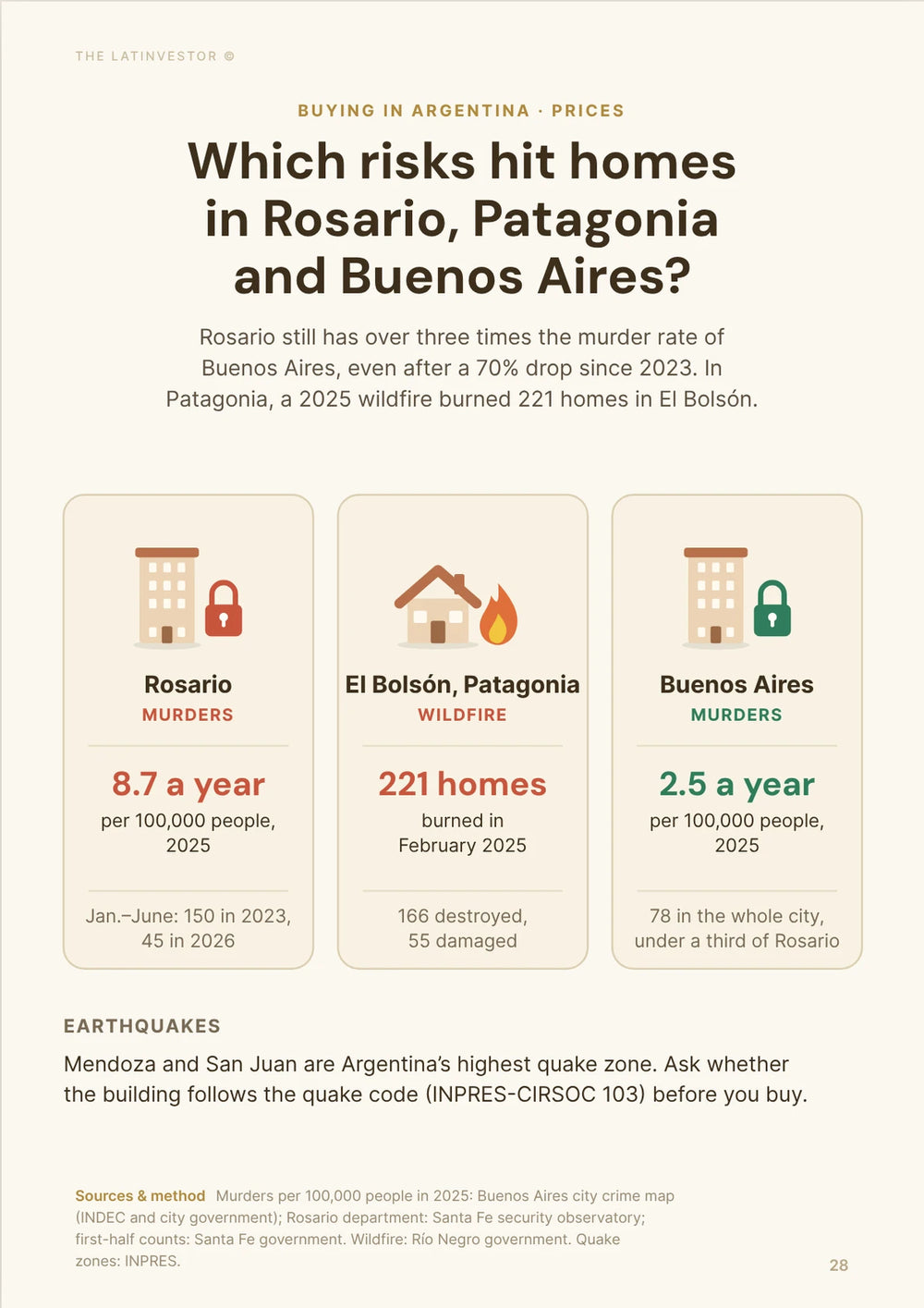
Crime is not the main risk. The 2025 intentional-homicide rate was 2.7 per 100,000 people in Tierra del Fuego, 3.2 in Río Negro, 3.5 in Chubut, 4.5 in Santa Cruz and 5.7 in Neuquén (national security ministry, SNIC). What goes wrong for foreign buyers is title, land status and the condition of the house.
Some foreigners use an Argentine company or a local partner when a plot is rural. It does not get around the law when foreigners hold more than 51% of the company, and it adds accounting costs every year. For a normal home, buying in your own name is simpler and safer.
What buyer rights do foreigners actually have in Patagonia in 2026?
The same as an Argentine buyer. Article 20 of the Constitution gives foreigners the right to buy, own and sell real estate, and nothing in the deed or the registry marks your ownership as lesser. What protects you in a dispute is a registered title, not your nationality.
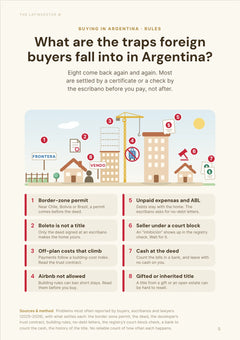
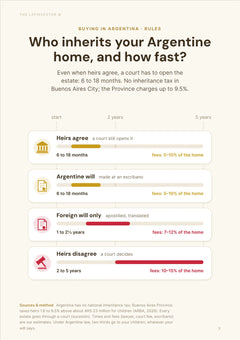
The most common mistake is to treat a signed boleto de compraventa (preliminary contract) as ownership. A boleto gives you contractual rights against the seller. Only the escritura, once registered at the provincial Registro de la Propiedad Inmueble, protects you against other creditors, buyers or heirs.
The same applies to off-plan units sold through a trust (fideicomiso): you hold a contract with the developer, not a registered flat, and a cost-based trust guarantees neither the final price nor the delivery date.
How strong is contract enforcement in Patagonia right now?
Weak enough that you should not plan on suing your way out of a bad deal. World Bank governance indicators put Argentina's rule of law below neighbours such as Chile and Uruguay, and civil cases over land and registry problems can take years in provincial courts.
The disputes that drag on most involve rural plots, unregistered access roads and registry records that do not match the land on the ground. Your protection is the checking you do before you pay, and a deed that states the exact price and how it was paid.
Which scams target foreign buyers in Patagonia right now?
Are scams against foreigners common in Patagonia right now?
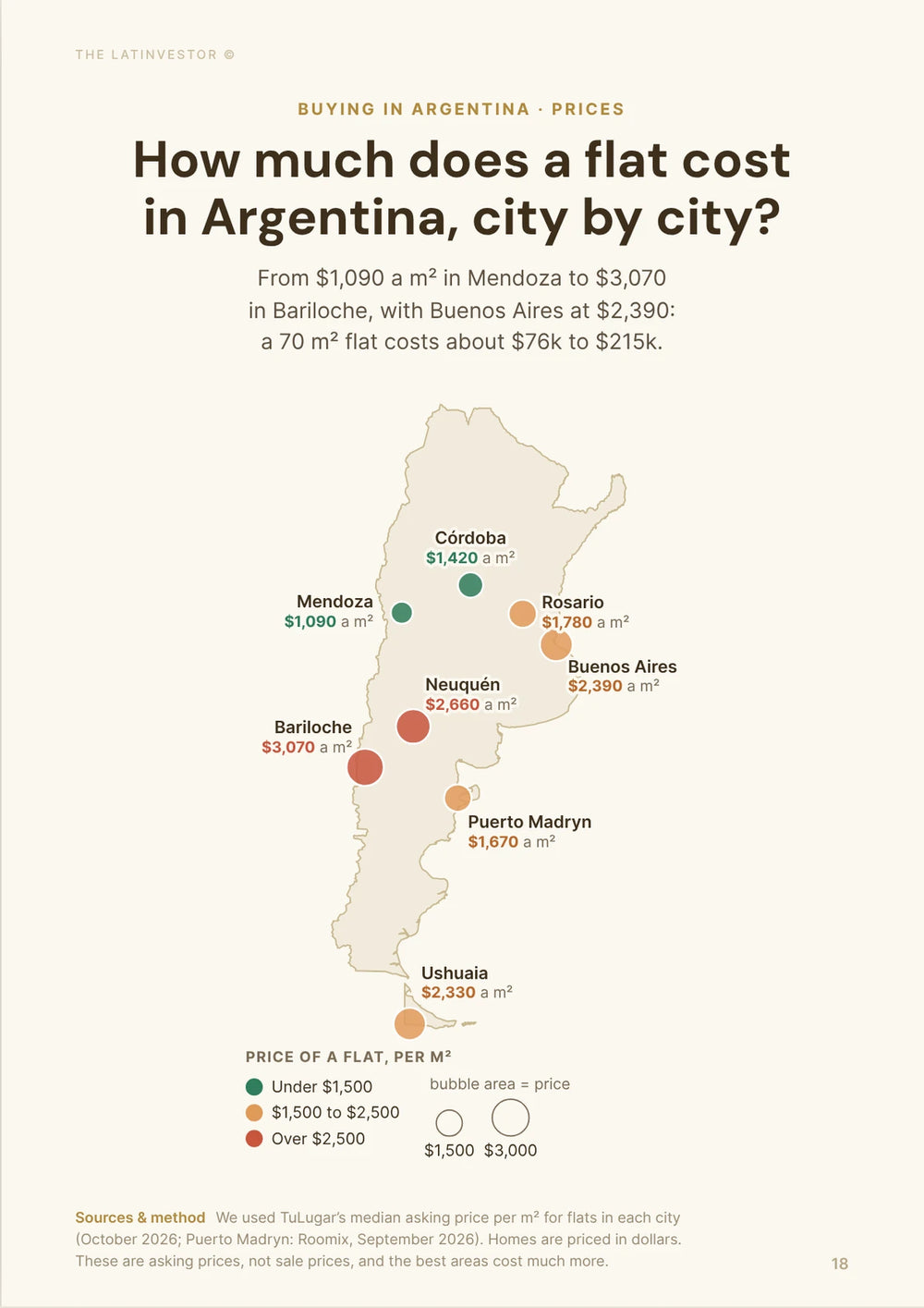
Not everywhere, but they cluster in the tourist and second-home towns: Bariloche, Villa La Angostura, San Martín de los Andes, El Bolsón and Ushuaia. That is where foreigners buy on emotion and where land outside the urban grid is easiest to sell with a view.
The deal most often abused is the remote "investment lot" or rural parcel marketed online as a future residential development, where the land cannot legally be built on, subdivided or connected the way the seller promises.
The buyers most often caught are those who find a dream property on a short holiday and try to lock it in before flying home, with a deposit wired before any registry search.
The clearest warning sign is urgency: a seller or agent who says you can "sort out the paperwork later". A seller with a clean title loses nothing by letting your notary check it first.
What are the top three scams foreigners face in Patagonia right now?
First, rural parcels sold as residential lots when the zoning or the land law does not allow it. Second, homes with hidden liens, unpaid taxes, court orders or open inheritances that only show up after you have paid. Third, deals that stay at the boleto stage while most of the money has already changed hands.
The rural parcel scam usually goes like this: beautiful lake or mountain land, a promise that power, water and a building permit are "coming soon", a deposit or full payment, then the discovery that the municipality classes the plot as rural, that subdivision was never approved, or that as a foreigner you need a certificate from the Rural Lands Registry before you can buy at all.
The fixes: for land, have the notary confirm in writing the plot's classification, zoning and whether the rural-land caps or a border zone apply, and make the reservation conditional on that answer. For liens, let the notary order fresh certificates from the provincial registry. For boleto deals, keep the deposit small and pay the balance at the signing of the escritura.
How do I verify the seller and ownership in Patagonia without getting fooled?
How do I confirm the seller is the real owner in Patagonia?
Get the documents from the registry, not from the seller. In practice your notary orders them, and the buyer usually chooses the notary.
You need a certificado de dominio y gravámenes from the Registro de la Propiedad Inmueble of the province where the property sits (each Patagonian province has its own), plus an inhibición report on the seller personally, which shows whether a court has barred him from selling his assets. Compare the names, ID numbers and cadastral reference with the seller's passport or DNI.
The usual trick, rare but real, is an authentic-looking copy the seller made himself, or an old certificate that does not show a recent mortgage, court order or inheritance. A heir selling a property before the succession is closed is another frequent problem in Patagonian family homes.
Where do I check liens or mortgages on a property in Patagonia?
At the provincial Registro de la Propiedad Inmueble, through the dominio y gravámenes certificate. It lists mortgages, court attachments (embargos), usufruct, registered easements and any restriction on the seller's right to transfer.
Ask for two more things the registry does not cover: a "libre deuda" for the provincial property tax and the municipal fees, and, for a flat, a certificate of unpaid building charges (expensas) from the building manager. Unpaid debts can follow the property.
The burden foreign buyers miss most is an informal access path or easement. If your road crosses a neighbour's land and no servitude is registered, the neighbour can close it. Ask for the survey plan and check that the access is on public land or registered.
How do I spot forged documents in Patagonia right now?
Forgery is occasional, not widespread, because it only works when the buyer never checks with the registry. The usual fake is a doctored or outdated title copy or certificate.
Red flags: a certificate dated suspiciously long ago, missing seals, a format that does not match other documents from the same registry, a power of attorney signed abroad without an apostille, and any reluctance to let your notary order the papers.
The rule is simple: if your own notary cannot reproduce the document from the registry with the property's identifiers, treat it as worthless.
What "grey-area" practices should I watch for in Patagonia?
What hidden costs surprise foreigners when buying a property in Patagonia?
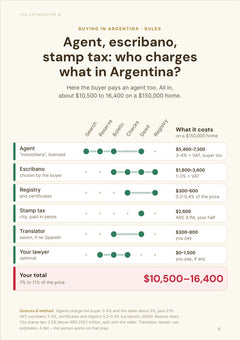
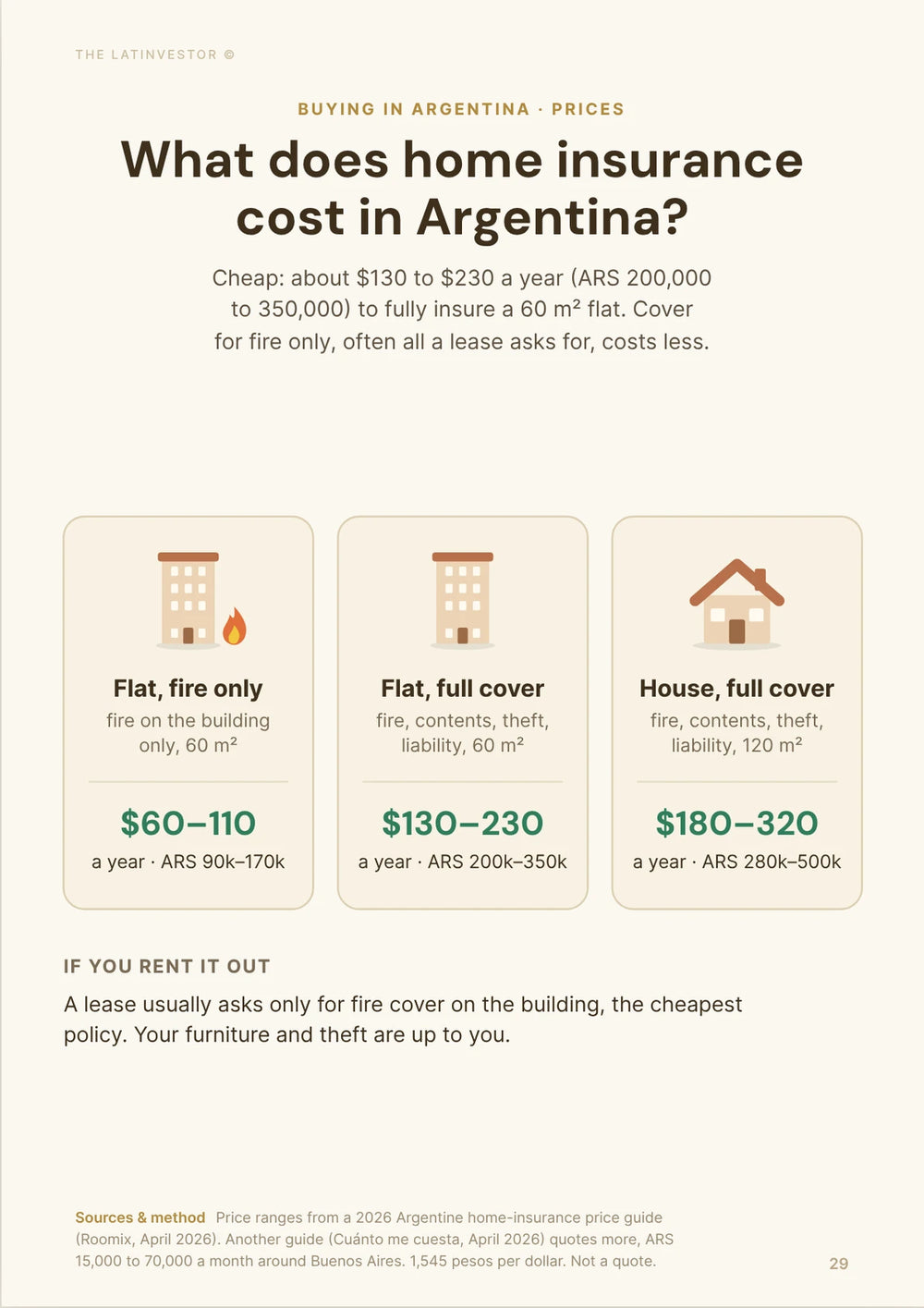
Closing costs first. On the buyer's side, count your share of the provincial stamp tax (about 1% to 1.5% in Río Negro, around 2.5% split between the parties in Neuquén, a Roomix figure not confirmed by an official source), the notary at 1% to 2% plus VAT, certificates and registry at 0.2% to 0.4%, and the buyer's broker at 3% to 4% plus VAT. That is about 5.5% to 9% of the price, so roughly USD 13,750 to USD 22,500 on a USD 250,000 house.
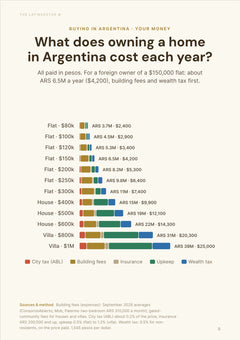
Then the yearly bills: provincial property tax, municipal fees and, in winter, gas and heating, which is the big line on a Patagonian house. Ask for a year of bills, not just the summer ones.
The cost sellers hide most often is regularization: a cabin, quincho or extension that is not on the approved plans. Getting it approved means an architect, updated plans and municipal fees, and sometimes fines or demolition. There is no standard price; ask for a quote before you sign and deduct it from your offer.
Taxes on resale are lighter than many old guides say: since 1 January 2026 an individual, resident or not, pays no income tax on the gain from selling a home, and the 1.5% ITI transfer tax was abolished in 2024.
Are "cash under the table" requests common in Patagonia right now?
They still happen, mostly where the seller wants to declare a lower price to cut his tax, where the papers have gaps, or where the intermediary is not a registered professional. Prices are quoted in US dollars and many deals close with dollar bills counted at the notary's office, which makes it tempting.
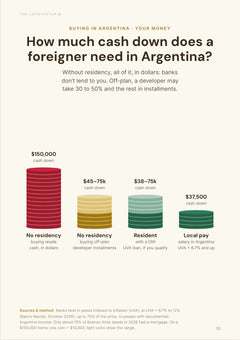
Paying cash is legal; hiding part of the price is not. A contract in dollars must be paid in dollars (Civil Code, arts. 765–766), and cash deals above ARS 275,850,000 (about USD 178,000) are reported to the financial intelligence unit (UIF) from July to December 2026. The Inocencia Fiscal law loosened some reporting rules in 2026, but notaries and banks still have to identify you and the origin of the money.
If you agree to an undeclared payment, you have no proof of what you really paid if the deal goes wrong, you understate your purchase price for any later dispute, and you take on tax and money-laundering risk. The safe route: the full price in the deed, and money arriving through a bank so the notary can document it.
Are side agreements used to bypass rules in Patagonia right now?
Yes, mostly on land. The classics are a verbal promise that "you can build later" on a plot outside the urban grid, and an informal arrangement over an access road where the seller tells you "the neighbour is fine with it".
Another one appears since the rural-land caps came back: a local "front" buyer who holds a rural plot for you. Deals that break Law 26.737 can be declared void, and a nominee arrangement leaves you with no registered right at all.
If a side agreement comes to light, you may be unable to build or connect services, face a demolition order, or lose the property, with little recourse because the agreement was written to avoid scrutiny.
Can I trust real estate agents in Patagonia in 2026?
Are real estate agents regulated in Patagonia in 2026?
Yes. Argentine provinces require agents (martilleros and corredores públicos) to hold a matrícula from the provincial professional college. In Neuquén, for example, the Colegio de Martilleros keeps a public list of licensed members.
Plenty of people still sell property without one, especially online and in tourist towns. An unlicensed intermediary cannot legally claim a fee and is not covered by the college's discipline rules.
To check an agent, ask for the matrícula number and confirm it with the college of the province where the property sits. Get a written mandate with the fee, and never pay a deposit into an agent's personal account: it should be paid against a signed receipt or reservation document that names the property and the conditions for refund.
What agent fee percentage is normal in Patagonia in 2026?
The buyer usually pays 3% to 4% of the price plus 21% VAT, and the seller pays his own agent separately. On a USD 250,000 house, 3% plus VAT comes to about USD 9,075.
Fees are negotiable, especially on expensive houses that sit on the market. Agree in writing who pays what before you sign anything, because "the commission" can mean the buyer side only or both sides.
What due diligence actually prevents disasters in Patagonia?
What structural inspection is standard in Patagonia right now?
There is no compulsory inspection, so you hire one yourself. In Patagonia it should focus on cold and snow: heating, insulation, roof load, damp and mould, drainage, foundations moved by frost, and fire defence in forested areas.
Ask the inspector to check the roof structure, wall and window insulation, plumbing (frozen pipes), wiring, the septic tank or sewer connection, and outbuildings such as cabins, quinchos and sheds.
Use a registered architect or civil engineer who works locally. Someone from Buenos Aires may miss frost and snow problems.
What inspections find most often: weak insulation, damp from poor drainage, extensions that are not on the approved plans and heating that is too small or badly maintained.
How do I confirm exact boundaries in Patagonia?
Compare the registered description with a survey of the actual land. Fences and "everyone knows where the line is" mean nothing legally.
The reference is the official survey plan (plano de mensura) registered with the provincial cadastre, which should match the title at the property registry.
The most common boundary dispute is about access: you assume you can use a track to reach the house, then the neighbour disputes it because no servitude was ever registered.
Hire a licensed surveyor (agrimensor) to stake the corners and confirm that what you see matches the plan, before you sign the boleto.
What defects are commonly hidden in Patagonia right now?
Three come up again and again: damp and insulation problems covered by fresh paint (common), extensions and cabins that are not registered (common), and water, septic or electrical limits that only show once you live there (less common).
How to catch them: visit during or just after rain or snowmelt, ask for gas, electricity and water bills from several seasons, and compare the approved plans and the registered built area with what actually stands on the plot.
What does the October 2026 land-law ruling change for lake and rural plots in Patagonia?
On 9 October 2026 the Supreme Court provisionally suspended the repeal of the Rural Lands Law, in a case filed in Bariloche by the environmental group Árbol de Pie. Ten days earlier it had dismissed a different challenge, so for a few days the headlines said the opposite. Today, the foreign caps apply again until the federal judge in Bariloche rules on the case.
For a buyer, that means the 15% ceilings per department are back, along with the limits on rural land around large lakes and rivers and the habilitation certificate foreigners need from the Rural Lands Registry. Some Patagonian departments are already over the line: Magallanes in Santa Cruz is at about 25.8% foreign ownership. In such a department, a foreigner may simply not be able to buy rural land.
Nothing changes for a flat or a house inside a town's urban boundary. The risk is the chacra, the lake plot or the estancia just outside it. Ask the notary to confirm in writing whether the parcel is rural and whether it sits in a border zone, and make any deposit refundable if the parcel turns out to be rural or in a border zone.
Which physical risks should you check before buying in Andean Patagonia now?
Fire first. The early-2025 fire around El Bolsón affected 221 homes, 166 destroyed and 55 damaged. Check the distance to the forest edge, the firebreaks, the slope around the plot and whether the house can be insured at a sensible price.
Roads and slopes second. On 18 October 2026, Route 40 near Puerto Arauco, Villa La Angostura, was fully closed after a slope collapse, and in September 2026 Neuquén province assessed damage after heavy rain and mountain runoff. Ask how the road to the house behaves in winter and after storms.
Water third. In El Calafate, a ruptured aqueduct interrupted supply in February 2026. On a plot outside town, ask where the water comes from, whether the well or water right is registered, and how the septic system is approved.
What insider lessons do foreigners share after buying in Patagonia?
What do foreigners say they did wrong in Patagonia right now?
The most common regret is trusting papers from the seller or the agent instead of having the notary pull fresh certificates from the registry.
The other regrets that come back: buying rural land sold as residential without understanding the rules, choosing the view over the paperwork, and rushing a "dream house" during a short holiday.
The advice experienced buyers give: start at the registry before you fall in love. Get the title, lien and land-status checks done before you negotiate seriously.
The costliest mistake is buying with an unresolved title or a hidden encumbrance. Fixing it afterwards can take years of legal fees with no guarantee of success.
What do locals do differently when buying in Patagonia right now?
Locals start with the paperwork and pay more for a "clean" property. Foreigners tend to start with the view and check the papers later.
The step locals rarely skip is checking the property's tax status and plans with the province and the municipality, which catches unregistered extensions and unpaid taxes before they become the buyer's problem.
Locals also know which municipalities and notaries are strict, and they use paperwork gaps to negotiate: a missing plan approval or a tax debt is a reason to lower the price or walk away.
Our methodology
This article covers the legal, paperwork and physical risks a foreigner faces when buying a home in Argentine Patagonia (Neuquén, Río Negro, Chubut, Santa Cruz and Tierra del Fuego): what you can own, the common scams, how to check title and liens, closing costs, agents, inspections, and the land-law and natural risks in the news in 2026. Chilean Patagonia is not covered.
Ownership rules come from the Constitution, ARCA's CDI guide, the Rural Lands Law 26.737 and its registry, Decree-Law 15.385 on border zones and the Previa Conformidad procedure. Verification steps come from the national and Río Negro property registries and Law 17.801. Closing costs come from the 2026 Río Negro and Neuquén stamp-tax schedules, Roomix and national notary and broker references. Crime rates come from the national SNIC 2025 report, and fire, road and water incidents from provincial and municipal government releases.
Tax rules come from Decree 406/2026 and ARCA; payment rules from the Civil and Commercial Code, La Nación and the BCRA and UIF guidance on Inocencia Fiscal; the land-law ruling from Chequeado; the comparison of court strength from the World Bank governance indicators.
We checked these figures in October 2026. Peso amounts are converted at about ARS 1,550 per US dollar (official and MEP rates were within 1% of each other on 22 October 2026, the blue rate about ARS 1,570), and euro amounts at about ARS 1,740 per euro.
Where we had no direct figure, we said so: there is no official count of property scams or forged documents in Patagonia, no published average length of property lawsuits and no standard price for legalizing unpermitted works. Frequencies ("common", "occasional") are our qualitative assessment, homicide rates are provincial, and stamp tax in Chubut, Santa Cruz and Tierra del Fuego must be checked case by case.
Key sources used for this analysis include Argentina.gob.ar property registry, Argentina.gob.ar inhibition reports, Río Negro RPI, ARCA CDI guide, Law 26.737, Rural Lands Registry data, Previa Conformidad, Chequeado, Río Negro stamp tax 2026, Neuquén stamp tax 2026, Roomix, Colegio de Martilleros de Neuquén, Colegio de Martilleros de San Isidro, Decree 406/2026, BCRA, SNIC 2025, Río Negro government, Villa La Angostura municipality, World Bank and Infobae.