
Summary
Yes, but more slowly: long-term rents in Mérida are about 7% higher than a year ago, roughly double Mexico's 3.45% inflation in September 2026. The gains are concentrated in the north and in the historic center.
A 2-bedroom apartment lists for around MXN 18,100 a month (about USD 975), a 1-bedroom for around MXN 13,800 (USD 740) and a studio for around MXN 8,500 (USD 457).
Per square meter, that's about MXN 135 a month, cheaper than Mexico City, Monterrey or Guadalajara.
We expect rents to rise another 5-7% over the next 12 months, but local wages cap how far the family end of the market can go: an average house rent of MXN 15,000 is close to double the average Yucatán salary.
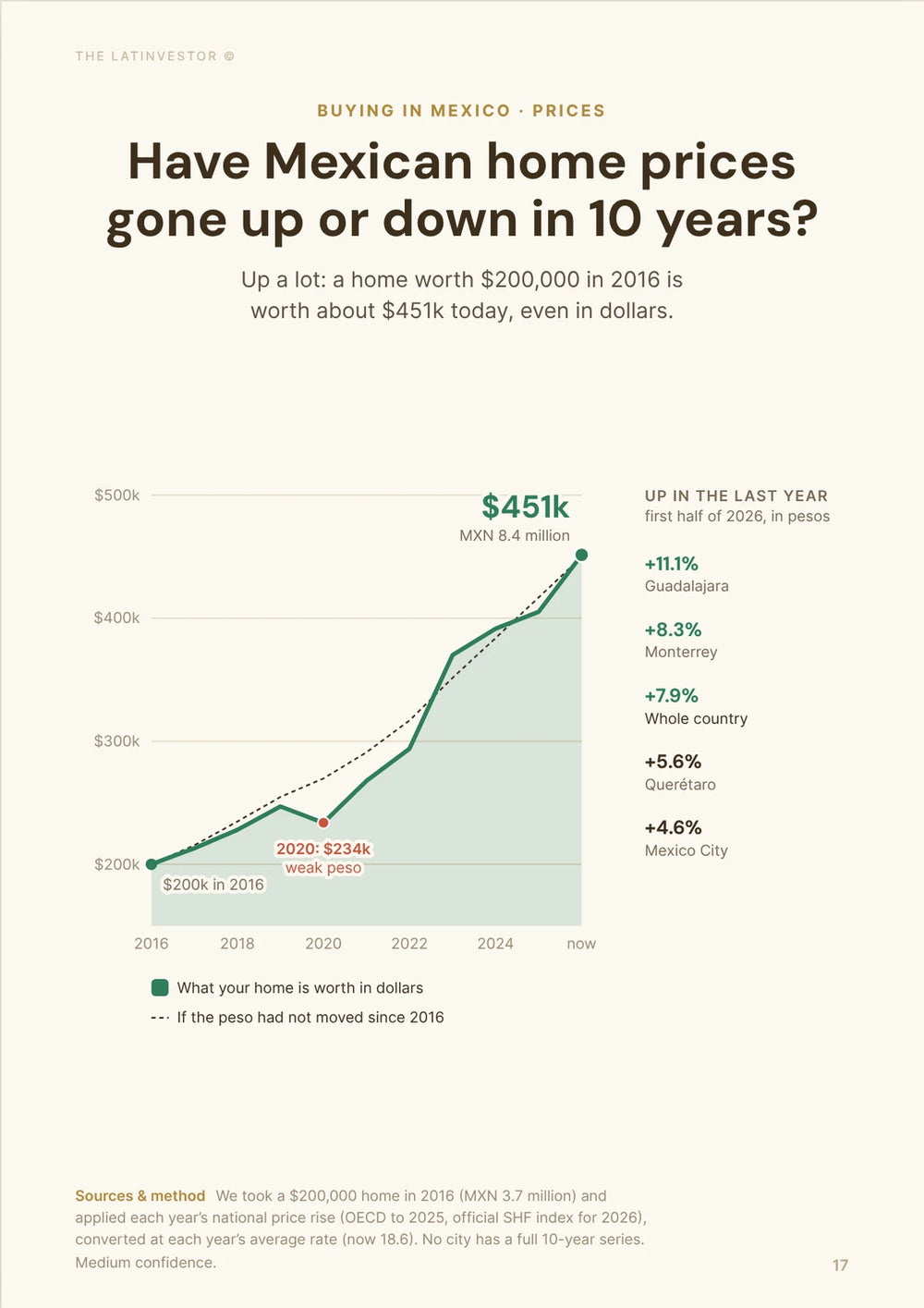
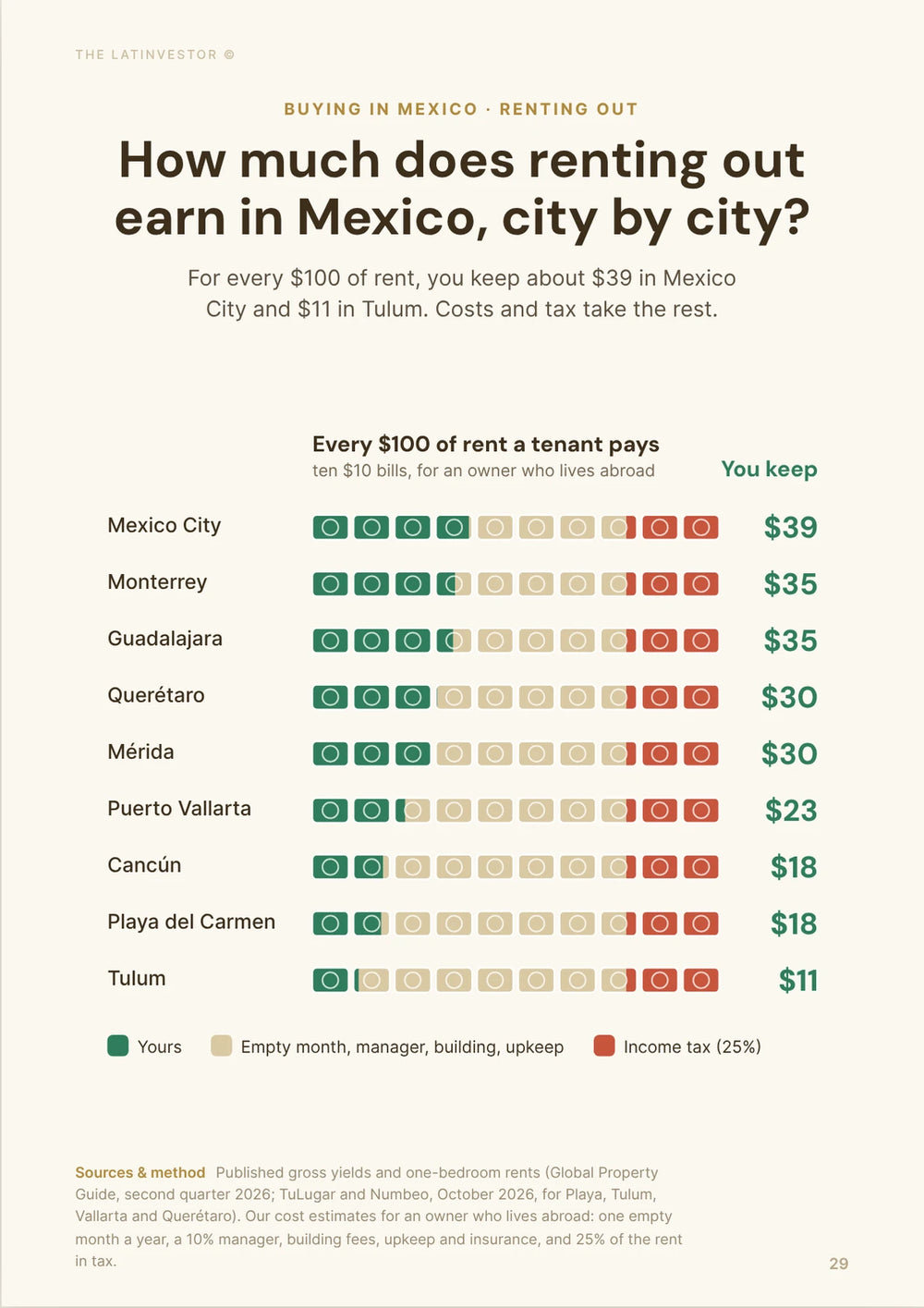
Home prices rose about 11% in a year, faster than rents, so gross yields have slipped to about 6.1%, and a non-resident landlord pays 25% of gross rent in tax on top of that.
The top of the market is Cabo Norte, Montebello and Altabrisa, where houses often rent for MXN 25,000-60,000 a month.
Families on a budget look at Las Américas, Ciudad Caucel and Cholul. Across family areas, a 2-3 bedroom home usually costs MXN 12,000-28,000 a month.
About half of tenants are local families. Strong air conditioning, furniture and covered parking can each add up to MXN 4,000 to the monthly rent.
Short-term rentals are shrinking: AirDNA counts 4,856 active listings, down 35.7% in a year, and the city is pushing hosts to register and pay their predial. Some of those homes are likely coming back as long-term rentals.
A well-priced rental fills in about 20-35 days, and vacancy for good units sits around 4-6%. Overpriced houses with big electricity bills can sit for 45-75 days.
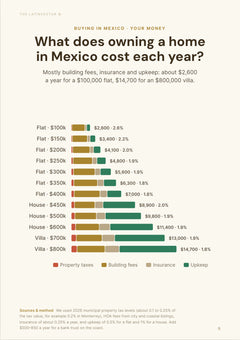
On the cost side, predial is usually MXN 2,000-8,000 a year and HOA fees MXN 1,500-4,000 a month in gated condos.
The bottom line: rents are still rising, but prices are rising faster, supply is growing in the north and taxes bite, so buy for the rent you can actually get, not the one on the listing.

What does it cost to rent in Mérida today?
What's the average monthly rent for a studio in Mérida?
In 2026, a studio in Mérida rents for around MXN 8,500 a month, which is about USD 457 or EUR 407.
Most studios go for MXN 7,000-10,000 per month, roughly USD 376-538 or EUR 335-478.
The rent depends mostly on air conditioning, furniture, parking, building age and how close the unit is to Centro, Paseo de Montejo or the northern business and hospital areas. Students can go cheaper: a room in a shared house starts at about MXN 3,000, or MXN 4,000-6,500 with internet, water and electricity included.
What's the average monthly rent for a 1-bedroom in Mérida?
The median asking rent for a 1-bedroom apartment in Mérida is about MXN 13,800 a month, which is about USD 740 or EUR 659.
Most 1-bedroom apartments list for MXN 9,000-15,000 per month, roughly USD 484-806 or EUR 431-718. The median sits near the top of that range because portals are full of new furnished condos in the north.
The cheapest 1-bedrooms are usually in Ciudad Caucel, Las Américas, Chuburná and older parts of Centro. The priciest are in Temozón Norte, Montebello, Altabrisa, Santa Gertrudis Copó, Vía Montejo and Cabo Norte.
What's the average monthly rent for a 2-bedroom in Mérida?
A 2-bedroom apartment in Mérida lists for around MXN 18,100 a month, which is about USD 975 or EUR 868.
Most 2-bedroom apartments and compact townhouses rent for MXN 15,000-23,000 per month, roughly USD 806-1,240 or EUR 718-1,100. A 3-bedroom apartment jumps to a median of about MXN 37,400 (USD 2,010), because most of them are new, premium units in the north.
The cheapest 2-bedrooms are in Ciudad Caucel, Las Américas, Chuburná and parts of Cholul. The most expensive are in Temozón Norte, Altabrisa, Montebello, Montes de Amé and Santa Gertrudis Copó.
What's the average rent per square meter in Mérida?
Residential rent in Mérida averages around MXN 135 per square meter per month, which is about USD 7.3 or EUR 6.5.
A realistic range is MXN 80-220 per square meter, roughly USD 4.3-11.8 or EUR 3.8-10.5.
That's lower than Mexico City, Monterrey and Guadalajara. But small furnished apartments with good air conditioning, covered parking, security and a pool near Altabrisa, Montebello, Temozón Norte or Paseo de Montejo sit well above the average, because the units are small and new.
Are rents in Mérida rising faster than inflation?
Yes: rents in Mérida's colonias and gated developments are rising about 7% a year, while Mexican inflation was 3.45% in September 2026.
Living costs are also rising faster in Mérida than in most of the country: local inflation was still 4% in early July 2026, one of the highest among Mexican cities. The biggest rent increases are in Centro, Paseo de Montejo, Santa Lucía, Santiago, Santa Ana, Itzimná, García Ginerés and colonia México.
Growth has cooled compared with the low double-digit jumps of 2025. Demand still comes from population growth, people moving from bigger Mexican cities and expats, but tenants are pushing back harder on price.
Will rents in Mérida keep rising over the next 12 months?
Probably, but not everywhere: we expect rents to rise about 5-7% over the next 12 months, mostly for small, modern, well-cooled units.
The strongest growth should be in Temozón Norte, Montebello, Altabrisa, Santa Gertrudis Copó, Itzimná and García Ginerés.
The family end of the market is close to its limit. An average house rent of about MXN 15,000 a month is nearly double the average Yucatán salary of MXN 8,000, so landlords in those areas can't push much further. More affordable homes are also coming: the federal Vivienda para el Bienestar program plans about 46,900 homes in Yucatán, including in Mérida, Kanasín and Umán, aimed at families earning one to two minimum wages.
The other risks are too much new supply in northern Mérida, weaker expat demand and landlords asking premium rents for poorly kept homes.
Rents up 7%, prices up 11%: does buying to rent out still pay in Mérida?
It still pays, but less than it did: home prices in Mérida rose about 11% in a year, faster than rents, so gross yields have slipped to about 6.1%.
That 6.1% is before any cost. If you're a foreign owner who isn't a Mexican tax resident, 25% of the gross rent goes to tax, which alone brings you down to about 4.6%. HOA fees of MXN 1,500-4,000 a month in a gated condo, predial, maintenance and a month of vacancy take you lower still.
What to do: run your numbers on the rent similar units actually get, not on the developer's projection, and on the price you'll really pay. Ask the developer for signed leases from finished towers, check how many identical units are listed for rent in the same building, and negotiate hard on new northern condos, where a lot of supply is arriving at once. Older homes in Centro, García Ginerés or Itzimná often hold their rent better than the tenth new tower on the same street.
Where in Mérida are rents highest, and who rents where?
Which neighborhoods have the highest rents in Mérida?
The three highest-rent areas in Mérida are Cabo Norte, Montebello and Altabrisa. Houses in Cabo Norte typically rent for MXN 40,000-60,000 a month (USD 2,150-3,230), in Montebello for MXN 30,000-45,000 (USD 1,610-2,420) and in Altabrisa for MXN 25,000-35,000 (USD 1,340-1,880).
Santa Gertrudis Copó (MXN 22,000-32,000) and Temozón Norte (MXN 18,000-28,000) come next. These areas cost more because they offer newer homes, gated communities, malls, hospitals, schools, security and easy access to the north-side corridor.
Tenants here are mostly higher-income Mexican families, relocating professionals, medical and business executives, remote workers and expats who want comfort and little hassle.
By the way, we’ve written a blog article detailing what are the current best areas to invest in property in Mérida.
Where do young professionals prefer to rent in Mérida?
Young professionals mostly pick Montebello, Altabrisa and Vía Montejo, with Itzimná, García Ginerés and Centro also popular.
They usually pay MXN 10,000-20,000 per month, roughly USD 538-1,080 or EUR 478-957.
Short commutes, cafés, gyms, hospitals, coworking, parking, fast internet and strong air conditioning matter more to them than extra space.
Where do families prefer to rent in Mérida?
Families on a budget go for Las Américas, Ciudad Caucel and Cholul, while higher-budget families pick Altabrisa, Montebello, Conkal and Temozón Norte.
They usually pay MXN 12,000-28,000 per month for 2 or 3 bedrooms, roughly USD 645-1,510 or EUR 574-1,340. In Cholul, a house typically rents for MXN 14,000-20,000. Further out, rents drop fast: about MXN 4,000-8,000 in Umán and MXN 3,500-7,000 in Kanasín.
These areas offer bigger homes, parking, supermarkets, schools, clinics and parks for less than the priciest northern apartment zones. Nearby schools and universities include Universidad Marista, Universidad Anáhuac Mayab, Universidad Modelo, UVM, Tecmilenio and several bilingual private schools.
Which areas near transit or universities rent faster in Mérida?
Altabrisa, Montebello and Francisco de Montejo rent fastest, with Chuburná, Itzimná, García Ginerés, Centro and the Temozón Norte corridor close behind.
Well-priced rentals in these areas usually stay listed for about 20-35 days, while overpriced or poorly cooled ones can sit much longer.
Being close to Va y Ven bus routes, universities, hospitals or major north-side roads can add about MXN 1,500-4,000 a month, roughly USD 81-215 or EUR 72-191. Mérida is still a car city, though, so parking matters as much as transit.
Which neighborhoods are most popular with expats in Mérida?
Expats mostly choose Centro Histórico, García Ginerés and Temozón Norte, with Santa Ana, Santa Lucía, Itzimná, Chuburná, Montebello and Santa Gertrudis Copó also popular.
They usually pay MXN 15,000-35,000 per month, roughly USD 806-1,880 or EUR 718-1,670. In Santiago and Santa Ana, rents typically run MXN 12,000-20,000.
Centro offers walkability and colonial houses, while the north offers newer homes, security, hospitals, malls and parking. Most expats come from the United States, Canada and Europe, alongside Mexican families moving from Mexico City, Monterrey and other big cities.
And if you are also an expat, you may want to read our exhaustive guide for expats in Mérida.
Who rents in Mérida, and what will they pay extra for?
What tenant profiles dominate rentals in Mérida?
The three main groups are local families, Mexican professionals moving in from other cities, and lifestyle renters such as remote workers, retirees and expats.
By our estimate, local families make up about 50% of rental demand, relocating professionals about 25%, and lifestyle renters, students and short-stay spillover the other 25%.
Families want 2 or 3-bedroom houses, professionals want 1 or 2-bedroom apartments in the north, and lifestyle renters want furnished studios, 1-bedrooms or character homes in Centro and the north.
If you want to optimize your cashflow, you can read our complete guide on how to buy and rent out in Mérida.
Do tenants prefer furnished or unfurnished in Mérida?
It depends on the tenant: premium renters usually want furnished, while local families usually want unfurnished.
A furnished apartment can often charge MXN 1,500-4,000 more per month than a similar unfurnished one, roughly USD 81-215 or EUR 72-191.
Furnished works best for expats, retirees, students, remote workers and relocating professionals. Unfurnished works better for families in Las Américas, Ciudad Caucel, Cholul, Conkal and Chuburná.
Which amenities increase rent the most in Mérida?
The five amenities that add the most rent are strong air conditioning, furniture, covered parking, a pool and private security.
Each can add about MXN 800-4,000 per month, roughly USD 43-215 or EUR 38-191, depending on the property and the neighborhood.
What renovations get the best ROI for rentals in Mérida?
The best-paying upgrades are inverter mini-splits, ceiling fans, mosquito screens, kitchen and bathroom refreshes, and better water pressure or storage.
A practical budget is MXN 80,000-180,000, roughly USD 4,300-9,680 or EUR 3,830-8,610, and the best upgrades can lift rent by about MXN 1,500-5,000 per month.
Poor bets include luxury decoration without better cooling, gardens nobody will maintain, oversized pools, fragile finishes and colonial restorations that look great but bring humidity and high repair bills.
Is the Airbnb pullback in Mérida pushing more homes into long-term rentals?
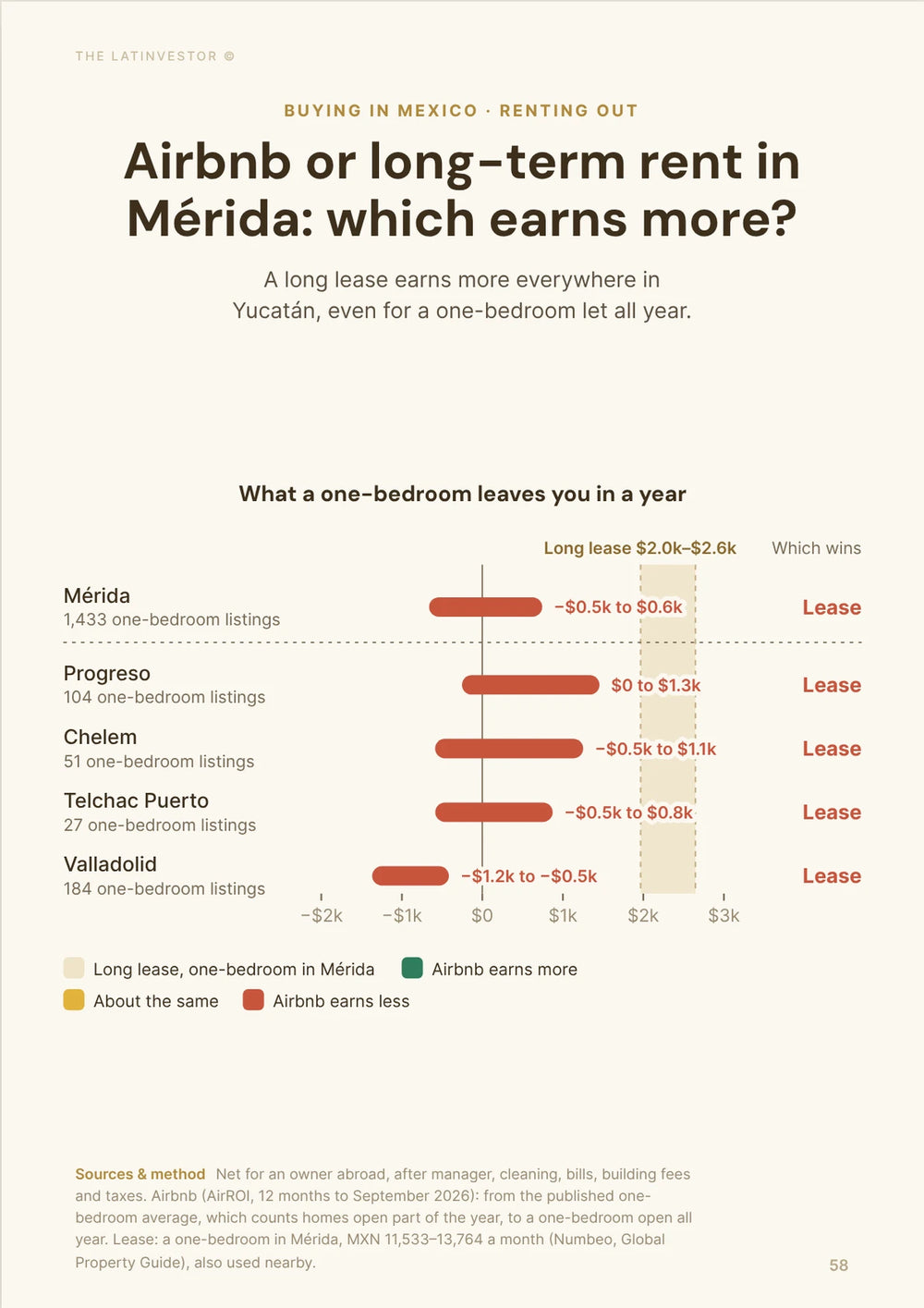
Probably in part: AirDNA counted 4,856 active short-term listings in Mérida in September 2026, down 35.7% in a year, and some of those homes are likely to come back as furnished long-term rentals.
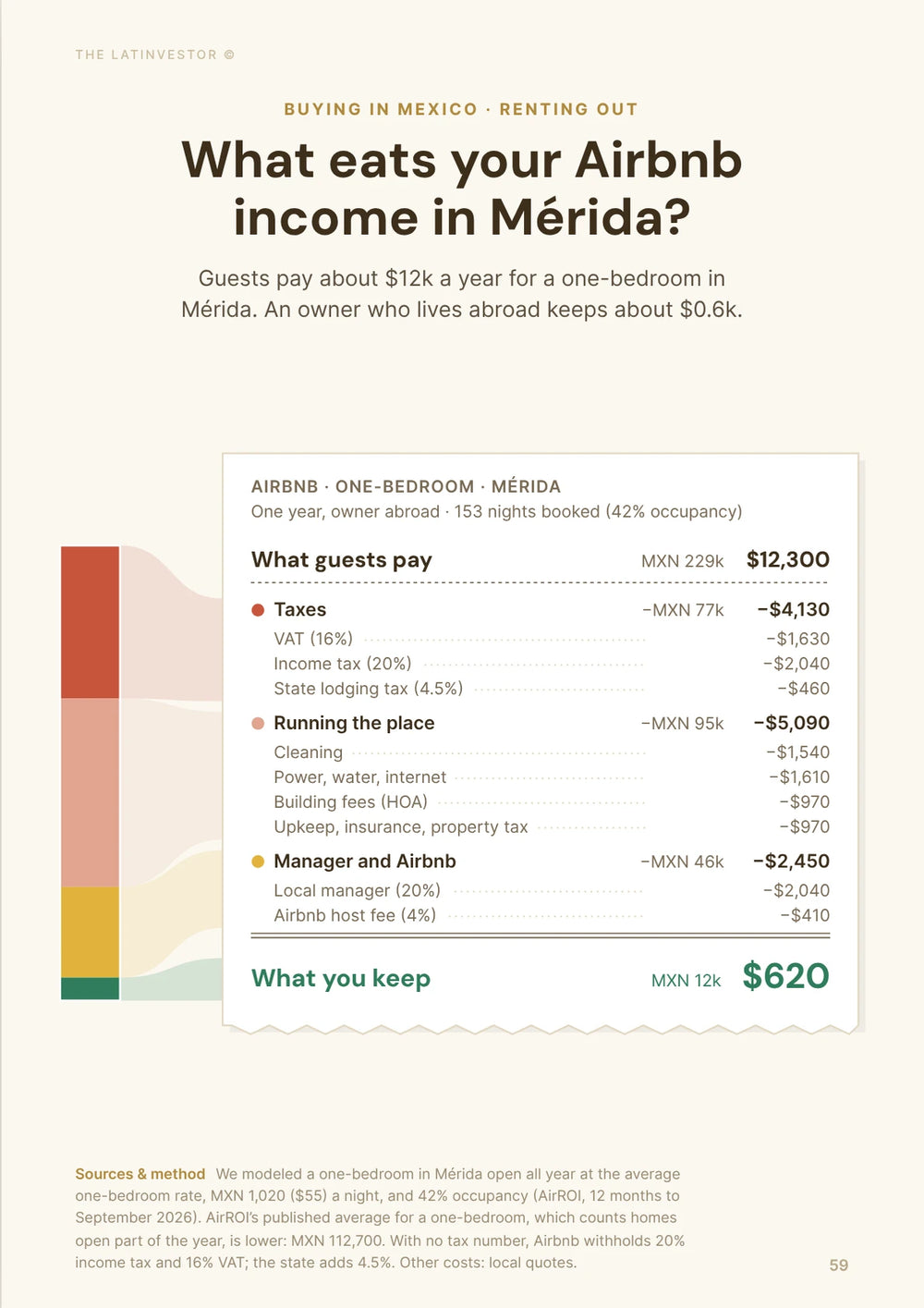
The short-term numbers explain why. Occupancy averages 58% at about USD 67 a night, and the average listing earns about USD 13,300 a year before cleaning, platform fees, electricity and the 4.5% state lodging tax. A 2-bedroom on a 12-month lease brings about USD 11,700 a year at today's asking rents, with far less work and no air-conditioning bills.
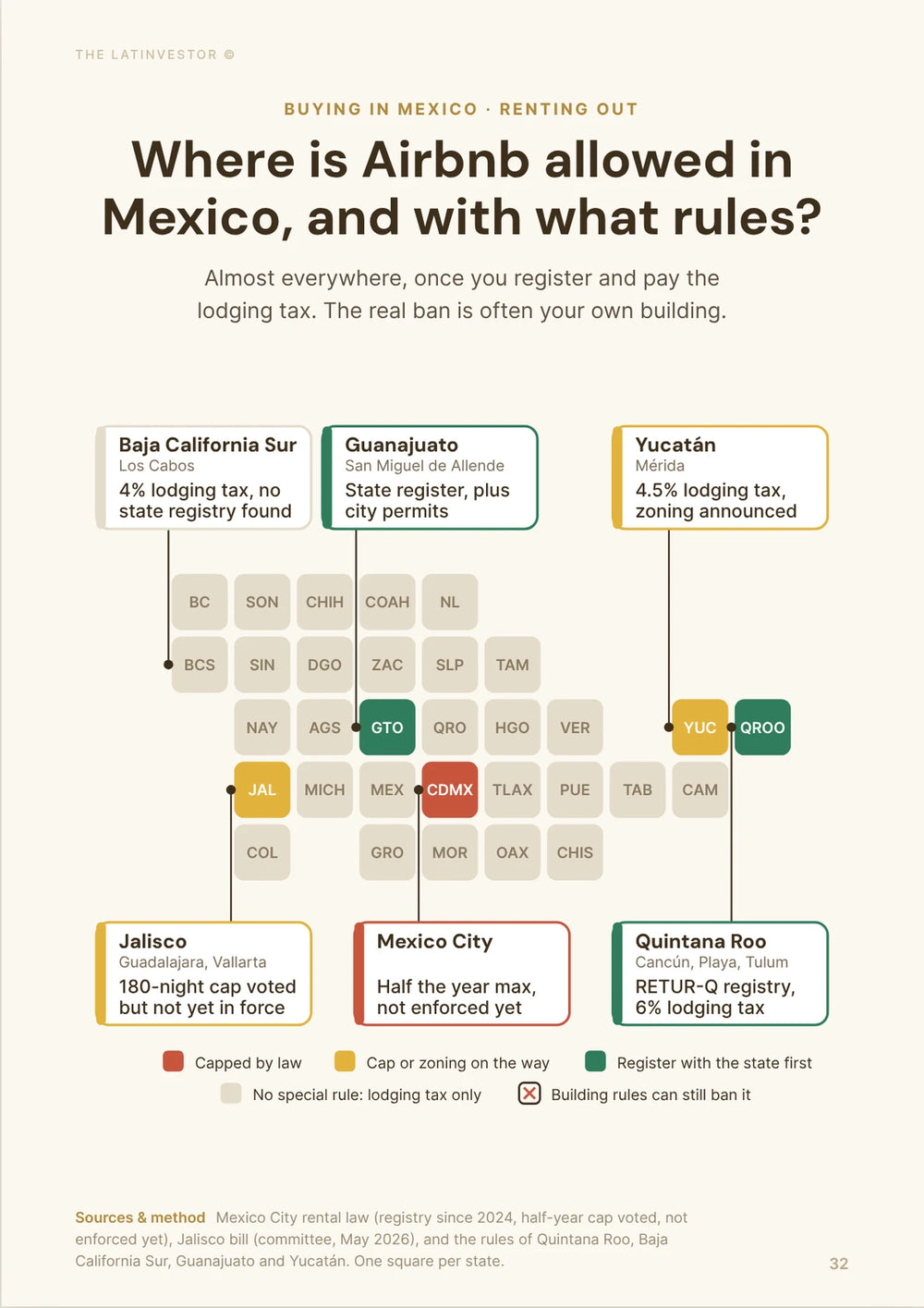
The rules are tightening too. In January 2026 the city started identifying the more than 5,000 Airbnb-type lodgings in Mérida, over half of them in Centro, to bring them under a framework closer to hotels, starting with predial, water and garbage payments.
What this means for you: expect more competition for furnished long-term tenants in Centro and the north, so a well-cooled unit priced at the market will fill, while an ex-Airbnb with tired furniture will sit. If you're buying to do short-term rentals, check the condo rules and make sure the property is up to date on predial before you sign.
How fast do rentals fill in Mérida right now?
What's the vacancy rate for rentals in Mérida?
We estimate vacancy for well-located long-term rentals in Mérida at about 4-6%.
It ranges from about 4% in strong areas like Montebello, Itzimná, García Ginerés and Temozón Norte to 8-12% for overpriced, oversized or badly located homes.
That's lower than the broad vacant-housing figures suggest, because many empty homes in Mérida aren't really on the rental market. But the risk is higher than in the tight post-pandemic years.
How many days do rentals stay listed in Mérida?
A well-priced rental in Mérida usually stays listed for about 20-35 days.
A cool furnished 1-bedroom in Montebello or Centro can go much faster, while an overpriced large house with high electricity bills can take 45-75 days.
Listings stay up a bit longer than a year ago, because there's more supply in the north, more ex-Airbnb units competing, and tenants are more careful about rent, electricity and maintenance.
Which months have peak tenant demand in Mérida?
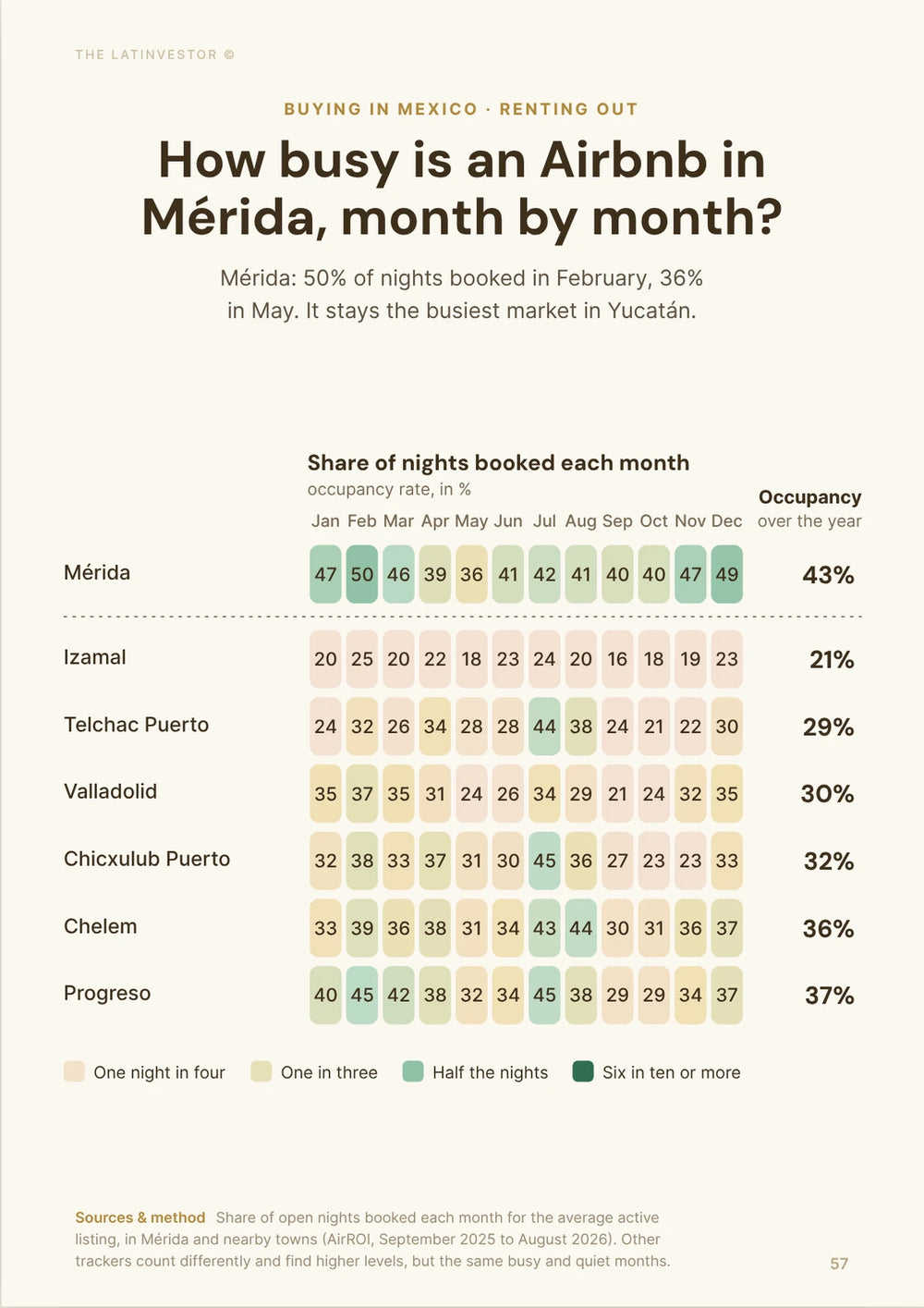
Demand peaks from January to March and again in July and August.
January to March brings relocations, retirees and remote workers. July and August bring families and students moving before the school and university year.
The slowest months are usually April, May and parts of September, when the heat and holidays put moves on hold.
What does a landlord pay in taxes and running costs in Mérida?
What property taxes should landlords expect in Mérida?
Most Mérida landlords pay about MXN 2,000-8,000 a year in predial for a normal home, roughly USD 108-430 or EUR 96-383.
The full range runs from about MXN 1,000 to MXN 20,000 a year (USD 54-1,080 or EUR 48-957), depending on the cadastral value, property type and location.
Predial is calculated property by property, so use the city's online calculator rather than a flat percentage. If you buy, ask the seller for proof that predial is paid up: the city is now chasing unpaid predial, especially on short-term rentals.
What utilities do landlords often pay in Mérida?
Landlords usually pay HOA fees, sometimes water, sometimes internet in furnished units, and the upkeep of major appliances.
Typical amounts are MXN 300-800 a month for water, MXN 400-800 for internet and MXN 1,500-4,000 for HOA fees in a gated condo with a pool. All together, that's about MXN 2,200-5,600 a month, roughly USD 118-301 or EUR 105-268, if you pay all three.
Tenants almost always pay electricity, because air conditioning makes CFE bills large and unpredictable in the hottest months.
How is rental income taxed in Mérida?
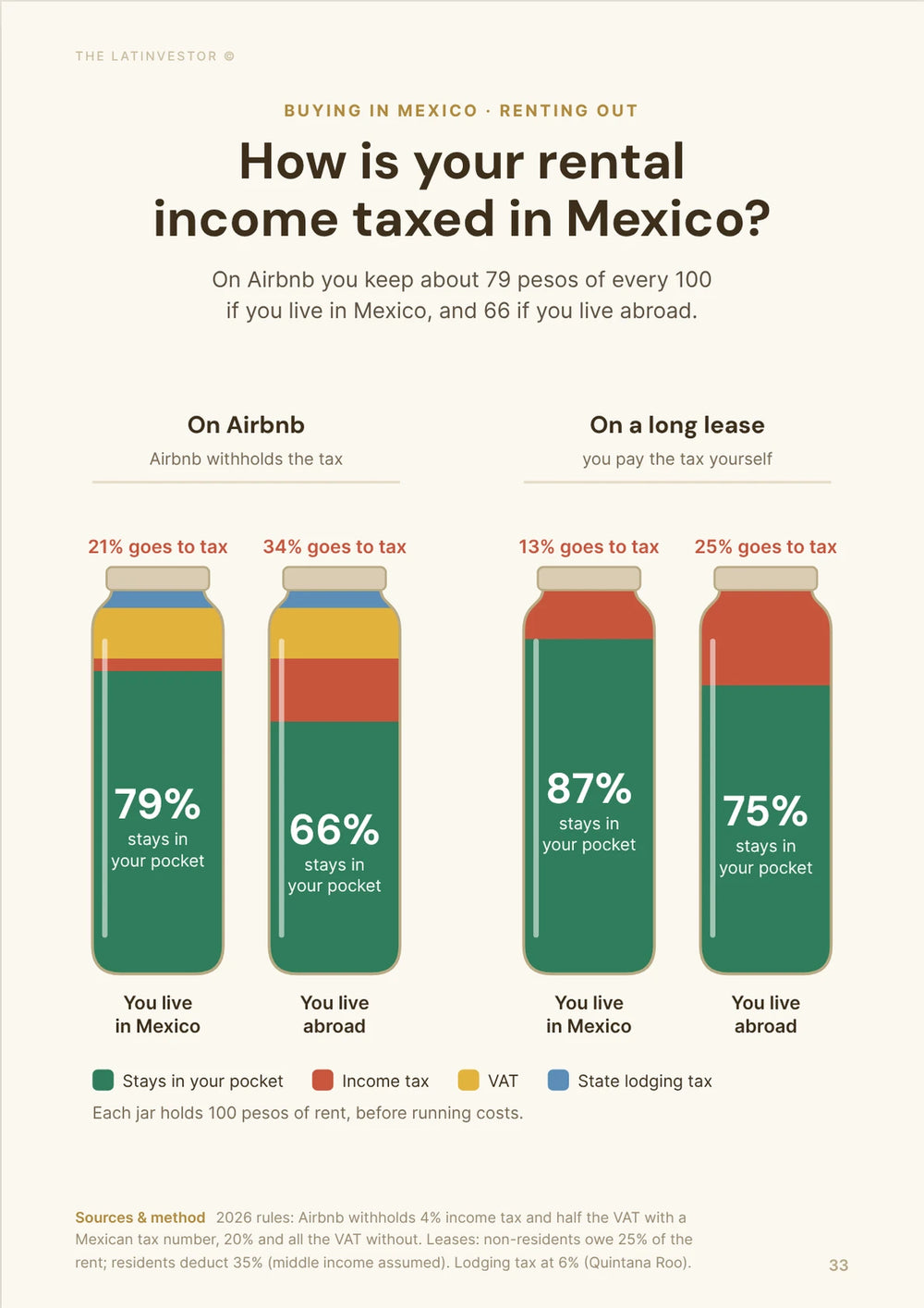
It depends on where you're a tax resident. A foreign owner who isn't a Mexican tax resident pays 25% of the gross rent, with no deductions.
A Mexican tax resident landlord files under the arrendamiento regime and can deduct actual expenses or take a flat 35% deduction, plus predial. Depending on total income, that usually works out to roughly 5-15% of gross rent. Some smaller landlords can use RESICO instead, at 1-2.5% of income.
A common mistake is treating a furnished or short-stay rental like a plain long-term lease without checking VAT, invoicing, platform withholding and the 4.5% state lodging tax.
We cover these mistakes, among others, in our list of risks and pitfalls people face when buying property in Mérida.
Our methodology
This article estimates what long-term rentals cost in Mérida, how fast rents are moving, which areas and tenants drive demand, and what landlords pay in taxes and running costs.
There's no official rent index for Mérida, so our rent figures come from asking rents: the Q2 2026 listing medians published by Global Property Guide, live listings on Lamudi, Vivanuncios and Mitula, and 2026 local press surveys from Por Esto!. We cleaned out luxury outliers, compared portals and rounded. Short-term rental figures come only from AirDNA.
For context we used official sources first: INEGI for inflation (3.45% in September 2026) and housing, SEFOET Yucatán and Data México for population and jobs, SHF for home prices and Tinsa's figures in El Economista for the 11% annual price rise. Tax rules come from the Ley del ISR, SAT guidance and the Yucatán lodging tax for 2026.
We checked these figures in October 2026. Conversions use about 18.6 pesos per US dollar and 20.9 pesos per euro.
Limits: asking rents are not always what tenants end up paying, the portal medians lean toward newer northern apartments, tenant shares, vacancy and days on market are our own estimates, and your tax bill depends on your residency and situation.
Key sources used for this analysis include INEGI INPC, INEGI Censo 2020, INEGI ENVI 2020, SEFOET Yucatán, Data México, SHF housing price index, El Economista (Tinsa data), Global Property Guide, AirDNA Mérida, Ley del ISR Article 158, LISR, Cámara de Diputados, SAT arrendamiento, Sefotur Yucatán, Ayuntamiento de Mérida Finanzas, Predial Mérida calculator, CFE domestic tariffs, JAPAY, Por Esto! on rents and wages, Por Esto! on north Mérida rents, Lamudi Mérida rentals, Vivanuncios Mérida rentals and Mitula Mérida rentals.