Summary
Not across the whole city: São Paulo asking prices were still up 3.64% in the year to September 2026 (FipeZAP). But the weakest investor studios are already losing value in real terms and through quiet discounts.
The supply pressure is real. Unsold new apartments of 30 to 45 m² went from 34,329 in June 2025 to 47,965 in June 2026, and the share sold each month fell from 15.9% to 11.1%. July was a little better, at 12.8%.
Those numbers are not all studios. In August 2026, Minha Casa, Minha Vida made up 77% of launches, and two-bedrooms made up 68% of sales. The real risk sits in a smaller group of 20 to 30 m² investor units.
Developers have room to cut the real price without touching the brochure: commissions, payment plans, furniture, fees paid for you. With construction costs up 6.21% in a year, they'd rather do that than lower the tabela.
After 4.58% inflation, São Paulo prices fell about 0.9% in real terms over 12 months. Part of the correction is already happening that way.
Neighborhoods are splitting. Jardins rose 6.7% and Santana 5.9%, while Vila Mariana barely moved (+0.4%) and Pinheiros slipped 0.3%, despite some of the city's highest rents.
Launch studios are expensive: the average studio of up to 30 m² was listed at about R$542,000 in Pinheiros, roughly R$21,700 per m² for a 25 m² unit, against R$18,260 for the neighborhood as a whole.
Rents are what holds prices up. FipeZAP rents rose 6.22% in a year, to R$65.78 per m², and one-bedrooms rent for about R$91 per m² on QuintoAndar's data.
The yield is thin next to a 13.75% Selic. A R$500,000 studio renting for R$2,625 a month makes about 4.9% after one empty month and the 15% tax withheld from a non-resident.
Credit is helping: savings-funded mortgages reached R$132.5 billion nationwide from January to August 2026, up 37.5% in a year.
HIS and HMP units are a separate, riskier case: the city sent platforms a list of 62,812 such units to take off Airbnb and Booking.com.
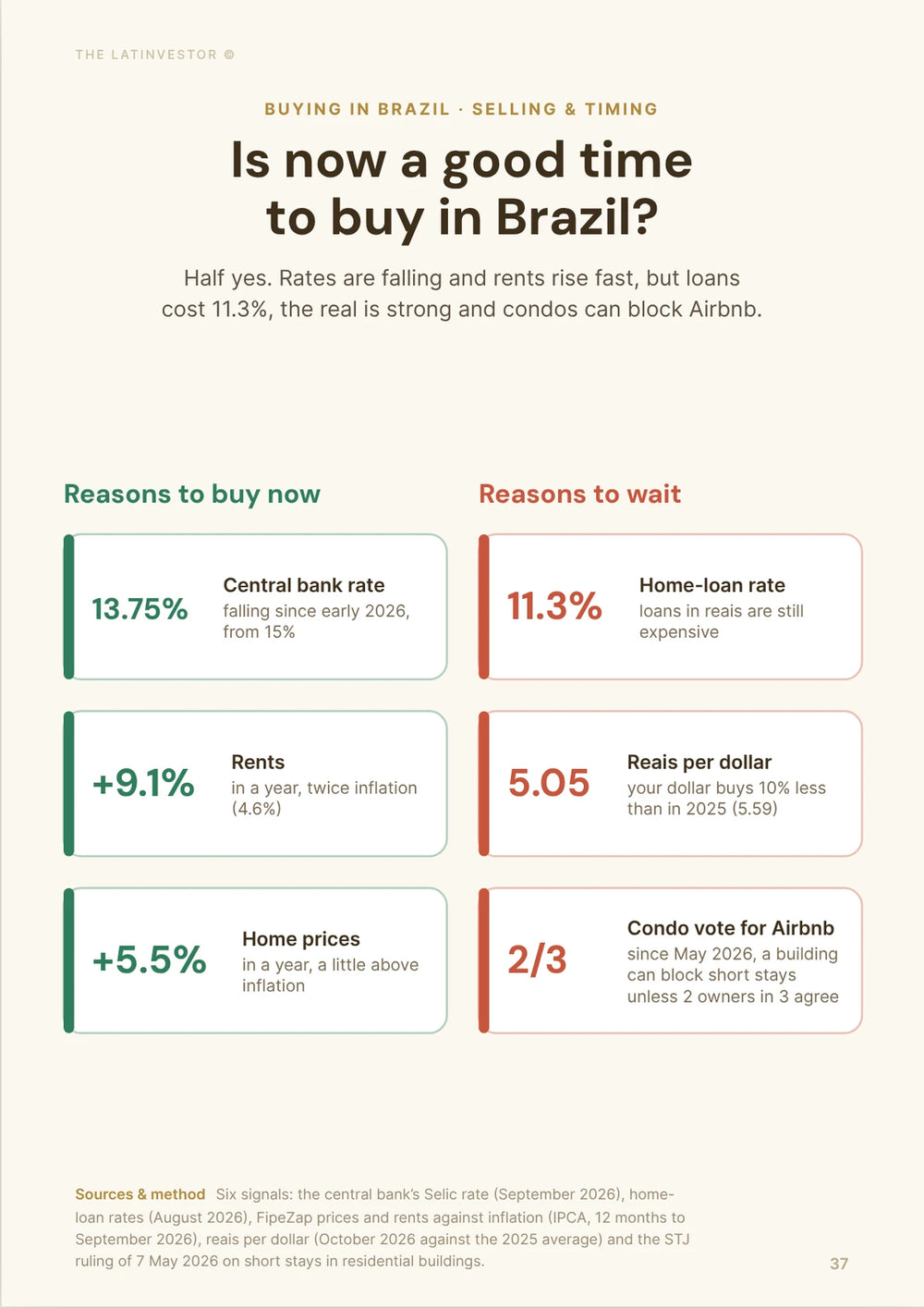
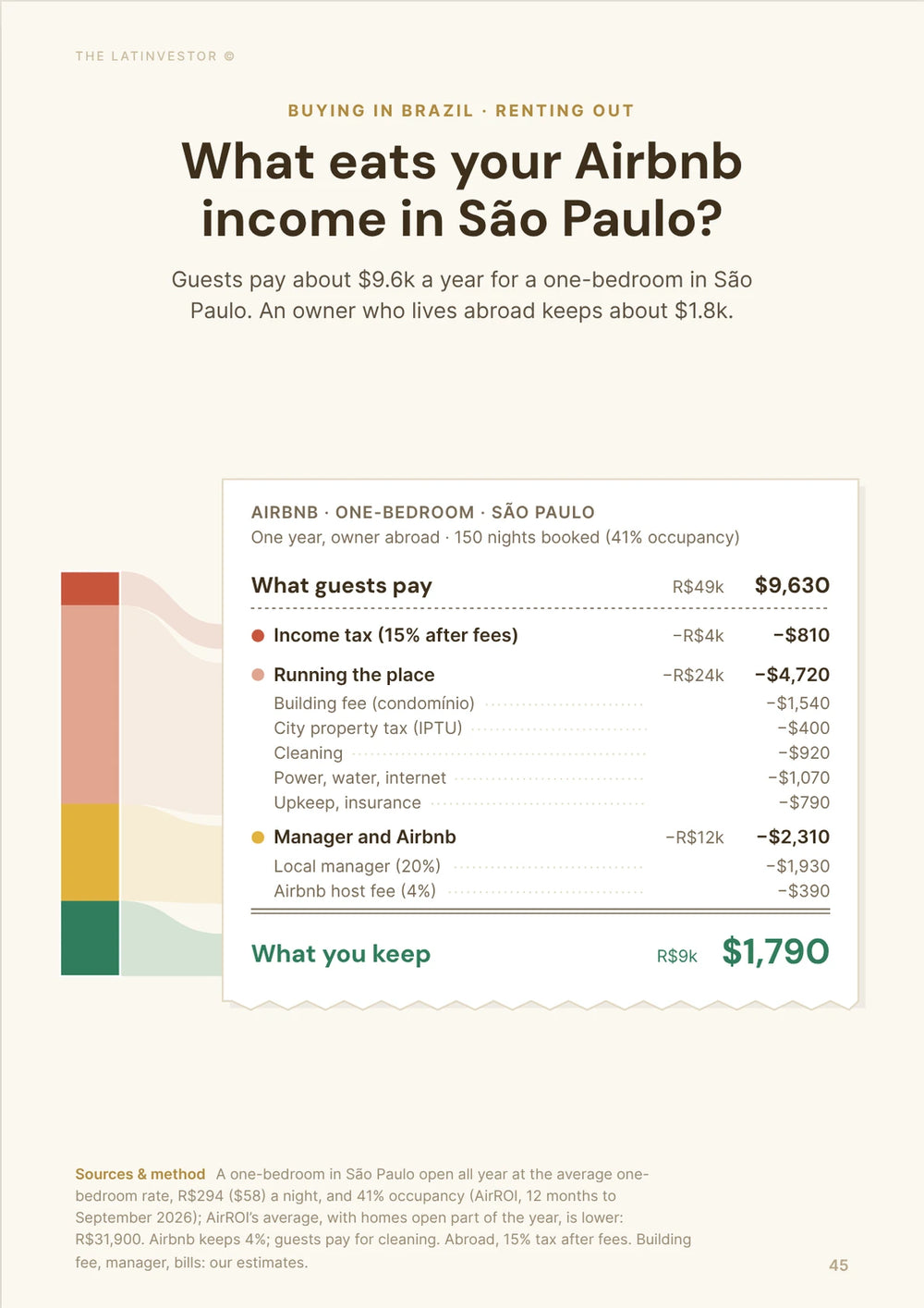
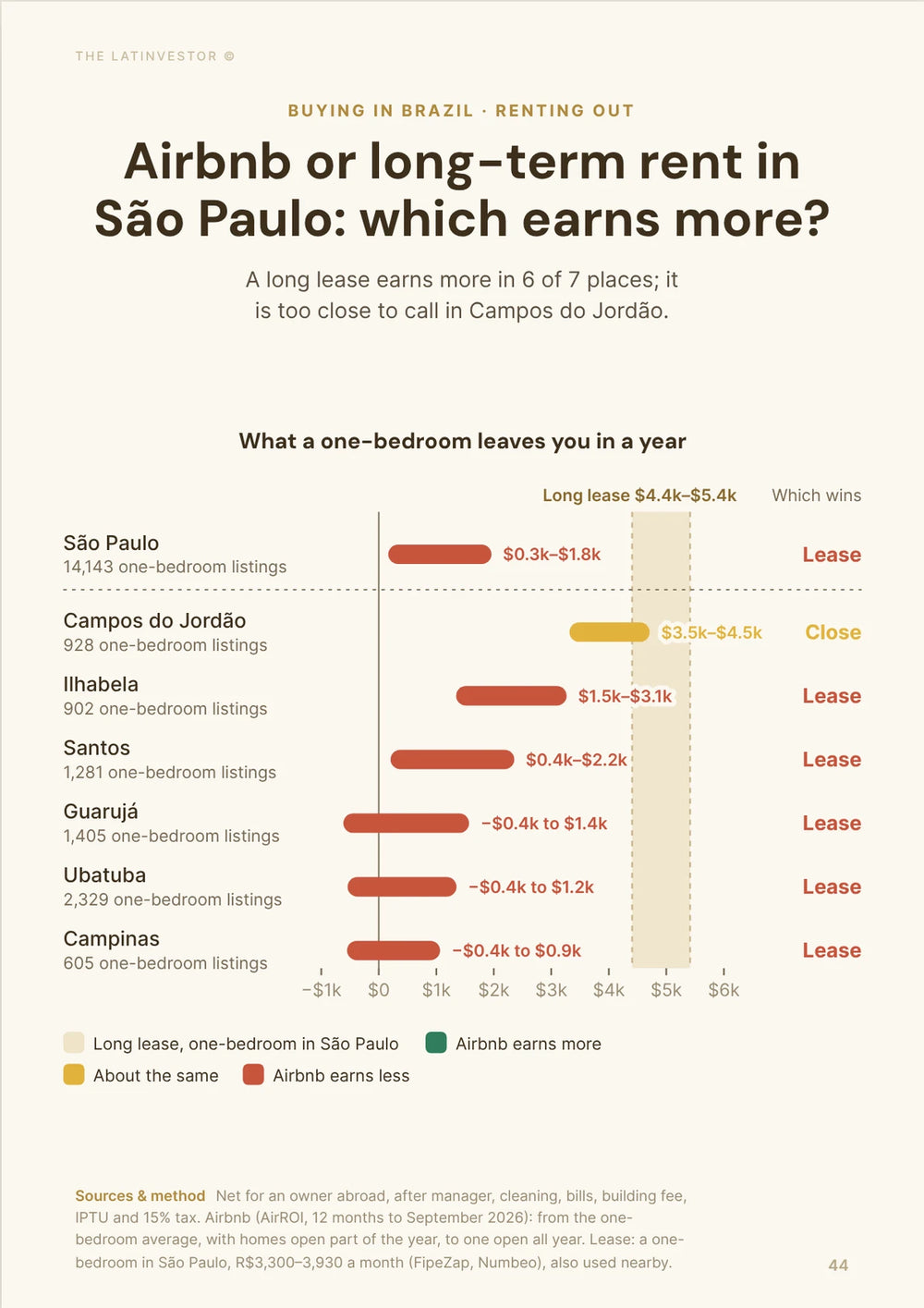
Short stays won't rescue a weak studio either. São Paulo has 34,925 Airbnb listings, up 66% in a year, at 40.1% occupancy, and since May 2026 a condo can block them unless two-thirds of owners agree.
New supply keeps coming: 98,018 new homes were for sale in August 2026, up 50.7%. If you buy, negotiate hard and compare with resale units in the same building.
Our take: no citywide crash, but a generic 20 to 25 m² unit bought at a launch premium could easily resell 5% to 15% below what its owner paid.


Are São Paulo studios finally running into too much supply?
Yes, supply pressure has clearly risen, but it hasn't turned into a citywide price fall.
São Paulo keeps building small apartments faster than buyers absorb them. In June 2026, Secovi-SP counted 8,777 new apartments of 30 to 45 m² launched in a single month, 70% of all launches in the city. The same size band made 5,985 sales, 64% of the total.
The worrying number is the unsold stock. There were 47,965 new 30 to 45 m² apartments for sale in June 2026, against 34,329 a year earlier, up almost 40%.
Buyers are still there, but they're slower. The share of available units sold in the month (VSO) fell from 15.9% to 11.1%. July 2026 looked a bit better: stock eased to 47,104 and VSO went back up to 12.8%, so this isn't a straight line down.
Meanwhile, the average asking price keeps climbing. FipeZAP put São Paulo at R$12,206 per square meter in September 2026, up 3.64% in 12 months.
So you get an odd mix: much more stock, slower sales, and prices that still haven't dropped.
| Indicator | June 2025 | June 2026 | Change | What we see |
|---|---|---|---|---|
| 30–45 m² launches | 8,631 | 8,777 | +1.7% | Developers are still building heavily |
| 30–45 m² sales | 6,474 | 5,985 | -7.6% | Demand has cooled |
| Unsold 30–45 m² stock | 34,329 | 47,965 | +39.7% | Stock has jumped |
| 30–45 m² VSO | 15.9% | 11.1% | -4.8 pp | Units take longer to sell |
| Average asking price (FipeZAP, September) | R$11,777/m² | R$12,206/m² | +3.64% | Prices are still rising |
Is São Paulo really building that many studios?
It's building a huge number of compact apartments, but calling them all "studios" exaggerates the problem.
Secovi-SP sorts new homes by size, and the 30 to 45 m² band dominates. Yet most of these homes have two bedrooms: in July 2026, two-bedrooms were 64% of launches and 71% of sales, and in August they were 68% of sales.
Minha Casa, Minha Vida explains much of the rest. In August 2026, the program made up 77% of São Paulo launches, 71% of sales and about 60% of unsold stock. Sales rose 36.9% in units that month while their total value fell 12.8%: the city is selling more cheap homes, not flooding Pinheiros with investor studios.
True studios are a smaller market. In June 2026, units under 30 m² made 2,137 launches and 2,405 sales, so that month they actually sold more than developers launched.
That gives you two compact markets in the same statistics. One is 30 to 45 m² economic housing bought by families to live in. The other is smaller free-market units, often 20 to 30 m², sold at a high price per square meter to investors in Pinheiros, Bela Vista, Vila Olímpia, Brooklin and around big metro stations.
Those two groups don't behave the same way. The risk of a studio correction sits in specific investor-heavy buildings and neighborhoods, not across tens of thousands of apartments.
Is compact inventory now growing faster than people are buying it?
Yes. Compact stock grew much faster than compact sales over the past year, and that's the strongest sign that developers' pricing power could weaken.
Between June 2025 and June 2026, unsold 30 to 45 m² stock rose by 13,636 units, while monthly sales in the band fell by 489.
The band still had the best sales speed of all the size bands Secovi-SP tracks, so these are still the easiest new homes to sell. Being the most liquid segment just doesn't stop supply from growing too fast.
In plain terms: for every 100 units for sale, about 16 sold in a month in June 2025. In June 2026 it was 11, and 13 in July.
The whole new-build market is getting heavier too. São Paulo had 98,018 new homes for sale in August 2026, up 50.7% in a year. In July, 30 to 45 m² homes were 52% of the 90,607 units then on sale.
Compact housing is now the center of the new-build market, so any lasting slowdown there will hit developers' pricing decisions.
| 30–45 m² apartments | June 2025 | June 2026 | July 2026 |
|---|---|---|---|
| Monthly launches | 8,631 | 8,777 | 5,111 |
| Monthly sales | 6,474 | 5,985 | 6,896 |
| Unsold stock | 34,329 | 47,965 | 47,104 |
| VSO | 15.9% | 11.1% | 12.8% |
Should you buy a studio from a developer now, or wait for resale bargains?
If you buy now, buy as a negotiator, not as a fan of the brochure: developers are sitting on record stock and need sales.
Secovi-SP estimates it would take about 13 months to sell the current mid- and high-end stock, against 8 months for Minha Casa, Minha Vida. Free-market studios sit in the slow group. That gives you room to ask for things: a lower price, the ITBI and registry fees paid, a longer payment plan, or a furnished unit at the same price.
Before you sign off plan, check three things. The balance is usually indexed to the INCC construction index until delivery, so the brochure price isn't your final cost. Walking away is expensive: under Lei 13.786/2018 the developer can keep up to 25% of what you paid, or up to 50% if the project has patrimônio de afetação. And check whether the unit is HIS or HMP, because that limits who can rent or buy it later.
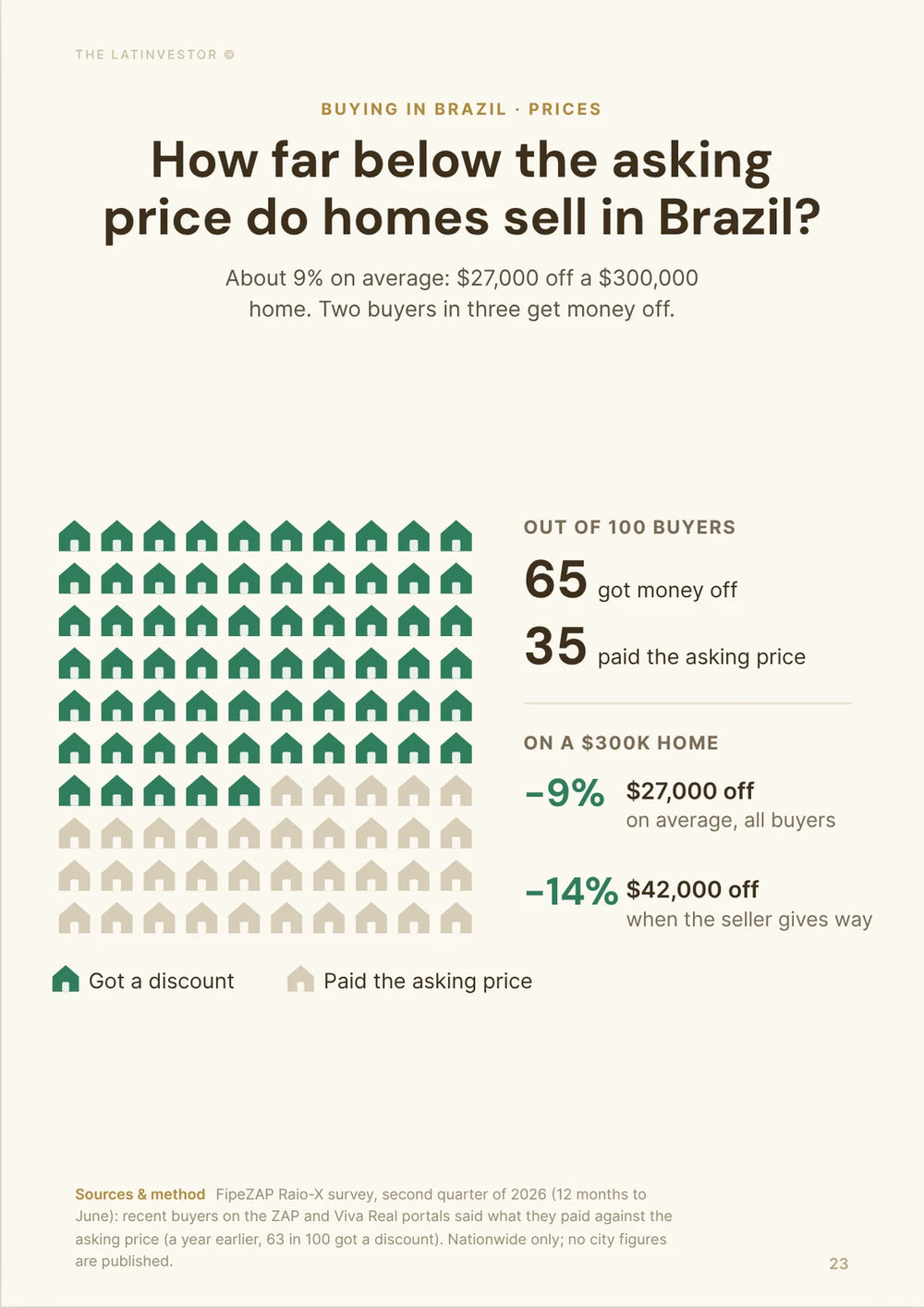
Then compare with resale. In a building delivered two or three years ago, a few owners who need cash can be the cheapest way in. FipeZAP's buyer survey for the second quarter of 2026 found an average discount of 9% on closed sales across its cities, and 14% when the buyer got one. Use that as your target, not the asking price.
Does slower studio sales mean prices will fall next?
Not necessarily. Slower sales make discounts more likely, but developers can lower the real price long before the advertised price moves.
They have plenty of ways to do it quietly: higher broker commissions, paying your registration costs, stretching payment schedules, adding furniture, or selling single units below the official tabela. Two buyers in the same building can pay quite different prices while the published price looks stable.
Developers also have reasons to avoid visible cuts. Construction costs are still high: SindusCon-SP's CUB index was 6.21% above a year earlier in August 2026, even after monthly increases slowed. And cutting the official price annoys earlier buyers and makes the remaining units look weaker.
So the start of a correction will look messy, not dramatic: more private deals, better payment terms, and resale sellers undercutting each other, long before a clean 10% drop shows up in any index.
For a buyer, the negotiated price matters more than the brochure price.
Are São Paulo apartment prices already falling after inflation?
Yes. Prices are losing value in real terms, even though the number on the listing keeps creeping up.
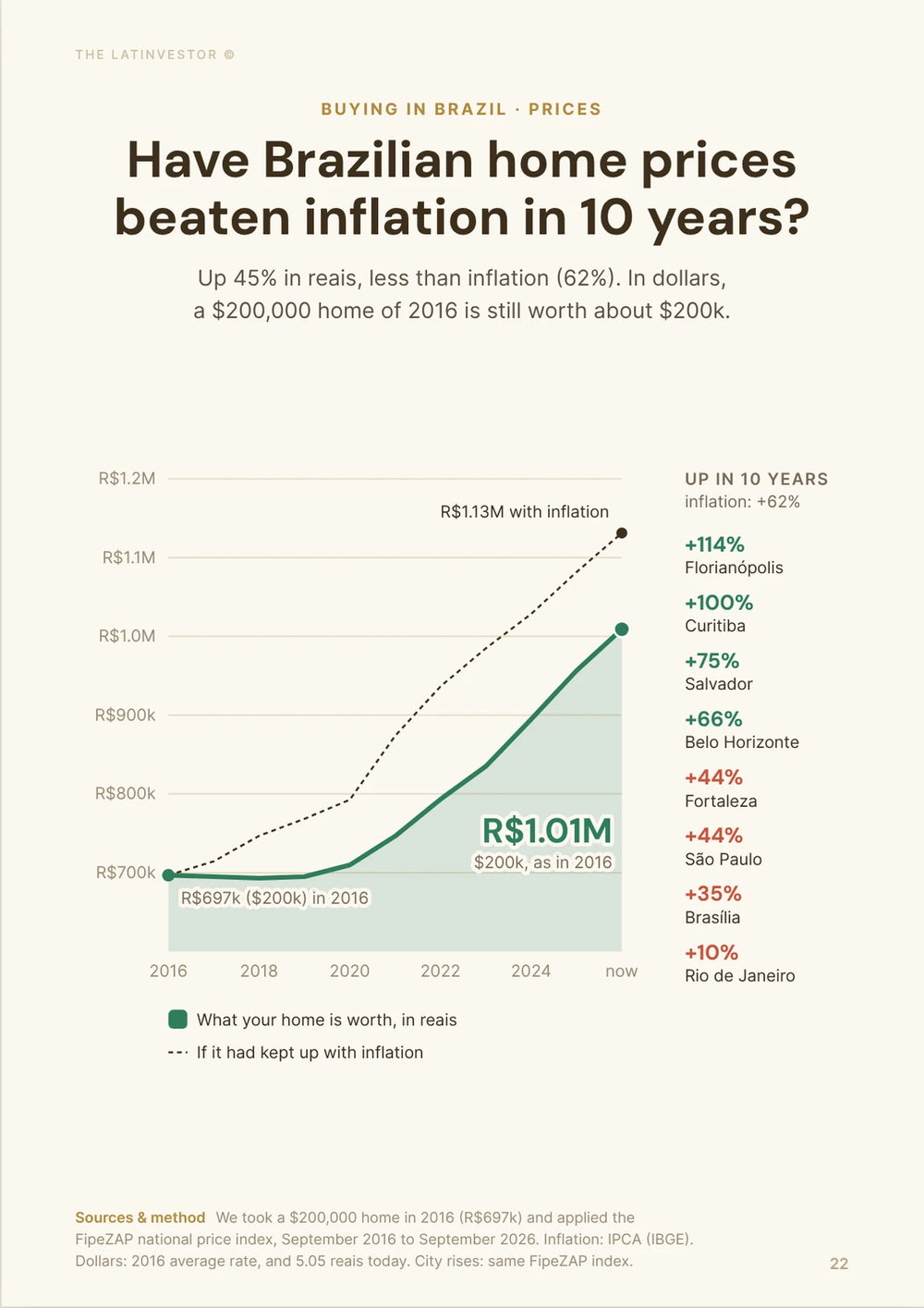
FipeZAP had citywide asking prices up 3.64% in the year to September 2026. IPCA inflation was 4.58% over the same 12 months, so prices fell about 0.9% in real terms.
There's been no crash in reais. An owner who only looks at listings can still say the apartment went up.
An investor should use a tougher yardstick. If a R$500,000 studio rises 3.64%, it gains R$18,200 on paper. Once you count inflation, buying costs of 4% to 6%, a future sales commission and what the money would have earned elsewhere, that gain doesn't look like much.
Part of the studio correction is already happening this way, through inflation rather than lower listing prices.
Are some São Paulo neighborhoods already seeing apartment prices fall?
Yes. A few neighborhoods are already slightly down, while the city average is still up.
Pinheiros is the clearest case: FipeZAP had its asking prices down 0.3% in the year to September 2026. Vila Mariana was almost flat, up 0.4%.
At the same time, Jardins rose 6.7%, Santana 5.9% and Moema 5.0%.
The market is splitting rather than moving as one block. Some expensive areas still have enough scarcity to push prices up, while others that got a lot of new building are struggling to gain anything.
Pinheiros matters for studios because it has everything investors look for: metro, restaurants, offices, high rents and plenty of tenants. If even Pinheiros can post a small annual drop, a good neighborhood doesn't guarantee appreciation.
| Area | 12-month change (Sept. 2026) | What it tells us |
|---|---|---|
| Jardins | +6.7% | Premium demand is still strong |
| Santana | +5.9% | Strength isn't limited to the prime west and south |
| Moema | +5.0% | Still beating the city average |
| São Paulo overall | +3.64% | Still up, but below inflation |
| Vila Mariana | +0.4% | Appreciation has almost stopped |
| Pinheiros | -0.3% | A small drop is already visible |
Are new São Paulo studios overpriced compared with older apartments?
Often, yes. Many new studios carry such a big premium per square meter that their resale value depends on rents staying high.
Loft's study of listings from August to October 2025 put the average studio of up to 30 m² at about R$542,000 in Pinheiros, R$531,000 in Vila Olímpia, R$471,000 in Brooklin and R$915,000 in Itaim Bibi.
For a 25 m² unit, R$542,000 is about R$21,700 per square meter. FipeZAP's average for all apartments in Pinheiros was R$18,260 in September 2026, and the city average R$12,206.
Small units always cost more per square meter: the kitchen, bathroom, lifts, amenities and land are spread over fewer meters. The problem starts when the premium gets so big that a resale buyer can choose between a 25 m² studio and a much bigger older apartment for a similar total price. In Pinheiros, the median one-bedroom was listed at R$677,000 in October 2026 (Tô Em Casa).
Launch buyers also pay for novelty: the rooftop, the coworking room, the brand, the payment plan and the promise of rental demand. Three years later, a resale buyer sees a used 25 m² apartment competing with the new tower down the street. That's where launch premiums disappear.
Are São Paulo rents still strong enough to stop studio prices falling?
For now, yes. Rents are the main reason we don't expect a broad studio price drop yet.
FipeZAP put the average asking rent at R$65.78 per square meter in September 2026, up 6.22% in 12 months. That's well ahead of the 3.64% rise in sale prices.
Small units also earn more per square meter. QuintoAndar Imovelweb's July 2026 data put one-bedroom rents at about R$91 per square meter citywide, with much higher figures in studio-heavy areas: about R$116.50 in Vila Olímpia, R$109.30 in Brooklin, R$105.40 in Pinheiros and R$95.40 in Campo Belo.
A 25 m² studio at R$105 per square meter rents for about R$2,625 a month (about US$520). On a long lease, the tenant pays the condo fee and IPTU, so that's what you collect before tax, repairs and empty months.
Strong rents give owners a choice when the resale market is weak: keep the unit and rent it out instead of taking a bad price. As long as tenants keep taking studios at rising rents, forced selling should stay limited.
Do São Paulo studio yields still make sense with the Selic at 13.75%?
Not on rent alone. A studio's net yield sits far below what fixed income pays in Brazil right now.
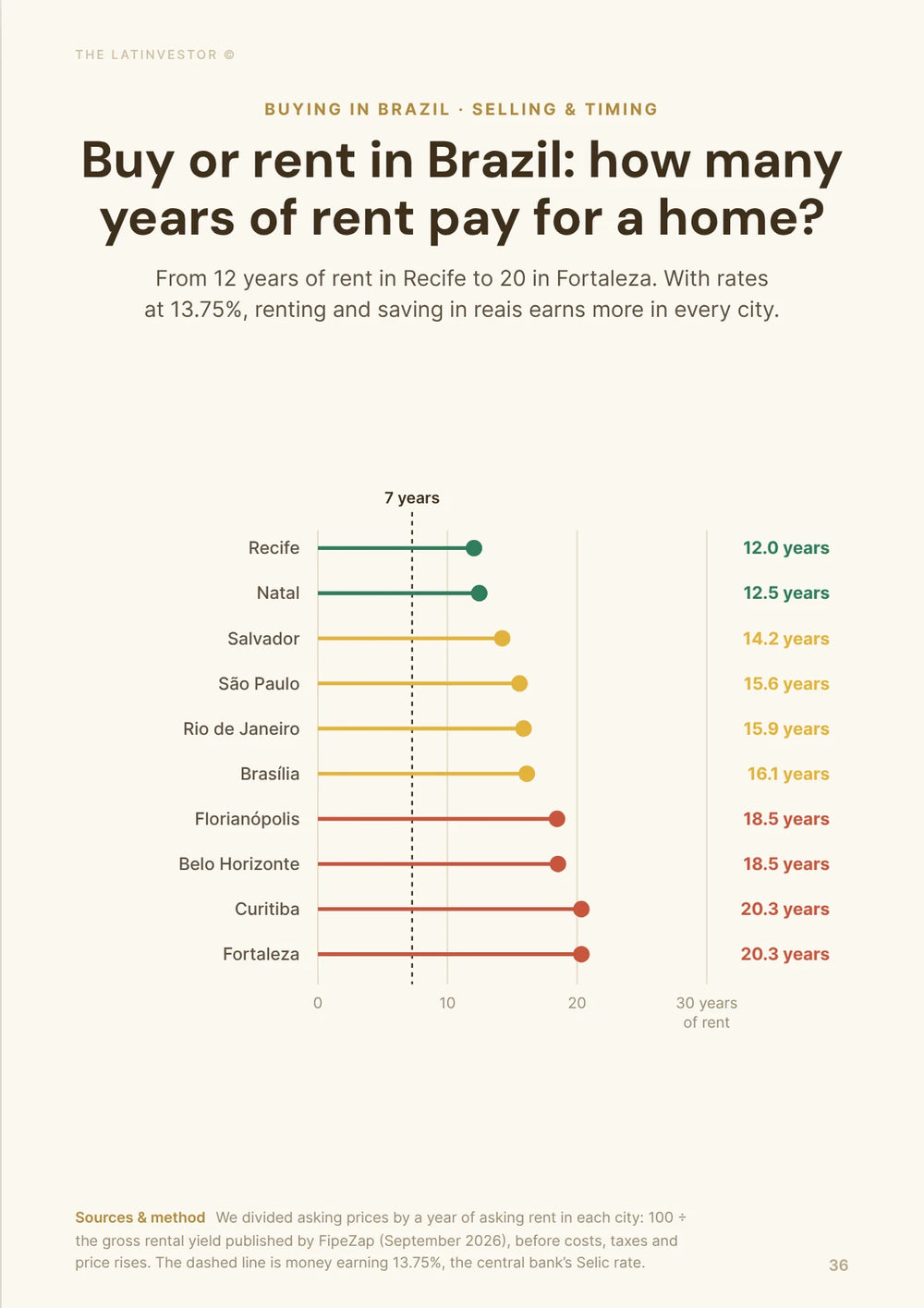
FipeZAP puts São Paulo's average gross rental yield at 6.43% a year. Take a R$500,000 studio (about US$99,000) renting for R$2,625 a month: that's R$31,500 a year, or 6.3% gross.
One empty month brings it down to about 5.8%. If you live abroad, 15% of the rent is withheld as income tax, which leaves about 4.9%, before repairs, insurance, furniture replacement and a manager's fee.
The Banco Central cut the Selic from 14% to 13.75% on September 16, 2026, and the next Copom meeting is on November 3 and 4. Even with a few more cuts, Brazilian fixed income beats a studio's cash yield without tenants, repairs or condo meetings.
So the studio case now depends on resale value. If you earn under 5% net from rent while the price barely keeps up with inflation, the total return can disappoint even if the price in reais never falls.
| R$500,000 studio, long lease | Per year | Yield |
|---|---|---|
| Rent at R$2,625 a month | R$31,500 | 6.3% gross |
| One month empty | R$28,875 | About 5.8% |
| After 15% non-resident tax | About R$24,500 | About 4.9% |
| Repairs, insurance, manager | Extra deduction | Lower still |
| Selic (September 2026) | — | 13.75% |

Can Airbnb still rescue a São Paulo studio?
Less and less. Short stays are more crowded than a year ago, and your building can now stop you.
AirROI counted 34,925 active Airbnb listings in São Paulo over the 12 months to September 2026, up 66% in a year. The average listing booked 40.1% of its nights at about R$309 a night. A one-bedroom averaged about R$32,800 of bookings a year, before Airbnb's fees, cleaning, utilities and furniture.
The rules have tightened too. Since the STJ's ruling of May 7, 2026, offering an apartment on platforms like Airbnb in a residential building can require the approval of two-thirds of the owners. A launch brochure that sells "Airbnb-friendly" doesn't settle that; the condo's convention and vote do.
Before buying a studio for short stays, ask for the convention and the last assembly minutes, and check whether the building already allows them. If it doesn't, price the unit as a long-term rental only.
Could cheaper mortgages rescue São Paulo studio prices?
They could help a lot. Better credit can absorb enough apartments to stop a supply problem from turning into a serious price fall.
Lending is already growing fast. ABECIP reported R$132.5 billion of savings-funded (SBPE) mortgages nationwide from January to August 2026, up 37.5% on a year earlier.
Mortgage rates are still expensive, so this isn't easy money. But housing markets care about the direction of credit. A household priced out at the peak of the rate cycle can come back as rates ease, and investors become more willing to hold property as fixed income loses some of its edge.
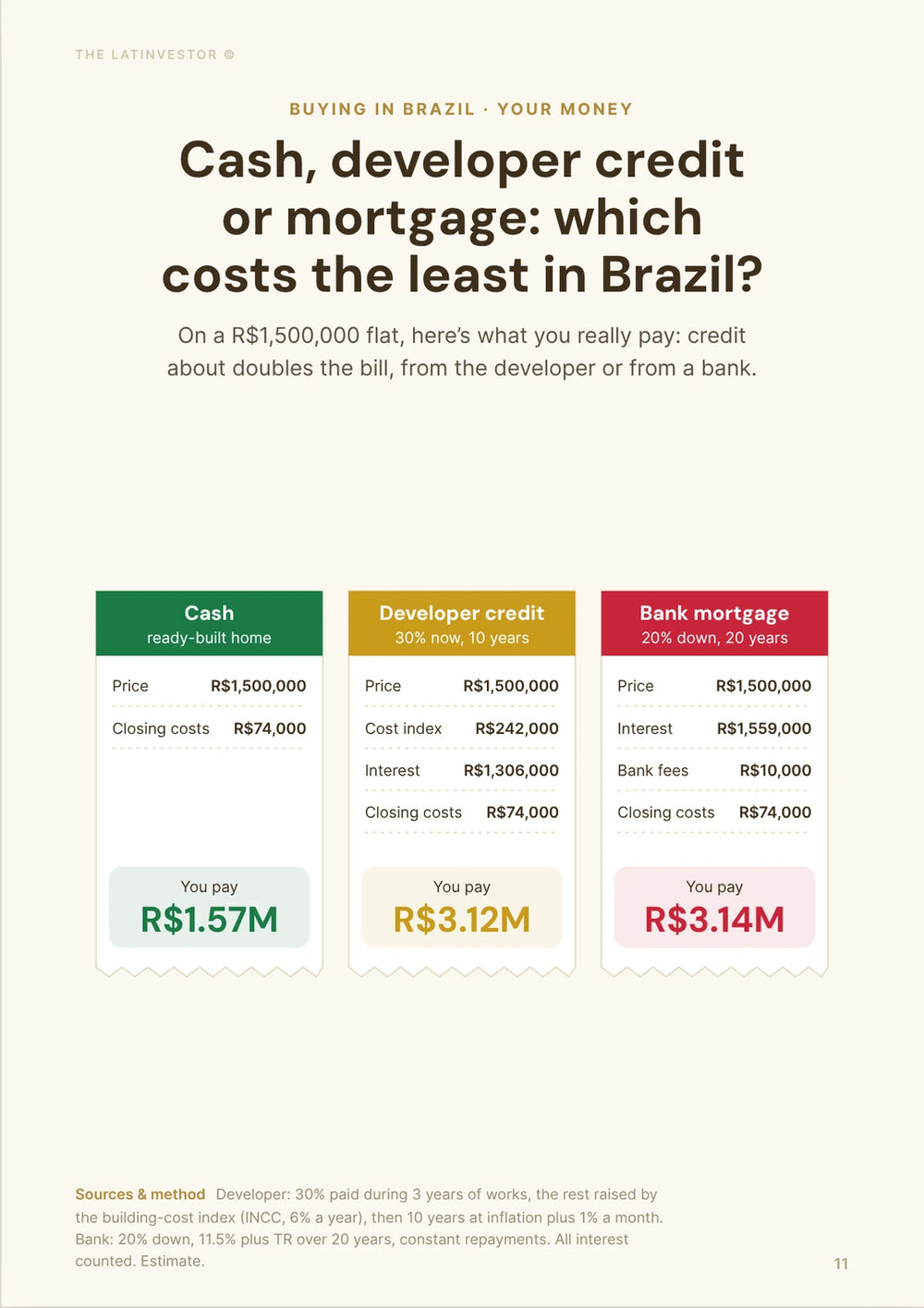
One limit for foreign buyers: Brazilian banks usually require nationality or permanent residence, so a non-resident almost always pays cash. Credit supports the market, but it won't finance your purchase.
If credit keeps growing while rents stay firm, São Paulo can absorb a lot of new housing without a big cut in listed prices. That's why predicting a studio crash from supply data alone goes too far.
Are HIS and HMP studios becoming riskier investments?
Yes. HIS and HMP apartments are much harder to treat as free investment studios, and the city now enforces the rules.
These are social and popular-market housing units, meant for buyers and tenants within set income limits. Many ended up sold as ordinary investment studios and listed on short-stay platforms.
Under the current rules, they stay subject to income and use limits, and short-term rental is banned. The city's housing department (SEHAB) sent platforms a list of 62,812 HIS and HMP units and asked them to remove irregular listings, and Airbnb and Booking.com started taking them down.
For sales and regular rentals, the first ten years after completion or first sale come with eligibility rules. Short stays stay banned after that.
That changes what a unit is worth. A 25 m² free-market studio that can be rented long-term, furnished by the month or for short stays has far more possible tenants and buyers than a similar-looking HIS unit.
Investors who bought without checking the legal status may find the resale market is smaller than they thought. Before comparing prices, separate HIS and HMP units from ordinary studios: legal status can matter as much as floor area.
Which São Paulo studios are most likely to lose value?
Small investor units bought at expensive launch prices, in buildings where dozens of owners will one day try to rent or sell almost the same apartment.
Picture a 300-unit tower of mostly 22 to 28 m² units. Views change by floor and some get more sun, but buyers are comparing the same product again and again. If ten owners decide to sell, each new listing competes directly with the other nine. It gets worse when two or three more studio projects deliver nearby.
This matters most in neighborhoods developers targeted because rents were already high: Pinheiros, Vila Olímpia, Brooklin, Bela Vista and the areas around big metro stations.
A famous address doesn't remove the risk. Pinheiros has some of the highest rents in the city, and its asking prices still slipped 0.3% in a year.
The weakest mix is easy to spot: tiny floor plan, high price per square meter, expensive condo fee, hundreds of similar units, and a purchase case that relies on unusually high rent. Those units can reprice fast once several owners want out at the same time.

Which São Paulo studios should hold their price better?
Studios people actually want to live in, rather than units designed around the investment pitch.
Start with transport. A real short walk to a metro or train station brings a steady flow of tenants year after year. Big employment areas, hospitals and universities add more.
Then the layout. A 19 m² box and a 30 m² unit with a proper sleeping area, a usable kitchen, daylight and storage are not the same product.
Look hard at the condo fee. On a long lease the tenant pays it, but tenants compare the total of rent plus condo plus IPTU, so a R$700 fee on a R$3,000 rent pushes you to lower the rent. And you pay it yourself every month the unit is empty or used for short stays.
Building size matters for resale too. An owner in a building with 100 different apartments has fewer direct rivals than someone selling unit 1,407 in a tower full of identical studios.
A good studio needs a reason for a tenant to choose it and a reason for the next buyer to choose it. "New" stops being a reason after five years.
What would have to happen for São Paulo studio prices to really fall?
A broad drop would need today's oversupply to meet weaker rents and more investors selling at once.
The supply part is already here. Compact stock has grown sharply, sales have slowed and some heavily built neighborhoods have lost their price momentum.
Rents haven't weakened. They're still up 6.22% a year, which gives owners a good reason to hold rather than sell cheap.
Credit is improving, with SBPE lending up 37.5% in the first eight months of 2026. And developers can adjust: delay launches, change unit sizes or add incentives. With construction costs up 6.21% in a year, they'd rather defend listed prices.
The warning signs to watch: delivered studio buildings struggling to find tenants, rent growth stalling, resale listings piling up, and owners repeatedly accepting less than similar units in the same building. When those show up together, the picture changes.
| What a broad studio fall needs | Situation now | Our reading |
|---|---|---|
| Large compact supply | Already here | Strong |
| Rising unsold stock | Already here | Strong |
| Slower sales | Already here | Strong, slightly better in July |
| Weak rents | Not yet | Main missing piece |
| Falling citywide prices | Not in reais | Down about 0.9% after inflation |
| Widespread investor selling | Not shown in the data | Still limited |
| Mortgage credit | Growing | Supports prices |
| Construction costs | Still rising | Developers resist cuts |
Could studios fall while São Paulo property prices keep going up?
Yes, and that's more likely than a citywide crash.
City averages mix very different markets. A family apartment in Jardins, a Minha Casa, Minha Vida two-bedroom and a 23 m² studio in Pinheiros have different buyers, budgets and supply.
The neighborhood data already show it: Jardins up 6.7% in a year, Pinheiros down 0.3%, and the city still up 3.64%.
Single buildings can split even more. Say several owners bought identical studios for R$550,000 at launch. If one needs cash and accepts R$500,000, that's 9% below the purchase price. Another at R$480,000 is down almost 13%. Neither sale is big enough to push FipeZAP's index below zero.
If you wait for a headline saying "São Paulo prices are falling", you'll notice the studio correction late. The useful data are at building and street level.
How much could a weak São Paulo studio actually fall?
A 5% to 15% drop looks plausible for individual studios bought too expensively. The data give little reason to expect a 20% to 30% citywide studio crash.
Owners can lose money in three ways. The mildest is already happening: prices rose 3.64% while inflation ran at 4.58%, so owners got slightly poorer in real terms.
The second is hidden discounts. A developer keeps the official R$550,000 price but gives new buyers R$25,000 of extras. An earlier buyer's unit has lost part of its value even though the tabela never moved.
The third shows up on resale. A R$550,000 studio sold for R$520,000 is down 5.5%. At R$500,000 it's down 9.1%, and at R$475,000, 13.6%. No crisis is needed for that: just a launch premium paid too high and more competition when you sell.
A 25% fall across all studios would take something much worse: weak jobs, falling rents, scarce credit and lots of forced selling at the same time. Today's data don't point there.
So, are studio prices in São Paulo about to fall?
Partly. Some studios are very likely to lose value, but a broad citywide fall still looks premature.
The bearish evidence is stronger than a year ago. Unsold 30 to 45 m² stock went from 34,329 to 47,965 units between June 2025 and June 2026, and VSO fell from 15.9% to 11.1%. Total new-home stock hit 98,018 in August 2026.
The first neighborhood cracks are visible too: Pinheiros is down 0.3% in a year and Vila Mariana is up only 0.4%.
But what usually turns oversupply into a crash is still holding. Rents are up 6.22% a year, mortgage lending is up 37.5%, construction costs keep developers from cutting the tabela, and the city's asking prices are still 3.64% higher than a year ago.
The real change is happening below the city average. Buying a tiny apartment near a metro station no longer guarantees appreciation: in some areas there are simply too many similar units, and resale buyers have more choice than before.
For a well-designed studio bought at a sensible price, with a low condo fee and solid long-term rental demand, we see little sign of a big fall. A generic 20 to 25 m² investor unit bought at a launch premium in a building full of identical units deserves much more caution: a 5% to 15% resale loss there wouldn't surprise us.
In short: no citywide crash, but the weakest studios are already correcting, through lost real value, harder negotiation and building-level discounts rather than one big drop in the index.
Related blog posts
- Is São Paulo overbuilding studio apartments?
- Are São Paulo studios becoming harder to rent?
- Are studios still a good investment in São Paulo?
- Are home prices in São Paulo going up or down?
- Where are home prices in São Paulo heading next?
- Are HIS and HMP apartments still worth buying in São Paulo?
Our methodology
No single statistic answers whether São Paulo studio prices are about to fall, so we split the question into what actually moves them: new supply, sales speed, unsold stock, price trends, rents, yields, credit, legal limits and resale competition inside buildings.
New-home launches, sales, stock and VSO come from Secovi-SP's monthly survey (June, July and August 2026, compared with June 2025). We did not treat every 30 to 45 m² apartment as an investor studio: we cross-checked with bedroom mix, Minha Casa, Minha Vida's share and the under-30 m² band. Asking prices and rents come from FipeZAP (September 2026), studio listing prices from Loft (August to October 2025) and Tô Em Casa (October 2026), one-bedroom rents by neighborhood from QuintoAndar Imovelweb (July 2026), negotiation discounts from FipeZAP's buyer survey (second quarter of 2026), and short-stay data from AirROI.
Inflation comes from IBGE (IPCA), the Selic from the Banco Central do Brasil, construction costs from SindusCon-SP's CUB, and mortgage volumes from ABECIP. National mortgage data only show the direction of credit, not São Paulo sales. Rules come from São Paulo City Hall (HIS and HMP), the STJ (short stays in condos), Lei 13.786/2018 (off-plan cancellations) and the Receita Federal's 15% withholding on rent paid to non-residents.
We checked these figures in October 2026. Conversions use about 5.05 reais per US dollar and 5.65 reais per euro.
Limits: FipeZAP, Loft and Tô Em Casa measure asking prices, not closing prices, and neighborhood figures rest on fewer listings than city figures. Secovi-SP only covers new developments, not resales. Our yield example and the 5% to 15% downside range are scenarios for exposed individual studios, not a forecast for every studio in São Paulo.
Key sources used for this analysis include Secovi-SP's monthly market survey, Secovi-SP's June 2025 report, June 2026 Secovi-SP data (ADEMI-RJ), Portas on compact launches (June 2026), Portas on new-home stock (July 2026), Portas on August 2026 sales, FipeZAP sale prices (September 2026), FipeZAP rents (September 2026), the FipeZAP index portal, Loft's studio price study (via Portas), Tô Em Casa, QuintoAndar's rental index, AirROI, IBGE's IPCA, the Banco Central's Selic history, SindusCon-SP's CUB (August 2026), ABECIP's monthly releases, São Paulo City Hall's HIS and HMP rules, City Hall's action against irregular short-stay listings, the STJ's May 2026 ruling and Lei 13.786/2018.