Summary
Yes, but only if you pick carefully. A São Paulo studio bought at a fair price still yields about 7.5% gross on a long lease. The generic new micro-studio bought off plan at any price is now a weak bet.
Supply is the problem, not demand. Secovi-SP counted about 44,000 one-bedroom launches in 2025, against 17,700 in 2023, and unsold mid- and high-end studios of up to 30 m² rose 71% in the year to June 2026, to about 10,900.
Small units still sell fastest: 30–45 m² apartments made up 64% of new-home sales in May 2026. But a whole segment can sell well while single towers full of identical investor units struggle.
Tenants still pay a premium. One-beds rent for R$91.14 per m² in QuintoAndar's July 2026 data, against R$66.68 for two-beds, but two-beds are now rising faster (+11.05% against +7.81%).
Rents are rising faster than prices: FipeZAP has asking rents up 6.22% in the 12 months to September 2026, while asking prices rose only 3.64%, a small loss after inflation.
On our R$450,000 example, a 7.5% gross yield drops to about 5.9% after one empty month and owner costs, and to about 4.9% after the 15% tax withheld from a non-resident's rent.
The smallest unit is rarely the best deal. A 40 m² older one-bed can yield 8% while a 25 m² new studio at the same price yields 6.6%.
Borrowing doesn't work: private banks charge about 11.8% plus TR and the Selic is 13.75%, well above what a studio earns. Most non-residents pay cash anyway.
Fixed income pays close to 13.75% with no tenant, so a studio only makes sense as a long-term bet on rents and prices, not on income alone.
Location still matters, but being near a metro is no longer enough. Vila Olímpia, Brooklin and Pinheiros rent above R$100 per m² because they mix offices, services and transit.
Developers are discounting quietly. Buyers who negotiate get 14% off on average (FipeZAP), and slow launches leave room for 10% to 15% off.
Airbnb is no longer a safe exit: since the STJ's May 2026 ruling, a building can require the approval of two-thirds of owners before units go on short-stay platforms.
Flipping is out: buying and selling costs 10% to 14%, while a year of 3.64% growth adds only about R$18,200 on a R$500,000 studio.
Our view: buy a studio only if the numbers work on a normal lease, the condo fee is low, few identical units compete nearby and you paid well below the asking price.


Why are investors getting nervous about São Paulo studios now?
Because developers have built compact apartments much faster than investors expected, and unsold stock is now piling up in exactly that segment.
Secovi-SP recorded about 44,000 one-bedroom launches in 2025, against about 27,700 in 2024 and 17,700 in 2023. That's roughly 149% more in two years.
It hasn't slowed in 2026. In June, Secovi-SP counted 47,965 new 30–45 m² units for sale. Unsold mid- and high-end studios of up to 30 m² reached about 10,900 in June, up 71% in 12 months (subsidized units aren't in this count), which is about 12 months of sales against about 5 a year earlier.
Across all sizes, unsold new stock reached 98,018 units in August 2026, up 50.7% in a year. XP Investimentos had already shown in July that stock below 60 m² rose from about 43,000 to about 75,000 units over its study period, while larger units barely moved.
Delivery is the next test. About 600 new residential condos are due in São Paulo in 2026, 13% more than in 2025, and almost 60% of them have small units (Lello). That's when investors all look for tenants at the same time.
| São Paulo compact-housing measure | Earlier level | Recent level | What changed |
|---|---|---|---|
| One-bedroom launches (Secovi-SP) | ~17,700 in 2023 | ~44,000 in 2025 | About +149% |
| Stock below 60 m² (XP analysis) | ~43,000 | ~75,000 | About +74% |
| Unsold mid- and high-end studios up to 30 m² | ~6,400 (June 2025) | 10,900 (June 2026) | +71%, about 12 months of sales |
| Unsold 30–45 m² units | — | 47,965 (June 2026) | Largest competing stock |
| All unsold new homes | ~65,000 (Aug. 2025) | 98,018 (Aug. 2026) | +50.7% |
Has São Paulo actually built too many studios?
In some towers and streets, yes. Citywide, not yet: small units still sell faster than any other size.
In May 2026, 30–45 m² apartments made up 52% of launches, 64% of sales and posted a 12.3% monthly sales-over-supply rate, the best of all sizes in Secovi-SP's survey. In June the rate was still 11.1%.
Units under 30 m² are the weak spot. Their stock now covers about 12 months of sales. Secovi-SP's Ely Wertheim says the worrying level is above 24 months, roughly the time it takes to build a tower. So it isn't a bubble, but the cushion has gone.
The real risk is local. A studio near Faria Lima with little similar stock nearby behaves very differently from the same unit in a tower where 40 investor-owned apartments hit the rental market the week the keys are handed over.
Are tenants still willing to pay a premium for one-bedroom apartments in São Paulo?
Yes. One-bedroom apartments still rent for much more per m² than anything else in São Paulo.
QuintoAndar Imovelweb's July 2026 index, which also sees signed contracts, puts the city average at R$75.20 per m². One-beds average R$91.14, about 21% above the city figure, against R$66.68 for two-beds and R$67.39 for three-beds.
That premium is about location. Many renters would rather have 25 or 30 m² close to work, hospitals or a useful metro line than twice the space an hour away.
Neighborhood rents show how much convenient space costs: R$116.50 per m² in Vila Olímpia, R$109.30 in Brooklin, R$105.40 in Pinheiros and R$90.30 in Moema (QuintoAndar, July 2026).
| São Paulo rental category (QuintoAndar, July 2026) | Average rent per m² | 12-month change |
|---|---|---|
| All residential rentals | R$75.20 | +9.0% |
| 1 bedroom | R$91.14 | +7.81% |
| 2 bedrooms | R$66.68 | +11.05% |
| 3 bedrooms | R$67.39 | +12.80% |
| Vila Olímpia | R$116.50 | — |
| Brooklin | R$109.30 | — |
| Pinheiros | R$105.40 | — |
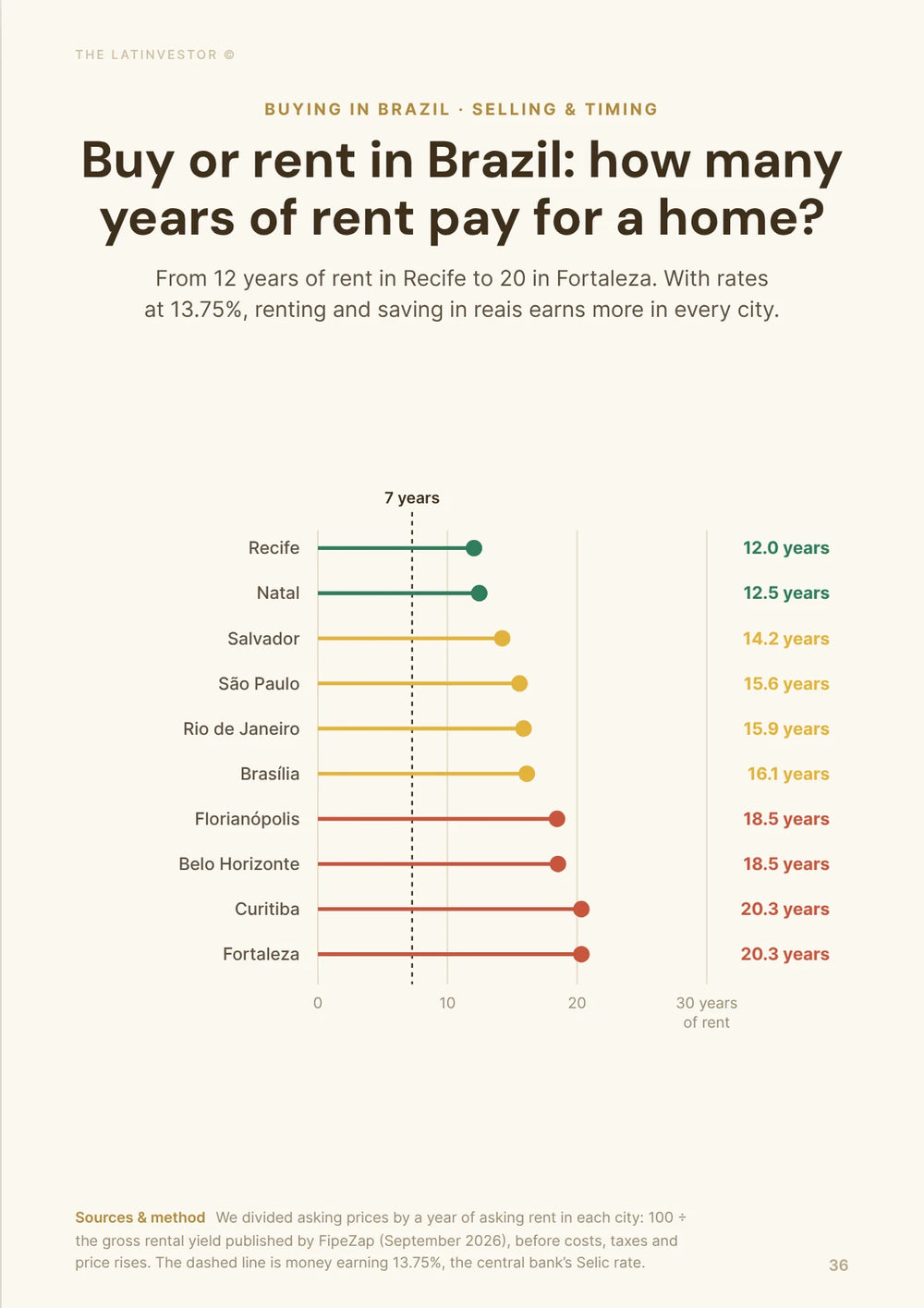
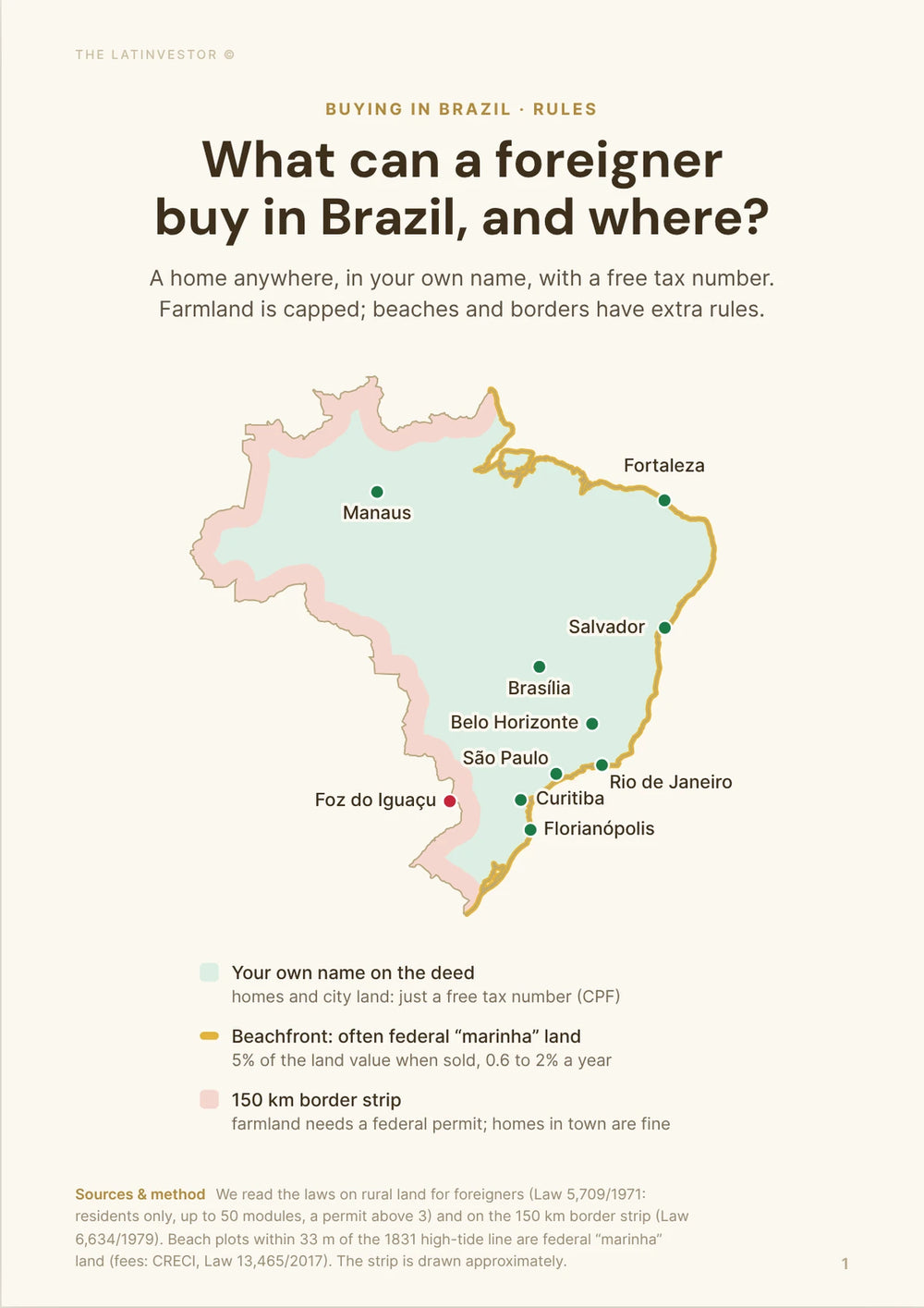
Are São Paulo studio rents still rising quickly?
Yes, but no longer faster than bigger apartments.
One-bed rents rose 7.81% over 12 months in QuintoAndar's July data, against 9% for the city, 11.05% for two-beds and 12.80% for three-beds. The squeeze has moved to families.
So don't count on the studio premium widening further. R$91.14 per m² is still a strong base, but future returns will depend on what you pay, not on rent growth rescuing an expensive purchase.
Are São Paulo rents rising faster than property prices?
Yes. FipeZAP has São Paulo asking rents up 6.22% in the 12 months to September 2026, against 3.64% for asking prices, which is about −0.9% after inflation.
The average asking price was R$12,206 per m² in September 2026 and the average asking rent R$65.78 per m², a gross yield of 6.43%. QuintoAndar, which also counts signed contracts, shows even faster rent growth (+9%).
For an owner who bought well, that's good news: the yield improves without prices having to fall. For a new buyer, it means a studio is an income asset, not a quick capital-gains play.
| São Paulo measure | 12-month change | What it suggests |
|---|---|---|
| Asking sale prices (FipeZAP, Sept. 2026) | +3.64% | Slight real loss after 4.58% inflation |
| Asking rents (FipeZAP, Sept. 2026) | +6.22% | Income growing faster than prices |
| All rents (QuintoAndar, July 2026) | +9.0% | Signed rents rising even faster |
| One-bedroom rents (QuintoAndar, July 2026) | +7.81% | Compact rents still rising |
What rental yield can a São Paulo studio actually produce today?
A well-bought studio can still gross about 7.5%, but a foreign owner ends up closer to 5%.
Take a R$450,000 studio (about USD 89,100) renting for R$2,800 a month (about USD 554). Annual rent is R$33,600, a gross yield of about 7.5%. That's above the 6.43% city average, so it already assumes a good purchase.
Lose one month to vacancy and you collect R$30,800. Add R$350 a month of costs the tenant doesn't cover (condo fees and IPTU while empty, extraordinary condo charges, repairs) and another R$4,200 goes, leaving R$26,600, or about 5.9%.
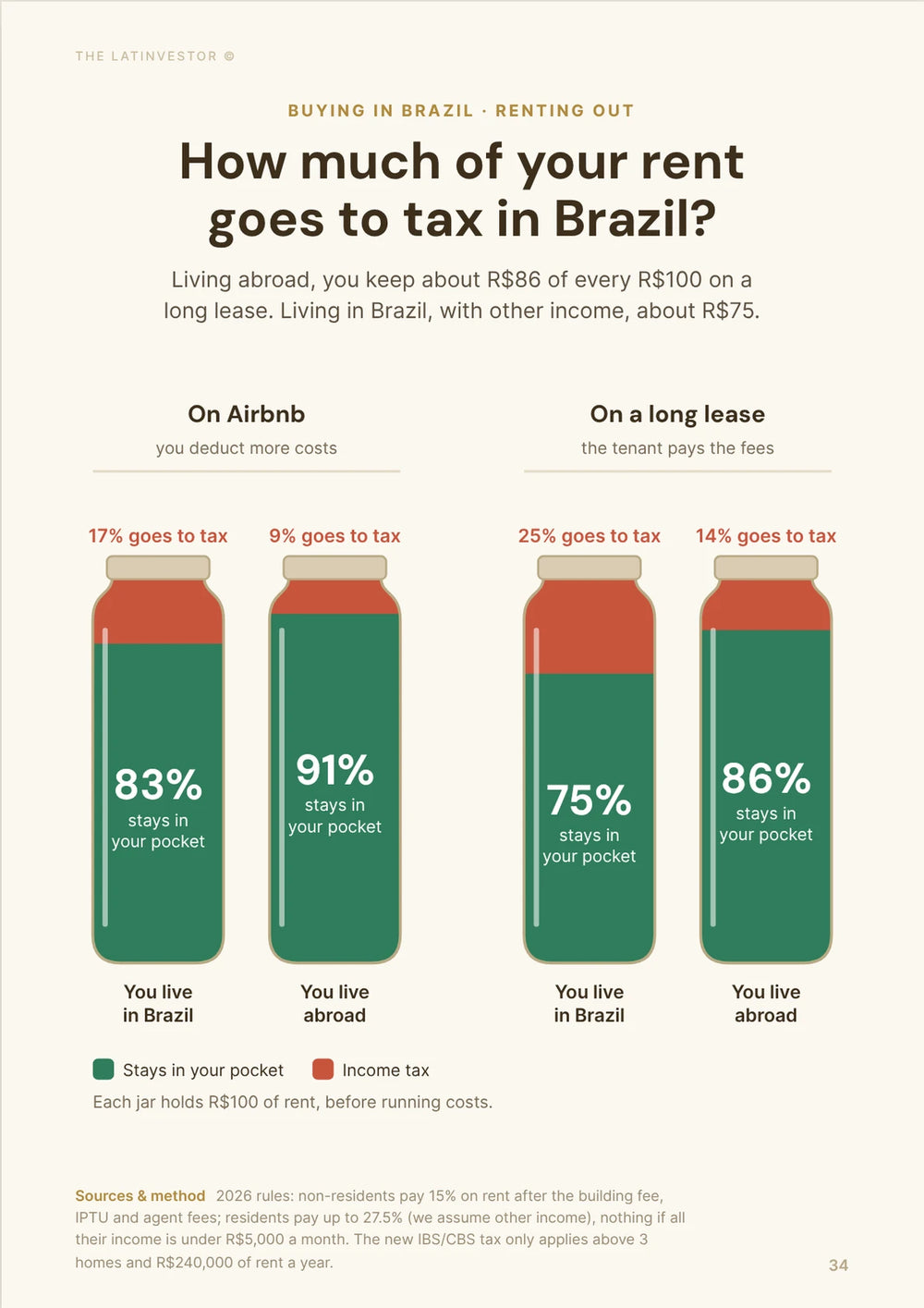
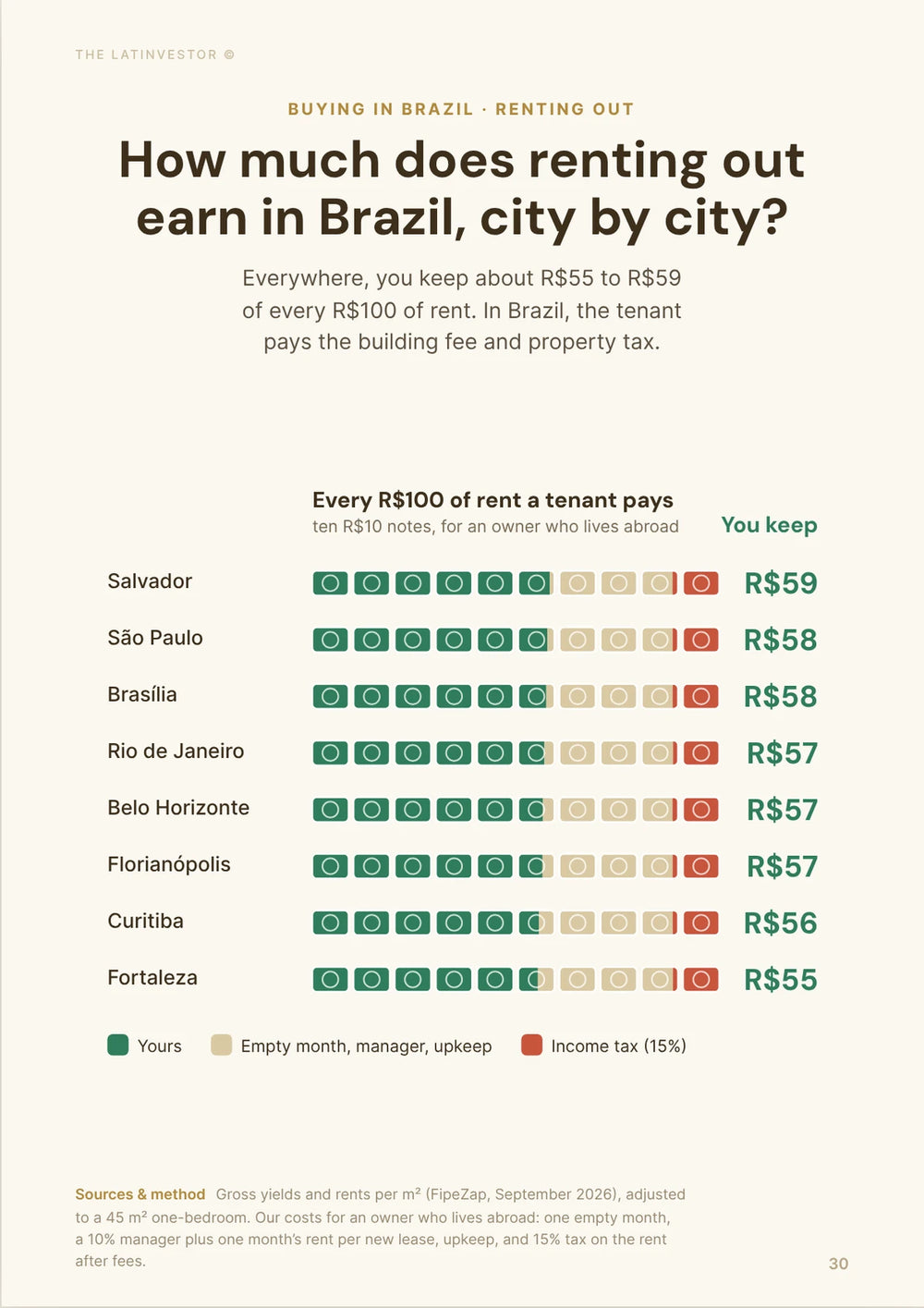
If you don't live in Brazil, 15% of the gross rent is withheld at source: R$4,620 here. That leaves R$21,980, about 4.9%, before any management fee. On a long lease the tenant pays the ordinary condo fee and the IPTU, so a building with high fees mainly hurts you when the unit is empty, and through the rent tenants will accept.
| Example: R$450,000 studio | Annual amount | Yield on purchase price |
|---|---|---|
| R$2,800 × 12 months | R$33,600 | 7.5% |
| After one vacant month | R$30,800 | 6.8% |
| After R$4,200 of owner costs | R$26,600 | 5.9% |
| After 15% non-resident withholding | R$21,980 | 4.9% |
Does buying the smallest São Paulo studio give you the best return?
No. Tiny studios earn more rent per m², but developers charge so much per m² that the advantage often disappears.
Imagine a 25 m² new studio renting at R$110 per m², so R$2,750 a month. At R$20,000 per m², it costs R$500,000: a 6.6% gross yield.
Now a 40 m² older one-bed renting at only R$80 per m², so R$3,200 a month. At R$12,000 per m², it costs R$480,000: an 8% gross yield.
The small one wins on rent per m² and loses on return. Compare annual rent with the full price you pay, not floor area.
Does financing a São Paulo studio still make sense?
No. Mortgage rates are well above what a studio earns, so every borrowed real costs you money.
In September 2026, Banco Central data put regulated TR-linked housing loans at 7.98% a year at Caixa and about 11.8% to 11.9% at Bradesco, Santander and Itaú, with TR on top. The Copom cut the Selic from 14% to 13.75% on September 16, and the next meeting is on November 3-4.
Against a 6% to 8% gross yield, that's negative leverage before vacancy, costs and tax. And for most foreign non-residents the question doesn't even come up: Brazilian banks usually ask for residency, so you'll buy in cash.
| Regulated TR-linked mortgage rates (Banco Central, Sept. 2026) | Average annual rate |
|---|---|
| Caixa | 7.98% + TR |
| Bradesco | 11.77% + TR |
| Santander | 11.85% + TR |
| Itaú | 11.87% + TR |
| Selic (for comparison) | 13.75% |
Does a studio still beat Brazilian fixed income with the Selic at 13.75%?
Not on income. A non-resident nets around 5% on a good studio, while Brazilian fixed income pays close to 13.75% with no tenant, no vacancy and no repairs.
So a studio is a bet on three things: rents keeping ahead of inflation, prices picking up once rates fall, and the real holding up against your own currency. The Focus survey only expects the Selic at 13.25% by the end of 2026, so that wait could be long.
What to do: if the studio doesn't reach at least 7% gross on a normal lease at the price you pay, put the money elsewhere and wait for the stock to clear. A bad purchase won't be fixed by lower rates.
Which parts of São Paulo still make the most sense for studio investors?
The places where tenants pay for an easier daily life, not just for a neighborhood name.
Vila Olímpia, Brooklin and Pinheiros all rent above R$100 per m² in QuintoAndar's data, thanks to offices, restaurants, transit and services within walking distance. That's also why developers keep launching studios there, so check what's being built around the unit.
Being near a metro is no longer enough, since developers built along the transit corridors precisely for that reason. Look for several separate sources of tenants nearby: offices, a big hospital, a university and a useful metro line. A studio whose only selling point is a station next to six new investor towers is much more exposed.
Walk the street at night too. A ten-minute walk on a developer's map can feel much longer after dark.
Are older one-bedroom apartments now better value than new studios?
Often, yes. An older one-bed gives you more space and a wider pool of tenants without the investor premium of many new studios.
A 20–25 m² studio is cheap to furnish but hard to live in for years. A 35–45 m² apartment with a real bedroom works for couples, people working from home and tenants who want to stay longer. When twenty identical studios are for rent in the same tower, that difference matters.
New buildings have real pluses: security, air-conditioning, laundry, fewer repairs. Older ones can surprise you with façade, lift or plumbing work, so ask for the building's recent minutes and planned works.
Price decides. If a 23 m² new studio and a 40 m² older one-bed cost about the same in the same area, take the bigger one seriously.
Could all this new studio supply push São Paulo prices down and make resale harder?
Inside some buildings, yes. Across the city, prices are flat in real terms rather than falling.
FipeZAP still shows São Paulo asking prices up 3.64% in a year, and compact units still sell. The danger is at the tower level: when 30 or 40 near-identical studios appear online at delivery, or later when several owners sell at once, one owner cutting R$20,000 resets the price for everyone.
Resale studios in finished buildings also compete with developers who can offer payment plans and hidden discounts, which private sellers can't. Expect a generic studio to sell, but not at the price you hoped.

How much can you negotiate off a new São Paulo studio right now?
More than the price list suggests: on a launch that has been selling slowly for months, aim for 10% to 15% off.
With 98,018 unsold new homes and studio stock up 71%, developers rarely cut list prices openly. They give discounts on finished units, free parking spaces, furniture packages or easier payment plans instead. FipeZAP's 2026 buyer survey found a 9% average discount between asking and closing prices, and 14% for buyers who did negotiate.
What to do: ask which finished or nearly finished units are still unsold, ask how many units in the tower were sold to investors, and compare with resale studios in finished buildings nearby, whose owners are often the ones cutting. Also check whether the unit is HIS or HMP social housing, since those can't be used for short stays.
How long do you need to own a São Paulo studio for the investment to make sense?
Several years. Buying and selling costs are too high for a quick flip.
São Paulo's ITBI is 3% for an ordinary purchase: R$15,000 on a R$500,000 studio. Add the deed and registry, and the 6% to 8% agent commission when you sell, and a round trip costs 10% to 14% of the price. Furniture and air-conditioning come on top before the first tenant moves in.
If that R$500,000 studio rises 3.64% in a year, as the city did, you gain about R$18,200 (about USD 3,600) on paper, which the ITBI alone nearly wipes out. Over seven to ten years, those costs matter much less against accumulated rent.
Buying off plan to resell at delivery is today's least comfortable bet: you'll be selling into the same wave of identical units.
Is Airbnb still a way out for São Paulo studios after the STJ ruling?
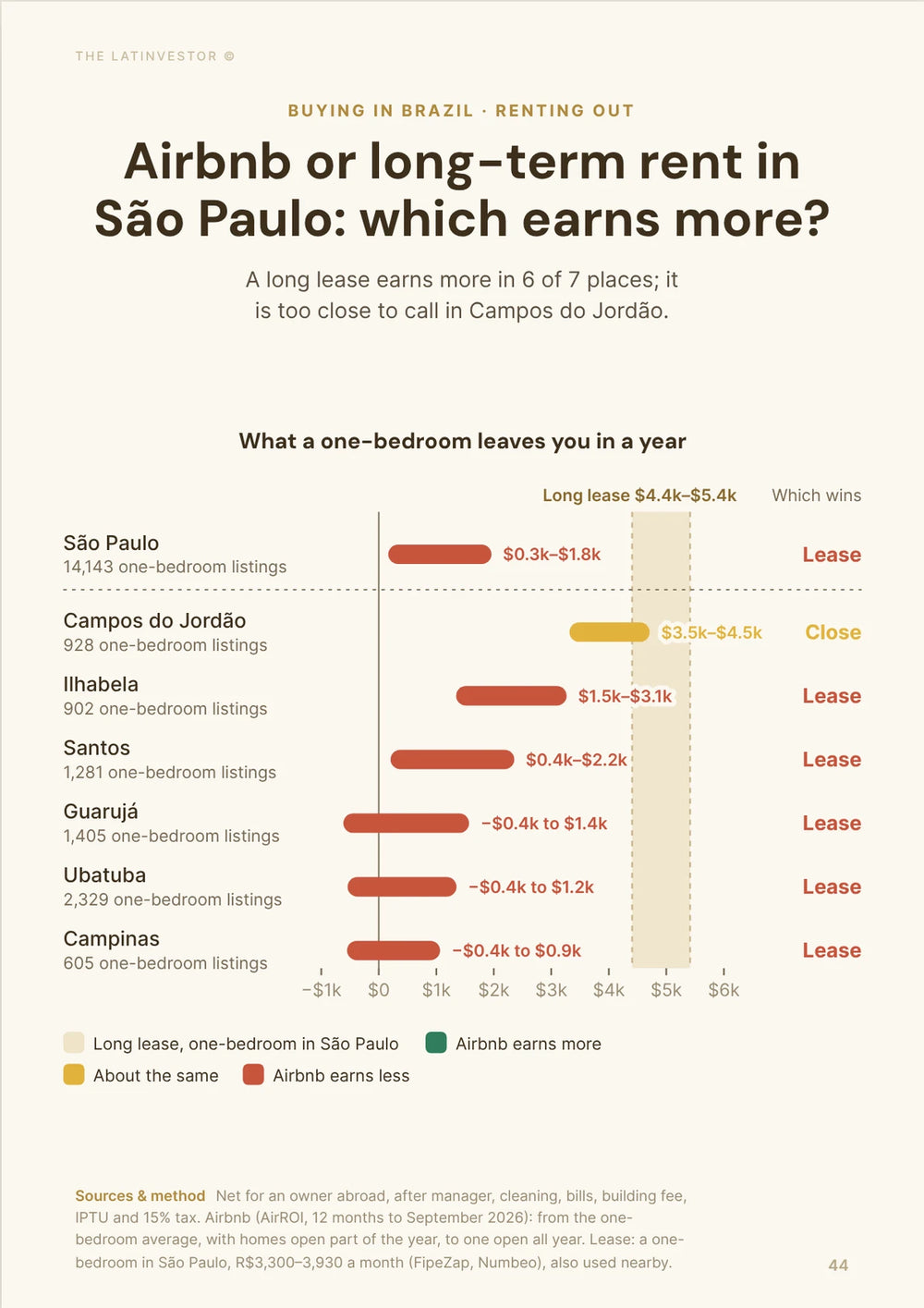
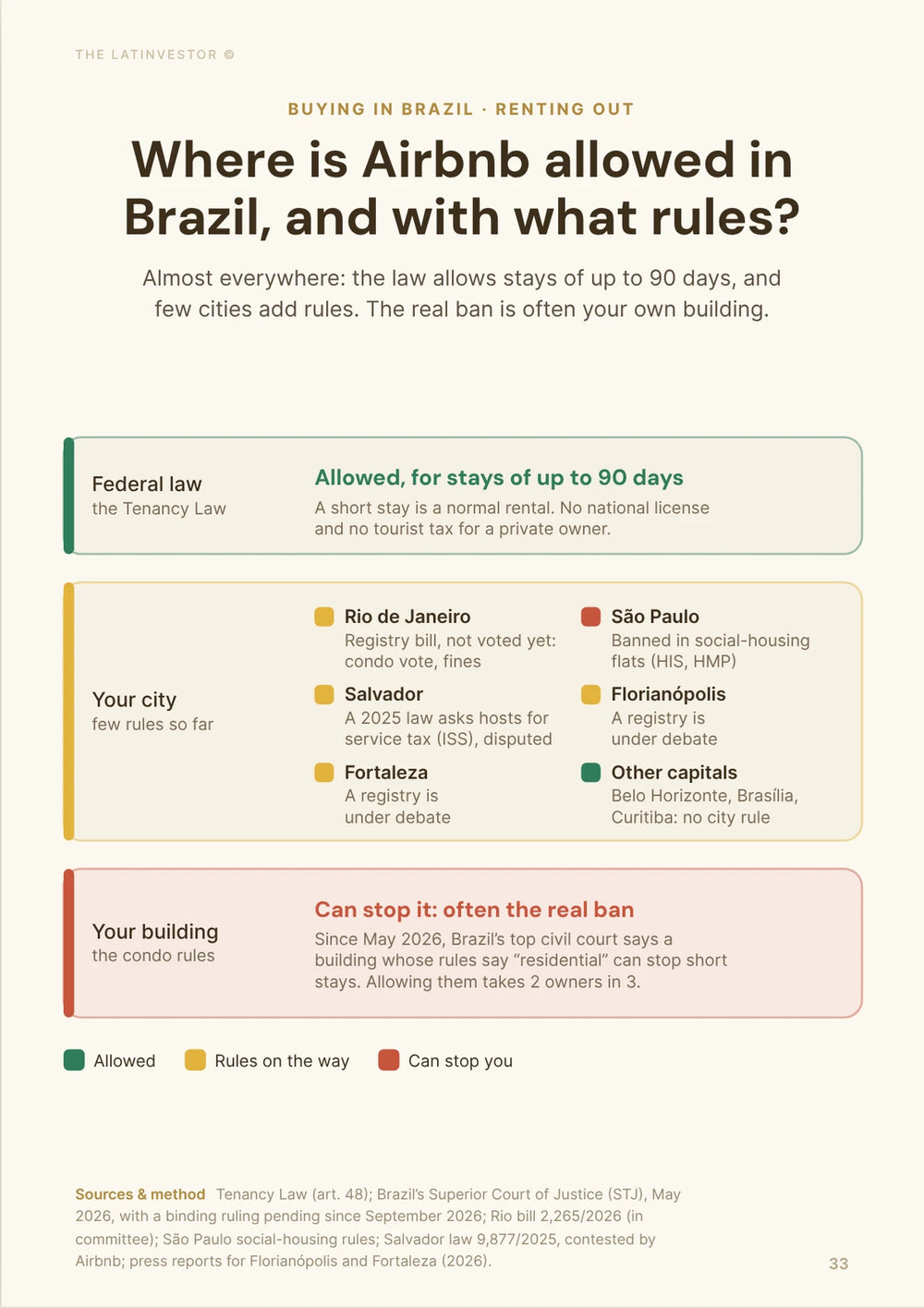
Less and less. Since May 2026, the STJ allows a residential building to require the approval of two-thirds of owners before units are offered on platforms like Airbnb, and in September 2026 it picked a case (Tema 1.443) to set a binding rule, with similar cases on hold.
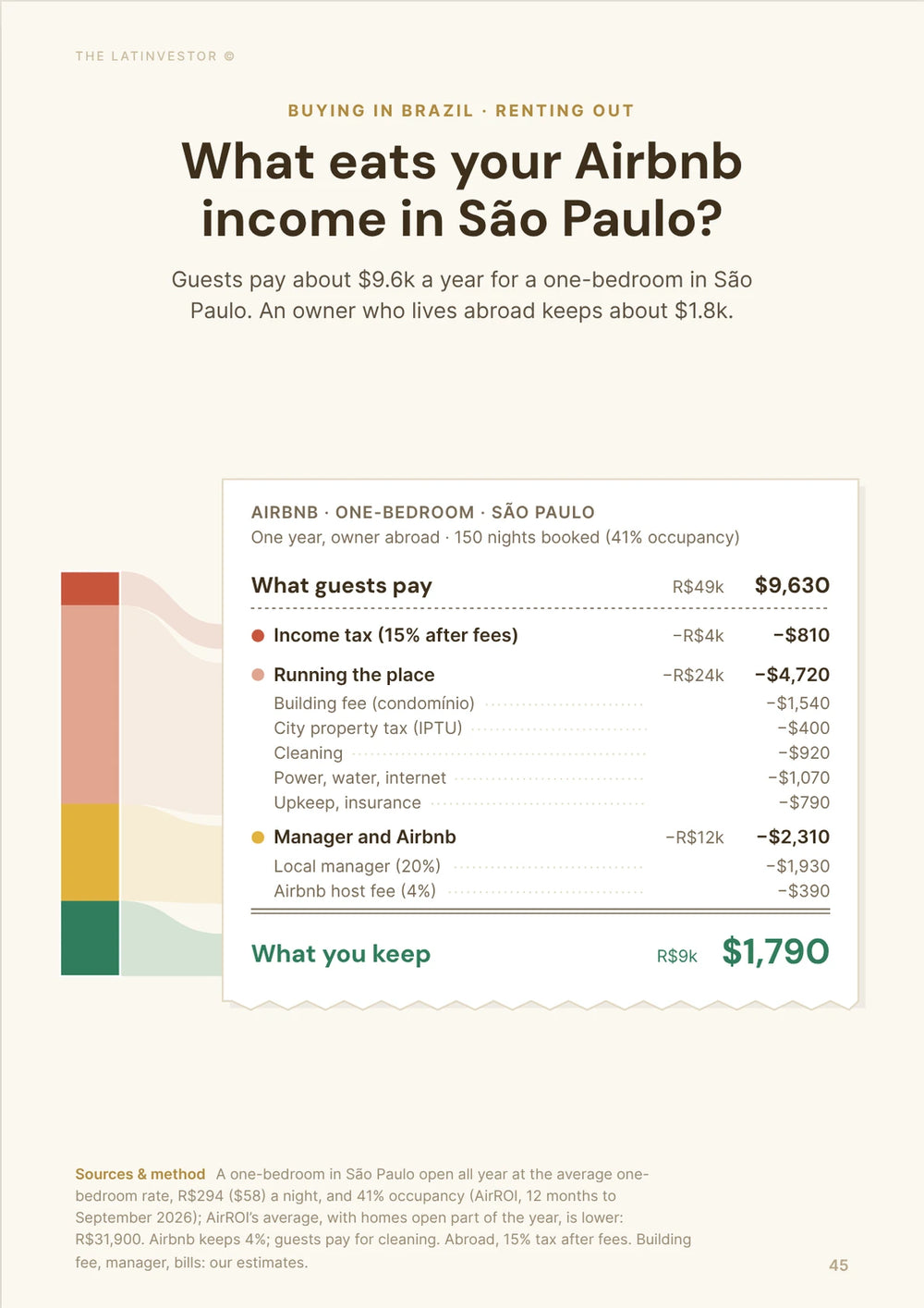
The numbers were thin anyway. AirROI puts the average São Paulo one-bed at R$302 a night with 41% occupancy, about R$32,800 a year (about USD 6,500) gross, while listings rose 66% in a year to 34,925. That's less than our R$33,600 long lease before the 16% host fee, cleaning, condo fees, utilities and the 15% non-resident tax, all of which a long-term tenant would largely spare you.
What to do: read the building's convention and recent assembly minutes before you buy, and never accept a sales pitch whose numbers only work on Airbnb. HIS and HMP units, common among new studios, can't legally be used for short stays at all.
What makes a São Paulo studio a bad investment today?
A pricey studio in a tower full of investors, with a high condo fee and a return that only works on Airbnb.
These weaknesses feed each other. A big new-build premium lowers the starting yield. Heavy amenities raise the condo fee, which you pay whenever the unit is empty. Identical units fight for the same tenants. Nearby launches cap future rent and resale prices. And a mortgage at 11.8% plus TR turns a mediocre deal into a bad one.
The riskiest product today is probably the polished 20 m² investor studio sold to every buyer with the same story.
| Red flag | Why we care | Better version |
|---|---|---|
| Large new-build price premium | Yield starts too low | Fair price against nearby resales |
| High condo fee | You pay it when the unit is empty, and it caps the rent | Simple building with controlled costs |
| Mostly investor-owned tower | Identical units compete directly | More owner-occupiers |
| Several new projects nearby | More rent and resale competition | Few comparable launches around |
| Deal only works on Airbnb | Building can block short stays (STJ, May 2026) | Numbers work on a normal lease |
| Heavy mortgage | 11.8% + TR is above the gross yield | Cash or a small loan |
What does a genuinely good São Paulo studio investment look like now?
Boring: solid normal rent, a fair price, low running costs and a location tenants keep needing.
Aim for a gross yield of about 7% or more on a long lease. That leaves room for vacancy, costs and the 15% withholding, where a fashionable unit starting at 5% leaves you almost nothing.
The unit should beat the competition on something real: a proper sleeping area, storage, a quiet side, or simply more space. That counts for more than a rooftop pool every tower nearby also has.
Low building costs pay every year. Saving R$250 a month is R$3,000 a year, about 0.67 point of yield on a R$450,000 purchase.
So, are studios still a good investment in São Paulo?
Yes, but only the well-bought ones. A studio still works when the rent is strong against the price you pay. A generic new micro-unit bought at any price doesn't.
Demand is there: one-beds rent for about R$91 per m², well above larger homes, and their rents rose almost 8% in a year. Supply is the warning: one-bedroom launches more than doubled since 2023 and studio stock is up 71%.
Rents rising faster than prices help disciplined buyers. Expensive credit and a 13.75% Selic mean you should buy in cash, for the long term, and only at a negotiated price.
We'd still buy a studio with a convincing normal-lease yield, low condo fees, real tenant demand and room for error on price. We'd skip the tiny off-plan unit with a big premium in a tower full of investors.
Our methodology
This article estimates whether studios in São Paulo are still a good buy for a foreign investor, by looking at supply, tenant demand, rent and price growth, the real yield after costs and tax, financing, short-stay rules and resale risk.
Supply comes from Secovi-SP: its annual surveys for one-bedroom launches from 2023 to 2025, and its 2026 monthly surveys (May, June and August) for sales speed by unit size and unsold stock, plus XP Investimentos' study of stock by unit size and Lello's count of 2026 deliveries. Rents come from QuintoAndar Imovelweb (July 2026, by bedroom and neighborhood) and FipeZAP (September 2026), sale prices from FipeZAP, inflation from IBGE, and short-stay data from AirROI.
Rules come from official sources: the Banco Central do Brasil for the Selic and bank mortgage rates, the São Paulo city hall for the 3% ITBI, the Receita Federal for the 15% withholding on a non-resident's rent, the Lei do Inquilinato for who pays condo fees and IPTU, and the STJ for the May 2026 short-stay ruling.
We checked these figures in October 2026, at about 5.05 reais per US dollar and 5.65 reais per euro.
Limits: FipeZAP and listing data are asking prices, not closing prices; QuintoAndar and FipeZAP use different methods, so we compare directions, not exact gaps; Secovi-SP covers new homes only; the yield examples are illustrations, not promises; and AirROI averages hide a wide spread between listings.
Key sources used for this analysis include Secovi-SP's 2025 yearbook, Secovi-SP's May 2026 survey, Secovi-SP's June 2026 data via ADEMI-RJ, Secovi-SP's August 2026 data via Portas, Portas on studio stock, Secovi-SP's December 2023 survey, Secovi-SP's December 2024 survey, XP Investimentos on São Paulo stock by unit size, Portas on 2026 condo deliveries, QuintoAndar Imovelweb São Paulo rental index, QuintoAndar rent per m² by neighborhood, FipeZAP sale report (September 2026), FipeZAP rental report (September 2026), FipeZAP discount survey via Portas, IBGE IPCA, Banco Central do Brasil mortgage rates, Banco Central do Brasil (Selic, September 2026), Banco Central do Brasil Focus, São Paulo city hall on ITBI, Lei do Inquilinato, the STJ's May 2026 decision, STJ on Tema 1.443, Exame on HIS and HMP units and AirROI São Paulo.