Summary
Yes, but slowly: we expect Querétaro prices to rise about 3% to 6% over the next 12 months, after the official SHF index rose 5.6% in a year in the first half of 2026.
In October 2026, a median two-bedroom apartment asks about USD 174,000 (MXN 3.24 million) and a three-bedroom house about USD 235,000 (MXN 4.37 million). Homes bought with a mortgage averaged MXN 2.38 million (USD 128,000) in the second quarter.
The pace keeps slowing: 7.3% in the third quarter of 2025, 6.7% in the first quarter of 2026, then 5.6%. With inflation at 3.45%, that's only about 2 points of real growth.
The gains have moved. Asking prices in El Marqués rose 12.0% in 18 months, while Juriquilla slipped 1.9% and El Refugio rose only 2.4%, according to Propiedades.com.
Cheaper homes hold up best: across Mexico they rose 10% in the first half of 2026. In Querétaro, developer sales of homes priced at MXN 3 million to 3.8 million fell from about 70 a month to fewer than 40 in 2026.
Many suburban new-build areas are flat because too many similar units are for sale and fewer buyers can borrow. Cash buyers should aim for 8% to 10% off.
Don't wait for cheap loans: Banxico's rate is at 6.50% and analysts expect no cut through 2027, while the average fixed-rate quote was still 11.31% in August 2026.
For a landlord, a 65 m² two-bedroom gives about 7.1% gross, or about 5.3% after the 25% tax a non-resident pays on rent, before vacancy and fees.
A citywide drop in 2027 is unlikely. The realistic bad case is flat prices, or 5% to 10% down after inflation, in far-out areas and generic new builds.
Over five years, we expect about 15% to 30% for good locations, roughly 3% to 5.5% a year. The train was only 30.38% built in September 2026; the airport grew 11.7%.
Over ten years, we expect about 35% to 70% in nominal terms. Inflation alone could account for about 40%, so the low end means flat prices in real terms.
The bottom line: Querétaro is still a solid market, but the easy gains are over. Buy a well-located home at the right price per square meter, check the water supply, and plan for single-digit growth.

How fast are prices rising in Querétaro right now?
What does a home cost in Querétaro in 2026?
In October 2026, the median asking price in Querétaro is about USD 174,000 (MXN 3.24 million or EUR 155,000) for a two-bedroom apartment and about USD 235,000 (MXN 4.37 million or EUR 209,000) for a three-bedroom house, according to TuLugar's listing data.
Homes that actually change hands with a mortgage cost less: the official SHF average for Querétaro state was MXN 2.38 million (USD 128,000) in the second quarter of 2026, the third highest in Mexico. Apartments ask about MXN 29,500 per square meter (USD 1,590), and houses about USD 1,270 (MXN 23,600).
Most homes on the market ask between about MXN 1.8 million and MXN 8 million (USD 96,800 to USD 430,000). Expect to close about 6% to 10% below the asking price, by our estimate.
How much have prices risen in Querétaro over the past year?
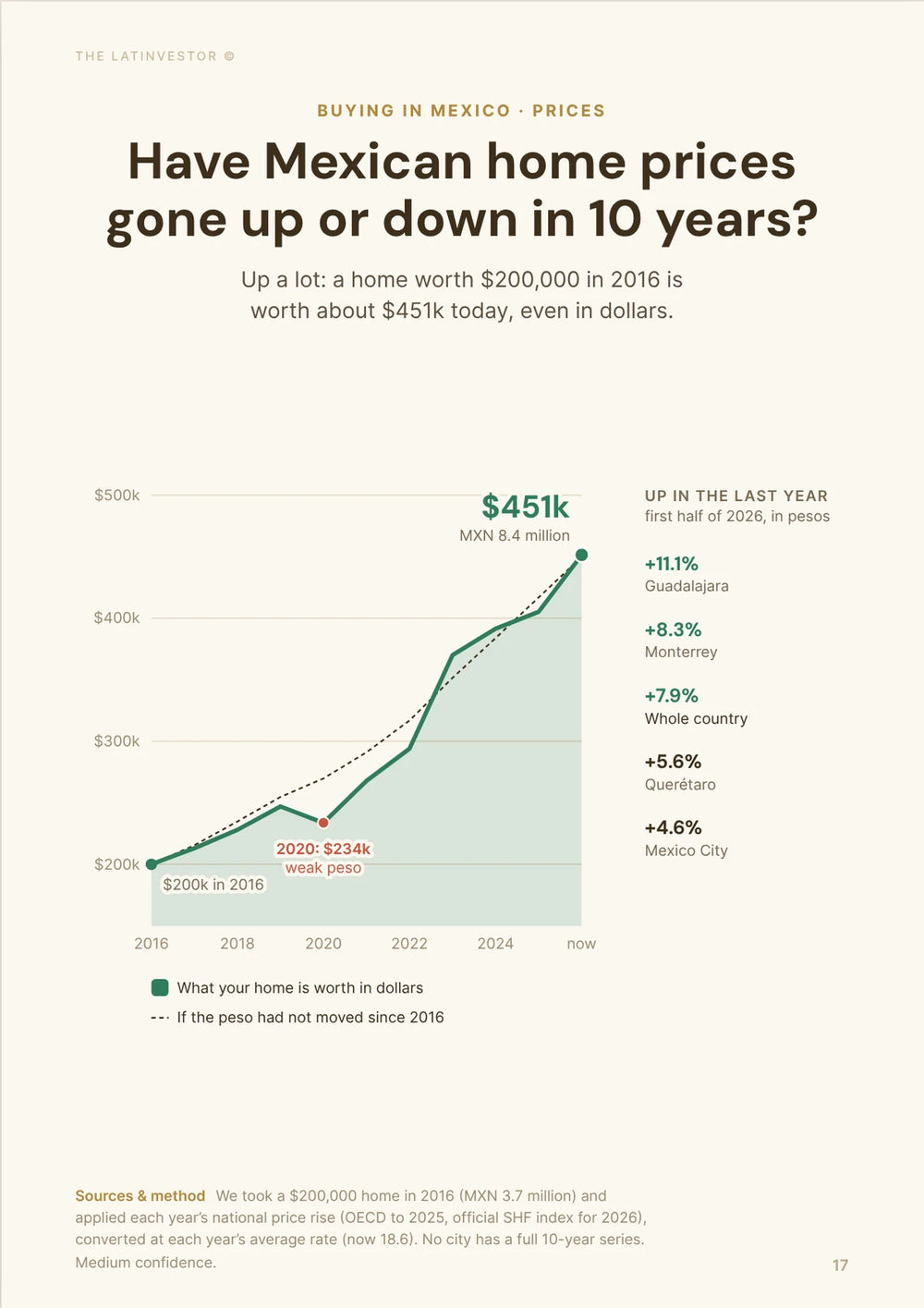
About 5.6%: that's the rise of the official SHF index for the Querétaro metro area in the first half of 2026. Mexico as a whole rose 7.9% over the same period.
The trend is what matters. Querétaro was at 7.3% in the third quarter of 2025, then 6.7% in the first quarter of 2026, then 5.6%. With inflation at 3.45% in September 2026, the real gain is only about 2 points. Asking prices tell the same story: the average listing in Querétaro rose 5.0% between April 2025 and October 2026, about 3% a year.
Demand is still there, from jobs, people leaving Mexico City and the universities. What's missing is credit: in the first half of 2026, mortgage lending in Mexico fell 0.1% in real terms.
Which neighborhoods are rising fastest in Querétaro?
Two kinds: the El Marqués corridor near the airport and industrial parks, and central neighborhoods getting renovated. Asking prices in El Marqués rose 12.0% between April 2025 and October 2026, more than twice the city average.
In the center, Hércules, La Cañada, Álamos, Milenio III and parts of Centro Sur are upgrading. We estimate the best-located homes there gained about 12% to 25% over the past two to three years.
The big suburban names are not the leaders anymore. Zibatá asking prices rose 6.6% in 18 months, El Refugio 2.4%, and Juriquilla fell 1.9%. El Campanario is still the most expensive area, at about MXN 40,400 per square meter (USD 2,170).
Which kinds of homes are holding their value best?
Well-priced homes below about MXN 3 million (USD 161,000): compact apartments and townhouses in established areas. Across Mexico, cheaper homes rose 10% in the first half of 2026, against 6.7% for middle and upper-end homes.
The middle of the new-build market is where it hurts. According to developers quoted by Publimetro in August 2026, homes priced at MXN 3 million to 3.8 million went from about 70 sales a month to fewer than 40, and homes above MXN 5 million were down nearly 30%. Sales above MXN 12 million held up, but luxury homes can still sit for 6 to 12 months.
What's pushing prices up, and what's holding them back?
Jobs push prices up. The state government counts 233 investment projects worth MXN 139 billion and 63,000 new jobs over its first five years, and Querétaro holds a large share of Mexico's data centers. People keep moving in from Mexico City and nearby states.
Credit holds them back. New mortgages cost about 10% to 11%, and BBVA counted only 0.3% more home loans in the first half of 2026 than a year earlier. The construction chamber (CMIC) expects the state's construction activity to shrink 20% to 30% this year. Water is the other brake, which we cover below.
Why are asking prices flat in some Querétaro suburbs?
Because there are too many similar new homes for the buyers who can still get a loan. While the official index rose 5.6%, asking prices in Juriquilla and El Refugio barely moved in 18 months.
| Area | Average asking price, apartments | Median asking price per m² | Change, April 2025 to October 2026 |
|---|---|---|---|
| El Marqués | n/a | n/a | +12.0% |
| Zibatá | MXN 3.25 million (USD 175,000) | MXN 26,300 (USD 1,410) | +6.6% |
| Querétaro, all areas | n/a | n/a | +5.0% |
| El Refugio | MXN 2.80 million (USD 151,000) | MXN 24,100 (USD 1,300) | +2.4% |
| Juriquilla | MXN 3.33 million (USD 179,000) | MXN 26,000 (USD 1,400) | -1.9% |
These are the areas where developers built the most in the last few years, so buyers can choose between many near-identical units, and some investors are reselling against the developer. Average asking prices also shift when cheaper or bigger units come onto the market, so read the trend, not the exact number.
What to do: compare the price per square meter with the area median (about MXN 24,000 to MXN 26,500 in these three areas), ask how long the home has been listed, and aim for 8% to 10% off if you pay cash. With a developer, ask for parking, finishes or closing fees to be included instead of chasing the list price. Don't fall for a "price goes up next month" deadline.
What will happen to Querétaro prices over the next 12 months?
How much could prices rise in Querétaro over the next 12 months?
We expect about 3% to 6%, roughly in line with or a bit above inflation. This is our estimate, not an official forecast.
Our earlier forecast of about 6% for 2026 was too high: the SHF pace has already slowed to 5.6%, developer sales are down and mortgage lending is flat. The low end applies to suburbs full of new builds, the high end to scarce, well-located homes.
Which neighborhoods should do best over the next year?
Established areas with little new supply: Centro Sur, Milenio III, Álamos, Hércules and Centro Histórico homes with parking. Add the El Marqués corridor near the airport and industrial parks, where asking prices are already rising fastest.
Zibatá, Zakia, El Refugio and Juriquilla are still good places to live, but resale will compete with developers for a while. Cheaper areas like Felipe Carrillo Puerto may catch up as access improves, but we haven't found 2026 data to back a specific number.
Which kinds of homes should gain the most?
Compact apartments and townhouses that a local buyer can still finance, roughly below MXN 3 million (USD 161,000). That's where demand is deepest, from both owners and tenants.
Mid-priced new builds between MXN 3 million and MXN 5 million should lag, because that's where developer sales fell most. Luxury homes have a small buyer pool and lower rental yields, so expect slow sales rather than big gains.
Will lower interest rates push Querétaro prices up?
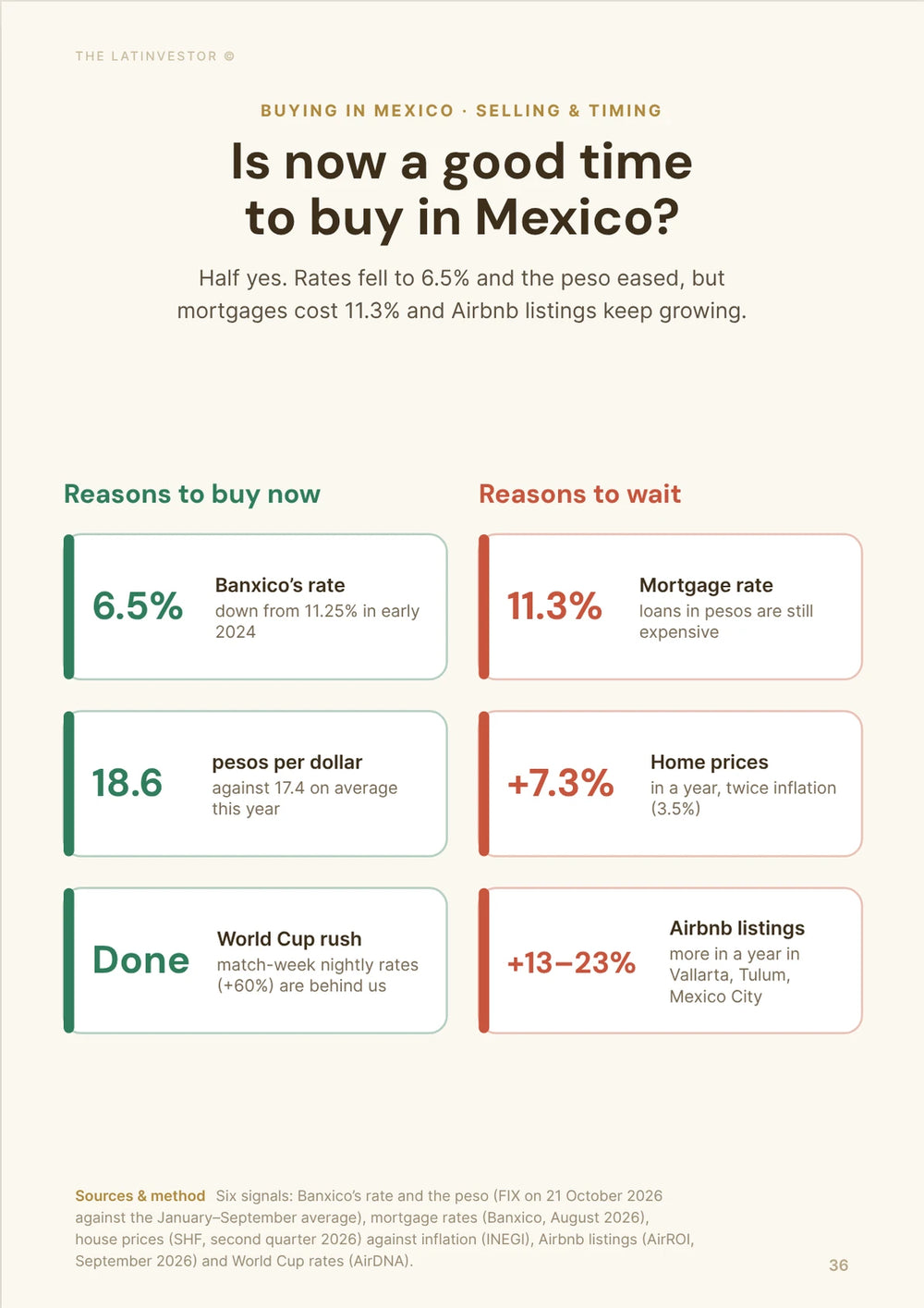
Not much. Banxico's rate is at 6.50%, and analysts in Citi's October 2026 survey expect no change in 2026 or 2027. Mortgages haven't followed: the average fixed-rate quote was 11.31% in August 2026, and loans actually granted averaged 9.99% in June.
The gap is what you can win. On a MXN 3 million, 20-year loan, 11.31% costs about MXN 31,600 a month (USD 1,700) and 9.99% about MXN 28,900 (USD 1,550). Shop at least three banks. Non-resident foreigners mostly borrow through cross-border lenders that want at least 35% down, so these averages rarely apply to them.
What are the biggest risks for Querétaro prices right now?
Three: prices running ahead of local incomes, too many similar new builds in the suburbs, and water.
The affordability gap is clear. A 65 m² two-bedroom asked about MXN 1.97 million (USD 106,000) in April 2026, while rents have stalled at about MXN 11,600 a month. Water is the local risk: when Acueducto II stopped in September 2025, 336 neighborhoods went on rotating supply, 8 of the state's 11 aquifers are overexploited, and the state is rewriting its water law in 2026. The state also counted more than 1,500 power cuts in the first half of 2026.
Before you buy, ask neighbors how often water was cut last year, check the cistern and rooftop tank, and for a new development ask for the final water feasibility from the state water commission (CEA).
Is it a good time to buy a rental property in Querétaro?
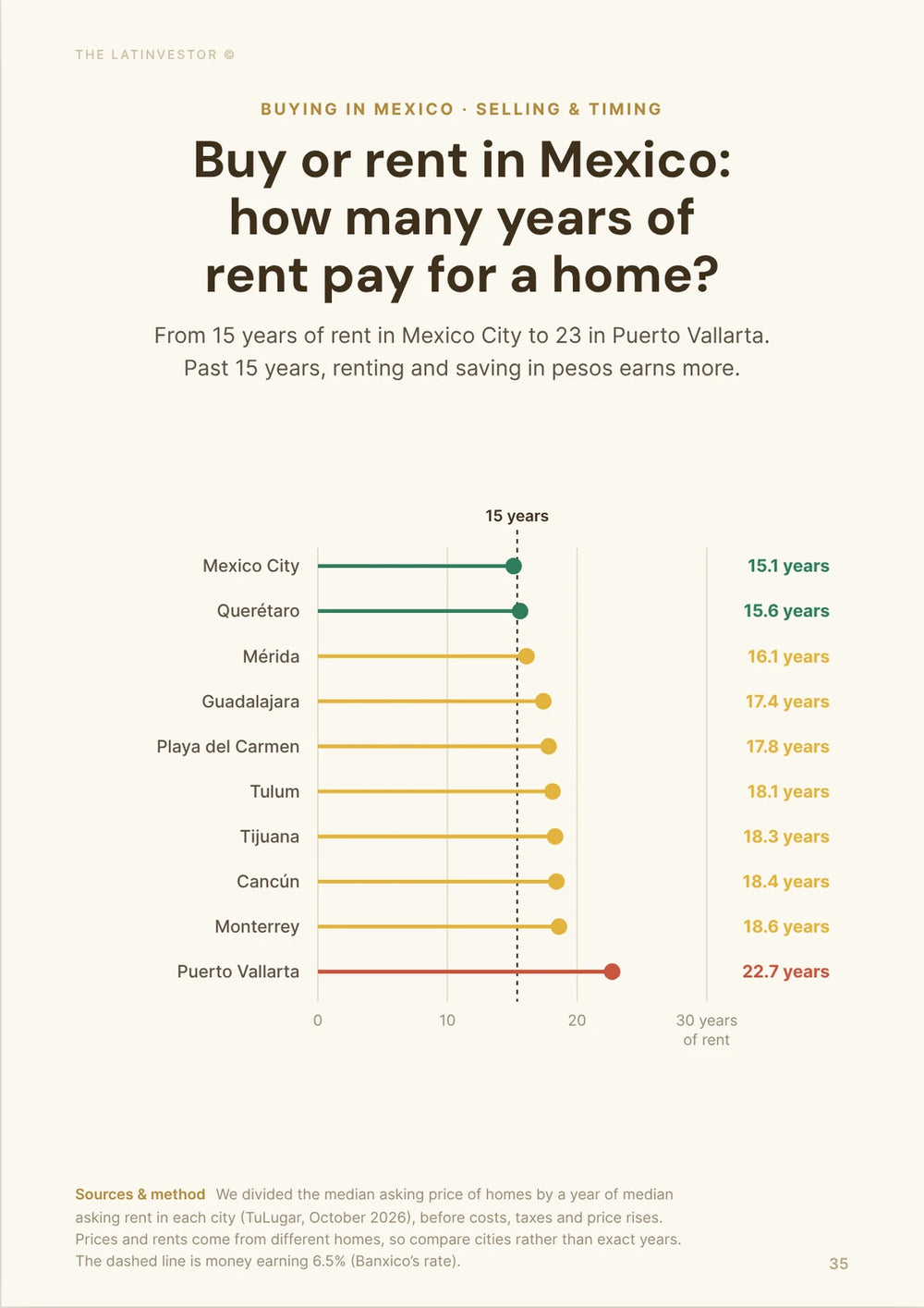
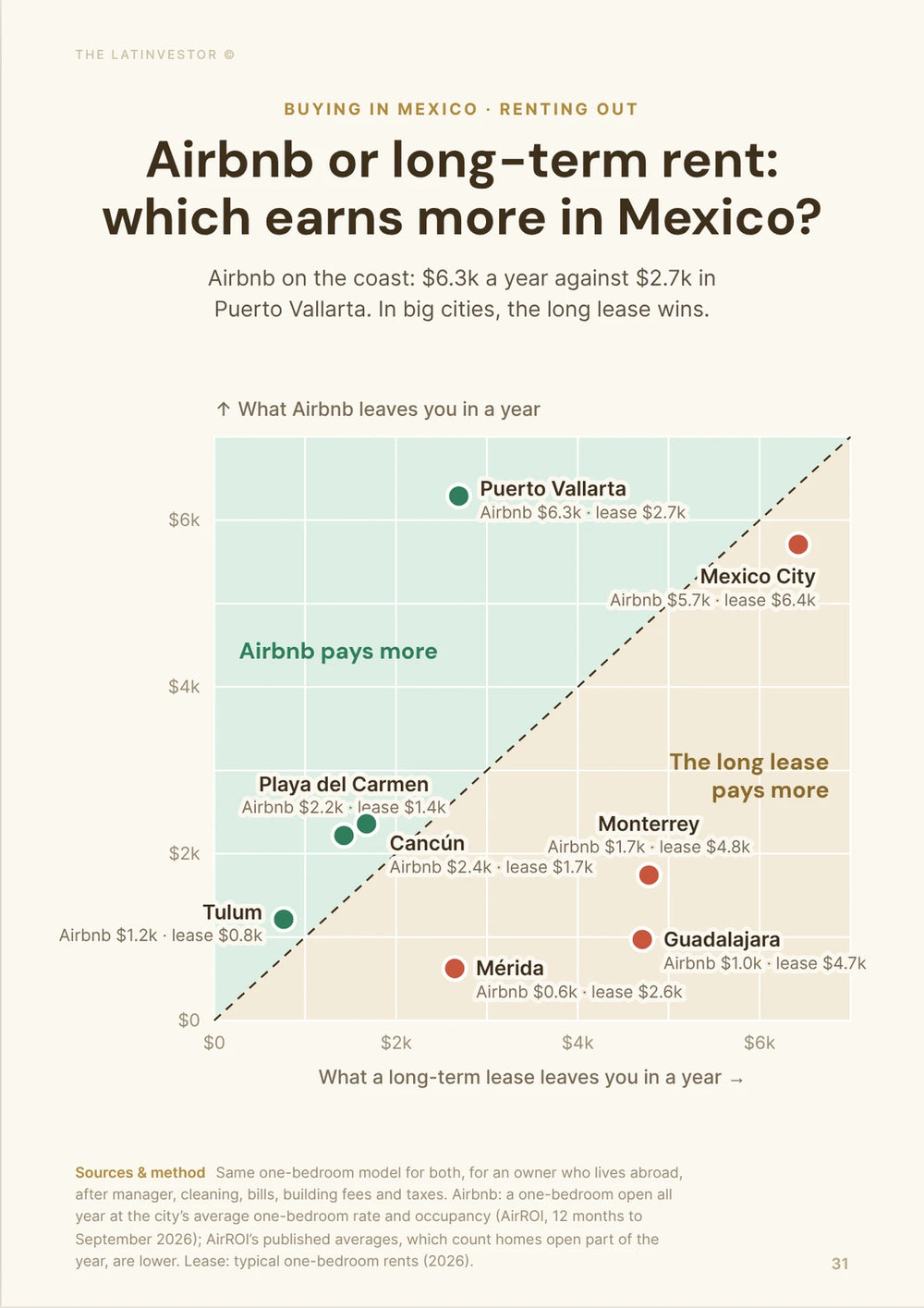
Only for a compact, well-located home bought at a price that works for the rent. On the April 2026 benchmark, a 65 m² two-bedroom gives about 7.1% gross. A non-resident owner pays 25% of the gross rent in tax, which brings it to about 5.3% before vacancy, HOA fees and repairs.
Rents have stopped rising in real terms: MXN 11,601 a month in June 2026, only 3.5% more than two years earlier. Airbnb is no shortcut either: active listings fell 34.9% in a year, to 2,583, and those still running made about USD 8,700 (MXN 162,000) a year before costs, not far from a long lease. Tenants are there, near jobs, universities and hospitals, so buy close to them.
Could Querétaro prices fall in 2027?
A citywide drop is unlikely. Jobs, investment and people moving in still support demand, and the SHF index rose about 56% in the five years to the end of 2025 without sharp swings.
But a real-terms dip in weak spots is possible. Growth has slowed from 7.3% to 6.7% to 5.6%, developer sales are down, and mortgage lending is flat. A realistic bad case is flat prices, or 5% to 10% down after inflation, in far-out suburbs and generic new-build projects, not in central or well-connected areas.
Signs to watch: the next SHF release for the third quarter of 2026, longer selling times, bigger developer discounts, more empty rentals in Zibatá, Zakia, Juriquilla and El Marqués, and repeated price cuts on large houses. Before you buy off-plan, check the project on the city's Semáforo Inmobiliario: only 26% of 555 rated developments had a clean record in 2026.
Where will Querétaro prices be in 5 years?
What's the 5-year price forecast for Querétaro?
About 15% to 30% in nominal terms for good locations, or roughly 3% to 5.5% a year. This is our estimate.
That's well below the last five years, when the SHF index rose about 56%. It assumes jobs and people moving in hold up, credit stays expensive, and the city keeps up with water and roads. With inflation around 3.5%, the low end leaves little real gain.
Which areas of Querétaro should grow most over the next 5 years?
The El Marqués corridor near the airport and industrial parks, the renovated central areas (Hércules, Álamos, Centro Sur, Milenio III), and the parts of Zibatá, Zakia and Corregidora that turn into finished neighborhoods with schools and shops. We expect these to sit at the upper end of our 15% to 30% range.
The areas that will struggle are the ones far from jobs, with weak water service, or with many projects delivering at the same time.
Which type of home should give the best return over 5 years?
A well-located apartment. Combining our price forecast with rent after the 25% non-resident tax, we estimate a total of about 40% to 55% over five years, before vacancy, HOA fees and repairs.
Townhouses offer a good balance: they rent to families and resell to owner-occupiers, so they're easier to exit. Large luxury houses are the weakest bet on return.
Will the new train and the airport push prices up?
The airport already does; the train not yet. The Mexico City to Querétaro passenger train was 30.38% built in September 2026, with opening targeted for the second half of 2027 at the earliest. Querétaro gets two stations, one in El Marqués and one near the old downtown station.
The airport (AIQ) handled 1,575,580 passengers from January to August 2026, 11.7% more than a year earlier, and the state plans to announce an expansion at the end of 2026. Announcements can lift nearby asking prices by about 5% to 10%, by our estimate, but the real effect comes once people actually save time. If a seller near a future station adds a "train premium", push back.
Will population growth keep supporting prices?
Yes, as long as the city can serve it. Families, engineers, students and people leaving Mexico City and the State of Mexico keep arriving, with 63,000 new jobs counted by the state over five years. Foreign buyers help, but they're a small part of demand.
The effect is strongest where new households get real access to jobs, schools and daily transport: Juriquilla, Milenio III, Centro Sur, El Refugio, Zibatá and El Pueblito.
What about Querétaro prices over the next 10 years?
What's the 10-year price prediction for Querétaro?
About 35% to 70% in nominal terms, or roughly 3% to 5.5% a year. This is our estimate, and the further out, the less precise.
Keep inflation in mind: at about 3.5% a year, it alone would add about 40% over ten years. So the low end means flat prices in real terms, and only the high end is a real gain. Our previous forecast of about 60% was too optimistic for a market that's already expensive for local incomes.
What will shape Querétaro prices in the long run?
Industry and logistics on the plus side: factories, aerospace, data centers and the airport create real demand, not just speculation.
Water and traffic on the minus side. A neighborhood that grows faster than its water supply and roads can lose value, whatever the developer promised. Over ten years, a home with good storage in an area with a steady supply and a short commute is the safest bet.
Related blog posts
- What are housing prices like in Querétaro now?
- Is the property market in Querétaro still growing?
- Can foreigners buy property in Querétaro?
- Are rents still rising in Querétaro?
- How much does a house cost in Querétaro?
- Moving to Querétaro? Here's everything you need to know (2026)
Our methodology
This article estimates where Querétaro property prices stand in 2026 and where they could go over the next 12 months, 5 years and 10 years, by area and type of home.
Price trends start from official data: the SHF housing price index (homes bought with a mortgage) for the Querétaro metro area and state, INEGI for inflation and Banxico for mortgage rates. We add asking prices from TuLugar, NOCNOK and Propiedades.com (October 2026), the Inmuebles24 benchmark reported by El Economista and Real Estate Market, BBVA Research for mortgage lending, AirDNA for short-term rentals, and local press dated 2026 for developer sales, the train, the airport, water and investment.
All forecasts are our own estimates: a base case built from the slowing SHF trend, credit conditions and local supply, not a straight line from past growth. The tax on rent for non-residents comes from Mexico's income tax law.
We checked these figures in October 2026. Conversions use about 18.6 pesos per US dollar and 20.9 pesos per euro.
Limits: listing prices are asking prices, not sale prices, and average asking prices move when the mix of homes on the market changes. SHF only covers mortgage-financed homes. Developer sales figures are unofficial. Forecasts can be wrong, especially over ten years.
Key sources used for this analysis include SHF, IIEG, Líder Empresarial, El Economista, Global Property Guide, TuLugar, NOCNOK, Propiedades.com, Real Estate Market, BBVA Research, Banxico, El Financiero, El Contribuyente (INEGI inflation), AirDNA, Proyectos México, Publimetro, Uno TV, ADN40 and Data México.