Summary
Yes, but only at the cheap end. At today's average bank rate of 11.31%, a MXN 1 million home needs about MXN 28,100 a month of household income, roughly what the average Jalisco household earns, and the typical listing in the city asks MXN 2.4 million.
The city runs on two price scales. ITESO's study of 2,442 listings found a median of MXN 2.4 million, while the MLS homes marketed to foreigners and wealthier buyers sit near MXN 7.47 million.
The middle household earns less than the average. In Jalisco it brings in roughly MXN 21,000 to 25,000 a month, enough for a home of about MXN 780,000 with a normal mortgage.
The deposit blocks people first. 20% down on a MXN 2.4 million home is MXN 480,000, eight years of saving MXN 5,000 a month, before transfer tax and notary fees.
Cheap homes still exist inland. ITESO found medians of MXN 505,000 to 750,000 in Vista Hermosa, Las Aralias I, Los Tamarindos and Delfines.
The coast is out of reach on local wages. Condos in Marina Vallarta ask a median of USD 545,000 (about MXN 10.1 million), and ITESO put Amapas at MXN 9.75 million.
Rates and the peso are not helping. Banxico has paused at 6.50%, mortgages still cost about 10% to 11.3%, and the peso's slide from under 17 to 18.6 per dollar since early September made a USD 300,000 condo at least MXN 480,000 dearer in pesos.
The market has cooled, but not for locals. 69% of homes around the bay sell below asking and there are 23 months of resale stock, yet the median sale is still USD 415,000.
New supply mostly targets other buyers. Presales are 46% of listings but only 26% of sales, and about 1,534 more units are due by 2028.
Foreign demand and Airbnb push hardest on the coast. 80% of residents surveyed by the University of Guadalajara saw more homes built or remodeled for tourist rentals.
Inland Bahía de Banderas is the escape route. San Vicente and Palma Real list houses around MXN 705,000 to 820,000, against MXN 7.4 million in Nuevo Vallarta.
Young first-time buyers are hit hardest, and federal help is not here yet. The Vivienda para el Bienestar homes, now capped at MXN 862,000 instead of 630,000, have no confirmed project in Puerto Vallarta or Bahía de Banderas in CONAVI's 2026 list.
Bottom line: a local household can still buy, but it usually needs two formal salaries, Infonavit, family help or land, and a home inland under MXN 1 million.

Why is it suddenly so hard for locals to buy in Puerto Vallarta?
Because prices now follow the budgets of investors, second-home buyers and wealthier Mexicans, not local salaries.
Several datasets show the gap. ITESO's 2025 study of 2,442 online listings in Puerto Vallarta found a median asking price of about MXN 2.4 million (about USD 129,000). At the other end, the MLS listings agents market to foreign buyers had a median close to MXN 7.47 million in October 2026, according to NAMI Realty's MLS data.
Residents feel it beyond the sales market. A University of Guadalajara study of 440 residents of Puerto Vallarta and Bahía de Banderas found that 93% had noticed higher rents, and 71% named rising housing costs and displacement as one of the main effects of recent development.
Puerto Vallarta is now several markets at once. Affordable homes still exist, but most of what you see in the center, on the coast and in new projects has nothing to do with what a local income can pay.
| Market measure | Recent finding | What it covers | What it shows |
|---|---|---|---|
| ITESO median asking price (2025) | MXN 2.4M | Broad online listings | Even the wider market is expensive for local earnings |
| MLS median asking price (Oct. 2026) | ~MXN 7.47M | Agent-marketed, largely international stock | Premium Vallarta runs on a different price scale |
| Bay closed-sale median (to Sept. 2026) | USD 415,000 (~MXN 7.7M) | Puerto Vallarta + Bahía de Banderas | Expensive homes actually sell, not just get advertised |
| Residents reporting higher rents | 93% | UdeG metro survey | Housing pressure is widely felt |
| Residents citing costs/displacement | 71% | UdeG metro survey | The issue goes well beyond luxury buyers |
Can someone on a normal Puerto Vallarta salary actually get a mortgage?
Yes, but it buys very little: a typical local salary qualifies for a home well under MXN 1 million.
Wage data for the municipality itself is thin, so we use official national and state figures. The minimum wage is MXN 315.04 a day in 2026, about MXN 9,580 a month. INEGI's latest household survey puts the average Jalisco household at MXN 87,199 per quarter, about MXN 29,000 a month, but the middle household earns less, roughly MXN 21,000 to 25,000 a month.
We ran a standard bank loan: 20 years, 20% down, the 11.31% average fixed rate banks quoted in August 2026 (Banxico), and a payment capped at 30% of household income. On those terms a MXN 1 million home needs about MXN 28,100 a month. At the 9.99% average rate banks actually granted in June 2026 (ABM), it drops to about MXN 25,700.
The city's MXN 2.4 million median needs about MXN 67,400 a month. That is far beyond a typical worker, and beyond most two-income households.
| Home price | 20% down payment | Mortgage | Household income needed (11.31%, 20 years) |
|---|---|---|---|
| MXN 500,000 | MXN 100,000 | MXN 400,000 | ~MXN 14,000/month |
| MXN 1.0M | MXN 200,000 | MXN 800,000 | ~MXN 28,100/month |
| MXN 1.5M | MXN 300,000 | MXN 1.2M | ~MXN 42,100/month |
| MXN 2.4M | MXN 480,000 | MXN 1.92M | ~MXN 67,400/month |
| MXN 3.0M | MXN 600,000 | MXN 2.4M | ~MXN 84,300/month |
Is the “average Puerto Vallarta home price” actually useful?
Not for locals. The city is so split by neighborhood and buyer that one citywide figure hides the answer.
ITESO's sample shows it: across 2,442 listings, the median was MXN 2.4 million while the average was MXN 4.86 million. A few very expensive homes drag the average up.
The type of home matters just as much. In October 2026, TuLugar's listings put the median 3-bedroom house at USD 121,000 (about MXN 2.25 million), close to ITESO's figure, while the median condo asks USD 371,000 (about MXN 6.9 million). Per square meter, condos ask about USD 3,853 and houses about USD 1,799.
The MLS figures sit higher still: the bay's median closed sale was USD 415,000 in the year to September 2026.
All of these are true at once. A small older home in an inland colonia, a MXN 2 million family house and a USD 500,000 coastal condo all count as “Puerto Vallarta real estate”, but they serve completely different buyers. For affordability, look at the neighborhood and the type of home, not the citywide number.
Can locals still find homes under MXN 1 million in Puerto Vallarta?
Yes, but mostly in cheaper inland and outlying areas.
ITESO's neighborhood data found medians of about MXN 505,000 in Vista Hermosa, MXN 577,000 in Las Aralias I, MXN 713,000 in Los Tamarindos and MXN 750,000 in Delfines.
These aren't one-off listings. The sample had 21 homes in Vista Hermosa, 54 in Las Aralias I, 47 in Los Tamarindos and 77 in Delfines.
So locals have not been completely priced out. Entry-level ownership survives inside the municipality.
The trade-off is location and quality. Most of the cheapest stock is far from the coast, smaller, older or built for lower-income households. Buying in Puerto Vallarta is still possible for some locals. Buying the Puerto Vallarta most outsiders picture is not.
| Puerto Vallarta area | Listings in ITESO sample | Median price | Typical market position |
|---|---|---|---|
| Vista Hermosa | 21 | MXN 505,000 | Very low-cost segment |
| Las Aralias I | 54 | MXN 577,200 | Lower-cost urban housing |
| Los Tamarindos | 47 | MXN 713,000 | Entry-level housing |
| Delfines | 77 | MXN 749,600 | Entry-level housing |
| Puerto Vallarta overall | 2,442 | MXN 2.4M | Broad city market |
| Amapas | 50 | MXN 9.75M | Premium coastal market |
Can a local family still afford the beachside parts of Puerto Vallarta?
No, not on local wages alone.
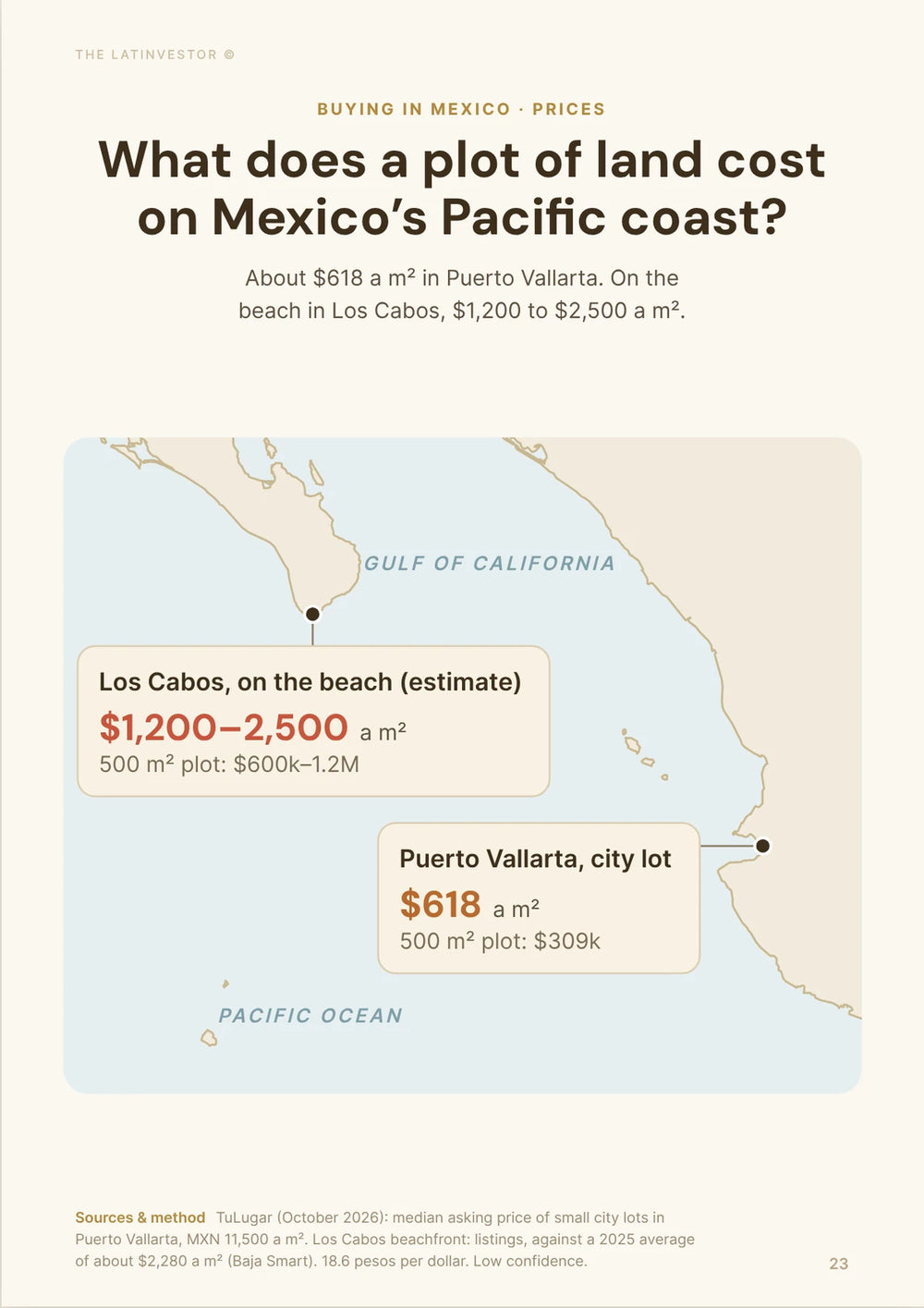
ITESO found a median asking price near MXN 9.75 million in Amapas and an average close to MXN 17.9 million. Rents tell the same story in its data: almost MXN 55,000 a month in Zona Hotelera Norte and around MXN 42,000 in Marina Vallarta.
Current listings confirm it. In October 2026, TuLugar's median condo asked USD 545,000 in Marina Vallarta (about MXN 10.1 million) and USD 944,000 in the northern hotel zone. At Marina Vallarta's USD 4,627 per square meter, even a 60-square-meter apartment asks about USD 278,000 (MXN 5.2 million).
These areas now belong to a higher-income market. Locals still work, shop and go out there. Owning there takes money made somewhere else.
Are locals really being pushed out of central Puerto Vallarta?
Yes, there is evidence that housing costs are pushing residents out of the central and touristy parts of the city.
In the University of Guadalajara study, 42% of respondents who had moved cited higher rent and another 17% reported being displaced. Researchers also recorded owners looking for higher-paying tenants or turning homes into more profitable uses.
The same study found that 80% of respondents had noticed more building or remodeling aimed at tourist rentals.
That matches the price map. ITESO's affordable pockets sit mostly outside the coastal core, while neighborhoods like Amapas cost several million pesos more than a local household can borrow.
It looks more like a slow move than a dramatic eviction. People move further inland, accept smaller homes, stay with relatives longer or cross into Bahía de Banderas. A household can still own somewhere in the metro while losing access to the neighborhoods closest to work, the beach and family.
Is the down payment killing local homeownership before the mortgage even starts?
For many first-time buyers, yes: the deposit stops them before the bank looks at their income.
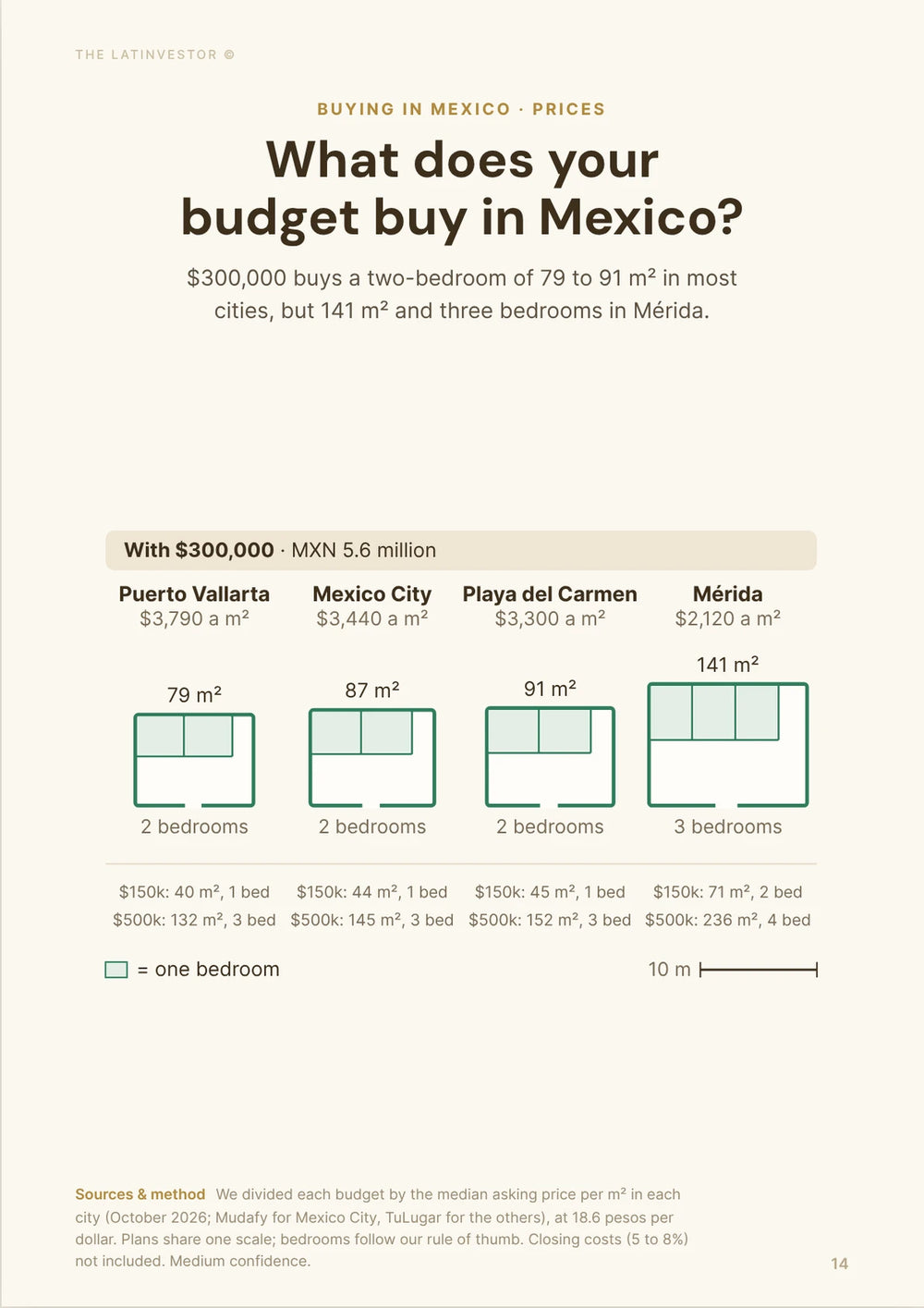
A MXN 2.4 million home with 20% down needs MXN 480,000 upfront. Closing costs come on top: in Puerto Vallarta the transfer tax alone runs from 2.65% to 3.55% of the price, before notary, appraisal and registry fees.
A household saving MXN 5,000 a month would need eight years to reach MXN 480,000, if every peso went to the deposit and nothing went wrong.
In the MLS segment the gap is much bigger. A MXN 7.5 million home needs about MXN 1.5 million for a 20% deposit.
That's why two households with the same salaries can have very different chances. One with family land, an inherited home or help with the deposit can get in. One starting from wages alone faces a much steeper climb. And after the deposit, the buyer still has to qualify for the monthly payment.
Can Infonavit and two salaries still make buying in Puerto Vallarta possible?
Yes, but mainly at the bottom of the market, below about MXN 1 million.
The average Jalisco household earns about MXN 29,000 a month. With a bank loan at 11.31%, that supports a home of about MXN 1 million. Two formal workers can combine their Infonavit credits, and Infonavit's 2026 rates run from 3.69% to 10.45% depending on salary, cheaper than banks for lower earners.
The problem starts as soon as you compare that with the wider market. MXN 1 million is less than half of ITESO's MXN 2.4 million median and a fraction of the MLS market.
Infonavit still matters because it connects formal workers with the MXN 500,000 to 1 million homes left in cheaper neighborhoods. It does nothing for a MXN 5 million condo. Local ownership survives, but in a much narrower slice of the city.
| Household situation | Monthly income | Home price it supports (bank loan, 11.31%) | What it means in Vallarta |
|---|---|---|---|
| One minimum-wage worker | ~MXN 9,580 | ~MXN 340,000 | Almost nothing on the market |
| Two minimum-wage workers | ~MXN 19,150 | ~MXN 680,000 | Some inland housing (Vista Hermosa, Las Aralias I) |
| Middle Jalisco household | ~MXN 22,000 | ~MXN 780,000 | Entry-level inland neighborhoods |
| Average Jalisco household | ~MXN 29,000 | ~MXN 1.0M | Entry-level market |
| MXN 45,000 household | MXN 45,000 | ~MXN 1.6M | More choice, still below the city median |
| MXN 70,000 household | MXN 70,000 | ~MXN 2.5M | Around the city median |
| MXN 100,000 household | MXN 100,000 | ~MXN 3.6M | Real access to the regular market |
Will Banxico's pause or the weaker peso help local buyers this year?
No. Rates have stopped falling, and the peso's recent drop makes dollar-priced homes more expensive for anyone earning pesos.
Banxico has held its policy rate at 6.50%, but mortgages haven't followed it down much. Banks quoted 11.31% on average in August 2026 and granted 9.99% on average in June. On a MXN 800,000 loan over 20 years, that gap is worth about MXN 700 a month, or MXN 2,400 of required household income.
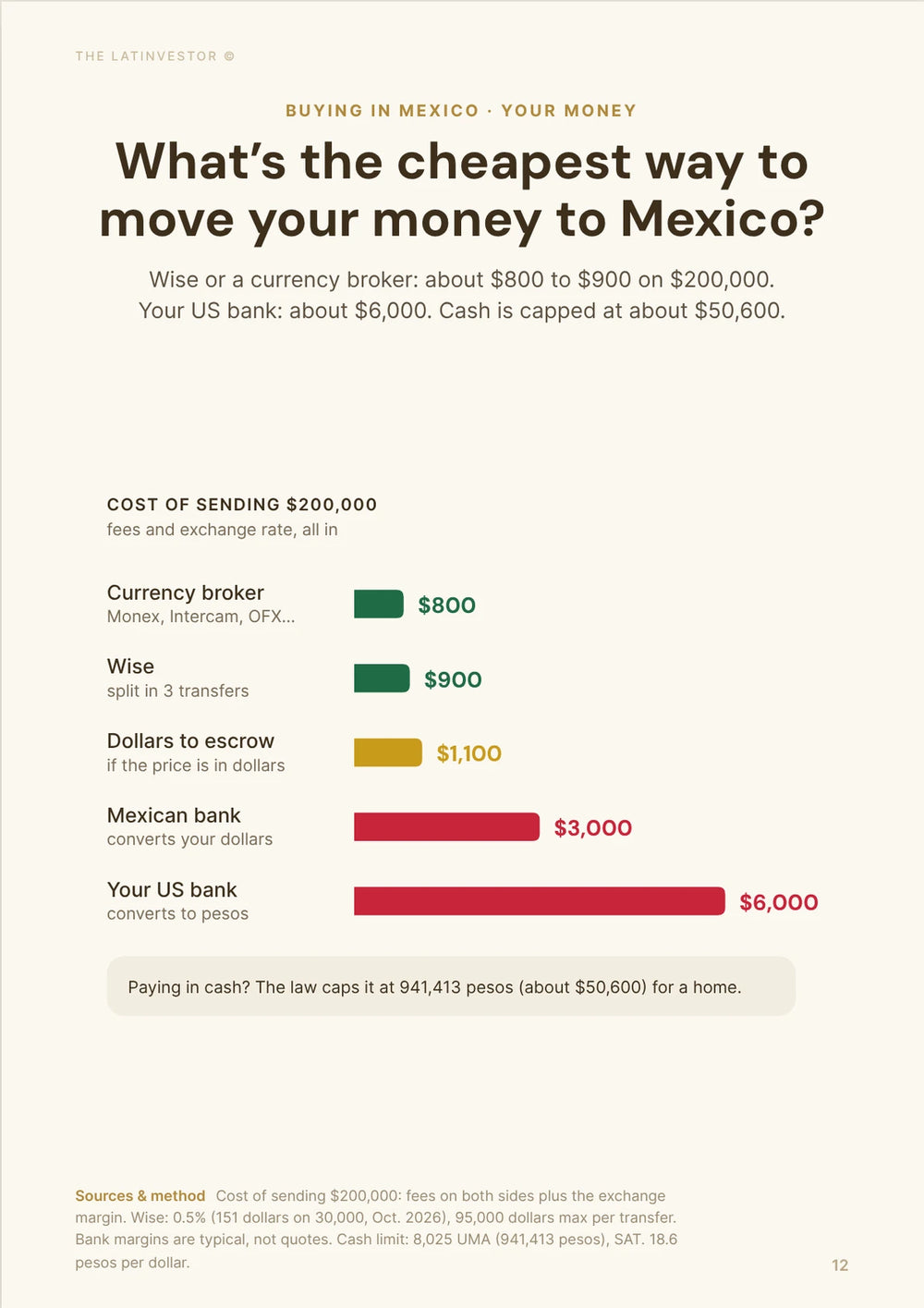
The peso works against locals too. It was under 17 per dollar in early September and is about 18.6 today. A condo listed at USD 300,000 cost less than MXN 5.1 million then and about MXN 5.58 million now, with nobody touching the price. Many coastal homes are priced in dollars, so local buyers pay for every dip in the peso.
What to do: compare the CAT (total annual cost) of at least three banks, not the headline rate; ask Infonavit about combining your credit with a bank loan; and favor homes priced in pesos, so your price doesn't move with the exchange rate.
Are foreigners pricing locals out of Puerto Vallarta?
On the coast, yes. They don't set the price of every home in the municipality, though.
The MLS data is the clearest evidence. The bay's 1,338 residential sales in the year to September 2026 had a median of USD 415,000 (about MXN 7.7 million), up 9.2%. Those prices make sense for wealthy Mexicans, retirees, second-home owners and people earning dollars. They make no sense next to local salaries.
Yet ITESO still found dozens of homes below MXN 1 million inland. Foreign demand hasn't imposed one international price on the whole city.
Its bigger effect is on what gets built and what owners expect. A developer who can sell a condo for USD 350,000 has little reason to use good land for MXN 700,000 starter homes. Owners near tourist areas also start expecting much more for their property. The pressure starts on the coast and spreads outward from there.
Is Airbnb still making Puerto Vallarta housing less affordable?
Yes, but it's one part of the problem, not the whole of it.
In the University of Guadalajara survey, 80% of respondents had seen more homes built or remodeled for tourist rentals. Researchers also recorded homes taken off the long-term rental market or repriced for better-paying tenants.
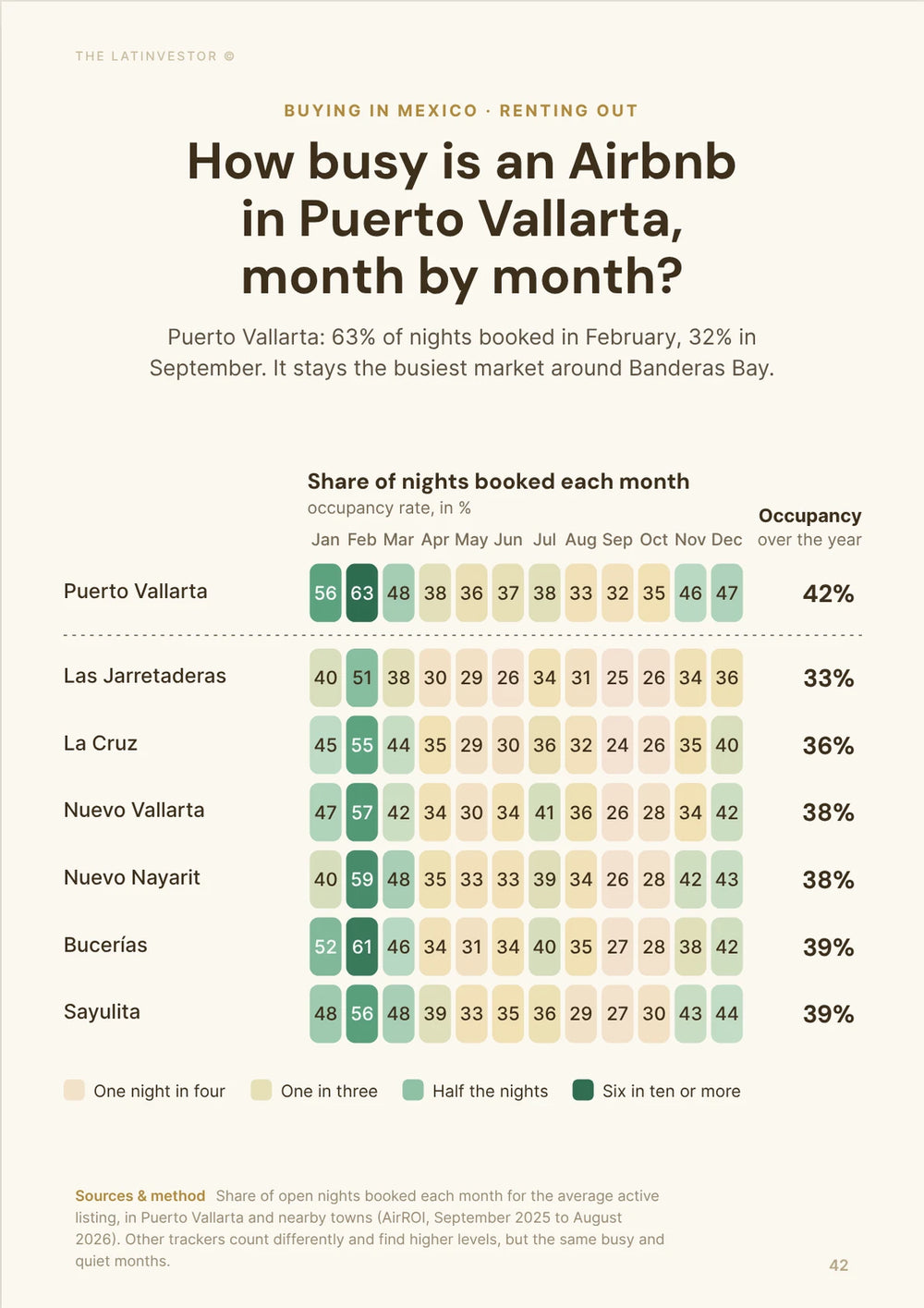
There's a counter-signal. In June 2026, El Economista reported an 8.8% drop in available short-term rental inventory in Puerto Vallarta as several resort markets started to rebalance. Airbnb growth is no longer moving in one direction only.
That still doesn't make central Vallarta affordable. Land is expensive, second-home demand is strong, and developers keep building for buyers who earn far more than local workers. Vacation rentals add pressure in specific neighborhoods, but the gap would be large without them.
Sellers are cutting prices: does that help local buyers?
Hardly. The market has cooled a lot, but prices haven't fallen anywhere near enough for local households.
The Bay Report from Vallarta Seaside, built on MLS closings across Puerto Vallarta and Bahía de Banderas to September 2026, shows sales down 7.5% to 1,338, a median of 229 days to sell (up 13.9%), and 23 months of resale stock, 31 months with presales. Six months is usually seen as balanced. Only 11% of homes sold above asking, and 69% sold below.
So buyers with money have leverage: more choice, more time and room to negotiate.
But the median sale still rose 9.2% to USD 415,000, while the median condo price per square meter held at about USD 3,948. Much of the rise comes from larger, pricier homes selling, not from the same homes getting dearer. A household that can spend MXN 6 million can get a better deal now. One capped at MXN 900,000 gains nothing from a 5% discount on a MXN 6 million condo.
| Bay market measure (year to Sept. 2026) | Latest reading | Direction | What locals gain from it |
|---|---|---|---|
| Median closed price | USD 415,000 (~MXN 7.7M) | +9.2% | Nothing |
| Median condo price/m² | USD 3,948 | Stable | Very little |
| Closed sales | 1,338 | -7.5% | Fewer competing buyers |
| Median days on market | 229 | +13.9% | More negotiating power |
| Resale supply | 23 months | High | More choice |
| Total supply incl. presales | 31 months | Very high | Strong buyer leverage |
| Homes sold below asking | 69% | High | Sellers have less control |
If Puerto Vallarta is building so many condos, why aren't homes getting cheaper?
Because most of the new supply is built for buyers who can spend far more than local households.
In the Bay Report, presales make up 46% of active listings but only 26% of sales. Another 1,534 units are due to be delivered by 2028, 607 of them in 2027. That's a lot of new stock waiting for buyers, and the MLS median listing is still around MXN 7.47 million.
More units at that price do little for a household that can borrow MXN 800,000 or MXN 1 million. Developers build what sells best: rooftop pools, furnished investment units, ocean views and vacation-rental pitches make sense when the target is foreign or wealthy Mexican buyers.
A city can be full of cranes and still build very little for teachers, hotel staff, restaurant workers or young local families. The real question for locals is how much is being built below MXN 1 million to 1.5 million. On that count, the construction boom looks much smaller.
Is Bahía de Banderas still the affordable option for Puerto Vallarta locals?
Yes, inland, but the advantage disappears fast near the resort coast.
Propiedades.com's listing data shows the split. Houses in San Vicente ask around MXN 705,000, Palma Real around MXN 820,000 and Altavela around MXN 1.19 million. Mezcales is already near MXN 2.16 million.
Move toward the resorts and the numbers jump: around MXN 7.38 million in Nuevo Vallarta and more than MXN 10 million in Punta de Mita.
So the real escape route is inland Nayarit, not “Bahía de Banderas” in general. The cost is the commute. The University of Guadalajara research describes residents moving further from their jobs as housing costs rise, which shifts part of the housing bill into transport, time and weaker access to services.
| Area | Indicative house asking price | Type of market | Local affordability |
|---|---|---|---|
| San Vicente | ~MXN 705k | Inland residential | Relatively accessible |
| Palma Real | ~MXN 820k | Inland residential | Relatively accessible |
| Altavela | ~MXN 1.19M | Expanding residential | Possible for some dual-income households |
| Mezcales | ~MXN 2.16M | Urbanizing corridor | Already difficult |
| Nuevo Vallarta | ~MXN 7.38M | Resort/investment | Out of reach on local wages |
| Punta de Mita | ~MXN 10.72M | Luxury resort | Far outside local budgets |
Who is getting hit hardest by Puerto Vallarta's housing prices?
Young locals without family property, because the market now rewards people who already own something.
An owner can sell a MXN 1.5 million home and put the equity toward a MXN 2.5 million one. A first-time buyer in their twenties has to build the first MXN 200,000, 400,000 or 500,000 from wages alone, and that gap widens every time prices rise.
Jalisco's Mi Primera Renta program now covers Puerto Vallarta residents aged 20 to 29 who don't own a home, with temporary help on rent. It doesn't prove a generational crisis on its own, but it fits the evidence that young people struggle even to rent on their own.
Public programs help at the edges, mostly by improving existing homes. They are far too small to reset private prices in a metro where tourism and investment have transformed land values.
Meanwhile, existing local owners have done very well. Someone who bought land decades ago may now hold an asset worth many times what they paid. The real divide in Puerto Vallarta is increasingly between households that already own and those trying to buy their first home.
Is Vivienda para el Bienestar coming to Puerto Vallarta?
Not yet. The federal program's cheap homes are real, but we found no confirmed project in Puerto Vallarta or Bahía de Banderas.
The program targets low-cost houses through Infonavit, with a price cap raised from MXN 630,000 to MXN 862,000 at the end of September 2026 (published in the official gazette on September 28), plus CONAVI homes for households earning no more than about two minimum wages who don't already own. Nationally it is moving: SEDATU reported about 277,000 homes under construction and 89,000 assigned in September 2026. But CONAVI's January 2026 list of cities only included Tepic for Nayarit (304 homes) and nothing for the Vallarta area.
A home under MXN 862,000 sits around what the local households in our examples can borrow (MXN 800,000 to 1 million), so it would matter here if it arrives. What to do now: if you're a formal worker, check your Infonavit points and credit in Mi Cuenta Infonavit, keep your registration up to date, and never pay an intermediary who promises a place on a list. Registration is free and goes through official channels only.
So can locals still afford to buy in Puerto Vallarta today?
Yes, some can, but local income alone no longer reaches most of the city's mainstream market.
The affordable part is narrow and specific. ITESO still found neighborhoods with medians between about MXN 500,000 and 750,000, so local ownership hasn't disappeared.
The wider market is harsher. ITESO's citywide median was MXN 2.4 million and MLS listings sit near MXN 7.47 million. At today's bank rates, even a MXN 1 million home needs about MXN 28,100 a month of household income.
The average Jalisco household sits right at that MXN 1 million line, and the middle household below it. That puts most of Puerto Vallarta out of reach before you even get to Amapas, Marina Vallarta or the hotel zone.
The people who still make it usually have at least one advantage: two formal salaries, Infonavit, family help, inherited land, savings from elsewhere, a home to sell, or the willingness to buy far inland.
So “locals can't buy in Puerto Vallarta anymore” goes too far. The honest version: locals can still buy, but local ownership is being pushed away from the parts of the city where demand and investment are strongest. For a young household starting with nothing but local wages, buying a regular market-rate home is now the exception.
Our methodology
This article estimates whether households earning local wages can still buy in Puerto Vallarta, by comparing home prices by neighborhood with incomes, the deposit and the mortgage payment a bank would accept.
Prices come from ITESO's 2025 study of 2,442 Puerto Vallarta listings (citywide and neighborhood medians), NAMI Realty's October 2026 MLS data, TuLugar's October 2026 listing data and Propiedades.com for Bahía de Banderas. Market conditions come from Vallarta Seaside's Bay Report on MLS closings to September 2026. Incomes come from INEGI's ENIGH 2024 survey for Jalisco and CONASAMI's 2026 minimum wage; we keep state figures separate from city figures because reliable city-level income data does not exist.
The affordability tables are our own calculation: a 20-year loan, 20% down, Banxico's August 2026 average quoted mortgage rate of 11.31% (and the 9.99% average granted rate reported by ABM for comparison), and a payment capped at 30% of household income. Infonavit rates come from Infonavit, and federal housing figures from SEDATU and CONAVI.
Resident experience (rents, displacement, tourist-rental conversions) comes from the University of Guadalajara's 440-person survey of Puerto Vallarta and Bahía de Banderas. The 8.8% drop in short-term rental inventory comes from El Economista's June 2026 reporting.
We checked these figures in October 2026. Conversions use about 18.6 pesos per US dollar and 20.9 pesos per euro.
Limits: most prices here are asking prices, and homes usually sell below them (69% did around the bay in the year to September 2026). ITESO's figures date from 2025, the MLS covers mostly homes marketed to wealthier and foreign buyers, and household income is a state figure, so Puerto Vallarta's own incomes may differ.
Key sources used for this analysis include: ITESO's Boletín de Análisis Económico, the Puerto Vallarta-Bahía de Banderas housing-access study, Vallarta Seaside's Bay Report, NAMI Realty's Vallarta MLS data, TuLugar's Puerto Vallarta market data, INEGI's ENIGH 2024 results for Jalisco, CONASAMI's 2026 minimum-wage release, Banxico's mortgage rate data, Infonavit, SEDATU on Vivienda para el Bienestar, ADN40 on CONAVI's 2026 city list, Propiedades.com data for San Vicente, Propiedades.com data for Nuevo Vallarta, and El Economista's reporting on tourist-market housing.