Summary
There is no single best area in Argentine Patagonia: for rental income, Ushuaia (about 6% to 7% gross on a long lease) and Bariloche Centro (close to 6%) come out on top, while Melipal and San Martín de los Andes cost the most and yield less.
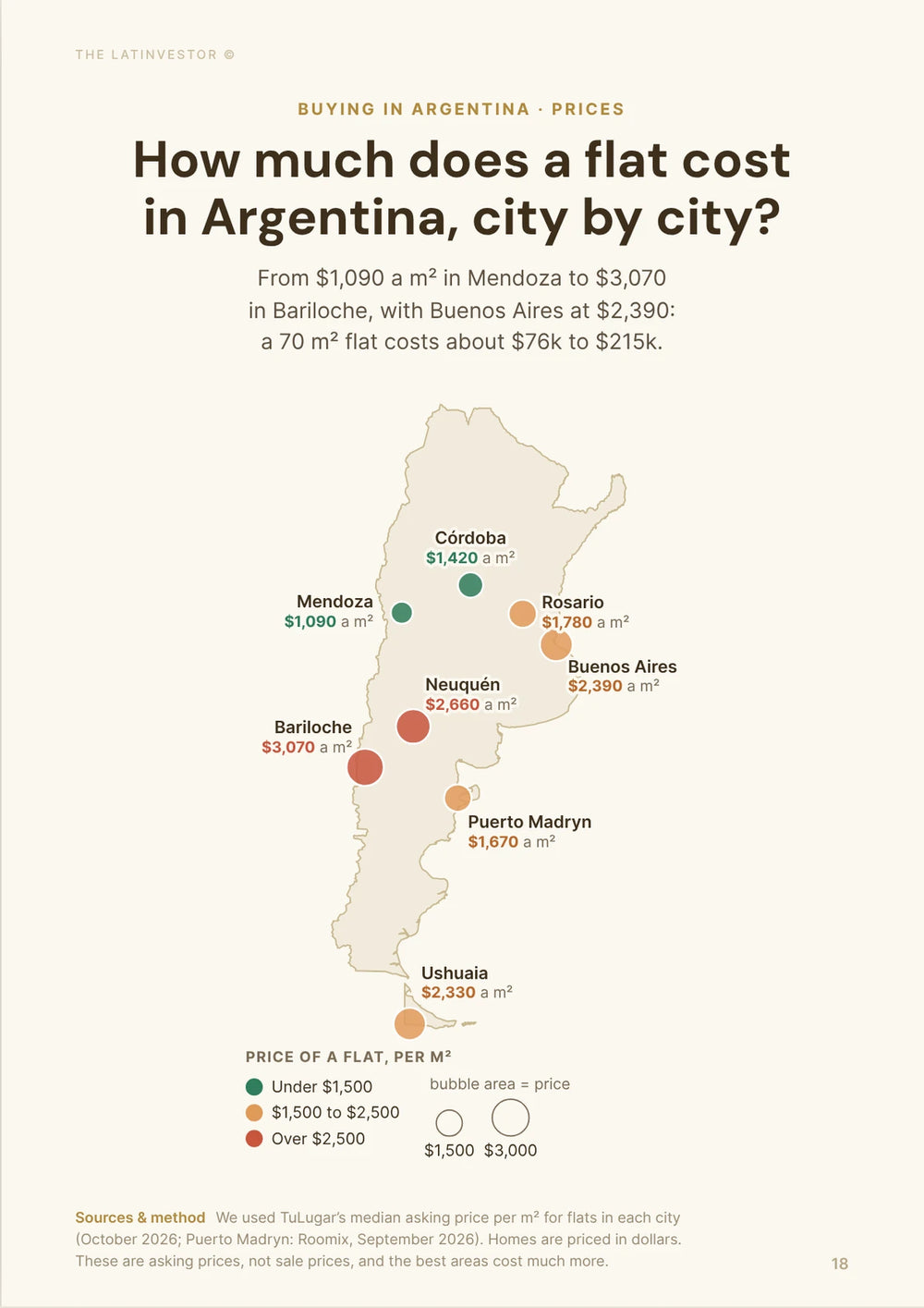
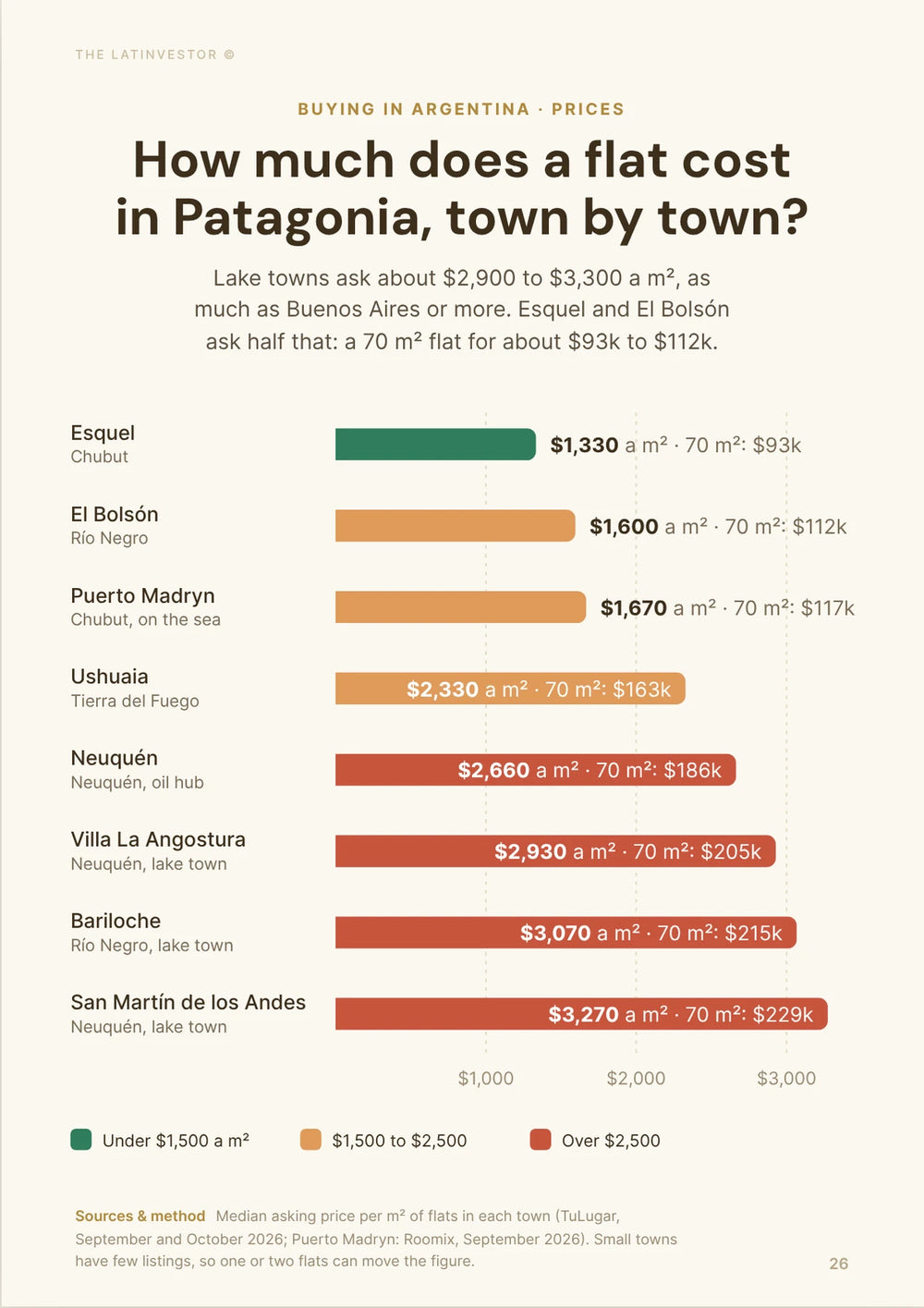
Apartment asking prices run from about USD 1,333 per square meter in Esquel to USD 3,936 in Melipal, Bariloche's priciest area with a published median, in October 2026.
The cheaper places to buy are Esquel, El Bolsón (USD 1,595 per square meter), Puerto Madryn (USD 1,667), Las Victorias in Bariloche (USD 1,867) and Dina Huapi (USD 2,133), but resale and tenant demand are thinner there.
On a long lease, a median flat in Centro, Bariloche, yields about 5.9% gross, against 5.6% in Melipal and 4.8% in Las Victorias; in Ushuaia, a 1-bedroom gets close to 6.9%.
Airbnb is crowded: active listings rose about 23% in a year in Bariloche, 37% in El Calafate and 52% in San Martín de los Andes, while occupancy stayed between 36% and 45%.
Long-term tenants concentrate in Centro, Belgrano and Melipal in Bariloche, where median apartment rents run from about USD 720 (Centro) to USD 985 (Melipal) a month, and in central Neuquén and Ushuaia.
The areas with new momentum are Dina Huapi and the east side of Bariloche, plus towns with fresh transport works, such as San Martín de los Andes, whose Chapelco airport terminal doubled in size in August 2026.
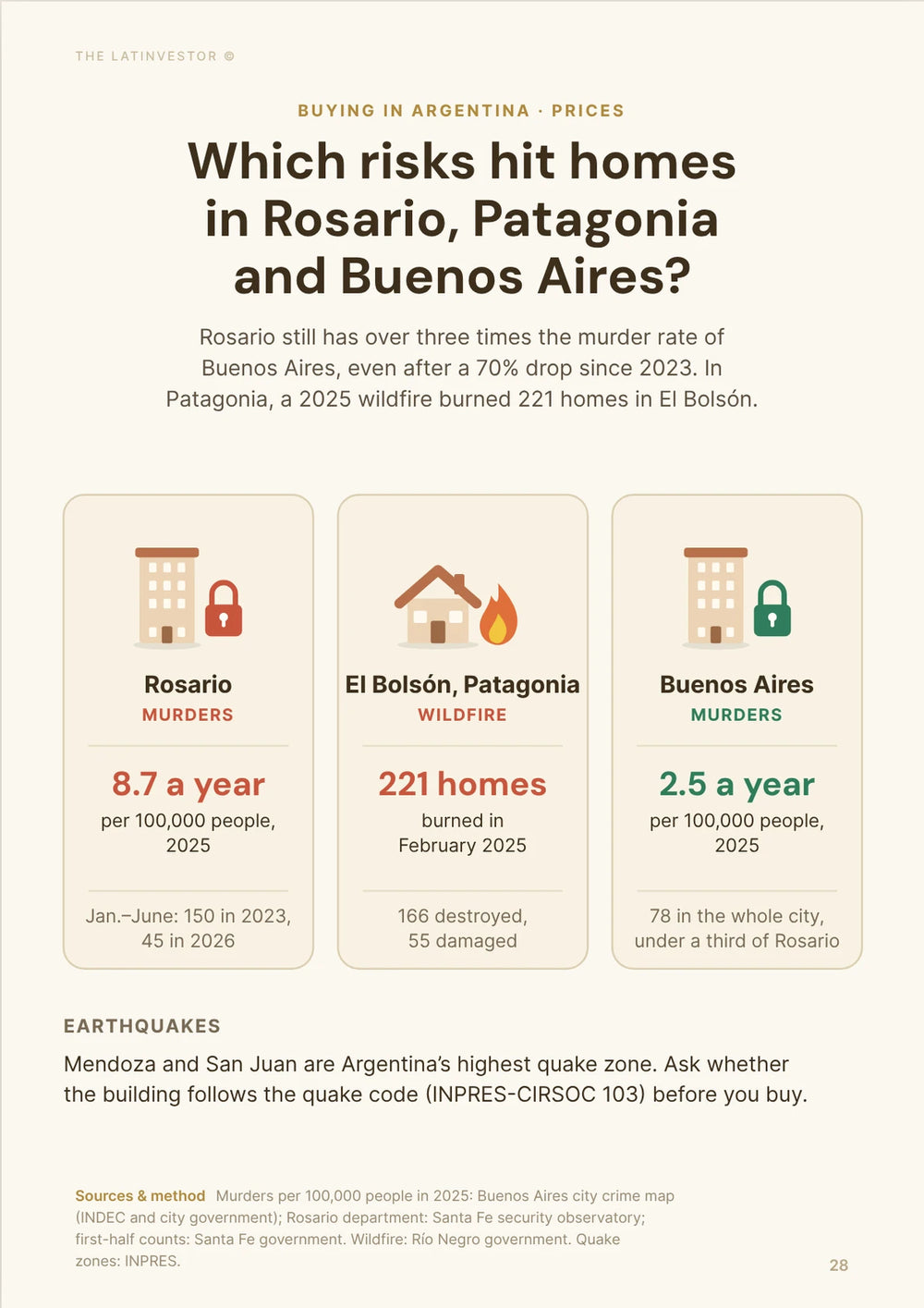
The areas to be careful with are forest plots exposed to fire (the 2025 El Bolsón fire hit 221 homes), roads that close in winter or after slope collapses, and cold, poorly insulated houses.
No area shows a measured price fall right now, but Bariloche long-term rents were flat in pesos over 12 months, a real fall of about 25% after 33.4% inflation.
On price growth, one Bariloche index shows asking prices up about 17.8% in dollars over 12 months, but that is asking, not closing prices, and no multi-year index exists for Patagonian neighborhoods.
Locals favour Belgrano, Melipal and Centro for practical winter life, while expats cluster in Bariloche, San Martín de los Andes and Villa La Angostura.
In Vaca Muerta, an average flat in Añelo listed at about ARS 1.53 million a month in May 2026, 22% above the Neuquén province average, but the income depends on oil activity.
Since 9 October 2026, the limits on foreign ownership of rural land are back pending a final court ruling, which matters for lake plots and estates outside town grids.
Bottom line: buy a warm, central flat in Bariloche Centro or Belgrano or in Ushuaia for income, pay the Melipal or lake premium only for your own use, and check fire risk, road access and land status before anything else.

How do prices compare between Patagonia's towns and neighborhoods?
This article covers Argentine Patagonia. Chilean towns such as Puerto Natales or Punta Arenas follow Chilean rules and prices in UF, so they are not in the figures below.
Which areas in Patagonia have the highest property prices per square meter in 2026?
The most expensive areas are in and around Bariloche. In October 2026, apartments listed at a median of about USD 3,936 per square meter in Melipal and USD 3,880 at Cerro Catedral, against USD 3,067 for Bariloche as a whole. The lake towns follow: San Martín de los Andes at about USD 3,274 and Villa La Angostura at USD 2,928.
Above those medians sit the trophy areas with no published median: the Llao Llao peninsula, lake-view stretches of Avenida Bustillo, Playa Bonita and the Arelauquen gated community, where apartments list at a median of about USD 420,000 and lake-view houses often go above USD 1 million.
Each of these areas is expensive for a clear reason:
- Melipal (Bariloche): close to the lake and to Centro, family homes and villas, median apartment about USD 210,000
- Cerro Catedral: ski-in access and holiday flats, median 1-bedroom about USD 197,000 and 2-bedroom USD 362,000
- Bustillo corridor and Llao Llao (Bariloche): direct lake views and very little land left to build on
- San Martín de los Andes: lake Lácar, the Chapelco ski area and a small supply of flats, median 2-bedroom about USD 220,000
Which areas in Patagonia have the most affordable property prices in 2026?
The cheapest apartment markets are Esquel at about USD 1,333 per square meter, El Bolsón at USD 1,595 and Puerto Madryn at USD 1,667. Near Bariloche, Las Victorias lists at about USD 1,867 and Dina Huapi, a separate town just east of Bariloche, at USD 2,133.
In money terms, a median 1-bedroom flat lists at about USD 92,000 in El Bolsón, USD 110,000 in Ushuaia and USD 135,000 in Dina Huapi. For USD 200,000 you get about 125 square meters in El Bolsón, 86 in Ushuaia and only 65 in Bariloche.
The trade-offs are real. El Bolsón and Esquel have fewer buyers, so resale takes longer, and El Bolsón was hit by the 2025 fire. Dina Huapi and Las Victorias mean driving for most errands and get fewer tourists. Ushuaia is the exception: cheaper than Bariloche but with steady demand from public-sector workers and tourism.
Which Areas in Patagonia Offer the Best Rental Yields?
Which neighborhoods in Patagonia have the highest gross rental yields in 2026?
On a long lease, the best gross yields we can calculate are in Ushuaia, about 6.9% on a median 1-bedroom (rent about USD 635 a month against a price of USD 110,000), and in Bariloche Centro, about 5.9% (USD 720 against USD 147,000).
Most other areas sit between about 5% and 5.7%: Melipal 5.6%, Belgrano 5.4%, El Bolsón 5.5% on a 1-bedroom and Neuquén 5.5% on a 2-bedroom. The lowest are Las Victorias (4.8%) and San Martín de los Andes (about 4.3% on a 2-bedroom), where prices are high for the rents tenants pay.
Why these areas lead:
- Ushuaia: prices well below Bariloche but year-round tenants (public sector, tourism, the port)
- Bariloche Centro: small flats, walkable, demand from workers, students and tourists all year
- Melipal: the highest rents in Bariloche (about USD 985 a month), but also the highest prices
- Neuquén: oil and services jobs keep flats rented, at prices below Bariloche per square meter
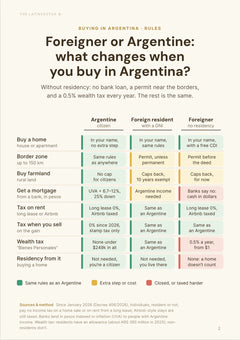
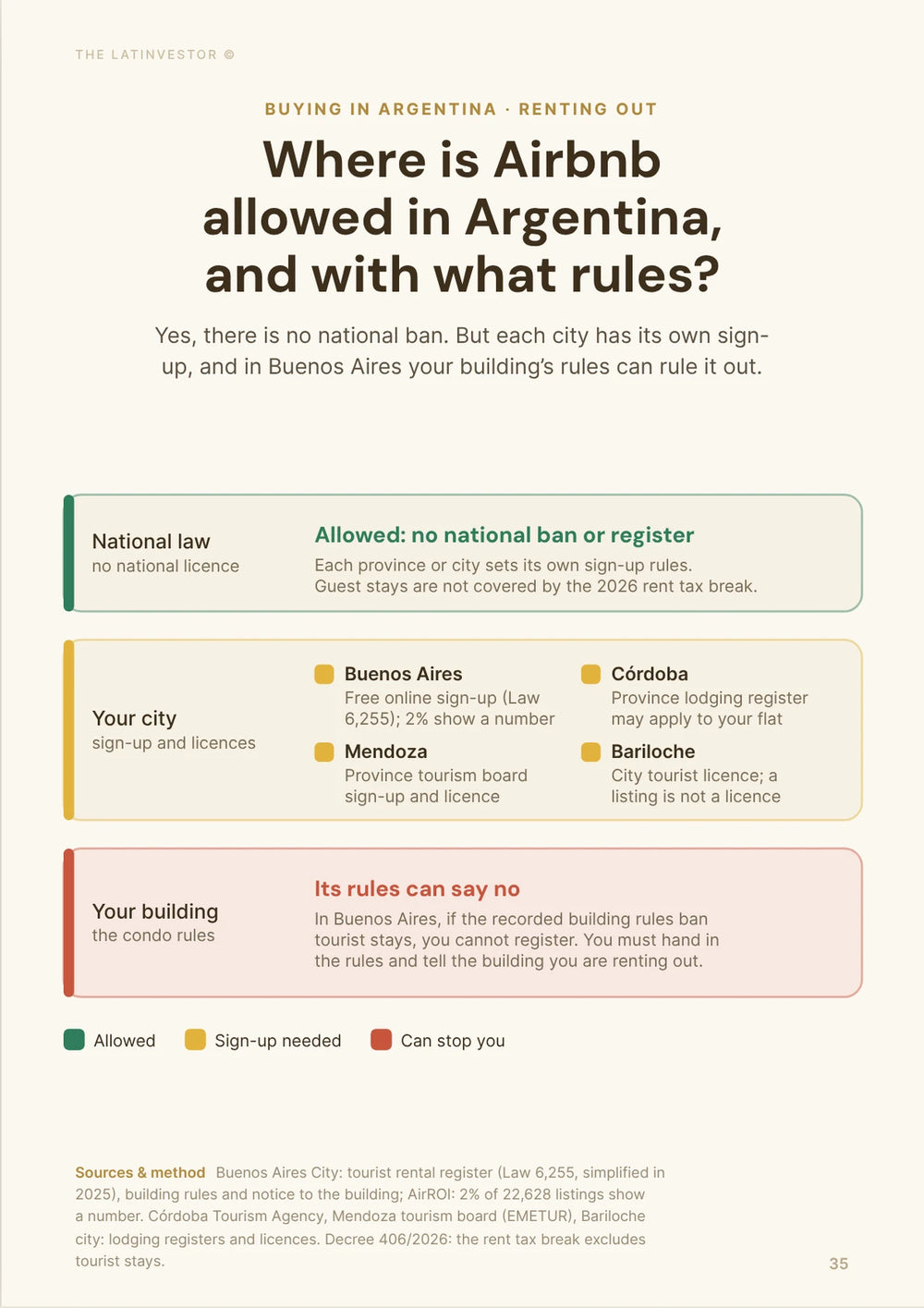
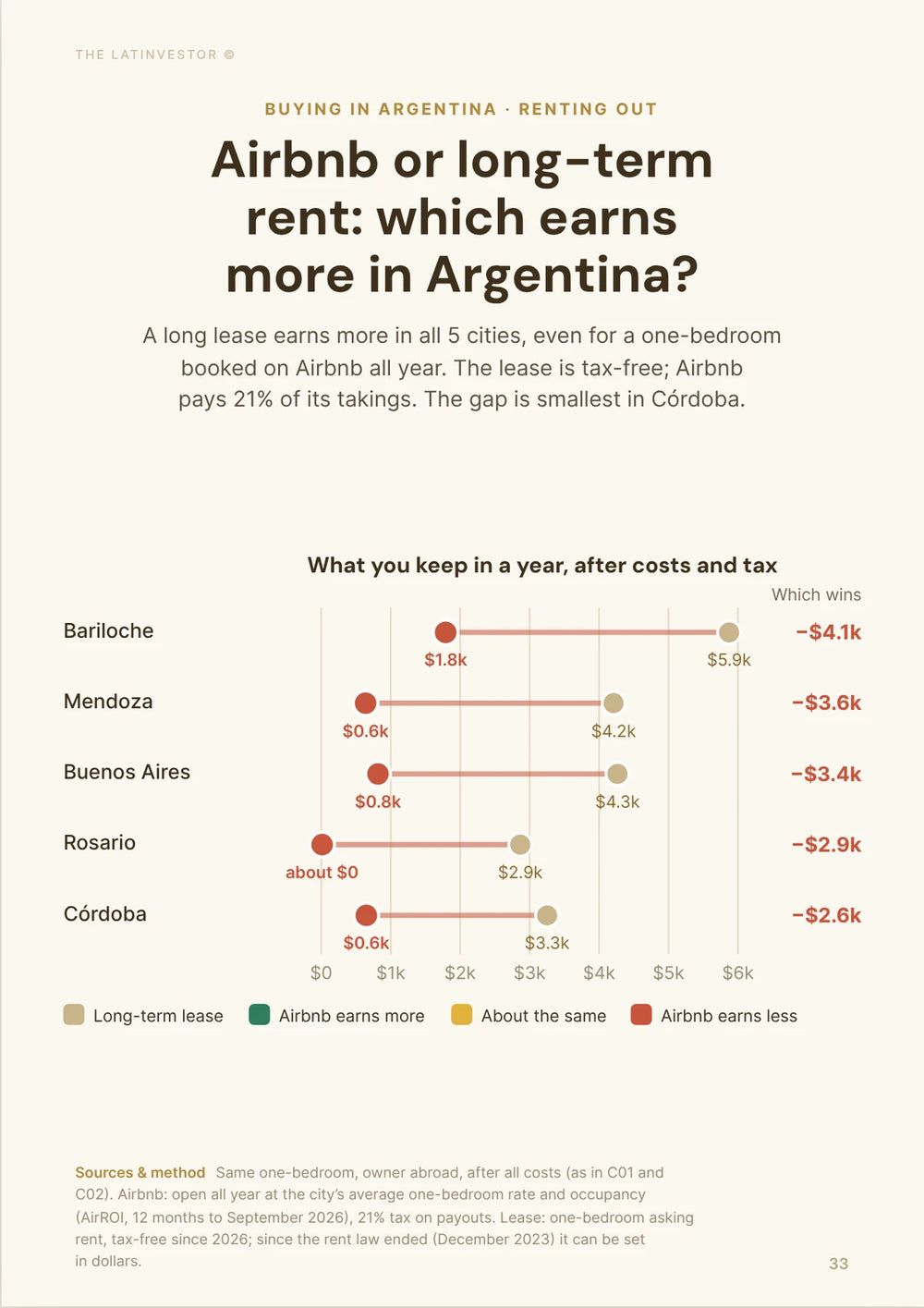
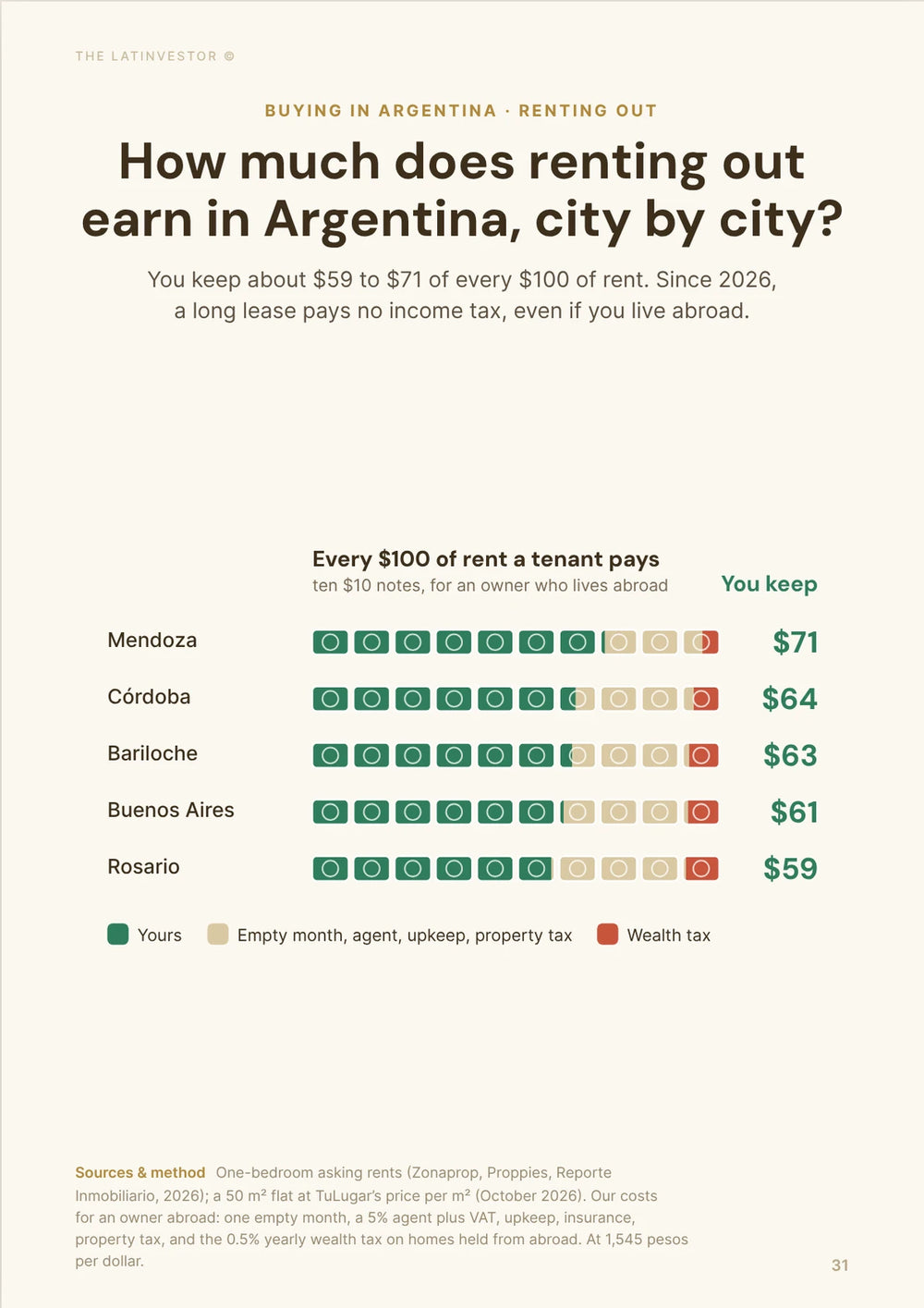
These are gross figures. A foreign owner must take off expensas, property taxes, vacant months, the agent, and by default 21% of gross rent withheld for income tax (the 2026 exemption for long leases is confirmed only for residents), plus the 0.5% yearly wealth tax. Net, expect something nearer 3.5% to 4.5%.
Which Areas in Patagonia Are Best for Short-Term Vacation Rentals?
Which neighborhoods in Patagonia perform best on Airbnb in 2026?
Ushuaia has the best occupancy, about 44.7% over October 2025 to September 2026, against 39.7% in Bariloche, 37.4% in El Calafate and 36.0% in San Martín de los Andes. Bariloche has the highest nightly rate, about ARS 185,000 (USD 128) on average, against about ARS 175,000 in San Martín de los Andes and ARS 128,000 in Ushuaia.
Over that year, the average active listing grossed about ARS 17.7 million (USD 12,300) in Bariloche, ARS 15.1 million (USD 10,500) in Ushuaia, ARS 13.7 million (USD 9,500) in San Martín de los Andes and ARS 10 million (USD 6,960) in El Calafate. Averages are pulled up by the best listings: the median 2-bedroom in Bariloche grossed only about ARS 12 million (USD 8,300), about 3.9% of a median 2-bedroom price.
Inside Bariloche, the areas that work best for tourists are:
- Centro: walkable to restaurants, the lake front and buses, so it books in every season
- Melipal and the first kilometers of Bustillo: lake views lift the nightly rate
- Cerro Catedral: strong in July and August, weak the rest of the year; on a small sample of 36 listings, occupancy was about 31.4% and yearly revenue about USD 9,250
Which tourist areas in Patagonia are becoming oversaturated with short-term rentals?
San Martín de los Andes is the clearest case: active Airbnb listings rose about 52% in a year to about 1,160, while occupancy was only 36.0%. El Calafate follows, with about 37% more listings (828) and 37.4% occupancy.
Bariloche has the largest supply, about 4,560 active listings, up about 23% in a year, against roughly 500 homes listed for long-term rent. Ushuaia grew more slowly, about 17% to about 1,300 listings, and keeps the best occupancy of the four.
The sign to watch is new supply arriving faster than guests: revenue per listing gets squeezed and hosts compete on price. In Bariloche, occupancy falls to about 32% in April and May, so the off-season decides whether a unit pays.
Which Areas in Patagonia Are Best for Long-Term Rentals?
Which neighborhoods in Patagonia have the strongest demand for long-term tenants?
The strongest long-term demand is in Bariloche Centro, Belgrano and Melipal, in central Neuquén and in Ushuaia, where year-round jobs in the public sector, health, education, tourism and oil keep tenants coming.
Supply is the tight part: in October 2026, TuLugar showed only about 501 homes for long-term rent in Bariloche, against about 5,000 for sale. No vacancy rate is published for any Patagonian town.
Who rents where:
- Bariloche Centro: workers, students of the UNRN and young professionals who want to live without a car
- Belgrano (Bariloche): families close to schools and services
- Melipal (Bariloche): remote workers, people moving from Buenos Aires and well-off local families
- Central Neuquén: oil and gas staff, doctors and public-sector workers
What tenants look at first is the heating bill and the winter commute: a warm, insulated flat on a bus line rents fast, a cold chalet up a steep road can sit for months.
What are the average long-term monthly rents by neighborhood in Patagonia in 2026?
In Bariloche, the median apartment rent in October 2026 was about USD 985 a month in Melipal, USD 754 in Belgrano, USD 720 in Centro and USD 624 in Las Victorias, against USD 722 for the whole city. By size, a 1-bedroom listed at about ARS 1.19 million (USD 770) and a 2-bedroom at ARS 1.58 million (USD 1,020) in May 2026.
In the cheaper towns, the median apartment rent is about USD 425 in El Bolsón, and the median of all rental ads about ARS 697,500 (USD 450) in Puerto Madryn.
In between, Ushuaia's median apartment rent is about USD 635 and San Martín de los Andes about USD 785. In Neuquén, a 1-bedroom listed at about ARS 960,000 (USD 620) and a 2-bedroom at ARS 1.58 million (USD 1,020).
At the top, Añelo, in Vaca Muerta, is a market of its own: the average flat listed at about ARS 1.53 million (USD 985) in May 2026, and furnished company leases go higher.
Which Are the Up-and-Coming Areas to Invest in Patagonia?
Which neighborhoods in Patagonia are gentrifying and attracting new investors in 2026?
The areas drawing new buyers are Dina Huapi and the east side of Bariloche (Las Victorias and the road to the airport), where land and houses cost far less than in Melipal, and the outer parts of San Martín de los Andes and Villa La Angostura, where second-home buyers look for plots.
The price gap is what pulls them: an apartment in Dina Huapi lists at about USD 2,133 per square meter and in Las Victorias at USD 1,867, against USD 3,936 in Melipal. We found no published price trend for these areas, so we do not quote a yearly rise.
Which areas in Patagonia have major infrastructure projects planned that will boost prices?
Several transport works are under way or just finished. The Chapelco airport terminal, serving San Martín de los Andes, doubled in size in August 2026. In Bariloche, the 5.6 km airport access road (Route 80) is being rebuilt, with a budget of about ARS 4,475 million (USD 2,890,000), which matters for Dina Huapi and the east side.
Further out, Ushuaia's port is being modernized ahead of the cruise season, Villa La Angostura's Route 40 bypass was still waiting for completion in September 2026, Chubut announced on 19 October 2026 that it will tender works to enlarge Esquel airport, and Puerto Madryn says talks to modernize its airport are well advanced.
None of these comes with a measured effect on home prices. Better access helps tourism and rentals first; treat any price effect as a bonus, and only count on works that are actually finished.
Which Areas in Patagonia Should I Avoid as a Property Investor?
Which neighborhoods in Patagonia with lots of problems I should avoid and why?
Rather than whole neighborhoods, avoid certain kinds of property: cabins in dense forest, houses on roads that close in winter or after storms, and older homes with poor insulation.
The main problems:
- Forest plots: the early-2025 fire around El Bolsón affected 221 homes, 166 of them destroyed
- Slopes and roads: on 18 October 2026, Route 40 near Puerto Arauco, Villa La Angostura, was fully closed after a slope collapse; in September 2026 Neuquén assessed damage after heavy rain and runoff
- Old, cold houses: heating bills and insulation works eat the net yield, and works are paid in pesos: prices rose about 23.6% from January to September 2026 while the dollar rose only about 4.9%, so works got much dearer in dollars
- Remote lake properties: few buyers, so you may wait a long time to sell
These areas become fine buys only with year-round road access, fire protection (firebreaks, distance to the forest edge) and insurance you can actually get at a sensible price.
Which areas in Patagonia have stagnant or declining property prices in 2026?
No reliable index shows a measured price fall in any Patagonian area in October 2026. The weakest signals are on rents and on the cheaper outer areas. Bariloche long-term asking rents were flat in pesos over 12 months, a real fall of about 25% after 33.4% inflation.
Las Victorias, at about USD 1,867 per square meter, has the lowest yield we calculated in Bariloche (4.8%), and El Bolsón still carries the image of the 2025 fire. Remote cabins and large chalets that need heating work tend to sit online for months, which is where you can push the price down.
The reasons:
- Local salaries: in Bariloche, rents are already near what local incomes can bear
- Fewer mortgages: 14,237 home loans were granted in Argentina from January to July 2026, 43% fewer than a year earlier
- Car-dependent areas: buyers now favour year-round practicality over a view
Which Areas in Patagonia Have the Best Long-Term Appreciation Potential?
Which areas in Patagonia have historically appreciated the most recently?
Bariloche is the only Patagonian market with a recent dollar trend: the Roomix index shows the median asking price up about 17.8% over the 12 months to October 2026, and the TuLugar apartment median went from USD 2,983 to USD 3,039 per square meter between August and September 2026.
Treat the 17.8% with care: it measures asking prices. In Buenos Aires, closing prices fell 0.4% over the same 12 months. No multi-year price index exists for Melipal, Bustillo, Llao Llao or Ushuaia, so we do not give five-year figures.
What we can say is where prices hold best: areas where land is scarce (lake fronts, Melipal, Llao Llao, Cerro Catedral), with a nearby airport and year-round life. They list at USD 3,900 or more per square meter, against about USD 3,067 for Bariloche as a whole.
Which neighborhoods in Patagonia are expected to see price growth in coming years?
The best bets are areas where land is short and demand comes all year: Belgrano, Melipal and Centro in Bariloche, Dina Huapi as Bariloche's overflow, San Martín de los Andes with its bigger airport, and Ushuaia, which is still cheap compared with its demand.
We do not give a yearly forecast: nobody publishes one for these areas, and the national backdrop is mixed. The IMF cut Argentina's 2026 growth forecast from 3.5% to 2.1% in October 2026, mortgage lending slowed, and the peso is strong in real terms, which makes Argentina dearer for buyers paying in dollars.
The main thing to watch is whether mortgages come back: the state pension fund (FGS) put ARS 200 billion into new home loans in September 2026 and the same in October. Foreigners with only foreign income have no confirmed access to these loans, but more local buyers would support prices.
What Do Locals and Expats Really Think About Different Areas in Patagonia?
Which areas in Patagonia do local residents consider the most desirable to live?
In Bariloche, locals favour Belgrano, Melipal and the streets around Centro; in Neuquén, the center and residential areas such as Santa Genoveva and Alta Barda.
Why:
- Belgrano (Bariloche): quiet streets, close to schools and services, roads that stay open in winter
- Melipal (Bariloche): near the lake without being far from town
- Bariloche Centro: everything on foot, all year
- Central Neuquén: close to offices, clinics and services
These areas are home to teachers, health workers, public-sector staff and families with stable incomes, who care more about daily life than views.
What locals want is what a foreign investor should want too: winter access and low heating bills. Many foreign buyers pay too much for a view and too little attention to the commute.
Which neighborhoods in Patagonia have the best reputation among expat communities?
Expats mostly settle in Bariloche (Centro, Melipal, Playa Bonita and the Bustillo road), San Martín de los Andes and Villa La Angostura, and to a lesser extent El Bolsón for a cheaper, rural life.
The main reasons:
- Bariloche Centro and the lake corridor: an airport with direct flights to Buenos Aires, services in English, and property managers
- San Martín de los Andes and Villa La Angostura: small, safe lake towns with ski resorts nearby
- El Bolsón: cheaper land and a slower rural life, with a median apartment rent of about USD 425
The usual profiles are retirees, remote workers and holiday-home buyers from Europe, North America, Brazil and Chile, plus many people moving from Buenos Aires.
Which areas in Patagonia do locals say are overhyped by foreign buyers?
Locals often say foreigners overpay for the far end of the Llao Llao peninsula, remote lakefront houses and some Cerro Catedral units that look great in photos but are hard to live in all year.
Why they think so:
- Far Llao Llao pockets: amazing views, but long drives and difficult winter access
- Remote lakefront houses: heavy upkeep and few tenants
- Cerro Catedral: busy in winter, quiet the rest of the year; on a small sample, Airbnb occupancy was about 31.4%
Foreign buyers see the scenery; locals look at road access, schools, clinics, heating and how long errands take in July.
Which areas in Patagonia are considered boring or undesirable by residents?
Residents are least keen on inland areas far from the lakes and services, wind-exposed outskirts of the coastal towns, and car-dependent suburbs that have neither views nor town life.
The reasons:
- Inland areas far from services: no lake or mountain view, little to do, long drives
- Windy coastal outskirts: on the Atlantic side, the wind makes unsheltered areas unpleasant most of the year
- Car-dependent suburbs: neither the calm of nature nor the ease of a walkable center
Is Vaca Muerta making Neuquén and Añelo the best place to buy for rental income?
For rent levels, yes in Añelo: the average flat listed at about ARS 1.53 million (USD 985) a month in May 2026, 22% above the Neuquén province average, and a small 1-bedroom leased to an oil company could reach about USD 1,350.
Neuquén city is calmer. Its asking rents rose about 25% in the year to October 2026, less than inflation, and a median 2-bedroom flat lists at about USD 223,000, which gives about 5.5% gross. The city has more supply, and many oil workers live in company camps or commute.
What to check: in Añelo, your income depends on a few company contracts and on drilling activity. Ask for corporate lease terms in dollars, check who pays services, and assume a slowdown in oil would empty units fast.
Which Patagonia areas got riskier for foreign buyers after the October 2026 land ruling?
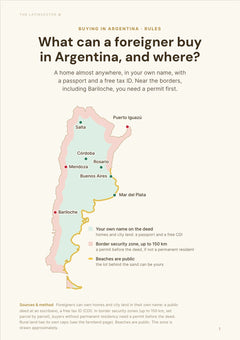
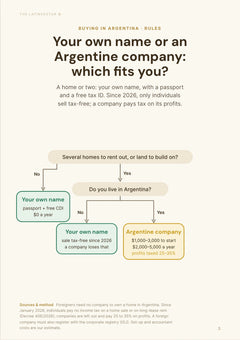
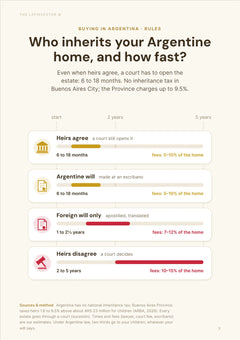
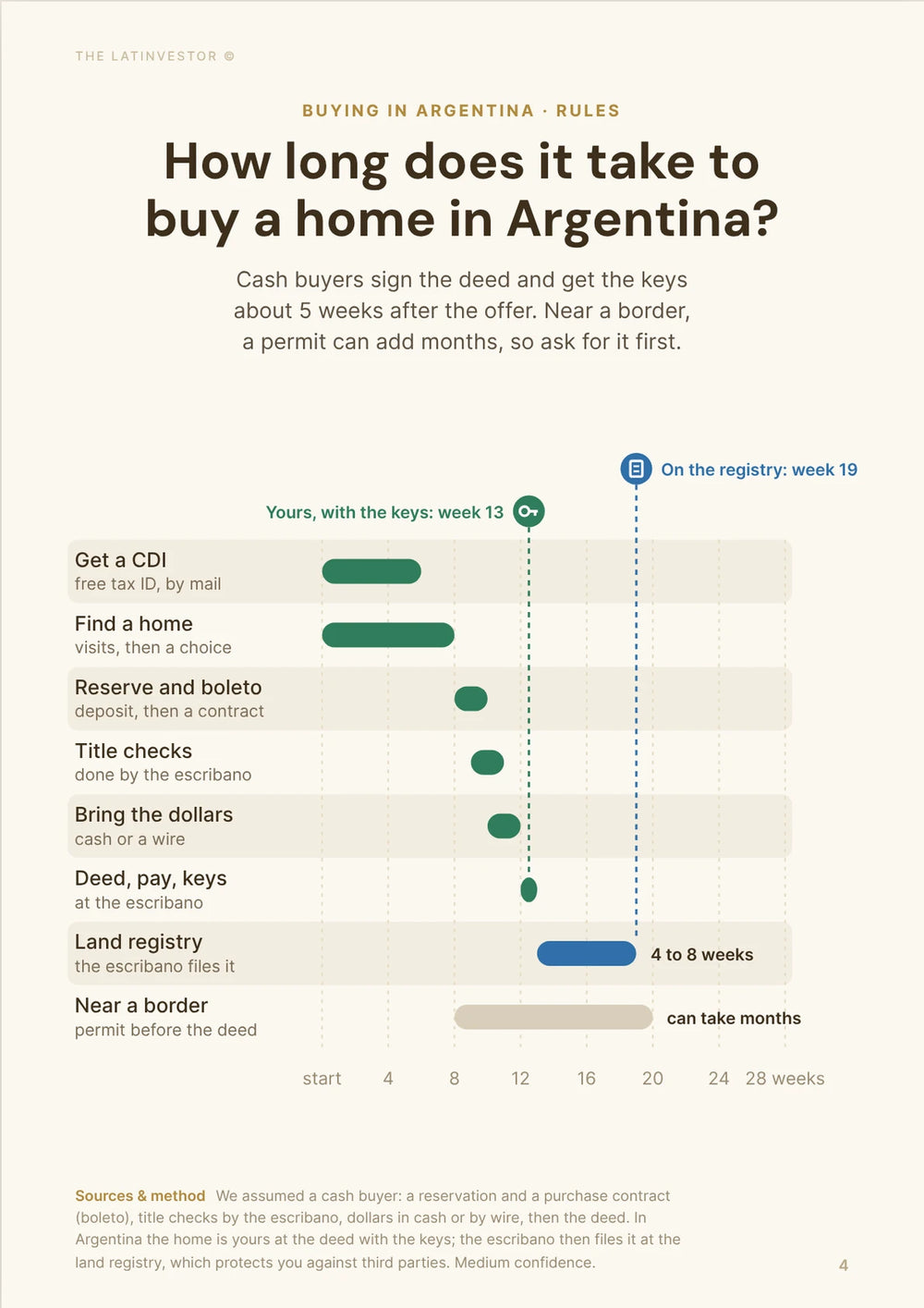
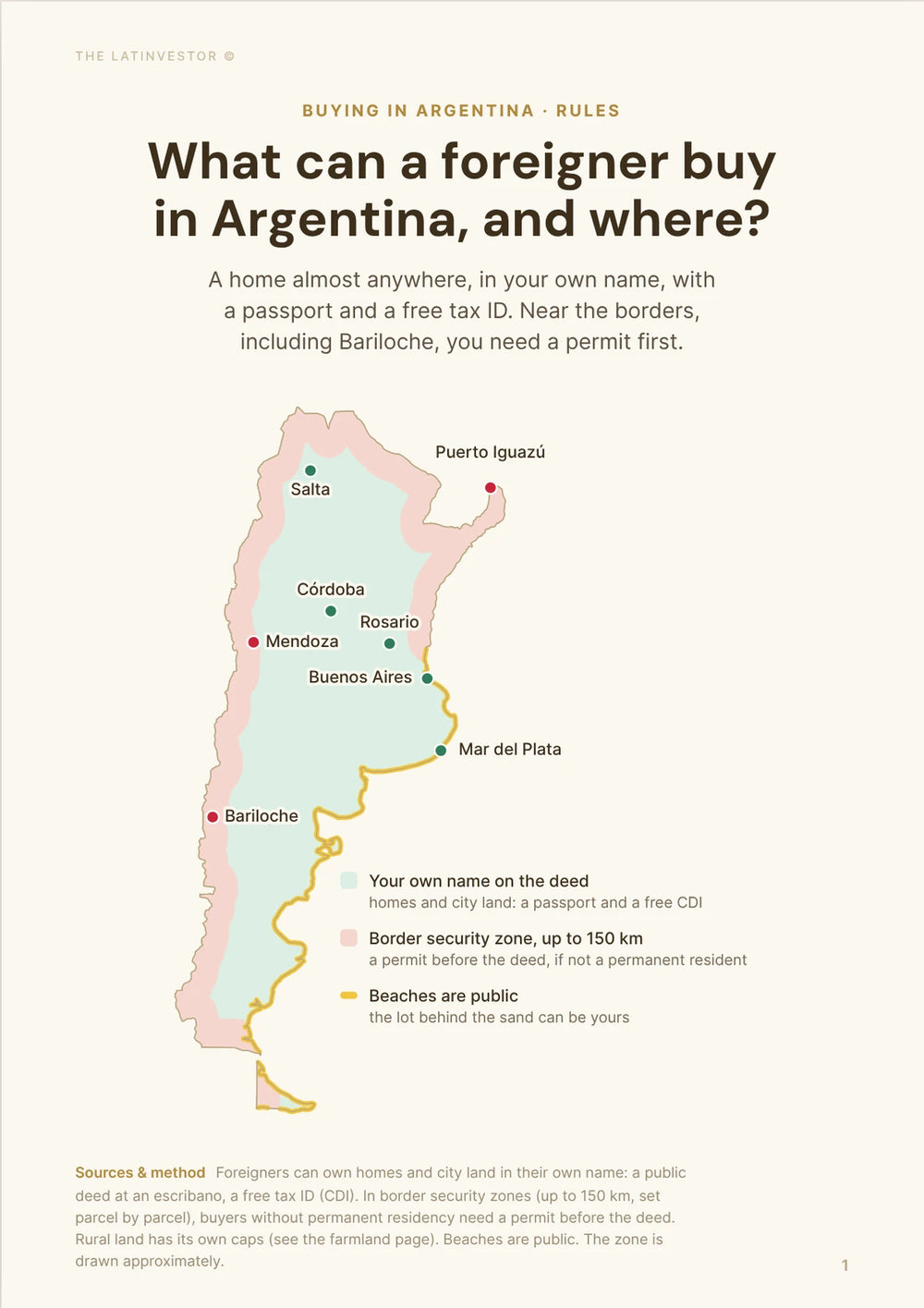
For a flat or a house inside a town, nothing changed: a non-resident foreigner can buy in his own name with a tax ID (CDI), a deed before a notary and registration. Buying gives no residency on its own.
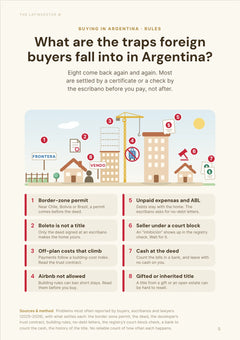
For land outside the urban grid, it did change. On 9 October 2026, the Supreme Court provisionally suspended the repeal of the rural land law (Law 26.737), in a case that came from Bariloche. The limits on foreign ownership of rural land, including the 15% caps, are back while the case goes on. Border security zones near Chile have their own rules on top.
This hits exactly the areas foreigners love most: lake plots, estancias and large parcels around Bariloche, Villa La Angostura, San Martín de los Andes and El Bolsón. Before signing, ask the notary to confirm in writing whether the parcel is classed as rural and whether it is in a border zone, and make that a condition of the reservation contract.
Our methodology
This article compares the areas of Argentine Patagonia for a property buyer: prices per square meter by town and neighborhood, long-term and Airbnb rental yields, saturation, tenant demand, infrastructure, risks, price trends and what locals and expats think. Chilean Patagonia is not covered.
Prices and area rents are median asking figures from TuLugar (Bariloche and its areas, Villa Catedral, Dina Huapi, Neuquén, Ushuaia, San Martín de los Andes, Villa La Angostura, El Bolsón, Esquel) and the Roomix index (Puerto Madryn, Bariloche trend), September to October 2026. Rents by size come from the Reporte Inmobiliario survey published by La Nación (May 2026) and Añelo rents from LM Neuquén. Airbnb figures come from AirROI (October 2025 to September 2026). Yields are our calculation: yearly asking rent divided by median asking price.
Rules come from Decree 406/2026, Estudio Piccinini's June 2026 note on non-resident landlords and Chequeado's report on the 9 October 2026 rural land ruling. Risks and infrastructure come from Río Negro, Neuquén, Chubut, Villa La Angostura, Puerto Madryn and national government releases. Comparisons use INDEC inflation, the M² Real closing-price survey, CPAU (Tejido Urbano) for mortgages and BCRA.
We checked these figures in October 2026. Peso amounts are converted at about ARS 1,550 per US dollar (official and MEP rates were within 1% of each other on 22 October 2026, the blue rate about ARS 1,570), and euro amounts at about ARS 1,740 per euro.
Where we had no direct figure, we said so: there is no Patagonia-wide price index, no multi-year trend for individual neighborhoods, no vacancy rate and no published price for Llao Llao or Bustillo as areas. Area medians mix all flat sizes, some samples are small (Cerro Catedral Airbnb, El Calafate), and all prices and rents are asking figures, not deeds or signed leases.
Key sources used for this analysis include TuLugar Bariloche, TuLugar Ushuaia, TuLugar Neuquén, Roomix Bariloche, AirROI Bariloche, La Nación (Reporte Inmobiliario), LM Neuquén, Zonaprop, Argenprop, Chequeado, Decree 406/2026, INDEC, BCRA and Infobae.