Summary
Yes, a little. Since June 16, 2026, the SRE has 3 business days instead of 5 to approve a beach-or-border trust, and the inland ownership agreement has a 30-business-day limit instead of 90 calendar days.
The change is about paperwork, not ownership. Foreigners still can't hold direct title to homes within 50 km of the coast or 100 km of a border, and the 2013 reform that would have changed that is still stuck in the Senate.
Inland, you own the deed yourself after a one-off SRE agreement that costs MXN 5,250 (about USD 282) in 2026. In Cancún, Tulum, Puerto Vallarta or Los Cabos, you still buy through a bank trust.
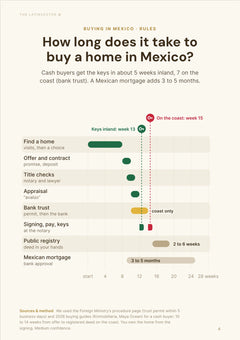
On the coast, the faster permit saves you 2 business days at most. The bank, the notary, the title checks and the registry still take most of the time.
A trust gives you nearly everything an owner has, for 50 years, renewable. An on-time extension costs MXN 9,740 plus MXN 595 in 2026.
The government side got lighter too: 7 pieces of trust data now go straight into the SRE's online form, and several free-form letters are gone.
The other paperwork got heavier. Since July 2025, notaries must report property deals above 8,000 daily UMAs, about MXN 938,000 (USD 50,500), and dig into who really stands behind the money.
Nothing got cheaper. The SRE trust permit is MXN 21,650 (about USD 1,160), and banks charge roughly USD 550 to 800 to open the trust plus USD 550 to 700 a year.
The exchange rate moves your bill more than the reform does. The peso has weakened since early September (from under 17 to about 18.6 per dollar), so a MXN 6 million condo costs about USD 323,000, roughly USD 30,000 less than a few weeks ago, though still about USD 10,000 more than at the 2025 average rate.
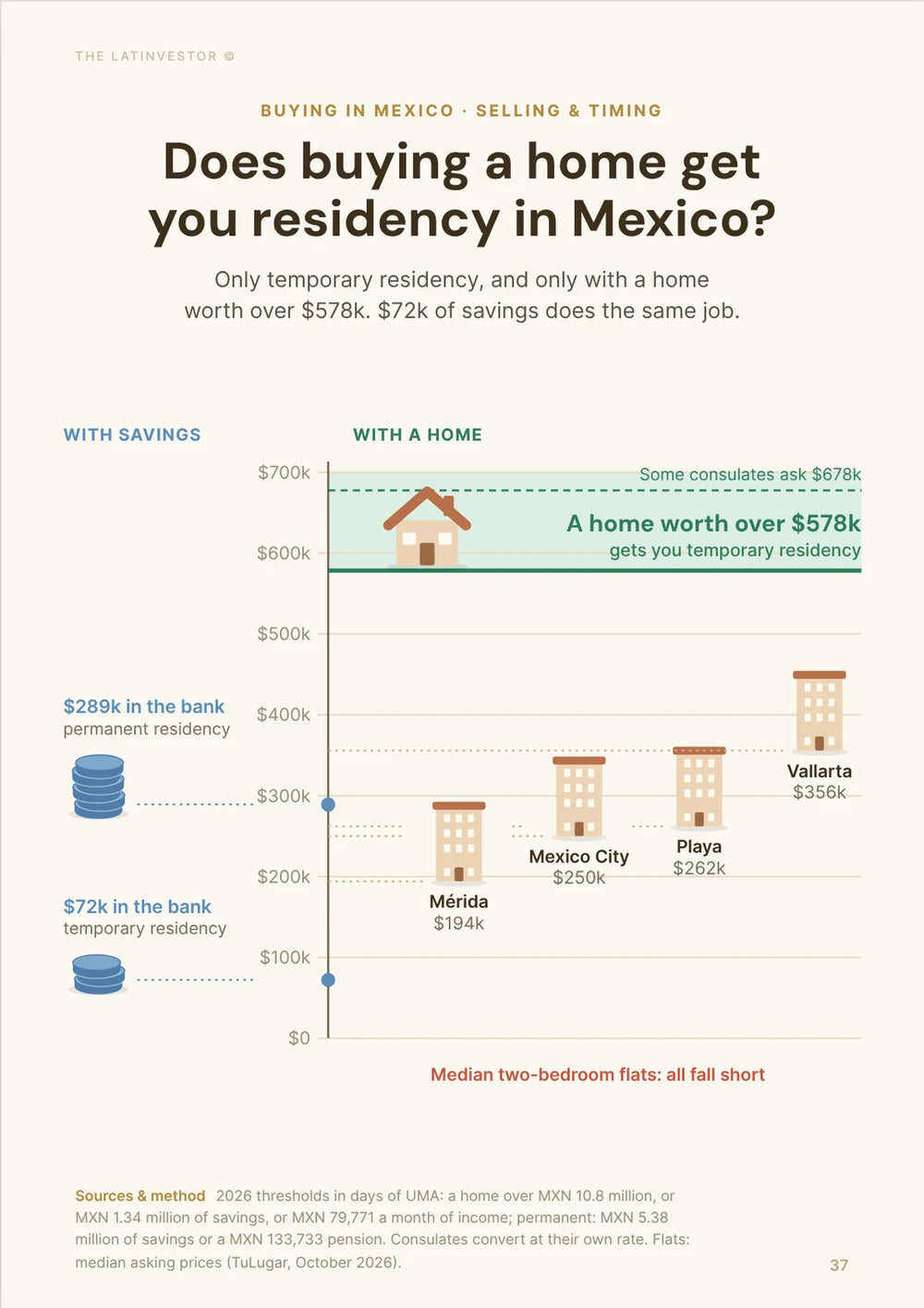
You don't need residency to buy, and buying doesn't give you residency. Only a property worth more than about MXN 10.76 million (USD 578,000) can support an application.
A Mexican company only skips the trust for non-residential use; its SRE notice is now approved immediately instead of within 5 business days.
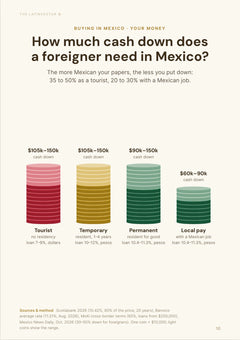
Financing is still the slow part. New Mexican mortgages averaged 10.13% in March 2026, and cross-border lenders want at least 35% down.
The real risk is bad paper, not the SRE: Quintana Roo had 123 irregular developments on its blacklist by August 2026.
Bottom line: if you pay cash, the process is a bit smoother than a year ago. Spend your energy on the title, the permits and the exchange rate, not on the 3-day permit.

What exactly changed for foreign buyers in June 2026?
The SRE, Mexico's foreign ministry, cut its own deadlines for foreign property procedures in an agreement published in the federal gazette on June 16, 2026, in force the next day.
The headline change is the fideicomiso, the bank trust foreigners use near coasts and borders. The SRE now has 3 business days instead of 5 to approve a new trust, a change to one, an extension or the annual trust report.
The forms got shorter. Seven pieces of information that used to be separate requirements, including the parties, the trustee bank, the trust's length, the property's use and its distance from the coast or border, now go straight into the SIPAC27 online form. The free-form request letters for trust changes, extensions and reports are gone.
Inland purchases got the biggest cut on paper: the SRE agreement a foreigner signs to own property outside the restricted zone now has a 30-business-day limit, down from 90 calendar days.
So yes, the government side is faster. The question is how much of a purchase that actually covers.
| Foreign-property procedure | Previous maximum | Current maximum | Practical change |
|---|---|---|---|
| New restricted-zone fideicomiso | 5 business days | 3 business days | 2 days shorter SRE limit |
| Fideicomiso modification | 5 business days | 3 business days | Faster amendments |
| Fideicomiso extension | 5 business days | 3 business days | Faster renewal, no request letter |
| Foreign acquisition outside restricted zone | 90 calendar days | 30 business days | Much shorter formal ceiling |
| Non-residential restricted-zone notice by qualifying Mexican company | 5 business days | Immediate | Federal waiting period disappears |
Is the 50 km beach rule finally going away?
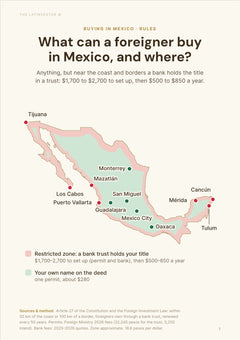
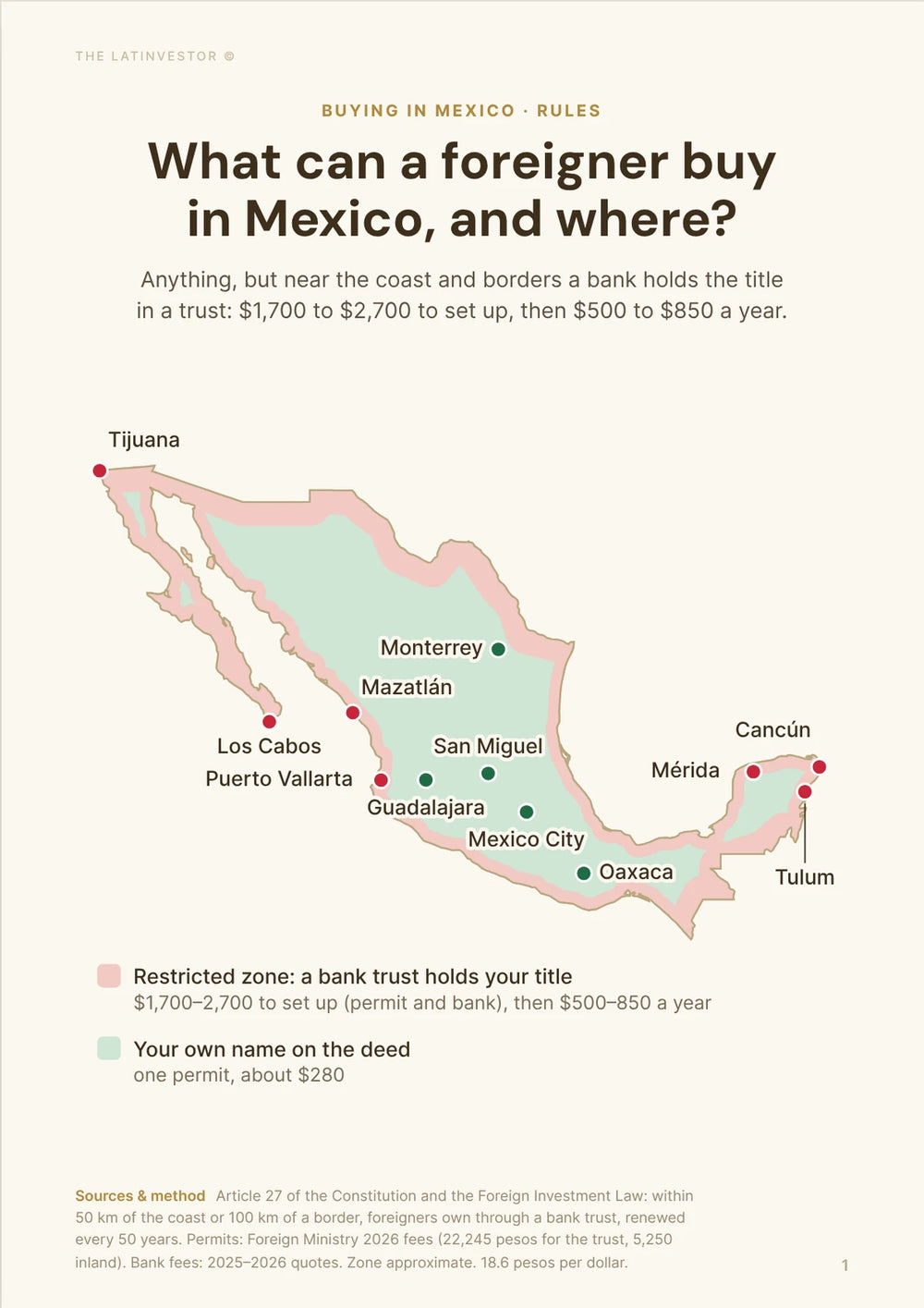
No. Foreigners still can't hold direct title to land within 50 km of the coast or 100 km of an international border, and nothing passed in 2026 changes that.
Article 27 of the Constitution still carries both limits, and the SRE applies them exactly as before. That covers most places foreign buyers want: Cancún, Playa del Carmen, Tulum, Puerto Vallarta, Los Cabos and almost all of Baja California.
The idea of scrapping the rule isn't new. In 2013 the Chamber of Deputies voted 356 to 119 to let foreigners own homes directly near beaches, but the reform never made it through the Senate. If an agent tells you the trust will "soon be optional", treat it as a sales line.
If anything, the political wind blows the other way: a February 2026 Senate bill asks trust banks to check who really stands behind each trust. It hasn't passed.
Can foreigners own a home directly in Mexico City or other inland areas?
Yes. Outside the restricted zone, a foreigner holds the deed in their own name, with no bank in between.
In Mexico City, San Miguel de Allende or most of Guadalajara, you sign an agreement with the SRE in which you accept being treated as Mexican for that property and give up diplomatic protection over it. In 2026 it costs MXN 5,250 (about USD 282), and the SRE now has 30 business days to sign off. Then you buy before a notary like anyone else.
This split between inland and coast matters far more than any 2026 reform.
| Typical purchase | Direct foreign ownership? | Fideicomiso? | Relative complexity |
|---|---|---|---|
| Apartment in Mexico City | Yes | No | Lower |
| Home in San Miguel de Allende | Yes | No | Lower |
| Home in most of Guadalajara | Yes | No | Lower |
| Condo in Cancún | No | Yes | Higher |
| Condo in Playa del Carmen | No | Yes | Higher |
| Home in Puerto Vallarta | No | Yes | Higher |
| Villa in Los Cabos | No | Yes | Higher |
Is buying a beach property in Mexico actually easier now?
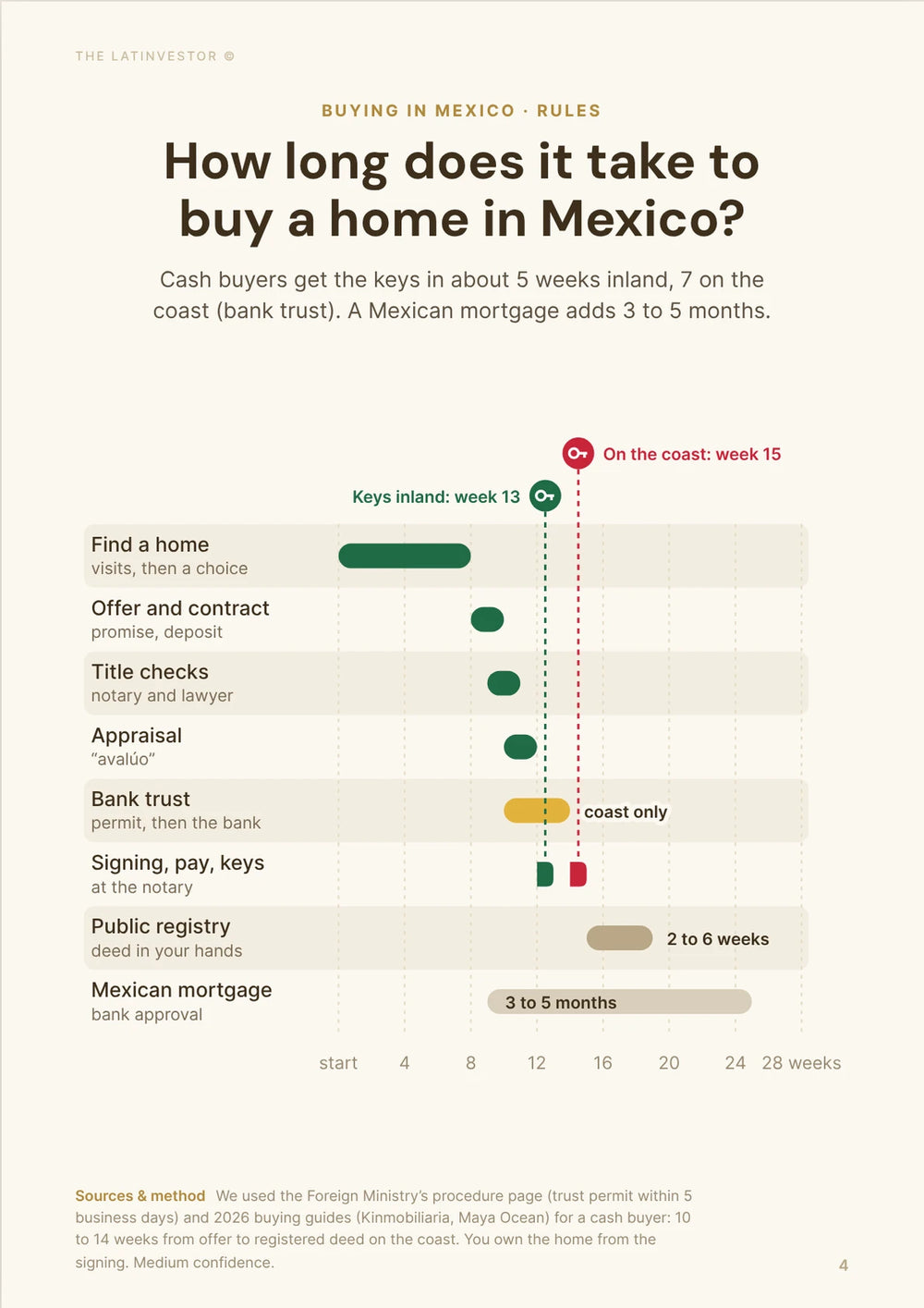
Only slightly. The SRE decision now takes 3 business days at most instead of 5, but that was never the slow part of a beach purchase.
The trustee bank still has to onboard you, check your documents, draft the trust and file the SIPAC27 application. Then the notary prepares the deed, the title and liens get checked, and the deed is recorded at the Public Registry. Each of these steps takes longer than the SRE does.
What to do: ask two or three banks how long their own onboarding takes and what they charge, before you sign a purchase contract with a closing date. That date depends on the bank and the notary, not on the SRE.
For a cash buyer of a condo in Playa del Carmen or a villa in Los Cabos, the improvement is real but small.
What does a foreign buyer actually own through a Mexican fideicomiso?
Almost everything an owner has, except your name on the title.
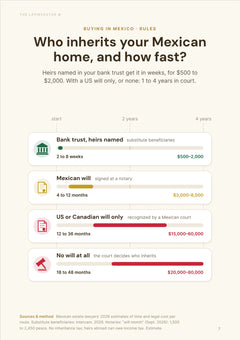
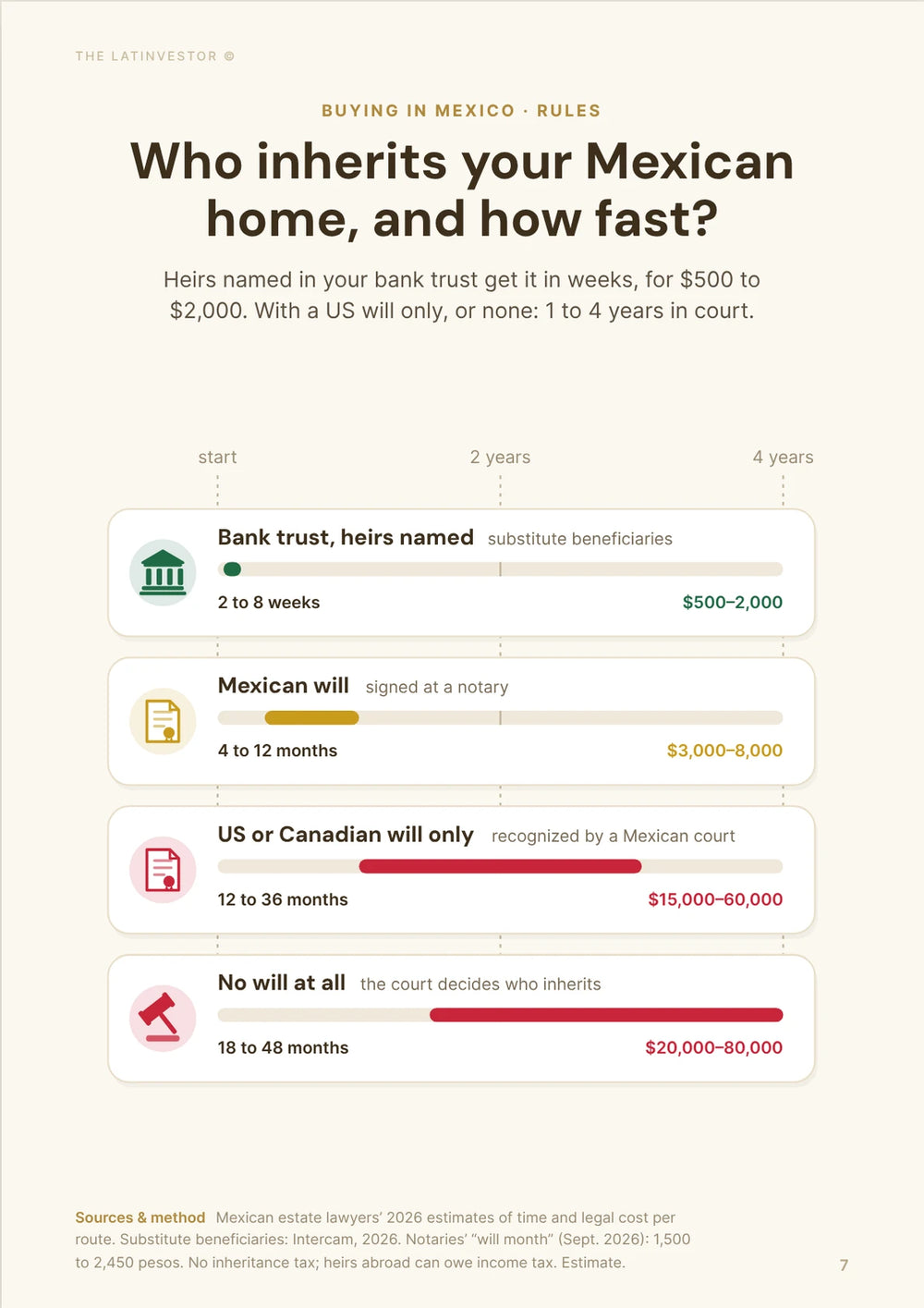
The bank holds title as trustee and follows your instructions. You can live in the property, rent it where local rules allow, improve it, sell your rights and name who inherits them. Calling it "renting from a bank" is wrong.
The trust runs for up to 50 years and can be extended. In 2026, an on-time extension costs MXN 9,740 plus MXN 595 for the review, about USD 556 in total, and the SRE now answers within 3 business days. BBVA, Banorte, Scotiabank and other major banks all run these trusts.
Did Mexico remove much of the paperwork for foreign buyers?
On the SRE side, yes. Across the whole purchase, not really.
The 2026 agreement folded property and beneficiary data into the SIPAC27 form and dropped the free-form letters for trust changes, annual reports, extensions and terminations. Your bank and lawyer will feel that more than you will.
Everything property-specific stays: the trustee bank on the coast, the notary, the title and lien checks, the tax checks, the deed and the registration.
| Step | Recent simplification? | Still required? | Buyer impact |
|---|---|---|---|
| SIPAC27 property and beneficiary information | Yes | Yes, inside standardized form | Less duplicated paperwork |
| Separate free-form documents for several trust procedures | Yes | Some removed | Simpler administration |
| Trustee bank for coastal residential property | No | Yes | Major structural step remains |
| Mexican notary | No | Yes | Closing still formal |
| Anti-money-laundering identification and source of funds | No, tighter since 2025 | Yes | More documents to show |
| Title and lien checks | No | Yes | Due diligence unchanged |
| Public Registry registration | No | Yes | Ownership still needs registration |
Are new anti-money-laundering checks making it harder to close?
Yes, a bit, and you're more likely to feel it than the 2-day SRE gain. Mexico's anti-money-laundering law was tightened in a reform published on July 16, 2025, and notaries and developers now have more to check.
Notaries now have to report property sales and transfers above 8,000 daily UMAs, about MXN 938,000 (USD 50,500) in 2026, half the old 16,000 UMA threshold. In practice that's almost every sale. They also have to identify the "beneficiario controlador", the real person behind the money, and keep the records for 10 years instead of 5. Taking money for an off-plan project now counts as a monitored activity for the developer, and paying in cash is restricted.
What to do: have your passport, proof of address, tax ID from your home country and a clear paper trail for the money (bank statements, sale of a previous home) ready before the notary asks. Wire the funds from an account in your own name, never from a friend's or a company you can't document. If you buy through a company, expect to show who owns it.
Has buying property in Mexico become cheaper for foreigners?
No. The 2026 changes cut waiting time, not fees.
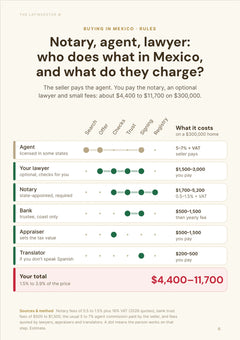
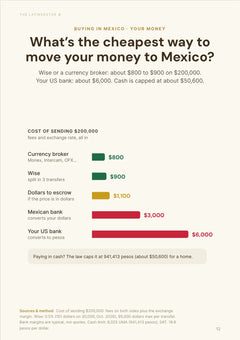
The SRE charges MXN 21,650 (about USD 1,160) in 2026 for a new coastal trust permit. The bank adds roughly USD 550 to 800 (about MXN 10,200 to 14,900) to open the trust and USD 550 to 700 (about MXN 10,200 to 13,000) a year to run it, according to a 2026 broker comparison. Ask two or three banks for written quotes.
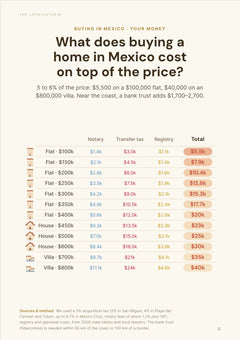
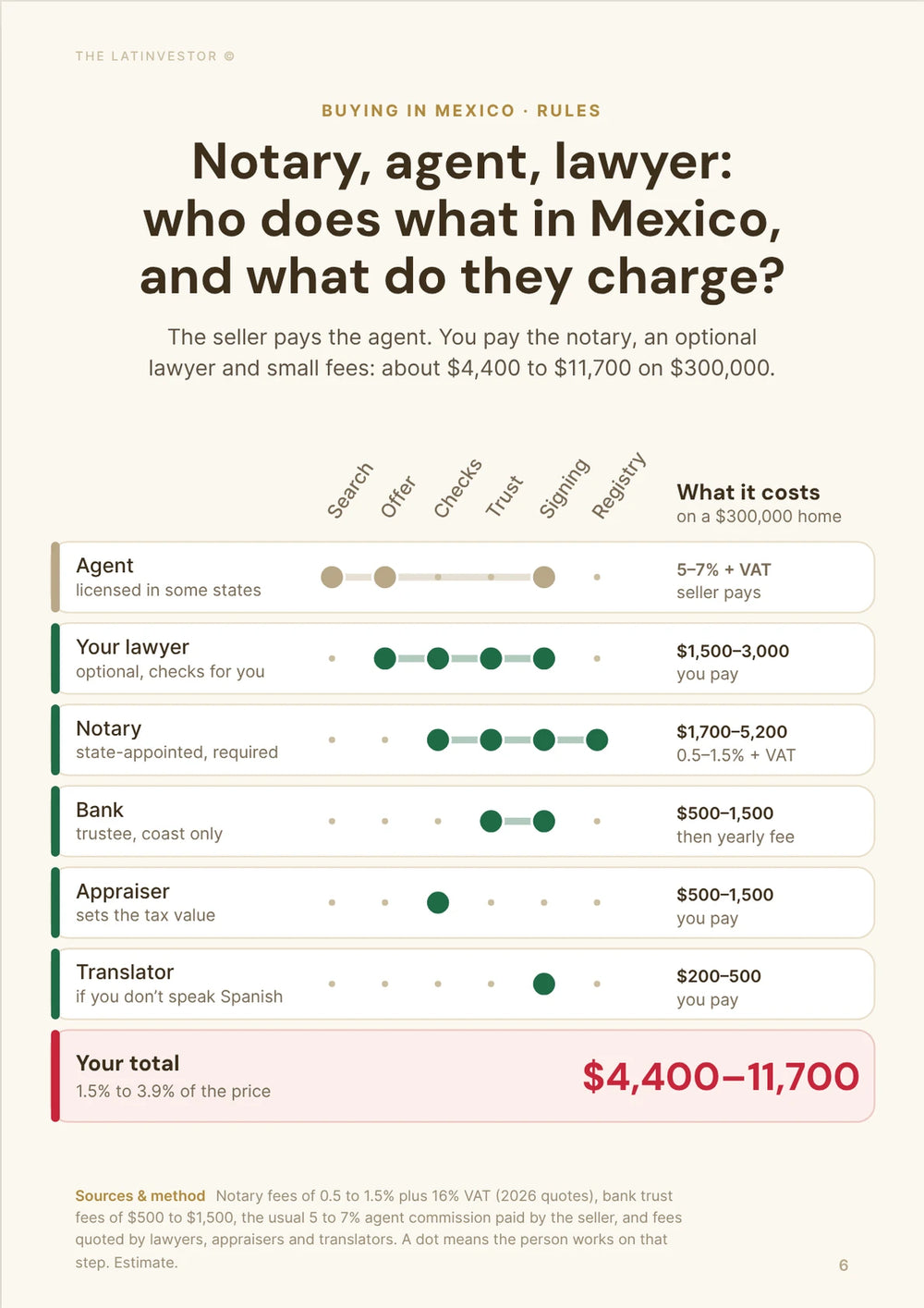
On top of that come the costs every buyer pays: acquisition tax, which varies by state and municipality, notary fees, appraisal and registration. All in, foreign buyers typically budget 6% to 9% of the price for closing, trust included where needed.
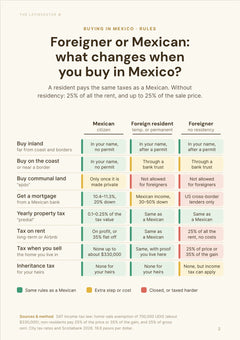
Inland, the only foreign-specific cost is the MXN 5,250 SRE agreement. On the coast, you pay a layer a Mexican buyer of the same condo doesn't.
| Cost or fee | Mexican buyer | Foreign inland buyer | Foreign restricted-zone buyer |
|---|---|---|---|
| Acquisition tax | Yes | Yes | Yes |
| Notary costs | Yes | Yes | Yes |
| Registration costs | Yes | Yes | Yes |
| SRE agreement outside the restricted zone | No | MXN 5,250 | No |
| New fideicomiso permit | No | No | MXN 21,650 |
| Trust opening fee (bank) | No | No | About USD 550 to 800 |
| Annual trust fee (bank) | No | No | About USD 550 to 700 |
Has the peso's recent slide made Mexico cheaper for foreign buyers?
A little, and it moves your bill more than any 2026 rule change. The peso went from under 17 per US dollar in early September 2026 to about 18.6 in late October, but it's still a bit stronger than its 2025 average of 19.20.
On a condo priced at MXN 6 million, that's about USD 323,000 today, against about USD 353,000 at 17 pesos in early September and about USD 312,500 at last year's average rate. Forecasters expect the peso to firm up again: BBVA Research sees 17.30 pesos per dollar at the end of 2026, and Citi's survey of analysts 18.20.
What to do: compare prices in pesos, not in dollars, since many coastal listings are quoted in dollars and inland ones in pesos. If you're paying in instalments on a pre-sale, agree on the currency in the contract. And use a transfer service with a locked rate for the closing payment rather than your home bank's rate on the day.
Does a foreigner need Mexican residency to buy property?
No. A tourist can buy, inland in their own name or on the coast through a trust.
Residency matters when you want a mortgage. Mexican banks such as HSBC and BBVA lend to foreigners, but they ask for immigration documents, local income or credit history on top of your passport. A cash buyer living abroad usually has no problem; the same person can struggle to get a Mexican loan.
Can foreigners skip the fideicomiso by opening a Mexican company?
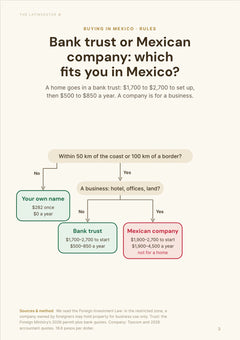
Not for a holiday home. A Mexican company with foreign shareholders can only own coastal property directly if it's used for a real business, such as a hotel, an office or a commercial project.
That route did get faster in 2026: the company's SRE notice is now approved immediately instead of within 5 business days, and costs MXN 1,475 if filed on time. But for residential property near the coast, the government's own procedure says the company still needs a trust.
A company also costs about MXN 35,000 to 50,000 to set up, plus accounting every year. Forming one just to hold a condo in Tulum doesn't make Article 27 go away.
| Buyer structure | Residential property in restricted zone | Non-residential property in restricted zone |
|---|---|---|
| Foreign individual | Fideicomiso | Fideicomiso available |
| Foreign company | Fideicomiso | Fideicomiso available |
| Mexican company with foreign shareholders | Residential restriction still applies | Direct acquisition can be possible |
| Mexican individual | Direct ownership | Direct ownership |
Is getting a mortgage still the hard part for foreign buyers in Mexico?
Yes. The legal right to buy is easy to get; a Mexican loan isn't.
New mortgages in Mexico averaged 10.13% a year in March 2026, according to Banco de México, and banks' average fixed-rate quote was 11.31% in August 2026. That's with Banxico's own rate down to 6.50%, so don't wait for mortgage rates to follow it quickly. Lending isn't growing either: the number of new mortgages rose only 0.3% in the first half of 2026.
Foreigners can borrow. HSBC lends to legal residents with immigration papers and proof of income, and BBVA has a product that accepts some US income documents. Cross-border lenders working with non-residents typically want at least 35% down.
So the 2026 reform helps cash buyers most. If you need a loan, expect underwriting to take far longer than the 3-day trust permit.
Can a foreigner buy property in Mexico mostly from abroad now?
Most of it, but not the very end. The bank files the SRE trust application online through SIPAC27, BBVA and other banks let you start the trust online, and a power of attorney can stand in for you at signing.
The deed still has to be signed before a Mexican notary and recorded in the Public Registry. Plan for one trip, or for a well-drafted power of attorney given to someone you trust.
Are title checks still a bigger risk than the foreign-buyer paperwork?
Yes, by far. A faster SRE doesn't tell you whether the seller owns what they're selling.
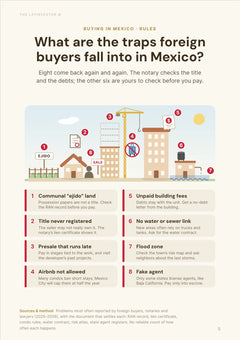
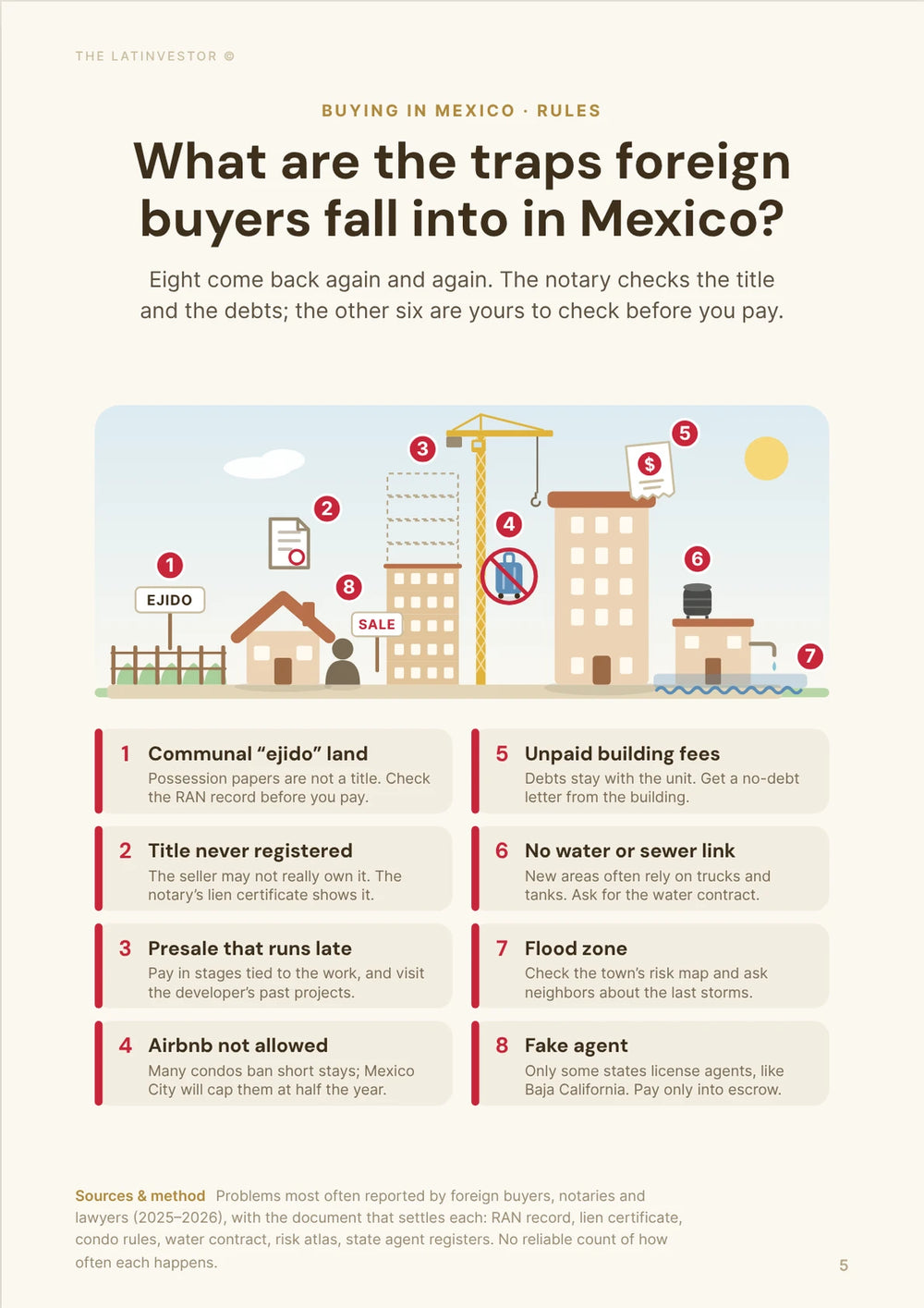
The risk is concrete in 2026: Quintana Roo's urban development agency had 123 irregular developments on its blacklist by August 2026, mostly in Tulum, Isla Mujeres, Playa del Carmen and Cancún. Some sold land that was still ejido, communal farmland that can't be sold to you as private property until it's been converted.
What to check before paying anything: a recent certificate of no liens from the Public Registry, paid property tax and water bills, condo fees up to date, and for a pre-sale, the land-use permit, the environmental authorization and the construction license. If the word "ejido" comes up, stop until a lawyer has seen the papers. Never pay a deposit without a written contract that names the seller, the trust bank and what happens to your money if the project stops.
Does buying a Mexican property give a foreigner residency?
Not by itself. Buying and immigration are separate processes in Mexico.
Some consulates accept a property worth more than about MXN 10.76 million (USD 578,000) as the basis for a temporary-residency application. Below that, you qualify on income or savings, not on the house.
What's our verdict on the 2026 changes?
Buying is easier on the government side, and that's about it.
The SRE now has 3 business days instead of 5 for a coastal trust and 30 business days instead of 90 calendar days for the inland agreement, with fewer forms. That's real, measurable progress.
Everything else stayed put or got harder. The 50 km and 100 km limits haven't moved, the trust still costs MXN 21,650 plus bank fees, notaries are checking the money more closely since 2025, mortgages sit above 10%, and even after its recent slide, the peso leaves the same condo about 3% more expensive in dollars than at last year's average rate.
For a cash buyer inland, the process is now fairly simple. For a cash buyer on the coast, it's slightly faster but no cheaper. For a buyer who needs a Mexican loan, the 2026 changes solve very little.
Mexico has made the road smoother. It hasn't opened a new one.
Our methodology
This article checks whether buying property in Mexico has become easier for foreigners in 2026, looking at six parts of a purchase: federal processing, ownership structure, costs, compliance checks, financing and property-level risk.
The deadlines come straight from the SRE simplification agreement published in the Diario Oficial on June 16, 2026, which lists each procedure's old and new limit. Fees come from the SRE's 2026 costs and processing-time page, updated in September 2026. Bank trust fees come from a 2026 broker comparison, not published bank tariffs, so we give them as ranges.
The ownership rules come from Article 27 of the Constitution and the Foreign Investment Law. The anti-money-laundering thresholds come from the July 2025 reform, as summarized by EY Mexico and the local press, converted with the 2026 UMA of MXN 117.31 per day. Mortgage rates come from Banco de México, mortgage volumes from BBVA Research, and the irregular-development count from the Quintana Roo press.
We checked these figures in October 2026. Conversions use about 18.6 pesos per US dollar and 20.9 pesos per euro.
The limits: the SRE deadlines are legal maximums, not average times, and the slowest steps (bank, notary, registry) have no official deadline. Closing-cost ranges are estimates, and acquisition tax varies by state. Exchange-rate forecasts are forecasts.
Key sources used for this analysis include the June 2026 SRE simplification agreement, SRE costs and processing times, the SRE restricted-zone trust procedure, SRE guidance for purchases outside the restricted zone, the Ventanilla Única procedure for foreign acquisitions, the restricted-zone procedure for Mexican companies, the SRE notice for non-residential acquisitions, the Mexican Constitution, the Foreign Investment Law, the Chamber of Deputies on the 2013 reform, the February 2026 Senate bill, EY Mexico on the 2025 anti-money-laundering reform, Por Esto on notaries' new obligations, Homia's 2026 trust-fee comparison, Compass Abroad on closing costs, Tandazo on company set-up costs, Banco de México, BBVA Research, El Financiero on the Citi survey, Calcu.mx historical exchange rates, Global Mortgage, HSBC México's mortgage guide, BBVA's restricted-zone trust checklist, the Mexican consulate on residency through property and Por Esto on Quintana Roo's irregular developments, Riviera Maya News on the 123 blacklisted developments (August 2026).