Summary
Yes, rents are still rising in Mexico: a standard two-bedroom in Mexico City was listed about 9.6% higher in June 2026 than a year earlier. But the national boom has split into very different local markets.
Official data are calmer. INEGI's housing index was up 3.57% year over year in August 2026, close to headline inflation, because it follows existing leases that reprice slowly.
Mexico City is still the main pressure point. Its standard two-bedroom asking rent reached about MXN 21,900 a month in June 2026, roughly 64% above its late-2021 low, with jumps of 13.7% in Cuauhtémoc and 15.5% in Coyoacán over 12 months.
Guadalajara ran a bit hotter in the first half of 2026 (+4.3% against +3.7% in Mexico City). Monterrey, the most expensive of the three at about MXN 25,500, barely moved (+1.5%, below inflation).
Rents can fall. Tijuana's advertised rents dropped about 9% in 2025 after years as one of the country's fastest-rising markets.
Formal wages rose about 6.4% in the year to June 2026, faster than inflation. That helps people who stay put, much less someone hunting for a new apartment in Condesa or Providencia.
Affordability is the real problem. About 694,800 renter households spend more than 30% of their income on rent, and an average household earns roughly MXN 25,955 a month, barely more than one standard Mexico City two-bedroom.
Supply won't fix this quickly. Households grew 17.8% from 2016 to 2024 against 7.8% for population, and the federal housing program had 277,000 homes under construction in September 2026, mostly for lower-income buyers.
Buying is out of reach for many: new bank mortgages averaged 10.13% in March 2026, so more households keep renting.
The World Cup did not reset long-term rents. Event listings were priced 248% to 660% above normal in the three host cities, but the long-term indexes moved less than 1% in June 2026.
In Mexico City, renewing is usually far cheaper than moving: the rent cap ties renewal increases to last year's inflation, while new asking rents rose 9.6% in a year.
For buyers, rising rents don't mean easy returns: gross yields sit around 5.8% before costs, below the cost of a bank mortgage.
The bottom line: read the market city by city and neighborhood by neighborhood, and always separate renewing a lease from signing a new one.

Which Mexican cities are rents still climbing in?
Rents are still climbing in Mexico City and Guadalajara, crawling in Monterrey and falling in Tijuana. Where you rent, and whether you're renewing or signing a new lease, now matters more than the national number.
Official data still point upward, but gently. INEGI's housing sub-index was up 3.57% year over year in August 2026, and headline inflation reached 3.45% in September. These indexes follow existing leases, which reprice slowly.
New listings move faster. Inmuebles24's standard two-bedroom index rose 3.7% in the first half of 2026 in Mexico City and 4.3% in Guadalajara. Monterrey gained only 1.5%, slightly below the 1.7% inflation of the same six months.
The synchronized surge that followed the pandemic is over. Mexico City and Guadalajara remain hot, Monterrey is flat after inflation, and some markets have already recorded outright declines.
| Market | Recent direction | Recent change | What we see now |
|---|---|---|---|
| Mexico City asking rents | Rising | +3.7% in H1 2026 (+9.6% over 12 months) | Still clearly above inflation |
| Guadalajara asking rents | Rising | +4.3% in H1 2026 | One of the strongest big-city markets |
| Monterrey asking rents | Barely rising | +1.5% in H1 2026 | Roughly flat after inflation |
| National housing CPI | Rising | +3.57% YoY (August 2026) | Existing leases repricing slowly |
Why do Mexican rent reports show such different numbers?
Mexican rent reports disagree because a property portal measures what a new tenant sees today, while official data follow millions of households whose rents adjust much more slowly.
INEGI tracks occupied housing over time. Many tenants stay in the same place for years, and landlords usually change rents once a year at most, not every time the market moves.
Inmuebles24, Mercado Libre Inmuebles and similar platforms show homes looking for a tenant right now. These listings lean toward urban, formally marketed and more expensive properties.
INFONAVIT looked at this gap directly. Using more than 21,000 traditional online rental listings collected in 2025, it found that homes advertised online were more expensive than the wider rental stock recorded by official household surveys.
So a renter searching Condesa, Providencia or San Pedro today can face a much sharper increase than the national index suggests, while a household that stayed in the same apartment sees a modest annual bump. Both are real at the same time.
Are the rents Mexicans actually pay rising quickly?
No. Rents already being paid are still going up, but at a steady low single-digit pace, not another national surge.
INFONAVIT rebuilt the path of Mexican residential rents from INEGI data and estimated annual rental inflation at roughly 3.25% toward the end of 2025.
The longer picture: rent growth dropped around the pandemic, sped up from 2022 through 2024, then cooled. INFONAVIT found the monthly pace had settled around 0.27%, below the earlier peaks.
INEGI's 2026 readings still show housing costs moving higher, so there is no sign of a national reversal. What changed is the speed.
Are Mexico City rents still going up?
Yes. A standard two-bedroom in Mexico City was listed at about MXN 21,900 a month (about USD 1,180) in June 2026, 9.6% more than a year earlier.
The bigger number is the cumulative increase. Inmuebles24 puts the start of this cycle in late 2021. Since then, its Mexico City asking-rent index has climbed by roughly 64%: an apartment indexed near MXN 13,400 at that low is now close to MXN 22,000.
The central boroughs are where it bites. Over the 12 months to June 2026, asking rents for the same standard apartment rose 15.5% in Coyoacán, 13.7% in Cuauhtémoc (to about MXN 29,100) and 10.1% in Miguel Hidalgo (about MXN 27,800). Benito Juárez was calmer at 6.9% (about MXN 20,500).
The spread between neighborhoods is huge. Hipódromo de la Condesa was around MXN 38,400 a month in the same index, while Pantitlán was close to MXN 10,900: more than three times less.
| Mexico City rent measure | Approximate level |
|---|---|
| Standard two-bedroom asking rent (June 2026) | MXN 21,900/month |
| H1 2026 increase | +3.7% |
| 12-month increase to June 2026 | +9.6% |
| Increase since late 2021 | About +64% |
| Hipódromo de la Condesa | MXN 38,400/month |
| Pantitlán | MXN 10,900/month |
Is Mexico City rent growth really slowing down?
Only a little. The first half of 2026 was calmer than the year before, but asking rents still rose 9.6% over 12 months, nearly three times inflation.
Inmuebles24 recorded monthly gains of about 1.0% in February, 0.3% in April and 0.5% in June, for 3.7% over the half-year. That's slower than the second half of 2025, which did most of the 12-month jump.
The problem is the base. After a 64% climb, the same percentage costs far more in pesos. A 9.6% increase on MXN 13,400 adds about MXN 1,290 a month; on MXN 21,900 it adds about MXN 2,100.
That's why renters hear that rent inflation is cooling and still can't find anything close to pre-2022 prices.
Are Guadalajara rents rising faster than Mexico City rents?
In the first half of 2026, yes: Guadalajara's standard two-bedroom asking rent rose 4.3% to about MXN 18,700 a month (about USD 1,010), against 3.7% in Mexico City.
The longer run is even steeper. Guadalajara's upswing began around late 2020 in Inmuebles24's series, and asking rents have risen by roughly 73% since then. The index sat around MXN 11,000 in 2021.
Growth is cooling, from 10.7% in 2024 to 7.7% in 2025 and 4.3% in the first half of 2026. It's a slowdown, not a plateau.
Neighborhoods differ a lot: Providencia was close to MXN 26,900 a month in the June index, La Aurora roughly MXN 11,200.
| Guadalajara rent measure | Approximate level |
|---|---|
| Standard two-bedroom asking rent (June 2026) | MXN 18,700/month |
| H1 2026 increase | +4.3% |
| 2025 increase | +7.7% |
| 2024 increase | +10.7% |
| Increase since late 2020 | About +73% |
| Providencia | MXN 26,900/month |
| La Aurora | MXN 11,200/month |
Has Monterrey's rental boom basically stopped?
Yes, for now. Monterrey's standard two-bedroom reached about MXN 25,500 a month (about USD 1,370) in June 2026, a new record in pesos, but it rose only 1.5% in the first half of the year, below the 1.7% inflation of the same period.
The index spent most of the time from mid-2024 to the start of 2026 hovering around MXN 24,000 to 25,000 before edging up.
INFONAVIT found the same weak pattern in rents actually paid: about 1.8% a year on average between 2018 and mid-2024, one of the lowest rates among the 17 large cities it studied, and around 1.9% a year from 2022 to mid-2024.
The gaps inside the metro area are still wide: from about MXN 45,100 in Valle de Campestre to about MXN 14,700 in Victoria. Monterrey is a good reality check: rents can be very high without still rising fast.
Are rents actually falling anywhere in Mexico?
Yes. Mercado Libre Inmuebles estimated that advertised rents in Tijuana fell about 9% during 2025, to close to MXN 19,000 a month.
That's a sharp turn. INFONAVIT had found average rent growth of roughly 5.8% a year in Tijuana between 2018 and mid-2024, the strongest of the 17 large cities it studied, and about 6.4% a year from early 2022 to mid-2024.
Over the same 2025 period, Mercado Libre's data showed Mexico City up about 9%, Guadalajara 8.5%, Querétaro 4% and Monterrey 2%.
The lesson for anyone assuming Mexican rents only go up: local supply, cross-border demand, jobs and affordability eventually catch up, even in the hottest market of the previous cycle.
| City | 2025 asking-rent estimate | Recent direction |
|---|---|---|
| Mexico City | About +9% | Still rising strongly |
| Guadalajara | About +8.5% | Still rising strongly |
| Querétaro | About +4% | Moderate increase |
| Monterrey | About +2% | Nearly flat |
| Tijuana | About -9% | Clear correction |
Are Mexican rents rising faster than inflation and salaries?
Nationally, no: rents paid are growing roughly in line with inflation and slower than formal wages. Mexico City and Guadalajara are the exceptions for people signing a new lease.
Headline inflation was 3.45% in September 2026 and INEGI's housing sub-index 3.57% in August. INFONAVIT's rebuilt rent index has been running in the low-3% range.
Formal wages are rising faster. IMSS reported an average daily contribution salary of MXN 669.1 in June 2026, up MXN 40.2 from a year earlier, or about 6.4%.
It's a different story for a new lease in Mexico City, where asking rents rose 9.6% in a year. Existing renters on formal wages got some breathing room; new renters in the hottest neighborhoods can still see rent outrun their pay.
Are rents in Mexico still too expensive for local incomes?
Yes. Slower increases don't undo several years of big ones.
CONAVI's analysis of the 2024 ENIGH survey counted more than six million households renting. Around 694,800 of them were spending more than 30% of their income on rent, the point where housing starts eating into food, transport and health spending.
CONAVI flagged Mexico City, Querétaro, Baja California Sur, Baja California and Yucatán among the places where rent burdens were heaviest.
Incomes have improved: the 2024 ENIGH put average household income at roughly MXN 25,955 a month, up 10.6% in real terms from 2022. Still, a standard two-bedroom costs about MXN 21,900 in Mexico City and MXN 18,700 in Guadalajara. An average household can't carry that without a very heavy burden.
Is Mexico building enough housing to stop rents from rising?
No, not in the cities where demand is strongest, and not fast enough to push rents down any time soon.
INEGI estimated that Mexico had about 38.8 million households in 2024, up roughly 17.8% from 2016, while the population living in households grew only about 7.8%. Smaller households (young adults living alone, more single-person homes) need more separate units even when population growth is moderate.
Construction hasn't kept up where affordability is tight. INFONAVIT reported only 39,428 completed homes in the first four months of 2025, with total inventory near 70,700 units.
The federal Vivienda para el Bienestar program is the big push. In September 2026, SEDATU reported about 667,000 homes contracted, 277,000 under construction and 89,000 already assigned. These are mostly low-cost homes for lower-income workers, often far from the central neighborhoods where rents jump most, so don't expect them to cool Condesa or Providencia.
| Housing indicator | Latest useful figure |
|---|---|
| Mexican households in 2024 | About 38.8 million |
| Household growth since 2016 | +17.8% |
| Population growth over same period | +7.8% |
| Homes completed Jan-Apr 2025 | 39,428 |
| Housing inventory Apr 2025 | 70,749 |
| Bienestar homes under construction (Sept 2026) | About 277,000 |
Is expensive homeownership keeping more Mexicans in the rental market?
Yes. Expensive homes and costly mortgages keep many households renting for longer, which adds demand to already tight urban markets.
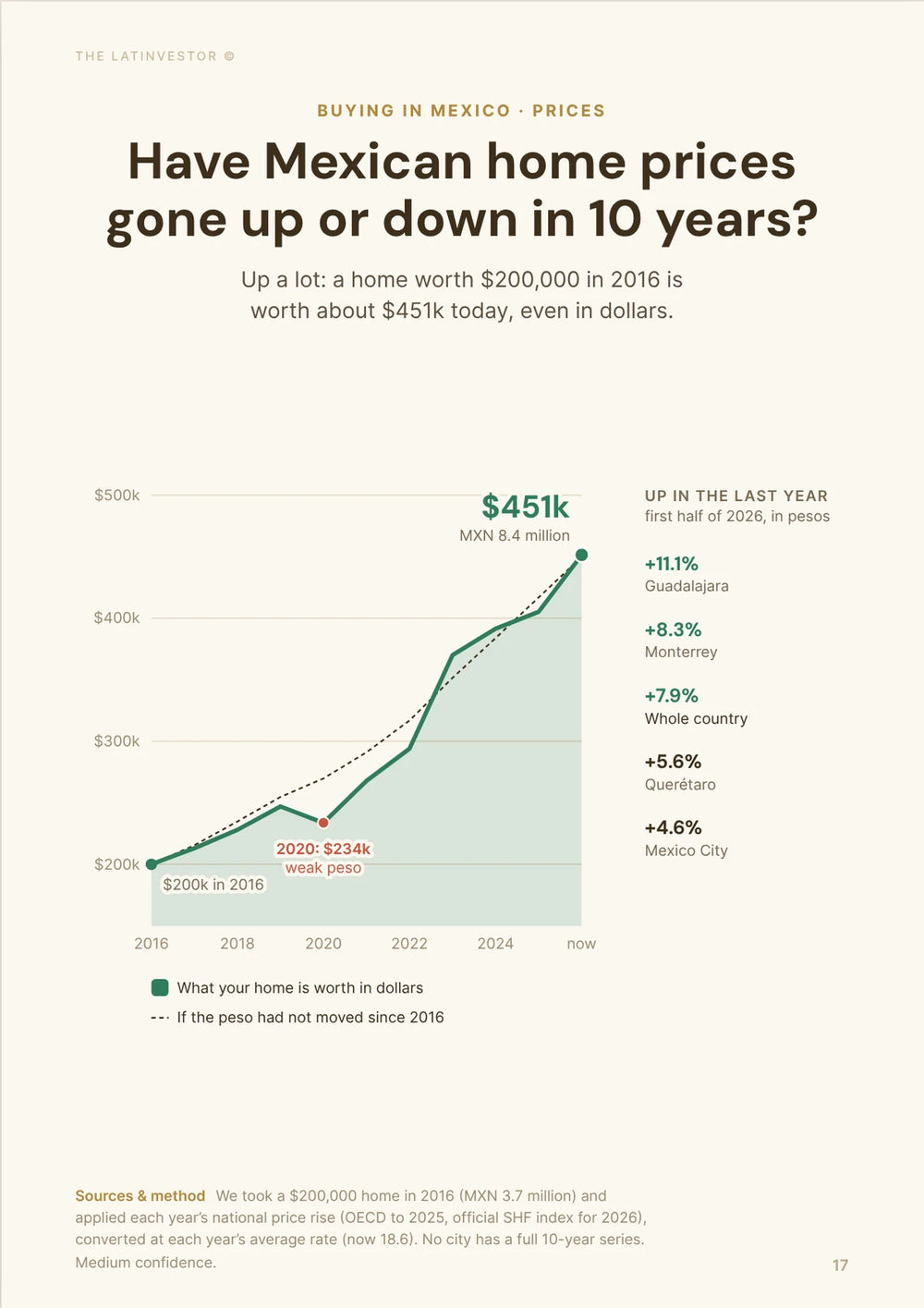
Mexico's average home price reached roughly MXN 1.74 million in 2024, according to Sociedad Hipotecaria Federal figures cited by CONAVI, and SHF's index was still up 7.3% year over year in the second quarter of 2026. CONAVI calculated that buying at that price without spending more than 30% of income on the payment takes about MXN 24,116 a month. Only 38.7% of households earn that much.
Financing doesn't help. New bank mortgages averaged 10.13% in March 2026, according to Banco de México, and BBVA Research found the number of mortgages granted in the first half of 2026 up only 0.3% from a year earlier.
A household that can't buy in Mexico City, Guadalajara or Monterrey doesn't disappear from the housing market. It stays in the rental pool, often for years.
Do rising rents make buying to rent out worth it now?
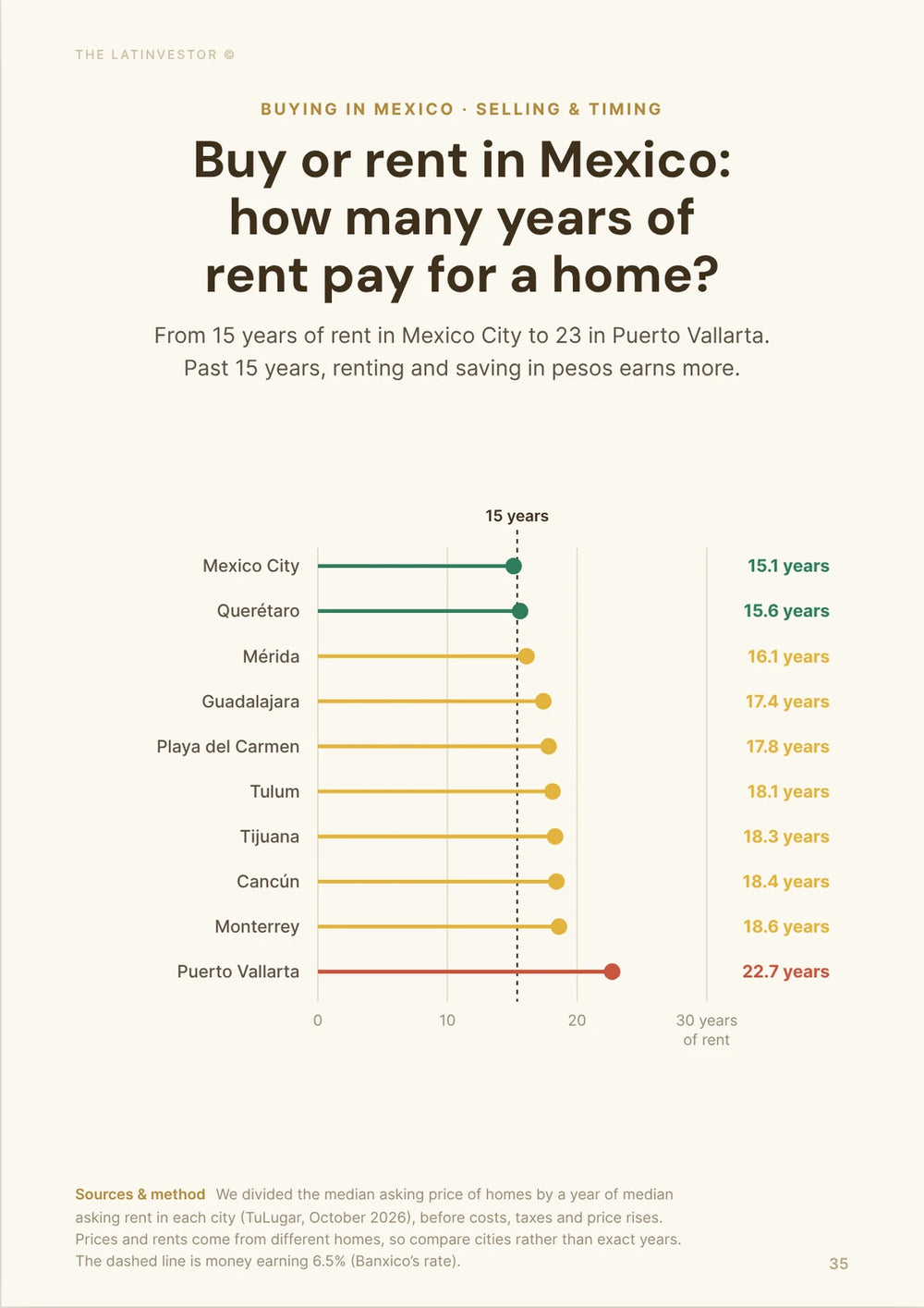
Not on borrowed money. Gross rental yields in Mexico were about 5.8% before costs in Global Property Guide's June 2026 survey, while new bank mortgages cost around 10%. Rising rents help, but they don't close that gap.
Prices are also moving up: SHF's national index rose 7.3% in the year to the second quarter of 2026. So the rent you collect grows, but so does what you pay to get in.
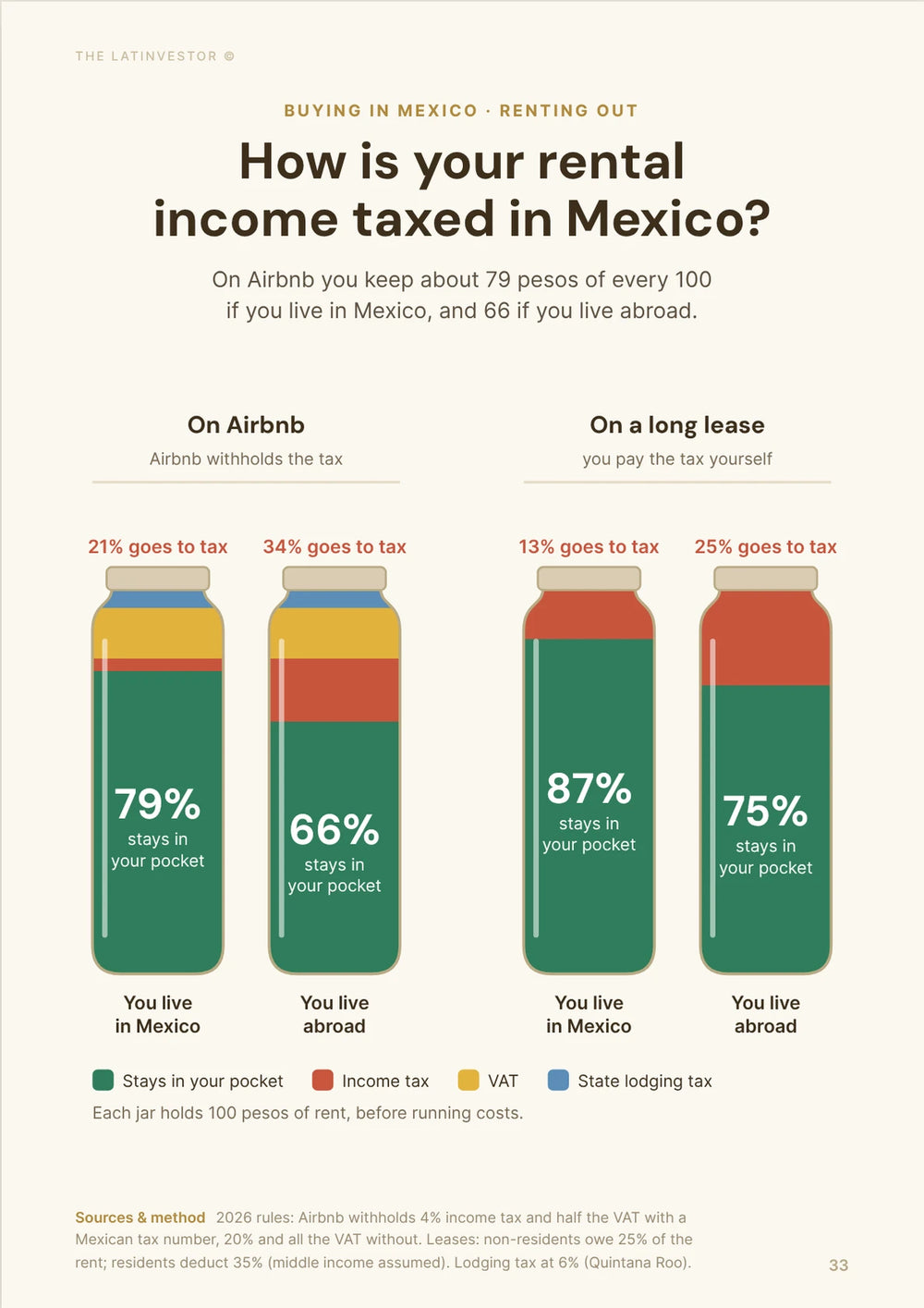
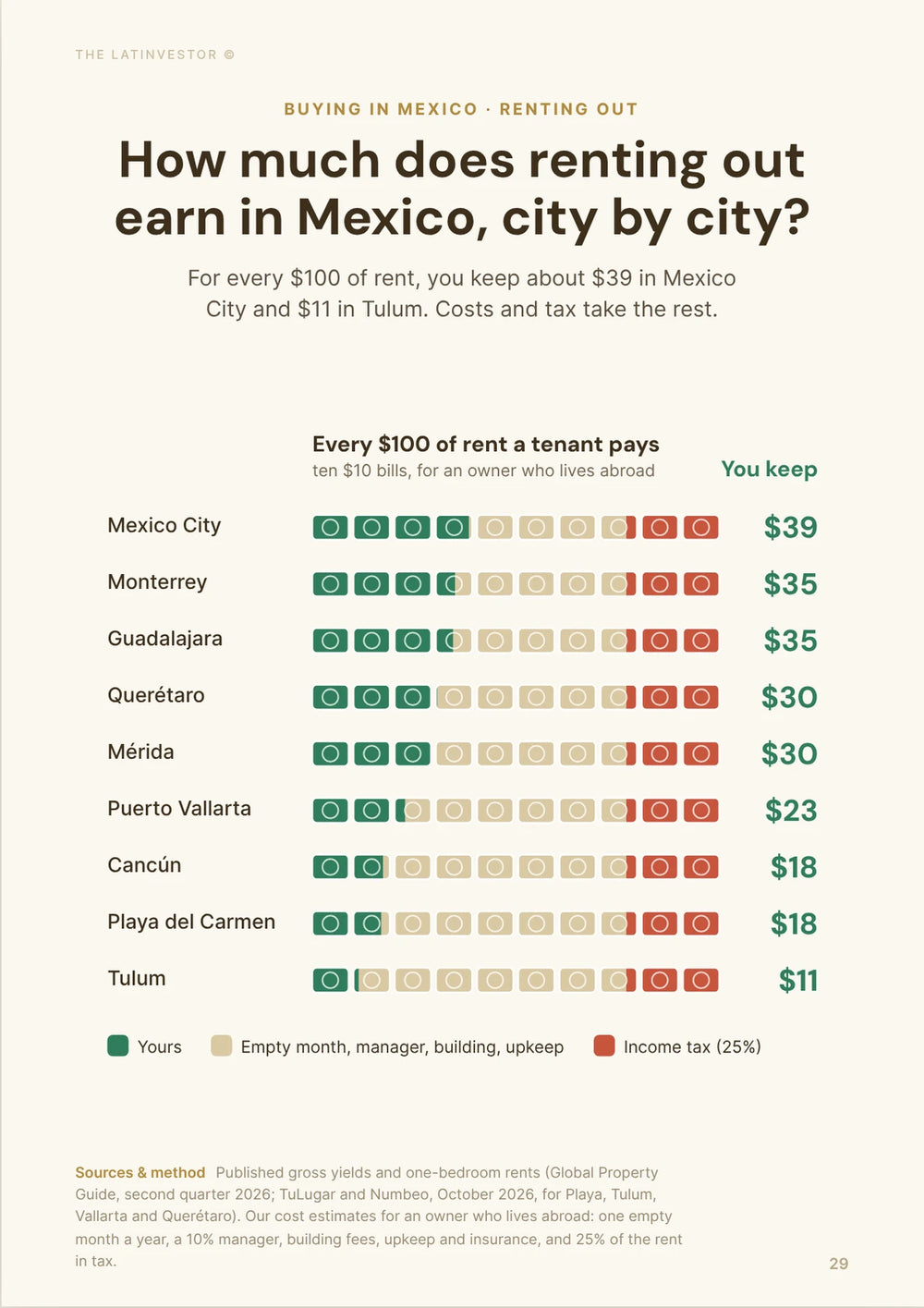
If you're a non-resident, Mexico can withhold 25% of gross rent as income tax, with no deduction for expenses. Run the numbers on net income after that tax, maintenance, vacancy and management, not on the listing's gross yield.
What works better right now: buying cash, in neighborhoods with steady local demand rather than the most hyped central streets (Benito Juárez asking rents rose a steadier 6.9% in a year), and pricing your rent off the Inmuebles24 index for that neighborhood, not off what Airbnb hosts claim to make.
Is Airbnb still pushing up Mexico City rents?
In a few central neighborhoods, yes. Across Mexico as a whole, Airbnb is not the main reason rents went up.
INFONAVIT compared short-term and traditional online rentals in Mexico City and found short-term rentals averaged roughly MXN 8,600 a month more than traditional homes.
The gap reached MXN 10,400 in Miguel Hidalgo, where the median traditional rent in its sample was around MXN 11,000 and the short-term median roughly MXN 21,400. That's a strong incentive for landlords to aim for visitors and remote workers in Roma, Condesa, Juárez or Polanco.
But with more than six million renter households nationally, Airbnb can't explain the whole cycle. It makes the shortage worse in a small number of neighborhoods where locals already compete for limited housing.
Did the World Cup push long-term rents up for good?
No. The World Cup spike hit short-stay listings, not long-term leases. In June 2026, the month the tournament opened, Inmuebles24's long-term indexes rose just 0.5% in Mexico City, 0.3% in Guadalajara and 0.6% in Monterrey.
The short-stay side was a different world. N+ tracked 90 accommodation listings in the three host cities in May and June 2026 and found event prices set 248% above normal in Mexico City, 392% in Guadalajara and 660% in Monterrey. Many of those quotes were cut once bookings failed to match the hype.
What to do with that: if you're buying to rent out, ignore any income projection built on World Cup nightly rates. If you're renting, a landlord who kept a unit empty for the tournament may now be more open to a long lease at the index price. Check the neighborhood figure on Inmuebles24 before you negotiate.
How much can a Mexico City landlord raise your rent in 2026?
If you're renewing, no more than last year's official inflation. If the apartment goes back on the market, there's no limit on the new asking rent.
Mexico City changed its Civil Code in 2024 so that annual residential rent increases can't exceed the previous year's inflation rate, and the Supreme Court upheld the rule in February 2026.
For a tenant who stays, that's real protection: a landlord can't push a 10% increase just because the building next door now asks more. But when a unit is re-let, the new rent can jump to market level, which is why the gap between people who stay and people who move keeps growing.
The cap is in Mexico City's Civil Code, so it doesn't apply in Guadalajara, Monterrey or other cities, where renewal increases come down to the lease and to negotiation.
Should you renew your lease or move right now?
In Mexico City, renew if you can. Your increase is capped at last year's inflation, while new asking rents rose 9.6% in a year, and 13.7% to 15.5% in Cuauhtémoc and Coyoacán.
On a MXN 21,900 apartment, the market move over the last 12 months is worth about MXN 2,100 a month. Inflation has run between about 3.1% and 3.5% in recent readings, so a capped renewal usually costs a fraction of that.
Before you sign a renewal, ask the landlord which official inflation figure they used and get the new rent in writing. If you do move, budget for a deposit of about one month's rent plus a guarantor (fiador or aval) or a póliza jurídica, which landlords commonly ask for.
Outside Mexico City there's no cap, but the market can work for you. In Monterrey, where asking rents rose 1.5% in six months, below inflation, there's little reason to accept a large renewal increase.
Could rents across Mexico start falling soon?
A broad fall looks unlikely. Slower increases and local corrections are much more plausible.
Rent growth has already stalled in Monterrey, which is flat after inflation, and Tijuana's asking rents fell about 9% in 2025. Inflation is running around 3.5%, formal wages are growing faster, and rents in occupied homes have cooled.
But demand hasn't weakened enough for a nationwide drop. Mexico keeps creating households, buying stays hard with mortgages around 10%, and supply is still tight in the big job centers. Mexico City and Guadalajara keep showing that desirable urban markets can rise even when national inflation cools.
A recession, a big jobs shock or a much larger wave of new housing could change that. Nothing in the current data says it's happening yet.
So, are rents still rising in Mexico?
Yes, but the boom is now local, not national.
Mexico City asking rents rose 9.6% in the 12 months to June 2026 and sit about 64% above their late-2021 low. Guadalajara gained 4.3% in six months and is about 73% above its 2020 level. Monterrey rose only 1.5%, flat after inflation, and Tijuana has already corrected.
Official data, which follow existing leases, show a few percent a year. People entering the most competitive neighborhoods face much sharper increases.
So if you're renting in Mexico City or Guadalajara, don't expect broad price cuts; if you're buying to rent out, don't assume the last five years will repeat. The city, the neighborhood and whether you're renewing or moving matter almost as much as the national trend.
Our methodology
This article estimates whether rents are still rising in Mexico, and where. We separate rents already being paid (official data on occupied homes) from the asking rents a new tenant faces today (listing portals), and we look at the big cities one by one instead of forcing them into a single national number.
For national trends we rely on official and institutional sources first: INEGI for inflation, the housing sub-index, household counts and the ENIGH income survey; INFONAVIT for rebuilt rent trends and its study of online rentals; IMSS for formal wages; Sociedad Hipotecaria Federal, Banco de México and BBVA Research for home prices, mortgage rates and lending; SEDATU and CONAVI for public housing.
For city asking rents we use Inmuebles24's standard two-bedroom index (June 2026) for Mexico City, Guadalajara and Monterrey, El Economista's June 2026 borough breakdown for Mexico City, and Mercado Libre Inmuebles for the 2025 comparison that includes Tijuana and Querétaro. World Cup pricing comes from N+'s May-June 2026 sample of 90 listings, and rental yields from Global Property Guide's June 2026 survey. Rules come from Mexico City's Civil Code, the Supreme Court's February 2026 ruling on the rent cap and Mexico's income tax law for non-resident landlords.
We checked these figures in October 2026. Conversions use about 18.6 pesos per US dollar and 20.9 pesos per euro.
Limits: asking rents are what landlords hope to get, not signed lease prices, and portal listings lean toward more expensive, formally marketed homes. A city figure doesn't apply to every neighborhood, and the standard two-bedroom index describes one type of apartment, not every rental.
Key sources used for this analysis include: INEGI's August 2026 consumer-price release, México, ¿cómo vamos? on September 2026 inflation, INEGI's INPC component tables, INFONAVIT's Digital Rental Housing Market in 2025, Inmuebles24's Mexico City Rent Index, Inmuebles24's Guadalajara Rent Index, Inmuebles24's Monterrey Rent Index, El Economista on Mexico City rents by borough, Mercado Libre Inmuebles on 2025 rental-market adjustments, N+ on World Cup accommodation prices, INEGI's ENIGH 2024, IMSS's June 2026 employment and salary release, SHF's housing price index for Q2 2026, Banco de México's mortgage-rate series, BBVA Research's Situación Inmobiliaria, second half 2026, Global Property Guide on Mexican rental yields, Article 158 of Mexico's Income Tax Law, the Supreme Court's Mexico City rent-cap ruling, SEDATU on Vivienda para el Bienestar progress, NorthAmericans' guide to renting in Mexico and CONAVI's Social Housing Program.