Summary
Guadalajara is still the best all-round place to buy in Mexico: metro prices rose 11.1% in the first half of 2026, against 7.9% nationally, and the demand behind them is local, not tourist.
Mexico is several markets at once. Quintana Roo rose 11.5% and Jalisco 11.2%, while Mexico City managed only 3.9%.
Guadalajara is cooling a little, though. Its quarterly index went from 12.3% growth in the first quarter of 2026 to 10.0% in the second, so buy for the long run, not for a quick flip.
Mérida is the safest second choice. Yucatán prices rose 9.6%, airport traffic is up 6.1% this year, but about 12,800 homes are now for sale, so buyers have room to negotiate.
Puerto Vallarta still earns the most from short-term rentals among the big beach towns, about $31,300 a year per listing, but nightly rates fell 17.6% and airport traffic is down 12.3%.
Playa del Carmen beats Tulum today: 58% occupancy against 46%, and RevPAR up 3.9% while Tulum's fell 10.7%.
Tulum is where prices and rents disagree the most. Home sales fell from 3,487 in 2023 to 1,711 in 2025 while new condos kept coming.
Los Cabos is the luxury pick, with hotel rates around $440 a night, but you pay entry prices around MXN 2.62 million on average for Baja California Sur, the second-highest in the country.
Mexico City costs the most (about MXN 4.29 million for an average mortgaged home) and grows the slowest, so you are paying for resale depth, not growth.
Querétaro is a fair long-term buy but has slowed from 7.2% to 5.6% growth, behind Guadalajara and Mérida.
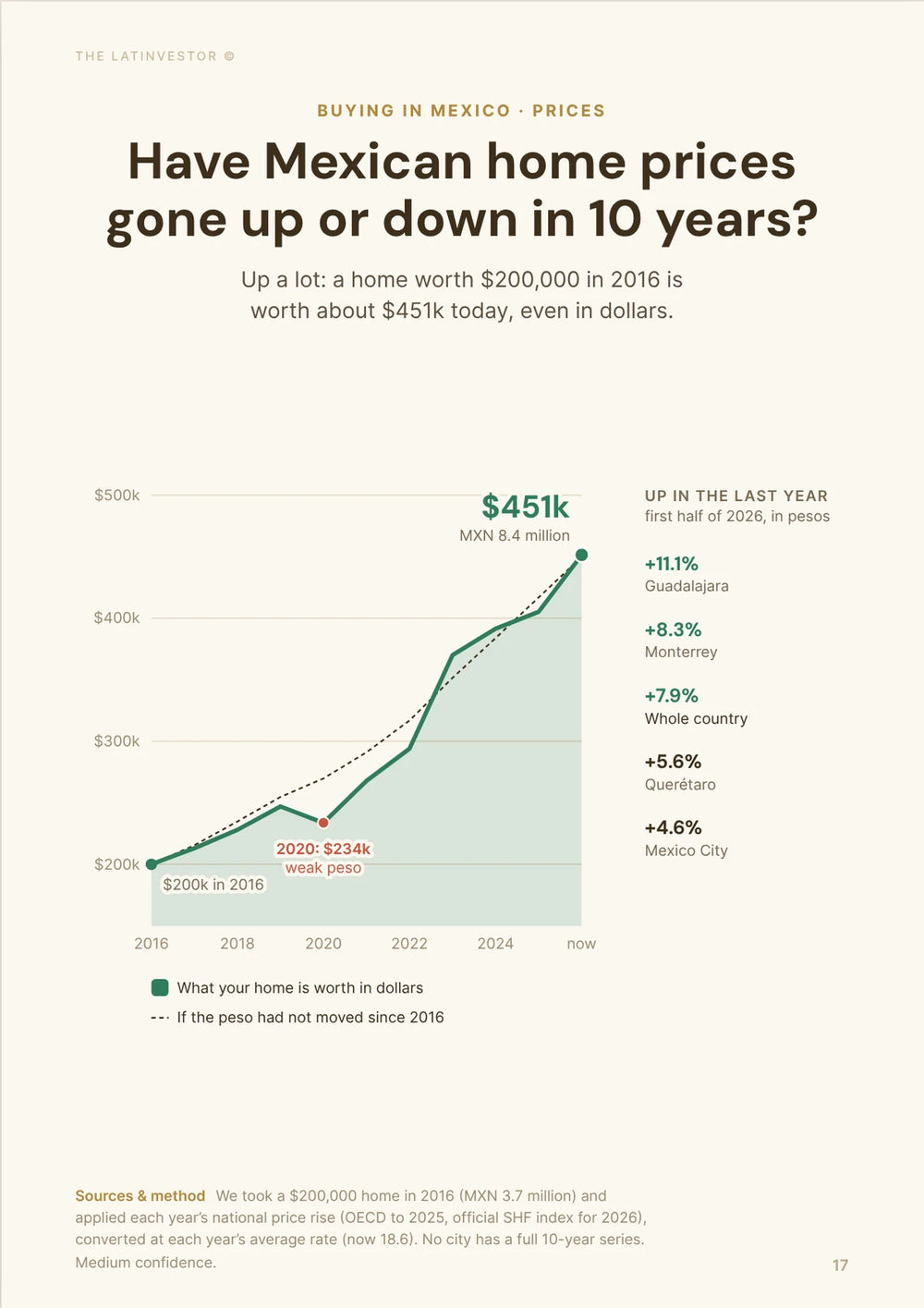
Prices still beat inflation by a wide margin (7.9% vs 3.45%), even with mortgage rates around 11.3% and the number of new mortgages flat.
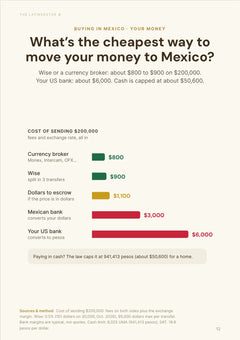
The peso has weakened since early September (from under 17 to about 18.6 per dollar), so dollar buyers get more pesos than a few weeks ago, though still about 3% fewer than at the 2025 average. Most forecasts see it firming up again, so waiting for a better rate is a weak plan.
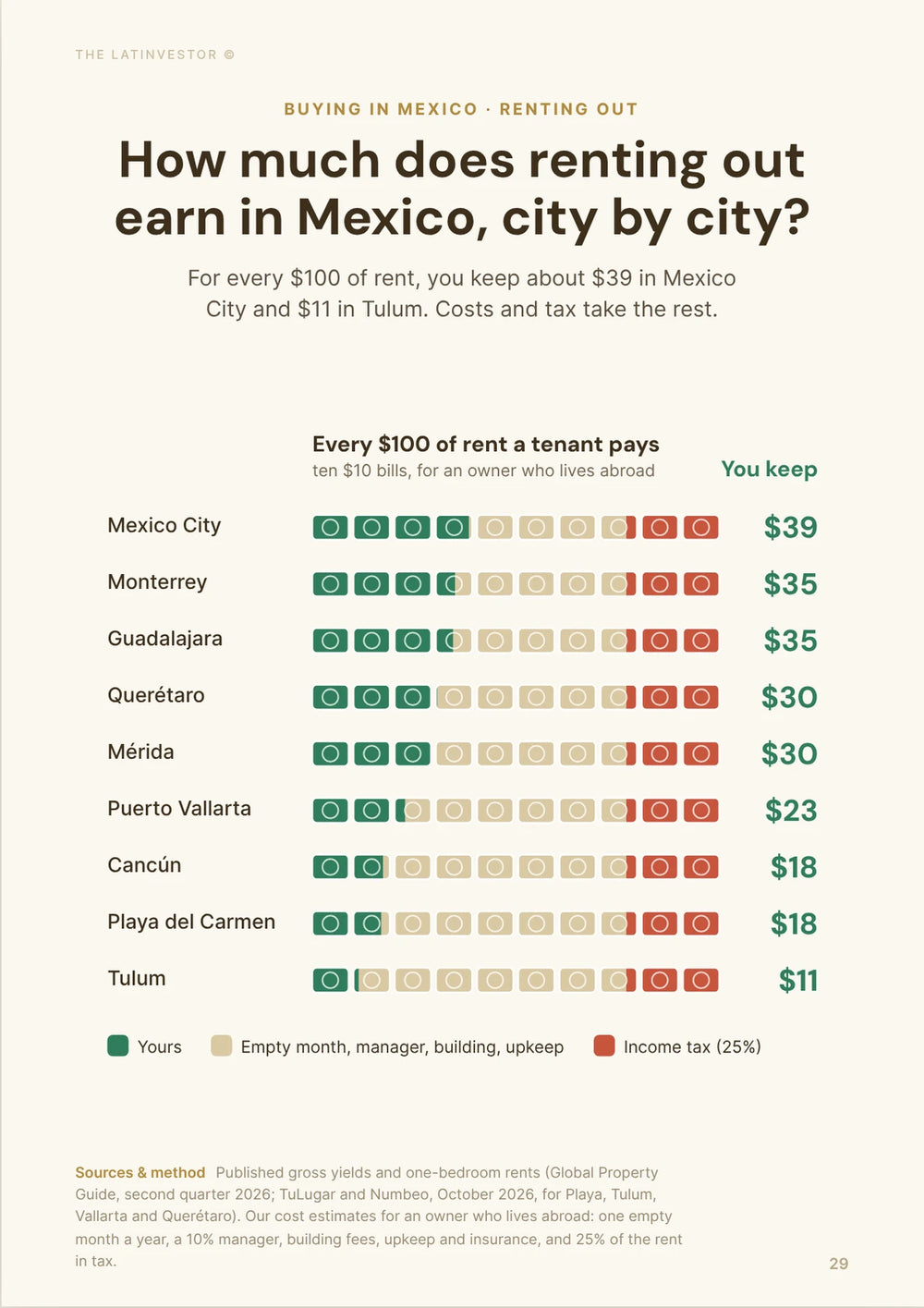
Airbnb rules are tightening: Mexico City has a 50%-of-nights cap on the books, Quintana Roo requires registration, and Jalisco is debating a 5% to 11% levy on multi-property owners.
Our pick: Guadalajara for an all-round investment, Mérida for living and renting, Puerto Vallarta for rental income, Los Cabos for luxury, Playa del Carmen in the Riviera Maya, and Mexico City for liquidity.

Why is there no single best place to buy in Mexico?
Because it depends on what you want most: price growth, rental income, easy resale, or just not making a bad purchase.
Mexico does not move as one market. According to Sociedad Hipotecaria Federal (SHF), national home prices rose 7.9% in the first half of 2026 compared with the first half of 2025. Jalisco gained 11.2%, Quintana Roo 11.5%, Yucatán 9.6% and Querétaro 5.7%, while Mexico City managed just 3.9%.
Even two cities in the same state can behave very differently. Guadalajara and Puerto Vallarta are both in Jalisco, but Guadalajara lives on a large local economy while Puerto Vallarta lives on visitors and foreign buyers.
Rentals widen the gap. AirDNA puts average short-term-rental occupancy at about 58% in Mérida, 57% in Puerto Vallarta, 58% in Playa del Carmen and 46% in Tulum, on top of very different nightly rates, supply and seasons.
So we judge each market on what is happening now, how much buyers are already paying for the story, and how many things need to go right for the purchase to work.
| Market | Main strength | Main weakness | What we would be betting on |
|---|---|---|---|
| Guadalajara | Local demand + price growth | No tourism premium | Continued broad economic growth |
| Mérida | Balanced demand + tourism | Lower nightly rates, lots of new supply | Continued population and visitor growth |
| Puerto Vallarta | Strong vacation-rental revenue | Tourism exposure, falling air traffic | Visitors coming back |
| Playa del Carmen | Caribbean demand + price growth | Heavy condo competition | Rental demand absorbing supply |
| Tulum | Strong price story | Weak rentals, falling sales | Supply eventually tightening |
| Los Cabos | Premium foreign demand | Expensive entry prices | Luxury tourism staying resilient |
| Mexico City | Liquidity + deep demand | Slow appreciation, highest prices | Scarcity protecting long-term values |
Which Mexican property markets are rising fastest in 2026?
Guadalajara and the Caribbean are rising fastest among the places foreign buyers actually look at.
SHF figures for the first half of 2026 put Guadalajara metro at 11.1%. At state level, Quintana Roo rose 11.5%, Jalisco 11.2%, Nayarit 10.6%, Baja California Sur 9.8% and Yucatán 9.6%.
Other large inland markets are calmer. Monterrey rose 8.3%, Querétaro 5.6% and the Valley of Mexico 4.6%.
Playa del Carmen is still climbing fast too. SHF reported 11.7% for the municipality, one of the highest rates in the country, and 11.4% for Cancún.
Guadalajara stands out because its growth has lasted: 11.3% in 2025, then 11.1% in the first half of 2026, while the national rate slowed from 8.7% to 7.9%.
One warning sign: the second quarter on its own was softer everywhere. Nationally the yearly change fell from 8.6% to 7.3%, and in Guadalajara from 12.3% to 10.0%. Still strong, but the peak is probably behind us.
| Market | First half 2026 | 2025 where available | What the trend looks like |
|---|---|---|---|
| Guadalajara metro | 11.1% | 11.3% | Strong, easing a little |
| Quintana Roo | 11.5% | — | Very strong |
| Nayarit | 10.6% | — | Very strong |
| Baja California Sur | 9.8% | — | Strong |
| Yucatán | 9.6% | — | Strong |
| Monterrey metro | 8.3% | 9.4% | Still strong, but slowing |
| Querétaro metro | 5.6% | 7.2% | Clearly slowing |
| Valley of Mexico | 4.6% | 5.1% | Slow appreciation |
Is Guadalajara still the best place to buy now that the World Cup is over?
Yes. Guadalajara is still our strongest overall choice because prices are rising fast without depending on tourism or foreign buyers.
Price growth is the first reason. Guadalajara metro prices rose 11.3% in 2025 and another 11.1% in the first half of 2026, against 7.9% nationally.
Travel demand is holding up after the World Cup. Grupo Aeroportuario del Pacífico (GAP) counted 14.27 million Guadalajara passengers from January to September 2026, up 4.2% on 2025. July, the World Cup month, jumped 13.2%; September was back to flat (down 0.9%). So the tournament gave a short boost, not the base of the story.
Compare that with the beach airports in the same group: Puerto Vallarta is down 12.3% over the same nine months and Los Cabos down 5.6%.
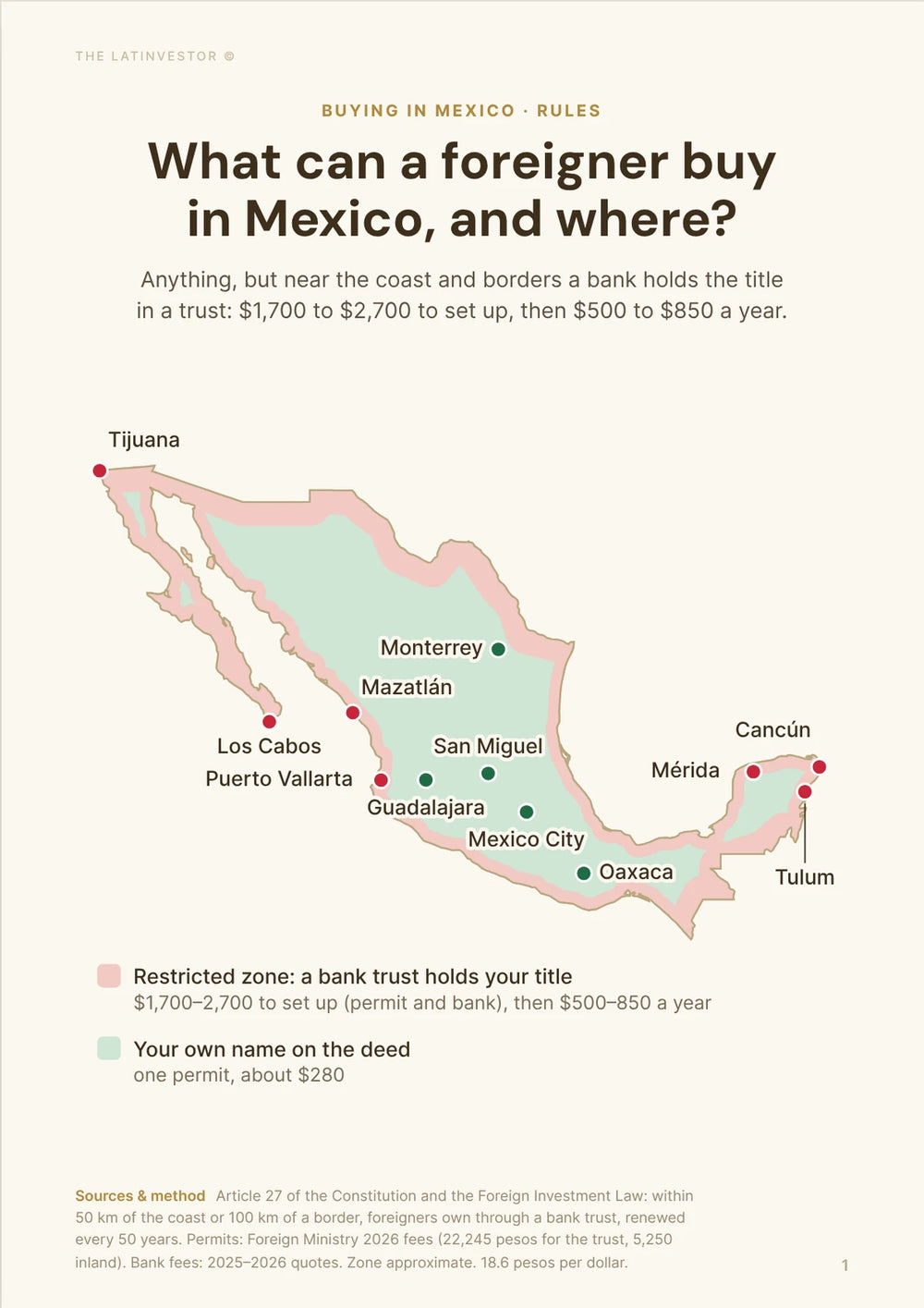
Guadalajara is also outside Mexico's restricted coastal zone, so a foreign buyer can hold the title directly instead of going through a bank trust (fideicomiso).
That doesn't make every project a good buy. With growth slowing from 12.3% to 10.0% between the first and second quarters, we would stick to established areas with real local resale demand, not far-out projects sold on promised appreciation.
The point is that Guadalajara still works if tourism cools, Airbnb gets more crowded or foreign buyers slow down. That is what we like most about it.
Is Mérida the best lower-risk alternative to Guadalajara?
Yes, Mérida is the best lower-risk alternative right now, especially if you want to live in the home part of the year and still rent it out.
Yucatán home prices rose 9.6% in the first half of 2026 (SHF), above the national rate. Mérida's airport is growing too: ASUR counted 3.05 million passengers from January to September 2026, up 6.1% on 2025.
Rentals are steady. AirDNA tracks about 4,900 short-term rentals in Mérida, with occupancy around 58%, annual revenue near $13,200 per listing and an average daily rate around $67. Nightly rates fell 11.5% over the year, but RevPAR (revenue per available night) rose 14%, because more nights got booked.
Those numbers look small next to Puerto Vallarta, but demand is spread more evenly through the year, which matters if you want steady income rather than a few great months.
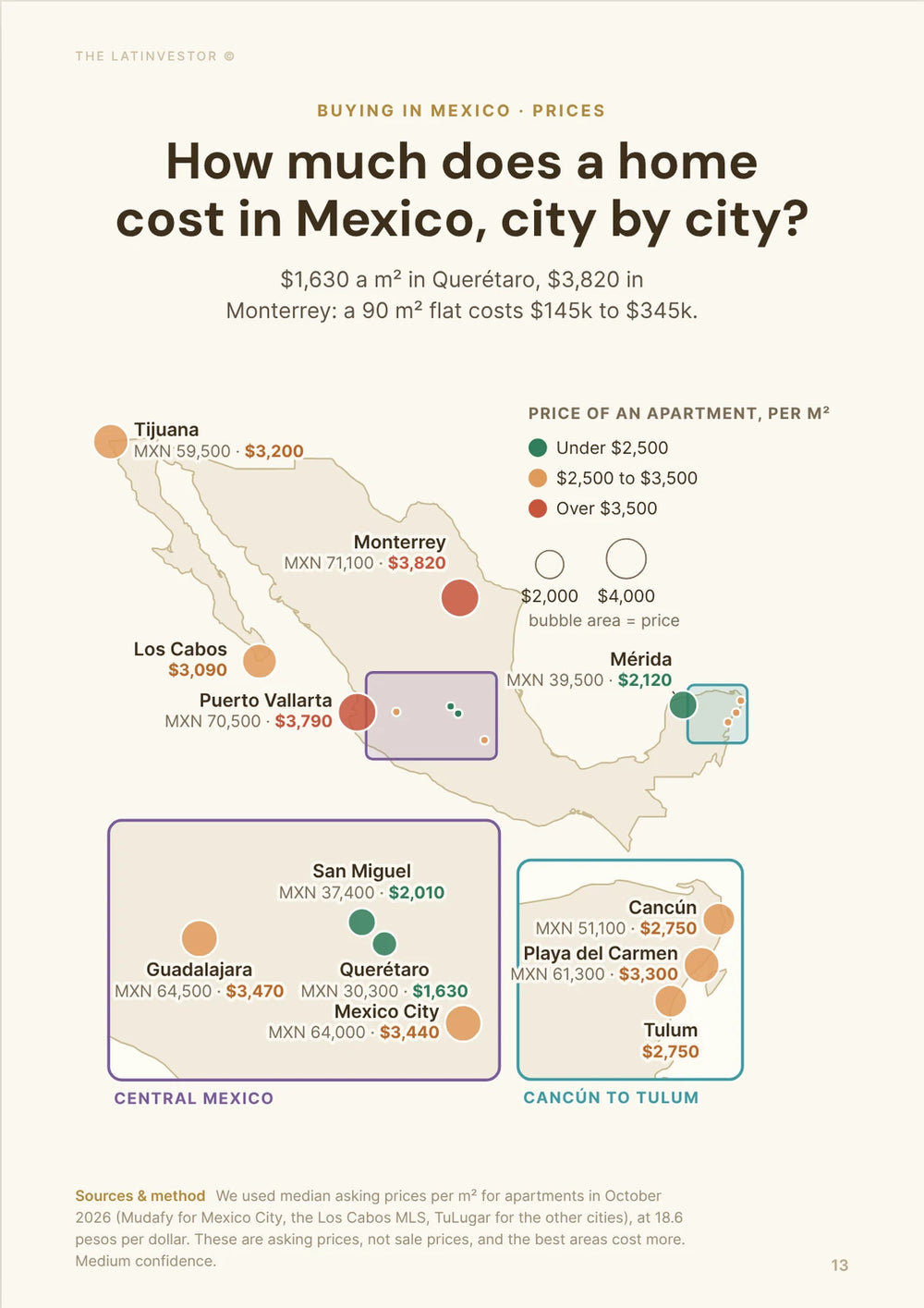
The catch: Mérida is no longer cheap, and supply has caught up. Yucatán's average mortgaged home now costs about MXN 2.02 million (about $108,000), and Tinsa counted roughly 12,800 homes for sale in the metro area in October 2026, with prices up about 11% a year.
With that much stock on offer, you can negotiate, especially on new builds in the north (Temozón, Cholul). We would still keep Mérida near the top: local demand, tourism and airport growth together make it a balanced bet.
Is Puerto Vallarta still the best place in Mexico for rental income?
It is still one of the best for vacation-rental income, but owners are working harder for that money than a year ago.
AirDNA tracks about 5,900 active short-term rentals in Puerto Vallarta. Average occupancy is near 57%, annual revenue about $31,300 per listing and the average daily rate about $178.
That is far more cash than Mérida, where the average listing makes about $13,200 a year.
The problem is the direction. Puerto Vallarta's average daily rate fell about 17.6% over the year to September 2026, and RevPAR about 10.5%.
Visitors are down too. GAP counted about 4.54 million Puerto Vallarta passengers from January to September 2026, 12.3% fewer than a year earlier, and September alone fell 10.4%.
Jalisco prices are still rising fast, so Puerto Vallarta has not turned into a weak property market. But you can't count on tourism pushing your rental income up every year.
If cash flow from holiday rentals is what you want, Puerto Vallarta stays near the top. For the best all-round purchase, Guadalajara looks cleaner.
| Puerto Vallarta measure | Current level / change | What it tells us |
|---|---|---|
| Short-term-rental occupancy | 57% | Healthy |
| Average annual revenue per listing | $31.3K | Strong |
| Average daily rate | $178 | High prices per night |
| Daily rate change | -17.6% YoY | Clear pricing pressure |
| RevPAR change | -10.5% YoY | Lower earnings per night |
| Airport traffic Jan–Sep 2026 | -12.3% YoY | Fewer visitors |
| Jalisco home prices (first half 2026) | +11.2% | Property prices still strong |
Is Playa del Carmen a better buy than Tulum now?
Yes. Playa del Carmen is the better Riviera Maya purchase today because its rentals are holding up better while prices keep rising.
SHF reported 11.7% price growth for Playa del Carmen in the first half of 2026. Quintana Roo as a whole rose 11.5%.
AirDNA tracks about 6,500 short-term rentals in Playa del Carmen and about 3,600 in Tulum. Playa averages around 58% occupancy, Tulum only 46%.
Average annual revenue is a bit higher in Playa too: about $18,800 per listing against $17,400 in Tulum.
Both have cut prices hard. Playa's average daily rate fell about 19.2% over the year and Tulum's about 23.6%. But Playa filled more nights, so its RevPAR rose 3.9%, while Tulum's fell 10.7%.
Playa also works like a normal city, with residents, shops, schools and transport. That gives you a second pool of tenants and buyers if tourism slows.
| Metric | Playa del Carmen | Tulum |
|---|---|---|
| Short-term rental listings | ~6,500 | ~3,600 |
| Occupancy | 58% | 46% |
| Average annual revenue | $18.8K | $17.4K |
| Average daily rate | $103 | $125 |
| Daily rate change (YoY) | -19.2% | -23.6% |
| RevPAR (rate × occupancy) | ~$60 | ~$58 |
| RevPAR change (YoY) | +3.9% | -10.7% |
Has Tulum become too risky for property buyers?
Too risky for us to call it the best market, yes: prices are still climbing while rentals and sales are getting weaker.
That gap is the whole Tulum story right now. Quintana Roo posts double-digit price growth, yet AirDNA puts Tulum occupancy at about 46%, with daily rates down about 23.6% and RevPAR down about 10.7% over the year.
Sales tell the same story. El Economista, citing a survey of Tulum's housing supply, counted 3,487 homes sold in 2023 and only 1,711 in 2025, while new projects kept launching. Fewer buyers, more condos.
Visitors to the region are softening as well. Cancún Airport, which feeds Tulum, Playa and the rest of the coast, handled about 20.9 million passengers from January to September 2026, 5.9% fewer than a year earlier.
You can still find good deals in Tulum: a heavily discounted unit in a proven area, with a real rental history you can check. Ask for 12 months of booking data, not a developer's projection, and compare against the 46% city average.
What we would avoid is an average new-build condo bought just because Tulum grew fast. These days the unit itself has to be very good, because the market no longer does the work for you.
Is Los Cabos still the best luxury property market in Mexico?
Yes, Los Cabos is still Mexico's clearest luxury market, but its prices make it a poor default for most buyers.
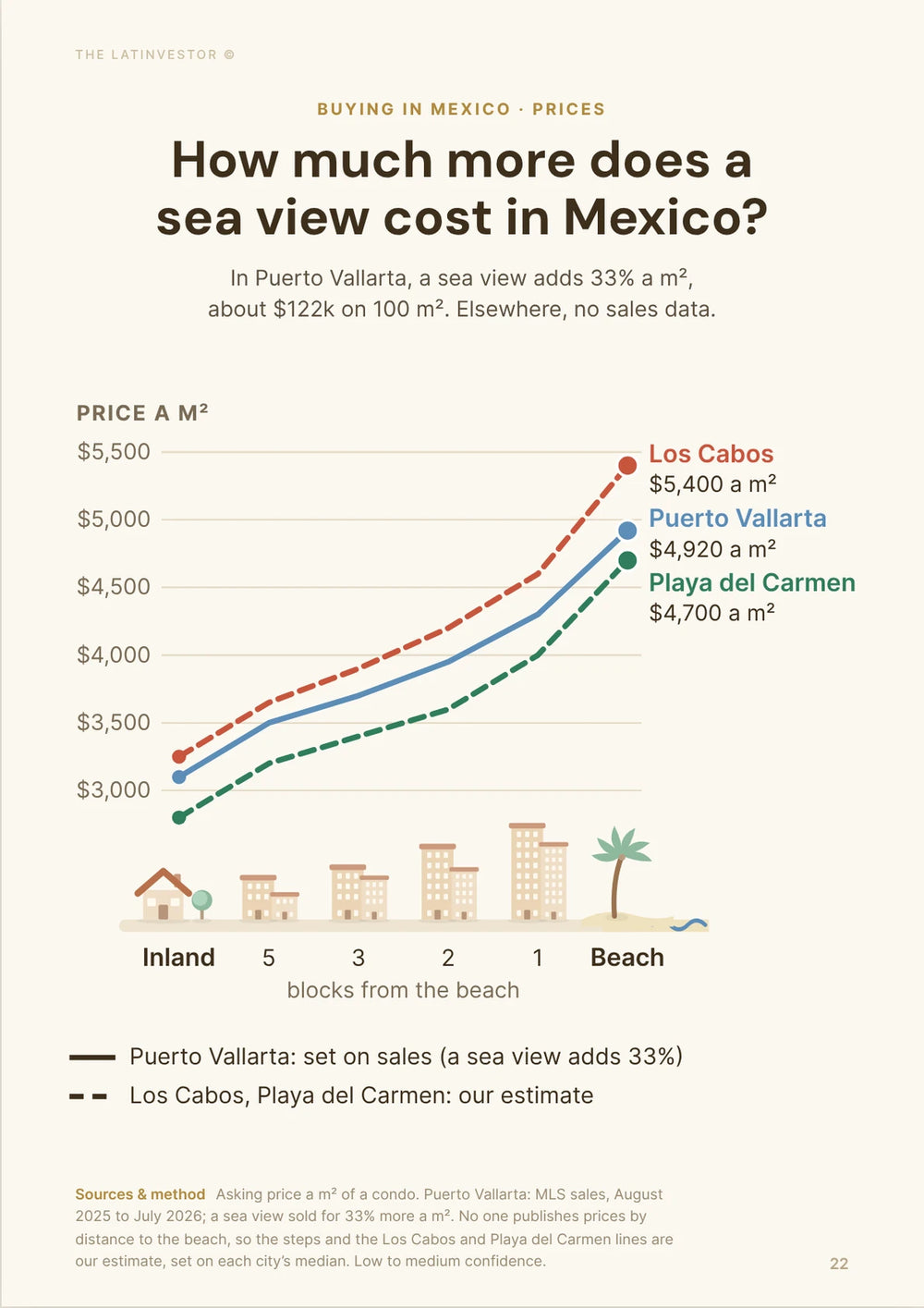
Its tourism plays in a different league. The Los Cabos Tourism Board reported nearly 3.8 million visitors in 2025, hotel occupancy around 70%, an average hotel rate around $440 a night and RevPAR near $306.
About 80% of the area's hotel rooms are five-star. That many high-spending visitors is what supports such expensive real estate.
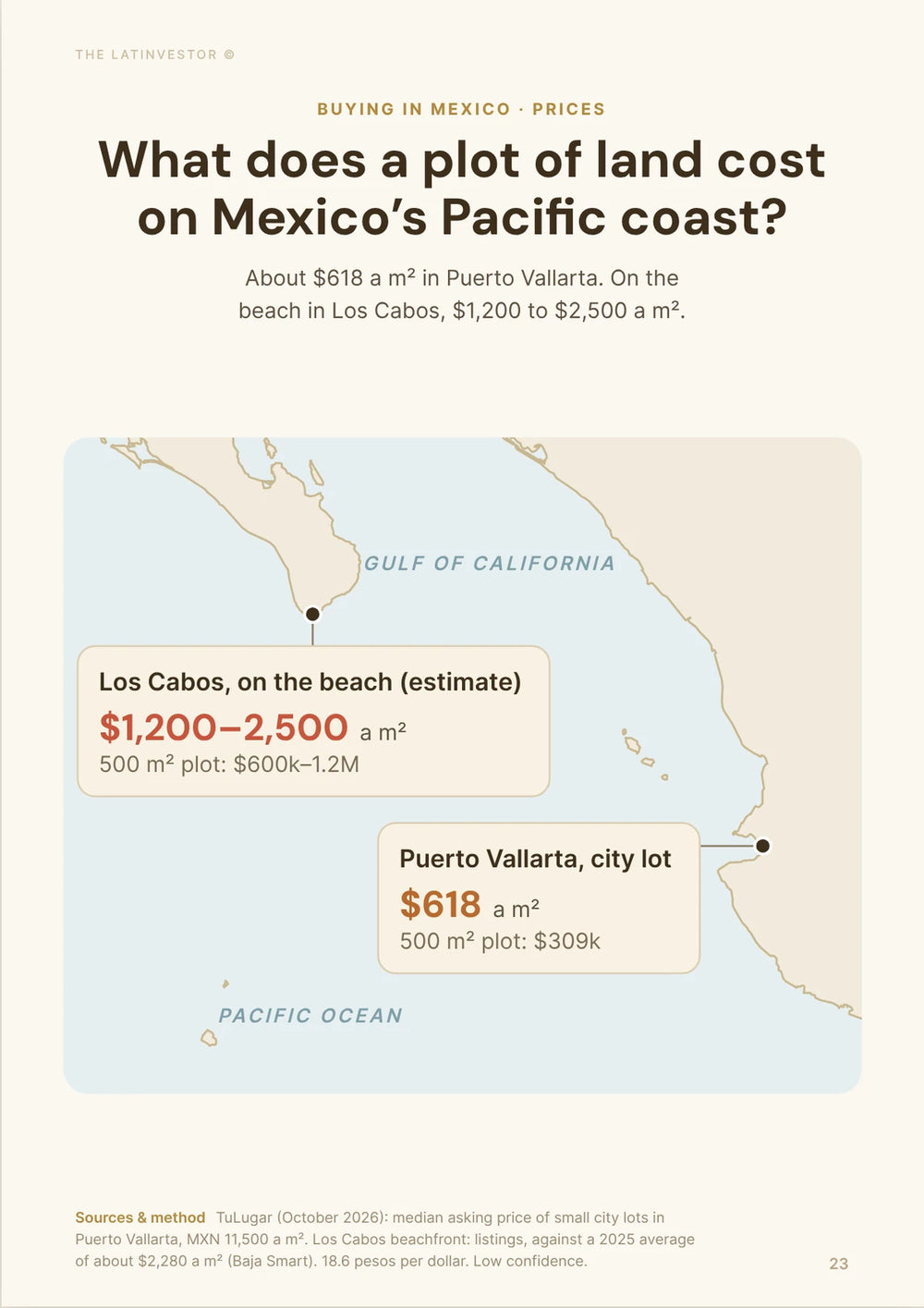
Baja California Sur is the second most expensive state for mortgaged homes, at about MXN 2.62 million (about $141,000) on average, and prices still rose 9.8% in the first half of 2026.
The softer part is air traffic. Los Cabos handled about 5.35 million passengers from January to September 2026, 5.6% fewer than a year earlier.
That is not enough to break the luxury case. But when you already pay top prices, fewer visitors matter more.
Los Cabos is where we would look for a premium second home or a luxury rental. It would not be our first choice for the best risk-adjusted investment.
Is Mexico City still worth buying when prices barely move?
Yes, for liquidity and steady demand, but you pay a big premium for that safety.
SHF puts the average mortgaged home in Mexico City at about MXN 4.29 million (about $230,000). Baja California Sur, the second most expensive state, sits around MXN 2.62 million.
That is a huge gap.
Growth is also slower than elsewhere. Mexico City rose only 3.9% in the first half of 2026 and the wider Valley of Mexico 4.6%, while Guadalajara was above 11%.
That doesn't make the capital a bad buy. It has a huge permanent population, a deep job market, little prime central land and the country's largest pool of future buyers.
The trade is simply different. In Mexico City you pay for resilience and easy resale, not fast growth. It suits a main home, a prime central apartment, or a buyer who wants to protect capital more than chase returns.
Is Querétaro still one of Mexico's best property investments?
Querétaro is still a good long-term market, but the numbers no longer justify putting it ahead of Guadalajara or Mérida.
It is already expensive. SHF puts the average mortgaged home in Querétaro state at about MXN 2.38 million (about $128,000), the third highest in Mexico behind Mexico City and Baja California Sur.
And growth has slowed. Querétaro metro rose 7.2% in 2025 but only 5.6% in the first half of 2026. The state figure was 5.7%.
That slowdown stands out next to Guadalajara, which stayed around 11% over both periods.
Querétaro still makes sense if you want a growing inland city, a long holding period and little exposure to tourism. We just don't see enough momentum right now to call it Mexico's best buy.
| Market | First half 2026 | Average mortgaged home (state) | Current read |
|---|---|---|---|
| Guadalajara metro | 11.1% | ~MXN 2.11M (Jalisco) | Strong momentum |
| Monterrey metro | 8.3% | ~MXN 2.04M (Nuevo León) | Strong |
| Querétaro metro | 5.6% | ~MXN 2.38M (Querétaro) | Moderate |
| Valley of Mexico | 4.6% | ~MXN 4.29M (Mexico City) | Slow but defensive |
Are inland Mexican cities becoming better buys than beach markets?
Right now, yes: inland cities carry less risk because their demand is local and the ownership rules are simpler for foreigners.
The split shows up in travel data. From January to September 2026, Guadalajara airport traffic rose 4.2% while Puerto Vallarta fell 12.3%, even though both cities are in Jalisco, where prices rose 11.2%.
The Riviera Maya shows the same split between strong prices and weaker rental rates. Playa del Carmen and Tulum both cut nightly rates by roughly 19% to 24% over the year.
Mérida sits in the middle. It has tourism, but its economy and housing market don't depend on beach visitors.
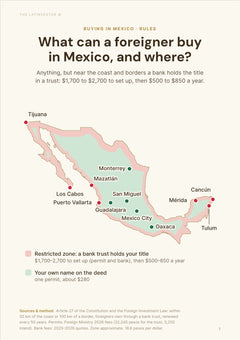
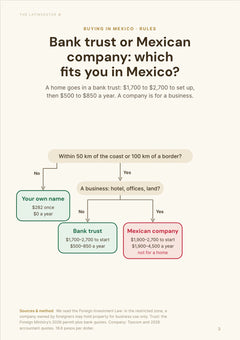
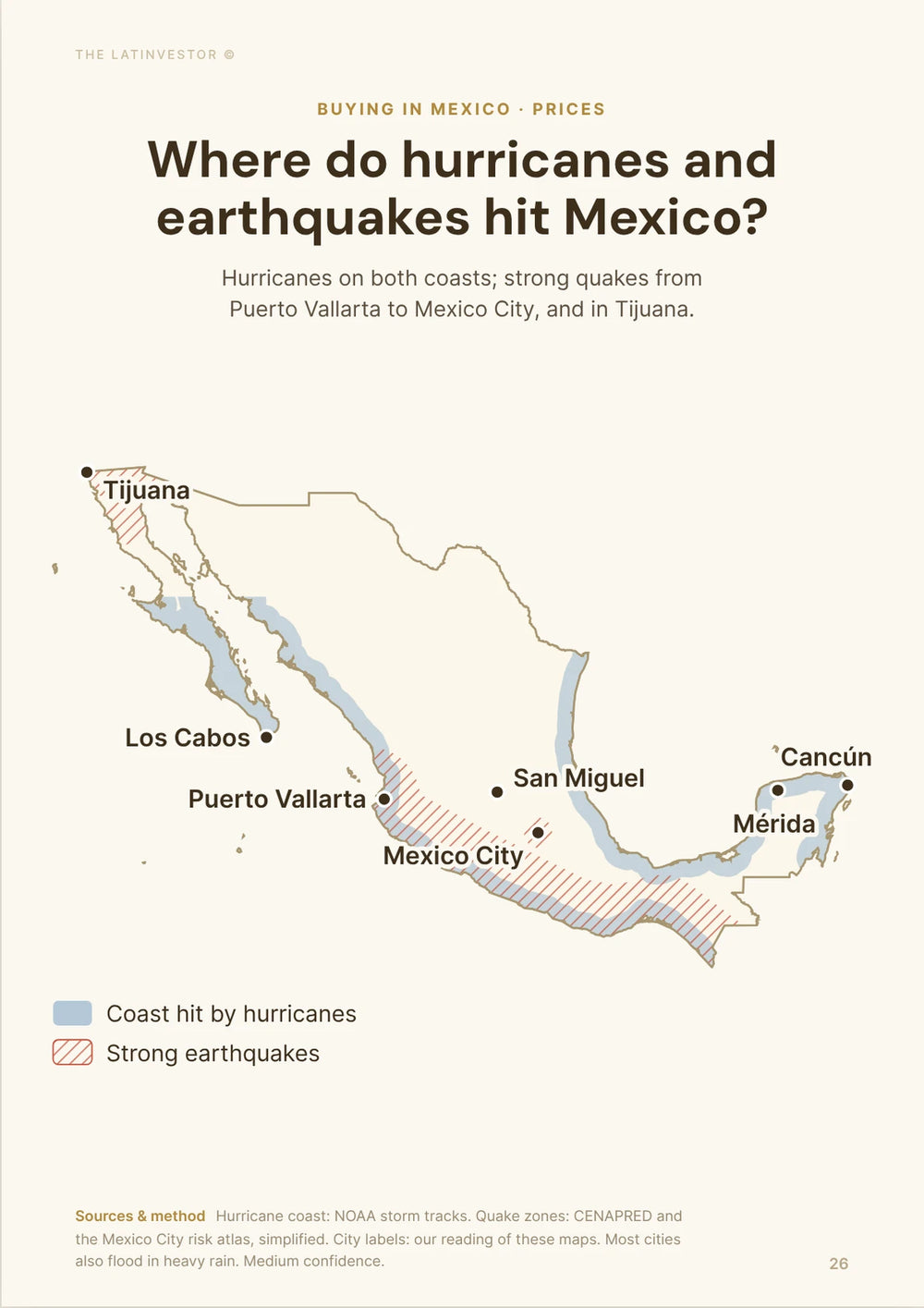
Ownership rules give inland cities a small extra edge. The Constitution bans direct foreign ownership within 50 kilometers of the coast and 100 kilometers of a border. In those zones foreigners buy through a bank fideicomiso, granted for up to 50 years and renewable.
The fideicomiso is standard and widely used, so it is no reason to avoid the coast. But Guadalajara, Mexico City and Querétaro are simpler.
Put together, the demand data and the simpler paperwork tilt the case slightly toward inland cities today.
Will new Airbnb rules change where you should buy?
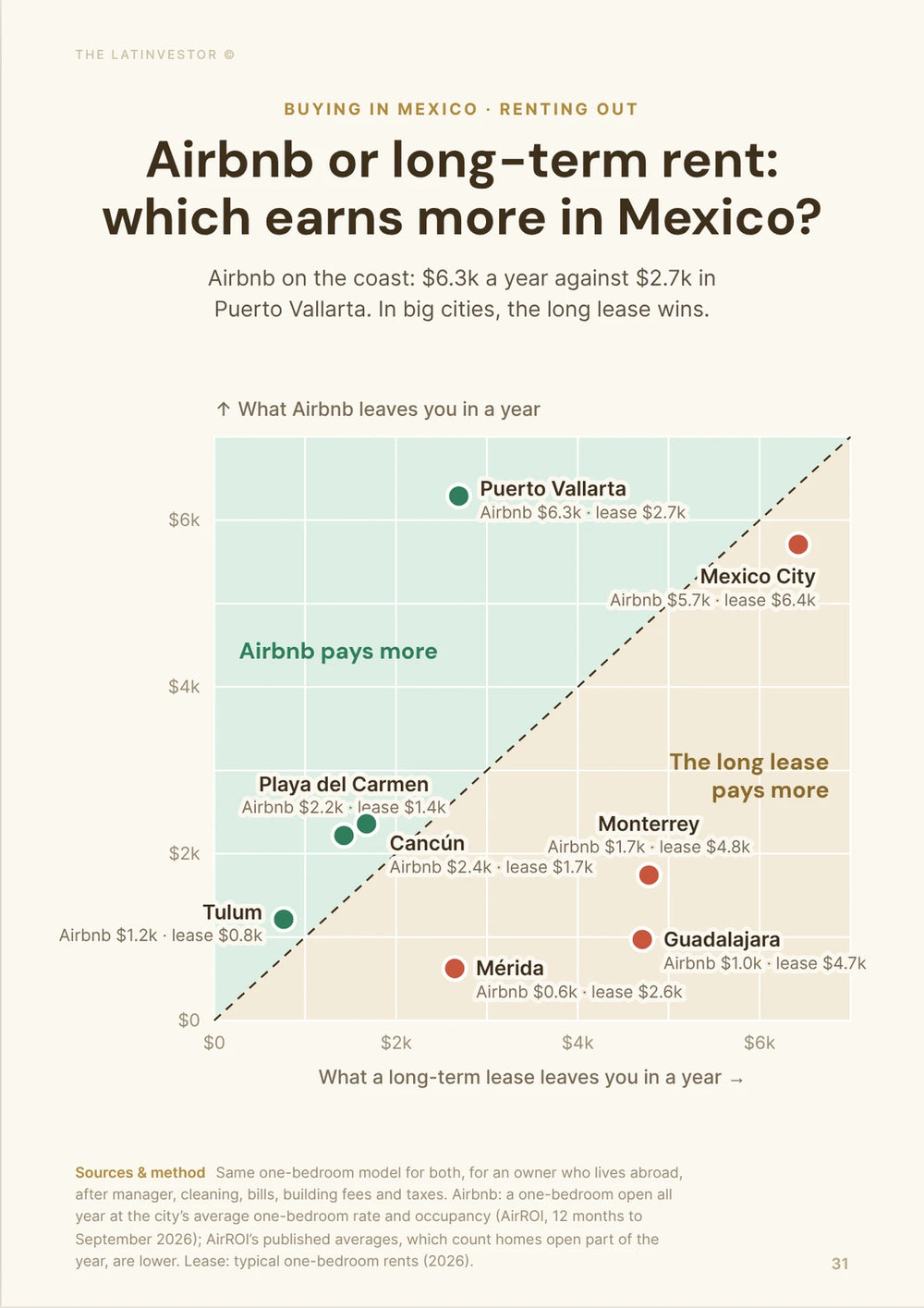
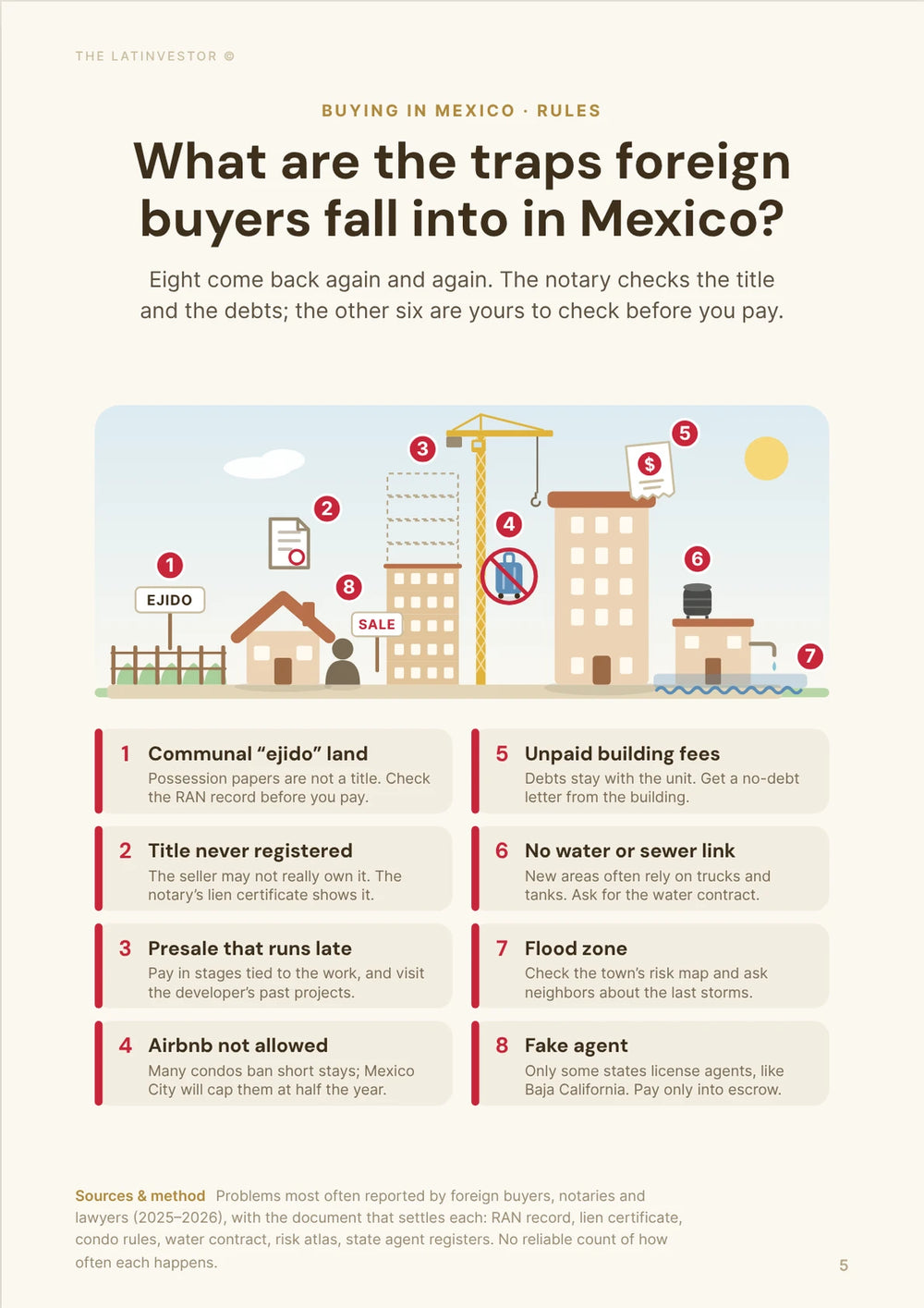
They already should. Short-term rentals are getting more regulated in the three markets foreigners like most, so check the local rules before you count on Airbnb income.
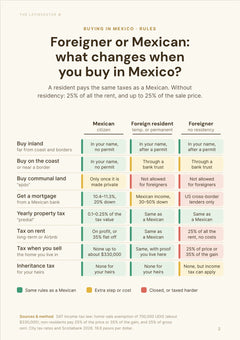
Mexico City is the strictest on paper. Its law caps short-term rentals at 50% of the nights in a year (about 182 nights), adds a host registry and limits multiple units. As of October 2026, El Financiero and Excélsior report that most of it is still not enforced because of extensions and court challenges (amparos). That is not a green light: it can be switched on later, and the cap would cut income for any unit booked more than half the year (AirDNA puts the city's average at 64%).
Quintana Roo (Cancún, Playa del Carmen, Tulum) requires state and municipal licences and registration in the state tourism registry, RETUR-Q, and the platforms are expected to require that registration. In Jalisco (Guadalajara, Puerto Vallarta), a bill filed in the state Congress in May 2026 proposes a 5% to 11% levy on owners with several short-term rentals. It is only a proposal for now.
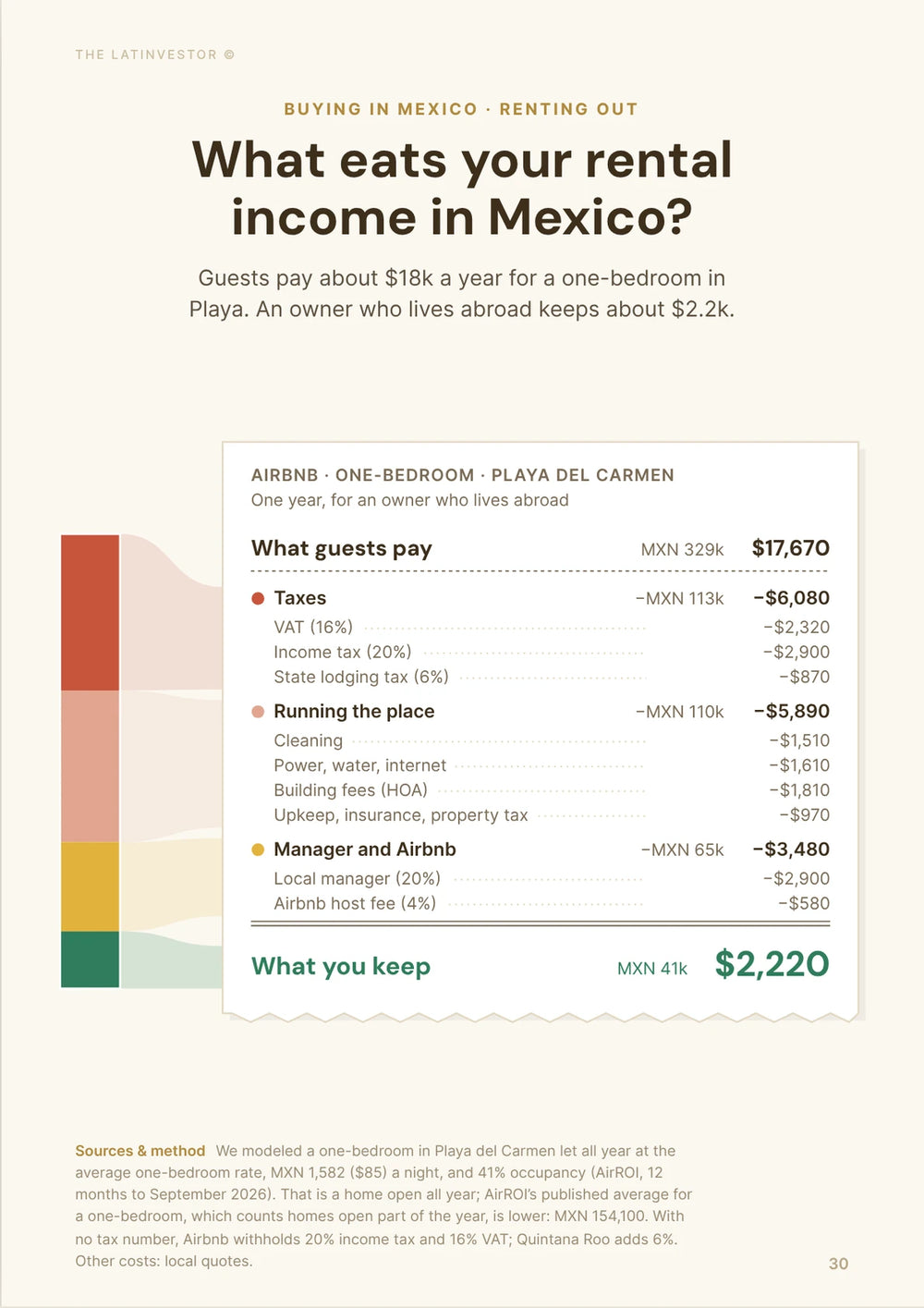
On top of that, Airbnb withholds 4% income tax for hosts who give a valid tax ID (RFC), or 20% without one, plus 16% VAT on lodging. What to do: get the RFC before your first booking, ask the seller or building for proof that short stays are allowed (many condo rules ban them), and run your numbers at 50% occupancy in Mexico City and at the city average elsewhere. If the deal only works with Airbnb, it is a weak deal.
Are Mexican property prices still rising fast enough to justify buying now?
Yes, prices are still rising well above inflation, though the national market is clearly cooling.
SHF recorded 8.7% growth nationwide in 2025 and 7.9% in the first half of 2026.
Inflation was 3.45% in September 2026 (INEGI), so home prices are still rising at more than twice that rate.
Credit isn't driving this. Banco de México's average fixed mortgage rate was about 11.31% in August 2026, and BBVA Research counts the number of new mortgages up just 0.3% in the first half of 2026, with the amount lent down 0.1% in real terms.
That is the tension: prices up 7.9% while lending is flat. Buyers paying cash, foreigners and investors carry much of the market, and that kind of demand can fade quickly.
What has changed is the gap between markets. Guadalajara barely slowed over the year, from 11.3% to 11.1%. Querétaro fell from 7.2% to 5.6% and the Valley of Mexico from 5.1% to 4.6%.
So the market is more selective now. You can no longer assume any big city will deliver similar growth, which is why picking the city matters more than deciding on Mexico as a whole.
| Market | 2025 | First half 2026 | Change in momentum |
|---|---|---|---|
| Mexico overall | 8.7% | 7.9% | -0.8 pp |
| Guadalajara metro | 11.3% | 11.1% | -0.2 pp |
| Monterrey metro | 9.4% | 8.3% | -1.1 pp |
| Querétaro metro | 7.2% | 5.6% | -1.6 pp |
| Valley of Mexico | 5.1% | 4.6% | -0.5 pp |
Should you wait for a better peso before buying?
Probably not. The peso already slid from under 17 per dollar in early September to about 18.6 in October 2026, and most forecasts expect it to firm up again rather than keep falling.
For dollar buyers, that's better than a few weeks ago ($200,000 bought only about MXN 3.4 million at 17 pesos), but still a bit worse than last year. $200,000 buys about MXN 3.72 million today, against about MXN 3.84 million at the 2025 average of 19.20 pesos per dollar, about 3% less.
Waiting is a gamble, though. BBVA Research expects about 17.30 at the end of 2026, analysts surveyed by Banco de México about 17.57, and Citi's survey 18.20. Banxico's rate sits at 6.50%, and analysts in Citi's survey expect no change in 2026 or 2027, so nothing points to a quick return to 20.
Meanwhile prices in the cities we like rise 10% to 11% a year, which wipes out a 3% currency gain in a few months. What we would do: negotiate in pesos where the listing is in pesos, as in most inland cities; if a developer on the coast prices in dollars, ask for the peso price and compare; and move money in two or three transfers to average the rate.
Where should different buyers actually buy property in Mexico?
The right market changes fast once you know what you want from the property.
For an all-round investment, Guadalajara comes first: 11.1% growth, local demand and little dependence on tourism.
Mérida comes next if you want to use the home yourself and still have a solid rental and growth story.
Puerto Vallarta makes the most sense when vacation-rental income matters most. Nightly rates are falling, so be choosy, but average revenue is still about $31,300 a year.
In the Riviera Maya, we prefer Playa del Carmen over Tulum: higher occupancy, slightly better revenue and RevPAR still growing.
Los Cabos is our pick for luxury. Mexico City works better if you care most about liquidity and protecting capital.
Querétaro is still interesting for a long inland hold, but growing at 5.6% it is too slow for us to put near the top.
Tulum is the one major market where we would only buy an exceptionally good individual deal.
| Buyer goal | First choice | Second choice | Why |
|---|---|---|---|
| Best overall investment | Guadalajara | Mérida | Price growth + varied demand |
| Lifestyle + investment | Mérida | Puerto Vallarta | Personal use + rental demand |
| Vacation-rental income | Puerto Vallarta | Playa del Carmen | Established tourism markets |
| Luxury property | Los Cabos | Puerto Vallarta | High-spending international demand |
| Riviera Maya | Playa del Carmen | Tulum | Better current rental numbers |
| Maximum liquidity | Mexico City | Guadalajara | Deep permanent buyer base |
| Long-term inland growth | Guadalajara | Querétaro | Stronger current momentum |
| Higher-risk upside | Tulum | Riviera Nayarit | More speculative growth |
So where is the best place to buy property in Mexico right now?
Guadalajara, because it combines strong price growth with broad local demand and fewer tourism risks.
The strongest evidence is that the growth has lasted: 11.3% in 2025 and 11.1% in the first half of 2026, while the national rate slowed from 8.7% to 7.9%.
Its airport also grew 4.2% from January to September 2026, while Puerto Vallarta and Los Cabos lost passengers.
Mérida is the closest challenger. Yucatán's 9.6% price growth, about 58% short-term-rental occupancy and a growing airport make it a good fit if you want both lifestyle and investment, and its large stock of homes for sale gives you room to negotiate.
Puerto Vallarta still wins for rental income, Los Cabos for luxury, and Playa del Carmen in the Riviera Maya. Mexico City is the defensive option.
Tulum still has rising prices, but 46% occupancy and falling rates make the average purchase hard to justify.
Guadalajara comes first because it needs fewer things to go right. You don't need another tourism boom, higher Airbnb rates or a new wave of foreign buyers for it to work. If you want the best mix of growth, demand, resale and downside protection, that is where we would start.
Our methodology
This article estimates where the best place to buy property in Mexico is right now, looking at recent price growth, whether that growth is lasting, rental performance, visitor trends, entry prices, ease of resale, ownership rules, and how much each market depends on one type of demand.
Price growth and average home values come from Sociedad Hipotecaria Federal (SHF): its first-half 2026 figures, its full-year 2025 release, and the second-quarter 2026 breakdown published by Jalisco's statistics institute (IIEG). SHF tracks homes bought with a mortgage, so we used the state, metro or municipal figure that best matched each market and did not mix levels.
Rental figures come from AirDNA for Mérida, Puerto Vallarta, Playa del Carmen, Tulum and Mexico City (12 months to September 2026): listings, occupancy, revenue, daily rate and RevPAR changes. We did not mix AirDNA with other rental data providers. Airport traffic comes from GAP (Guadalajara, Puerto Vallarta, Los Cabos) and ASUR (Cancún, Mérida) for January to September 2026. Tulum sales and Mérida supply come from El Economista; Los Cabos hotel figures from the Los Cabos Tourism Board.
Rules come from official and dated sources: the Secretaría de Relaciones Exteriores for the restricted zone and fideicomisos, SAT for the 4% and 20% platform withholding and 16% VAT, the Quintana Roo government and the Jalisco Congress for short-term rentals, and El Financiero and Excélsior for the status of Mexico City's rules. Inflation is from INEGI, mortgage rates and the policy rate from Banco de México, mortgage volumes from BBVA Research, and exchange-rate forecasts from BBVA, Banco de México's analyst survey and Citi.
We checked these figures in October 2026. Conversions use about 18.6 pesos per US dollar and 20.9 pesos per euro.
Limits: SHF values are averages for mortgaged homes, not asking prices for a given condo; AirDNA averages hide big gaps between good and bad listings; airport traffic is a demand signal, not a price forecast. We did not use a scoring model: a market moved up only when several indicators pointed the same way.
Key sources used for this analysis include SHF housing price index, Q2 2026, SHF housing price index, Q4 2025, SHF open data, IIEG Jalisco, SHF index report Q2 2026, El CEO on SHF first-half 2026 figures, Ruptura 360 on Quintana Roo SHF figures, GAP passenger traffic, September 2026, GAP passenger traffic, July 2026, ASUR passenger traffic, September 2026, AirDNA Mérida, AirDNA Puerto Vallarta, AirDNA Playa del Carmen, AirDNA Tulum, El Economista on Tulum oversupply, El Economista on Mérida supply, Los Cabos Tourism Board 2025 results, SRE on restricted-zone fideicomisos, SAT, income tax Article 113-A, El Financiero on Mexico City short-term rental rules, Jalisco Congress short-term rental proposal, Quintana Roo government on rental registration, INEGI consumer prices, Banco de México mortgage rates, BBVA Research, real estate outlook H2 2026, BBVA Research, Mexico outlook September 2026 and El Financiero on the Citi survey.