

Summary
For most buyers, the best place to buy in Tegucigalpa is a gated tower in the Lomas del Guijarro, Lomas del Mayab, San Ignacio or Palmira belt, where apartments ask around the city median of $2,481 per square meter and good tenants actually look.
The top of the market is new towers in Lomas del Guijarro: a 61 sq m 2-bedroom there asked $179,900 in September 2026, about $2,949 per square meter, 19% above the city median.
The cheapest square meters are older houses in Loarque, Kennedy and Suyapa, from about $670 per square meter, against a city house median of $1,152.
Long-term rental yields are modest: at the typical $11 per sq m monthly ask, an apartment grosses about 5.3%, about 4.0% after the 25% tax withheld from a non-resident landlord, and about 1.3% to 2.8% net once empty months, condo fees, repairs and management are also counted.
Airbnb is crowded: Tegucigalpa had 1,010 active listings, 67.5% more than a year earlier, and the average one grossed about $3,834 over the 12 months to July 2026.
Long-term tenants pay $1,000 to $1,400 for a furnished 2-bedroom in Lomas del Guijarro, Palmira or Colonia Lara, and L 14,000 to L 18,000 for an unfurnished one in gated middle-class areas.
The one big road project is the 8.15 km southern bypass between the Anillo Periférico and the CA-5 Sur highway: $57.7 million, and only 11% built in July 2026.
Skip steep or low-lying colonias: the fire department counts 763 neighborhoods of the capital at risk of floods or landslides, including Colonia Kennedy and Hato de Enmedio.
No price index exists for any Tegucigalpa neighborhood, so "5% to 8% a year" appreciation claims are guesses; with inflation at 6.28% in September 2026, a flat asking price is a real-terms loss.
Water is the issue nobody puts in the listing: since September 20, 2026, parts of the city get mains water in cycles of up to 12 days, so a building's own well and tank matter as much as its view.
Tegucigalpa is inland, outside the 40 km coastal strip, so a foreigner can buy in their own name; the real risk is the title, with about 80% of private land in Honduras untitled or poorly titled.
Locals and expats agree on the same handful of secure areas: buy there, at a resale-friendly price near $2,481 per square meter, with your own water supply, and plan on long-term tenants rather than Airbnb guests.

What does a square meter cost in each part of Tegucigalpa?
Which areas in Tegucigalpa have the highest property prices per square meter?
The priciest areas in Tegucigalpa in October 2026 are Lomas del Guijarro, Lomas del Mayab and Boulevard Morazán, followed by San Ignacio. That's where the new towers, 24-hour security, backup power and corporate tenants are.
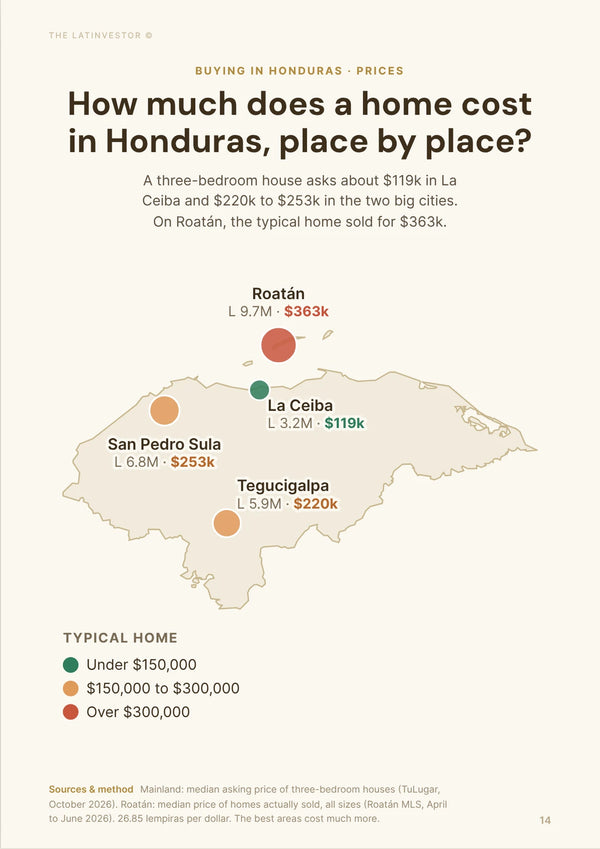
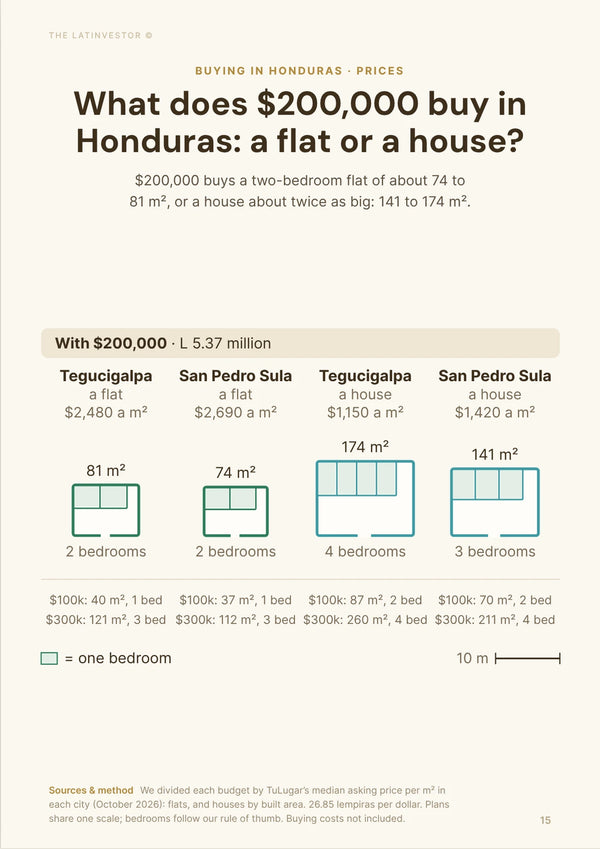
Citywide, apartments ask a median of $2,481 per square meter (about L 66,600) and houses $1,152 (about L 30,900), according to TuLugar's listing tracker on October 19, 2026. In the prime areas, asking prices run from about L 45,000 to L 90,000 per square meter ($1,680 to $3,350), with new towers at the top of that range.
Two real asks: a 61 sq m 2-bedroom in Lomas del Guijarro at $179,900 (about L 4,830,000), or about $2,949 per square meter, in September 2026; and an 83 sq m 2-bedroom in Lomas del Mayab at $218,000 (about L 5,850,000), about $2,627 per square meter, in July 2026.
Why these areas cost more:
- Lomas del Guijarro: the city's prestige address, with gated towers, secured parking and family homes on hillside streets.
- Lomas del Mayab: modern apartment towers with city views, a step below Lomas del Guijarro in price.
- Boulevard Morazán: central, close to offices, restaurants and malls, with newer professional towers.
- Boulevard Los Próceres and Colonia Lara: close to the US Embassy, which keeps corporate and diplomatic tenants coming.
Which areas in Tegucigalpa have the most affordable property prices?
The cheapest square meters in Tegucigalpa are in Loarque, Kennedy, Suyapa, Hato de Enmedio, parts of the old center and the edges of Comayagüela.
Older houses there ask from about L 18,000 to L 38,000 per square meter ($670 to $1,420), with the cheapest well under the city house median of $1,152. Newer towers in Kennedy and Suyapa ask much more, up to about L 60,000 ($2,230), so in these areas the price tells you more about the building than about the neighborhood.
The discount comes with trade-offs. Colonia Kennedy and Hato de Enmedio are on the fire department's list of neighborhoods at risk of floods or landslides, older central stock often lacks parking and water backup, and title chains on older houses can be messy. Check the registry at the Instituto de la Propiedad before you fall for the price.
 Honduras Property Prices

Where do rents pay best against prices?
Which neighborhoods in Tegucigalpa have the highest gross rental yields?
Gross yields in Tegucigalpa's good areas sit around 4% to 7%, not the 7% to 10% often quoted. At the typical ask of about $11 per square meter a month, an apartment bought at the city median of $2,481 per square meter grosses about 5.3%.
Two examples from real listings. In Lomas del Guijarro, a furnished 2-bedroom rents for $1,000 a month (September 2026), against a 2-bedroom asking $179,900: about 6.7% gross. In El Trapiche, a new gated 2-bedroom rents for L 14,000 (about $520), against the citywide 2-bedroom median of $147,900: about 4.2%.
Net is lower. A non-resident landlord has 25% of the rent withheld, which takes 5.3% down to about 4.0%. Count one empty month, condo fees, repairs and management too, and a non-resident keeps about 1.3% to 2.8% net (about 2.1% to 4.2% for a resident), based on our Tegucigalpa rental yields tracker. A resident landlord pays 10% only once rent passes L 15,000 a month.
Where the yield math works better:
- Lomas del Guijarro: compact units in good towers rent furnished to executives at prices that hold up against the purchase price.
- Palmira and Colonia Lara: furnished 2-bedrooms ask $1,000 to $1,400 from embassy, NGO and corporate tenants.
- El Trapiche and Loarque: cheaper entry and steady family demand, but rents of L 14,000 to L 15,500 cap the upside.
Does Airbnb work in Tegucigalpa, and where?
Which neighborhoods in Tegucigalpa perform best on Airbnb?
Tegucigalpa is a business and government city, and the numbers show it. Between August 2025 and July 2026, the average listing was booked 28.5% of nights at about $57 a night (about L 1,530) and grossed about $3,834 (about L 103,000) for the year.
Against a median 1-bedroom asking price of $100,000, that's about 3.8% gross. If the unit is registered as tourist lodging, the 15% sales tax and 4% tourism tax take it to about $3,106, or 3.1%, before cleaning, platform fees and management.
The listings that do better sit in Lomas del Guijarro, Boulevard Los Próceres, Palmira and Boulevard Morazán, close to offices, the US Embassy, hotels and malls. They live off business travelers, consultants, visiting families and people handling paperwork in the capital.
Why these areas do better:
- Lomas del Guijarro: secure towers that executives and visiting families trust.
- Boulevard Los Próceres: short trips to the US Embassy and the business district.
- Palmira: central, with restaurants and services for NGO staff and consultants.
- Boulevard Morazán: modern units near malls and offices at mid-range nightly rates.
Which tourist areas in Tegucigalpa are becoming oversaturated with short-term rentals?
The crowded spots are the new tower clusters of Lomas del Guijarro, Palmira, Miraflores and Boulevard Morazán, where dozens of near-identical furnished 1-bedrooms chase the same business traveler.
Tegucigalpa had 1,010 active short-term listings over the year to July 2026, 67.5% more than a year earlier. Visitor arrivals to Honduras grew 18.5% in the first half of 2026, so supply is running well ahead of demand.
The clearest sign is occupancy: at 28.5% on average, most listings sit empty more than two-thirds of the month. A local host told La Prensa in October 2026 that supply in the city "has grown much faster than demand". Tourism minister Andrés Ehrler also said on October 4, 2026 that app-based hosts should pay like hotels; no rule had been published by October 22, 2026, but budget for it.
 70+pages
Where are long-term tenants easiest to find?
Which neighborhoods in Tegucigalpa have the strongest demand for long-term tenants?
Long-term tenants concentrate in Lomas del Guijarro, Colonia Lara and Boulevard Los Próceres, Palmira, Lomas del Mayab, San Ignacio and the gated parts of El Trapiche and Loarque.
We found no reliable vacancy rate or time-to-rent figure for Tegucigalpa. What listings do show: secure, well-priced apartments let without much trouble, while overpriced luxury units sit, like a furnished 2-bedroom in Urbana Lara that showed a 13% price cut on Encuentra24 in 2026.
Who rents where:
- Lomas del Guijarro: executive and expat families looking for multi-year leases in secure towers.
- Colonia Lara and Boulevard Los Próceres: embassy staff and corporate employees on one- to three-year postings.
- Palmira: NGO workers, consultants and young professionals who want to be central.
- Lomas del Mayab and San Ignacio: young professionals and couples after modern 1-bedrooms.
- El Trapiche and Loarque: local families who want a gated 2-bedroom at a lempira rent.
What tenants won't give up: gated security with controlled access, a water tank or cistern, and backup power. With the 2026 water rationing, a building with its own well now rents faster.
What are the average long-term monthly rents by neighborhood in Tegucigalpa?
Nobody publishes an average rent by neighborhood in Tegucigalpa, so here are real asks from 2026. Numbeo's small crowd-sourced sample (July 2026) puts a 1-bedroom at about L 12,100 (about $450) in the center and L 12,555 (about $470) outside it.
Entry and mid-market: unfurnished gated 2-bedrooms ask L 14,000 (about $520) in El Trapiche, L 15,500 (about $575) in Loarque and L 18,000 (about $670) for 110 sq m in Roble Oeste (September and October 2026). A 2-bedroom in Residencial Florencia asked $800 (about L 21,500).
Furnished and executive: studios of about 31 sq m in Torre Artemisa Sur and in San Ignacio ask $750 (about L 20,100). Furnished 2-bedrooms ask $1,000 (about L 26,800) in Lomas del Guijarro and Palmira, $1,350 (about L 36,200) for 140 sq m in Lomas del Mayab and $1,400 (about L 37,600) in Palmira and Urbana Lara.
Top end: 3-bedrooms in Lomas del Guijarro, Colonia Lara and the Nivo towers ask $2,400 (about L 64,400) to $2,500 (about L 67,100) a month.
Which areas are moving up, and what's being built?
Which neighborhoods in Tegucigalpa are gentrifying and attracting new investors?
New money is going into Lomas del Mayab, San Ignacio, El Trapiche and the tower corridor along Boulevard Morazán and Miraflores, where developers keep launching apartment buildings and off-plan projects such as Altos del Trapiche and NIVO Las Lomas.
What we can't give you is a growth rate. No price index exists for any Tegucigalpa neighborhood, and TuLugar's monthly series only started in September 2026: the citywide apartment median moved from $2,440 to $2,481 per square meter between September and October 2026, too short a window to call a trend.
If you buy off-plan, pay in stages tied to construction milestones, check that the land is registered to the developer with no liens, and visit a building the same developer has already finished.
Which areas in Tegucigalpa have major infrastructure projects planned that will boost prices?
The project that matters is the southern bypass (libramiento) linking the Anillo Periférico to the CA-5 Sur highway: 8.15 km of new four-lane road, $57.7 million (about L 1.55 billion) financed by CABEI and national funds, with interchanges at La Cañada and Tizatillo and a tunnel toward Altos de Santa Rosa.
It is far from done. In July 2026, physical progress was 11%, and no completion date was given. Areas near the south exit, around Tizatillo and La Cañada, should gain from shorter commutes once it opens, but buying there today is a bet on the timetable.
The other project worth tracking is water: the San José dam, expected in 2028, should supply about 300,000 residents, including Kennedy and Villanueva, and a $150 million upgrade of the distribution network is planned with IDB and JICA support. That could do more for prices in the east and south than any road. We found no data on how much prices rose near past projects in the capital, so ignore anyone quoting a precise uplift.
 70+pages
Which areas should you skip as an investor?
Which neighborhoods in Tegucigalpa with lots of problems I should avoid and why?
Rather than whole neighborhoods, avoid three kinds of property: houses on steep or low-lying ground, older central stock with a weak paper trail, and blocks where security changes from one street to the next.
On October 6, 2026, the fire department said 763 of the capital's neighborhoods are at risk of floods or landslides, with about 220 places prone to flooding. The list includes Colonia Kennedy, Villa Nueva, El Pedregal, La Pradera, Hato de Enmedio, La Era, La Travesía and José Ángel Ulloa. The city announced L 700 million (about $26 million) for drainage and slopes, but that will take years.
What goes wrong:
- Hillside and riverside colonias: cracked walls, failed retaining walls and access roads cut in the rainy season.
- Older Barrio Centro and Comayagüela properties: incomplete registry chains, unclear boundaries and unresolved liens.
- Central blocks without parking: hard to rent to good tenants.
- Buildings without a water tank or well: increasingly hard to rent during rationing.
To make any of these viable, you'd need a clean registry certificate, a structural survey (about L 8,000 to L 50,000) and proof of reliable water.
Which areas in Tegucigalpa have stagnant or declining property prices as of 2026?
Prices look flat in older central apartments without parking or backup utilities, in crowded new-tower segments where many identical units compete, and in car-dependent outer suburbs. Listings there sit longer and get relisted lower.
We can't put a percentage on it: no sale-price series exists for Tegucigalpa. What we know is that inflation was 6.28% over the year to September 2026, so a home whose asking price hasn't moved has lost value in real terms.
Why these areas lag:
- Older central apartments: no parking and no backup utilities, so they lose out to new towers.
- Crowded tower segments in Miraflores and Boulevard Morazán: too many similar 1-bedrooms keep prices and rents in check.
- Car-dependent outer suburbs: long commutes put off both tenants and buyers.
Which areas should hold their value best?
Which areas in Tegucigalpa have historically appreciated the most recently?
Agents and long-time owners name the same list: Lomas del Guijarro, Lomas del Mayab, the better towers along Boulevard Morazán and the blocks around Boulevard Los Próceres and Colonia Lara.
What we can't give you is an honest percentage. There is no audited price index for Tegucigalpa, and the "5% to 8% a year" figures that circulate online are not backed by sale data. Today's prices show the ranking, though: Lomas del Guijarro towers ask up to about $2,949 per square meter, against a city median of $2,481.
What drove the gains: very little secure, modern housing, steady demand from executives and diplomats, and remittances, which reached $8,920 million in January to August 2026, 12.3% more than a year earlier.
Which neighborhoods in Tegucigalpa are expected to see price growth in coming years?
The best bets are Lomas del Guijarro and Lomas del Mayab (scarce secure land), the Los Próceres and Colonia Lara corridor (embassy and corporate demand) and, more speculatively, the south exit near Tizatillo and La Cañada once the bypass is finished.
We found no published forecast for Tegucigalpa prices in 2026 or 2027, so we don't give you one. Two things pull in opposite directions: remittances keep local buyers coming, but the central bank raised its policy rate from 5.75% to 6.00% in September 2026, and bank mortgages cost around 13% in lempiras (Ficohsa, June 2026).
Where to look:
- Lomas del Guijarro: the best-located towers should hold up; generic units in a crowded launch won't.
- Lomas del Mayab: modern stock a step below Lomas del Guijarro in price.
- Los Próceres and Colonia Lara: steady demand from the US Embassy, offices and hotels.
- South exit (Tizatillo, La Cañada): upside only if the bypass is delivered; it was 11% built in July 2026.
 70+pages
Which Tegucigalpa neighborhoods have water, and how do you check before buying?
This is the question everyone in the capital is asking in 2026. After a dry year, the city's dams fell to about 24% of capacity, and from September 20, 2026 the city moved to delivery cycles of up to 12 days in the areas served by the mains. The mayor, Juan Diego Zelaya, asked residents to save water, and the city has said rationing will continue even if the rains return.
About 40% of the water that leaves the dams is lost in the pipes, and the long-term fixes (the San José dam in 2028, a $150 million network upgrade) won't help a buyer this year. In practice, gated towers and residential compounds with their own well and large cisterns live a different life from houses that depend on the mains and on tanker trucks.
What to check before you sign:
- Ask for the schedule: how many days a week does mains water actually arrive at this address?
- Well and tank: does the building have its own well, and how big is the cistern per unit?
- Who pays: are tanker deliveries billed in the condo fee or on top?
- Price it in: a unit with no reliable water should sell for less; use it to negotiate.
Can a foreigner buy anywhere in Tegucigalpa?
Yes, and more easily than on the coast. Article 107 of the Constitution reserves land within 40 km of the coasts and land borders, and on the islands, to Hondurans by birth. Tegucigalpa is inland, outside that strip, so a foreigner can buy in their own name, with no residency and no one-home limit.
The real risk is the title. About 80% of private land in Honduras is untitled or poorly titled, according to the US State Department. That risk is highest in older central stock and informal hillside colonias, and lowest in registered condo towers.
What to do:
- Registry certificate: get a certificación íntegra from the Instituto de la Propiedad showing the seller as owner, no mortgage and no court seizure.
- Full ownership: check it is dominio pleno, not dominio útil over municipal land; banks won't lend on the second.
- Condo debts: ask for a letter showing HOA fees are paid up.
- Costs: budget 1.5% transfer tax, about 0.15% registry fee and 1% to 2% for the notary, so 4% to 8% in total, plus L 3.50 per L 1,000 of cadastral value in yearly property tax.
What do locals and expats really think of each area?
Which areas in Tegucigalpa do local residents consider the most desirable to live?
Locals rank Lomas del Guijarro, Lomas del Mayab, Palmira, San Ignacio and the gated parts of El Hatillo at the top, based on where premium rents are paid and good homes sell fastest.
Why:
- Lomas del Guijarro: the best security setup and an established prestige address.
- Lomas del Mayab: modern towers with good finishes.
- Palmira: central, with restaurants and services within reach.
- El Hatillo gated communities: big houses, green space and cooler air, at the cost of a longer drive.
The people living there are upper-middle-class families, business owners and professionals, plus some expats. They put security, reliable water and power, and access to schools first.
Local and foreign buyers mostly want the same areas. The difference: foreigners sometimes overpay for amenity-heavy new towers, while locals happily buy a well-kept older unit in the same neighborhood for less.
Which neighborhoods in Tegucigalpa have the best reputation among expat communities?
Expats favor Lomas del Guijarro, Colonia Lara and Boulevard Los Próceres, and parts of Palmira.
Why:
- Lomas del Guijarro: other expat families as neighbors and secure towers.
- Colonia Lara and Los Próceres: close to the US Embassy, offices and international hotels.
- Palmira: central, with English-speaking services and familiar restaurants.
Most expats here are embassy staff, NGO workers, international school teachers and corporate transfers who stay one to three years and pay $1,000 to $1,400 a month for a furnished 2-bedroom. Tegucigalpa is a work city: the retiree crowd is on Roatán and the coast.
Which areas in Tegucigalpa do locals say are overhyped by foreign buyers?
Locals point at amenity-heavy new towers in Miraflores and Boulevard Morazán and some new builds in Lomas del Mayab, sold on gyms, rooftop pools and brochures rather than location.
Why:
- New Miraflores and Morazán towers: many near-identical buildings compete, so the "exclusive" premium fades quickly at resale.
- Some Lomas del Mayab new builds: priced like Lomas del Guijarro without its track record.
- Amenity-led projects anywhere: locals care more about water, parking and security than a cinema room.
The numbers back them: furnished 2-bedrooms rent for $1,000 to $1,400 across Lomas del Guijarro, Palmira and Lomas del Mayab whatever the amenities, so a tower asking 19% above the city median of $2,481 per square meter doesn't get that premium back in rent.
Which areas in Tegucigalpa are considered boring or undesirable by residents?
Residents find car-dependent outer suburbs dull, along with older central blocks under strain and purely residential zones with nothing within walking distance.
Why:
- Distant outer suburbs: long peak-hour commutes through a few congested exits, especially to the south.
- Older central zones: worn infrastructure, unreliable water and no parking.
- Purely residential blocks without services: no cafés, shops or restaurants within walking distance.
Our methodology
This article estimates which areas of Tegucigalpa (the Distrito Central, including Comayagüela) are worth buying in: what a square meter costs, what long-term rents and Airbnb bring in, which areas are moving up or should be avoided, and the water, flood and title checks a buyer should run.
Prices and rents are asking figures, not sale prices, because Honduras publishes no sale data by neighborhood. We used the TuLugar listing tracker (about 740 sale listings, October 19, 2026) for citywide medians and individual Encuentra24 listings, each dated, for neighborhood examples. Yields are 12 months of asking rent divided by asking price, and Airbnb figures come from a single platform, AirROI. Neighborhood price ranges are our own working ranges built from listings.
Rules and taxes come from the Constitution (Article 107), the AMDC tax plan and Trolto's 2026 closing-cost guide; macro figures from the Banco Central de Honduras as reported by La Tribuna and El Heraldo; flood, water and road figures from El Heraldo, quoting the fire department, the mayor's office and the infrastructure ministry.
We checked these figures in October 2026. Conversions use about 26.85 lempiras per US dollar.
Limits: asking prices run above what buyers actually pay, single listings are not area averages, and no price index or forecast exists for Tegucigalpa, so we give no growth percentage. Water rationing schedules change often; check the current one for your exact address.
Key sources used for this analysis include TuLugar, Distrito Central market data, Encuentra24 Tegucigalpa apartments, Encuentra24 rentals, Numbeo Tegucigalpa, AirROI Tegucigalpa, Banco Central de Honduras exchange rates, La Tribuna, September 2026 inflation, El Heraldo, BCH policy rate, Banco Ficohsa, June 2026 tariff, El Heraldo, at-risk neighborhoods, El Heraldo, 12-day water cycles, El Heraldo, rationing to continue, El Heraldo, southern bypass, Revista Estrategia y Negocios, CABEI, Instituto Hondureño de Turismo, Instituto de la Propiedad, SINAP, AMDC tax plan, AMDC construction permits, Constitution of Honduras, Article 107, US State Department, Investment Climate Statement, Trolto, Honduras closing costs 2026, UNAH Observatorio de la Violencia, US State Department Travel Advisory, US Embassy Honduras, American School of Tegucigalpa, IMF and World Bank.