
Authored by the expert who managed and guided the team behind the Brazil Property Pack
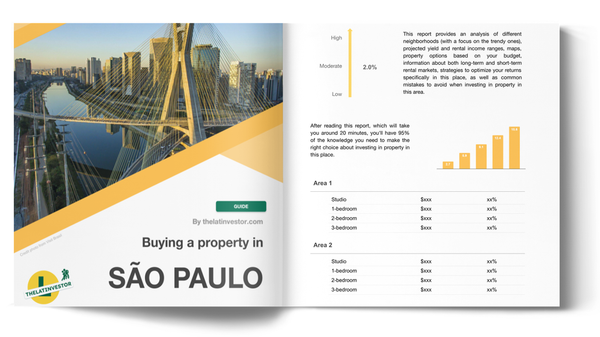
Yes, the analysis of São Paulo's property market is included in our pack
If you're thinking about buying an apartment in São Paulo, you probably want real numbers, not vague estimates.
We've pulled together the latest data on apartment prices, closing costs, ongoing fees, and neighborhood breakdowns so you can plan your budget with confidence.
This guide is written for foreigners and we constantly update it as new data comes in.
And if you're planning to buy a property in this place, you may want to download our pack covering the real estate market in São Paulo.
Insights
- São Paulo apartment prices rose only 4.56% in 2025, making it one of Brazil's slowest-appreciating major markets despite strong national demand.
- Studios in premium São Paulo neighborhoods like Itaim Bibi can cost R$850,000 or more, even though they're under 30 square meters.
- Closing costs in São Paulo typically add 4.5% to 6.5% on top of the purchase price, with ITBI transfer tax alone accounting for 3%.
- New-build apartments in São Paulo command a 15% to 25% premium over resale units, driven by modern amenities and lower maintenance risk.
- HOA fees in São Paulo vary wildly, from R$400 per month in basic buildings to over R$2,000 in full-service luxury towers.
- Budget-friendly neighborhoods like Cidade Tiradentes offer prices around R$6,700 per square meter, roughly one-third of elite areas like Vila Uberabinha.
- The typical closed sale price in São Paulo is about 7% below the listed asking price, so negotiation room exists.
- IPTU property tax in São Paulo is calculated from the city's "valor venal" assessment, which often differs from your actual purchase price.


How much do apartments really cost in São Paulo in 2026?
What's the average and median apartment price in São Paulo in 2026?
As of January 2026, the average asking price for an apartment in São Paulo is around R$720,000 (approximately $130,000 USD or €110,000 EUR), while the median sits closer to R$660,000 ($120,000 USD or €100,000 EUR), based on a typical 60 square meter unit.
In terms of price per square meter, São Paulo apartments average about R$11,900 per sqm ($2,150 USD or €1,830 EUR per sqm), which translates to roughly R$1,100 per square foot ($200 USD or €170 EUR per sq ft).
The typical price range that covers most standard apartments in São Paulo in 2026 runs from about R$500,000 to R$1,200,000 ($90,000 to $215,000 USD or €77,000 to €185,000 EUR), depending on size, location, and building quality.
How much is a studio apartment in São Paulo in 2026?
As of January 2026, a typical studio apartment in São Paulo costs between R$350,000 and R$510,000 ($63,000 to $92,000 USD or €54,000 to €78,000 EUR), though premium locations push prices much higher.
Entry-level to mid-range studios in São Paulo range from R$280,000 to R$450,000 ($50,000 to $80,000 USD or €43,000 to €69,000 EUR), while high-end studios in neighborhoods like Itaim Bibi or Jardim América can reach R$700,000 to R$900,000 ($125,000 to $160,000 USD or €107,000 to €138,000 EUR).
Studio apartments in São Paulo typically measure between 25 and 35 square meters, with compact units in newer buildings often clustered around 28 to 32 square meters to maximize shared amenities and location value.
How much is a one-bedroom apartment in São Paulo in 2026?
As of January 2026, a typical one-bedroom apartment in São Paulo costs between R$450,000 and R$760,000 ($80,000 to $135,000 USD or €69,000 to €117,000 EUR), depending heavily on location and building age.
Entry-level to mid-range one-bedroom apartments in São Paulo range from R$380,000 to R$600,000 ($68,000 to $108,000 USD or €58,000 to €92,000 EUR), while high-end units in areas like Pinheiros or Vila Mariana can reach R$800,000 to R$1,100,000 ($145,000 to $200,000 USD or €123,000 to €169,000 EUR).
One-bedroom apartments in São Paulo typically measure between 35 and 55 square meters, with newer developments often targeting the 40 to 50 square meter sweet spot for young professionals and investors.
How much is a two-bedroom apartment in São Paulo in 2026?
As of January 2026, a typical two-bedroom apartment in São Paulo costs between R$600,000 and R$1,000,000 ($108,000 to $180,000 USD or €92,000 to €154,000 EUR), representing the mass-market sweet spot for owner-occupiers.
Entry-level to mid-range two-bedroom apartments in São Paulo range from R$550,000 to R$850,000 ($99,000 to $153,000 USD or €85,000 to €130,000 EUR), while high-end units in premium neighborhoods like Brooklin or Vila Madalena can reach R$1,200,000 to R$1,800,000 ($215,000 to $325,000 USD or €185,000 to €277,000 EUR).
By the way, you will find much more detailed price ranges for apartments in our property pack covering the property market in São Paulo.
How much is a three-bedroom apartment in São Paulo in 2026?
As of January 2026, a typical three-bedroom apartment in São Paulo costs between R$800,000 and R$1,400,000 ($145,000 to $250,000 USD or €123,000 to €215,000 EUR), though prices can climb significantly higher in elite neighborhoods.
Entry-level to mid-range three-bedroom apartments in São Paulo range from R$750,000 to R$1,100,000 ($135,000 to $200,000 USD or €115,000 to €169,000 EUR), while high-end units in areas like Jardim Europa or Vila Nova Conceição can reach R$2,000,000 to R$4,000,000 ($360,000 to $720,000 USD or €308,000 to €615,000 EUR).
Three-bedroom apartments in São Paulo typically measure between 80 and 120 square meters, with older buildings sometimes offering larger layouts of 130 to 150 square meters at lower per-sqm prices.
What's the price gap between new and resale apartments in São Paulo in 2026?
As of January 2026, new-build apartments in São Paulo typically command a 15% to 25% premium over comparable resale units in the same neighborhood, driven by modern amenities and lower near-term maintenance risk.
The average price per square meter for new-build apartments in São Paulo is around R$13,500 to R$15,000 ($2,430 to $2,700 USD or €2,075 to €2,300 EUR per sqm), particularly in high-rise developments with shared amenities like gyms, coworking spaces, and concierge services.
For resale apartments in São Paulo, the average price per square meter sits closer to R$10,500 to R$12,000 ($1,890 to $2,160 USD or €1,615 to €1,845 EUR per sqm), though well-maintained units in prime locations can match or exceed new-build pricing.
Make a profitable investment in São Paulo
Better information leads to better decisions. Save time and money. Download our guide.

Can I afford to buy in São Paulo in 2026?
What's the typical total budget (all-in) to buy an apartment in São Paulo in 2026?
As of January 2026, the typical all-in budget to buy a standard 60 sqm apartment in São Paulo is around R$690,000 to R$750,000 ($125,000 to $135,000 USD or €106,000 to €115,000 EUR), which includes both the purchase price and closing costs.
Beyond the purchase price, your all-in budget in São Paulo should cover ITBI transfer tax (typically 3%), cartório and registry fees (1% to 2.5%), document certifications, and any bank fees if you're financing the purchase.
We go deeper and try to understand what costs can be avoided or minimized (and how) in our São Paulo property pack.
You can also read our dedicated blog article to understand what you can at different budget levels in São Paulo.
What down payment is typical to buy in São Paulo in 2026?
As of January 2026, the typical down payment to buy an apartment in São Paulo is 20% to 30% of the purchase price, which means R$130,000 to R$200,000 ($23,000 to $36,000 USD or €20,000 to €31,000 EUR) for a median-priced unit.
Most banks and lenders in São Paulo require a minimum down payment of 20%, with CAIXA (Brazil's largest housing lender) explicitly stating this threshold for standard mortgage products.
To secure favorable mortgage terms in São Paulo, a down payment of 25% to 30% is recommended, as it can help you qualify for better interest rates and demonstrates stronger financial standing to lenders.
You can also read our latest update about mortgage and interest rates in Brazil.

We made this infographic to show you how property prices in Brazil compare to other big cities across the region. It breaks down the average price per square meter in city centers, so you can see how cities stack up. It’s an easy way to spot where you might get the best value for your money. We hope you like it.
Which neighborhoods are cheapest or priciest in São Paulo in 2026?
How much does the price per m² for apartments vary by neighborhood in São Paulo in 2026?
As of January 2026, the price per square meter for apartments in São Paulo ranges from about R$6,700 ($1,200 USD or €1,030 EUR per sqm) in more affordable areas to R$20,000 or higher ($3,600 USD or €3,075 EUR per sqm) in elite neighborhoods.
In the most affordable neighborhoods of São Paulo, such as Cidade Tiradentes, Itaquera, São Miguel Paulista, and Guaianases, prices typically range from R$6,500 to R$8,500 per sqm ($1,170 to $1,530 USD or €1,000 to €1,310 EUR per sqm).
In the most expensive neighborhoods of São Paulo, such as Vila Nova Conceição, Alto de Pinheiros, Jardim Europa, and Itaim Bibi, prices typically range from R$18,000 to R$35,000 per sqm ($3,240 to $6,300 USD or €2,770 to €5,385 EUR per sqm).
By the way, we've written a blog article detailing what are the current best areas to invest in property in São Paulo.
What neighborhoods are best for first-time buyers on a budget in São Paulo in 2026?
As of January 2026, the top three neighborhoods best suited for first-time buyers on a budget in São Paulo are Bela Vista, Vila Prudente, and Barra Funda, which combine reasonable prices with solid metro access and urban amenities.
In these budget-friendly neighborhoods, typical apartment prices range from R$450,000 to R$750,000 ($81,000 to $135,000 USD or €69,000 to €115,000 EUR), with per-sqm prices around R$9,000 to R$12,000.
These neighborhoods offer first-time buyers in São Paulo good public transit connections, walkable streets, restaurants, and access to employment hubs without the premium pricing of nearby elite zones.
The main trade-off of buying in these budget-friendly São Paulo neighborhoods is that older building stock may require renovation, and some streets can feel more congested or less polished than pricier alternatives.
Which neighborhoods have the fastest-rising apartment prices in São Paulo in 2026?
As of January 2026, the top three neighborhoods with the fastest-rising apartment prices in São Paulo are Pinheiros, Vila Mariana, and Perdizes, all of which benefit from strong demand, metro expansions, and limited new supply.
These fast-appreciating neighborhoods in São Paulo have seen estimated year-over-year price increases of 7% to 12%, outpacing the citywide average of 4.56% recorded by FipeZAP in 2025.
The main driver behind the rapid price growth in these São Paulo neighborhoods is a combination of metro connectivity, concentration of tech and finance jobs, and sustained demand from young professionals seeking walkable, amenity-rich living.
You can also read our latest update about property price forecasts in São Paulo.
Don't lose money on your property in São Paulo
100% of people who have lost money there have spent less than 1 hour researching the market. We have reviewed everything there is to know. Grab our guide now.

What extra costs will I pay on top of the apartment price in São Paulo in 2026?
What are all the buyer closing costs when you buy an apartment in São Paulo?
For a typical apartment purchase in São Paulo, estimated total buyer closing costs range from R$30,000 to R$50,000 ($5,400 to $9,000 USD or €4,600 to €7,700 EUR), depending on the purchase price and whether you're financing.
The main categories of closing costs buyers must pay in São Paulo include ITBI transfer tax, cartório fees (escritura and registro), document certifications, and any lender-related fees if you're taking out a mortgage.
The largest closing cost expense for buyers in São Paulo is typically the ITBI transfer tax, which is set at 3% of the property's tax base and alone can represent about R$20,000 ($3,600 USD or €3,075 EUR) on a median-priced apartment.
Some closing costs in São Paulo are negotiable or can vary, particularly cartório fees at the margins and certain bank origination fees, though ITBI is fixed by the municipality and cannot be reduced.
On average, how much are buyer closing costs as a percentage of the purchase price for an apartment in São Paulo?
In São Paulo, buyers should budget approximately 4.5% to 6.5% of the purchase price for total closing costs, with the exact percentage depending on property value and financing complexity.
The realistic low-to-high percentage range that covers most standard apartment transactions in São Paulo is 4% on the low end (for cash purchases with minimal documentation) to 7% on the high end (for financed purchases with additional bank fees and assessments).
We actually cover all these costs and strategies to minimize them in our pack about the real estate market in São Paulo.

We did some research and made this infographic to help you quickly compare rental yields of the major cities in Brazil versus those in neighboring countries. It provides a clear view of how this country positions itself as a real estate investment destination, which might interest you if you’re planning to invest there.
What are the ongoing monthly and yearly costs of an apartment in São Paulo in 2026?
What are typical HOA fees in São Paulo right now?
HOA fees (called "condomínio" in Brazil) are very common in São Paulo, and the typical monthly fee for apartments ranges from R$700 to R$1,200 ($125 to $215 USD or €108 to €185 EUR), depending on building size and amenities.
The realistic range of HOA fees in São Paulo runs from about R$400 per month ($72 USD or €62 EUR) in basic older buildings with minimal services, up to R$2,000 or more ($360 USD or €310 EUR) in full-service luxury towers with 24-hour concierge, gyms, pools, and coworking spaces.
What utilities should I budget monthly in São Paulo right now?
The estimated total monthly utility cost for a typical apartment in São Paulo is around R$450 to R$700 ($80 to $125 USD or €69 to €108 EUR), covering electricity, water, sewage, and gas.
Depending on apartment size and usage, monthly utility costs in São Paulo can range from R$350 ($63 USD or €54 EUR) for a small, energy-efficient unit up to R$900 or more ($160 USD or €138 EUR) for a larger apartment with high air conditioning use.
The specific utilities included in a typical monthly budget in São Paulo are electricity (Enel SP), water and sewage (Sabesp), and piped gas (Comgás) if your building is connected to the gas network.
Electricity tends to be the most expensive utility for apartment owners in São Paulo, especially during summer months when air conditioning use spikes and tariff bands adjust based on grid demand.
How much is property tax on apartments in São Paulo?
The estimated typical annual property tax (IPTU) for an apartment in São Paulo ranges from R$2,500 to R$5,000 ($450 to $900 USD or €385 to €770 EUR), though this varies significantly by location and assessed value.
IPTU in São Paulo is calculated based on the city's "valor venal" (assessed market value), which is determined by factors like location, building type, and unit size, and often differs from your actual purchase price.
Depending on property value, annual IPTU in São Paulo can range from about R$1,500 ($270 USD or €230 EUR) for more affordable apartments to R$10,000 or more ($1,800 USD or €1,540 EUR) for high-end properties in premium neighborhoods.
If you want to go into more details, we also have a blog article detailing all the property taxes and fees in São Paulo.
What's the yearly building maintenance cost in São Paulo?
The estimated typical yearly building maintenance cost for apartment owners in São Paulo is around R$3,500 to R$7,000 ($630 to $1,260 USD or €540 to €1,080 EUR), representing roughly 0.5% to 1% of the apartment's value.
Depending on building age and type, yearly maintenance costs in São Paulo can range from R$2,000 ($360 USD or €310 EUR) for a newer building with minimal repairs to R$12,000 or more ($2,160 USD or €1,850 EUR) for older buildings requiring facade work, elevator upgrades, or plumbing overhauls.
Building maintenance costs in São Paulo typically include interior unit upkeep (appliances, minor repairs, painting), plus contributions to building-wide reserve funds for major projects like roof repairs or structural work.
In most São Paulo buildings, day-to-day maintenance is included in your monthly HOA (condomínio) fee, but owner-side repairs and special assessments for major building projects come as separate, additional costs.
How much does home insurance cost in São Paulo?
The estimated typical annual home insurance cost for an apartment in São Paulo is around R$400 to R$700 ($72 to $126 USD or €62 to €108 EUR), which is quite affordable compared to many other markets.
Depending on coverage level and property value, annual home insurance costs in São Paulo can range from about R$250 ($45 USD or €38 EUR) for basic coverage to R$1,200 or more ($215 USD or €185 EUR) for comprehensive policies covering high-value contents and extended liability.
Home insurance is generally optional for apartment owners in São Paulo, though the building's master policy may only cover common areas, meaning your unit's interior and contents require separate coverage.
Get fresh and reliable information about the market in São Paulo
Don't base significant investment decisions on outdated data. Get updated and accurate information with our guide.
What sources have we used to write this blog article?
Whether it's in our blog articles or the market analyses included in our property pack about São Paulo, we always rely on the strongest methodology we can … and we don't throw out numbers at random.
We also aim to be fully transparent, so below we've listed the authoritative sources we used, and explained how we used them and the methods behind our estimates.
| Source | Why It's Authoritative | How We Used It |
|---|---|---|
| Índice FipeZAP (December 2025) | Brazil's most cited public index for residential asking prices, built with consistent methodology. | We used it as our headline São Paulo price benchmark at R$11,900 per sqm. We also anchored our per-sqm estimates and validated other datasets against it. |
| QuintoAndar Transaction Report | Large platform publishing transparent, data-backed reports based on actual closed deals. | We used it to understand how transaction prices differ from listing prices. We kept our "what you'll really pay" estimates realistic, not just optimistic asking numbers. |
| Prefeitura de São Paulo (ITBI) | Official municipal tax authority explaining transfer tax rates and calculation rules. | We used it to compute the biggest buyer closing cost at 3% in São Paulo. We also highlighted the "base de cálculo" rule that surprises many foreign buyers. |
| Prefeitura de São Paulo (IPTU) | City's official guide to property tax calculation starting in 2026. | We used it to explain how São Paulo estimates "valor venal" for IPTU purposes. We built practical annual IPTU budgeting ranges from this framework. |
| CNB/SP (Notary Fee Tables) | São Paulo notaries' official body publishing reference fee tables used in practice. | We used it to estimate escritura and registro fees. We built our all-in closing cost percentage using these official figures. |
| ANOREG/SP (Registrar Fee Tables) | Official association for registrars and notaries in São Paulo with valid annual tables. | We used it to cross-check that São Paulo has current fee tables. We validated the cartório cost framework for buyers. |
| CRECI-SP (Brokerage Guidelines) | Official real estate council in São Paulo publishing guidance for brokerage commissions. | We used it to explain typical commission ranges and who usually pays. We flagged situations where buyers may be charged, especially on new builds. |
| Banco Central do Brasil (BCB) | Brazil's central bank publishing official time-series on credit rates including mortgages. | We used it to ground mortgage rate expectations in official statistics. We framed affordability and financing trade-offs for early 2026. |
| CAIXA (Housing Finance) | Brazil's largest housing lender with clear published underwriting rules. | We used it to anchor typical down payment expectations at 20% minimum. We translated local financing norms for foreign buyers. |
| ANEEL (Electricity Regulator) | Federal electricity regulator with official tariff decisions for Enel SP. | We used it to justify why electricity bills in São Paulo can shift year to year. We built our energy cost budgeting on this regulatory foundation. |
| Arsesp / Governo de SP (Water Tariff) | Official São Paulo state channel reporting regulated Sabesp water tariff values. | We used it to anchor a concrete per-m³ water figure (R$6.40) for 2026 budgeting. We turned utility costs into actual calculations, not guesses. |
| Comgás (Gas Tariffs) | Gas distributor's official page with tariff deliberações and history. | We used it to justify a realistic gas bill range based on usage. We confirmed that gas is regulated and published, not arbitrary. |
| SUSEP (Insurance Regulator) | Brazil's insurance regulator with official statistics on the insurance market. | We used it to ground our insurance discussion in regulatory data. We kept insurance estimates conservative and clearly market-priced. |
| SulAmérica (Insurance Pricing) | Major insurer giving a direct public baseline for home insurance starting prices. | We used it to set a credible lower bound for home insurance costs. We triangulated our annual insurance range for São Paulo apartments. |
| Loft Dados (Neighborhood Prices) | Structured dataset built from official São Paulo ITBI transaction records. | We used it to name real São Paulo neighborhoods and show price variation. We identified areas with high transaction volume linked to liquidity. |
| Loft Dados (Price per m² by Neighborhood) | Large neighborhood table with clear methodology based on ITBI records. | We used it to build a neighborhood price ladder from cheaper to pricier areas. We scaled historical data to 2026 price levels. |
| Secovi-SP (Market Indicators) | São Paulo housing industry association with comprehensive market data and reports. | We used it to validate price trends and new-build premiums. We cross-referenced our estimates with their market indicators. |
| Global Property Guide (Brazil) | International real estate research platform with consistent cross-country methodology. | We used it to validate rental yield figures and price growth trends. We confirmed São Paulo's position among Brazilian cities. |

We created this infographic to give you a simple idea of how much it costs to buy property in different parts of Brazil. As you can see, it breaks down price ranges and property types for popular cities in the country. We hope this makes it easier to explore your options and understand the market.