
Summary
For most foreign buyers in 2026, the best place to buy in Santo Domingo is the Distrito Nacional core: Naco, Bella Vista, Serrallés, La Esperilla and Evaristo Morales, where apartments ask about $2,000 to $2,400 per m² (Casanix and CLIC, 2026).
Piantini is the most expensive area at about $2,721 per m² (CLIC, June 2026). Outside the Distrito Nacional, Santo Domingo Este, Norte and Oeste ask only about $1,030 to $1,120 per m².
On a long lease, central 2-bedrooms earn about 6.3% to 6.9% gross a year on asking prices (Casanix medians, October 2026). Arroyo Hondo does a bit better at about 7.6%.
Airbnb is weak: the average Santo Domingo listing was booked only 36.4% of the time over the 12 months to September 2026, and supply grew about 5% to 3,937 listings (AirROI).
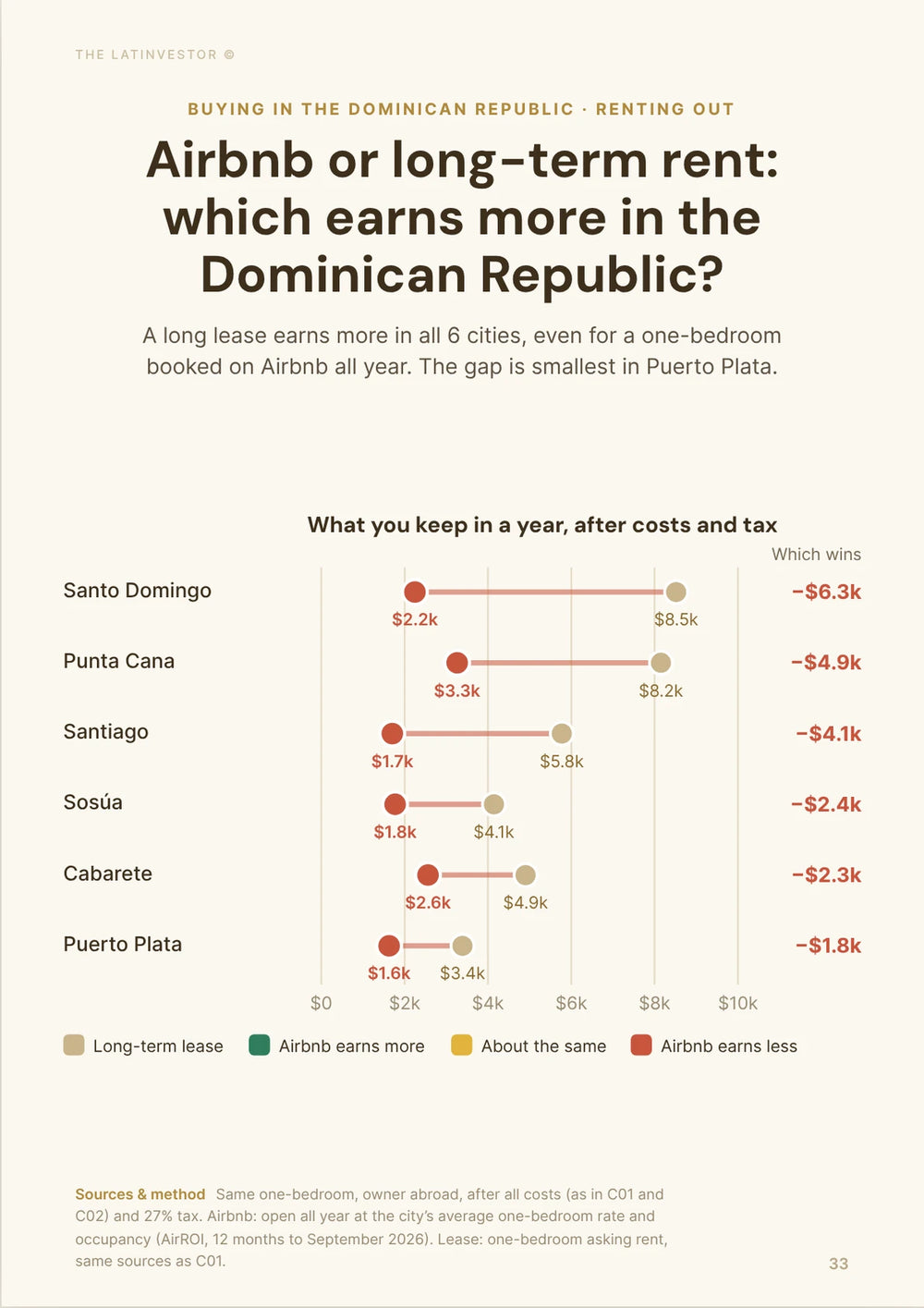
A long lease wins for a normal apartment: our Naco 1-bedroom example nets about 3.7% a year on a long lease against about 0.9% on Airbnb, both before income tax.
Long-term rents for a 2-bedroom ask about $1,200 in Gazcue to $1,900 in Piantini (Casanix, October 2026). CLIC put prime Piantini vacancy under 4% in the first half of 2026.
Metro Line 2C to Los Alcarrizos opened on 24 February 2026. New-project offer prices in Los Alcarrizos jumped 52.6% between the last two ONE surveys, but from a very low base.
Some areas are flat: new-project offer prices fell 4.7% in Santo Domingo Norte and rose only 1.0% in Santo Domingo Oeste over the same period (ONE).
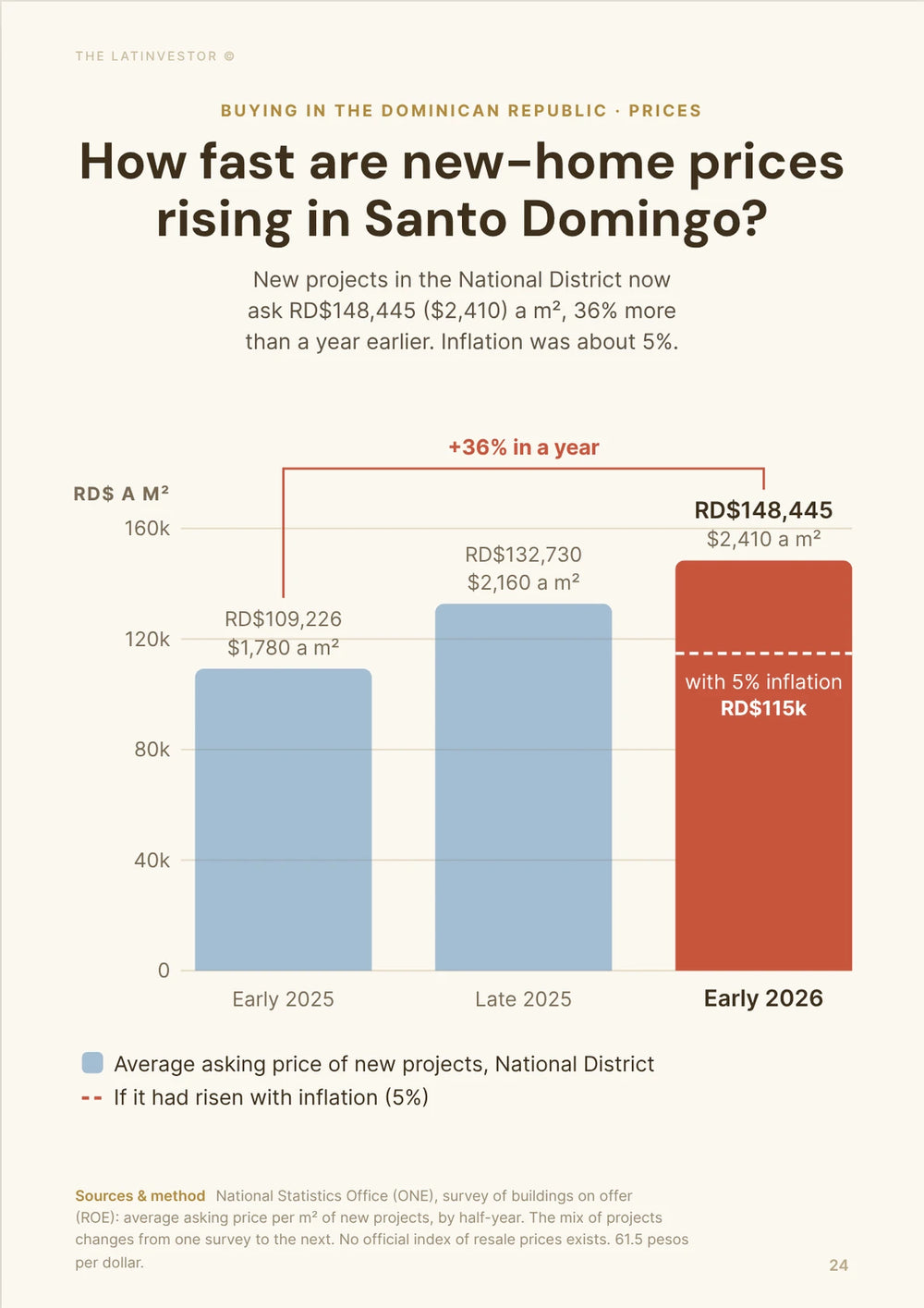
No index measures neighborhood price growth, so ignore precise "8% a year" promises. In the Distrito Nacional, new-project offer prices rose 11.8% in one semester, while building costs rose only 1.94% in a year.
The Zona Colonial is being restored (60 facades and 44 homes delivered by MITUR in October 2026), but it asks about $2,354 per m² and its Airbnb market is crowded.
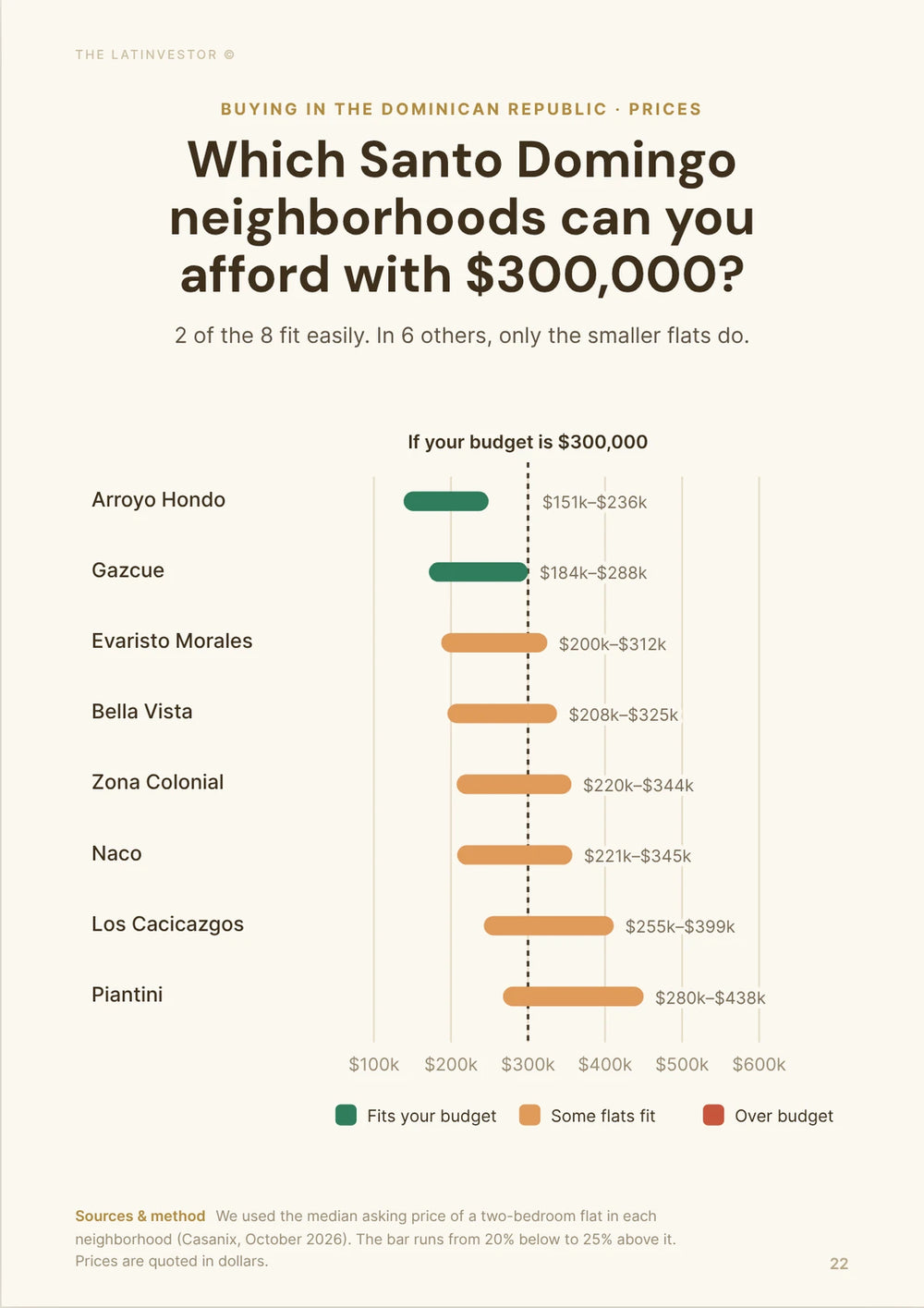
Locals and expats agree on Piantini, Naco, Serrallés, Bella Vista and Los Cacicazgos, where a 2-bedroom asks about $260,000 to $350,000.
Bottom line: buy a 1- or 2-bedroom in Naco, Bella Vista, Serrallés or Evaristo Morales at around $2,000 to $2,400 per m², rent it long term, and aim for at least 6.5% gross.

How do prices compare across Santo Domingo's neighborhoods?
Which areas in Santo Domingo have the highest property prices per square meter in 2026?
In 2026, the most expensive areas in Santo Domingo are Piantini, Serrallés and Naco, all in the Distrito Nacional, where the city's modern towers and best services are.
Listed apartments ask a median of about $2,721 per m² in Piantini, $2,381 in Serrallés and $2,378 in Naco (CLIC Inmobiliaria, June 2026). Casanix shows almost the same in October 2026: $2,701, $2,369 and $2,378.
New projects cost more. ONE's survey of new developments puts the average offer at RD$210,026 (about $3,420) per m² in Piantini and RD$164,134 (about $2,670) in Naco in the first half of 2026. For the whole Distrito Nacional, the listing median is about $2,119 per m² (CLIC, June 2026).
What makes each of these Santo Domingo areas command such high prices is quite specific:
- Piantini: the best restaurants, embassies nearby and the most established high-rise towers in the city; a 2-bedroom asks a median of $350,000
- Ensanche Naco: close to office clusters and malls like Blue Mall and Acrópolis; a 2-bedroom asks about $275,950
- Serrallés: quieter streets with newer towers and private security; a 2-bedroom asks about $265,000
Which areas in Santo Domingo have the most affordable property prices in 2026?
In 2026, the cheapest areas are outside the Distrito Nacional: Ensanche Ozama and Alma Rosa in Santo Domingo Este, Herrera in Santo Domingo Oeste, and Santo Domingo Norte. Inside the Distrito Nacional, older pockets like Villa Juana are the cheapest.
Listed apartments ask about $1,120 per m² in Santo Domingo Este, $1,058 in Santo Domingo Oeste and $1,029 in Santo Domingo Norte (CLIC, June 2026). That is about half the Distrito Nacional median. Among central areas, Arroyo Hondo ($1,745 per m²) and Gazcue ($1,980) are the cheapest (Casanix, October 2026).
The trade-offs: in Ensanche Ozama and Alma Rosa, longer commutes and fewer walkable services. In the west, the metro helps since Line 2C to Los Alcarrizos opened in February 2026, but much of the area is still car-dependent. In Villa Juana, many older buildings have no generator or secure parking, which matters a lot in Santo Domingo.
Are Piantini and Naco too expensive to buy in 2026?
For an investor, Piantini is expensive, Naco less so. A 2-bedroom in Piantini asks a median of $350,000 and rents for about $1,900 a month, or 6.5% gross. Naco gives the same 6.5% at $275,950, and a Naco 1-bedroom ($189,000, $1,150 a month) gives about 7.3% (Casanix, October 2026).
New towers carry a big premium. ONE's new-project offers in Piantini average about RD$210,026 (about $3,420) per m², about 26% above the listing median of $2,721 (CLIC). In Naco, the gap is about 12%. Across Greater Santo Domingo, new-project offer prices rose 12.2% between the second half of 2025 and the first half of 2026, while building costs rose only 1.94% in the year to June 2026 (ONE).
So part of what you pay off-plan is the developer's margin, not the land or the bricks. Compare a new unit with resales in the same street before you sign, and remember that a fideicomiso does not guarantee the tower gets finished.
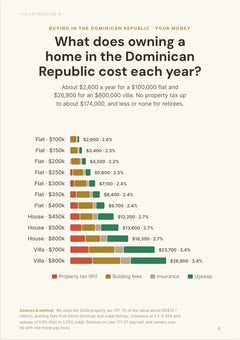
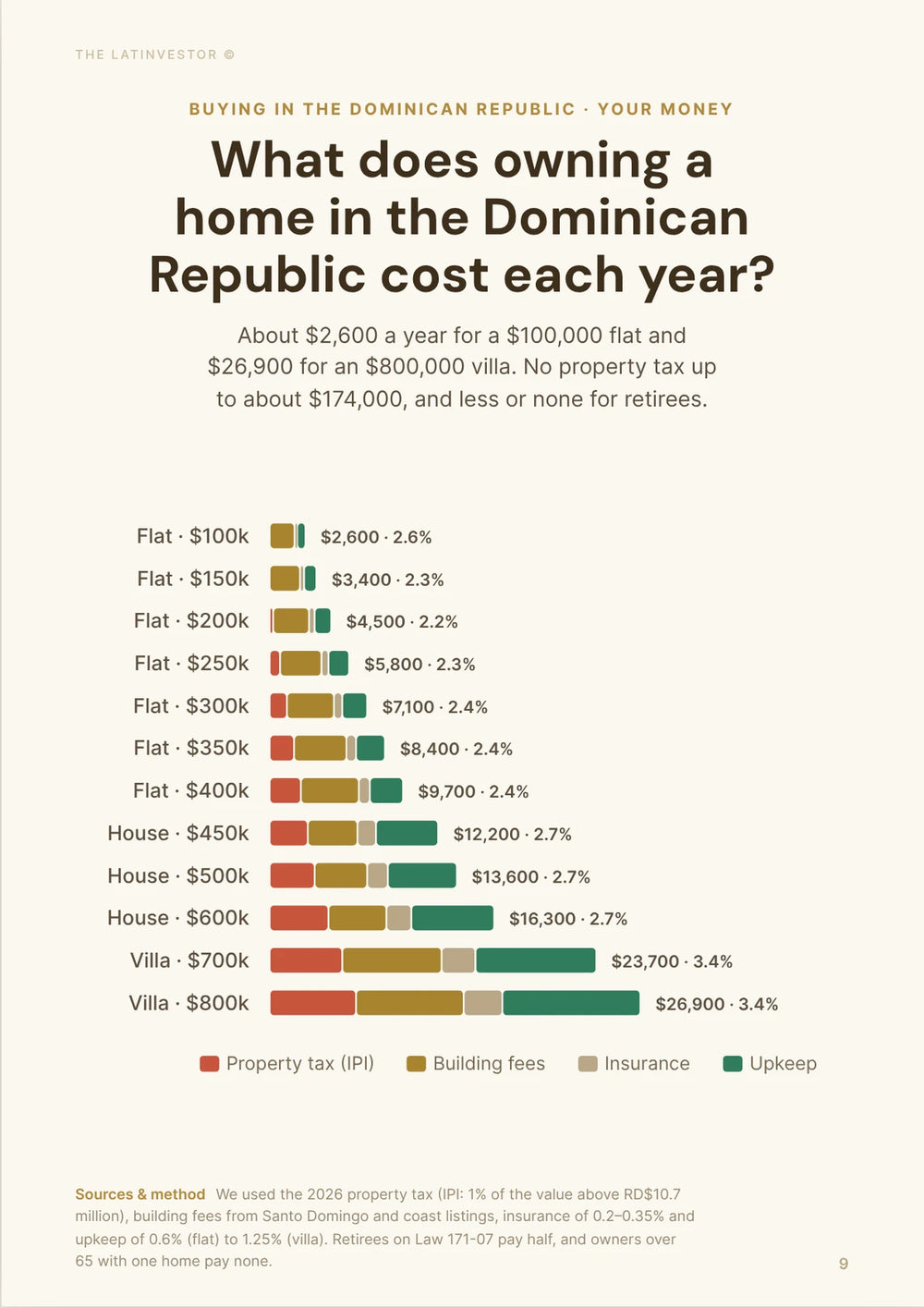
Also count the yearly tax. Above a combined DGII value of RD$10,695,494 (about $174,000), you pay 1% a year of IPI on the excess. DGII values are often below market price, but a Piantini 2-bedroom can cross the line.
What to aim for: in Naco, Serrallés or La Esperilla, a resale 1- or 2-bedroom at $2,100 to $2,400 per m² that rents for at least 6.5% gross. In Piantini, buy for living or prestige, not for yield.
Which Areas in Santo Domingo Offer the Best Rental Yields?
Which neighborhoods in Santo Domingo have the highest gross rental yields in 2026?
In 2026, Arroyo Hondo, Bella Vista, Serrallés and La Esperilla give the best gross yields on a 2-bedroom long lease: about 7.6%, 6.9%, 6.8% and 6.8% (Casanix asking medians, October 2026).
The spread is narrower than people think: central neighborhoods all sit between about 6.3% (Gazcue) and 6.9% on 2-bedrooms. 1-bedrooms do a bit better, at about 6.7% (Gazcue) to 7.8%, with Evaristo Morales on top ($170,250 asking, $1,100 a month).
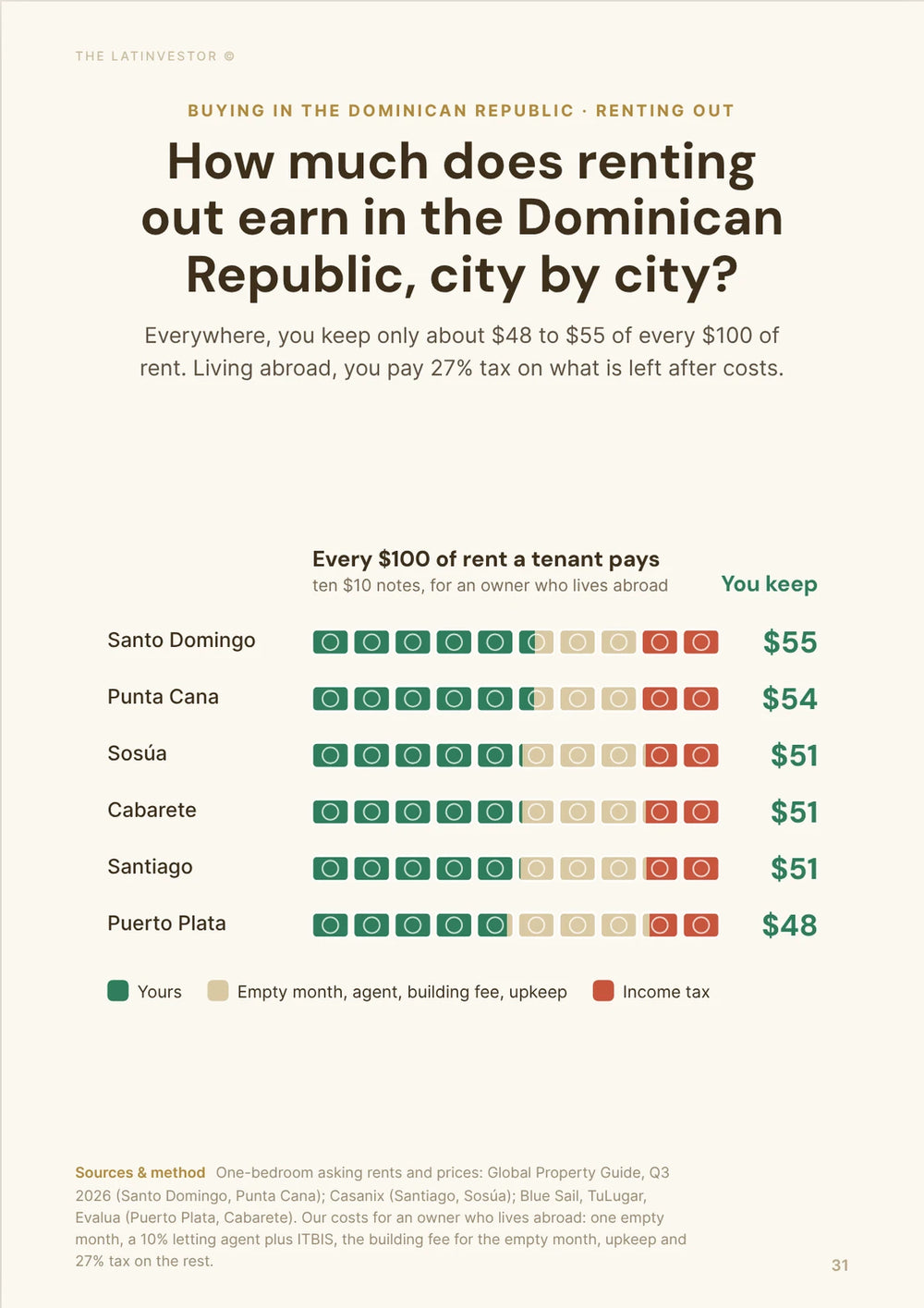
Global Property Guide shows 9.35% for Santo Domingo, but that is a prime sample of asking rents and prices (Q3 2026). Treat it as a ceiling. After costs, a long lease in a good area nets about 3% to 4% before income tax.
Here is what makes each of these top-yielding Santo Domingo neighborhoods deliver better returns:
- Evaristo Morales: about $2,000 per m² on Casanix, roughly 26% below Piantini's $2,701 there (CLIC gives 22%), while 1-bedroom rents are only about 21% lower ($1,100 vs $1,400)
- Ensanche Quisqueya: demand from Dominican professionals who want the Distrito Nacional without Piantini prices (no separate price data)
- Bella Vista: a 2-bedroom asks $260,000 and rents for about $1,500, with stable family tenants
- Julieta Morales: smaller buildings with lower condo fees keep net yields higher than in big towers (no separate price data)
Which Areas in Santo Domingo Are Best for Short-Term Vacation Rentals?
Which neighborhoods in Santo Domingo perform best on Airbnb in 2026?
In 2026, the Airbnb areas that work best in Santo Domingo are the Zona Colonial, Gazcue near the Malecón, and parts of Piantini and Naco for business travelers. Across the city, the average listing charged RD$4,882 (about $79) a night and was booked 36.4% of the time (AirROI, October 2025 to September 2026).
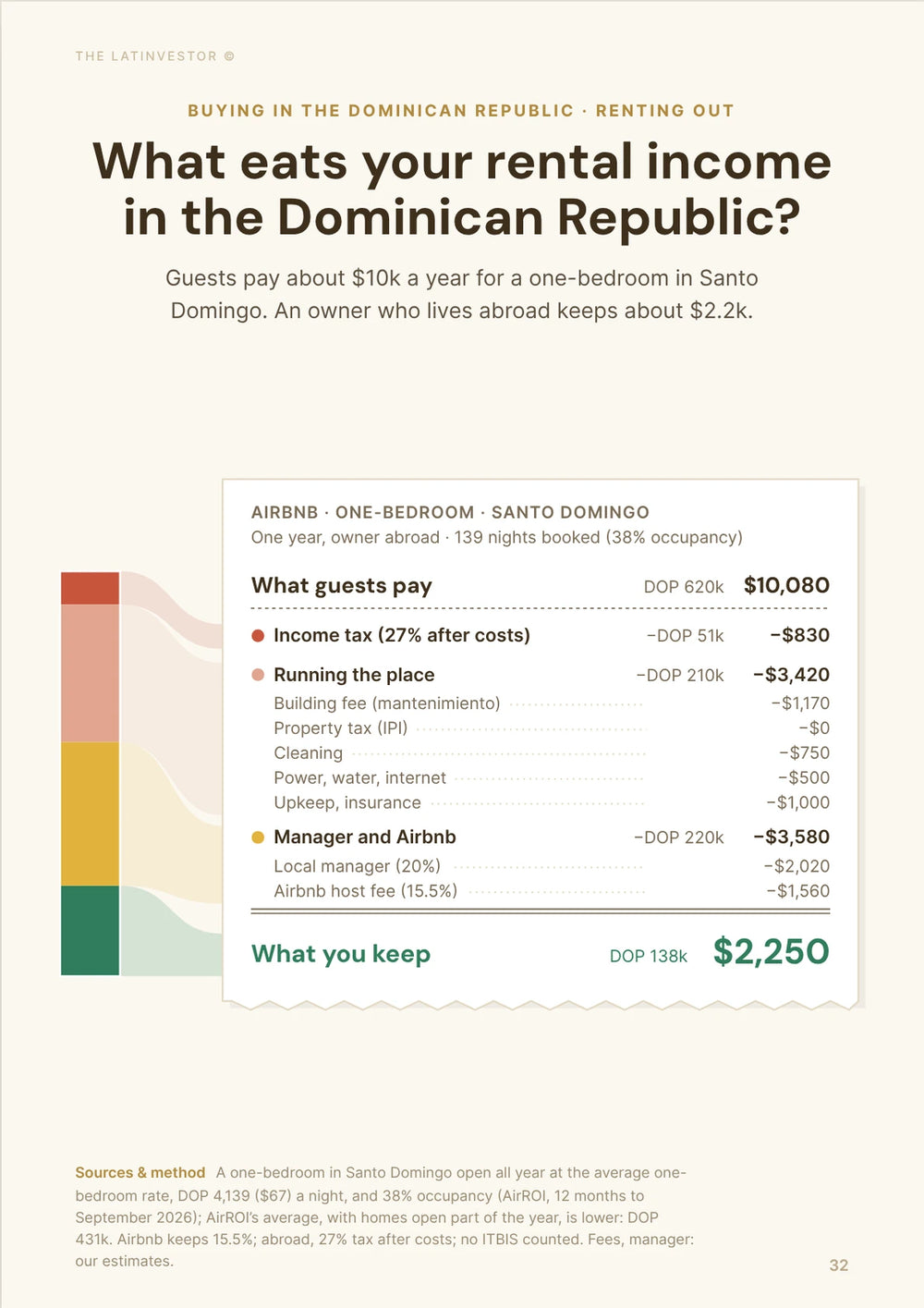
The average listing grossed about RD$481,596 (about $7,830) over the year, but that includes part-time listings. A 2-bedroom run all year at the city's average 2-bedroom rate, RD$5,334 (about $87) a night, and occupancy of 38%, grosses about RD$740,000 (about $12,000), less than a year of rent on a Naco 2-bedroom at $1,500 a month ($18,000).
Occupancy is steady, between about 37% and 43% every month, because guests come for business, family visits and medical stays more than for beaches. AirROI doesn't publish figures by neighborhood.
Here is what makes each neighborhood outperform for short-term rentals in Santo Domingo:
- Zona Colonial: walkable historic sites and restaurants draw weekend tourists and diaspora visitors year-round
- Gazcue: close to the Malecón and cultural venues, at lower prices ($1,980 per m²)
- Piantini/Naco edge: business travelers want corporate stays near offices and safer streets
Which tourist areas in Santo Domingo are becoming oversaturated with short-term rentals?
The areas with the most crowded Airbnb supply are the core blocks of the Zona Colonial, the tower clusters of Piantini, and the streets of Naco where many units look the same.
AirROI counted 3,937 active listings in Santo Domingo in September 2026, about 5% more than a year earlier, while occupancy stayed at about 36%. In the Zona Colonial, hundreds of listings compete within a few blocks.
The clearest warning sign: hosts compete on price, not quality. Our Naco 1-bedroom example nets about 0.9% a year on Airbnb at the city's average rate and occupancy, after the 15.5% host-only fee (3% for hosts still on split fees), 20% management and about 5% of bookings for utilities, against about 3.7% on a long lease. Both are before income tax.
The rules are open too. MITUR's RENATUR registry draft was withdrawn on 20 July 2026 and sent to talks with the sector, with no new date. Many towers ban short stays in their bylaws (reglamento): read them before you buy.
Is the Zona Colonial still worth buying in 2026?
For living or a long lease, it can be. For an Airbnb business, be careful. Listed apartments ask a median of about $2,354 per m², close to Naco, and a 2-bedroom asks about $275,000 and $1,500 a month in rent, or 6.5% gross (Casanix, October 2026).
The area is getting real public money. On 2 October 2026, MITUR delivered repairs to 44 homes, worth over RD$71 million (about $1.15 million), restored 60 facades, worth RD$62 million (about $1 million), and painted 150 more, under its Ciudad Colonial program.
The daily problems are also real: noise from bars and traffic, old pipes and drains (residents of Arzobispo Meriño complained of water coming out of a blocked drain in July 2026), and almost no parking.
Heritage rules add steps. Works on a listed building need approval, and you should check the title, the condo debts and the building's permits one by one.
What to check: the exact street (quiet residential blocks rent better long term than nightlife streets), the reglamento on short stays, and the last 12 months of bookings of similar units, not the seller's projections.
Which Areas in Santo Domingo Are Best for Long-Term Rentals?
Which neighborhoods in Santo Domingo have the strongest demand for long-term tenants?
The neighborhoods with the strongest long-term demand are Piantini, Naco, Evaristo Morales and Ensanche Quisqueya, where expats, executives and local professionals look for apartments near offices and international schools.
CLIC put vacancy in prime Piantini under 4% in the first half of 2026. There is no official figure for time to rent. Units with parking, an elevator and backup power rent fastest; older units in less central areas usually sit much longer.
Here is the main tenant profile driving demand in each of these Santo Domingo neighborhoods:
- Piantini: embassy staff, multinational executives and diplomatic families
- Naco: professionals working in nearby corporate offices and banks
- Evaristo Morales: young professionals and couples who want the Distrito Nacional at better value
- Ensanche Quisqueya: Dominican middle-class families who want schools and safety nearby
The amenity tenants care about most is backup power. Electricity tariffs were frozen again in October 2026, but outages continue, and tenants pay more for buildings with a well-kept generator.
What are the average long-term monthly rents by neighborhood in Santo Domingo in 2026?
In October 2026, a 1-bedroom in the central neighborhoods asked a median of about $875 in Gazcue to $1,400 in Piantini, and a 2-bedroom about $1,200 to $1,900 (Casanix).
In the most affordable areas, rents are quoted in pesos. Across Greater Santo Domingo, the median peso listing asked about RD$25,000 (about $405) a month in early October 2026 (Revista Mercado). There is no separate median for Ensanche Ozama or Alma Rosa.
In mid-range areas, 1-bedrooms ask about $1,100 in Evaristo Morales, Bella Vista and La Esperilla, and 2-bedrooms about $1,350 in Evaristo Morales and $1,500 to $1,550 in Bella Vista and La Esperilla.
In the most expensive areas, 2-bedrooms ask about $1,500 in Naco and Serrallés, $1,775 in Los Cacicazgos and $1,900 in Piantini. Piantini 3-bedrooms ask about $2,700 (Apartamentos en RD). Furnished units in new towers ask more.
Which Are the Up-and-Coming Areas to Invest in Santo Domingo?
Which neighborhoods in Santo Domingo are gentrifying and attracting new investors in 2026?
In 2026, the areas changing the most are Ciudad Nueva (next to the Zona Colonial), parts of Gazcue, and some streets of Bella Vista where old buildings are being renovated or replaced.
No index measures their price growth, so we removed the old "5% to 8% a year" claim. The signals are public works: MITUR's Zona Colonial program (60 facades restored in October 2026) and CAASD's July 2026 pipe repairs to stabilize water for more than 60,000 residents of Gazcue and La Esperilla.
Prices in these areas are still below the core: Gazcue asks about $1,980 per m² against $2,378 in Naco (Casanix, October 2026). ONE's new projects in Gazcue average about RD$153,997 (about $2,500) per m², so new towers there already price close to Naco resales.

Which areas in Santo Domingo have major infrastructure projects planned that will boost prices?
The biggest recent project is Metro Line 2C toward Los Alcarrizos, in the west of the city. It is no longer a plan: it opened on 24 February 2026, with 7.3 km and 5 stations, linked to the Los Alcarrizos cable car.
Developers reacted. ONE's new-project offers in Los Alcarrizos rose from RD$31,738 (about $515) to RD$48,418 (about $785) per m² between the second half of 2025 and the first half of 2026, a 52.6% jump. That is from a very low base and partly a change in the projects surveyed, so don't read it as a rise of 50% in resale prices.
We removed the old claim that homes near metro stations gain 10% to 20%: no study measures it in Santo Domingo. In practice, prices move first within walking distance of a working station. In August 2026, the government presented plans to keep expanding mass transit, but those lines have no opening date yet.
Which Areas in Santo Domingo Should I Avoid as a Property Investor?
Which neighborhoods in Santo Domingo with lots of problems I should avoid and why?
The areas that cause the most problems for foreign buyers are the low-lying zones along the Ozama and Isabela rivers, some blocks of Villa Juana and Villas Agrícolas with old buildings, and parts of Los Mina in Santo Domingo Este where resale is slow.
Here are the specific issues affecting each of these Santo Domingo areas:
- Ozama/Isabela riverbank zones: flooding in heavy rains, higher insurance and more tenant turnover
- Villa Juana older blocks: many buildings lack backup power, secure parking and a working condo board
- Villas Agrícolas: few services within walking distance, so it is hard to find tenants who pay in dollars
- Parts of Los Mina: a thin resale market, so you may struggle to sell when you want
No official crime or flood figure exists by neighborhood. Nationally, homicides fell to 8.7 per 100,000 people in 2025 and 7.41 in January-August 2026 (Presidency and Policía Nacional; 2026 is preliminary), but street robbery is still the main risk in the city. For these areas to become good buys, they would need drainage works, generators and organized condo boards in the buildings.
Which areas in Santo Domingo have stagnant or declining property prices in 2026?
In 2026, the clearest signs of flat prices are in Santo Domingo Norte and Santo Domingo Oeste. Between the second half of 2025 and the first half of 2026, ONE's new-project offer prices fell 4.7% in Santo Domingo Norte and rose only 1.0% in Santo Domingo Oeste, against 11.8% in the Distrito Nacional.
Inside the Distrito Nacional, the risk is oversupply of look-alike units: luxury tower clusters in Piantini and Naco, and Airbnb-heavy blocks in the Zona Colonial. There is no price index for them, so we removed the old "0% to 2% a year" figure.
Here is what is causing price stagnation in each of these Santo Domingo areas:
- Santo Domingo Norte and Oeste: long commutes and a lot of cheaper supply ($1,029 and $1,058 per m², CLIC)
- Piantini luxury tower clusters: developers keep launching similar units, which gives buyers room to negotiate
- Zona Colonial Airbnb blocks: 3,937 listings citywide at about 36% occupancy keep nightly rates under pressure
Which Areas in Santo Domingo Have the Best Long-Term Appreciation Potential?
Which areas in Santo Domingo have historically appreciated the most recently?
The areas that have gained the most in recent years are Piantini, Naco, Serrallés and Evaristo Morales, in the Distrito Nacional, where high-income demand and new towers concentrate.
No index tracks resale prices by neighborhood, so we removed the old per-neighborhood rates (6% to 9% a year). What we can measure today:
- Piantini: the highest prices in the city, about $2,721 per m², and new projects at about RD$210,026 (about $3,420) per m²
- Naco: about $2,378 per m², with new projects at about RD$164,134 (about $2,670)
- Serrallés: about $2,381 per m² (CLIC), level with Naco
- Evaristo Morales: about $2,132 per m² (CLIC), still about 22% below Piantini
The main driver is rising new-project prices: in the Distrito Nacional, ONE's new-project offers rose 11.8% in one semester, to RD$148,445 (about $2,410) per m² in the first half of 2026. Building costs rose only 1.94% in the year to June 2026, so the gain comes from demand and land, not from costs.
Which neighborhoods in Santo Domingo are expected to see price growth in coming years?
The areas most likely to gain are the Metro Line 2C corridor in Santo Domingo Oeste and Los Alcarrizos, Ciudad Nueva next to the Zona Colonial, and the value belt of Evaristo Morales and Ensanche Quisqueya.
We don't publish growth forecasts by neighborhood: no source supports them, so the old "8% to 12% a year" figures are gone. Here is why each area has room to gain:
- Metro Line 2C corridor: the line is open since February 2026 and new-project offers in Los Alcarrizos already jumped 52.6% (ONE), from a low base
- Ciudad Nueva: spillover from the restored Zona Colonial
- Evaristo Morales: about 26% cheaper per m² than Piantini on Casanix (22% on CLIC) with strong tenant demand
- Ensanche Quisqueya: Distrito Nacional professionals looking for cheaper options nearby
The main thing to watch is transport. Buying within walking distance of a working metro station is a safer bet than buying near a line that is only announced.
What Do Locals and Expats Really Think About Different Areas in Santo Domingo?
Which areas in Santo Domingo do local residents consider the most desirable to live?
The areas locals find most desirable are Piantini, Naco, Serrallés, Paraíso, Los Cacicazgos and the best streets of Bella Vista, for safety, services and lifestyle.
Here is what makes each of these areas most desirable to locals in Santo Domingo:
- Piantini: the best restaurants and nightlife, with top schools a short drive away
- Naco: easy access to the big malls and offices
- Serrallés: a quieter family feel with newer buildings and private security
- Los Cacicazgos: bigger homes and green space; a 2-bedroom asks about $319,000
- Bella Vista (best streets): a neighborhood feel, parks and stable neighbors
Residents here are mostly upper-middle-class and wealthy Dominican families, business owners and professionals in finance, law or management.
Locals mostly agree with foreign buyers, but they care more about schools and being near family, while foreigners look more at rental yield.
Which neighborhoods in Santo Domingo have the best reputation among expat communities?
The neighborhoods with the best reputation among expats are Piantini, Naco, Serrallés and Paraíso, with Evaristo Morales and Ensanche Quisqueya growing as cheaper options.
Here is why expats prefer these Santo Domingo neighborhoods over others:
- Piantini: international restaurants, good building services and security
- Naco: close to offices and malls, with many foreigner-friendly buildings
- Serrallés: newer towers with pools, gyms and 24/7 guards
- Evaristo Morales: the Distrito Nacional at about 21% lower 1-bedroom rents than Piantini ($1,100 vs $1,400 a month)
The typical expat: embassy staff and diplomats in Piantini, corporate employees and remote workers in Naco and Evaristo Morales, and retirees in quieter Serrallés.
Which areas in Santo Domingo do locals say are overhyped by foreign buyers?
The areas locals most often call overhyped are branded luxury towers in Piantini, the most touristy blocks of the Zona Colonial, and some new towers in Naco sold mainly to overseas investors.
Here is why locals believe these Santo Domingo areas are overvalued:
- Piantini branded towers: new projects ask about 26% more per m² than the area's listing median (ONE vs CLIC)
- Zona Colonial tourist blocks: with Airbnb occupancy at about 36%, real returns fall short of what sellers promise
- Naco investment towers: many units bought for Airbnb compete for the same guests
Foreign buyers are drawn by marketing, rental projections that assume high occupancy and the prestige of a "name" building. Locals look at services and how the area will age.
Which areas in Santo Domingo are considered boring or undesirable by residents?
The areas residents most often find boring or undesirable are residential pockets of Santo Domingo Norte far from transit, car-dependent parts of Santo Domingo Oeste away from the metro, and isolated parts of Santo Domingo Este with few services.
Here is what makes these Santo Domingo areas feel boring or undesirable to residents:
- Santo Domingo Norte (distant pockets): long commutes and few restaurants or things to do
- Santo Domingo Oeste (away from Line 2C): you need a car for daily life
- Santo Domingo Este (isolated sections): few cafes, shops or services within walking distance
Our methodology
This article compares the main areas to buy in Santo Domingo in 2026: prices per m², long-term rents and yields, Airbnb performance, up-and-coming areas and infrastructure, areas to avoid, and what locals and expats think of each.
Prices per m² come from listing medians published by CLIC Inmobiliaria (June-July 2026) and Casanix (October 2026), and from ONE's survey of new projects (first half of 2026). Rents come from Casanix, checked against Apartamentos en RD and Revista Mercado. Gross yields are median rent × 12 ÷ median asking price. Airbnb figures come from AirROI only (October 2025 to September 2026); full-year revenue is the average nightly rate × occupancy × 365.
Taxes and rules come from DGII (IPI threshold for 2026), MITUR (RENATUR draft) and the Presidency (Metro Line 2C, electricity tariffs). Safety figures come from the Presidency and the Policía Nacional. Net yields are before income tax: as a non-resident, budget for Dominican income tax on that profit (the general rate for non-residents is 27%).
We checked these figures in October 2026. Conversions use about 61.5 Dominican pesos per US dollar.
Where we had no direct figure, we estimated it from listings or removed the claim, especially neighborhood price growth, which no index measures. Asking prices are not sale prices. Your own costs will depend on the building, the condo fees, the exact street and how you rent.
Key sources used for this analysis include CLIC Inmobiliaria price per m² report (July 2026), CLIC Inmobiliaria H1 2026 report, Casanix Piantini apartments, Casanix Bella Vista apartments, Casanix Arroyo Hondo apartments, Casanix Piantini rentals, Apartamentos en RD, Revista Mercado, ONE prices by neighborhood (Sinergya), ONE new-project survey (Incaribemedia), ONE construction cost index (ICDV), Oficina Nacional de Estadística (ONE), AirROI Santo Domingo, Global Property Guide rental yields, Banco Central de la República Dominicana (BCRD), DGII IPI property tax, Presidency on Metro Line 2C, Presidency on the transit expansion, OPRET metro routes, Presidency on MITUR's Ciudad Colonial program, Presidency on CAASD water repairs, Diario Libre on Calle Meriño, Presidency electricity tariff freeze, Presidency 2025 homicide rate, Policía Nacional 2026 homicide rate, CEPAL Urban Resilience Study, MITUR SITUR Portal and IMF Article IV Report.