
Summary
Yes, and fast. Asking rents in Rio rose 14.8% in the 12 months to September 2026, more than three times the 4.58% inflation rate, to R$61.86 per m² a month.
At that level, a 30 m² studio asks about R$2,460 a month (USD 487), a 45 m² one-bed about R$3,690 and a 65 m² two-bed about R$3,770. Small units cost much more per m².
The pace hasn't slowed: rents were already up 11.86% in the first nine months of 2026, and another 0.74% in September alone. We expect 2026 to end around 13% to 15%.
New leases are pulling away from old ones: contracts indexed to the IGP-M rose only 3.34% over the year. A sitting tenant can be 10% or more below the market.
Leblon (R$122 per m²) and Ipanema (R$118) are the priciest. A 70 m² two-bed there asks R$8,260 to R$8,540 a month. Tijuca is a third of that, at R$39 per m².
The biggest jumps are next to the expensive areas: Copacabana +20.2%, Flamengo +19.6%, Botafogo +19.5% and Lagoa +18.2%, against +10.7% in Leblon. Centro rose about 49% on QuintoAndar's count.
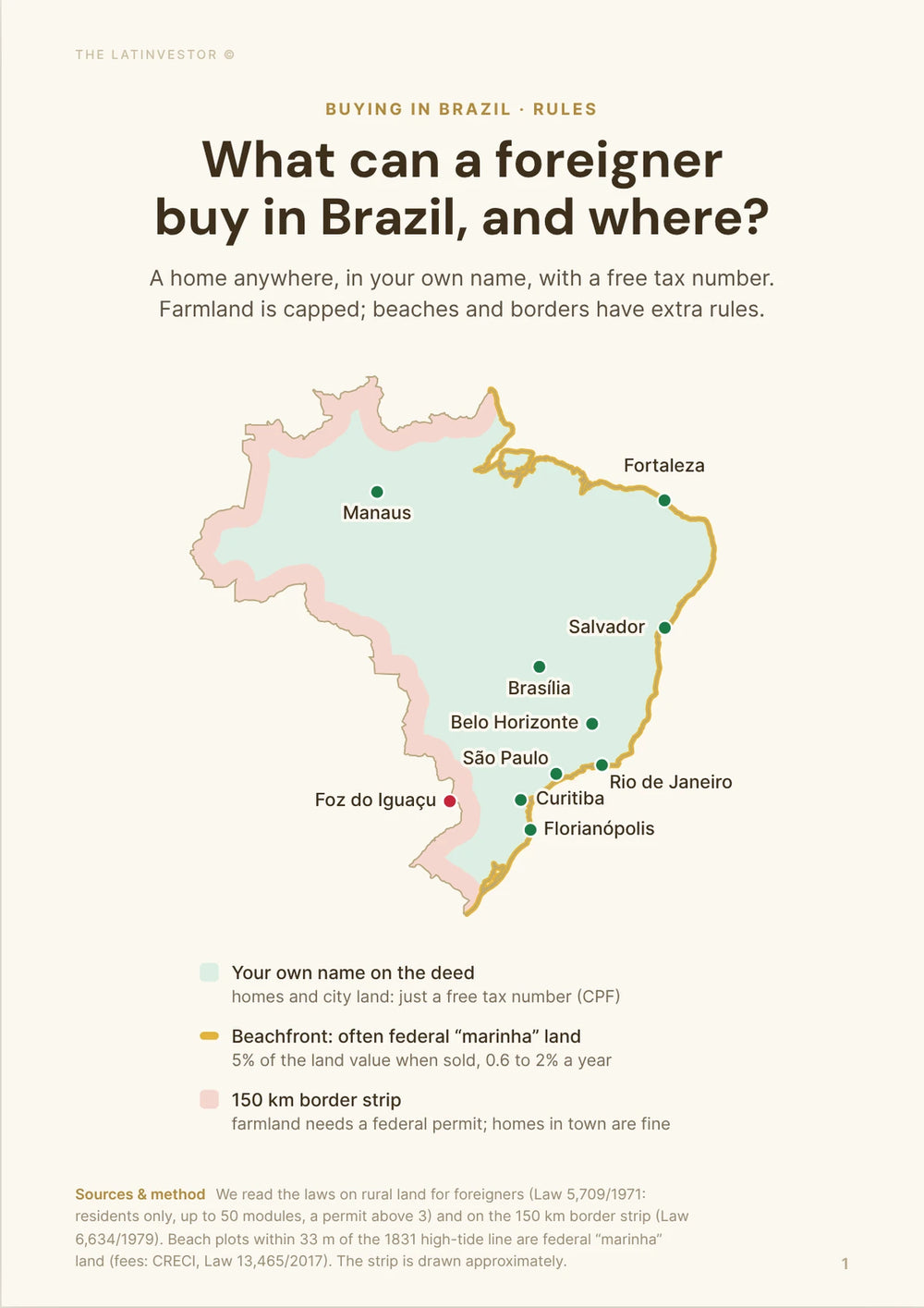
Supply is shrinking: Secovi Rio says homes offered for long-term rent fell 31.8% between 2023 and 2026, partly because owners moved to Airbnb, where AirROI counts 33,138 active listings, 50% more than a year earlier.
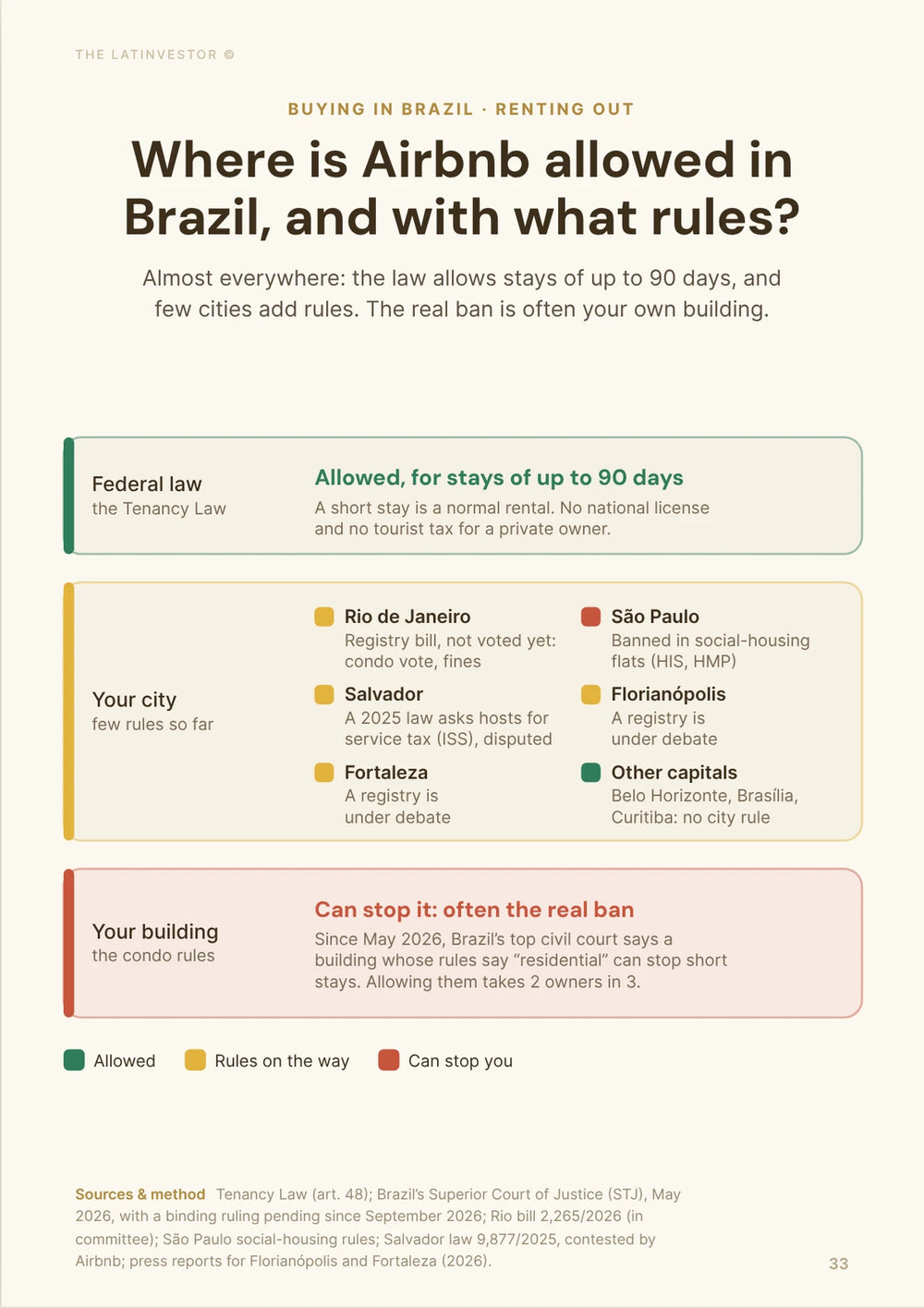
That shift is now riskier: since the STJ's May 2026 ruling, a building can require a two-thirds vote before a unit goes on Airbnb, and two city bills (PL 372/2025, approved in committee in December 2025, and PL 2.265/2026) still await a vote.
Tenants pay well: rent arrears in Rio state fell to 3.4% in June 2026, a record low, before edging up to 3.68% in July.
On a long lease, the tenant pays the condo fee (about R$620 a month on average in Rio) and usually the IPTU. You pay them only when the unit is empty or rented short-term.
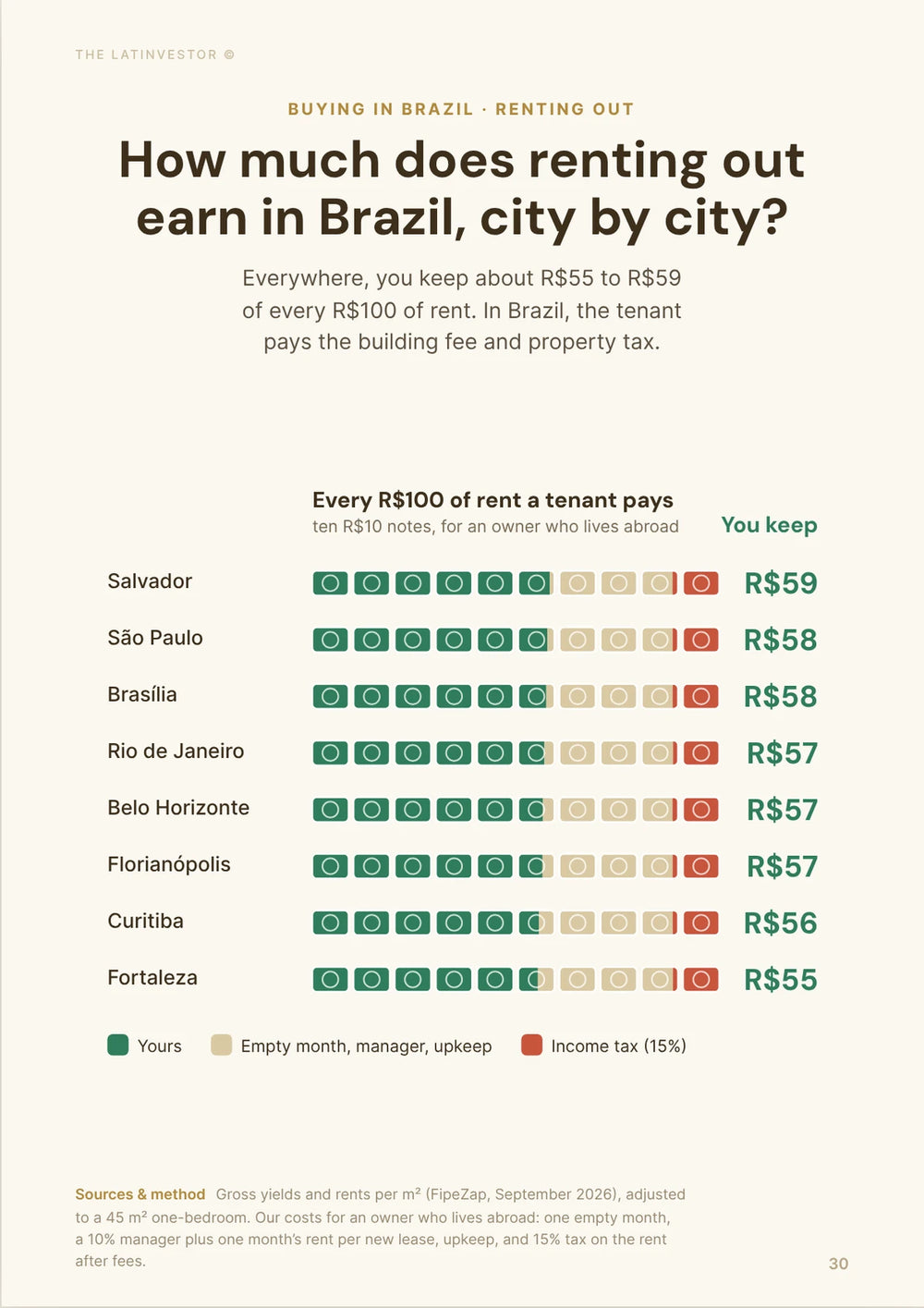
A non-resident landlord pays 15% on gross rent, withheld at source, so Rio's 6.3% gross yield becomes about 5.4% before other costs. Residents pay up to 27.5%.
Bottom line: rents are still rising, mostly in Zona Sul's middle tier and Centro. If you buy to rent, price on today's listings, but don't model 15% a year forever.


What does an apartment rent for in Rio today?
What's the average monthly rent for a studio in Rio de Janeiro?
About R$2,460 a month (USD 487, EUR 435) for a 30 m² studio, before condo fee and IPTU. That's our estimate: FipeZAP doesn't publish a Rio studio figure, so we applied Rio's average rent with the national premium for small units.
The neighborhood matters more than the size: a 25 to 35 m² studio asks about R$975 to R$1,365 in Tijuca, R$1,925 to R$2,695 in Copacabana or Botafogo, and R$2,950 to R$4,270 in Ipanema or Leblon.
Studios cost the most per m² when they're furnished, close to the beach or the metro, and in a building with a 24-hour doorman.
What's the average monthly rent for a 1-bedroom in Rio de Janeiro?
About R$3,690 a month (USD 731, EUR 653) for a 45 m² one-bed, before condo fee and IPTU, on the same basis as the studio estimate.
For a 35 to 50 m² one-bed, expect about R$1,365 to R$1,950 in Tijuca, R$2,700 to R$3,850 in Botafogo, Copacabana or Barra da Tijuca, and R$4,130 to R$6,100 in Ipanema and Leblon (USD 818 to USD 1,210).
The cheapest one-beds are in Tijuca, Méier and the rest of Zona Norte. The priciest are in Leblon, Ipanema, Lagoa and Jardim Botânico.
What's the average monthly rent for a 2-bedroom in Rio de Janeiro?
About R$3,770 a month (USD 747, EUR 667) for a 65 m² two-bed, barely more than a one-bed, because rent per m² falls as units get bigger.
Live listings in the popular areas ask more: in October 2026, the median two-bed asked R$5,500 in Botafogo, R$5,100 in Barra da Tijuca and R$3,450 in Recreio. With FipeZAP's rates, a 60 to 85 m² two-bed asks about R$2,340 to R$3,315 in Tijuca and R$4,620 to R$6,545 in Copacabana.
The cheapest two-beds are in Tijuca, Méier and Recreio. The most expensive are in Leblon, Ipanema, Lagoa and beachfront Copacabana.
What's the average rent per square meter in Rio de Janeiro?
R$61.86 per m² a month (about USD 12.20, EUR 10.90) in September 2026, the fourth highest among Brazilian state capitals after São Paulo, Recife and Belém.
Across the neighborhoods FipeZAP tracks, the range runs from R$39 per m² in Tijuca and R$43 in Recreio to R$122 in Leblon (USD 7.70 to USD 24.20).
Rio is cheaper than São Paulo on average (R$65.78 per m²), but Leblon and Ipanema are the most expensive neighborhoods FipeZAP tracks in Brazil, ahead of Pinheiros and Itaim Bibi.
Rent per m² goes up when the unit is small, renovated, furnished, near the beach or the metro, and in a secure building.
How much have rents changed in Rio over the past year?
Asking rents rose 14.8% in the 12 months to September 2026, against 4.58% for consumer prices (IPCA), 9.13% for rents across Brazil and 5.6% for Rio's apartment sale prices.
The drivers: expensive credit that keeps households renting, fewer apartments offered for long-term rent (down 31.8% since 2023, according to Secovi Rio) and a shift of units to short-term rentals in Zona Sul.
Rio is now one of the hottest rental markets in Brazil, behind only Niterói, Campinas, Fortaleza and Natal over the year. São Paulo rose 6.22%.
Will rents keep rising in Rio in 2026?
Yes, for the rest of the year. Rents were up 11.86% by September and gained 0.74% that month, so 2026 should end at around 13% to 15% (our estimate, extending the current monthly pace).
A lower Selic won't change that soon. The Copom cut it from 14% to 13.75% on September 16, 2026, and the market expects only 13.25% at the end of the year. The next meeting is on November 3 and 4.
The weak spots are visible: Recreio rose only 5% in a year, and Leblon (+10.7%) is rising more slowly than its neighbors. Rents can't outrun wages forever.
If you buy to rent, model 4% to 5% rent growth a year, close to inflation, and treat anything above as a bonus.
Why does my lease go up 3% when new rents in Rio rise 15%?
Because most leases are adjusted once a year by an index, usually the IGP-M or the IPCA, and the IGP-M rose only 3.34% in the 12 months to September 2026. New asking rents in Rio rose 14.8% over the same period.
The law doesn't set the index: it's whatever the lease says, and the rent can't be adjusted more than once a year. In Copacabana or Botafogo, where new rents jumped about 20%, a tenant who signed in 2025 can now be well below the market.
If you're a landlord: pick the IPCA rather than the IGP-M, which swings a lot, and plan to reprice when the lease ends. After three years, either side can ask a court to bring the rent back to market (ação revisional). If you're a tenant: check similar listings before renewing. If you're well below, offering a longer lease with a modest increase usually beats moving at today's prices.
The landlord can ask for only one guarantee: rental insurance (seguro-fiança), a guarantor, or a cash deposit capped at three months of rent.
Which neighborhoods cost the most, and where are rents jumping?
Which neighborhoods have the highest rents in Rio de Janeiro?
Leblon at R$122 per m², Ipanema at R$118 and Lagoa at R$91 (USD 24.20, USD 23.40 and USD 18 per m²). A 70 m² two-bed asks about R$8,540 in Leblon (USD 1,690, EUR 1,510) and R$8,260 in Ipanema.
These areas combine the beach or the lagoon, a feeling of safety, restaurants, walkability and almost no new supply.
Tenants there are high-income local households, executives, foreign tenants and families who put location ahead of space. If you're buying, we've also looked at the best areas to buy in Rio de Janeiro.
Where do young professionals prefer to rent in Rio de Janeiro right now?
Botafogo, Flamengo and Copacabana, with Laranjeiras, Catete and Tijuca close behind.
A 35 to 50 m² one-bed asks about R$2,555 to R$3,650 in Flamengo and R$2,700 to R$3,850 in Botafogo or Copacabana (USD 534 to USD 762). Laranjeiras is cheaper at R$63 per m², and Tijuca much cheaper at R$39.
They choose these areas for the metro, short commutes to Centro and Botafogo's offices, bars and gyms. That demand is why these three neighborhoods rose about 20% in a year.
Where do families prefer to rent in Rio de Janeiro right now?
Barra da Tijuca, Tijuca and Flamengo, with Recreio, Laranjeiras, Lagoa and Botafogo also popular.
A two-bed asks a median of R$5,100 in Barra (USD 1,010) and R$3,450 in Recreio. A 60 to 85 m² two-bed asks about R$2,340 to R$3,315 in Tijuca and R$4,380 to R$6,205 in Flamengo.
Families look for bigger apartments, parking, schools, supermarkets and buildings with leisure areas, which is what Barra and Recreio offer. Tijuca has the schools and the metro at a much lower price.
Where are rents rising fastest in Rio de Janeiro in 2026?
In the middle tier next to Leblon and Ipanema. Copacabana (+20.2%), Flamengo (+19.6%), Botafogo (+19.5%) and Lagoa (+18.2%) rose much faster than Leblon (+10.7%) in the year to September 2026. Tijuca, near the Saens Peña and Uruguai stations, gained 12.9%.
Centro is the surprise: QuintoAndar measured a 48.8% jump in a year to July 2026, and Secovi Rio 34.9%. It started from low rents, close to offices and the metro. Jardim Botânico, near PUC-Rio, rose 31.7% on Secovi Rio's count.
The far West Zone is the exception: Recreio rose only 5%.
Which neighborhoods are most popular with expats in Rio de Janeiro right now?
Ipanema, Leblon and Copacabana, then Botafogo, Flamengo, Lagoa, Jardim Botânico and Barra da Tijuca.
A 70 m² apartment asks R$8,260 to R$8,540 a month in Ipanema and Leblon, and about R$5,390 in Copacabana or Botafogo. Furnished units ask more.
Expats choose these areas for the beach, services, furnished stock and daily life without a car. You'll find Europeans, Americans, other Latin Americans and remote workers there. See also our guide for expats in Rio de Janeiro.
Is Airbnb pushing long-term rents up in Rio?
Partly. Homes offered for long-term rent fell 31.8% between 2023 and 2026 according to Secovi Rio, while AirROI counts 33,138 active Airbnb listings in Rio, 50% more than a year earlier. Secovi Rio's president points out that rents also rose in non-tourist areas like Méier and Tijuca, so a tight market and expensive credit matter as much.
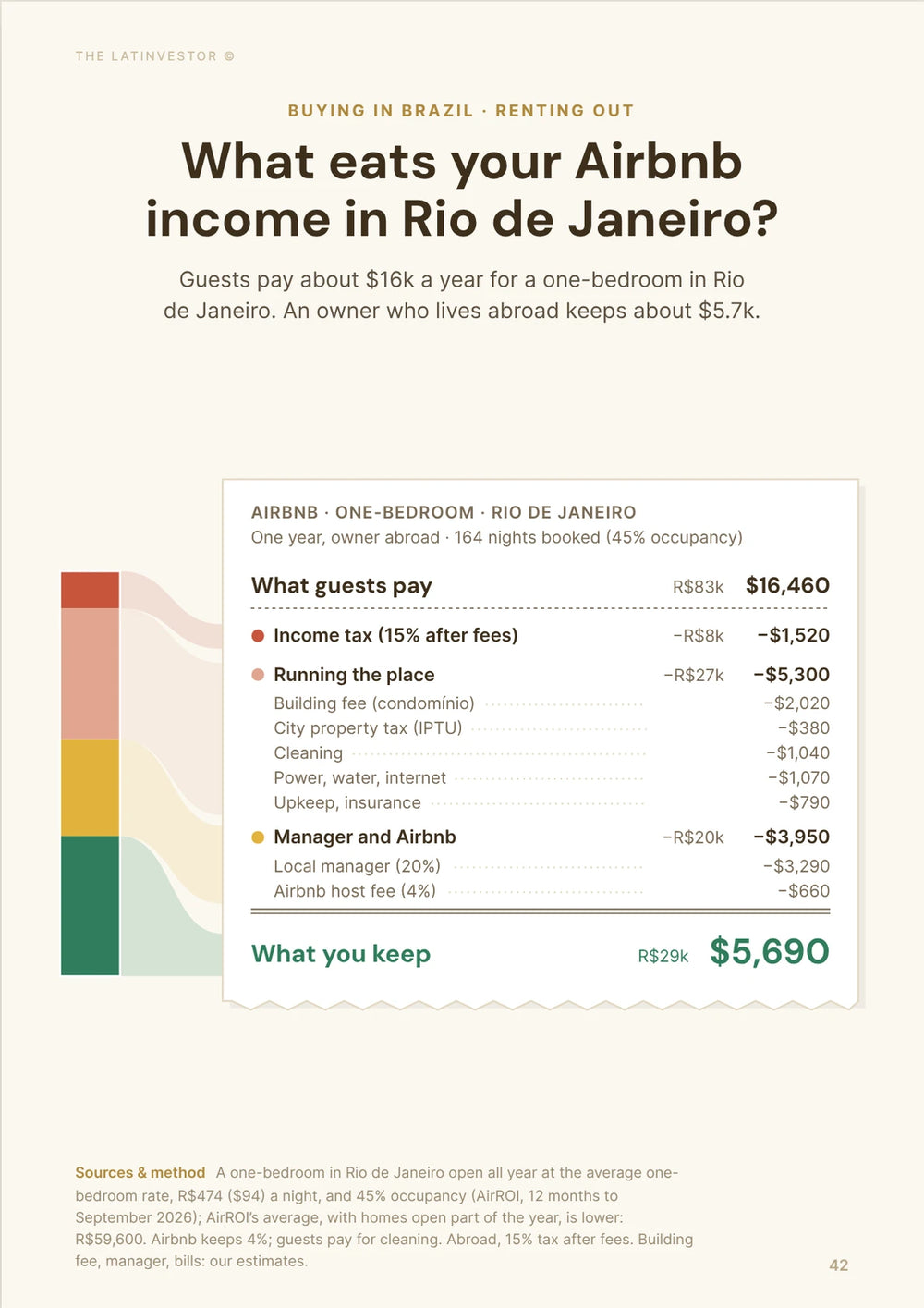
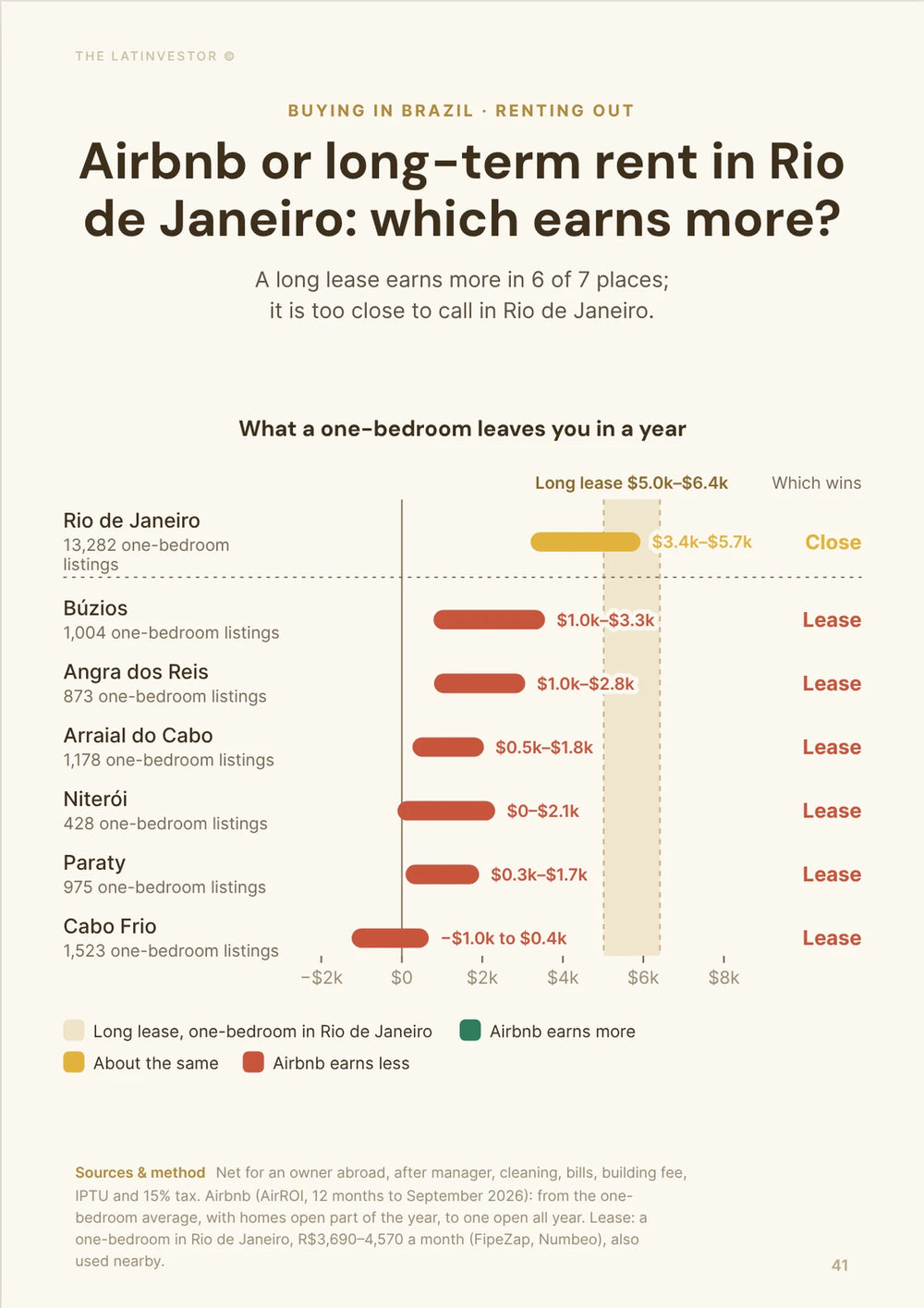
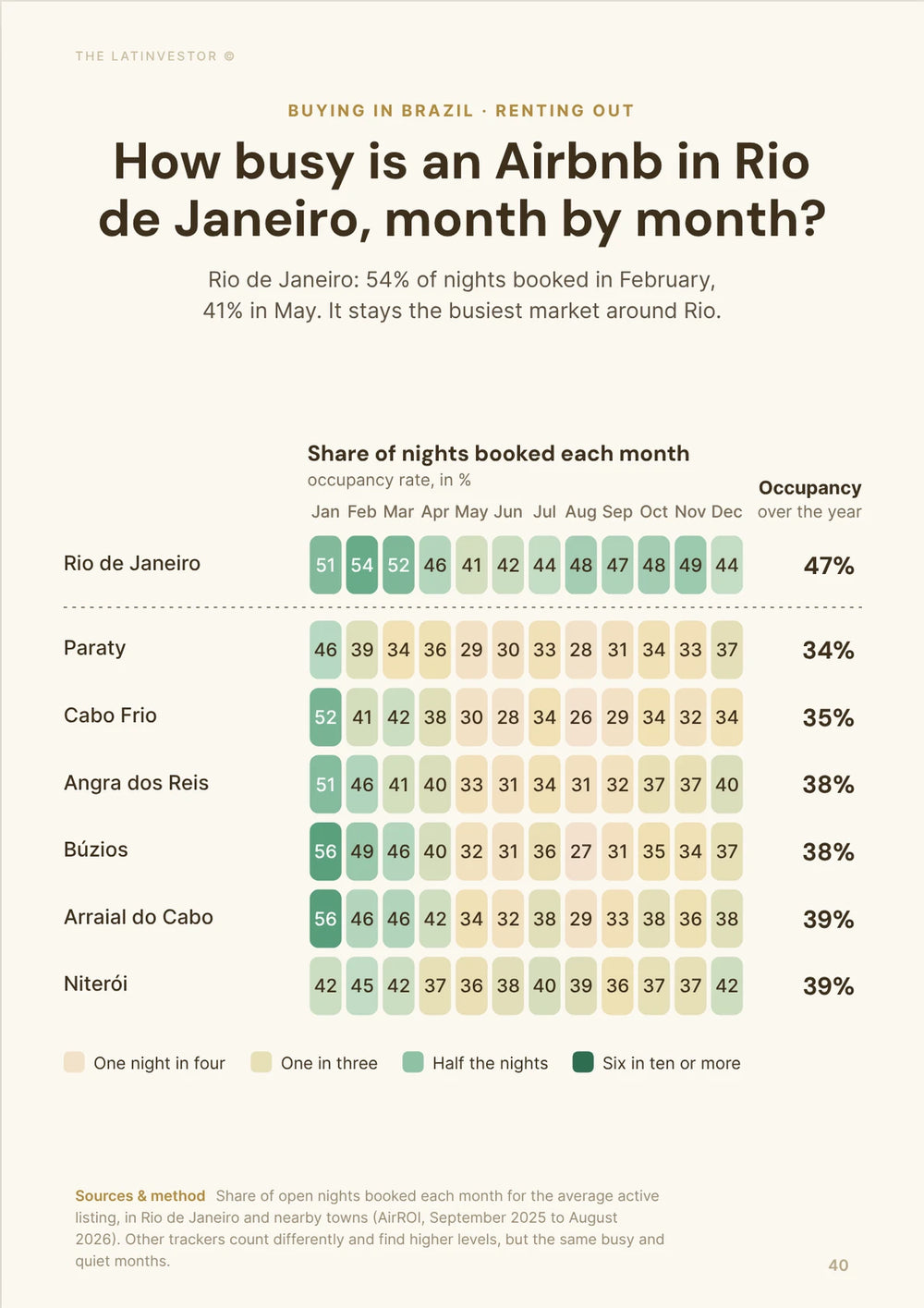
The money explains the shift. AirROI puts the average two-bed on Airbnb at R$87,100 a year in gross bookings (USD 17,200), with 43% occupancy. A 65 m² two-bed on a long lease at the city average brings about R$45,200 a year. But short-term income swings with the season and costs more to run: AirROI allows about 24% of bookings for running costs alone, and you pay the condo fee and IPTU yourself.
The rules are tightening. In May 2026, the STJ ruled that a residential building can require a two-thirds vote of owners before units are let through platforms. At city level, PL 372/2025 was approved in committee in December 2025 (3 votes to 1) but has not been voted on by the full council, and a newer bill, PL 2.265/2026 (May 2026), is still in committee; it would add rules on guest registration, taxation and building security. No city law is in force as of October 2026.
What to do: before buying for Airbnb, ask the building manager (síndico) for the convention and the latest assembly minutes, and check that short-term letting isn't banned or under a vote. If it's unclear, price the unit as a long-term rental: if the numbers only work on Airbnb, walk away. More detail in our guide on how to buy and rent out in Rio de Janeiro.
Who rents, and what do tenants want in Rio?
What tenant profiles dominate rentals in Rio de Janeiro?
Local professionals, families who can't afford to buy at a 13.75% Selic, and students or academic staff around PUC-Rio and UFRJ. Foreign tenants are a smaller but well-paying group in Zona Sul and Barra.
Professionals want studios and one-beds near the metro, families two- and three-beds with parking, and students small or shared units near a campus. There is no official breakdown of Rio's tenants by profile.
Do tenants prefer furnished or unfurnished in Rio de Janeiro?
Most long-term tenants, and nearly all families, rent unfurnished. Apartments usually come with built-in wardrobes and kitchen cabinets, but no furniture.
Furnished units rent faster to expats, remote workers, students and young professionals in Ipanema, Copacabana, Botafogo and Flamengo, and ask more. We found no reliable 2026 figure for the furnished premium in Rio, so compare similar listings in the same building.
Which amenities increase rent the most in Rio de Janeiro?
Air conditioning, a parking space, building security (24-hour doorman), an elevator and a renovated kitchen or bathroom.
In Rio's heat, air conditioning is close to essential. Parking matters most in Barra, Recreio and Tijuca, where families drive. In Zona Sul, the doorman and the building's condition count more than the space.
What renovations get the best ROI for rentals in Rio de Janeiro?
Split air conditioning, updated wiring (needed for the air conditioning in older buildings), a clean bathroom, a simple modern kitchen and fixing damp or mold.
Skip luxury finishes in mid-market areas: tenants in Tijuca, Méier, Centro or ordinary Barra buildings rarely pay enough extra to cover marble or designer furniture.
How fast do rentals find tenants in Rio?
What's the vacancy rate for rentals in Rio de Janeiro?
Rio has no official rental vacancy rate. The best signals point to a tight market: supply for long-term rent is down 31.8% since 2023, and asking rents rose 14.8% in a year.
Tenants are paying, too: rent arrears in Rio state hit a record low of 3.4% in June 2026 and stood at 3.68% in July, against 5.23% in October 2025. That's still above the national average (3.05%).
Budget about one empty month a year for a well-priced unit in Zona Sul or near the metro (our estimate), more for a large, older unit with a high condo fee.
How many days do rentals stay listed in Rio de Janeiro?
No source publishes a time-to-rent figure for Rio. From listing activity, a well-priced small unit near the beach or the metro often goes in two to four weeks (our estimate).
Overpriced large units, apartments with a high condo fee or in weak locations sit much longer. If yours hasn't rented within two months, the price is the problem, not the season.
Which months have peak tenant demand in Rio de Janeiro?
January to March, and to a lesser extent July and August.
Early in the year, job moves and the school year start drive demand. July and August bring mid-year moves and the second university semester.
The quieter months are usually May, June, October and November. A lease that ends in February or March re-lets faster than one ending mid-year.
What does a landlord actually pay in Rio?
What property taxes should landlords expect in Rio de Janeiro?
IPTU, the city property tax. It's based on the city's assessed value (valor venal), not the market price, so two similar apartments can get very different bills. For 2026, it was adjusted for inflation (IPCA-E), with a 7% discount for paying in one go in February.
Homes with an assessed value up to R$81,659 (USD 16,200) are exempt. On a long lease, the IPTU is normally passed to the tenant in the contract; you pay it when the unit is empty or rented short-term.
Before buying, ask for the latest IPTU bill (carnê) and a debt certificate: unpaid IPTU follows the property.
What costs do landlords pay in Rio de Janeiro?
On a long lease, the tenant pays electricity, gas, water, internet, the ordinary condo fee (by law) and usually the IPTU. You pay extraordinary condo charges (works, reserve fund), structural repairs and an administrator, typically around 8% to 10% of the rent.
When the unit is empty, everything is yours. Condo fees averaged about R$620 a month (USD 123, EUR 110) in Rio in 2026, and much more in Zona Sul buildings with a pool and 24-hour doorman.
Ask for the last 12 months of condo bills and any planned extraordinary calls (chamadas extras) before you buy. A high condo fee also makes the unit harder to rent, because tenants look at the total.
How is rental income taxed in Rio de Janeiro?
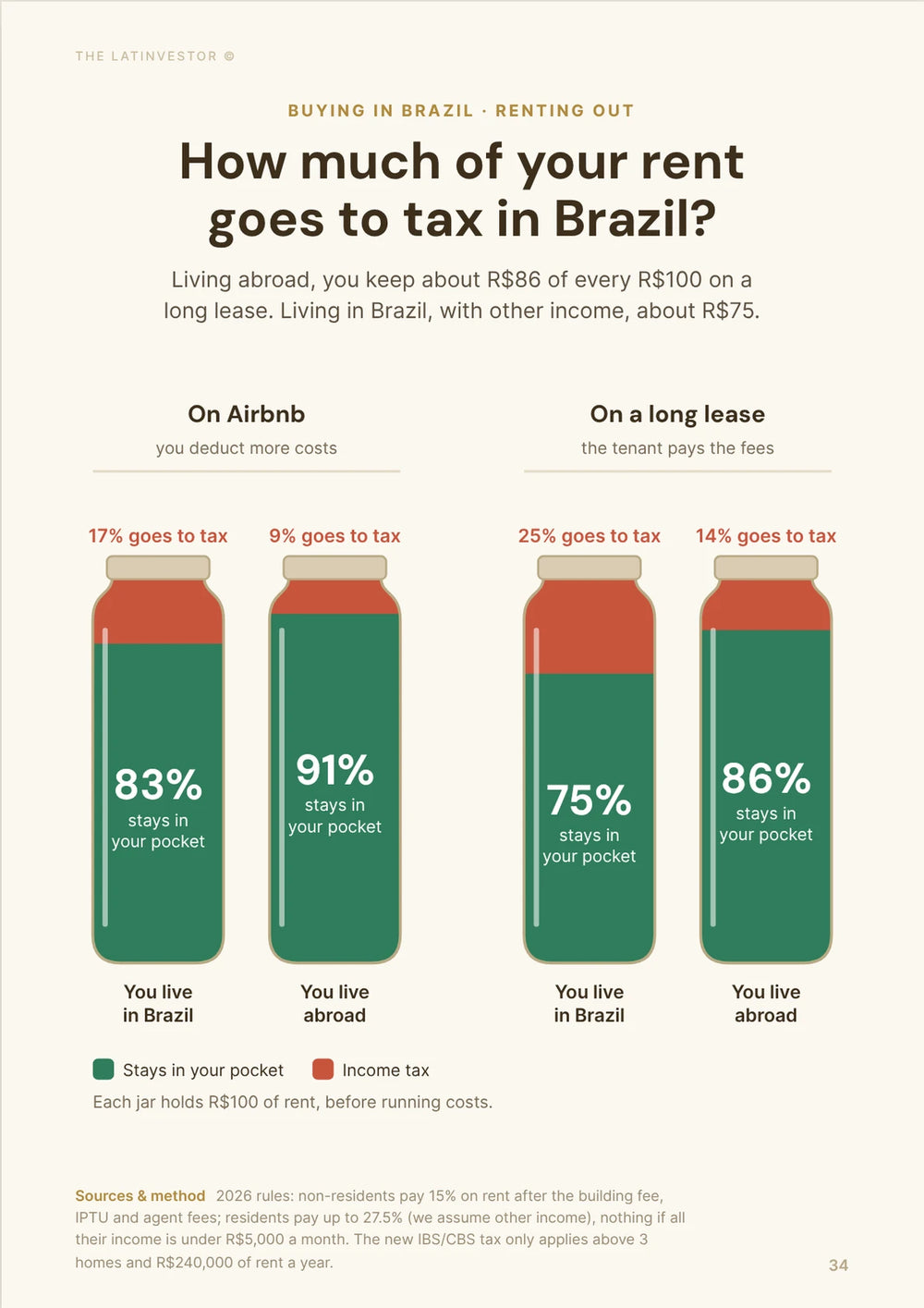
It's a federal tax, so it depends on where you live, not on the city. A non-resident pays 15% on the gross rent, withheld at source by the tenant or administrator, with no deductions. Rio's 6.3% gross yield becomes about 5.4% after that tax, before any other cost. A Brazilian tax resident pays monthly income tax (Carnê-Leão) at up to 27.5%.
The CBS/IBS tax reform, phased in from 2026, doesn't touch most small landlords: an individual only enters it with more than three rental properties and over R$240,000 (USD 47,500, EUR 42,500) of rent the year before.
Common mistakes: forgetting Carnê-Leão as a resident, not keeping withholding slips as a non-resident (you may credit them at home), and confusing the city's IPTU with federal income tax. More in our list of risks and pitfalls when buying property in Rio de Janeiro.
Our methodology
This article estimates what apartments rent for in Rio de Janeiro today, how fast rents are rising and where, and what a landlord really pays and keeps.
Rents come from FipeZAP's September 2026 rental report, which tracks asking rents on new listings, and from FipeZAP's neighborhood data. We turned rent per m² into monthly rents with standard sizes (30 m² studio, 45 m² one-bed, 65 m² two-bed), using the national gap between small and larger units because FipeZAP doesn't split Rio by bedrooms. We cross-checked with QuintoAndar and Secovi Rio figures, October 2026 listing medians, Superlógica's arrears index and AirROI for short-term rentals.
Rules come from official sources: the Lei do Inquilinato for leases and costs, the Receita Federal for rental tax, the Prefeitura do Rio for IPTU, the Banco Central do Brasil for the Selic and IBGE for inflation.
We checked these figures in October 2026. Conversions use about 5.05 reais per US dollar and 5.65 reais per euro.
Limits: FipeZAP shows asking rents for new leases, not what sitting tenants pay. QuintoAndar, Secovi Rio and FipeZAP use different samples, so their neighborhood growth rates differ. Size-based ranges, the year-end projection, vacancy and time to rent are our own estimates.
Key sources used for this analysis include FipeZAP rental report (September 2026), FipeZAP sales report (September 2026), Fipe, FipeZAP neighborhood data (Hasta), ADEMI-RJ on QuintoAndar rents, Secovi Rio via Portas, Diário do Rio on rent arrears, O Globo on Rio rents and PL 2.265/2026, AirROI, MatchLar, Portas on 2026 condo fees, Lei do Inquilinato, Receita Federal Carnê-Leão, Receita Federal 2026 tax tables, Prefeitura do Rio IPTU, Banco Central do Brasil Focus and IBGE IPCA.